EP0449049B1 - Naphthalenedicarboxylic acid esters - Google Patents
Naphthalenedicarboxylic acid esters Download PDFInfo
- Publication number
- EP0449049B1 EP0449049B1 EP91103983A EP91103983A EP0449049B1 EP 0449049 B1 EP0449049 B1 EP 0449049B1 EP 91103983 A EP91103983 A EP 91103983A EP 91103983 A EP91103983 A EP 91103983A EP 0449049 B1 EP0449049 B1 EP 0449049B1
- Authority
- EP
- European Patent Office
- Prior art keywords
- optically active
- compounds
- alkenyl
- formula
- alkyl
- Prior art date
- Legal status (The legal status is an assumption and is not a legal conclusion. Google has not performed a legal analysis and makes no representation as to the accuracy of the status listed.)
- Expired - Lifetime
Links
- 0 C*[C@](C)N*c1ccc(cc(*[C@@](C)N*C)cc2)c2c1 Chemical compound C*[C@](C)N*c1ccc(cc(*[C@@](C)N*C)cc2)c2c1 0.000 description 1
Classifications
-
- C—CHEMISTRY; METALLURGY
- C09—DYES; PAINTS; POLISHES; NATURAL RESINS; ADHESIVES; COMPOSITIONS NOT OTHERWISE PROVIDED FOR; APPLICATIONS OF MATERIALS NOT OTHERWISE PROVIDED FOR
- C09K—MATERIALS FOR MISCELLANEOUS APPLICATIONS, NOT PROVIDED FOR ELSEWHERE
- C09K19/00—Liquid crystal materials
- C09K19/52—Liquid crystal materials characterised by components which are not liquid crystals, e.g. additives with special physical aspect: solvents, solid particles
- C09K19/58—Dopants or charge transfer agents
- C09K19/586—Optically active dopants; chiral dopants
-
- C—CHEMISTRY; METALLURGY
- C07—ORGANIC CHEMISTRY
- C07C—ACYCLIC OR CARBOCYCLIC COMPOUNDS
- C07C69/00—Esters of carboxylic acids; Esters of carbonic or haloformic acids
- C07C69/76—Esters of carboxylic acids having a carboxyl group bound to a carbon atom of a six-membered aromatic ring
-
- C—CHEMISTRY; METALLURGY
- C09—DYES; PAINTS; POLISHES; NATURAL RESINS; ADHESIVES; COMPOSITIONS NOT OTHERWISE PROVIDED FOR; APPLICATIONS OF MATERIALS NOT OTHERWISE PROVIDED FOR
- C09K—MATERIALS FOR MISCELLANEOUS APPLICATIONS, NOT PROVIDED FOR ELSEWHERE
- C09K19/00—Liquid crystal materials
- C09K19/04—Liquid crystal materials characterised by the chemical structure of the liquid crystal components, e.g. by a specific unit
- C09K19/06—Non-steroidal liquid crystal compounds
- C09K19/32—Non-steroidal liquid crystal compounds containing condensed ring systems, i.e. fused, bridged or spiro ring systems
- C09K19/322—Compounds containing a naphthalene ring or a completely or partially hydrogenated naphthalene ring
-
- C—CHEMISTRY; METALLURGY
- C09—DYES; PAINTS; POLISHES; NATURAL RESINS; ADHESIVES; COMPOSITIONS NOT OTHERWISE PROVIDED FOR; APPLICATIONS OF MATERIALS NOT OTHERWISE PROVIDED FOR
- C09K—MATERIALS FOR MISCELLANEOUS APPLICATIONS, NOT PROVIDED FOR ELSEWHERE
- C09K19/00—Liquid crystal materials
- C09K19/04—Liquid crystal materials characterised by the chemical structure of the liquid crystal components, e.g. by a specific unit
- C09K19/42—Mixtures of liquid crystal compounds covered by two or more of the preceding groups C09K19/06 - C09K19/40
- C09K19/44—Mixtures of liquid crystal compounds covered by two or more of the preceding groups C09K19/06 - C09K19/40 containing compounds with benzene rings directly linked
Definitions
- the present invention relates to new chiral dopants for liquid crystals and their production and liquid-crystalline mixtures which contain such dopants and their use for optical and electro-optical purposes.
- Liquid crystal materials for electro-optical display devices often contain one or more optically active additives for inducing a chiral structure.
- a nematic liquid crystal is preferably doped with an optically active additive, for example in order to avoid a reversal of the twisting direction (reverse twist) in TN cells (twisted nematic) or to ensure adequate twisting in cells with high to achieve twisted nematic structure, such as STN cells (super twisted nematic), SBE cells (super birefringence effect) or OMI cells (optical mode interference).
- cholesteric liquid crystals for phase change cells can preferably consist of a nematic base material and one or more optically active dopants
- ferroelectric liquid crystals for display devices based on chirally tilted smectic phases can preferably consist of a material with tilted smectic phase and one or more optically active dopants.
- the electro-optical characteristics of liquid crystal display devices are temperature-dependent, which is particularly troublesome in multiplex operation.
- this temperature dependency can be at least partially compensated for by adding chiral dopant, which induces a pitch that decreases with increasing temperature.
- Such an inverse temperature dependency was found for only a few compounds.
- this usually requires a relatively high proportion of chiral dopants.
- Cholesteric liquid crystals reflect light in a wavelength range for which the wavelength is approximately equal to the helical pitch.
- the spectral width of this reflection light can be varied by a suitable choice of the liquid crystal.
- the reflected light is completely circularly polarized.
- the direction of rotation of the reflected light depends on the direction of rotation of the cholesteric helix structure.
- the opposite circularly polarized light is transmitted undiminished.
- Cholesteric liquid crystals for the above applications can preferably consist of a nematic or cholesteric base material and one or more chiral dopants, which allows easy adjustment of the desired helical pitch.
- the chiral dopants In order to achieve cholesteric mixtures with a pitch in the range of the wavelength of visible light, the chiral dopants should have the highest possible twisting power and be readily soluble in conventional liquid crystal materials. Furthermore, the chiral dopants should have sufficient stability, be well compatible with the mesophase type of the liquid crystal material and not restrict the mesophase range too much. Such properties would also be desirable for chiral dopants in order to achieve the twisted nematic structures mentioned at the beginning, since their proportion could be kept so low that the properties of the liquid crystal material are influenced only insignificantly.
- the invention relates to optically active naphthalene-2,6-dicarboxylic acid esters of the general formula wherein C * denotes a chiral carbon atom and R1 is C2-C12-alkyl, C2-C12-alkenyl, C2-C12-alkoxycarbonyl or C3-C12-alkenyloxycarbonyl.
- the compounds of the formula I are readily soluble in customary liquid crystal materials and enable the liquid crystal structure to be twisted to a high degree.
- the clearing points of liquid crystals are the addition of compounds Formula I usually not or only slightly reduced.
- the compounds of the formula I are easy to prepare, relatively low-viscosity and sufficiently stable against electrical and magnetic fields. They therefore optimally meet the above requirements.
- both chiral carbon atoms shown in formula I should have the R configuration or both the S configuration.
- R1 can be branched-chain and optionally chiral. In general, however, straight-chain R 1 radicals are preferred.
- C2-C12 alkyl includes residues such as ethyl, propyl, butyl, pentyl, hexyl, heptyl, octyl, nonyl, decyl and the like.
- C2-C12 alkenyl includes radicals such as vinyl, allyl, propenyl, butenyl, pentenyl, hexenyl, heptenyl, octenyl, nonenyl, decenyl and the like.
- C2-C12 alkoxycarbonyl includes radicals such as methoxycarbonyl, ethoxycarbonyl, propyloxycarbonyl, butyloxycarbonyl, pentyloxycarbonyl, hexyloxycarbonyl, heptyloxycarbonyl, octyloxycarbonyl and the like.
- C3-C12 alkenyloxycarbonyl includes radicals such as vinyloxycarbonyl, allyloxycarbonyl, propenyloxycarbonyl, butenyloxycarbonyl, pentenyloxycarbonyl, hexenyloxycarbonyl, heptenyloxycarbonyl, octenyloxycarbonyl, 2,6-dimethyl-5-hepten-1-yloxycarbonyl and the like.
- 2E-alkenyloxycarbonyl groups and alkenyloxycarbonyl groups with a terminal double bond are preferred.
- the compounds of the formula I can be prepared by naphthalene-2,6-dicarboxylic acid or a suitable derivative of naphthalene-2,6-dicarboxylic acid with an optically active compound of the general formula in which C * and R 1 have the meanings given above, esterified.
- Suitable derivatives of naphthalene-2,6-dicarboxylic acid are, for example, the acid halides, e.g. Naphthalene-2,6-dicarboxylic acid chloride.
- a preferred method is to react a naphthalene-2,6-dicarboxylic acid halide in an inert organic solvent (e.g. an aromatic or saturated, optionally chlorinated hydrocarbon such as benzene, toluene, hexane or carbon tetrachloride) in the presence of an acid binding agent (e.g. pyridine).
- an inert organic solvent e.g. an aromatic or saturated, optionally chlorinated hydrocarbon such as benzene, toluene, hexane or carbon tetrachloride
- an acid binding agent e.g. pyridine
- the starting materials are known or analogs of known compounds.
- the invention also relates to a liquid-crystalline mixture comprising a liquid-crystalline carrier material and one or more optically active compounds of the formula I.
- a liquid-crystalline carrier material comprising a liquid-crystalline carrier material and one or more optically active compounds of the formula I.
- all liquid-crystal materials which have a twistable liquid-crystal phase with an adequate mesophase range are suitable as carrier material exhibit.
- the compounds of the formula I are particularly suitable as chiral dopants for nematic or cholesteric carrier materials.
- the liquid-crystalline carrier material can be a single compound or a mixture and preferably has a clearing point of at least about 60 ° C.
- the proportion of chiral dopant of the formula I is essentially determined by its twisting power and the desired pitch.
- the proportion of chiral dopant can therefore vary within a wide range depending on the application and can be, for example, about 0.1-30% by weight.
- a pitch of about 3-40 ⁇ m is usually required and therefore a correspondingly small proportion is sufficient (usually about 0.1-1% by weight).
- pitches of less than 2 ⁇ m, for example about 0.4-0.6 ⁇ m are required for applications which are based on the reflection of visible light by cholesteric layers, which requires a correspondingly higher proportion of chiral dopant (usually about 2- 20% by weight).
- the chiral dopant content is usually about 0.3-3% by weight.
- Suitable liquid-crystalline carrier materials are known in large numbers and are commercially available. As a rule, liquid-crystalline mixtures containing 2 or more components are preferred as carrier materials. In principle, however, a liquid-crystalline compound can also be used as the carrier material if it has a sufficiently wide mesophase.
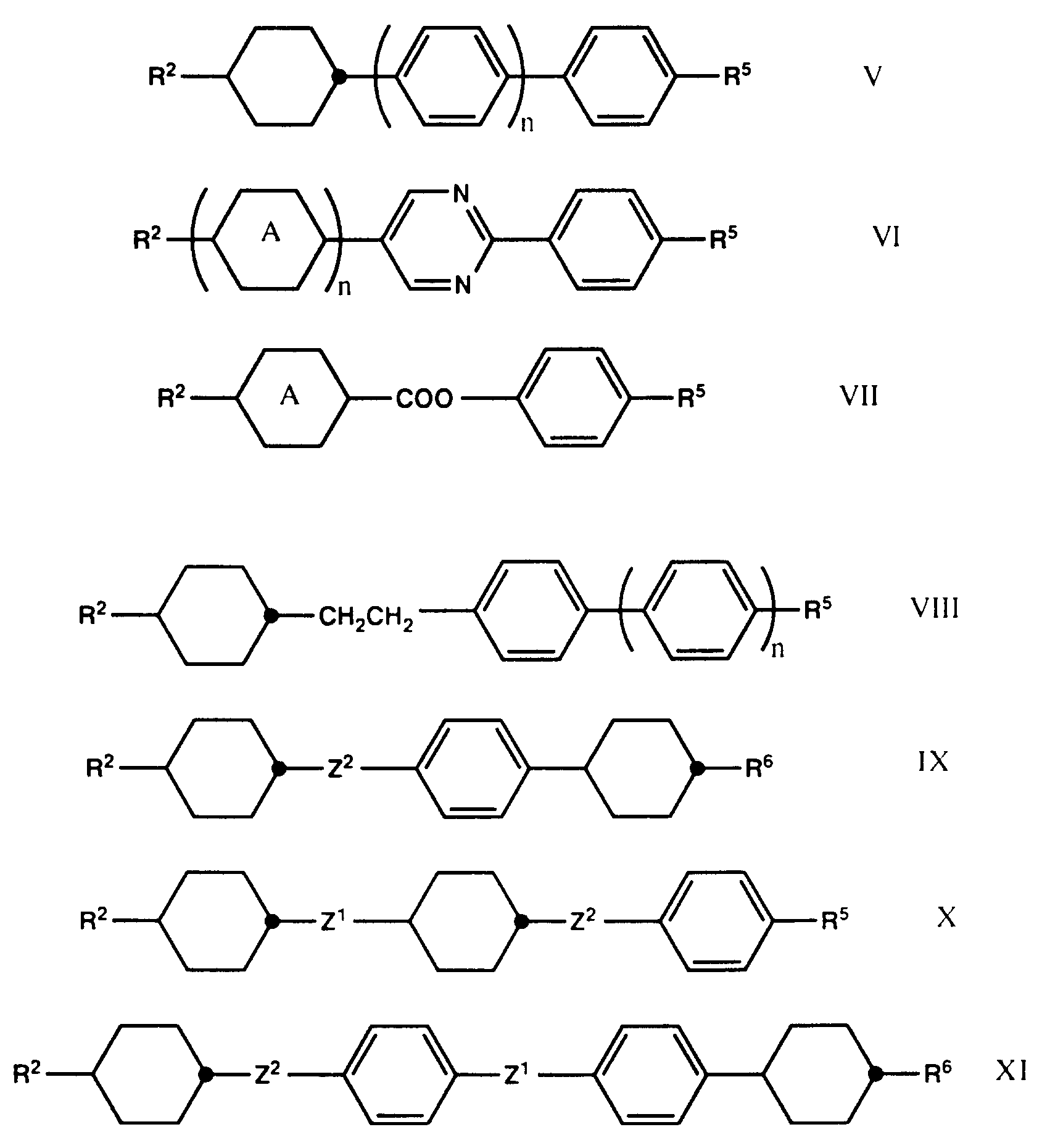
- R2 and R6 independently denote alkyl or alkenyl;
- R3 is cyano, alkyl, alkoxy, alkenyl, alkenyloxy, alkoxymethyl or alkenyloxymethyl;
- Z1 represents a simple covalent bond or -CH2CH2-;
- n represents the number 0 or 1;
- R4 denotes alkyl, alkoxy, alkenyl or alkenyloxy;
- R5 is cyano, alkyl, alkoxy, alkenyl or alkenyloxy;
- Ring A represents 1,4-phenylene or trans-1,4-cyclohexylene;
- Z2 denotes a simple covalent bond, -COO- or -CH2CH2-.
- Liquid-crystalline mixtures which contain one or more optically active compounds of the formula I and one or more compounds from the group of the compounds of the formulas III-XI are therefore particularly preferred.
- R2, R3, R4, R5 and R6 preferably have at most 12 carbon atoms, particularly preferably at most 7 carbon atoms.
- Preferred alkenyl groups are 1E-alkenyl, 3E-alkenyl and 4Z-alkenyl.
- Preferred alkenyloxy groups are 2E-alkenyloxy and 3Z-alkenyloxy.
- C means a crystalline phase
- N a nematic phase
- N * a cholesteric (chiral nematic) phase
- I the isotropic phase.
- the helical pitch is denoted by p and the wavelength of the selectively reflected, circularly polarized light by ⁇ max .
- Optical antipodes each have "mirror-image properties", ie the same melting points etc., but lead to the opposite direction of helix rotation and the opposite circular polarization of the reflected light.
- naphthalene-2,6-dicarboxylic acid chloride used as the starting material was prepared as follows: A mixture of 1 g of naphthalene-2,6-dicarboxylic acid and 100 ml of toluene was mixed with 2 ml of thionyl chloride under a nitrogen atmosphere and then heated under gentle reflux overnight. The reaction mixture was concentrated, then 50 ml of absolute toluene were added and the mixture was concentrated again. This procedure was repeated two more times. The solid residue was then sublimed in a Kugelrohr. This gave 0.8 g of naphthalene-2,6-dicarboxylic acid chloride.
Landscapes
- Chemical & Material Sciences (AREA)
- Organic Chemistry (AREA)
- Crystallography & Structural Chemistry (AREA)
- Engineering & Computer Science (AREA)
- Materials Engineering (AREA)
- Liquid Crystal Substances (AREA)
- Organic Low-Molecular-Weight Compounds And Preparation Thereof (AREA)
Description
Die vorliegende Erfindung betrifft neue chirale Dotierstoffe für Flüssigkristalle und deren Herstellung sowie flüssigkristalline Gemische, die solche Dotierstoffe enthalten, und deren Verwendung für optische und elektro-optische Zwecke.The present invention relates to new chiral dopants for liquid crystals and their production and liquid-crystalline mixtures which contain such dopants and their use for optical and electro-optical purposes.
Flüssigkristallmaterialien für elektro-optische Anzeigevorrichtungen enthalten häufig einen oder mehrere optisch aktive Zusatzstoffe zur Induzierung einer chiralen Struktur. Beispielsweise wird zur Verwendung in Anzeigevorrichtungen mit verdrillt nematischer Struktur bevorzugt ein nematischer Flüssigkristall mit optisch aktivem Zusatzstoff dotiert, z.B. um eine Umkehr der Verdrillungsrichtung (reverse twist) in TN-Zellen (twisted-nematic) zu vermeiden oder um eine ausreichende Verdrillung in Zellen mit hoch verdrillter nematischer Struktur, wie STN-Zellen (super twisted-nematic), SBE-Zellen (super birefringence effect) oder OMI-Zellen (optical mode interference) zu erreichen. Ferner können cholesterische Flüssigkristalle für Phase-Change-Zellen vorzugsweise aus einem nematischen Basismaterial und einem oder mehreren optisch aktiven Dotierstoffen bestehen und ferroelektrische Flüssigkristalle für Anzeigevorrichtungen auf der Basis von chiral getilteten smektischen Phasen können vorzugsweise aus einem Material mit getilteter smektischer Phase und einem oder mehreren optisch aktiven Dotierstoffen bestehen.Liquid crystal materials for electro-optical display devices often contain one or more optically active additives for inducing a chiral structure. For example, for use in display devices with a twisted nematic structure, a nematic liquid crystal is preferably doped with an optically active additive, for example in order to avoid a reversal of the twisting direction (reverse twist) in TN cells (twisted nematic) or to ensure adequate twisting in cells with high to achieve twisted nematic structure, such as STN cells (super twisted nematic), SBE cells (super birefringence effect) or OMI cells (optical mode interference). Furthermore, cholesteric liquid crystals for phase change cells can preferably consist of a nematic base material and one or more optically active dopants and ferroelectric liquid crystals for display devices based on chirally tilted smectic phases can preferably consist of a material with tilted smectic phase and one or more optically active dopants.
Die elektro-optischen Kennlinien von Flüssigkristall-Anzeigevorrichtungen sind temperaturabhängig, was insbesondere beim Multiplexbetrieb störend ist. Es ist jedoch bekannt, dass diese Temperaturabhängigkeit mindestens teilweise kompensiert werden kann durch Zusatz von chiralem Dotierstoff, welcher eine mit steigender Temperatur abnehmende Ganghöhe induziert. Eine solche inverse Temperaturabhängigkeit wurde nur für wenige Verbindungen gefunden. Sie kann aber auch durch Verwendung von mindestens 2 chiralen Dotierstoffen erreicht werden, welche eine unterschiedliche relative Temperaturabhängigkeit aufweisen und unterschiedliche Verdrillungsrichtung induzieren (DE-A-2827471). Allerdings erfordert dies meist einen relativ hohen Anteil an chiralen Dotierstoffen.The electro-optical characteristics of liquid crystal display devices are temperature-dependent, which is particularly troublesome in multiplex operation. However, it is known that this temperature dependency can be at least partially compensated for by adding chiral dopant, which induces a pitch that decreases with increasing temperature. Such an inverse temperature dependency was found for only a few compounds. However, it can also be achieved by using at least 2 chiral dopants which have a different relative temperature dependency and induce different twisting directions (DE-A-2827471). However, this usually requires a relatively high proportion of chiral dopants.
Cholesterische Flüssigkristalle reflektieren Licht in einem Wellenlängenbereich, für den die Wellenlänge etwa gleich der Helixganghöhe ist. Die spektrale Breite dieses Reflexionslichtes kann durch geeignete Wahl des Flüssigkristalles variiert werden. Das reflektierte Licht ist vollständig zirkular polarisiert. Die Drehrichtung des reflektierten Lichts hängt vom Drehsinn der cholesterischen Helixstruktur ab. Das entgegengesetzt zirkular polarisierte Licht wird ungeschwächt transmittiert. Diese Eigenschaften können zur Herstellung von optischen Filtern, Polarisatoren, Analysatoren etc. ausgenutzt werden. Ferner wurden cholesterische Flüssigkristalle auch verschiedentlich für thermochrome Anwendungen und in kosmetischen Präparaten verwendet.Cholesteric liquid crystals reflect light in a wavelength range for which the wavelength is approximately equal to the helical pitch. The spectral width of this reflection light can be varied by a suitable choice of the liquid crystal. The reflected light is completely circularly polarized. The direction of rotation of the reflected light depends on the direction of rotation of the cholesteric helix structure. The opposite circularly polarized light is transmitted undiminished. These properties can be used to manufacture optical filters, polarizers, analyzers etc. Furthermore, cholesteric liquid crystals have also been used variously for thermochromic applications and in cosmetic preparations.
Cholesterische Flüssigkristalle für obige Anwendungen können vorzugsweise aus einem nematischen oder cholesterischen Basismaterial und einem oder mehreren chiralen Dotierstoffen bestehen, was eine einfache Einstellung der gewünschten Helixganghöhe erlaubt.Cholesteric liquid crystals for the above applications can preferably consist of a nematic or cholesteric base material and one or more chiral dopants, which allows easy adjustment of the desired helical pitch.
Um cholesterische Gemische mit einer Ganghöhe im Bereich der Wellenlänge des sichtbaren Lichts zu erreichen, sollten die chiralen Dotierstoffe ein möglichst hohes Verdrillungsvermögen aufweisen und in üblichen Flüssigkristallmaterialien gut löslich sein. Weiterhin sollten die chiralen Dotierstoffe eine ausreichende Stabilität besitzen, mit dem Mesophasetyp des Flüssigkristallmaterials gut kompatibel sein und den Mesophasenbereich nicht zu stark einschränken. Solche Eigenschaften wären auch für chirale Dotierstoffe zur Erzielung der eingangs genannten, verdrillt nematischen Strukturen erwünscht, da ihr Anteil so niedrig gehalten werden könnte, dass die Eigenschaften des Flüssigkristallmaterials nur unwesentlich beeinflusst werden.In order to achieve cholesteric mixtures with a pitch in the range of the wavelength of visible light, the chiral dopants should have the highest possible twisting power and be readily soluble in conventional liquid crystal materials. Furthermore, the chiral dopants should have sufficient stability, be well compatible with the mesophase type of the liquid crystal material and not restrict the mesophase range too much. Such properties would also be desirable for chiral dopants in order to achieve the twisted nematic structures mentioned at the beginning, since their proportion could be kept so low that the properties of the liquid crystal material are influenced only insignificantly.
Die Erfindung betrifft optisch aktive Naphthalin-2,6-dicarbonsäureester der allgemeinen Formel

worin C* ein chirales Kohlenstoffatom bezeichnet und R¹ C₂-C₁₂-Alkyl, C₂-C₁₂-Alkenyl, C₂-C₁₂-Alkoxycarbonyl oder C₃-C₁₂-Alkenyloxycarbonyl bedeutet.The invention relates to optically active naphthalene-2,6-dicarboxylic acid esters of the general formula
wherein C * denotes a chiral carbon atom and R¹ is C₂-C₁₂-alkyl, C₂-C₁₂-alkenyl, C₂-C₁₂-alkoxycarbonyl or C₃-C₁₂-alkenyloxycarbonyl.
Die Verbindungen der Formel I sind gut löslich in üblichen Flüssigkristallmaterialien und ermöglichen eine hohe Verdrillung der Flüssigkristallstruktur. Die Klärpunkte von Flüssigkristallen werden bei Zusatz von Verbindungen der Formel I in der Regel nicht oder nur unwesentlich gesenkt. Die Verbindungen der Formel I sind leicht herstellbar, relativ niederviskos und ausreichend stabil gegen elektrische und magnetische Felder. Sie erfüllen daher in optimaler Weise die oben genannten Anforderungen.The compounds of the formula I are readily soluble in customary liquid crystal materials and enable the liquid crystal structure to be twisted to a high degree. The clearing points of liquid crystals are the addition of compounds Formula I usually not or only slightly reduced. The compounds of the formula I are easy to prepare, relatively low-viscosity and sufficiently stable against electrical and magnetic fields. They therefore optimally meet the above requirements.
Es versteht sich, dass zur Erzielung optischer Aktivität und eines hohen Verdrillungsvermögens beide in Formel I dargestellten chiralen Kohlenstoffatome R-Konfiguration oder beide S-Konfiguration aufweisen sollten.It is understood that, in order to achieve optical activity and a high twisting capacity, both chiral carbon atoms shown in formula I should have the R configuration or both the S configuration.
R¹ kann verzweigt-kettig und gegebenenfalls chiral sein. Im allgemeinen sind jedoch geradkettige Reste R¹ bevorzugt.R1 can be branched-chain and optionally chiral. In general, however, straight-chain R 1 radicals are preferred.
Der obige Ausdruck "C₂-C₁₂-Alkyl" umfasst Reste wie Aethyl, Propyl, Butyl, Pentyl, Hexyl, Heptyl, Octyl, Nonyl, Decyl und dergleichen.The above term "C₂-C₁₂ alkyl" includes residues such as ethyl, propyl, butyl, pentyl, hexyl, heptyl, octyl, nonyl, decyl and the like.
Der Ausdruck "C₂-C₁₂-Alkenyl" umfasst Reste wie Vinyl, Allyl, Propenyl, Butenyl, Pentenyl, Hexenyl, Heptenyl, Octenyl, Nonenyl, Decenyl und dergleichen.The term "C₂-C₁₂ alkenyl" includes radicals such as vinyl, allyl, propenyl, butenyl, pentenyl, hexenyl, heptenyl, octenyl, nonenyl, decenyl and the like.
Der Ausdruck "C₂-C₁₂-Alkoxycarbonyl" umfasst Reste wie Methoxycarbonyl, Aethoxycarbonyl, Propyloxycarbonyl, Butyloxycarbonyl, Pentyloxycarbonyl, Hexyloxycarbonyl, Heptyloxycarbonyl, Octyloxycarbonyl und dergleichen.The term "C₂-C₁₂ alkoxycarbonyl" includes radicals such as methoxycarbonyl, ethoxycarbonyl, propyloxycarbonyl, butyloxycarbonyl, pentyloxycarbonyl, hexyloxycarbonyl, heptyloxycarbonyl, octyloxycarbonyl and the like.
Der Ausdruck "C₃-C₁₂-Alkenyloxycarbonyl" umfasst Reste wie Vinyloxycarbonyl, Allyloxycarbonyl, Propenyloxycarbonyl, Butenyloxycarbonyl, Pentenyloxycarbonyl, Hexenyloxycarbonyl, Heptenyloxycarbonyl, Octenyloxycarbonyl, 2,6-Dimethyl-5-hepten-1-yloxycarbonyl und dergleichen. Bevorzugt sind im allgemeinen 2E-Alkenyloxycarbonylgruppen und Alkenyloxycarbonylgruppen mit endständiger Doppelbindung.The term "C₃-C₁₂ alkenyloxycarbonyl" includes radicals such as vinyloxycarbonyl, allyloxycarbonyl, propenyloxycarbonyl, butenyloxycarbonyl, pentenyloxycarbonyl, hexenyloxycarbonyl, heptenyloxycarbonyl, octenyloxycarbonyl, 2,6-dimethyl-5-hepten-1-yloxycarbonyl and the like. In general, 2E-alkenyloxycarbonyl groups and alkenyloxycarbonyl groups with a terminal double bond are preferred.
Besonders bevorzugt sind im allgemeinen diejenigen Verbindungen der Formel I, worin R¹ höchstens 7 Kohlenstoffatome aufweist.In general, particular preference is given to those compounds of the formula I in which R 1 has at most 7 carbon atoms.
Die Verbindungen der Formel I können erfindungsgemäss dadurch hergestellt werden, dass man Naphthalin-2,6-dicarbonsäure oder ein geeignetes Derivat der Naphthalin-2,6-dicarbonsäure mit einer optisch aktiven Verbindung der allgemeinen Formel

worin C* und R¹ die obigen Bedeutungen haben,
verestert.According to the invention, the compounds of the formula I can be prepared by naphthalene-2,6-dicarboxylic acid or a suitable derivative of naphthalene-2,6-dicarboxylic acid with an optically active compound of the general formula
in which C * and R 1 have the meanings given above,
esterified.
Die Veresterung kann in an sich bekannter Weise erfolgen. Geeignete Derivate der Naphthalin-2,6-dicarbonsäure sind beispielsweise die Säurehalogenide, z.B. Naphthalin-2,6-dicarbonsäurechlorid. Eine bevorzugte Methode ist die Umsetzung eines Naphthalin-2,6-dicarbonsäurehalogenids in einem inerten organischen Lösungsmittel (z.B. einem aromatischen oder gesättigten, gegebenenfalls chlorierten Kohlenwasserstoff, wie Benzol, Toluol, Hexan oder Tetrachlorkohlenstoff) in Gegenwart eines säurebindenden Mittels (z.B. Pyridin).The esterification can be carried out in a manner known per se. Suitable derivatives of naphthalene-2,6-dicarboxylic acid are, for example, the acid halides, e.g. Naphthalene-2,6-dicarboxylic acid chloride. A preferred method is to react a naphthalene-2,6-dicarboxylic acid halide in an inert organic solvent (e.g. an aromatic or saturated, optionally chlorinated hydrocarbon such as benzene, toluene, hexane or carbon tetrachloride) in the presence of an acid binding agent (e.g. pyridine).
Die Ausgangsmaterialien sind bekannte oder Analoge bekannter Verbindungen.The starting materials are known or analogs of known compounds.
Die Erfindung betrifft ebenfalls ein flüssigkristallines Gemisch enthaltend ein flüssigkristallines Trägermaterial und eine oder mehrere optisch aktive Verbindungen der Formel I. Als Trägermaterial eignen sich grundsätzlich alle Flüssigkristallmaterialien, welche eine verdrillbare Flüssigkristallphase mit einem adäquaten Mesophasenbereich aufweisen. Besonders geignet sind die Verbindungen der Formel I als chirale Dotierstoffe für nematische oder cholesterische Trägermaterialien. Das flüssigkristalline Trägermaterial kann eine Einzelverbindung oder ein Gemisch sein und besitzt vorzugsweise einen Klärpunkt von mindestens etwa 60°C.The invention also relates to a liquid-crystalline mixture comprising a liquid-crystalline carrier material and one or more optically active compounds of the formula I. In principle, all liquid-crystal materials which have a twistable liquid-crystal phase with an adequate mesophase range are suitable as carrier material exhibit. The compounds of the formula I are particularly suitable as chiral dopants for nematic or cholesteric carrier materials. The liquid-crystalline carrier material can be a single compound or a mixture and preferably has a clearing point of at least about 60 ° C.
Der Anteil an chiralem Dotierstoff der Formel I ist im wesentlichen durch dessen Verdrillungsvermögen und die gewünschte Ganghöhe bestimmt. Der Anteil an chiralem Dotierstoff kann daher je nach Anwendung in einem breiten Bereich variieren und beispielsweise etwa 0,1-30 Gew.% betragen. Für Anzeigevorrichtungen auf der Basis von Flüssigkristallen mit verdrillt nematischer Struktur ist je nach Zellentyp und -dicke meist eine Ganghöhe von etwa 3-40 µm erforderlich und daher ein entsprechend kleiner Anteil ausreichend (meist etwa 0,1-1 Gew.%). Demgegenüber werden für Anwendungen, welche auf der Reflexion von sichtbarem Licht durch cholesterische Schichten beruhen, Ganghöhen von weniger als 2 µm, beispielsweise etwa 0,4-0,6 µm benötigt, was einen entsprechend höheren Anteil an chiralem Dotierstoff erfordert (meist etwa 2-20 Gew.%). Für Zellen mit hochverdrillter nematischer Struktur beträgt der Anteil an chiralem Dotierstoff meist etwa 0,3-3 Gew.%.The proportion of chiral dopant of the formula I is essentially determined by its twisting power and the desired pitch. The proportion of chiral dopant can therefore vary within a wide range depending on the application and can be, for example, about 0.1-30% by weight. For display devices based on liquid crystals with a twisted nematic structure, depending on the cell type and thickness, a pitch of about 3-40 µm is usually required and therefore a correspondingly small proportion is sufficient (usually about 0.1-1% by weight). In contrast, pitches of less than 2 μm, for example about 0.4-0.6 μm, are required for applications which are based on the reflection of visible light by cholesteric layers, which requires a correspondingly higher proportion of chiral dopant (usually about 2- 20% by weight). For cells with a highly twisted nematic structure, the chiral dopant content is usually about 0.3-3% by weight.
Geeignete flüssigkristalline Trägermaterialien sind in grosser Zahl bekannt und im Handel erhältlich. In der Regel sind flüssigkristalline Gemische enthaltend 2 oder mehrere Komponenten als Trägermaterialien bevorzugt. Grundsätzlich kann aber auch eine flüssigkristalline Verbindung als Trägermaterial verwendet werden, wenn sie eine ausreichend breite Mesophase aufweist.Suitable liquid-crystalline carrier materials are known in large numbers and are commercially available. As a rule, liquid-crystalline mixtures containing 2 or more components are preferred as carrier materials. In principle, however, a liquid-crystalline compound can also be used as the carrier material if it has a sufficiently wide mesophase.
Als Komponenten für flüssigkristalline Trägermaterialien eignen sich insbesondere Verbindungen der folgendn allgemeinen Formeln


worin R² und R⁶ unabhängig voneinander Alkyl oder Alkenyl bezeichnen; R³ Cyano, Alkyl, Alkoxy, Alkenyl, Alkenyloxy, Alkoxymethyl oder Alkenyloxymethyl bedeutet; Z¹ eine einfache Kovalenzbindung oder -CH₂CH₂-darstellt; n für die Zahl 0 oder 1 steht; R⁴ Alkyl, Alkoxy, Alkenyl oder Alkenyloxy bezeichnet; R⁵ Cyano, Alkyl, Alkoxy, Alkenyl oder Alkenyloxy bedeutet; Ring A 1,4-Phenylen oder trans-1,4-Cyclohexylen darstellt; und Z² eine einfache Kovalenzbindung, -COO- oder -CH₂CH₂- bezeichnet.Compounds of the following general formulas are particularly suitable as components for liquid-crystalline support materials
wherein R² and R⁶ independently denote alkyl or alkenyl; R³ is cyano, alkyl, alkoxy, alkenyl, alkenyloxy, alkoxymethyl or alkenyloxymethyl; Z¹ represents a simple covalent bond or -CH₂CH₂-; n represents the number 0 or 1; R⁴ denotes alkyl, alkoxy, alkenyl or alkenyloxy; R⁵ is cyano, alkyl, alkoxy, alkenyl or alkenyloxy; Ring A represents 1,4-phenylene or trans-1,4-cyclohexylene; and Z² denotes a simple covalent bond, -COO- or -CH₂CH₂-.
Besonders bevorzugt sind daher flüssigkristalline Gemische, welche eine oder mehrere optisch aktive Verbindungen der Formel I und eine oder mehrere Verbindungen aus der Gruppe der Verbindungen der Formeln III-XI enthalten.Liquid-crystalline mixtures which contain one or more optically active compounds of the formula I and one or more compounds from the group of the compounds of the formulas III-XI are therefore particularly preferred.
R², R³, R⁴, R⁵ und R⁶ besitzen vorzugsweise höchstens je 12 Kohlenstoffatome, besonders bevorzugt höchstens je 7 Kohlenstoffatome. Bevorzugte Alkenylgruppen sind 1E-Alkenyl, 3E-Alkenyl und 4Z-Alkenyl. Bevorzugte Alkenyloxygruppen sind 2E-Alkenyloxy und 3Z-Alkenyloxy.R², R³, R⁴, R⁵ and R⁶ preferably have at most 12 carbon atoms, particularly preferably at most 7 carbon atoms. Preferred alkenyl groups are 1E-alkenyl, 3E-alkenyl and 4Z-alkenyl. Preferred alkenyloxy groups are 2E-alkenyloxy and 3Z-alkenyloxy.
Die Erfindung wird durch die folgenden Beispiele weiter veranschaulicht. Im Zusammenhang mit Flüssigkristallphasen und Phasenübergängen bedeuten C eine kristalline Phase, N eine nematische Phase, N* eine cholesterische (chiral nematische) Phase und I die isotrope Phase. Die Helixganghöhe wird mit p bezeichnet und die Wellenlänge des selektiv reflektierten, zirkular polarisierten Lichts mit λmax. Optische Antipoden besitzen jeweils "spiegelbildliche Eigenschaften", d.h. gleiche Schmelzpunkte etc., führen aber zu entgegengesetztem Helixdrehsinn und entgegengesetzter Zirkularpolarisation des reflektierten Lichts.The invention is further illustrated by the following examples. In connection with liquid crystal phases and phase transitions, C means a crystalline phase, N a nematic phase, N * a cholesteric (chiral nematic) phase and I the isotropic phase. The helical pitch is denoted by p and the wavelength of the selectively reflected, circularly polarized light by λ max . Optical antipodes each have "mirror-image properties", ie the same melting points etc., but lead to the opposite direction of helix rotation and the opposite circular polarization of the reflected light.
Ein Gemisch von 0,4 g Naphthalin-2,6-dicarbonsäurechlorid, 0,5 g S(+)-Milchsäure-butylester, 1 ml absolutem Pyridin und 50 ml absolutem Toluol wurde über Nacht unter leichtem Rückfluss und einer Stickstoffatmosphäre erwärmt. Danach wurde das Reaktionsgemisch nacheinander mit 500 ml Wasser, 100 ml verdünnter Salzsäure und nochmals mit 500 ml Wasser gewaschen, über Magnesiumsulfat getrocknet, filtriert und anschliessend eingeengt. Der Rückstand wurde an Kieselgel mit Toluol/Aethylacetat (Vol. 4:1) chromatographisch gereinigt. Umkristallisation aus Aethanol ergab 0,4 g Bis-[(S)-1-(butyloxycarbonyl)äthyl]-2,6-naphthalindicarboxylat mit Smp. (C-I) 81°C.A mixture of 0.4 g of naphthalene-2,6-dicarboxylic acid chloride, 0.5 g of S (+) - lactic acid butyl ester, 1 ml of absolute pyridine and 50 ml of absolute toluene was heated overnight under gentle reflux and under a nitrogen atmosphere. The reaction mixture was then washed successively with 500 ml of water, 100 ml of dilute hydrochloric acid and again with 500 ml of water, dried over magnesium sulfate, filtered and then concentrated. The residue was purified chromatographically on silica gel with toluene / ethyl acetate (vol. 4: 1). Recrystallization from ethanol gave 0.4 g of bis - [(S) -1- (butyloxycarbonyl) ethyl] -2,6-naphthalenedicarboxylate with mp (C-I) 81 ° C.
Das als Ausgangsmaterial verwendete Naphthalin-2,6-dicarbonsäurechlorid wurde wie folgt hergestellt:
Ein Gemisch aus 1 g Naphthalin-2,6-dicarbonsäure und 100 ml Toluol wurde unter einer Stickstoffatmosphäre mit 2 ml Thionylchlorid versetzt und anschliessend über Nacht unter leichtem Rückfluss erwärmt. Das Reaktionsgemisch wurde eingeengt, dann mit 50 ml absolutem Toluol versetzt und nochmals eingeengt. Diese Prozedur wurde noch zweimal wiederholt. Anschliessend wurde der feste Rückstand in einem Kugelrohr sublimiert. Dies ergab 0,8 g Naphthalin-2,6-dicarbonsäurechlorid.The naphthalene-2,6-dicarboxylic acid chloride used as the starting material was prepared as follows:
A mixture of 1 g of naphthalene-2,6-dicarboxylic acid and 100 ml of toluene was mixed with 2 ml of thionyl chloride under a nitrogen atmosphere and then heated under gentle reflux overnight. The reaction mixture was concentrated, then 50 ml of absolute toluene were added and the mixture was concentrated again. This procedure was repeated two more times. The solid residue was then sublimed in a Kugelrohr. This gave 0.8 g of naphthalene-2,6-dicarboxylic acid chloride.
In analoger Weise können folgende Verbindungen hergestellt werden:
Bis-[(S)-1-(methoxycarbonyl)äthyl]-2,6-naphthalindicarboxylat, Smp. (C-I) 120°C;
Bis-[(S)-1-(äthoxycarbonyl)äthyl]-2,6-naphthalindicarboxylat, Smp. (C-I) 74°C;
Bis-[(S)-1-(propyloxycarbonyl)äthyl]-2,6-naphthalindicarboxylat, Smp. (C-I) 121°C;
Bis-[(S)-1-(pentyloxycarbonyl)äthyl]-2,6-naphthalindicarboxylat;
Bis-[(S)-1-(hexyloxycarbonyl)äthyl]-2,6-naphthalindicarboxylat;
Bis-[(S)-1-(2E-hexenyloxycarbonyl)äthyl]-2,6-naphthalindicarboxylat, Smp. (C-I) 70°C;
Bis-[(R)-2-pentyl]-2,6-naphthalindicarboxylat, Smp. (C-I) 76°C;
Bis-[(R)-2-hexyl]-2,6-naphthalindicarboxylat, Smp. (C-I) 53°C;
Bis-[(R)-2-heptyl]-2,6-naphthalindicarboxylat;
Bis-[(R)-2-octyl]-2,6-naphthalindicarboxylat, Smp. (C-I) 4°C;
Bis-[(R)-2-nonyl]-2,6-naphthalindicarboxylat.The following connections can be made in an analogous manner:
Bis - [(S) -1- (methoxycarbonyl) ethyl] -2,6-naphthalenedicarboxylate, mp (CI) 120 ° C;
Bis - [(S) -1- (ethoxycarbonyl) ethyl] -2,6-naphthalenedicarboxylate, mp (CI) 74 ° C;
Bis - [(S) -1- (propyloxycarbonyl) ethyl] -2,6-naphthalenedicarboxylate, mp (CI) 121 ° C;
Bis - [(S) -1- (pentyloxycarbonyl) ethyl] -2,6-naphthalenedicarboxylate;
Bis - [(S) -1- (hexyloxycarbonyl) ethyl] -2,6-naphthalenedicarboxylate;
Bis - [(S) -1- (2E-hexenyloxycarbonyl) ethyl] -2,6-naphthalenedicarboxylate, m.p. (CI) 70 ° C;
Bis - [(R) -2-pentyl] -2,6-naphthalenedicarboxylate, m.p. (CI) 76 ° C;
Bis - [(R) -2-hexyl] -2,6-naphthalenedicarboxylate, m.p. (CI) 53 ° C;
Bis - [(R) -2-heptyl] -2,6-naphthalenedicarboxylate;
Bis - [(R) -2-octyl] -2,6-naphthalenedicarboxylate, m.p. (CI) 4 ° C;
Bis - [(R) -2-nonyl] -2,6-naphthalenedicarboxylate.
Zur Messung der induzierten Ganghöhe (Pitch) und deren Temperaturabhängigkeit in Flüssigkristallmaterialien wurde die folgende Flüssigkristall-Grundmischung BM-1 verwendet:


Smp. <-30°C, Klp. (N-I) 90°C; Δε = 8,5, Δn = 0,139 und η = 22 mPa·s gemessen bei 22°C.The following basic BM-1 liquid crystal mixture was used to measure the induced pitch and its temperature dependence in liquid crystal materials:
Mp <-30 ° C, clp. (NI) 90 ° C; Δε = 8.5, Δn = 0.139 and η = 22 mPas measured at 22 ° C.
Das Verdrillungsvermögen des optisch aktiven Dotierstoffes und dessen Temperaturabhängigkeit wird charakterisiert durch die Parameter A, B und C entsprechend der Reihenentwicklung.
worin und p, c und T₁ die folgenden Bedeutungen haben:
- T₁
- = T-22°C
- T
- = Temperatur in °C
- p
- = Ganghöhe in µm (ein positiver Wert bedeutet rechtsdrehende Helixstruktur und ein negativer Wert bedeutet linksdrehende Helixstruktur)
- c
- = Konzentration des optisch aktiven Dotierstoffes in Gew.-%.
wherein and p, c and T₁ have the following meanings:
- T₁
- = T-22 ° C
- T
- = Temperature in ° C
- p
- = Pitch in µm (a positive value means clockwise helix structure and a negative value means counterclockwise helix structure)
- c
- = Concentration of the optically active dopant in% by weight.
99 Gew.-% BM-1,
1 Gew.-% Bis-[(S)-1-(butyloxycarbonyl)äthyl]-2,6-naphthalindicarboxylat;
Klp. (N*-I) 86,7°C; p (22°C) = -5,4 µm;
A = -0,1863·µm⁻¹·Gew.-%⁻¹,
B = 3,605·10⁻⁴·µm⁻¹·Gew.-%⁻¹·°C⁻¹,
C = 2,838·10⁻⁶·µm⁻¹·Gew.-%⁻¹·°C⁻².99% by weight of BM-1,
1% by weight bis - [(S) -1- (butyloxycarbonyl) ethyl] -2,6-naphthalenedicarboxylate;
Klp. (N * -I) 86.7 ° C; p (22 ° C) = -5.4 µm;
A = -0.1863 · µm⁻¹ · wt% ⁻¹,
B = 3.605 · 10⁻⁴ · µm⁻¹ · wt .-% ⁻¹ · ° C⁻¹,
C = 2.838 · 10⁻⁶ · µm⁻¹ · wt% ⁻¹ · ° C⁻².
99 Gew.-% BM-1,
1 Gew.-% Bis-[(S)-1-(äthoxycarbonyl)äthyl]-2,6-naphthalindicarboxylat;
Klp. (N*-I) 90°C; p (22°C) = -4,7 µm;
A = -0,2133·µm⁻¹·Gew.-%⁻¹,
B = 4,503·10⁻⁴·µm⁻¹·Gew.-%⁻¹·°C⁻¹,
C = 2,416·10⁻⁶·µm⁻¹·Gew.-%⁻¹·°C⁻².99% by weight of BM-1,
1% by weight bis - [(S) -1- (ethoxycarbonyl) ethyl] -2,6-naphthalenedicarboxylate;
Klp. (N * -I) 90 ° C; p (22 ° C) = -4.7 µm;
A = -0.2133 · µm⁻¹ · wt% ⁻¹,
B = 4.503 · 10⁻⁴ · µm⁻¹ · wt .-% ⁻¹ · ° C⁻¹,
C = 2.416 · 10⁻⁶ · µm⁻¹ · wt% ⁻¹ · ° C⁻².
99 Gew.-% BM-1,
1 Gew.-% Bis-[(R)-2-pentyl]-2,6-naphthalindicarboxylat;
Klp. (N*-I) 89,7°C; p (22°C) = +24,8 µm;
A = 0,04039·µm⁻¹·Gew.-%⁻¹,
B = -0,341·10⁻⁴·µm⁻¹·Gew.-%⁻¹·°C⁻¹,
C = -1,156·10⁻⁶·µm⁻¹·Gew.-%⁻¹·°C⁻².99% by weight of BM-1,
1 wt% bis - [(R) -2-pentyl] -2,6-naphthalenedicarboxylate;
Klp. (N * -I) 89.7 ° C; p (22 ° C) = +24.8 µm;
A = 0.04039 · µm⁻¹ · wt% ⁻¹,
B = -0.341 · 10⁻⁴ · µm⁻¹ · wt .-% ⁻¹ · ° C⁻¹,
C = -1.156 · 10⁻⁶ · µm⁻¹ · wt% ⁻¹ · ° C⁻².
99 Gew.-% BM-1,
1 Gew.-% Bis-[(R)-2-hexyl]-2,6-naphthalindicarboxylat;
Klp. (N*-I) 89,8°C; p (22°C) = +11,7 µm;
A = 0,0853·µm⁻¹·Gew.-%⁻¹,
B = -2,711·10⁻⁴·µm⁻¹·Gew.-%⁻¹·°C⁻¹,
C = -1,710·10⁻⁶·µm⁻¹·Gew.-%⁻¹·°C⁻².99% by weight of BM-1,
1% by weight bis - [(R) -2-hexyl] -2,6-naphthalenedicarboxylate;
Klp. (N * -I) 89.8 ° C; p (22 ° C) = +11.7 µm;
A = 0.0853 · µm⁻¹ · wt% ⁻¹,
B = -2.711 · 10⁻⁴ · µm⁻¹ · wt .-% ⁻¹ · ° C⁻¹,
C = -1.710 · 10⁻⁶ · µm⁻¹ · wt% ⁻¹ · ° C⁻².
99 Gew.-% BM-1,
1 Gew.-% Bis-[(R)-2-octyl]-2,6-naphthalindicarboxylat;
Klp. (N*-I) 88,6°C; p (22°C) = +9,4 µm;
A = 0,1059·µm⁻¹·Gew.-%⁻¹,
B = -4,245·10⁻⁴·µm⁻¹·Gew.-%⁻¹·°C⁻¹,
C = -3,163·10⁻⁶·µm⁻¹·Gew.-%⁻¹·°C⁻².99% by weight of BM-1,
1% by weight bis - [(R) -2-octyl] -2,6-naphthalenedicarboxylate;
Klp. (N * -I) 88.6 ° C; p (22 ° C) = +9.4 µm;
A = 0.1059 · µm⁻¹ · wt% ⁻¹,
B = -4.245 · 10⁻⁴ · µm⁻¹ · wt .-% ⁻¹ · ° C⁻¹,
C = -3.163 · 10⁻⁶ · µm⁻¹ · wt .-% ⁻¹ · ° C⁻².
Claims (8)
- Optically active naphthalene-2,6-dicarboxylic acid esters of the general formula

- Compounds according to claim 1, characterized in that R¹ signifies a straight-chain residue.
- Compounds according to claim 1 or 2, characterized in that R¹ signifies a residue having a maximum of 7 carbon atoms.
- A liquid crystalline mixture containing a liquid crystalline carrier material and one or more optically active compounds of formula I defined in claim 1.
- A liquid crystalline mixture according to claim 4, characterized in that the content of optically active compounds of formula I is 0.1-30 wt.%.
- A liquid crystalline mixture according to claim 4 or 5, characterized in that it contains one or more optically active compounds of formula I and one or more compounds from the group of compounds of the general formulae

- A process for the manufacture of the optically active naphthalene-2,6-dicarboxylic acid esters of formula I defined in claim 1, characterized by esterifying naphthalene-2,6-dicarboxylic acid or a suitable derivative of naphthalene-2,6-dicarboxylic acid with an optically active compound of the general formula

- The use of liquid crystalline mixtures in accordance with claim 4 for optical or electro-optical purposes.
Applications Claiming Priority (2)
| Application Number | Priority Date | Filing Date | Title |
|---|---|---|---|
| CH100990 | 1990-03-27 | ||
| CH1009/90 | 1990-03-27 |
Publications (3)
| Publication Number | Publication Date |
|---|---|
| EP0449049A2 EP0449049A2 (en) | 1991-10-02 |
| EP0449049A3 EP0449049A3 (en) | 1993-01-20 |
| EP0449049B1 true EP0449049B1 (en) | 1994-12-28 |
Family
ID=4200322
Family Applications (1)
| Application Number | Title | Priority Date | Filing Date |
|---|---|---|---|
| EP91103983A Expired - Lifetime EP0449049B1 (en) | 1990-03-27 | 1991-03-15 | Naphthalenedicarboxylic acid esters |
Country Status (6)
| Country | Link |
|---|---|
| US (1) | US5230828A (en) |
| EP (1) | EP0449049B1 (en) |
| JP (1) | JP2944244B2 (en) |
| KR (1) | KR100192730B1 (en) |
| DE (1) | DE59104009D1 (en) |
| HK (1) | HK49697A (en) |
Families Citing this family (6)
| Publication number | Priority date | Publication date | Assignee | Title |
|---|---|---|---|---|
| EP0731084B1 (en) * | 1995-03-03 | 2002-09-25 | Rolic AG | Photocrosslinkable naphthyl derivatives |
| KR20020079442A (en) * | 2001-04-13 | 2002-10-19 | 미츠비시 가스 가가쿠 가부시키가이샤 | Optically active compound and liquid crystal composition containing the compound |
| JP2003012610A (en) | 2001-06-26 | 2003-01-15 | Mitsubishi Gas Chem Co Inc | Optically active compound and liquid crystal composition containing the same |
| JP4696549B2 (en) * | 2004-10-29 | 2011-06-08 | Dic株式会社 | Trifluoronaphthalene derivative |
| WO2008077261A1 (en) * | 2006-12-22 | 2008-07-03 | Rolic Ag | Patternable liquid crystal polymer comprising thio-ether units |
| CN108717239B (en) * | 2017-11-20 | 2021-02-19 | 山东蓝贝易书信息科技有限公司 | Easy thermal erasing type liquid crystal film writing board and preparation method |
Family Cites Families (6)
| Publication number | Priority date | Publication date | Assignee | Title |
|---|---|---|---|---|
| GB1603075A (en) * | 1977-10-24 | 1981-11-18 | Secr Defence | Liquid crystal esters containing naphthyl groups |
| GB8520715D0 (en) * | 1985-08-19 | 1985-09-25 | Secr Defence | Secondary alcohol derivatives |
| DE3534778A1 (en) * | 1985-09-30 | 1987-04-02 | Hoechst Ag | CHIRAL ESTER OF MESOGENIC CARBONIC ACIDS, A METHOD FOR THE PRODUCTION THEREOF AND THEIR USE AS A DOPER IN LIQUID CRYSTAL PHASES |
| EP0257048B1 (en) * | 1986-02-17 | 1994-08-24 | MERCK PATENT GmbH | Optically active compounds |
| GB8610349D0 (en) * | 1986-04-28 | 1986-06-04 | Bdh Ltd | 6-hydroxy-2-naphthoic acid derivatives |
| JPH02209990A (en) * | 1989-02-10 | 1990-08-21 | Dainippon Ink & Chem Inc | Ferroelectric liquid crystal composition |
-
1991
- 1991-03-15 EP EP91103983A patent/EP0449049B1/en not_active Expired - Lifetime
- 1991-03-15 DE DE59104009T patent/DE59104009D1/en not_active Expired - Fee Related
- 1991-03-22 US US07/673,545 patent/US5230828A/en not_active Expired - Fee Related
- 1991-03-25 KR KR1019910004703A patent/KR100192730B1/en not_active Expired - Fee Related
- 1991-03-26 JP JP3084337A patent/JP2944244B2/en not_active Expired - Fee Related
-
1997
- 1997-04-17 HK HK49697A patent/HK49697A/en not_active IP Right Cessation
Also Published As
| Publication number | Publication date |
|---|---|
| EP0449049A3 (en) | 1993-01-20 |
| KR100192730B1 (en) | 1999-06-15 |
| EP0449049A2 (en) | 1991-10-02 |
| KR910016659A (en) | 1991-11-05 |
| JPH04221346A (en) | 1992-08-11 |
| JP2944244B2 (en) | 1999-08-30 |
| HK49697A (en) | 1997-04-25 |
| US5230828A (en) | 1993-07-27 |
| DE59104009D1 (en) | 1995-02-09 |
Similar Documents
| Publication | Publication Date | Title |
|---|---|---|
| EP0217240B1 (en) | Chiral esters of mesogenic-carboxylic acids, process for their preparation and their use as doping agents in liquid crystal phases | |
| EP0218132B1 (en) | Liquid-crystal phase containing a dopant agent having a temperature-compensating effect | |
| DE3689329T2 (en) | Compounds based on the phenylpyrimidines and liquid-crystalline compositions containing them. | |
| DE3534780A1 (en) | Chiral phenol esters of mesogenic carboxylic acids, a process for the preparation thereof and the use thereof as dopes in liquid-crystal phases | |
| EP0699731B1 (en) | Optically avtive smectic photo-curable liquid crystals | |
| DE69109680T2 (en) | FERROELECTRIC LIQUID CRYSTAL COMPOSITIONS CONTAINING CHIRAL HALOALKOXY TIPS. | |
| EP0248335B1 (en) | Chiral esters of alpha-substituted carboxylic acids and mesogeneous pyrimidine-5-yl-phenols, and their use as dopants in liquid-crystal phases | |
| DE69822971T2 (en) | Fluorine-substituted 4-alkylene benzoic acid and derivatives, nematic liquid crystal composition containing cyabophenylbenzoic acid ester derivatives and liquid crystal display system using the same | |
| DE69008544T2 (en) | Liquid crystal compounds with high optical anisotropy. | |
| EP0355561A1 (en) | Use of optically active tetrahydrofuran-2-carboxylic-acid esters in doping liquid-crystal mixtures, liquid-crystal mixtures containing them, and optically active tetrahydrofuran-2-carboxylic-acid esters | |
| EP0234437B1 (en) | Chiralic reaction products of mesogene molecular structures and bifunctional reactive derivatives of tartaric acid, method for their production and their use as a doping material in liquid crystal phases | |
| DE3718174A1 (en) | USE OF OPTICALLY ACTIVE OXIRAN-2-CARBONIC ACID ESTERS AS DOPING AGENTS IN LIQUID CRYSTAL MIXTURES, THESE CONTAINING LIQUID CRYSTAL MIXTURES AND NEW OPTICALLY ACTIVE OXIRAN-2-CARBONIC ACID ESTERS | |
| EP0415220B1 (en) | Chiral doping agents for liquid crystals | |
| EP0449049B1 (en) | Naphthalenedicarboxylic acid esters | |
| EP0520292A1 (en) | Chiral azetidinone derivatives and their use as dopants in liquid crystalline mixtures | |
| DE3885864T2 (en) | Condensates of optically active 4- (1-hydroxyethyl) biphenyls with optically active organic acids. | |
| DD274040A5 (en) | LIQUID CRYSTALLINE MIXTURE WHICH IS INTENDED FOR USE IN THE DEVICE FOR INFORMATION PICTURE | |
| DE3713273A1 (en) | USE OF OPTICALLY ACTIVE 1,3-DIOXOLAN-4-CARBONIC ACID ESTERS AS DOPING SUBSTANCES IN LIQUID CRYSTAL MIXTURES, THESE CONTAINING LIQUID CRYSTAL MIXTURES AND NEW OPTICALLY ACTIVE 1.3-DIOXOLAN-4-CARBONIC ACID ESTERS | |
| DE3617826A1 (en) | Chiral esters of mesogenic carboxylic acids with dihydric alcohols, a process for their preparation, and their use as doping substance in liquid-crystalline phases | |
| DE68921230T2 (en) | Optically active pyridylethanol derivatives. | |
| DE60200184T2 (en) | Optically active compound and liquid crystal composition containing the compound | |
| EP0286043B1 (en) | Use of compounds having a polar chiral group as components of liquid-crystal mixtures for the exploitation of the electroclinic effect | |
| EP0523543B1 (en) | Chiral piperazine derivatives | |
| EP0304738A2 (en) | Optically active liquid-crystal components | |
| DE68913156T2 (en) | Optically active compound and liquid-crystalline ferroelectric composition containing it. |
Legal Events
| Date | Code | Title | Description |
|---|---|---|---|
| PUAI | Public reference made under article 153(3) epc to a published international application that has entered the european phase |
Free format text: ORIGINAL CODE: 0009012 |
|
| 17P | Request for examination filed |
Effective date: 19910315 |
|
| AK | Designated contracting states |
Kind code of ref document: A2 Designated state(s): CH DE FR GB IT LI NL |
|
| PUAL | Search report despatched |
Free format text: ORIGINAL CODE: 0009013 |
|
| AK | Designated contracting states |
Kind code of ref document: A3 Designated state(s): CH DE FR GB IT LI NL |
|
| 17Q | First examination report despatched |
Effective date: 19940531 |
|
| GRAA | (expected) grant |
Free format text: ORIGINAL CODE: 0009210 |
|
| AK | Designated contracting states |
Kind code of ref document: B1 Designated state(s): CH DE FR GB IT LI NL |
|
| REF | Corresponds to: |
Ref document number: 59104009 Country of ref document: DE Date of ref document: 19950209 |
|
| ITF | It: translation for a ep patent filed | ||
| ET | Fr: translation filed | ||
| GBT | Gb: translation of ep patent filed (gb section 77(6)(a)/1977) |
Effective date: 19950317 |
|
| PLBE | No opposition filed within time limit |
Free format text: ORIGINAL CODE: 0009261 |
|
| STAA | Information on the status of an ep patent application or granted ep patent |
Free format text: STATUS: NO OPPOSITION FILED WITHIN TIME LIMIT |
|
| 26N | No opposition filed | ||
| REG | Reference to a national code |
Ref country code: CH Ref legal event code: PUE Owner name: F. HOFFMANN-LA ROCHE AG TRANSFER- ROLIC AG Ref country code: CH Ref legal event code: NV Representative=s name: PATENTANWALTSBUERO EDER AG |
|
| REG | Reference to a national code |
Ref country code: GB Ref legal event code: 732E |
|
| NLS | Nl: assignments of ep-patents |
Owner name: ROLIC AG |
|
| REG | Reference to a national code |
Ref country code: CH Ref legal event code: PFA Free format text: ROLIC AG,INNERE GUETERSTRASSE 2,6301 ZUG (CH) TRANSFER- ROLIC AG,CHAMERSTRASSE 50,6301 ZUG (CH) |
|
| REG | Reference to a national code |
Ref country code: GB Ref legal event code: IF02 |
|
| PGFP | Annual fee paid to national office [announced via postgrant information from national office to epo] |
Ref country code: CH Payment date: 20030121 Year of fee payment: 13 |
|
| PGFP | Annual fee paid to national office [announced via postgrant information from national office to epo] |
Ref country code: FR Payment date: 20030211 Year of fee payment: 13 |
|
| PGFP | Annual fee paid to national office [announced via postgrant information from national office to epo] |
Ref country code: GB Payment date: 20030213 Year of fee payment: 13 |
|
| PGFP | Annual fee paid to national office [announced via postgrant information from national office to epo] |
Ref country code: NL Payment date: 20030217 Year of fee payment: 13 |
|
| PGFP | Annual fee paid to national office [announced via postgrant information from national office to epo] |
Ref country code: DE Payment date: 20030225 Year of fee payment: 13 |
|
| PG25 | Lapsed in a contracting state [announced via postgrant information from national office to epo] |
Ref country code: GB Free format text: LAPSE BECAUSE OF NON-PAYMENT OF DUE FEES Effective date: 20040315 |
|
| PG25 | Lapsed in a contracting state [announced via postgrant information from national office to epo] |
Ref country code: LI Free format text: LAPSE BECAUSE OF NON-PAYMENT OF DUE FEES Effective date: 20040331 Ref country code: CH Free format text: LAPSE BECAUSE OF NON-PAYMENT OF DUE FEES Effective date: 20040331 |
|
| PG25 | Lapsed in a contracting state [announced via postgrant information from national office to epo] |
Ref country code: NL Free format text: LAPSE BECAUSE OF NON-PAYMENT OF DUE FEES Effective date: 20041001 Ref country code: DE Free format text: LAPSE BECAUSE OF NON-PAYMENT OF DUE FEES Effective date: 20041001 |
|
| GBPC | Gb: european patent ceased through non-payment of renewal fee |
Effective date: 20040315 |
|
| REG | Reference to a national code |
Ref country code: CH Ref legal event code: PL |
|
| PG25 | Lapsed in a contracting state [announced via postgrant information from national office to epo] |
Ref country code: FR Free format text: LAPSE BECAUSE OF NON-PAYMENT OF DUE FEES Effective date: 20041130 |
|
| NLV4 | Nl: lapsed or anulled due to non-payment of the annual fee |
Effective date: 20041001 |
|
| REG | Reference to a national code |
Ref country code: FR Ref legal event code: ST |
|
| PG25 | Lapsed in a contracting state [announced via postgrant information from national office to epo] |
Ref country code: IT Free format text: LAPSE BECAUSE OF NON-PAYMENT OF DUE FEES;WARNING: LAPSES OF ITALIAN PATENTS WITH EFFECTIVE DATE BEFORE 2007 MAY HAVE OCCURRED AT ANY TIME BEFORE 2007. THE CORRECT EFFECTIVE DATE MAY BE DIFFERENT FROM THE ONE RECORDED. Effective date: 20050315 |