EP0449250A1 - Trisazo compounds and use thereof - Google Patents
Trisazo compounds and use thereof Download PDFInfo
- Publication number
- EP0449250A1 EP0449250A1 EP91104877A EP91104877A EP0449250A1 EP 0449250 A1 EP0449250 A1 EP 0449250A1 EP 91104877 A EP91104877 A EP 91104877A EP 91104877 A EP91104877 A EP 91104877A EP 0449250 A1 EP0449250 A1 EP 0449250A1
- Authority
- EP
- European Patent Office
- Prior art keywords
- substituted
- group
- following formula
- compound according
- represented
- Prior art date
- Legal status (The legal status is an assumption and is not a legal conclusion. Google has not performed a legal analysis and makes no representation as to the accuracy of the status listed.)
- Granted
Links
Classifications
-
- C—CHEMISTRY; METALLURGY
- C09—DYES; PAINTS; POLISHES; NATURAL RESINS; ADHESIVES; COMPOSITIONS NOT OTHERWISE PROVIDED FOR; APPLICATIONS OF MATERIALS NOT OTHERWISE PROVIDED FOR
- C09B—ORGANIC DYES OR CLOSELY-RELATED COMPOUNDS FOR PRODUCING DYES, e.g. PIGMENTS; MORDANTS; LAKES
- C09B31/00—Disazo and polyazo dyes of the type A->B->C, A->B->C->D, or the like, prepared by diazotising and coupling
- C09B31/16—Trisazo dyes
-
- C—CHEMISTRY; METALLURGY
- C09—DYES; PAINTS; POLISHES; NATURAL RESINS; ADHESIVES; COMPOSITIONS NOT OTHERWISE PROVIDED FOR; APPLICATIONS OF MATERIALS NOT OTHERWISE PROVIDED FOR
- C09D—COATING COMPOSITIONS, e.g. PAINTS, VARNISHES OR LACQUERS; FILLING PASTES; CHEMICAL PAINT OR INK REMOVERS; INKS; CORRECTING FLUIDS; WOODSTAINS; PASTES OR SOLIDS FOR COLOURING OR PRINTING; USE OF MATERIALS THEREFOR
- C09D11/00—Inks
- C09D11/30—Inkjet printing inks
- C09D11/32—Inkjet printing inks characterised by colouring agents
- C09D11/328—Inkjet printing inks characterised by colouring agents characterised by dyes
-
- C—CHEMISTRY; METALLURGY
- C09—DYES; PAINTS; POLISHES; NATURAL RESINS; ADHESIVES; COMPOSITIONS NOT OTHERWISE PROVIDED FOR; APPLICATIONS OF MATERIALS NOT OTHERWISE PROVIDED FOR
- C09B—ORGANIC DYES OR CLOSELY-RELATED COMPOUNDS FOR PRODUCING DYES, e.g. PIGMENTS; MORDANTS; LAKES
- C09B35/00—Disazo and polyazo dyes of the type A<-D->B prepared by diazotising and coupling
- C09B35/38—Trisazo dyes ot the type
- C09B35/44—Trisazo dyes ot the type the component K being a hydroxy amine
- C09B35/46—Trisazo dyes ot the type the component K being a hydroxy amine the component K being an amino naphthol
- C09B35/467—D being derived from diaminodiaryl linked through CON<, SO2N<, CSN<
-
- D—TEXTILES; PAPER
- D21—PAPER-MAKING; PRODUCTION OF CELLULOSE
- D21H—PULP COMPOSITIONS; PREPARATION THEREOF NOT COVERED BY SUBCLASSES D21C OR D21D; IMPREGNATING OR COATING OF PAPER; TREATMENT OF FINISHED PAPER NOT COVERED BY CLASS B31 OR SUBCLASS D21G; PAPER NOT OTHERWISE PROVIDED FOR
- D21H21/00—Non-fibrous material added to the pulp, characterised by its function, form or properties; Paper-impregnating or coating material, characterised by its function, form or properties
- D21H21/14—Non-fibrous material added to the pulp, characterised by its function, form or properties; Paper-impregnating or coating material, characterised by its function, form or properties characterised by function or properties in or on the paper
- D21H21/28—Colorants ; Pigments or opacifying agents
Definitions
- the present invention relates to trisazo compounds. More particularly, the present invention relates to trisazo compounds useful for dyeing or printing fiber, paper, leather and the like having hydroxy or amido groups, in black color, and for use in an ink used in ink jet printing and the like.
- dyes represented by, for example, the following formula are disclosed:
- Polyazo direct or acid dye prepared using benzidine or its derivative have been used for dyeing or printing a fiber having hydroxyl or amido group, or a composition comprising said fiber.
- benzidine derivatives such as o-tolidine and dianisidine are registered as special chemical substances of which handling is restricted in production and use, because of their toxicity.
- non-benzidine type dyes For such a reason, a variety of compounds have been proposed as non-benzidine type dyes. However, they do not reach a level capable of satisfying the requirements of users at the present stage, particularly in the dye abilities. Thus, it is earnestly desired to provide a further improved compound.
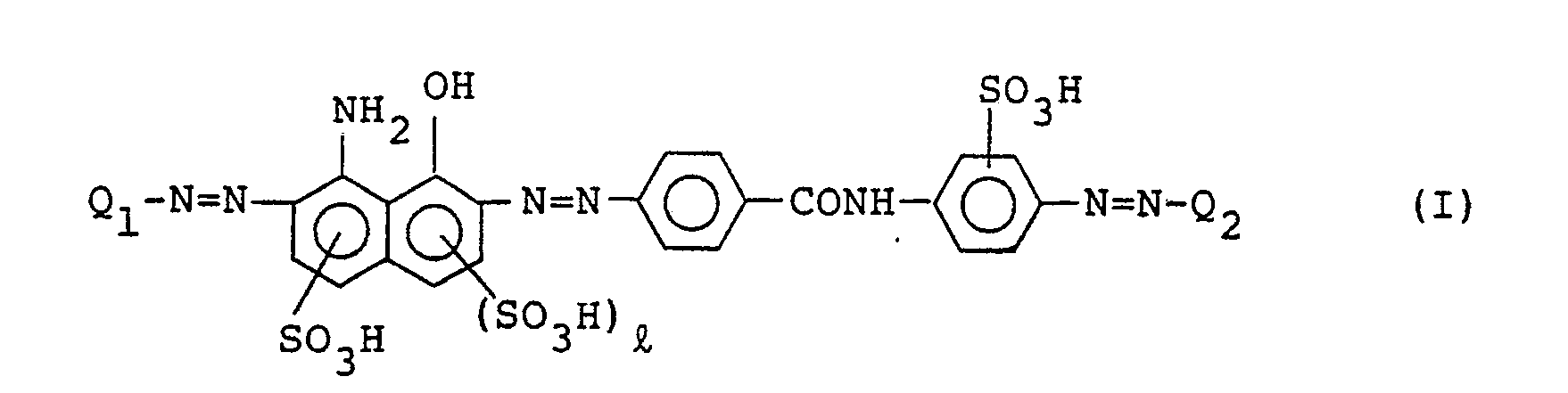
- the present invention provides trisazo compounds represented by the following formula (I) in the free acid form: wherein Q1 and Q2 independently of one another are each an unsubstituted or substituted phenyl or naphthyl group and l represents 0 or 1.
- trisazo compounds of the present invention represented by the formula (I)
- the trisazo compounds represented by the following formulas (II) and (III) in the free acid form are preferred: wherein Q1 and Q2 are as defined above, wherein l, Q1 and Q2 are as defined above.
- trisazo compounds represented by the following general formula (IV) in the free acid form are particularly preferred: wherein Q1 and Q2 are as defined above.
- the unsubstituted or substituted phenyl group represented by Q1 is preferably represented by the following formula: wherein R1 and R2 independently of one another are hydrogen, a nitro, sulfo, sulfamoyl, alkyl, alkoxy, substituted or unsubstituted amino, carboxy or halogeno group, and particularly preferably a phenyl group unsubstituted or substituted by a nitro, sulfo, sulfamoyl, methyl, ethyl, methoxy, ethoxy, carboxy or chloro group.
- the unsubstituted or substituted naphthyl group represented by Q1 is preferably represented by the following formula: wherein R3, R4 and R5 independently of one another are each hydrogen, a hydroxy or sulfo group.
- the unsubstituted or substituted phenyl group represented by Q2 is preferably a phenyl group substituted once or twice by a substituted or unsubstituted amino group and unsubstituted or substituted by a hydroxy, sulfo, alkyl, alkoxy or carboxy group, or a phenyl group substituted once, twice or three times by a hydroxy group and unsubstituted or substituted by a substituted or unsubstituted amino, sulfo, alkyl, alkoxy or carboxy group.
- the substituted amino group amino groups substituted by methyl, ethyl, hydroxyethyl, cyanoethyl, acetyl or carbamoyl groups can be referred to.
- the unsubstituted or substituted naphthyl group represented by Q2 is preferably a naphthyl group substituted once or twice by a hydroxy group and unsubstituted or substituted by a sulfo, unsubstituted amino, acetyl, phenyl, sulfophenyl, disulfophenyl, benzoyl or methyl-substituted amino group, or a naphthyl group substituted once or twice by an unsubstituted amino group or a methyl-, ethyl-, hydroxyethyl-, cyanoethyl-, acetyl-or carbamoyl-substituted amino group(s) and unsubstituted or substituted by a hydroxy or sulfo group.
- alkyl and “alkoxy” refer to residues having 1 to 6, preferably 1 to 4 carbon atoms. Specific examples are the methyl
- the compound of the present invention is used in the form of the free acid or preferably in the form of an alkali metal salt, ammonium salt or organic amine salt.
- an alkali metal salt, ammonium salt or organic amine salt for example, it is used in the form of the lithium salt, sodium salt, potassium salt, monoethanolamine salt, diethanolamine salt or triethanolamine salt.
- Such trisazo compounds represented by the formula (I) can be produced, for example, in the following manner.
- Examples of the compound represented by the formula (V) include 1-aminobenzene, 1-amino-2-, 3- or 4-nitrobenzene, 1-amino-2, 3- or 4-benzenesulfonic acid, 5-aminobenzene-1,3-disulfonic acid, 6-aminobenzene-1,4-disulfonic acid, 4-aminobenzene-1,2-disulfonic acid, 1-amino-2-, 3- or 4-sulfamoylbenzene, 1-amino-2-, 3- or 4-benzoic acid, 1-amino-2-, 3- or 4-chlorobenzene, 1-amino-2,5-dichlorobenzene, 1-amino-2-, 3- or 4-bromobenzene, 1-amino-2-, 3- or 4-methylbenzene, 1-amino-2-, 3- or 4-ethylbenzene, 1-amino-2-, 3- or 4-methoxybenzene, 1-amino-2-, 3- or 4-eth
- Examples of the compound represented by the formula (VI) include 1-amino-8-naphthol-4-sulfonic acid and 1-amino-8-naphthol-3,6- or 4,6-disulfonic acid, among which 1-amino-8-naphthol-3,6-disulfonic aicd is particularly preferable.
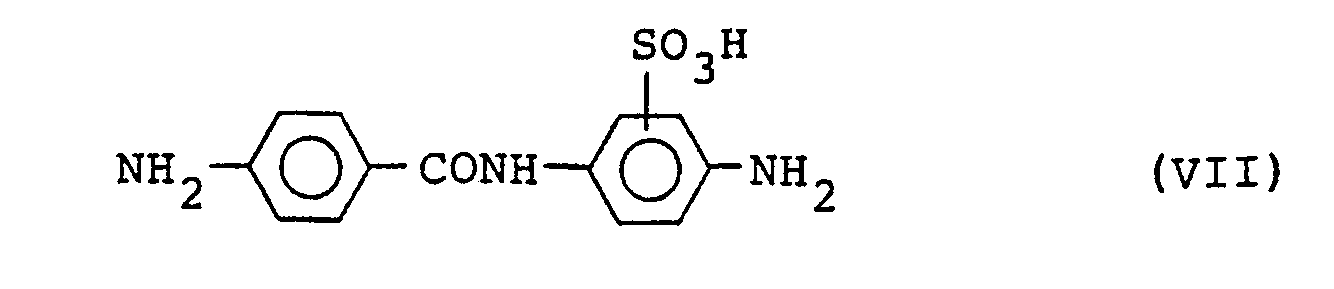
- Examples of the compound represented by the formula (VII) include 4,4'-diaminobenzanilide-3'-sulfonic acid and 4,4'-diaminobenzanilide-2'-sulfonic acid. Among them, 4,4'-diaminobenzanilide-3'-sulfonic acid is particularly preferable.
- Examples of the compound represented by the formula (VIII) include aniline derivatives, phenol derivatives, aminophenol derivatives, naphthol derivatives, naphthylaminesulfonic acid derivatives and naphtholsulfonic acid derivatives.
- the trisazo compound of the present invention is usable either singly or in the form of a mixture, and useful particularly for dyeing cellulose fibers such as rayon, cotton, paper, leather, silk and synthetic polyamide.
- the dyeing can be carried out by various dyeing processes and printing processes such as the exhaustion dyeing process.
- the compounds of the present invention exhibit excellent performances and are usually useful as a black-colored dye. Particularly they have a good solubility ability and a high fixation property and can give a deep black colored dyed product. Further, they are characterized by their good build-up property and the ability to give a dyed product of excellent fastness.
- the compounds of the present invention can be made into a stable liquid composition.
- the liquid composition is particularly suitable for dyeing rayon and paper. Further, the liquid composition is successfully usable as an ink which can be applied, for example, by the ink jet process.
- the compounds of the present invention are particularly excellent in solubility.
- the ink prepared therefrom has a good storage stability which has so far been an important problem in the field of inks for use in ink jet process.
- the ink is characterized in that it is free from the problem of clogging of nozzle caused by deposited matter and it can form a deep black-colored image excellent in ink characteristics such as clarity, water resistance and light resistance.
- Aniline (9.3 parts) was diazotized in a conventional manner and coupled with 31.9 parts of 1-amino-8-naphthol-3,6-disulfonic acid at 0-5°C under an acidic condition. Then, a tetrazo compound prepared by tetrazotizing 30.7 parts of 4,4'-diaminobenzanilide-3'-sulfonic acid in a conventional manner was poured thereinto and coupled at 0-10°C under a neutral condition. Then, 10.9 parts of 1-hydroxy-3-aminobenzene was added and the reaction was completed, after which the product was salted out and isolated in a conventional manner to obtain a trisazo compound represented by the following formula in the free acid form:
- Example 1 was repeated, except that the 1-hydroxy-3-aminobenzene used in Example 1 was replaced with the compounds of the formula (VIII) as shown in the second column of the following table. Thus, the corresponding trisazo compounds were obtained.
- ⁇ max denotes the values measured in an aqueous medium.
- Example 1 was repeated, except that the aniline used in Example 1 was replaced with the compounds of formula (V) as shown in the second column of the following table. Thus, the corresponding trisazo compounds were obtained.
- ⁇ max denotes the values measured in an aqueous medium.
- Example 1 can be repeated, except that the aniline and 1-hydroxy-3-aminobenzene used in Example 1 are replaced with the compounds of formula (V) used in Example 3 and the compounds of formula (VIII) used in Example 2, respectively, to obtain the corresponding trisazo compounds.
- Example 1 was repeated, except that the 1-amino-8-naphthol-3,6-disulfonic acid and 4,4'-diaminobenzanilide-3'-sulfonic acid used in Example 1 were replaced with 1-amino-8-naphthol-4,6-disulfonic acid and 4,4'-diaminobenzanilide-2'-sulfonic acid, respectively.
- trisazo compound represented by the following formula in the free acid form was obtained:
- a dyeing bath was prepared by dissolving 0.25 part of the trisazo compound obtained in Example 1 into 200 parts of water. In the dyeing bath was dipped 5.0 parts of viscose rayon staple fiber yarn. After maintaining the bath at 90°C for 10 minutes, 0.25 part of anhydrous sodium sulfate was added, and dyeing was carried out at that temperature for 40 minutes. Then, the yarn was washed with water and dried. The dyed product thus obtained had a black color tone and an excellent fastness.
- Example 3 Into 500 parts of an LBKP 20 g/liter pulp dispersion having been beaten up to a degree of beating of CF 400 ml was introduced 0.5 part of the trisazo compound obtained in Example 3 (No. 19). After agitating the mixture for 10 minutes, 0.3 part of Sizepine E (sizing agent manufactured by Arakawa Chemical Industry, Co.). After an additional 10 minutes had passed, 0.3 part of crystalline aluminum sulfate was added, and agitation was continued for 20 minutes to carry out dyeing. Then, the pulp was made into paper and dried. The paper thus prepared had a black color tone and an excellent fastness.
- Sizepine E sizing agent manufactured by Arakawa Chemical Industry, Co.
- a composition of the following formulation was heated at about 50°C with agitation to form a uniform solution and then filtered through a Teflon filter having a pore diameter of 0.45 ⁇ m to prepare an ink.
- an ink jet recording was carried out on a commercially available high quality paper by means of a recording apparatus equipped with an On-Demand type recording head discharging an ink by the action of a piezoelectric vibrator.
- the image thus formed was excellent in water resistance, light resistance, color depth and clarity.
- Example 1 was repeated, except that the aniline and 1-hydroxy-3-aminobenzene used in Example 1 were replaced with the compounds as shown in the second column of the following table (compound of formula (V)) and the compounds of the third column of the following table (compound of formula (VIII)), respectively, to synthesize the corresponding trisazo compounds.
- ⁇ max denotes the values in an aqueous medium.
- An ink was prepared from the following composition by the same procedure as in Example 8.
- the ink was sealed into a glass container and left standing at 20°C for 6 months or at 50°C for 2 weeks. After standing, the ink showed no deposition of crystalline matter, demonstrating a high stability of its quality.
- An ink was prepared from the following composition by the same procedure as in Example 8.
- Example 8 Using the ink, an ink jet recording was continuously performed by the same procedure as in Example 8. As the result, no clogging of nozzle took place, and the result was stable.
Landscapes
- Chemical & Material Sciences (AREA)
- Organic Chemistry (AREA)
- Life Sciences & Earth Sciences (AREA)
- Engineering & Computer Science (AREA)
- Materials Engineering (AREA)
- Wood Science & Technology (AREA)
- Inks, Pencil-Leads, Or Crayons (AREA)
- Coloring (AREA)
- Photoreceptors In Electrophotography (AREA)
Abstract

wherein Q₁ and Q₂ independently of one another are each unsubstituted or substituted phenyl or naphthyl group and ℓ represents 0 or 1, which is useful for dyeing fiber, paper, leather and the like having hydroxy or amido group in black color, and for use in an ink used in ink jet printing and the like.
Description
- The present invention relates to trisazo compounds. More particularly, the present invention relates to trisazo compounds useful for dyeing or printing fiber, paper, leather and the like having hydroxy or amido groups, in black color, and for use in an ink used in ink jet printing and the like.
In JP-A- 61-51064, dyes represented by, for example, the following formula are disclosed:
- Polyazo direct or acid dye prepared using benzidine or its derivative have been used for dyeing or printing a fiber having hydroxyl or amido group, or a composition comprising said fiber. However, in many countries, production of benzidine is now prohibited, and benzidine derivatives such as o-tolidine and dianisidine are registered as special chemical substances of which handling is restricted in production and use, because of their toxicity.
- For such a reason, a variety of compounds have been proposed as non-benzidine type dyes. However, they do not reach a level capable of satisfying the requirements of users at the present stage, particularly in the dye abilities. Thus, it is earnestly desired to provide a further improved compound.
- It is the object of the present invention to provide novel compounds capable of fulfilling the necessary conditions of a dye, without using benzidine nor benzidine derivatives.
- The present invention provides trisazo compounds represented by the following formula (I) in the free acid form:

wherein Q₁ and Q₂ independently of one another are each an unsubstituted or substituted phenyl or naphthyl group and ℓ represents 0 or 1. - Among the trisazo compounds of the present invention represented by the formula (I), the trisazo compounds represented by the following formulas (II) and (III) in the free acid form are preferred:

wherein Q₁ and Q₂ are as defined above,
wherein ℓ, Q₁ and Q₂ are as defined above. - Among these trisazo compounds, the trisazo compounds represented by the following general formula (IV) in the free acid form are particularly preferred:

wherein Q₁ and Q₂ are as defined above. - The unsubstituted or substituted phenyl group represented by Q₁ is preferably represented by the following formula:

wherein R₁ and R₂ independently of one another are hydrogen, a nitro, sulfo, sulfamoyl, alkyl, alkoxy, substituted or unsubstituted amino, carboxy or halogeno group, and particularly preferably a phenyl group unsubstituted or substituted by a nitro, sulfo, sulfamoyl, methyl, ethyl, methoxy, ethoxy, carboxy or chloro group. - The unsubstituted or substituted naphthyl group represented by Q₁ is preferably represented by the following formula:

wherein R₃, R₄ and R₅ independently of one another are each hydrogen, a hydroxy or sulfo group. - The unsubstituted or substituted phenyl group represented by Q₂ is preferably a phenyl group substituted once or twice by a substituted or unsubstituted amino group and unsubstituted or substituted by a hydroxy, sulfo, alkyl, alkoxy or carboxy group, or a phenyl group substituted once, twice or three times by a hydroxy group and unsubstituted or substituted by a substituted or unsubstituted amino, sulfo, alkyl, alkoxy or carboxy group. As examples of the substituted amino group, amino groups substituted by methyl, ethyl, hydroxyethyl, cyanoethyl, acetyl or carbamoyl groups can be referred to.
- The unsubstituted or substituted naphthyl group represented by Q₂ is preferably a naphthyl group substituted once or twice by a hydroxy group and unsubstituted or substituted by a sulfo, unsubstituted amino, acetyl, phenyl, sulfophenyl, disulfophenyl, benzoyl or methyl-substituted amino group, or a naphthyl group substituted once or twice by an unsubstituted amino group or a methyl-, ethyl-, hydroxyethyl-, cyanoethyl-, acetyl-or carbamoyl-substituted amino group(s) and unsubstituted or substituted by a hydroxy or sulfo group.
As used herein the terms "alkyl" and "alkoxy" refer to residues having 1 to 6, preferably 1 to 4 carbon atoms. Specific examples are the methyl, ethyl, methoxy and ethoxy group. - The compound of the present invention is used in the form of the free acid or preferably in the form of an alkali metal salt, ammonium salt or organic amine salt. For example, it is used in the form of the lithium salt, sodium salt, potassium salt, monoethanolamine salt, diethanolamine salt or triethanolamine salt.
- Such trisazo compounds represented by the formula (I) can be produced, for example, in the following manner.
- A compound represented by the following formula (V):
Q₁-NH₂ (V)
wherein Q₁ is as defined above, is diazotized in a conventional manner followed by coupling with a compound represented by the following formula (VI) in the free acid form:
wherein ℓ is as defined above, in an aqueous medium under acidic conditions and then the product of the coupling reaction is further coupled in an acidic or weakly alkaline aqueous medium with a tetrazo compound prepared by tetrazotizing in a conventional manner a compound represented by the following formula (VII):
and the disazo-diazo compound thus obtained is coupled with a compound represented by the following formula (VIII):
Q₂-H (VIII)
wherein Q₂ is as defined above, to form a trisazo compound represented by the formula (I). - Examples of the compound represented by the formula (V) include 1-aminobenzene, 1-amino-2-, 3- or 4-nitrobenzene, 1-amino-2, 3- or 4-benzenesulfonic acid, 5-aminobenzene-1,3-disulfonic acid, 6-aminobenzene-1,4-disulfonic acid, 4-aminobenzene-1,2-disulfonic acid, 1-amino-2-, 3- or 4-sulfamoylbenzene, 1-amino-2-, 3- or 4-benzoic acid, 1-amino-2-, 3- or 4-chlorobenzene, 1-amino-2,5-dichlorobenzene, 1-amino-2-, 3- or 4-bromobenzene, 1-amino-2-, 3- or 4-methylbenzene, 1-amino-2-, 3- or 4-ethylbenzene, 1-amino-2-, 3- or 4-methoxybenzene, 1-amino-2-, 3- or 4-ethoxybenzene, 1,4-diaminobenzene-2-sulfonic acid, 4-di(β-hydroxyethyl)-1-aminobenzene, 1-aminonaphthalene-4-, 5-, 6-, 7- or 8-sulfonic acid, 2-aminonaphthalene-1-, 8-, 7-, 6- or 5-sulfonic acid, 1-aminonaphthalene-4,7-, 4,6-, 3,7-, 3,8- or 3,6-disulfonic acid, 2-aminonaphthalene-4,8-, 6,8-, 3,6-, 1,5- or 5,7-disulfonic acid, 1-aminonaphthalene-3,6,8-trisulfonic acid and 2-aminonaphthalene-3,6,8- or 4,6,8-trisulfonic acid.
- Examples of the compound represented by the formula (VI) include 1-amino-8-naphthol-4-sulfonic acid and 1-amino-8-naphthol-3,6- or 4,6-disulfonic acid,
among which 1-amino-8-naphthol-3,6-disulfonic aicd is particularly preferable. - Examples of the compound represented by the formula (VII) include 4,4'-diaminobenzanilide-3'-sulfonic acid and 4,4'-diaminobenzanilide-2'-sulfonic acid. Among them, 4,4'-diaminobenzanilide-3'-sulfonic acid is particularly preferable.
- Examples of the compound represented by the formula (VIII) include aniline derivatives, phenol derivatives, aminophenol derivatives, naphthol derivatives, naphthylaminesulfonic acid derivatives and naphtholsulfonic acid derivatives. Among them, 1-hydroxybenzene, 1-hydroxy-2-, 3- or 4-methyl-benzene, 1,3-dihydroxybenzene, 1-hydroxy-3-methoxybenzene, 1-hydroxy-3-aminobenzene, 3-di(β-hydroxyethyl)-amino-1-hydroxybenzene, 1-di(β-hydroxyethyl)aminobenzene, 1,3-diamino-4-methylbenzene, 1-hydroxy-2-benzoic acid, 1,3-diaminobenzene-6-sulfonic acid, 1-acetylamino-4-methoxy-3-di(β-hydroxyethyl)aminobenzene, 3-diethylamino-1-hydroxybenzene, 1-hydroxynaphthalene, 1-hydroxynaphthalene-4-, 5- or 3-sulfonic acid, 1-hydroxynaphthalene-3,8- or 3,6-disulfonic acid, 1-hydroxynaphthalene-3,6,8-trisulfonic acid, 2-hydroxynaphthalene, 2-hydroxynaphthalene-8-, 7- or 6-sulfonic acid, 2-hydroxynaphthalene-6,8- or 3,6-disulfonic acid, 2-amino-, methylamino-, ethylamino-, acetylamino-, propionylamino-, benzoylamino-, carbamoylamino-, sulfamoylamino or phenylamino-8-hydroxynaphthalene-6-sulfonic acid, 3-amino-, methylamino-, ethylamino-, propionylamino-, acetylamino-, benzoylamino-, carbamoylamino-, sulfamoylamino- or phenylamino-8-hydroxynaphthalene-6-sulfonic acid, 1-amino- or acetylamino-8-hydroxynaphthalene-3,6-disulfonic acid, 1-amino- or acetylamino-8-hydroxynaphthalene-4,6-disulfonic acid, 1-amino-8-hydroxynaphthalene-2,4-disulfonic acid and 1,8-dihydroxynaphthalene-3,6-disulfonic acid are preferred.
- The trisazo compound of the present invention is usable either singly or in the form of a mixture, and useful particularly for dyeing cellulose fibers such as rayon, cotton, paper, leather, silk and synthetic polyamide. The dyeing can be carried out by various dyeing processes and printing processes such as the exhaustion dyeing process.
- In such dyeing processes, the compounds of the present invention exhibit excellent performances and are usually useful as a black-colored dye. Particularly they have a good solubility ability and a high fixation property and can give a deep black colored dyed product. Further, they are characterized by their good build-up property and the ability to give a dyed product of excellent fastness.
- Further, the compounds of the present invention can be made into a stable liquid composition. The liquid composition is particularly suitable for dyeing rayon and paper. Further, the liquid composition is successfully usable as an ink which can be applied, for example, by the ink jet process.
- The compounds of the present invention are particularly excellent in solubility. Thus, the ink prepared therefrom has a good storage stability which has so far been an important problem in the field of inks for use in ink jet process. Further, the ink is characterized in that it is free from the problem of clogging of nozzle caused by deposited matter and it can form a deep black-colored image excellent in ink characteristics such as clarity, water resistance and light resistance.
- The present invention will be illustrated in more detail by way of the following examples. In the examples, parts are by weight.
- Aniline (9.3 parts) was diazotized in a conventional manner and coupled with 31.9 parts of 1-amino-8-naphthol-3,6-disulfonic acid at 0-5°C under an acidic condition. Then, a tetrazo compound prepared by tetrazotizing 30.7 parts of 4,4'-diaminobenzanilide-3'-sulfonic acid in a conventional manner was poured thereinto and coupled at 0-10°C under a neutral condition. Then, 10.9 parts of 1-hydroxy-3-aminobenzene was added and the reaction was completed, after which the product was salted out and isolated in a conventional manner to obtain a trisazo compound represented by the following formula in the free acid form:

- Example 1 was repeated, except that the 1-hydroxy-3-aminobenzene used in Example 1 was replaced with the compounds of the formula (VIII) as shown in the second column of the following table. Thus, the corresponding trisazo compounds were obtained. In the table, λmax denotes the values measured in an aqueous medium.


- Example 1 was repeated, except that the aniline used in Example 1 was replaced with the compounds of formula (V) as shown in the second column of the following table. Thus, the corresponding trisazo compounds were obtained. In the table, λmax denotes the values measured in an aqueous medium.


- Example 1 can be repeated, except that the aniline and 1-hydroxy-3-aminobenzene used in Example 1 are replaced with the compounds of formula (V) used in Example 3 and the compounds of formula (VIII) used in Example 2, respectively, to obtain the corresponding trisazo compounds.
- Example 1 was repeated, except that the 1-amino-8-naphthol-3,6-disulfonic acid and 4,4'-diaminobenzanilide-3'-sulfonic acid used in Example 1 were replaced with 1-amino-8-naphthol-4,6-disulfonic acid and 4,4'-diaminobenzanilide-2'-sulfonic acid, respectively. Thus, trisazo compound represented by the following formula in the free acid form was obtained:

- A dyeing bath was prepared by dissolving 0.25 part of the trisazo compound obtained in Example 1 into 200 parts of water. In the dyeing bath was dipped 5.0 parts of viscose rayon staple fiber yarn. After maintaining the bath at 90°C for 10 minutes, 0.25 part of anhydrous sodium sulfate was added, and dyeing was carried out at that temperature for 40 minutes. Then, the yarn was washed with water and dried. The dyed product thus obtained had a black color tone and an excellent fastness.
- Into 500 parts of an LBKP 20 g/liter pulp dispersion having been beaten up to a degree of beating of CF 400 ml was introduced 0.5 part of the trisazo compound obtained in Example 3 (No. 19). After agitating the mixture for 10 minutes, 0.3 part of Sizepine E (sizing agent manufactured by Arakawa Chemical Industry, Co.). After an additional 10 minutes had passed, 0.3 part of crystalline aluminum sulfate was added, and agitation was continued for 20 minutes to carry out dyeing. Then, the pulp was made into paper and dried. The paper thus prepared had a black color tone and an excellent fastness.
- A composition of the following formulation was heated at about 50°C with agitation to form a uniform solution and then filtered through a Teflon filter having a pore diameter of 0.45 µm to prepare an ink.

- Using the ink thus obtained, an ink jet recording was carried out on a commercially available high quality paper by means of a recording apparatus equipped with an On-Demand type recording head discharging an ink by the action of a piezoelectric vibrator. The image thus formed was excellent in water resistance, light resistance, color depth and clarity.
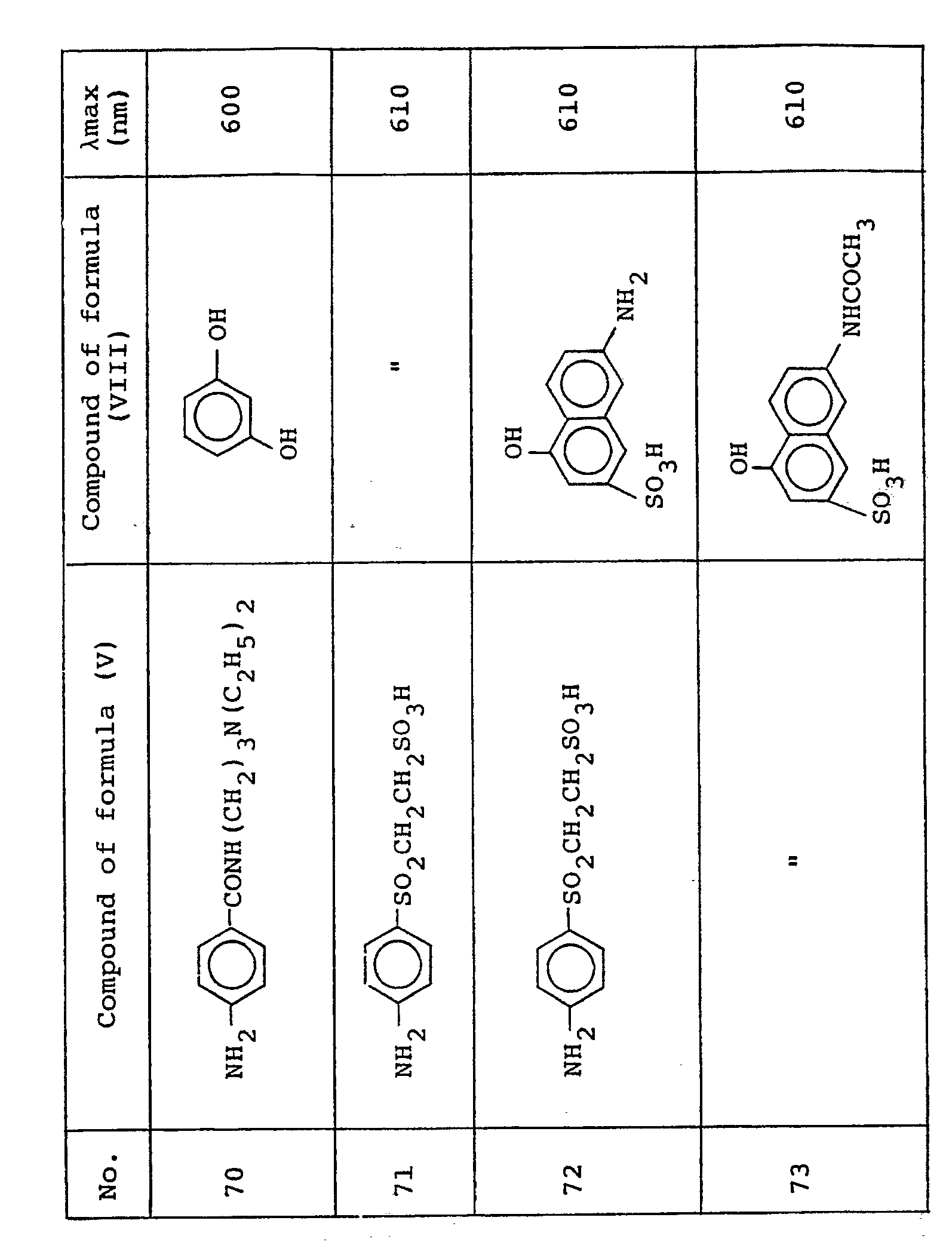
- Example 1 was repeated, except that the aniline and 1-hydroxy-3-aminobenzene used in Example 1 were replaced with the compounds as shown in the second column of the following table (compound of formula (V)) and the compounds of the third column of the following table (compound of formula (VIII)), respectively, to synthesize the corresponding trisazo compounds. In the table, λmax denotes the values in an aqueous medium.


- An ink was prepared from the following composition by the same procedure as in Example 8.

- The ink was sealed into a glass container and left standing at 20°C for 6 months or at 50°C for 2 weeks. After standing, the ink showed no deposition of crystalline matter, demonstrating a high stability of its quality.
- An ink was prepared from the following composition by the same procedure as in Example 8.

- Using the ink, an ink jet recording was continuously performed by the same procedure as in Example 8. As the result, no clogging of nozzle took place, and the result was stable.
Claims (13)
- A trisazo compound represented by the following formula (I) in the free acid form:
- The trisazo compound according to Claim 1 represented by the following formula (II) in the free acid form:

- The trisazo compound according to Claim 1 represented by the following formula (III) in the free acid form:

- The trisazo compound according to Claim 1 represented by the following formula (IV) in the free acid form:

- The trisazo compound according to any one of Claims 1 to 4, wherein Q₁ is a phenyl group represented by the following formula:

- The trisazo compound according to any one of Claims 1 to 4, wherein Q₁ is a naphthyl group represented by the following formula:

- The trisazo compound according to any one of Claims 1 to 6, wherein Q₂ is a phenyl group substituted by 1 to 3 hydroxy group(s) and unsubstituted or substituted by a substituted or unsubstituted amino, sulfo, alkyl, alkoxy or carboxy group.
- The trisazo compound according to any one of Claims 1 to 6, wherein Q₂ is a phenyl group substituted by one or two substituted or unsubstituted amino group and unsubstituted or substituted by a hydroxy, sulfo, alkyl, alkoxy or carboxy group.
- The trisazo compound according to any one of Claims 1 to 6, wherein Q₂ is a naphthyl group substituted by one or two hydroxy group(s) and unsubstituted or substituted by a substituted or unsubstituted amino or sulfo group.
- The trisazo compound according to any one of Claims 1 to 6, wherein Q₂ is a naphthyl group substituted by one or two substituted or unsubstituted amino group(s) and unsubstituted or substituted by a hydroxy or sulfo group.
- A process for dyeing or printing fiber or paper, which comprising using the trisazo compound according to any one of Claims 1 to 10.
- An ink comprising the trisazo compound according to any one of Claims 1 to 10.
- A process for producing the trisazo compound according to Claim 1, which is characterized in that a compound represented by the following formula (V):
Q₁-NH₂ (V)
wherein Q₁ is as defined in Claim 1, is diazotized in a conventional manner followed by coupling with a compound represented by the following formula (VI) in the free acid form:
Q₂-H (VIII)
wherein Q₂ is as defined in Claim 1.
Applications Claiming Priority (2)
| Application Number | Priority Date | Filing Date | Title |
|---|---|---|---|
| JP8176290 | 1990-03-28 | ||
| JP81762/90 | 1990-03-28 |
Publications (2)
| Publication Number | Publication Date |
|---|---|
| EP0449250A1 true EP0449250A1 (en) | 1991-10-02 |
| EP0449250B1 EP0449250B1 (en) | 1996-11-27 |
Family
ID=13755467
Family Applications (1)
| Application Number | Title | Priority Date | Filing Date |
|---|---|---|---|
| EP91104877A Expired - Lifetime EP0449250B1 (en) | 1990-03-28 | 1991-03-27 | Trisazo compounds and use thereof |
Country Status (5)
| Country | Link |
|---|---|
| US (1) | US5180817A (en) |
| EP (1) | EP0449250B1 (en) |
| KR (1) | KR0169989B1 (en) |
| DE (1) | DE69123273D1 (en) |
| ES (1) | ES2094765T3 (en) |
Cited By (2)
| Publication number | Priority date | Publication date | Assignee | Title |
|---|---|---|---|---|
| WO1999064520A1 (en) * | 1998-06-05 | 1999-12-16 | Basf Aktiengesellschaft | Trisazo and polyazo dyes and the mixtures thereof |
| WO2004046265A1 (en) * | 2002-11-15 | 2004-06-03 | Avecia Inkjet Limited | Inks for ink jet printing comprising a tris-azo dye |
Families Citing this family (3)
| Publication number | Priority date | Publication date | Assignee | Title |
|---|---|---|---|---|
| JPH06340820A (en) * | 1993-05-31 | 1994-12-13 | Sumitomo Chem Co Ltd | Trisazo compound, textile material using the same, method for dyeing paper or leather, and recording liquid containing the same |
| TW412575B (en) * | 1994-10-13 | 2000-11-21 | Ciba Sc Holding Ag | Reactive dyes, process for their preparation and the use thereof |
| US5965717A (en) * | 1997-11-04 | 1999-10-12 | North Carolina State University | Organic pigments from twisted benzidines |
Citations (2)
| Publication number | Priority date | Publication date | Assignee | Title |
|---|---|---|---|---|
| DE2255652A1 (en) * | 1971-11-17 | 1973-05-24 | Acna | SULFONIZED TRIAZO DYES AND THE PROCESS FOR THEIR MANUFACTURING |
| GB1327914A (en) * | 1971-03-06 | 1973-08-22 | Bayer Ag | Trisazo dyestuffs |
Family Cites Families (5)
| Publication number | Priority date | Publication date | Assignee | Title |
|---|---|---|---|---|
| DE2110772C3 (en) * | 1971-03-06 | 1978-08-10 | Bayer Ag, 5090 Leverkusen | Trisazo dyes, processes for their production and their use for dyeing hydroxyl-containing and nitrogen-containing fiber materials |
| FR2214684B1 (en) * | 1973-01-18 | 1978-04-14 | Ugine Kuhlmann | |
| DE3021979A1 (en) * | 1980-06-12 | 1981-12-17 | Bayer Ag, 5090 Leverkusen | TRISAZO / AZOXY DYE MIXTURES, METHOD FOR THE PRODUCTION THEREOF AND THEIR USE |
| US4624708A (en) * | 1985-04-15 | 1986-11-25 | Xerox Corporation | Sulfonated trisazo dyes for ink jet compositions |
| JPH02201978A (en) * | 1989-01-31 | 1990-08-10 | Canon Inc | Switching device |
-
1991
- 1991-03-18 US US07/670,581 patent/US5180817A/en not_active Expired - Fee Related
- 1991-03-27 ES ES91104877T patent/ES2094765T3/en not_active Expired - Lifetime
- 1991-03-27 DE DE69123273T patent/DE69123273D1/en not_active Expired - Lifetime
- 1991-03-27 EP EP91104877A patent/EP0449250B1/en not_active Expired - Lifetime
- 1991-03-28 KR KR1019910004867A patent/KR0169989B1/en not_active Expired - Fee Related
Patent Citations (2)
| Publication number | Priority date | Publication date | Assignee | Title |
|---|---|---|---|---|
| GB1327914A (en) * | 1971-03-06 | 1973-08-22 | Bayer Ag | Trisazo dyestuffs |
| DE2255652A1 (en) * | 1971-11-17 | 1973-05-24 | Acna | SULFONIZED TRIAZO DYES AND THE PROCESS FOR THEIR MANUFACTURING |
Cited By (5)
| Publication number | Priority date | Publication date | Assignee | Title |
|---|---|---|---|---|
| WO1999064520A1 (en) * | 1998-06-05 | 1999-12-16 | Basf Aktiengesellschaft | Trisazo and polyazo dyes and the mixtures thereof |
| WO2004046265A1 (en) * | 2002-11-15 | 2004-06-03 | Avecia Inkjet Limited | Inks for ink jet printing comprising a tris-azo dye |
| US7153351B2 (en) | 2002-11-15 | 2006-12-26 | Fujifilm Imaging Colorants Limited | Inks for ink jet printing comprising a tris-azo dye |
| CN100396738C (en) * | 2002-11-15 | 2008-06-25 | 富士胶片映像着色有限公司 | Ink for inkjet printing containing trisazo dye |
| KR101007620B1 (en) * | 2002-11-15 | 2011-01-12 | 후지필름 이미징 컬러런츠 리미티드 | Ink jet printing inks containing tris azo dyes |
Also Published As
| Publication number | Publication date |
|---|---|
| US5180817A (en) | 1993-01-19 |
| EP0449250B1 (en) | 1996-11-27 |
| KR0169989B1 (en) | 1999-03-20 |
| KR910016874A (en) | 1991-11-05 |
| DE69123273D1 (en) | 1997-01-09 |
| ES2094765T3 (en) | 1997-02-01 |
Similar Documents
| Publication | Publication Date | Title |
|---|---|---|
| US5488101A (en) | Trisazo compounds, method for dyeing fiber materials, paper or leather using the same and inks containing the same | |
| JPS61264062A (en) | Reactive dye, its production and use | |
| EP0449250B1 (en) | Trisazo compounds and use thereof | |
| US6194554B1 (en) | Disazo dyes | |
| DE3910649A1 (en) | REACTIVE DYES THAT HAVE TWO OR THREE NITROGEN-containing HALOGEN HETEROCYCLES AS ANCHORS | |
| KR960000172B1 (en) | Yellow color monoazo compound, the process for producing the same and the process for dyeing or printing fiber material using the same | |
| US5536819A (en) | Trisazo compounds imparting deep black color a method for dyeing by using them and an ink containing them | |
| JPS63243166A (en) | Disazo compound and dyeing of substrate using same | |
| JPH04506531A (en) | Water-soluble azo dyes, their manufacturing methods and uses | |
| JPH04108865A (en) | Trisazo compound and its use | |
| JPH04211457A (en) | Trisazo compound and its use | |
| JPS591782A (en) | Dyeing or printing of fabric fiber material by reactive dye | |
| JPH07196936A (en) | Stilbene disazo dye | |
| JPH05311088A (en) | Water-soluble azo compound, production thereof, and its use as dye | |
| US5128456A (en) | Reactive dyes | |
| EP1027387B1 (en) | Double reactive dyes | |
| EP0433821B1 (en) | Reactive dyes having an anchor on basis of alkenylsulfonyl and benzyl compounds as their intermediates | |
| JP3441017B2 (en) | Method for defluorescence treatment of cellulose fiber, coumarin compound, aqueous liquid composition containing the same, and method for coloring paper and pulp | |
| JPH05246977A (en) | Trisazo compound, textile material using the same, method for dyeing paper or leather, and ink containing the same | |
| JP2001501242A (en) | Reactive dyes with heterocyclic anchors | |
| EP0645434A1 (en) | Trisazo compound, method for dyeing by using it and ink containing it | |
| KR100583392B1 (en) | Formazan compound and dyeing method using the same | |
| EP0459259A1 (en) | Disazo dyes | |
| JPH06157932A (en) | Dye mixtures, their production and their use | |
| EP0492236B1 (en) | Reactive dyes with alkenylsulphonyl or alkinylsulphonyl groups serving as anchor |
Legal Events
| Date | Code | Title | Description |
|---|---|---|---|
| PUAI | Public reference made under article 153(3) epc to a published international application that has entered the european phase |
Free format text: ORIGINAL CODE: 0009012 |
|
| AK | Designated contracting states |
Kind code of ref document: A1 Designated state(s): BE CH DE ES FR GB IT LI NL SE |
|
| 17P | Request for examination filed |
Effective date: 19920213 |
|
| 17Q | First examination report despatched |
Effective date: 19930906 |
|
| GRAG | Despatch of communication of intention to grant |
Free format text: ORIGINAL CODE: EPIDOS AGRA |
|
| GRAH | Despatch of communication of intention to grant a patent |
Free format text: ORIGINAL CODE: EPIDOS IGRA |
|
| GRAH | Despatch of communication of intention to grant a patent |
Free format text: ORIGINAL CODE: EPIDOS IGRA |
|
| GRAA | (expected) grant |
Free format text: ORIGINAL CODE: 0009210 |
|
| ITF | It: translation for a ep patent filed | ||
| AK | Designated contracting states |
Kind code of ref document: B1 Designated state(s): BE CH DE ES FR GB IT LI NL SE |
|
| REG | Reference to a national code |
Ref country code: CH Ref legal event code: NV Representative=s name: A. BRAUN, BRAUN, HERITIER, ESCHMANN AG PATENTANWAE |
|
| ET | Fr: translation filed | ||
| REF | Corresponds to: |
Ref document number: 69123273 Country of ref document: DE Date of ref document: 19970109 |
|
| REG | Reference to a national code |
Ref country code: ES Ref legal event code: FG2A Ref document number: 2094765 Country of ref document: ES Kind code of ref document: T3 |
|
| PG25 | Lapsed in a contracting state [announced via postgrant information from national office to epo] |
Ref country code: DE Effective date: 19970228 |
|
| PG25 | Lapsed in a contracting state [announced via postgrant information from national office to epo] |
Ref country code: GB Effective date: 19970327 |
|
| PG25 | Lapsed in a contracting state [announced via postgrant information from national office to epo] |
Ref country code: LI Effective date: 19970331 Ref country code: CH Effective date: 19970331 |
|
| PLBE | No opposition filed within time limit |
Free format text: ORIGINAL CODE: 0009261 |
|
| STAA | Information on the status of an ep patent application or granted ep patent |
Free format text: STATUS: NO OPPOSITION FILED WITHIN TIME LIMIT |
|
| REG | Reference to a national code |
Ref country code: CH Ref legal event code: PL |
|
| 26N | No opposition filed | ||
| GBPC | Gb: european patent ceased through non-payment of renewal fee |
Effective date: 19970327 |
|
| PG25 | Lapsed in a contracting state [announced via postgrant information from national office to epo] |
Ref country code: FR Free format text: LAPSE BECAUSE OF NON-PAYMENT OF DUE FEES Effective date: 19971128 |
|
| REG | Reference to a national code |
Ref country code: FR Ref legal event code: ST |
|
| PGFP | Annual fee paid to national office [announced via postgrant information from national office to epo] |
Ref country code: SE Payment date: 19990120 Year of fee payment: 9 |
|
| PGFP | Annual fee paid to national office [announced via postgrant information from national office to epo] |
Ref country code: ES Payment date: 20000317 Year of fee payment: 10 |
|
| PG25 | Lapsed in a contracting state [announced via postgrant information from national office to epo] |
Ref country code: SE Free format text: LAPSE BECAUSE OF NON-PAYMENT OF DUE FEES Effective date: 20000328 |
|
| PGFP | Annual fee paid to national office [announced via postgrant information from national office to epo] |
Ref country code: NL Payment date: 20000331 Year of fee payment: 10 |
|
| PGFP | Annual fee paid to national office [announced via postgrant information from national office to epo] |
Ref country code: BE Payment date: 20000518 Year of fee payment: 10 |
|
| EUG | Se: european patent has lapsed |
Ref document number: 91104877.5 |
|
| PG25 | Lapsed in a contracting state [announced via postgrant information from national office to epo] |
Ref country code: ES Free format text: LAPSE BECAUSE OF NON-PAYMENT OF DUE FEES Effective date: 20010328 |
|
| PG25 | Lapsed in a contracting state [announced via postgrant information from national office to epo] |
Ref country code: BE Free format text: LAPSE BECAUSE OF NON-PAYMENT OF DUE FEES Effective date: 20010331 |
|
| BERE | Be: lapsed |
Owner name: SUMITOMO CHEMICAL CY LTD Effective date: 20010331 |
|
| PG25 | Lapsed in a contracting state [announced via postgrant information from national office to epo] |
Ref country code: NL Free format text: LAPSE BECAUSE OF NON-PAYMENT OF DUE FEES Effective date: 20011001 |
|
| NLV4 | Nl: lapsed or anulled due to non-payment of the annual fee |
Effective date: 20011001 |
|
| REG | Reference to a national code |
Ref country code: ES Ref legal event code: FD2A Effective date: 20020411 |
|
| PG25 | Lapsed in a contracting state [announced via postgrant information from national office to epo] |
Ref country code: IT Free format text: LAPSE BECAUSE OF NON-PAYMENT OF DUE FEES Effective date: 20050327 |