EP0449660A2 - A method and apparatus of generating shadow process - Google Patents
A method and apparatus of generating shadow process Download PDFInfo
- Publication number
- EP0449660A2 EP0449660A2 EP91302831A EP91302831A EP0449660A2 EP 0449660 A2 EP0449660 A2 EP 0449660A2 EP 91302831 A EP91302831 A EP 91302831A EP 91302831 A EP91302831 A EP 91302831A EP 0449660 A2 EP0449660 A2 EP 0449660A2
- Authority
- EP
- European Patent Office
- Prior art keywords
- real
- shadow
- computer
- service
- generating
- Prior art date
- Legal status (The legal status is an assumption and is not a legal conclusion. Google has not performed a legal analysis and makes no representation as to the accuracy of the status listed.)
- Granted
Links
Images



Classifications
-
- G—PHYSICS
- G06—COMPUTING OR CALCULATING; COUNTING
- G06F—ELECTRIC DIGITAL DATA PROCESSING
- G06F11/00—Error detection; Error correction; Monitoring
- G06F11/07—Responding to the occurrence of a fault, e.g. fault tolerance
- G06F11/14—Error detection or correction of the data by redundancy in operations
- G06F11/1479—Generic software techniques for error detection or fault masking
- G06F11/1482—Generic software techniques for error detection or fault masking using middleware or operating system [OS] functionalities
-
- G—PHYSICS
- G06—COMPUTING OR CALCULATING; COUNTING
- G06F—ELECTRIC DIGITAL DATA PROCESSING
- G06F11/00—Error detection; Error correction; Monitoring
- G06F11/07—Responding to the occurrence of a fault, e.g. fault tolerance
- G06F11/14—Error detection or correction of the data by redundancy in operations
- G06F11/1402—Saving, restoring, recovering or retrying
- G06F11/1405—Saving, restoring, recovering or retrying at machine instruction level
-
- G—PHYSICS
- G06—COMPUTING OR CALCULATING; COUNTING
- G06F—ELECTRIC DIGITAL DATA PROCESSING
- G06F11/00—Error detection; Error correction; Monitoring
- G06F11/07—Responding to the occurrence of a fault, e.g. fault tolerance
- G06F11/16—Error detection or correction of the data by redundancy in hardware
- G06F11/20—Error detection or correction of the data by redundancy in hardware using active fault-masking, e.g. by switching out faulty elements or by switching in spare elements
- G06F11/202—Error detection or correction of the data by redundancy in hardware using active fault-masking, e.g. by switching out faulty elements or by switching in spare elements where processing functionality is redundant
- G06F11/2046—Error detection or correction of the data by redundancy in hardware using active fault-masking, e.g. by switching out faulty elements or by switching in spare elements where processing functionality is redundant where the redundant components share persistent storage
-
- G—PHYSICS
- G06—COMPUTING OR CALCULATING; COUNTING
- G06F—ELECTRIC DIGITAL DATA PROCESSING
- G06F11/00—Error detection; Error correction; Monitoring
- G06F11/07—Responding to the occurrence of a fault, e.g. fault tolerance
- G06F11/16—Error detection or correction of the data by redundancy in hardware
- G06F11/20—Error detection or correction of the data by redundancy in hardware using active fault-masking, e.g. by switching out faulty elements or by switching in spare elements
- G06F11/2097—Error detection or correction of the data by redundancy in hardware using active fault-masking, e.g. by switching out faulty elements or by switching in spare elements maintaining the standby controller/processing unit updated
-
- G—PHYSICS
- G06—COMPUTING OR CALCULATING; COUNTING
- G06F—ELECTRIC DIGITAL DATA PROCESSING
- G06F11/00—Error detection; Error correction; Monitoring
- G06F11/07—Responding to the occurrence of a fault, e.g. fault tolerance
- G06F11/16—Error detection or correction of the data by redundancy in hardware
- G06F11/20—Error detection or correction of the data by redundancy in hardware using active fault-masking, e.g. by switching out faulty elements or by switching in spare elements
- G06F11/202—Error detection or correction of the data by redundancy in hardware using active fault-masking, e.g. by switching out faulty elements or by switching in spare elements where processing functionality is redundant
- G06F11/2038—Error detection or correction of the data by redundancy in hardware using active fault-masking, e.g. by switching out faulty elements or by switching in spare elements where processing functionality is redundant with a single idle spare processing component
-
- G—PHYSICS
- G06—COMPUTING OR CALCULATING; COUNTING
- G06F—ELECTRIC DIGITAL DATA PROCESSING
- G06F11/00—Error detection; Error correction; Monitoring
- G06F11/07—Responding to the occurrence of a fault, e.g. fault tolerance
- G06F11/16—Error detection or correction of the data by redundancy in hardware
- G06F11/20—Error detection or correction of the data by redundancy in hardware using active fault-masking, e.g. by switching out faulty elements or by switching in spare elements
- G06F11/202—Error detection or correction of the data by redundancy in hardware using active fault-masking, e.g. by switching out faulty elements or by switching in spare elements where processing functionality is redundant
- G06F11/2041—Error detection or correction of the data by redundancy in hardware using active fault-masking, e.g. by switching out faulty elements or by switching in spare elements where processing functionality is redundant with more than one idle spare processing component
Definitions
- the present invention relates to a method and apparatus for generating a shadow-process in a faulttolerant multi-computer system.
- the database is typically stored in a mass storage device, such as a hard disk.
- a first component executes a process of an application program and an operating system.
- the application program may be, for example, a banking program, or an airline reservation program.
- the operating system provides the application program with services for manipulating computer system resources such as mass storage and input/output (I/O) devices.
- I/O input/output
- the operating system reads data from the database and writes data to the database in response to requests from the application programs.
- the application program issues a write request to the database and a "crash", that is, a malfunction, subsequently occurs during execution of the application program, the database remains in a partially updated condition, as commanded by the write request. However, following the crash the computer is restarted and executes the application program from the beginning. Therefore, the content of the database does not coincide with the data which is necessary at the beginning or execution of the application program.
- the application program includes a request for a second computer to execute a processing operation which the first computer cannot execute (called "remote execution"), the second computer may write the result to the database. In this case, if the second computer crashes, the same inconvenience occurs.
- replication a process duplication method
- the process of an application program being generated by replication is called a “shadow-process”
- the original process which generates the shadow-process is called the "real-process”.
- Figure 1 shows a block diagram of a multi-computer system 10 for replication according to the prior art
- Figure 2 shows a time chart for generating the shadow-process according to the prior art
- the components of multi-computer system 10 include computers 12, 14 and storage device 16.
- an operating system 18 When computer 12 is commanded to begin execution of a new application program, an operating system 18 generates a new real-process 20 in computer 12 from a load-module 22 in storage device 16.
- operating system 18 comprises a set of computer instructions which control the overall behaviour of the computer system, including the loading of application programs, the spawning of processes and the handling of requests for service by process of an application program to input/output devices of the system.
- Load module 22 is comprised of program code and necessary data for the application program to be executed by computers 12 and 14.
- Real-process 20 consists of a new application program to be executed by computer 12. As real-process 20 is executed, it generates request for service by operating system 18. When real-process 20 is generated, operating system 18 also generates a shadow-process 24 in computer 14 through a communication line 26.
- Shadow-process 24 is a copy of real-process 20.
- real-process 20 in computer 12 is executed.
- computer 12 copies state information (defining the status of execution by real-process 20) to computer 14 through communication line 26 at predetermined intervals.
- the state information includes an execute line number of real-process 20 and the current results of execution of real-process 20.
- synchronization of computers 12 and 14 is executed to cause the execution state of computer 14 to coincide with the state of computer 12. Therefore, when real-process 20 crashes, shadow-process 24 begins execution from the latest synchronization point.
- computer 14 executes shadow-process 24 according to the latest execute line number and the latest execute result.
- real-process 20 does not update the data outside the real-process (i.e. issue a write request to the database 23 in storage device 16), the problem of an inconsistent status following a crash does not occur.
- real-process 20 is a program issuing only read instructions from the database and send their result to the display device (not shown), database is not altered just prior to a crash. Accordingly, it is not necessary for shadow-process 24 to continue execution of real-process 20 even if real-process 20 crashes.
- the shadowprocess is always generated at the same time that the realprocess is generated. In short, the shadow-process is generated, even though it is not necessary for continued execution of real-process 20 following a crash. Therefore, unnecessary system resources are consumed by generating the shadow-process. Moreover the time of the synchronization between the real-process and the shadow-process is wasted.
- the present invention seeks to provide a method and apparatus for generating a shadow-process in which system resources are conserved by avoiding the generation of unnecessary shadow-processes.
- the present invention also seeks to provide a method and apparatus of generating a shadow-process in which the time for synchronization operation between a real-process and the shadow process is not wasted.
- the present invention provides a method of generating a shadow-process in a computer system having a plurality of components including multiple computers and storage device, the method comprising the steps of: generating a request for service from a real-process of a first of the computers to an operating system of the first computer;
- the request might be for service to update the external data of real-process (i.e. update database in a storage device) or a service to remotely execute an operation on another computer.
- the service us such an update instruction or remote execution, it is examined to determine if the shadow-process has already been generated during execution of the real-process. If the shadow-process was not already generated, the operating system generates the shadow-process in another computer. Therefore, system resources are not unnecessarily consumed in comparison with the method of generating the shadow-process whenever the real-process is generated. Moreover, because synchronization is not necessary from the generation time of the real-process to the generation time of the shadow-process, the overhead synchronization is reduced in comparison with prior art methods.
- system 30 comprises system components including components 32, 34 and a storage device 35, such as a hard disk.
- Computers 32 and 34 may be, for example, a Nixdorf Computer (Targon/32), and storage device 35 stores database 37, load-module 38 and other files (not shown).
- System 30 typically includes additional computers, not shown, which may be identical to computers 32 and 34.
- an operating system 36 retrieves a corresponding program from a load module 38 in storage device 35.
- Operating system 36 generates a real-process 40 according to the program stored in the load module.
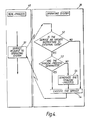
- Real-process 40 is executed, and requests service by operating system 36 (step S1 Figure 4).
- a request for service may constitute a data transfer by instructions to access database 37 through operating system 36.
- operating system 36 decides if the service consists of an alteration of the status of a system component outside the real-process 40, such as a write instruction to external data, that is, database 37, by referring to a service table 42 (step S2),
- Figure 5 shows the content of service table 42.
- service table 42 stores a list of entries of the kind of service which the operating system offers to application programs. Each entry includes a flag which designates whether the corresponding service consists of a write instruction which updates the external data. Therefore, operating system 36 is capable of deciding if the requested service is a write instruction to update the external data according to the service table 42.
- the operating system 36 decides that the service is such a write instruction, the operating system examines if a shadow-process 44 corresponding to real-process 40 was previously generated in computer 34 (step S3). If shadow-process 44 was not previously generated, operating system 36 sends the generation request to an operating system 46 through the communication line 50. Operating system 46 then generates shadow-process 44 in the computer 34 (step S4). Shadow-process 44 is a copy of realprocess 40 and includes the execute result of real-process 40 at that time.
- shadow-process 44 After generating shadow-process 44 (or if shadow-process 44 was already generated), operating system 36 executes the requested service and sends the execution result to real-process 40 (step S5). Operating system 36 then copies the state information to computer 34 at predetermined intervals.
- the state information includes the program execute line number of real-process 40 and the results of execution at that time. Therefore, if real-process 40 crashes, shadow-process 44 begins executing according to the latest execute line number and the results of execution at that time.
- Figure 6 shows a time chart for generating the shadow-process 44 according to the present invention.
- shadow-process 44 is generated in the computer 34.
- the state information is copies at predetermined intervals. Therefore, if real-process 40 does not request the service of updating the external data at all, the real-process 40 finishes execution without generating the shadow-process 44. In short, by not unnecessarily generating the shadow-process 44, system processing resources are not wasted. Moreover, because synchronization is not necessary from the generation time of the real-process to the generation time of the shadow-process, the overhead of the synchronization is reduced.
- FIG. 7 shows a block diagram of fault tolerant multi-computer system constituting another preferred embodiment of the invention.
- System 70 comprises computers 72, 74, 76 and storage devices 78, 80.
- Computers 72, 74 and storage device 78 corresponds to system 30 as shown in Figure 3.
- the computer 76 may update the execution result to external data, such as database, in the storage device 80.
- the requested service is executed at step S5.
- the shadow-process may also be generated after the requested service is executed.
Landscapes
- Engineering & Computer Science (AREA)
- Theoretical Computer Science (AREA)
- Quality & Reliability (AREA)
- Physics & Mathematics (AREA)
- General Engineering & Computer Science (AREA)
- General Physics & Mathematics (AREA)
- Hardware Redundancy (AREA)
- Retry When Errors Occur (AREA)
- Information Retrieval, Db Structures And Fs Structures Therefor (AREA)
Abstract
Description
- The present invention relates to a method and apparatus for generating a shadow-process in a faulttolerant multi-computer system.
- Recently an information system, which is composed of multiple computers and a database, has been developed. The database is typically stored in a mass storage device, such as a hard disk. A first component executes a process of an application program and an operating system. The application program may be, for example, a banking program, or an airline reservation program. The operating system provides the application program with services for manipulating computer system resources such as mass storage and input/output (I/O) devices. In particular, the operating system reads data from the database and writes data to the database in response to requests from the application programs.
- If the application program issues a write request to the database and a "crash", that is, a malfunction, subsequently occurs during execution of the application program, the database remains in a partially updated condition, as commanded by the write request. However, following the crash the computer is restarted and executes the application program from the beginning. Therefore, the content of the database does not coincide with the data which is necessary at the beginning or execution of the application program. In the same way, if the application program includes a request for a second computer to execute a processing operation which the first computer cannot execute (called "remote execution"), the second computer may write the result to the database. In this case, if the second computer crashes, the same inconvenience occurs.
- Accordingly, a process duplication method (called replication) is adopted for increasing reliability. The process of an application program being generated by replication is called a "shadow-process", and the original process which generates the shadow-process is called the "real-process".
- Figure 1 shows a block diagram of a
multi-computer system 10 for replication according to the prior art, and Figure 2 shows a time chart for generating the shadow-process according to the prior art. As shown in Figure 1, the components ofmulti-computer system 10 includecomputers storage device 16. Whencomputer 12 is commanded to begin execution of a new application program, anoperating system 18 generates a new real-process 20 incomputer 12 from a load-module 22 instorage device 16. As is well known to those skilled in the art,operating system 18 comprises a set of computer instructions which control the overall behaviour of the computer system, including the loading of application programs, the spawning of processes and the handling of requests for service by process of an application program to input/output devices of the system. -
Load module 22 is comprised of program code and necessary data for the application program to be executed bycomputers - Real-
process 20 consists of a new application program to be executed bycomputer 12. As real-process 20 is executed, it generates request for service byoperating system 18. When real-process 20 is generated,operating system 18 also generates a shadow-process 24 incomputer 14 through acommunication line 26. - Shadow-
process 24 is a copy of real-process 20. In a normal situation, real-process 20 incomputer 12 is executed. As shown in Figure 2,computer 12 copies state information (defining the status of execution by real-process 20) tocomputer 14 throughcommunication line 26 at predetermined intervals. The state information includes an execute line number of real-process 20 and the current results of execution of real-process 20. In other words, synchronization ofcomputers computer 14 to coincide with the state ofcomputer 12. Therefore, when real-process 20 crashes, shadow-process 24 begins execution from the latest synchronization point. In short,computer 14 executes shadow-process 24 according to the latest execute line number and the latest execute result. - If real-
process 20 does not update the data outside the real-process (i.e. issue a write request to thedatabase 23 in storage device 16), the problem of an inconsistent status following a crash does not occur. For example, if real-process 20 is a program issuing only read instructions from the database and send their result to the display device (not shown), database is not altered just prior to a crash. Accordingly, it is not necessary for shadow-process 24 to continue execution of real-process 20 even if real-process 20 crashes. However, according to prior methods of generating the shadow-process, the shadowprocess is always generated at the same time that the realprocess is generated. In short, the shadow-process is generated, even though it is not necessary for continued execution of real-process 20 following a crash. Therefore, unnecessary system resources are consumed by generating the shadow-process. Moreover the time of the synchronization between the real-process and the shadow-process is wasted. - Accordingly, the present invention seeks to provide a method and apparatus for generating a shadow-process in which system resources are conserved by avoiding the generation of unnecessary shadow-processes.
- The present invention also seeks to provide a method and apparatus of generating a shadow-process in which the time for synchronization operation between a real-process and the shadow process is not wasted.
- Accordingly, the present invention provides a method of generating a shadow-process in a computer system having a plurality of components including multiple computers and storage device, the method comprising the steps of: generating a request for service from a real-process of a first of the computers to an operating system of the first computer;
- deciding if the request for service is an instruction to alter the status of a system component outside the real-process; and
- generating a shadow-process of the real-process in a second of the computers when the requested service is an instruction to alter the status of a system component outside the real-process.
- For example the request might be for service to update the external data of real-process (i.e. update database in a storage device) or a service to remotely execute an operation on another computer. If the service us such an update instruction or remote execution, it is examined to determine if the shadow-process has already been generated during execution of the real-process. If the shadow-process was not already generated, the operating system generates the shadow-process in another computer. Therefore, system resources are not unnecessarily consumed in comparison with the method of generating the shadow-process whenever the real-process is generated. Moreover, because synchronization is not necessary from the generation time of the real-process to the generation time of the shadow-process, the overhead synchronization is reduced in comparison with prior art methods.
- One embodiment of the invention will now be described by way of example with reference to the accompanying drawings in which:
- Figure 1 shows a block diagram of a fault-tolerant multi-computer system according to the prior art;
- Figure 2 shows a time chart of generating the shadow-process according to the prior art;
- Figure 3 shows a block diagram of a fault tolerant multi-computer system constituting a preferred embodiment of the present invention;
Figure 4 shows a flow chart of the process for generating the shadow-process in the multi-computer system of Figure 3; - Figure 5 shows the content of a service table of the operating system on the multi-computer system of Figure 3; and
- Figure 6 shows a time chart of generating a shadow-process in the multi-computer system of Figure 3; and
- Figure 7 shows a block diagram of fault tolerant multi-computer system constituting another preferred embodiment of the present invention.
- Referring first to Figure 3,
system 30 comprises systemcomponents including components storage device 35, such as a hard disk.Computers storage device 35stores database 37, load-module 38 and other files (not shown).System 30 typically includes additional computers, not shown, which may be identical tocomputers - When
computer 32 begins executing a new application, anoperating system 36 retrieves a corresponding program from aload module 38 instorage device 35.Operating system 36 generates a real-process 40 according to the program stored in the load module. Real-process 40 is executed, and requests service by operating system 36 (step S1 Figure 4). A request for service may constitute a data transfer by instructions to accessdatabase 37 throughoperating system 36. Whenoperating system 36 is requested to provide service by real-process 40,operating system 36 decides if the service consists of an alteration of the status of a system component outside the real-process 40, such as a write instruction to external data, that is,database 37, by referring to a service table 42 (step S2), - Figure 5 shows the content of service table 42. As shown in Figure 5, service table 42 stores a list of entries of the kind of service which the operating system offers to application programs. Each entry includes a flag which designates whether the corresponding service consists of a write instruction which updates the external data. Therefore,
operating system 36 is capable of deciding if the requested service is a write instruction to update the external data according to the service table 42. - When the
operating system 36 decided that the service is such a write instruction, the operating system examines if a shadow-process 44 corresponding to real-process 40 was previously generated in computer 34 (step S3). If shadow-process 44 was not previously generated,operating system 36 sends the generation request to anoperating system 46 through thecommunication line 50.Operating system 46 then generates shadow-process 44 in the computer 34 (step S4). Shadow-process 44 is a copy ofrealprocess 40 and includes the execute result of real-process 40 at that time. - After generating shadow-process 44 (or if shadow-
process 44 was already generated),operating system 36 executes the requested service and sends the execution result to real-process 40 (step S5).Operating system 36 then copies the state information tocomputer 34 at predetermined intervals. The state information includes the program execute line number of real-process 40 and the results of execution at that time. Therefore, if real-process 40 crashes, shadow-process 44 begins executing according to the latest execute line number and the results of execution at that time. - Figure 6 shows a time chart for generating the shadow-
process 44 according to the present invention. As shown in Figure 6, when real-process 44 requests the service which performs updating of external data, shadow-process 44 is generated in thecomputer 34. After shadow-process 44 is generated, the state information is copies at predetermined intervals. Therefore, if real-process 40 does not request the service of updating the external data at all, the real-process 40 finishes execution without generating the shadow-process 44. In short, by not unnecessarily generating the shadow-process 44, system processing resources are not wasted. Moreover, because synchronization is not necessary from the generation time of the real-process to the generation time of the shadow-process, the overhead of the synchronization is reduced. - At step S2 of Figure 4, it may also be decided if the requested service is a different type of request for alteration of the status of a system component, such as a request for another computer to execute. Figure 7 shows a block diagram of fault tolerant multi-computer system constituting another preferred embodiment of the invention.
System 70 comprisescomputers storage devices Computers storage device 78 corresponds tosystem 30 as shown in Figure 3. In Figure 7, if the real-process of thecomputer 72 requests thecomputer 76 to execute a processing operation which thecomputer 72 cannot execute (i.e. if thecomputer 72 requests remote execution to the computer 76) thecomputer 76 may update the execution result to external data, such as database, in thestorage device 80. In this case, if thecomputer 72 crashes during such execution, the same problem of inconsistent data can occur as when thecomputer 72 crashes following an update to external data in thestorage device 78. Therefore, when real-process 82 in thecomputer 72 requests the remote execution to thecomputer 76, the shadow-process 84 is generated in thecomputer 74. - In Figure 4, after it is decided if the service is an update instruction to external data of the real-process at step S2, it is determined if the shadow-process was already generated at step S3. However, this order may be reversed, such as that after it is determined if the shadow-process was already generated, it may be decided if the service is the update instruction to external data of the real-process.
- In Figure 4, after generating the shadow-process at step S4, the requested service is executed at step S5. However, the shadow-process may also be generated after the requested service is executed.
- It will be apparent to those skilled in the art that various modifications and variations can be made in the methods and apparatus disclosed herein without departing from the scope of the appended claims.
Claims (10)
- A method of generating a shadow-process in a computer system (30) having a plurality of components including multiple computers (32, 34) and storage device (35), the method comprising the steps of: generating a request for service from a real-process (40) of a first of the computers to an operating system (36) of the first computer (32);
deciding if the request for service is an instruction to alter the status of a system component outside the real-process (40); and
generating a shadow-process (44) of the realprocess in a second of the computers when the requested service is an instruction to alter the status of a system component outside the real-process. - A method according to claim 1, wherein the shadow-process generating step includes the steps of:
examining if the shadow-process (44) was previously generated during execution of the real-process (40); and
generating the shadow-process (44) if the shadow-process was not already generated. - A method according to claim 1 or claim 2 further comprising the step of:
executing the requested service after the shadow-process (44) is generated. - A method according to any preceding claim wherein the deciding step includes the step of:
deciding if the requested service is an instruction to update external data stored in the storage device (35), of the real-process (40). - A method according to any of claims 1 to 3, wherein the deciding step includes the steps of:
deciding if the requested service is a request for remote execution of another computer. - A method according to any of claims 1 to 3, wherein the deciding step includes the steps of:
comparing the requested service to entries of a service table (42) containing data specifying which of a plurality of kinds of service constitute an instruction to alter the status of a system component outside the real-process (40); and
thereby deciding if the required service is an instruction to alter the status of a system component outside the real-process (40). - A method according to any preceding claim, wherein the execution status of the real-process is defined by state information, the method further comprising the step of:
copying at predetermined intervals, the state information of the real-process (40) from the first computer (32) to the second computer (34) executing the shadow-process (44). - A method according to claim 7, further comprising the step of:
initiating execution of the shadow-process (44) according to the copied state information when it is impossible for the first computer (32) to execute the real-process (40). - A method of generating a shadow-process in a system comprising multiple computers (32, 34) and storage device (35), each of the computers having an operating system (36, 46), wherein a first of the computers execute a real-process (40) in accordance with services supplied by the operating system (36) of the first computer (32), comprising the steps of: generating a request for a service from the real-process (40) to the operating system (36) of the first computer (32);
deciding if the requested service is one which includes an update instruction to external data of the real-process (40), or a request for remote execution of another computer;
determining whether the shadow-process (44) has already been generated during execution of the real-process (40) when the requested service is an update instruction or a request for remote execution on another computer; and
generating the shadow-process (44) in a second computer (34) when the shadow-process has not been previously generated. - An apparatus for generating a shadow-process in a computer system (30) having a plurality of components including multiple computers (32, 34) and a storage device (35), comprising:
first computer means (32) for executing a real-process (40) and an operating system (36), execution of the real-process including the steps of generating a request for service from the operating system, and deciding whether the request for service is an instruction to alter the status of a system component outside the real-process; and
second computer means (34) for generating a shadow-process (44) of the real-process (40) in accordance with an instruction of the first computer means (32), only when the requested service is an instruction to alter the status of a system component outside the real-process.
Applications Claiming Priority (2)
| Application Number | Priority Date | Filing Date | Title |
|---|---|---|---|
| JP2078857A JP2846047B2 (en) | 1990-03-29 | 1990-03-29 | Shadow process generation method |
| JP78857/90 | 1990-03-29 |
Publications (3)
| Publication Number | Publication Date |
|---|---|
| EP0449660A2 true EP0449660A2 (en) | 1991-10-02 |
| EP0449660A3 EP0449660A3 (en) | 1992-09-16 |
| EP0449660B1 EP0449660B1 (en) | 1996-05-08 |
Family
ID=13673499
Family Applications (1)
| Application Number | Title | Priority Date | Filing Date |
|---|---|---|---|
| EP91302831A Expired - Lifetime EP0449660B1 (en) | 1990-03-29 | 1991-03-28 | A method and apparatus of generating shadow process |
Country Status (3)
| Country | Link |
|---|---|
| EP (1) | EP0449660B1 (en) |
| JP (1) | JP2846047B2 (en) |
| DE (1) | DE69119286T2 (en) |
Cited By (3)
| Publication number | Priority date | Publication date | Assignee | Title |
|---|---|---|---|---|
| EP1024430A3 (en) * | 1999-01-30 | 2002-08-14 | Nortel Networks Limited | Fault-tolerant Java virtual machine |
| US6799222B1 (en) * | 1999-08-13 | 2004-09-28 | Kabushiki Kaisha Toshiba | Method for synchronizing program applied to distributed computer system |
| GB2434890A (en) * | 2006-02-01 | 2007-08-08 | Avaya Tech Llc | Software duplication |
Families Citing this family (4)
| Publication number | Priority date | Publication date | Assignee | Title |
|---|---|---|---|---|
| US5938778A (en) * | 1997-11-10 | 1999-08-17 | International Business Machines Corporation | System and method for tracing instructions in an information handling system without changing the system source code |
| CN102214126A (en) * | 2010-04-02 | 2011-10-12 | 英业达股份有限公司 | Method for creating object of provider of volume shadow copy service |
| JP5565153B2 (en) * | 2010-07-07 | 2014-08-06 | 富士通株式会社 | Program, information processing apparatus, and control method for information processing apparatus |
| JP6819061B2 (en) * | 2016-03-28 | 2021-01-27 | 日本電気株式会社 | Information processing equipment, process switching method and program |
Family Cites Families (3)
| Publication number | Priority date | Publication date | Assignee | Title |
|---|---|---|---|---|
| US4823256A (en) * | 1984-06-22 | 1989-04-18 | American Telephone And Telegraph Company, At&T Bell Laboratories | Reconfigurable dual processor system |
| US5155678A (en) * | 1985-10-29 | 1992-10-13 | International Business Machines Corporation | Data availability in restartable data base system |
| JP2755437B2 (en) * | 1989-07-20 | 1998-05-20 | 富士通株式会社 | Continuous operation guarantee processing method of communication control program |
-
1990
- 1990-03-29 JP JP2078857A patent/JP2846047B2/en not_active Expired - Fee Related
-
1991
- 1991-03-28 DE DE69119286T patent/DE69119286T2/en not_active Expired - Fee Related
- 1991-03-28 EP EP91302831A patent/EP0449660B1/en not_active Expired - Lifetime
Cited By (3)
| Publication number | Priority date | Publication date | Assignee | Title |
|---|---|---|---|---|
| EP1024430A3 (en) * | 1999-01-30 | 2002-08-14 | Nortel Networks Limited | Fault-tolerant Java virtual machine |
| US6799222B1 (en) * | 1999-08-13 | 2004-09-28 | Kabushiki Kaisha Toshiba | Method for synchronizing program applied to distributed computer system |
| GB2434890A (en) * | 2006-02-01 | 2007-08-08 | Avaya Tech Llc | Software duplication |
Also Published As
| Publication number | Publication date |
|---|---|
| DE69119286T2 (en) | 1996-09-19 |
| DE69119286D1 (en) | 1996-06-13 |
| JP2846047B2 (en) | 1999-01-13 |
| EP0449660B1 (en) | 1996-05-08 |
| JPH03280134A (en) | 1991-12-11 |
| EP0449660A3 (en) | 1992-09-16 |
Similar Documents
| Publication | Publication Date | Title |
|---|---|---|
| EP0405926B1 (en) | Method and apparatus for managing a shadow set of storage media | |
| US6018746A (en) | System and method for managing recovery information in a transaction processing system | |
| US8589642B2 (en) | Computer system duplicating writes by synchronous remote copy with multiple host computers using heterogeneous operating systems | |
| US5241670A (en) | Method and system for automated backup copy ordering in a time zero backup copy session | |
| US6594675B1 (en) | Method, system for using file name to access application program where a logical file system processes pathname to determine whether the request is a file on storage device or operation for application program | |
| US5210865A (en) | Transferring data between storage media while maintaining host processor access for I/O operations | |
| JPH0683687A (en) | Data processing system and method thereof | |
| WO2000025213A1 (en) | Distributed transactional processing system and method | |
| US7039657B1 (en) | Method, system, and program for accessing data from storage systems | |
| US8725686B2 (en) | Method and program for creating determinate backup data in a database backup system | |
| EP0449660B1 (en) | A method and apparatus of generating shadow process | |
| JP4277873B2 (en) | Transaction processing apparatus and transaction processing method | |
| US6336215B1 (en) | Apparatus and method for on-line code only replacement of a running program using checkpoints | |
| US20050228960A1 (en) | Method and system for copying the data contents of a computer system memory during application program run-time | |
| JP2939414B2 (en) | Database Equivalent Processor for Dual Computer | |
| JP2017068668A (en) | Database system, replication controller, replication method and program | |
| EP0445954A2 (en) | Synchronising concurrent processes in a computer system | |
| JPH1091405A (en) | Software maintenance method | |
| US6282672B1 (en) | System for simultaneously executing any one of plurality of applications that must be executed using static data not modified by another computer program | |
| JP3992767B2 (en) | Computer processing system | |
| KR101091071B1 (en) | Method system and software for journaling system objects | |
| JP2000305830A (en) | File management method and file management system in computer system | |
| Yacobellis et al. | The 3B20D Processor & DMERT operating system: Field administration subsystems | |
| JP2999024B2 (en) | End process for child process | |
| JP2850756B2 (en) | Failure recovery method for files in distributed processing system |
Legal Events
| Date | Code | Title | Description |
|---|---|---|---|
| PUAI | Public reference made under article 153(3) epc to a published international application that has entered the european phase |
Free format text: ORIGINAL CODE: 0009012 |
|
| 17P | Request for examination filed |
Effective date: 19910412 |
|
| AK | Designated contracting states |
Kind code of ref document: A2 Designated state(s): DE FR GB |
|
| PUAL | Search report despatched |
Free format text: ORIGINAL CODE: 0009013 |
|
| AK | Designated contracting states |
Kind code of ref document: A3 Designated state(s): DE FR GB |
|
| 17Q | First examination report despatched |
Effective date: 19940711 |
|
| GRAH | Despatch of communication of intention to grant a patent |
Free format text: ORIGINAL CODE: EPIDOS IGRA |
|
| GRAA | (expected) grant |
Free format text: ORIGINAL CODE: 0009210 |
|
| AK | Designated contracting states |
Kind code of ref document: B1 Designated state(s): DE FR GB |
|
| PG25 | Lapsed in a contracting state [announced via postgrant information from national office to epo] |
Ref country code: FR Effective date: 19960508 |
|
| REF | Corresponds to: |
Ref document number: 69119286 Country of ref document: DE Date of ref document: 19960613 |
|
| EN | Fr: translation not filed | ||
| PLBE | No opposition filed within time limit |
Free format text: ORIGINAL CODE: 0009261 |
|
| STAA | Information on the status of an ep patent application or granted ep patent |
Free format text: STATUS: NO OPPOSITION FILED WITHIN TIME LIMIT |
|
| 26N | No opposition filed | ||
| REG | Reference to a national code |
Ref country code: GB Ref legal event code: 746 Effective date: 19981008 |
|
| PGFP | Annual fee paid to national office [announced via postgrant information from national office to epo] |
Ref country code: GB Payment date: 19990401 Year of fee payment: 9 |
|
| PGFP | Annual fee paid to national office [announced via postgrant information from national office to epo] |
Ref country code: DE Payment date: 19990406 Year of fee payment: 9 |
|
| PG25 | Lapsed in a contracting state [announced via postgrant information from national office to epo] |
Ref country code: GB Free format text: LAPSE BECAUSE OF NON-PAYMENT OF DUE FEES Effective date: 20000328 |
|
| GBPC | Gb: european patent ceased through non-payment of renewal fee |
Effective date: 20000328 |
|
| PG25 | Lapsed in a contracting state [announced via postgrant information from national office to epo] |
Ref country code: DE Free format text: LAPSE BECAUSE OF NON-PAYMENT OF DUE FEES Effective date: 20010103 |