EP0449672B1 - Agglomérés d'alumine activée et leur procédé d'obtention - Google Patents
Agglomérés d'alumine activée et leur procédé d'obtention Download PDFInfo
- Publication number
- EP0449672B1 EP0449672B1 EP91400331A EP91400331A EP0449672B1 EP 0449672 B1 EP0449672 B1 EP 0449672B1 EP 91400331 A EP91400331 A EP 91400331A EP 91400331 A EP91400331 A EP 91400331A EP 0449672 B1 EP0449672 B1 EP 0449672B1
- Authority
- EP
- European Patent Office
- Prior art keywords
- activated alumina
- agglomerates
- range
- complexing agent
- process according
- Prior art date
- Legal status (The legal status is an assumption and is not a legal conclusion. Google has not performed a legal analysis and makes no representation as to the accuracy of the status listed.)
- Expired - Lifetime
Links
- PNEYBMLMFCGWSK-UHFFFAOYSA-N aluminium oxide Inorganic materials [O-2].[O-2].[O-2].[Al+3].[Al+3] PNEYBMLMFCGWSK-UHFFFAOYSA-N 0.000 title claims abstract description 121
- 238000000034 method Methods 0.000 title claims abstract description 38
- 230000008569 process Effects 0.000 title claims abstract description 32
- 238000002360 preparation method Methods 0.000 title claims abstract 3
- 239000008139 complexing agent Substances 0.000 claims abstract description 43
- 238000001179 sorption measurement Methods 0.000 claims abstract description 24
- 150000001768 cations Chemical class 0.000 claims abstract description 8
- KRKNYBCHXYNGOX-UHFFFAOYSA-N citric acid Chemical compound OC(=O)CC(O)(C(O)=O)CC(O)=O KRKNYBCHXYNGOX-UHFFFAOYSA-N 0.000 claims description 29
- MUBZPKHOEPUJKR-UHFFFAOYSA-N Oxalic acid Chemical compound OC(=O)C(O)=O MUBZPKHOEPUJKR-UHFFFAOYSA-N 0.000 claims description 19
- -1 1,2-ethylene Chemical group 0.000 claims description 18
- 239000000843 powder Substances 0.000 claims description 17
- 238000000227 grinding Methods 0.000 claims description 13
- 239000002253 acid Substances 0.000 claims description 12
- 150000007513 acids Chemical class 0.000 claims description 12
- 125000004432 carbon atom Chemical group C* 0.000 claims description 12
- 239000011148 porous material Substances 0.000 claims description 10
- 125000004435 hydrogen atom Chemical group [H]* 0.000 claims description 8
- 238000005054 agglomeration Methods 0.000 claims description 7
- 230000002776 aggregation Effects 0.000 claims description 7
- 230000018044 dehydration Effects 0.000 claims description 7
- 238000006297 dehydration reaction Methods 0.000 claims description 7
- 125000003277 amino group Chemical group 0.000 claims description 6
- 150000007942 carboxylates Chemical group 0.000 claims description 6
- 235000006408 oxalic acid Nutrition 0.000 claims description 6
- MCJGNVYPOGVAJF-UHFFFAOYSA-N quinolin-8-ol Chemical group C1=CN=C2C(O)=CC=CC2=C1 MCJGNVYPOGVAJF-UHFFFAOYSA-N 0.000 claims description 6
- 150000001875 compounds Chemical class 0.000 claims description 5
- 229910001679 gibbsite Inorganic materials 0.000 claims description 5
- 239000005725 8-Hydroxyquinoline Substances 0.000 claims description 4
- RGHNJXZEOKUKBD-SQOUGZDYSA-N D-gluconic acid Chemical compound OC[C@@H](O)[C@@H](O)[C@H](O)[C@@H](O)C(O)=O RGHNJXZEOKUKBD-SQOUGZDYSA-N 0.000 claims description 4
- NBIIXXVUZAFLBC-UHFFFAOYSA-N Phosphoric acid Chemical compound OP(O)(O)=O NBIIXXVUZAFLBC-UHFFFAOYSA-N 0.000 claims description 4
- 125000001931 aliphatic group Chemical group 0.000 claims description 4
- 150000001735 carboxylic acids Chemical group 0.000 claims description 4
- ROBFUDYVXSDBQM-UHFFFAOYSA-N hydroxymalonic acid Chemical compound OC(=O)C(O)C(O)=O ROBFUDYVXSDBQM-UHFFFAOYSA-N 0.000 claims description 4
- 229960003540 oxyquinoline Drugs 0.000 claims description 4
- 235000011007 phosphoric acid Nutrition 0.000 claims description 4
- 150000003839 salts Chemical class 0.000 claims description 4
- 229920006395 saturated elastomer Polymers 0.000 claims description 4
- 125000000217 alkyl group Chemical group 0.000 claims description 3
- 229930195733 hydrocarbon Natural products 0.000 claims description 3
- BJEPYKJPYRNKOW-REOHCLBHSA-N (S)-malic acid Chemical compound OC(=O)[C@@H](O)CC(O)=O BJEPYKJPYRNKOW-REOHCLBHSA-N 0.000 claims description 2
- 239000004215 Carbon black (E152) Substances 0.000 claims description 2
- RGHNJXZEOKUKBD-UHFFFAOYSA-N D-gluconic acid Natural products OCC(O)C(O)C(O)C(O)C(O)=O RGHNJXZEOKUKBD-UHFFFAOYSA-N 0.000 claims description 2
- GXPNUDNEODMYQE-UHFFFAOYSA-N NP(OCO1)(OP1(OP(O)=O)=O)=O Chemical compound NP(OCO1)(OP1(OP(O)=O)=O)=O GXPNUDNEODMYQE-UHFFFAOYSA-N 0.000 claims description 2
- FEWJPZIEWOKRBE-UHFFFAOYSA-N Tartaric acid Natural products [H+].[H+].[O-]C(=O)C(O)C(O)C([O-])=O FEWJPZIEWOKRBE-UHFFFAOYSA-N 0.000 claims description 2
- BJEPYKJPYRNKOW-UHFFFAOYSA-N alpha-hydroxysuccinic acid Natural products OC(=O)C(O)CC(O)=O BJEPYKJPYRNKOW-UHFFFAOYSA-N 0.000 claims description 2
- 229910000147 aluminium phosphate Inorganic materials 0.000 claims description 2
- 125000003710 aryl alkyl group Chemical group 0.000 claims description 2
- 125000003118 aryl group Chemical group 0.000 claims description 2
- 238000011049 filling Methods 0.000 claims description 2
- 239000000174 gluconic acid Substances 0.000 claims description 2
- 235000012208 gluconic acid Nutrition 0.000 claims description 2
- 125000005843 halogen group Chemical group 0.000 claims description 2
- 235000011090 malic acid Nutrition 0.000 claims description 2
- 239000001630 malic acid Substances 0.000 claims description 2
- 150000002763 monocarboxylic acids Chemical class 0.000 claims description 2
- HJZKOAYDRQLPME-UHFFFAOYSA-N oxidronic acid Chemical compound OP(=O)(O)C(O)P(O)(O)=O HJZKOAYDRQLPME-UHFFFAOYSA-N 0.000 claims description 2
- 229960004230 oxidronic acid Drugs 0.000 claims description 2
- 150000003016 phosphoric acids Chemical class 0.000 claims description 2
- WSHYKIAQCMIPTB-UHFFFAOYSA-M potassium;2-oxo-3-(3-oxo-1-phenylbutyl)chromen-4-olate Chemical compound [K+].[O-]C=1C2=CC=CC=C2OC(=O)C=1C(CC(=O)C)C1=CC=CC=C1 WSHYKIAQCMIPTB-UHFFFAOYSA-M 0.000 claims description 2
- QQONPFPTGQHPMA-UHFFFAOYSA-N propylene Natural products CC=C QQONPFPTGQHPMA-UHFFFAOYSA-N 0.000 claims description 2
- FNXKBSAUKFCXIK-UHFFFAOYSA-M sodium;hydrogen carbonate;8-hydroxy-7-iodoquinoline-5-sulfonic acid Chemical class [Na+].OC([O-])=O.C1=CN=C2C(O)=C(I)C=C(S(O)(=O)=O)C2=C1 FNXKBSAUKFCXIK-UHFFFAOYSA-M 0.000 claims description 2
- 239000011975 tartaric acid Substances 0.000 claims description 2
- 235000002906 tartaric acid Nutrition 0.000 claims description 2
- 125000001570 methylene group Chemical group [H]C([H])([*:1])[*:2] 0.000 claims 5
- 125000004356 hydroxy functional group Chemical group O* 0.000 claims 3
- 230000032683 aging Effects 0.000 claims 2
- 239000005977 Ethylene Substances 0.000 claims 1
- 125000004805 propylene group Chemical group [H]C([H])([H])C([H])([*:1])C([H])([H])[*:2] 0.000 claims 1
- 239000011324 bead Substances 0.000 abstract description 33
- 239000003463 adsorbent Substances 0.000 abstract description 6
- 239000012530 fluid Substances 0.000 abstract description 3
- 239000012535 impurity Substances 0.000 abstract description 2
- 238000007669 thermal treatment Methods 0.000 abstract 1
- XQRLCLUYWUNEEH-UHFFFAOYSA-L diphosphonate(2-) Chemical compound [O-]P(=O)OP([O-])=O XQRLCLUYWUNEEH-UHFFFAOYSA-L 0.000 description 20
- 229910001593 boehmite Inorganic materials 0.000 description 14
- FAHBNUUHRFUEAI-UHFFFAOYSA-M hydroxidooxidoaluminium Chemical compound O[Al]=O FAHBNUUHRFUEAI-UHFFFAOYSA-M 0.000 description 14
- XLYOFNOQVPJJNP-UHFFFAOYSA-N water Substances O XLYOFNOQVPJJNP-UHFFFAOYSA-N 0.000 description 14
- 230000005070 ripening Effects 0.000 description 11
- 229910001680 bayerite Inorganic materials 0.000 description 10
- 238000010438 heat treatment Methods 0.000 description 9
- 239000007864 aqueous solution Substances 0.000 description 7
- 238000001354 calcination Methods 0.000 description 7
- 239000007789 gas Substances 0.000 description 6
- 230000000875 corresponding effect Effects 0.000 description 5
- 125000000325 methylidene group Chemical group [H]C([H])=* 0.000 description 5
- 239000002245 particle Substances 0.000 description 5
- 229910018072 Al 2 O 3 Inorganic materials 0.000 description 4
- 238000002441 X-ray diffraction Methods 0.000 description 4
- 235000013339 cereals Nutrition 0.000 description 4
- 230000000052 comparative effect Effects 0.000 description 4
- 238000000746 purification Methods 0.000 description 4
- JHJLBTNAGRQEKS-UHFFFAOYSA-M sodium bromide Chemical compound [Na+].[Br-] JHJLBTNAGRQEKS-UHFFFAOYSA-M 0.000 description 4
- 239000004604 Blowing Agent Substances 0.000 description 3
- WNROFYMDJYEPJX-UHFFFAOYSA-K aluminium hydroxide Chemical class [OH-].[OH-].[OH-].[Al+3] WNROFYMDJYEPJX-UHFFFAOYSA-K 0.000 description 3
- 150000001412 amines Chemical class 0.000 description 3
- 238000003556 assay Methods 0.000 description 3
- 238000001035 drying Methods 0.000 description 3
- 238000005469 granulation Methods 0.000 description 3
- 230000003179 granulation Effects 0.000 description 3
- 125000002887 hydroxy group Chemical group [H]O* 0.000 description 3
- 238000004519 manufacturing process Methods 0.000 description 3
- QSHDDOUJBYECFT-UHFFFAOYSA-N mercury Chemical compound [Hg] QSHDDOUJBYECFT-UHFFFAOYSA-N 0.000 description 3
- 239000000203 mixture Substances 0.000 description 3
- IJGRMHOSHXDMSA-UHFFFAOYSA-N Atomic nitrogen Chemical compound N#N IJGRMHOSHXDMSA-UHFFFAOYSA-N 0.000 description 2
- VGGSQFUCUMXWEO-UHFFFAOYSA-N Ethene Chemical compound C=C VGGSQFUCUMXWEO-UHFFFAOYSA-N 0.000 description 2
- UFWIBTONFRDIAS-UHFFFAOYSA-N Naphthalene Chemical compound C1=CC=CC2=CC=CC=C21 UFWIBTONFRDIAS-UHFFFAOYSA-N 0.000 description 2
- HIGRAKVNKLCVCA-UHFFFAOYSA-N alumine Chemical compound C1=CC=[Al]C=C1 HIGRAKVNKLCVCA-UHFFFAOYSA-N 0.000 description 2
- 238000004458 analytical method Methods 0.000 description 2
- 125000004429 atom Chemical group 0.000 description 2
- 238000001816 cooling Methods 0.000 description 2
- 230000002596 correlated effect Effects 0.000 description 2
- 229910052753 mercury Inorganic materials 0.000 description 2
- 229910052757 nitrogen Inorganic materials 0.000 description 2
- DOKHEARVIDLSFF-UHFFFAOYSA-N prop-1-en-1-ol Chemical compound CC=CO DOKHEARVIDLSFF-UHFFFAOYSA-N 0.000 description 2
- 238000007493 shaping process Methods 0.000 description 2
- 239000011734 sodium Substances 0.000 description 2
- 238000005507 spraying Methods 0.000 description 2
- 238000005303 weighing Methods 0.000 description 2
- PXRKCOCTEMYUEG-UHFFFAOYSA-N 5-aminoisoindole-1,3-dione Chemical compound NC1=CC=C2C(=O)NC(=O)C2=C1 PXRKCOCTEMYUEG-UHFFFAOYSA-N 0.000 description 1
- NOWKCMXCCJGMRR-UHFFFAOYSA-N Aziridine Chemical group C1CN1 NOWKCMXCCJGMRR-UHFFFAOYSA-N 0.000 description 1
- 238000004438 BET method Methods 0.000 description 1
- UDHXJZHVNHGCEC-UHFFFAOYSA-N Chlorophacinone Chemical compound C1=CC(Cl)=CC=C1C(C=1C=CC=CC=1)C(=O)C1C(=O)C2=CC=CC=C2C1=O UDHXJZHVNHGCEC-UHFFFAOYSA-N 0.000 description 1
- IMROMDMJAWUWLK-UHFFFAOYSA-N Ethenol Chemical group OC=C IMROMDMJAWUWLK-UHFFFAOYSA-N 0.000 description 1
- KKCBUQHMOMHUOY-UHFFFAOYSA-N Na2O Inorganic materials [O-2].[Na+].[Na+] KKCBUQHMOMHUOY-UHFFFAOYSA-N 0.000 description 1
- AMCXYIWQDHNYSB-UHFFFAOYSA-N P1(=O)OCCCCCCOP(O1)=O Chemical compound P1(=O)OCCCCCCOP(O1)=O AMCXYIWQDHNYSB-UHFFFAOYSA-N 0.000 description 1
- 229920002472 Starch Polymers 0.000 description 1
- 238000013019 agitation Methods 0.000 description 1
- 229910052783 alkali metal Inorganic materials 0.000 description 1
- 150000003863 ammonium salts Chemical class 0.000 description 1
- 230000003416 augmentation Effects 0.000 description 1
- 229910002091 carbon monoxide Inorganic materials 0.000 description 1
- 238000006555 catalytic reaction Methods 0.000 description 1
- 229920002678 cellulose Polymers 0.000 description 1
- 239000001913 cellulose Substances 0.000 description 1
- 239000003610 charcoal Substances 0.000 description 1
- 238000004587 chromatography analysis Methods 0.000 description 1
- 238000005056 compaction Methods 0.000 description 1
- 230000000295 complement effect Effects 0.000 description 1
- 230000001143 conditioned effect Effects 0.000 description 1
- 238000001739 density measurement Methods 0.000 description 1
- 238000010586 diagram Methods 0.000 description 1
- 229910001648 diaspore Inorganic materials 0.000 description 1
- 239000000428 dust Substances 0.000 description 1
- UYMKPFRHYYNDTL-UHFFFAOYSA-N ethenamine Chemical compound NC=C UYMKPFRHYYNDTL-UHFFFAOYSA-N 0.000 description 1
- 238000001125 extrusion Methods 0.000 description 1
- 235000013312 flour Nutrition 0.000 description 1
- 230000012010 growth Effects 0.000 description 1
- 239000001307 helium Substances 0.000 description 1
- 229910052734 helium Inorganic materials 0.000 description 1
- SWQJXJOGLNCZEY-UHFFFAOYSA-N helium atom Chemical compound [He] SWQJXJOGLNCZEY-UHFFFAOYSA-N 0.000 description 1
- 150000002430 hydrocarbons Chemical class 0.000 description 1
- 239000001257 hydrogen Substances 0.000 description 1
- 229910052739 hydrogen Inorganic materials 0.000 description 1
- XLYOFNOQVPJJNP-UHFFFAOYSA-M hydroxide Chemical compound [OH-] XLYOFNOQVPJJNP-UHFFFAOYSA-M 0.000 description 1
- 125000006289 hydroxybenzyl group Chemical group 0.000 description 1
- 230000006872 improvement Effects 0.000 description 1
- 239000007788 liquid Substances 0.000 description 1
- 238000011068 loading method Methods 0.000 description 1
- 230000035800 maturation Effects 0.000 description 1
- 238000005259 measurement Methods 0.000 description 1
- 229910001682 nordstrandite Inorganic materials 0.000 description 1
- 150000002894 organic compounds Chemical class 0.000 description 1
- 230000009467 reduction Effects 0.000 description 1
- 230000001105 regulatory effect Effects 0.000 description 1
- 230000000717 retained effect Effects 0.000 description 1
- 238000007873 sieving Methods 0.000 description 1
- 159000000000 sodium salts Chemical class 0.000 description 1
- 239000007787 solid Substances 0.000 description 1
- 239000007921 spray Substances 0.000 description 1
- 229910001220 stainless steel Inorganic materials 0.000 description 1
- 239000010935 stainless steel Substances 0.000 description 1
- 235000019698 starch Nutrition 0.000 description 1
- 238000003756 stirring Methods 0.000 description 1
- 230000007704 transition Effects 0.000 description 1
- 239000002023 wood Substances 0.000 description 1
Images

Classifications
-
- C—CHEMISTRY; METALLURGY
- C01—INORGANIC CHEMISTRY
- C01F—COMPOUNDS OF THE METALS BERYLLIUM, MAGNESIUM, ALUMINIUM, CALCIUM, STRONTIUM, BARIUM, RADIUM, THORIUM, OR OF THE RARE-EARTH METALS
- C01F7/00—Compounds of aluminium
- C01F7/02—Aluminium oxide; Aluminium hydroxide; Aluminates
-
- B—PERFORMING OPERATIONS; TRANSPORTING
- B01—PHYSICAL OR CHEMICAL PROCESSES OR APPARATUS IN GENERAL
- B01J—CHEMICAL OR PHYSICAL PROCESSES, e.g. CATALYSIS OR COLLOID CHEMISTRY; THEIR RELEVANT APPARATUS
- B01J20/00—Solid sorbent compositions or filter aid compositions; Sorbents for chromatography; Processes for preparing, regenerating or reactivating thereof
- B01J20/02—Solid sorbent compositions or filter aid compositions; Sorbents for chromatography; Processes for preparing, regenerating or reactivating thereof comprising inorganic material
- B01J20/06—Solid sorbent compositions or filter aid compositions; Sorbents for chromatography; Processes for preparing, regenerating or reactivating thereof comprising inorganic material comprising oxides or hydroxides of metals not provided for in group B01J20/04
- B01J20/08—Solid sorbent compositions or filter aid compositions; Sorbents for chromatography; Processes for preparing, regenerating or reactivating thereof comprising inorganic material comprising oxides or hydroxides of metals not provided for in group B01J20/04 comprising aluminium oxide or hydroxide; comprising bauxite
-
- C—CHEMISTRY; METALLURGY
- C01—INORGANIC CHEMISTRY
- C01P—INDEXING SCHEME RELATING TO STRUCTURAL AND PHYSICAL ASPECTS OF SOLID INORGANIC COMPOUNDS
- C01P2004/00—Particle morphology
- C01P2004/01—Particle morphology depicted by an image
- C01P2004/03—Particle morphology depicted by an image obtained by SEM
-
- C—CHEMISTRY; METALLURGY
- C01—INORGANIC CHEMISTRY
- C01P—INDEXING SCHEME RELATING TO STRUCTURAL AND PHYSICAL ASPECTS OF SOLID INORGANIC COMPOUNDS
- C01P2004/00—Particle morphology
- C01P2004/50—Agglomerated particles
-
- C—CHEMISTRY; METALLURGY
- C01—INORGANIC CHEMISTRY
- C01P—INDEXING SCHEME RELATING TO STRUCTURAL AND PHYSICAL ASPECTS OF SOLID INORGANIC COMPOUNDS
- C01P2006/00—Physical properties of inorganic compounds
- C01P2006/10—Solid density
-
- C—CHEMISTRY; METALLURGY
- C01—INORGANIC CHEMISTRY
- C01P—INDEXING SCHEME RELATING TO STRUCTURAL AND PHYSICAL ASPECTS OF SOLID INORGANIC COMPOUNDS
- C01P2006/00—Physical properties of inorganic compounds
- C01P2006/11—Powder tap density
-
- C—CHEMISTRY; METALLURGY
- C01—INORGANIC CHEMISTRY
- C01P—INDEXING SCHEME RELATING TO STRUCTURAL AND PHYSICAL ASPECTS OF SOLID INORGANIC COMPOUNDS
- C01P2006/00—Physical properties of inorganic compounds
- C01P2006/12—Surface area
-
- C—CHEMISTRY; METALLURGY
- C01—INORGANIC CHEMISTRY
- C01P—INDEXING SCHEME RELATING TO STRUCTURAL AND PHYSICAL ASPECTS OF SOLID INORGANIC COMPOUNDS
- C01P2006/00—Physical properties of inorganic compounds
- C01P2006/14—Pore volume
-
- C—CHEMISTRY; METALLURGY
- C01—INORGANIC CHEMISTRY
- C01P—INDEXING SCHEME RELATING TO STRUCTURAL AND PHYSICAL ASPECTS OF SOLID INORGANIC COMPOUNDS
- C01P2006/00—Physical properties of inorganic compounds
- C01P2006/21—Attrition-index or crushing strength of granulates
Definitions
- the subject of the present invention is agglomerates of activated alumina having good adsorption properties and improved mechanical properties.
- the invention relates more particularly to activated alumina beads. It also targets their production process.
- alumina as an adsorbent to remove impurities present in a fluid whether it is liquid or gaseous.
- Alumina is used in particular to remove the water contained in a gas stream.
- the purification is carried out by passing the fluid through a bed of alumina agglomerates, preferably in the form of beads stacked inside purification columns.
- the alumina agglomerates intended to be used as adsorbents must have not only good adsorption capacity, but also excellent mechanical properties, in particular, good resistance to crushing.
- One of the objectives of the present invention is to provide alumina agglomerates having good adsorption capacity and improved mechanical properties.
- Another object of the invention is to provide said agglomerates in the form of balls which are easier to transport both for the loading and the unloading of the purification columns carried out, for example, by pneumatic systems.
- Another objective of the invention is to propose a process making it possible to obtain said agglomerates.
- the present invention specifically relates to alumina agglomerates meeting the above requirements.
- the activated alumina agglomerates of the invention are characterized in that they have a crushing strength greater than 12 daN, measured on activated alumina agglomerates having an average diameter between 3 and 4 mm and a adsorption capacity expressed as a weight percentage of adsorbed water, greater than 18%.
- mean diameter is understood to mean a diameter such that 50% by weight of the agglomerates have a diameter greater or less than the mean diameter.
- the activated alumina agglomerates of the invention are preferably in the form of beads having an average diameter varying between approximately 1 mm and approximately 10 mm.
- They have a crushing strength greater than 15 daN, preferably between 15 and 25 daN, more particularly between 15 and 20 daN.
- crushing resistance values mentioned above are defined for alumina agglomerates having an average diameter of between 3 and 4 mm. Said values are therefore defined with reference to the average diameter of the agglomerates.
- the agglomerates of activated alumina according to the invention having an average diameter of between 6 and 7 mm, have a crushing strength greater than 22 daN, preferably greater than 25 daN and more particularly comprised between 30 and 50 daN .
- the other characteristic of the activated alumina agglomerates of the invention is a good adsorption capacity greater than 18%, preferably between 20 and 24%.
- the alumina agglomerates of the invention Compared to the alumina beads used in a conventional manner as adsorbents, the alumina agglomerates of the invention have the characteristic of having a higher crushing strength for equivalent adsorption properties.
- the activated alumina agglomerates of the invention are also distinguished by a surface morphology in "sticks", that is to say in the form of cylindrical sticks.
- This morphology can be correlated with that of the agglomerates obtained before calcination and, more precisely, following the rehydration of the activated alumina.
- the morphology of said agglomerates hereinafter called “intermediate alumina agglomerates”.
- intermediate alumina agglomerates Other structural, textural and mechanical characteristics of the agglomerates of the invention will also be given.
- the process for preparing the activated alumina agglomerates of the invention consists in carrying out the maturing of activated alumina agglomerates under atmospheric pressure, in the presence of a complexing agent of the Al 3+ cation, then in subjecting said agglomerates heat treatment at a temperature between about 100 ° C and about 500 ° C.
- the Applicant has discovered that the solidity of the activated alumina agglomerates could be increased by orienting the rehydration of the activated alumina into boehmite, by adding a complexing agent carried out before the ripening operation.
- the activated alumina powder is ground and granulated and then matured.
- the activated alumina powder rehydrates into boehmite (Al 2 O 3 , H 2 O) and bayerite (Al 2 O 3 , 3H 2 O).
- the rate of rehydration of the alumina is at most equal to 30% and, generally, 20 to 25% of bayerite and less than 5% of boehmite are formed.
- the alumina rehydrates with a boehmite level of at least 5%, preferably from 8 to 20%, the bayerite representing the complement at most equal to 30%.
- the Applicant has unexpectedly found that increasing the boehmite level makes it possible to improve the mechanical properties of the agglomerates obtained without affecting their adsorption capacity.
- a first implementation variant of the process of the invention consists in introducing the complexing agent during the grinding operation of the activated alumina powder.
- a second variant of the process of the invention consists in introducing the complexing agent during the agglomeration operation of the activated alumina powder.
- a third embodiment of the invention optionally consists in grinding the activated alumina powder, in agglomerating it and then in treating the agglomerates obtained with the complexing agent, before maturing.
- the activated alumina agglomerates used according to the present invention are prepared from an activated alumina powder having a poorly crystallized and / or amorphous structure.
- alumina with poorly crystallized structure is intended to mean an alumina such as X-ray analysis gives a diagram having only one or a few diffuse lines corresponding to the crystalline phases of low temperature transition aluminas and comprising essentially the chi, rho, eta, gamma, pseudogamma phases and their mixtures.
- alumina of amorphous structure is intended to mean an alumina such that its analysis by X-rays does not detect any line characteristic of any crystalline phase.
- the activated alumina used in the invention is generally obtained by rapid dehydration of aluminum hydroxides such as bayerite, hydrargillite or gibbsite, nordstrandite or aluminum oxyhydroxides such as boehmite and diaspore.
- the temperature of the gases in the apparatus generally varies from 400 ° C. to 1200 ° C. approximately with a time of contact of the hydroxide with the hot gases of the order of a fraction of a second to 4 or 5 seconds.
- the alumina thus obtained can be used as it is or can undergo, depending on the application envisaged, a treatment to eliminate in particular the alkalis present: an Na 2 O content of less than 0.5% may be preferred.
- the specific surface area measured by the BET method of activated alumina obtained by rapid dehydration of aluminum hydroxides or oxyhydroxides generally varies between approximately 50 and 400 m 2 / g, the diameter of the particles is generally between 0.1 and 300 microns, preferably between 1 and 120 microns.
- This alumina has a pore volume of the order of 0.10 to 0.50 cm 3 / g, the pores having dimensions less than 50 nm.
- the activated alumina comes from the rapid dehydration of Bayer hydrate (hydrargillite) which is an easily accessible and very inexpensive industrial aluminum hydroxide.
- Bayer hydrate hydroargillite
- Such an activated alumina is well known to those skilled in the art and is described in particular in FR-A 1108011.
- the activated alumina is brought into contact with a complexing agent of the cation Al 3+ , before the ripening operation, either when it is in the powder state, or when it is already in the form of agglomerates.
- carboxylic acids used as complexing agent of cation Al 3+ a carboxylic acid having from 2 to 15 carbon atoms, preferably from 2 to 10 carbon atoms, is chosen more particularly.
- a mixture of these acids can also be used.
- citric or oxalic acid is chosen.
- the salts of these acids are also suitable for the invention.
- the preferred salts are the alkali metal salts, such as the sodium salts, or the ammonium salts.
- complexing agents of formula (I) to (III) use is made of an organic phosphoric acid, preferably aliphatic, substituted or not.
- a compound corresponding to formula (IV) is preferably chosen in which R is a hydrogen atom or a linear or branched, saturated or unsaturated aliphatic group having preferably from 5 to 20 carbon atoms.
- oxine (8-hydroxy-quinoline) or an 8-hydroxyquinoline of formula (IV) in which R is always a hydrogen atom, with the exception of position 7 on the cycle where it represents an alkyl group of formula C m H 2m + 1 with m between 5 and 20.
- the complexing agent as defined may be used in solid form or, more preferably, in the form of an aqueous solution, the concentration of which preferably varies between 0.01 and 1 mole / liter.
- the amount of complexing agent introduced relative to the amount of alumina is determined so that it preferably represents between 0.01 and 5% of the weight of alumina and, even more preferably, between 0.05 and 0.5%.
- the activated alumina powder Before agglomerating the activated alumina, it may be advantageous to grind the activated alumina powder so that it consists of particles having an average diameter of between approximately 1 and 20 microns.
- a first embodiment of the invention consists in introducing the complexing agent during grinding, in particular by spraying an aqueous solution comprising the complexing agent onto the activated alumina powder.
- This grinding operation is optional and it is necessary in its absence to add the complexing agent in a following step.
- Another variant embodiment of the invention consists in adding the complexing agent, during the agglomeration operation.
- the agglomeration of activated alumina is carried out according to methods known to a person skilled in the art such as, for example, by tableting, extrusion, shaping in the form of balls with a rotating bezel, etc.
- This agglomeration can be carried out on activated alumina as it is obtained by dehydration and optionally subsequent treatment, or on an activated alumina ground to one or more determined particle sizes.
- blowing agents which can be used are in particular wood flour, charcoal, cellulose, starches, naphthalene and, in general, all the organic compounds capable of being eliminated by calcination.
- a preferred embodiment of the invention is to spray on the activated alumina powder set in motion for example by the rotation of a bezel, an aqueous solution comprising the complexing agent.
- the complexing agent can be added to the agglomerates of activated alumina, before the ripening operation.
- the addition of the complexing agent can be carried out in particular by spraying an aqueous solution comprising the complexing agent on said agglomerates.
- the agglomerates of activated alumina are subjected to the ripening operation or also called maturation, during which the alumina rehydrates and the crystalline phase called boehmite develops.
- the ripening process takes place at a temperature between 80 ° C and 120 ° C, preferably around 100 ° C.
- the ripening time is variable and is preferably between 1 hour and 24 hours, more particularly between 2 and 6 hours.
- a practical mode of implementation of curing consists in injecting living water vapor onto the alumina agglomerates.
- the agglomerates of activated alumina obtained after curing are subjected to a heat treatment in order to stabilize the specific surface of the alumina and to promote the adsorbent properties of these agglomerates.
- the heat treatment is carried out at a temperature between about 100 ° C and about 500 ° C, for a time sufficient to remove the free water and the structural water.
- the blowing agent can be decomposed.
- the duration of the heat treatment preferably varies between 2 hours and 12 hours.
- the heat treatment can also be carried out in two conventional stages, drying and then calcination.
- the activated alumina agglomerates can therefore be dried at a temperature generally between approximately 100 ° C. and 250 ° C., for a period most often between 2 hours and 24 hours.
- the activated alumina agglomerates obtained consist essentially of alumina. Their loss on ignition is of the order of 2 to 6%.
- the alumina agglomerates are preferably in the form of beads, having an average diameter of between 1 and 10 mm.
- mean diameter is understood to mean a diameter such that 50% by weight of the balls have a diameter greater or less than the mean diameter.
- the average diameter is determined by the sieving method with different sieves with defined mesh opening.
- Their BET specific surface area generally varies between 250 m 2 / g and 400 m 2 / g, preferably between 290 m 2 / g and 350 m 2 / g.
- the specific surface expressed is a BET surface, that is to say determined by nitrogen adsorption, in accordance with standard ASTM: D 3663-78 established on the basis of the BRUNAUER - EMMET - TELLER method. [The Journal of American Society 60, 309 (1938).
- VPT total pore volume
- the activated alumina agglomerates according to the invention have a packed filling density DRT of between approximately 500 g / cm 3 and approximately 1000 g / cm 3 .
- a given weight of agglomerates is introduced into a graduated cylinder to contain the agglomerates in a given volume.
- the specimen is then vibrated until the end of any compaction and until a constant volume is obtained.
- the mechanical properties of the agglomerates have a very good resistance to crushing as defined above.
- the EGG grain-to-grain crushing resistance measurement is made on a "LHOMARGY DY.20 B" crushing device having a jaw closing speed of 0.5 mm / min. 10 beads are taken at random from the 3.15-4 mm particle size fraction. They are successively placed between the hammer and the anvil of the device using tweezers. The final result (expressed in daN) is given by the average of the crushing of the 10 balls.
- the activated alumina agglomerates of the invention also exhibit good attrition resistance, greater than about 98%.
- the attrition resistance is measured by the percentage of product not worn by friction according to a method described below which consists in subjecting a determined weight of agglomerates to intense agitation and in measuring the quantity of agglomerates remaining not reduced in dust.
- the activated alumina agglomerates according to the invention have a good EO.6 adsorption capacity since it can reach 25%.
- the advantageous properties of the activated alumina agglomerates of the invention can be correlated with the structure of the agglomerates obtained before curing and that the presence of boehmite at the periphery of the agglomerates their provides excellent crush resistance.
- a preferred embodiment of the invention consists in preparing the agglomerates of activated alumina of the invention according to the method described above and by choosing citric acid as the complexing agent.
- the intermediate alumina agglomerates that is to say the agglomerates obtained after curing as well as the final alumina agglomerates obtained after calcination, both have a surface morphology completely original.
- the agglomerates or intermediate alumina beads comprise a core composed essentially of poorly crystallized alumina (chi alumina) and amorphous, boehmite and bayerite.
- the boehmite content is preferably greater than 5% and, more preferably, between 8 and 20%.
- the matured alumina beads reveal growths on the surface formed by cylindrical rods whose dimensions are very variable. This external surface of said balls is characteristic.
- FIG. 2 represents for comparison, the morphology of the matured alumina beads obtained according to the same process but without the intervention of a complexing agent.
- the final alumina agglomerates which are therefore obtained after heat treatment, have a surface morphology similar to that of the intermediate alumina agglomerates.
- the activated alumina agglomerates of the invention are perfectly well suited to be used as adsorbents, in particular for the purification of gas by adsorption of CO 2 , CO, N 2 , NH 3 , of hydrocarbons, etc ...
- an aqueous solution of citric acid is sprayed prepared by dissolving 68 g of citric acid in 4.75 liters of water, which corresponds to a citric acid / 0.1% Al 2 O 3 .
- the ground powder is then shaped in a granulator or bezel.
- the temperature conditions during granulation are around 50 ° C. To allow this shaping, water is added.
- the agglomerates or alumina beads obtained have an average diameter of 3.35 mm, with a loss on ignition of approximately 35%.
- the beads are stored in a tank and then subjected to a maturing step by passing steam at 100 ° C for 4 hours.
- the X-ray diffraction assay of the ripened beads reveals 9% bayerite and 12% boehmite.
- Figure 1 reveals the surface condition of the matured beads obtained.
- the beads After ripening, the beads are dried for 2 hours 30 minutes at 220 ° C and calcined for 2 hours 30 minutes at 450 ° C.
- Example 1 is reproduced with the difference that an aqueous solution of oxalic acid is prepared during grinding, prepared by dissolving 175 g of oxalic acid in 4.75 liters of water, which corresponds to a 0.25% oxalic acid / Al 2 O 3 ratio.
- beads After granulation of the powder, beads are obtained which are subjected to the ripening operation.
- the X-ray diffraction assay of the ripened beads shows 4% bayerite and 15% boehmite.
- Example 1 is reproduced with the difference that 76 kg of activated alumina are ground and 4.75 liters of water are sprayed during grinding.
- beads After granulation of the powder, beads are obtained which are subjected to the ripening operation.
- the X-ray diffraction assay of the ripened beads reveals 26% bayerite and 2% boehmite.
- FIG. 2 illustrates the surface condition of the matured beads obtained.
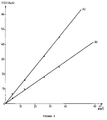
- Example 1 In order to compare the resistance to crushing of the alumina beads obtained according to the process of the invention (Example 1) which involves citric acid as complexing agent and of beads obtained in the absence of complexing agent (test Comparative A), the resistance to crushing of the balls was determined as a function of the diameter of the latter.
- Figure 3 is a graph on which are plotted two lines (A) and (B) which represent the variation of the EGG (in daN), as a function of the diameter d of the ball squared (in mm 2 ).
Landscapes
- Chemical & Material Sciences (AREA)
- Organic Chemistry (AREA)
- Inorganic Chemistry (AREA)
- Life Sciences & Earth Sciences (AREA)
- Geology (AREA)
- Analytical Chemistry (AREA)
- Chemical Kinetics & Catalysis (AREA)
- Solid-Sorbent Or Filter-Aiding Compositions (AREA)
- Compounds Of Alkaline-Earth Elements, Aluminum Or Rare-Earth Metals (AREA)
- Catalysts (AREA)
- Drying Of Gases (AREA)
- Treatment Of Liquids With Adsorbents In General (AREA)
Applications Claiming Priority (2)
| Application Number | Priority Date | Filing Date | Title |
|---|---|---|---|
| FR9002273A FR2658806B1 (fr) | 1990-02-23 | 1990-02-23 | Agglomeres d'alumine activee et leur procede d'obtention. |
| FR9002273 | 1990-02-23 |
Publications (2)
| Publication Number | Publication Date |
|---|---|
| EP0449672A1 EP0449672A1 (fr) | 1991-10-02 |
| EP0449672B1 true EP0449672B1 (fr) | 1997-07-23 |
Family
ID=9394075
Family Applications (1)
| Application Number | Title | Priority Date | Filing Date |
|---|---|---|---|
| EP91400331A Expired - Lifetime EP0449672B1 (fr) | 1990-02-23 | 1991-02-12 | Agglomérés d'alumine activée et leur procédé d'obtention |
Country Status (9)
| Country | Link |
|---|---|
| EP (1) | EP0449672B1 (da) |
| JP (2) | JP2681547B2 (da) |
| AT (1) | ATE155761T1 (da) |
| CA (1) | CA2036682C (da) |
| DE (1) | DE69126906T2 (da) |
| DK (1) | DK0449672T3 (da) |
| ES (1) | ES2106062T3 (da) |
| FR (1) | FR2658806B1 (da) |
| GR (1) | GR3024944T3 (da) |
Families Citing this family (7)
| Publication number | Priority date | Publication date | Assignee | Title |
|---|---|---|---|---|
| FR2764214B1 (fr) * | 1997-06-10 | 1999-07-16 | Inst Francais Du Petrole | Procede et masses de captation pour l'elimination du mercure et de l'arsenic dans les coupes hydrocarbonees |
| FR2764298B1 (fr) * | 1997-06-10 | 1999-07-16 | Inst Francais Du Petrole | Hydrotraitement de charges hydrocarbonees dans un reacteur en lit bouillonnant |
| US6495709B1 (en) * | 2000-03-16 | 2002-12-17 | Symetrix Corporation | Liquid precursors for aluminum oxide and method making same |
| FR2823684B1 (fr) * | 2001-04-20 | 2003-05-30 | Inst Francais Du Petrole | Billes d'alumine ayant une grande resistance mecanique aux chocs, leur procede de fabrication et leurs utilisations |
| US7101528B2 (en) * | 2004-04-26 | 2006-09-05 | Sasol North America Inc. | High pH dispersible nano-aluminas |
| US8501150B2 (en) | 2006-04-18 | 2013-08-06 | Basf Aktiengesellschaft | Metal oxides from metal-organic framework materials |
| JP4685974B2 (ja) * | 2009-02-24 | 2011-05-18 | 帝人株式会社 | 非水系二次電池用多孔膜、非水系二次電池用セパレータ、非水系二次電池用吸着剤および非水系二次電池 |
Citations (1)
| Publication number | Priority date | Publication date | Assignee | Title |
|---|---|---|---|---|
| EP0271104A2 (en) * | 1986-12-11 | 1988-06-15 | Aluminum Company Of America | Controlled crystal form of aluminum hydroxide |
Family Cites Families (9)
| Publication number | Priority date | Publication date | Assignee | Title |
|---|---|---|---|---|
| US3491491A (en) * | 1968-01-15 | 1970-01-27 | Us Industries Inc | Aluminous slurries containing ferric ammonium citrate |
| US4102978A (en) * | 1975-11-10 | 1978-07-25 | Norton Company | Process for producing alumina catalyst carriers |
| GB1529771A (en) * | 1976-02-17 | 1978-10-25 | Ford Motor Co | Method for preparing shaped green ceramic compacts from highly flowable and fillable powders containing beta and/or beta''al2o3 |
| JPS5335920A (en) * | 1976-09-16 | 1978-04-03 | Hitachi Ltd | Transformer windings |
| FR2449474A1 (fr) * | 1979-02-26 | 1980-09-19 | Rhone Poulenc Ind | Billes d'alumine a double porosite, leur procede de preparation et leurs applications comme supports de catalyseurs |
| FR2449650A1 (fr) * | 1979-02-26 | 1980-09-19 | Rhone Poulenc Ind | Procede de preparation d'alumine au moins partiellement sous forme de boehmite ultra-fine |
| FR2496631B1 (fr) * | 1980-12-23 | 1989-06-30 | Rhone Poulenc Ind | Procede de preparation d'agglomeres d'alumine |
| JPS6442888A (en) * | 1987-08-10 | 1989-02-15 | Nec Corp | Manufacture of semiconductor laser |
| US8942766B2 (en) | 2008-08-28 | 2015-01-27 | Optis Cellular Technology, Llc | Arrangement for improved isolation between adjacent cell areas |
-
1990
- 1990-02-23 FR FR9002273A patent/FR2658806B1/fr not_active Expired - Lifetime
-
1991
- 1991-02-12 AT AT91400331T patent/ATE155761T1/de not_active IP Right Cessation
- 1991-02-12 DE DE69126906T patent/DE69126906T2/de not_active Expired - Fee Related
- 1991-02-12 DK DK91400331.4T patent/DK0449672T3/da active
- 1991-02-12 EP EP91400331A patent/EP0449672B1/fr not_active Expired - Lifetime
- 1991-02-12 ES ES91400331T patent/ES2106062T3/es not_active Expired - Lifetime
- 1991-02-20 CA CA002036682A patent/CA2036682C/fr not_active Expired - Lifetime
- 1991-02-22 JP JP3048720A patent/JP2681547B2/ja not_active Expired - Fee Related
-
1997
- 1997-04-10 JP JP09106786A patent/JP3080899B2/ja not_active Expired - Lifetime
- 1997-10-06 GR GR970402585T patent/GR3024944T3/el unknown
Patent Citations (1)
| Publication number | Priority date | Publication date | Assignee | Title |
|---|---|---|---|---|
| EP0271104A2 (en) * | 1986-12-11 | 1988-06-15 | Aluminum Company Of America | Controlled crystal form of aluminum hydroxide |
Also Published As
| Publication number | Publication date |
|---|---|
| DE69126906T2 (de) | 1998-02-12 |
| JP2681547B2 (ja) | 1997-11-26 |
| GR3024944T3 (en) | 1998-01-30 |
| JP3080899B2 (ja) | 2000-08-28 |
| DE69126906D1 (de) | 1997-09-04 |
| CA2036682A1 (fr) | 1991-08-24 |
| ATE155761T1 (de) | 1997-08-15 |
| FR2658806A1 (fr) | 1991-08-30 |
| CA2036682C (fr) | 1999-03-23 |
| ES2106062T3 (es) | 1997-11-01 |
| DK0449672T3 (da) | 1997-09-15 |
| JPH05237376A (ja) | 1993-09-17 |
| JPH1059712A (ja) | 1998-03-03 |
| EP0449672A1 (fr) | 1991-10-02 |
| FR2658806B1 (fr) | 1992-05-22 |
Similar Documents
| Publication | Publication Date | Title |
|---|---|---|
| EP3218102B1 (fr) | Adsorbant zéolithique à base de zéolithe mésoporeuse | |
| CA2909798C (fr) | Zeolithes a porosite hierarchisee | |
| EP0055164B1 (fr) | Procédé de préparation d'agglomérés d'alumine | |
| FR2663245A1 (fr) | Composition a base d'alumine pour catalyseur et procede de fabrication. | |
| FR2538814A1 (fr) | Procede de traitement d'une huile lourde ou d'une fraction d'huile lourde pour les convertir en fractions plus legeres | |
| EP0353129B1 (fr) | Procédé de fabrication d'agglomérés d'alumine | |
| EP3030520A2 (fr) | Matériau zéolithique à base de zéolithe mésoporeuse | |
| CA2016345C (fr) | Zircone microporeuse et son procede de preparation | |
| CA2320824C (fr) | Procede d'elimination de composes halogenes contenus dans un gaz ou un liquide | |
| EP0449672A1 (fr) | Agglomérés d'alumine activée et leur procédé d'obtention | |
| EP0346962B1 (fr) | Procédé pour la fabrication de cristaux de titanate de baryum et/ou de strontium | |
| FR2851558A1 (fr) | Procede de production de poudre d'alumine | |
| EP0432007A1 (fr) | Nitrure de bore hexagonal monodisperse de haute pureté vis à vis des métaux et de l'oxygène et son procédé de prÀ©paration | |
| EP0161975B1 (fr) | Procédé de fabrication de produits poreux en bore ou en composés du bore | |
| WO2021105598A1 (fr) | Séparation des gaz de l'air | |
| US5637547A (en) | Crush resistant adsorptive agglomerates of activated alumina | |
| EP0396440A1 (fr) | Procédé de préparation de magnésite, application à la préparation de fluorure de magnésium et fluorure de magnésium ainsi obtenu | |
| CA2276558C (fr) | Nouvelle alumine, son procede de preparation et son utilisation en tant que catalyseur, support de catalyseur ou adsorbant | |
| FR3110907A1 (fr) | Procédé de synthèse d’une zéolithe IZM-6 en présence d’un structurant organique azoté | |
| EP3897968B1 (fr) | Matériau aggloméré zéolithique, procédé de préparation et utilisation pour la séparation non-cryogénique de gaz | |
| FR3101788A1 (fr) | METHODE DE STABILISATION DE MATERIAUX SILICOGERMANATES MICROPOREUX EN PRESENCE DE SiCl4 | |
| FR2640953A1 (da) | ||
| WO2023193974A1 (de) | Mit elementarem silber und elementarem ruthenium ausgestattetes partikelförmiges anorganisches material | |
| FR3117379A1 (fr) | Procede de preparation d'un materiau microporeux zeolithique contenant plus de 95% de zeolithe x et ayant une bonne resistance mecanique | |
| FR2834228A1 (fr) | Procede de preparation de catalyseurs basiques solides pour la reaction de wadworth-emmons |
Legal Events
| Date | Code | Title | Description |
|---|---|---|---|
| PUAI | Public reference made under article 153(3) epc to a published international application that has entered the european phase |
Free format text: ORIGINAL CODE: 0009012 |
|
| AK | Designated contracting states |
Kind code of ref document: A1 Designated state(s): AT BE CH DE DK ES FR GB GR IT LI LU NL SE |
|
| 17P | Request for examination filed |
Effective date: 19920116 |
|
| 17Q | First examination report despatched |
Effective date: 19940610 |
|
| GRAG | Despatch of communication of intention to grant |
Free format text: ORIGINAL CODE: EPIDOS AGRA |
|
| GRAH | Despatch of communication of intention to grant a patent |
Free format text: ORIGINAL CODE: EPIDOS IGRA |
|
| GRAH | Despatch of communication of intention to grant a patent |
Free format text: ORIGINAL CODE: EPIDOS IGRA |
|
| GRAA | (expected) grant |
Free format text: ORIGINAL CODE: 0009210 |
|
| AK | Designated contracting states |
Kind code of ref document: B1 Designated state(s): AT BE CH DE DK ES FR GB GR IT LI LU NL SE |
|
| REF | Corresponds to: |
Ref document number: 155761 Country of ref document: AT Date of ref document: 19970815 Kind code of ref document: T |
|
| REG | Reference to a national code |
Ref country code: CH Ref legal event code: EP |
|
| REF | Corresponds to: |
Ref document number: 69126906 Country of ref document: DE Date of ref document: 19970904 |
|
| REG | Reference to a national code |
Ref country code: DK Ref legal event code: T3 |
|
| REG | Reference to a national code |
Ref country code: CH Ref legal event code: NV Representative=s name: KIRKER & CIE SA |
|
| REG | Reference to a national code |
Ref country code: ES Ref legal event code: FG2A Ref document number: 2106062 Country of ref document: ES Kind code of ref document: T3 |
|
| GBT | Gb: translation of ep patent filed (gb section 77(6)(a)/1977) |
Effective date: 19971027 |
|
| REG | Reference to a national code |
Ref country code: GR Ref legal event code: FG4A Free format text: 3024944 |
|
| RAP2 | Party data changed (patent owner data changed or rights of a patent transferred) |
Owner name: RHODIA CHIMIE |
|
| PLBE | No opposition filed within time limit |
Free format text: ORIGINAL CODE: 0009261 |
|
| STAA | Information on the status of an ep patent application or granted ep patent |
Free format text: STATUS: NO OPPOSITION FILED WITHIN TIME LIMIT |
|
| NLT2 | Nl: modifications (of names), taken from the european patent patent bulletin |
Owner name: RHODIA CHIMIE |
|
| 26N | No opposition filed | ||
| REG | Reference to a national code |
Ref country code: CH Ref legal event code: PFA Free format text: RHONE-POULENC CHIMIE TRANSFER- RHODIA CHIMIE Ref country code: CH Ref legal event code: PUE Owner name: RHODIA CHIMIE TRANSFER- INSTITUT FRANCAIS DU PETRO |
|
| NLS | Nl: assignments of ep-patents |
Owner name: INSTITUT FRANCAIS DU PETROLE |
|
| NLT1 | Nl: modifications of names registered in virtue of documents presented to the patent office pursuant to art. 16 a, paragraph 1 |
Owner name: RHODIA CHIMIE |
|
| REG | Reference to a national code |
Ref country code: GB Ref legal event code: 732E |
|
| REG | Reference to a national code |
Ref country code: FR Ref legal event code: TP |
|
| BECH | Be: change of holder |
Free format text: 19990615 INSTITUT FRANCAIS DU *PETROLE |
|
| REG | Reference to a national code |
Ref country code: GB Ref legal event code: IF02 |
|
| PGFP | Annual fee paid to national office [announced via postgrant information from national office to epo] |
Ref country code: AT Payment date: 20030217 Year of fee payment: 13 |
|
| PGFP | Annual fee paid to national office [announced via postgrant information from national office to epo] |
Ref country code: LU Payment date: 20030227 Year of fee payment: 13 |
|
| PG25 | Lapsed in a contracting state [announced via postgrant information from national office to epo] |
Ref country code: LU Free format text: LAPSE BECAUSE OF NON-PAYMENT OF DUE FEES Effective date: 20040212 Ref country code: AT Free format text: LAPSE BECAUSE OF NON-PAYMENT OF DUE FEES Effective date: 20040212 |
|
| PGFP | Annual fee paid to national office [announced via postgrant information from national office to epo] |
Ref country code: ES Payment date: 20090205 Year of fee payment: 19 Ref country code: DK Payment date: 20090224 Year of fee payment: 19 |
|
| PGFP | Annual fee paid to national office [announced via postgrant information from national office to epo] |
Ref country code: NL Payment date: 20090226 Year of fee payment: 19 Ref country code: DE Payment date: 20090227 Year of fee payment: 19 |
|
| PGFP | Annual fee paid to national office [announced via postgrant information from national office to epo] |
Ref country code: CH Payment date: 20090327 Year of fee payment: 19 Ref country code: GB Payment date: 20090223 Year of fee payment: 19 Ref country code: GR Payment date: 20090203 Year of fee payment: 19 |
|
| PGFP | Annual fee paid to national office [announced via postgrant information from national office to epo] |
Ref country code: BE Payment date: 20090302 Year of fee payment: 19 |
|
| PGFP | Annual fee paid to national office [announced via postgrant information from national office to epo] |
Ref country code: SE Payment date: 20090223 Year of fee payment: 19 Ref country code: IT Payment date: 20090219 Year of fee payment: 19 |
|
| PGFP | Annual fee paid to national office [announced via postgrant information from national office to epo] |
Ref country code: FR Payment date: 20090121 Year of fee payment: 19 |
|
| BERE | Be: lapsed |
Owner name: INSTITUT FRANCAIS DU *PETROLE Effective date: 20100228 |
|
| REG | Reference to a national code |
Ref country code: NL Ref legal event code: V1 Effective date: 20100901 |
|
| REG | Reference to a national code |
Ref country code: CH Ref legal event code: PL |
|
| REG | Reference to a national code |
Ref country code: DK Ref legal event code: EBP |
|
| EUG | Se: european patent has lapsed | ||
| GBPC | Gb: european patent ceased through non-payment of renewal fee |
Effective date: 20100212 |
|
| PG25 | Lapsed in a contracting state [announced via postgrant information from national office to epo] |
Ref country code: CH Free format text: LAPSE BECAUSE OF NON-PAYMENT OF DUE FEES Effective date: 20100228 Ref country code: LI Free format text: LAPSE BECAUSE OF NON-PAYMENT OF DUE FEES Effective date: 20100228 |
|
| REG | Reference to a national code |
Ref country code: FR Ref legal event code: ST Effective date: 20101029 |
|
| PG25 | Lapsed in a contracting state [announced via postgrant information from national office to epo] |
Ref country code: FR Free format text: LAPSE BECAUSE OF NON-PAYMENT OF DUE FEES Effective date: 20100301 Ref country code: DK Free format text: LAPSE BECAUSE OF NON-PAYMENT OF DUE FEES Effective date: 20100228 Ref country code: NL Free format text: LAPSE BECAUSE OF NON-PAYMENT OF DUE FEES Effective date: 20100901 |
|
| PG25 | Lapsed in a contracting state [announced via postgrant information from national office to epo] |
Ref country code: DE Free format text: LAPSE BECAUSE OF NON-PAYMENT OF DUE FEES Effective date: 20100901 Ref country code: BE Free format text: LAPSE BECAUSE OF NON-PAYMENT OF DUE FEES Effective date: 20100228 |
|
| REG | Reference to a national code |
Ref country code: ES Ref legal event code: FD2A Effective date: 20110302 |
|
| PG25 | Lapsed in a contracting state [announced via postgrant information from national office to epo] |
Ref country code: IT Free format text: LAPSE BECAUSE OF NON-PAYMENT OF DUE FEES Effective date: 20100212 Ref country code: GB Free format text: LAPSE BECAUSE OF NON-PAYMENT OF DUE FEES Effective date: 20100212 |
|
| PG25 | Lapsed in a contracting state [announced via postgrant information from national office to epo] |
Ref country code: ES Free format text: LAPSE BECAUSE OF EXPIRATION OF PROTECTION Effective date: 20110213 |
|
| PG25 | Lapsed in a contracting state [announced via postgrant information from national office to epo] |
Ref country code: SE Free format text: LAPSE BECAUSE OF NON-PAYMENT OF DUE FEES Effective date: 20100213 |
|
| PG25 | Lapsed in a contracting state [announced via postgrant information from national office to epo] |
Ref country code: ES Free format text: LAPSE BECAUSE OF EXPIRATION OF PROTECTION Effective date: 20100213 |