EP0449867B1 - Plaque de fixation en polymere pour utilisation chirurgicale - Google Patents
Plaque de fixation en polymere pour utilisation chirurgicale Download PDFInfo
- Publication number
- EP0449867B1 EP0449867B1 EP90900201A EP90900201A EP0449867B1 EP 0449867 B1 EP0449867 B1 EP 0449867B1 EP 90900201 A EP90900201 A EP 90900201A EP 90900201 A EP90900201 A EP 90900201A EP 0449867 B1 EP0449867 B1 EP 0449867B1
- Authority
- EP
- European Patent Office
- Prior art keywords
- plate
- plates
- multilayer
- multilayer plate
- bone
- Prior art date
- Legal status (The legal status is an assumption and is not a legal conclusion. Google has not performed a legal analysis and makes no representation as to the accuracy of the status listed.)
- Expired - Lifetime
Links
Images




Classifications
-
- A—HUMAN NECESSITIES
- A61—MEDICAL OR VETERINARY SCIENCE; HYGIENE
- A61B—DIAGNOSIS; SURGERY; IDENTIFICATION
- A61B17/00—Surgical instruments, devices or methods
- A61B17/56—Surgical instruments or methods for treatment of bones or joints; Devices specially adapted therefor
- A61B17/58—Surgical instruments or methods for treatment of bones or joints; Devices specially adapted therefor for osteosynthesis, e.g. bone plates, screws or setting implements
- A61B17/68—Internal fixation devices, including fasteners and spinal fixators, even if a part thereof projects from the skin
- A61B17/80—Cortical plates, i.e. bone plates; Instruments for holding or positioning cortical plates, or for compressing bones attached to cortical plates
-
- A—HUMAN NECESSITIES
- A61—MEDICAL OR VETERINARY SCIENCE; HYGIENE
- A61B—DIAGNOSIS; SURGERY; IDENTIFICATION
- A61B17/00—Surgical instruments, devices or methods
- A61B2017/00004—(bio)absorbable, (bio)resorbable or resorptive
-
- A—HUMAN NECESSITIES
- A61—MEDICAL OR VETERINARY SCIENCE; HYGIENE
- A61F—FILTERS IMPLANTABLE INTO BLOOD VESSELS; PROSTHESES; DEVICES PROVIDING PATENCY TO, OR PREVENTING COLLAPSING OF, TUBULAR STRUCTURES OF THE BODY, e.g. STENTS; ORTHOPAEDIC, NURSING OR CONTRACEPTIVE DEVICES; FOMENTATION; TREATMENT OR PROTECTION OF EYES OR EARS; BANDAGES, DRESSINGS OR ABSORBENT PADS; FIRST-AID KITS
- A61F2/00—Filters implantable into blood vessels; Prostheses, i.e. artificial substitutes or replacements for parts of the body; Appliances for connecting them with the body; Devices providing patency to, or preventing collapsing of, tubular structures of the body, e.g. stents
- A61F2/02—Prostheses implantable into the body
- A61F2/30—Joints
- A61F2/3094—Designing or manufacturing processes
- A61F2/30965—Reinforcing the prosthesis by embedding particles or fibres during moulding or dipping
Definitions
- This invention describes a fixation device, which has been manufactured of a polymer, polymer mixture, copolymer or polymer composite and which is meant for fixation of bone fractures, osteotomies or arthrodeses.
- the device has been defined in more detail in the preamble of claim 1.
- Figure 1 shows schematically as a side view in cross-section how metallic plate 1 immobilises the fracture 3 in a bone 2 when the plate has been fixed into bone on both sides of the fracture with fixation devices like screws 4. Plate - screw combination maintaines the contact between the bone parts and makes healing possible.
- Metallic plates have, however, some negative properties. Metals are biomechanically too stiff materials (elastic modulus typically 100-200 GPa) in comparison to bone (elastic modulus typically 1-20 GPa). Therefore the metallic plate fixation protects bone too effectively against outer stresses. This leads to a so-called primary healing, which is slower than the healing with so-called callus mechanism, which happens with plates more flexible than the traditional metallic plates (see e.g. S.L.-Y. Woo, W.H. Akeson and R.D. Coutss in Perspectives on Biomaterials", O.C.C. Lind and E.Y.S. Chao (eds.), Elsevier, Amsterdam, 1986, pp. 223-244). Additionally the stiff metallic plate can lead to the increse of bone porosity.
- An advantage of metallic plates is that they can easily be bend according to the form of the bone surface, which facilitates the creation of exact reduction. The bending can be done in an operation room with specific instruments. This is possible because fixation metals have strong plastic deformation capacity.
- EP-A-0 149 540 discloses a fracture fixation device comprising at least two laminae being bonded together such that repeated loading results in progressive failure of the interlaminar bond.
- the multilayer plate of the invention It is typical for the multilayer plate of the invention that it can before fixation easily be bent by hand or by a bending instrument, because the single plates of the multilayer plate glide in respect to each other.
- the multilayer plate can be fixed on the bone surface in the bended form temporarily e.g. by means of metallic clamps. Thereafter the bended multilayer plate can be locked into this desired form by drilling through the multilayer plate and the bone below it a suitable amount of drill holes and by fixing the bended multilayer plate into bone with screws, bolts, rivets, clamps etc.
- the multilayer plate retains its bended form.
- the single plates of the multilayer plate can no more bend nor glide in respect to each other because of the compression friction between plates and fixation devices, like screws, which have been applied into the drill holes.
- the multilayer plate which is constructed of thin, flexible plates, functions like a thick and stiff bended plate giving an efficient fixation for the bone fracture.
- Figure 2 shows a side view in cross-section of a typical embodiment of the invention.
- a bundle 5 of four relatively thin, flexible plates is bent on the uncovered bone surface 6 over the fracture 3 (Figure 2a) and the bundle of the plates is fixed temporarily on the bone surface with metallic clamps 7 ( Figure 2b).
- a suitable amount of holes 8 is drilled on the both sides of the fracture through the multilayer plate (or plate bundle) and through bone ( Figure 2c).
- the multilayer plate 5 is fixed to the bone by means of screws 4 which are driven into the drill holes 8.
- the screws are typically driven through the back cortex to obtain strong fixation.
- the temporary clamps are removed ( Figure 2d) and the uncovered bone surface can be covered with soft tissues. The reduction of the fracture is retained exact, because the single plates of the multilayer plate cannot glide in relation to each other.
- the multilayer plate 5 can be first fixed with one screw 4, with bolt, rivet, clamp or corresponding, to the surface of the uncovered bone through one drill hole (Figure 3a). Thereafter the multilayer plate can be fixed stepwise on the bone surface by bending the multilayer plate on the bone surface by fixing it temporarily with a metallic clamp 7, by drilling another hole 8 for the second screw through the multilayer plate and bone ( Figure 3b) and by tightening the multilayer plate also through this hole on the bone by a screw. Now the clamp can be loosened ( Figure 3c). The surgeon proceeds over the whole multilayer plate with this technique and as a consequence the multilayer plate will be fixed tightly on the bone ( Figure 3d). It is self-evident that other versions of fixation techniques are possible for fixation of the multilayer plate of the invention on the bone.
- the plates of the multilayer plate can have elongated holes.
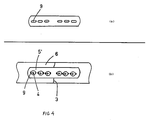
- Figure 4a shows schematically a plan view from above one such plate of the multilayer plate with its elongated holes 9.
- the fixation holes can be drilled directly into the bone through the elongated holes and the multilayer plate can be fixed with screws or other fixation elements on the bone. After tightening of the screws the plates cannot glide any more in relation to each other.
- This situation has been described schematically from above in Figure 4b, where the topmost plate 5' of the multilayer plate bridging the fracture 3 of the bone 6.
- the fixation screws 4 going through the elongated holes 9 are also seen.
- the multilayer plate of the invention one can create also compression into the bone fracture according to the following principles:
- the multilayer plate is fixed with metallic clamps on the bone surface over the fracture in such a way that a good mutual contact between bone fragments, and between multilayer plate and bone is retained.
- the multilayer plate is fixed on bone first with one fixation device (e.g. with a screw according to Figure 3a).
- one fixation device e.g. with a screw according to Figure 3a
- On the same side of the fracture additionally necessary amounts of screws is fixed (e.g. 2-3 additional screws).
- Figure 5a shows schematically from above the situation, where the multilayer plate 5 (whose uppermost plate 5' is seen) has been fixed on the bone 6 on the other side of the fracture 3 with three screws 4, 4', 4''.
- the screws have been installed in the middle of the holes of the multilayer plate so that every screw acts as a so-called neutral guide.
- the compression effect can also be caused by designing the holes of the multilayer plate eccentric by other ways and/or by using suitable auxiliary devices which cause compression.
- suitable auxiliary devices which cause compression.
- Different kinds of compression techniques are well-known in surgical techniques. They have been introduced e.g. in the book F. Séquin and R. Texhammar, "AO/ASIF Instrumentation", Springer, Berlin, 1981.
- the single plates of the multilayer plate of this invention can be manufactured of biostable and/or absorbable polymer, polymer mixture, copolymer or polymer composite.
- absorbable polymers given in Table 1 can be used for manufacturing of the devices of this invention:
- the multilayer plates of this invention which are manufactured of polymer, polymer mixture or copolymer, are of their structure at best reinforced composites.
- Absorbable composites like self-reinforced absorbable composites, are specially advantageous raw-materials for manufacturing the multilayer plates of this invention.
- Such self-reinforced composites have been described in publications U.S. Pat. No. 4 743 257 (Törmälä et al. ) and WO88/05312 (Törmälä et al. ).
- other types of absorbable composites can be applied in manufacturing of the multilayer plate of this invention. Accordingly multilayer plates can be manufactured by reinforcing absorbable material with fibers, film fibers, filaments, etc. which have been manufactured of absorbable polymer, copolymer or polymer mixture.
- the reinforcing can be carried out also with structures which have been constructed of above reinforcing elements like with braids, threads, bands, non-vowen stuctures, fabrics, knits etc.
- the reinforcing with the above reinforcing elements is made by combining the reinforcing elements and the absorbable polymer matrix with each other applying typical polymer technological methods.
- the reinforcing elements like absorbable fibers can be manufactured e.g. of several of the abosorbable polymers given in Table 1 and in the above text.
- the fibers can also be biodegradable ceramic fibers, like e.g. calcium phosphate fibers (see e.g. S. Vainion Georgä et al. , progr. Polym. Sci., in press).
- the multilayer plates of the invention comprising absorbable organic and/or unorganic absorbable fibers or structures constaucted of them and absorbable matrix, can be manufactured with various methods of plastics technology by winding the reinforcing structures at least partially to each other with absorbable polymer, copolymer or polymer mixture (matrix material) in such conditions, where matrix and reinforcing structures form homogeneous enough composite.
- Such structures are formes usually when the matrix is in liquid or melted state.
- Suitable methods to bind the reinforcing fibers etc. and matrix to each other and to form the composite material to semifinished products and/or implants are e.g. injection molding, extrusion, pultrusion, filament winding, compression winding and other plastics technological processing methods.
- the multilayer plate of the invention can also be manufactured of many biostable polymers, like polyethylene, polypropylene, polyasetal, polyamides, polyesters, polysulphone, polyetheretherketone, thermoplastic liquid crystalline polymers and other polymers.
- Absorbable and/or biostable multilayer plate materials can also be reinforced with biostable fibers like with carbon fibers, ceramic fibers (e.g. Al2O3), polyester fibers etc. It is natural that the devices of the invention can additionally include different kind of additives or auxiliary chemicals to facilitate the processing of the material (e.g. stabilizators, antioxidants or plasticizers) or to change its properties (e.g. plasticizers or powder-like ceramic materials or biostable fibers like carbon fibers) or facilitate its handling (e.g. colours).
- additives or auxiliary chemicals to facilitate the processing of the material (e.g. stabilizators, antioxidants or plasticizers) or to change its properties (e.g. plasticizers or powder-like ceramic materials or biostable fibers like carbon fibers) or facilitate its handling (e.g. colours).
- the devices of the invention include some bioactive material or materials, like antibiotic, chemotherapeutic, chemicals accelerating the healing of the wound, growth hormones, anticoagulants (like heparine) etc.
- bioactive material or materials like antibiotic, chemotherapeutic, chemicals accelerating the healing of the wound, growth hormones, anticoagulants (like heparine) etc.
- This kind of bioactive devices are especially advantageous in clinical use, because they have in addition to the mechanical effect also biochemical, chemotherapeutic, drug effect etc. in living tissues.
- the fixation device of the invention has several advantages in comparison the known plate-like devices.
- the polymeric or polymer composite plate do not have the adverse corrosion effects of metal plates and the elastic modulus of the polymer or polymer composite plate can be regulated suitably in such a way that the porosity of the bone does not increase and the healing of the fracture occurs with the callus mechanism.
- a special advantage is that the drill holes of the devices of the invention can be done just in the operation room by drilling. In this way the drill holes can be tailormade into the plate in the best way for the treatment of the patient.
- a significant advantage of the multilayer plate of the invention in comparison to the known polymeric and composite plates is the fact that the multilayer plate of the invention can be bended easily without heating, which facilitates and simplifies the operation and gives an exact operational result.
- the multilayer plate is also tougher than one thick polymer plate.
- the thick absorbable polymer plates have a tendency of breaking (see e.g. J. Eitenmüller et al. Abstracts of Eur. Congr. Biomater., Bologna, Italia, 1986, p. 94).
- Example 1 of this invention shows that the multilayer plates did not break in animal test. A evident reason to this is that the thin plates, about which the multilayer plate is constructed, are tougher than the thick plates.
- a fracture nucleates in one plate of the multilayer plate, it does not necessarily lead to catastrophal fracture of the whole device as easily as a nucleated fracture in a thick homogeneous plate.
- the multilayer plate of the invention can be applied in fixation of different kinds of bone fractures, osteotomies and arthrodeses.
- multilayer plate of the invention in comparison to the known plates is that surgeon can manufacture the multilayer in operation room taking into account the size of the bone and/or the fracture of the patient.
- the multilayer plate can be easily constructed in the operation room by cutting suitable parts from bigger polymer- or composite plate e.g. with scissors, stamping device, cutter, saw, hot wire, laser cutter etc. other cutting device desirable plates and by combining them to a multilayer plate (plate bundle) of the invention.
- By using such tailormade multilayer plates it is possible to optimize the fixation effect and at the same time to minimize the foreign material amount which is impanted into the tissues of the patient.
- Single plates of the multilayer plate of the invention can be fixed to each other with a binding material layer which is very elastic or easily deformable with plastic deformation. This makes the treatment of the multilayer plate in operation room easier when the single plates have been bound to each other.
- the binding material layer deforms (elastic or plastic deformation) which facilitates the gliding of the single plates to each other giving at last for the multilayer plate the desired shape.
- Suitable binding materials to the above multilayer plate are flexible and soft polymers, e.g. -caprolactone and its copolymers (e.g. with lactide), ethylene oxide-lactide copolymers, amorphous lactides like poly-DL-lactide. It is natural that also other types of elastic or plastic polymers or waxy oligomers etc. can be applied as binding material.
- the different plates can be manufactured of materials oriented and/or reinforced in different directions.
- a multilayer plate structure which is strong in different directions can be constructed.
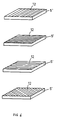
- the structure of such a multilayer plate has been schematically in Figure 6 where the orientation of molecular chains and/or the orientation of reinforcement elements (like reinforcing fibers) in different single plates 5' of a multilayer plate has described with black lines 12.
- Polylactide plates with the thickness 2.0 mm and other dimensions 50 x 50 mm were manufactured by injection molding from poly-L-lactide (Mw 250.000, manufacturer CCA biochem, Holland). The plates were drawn at 90°C to the final thickness of 0.5 mm. The plates self-reinforced during the drawing. The drawn plate was cut in the drawing direction to 60 mm long and 12 broad plates. Four such plates were stacked on each other to form a multilayer plate. The plates were sterilized by immersing them for 5 minutes in ethanol/water (75 w/w-% of ethanol) mixture.
- a sheep was anesthetized.
- the skin area on the right side of mandibular was shaved and washed with Neo-Amisept.
- the skin was opened and the periosteum of mandibula was revealed.
- the diastema area of mandibula was revealed and the mandibula was osteotomised in this area.
- the cut part of mandibula was fixed temporarily from the upper part of the bone with a fracture clamp.
- the bone tissue was dissected free of soft tissues 3 cm to both sides of the osteotomy.
- a 0.5 mm thick, 12 mm broad and 60 mm long self-reinforced polylactide plate was located on the dissected area so that the middle point of the plate was above the osteotomy.
- the multilayer plate comprising four single plates was fixed with plate clamps to the both pieces of mandibula so that a good contact of the osteotomized fragments remained.
- a 2.5 mm diameter drill hole was drilled through the multilayer plate to the end of the plate near the condyle. Through this drill hole a 2 mm diameter drill hole was drilled into the bone through both cortexes. This drill hole was drilled in the middle of the bigger hole in the multilayer plate (neutral guide). The length of the drill hole in bone was measured and it was threaded.
- a 2.5 mm diameter titanium screw was driven into the bone so that the multilayer plate was now fixed with one screw on the mandibula.
- X-ray figures were taken from all osteotomies after three weeks. Three animals were sacrificed 6, 12 and 24 weeks after operation and the mandibulas were reprepared carefully, x-ray figures were taken from mandibula and the bone was cast into methylmethacrylate. Histological observations showed that ossifying of the osteotomies was in progress after six weeks and after 12 weeks all the osteotomies were ossified. After one and two years' follow-up x-ray figures showed normal ossifying. Histological study from one mandibula afetr two years' follow-up time showed that the biodegradation of polylactide plates had started.
- the following polymers were applied to manufacture by injection molding 2 x 60 x 80 big plates: poly-L-lactide, polyglycolide, poly- ⁇ -hydroxybutyrate, glycolide/lactide copolymer (Polyglactine 910), HD-polyethylene, polypropylene, HD-polyethylene+ polypropylene mixture (mole ratio 1:1), polysulphone, polyetheretherketone.
- the drawn plates were cut in the drawing direction to 70 mm long and 10 mm broad plates. All such cut plates were stacked on each other to form a multilayer plate.
Landscapes
- Health & Medical Sciences (AREA)
- Orthopedic Medicine & Surgery (AREA)
- Surgery (AREA)
- Life Sciences & Earth Sciences (AREA)
- Heart & Thoracic Surgery (AREA)
- Nuclear Medicine, Radiotherapy & Molecular Imaging (AREA)
- Engineering & Computer Science (AREA)
- Biomedical Technology (AREA)
- Neurology (AREA)
- Medical Informatics (AREA)
- Molecular Biology (AREA)
- Animal Behavior & Ethology (AREA)
- General Health & Medical Sciences (AREA)
- Public Health (AREA)
- Veterinary Medicine (AREA)
- Surgical Instruments (AREA)
- Materials For Medical Uses (AREA)
Abstract
Claims (11)
- Plaque pour la fixation d'une fracture osseuse, d'une ostéotomie, d'une arthrodèse ou d'une opération correspondante, ou pour la fixation d'un ligament, d'un tendon ou d'un tissu conjonctif sur l'os, ladite plaque étant destinée à être fixée sur l'os au moins à l'aide d'un dispositif de fixation (4) comme par exemple une vis, une tige, une pince ou un dispositif correspondant, ladite plaque comprenant au moins deux plaques essentiellement superposées, de manière à réaliser une construction de plaque multicouche (5), dans laquelle les plaques ont été fabriquées en un polymère, un copolymère, un alliage de polymère ou un composite de polymère, caractérisée en ce que les plaques individuelles de ladite construction de plaque multicouche (5) sont flexibles de manière à assurer un changement de forme pour ladite construction de plaque multicouche afin d'adopter sensiblement la forme de la surface de l'os dans les conditions opératoires au moyen d'une force externe telle qu'appliquée à la main et/ou à l'aide d'un instrument de coudage sur ladite construction de plaque multicouche, grâce à quoi chaque plaque individuelle adopte sa propre position par rapport aux autres plaques individuelles par déplacement différentiel le long des surfaces de plaques superposées.
- Plaque selon la revendication 1, caractérisée en ce que les plaques individuelles ont été reliées les unes aux autres au moyen d'une couche intermédiaire entre les surfaces des plaques superposées afin de permettre le mouvement différentiel des plaques individuelles de ladite construction multicouche (5) par exemple le coulissement des plaques les unes par rapport aux autres dans des conditions opératoires.
- Plaque selon l'une et/ou l'autre des revendications 1 et 2, caractérisée en ce que les plaques individuelles sont bloquées les unes par rapport aux autres afin de réaliser une construction de plaque multicouche (5) sensiblement rigide, au moyen des forces de friction entre les plaques individuelles, lesdites forces de friction étant accomplies par les effets dudit au moins un dispositif de fixation (4) pendant la fixation de ladite construction (5) de plaque multicouche sur la surface de l'os.
- Plaque selon l'une quelconque des revendications 1 à 3, caractérisée en ce que ladite construction (5) de plaque multicouche est pourvue d'au moins deux trous (8) à travers chaque plaque individuelle de ladite construction (5) de plaque multicouche, la dimension en diamètre desdits trous étant, au moins dans une direction diamétrale, supérieure à la plus grande taille diamétrale de la partie du dispositif de fixation (4) qui doit être placé à travers ledit trou, assurant ainsi une certaine délocalisation entre les trous des plaques individuelles les uns par rapport aux autres sans risquer que ledit trou (8) à travers ladite construction (5) de plaque multicouche ne devienne incapable de recevoir ledit dispositif de fixation (4).
- Plaque selon l'une quelconque des revendications 1 à 4, caractérisée en ce que ladite construction (5) de plaque multicouche est pourvue d'au moins deux trous oblongs (8) à travers chaque plaque individuelle de ladite construction (5) de plaque multicouche, la direction de l'allongement desdits trous étant de préférence agencée sensiblement dans une direction qui permet le déplacement différentiel maximum entre lesdites plaques individuelles.
- Plaque selon l'une quelconque des revendications 1 à 5, caractérisée en ce qu'au moins une partie desdites plaques individuelles de ladite construction de plaque multicouche (5) a été produite en polymère stable sur le plan biologique.
- Plaque selon l'une quelconque des revendications 1 à 6, caractérisée en ce qu'au moins une partie desdites plaques individuelles de ladite construction (5) de plaque multicouche ont été produites en polymère absorbable.
- Plaque selon l'une quelconque des revendications 1 à 6, caractérisée en ce qu'au moins une partie desdites plaques individuelles de ladite construction (5) de plaque multicouche ont été renforcées à l'aide d'éléments de renfort stables sur le plan biologique, tels que des fibres ou des structures qui ont été construites avec des fibres.
- Plaque selon l'une quelconque des revendications 1 à 8, caractérisée en ce qu'au moins une partie desdites plaques individuelles de ladite construction (5) de plaque multicouche ont été renforcées avec des éléments de renfort absorbables, tels que des fibres ou des structures construites avec des fibres.
- Plaque selon l'une quelconque des revendications 1 à 9, caractérisée en ce qu'au moins une partie desdites plaques individuelles de ladite construction (5) de plaque multicouche sont auto-renforcées.
- Plaque selon l'une quelconque des revendications 8 à 10, caractérisée en ce que lesdits éléments de renfort et/ou les chaînes moléculaires dans les plaques individuelles séparées de ladite construction (5) de plaque multicouche sont orientés dans des directions différentes.
Applications Claiming Priority (3)
| Application Number | Priority Date | Filing Date | Title |
|---|---|---|---|
| FI885981 | 1988-12-23 | ||
| FI885981A FI82805C (fi) | 1988-12-23 | 1988-12-23 | En polymer fixeringskivkonstruktion foer kirurgiskt bruk. |
| PCT/FI1989/000236 WO1990007304A1 (fr) | 1988-12-23 | 1989-12-20 | Plaque de fixation en polymere pour utilisation chirurgicale |
Publications (2)
| Publication Number | Publication Date |
|---|---|
| EP0449867A1 EP0449867A1 (fr) | 1991-10-09 |
| EP0449867B1 true EP0449867B1 (fr) | 1994-04-20 |
Family
ID=8527631
Family Applications (1)
| Application Number | Title | Priority Date | Filing Date |
|---|---|---|---|
| EP90900201A Expired - Lifetime EP0449867B1 (fr) | 1988-12-23 | 1989-12-20 | Plaque de fixation en polymere pour utilisation chirurgicale |
Country Status (6)
| Country | Link |
|---|---|
| EP (1) | EP0449867B1 (fr) |
| AU (1) | AU4745690A (fr) |
| CA (1) | CA2006435A1 (fr) |
| DE (1) | DE68914849T2 (fr) |
| FI (1) | FI82805C (fr) |
| WO (1) | WO1990007304A1 (fr) |
Cited By (8)
| Publication number | Priority date | Publication date | Assignee | Title |
|---|---|---|---|---|
| WO2001022894A1 (fr) | 1999-09-30 | 2001-04-05 | Bionx Implants Oy | Systeme chirurgical de fixation de tissus |
| US6221075B1 (en) | 1998-03-06 | 2001-04-24 | Bionx Implants Oy | Bioabsorbable, deformable fixation plate |
| WO2001039680A1 (fr) | 1999-11-30 | 2001-06-07 | Bionx Implants, Oy | Plaque de fixation bioresorbable activant l'osteogenese |
| DE102006018867B3 (de) * | 2006-04-13 | 2008-01-03 | Aap Implantate Ag | Osteosynthetisches System |
| EP1857066B1 (fr) * | 2006-05-05 | 2010-07-21 | Bioretec Oy | Matériau de fixation bioabsorbable et déformable, et implant |
| US20130046346A1 (en) * | 2011-08-16 | 2013-02-21 | Goetz Thorwarth | Thermoplastic Multilayer Article |
| WO2017135519A1 (fr) * | 2016-02-04 | 2017-08-10 | Sung Chul Moon | Appareil de maintien de la largeur de palais expansé |
| US9855084B2 (en) | 2011-08-26 | 2018-01-02 | Bioretec Oy | Bioabsorbable, oriented, deformable fixation material and plate |
Families Citing this family (29)
| Publication number | Priority date | Publication date | Assignee | Title |
|---|---|---|---|---|
| CA2060635A1 (fr) * | 1991-02-12 | 1992-08-13 | Keith D'alessio | Implants medicaux bioabsorbables |
| US5779706A (en) * | 1992-06-15 | 1998-07-14 | Medicon Eg | Surgical system |
| US5290281A (en) * | 1992-06-15 | 1994-03-01 | Medicon Eg | Surgical system |
| DE59509247D1 (de) * | 1995-09-06 | 2001-06-13 | Synthes Ag | Knochenplatte |
| FI98136C (fi) | 1995-09-27 | 1997-04-25 | Biocon Oy | Kudosolosuhteissa hajoava materiaali ja menetelmä sen valmistamiseksi |
| EP1006915B1 (fr) * | 1997-09-04 | 2003-05-21 | SYNTHES AG Chur | Plaque symetrique pour osteosynthese |
| JPH11206871A (ja) * | 1998-01-27 | 1999-08-03 | Bmg:Kk | 生体内分解吸収性の骨固定材およびその製造方法 |
| US6406498B1 (en) | 1998-09-04 | 2002-06-18 | Bionx Implants Oy | Bioactive, bioabsorbable surgical composite material |
| JP3418350B2 (ja) | 1998-09-14 | 2003-06-23 | タキロン株式会社 | 生体内分解吸収性インプラント材とその形状調整方法 |
| CA2366783C (fr) * | 1999-04-05 | 2008-01-29 | Lance Middleton | Ligament rachidien artificiel |
| US6579533B1 (en) | 1999-11-30 | 2003-06-17 | Bioasborbable Concepts, Ltd. | Bioabsorbable drug delivery system for local treatment and prevention of infections |
| ES2223764T3 (es) * | 2001-03-09 | 2005-03-01 | Co-Ligne Ag | Implante longitudinal. |
| US7344539B2 (en) | 2001-03-30 | 2008-03-18 | Depuy Acromed, Inc. | Intervertebral connection system |
| SE522202C2 (sv) | 2001-10-29 | 2004-01-20 | Gen Orthopedics Internat Ab | System för fixering av frakturer |
| US7682392B2 (en) | 2002-10-30 | 2010-03-23 | Depuy Spine, Inc. | Regenerative implants for stabilizing the spine and devices for attachment of said implants |
| RU2241405C2 (ru) * | 2003-04-21 | 2004-12-10 | Московский государственный медико-стоматологический университет | Пластина для остеосинтеза |
| US8105367B2 (en) | 2003-09-29 | 2012-01-31 | Smith & Nephew, Inc. | Bone plate and bone plate assemblies including polyaxial fasteners |
| US8142462B2 (en) | 2004-05-28 | 2012-03-27 | Cavitech, Llc | Instruments and methods for reducing and stabilizing bone fractures |
| US7717946B2 (en) | 2004-06-07 | 2010-05-18 | Degima Gmbh | Polymeric plate bendable without thermal energy and methods of manufacture |
| EP1919385B1 (fr) | 2005-07-25 | 2014-08-20 | Smith & Nephew, Inc. | Plaques polyaxiales |
| US8382807B2 (en) | 2005-07-25 | 2013-02-26 | Smith & Nephew, Inc. | Systems and methods for using polyaxial plates |
| US7704257B2 (en) * | 2005-11-23 | 2010-04-27 | Stryker Trauma S.A. | Compression instrument |
| US7833253B2 (en) | 2006-01-17 | 2010-11-16 | Biodynamics Llc | Craniotomy closures and plugs |
| US8460346B2 (en) | 2006-01-17 | 2013-06-11 | Biodynamics Llc | Craniotomy closures |
| RU2313304C1 (ru) * | 2006-05-19 | 2007-12-27 | ООО "Медико-технологическое бюро "МТБ" | Пластинка для остеосинтеза |
| DE102009055826A1 (de) | 2009-11-25 | 2011-05-26 | Universitätsklinikum Jena | Vorrichtung zur Plattenosteosynthese |
| CN103717179B (zh) | 2011-06-15 | 2017-08-08 | 史密夫和内修有限公司 | 可变角度锁定植入物 |
| US10835301B1 (en) | 2014-03-13 | 2020-11-17 | Curax Scientific, Llc | Malleable auxiliary compression plate system and method |
| US10993750B2 (en) | 2015-09-18 | 2021-05-04 | Smith & Nephew, Inc. | Bone plate |
Family Cites Families (3)
| Publication number | Priority date | Publication date | Assignee | Title |
|---|---|---|---|---|
| US4338926A (en) * | 1980-11-21 | 1982-07-13 | Howmedica, Inc. | Bone fracture prosthesis with controlled stiffness |
| GB8400932D0 (en) * | 1984-01-13 | 1984-02-15 | Geistlich Soehne Ag | Bone fracture fixation plates |
| FI81498C (fi) * | 1987-01-13 | 1990-11-12 | Biocon Oy | Kirurgiska material och instrument. |
-
1988
- 1988-12-23 FI FI885981A patent/FI82805C/fi not_active IP Right Cessation
-
1989
- 1989-12-20 EP EP90900201A patent/EP0449867B1/fr not_active Expired - Lifetime
- 1989-12-20 AU AU47456/90A patent/AU4745690A/en not_active Abandoned
- 1989-12-20 WO PCT/FI1989/000236 patent/WO1990007304A1/fr not_active Ceased
- 1989-12-20 DE DE68914849T patent/DE68914849T2/de not_active Expired - Fee Related
- 1989-12-21 CA CA002006435A patent/CA2006435A1/fr not_active Abandoned
Cited By (9)
| Publication number | Priority date | Publication date | Assignee | Title |
|---|---|---|---|---|
| US6221075B1 (en) | 1998-03-06 | 2001-04-24 | Bionx Implants Oy | Bioabsorbable, deformable fixation plate |
| WO2001022894A1 (fr) | 1999-09-30 | 2001-04-05 | Bionx Implants Oy | Systeme chirurgical de fixation de tissus |
| WO2001039680A1 (fr) | 1999-11-30 | 2001-06-07 | Bionx Implants, Oy | Plaque de fixation bioresorbable activant l'osteogenese |
| DE102006018867B3 (de) * | 2006-04-13 | 2008-01-03 | Aap Implantate Ag | Osteosynthetisches System |
| EP1857066B1 (fr) * | 2006-05-05 | 2010-07-21 | Bioretec Oy | Matériau de fixation bioabsorbable et déformable, et implant |
| US8080043B2 (en) | 2006-05-05 | 2011-12-20 | Bioretec Oy | Bioabsorbable, deformable fixation material and implant |
| US20130046346A1 (en) * | 2011-08-16 | 2013-02-21 | Goetz Thorwarth | Thermoplastic Multilayer Article |
| US9855084B2 (en) | 2011-08-26 | 2018-01-02 | Bioretec Oy | Bioabsorbable, oriented, deformable fixation material and plate |
| WO2017135519A1 (fr) * | 2016-02-04 | 2017-08-10 | Sung Chul Moon | Appareil de maintien de la largeur de palais expansé |
Also Published As
| Publication number | Publication date |
|---|---|
| CA2006435A1 (fr) | 1990-06-23 |
| DE68914849T2 (de) | 1994-08-25 |
| WO1990007304A1 (fr) | 1990-07-12 |
| FI82805C (fi) | 1991-04-25 |
| FI885981A7 (fi) | 1990-06-24 |
| FI82805B (fi) | 1991-01-15 |
| EP0449867A1 (fr) | 1991-10-09 |
| DE68914849D1 (de) | 1994-05-26 |
| AU4745690A (en) | 1990-08-01 |
Similar Documents
| Publication | Publication Date | Title |
|---|---|---|
| EP0449867B1 (fr) | Plaque de fixation en polymere pour utilisation chirurgicale | |
| EP0299004B1 (fr) | Materiel chirurgical et l'utilisation du materiel pour la fabrication (d'une partie) du materiel pour l'utilisation en chirurgie osseuse | |
| EP1902680B1 (fr) | Élément allongé bioabsorbable | |
| US6503278B1 (en) | Under tissue conditions degradable material and a method for its manufacturing | |
| Törmälä et al. | Bioabsorbable polymers: materials technology and surgical applications | |
| EP0525352B1 (fr) | Dispositif de fixation résorbable à rigidité contrÔlée pour traitement in vivo du corps humain | |
| US4655203A (en) | Bone fracture surgical device | |
| US7648504B2 (en) | Bioabsorbable band system | |
| JP2960166B2 (ja) | 外科用インプラント | |
| US20020169452A1 (en) | Minimally traumatic surgical device for tissue treatment | |
| EP0390613A1 (fr) | Agrafe chirurgicale résorbable avec éléments pénétrant dans un os | |
| JP4231696B2 (ja) | 二次圧縮を有する骨固定用の遠位骨アンカー | |
| JP2001506171A (ja) | 組織治療のための外科用留め具 | |
| EP0815878A3 (fr) | Dispositifs de fixation des os à haute résistance et leur procédé de fabrication | |
| Suuronen et al. | New generation biodegradable plate for fracture fixation: comparison of bending strengths of mandibular osteotomies fixed with absorbable self-reinforced multi-layer poly-L-lactide plates and metallic plates—an experimental study in sheep | |
| Räihä | Biodegradable implants as intramedullary nails. A survey of recent studies and an introduction to their use | |
| Prevel et al. | A comparative biomechanical analysis of resorbable rigid fixation versus titanium rigid fixation of metacarpal fractures | |
| EP0471334B1 (fr) | Dispositif résorbable de fixation, avec éléments pénétrant dans un os | |
| Tunc | Orientruded polylactide based body-absorbable osteosynthesis devices: A short review |
Legal Events
| Date | Code | Title | Description |
|---|---|---|---|
| PUAI | Public reference made under article 153(3) epc to a published international application that has entered the european phase |
Free format text: ORIGINAL CODE: 0009012 |
|
| 17P | Request for examination filed |
Effective date: 19910619 |
|
| AK | Designated contracting states |
Kind code of ref document: A1 Designated state(s): DE FR GB IT |
|
| 17Q | First examination report despatched |
Effective date: 19930510 |
|
| GRAA | (expected) grant |
Free format text: ORIGINAL CODE: 0009210 |
|
| AK | Designated contracting states |
Kind code of ref document: B1 Designated state(s): DE FR GB IT |
|
| REF | Corresponds to: |
Ref document number: 68914849 Country of ref document: DE Date of ref document: 19940526 |
|
| ITF | It: translation for a ep patent filed | ||
| ET | Fr: translation filed | ||
| PLBE | No opposition filed within time limit |
Free format text: ORIGINAL CODE: 0009261 |
|
| STAA | Information on the status of an ep patent application or granted ep patent |
Free format text: STATUS: NO OPPOSITION FILED WITHIN TIME LIMIT |
|
| 26N | No opposition filed | ||
| PGFP | Annual fee paid to national office [announced via postgrant information from national office to epo] |
Ref country code: DE Payment date: 20001211 Year of fee payment: 12 |
|
| PGFP | Annual fee paid to national office [announced via postgrant information from national office to epo] |
Ref country code: FR Payment date: 20001212 Year of fee payment: 12 |
|
| PGFP | Annual fee paid to national office [announced via postgrant information from national office to epo] |
Ref country code: GB Payment date: 20001220 Year of fee payment: 12 |
|
| PG25 | Lapsed in a contracting state [announced via postgrant information from national office to epo] |
Ref country code: GB Free format text: LAPSE BECAUSE OF NON-PAYMENT OF DUE FEES Effective date: 20011220 |
|
| REG | Reference to a national code |
Ref country code: GB Ref legal event code: IF02 |
|
| PG25 | Lapsed in a contracting state [announced via postgrant information from national office to epo] |
Ref country code: DE Free format text: LAPSE BECAUSE OF NON-PAYMENT OF DUE FEES Effective date: 20020702 |
|
| GBPC | Gb: european patent ceased through non-payment of renewal fee |
Effective date: 20011220 |
|
| PG25 | Lapsed in a contracting state [announced via postgrant information from national office to epo] |
Ref country code: FR Free format text: LAPSE BECAUSE OF NON-PAYMENT OF DUE FEES Effective date: 20020830 |
|
| REG | Reference to a national code |
Ref country code: FR Ref legal event code: ST |
|
| PG25 | Lapsed in a contracting state [announced via postgrant information from national office to epo] |
Ref country code: IT Free format text: LAPSE BECAUSE OF NON-PAYMENT OF DUE FEES Effective date: 20051220 |