EP0450151A1 - Verwertung von Kohlevergasungsschlacken - Google Patents
Verwertung von Kohlevergasungsschlacken Download PDFInfo
- Publication number
- EP0450151A1 EP0450151A1 EP19900121365 EP90121365A EP0450151A1 EP 0450151 A1 EP0450151 A1 EP 0450151A1 EP 19900121365 EP19900121365 EP 19900121365 EP 90121365 A EP90121365 A EP 90121365A EP 0450151 A1 EP0450151 A1 EP 0450151A1
- Authority
- EP
- European Patent Office
- Prior art keywords
- aggregate
- coal ash
- ash slag
- binder
- coal
- Prior art date
- Legal status (The legal status is an assumption and is not a legal conclusion. Google has not performed a legal analysis and makes no representation as to the accuracy of the status listed.)
- Ceased
Links
Images


Classifications
-
- C—CHEMISTRY; METALLURGY
- C04—CEMENTS; CONCRETE; ARTIFICIAL STONE; CERAMICS; REFRACTORIES
- C04B—LIME, MAGNESIA; SLAG; CEMENTS; COMPOSITIONS THEREOF, e.g. MORTARS, CONCRETE OR LIKE BUILDING MATERIALS; ARTIFICIAL STONE; CERAMICS; REFRACTORIES; TREATMENT OF NATURAL STONE
- C04B18/00—Use of agglomerated or waste materials or refuse as fillers for mortars, concrete or artificial stone; Treatment of agglomerated or waste materials or refuse, specially adapted to enhance their filling properties in mortars, concrete or artificial stone
- C04B18/02—Agglomerated materials, e.g. artificial aggregates
- C04B18/027—Lightweight materials
-
- Y—GENERAL TAGGING OF NEW TECHNOLOGICAL DEVELOPMENTS; GENERAL TAGGING OF CROSS-SECTIONAL TECHNOLOGIES SPANNING OVER SEVERAL SECTIONS OF THE IPC; TECHNICAL SUBJECTS COVERED BY FORMER USPC CROSS-REFERENCE ART COLLECTIONS [XRACs] AND DIGESTS
- Y02—TECHNOLOGIES OR APPLICATIONS FOR MITIGATION OR ADAPTATION AGAINST CLIMATE CHANGE
- Y02W—CLIMATE CHANGE MITIGATION TECHNOLOGIES RELATED TO WASTEWATER TREATMENT OR WASTE MANAGEMENT
- Y02W30/00—Technologies for solid waste management
- Y02W30/50—Reuse, recycling or recovery technologies
- Y02W30/91—Use of waste materials as fillers for mortars or concrete
Definitions
- This invention relates to an aggregate and method for making the same which utilizes coal ash slag from coal gasification systems. More particularly, the present invention relates to a lightweight aggregate having a lesser density than the coal ash slag from which it was formed allowing for its use as a structural material. Further, the processed aggregate includes interlaced channels of characteristic diameter and length which allow for its use in chemical filtering or reaction processes.
- the flowing stream of gases and molten ash is rapidly cooled by quenching in a liquid pool of water.
- the slag produced by standard coal gasification systems has been shown to be relatively dense, impervious to leaching and relatively inert.
- the slag material is continuously removed from the system by equipment that permits an intermittent or continuous let down of the slag-water by-product from the elevated pressure of the particular system. Once removed, the slag must be disposed of in a safe and suitable manner. This step further adds to the total cost of producing syngas.
- coal combustion waste products due to the increasing costs of disposal and the limited availability of land for this purpose, particularly in areas of high population density.
- coal combustion waste materials are utilized to a far greater degree in Europe than in the United States.
- Another object of the present invention is to provide a lightweight aggregate useful as a structural material which is produced by firing a mixture including a substantial amount of coal ash slag removed from a coal gasification system and a minor amount of a suitable binder wherein the aggregate produced has a density less than the component coal ash slag.
- Still another object of the present invention is to provide a lightweight aggregate useful as a porous structure which is produced by firing a mixture including a substantial amount of coal ash slag removed from a coal gasification process and a minor amount of a suitable binder wherein the porous aggregate includes interlaced channels having a characteristic diameter and length.
- Yet another object of the present invention is to provide a method for producing a lightweight aggregate useful as a structural material including coal ash slag resulting from coal gasification wherein the aggregate produced is of a lesser density than the component coal ash slag, the method including the steps of screening the coal ash slag, recovering excess char from the screened coal ash, crushing the oversize particles removed by the screening process and re-combining the crushed particles with the slag, extruding or pelletizing the non-recombined slag with a binder to form a pre-aggregate, drying the pre-aggregate, firing the pre-aggregate and finally sealing the surface of the aggregate to form a final product.
- the binder may be a readily available clay, such as bentonite, present in the aggregate at approximately 2-10% of the mixture.
- the coal ash slag is processed through a series of steps which result in an aggregate which has a lesser density or weight than the original coal ash slag.
- the lower density allows for its use as a component in a number of structural materials such as mortar, cement, lightweight concrete blocks, etc.
- the aggregate is also characterized by interconnected channels having a particular characteristic diameter and length.
- the aggregate may also be useful in chemical processes as a means for chemical fixation, as a filter aid, or as a porous soil amendment material.
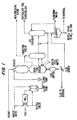
- Figure 1 is an example of a typical coal gasification process.
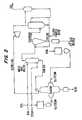
- Figure 2 is a further example of a typical coal gasification process.
- Figure 3 is a simple flowsheet representation of the slag utilization process of the subject invention.
- Figure 4 is a graphical illustration of the density of the aggregate product when the slag is fired at different times and temperatures.
- coal ash slag is a glassy by-product which is relatively dense, impervious to leaching and relatively inert. These characteristics make subsequent use of the slag very limited. It is the process of transforming the dense, glassy slag produced from a typical coal gasification system into a commercially desirable form having a reduced density and weight which constitutes the essence of the present invention.
- LWA lightweight aggregates
- Other naturally occurring materials of lower strength and/or quality that are used as lightweight aggregates include volcanic ash and cinder and pumice stone.
- Lightweight aggregates aside from having lower unit weights, provide better insulation and are more resistant to fire damage than conventional aggregates.
- Major applications of these aggregates are in the production of lightweight structural concrete and lightweight precast concrete products such as roofing tiles, masonry blocks, utility vaults for underground power cable connections, and cement concrete pipes, etc.
- typical coal gasification systems involve partial combustion of coal using an oxidant to produce synthesis gas consisting primarily of hydrogen and carbon monoxide.
- synthesis gas consisting primarily of hydrogen and carbon monoxide.
- all or substantially all of the carbon in the coal is reacted at an elevated temperature in the range of 900 . -1400 . C and at an elevated pressure in the range of 20-200 atm., using nozzles to inject the coal and the oxidant to form the desired synthesis gas.
- the reaction time for this process is typically 1-5 seconds.
- Systems vary with respect to the specific methods for feeding the ground coal, examples of such are coal water slurry systems or dry feed systems.
- Figures 1 and 2 illustrate schematically typical coal gasification systems.
- the reaction temperature is maintained above the melting point of the ash present in the coal that is fed to the system.
- the ash is in a molten state, as discussed previously which allows the oxidant to react with the carbonaceous material and reach near complete combustion.
- the flowing stream of gases and molten ash are rapidly cooled by quenching the stream of fluid in a liquid pool of water maintained at a low temperature; e.g., approximately 315 . C. On contact with the pool, the syngas is liberated and the ash is cooled to form a dense, glassy slag.
- FIG. 3 illustrates a flowchart representation of the steps carried out in accordance with the present invention.
- the coal ash slag is screened to provide a desired aggregate particle size.
- the acceptable particulate size will be directly dependent upon on the commercial use of the resulting aggregate.
- oversized particles are separately crushed and classified in a closed-circuit crushing operation, with these particles being re-combined with acceptable size particles.
- the screened particles may be processed through a char recovery step to recover excess char (carbon) from the slag which may in some instances reduce the final strength of the resultant aggregate. Complete char recovery is not, however, essential or even desired as examples hereinafter provided will demonstrate.
- the slag before firing of the slag, the slag is combined with an appropriate amount of a binder and water. The mixture is then agglomerated by extrusion or pelletization to form a pre-aggregate component.
- the final selection of the agglomeration method depends on the cost and availability of a binder.
- the binder may be any conventional, readily available clay such as bentonite.
- the binder is preferably present at about 2-10% of the total pre-aggregate.
- the pre-aggregate is air dried to reduce firing time and improve the aggregate strength.
- the firing step is preferably conducted in a commercially available kiln.
- a rotary kiln is recommended because of its flexibility and capability to produce aggregate products with differing specifications.
- the duration of the firing step has been shown not to be of particular significance in the overall process.
- Test results have shown the preferable range to be 4 to 10 minutes.
- the preferred temperature for firing the pre-aggregate is in the range of 1600 . F to 1900 .
- F. As can be seen from Figure 4, the effects of different firing times and temperatures on the resulting density of the aggregate product are set forth. It can be noted, that in each case, the minimum apparent densities were observed at a temperature range between 1700 and 1800 . F.
- the resulting aggregate is surface sealed with an appropriate oxide sealer to avoid water absorption.
- an appropriate oxide sealer to avoid water absorption.
- silicon oxide is used in the sealing process.
- the aggregate may again be screened to provide a desired resultant product size. The necessity for this final step will greatly depend upon the specific uses and requirements of the resultant product.
- the required firing temperatures apparently permit the emission of a gaseous efflux through the softened material.
- the efflux causes the structure of the aggregate to develop interlaced channels having a characteristic diameter and length. It is believed these channels result from the melting of the coal ash in the coal gasification system. Water from hydration and carbon dioxide from the calcination of carbonates formed during the melting of the coal ash in the coal gasification process are subsequently removed during the firing step of the subject invention. This removal produces the resulting porous structure.
- the coal gasification system is integral in forming a specific type of material which may be fired to form the desired product of the subject invention.
- the low density aggregate product may be used for a number of specific purposes, such as:
- Example 1 relates to the use of a 28 mesh grind, low density aggregate made in accordance with the subject invention as a substitute for concrete sand in a mortar mix. Specifically, three mixes were made. The first contained 40% by volume aggregate and 60% concrete sand, the second contained 100% aggregate and the third or Standard Mix contained 100% concrete sand. All three mixes also contained 6 sacks/cu yd of cement and 1.2 sacks/cu yd of lime. The results, tabulated below in Table 3, show mix 1 and mix 2 had 7-day and 28-day strengths of equal to or greater than that of the Standard Mix, while the unit weight of Mixes 1 and 2 were substantially lower than the unit weight of the Standard Mix.
- Example 2 relates to lightweight cement concrete wherein two mixes were compared, as in Example 1, for strength and unit weight.
- extruded low density aggregate made in accordance with the subject invention was combined with concrete sand to form Mix 1 wherein the aggregate was present in the amount of 60% by volume.
- the Standard Mix contained 60% coarse rock and 40% concrete sand.
- the size range of the low density aggregate and the rock is included below in Table 4.
- 6 sacks/cu yd of cement were used in each mix.
- the strength measurements for Mix 1 were lower than those for the Standard Mix. However, depending upon the aggregate product's use requirements, it may be sufficiently strong. Table 4 summarizes these results.
- Synthetic lightweight aggregate may be used in a variety of applications.
- Major applications of SLA may be found in the production of lightweight structural concrete and lightweight precast products such as roofing tiles, masonry blocks, utility vaults for underground power cable connections, cement concrete pipes and lightweight concrete masonry units.
Landscapes
- Engineering & Computer Science (AREA)
- Chemical & Material Sciences (AREA)
- Civil Engineering (AREA)
- Ceramic Engineering (AREA)
- Materials Engineering (AREA)
- Structural Engineering (AREA)
- Organic Chemistry (AREA)
- Processing Of Solid Wastes (AREA)
Applications Claiming Priority (2)
| Application Number | Priority Date | Filing Date | Title |
|---|---|---|---|
| US503985 | 1990-04-04 | ||
| US07/503,985 US5091349A (en) | 1990-04-04 | 1990-04-04 | Utilization of slag from coil gasification systems |
Publications (1)
| Publication Number | Publication Date |
|---|---|
| EP0450151A1 true EP0450151A1 (de) | 1991-10-09 |
Family
ID=24004368
Family Applications (1)
| Application Number | Title | Priority Date | Filing Date |
|---|---|---|---|
| EP19900121365 Ceased EP0450151A1 (de) | 1990-04-04 | 1990-11-08 | Verwertung von Kohlevergasungsschlacken |
Country Status (2)
| Country | Link |
|---|---|
| US (1) | US5091349A (de) |
| EP (1) | EP0450151A1 (de) |
Families Citing this family (9)
| Publication number | Priority date | Publication date | Assignee | Title |
|---|---|---|---|---|
| US5436227A (en) * | 1993-05-27 | 1995-07-25 | Shell Oil Company | Soluble/insoluble alcohol in drilling fluid |
| US5358044A (en) * | 1993-05-27 | 1994-10-25 | Shell Oil Company | Drilling and cementing with blast furnace slag/soluble/insoluble alcohol |
| US5361842A (en) * | 1993-05-27 | 1994-11-08 | Shell Oil Company | Drilling and cementing with blast furnace slag/silicate fluid |
| US5361841A (en) * | 1993-05-27 | 1994-11-08 | Shell Oil Company | Drilling and cementing with blast furnace slag/polyalcohol fluid |
| US5337824A (en) * | 1993-06-28 | 1994-08-16 | Shell Oil Company | Coal slag universal fluid |
| US5439056A (en) * | 1993-06-28 | 1995-08-08 | Shell Oil Company | Coal slag solidification of drilling fluid |
| US5363918A (en) * | 1993-08-04 | 1994-11-15 | Shell Oil Company | Wellbore sealing with unsaturated monomer system |
| US5379840A (en) * | 1993-08-19 | 1995-01-10 | Shell Oil Company | High temperature well cementing with low grade blast furnace slag |
| CN103936364B (zh) * | 2014-03-25 | 2016-02-10 | 暨南大学 | 一种利用水煤浆渣制备的高性能混凝土 |
Citations (4)
| Publication number | Priority date | Publication date | Assignee | Title |
|---|---|---|---|---|
| FR589558A (fr) * | 1924-11-22 | 1925-06-02 | Fabrication de nouveaux matériaux | |
| US1746860A (en) * | 1927-01-18 | 1930-02-11 | Dwight & Lloyd Metallurg Compa | Process of manufacturing cellular aggregate |
| FR2117647A5 (en) * | 1970-12-10 | 1972-07-21 | Gruenzweig & Hartmann | Slag treatment - by mixing with clay, forming into granules and heating |
| EP0188371A2 (de) * | 1985-01-14 | 1986-07-23 | Ube Industries, Ltd. | Leichtes Kunstaggregat |
Family Cites Families (8)
| Publication number | Priority date | Publication date | Assignee | Title |
|---|---|---|---|---|
| US300593A (en) * | 1884-06-17 | Fbedeicii geib | ||
| US1580906A (en) * | 1924-06-07 | 1926-04-13 | Korber Friedrich | Process for the production of artificial stone, stoveware, and the like from boiler slag, dust slag, or ashes |
| US2055706A (en) * | 1932-06-06 | 1936-09-29 | Chicago Distr Electric Generat | Method of making ceramic products |
| US2247120A (en) * | 1939-02-03 | 1941-06-24 | James A Fitzgerald | Ceramic body |
| US2576565A (en) * | 1947-04-04 | 1951-11-27 | G And W H Corson Inc | Ceramic product and method of making the same |
| JPS546568A (en) * | 1977-06-17 | 1979-01-18 | Nippon Telegr & Teleph Corp <Ntt> | Optical fiber connector |
| JPS6437447A (en) * | 1987-08-03 | 1989-02-08 | Hybrid Kk | Method for forming lightweight aggregate |
| JPH01122944A (ja) * | 1987-11-06 | 1989-05-16 | Agency Of Ind Science & Technol | 人工軽量骨材製造における焼成用成形物 |
-
1990
- 1990-04-04 US US07/503,985 patent/US5091349A/en not_active Expired - Fee Related
- 1990-11-08 EP EP19900121365 patent/EP0450151A1/de not_active Ceased
Patent Citations (4)
| Publication number | Priority date | Publication date | Assignee | Title |
|---|---|---|---|---|
| FR589558A (fr) * | 1924-11-22 | 1925-06-02 | Fabrication de nouveaux matériaux | |
| US1746860A (en) * | 1927-01-18 | 1930-02-11 | Dwight & Lloyd Metallurg Compa | Process of manufacturing cellular aggregate |
| FR2117647A5 (en) * | 1970-12-10 | 1972-07-21 | Gruenzweig & Hartmann | Slag treatment - by mixing with clay, forming into granules and heating |
| EP0188371A2 (de) * | 1985-01-14 | 1986-07-23 | Ube Industries, Ltd. | Leichtes Kunstaggregat |
Non-Patent Citations (3)
| Title |
|---|
| PATENT ABSTRACTS OF JAPAN, vol. 13, no. 367 (C-626) 15 August 1989; & JP-A-01 122 944 (AGENCY OF IND. SCIENCE & TECHNOLOGY) 16 May 1989. * |
| WORLD PATENTS INDEX LATEST, Accession No 89-088441, Week 12, DERWENT PUBLICATIONS LTD., LONDON, GB; & JP-A-01 037 447 (HYBRID KK) 08-02-89 * |
| WORLD PATENTS INDEX, Accession No 79-32634B, Week 17, DERWENT PUBLICATIONS LTD, LONDON, GB; & JP-A-54 006 568 (HOKKAIDO DENRYOKU) 29-03-79 * |
Also Published As
| Publication number | Publication date |
|---|---|
| US5091349A (en) | 1992-02-25 |
Similar Documents
| Publication | Publication Date | Title |
|---|---|---|
| Bijen | Manufacturing processes of artificial lightweight aggregates from fly ash | |
| USRE34775E (en) | Lightweight aggregate from flyash and sewage sludge | |
| US5166109A (en) | Utilization of slag from coal gasification systems | |
| TWI393691B (zh) | 含有焚化爐底灰(iba)和低鈣的矽鋁物質之高溫處理的聚集體及製造此聚集體的方法 | |
| AU2020102253A4 (en) | Lightweight and high-strength ceramsite and preparation method thereof | |
| CN105906176A (zh) | 一种利用油泥与固废共资源化制备轻质陶粒的方法 | |
| CN101905961A (zh) | 粉煤灰保温烧结材料及其生产工艺 | |
| US5091349A (en) | Utilization of slag from coil gasification systems | |
| CN101137595A (zh) | 包含iba和低钙的硅铝材料的高温加工的聚集体和此类聚集体的制备方法 | |
| KR100461090B1 (ko) | 석탄 연소 부산물로부터의 인공 쇄석의 제조 방법 | |
| GB2161174A (en) | Process for the preparation of an absorbing and adsorbing agent, and an absorbing and adsorbing agent thus produced | |
| CN116835961A (zh) | 一种煤基固废协同制备的陶粒及其制备方法 | |
| CN116177990A (zh) | 煤矸石协同石膏渣生产陶粒轻骨料的方法及系统 | |
| CN115057633A (zh) | 煤矸石基混凝土掺合料制备方法 | |
| JP2000119050A (ja) | 人工軽量骨材の製造方法およびこの方法により得られた人工軽量骨材 | |
| JP2000143307A (ja) | 人工軽量骨材の製造方法およびこの方法により得られた人工軽量骨材 | |
| JP2004269301A (ja) | 軽量骨材及びその製造方法 | |
| JP3275725B2 (ja) | 石炭灰系軽量骨材の製造方法 | |
| JPH04119952A (ja) | 人工軽量骨材の製造方法 | |
| Borowski et al. | Using agglomeration techniques for coal and ash waste management in the circular economy | |
| CN106167360A (zh) | 利用高铝硅酸盐尾矿及炉渣制备陶粒的方法 | |
| CN86106748A (zh) | 超轻陶粒及其配制方法 | |
| Bethanis et al. | Production of lightweight aggregate from incinerator bottom ash and pulverised fuel ash | |
| JPS62218524A (ja) | 鉄鉱石、鉄鋼製造副生成物および排出物、又はその他の鉄酸化物含有物質から鉄を回収する方法 | |
| DE2851412B2 (de) | Verfahren, Verwendung und Vorrichtung zum Herstellen von grobkeramischen Massen als Ausgangsprodukt für Ziegel |
Legal Events
| Date | Code | Title | Description |
|---|---|---|---|
| PUAI | Public reference made under article 153(3) epc to a published international application that has entered the european phase |
Free format text: ORIGINAL CODE: 0009012 |
|
| AK | Designated contracting states |
Kind code of ref document: A1 Designated state(s): AT BE CH DE DK ES FR GB GR IT LI LU NL SE |
|
| 17P | Request for examination filed |
Effective date: 19910921 |
|
| 17Q | First examination report despatched |
Effective date: 19921113 |
|
| STAA | Information on the status of an ep patent application or granted ep patent |
Free format text: STATUS: THE APPLICATION HAS BEEN REFUSED |
|
| 18R | Application refused |
Effective date: 19940729 |