EP0450437A2 - Copolymerisate auf Basis von C1-C8-Alkylacrylaten und/oder -methacrylaten, Verfahren zu ihrer Herstellung und ihre Verwendung - Google Patents
Copolymerisate auf Basis von C1-C8-Alkylacrylaten und/oder -methacrylaten, Verfahren zu ihrer Herstellung und ihre Verwendung Download PDFInfo
- Publication number
- EP0450437A2 EP0450437A2 EP91104620A EP91104620A EP0450437A2 EP 0450437 A2 EP0450437 A2 EP 0450437A2 EP 91104620 A EP91104620 A EP 91104620A EP 91104620 A EP91104620 A EP 91104620A EP 0450437 A2 EP0450437 A2 EP 0450437A2
- Authority
- EP
- European Patent Office
- Prior art keywords
- weight
- polyvinyl alcohol
- acid
- bis
- gew
- Prior art date
- Legal status (The legal status is an assumption and is not a legal conclusion. Google has not performed a legal analysis and makes no representation as to the accuracy of the status listed.)
- Granted
Links
- 229920001577 copolymer Polymers 0.000 title claims abstract description 60
- 150000002734 metacrylic acid derivatives Chemical class 0.000 title claims abstract description 6
- 238000000034 method Methods 0.000 title claims description 13
- 238000002360 preparation method Methods 0.000 title claims description 5
- 229920002451 polyvinyl alcohol Polymers 0.000 claims abstract description 45
- 239000004372 Polyvinyl alcohol Substances 0.000 claims abstract description 37
- 238000004513 sizing Methods 0.000 claims abstract description 32
- 239000003795 chemical substances by application Substances 0.000 claims abstract description 25
- 239000000203 mixture Substances 0.000 claims abstract description 18
- 239000000178 monomer Substances 0.000 claims abstract description 12
- 125000004209 (C1-C8) alkyl group Chemical group 0.000 claims abstract description 9
- CERQOIWHTDAKMF-UHFFFAOYSA-M Methacrylate Chemical compound CC(=C)C([O-])=O CERQOIWHTDAKMF-UHFFFAOYSA-M 0.000 claims abstract description 7
- 150000001735 carboxylic acids Chemical class 0.000 claims abstract description 6
- 239000000839 emulsion Substances 0.000 claims abstract description 6
- 150000001244 carboxylic acid anhydrides Chemical class 0.000 claims abstract description 4
- 229920000728 polyester Polymers 0.000 claims description 20
- 229920000642 polymer Polymers 0.000 claims description 17
- -1 aromatic tricarboxylic acid Chemical class 0.000 claims description 14
- 125000003118 aryl group Chemical group 0.000 claims description 10
- NIXOWILDQLNWCW-UHFFFAOYSA-M Acrylate Chemical compound [O-]C(=O)C=C NIXOWILDQLNWCW-UHFFFAOYSA-M 0.000 claims description 9
- 239000002253 acid Substances 0.000 claims description 7
- 239000000654 additive Substances 0.000 claims description 7
- 239000000835 fiber Substances 0.000 claims description 7
- OFOBLEOULBTSOW-UHFFFAOYSA-N Malonic acid Chemical compound OC(=O)CC(O)=O OFOBLEOULBTSOW-UHFFFAOYSA-N 0.000 claims description 6
- 125000003178 carboxy group Chemical group [H]OC(*)=O 0.000 claims description 6
- 150000002009 diols Chemical class 0.000 claims description 6
- 125000000020 sulfo group Chemical group O=S(=O)([*])O[H] 0.000 claims description 5
- 239000006185 dispersion Substances 0.000 claims description 4
- 150000003839 salts Chemical group 0.000 claims description 3
- 229920001410 Microfiber Polymers 0.000 claims description 2
- 229910052783 alkali metal Inorganic materials 0.000 claims description 2
- 150000001340 alkali metals Chemical class 0.000 claims description 2
- 229910052784 alkaline earth metal Inorganic materials 0.000 claims description 2
- 150000001342 alkaline earth metals Chemical class 0.000 claims description 2
- 150000003863 ammonium salts Chemical class 0.000 claims description 2
- 239000003658 microfiber Substances 0.000 claims description 2
- 238000000465 moulding Methods 0.000 claims description 2
- 239000004744 fabric Substances 0.000 claims 1
- 238000007720 emulsion polymerization reaction Methods 0.000 abstract description 6
- 238000010528 free radical solution polymerization reaction Methods 0.000 abstract description 3
- XLYOFNOQVPJJNP-UHFFFAOYSA-N water Substances O XLYOFNOQVPJJNP-UHFFFAOYSA-N 0.000 description 40
- 235000019422 polyvinyl alcohol Nutrition 0.000 description 34
- 239000000243 solution Substances 0.000 description 30
- BDHFUVZGWQCTTF-UHFFFAOYSA-M sulfonate Chemical compound [O-]S(=O)=O BDHFUVZGWQCTTF-UHFFFAOYSA-M 0.000 description 27
- 239000012188 paraffin wax Substances 0.000 description 25
- BWYYYTVSBPRQCN-UHFFFAOYSA-M sodium;ethenesulfonate Chemical compound [Na+].[O-]S(=O)(=O)C=C BWYYYTVSBPRQCN-UHFFFAOYSA-M 0.000 description 24
- NLHHRLWOUZZQLW-UHFFFAOYSA-N Acrylonitrile Chemical compound C=CC#N NLHHRLWOUZZQLW-UHFFFAOYSA-N 0.000 description 13
- CERQOIWHTDAKMF-UHFFFAOYSA-N Methacrylic acid Chemical compound CC(=C)C(O)=O CERQOIWHTDAKMF-UHFFFAOYSA-N 0.000 description 13
- CQEYYJKEWSMYFG-UHFFFAOYSA-N butyl acrylate Chemical compound CCCCOC(=O)C=C CQEYYJKEWSMYFG-UHFFFAOYSA-N 0.000 description 13
- LCPVQAHEFVXVKT-UHFFFAOYSA-N 2-(2,4-difluorophenoxy)pyridin-3-amine Chemical compound NC1=CC=CN=C1OC1=CC=C(F)C=C1F LCPVQAHEFVXVKT-UHFFFAOYSA-N 0.000 description 12
- VVQNEPGJFQJSBK-UHFFFAOYSA-N Methyl methacrylate Chemical compound COC(=O)C(C)=C VVQNEPGJFQJSBK-UHFFFAOYSA-N 0.000 description 12
- 229920002959 polymer blend Polymers 0.000 description 12
- CHQMHPLRPQMAMX-UHFFFAOYSA-L sodium persulfate Substances [Na+].[Na+].[O-]S(=O)(=O)OOS([O-])(=O)=O CHQMHPLRPQMAMX-UHFFFAOYSA-L 0.000 description 12
- YAJYJWXEWKRTPO-UHFFFAOYSA-N 2,3,3,4,4,5-hexamethylhexane-2-thiol Chemical compound CC(C)C(C)(C)C(C)(C)C(C)(C)S YAJYJWXEWKRTPO-UHFFFAOYSA-N 0.000 description 11
- 230000000694 effects Effects 0.000 description 10
- MTHSVFCYNBDYFN-UHFFFAOYSA-N diethylene glycol Chemical compound OCCOCCO MTHSVFCYNBDYFN-UHFFFAOYSA-N 0.000 description 9
- 238000006116 polymerization reaction Methods 0.000 description 9
- 239000007864 aqueous solution Substances 0.000 description 8
- 239000003995 emulsifying agent Substances 0.000 description 7
- 239000003999 initiator Substances 0.000 description 7
- HEMHJVSKTPXQMS-UHFFFAOYSA-M Sodium hydroxide Chemical compound [OH-].[Na+] HEMHJVSKTPXQMS-UHFFFAOYSA-M 0.000 description 6
- KKEYFWRCBNTPAC-UHFFFAOYSA-N Terephthalic acid Chemical compound OC(=O)C1=CC=C(C(O)=O)C=C1 KKEYFWRCBNTPAC-UHFFFAOYSA-N 0.000 description 6
- 230000007062 hydrolysis Effects 0.000 description 6
- 238000006460 hydrolysis reaction Methods 0.000 description 6
- QQVIHTHCMHWDBS-UHFFFAOYSA-N isophthalic acid Chemical compound OC(=O)C1=CC=CC(C(O)=O)=C1 QQVIHTHCMHWDBS-UHFFFAOYSA-N 0.000 description 6
- WSFSSNUMVMOOMR-UHFFFAOYSA-N Formaldehyde Chemical compound O=C WSFSSNUMVMOOMR-UHFFFAOYSA-N 0.000 description 5
- 239000000853 adhesive Substances 0.000 description 5
- 230000001070 adhesive effect Effects 0.000 description 5
- 238000004519 manufacturing process Methods 0.000 description 5
- PPBRXRYQALVLMV-UHFFFAOYSA-N Styrene Chemical compound C=CC1=CC=CC=C1 PPBRXRYQALVLMV-UHFFFAOYSA-N 0.000 description 4
- XSQUKJJJFZCRTK-UHFFFAOYSA-N Urea Chemical compound NC(N)=O XSQUKJJJFZCRTK-UHFFFAOYSA-N 0.000 description 4
- QGZKDVFQNNGYKY-UHFFFAOYSA-N ammonia Natural products N QGZKDVFQNNGYKY-UHFFFAOYSA-N 0.000 description 4
- 230000000903 blocking effect Effects 0.000 description 4
- 150000001732 carboxylic acid derivatives Chemical class 0.000 description 4
- 238000006386 neutralization reaction Methods 0.000 description 4
- NIXOWILDQLNWCW-UHFFFAOYSA-N 2-Propenoic acid Natural products OC(=O)C=C NIXOWILDQLNWCW-UHFFFAOYSA-N 0.000 description 3
- 229920000742 Cotton Polymers 0.000 description 3
- MHAJPDPJQMAIIY-UHFFFAOYSA-N Hydrogen peroxide Chemical compound OO MHAJPDPJQMAIIY-UHFFFAOYSA-N 0.000 description 3
- KWYUFKZDYYNOTN-UHFFFAOYSA-M Potassium hydroxide Chemical compound [OH-].[K+] KWYUFKZDYYNOTN-UHFFFAOYSA-M 0.000 description 3
- WPYMKLBDIGXBTP-UHFFFAOYSA-N benzoic acid Chemical compound OC(=O)C1=CC=CC=C1 WPYMKLBDIGXBTP-UHFFFAOYSA-N 0.000 description 3
- 150000002148 esters Chemical class 0.000 description 3
- 229920002689 polyvinyl acetate Polymers 0.000 description 3
- 239000011118 polyvinyl acetate Substances 0.000 description 3
- VZCYOOQTPOCHFL-UHFFFAOYSA-N trans-butenedioic acid Natural products OC(=O)C=CC(O)=O VZCYOOQTPOCHFL-UHFFFAOYSA-N 0.000 description 3
- 238000009941 weaving Methods 0.000 description 3
- WRIDQFICGBMAFQ-UHFFFAOYSA-N (E)-8-Octadecenoic acid Natural products CCCCCCCCCC=CCCCCCCC(O)=O WRIDQFICGBMAFQ-UHFFFAOYSA-N 0.000 description 2
- SMZOUWXMTYCWNB-UHFFFAOYSA-N 2-(2-methoxy-5-methylphenyl)ethanamine Chemical compound COC1=CC=C(C)C=C1CCN SMZOUWXMTYCWNB-UHFFFAOYSA-N 0.000 description 2
- YZTJKOLMWJNVFH-UHFFFAOYSA-N 2-sulfobenzene-1,3-dicarboxylic acid Chemical compound OC(=O)C1=CC=CC(C(O)=O)=C1S(O)(=O)=O YZTJKOLMWJNVFH-UHFFFAOYSA-N 0.000 description 2
- LQJBNNIYVWPHFW-UHFFFAOYSA-N 20:1omega9c fatty acid Natural products CCCCCCCCCCC=CCCCCCCCC(O)=O LQJBNNIYVWPHFW-UHFFFAOYSA-N 0.000 description 2
- QSBYPNXLFMSGKH-UHFFFAOYSA-N 9-Heptadecensaeure Natural products CCCCCCCC=CCCCCCCCC(O)=O QSBYPNXLFMSGKH-UHFFFAOYSA-N 0.000 description 2
- QGZKDVFQNNGYKY-UHFFFAOYSA-O Ammonium Chemical compound [NH4+] QGZKDVFQNNGYKY-UHFFFAOYSA-O 0.000 description 2
- VHUUQVKOLVNVRT-UHFFFAOYSA-N Ammonium hydroxide Chemical compound [NH4+].[OH-] VHUUQVKOLVNVRT-UHFFFAOYSA-N 0.000 description 2
- SOGAXMICEFXMKE-UHFFFAOYSA-N Butylmethacrylate Chemical compound CCCCOC(=O)C(C)=C SOGAXMICEFXMKE-UHFFFAOYSA-N 0.000 description 2
- VZCYOOQTPOCHFL-OWOJBTEDSA-N Fumaric acid Chemical compound OC(=O)\C=C\C(O)=O VZCYOOQTPOCHFL-OWOJBTEDSA-N 0.000 description 2
- OAKJQQAXSVQMHS-UHFFFAOYSA-N Hydrazine Chemical compound NN OAKJQQAXSVQMHS-UHFFFAOYSA-N 0.000 description 2
- DGAQECJNVWCQMB-PUAWFVPOSA-M Ilexoside XXIX Chemical compound C[C@@H]1CC[C@@]2(CC[C@@]3(C(=CC[C@H]4[C@]3(CC[C@@H]5[C@@]4(CC[C@@H](C5(C)C)OS(=O)(=O)[O-])C)C)[C@@H]2[C@]1(C)O)C)C(=O)O[C@H]6[C@@H]([C@H]([C@@H]([C@H](O6)CO)O)O)O.[Na+] DGAQECJNVWCQMB-PUAWFVPOSA-M 0.000 description 2
- 239000005642 Oleic acid Substances 0.000 description 2
- ZQPPMHVWECSIRJ-UHFFFAOYSA-N Oleic acid Natural products CCCCCCCCC=CCCCCCCCC(O)=O ZQPPMHVWECSIRJ-UHFFFAOYSA-N 0.000 description 2
- 229920000297 Rayon Polymers 0.000 description 2
- CDBYLPFSWZWCQE-UHFFFAOYSA-L Sodium Carbonate Chemical compound [Na+].[Na+].[O-]C([O-])=O CDBYLPFSWZWCQE-UHFFFAOYSA-L 0.000 description 2
- UIIMBOGNXHQVGW-UHFFFAOYSA-M Sodium bicarbonate Chemical compound [Na+].OC([O-])=O UIIMBOGNXHQVGW-UHFFFAOYSA-M 0.000 description 2
- WYURNTSHIVDZCO-UHFFFAOYSA-N Tetrahydrofuran Chemical compound C1CCOC1 WYURNTSHIVDZCO-UHFFFAOYSA-N 0.000 description 2
- ORLQHILJRHBSAY-UHFFFAOYSA-N [1-(hydroxymethyl)cyclohexyl]methanol Chemical compound OCC1(CO)CCCCC1 ORLQHILJRHBSAY-UHFFFAOYSA-N 0.000 description 2
- 150000007513 acids Chemical class 0.000 description 2
- XXROGKLTLUQVRX-UHFFFAOYSA-N allyl alcohol Chemical compound OCC=C XXROGKLTLUQVRX-UHFFFAOYSA-N 0.000 description 2
- 150000001408 amides Chemical class 0.000 description 2
- 230000015572 biosynthetic process Effects 0.000 description 2
- WQAQPCDUOCURKW-UHFFFAOYSA-N butanethiol Chemical compound CCCCS WQAQPCDUOCURKW-UHFFFAOYSA-N 0.000 description 2
- 238000006243 chemical reaction Methods 0.000 description 2
- 239000003638 chemical reducing agent Substances 0.000 description 2
- 239000000084 colloidal system Substances 0.000 description 2
- 238000009833 condensation Methods 0.000 description 2
- 230000005494 condensation Effects 0.000 description 2
- ARUVKPQLZAKDPS-UHFFFAOYSA-L copper(II) sulfate Chemical compound [Cu+2].[O-][S+2]([O-])([O-])[O-] ARUVKPQLZAKDPS-UHFFFAOYSA-L 0.000 description 2
- 238000005520 cutting process Methods 0.000 description 2
- QXJSBBXBKPUZAA-UHFFFAOYSA-N isooleic acid Natural products CCCCCCCC=CCCCCCCCCC(O)=O QXJSBBXBKPUZAA-UHFFFAOYSA-N 0.000 description 2
- 239000004816 latex Substances 0.000 description 2
- 229920000126 latex Polymers 0.000 description 2
- VZCYOOQTPOCHFL-UPHRSURJSA-N maleic acid Chemical compound OC(=O)\C=C/C(O)=O VZCYOOQTPOCHFL-UPHRSURJSA-N 0.000 description 2
- 239000011976 maleic acid Substances 0.000 description 2
- GLDOVTGHNKAZLK-UHFFFAOYSA-N octadecan-1-ol Chemical compound CCCCCCCCCCCCCCCCCCO GLDOVTGHNKAZLK-UHFFFAOYSA-N 0.000 description 2
- 239000003921 oil Substances 0.000 description 2
- ZQPPMHVWECSIRJ-KTKRTIGZSA-N oleic acid Chemical compound CCCCCCCC\C=C/CCCCCCCC(O)=O ZQPPMHVWECSIRJ-KTKRTIGZSA-N 0.000 description 2
- 229920001296 polysiloxane Polymers 0.000 description 2
- 230000001681 protective effect Effects 0.000 description 2
- 239000011734 sodium Substances 0.000 description 2
- 229910052708 sodium Inorganic materials 0.000 description 2
- GEHJYWRUCIMESM-UHFFFAOYSA-L sodium sulfite Chemical compound [Na+].[Na+].[O-]S([O-])=O GEHJYWRUCIMESM-UHFFFAOYSA-L 0.000 description 2
- 239000007787 solid Substances 0.000 description 2
- CIHOLLKRGTVIJN-UHFFFAOYSA-N tert‐butyl hydroperoxide Chemical compound CC(C)(C)OO CIHOLLKRGTVIJN-UHFFFAOYSA-N 0.000 description 2
- HJUGFYREWKUQJT-UHFFFAOYSA-N tetrabromomethane Chemical compound BrC(Br)(Br)Br HJUGFYREWKUQJT-UHFFFAOYSA-N 0.000 description 2
- VZGDMQKNWNREIO-UHFFFAOYSA-N tetrachloromethane Chemical compound ClC(Cl)(Cl)Cl VZGDMQKNWNREIO-UHFFFAOYSA-N 0.000 description 2
- 239000002562 thickening agent Substances 0.000 description 2
- ARCGXLSVLAOJQL-UHFFFAOYSA-N trimellitic acid Chemical compound OC(=O)C1=CC=C(C(O)=O)C(C(O)=O)=C1 ARCGXLSVLAOJQL-UHFFFAOYSA-N 0.000 description 2
- ALSTYHKOOCGGFT-KTKRTIGZSA-N (9Z)-octadecen-1-ol Chemical compound CCCCCCCC\C=C/CCCCCCCCO ALSTYHKOOCGGFT-KTKRTIGZSA-N 0.000 description 1
- DMWVYCCGCQPJEA-UHFFFAOYSA-N 2,5-bis(tert-butylperoxy)-2,5-dimethylhexane Chemical compound CC(C)(C)OOC(C)(C)CCC(C)(C)OOC(C)(C)C DMWVYCCGCQPJEA-UHFFFAOYSA-N 0.000 description 1
- JAHNSTQSQJOJLO-UHFFFAOYSA-N 2-(3-fluorophenyl)-1h-imidazole Chemical compound FC1=CC=CC(C=2NC=CN=2)=C1 JAHNSTQSQJOJLO-UHFFFAOYSA-N 0.000 description 1
- FRIBMENBGGCKPD-UHFFFAOYSA-N 3-(2,3-dimethoxyphenyl)prop-2-enal Chemical compound COC1=CC=CC(C=CC=O)=C1OC FRIBMENBGGCKPD-UHFFFAOYSA-N 0.000 description 1
- FLZDRQXGVYVYSL-UHFFFAOYSA-N 3-(2-cyanopropyldiazenyl)-2-methylpropanenitrile Chemical compound N#CC(C)CN=NCC(C)C#N FLZDRQXGVYVYSL-UHFFFAOYSA-N 0.000 description 1
- CGTLMVREWQIWEC-UHFFFAOYSA-N 4-decylphenol Chemical compound CCCCCCCCCCC1=CC=C(O)C=C1 CGTLMVREWQIWEC-UHFFFAOYSA-N 0.000 description 1
- IGFHQQFPSIBGKE-UHFFFAOYSA-N 4-nonylphenol Chemical compound CCCCCCCCCC1=CC=C(O)C=C1 IGFHQQFPSIBGKE-UHFFFAOYSA-N 0.000 description 1
- QTBSBXVTEAMEQO-UHFFFAOYSA-M Acetate Chemical compound CC([O-])=O QTBSBXVTEAMEQO-UHFFFAOYSA-M 0.000 description 1
- HRPVXLWXLXDGHG-UHFFFAOYSA-N Acrylamide Chemical compound NC(=O)C=C HRPVXLWXLXDGHG-UHFFFAOYSA-N 0.000 description 1
- 239000005711 Benzoic acid Substances 0.000 description 1
- OMPJBNCRMGITSC-UHFFFAOYSA-N Benzoylperoxide Chemical compound C=1C=CC=CC=1C(=O)OOC(=O)C1=CC=CC=C1 OMPJBNCRMGITSC-UHFFFAOYSA-N 0.000 description 1
- OYPRJOBELJOOCE-UHFFFAOYSA-N Calcium Chemical compound [Ca] OYPRJOBELJOOCE-UHFFFAOYSA-N 0.000 description 1
- PQUCIEFHOVEZAU-UHFFFAOYSA-N Diammonium sulfite Chemical compound [NH4+].[NH4+].[O-]S([O-])=O PQUCIEFHOVEZAU-UHFFFAOYSA-N 0.000 description 1
- RWSOTUBLDIXVET-UHFFFAOYSA-N Dihydrogen sulfide Chemical class S RWSOTUBLDIXVET-UHFFFAOYSA-N 0.000 description 1
- DCXXMTOCNZCJGO-UHFFFAOYSA-N Glycerol trioctadecanoate Natural products CCCCCCCCCCCCCCCCCC(=O)OCC(OC(=O)CCCCCCCCCCCCCCCCC)COC(=O)CCCCCCCCCCCCCCCCC DCXXMTOCNZCJGO-UHFFFAOYSA-N 0.000 description 1
- FYYHWMGAXLPEAU-UHFFFAOYSA-N Magnesium Chemical compound [Mg] FYYHWMGAXLPEAU-UHFFFAOYSA-N 0.000 description 1
- WHNWPMSKXPGLAX-UHFFFAOYSA-N N-Vinyl-2-pyrrolidone Chemical compound C=CN1CCCC1=O WHNWPMSKXPGLAX-UHFFFAOYSA-N 0.000 description 1
- 239000004952 Polyamide Substances 0.000 description 1
- XBDQKXXYIPTUBI-UHFFFAOYSA-M Propionate Chemical compound CCC([O-])=O XBDQKXXYIPTUBI-UHFFFAOYSA-M 0.000 description 1
- XBDQKXXYIPTUBI-UHFFFAOYSA-N Propionic acid Chemical group CCC(O)=O XBDQKXXYIPTUBI-UHFFFAOYSA-N 0.000 description 1
- 229910006069 SO3H Inorganic materials 0.000 description 1
- DWAQJAXMDSEUJJ-UHFFFAOYSA-M Sodium bisulfite Chemical compound [Na+].OS([O-])=O DWAQJAXMDSEUJJ-UHFFFAOYSA-M 0.000 description 1
- 235000021355 Stearic acid Nutrition 0.000 description 1
- GSEJCLTVZPLZKY-UHFFFAOYSA-N Triethanolamine Chemical compound OCCN(CCO)CCO GSEJCLTVZPLZKY-UHFFFAOYSA-N 0.000 description 1
- XTXRWKRVRITETP-UHFFFAOYSA-N Vinyl acetate Chemical compound CC(=O)OC=C XTXRWKRVRITETP-UHFFFAOYSA-N 0.000 description 1
- 238000005299 abrasion Methods 0.000 description 1
- 125000001931 aliphatic group Chemical group 0.000 description 1
- 125000005250 alkyl acrylate group Chemical group 0.000 description 1
- DIZPMCHEQGEION-UHFFFAOYSA-H aluminium sulfate (anhydrous) Chemical compound [Al+3].[Al+3].[O-]S([O-])(=O)=O.[O-]S([O-])(=O)=O.[O-]S([O-])(=O)=O DIZPMCHEQGEION-UHFFFAOYSA-H 0.000 description 1
- 229910021529 ammonia Inorganic materials 0.000 description 1
- 150000008064 anhydrides Chemical class 0.000 description 1
- 125000000129 anionic group Chemical group 0.000 description 1
- 239000003963 antioxidant agent Substances 0.000 description 1
- ZETCGWYACBNPIH-UHFFFAOYSA-N azane;sulfurous acid Chemical compound N.OS(O)=O ZETCGWYACBNPIH-UHFFFAOYSA-N 0.000 description 1
- 239000002585 base Substances 0.000 description 1
- 235000010233 benzoic acid Nutrition 0.000 description 1
- 235000019400 benzoyl peroxide Nutrition 0.000 description 1
- AGEZXYOZHKGVCM-UHFFFAOYSA-N benzyl bromide Chemical compound BrCC1=CC=CC=C1 AGEZXYOZHKGVCM-UHFFFAOYSA-N 0.000 description 1
- 239000011230 binding agent Substances 0.000 description 1
- KGBXLFKZBHKPEV-UHFFFAOYSA-N boric acid Chemical compound OB(O)O KGBXLFKZBHKPEV-UHFFFAOYSA-N 0.000 description 1
- 239000004327 boric acid Substances 0.000 description 1
- XNNQFQFUQLJSQT-UHFFFAOYSA-N bromo(trichloro)methane Chemical compound ClC(Cl)(Cl)Br XNNQFQFUQLJSQT-UHFFFAOYSA-N 0.000 description 1
- 229910052791 calcium Inorganic materials 0.000 description 1
- 239000011575 calcium Substances 0.000 description 1
- 239000004202 carbamide Substances 0.000 description 1
- 125000002091 cationic group Chemical group 0.000 description 1
- 229920002301 cellulose acetate Polymers 0.000 description 1
- 230000000052 comparative effect Effects 0.000 description 1
- 150000001875 compounds Chemical class 0.000 description 1
- 229910000365 copper sulfate Inorganic materials 0.000 description 1
- 239000003431 cross linking reagent Substances 0.000 description 1
- LDHQCZJRKDOVOX-NSCUHMNNSA-N crotonic acid Chemical compound C\C=C\C(O)=O LDHQCZJRKDOVOX-NSCUHMNNSA-N 0.000 description 1
- LSXWFXONGKSEMY-UHFFFAOYSA-N di-tert-butyl peroxide Chemical compound CC(C)(C)OOC(C)(C)C LSXWFXONGKSEMY-UHFFFAOYSA-N 0.000 description 1
- 150000001991 dicarboxylic acids Chemical class 0.000 description 1
- 235000014113 dietary fatty acids Nutrition 0.000 description 1
- LQZZUXJYWNFBMV-UHFFFAOYSA-N dodecan-1-ol Chemical compound CCCCCCCCCCCCO LQZZUXJYWNFBMV-UHFFFAOYSA-N 0.000 description 1
- MOTZDAYCYVMXPC-UHFFFAOYSA-N dodecyl hydrogen sulfate Chemical compound CCCCCCCCCCCCOS(O)(=O)=O MOTZDAYCYVMXPC-UHFFFAOYSA-N 0.000 description 1
- 229940043264 dodecyl sulfate Drugs 0.000 description 1
- UIWXSTHGICQLQT-UHFFFAOYSA-N ethenyl propanoate Chemical compound CCC(=O)OC=C UIWXSTHGICQLQT-UHFFFAOYSA-N 0.000 description 1
- 125000001495 ethyl group Chemical group [H]C([H])([H])C([H])([H])* 0.000 description 1
- 239000003925 fat Substances 0.000 description 1
- 239000000194 fatty acid Substances 0.000 description 1
- 229930195729 fatty acid Natural products 0.000 description 1
- 150000004665 fatty acids Chemical class 0.000 description 1
- 239000000945 filler Substances 0.000 description 1
- 230000009969 flowable effect Effects 0.000 description 1
- 239000001530 fumaric acid Substances 0.000 description 1
- 239000011521 glass Substances 0.000 description 1
- 238000010438 heat treatment Methods 0.000 description 1
- 230000002209 hydrophobic effect Effects 0.000 description 1
- 125000000959 isobutyl group Chemical group [H]C([H])([H])C([H])(C([H])([H])[H])C([H])([H])* 0.000 description 1
- 125000001449 isopropyl group Chemical group [H]C([H])([H])C([H])(*)C([H])([H])[H] 0.000 description 1
- 229910052749 magnesium Inorganic materials 0.000 description 1
- 239000011777 magnesium Substances 0.000 description 1
- 239000000463 material Substances 0.000 description 1
- 238000005259 measurement Methods 0.000 description 1
- 229910052751 metal Inorganic materials 0.000 description 1
- 239000002184 metal Substances 0.000 description 1
- FQPSGWSUVKBHSU-UHFFFAOYSA-N methacrylamide Chemical compound CC(=C)C(N)=O FQPSGWSUVKBHSU-UHFFFAOYSA-N 0.000 description 1
- 238000010327 methods by industry Methods 0.000 description 1
- 125000002496 methyl group Chemical group [H]C([H])([H])* 0.000 description 1
- LVHBHZANLOWSRM-UHFFFAOYSA-N methylenebutanedioic acid Natural products OC(=O)CC(=C)C(O)=O LVHBHZANLOWSRM-UHFFFAOYSA-N 0.000 description 1
- GOQYKNQRPGWPLP-UHFFFAOYSA-N n-heptadecyl alcohol Natural products CCCCCCCCCCCCCCCCCO GOQYKNQRPGWPLP-UHFFFAOYSA-N 0.000 description 1
- 125000003136 n-heptyl group Chemical group [H]C([H])([H])C([H])([H])C([H])([H])C([H])([H])C([H])([H])C([H])([H])C([H])([H])* 0.000 description 1
- 125000001280 n-hexyl group Chemical group C(CCCCC)* 0.000 description 1
- 125000000740 n-pentyl group Chemical group [H]C([H])([H])C([H])([H])C([H])([H])C([H])([H])C([H])([H])* 0.000 description 1
- 125000004123 n-propyl group Chemical group [H]C([H])([H])C([H])([H])C([H])([H])* 0.000 description 1
- QIQXTHQIDYTFRH-UHFFFAOYSA-N octadecanoic acid Chemical compound CCCCCCCCCCCCCCCCCC(O)=O QIQXTHQIDYTFRH-UHFFFAOYSA-N 0.000 description 1
- OQCDKBAXFALNLD-UHFFFAOYSA-N octadecanoic acid Natural products CCCCCCCC(C)CCCCCCCCC(O)=O OQCDKBAXFALNLD-UHFFFAOYSA-N 0.000 description 1
- ANISOHQJBAQUQP-UHFFFAOYSA-N octyl prop-2-enoate Chemical compound CCCCCCCCOC(=O)C=C ANISOHQJBAQUQP-UHFFFAOYSA-N 0.000 description 1
- FATBGEAMYMYZAF-KTKRTIGZSA-N oleamide Chemical compound CCCCCCCC\C=C/CCCCCCCC(N)=O FATBGEAMYMYZAF-KTKRTIGZSA-N 0.000 description 1
- 229940055577 oleyl alcohol Drugs 0.000 description 1
- XMLQWXUVTXCDDL-UHFFFAOYSA-N oleyl alcohol Natural products CCCCCCC=CCCCCCCCCCCO XMLQWXUVTXCDDL-UHFFFAOYSA-N 0.000 description 1
- 229940113162 oleylamide Drugs 0.000 description 1
- 239000003973 paint Substances 0.000 description 1
- XYFCBTPGUUZFHI-UHFFFAOYSA-O phosphonium Chemical compound [PH4+] XYFCBTPGUUZFHI-UHFFFAOYSA-O 0.000 description 1
- 239000000049 pigment Substances 0.000 description 1
- 229920002647 polyamide Polymers 0.000 description 1
- DJEHXEMURTVAOE-UHFFFAOYSA-M potassium bisulfite Chemical compound [K+].OS([O-])=O DJEHXEMURTVAOE-UHFFFAOYSA-M 0.000 description 1
- 235000010259 potassium hydrogen sulphite Nutrition 0.000 description 1
- 229940096992 potassium oleate Drugs 0.000 description 1
- BHZRJJOHZFYXTO-UHFFFAOYSA-L potassium sulfite Chemical compound [K+].[K+].[O-]S([O-])=O BHZRJJOHZFYXTO-UHFFFAOYSA-L 0.000 description 1
- 235000019252 potassium sulphite Nutrition 0.000 description 1
- MLICVSDCCDDWMD-KVVVOXFISA-M potassium;(z)-octadec-9-enoate Chemical compound [K+].CCCCCCCC\C=C/CCCCCCCC([O-])=O MLICVSDCCDDWMD-KVVVOXFISA-M 0.000 description 1
- 239000003755 preservative agent Substances 0.000 description 1
- 238000010526 radical polymerization reaction Methods 0.000 description 1
- 230000035484 reaction time Effects 0.000 description 1
- 239000012744 reinforcing agent Substances 0.000 description 1
- 238000007127 saponification reaction Methods 0.000 description 1
- 125000002914 sec-butyl group Chemical group [H]C([H])([H])C([H])([H])C([H])(*)C([H])([H])[H] 0.000 description 1
- 229910000030 sodium bicarbonate Inorganic materials 0.000 description 1
- 235000017557 sodium bicarbonate Nutrition 0.000 description 1
- 229910000029 sodium carbonate Inorganic materials 0.000 description 1
- 229940079827 sodium hydrogen sulfite Drugs 0.000 description 1
- 235000010267 sodium hydrogen sulphite Nutrition 0.000 description 1
- RYYKJJJTJZKILX-UHFFFAOYSA-M sodium octadecanoate Chemical compound [Na+].CCCCCCCCCCCCCCCCCC([O-])=O RYYKJJJTJZKILX-UHFFFAOYSA-M 0.000 description 1
- 159000000000 sodium salts Chemical class 0.000 description 1
- 235000010265 sodium sulphite Nutrition 0.000 description 1
- 230000006641 stabilisation Effects 0.000 description 1
- 238000011105 stabilization Methods 0.000 description 1
- 239000008117 stearic acid Substances 0.000 description 1
- 238000005728 strengthening Methods 0.000 description 1
- 239000000126 substance Substances 0.000 description 1
- OPQYOFWUFGEMRZ-UHFFFAOYSA-N tert-butyl 2,2-dimethylpropaneperoxoate Chemical compound CC(C)(C)OOC(=O)C(C)(C)C OPQYOFWUFGEMRZ-UHFFFAOYSA-N 0.000 description 1
- 125000000999 tert-butyl group Chemical group [H]C([H])([H])C(*)(C([H])([H])[H])C([H])([H])[H] 0.000 description 1
- ISXSCDLOGDJUNJ-UHFFFAOYSA-N tert-butyl prop-2-enoate Chemical compound CC(C)(C)OC(=O)C=C ISXSCDLOGDJUNJ-UHFFFAOYSA-N 0.000 description 1
- YLQBMQCUIZJEEH-UHFFFAOYSA-N tetrahydrofuran Natural products C=1C=COC=1 YLQBMQCUIZJEEH-UHFFFAOYSA-N 0.000 description 1
- 238000009988 textile finishing Methods 0.000 description 1
- LDHQCZJRKDOVOX-UHFFFAOYSA-N trans-crotonic acid Natural products CC=CC(O)=O LDHQCZJRKDOVOX-UHFFFAOYSA-N 0.000 description 1
- SRPWOOOHEPICQU-UHFFFAOYSA-N trimellitic anhydride Chemical compound OC(=O)C1=CC=C2C(=O)OC(=O)C2=C1 SRPWOOOHEPICQU-UHFFFAOYSA-N 0.000 description 1
- 125000000391 vinyl group Chemical group [H]C([*])=C([H])[H] 0.000 description 1
- 229920002554 vinyl polymer Polymers 0.000 description 1
- 239000000080 wetting agent Substances 0.000 description 1
- 210000002268 wool Anatomy 0.000 description 1
Classifications
-
- D—TEXTILES; PAPER
- D06—TREATMENT OF TEXTILES OR THE LIKE; LAUNDERING; FLEXIBLE MATERIALS NOT OTHERWISE PROVIDED FOR
- D06M—TREATMENT, NOT PROVIDED FOR ELSEWHERE IN CLASS D06, OF FIBRES, THREADS, YARNS, FABRICS, FEATHERS OR FIBROUS GOODS MADE FROM SUCH MATERIALS
- D06M15/00—Treating fibres, threads, yarns, fabrics, or fibrous goods made from such materials, with macromolecular compounds; Such treatment combined with mechanical treatment
- D06M15/19—Treating fibres, threads, yarns, fabrics, or fibrous goods made from such materials, with macromolecular compounds; Such treatment combined with mechanical treatment with synthetic macromolecular compounds
- D06M15/21—Macromolecular compounds obtained by reactions only involving carbon-to-carbon unsaturated bonds
- D06M15/327—Macromolecular compounds obtained by reactions only involving carbon-to-carbon unsaturated bonds of unsaturated alcohols or esters thereof
- D06M15/333—Macromolecular compounds obtained by reactions only involving carbon-to-carbon unsaturated bonds of unsaturated alcohols or esters thereof of vinyl acetate; Polyvinylalcohol
-
- C—CHEMISTRY; METALLURGY
- C08—ORGANIC MACROMOLECULAR COMPOUNDS; THEIR PREPARATION OR CHEMICAL WORKING-UP; COMPOSITIONS BASED THEREON
- C08F—MACROMOLECULAR COMPOUNDS OBTAINED BY REACTIONS ONLY INVOLVING CARBON-TO-CARBON UNSATURATED BONDS
- C08F220/00—Copolymers of compounds having one or more unsaturated aliphatic radicals, each having only one carbon-to-carbon double bond, and only one being terminated by only one carboxyl radical or a salt, anhydride ester, amide, imide or nitrile thereof
- C08F220/02—Monocarboxylic acids having less than ten carbon atoms; Derivatives thereof
- C08F220/10—Esters
- C08F220/12—Esters of monohydric alcohols or phenols
-
- C—CHEMISTRY; METALLURGY
- C08—ORGANIC MACROMOLECULAR COMPOUNDS; THEIR PREPARATION OR CHEMICAL WORKING-UP; COMPOSITIONS BASED THEREON
- C08F—MACROMOLECULAR COMPOUNDS OBTAINED BY REACTIONS ONLY INVOLVING CARBON-TO-CARBON UNSATURATED BONDS
- C08F261/00—Macromolecular compounds obtained by polymerising monomers on to polymers of oxygen-containing monomers as defined in group C08F16/00
- C08F261/02—Macromolecular compounds obtained by polymerising monomers on to polymers of oxygen-containing monomers as defined in group C08F16/00 on to polymers of unsaturated alcohols
- C08F261/04—Macromolecular compounds obtained by polymerising monomers on to polymers of oxygen-containing monomers as defined in group C08F16/00 on to polymers of unsaturated alcohols on to polymers of vinyl alcohol
-
- D—TEXTILES; PAPER
- D06—TREATMENT OF TEXTILES OR THE LIKE; LAUNDERING; FLEXIBLE MATERIALS NOT OTHERWISE PROVIDED FOR
- D06M—TREATMENT, NOT PROVIDED FOR ELSEWHERE IN CLASS D06, OF FIBRES, THREADS, YARNS, FABRICS, FEATHERS OR FIBROUS GOODS MADE FROM SUCH MATERIALS
- D06M15/00—Treating fibres, threads, yarns, fabrics, or fibrous goods made from such materials, with macromolecular compounds; Such treatment combined with mechanical treatment
- D06M15/19—Treating fibres, threads, yarns, fabrics, or fibrous goods made from such materials, with macromolecular compounds; Such treatment combined with mechanical treatment with synthetic macromolecular compounds
- D06M15/21—Macromolecular compounds obtained by reactions only involving carbon-to-carbon unsaturated bonds
- D06M15/263—Macromolecular compounds obtained by reactions only involving carbon-to-carbon unsaturated bonds of unsaturated carboxylic acids; Salts or esters thereof
Definitions
- the invention relates to the copolymers completely or partially neutralized with alkali metal, alkaline earth metal and ammonium salts, a process for the preparation of the copolymers, their use as a means for the temporary surface protection of moldings and sheet materials and as a sizing agent for the processing of staple fiber and filament yarns and the like Sizing agents.
- the invention relates to sizing agents from the described acrylate and / or methacrylate copolymers, polyvinyl alcohol, conventional additives and completely or partially neutralized sulfo and / or carboxyl groups, salt-soluble water-soluble polyesters from non-aromatic C2-C6 diols and mixtures of aromatic dicarboxylic acids and aromatic Tricarboxylic acids and / or sulfodicarboxylic acids and the use of these sizing agents for the processing of filament yarns.
- Copolymers prepared by emulsion polymerization in the presence of protective colloids such as polyvinyl alcohol and based on alkyl acrylates and / or methacrylates with minor amounts of other comonomers such as unsaturated carboxylic acids, e.g. Acrylic acid, are known from various publications.
- the copolymers in the other hand contain a maximum of 7% (US Pat. No. 3,876,596), a maximum of 5% (US Pat. No. 4,670,505) or a maximum of 2% (US Pat. No. 4,265,796) ) very little polyvinyl alcohol as a protective colloid.
- Copolymers based on acrylate and / or methacrylate copolymers are known from Ullmann, vol. 23, p. 16 (1983), which are recommended as sizing agents.
- copolymers described have an undesired sticking of the sized filament threads and experience a large increase in viscosity during neutralization.
- the object of the present invention is therefore to provide new copolymers which can be used in particular as sizing agents.
- copolymers defined at the outset a process for the preparation of these copolymers and their use as agents for temporary surface protection and as sizing agents for the processing of staple fiber and filament yarns have been found.
- sizing agents from the described acrylate and / or methacrylate copolymers, polyvinyl alcohol, customary additives and completely or partially neutralized sulfo and / or carboxyl groups, salt-soluble polyesters from non-aromatic C2-C6 diols and mixtures of aromatic dicarboxylic acids and aromatic tricarboxylic acids and / or -sulfodicarboxylic acids found.
- the copolymers of the invention are from 50 to 95 wt .-%, preferably 70 to 80 wt .-% of a C1-C8-alkyl acrylate and / or methacrylate as component A and 5 to 20 wt .-% of an unsaturated carboxylic acid as component B in Presence of 2 to 60 parts by weight, preferably 10 to 40 parts by weight of polyvinyl alcohol, based on 100 parts by weight of A and B.
- copolymers according to the invention can also be built up from up to 20% by weight of further water-soluble comonomers as component C and from up to 10% by weight of other comonomers as component D.
- component A are C1-C8 alkyl acrylates and / or methacrylates.
- Particularly preferred components A are methyl and n-butyl acrylate and / or methacrylate.
- Ethyl, n-propyl, iso-propyl, iso-butyl, sec-butyl, tert-butyl acrylate or methacrylate are preferred.
- n-pentyl, n-hexyl, 2-ethylhexyl, n-heptyl and n-octyl acrylate or methacrylate should be mentioned.
- Unsaturated carboxylic acids come into consideration as component B, primarily acrylic acid and methacrylic acid.
- Crotonic acid, maleic acid, fumaric acid, itaconic acid and the anhydrides of unsaturated carboxylic acids are also suitable.
- Additional water-soluble comonomers as component C are, above all, acrylamide, methacrylamide, allyl alcohol and very particularly acrylonitrile and sodium vinyl sulfonate.
- component D preferably vinyl aromatics such as styrene, vinyl acetate, vinyl propionate, N-vinylpyrrolidone and the esters of unsaturated dicarboxylic acids such as the di-n-butyl ester of maleic acid.
- vinyl aromatics such as styrene, vinyl acetate, vinyl propionate, N-vinylpyrrolidone and the esters of unsaturated dicarboxylic acids such as the di-n-butyl ester of maleic acid.
- the polyvinyl alcohols used as component E preferably have a degree of polymerization of 200 to 2000 and a degree of hydrolysis of 75 to 99 mol%. The remaining 1 to 25 mol% are accounted for by acetate or propionate groups of the polyvinyl acetate or propionate preferably used for the production of the polyvinyl alcohol.
- polyvinyl alcohols with a degree of polymerization of 300 to 2000 (corresponding to a standard viscosity of 3 to 25 mPa ⁇ s) and a degree of saponification of 86 to 90 mol% are preferred.
- copolymers according to the invention are prepared by free-radical solution polymerization, preferably by free-radical emulsion polymerization in aqueous solution.
- the usual peroxo or azo compounds, also in combination with, can be used as initiators for the radical polymerization reaction Reducing agents, advantageously in amounts of 0.5 to 2.0 wt .-%, based on the weight of the monomers, are used.
- Preferred initiators are dibenzoyl peroxide, tert-butyl perpivalate, tert-butyl per-2-ethylhexanoate, di-tert-butyl peroxide, tert-butyl hydroperoxide, 2,5-dimethyl-2,5-di (tert-butyl peroxy) hexane To name cumene hydroperoxide and 4,4'-azobisisobutyronitrile.
- Preferred reducing agents are hydrazine, sodium sulfite, sodium hydrogen sulfite, potassium sulfite, potassium hydrogen sulfite, ammonium sulfite and ammonium hydrogen sulfite, which are used in amounts of 0.005 to 2.0% by weight.
- Preferred emulsifiers are anionic emulsifiers such as lauryl sulfate, p-n-nonylphenol, p-n-decylphenol, sodium stearate, potassium oleate and especially C15 paraffin sulfonate.
- Suitable nonionic emulsifiers are preferably the oxyethylation products of lauryl alcohol, oleyl alcohol, stearyl alcohol, oleic acid and stearin amide, oleyl amide and stearic and oleic acid with a degree of oxethylation of 3 to 20.
- cationic emulsifiers such as ammonium, phosphonium and sulfonium compounds are also suitable a long aliphatic hydrocarbon chain as a hydrophobic part of the molecule.
- the emulsifiers important for emulsion polymerization are used in amounts of 0.1 to 2.0% by weight.
- Regulators can be added to control the molecular mass. It is particularly important to use a regulator with larger quantities of polyvinyl alcohol, since without a regulator it is possible to form highly viscous, non-flowable solutions that are less suitable as sizing agents.
- Preferred regulators are carbon tetrachloride, carbon tetrabromide, benzyl bromide, trichlorobromomethane and butyl mercaptan, which are generally used in amounts of 0.1 to 5% by weight.
- tert-dodecyl mercaptan as a regulator in amounts of 0.2 to 1.0% by weight in combination with 1.0 to 1.5% by weight of a peroxo compound as an initiator.
- the polymerization is carried out at 20 to 95 ° C., preferably at 65 to 90 ° C.
- reaction is expediently carried out at normal pressure, but it is also possible to work at reduced or slightly elevated pressure, that is to say in the range from 0.5 to 5 bar.
- the reaction times are usually 1 to 5, usually 2 to 3 hours.
- the emulsion feed process is generally carried out in such a way that an aqueous solution of some of the initiators, emulsifiers and regulators is heated to the reaction temperature and the monomers are fed in the same or changing proportions, preferably continuously. It is also possible to add some of the monomers, preferably 4 to 20% by weight, to start the polymerization and to start adding the majority of the monomer mixture after about 10 to 30 minutes.
- the polyvinyl alcohol can be added at the same time or with a time lag with the monomers; amounts of up to 10% by weight are preferably introduced in the aqueous solution.
- the remaining portions of the initiators, emulsifiers and regulators are added continuously or intermittently.
- the polymerization is expediently continued, with the addition of further amounts of initiator, for a period of about 1 hour in order to lower residual monomer contents.
- the copolymers are preferably converted into their sodium, calcium, magnesium, ammonium or C1-C4-alkylammonium salts at temperatures between 50 and 85 ° C.
- the salt content is at least 50%.
- the aqueous latex is preferably treated with aqueous ammonia.
- Staple fiber sizing is preferably obtained by adding sodium hydroxide solution, sodium carbonate or sodium hydrogen carbonate to the aqueous latex.
- solutions thus obtainable can be used directly or together with other components as sizing agents for polyester, cellulose acetate, polyamide, viscose, cotton, cotton / polyester, viscose / polyester and for polyester / wool fibers.
- polyesters defined as component c) are known or can be obtained by known methods (Ullmann, Vol. 23, p. 17 (1983).
- non-aromatic C2-66 diols such as diethylene glycol or 1,4-hydroxymethylcyclohexane and a mixture of an aromatic dicarboxylic acid such as isophthalic acid or terephthalic acid and an aromatic tricarboxylic acid and / or sulfodicarboxylic acid such as trimellitic acid and / or sulfoisophthalic acid.
- Polyesters with molecular weights of 150,000 to 250,000 and an acid number of 40 to 60 mg of potassium hydroxide per gram of polymer are preferably used.
- Thickeners, pigments, crosslinking agents, fillers, reinforcing agents, filming aids and antioxidants are also suitable.
- the polymer mixtures according to the invention are preferably produced by combining acrylate and / or methacrylate copolymers, polyvinyl alcohol, polyester and optionally conventional additives as a 15 to 25% strength by weight solution.
- the copolymers and polymer mixtures according to the invention preferably have K values of 25 to 120, particularly 30 to 50.
- the desired K value in each case can be set in a manner known per se by choosing the polymerization conditions, primarily the polymerization time and the initiator concentration.
- the K values are measured according to Fikentscher, Cellulose-Chemie, Vol. 13, pp. 58 to 64 (1932) at 25 ° C in 0.5% by weight tetrahydrofuran solution and represent a measure of the molecular weight.
- the dispersions or solutions of the copolymers and polymer mixtures according to the invention have solids contents of preferably 20 to 50% by weight, the partially neutralized or neutralized dispersions or solutions preferably have solids contents of 18 to 25% by weight.
- copolymers according to the invention are mainly used as sizing agents for processing staple fiber and filament yarns; the polymer mixtures according to the invention are preferably used as sizing agents for processing microfiber yarns, multifilament yarns and textured or smooth filament yarns.
- They can also be used for temporary surface protection of flat or spatial structures, such as drawings, maps, prints, photos or pictures.
- copolymers according to the invention are notable for their good sizing effect, at the same time having a high film hardness and hence a low tendency to stick the sized filament threads. Furthermore they show high adhesive strength values as well as mixture stability and low viscosity. A particular advantage of these copolymers is that they can be easily washed out before further processing of the yarns.
- the viscosities of the copolymers given in the examples were measured in a Brookfield viscometer at 100 rpm and a temperature of 20 ° C. in aqueous solution at the concentrations given in each case.
- copolymers prepared according to methods a) and b) were obtained in the form of aqueous dispersions by the emulsion polymerization process. After addition of a base, the copolymer dispersed in water dissolved in each case with the formation of clear aqueous copolymer solutions.
- the mixture was then polymerized for 1 hour, cooled to 55 ° C and neutralized to pH 7.4 with 15% aqueous sodium hydroxide solution.
- the solution obtained had a polymer content of 20.6% by weight and a viscosity of 2450 mPa ⁇ s at 20 ° C.
- This copolymer was prepared analogously to Example 1 with the following template and feeds 1 and 2. 600.5 g water 0.36 g of a C-15 paraffin sulfonate 1.4 g sodium vinyl sulfonate 10 g polyvinyl alcohol 25.7 g feed 2
- the solution obtained had a polymer content of 25.1% by weight and a viscosity of 166 mPa ⁇ s at 20 ° C.
- This copolymer was prepared analogously to Example 1 with the following template and feeds 1 and 2. 842 g water 0.36 g of a C-15 paraffin sulfonate 1.4 g sodium vinyl sulfonate 20 g polyvinyl alcohol 25.5 g feed 2
- the solution obtained had a polymer content of 21.7% by weight and a viscosity of 298 mPa ⁇ s at 20 ° C.
- This copolymer was prepared analogously to Example 1 with the following template and feeds 1 and 2. 832.5 g water 0.36 g of a C-15 paraffin sulfonate 1.4 g sodium vinyl sulfonate 25.7 g feed 2
- the solution obtained had a polymer content of 20.3% by weight and a viscosity of 1660 mPa ⁇ s at 20 ° C.
- This copolymer was prepared analogously to Example 1 with the following template and feeds 1 and 2. 400.3 g water 0.2 g of a C-15 paraffin sulfonate 0.8 g sodium vinyl sulfonate 25.4 g feed 2.
- the solution obtained had a polymer content of 20.5% by weight and a viscosity of 1640 mPa ⁇ s at 20 ° C.
- the film properties were determined as the application properties of the copolymers according to the invention and the pilling values and the pseudo warp thread break values were determined as a measure of the sizing effect.
- the sizing effect is tested on the Reutlingen weaving tester, which simulates the load on the warp yarns during the weaving process by repeatedly mechanically stressing sized yarns under a certain tension using metal pins (J. Trauter and R. Vialon, Textiltechnik International 1985, 1201).
- the number of these stresses, at which a certain damage to the yarn can be determined, represents a measure of the quality of the sizing agent.
- yarns of polyester / cotton in a weight ratio of 65:35 were sized at room temperature with 15% liquors of the copolymers on a laboratory sizing machine (DE-PS 2 714 897). The sized yarns were then held at 68% relative humidity and 20 ° C for 24 hours.
- Table 1 shows the results of tests A and B on the film properties and the sizing effect.
- the copolymers 1 to 5 according to the invention are completely tough, elastic and homogeneous and show high pilling and pseudo warp thread break values with regard to the sizing effect.
- This copolymer was prepared analogously to Example 1 with the following template and feeds 1 and 2. However, the neutralization was carried out with 25% aqueous ammonia. 873.5 g water 0.36 g of a C-15 paraffin sulfonate 1.4 g sodium vinyl sulfonate 25.7 g feed 2
- the solution obtained had a polymer content of 20.7% by weight and a viscosity of 1800 mPa ⁇ s at 20 ° C.
- This copolymer was prepared analogously to Example 6 with the following template and feeds 1 and 2. 873.5 g water 0.36 g of a C-15 paraffin sulfonate 1.4 g sodium sulfonate 25.7 g feed 2
- the solution obtained had a polymer content of 19.6% by weight and a viscosity of 152 mPa ⁇ s at 20 ° C.
- the thread closure and the tendency to blocking were determined as the application properties of the copolymers according to the invention.
- the thread closure is a measure of the quality of a size with regard to the protection and stabilization of the thread.
- the Shirley filament counter is used to determine the thread closure by cutting the filament thread before and after finishing and determining the number of free, unglued individual filaments from the pulses counted during cutting.
- the raw yarn has a manra value of 100, i.e. 100% of the individual filaments are unglued.
- the lower the manra value the more individual filaments are glued to the interface and the better the thread closure and the thread adhesion and thus the achievable weaving effect.
- test yarns made of polyester filament, smooth, dtex 50 f 18 with 6% size layer were used, which were both measured directly with the Shirley filament counter (Manra value MO in Table 2), as well as 200 stress cycles were exposed before the measurement on the Reutlingen web tester (Manra value M200 in Table 2).
- Blocking is an undesired sticking of the sized filament threads.
- sized filament bundles with a size of 6 to 7% by weight were placed between two glass plates of 5 x 5 cm in size under pressure of an attached weight of 1 kg at 65% relative humidity and 21 ° C. for a period of Stored for 3 days.
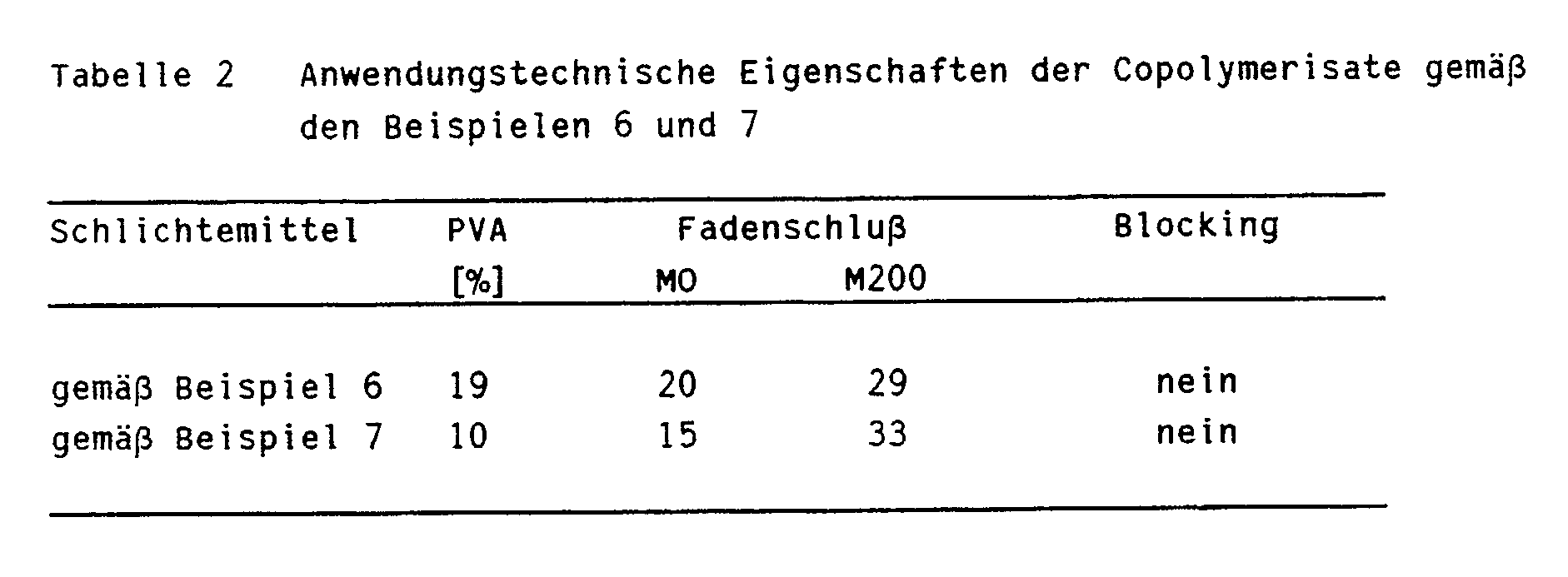
- Table 2 shows the results of tests A and B and the proportion of polyvinyl alcohol in the copolymers of examples 6 and 7.
- copolymers 6 and 7 according to the invention show good thread closure without a tendency to block.
- This copolymer was prepared analogously to Example 6 with the following template and feeds 1 and 2. 734.5 g water 0.36 g of a C-15 paraffin sulfonate 1.4 g sodium vinyl sulfonate 10.0 g polyvinyl alcohol 107.8 g feed 1
- the solution obtained had a polymer content of 24.2% by weight and a viscosity of 110 mPa ⁇ s at 20 ° C.
- This copolymer was prepared analogously to Example 6 with the following template and feeds 1 and 2. 873.5 g water 0.36 g of a C-15 paraffin sulfonate 1.4 g sodium vinyl sulfonate 20 g polyvinyl alcohol 138, 1 g feed 2
- the solution obtained had a polymer content of 20.1% by weight and a viscosity of 128 mPa ⁇ s at 20 ° C.
- This copolymer was prepared analogously to Example 6 with the following template and feeds 1 and 2. 873.5 g water 0.36 g of a C-15 paraffin sulfonate 1.4 g sodium vinyl sulfonate 161.7 g feed 1
- the solution obtained had a polymer content of 19.6% by weight and a viscosity of 152 mPa ⁇ s at 20 ° C.
- This copolymer was prepared analogously to Example 6 with the following template and feeds 1 and 2. 873.5 g water 0.36 g of a C-15 paraffin sulfonate 1.4 g sodium vinyl sulfonate 174.7 g feed 1
- the solution obtained had a polymer content of 20.4% by weight and a viscosity of 1620 mPa ⁇ s at 20 ° C.
- This copolymer was prepared analogously to Example 6 with the following template and feeds 1 and 2. 873.5 g water 0.36 g of a C-15 paraffin sulfonate 1.4 g sodium vinyl sulfonate 190 g feed 1
- the solution obtained had a polymer content of 20.6% by weight and a viscosity of 1400 mPa ⁇ s at 20 ° C.
- This polyester with -COOH groups was obtained by condensation of 1 mole of diethylene glycol 0.54 mol cyclohexanedimethanol (1,4-hydroxymethylcyclohexane) 1.12 moles of isophthalic acid 0.2 mole of terephthalic acid 0.23 mole trimellitic anhydride produced.
- the neutralization was carried out with ammonia / triethanolamine in a ratio of 6: 4.
- This polyester with -SO3H groups was by condensation of 0.86 mole of diethylene glycol 0.2 mol cyclohexanedimethanol (1,4-hydroxymethylcyclohexane) 0.23 mole of isophthalic acid 0.70 mole of terephthalic acid 0.13 mole of sulfoisophthalic acid produced.
- the neutralization was carried out with sodium salt up to pH 5.6.
- the thread closure values were determined as a performance characteristic of the polymer mixtures according to the invention.
- Table 3 shows the results of this test and the chemical composition in polymer mixtures 8 to 11.
- the corresponding individual components are given as examples C to G.
- the pure polyvinyl alcohol is compared.
- the polymer mixtures 8 to 11 according to the invention show better thread closure or adhesive strength values and better abrasion resistance than the associated individual components.
- Table 4 shows the results of the determination of the stability and viscosity of the polymer mixtures 8, 9 and 10 according to the invention.
- the comparative mixtures were prepared from one of the individual components A or B, polyvinyl alcohol and water and from the individual component F.
- the polymer mixtures 8 to 10 according to the invention are stable to the mixtures with respect to the mixtures with the individual components A and B.
Landscapes
- Chemical & Material Sciences (AREA)
- Chemical Kinetics & Catalysis (AREA)
- Engineering & Computer Science (AREA)
- Textile Engineering (AREA)
- Health & Medical Sciences (AREA)
- Medicinal Chemistry (AREA)
- Polymers & Plastics (AREA)
- Organic Chemistry (AREA)
- Treatments For Attaching Organic Compounds To Fibrous Goods (AREA)
- Addition Polymer Or Copolymer, Post-Treatments, Or Chemical Modifications (AREA)
- Paper (AREA)
- Polymerisation Methods In General (AREA)
Abstract
- A) 50 bis 95 Gew.-% eines C₁-C₈-Alkylacrylates und/oder -methacrylates,
- B) 5 bis 20 Gew.-% einer ungesättigten Carbonsäure und/oder eines ungesättigten Carbonsäureanhydrids,
- C) 0 bis 20 Gew.-% weiterer wasserlöslicher Comonomerer und
- D) 0 bis 10 Gew.-% sonstiger Comonomerer in Gegenwart von
- E) 2 bis 60 Gew.-Teilen Polyvinylalkohol, pro 100 Gew.-Teile des Monomerengemisches aus A) bis D).
Description
- Die vorliegende Erfindung betrifft Copolymerisate auf der Basis von C₁-C₈-Alkylacrylaten und/oder -methacrylaten, erhältlich durch radikalische Emulsions- oder Lösungspolymerisation von
- A) 50 bis 95 Gew.-% eines C₁-C₈-Alkylacrylates und/oder -methacrylates,
- B) 5 bis 20 Gew.-% einer ungesättigten Carbonsäure und/oder eines ungesättigten Carbonsäureanhydrids,
- C) 0 bis 20 Gew.-% weiterer wasserlöslicher Comonomerer und
- D) 0 bis 10 Gew.-% sonstiger Comonomerer in Gegenwart von
- E) 2 bis 60 Gew.-Teilen Polyvinylalkohol pro 100 Gew.-Teile des Monomerengemisches aus A) bis D).
- Außerdem betrifft die Erfindung die mit Alkalimetall-, Erdalkalimetall- und Ammoniumsalzen vollständig oder partiell neutralisierten Copolymerisate, ein Verfahren zur Herstellung der Copolymerisate, deren Verwendung als Mittel zum vorübergehenden Oberflächenschutz von Formkörpern und Flächengebilden und als Schlichtemittel für die Verarbeitung von Stapelfaser- und Filamentgarnen sowie diese Schlichtemittel.
- Weiterhin betrifft die Erfindung Schlichtemittel aus den beschriebenen Acrylat- und/oder Methacrylatcopolymeren, Polyvinylalkohol, üblichen Zusatzstoffen und vollständig oder partiell neutralisierten, Sulfo- und/oder Carboxylgruppen enthaltenen, in Salzform wasserlöslichen Polyestern aus nichtaromatischen C₂-C₆-Diolen und Gemischen aromatischer Dicarbonsäuren und aromatischer Tricarbonsäuren und/oder -Sulfodicarbonsäuren sowie die Verwendung dieser Schlichtemittel für die Verarbeitung von Filamentgarnen.
- Durch Emulsionspolymerisation in Gegenwart von Schutzkolloiden wie Polyvinylalkohol hergestellte Copolymerisate auf der Basis von Alkylacrylaten und/oder -methacrylaten mit untergeordneten Mengen weiterer Comonomerer wie ungesättigten Carbonsäuren, z.B. Acrylsäure, sind aus diversen Veröffentlichungen bekannt.
- In diesen Copolymerisaten, die sich vornehmlich als Bindemittel für Dispersionsfarben und als Klebstoffe eignen, ist der Anteil der ungesättigten Carbonsäure mit maximal 5 % (GB 1 278 813) oder mit 1 % (DE-A 3 111 602) sehr gering.
- Ist der Anteil der ungesättigten Carbonsäure höher, so enthalten die Copolymerisate andererseits mit maximal 7 % (US-A 3 876 596), mit maximal 5 % (US-A 4 670 505) oder mit maximal 2 % (US-A 4 265 796) nur sehr wenig Polyvinylalkohol als Schutzkolloid.
- Diese Copolymerisate sind für manche Zwecke aber nur bedingt geeignet.
- Aus Ullmann, Bd. 23, S. 16 (1983) sind Copolymerisate auf der Basis von Acrylat- und/oder Methacrylatcopolymeren bekannt, die als Schlichtemittel empfohlen werden.
- Die beschriebenen Copolymerisate weisen jedoch ein unerwünschtes Verkleben der geschlichteten Filamentfäden auf und erfahren bei der Neutralisation einen großen Viskositätszuwachs.
- Der vorliegenden Erfindung liegt daher die Aufgabe zugrunde, neue Copolymerisate bereitzustellen, die insbesondere als Schlichtemittel verwendet werden können.
- Demgemäß wurden die eingangs definierten Copolymerisate, ein Verfahren zur Herstellung dieser Copolymerisate sowie ihre Verwendung als Mittel zum vorübergehenden Oberflächenschutz und als Schlichtemittel für die Verarbeitung von Stapelfaser- und Filamentgarnen gefunden.
- Weiterhin wurden Schlichtemittel aus den beschriebenen Acrylat-und/oder Methacrylatcopolymeren, Polyvinylalkohol, üblichen Zusatzstoffen und vollständig oder partiell neutralisierten Sulfo- und/oder Carboxylgruppen enthaltenen, in Salzform wasserlöslichen Polyestern aus nichtaromatischen C₂-C₆-Diolen und Gemischen aromatischer Dicarbonsäuren und aromatischer Tricarbonsäuren und/oder -Sulfodicarbonsäuren gefunden.
- Die erfindungsgemäßen Copolymerisate werden aus 50 bis 95 Gew.-%, vorzugsweise 70 bis 80 Gew.-% eines C₁-C₈-Alkylacrylates und/oder -methacrylates als Komponente A und 5 bis 20 Gew.-% einer ungesättigten Carbonsäure als Komponente B in Gegenwart von 2 bis 60 Gew.-Teilen, vorzugsweise 10 bis 40 Gew.-Teilen Polyvinylalkohol, bezogen auf 100 Gew.-Teile A und B, hergestellt.
- Außerdem können die erfindungsgemäßen Copolymerisate aus bis zu 20 Gew.-% weiteren wasserlöslichen Comonomeren als Komponente C und aus bis zu 10 Gew.-% sonstigen Comonomeren als Komponente D mitaufgebaut sein.
- Als Komponente A eignen sich C₁-C₈-Alkylacrylate und/oder -methacrylate.
- Besonders bevorzugte Komponenten A sind Methyl- und n-Butylacrylat und/oder -methacrylat.
- Bevorzugt sind Ethyl-, n-Propyl-, iso-Propyl-, iso-Butyl-, sec.-Butyl-, tert.-Butylacrylat bzw. -methacrylat.
- Daneben sind n-Pentyl-, n-Hexyl-, 2-Ethylhexyl-, n-Heptyl- und n-Octylacrylat bzw. -methacrylat zu nennen.
- Als Komponente B kommen ungesättigte Carbonsäuren in Betracht, vornehmlich die Acrylsäure und Methacrylsäure.
- Weiterhin eignen sich die Crotonsäure, Maleinsäure, Fumarsäure, Itaconsäure und die Anhydride der ungesättigten Carbonsäuren.
- Zusätzliche wasserlösliche Comonomere als Komponente C sind vor allem Acrylamid, Methacrylamid, Allylalkohol und ganz besonders Acrylnitril und Natriumvinylsulfonat.
- Für die Komponente D kommen sonstige Comonomere in Betracht, bevorzugt Vinylaromaten wie Styrol, Vinylacetat, Vinylpropionat, N-Vinylpyrrolidon und die Ester von ungesättigten Dicarbonsäuren wie der Di-n-butylester der Maleinsäure.
- Die als Komponente E verwendeten Polyvinylalkohole haben vorzugsweise einen Polymerisationsgrad von 200 bis 2000 und einen Hydrolysegrad von 75 bis 99 mol-%. Die restlichen 1 bis 25 mol-% entfallen auf Acetat- oder Propionatgruppen des für die Herstellung des Polyvinylalkohols vorzugsweise verwendeten Polyvinylacetats bzw. -propionats.
- Zur Herstellung einer Filamentschlichte sind Polyvinylalkohole mit einem Polymerisationsgrad von 300 bis 2000 (entsprechend einer Standardviskosität von 3 bis 25 mPa·s) und einem Verseifungsgrad von 86 bis 90 mol-% bevorzugt.
- Die erfindungsgemäßen Copolymerisate werden durch radikalische Lösungspolymerisation, vorzugsweise durch radikalische Emulsionspolymerisation in wäßriger Lösung hergestellt.
- Als Initiatoren für die radikalisch ablaufende Polymerisationsreaktion können die üblichen Peroxo- oder Azoverbindungen, auch in Kombination mit Reduktionsmitteln, zweckmäßigerweise in Mengen von 0,5 bis 2,0 Gew.-%, bezogen auf das Gewicht der Monomeren, eingesetzt werden.
- Als bevorzugte Initiatoren sind Dibenzoylperoxid, tert.-Butylperpivalat, tert.-Butylper-2-ethylhexanoat, Di-tert.-butylperoxid, tert.-Butylhydroperoxid, 2,5-Dimethyl-2,5-di(tert.-butylperoxy)hexan, Cumolhydroperoxid und 4,4'-Azobisisobutyronitril zu nennen.
- Bevorzugte Reduktionsmittel sind Hydrazin, Natriumsulfit, Natriumhydrogensulfit, Kaliumsulfit, Kaliumhydrogensulfit, Ammoniumsulfit und Ammoniumhydrogensulfit, die in Mengen von 0,005 bis 2,0 Gew.-% eingesetzt werden.
- Bevorzugte Emulgatoren sind anionische Emulgatoren wie Laurylsulfat, p-n-Nonylphenol, p-n-Decylphenol, Natriumstearat, Kaliumoleat und vor allem C₁₅-Paraffinsulfonat. Als nichtionische Emulgatoren eignen sich vorzugsweise die Oxethylierungsprodukte des Laurylalkohols, Oleylalkohols, Stearylalkohols, Ölsäure- und Stearinamids, Oleylamids sowie der Stearin- und Ölsäure mit einem Oxethylierungsgrad von 3 bis 20. Ferner kommen auch kationische Emulgatoren wie Ammonium-, Phosphonium- und Sulfoniumverbindungen mit mindestens einer langen aliphatischen Kohlenwasserstoffkette als hydrophoben Molekülteil in Betracht.
- Die für eine Emulsionspolymerisation wichtigen Emulgatoren werden in Mengen von 0,1 bis 2,0 Gew.-% eingesetzt.
- Zur Steuerung der Molekularmasse können Regler zugesetzt werden. Besonders wichtig ist die Mitverwendung eines Reglers bei größeren Mengen Polyvinylalkohol, da es ohne einen Regler zur Bildung hochviskoser, nicht fließfähiger Lösungen kommen kann, die als Schlichtemittel weniger in Betracht kommen.
- Bevorzugte Regler sind Tetrachlorkohlenstoff, Tetrabromkohlenstoff, Benzylbromid, Trichlorbrommethan und Butylmercaptan, die im allgemeinen in Mengen von 0,1 bis 5 Gew.-% eingesetzt werden.
- Besonders gute Ergebnisse erzielt man mit tert.-Dodecylmercaptan als Regler in Mengen von 0,2 bis 1,0 Gew.-% in Kombination mit 1,0 bis 1,5 Gew.-% einer Peroxoverbindung als Initiator.
- Im allgemeinen führt man die Polymerisation bei 20 bis 95°C, vorzugsweise bei 65 bis 90°C durch.
- Zweckmäßigerweise wird die Umsetzung bei Normaldruck vorgenommen, jedoch kann man auch bei vermindertem oder leicht erhöhtem Druck arbeiten, also etwa im Bereich von 0,5 bis 5 bar.
- Die Reaktionszeiten betragen normalerweise 1 bis 5, meistens 2 bis 3 Stunden.
- Verfahrenstechnisch geht man nach dem Emulsions-Zulaufverfahren in der Regel so vor, daß man eine wäßrige Lösung aus einem Teil der Initiatoren, Emulgatoren und Regler auf die Reaktionstemperatur erhitzt und die Monomeren in gleichen oder wechselnden Anteilen, vorzugsweise kontinuierlich zuführt. Es ist auch möglich, einen Teil der Monomeren, bevorzugt 4 bis 20 Gew.-% mitvorzulegen, die Polymerisation zu starten und erst nach etwa 10 bis 30 Minuten mit dem Zulauf der Hauptmenge des Monomerengemisches zu beginnen.
- Der Polyvinylalkohol kann zeitgleich oder zeitversetzt mit den Monomeren zugegeben werden, bevorzugt werden Mengen bis zu 10 Gew.-% in der wäßrigen Lösung vorgelegt. Die restlichen Anteile der Initiatoren, Emulgatoren und Regler werden kontinuierlich oder intermittierend zugesetzt.
- Nach beendetem Zulauf setzt man die Polymerisation zweckmäßigerweise unter Zusatz weiterer Initiatormengen noch etwa für eine Zeit von 1 Stunde fort, um Restmonomerengehalte abzusenken.
- Zur Herstellung der Schlichtemittel überführt man die Copolymerisate bevorzugt bei Temperaturen zwischen 50 und 85°C in ihre Natrium-, Calcium-, Magnesium-, Ammonium- oder die C₁-C₄-Alkylammoniumsalze. Im allgemeinen beträgt der Anteil der Salze mindestens 50 %.
- Sollen die Schlichtemittel zur Ausrüstung von Filamentgarnen dienen, so behandelt man den wäßrigen Latex bevorzugt mit wäßrigem Ammoniak.
- Stapelfaserschlichten erhält man vorzugsweise durch Zugabe von Natronlauge, Natriumcarbonat oder Natriumhydrogencarbonat zum wäßrigen Latex.
- Man kann die so erhältlichen Lösungen unmittelbar oder zusammen mit weiteren Komponenten als Schlichtemittel für Polyester-, Celluloseacetat-, Polyamid-, Viskose-, Baumwolle-, Baumwolle/Polyester-, Viskose/Polyester- und für Polyester/Wolle-Fasern verwenden.
- Besonders gut geeignet sind Schlichtemittel aus
- a) 20 bis 60 Gew.-%, vorzugsweise 40 bis 60 Gew.-% eines definitionsgemäßen, vollständig oder partiell neutralisierten Acrylat- und/oder Methacrylatcopolymers,
- b) 10 bis 40 Gew.-%, vorzugsweise 10 bis 25 Gew.-% Polyvinylalkohol mit einem bevorzugten Hydrolysegrad von 85 bis 90 mol-%,
- c) 20 bis 60 Gew.-%, vorzugsweise 20 bis 50 Gew.-% eines vollständig oder partiell neutralisierten, Sulfo- und/oder Carboxylgruppen enthaltenen, in Salzform wasserlöslichen Polyesters aus einem nichtaromatischen C₂-C₆-Diol und einem Gemisch einer aromatischen Dicarbonsäure und einer aromatischen Tricarbonsäure und/oder -Sulfodicarbonsäure und
- d) 0 bis 10 Gew.-% üblicher Zusatzstoffe.
- Die als Komponente c) definierten Polyester sind bekannt oder nach bekannten Methoden erhältlich (Ullmann, Bd. 23, S. 17 (1983).
- Man gewinnt sie durch Kondensation von nichtaromatischen C₂-6₆-Diolen wie Diethylenglykol oder 1,4-Hydroxymethylcyclohexan und einem Gemisch einer aromatischen Dicarbonsäure wie iso-Phthalsäure oder Terephthalsäure und einer aromatischen Tricarbonsäure und/oder -Sulfodicarbonsäure wie Trimellithsäure und/oder Sulfoisophthalsäure.
- Bevorzugt werden Polyester mit Molekulargewichten von 150 000 bis 250 000 und einer Säurezahl von 40 bis 60 mg Kaliumhydroxid pro Gramm Polymer eingesetzt.
- Als übliche Zusatzstoffe d sind zu nennen:
- Viskositätsregulatoren wie Perborate, Wasserstoffperoxid und Harnstoff;
- Schlichtefette wie sulfatierte Fette und Öle und primäre Fettalkoholsulfate;
- Netzmittel wie sulfierte Öle, Fettalkoholsulfate und aromatische Sulfonate;
- Entschäumer wie Amide oder Ester von Fettsäuren und Silicone und
- Konservierungsmittel wie Kupfersulfat, Aluminiumalaun, Borsäure, Formaldehyd und Benzoesäure.
- Weiterhin kommen Verdickungsmittel, Pigmente, Vernetzer, Füllstoffe, Verstärkungsmittel, Verfilmungshilfsmittel und Antioxidantien in Betracht.
- Die erfindungsgemäßen Polymermischungen werden vorzugsweise durch Zusammengeben von Acrylat- und/oder Methacrylatcopolymeren, Polyvinylalkohol, Polyester und gegebenenfalls üblichen Zusatzstoffen als 15 bis 25 gew.-%ige Lösung hergestellt.
- Die Copolymerisate und Polymermischungen gemäß der Erfindung weisen bevorzugt K-Werte von 25 bis 120, besonders 30 bis 50, auf. Der jeweils gewünschte K-Wert läßt sich in an sich bekannter Weise durch Wahl der Polymerisationsbedingungen, in erster Linie der Polymerisationsdauer und der Initiatorkonzentration, einstellen.
- Die K-Werte werden nach Fikentscher, Cellulose-Chemie, Bd. 13, S. 58 bis 64 (1932) bei 25°C in 0,5 gew.-%iger Tetrahydrofuranlösung gemessen und stellen ein Maß für das Molgewicht dar.
- Die Dispersionen oder Lösungen der erfindungsgemäßen Copolymerisate und Polymermischungen weisen Feststoffgehalte von vorzugsweise 20 bis 50 Gew.-% auf, die teilneutralisierten oder neutralisierten Dispersionen oder Lösungen haben vorzugsweise Feststoffgehalte von 18 bis 25 Gew.-%.
- Die erfindungsgemäßen Copolymerisate finden hauptsächlich als Schlichtemittel für die Verarbeitung von Stapelfaser- und Filamentgarnen Verwendung, die erfindungsgemäßen Polymermischungen dienen bevorzugt als Schlichtemittel für die Verarbeitung von Mikrofasergarnen, Multifilamentgarnen und texturierten oder glatten Filamentgarnen.
- Außerdem können sie zum vorübergehenden Oberflächenschutz von flächigen oder räumlichen Gebilden, beispielsweise Zeichnungen, Karten, Drucken, Fotos oder Bildern benutzt werden.
- Des weiteren eignen sie sich als Papierverfestiger, Druckverdicker, Textilausrüstungsmittel und als Klebemittel.
- Die Copolymerisate gemäß der Erfindung zeichnen sich durch ihre gute Schlichtewirkung bei gleichzeitig hoher Filmhärte und damit geringer Neigung zum Verkleben der geschlichteten Filamentfäden aus. Des weiteren zeigen sie hohe Klebkraftwerte sowie Mischungsstabilität und geringe Viskosität. Ein besonderer Vorteil dieser Copolymerisate ist die leichte Auswaschbarkeit vor der Weiterverarbeitung der Garne.
- Die in den Beispielen angegebenen Viskositäten der Copolymerisate wurden in einem Brookfield-Viskosimeter bei 100 UpM und einer Temperatur von 20°C in wäßriger Lösung bei den jeweils angegebenen Konzentrationen gemessen.
- Die gemäß den Methoden a) und b) hergestellten Copolymerisate wurden nach dem Verfahren der Emulsionspolymerisation in Form wäßriger Dispersionen erhalten. Nach Zugabe einer Base löste sich das in Wasser dispergierte Copolymerisat jeweils unter Bildung klarer wäßriger Copolymerisatlösungen.
- In den folgenden Beispielen 1 bis 5 wurde ein Polyvinylalkohol (hergestellt durch Hydrolyse von Polyvinylacetat) mit einem Hydrolysegrad von 88 mol-% und einem Polymerisationsgrad von 400 (entsprechend einer Standardviskosität - gemessen bei 20°C an 4%igen wäßrigen Lösungen - von 4 mPa·s) verwendet.
- Eine Lösung aus
842,5 g Wasser
0,36 g eines C-15-Paraffinsulfonats
1,4 g Natriumvinylsulfonat
20 g Polyvinylalkohol und
25,7 g Zulauf 2
wurde nach dem Erwärmen auf 80°C im Laufe von 2 bis 2,5 Stunden bei 85°C kontinuierlich mit den Zuläufen 1 und 2 versetzt. - 846,9 g Wasser
1,96 g eines C-15-Paraffinsulfonats
0,6 g Natriumvinylsulfonat
70 g Methacrylsäure
280 g n-Butylacrylat
115 g Methylmethacrylat
35 g Acrylnitril - 250 g Wasser
7 g Natriumpersulfat. - Danach wurde 1 Stunde nachpolymerisiert, auf 55°C abgekühlt und mit 15%iger wäßriger Natronlauge bis pH 7,4 neutralisiert.
- Die erhaltene Lösung hatte einen Polymerisatgehalt von 20,6 Gew.-% und eine Viskosität von 2450 mPa·s bei 20°C.
- Dieses Copolymerisat wurde analog Beispiel 1 mit der folgenden Vorlage sowie den Zuläufen 1 und 2 hergestellt.
600,5 g Wasser
0,36 g eines C-15-Paraffinsulfonats
1,4 g Natriumvinylsulfonat
10 g Polyvinylalkohol
25,7 g Zulauf 2 - 572,9 g Wasser
1,96 g eines C-15-Paraffinsulfonats
0,6 g Natriumvinylsulfonat
2 g tert.-Dodecylmercaptan
70 g Methacrylsäure
280 g n-Butylacrylat
115 g Methylmethacrylat
35 g Acrylnitril - 250 g Wasser
7 g Natriumpersulfat. - Die erhaltene Lösung hatte einen Polymerisatgehalt von 25,1 Gew.-% und bei 20°C eine Viskosität von 166 mPa·s.
- Dieses Copolymerisat wurde analog Beispiel 1 mit der nachfolgenden Vorlage sowie den Zuläufen 1 und 2 hergestellt.
842 g Wasser
0,36 g eines C-15-Paraffinsulfonats
1,4 g Natriumvinylsulfonat
20 g Polyvinylalkohol
25,5 g Zulauf 2 - 839,9 g Wasser
1,96 g eines C-15-Paraffinsulfonats
0,6 g Natriumvinylsulfonat
2 g tert.-Dodecylmercaptan
70 g Methacrylsäure
280 g n-Butylacrylat
115 g Methylmethacrylat
35 g Acrylnitril - 250 g Wasser
7 g Natriumpersulfat. - Die erhaltene Lösung hatte einen Polymerisatgehalt von 21,7 Gew.-% und bei 20°C eine Viskosität von 298 mPa·s.
- Dieses Copolymerisat wurde analog Beispiel 1 mit der folgenden Vorlage sowie den Zuläufen 1 und 2 hergestellt.
832,5 g Wasser
0,36 g eines C-15-Paraffinsulfonats
1,4 g Natriumvinylsulfonat
25,7 g Zulauf 2 - 896,9 g Wasser
333,3 g 30%ige wäßrige Lösung von Polyvinylalkohol
1,96 g eines C-15-Paraffinsulfonats
0,6 g Natriumvinylsulfonat
2 g tert.-Dodecylmercaptan
70 g Methacrylsäure
280 g n-Butylacrylat
115 g Methylmethacrylat
35 g Acrylnitril - 250 g Wasser
7 g Natriumpersulfat. - Die erhaltene Lösung hatte einen Polymerisatgehalt von 20,3 Gew.-% und bei 20°C eine Viskosität von 1660 mPa·s.
- Dieses Copolymerisat wurde analog Beispiel 1 mit der folgenden Vorlage sowie den Zuläufen 1 und 2 hergestellt.
400,3 g Wasser
0,2 g eines C-15-Paraffinsulfonats
0,8 g Natriumvinylsulfonat
25,4 g Zulauf 2. - 661,7 g Wasser
500 g 30%ige wäßrige Lösung von Polyvinylalkohol
1,16 g eines C-15-Paraffinsulfonats
0,4 g Natriumvinylsulfonat
1,2 g tert.-Dodecylmercaptan
42 g Methacrylsäure
168 g n-Butylacrylat
69 g Methylmethacrylat
21 g Acrylnitril - 250 g Wasser
4,2 g Natriumpersulfat. - Die erhaltene Lösung hatte einen Polymerisatgehalt von 20,5 Gew.-% und bei 20°C eine Viskosität von 1640 mPa·s.
- Als anwendungstechnische Eigenschaften der erfindungsgemäßen Copolymerisate wurden die Filmeigenschaften und als Maß für die Schlichtewirkung die Pilling-Werte sowie die Pseudokettfadenbruch-Werte ermittelt.
- Zur Ermittlung der Filmeigenschaften werden mechanische Eigenschaften wie Elastizität sowie Homogenität und Zähigkeit der Filme geprüft.
- Zur Bestimmung der Filmeigenschafen wurden aus den Polymerlösungen gemäß den Beispielen 1 bis 5 2 mm dicke Folien hergestellt. Anschließend wurden diese Filme für die Dauer von 3 Stunden bei 80°C getrocknet und danach 24 Stunden bei 65 % bzw. 80 % relativer Feuchtigkeit und 20°C gehalten.
-
- a) der Pilling-Werte und
- b) der Pseudo-Kettfadenbruch-Werte
- Die Prüfung der Schlichtewirkung erfolgt auf dem Reutlinger Webtester, der die Belastung der Kettgarne beim Webvorgang simuliert, indem geschlichtete Garne unter einer bestimmten Spannung mittels Metallstiften wiederholt mechanisch beansprucht werden (J. Trauter u. R. Vialon, Textil Praxis International 1985, 1201). Die Anzahl dieser Beanspruchungen, bei der eine bestimmte Schädigung des Garns festzustellen ist, stellt ein Maß für die Qualität des Schlichtemittels dar.
- Als Kriterium für die Schlichtewirkung dienen
- a) die Pilling-Werte und
- b) die Pseudo-Kettfadenbruch-Werte.
- a) Der Pilling-Wert ist derjenige Wert, bei dem die Bildung eines Knötchens an einem bestimmten Garn zu beobachten ist.
- b) Der Pseudo-Kettfadenbruch-Wert ist derjenige Wert, bei dem ein bestimmtes Garn erschlafft.
- Hohe Pilling- und Pseudo-Kettfadenbruch-Werte bedeuten eine gute Schlichtewirkung.
- Zur Bestimmung der Schlichtewirkung wurden Garne aus Polyester/Baumwolle im Gewichtsverhältnis 65 : 35 bei Raumtemperatur mit 15%igen Flotten der Copolymeren auf einer Laborschlichtmaschine (DE-PS 2 714 897) geschlichtet. Anschließend wurden die geschlichteten Garne für die Dauer von 24 Stunden bei 68 % relativer Feuchtigkeit und 20°C gehalten.
- Die Tabelle 1 zeigt die Ergebnisse der Prüfungen A und B auf die Filmeigenschaften und die Schlichtewirkung. Die erfindungsgemäßen Copolymerisate 1 bis 5 sind vollkommen zäh, elastisch und homogen und zeigen bezüglich der Schlichtewirkung hohe Pilling- und Pseudo-Kettfadenbruch-Werte.

- In den folgenden Beispielen 6 und 7 wurde ein Polyvinylalkohol (hergestellt durch Hydrolyse von Polyvinylacetat) mit einem Hydrolysegrad von 88 mol-% und einem Polymerisationsgrad von 500 (entsprechend einer Standardviskosität - gemessen bei 20°C an 4%igen wäßrigen Lösungen - von 5 mPa·s) verwendet.
- Dieses Copolymerisat wurde analog Beispiel 1 mit der folgenden Vorlage sowie den Zuläufen 1 und 2 hergestellt. Die Neutralisation erfolgte jedoch mit 25%igem wäßrigem Ammoniak.
873,5 g Wasser
0,36 g eines C-15-Paraffinsulfonats
1,4 g Natriumvinylsulfonat
25,7 g Zulauf 2 - 738,9 g Wasser
475 g 20%ige wäßrige Polyvinylalkohol-Lösung
1,96 g eines C-15-Paraffinsulfonats
0,6 g Natriumvinylsulfonat
70 g Methacrylsäure
250 g n-Butylacrylat
25 g n-Butylmethacrdylat
120 g Methylmethacrylat
15 g Styrol
20 g Acrylnitril - 250 g Wasser
7 g Natriumpersulfat. - Die erhaltene Lösung hatte einen Polymerisatgehalt von 20,7 Gew.-% und bei 20°C eine Viskosität von 1800 mPa·s.
- Dieses Copolymerisat wurde analog Beispiel 6 mit der folgenden Vorlage sowie den Zuläufen 1 und 2 hergestellt.
873,5 g Wasser
0,36 g eines C-15-Paraffinsulfonats
1,4 g Natriumsulfonat
25,7 g Zulauf 2 - 945,9 g Wasser
166,6 g 30%ige wäßrige Polyvinylalkohol-Lösung
1,96 g eines C-15-Paraffinsulfonats
0,6 g Natriumvinylsulfonat
2 g tert.-Dodecylmercaptan
70 g Methacrylsäure
280 g n-Butylacrylat
115 g Methylmethacrylat
35 g Acrylnitril - 250 g Wasser
7 g Natriumpersulfat. - Die erhaltene Lösung hatte einen Polymerisatgehalt von 19,6 Gew.-% und bei 20°C eine Viskosität von 152 mPa·s.
- Als anwendungstechnische Eigenschaften der erfindungsgemäßen Copolymerisate wurden der Fadenschluß und die Blocking-Neigung ermittelt.
- Der Fadenschluß ist ein Maß für die Güte einer Schlichte in bezug auf den Schutz und die Stabilisierung des Fadens. Die Bestimmung des Fadenschlusses erfolgt mit dem Shirley-Filamentcounter, indem der Filamentfaden vor und nach dem Schlichten durchgeschnitten wird und aus den beim Schneiden gezählten Impulsen die Anzahl der freien, unverklebten Einzelfilamente ermittelt wird.
- Das Rohgarn besitzt einen Manra-Wert von 100, d.h. 100 % der Einzelfilamente sind unverklebt. Je niedriger der Manra-Wert, desto mehr Einzelfilamente sind an der Schnittstelle verklebt und desto besser sind der Fadenschluß sowie die Fadenhaftung und damit der erzielbare Webnutzeffekt.
- Zur Bestimmung des Fadenschlusses wurden Testgarne aus Polyester-Filament, glatt, dtex 50 f 18 mit 6 % Schlichteauflage verwendet, die sowohl direkt mit dem Shirley-Filamentcounter gemessen wurden (Manra-Wert MO in Tabelle 2), als auch vor der Messung auf dem Reutlinger Webtester 200 Beanspruchungszyklen ausgesetzt waren (Manra-Wert M200 in Tabelle 2).
- Gute Klebkraftwerte und guter Fadenschluß sind bei M200-Werten unter 50 und bei einer möglichst geringen Differenz zwischen den MO- und M200-Werten gegeben.
- Zur Bestimmung der Blocking-Neigung wurden geschlichtete Filamentbündel mit einer Schlichteauflage von 6 bis 7 Gew.-% zwischen zwei Glasplatten von 5 x 5 cm Größe unter Druck eines aufgesetzten Gewichtes von 1 kg bei 65 % relativer Feuchtigkeit und 21°C für die Dauer von 3 Tagen gelagert.
- Die Tabelle 2 zeigt die Ergebnisse der Prüfungen A und B sowie den Anteil an Polyvinylalkohol in den Copolymerisaten der Beispiele 6 und 7.
- Die erfindungsgemäßen Copolymerisate 6 und 7 zeigen einen guten Fadenschluß ohne Blocking-Neigung.
- Dieses Copolymerisat wurde analog Beispiel 6 mit der folgenden Vorlage sowie den Zuläufen 1 und 2 hergestellt.
734,5 g Wasser
0,36 g eines C-15-Paraffinsulfonats
1,4 g Natriumvinylsulfonat
10,0 g Polyvinylalkohol
107,8 g Zulauf 1 - 572,9 g Wasser
1,96 g eines C-15-Paraffinsulfonats
0,6 g Natriumvinylsulfonat
2,0 g tert.-Dodecylmercaptan
70,0 g Methacrylsäure
280,0 g n-Butylacrylat
115,0 g Methylmethacrylat
35,0 g Acrylnitril - 250 g Wasser
7,0 g Natriumpersulfat. - Die erhaltene Lösung hatte einen Polymerisatgehalt von 24,2 Gew.-% und bei 20°C eine Viskosität vom 110 mPa·s.
- Dieses Copolymerisat wurde analog Beispiel 6 mit der folgenden Vorlage sowie den Zuläufen 1 und 2 hergestellt.
873, 5 g Wasser
0,36 g eines C-15-Paraffinsulfonats
1,4 g Natriumvinylsulfonat
20 g Polyvinylalkohol
138, 1 g Zulauf 2 - 875,9 g Wasser
1,96 g eines C-15-Paraffinsulfonats
0,6 g Natriumvinylsulfonat
2 g tert.-Dodecylmercaptan
280 g n-Butylacrylat
115 g Methylmethacrylat
35 g Acrylnitril
70 g Methacrylsäure - 250 g Wasser
7 g Natriumpersulfat. - Die erhaltene Lösung hatte einen Polymerisatgehalt von 20,1 Gew.-% und bei 20°C eine Viskosität von 128 mPa·s.
- Dieses Copolymerisat wurde analog Beispiel 6 mit der folgenden Vorlage sowie den Zuläufen 1 und 2 hergestellt.
873,5 g Wasser
0,36 g eines C-15-Paraffinsulfonats
1,4 g Natriumvinylsulfonat
161,7 g Zulauf 1 - 945,9 g Wasser
166,6 g 30%ige wäßrige Polyvinylalkohollösung
1,96 g eines C-15-Paraffinsulfonats
0,6 g Natriumvinylsulfonat
2 g tert.-Dodecylmercaptan
280 g n-Butylacrylat
115 g Methylmethacrylat
35 g Acrylnitril
70 g Methacrylsäure - 250 g Wasser
7 g Natriumpersulfat. - Die erhaltene Lösung hatte einen Polymerisatgehalt von 19,6 Gew.-% und bei 20°C eine Viskosität von 152 mPa·s.
- Dieses Copolymerisat wurde analog Beispiel 6 mit der folgenden Vorlage sowie den Zuläufen 1 und 2 hergestellt.
873, 5 g Wasser
0,36 g eines C-15-Paraffinsulfonats
1,4 g Natriumvinylsulfonat
174,7 g Zulauf 1 - 768,9 g Wasser
475 g 20%ige wäßrige Polyvinylalkohollösung
1,96 g eines C-15-Paraffinsulfonats
0,6 g Natriumvinylsulfonat
2 g tert.-Dodecylmercaptan
280 g n-Butylacrylat
115 g Methylmethacrylat
35 g Acrylnitril
70 g Methacrylsäure - 250 g Wasser
7 g Natriumpersulfat. - Die erhaltene Lösung hatte einen Polymerisatgehalt von 20,4 Gew.-% und bei 20°C eine Viskosität von 1620 mPa·s.
- Dieses Copolymerisat wurde analog Beispiel 6 mit der folgenden Vorlage sowie den Zuläufen 1 und 2 hergestellt.
873,5 g Wasser
0,36 g eines C-15-Paraffinsulfonats
1,4 g Natriumvinylsulfonat
190 g Zulauf 1 - 770,9 g Wasser
625 g 20%ige wäßrige Polyvinylalkohollösung
1,96 g eines C-15-Paraffinsulfonats
0,6 g Natriumvinylsulfonat
2 g tert.-Dodecylmercaptan
280 g n-Butylacrylat
115 g Methylmethacrylat
35 g Acrylnitril
70 g Methacrylsäure - 768 g Wasser
7 g Natriumpersulfat. - Die erhaltene Lösung hatte einen Polymerisatgehalt von 20,6 Gew.-% und bei 20°C eine Viskosität von 1400 mPa·s.
- Dieser Polyester mit -COOH-Gruppen wurde durch Kondensation von
1 Mol Diethylenglykol
0,54 Mol Cyclohexandimethanol (1,4-Hydroxymethylcyclohexan)
1,12 Mol iso-Phthalsäure
0,2 Mol Terephthalsäure
0,23 Mol Trimellithsäureanhydrid
hergestellt. Die Neutralisation erfolgte mit Ammoniak/Triethanolamin im Verhältnis 6 : 4. - Dieser Polyester mit -SO₃H-Gruppen wurde durch Kondensation von
0,86 Mol Diethylenglykol
0,2 Mol Cyclohexandimethanol (1,4-Hydroxymethylcyclohexan)
0,23 Mol iso-Phthalsäure
0,70 Mol Terephthalsäure
0,13 Mol Sulfoisophthalsäure
hergestellt. Die Neutralisation erfolgte mit Natriumsalz bis zu pH 5,6. - Die erfindungsgemäßen Polymermischungen 8 bis 11 wurden in der Kälte in einem solchen Verhältnis aus
- Schlichtelösung aus einer der Einzelkomponenten C bis E
- Polyvinylalkohol und Wasser und
- Polyesterschlichtelösung aus einer der Einzelkomponenten F oder G
- 21 % Polyvinylalkohol als Summe aus dem Polyvinylalkoholanteil der Einzelkomponente und separat zugesetztem Polyvinylalkohol
- 50 % Acrylat/Methacrylat-Copolymer und
- 29 % Polyester
- Als anwendungstechnische Eigenschaft der erfindungsgemäßen Polymermischungen wurden die Fadenschlußwerte ermittelt.
- Die Tabelle 3 zeigt die Ergebnisse dieser Prüfung sowie die chemische Zusammensetzung in den Polymermischungen 8 bis 11. Zum Vergleich sind als Beispiele C bis G die entsprechenden Einzelkomponenten angegeben. Außerdem ist der reine Polyvinylalkohol gegenübergestellt.
- Die erfindungsgemäßen Polymermischungen 8 bis 11 zeigen bessere Fadenschluß- bzw. Klebkraftwerte sowie bessere Abriebfestigkeit als die zugehörigen Einzelkomponenten.

- Als Vergleich zu den erfindungsgemäßen Polymermischungen wurden solche mit den Einzelkomponenten A und B gegenübergestellt. Tabelle 4 zeigt die Ergebnisse der Bestimmung der Stabilität und Viskosität der erfindungsgemäßen Polymermischungen 8, 9 und 10. Die vergleichenden Mischungen wurden aus einer der Einzelkomponente A oder B, Polyvinylalkohol und Wasser sowie der Einzelkomponente F hergestellt.
- Die erfindungsgemäßen Polymermischungen 8 bis 10 sind gegenüber den Mischungen mit den Einzelkomponenten A und B mischungsstabil.
hergestellt, daß eine ca. 20 gew.-%ige Mischung mit einem Polymeranteil aus
entstand.
Claims (10)
- Verfahren zur Herstellung von Copolymerisaten auf der Basis von C₁-C₈-Alkylacrylaten und/oder -methacrylaten, dadurch gekennzeichnet, daß man Monomere der GruppenA) 50 bis 95 Gew.-% eines C₁-C₈-Alkylacrylates und/oder -meth-A) acrylates,B) 5 bis 20 Gew.-% einer ungesättigten Carbonsäure und/oder eines ungesättigten Carbonsäureanhydrids,C) 0 bis 20 Gew.-% weiterer wasserlöslicher Comonomerer undD) 0 bis 10 Gew.-% sonstiger Comonomerer in Gegenwart vonE) 2 bis 60 Gew.-Teilen Polyvinylalkohol pro 100 Gew.-Teile des Monomerengemisches aus A) bis D)radikalisch in Form einer Emulsion oder einer Lösung copolymerisiert.
- Verfahren zur Herstellung von Copolymerisaten nach Anspruch 1, dadurch gekennzeichnet, daß man Monomere der GruppenA) 70 bis 80 Gew.-% eines C₁-C₈-Alkylacrylates und/oder -methacrylates,B) 5 bis 20 Gew.-% einer ungesättigten Carbonsäure und/oder eines ungesättigten Carbonsäureanhydrids,C) 0 bis 20 Gew.-% weiterer wasserlöslicher Comonomerer undD) 0 bis 10 Gew.-% sonstiger Comonomerer in Gegenwart vonE) 10 bis 40 Gew.-Teilen Polyvinylalkohol 100 pro Gew.-Teile des Monomerengemisches aus A) bis D)radikalisch in Form einer Emulsion oder Lösung copolymerisiert.
- Verfahren nach Anspruch 1 oder 2, dadurch gekennzeichnet, daß man die erhaltenen Polymerdispersionen oder Polymerlösungen mit Alkalimetall-, Erdalkalimetall- und/oder Ammoniumsalzen vollständig oder partiell neutralisiert.
- Verwendung der nach Anspruch 1, 2 oder 3 erhältlichen Copolymerisate als Mittel zum vorübergehenden Oberflächenschutz von Formkörpern und Flächengebilden.
- Verwendung der nach Anspruch 3 erhältlichen Copolymerisate als Schlichtemittel für die Verarbeitung von Stapelfaser- und Filamentgarnen.
- Verfahren nach Anspruch 1, dadurch gekennzeichnet, daß man zua) 20 bis 60 Gew.-% eines so erhaltenen Acrylat- und/oder Methacrylatcopolymersb) 10 bis 40 Gew.-% Polyvinylalkohol,c) 20 bis 60 Gew.-% eines vollständig oder partiell neutralisierten, Sulfo- und/oder Carboxylgruppen enthaltenen, in Salzform wasserlöslichen Polyesters aus einem nichtaromatischen C₂-C₆-Diol und einem Gemisch einer aromatischen Dicarbonsäure und einer aromatischen Tricarbonsäure und/oder -Sulfodicarbonsäure undd) 0 bis 10 Gew.-% üblicher Zusatzstoffe zufügt.
- Verfahren nach Anspruch 3, dadurch gekennzeichnet, daß man zua) 40 bis 60 Gew.-% eines so erhaltenen Acrylat- und/oder Methacrylatcopolymersb) 10 bis 25 Gew.-% Polyvinylalkohol,c) 20 bis 50 Gew.-% eines vollständig oder partiell neutralisierten Sulfo- und/oder Carboxylgruppen enthaltenen, in Salzform wasserlöslichen Polyesters aus einem nichtaromatischen C₂-C₆-Diol und einem Gemisch einer aromatischen Dicarbonsäure und einer aromatischen Tricarbonsäure und/oder -Sulfodicarbonsäure undd) 0 bis 10 Gew.-% üblicher Zusatzstoffe zufügt.
- Verwendung der nach Anspruch 6 oder 7 erhältlichen Copolymerisate für die Verarbeitung von Mikrofasergarnen, Multifilamentgarnen und texturierten oder glatten Filamentgarnen.
Applications Claiming Priority (2)
| Application Number | Priority Date | Filing Date | Title |
|---|---|---|---|
| DE4010563A DE4010563A1 (de) | 1990-04-02 | 1990-04-02 | Copolymerisate auf basis von c(pfeil abwaerts)1(pfeil abwaerts)-c(pfeil abwaerts)8(pfeil abwaerts)-alkylacrylaten und/oder -methacrylaten |
| DE4010563 | 1990-04-02 |
Publications (3)
| Publication Number | Publication Date |
|---|---|
| EP0450437A2 true EP0450437A2 (de) | 1991-10-09 |
| EP0450437A3 EP0450437A3 (en) | 1992-04-08 |
| EP0450437B1 EP0450437B1 (de) | 1995-06-07 |
Family
ID=6403582
Family Applications (1)
| Application Number | Title | Priority Date | Filing Date |
|---|---|---|---|
| EP91104620A Expired - Lifetime EP0450437B1 (de) | 1990-04-02 | 1991-03-23 | Copolymerisate auf Basis von C1-C8-Alkylacrylaten und/oder -methacrylaten, Verfahren zu ihrer Herstellung und ihre Verwendung |
Country Status (6)
| Country | Link |
|---|---|
| US (1) | US5231145A (de) |
| EP (1) | EP0450437B1 (de) |
| JP (1) | JPH04224811A (de) |
| DE (2) | DE4010563A1 (de) |
| ES (1) | ES2073057T3 (de) |
| PT (1) | PT97218B (de) |
Cited By (13)
| Publication number | Priority date | Publication date | Assignee | Title |
|---|---|---|---|---|
| EP0566930A1 (de) * | 1992-04-24 | 1993-10-27 | BASF Aktiengesellschaft | Verwendung von wasserlöslichen oder wasserdispergierbaren Suspensionspolymerisaten als Textilfaserschlichtemittel |
| EP0627450A1 (de) * | 1993-05-29 | 1994-12-07 | Hoechst Aktiengesellschaft | Carboxylgruppenhaltige Copolymerisate in wässriger Dispersionsform oder redispergierbarer Pulverform und ihre wasserlöslichen Salze, Verfahren zu ihrer Herstellung und ihre Verwendung als Verdicker in wässrigen Zubereitungen |
| WO1995023254A1 (en) * | 1994-02-28 | 1995-08-31 | E.I. Du Pont De Nemours And Company | Poly(vinyl alcohol) copolymer sizes having high capacity to be desized |
| WO1995023184A1 (en) * | 1994-02-28 | 1995-08-31 | E.I. Du Pont De Nemours And Company | Poly(vinyl alcohol) starch blends for textile sizes with improved ability to be desized |
| WO1995023255A1 (en) * | 1994-02-28 | 1995-08-31 | E.I. Du Pont De Nemours And Company | Poly(vinyl alcohol) polymer blend textile sizes with improved ability to be desized |
| EP0671420A3 (de) * | 1994-03-09 | 1995-10-11 | Huels Chemische Werke Ag | |
| EP0812863A1 (de) * | 1996-06-14 | 1997-12-17 | Air Products And Chemicals, Inc. | Acrylemulsionen hergestellt in gegenwart von vollständig hydrolysiertem Poly(vinylalcohol) |
| EP0816557A1 (de) * | 1996-07-01 | 1998-01-07 | Kuraray Co., Ltd. | Schlichtemittel |
| EP0873978A1 (de) * | 1997-04-21 | 1998-10-28 | Air Products And Chemicals, Inc. | Mit durch Polyvinylalkohol stabilisierte Acrylpolymere modifizierte hydraulische Zementsysteme |
| EP0824565A4 (de) * | 1992-04-01 | 1999-01-07 | Henkel Corp | Zusammensetzung und verfahren zur behandlung von metall |
| EP0601518B1 (de) * | 1992-12-08 | 2000-03-08 | Air Products And Chemicals, Inc. | Herstellungsverfahren eines Acrylharzpulvers |
| EP1010707A1 (de) * | 1998-12-15 | 2000-06-21 | Basf Aktiengesellschaft | Verfahren zur Herstellung wässriger Polymerdispersionen |
| WO2011141265A1 (de) * | 2010-04-15 | 2011-11-17 | Basf Se | Verfahren zur behandlung von textil und dafür geeignete formulierungen |
Families Citing this family (16)
| Publication number | Priority date | Publication date | Assignee | Title |
|---|---|---|---|---|
| JP3416194B2 (ja) * | 1993-04-26 | 2003-06-16 | 株式会社ジーシー | 義歯床用分離材 |
| GB9422093D0 (en) * | 1994-11-02 | 1994-12-21 | Zeneca Ltd | Rheology modifier for solvent-based coatings |
| DE4447359C5 (de) * | 1994-12-21 | 2009-01-02 | ALTERFIL Nähfaden GmbH | Bauschiges Nähgarn |
| JP2002529603A (ja) * | 1998-07-01 | 2002-09-10 | イー・アイ・デュポン・ドウ・ヌムール・アンド・カンパニー | ポリ(ビニルアルコール)共重合体イオノマー、その調製、および織物のサイズでのその使用 |
| US6114417A (en) * | 1998-10-16 | 2000-09-05 | Cytec Technology Corp. | Paper sizing agents and methods |
| FR2785629B1 (fr) * | 1998-11-10 | 2000-12-22 | Coatex Sa | Composition polymerique retenteur d'eau et activateur d'azurants optiques, sauces de couchage pour papier, et feuilles de papier couche ainsi obtenues |
| DE19960863A1 (de) * | 1999-12-17 | 2001-06-28 | Basf Ag | Mit Polyvinylalkohol stabilisierte Polymerisate zur Verstärkung der optimalen Aufhellung von Beschichtungsmassen |
| ITSV20020051A1 (it) * | 2002-10-11 | 2004-04-12 | Allaix Roberto C O Ferrania S P A Uff Brevetti | Sintesi di un copolimero in forma di particelle contenente funzionalita' idrofile. |
| KR100659455B1 (ko) * | 2004-11-09 | 2006-12-19 | 주식회사 엘지화학 | 염화비닐수지용 첨가제 및 이를 포함하는 염화비닐계 수지 조성물 |
| JP4888853B2 (ja) | 2009-11-12 | 2012-02-29 | 学校法人慶應義塾 | 液晶表示装置の視認性改善方法、及びそれを用いた液晶表示装置 |
| MX342229B (es) | 2010-06-21 | 2016-09-21 | Basf Se | Composiciones para amortiguar el sonido y metodos para aplicacion y uso. |
| CN110187549B (zh) | 2010-06-22 | 2022-07-15 | 东洋纺株式会社 | 液晶显示装置、偏振板及偏振片保护膜 |
| KR101833582B1 (ko) | 2011-05-18 | 2018-02-28 | 도요보 가부시키가이샤 | 3차원 화상표시 대응 액정표시장치에 적합한 편광판 및 액정표시장치 |
| TWI542907B (zh) | 2011-05-18 | 2016-07-21 | 東洋紡績股份有限公司 | 液晶顯示裝置、偏光板及偏光子保護薄膜 |
| CN102505485B (zh) * | 2011-10-20 | 2013-08-21 | 天津工业大学 | 一种兔毛织物防掉毛整理剂及整理方法 |
| WO2014024855A1 (ja) * | 2012-08-07 | 2014-02-13 | 東洋紡株式会社 | 偏光子保護用ポリエステルフィルム、偏光板および液晶表示装置 |
Family Cites Families (12)
| Publication number | Priority date | Publication date | Assignee | Title |
|---|---|---|---|---|
| US3546008A (en) * | 1968-01-03 | 1970-12-08 | Eastman Kodak Co | Sizing compositions and fibrous articles sized therewith |
| GB1278813A (en) * | 1969-08-27 | 1972-06-21 | High Polymer Chemical Ind Ltd | Method of preparation of acrylic polymer latices |
| DE2256154C3 (de) * | 1972-11-16 | 1984-10-04 | Basf Ag, 6700 Ludwigshafen | Verfahren zur Herstellung von wäßrigen Dispersionen von Polymerisaten monoolefinisch ungesättigter Carbonsäureester |
| JPS515871B2 (de) * | 1973-01-19 | 1976-02-23 | Nippon Synthetic Chem Ind | |
| US3909477A (en) * | 1973-06-27 | 1975-09-30 | Dow Chemical Co | Warp-sizing compositions and yarns sized therewith |
| DE2714897C3 (de) * | 1977-04-02 | 1981-12-03 | Basf Ag, 6700 Ludwigshafen | Verwendung von wasserlöslichen Erdalkalisalzen von Polymerisaten der Acrylsäure oder Methacrylsäure als Schlichtemittel |
| DE2842719A1 (de) * | 1978-09-30 | 1980-04-10 | Basf Ag | Verfahren zur herstellung von waessrigen polyacrylat-dispersionen mit verbessertem fliessverhalten |
| ATE10215T1 (de) * | 1980-11-24 | 1984-11-15 | Akzo N.V. | Gestaerktes multifilamentgarn aus aromatischem polyamid, garnpaket und webstoff sowie verfahren zur herstellung dieses garns. |
| DE3111602A1 (de) * | 1981-03-24 | 1982-10-07 | Wacker-Chemie GmbH, 8000 München | Copolymerisate erhoehter wasserfestigkeit, verfahren zu ihrer herstellung und ihre verwendung |
| US4470505A (en) * | 1983-01-26 | 1984-09-11 | Paul Korwin | Method and apparatus for storing, mixing and delivering dental amalgam |
| EP0144155B1 (de) * | 1983-11-07 | 1989-03-15 | Showa Denko Kabushiki Kaisha | Kaschiermittel für gestrichenes Papier |
| US4670505A (en) * | 1985-08-23 | 1987-06-02 | Hercules Incorporated | Polyacrylate dispersions |
-
1990
- 1990-04-02 DE DE4010563A patent/DE4010563A1/de not_active Withdrawn
-
1991
- 1991-03-20 JP JP3056719A patent/JPH04224811A/ja active Pending
- 1991-03-23 ES ES91104620T patent/ES2073057T3/es not_active Expired - Lifetime
- 1991-03-23 DE DE59105640T patent/DE59105640D1/de not_active Expired - Lifetime
- 1991-03-23 EP EP91104620A patent/EP0450437B1/de not_active Expired - Lifetime
- 1991-04-01 PT PT97218A patent/PT97218B/pt not_active IP Right Cessation
- 1991-04-02 US US07/679,275 patent/US5231145A/en not_active Expired - Fee Related
Cited By (16)
| Publication number | Priority date | Publication date | Assignee | Title |
|---|---|---|---|---|
| EP0824565A4 (de) * | 1992-04-01 | 1999-01-07 | Henkel Corp | Zusammensetzung und verfahren zur behandlung von metall |
| EP0566930A1 (de) * | 1992-04-24 | 1993-10-27 | BASF Aktiengesellschaft | Verwendung von wasserlöslichen oder wasserdispergierbaren Suspensionspolymerisaten als Textilfaserschlichtemittel |
| EP0601518B1 (de) * | 1992-12-08 | 2000-03-08 | Air Products And Chemicals, Inc. | Herstellungsverfahren eines Acrylharzpulvers |
| EP0627450A1 (de) * | 1993-05-29 | 1994-12-07 | Hoechst Aktiengesellschaft | Carboxylgruppenhaltige Copolymerisate in wässriger Dispersionsform oder redispergierbarer Pulverform und ihre wasserlöslichen Salze, Verfahren zu ihrer Herstellung und ihre Verwendung als Verdicker in wässrigen Zubereitungen |
| WO1995023254A1 (en) * | 1994-02-28 | 1995-08-31 | E.I. Du Pont De Nemours And Company | Poly(vinyl alcohol) copolymer sizes having high capacity to be desized |
| WO1995023184A1 (en) * | 1994-02-28 | 1995-08-31 | E.I. Du Pont De Nemours And Company | Poly(vinyl alcohol) starch blends for textile sizes with improved ability to be desized |
| WO1995023255A1 (en) * | 1994-02-28 | 1995-08-31 | E.I. Du Pont De Nemours And Company | Poly(vinyl alcohol) polymer blend textile sizes with improved ability to be desized |
| EP0671420A3 (de) * | 1994-03-09 | 1995-10-11 | Huels Chemische Werke Ag | |
| KR100249052B1 (ko) * | 1996-06-14 | 2000-03-15 | 마쉬 윌리엄 에프 | 충분히가수분해된폴리(비닐알코올)존재하에제조되는아크릴계에멀션 |
| EP0812863A1 (de) * | 1996-06-14 | 1997-12-17 | Air Products And Chemicals, Inc. | Acrylemulsionen hergestellt in gegenwart von vollständig hydrolysiertem Poly(vinylalcohol) |
| EP0816557A1 (de) * | 1996-07-01 | 1998-01-07 | Kuraray Co., Ltd. | Schlichtemittel |
| EP0873978A1 (de) * | 1997-04-21 | 1998-10-28 | Air Products And Chemicals, Inc. | Mit durch Polyvinylalkohol stabilisierte Acrylpolymere modifizierte hydraulische Zementsysteme |
| EP1010707A1 (de) * | 1998-12-15 | 2000-06-21 | Basf Aktiengesellschaft | Verfahren zur Herstellung wässriger Polymerdispersionen |
| US6444748B1 (en) | 1998-12-15 | 2002-09-03 | Basf Aktiengesellschaft | Preparing aqueous polymer dispersions |
| US6710122B2 (en) | 1998-12-15 | 2004-03-23 | Basf Aktiengesellschaft | Preparing aqueous polymer dispersions |
| WO2011141265A1 (de) * | 2010-04-15 | 2011-11-17 | Basf Se | Verfahren zur behandlung von textil und dafür geeignete formulierungen |
Also Published As
| Publication number | Publication date |
|---|---|
| PT97218A (pt) | 1992-01-31 |
| JPH04224811A (ja) | 1992-08-14 |
| EP0450437B1 (de) | 1995-06-07 |
| ES2073057T3 (es) | 1995-08-01 |
| DE4010563A1 (de) | 1991-10-10 |
| US5231145A (en) | 1993-07-27 |
| PT97218B (pt) | 1998-07-31 |
| EP0450437A3 (en) | 1992-04-08 |
| DE59105640D1 (de) | 1995-07-13 |
Similar Documents
| Publication | Publication Date | Title |
|---|---|---|
| EP0450437B1 (de) | Copolymerisate auf Basis von C1-C8-Alkylacrylaten und/oder -methacrylaten, Verfahren zu ihrer Herstellung und ihre Verwendung | |
| DE69321068T2 (de) | Emulsionsbindemittel mit niedrigem Restformaldehyd und mit verbesserter Reissfestigkeit | |
| DE69410014T2 (de) | Emulsioninterpolymerzusammensetzung aus Vinylidenchlorid | |
| EP0019169B1 (de) | Verwendung von wässrigen Dispersionen von amidgruppenhaltigen Emulsions-Copolymerisaten zum Verfestigen von Faservliesen | |
| DE1495645C3 (de) | Verfahren zur Herstellung stabiler, wäßriger Emulsionen bzw. Dispersionen von Äthylen-Mischpolymerisaten | |
| EP0735065A1 (de) | Amphotere Polymerisatdispersion, Verfahren zur Herstellung und deren Verwendung | |
| DE1619206B2 (de) | Beschichtungslatex fuer gewebte stoffe und dessen verwendung | |
| DE1220613B (de) | Verfahren zur Herstellung von Polymerisat-emulsionen | |
| DE69514968T2 (de) | Äthylen-Vinylacetat-Emulsionen mit verbesserte Klebrigkeit | |
| DE68922755T2 (de) | Schnellvernetzungsbindemittel für Cellulose. | |
| DE2459160C3 (de) | Verfahren zur Herstellung von wäßrigen Dispersionen von Copolymerisaten nicht tertiärer Acrylsäureester | |
| US5240771A (en) | Copolymers based on C1 -C8 -alkyl acrylates and/or methacrylates and preparation and use thereof | |
| DE938629C (de) | Verfahren zur Emulsionspolymerisation von Vinylacetat | |
| EP0156971B1 (de) | Verfahren zur Herstellung von wässrigen Polyacrylat-Copolymer-Dispersionen und ihre Verwendung bei der Zurichtung von Leder | |
| DE2138202A1 (de) | Verfahren zur Herstellung wässriger Pfropf- und/oder Blockmischpolymeremulsionen | |
| DE2513162A1 (de) | Gemisch aus oberflaechenaktiven stoffen | |
| DE3620149A1 (de) | Geruchsarmes wasserloesliches polymerisat oder copolymerisat, seine herstellung und verwendung | |
| DE60104334T2 (de) | Formaldehydfreier vernetzter kern-schale-latex für textilien | |
| DE69509240T2 (de) | Verfahren zum schlichten von garnen oder textilfasern mittels einer latexzusammensetzung | |
| DE2536810A1 (de) | Verfahren zur behandlung von geweben | |
| DE3751160T2 (de) | Terpolymer-Emulsionen. | |
| EP0016403A1 (de) | Verfahren zur Herstellung von wässrigen Butadien-Copolymerisat-Dispersionen eines Polymerisatgehaltes von mindestens 58 Gew.% durch Emulsionscopolymerisation | |
| DE2538183A1 (de) | Verfahren zum herstellen von salzbestaendigen latices | |
| DE2454397A1 (de) | Verfahren zur herstellung scherstabiler kationischer waessriger copolymerisatdispersionen | |
| EP0532961A1 (de) | Pfropfcopolymerisate von Sulfonsäuregruppen enthaltenden Polyestern als Propfgrundlage, Verfahren zu ihrer Herstellung und ihre Verwendung |
Legal Events
| Date | Code | Title | Description |
|---|---|---|---|
| PUAI | Public reference made under article 153(3) epc to a published international application that has entered the european phase |
Free format text: ORIGINAL CODE: 0009012 |
|
| AK | Designated contracting states |
Kind code of ref document: A2 Designated state(s): BE DE ES FR GB IT NL |
|
| PUAL | Search report despatched |
Free format text: ORIGINAL CODE: 0009013 |
|
| AK | Designated contracting states |
Kind code of ref document: A3 Designated state(s): BE DE ES FR GB IT NL |
|
| 17P | Request for examination filed |
Effective date: 19920306 |
|
| 17Q | First examination report despatched |
Effective date: 19931207 |
|
| GRAA | (expected) grant |
Free format text: ORIGINAL CODE: 0009210 |
|
| AK | Designated contracting states |
Kind code of ref document: B1 Designated state(s): BE DE ES FR GB IT NL |
|
| REF | Corresponds to: |
Ref document number: 59105640 Country of ref document: DE Date of ref document: 19950713 |
|
| GBT | Gb: translation of ep patent filed (gb section 77(6)(a)/1977) |
Effective date: 19950623 |
|
| ITF | It: translation for a ep patent filed | ||
| REG | Reference to a national code |
Ref country code: ES Ref legal event code: FG2A Ref document number: 2073057 Country of ref document: ES Kind code of ref document: T3 |
|
| ET | Fr: translation filed | ||
| PGFP | Annual fee paid to national office [announced via postgrant information from national office to epo] |
Ref country code: FR Payment date: 19960223 Year of fee payment: 6 |
|
| PGFP | Annual fee paid to national office [announced via postgrant information from national office to epo] |
Ref country code: NL Payment date: 19960229 Year of fee payment: 6 |
|
| PGFP | Annual fee paid to national office [announced via postgrant information from national office to epo] |
Ref country code: BE Payment date: 19960313 Year of fee payment: 6 |
|
| PGFP | Annual fee paid to national office [announced via postgrant information from national office to epo] |
Ref country code: ES Payment date: 19960314 Year of fee payment: 6 |
|
| PGFP | Annual fee paid to national office [announced via postgrant information from national office to epo] |
Ref country code: GB Payment date: 19960315 Year of fee payment: 6 |
|
| PGFP | Annual fee paid to national office [announced via postgrant information from national office to epo] |
Ref country code: DE Payment date: 19960326 Year of fee payment: 6 |
|
| PLBE | No opposition filed within time limit |
Free format text: ORIGINAL CODE: 0009261 |
|
| STAA | Information on the status of an ep patent application or granted ep patent |
Free format text: STATUS: NO OPPOSITION FILED WITHIN TIME LIMIT |
|
| 26N | No opposition filed | ||
| PG25 | Lapsed in a contracting state [announced via postgrant information from national office to epo] |
Ref country code: DE Effective date: 19970312 |
|
| PG25 | Lapsed in a contracting state [announced via postgrant information from national office to epo] |
Ref country code: GB Effective date: 19970323 |
|
| PG25 | Lapsed in a contracting state [announced via postgrant information from national office to epo] |
Ref country code: ES Free format text: LAPSE BECAUSE OF THE APPLICANT RENOUNCES Effective date: 19970324 |
|
| PG25 | Lapsed in a contracting state [announced via postgrant information from national office to epo] |
Ref country code: BE Effective date: 19970331 |
|
| BERE | Be: lapsed |
Owner name: BASF A.G. Effective date: 19970331 |
|
| PG25 | Lapsed in a contracting state [announced via postgrant information from national office to epo] |
Ref country code: NL Effective date: 19971001 |
|
| GBPC | Gb: european patent ceased through non-payment of renewal fee |
Effective date: 19970323 |
|
| PG25 | Lapsed in a contracting state [announced via postgrant information from national office to epo] |
Ref country code: FR Free format text: LAPSE BECAUSE OF NON-PAYMENT OF DUE FEES Effective date: 19971128 |
|
| NLV4 | Nl: lapsed or anulled due to non-payment of the annual fee |
Effective date: 19971001 |
|
| REG | Reference to a national code |
Ref country code: FR Ref legal event code: ST |
|
| REG | Reference to a national code |
Ref country code: ES Ref legal event code: FD2A Effective date: 19991102 |
|
| PG25 | Lapsed in a contracting state [announced via postgrant information from national office to epo] |
Ref country code: IT Free format text: LAPSE BECAUSE OF NON-PAYMENT OF DUE FEES;WARNING: LAPSES OF ITALIAN PATENTS WITH EFFECTIVE DATE BEFORE 2007 MAY HAVE OCCURRED AT ANY TIME BEFORE 2007. THE CORRECT EFFECTIVE DATE MAY BE DIFFERENT FROM THE ONE RECORDED. Effective date: 20050323 |