EP0451426B1 - Gestion à accès multiple pour un système de communication par passage d'un bloc de commande - Google Patents
Gestion à accès multiple pour un système de communication par passage d'un bloc de commande Download PDFInfo
- Publication number
- EP0451426B1 EP0451426B1 EP90810294A EP90810294A EP0451426B1 EP 0451426 B1 EP0451426 B1 EP 0451426B1 EP 90810294 A EP90810294 A EP 90810294A EP 90810294 A EP90810294 A EP 90810294A EP 0451426 B1 EP0451426 B1 EP 0451426B1
- Authority
- EP
- European Patent Office
- Prior art keywords
- node
- label
- cycle
- req
- len
- Prior art date
- Legal status (The legal status is an assumption and is not a legal conclusion. Google has not performed a legal analysis and makes no representation as to the accuracy of the status listed.)
- Expired - Lifetime
Links
- 238000004891 communication Methods 0.000 title claims description 12
- 238000000034 method Methods 0.000 claims description 35
- 230000005540 biological transmission Effects 0.000 claims description 22
- 238000011144 upstream manufacturing Methods 0.000 claims description 5
- 230000001174 ascending effect Effects 0.000 claims description 3
- 238000003780 insertion Methods 0.000 description 7
- 230000037431 insertion Effects 0.000 description 7
- 238000010586 diagram Methods 0.000 description 6
- 230000008901 benefit Effects 0.000 description 5
- 125000004122 cyclic group Chemical group 0.000 description 5
- 230000007246 mechanism Effects 0.000 description 4
- 230000008569 process Effects 0.000 description 4
- 230000011664 signaling Effects 0.000 description 4
- 230000009977 dual effect Effects 0.000 description 3
- 238000012545 processing Methods 0.000 description 3
- 230000003190 augmentative effect Effects 0.000 description 2
- 230000008859 change Effects 0.000 description 2
- 230000006872 improvement Effects 0.000 description 2
- 101100533229 Galleria mellonella SER1 gene Proteins 0.000 description 1
- 101100533232 Galleria mellonella SER2 gene Proteins 0.000 description 1
- 230000004913 activation Effects 0.000 description 1
- 230000001955 cumulated effect Effects 0.000 description 1
- 238000000605 extraction Methods 0.000 description 1
- 230000001902 propagating effect Effects 0.000 description 1
- 238000011084 recovery Methods 0.000 description 1
- 230000003362 replicative effect Effects 0.000 description 1
- 230000011218 segmentation Effects 0.000 description 1
- 238000012360 testing method Methods 0.000 description 1
Images





Classifications
-
- H—ELECTRICITY
- H04—ELECTRIC COMMUNICATION TECHNIQUE
- H04L—TRANSMISSION OF DIGITAL INFORMATION, e.g. TELEGRAPHIC COMMUNICATION
- H04L12/00—Data switching networks
- H04L12/28—Data switching networks characterised by path configuration, e.g. LAN [Local Area Networks] or WAN [Wide Area Networks]
- H04L12/40—Bus networks
- H04L12/407—Bus networks with decentralised control
- H04L12/417—Bus networks with decentralised control with deterministic access, e.g. token passing
-
- H—ELECTRICITY
- H04—ELECTRIC COMMUNICATION TECHNIQUE
- H04L—TRANSMISSION OF DIGITAL INFORMATION, e.g. TELEGRAPHIC COMMUNICATION
- H04L12/00—Data switching networks
- H04L12/28—Data switching networks characterised by path configuration, e.g. LAN [Local Area Networks] or WAN [Wide Area Networks]
- H04L12/2852—Metropolitan area networks
Definitions
- Present invention is concerned with a multiple-access technique for a communication system based on a transmission bus to which several stations or nodes and headend means are connected, and in which for several separate and sequential operation cycles, an order pad is issued by the headend means and passed along the associated bus for insertion of access requests by the node stations.
- An accumulated count or request length is stored in the headend unit together with the respective cycle number, and when the respective cycle ist started, the headend issues the required number of slots so that each node station can definitely use the number of slots it has requested for that cycle.
- Each slot in such a system, is used only for a portion of its passage along the bus, i.e. between the origin node and the destination node of the data which the slot carries in that cycle.
- traffic is rather localized and slots will be used only for carrying data between neighbourhood nodes.
- Fig.1 is a block diagram of a dual bus communication network in which the invention is used.
- Fig.2 depicts the segmentation of a data frame which is to be transmitted, into segment payloads for insertion into time slots provided by the dual bus communication system.
- Fig.3 shows the time slot format used.
- Fig.4 illustrates a typical communication traffic situation on a dual-bus communication system in which a significant advantage can be gained by the invention.
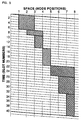
- Fig.5 illustrates the time slot history in the dual-bus system when the invention is not used (no slot reuse).
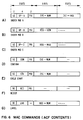
- Fig.6 depicts the medium access control (MAC) commands to be used for the order pad passing reservation procedure.
- MAC medium access control
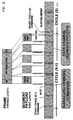
- Fig.7 shows schematically the local reservation queue of a node, with reuse flags according to the invention.
- Fig.8 is a flow diagram of the order pad passing reservation procedure with slot reuse according to the invention.
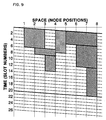
- Fig.9 is a diagram showing the time slot history for the traffic situation of Fig.4, in a system providing slot reuse according to the invention.
- Fig.10 (10A and 10B) is a block diagram of the node apparatus implementing the invention for providing slot reuse in a dual-bus system with an order pad passing reservation procedure.
- Fig.1 The environment or general system in which the present invention finds application is shown in Fig.1. It is a dual-bus communication system with a plurality of nodes or stations attached to each of the busses, and with two headend functions at the ends of the two busses. Each of the headend functions may be integrated with a node station as indicated in Fig.1 (e.g. headend HEAD-A with node 1).
- CRMA cyclic-reservation multiple access
- the system comprises an A-bus (11) and a B-bus (13) which serve as transmission medium for the one and the other direction.
- Two headend functions, HEAD-A (15) and HEAD-B (17) are provided.
- a plurality of node stations (19-1 ... 19-N) are attached to both busses.
- Each headend issues fixed-length time slots on its associated bus for use by the nodes.
- the time slots are organized in sequential cycles (of variable length) as indicated in Fig.1. Every cycle is explicitly numbered modulo some maximum number.
- an order pad passing procedure is used (as described in the above-mentioned European patent application).
- Each headend issues, on its associated bus, order pads (and other associated commands) which are transmitted at the leading ends of the time slots, as indicted by darker shaded bars in Fig.1.
- Each order pad is associated with a (future) transmission cycle; any node that wants to transmit data, requests the required number of slots (the "order length") by adding this quantity to a number in the order pad, the "requested length”. It stores the requested number in a Local Reservation Queue, which is shown as box 21 in node N-1,together with the respective cycle number.
- the order pad when arriving at the end of the bus, indicates by the accumulated requested length the total number of slots which are required for that cycle.
- the companion headend which receives the order pad, returns it on its associated bus to the originating headend. There, the accumulated requested length is stored, together with the cycle number, in a Global Reservation Queue, which is shown in HEAD-A as box 23.
- the headend unit issues a cycle start command (also transmitted along the bus in a time slot) containing the respective cycle number, and thereafter releases a number of slots as indicated in its Global Reservation Queue for this cycle.
- a cycle start command also transmitted along the bus in a time slot
- Each station along the bus after recognizing the cycle start command, then uses a number of consecutive free time slots for data transmission which corresponds to the order length number stored in its Local Reservation Queue with that cycle number.
- the headend may issue time slots without a leading cycle start command, as is indicated in Fig.1 by the section "free use" between cycles 5 and 8 (i.e. order pads for cycles 6 and 7 contained no reservations when returning to the headend). During such a period, any station may use any free slot it sees on the bus, without prior reservation.
- Fig.2 there is shown the principle for segmenting data frames prior to transmission so that they can be accomodated in the fixed-length time slots propagating on the bus.
- Each frame (which may be of any length up to a given maximum) and which contains the necessary delimiters SS (start sequence) and ES (end sequence), is simply cut into equal-size segments (payloads) which fit into the fixed-length data segment fields of the time slots.
- a segment header (e.g. a one byte "type" field) is added to each segment payload for identifying the type of segment payload (e.g. FDDI, 802.2, HPPI data, or begin/middle/end/single segment of a frame) and inserted together with the segment payload into a passing free time slot.
- type of segment payload e.g. FDDI, 802.2, HPPI data, or begin/middle/end/single segment of a frame
- each station Due to the cyclic-reservation multiple access (CRMA) technique roughly described above, each station is guaranteed the availability of n consecutive free time slots in a cycle for which it requested n time slots. This is very important because it eliminates the need for extensive protocol information and consecutive numbering of the segment payloads. They arrive at their destination in consecutive time slots (and of course in the same order as they were transmitted).
- CRMA cyclic-reservation multiple access
- each time slot besides a segment payload and associated header (together representing a data channel), also includes a section for commands or signalling information (representing a signalling channel), and of course a slot delimiter.
- a slot is filled up by padding data when the last payload segment does not exactly fit the slot segment size.
- Fig.3 shows the slot format in somewhat more detail. It is assumed here that each slot has a size of p+q bytes (e.g. 58 bytes as an example).
- the actual data segment for the data payload comprises q bytes (e.g. 53 bytes).
- the remaining p bytes (e.g. 5 bytes) are provided for system information.
- One byte represents the slot delimiter, the following bytes are representing an Access Control Field ACF (containing the commands or signalling information, to be explained later in more detail), and the last remaining byte is provided for the segment header (as shown in Fig.2).
- the first field (e.g. two bits) of each ACF contains Slot Control (SC) information. One of these bits may indicate whether the slot is a free-use slot not associated with a specific numbered cycle (cf. Fig.1); the other bit "B/F" indicates whether the slot's data segment is busy (occupied) or free.
- SC Slot Control
- the Global Reservation Queue stored in the headend contains in each entry, as already mentioned above, a cycle number and the associated requested length (i.e. the accumulated number of time slots requested by all the nodes for that cycle).
- the Local Reservation Queue contains in each entry a cycle number and an associated order length, i.e. the number of slots requested by the respective station for the cycle indicated.
- An extra bit in each entry indicates the status of the entry as being pending or confirmed. Initially, the bit is set to zero, indicating pending state.
- the headend station can accept the reservations for a particular cycle by issuing a "Confirm” command with the respective cycle number, or by issuing a "reject” command which cancels all pending reservations of cycles which were not yet confirmed.
- Each node when receiving a confirm command, converts the status of the entry for the respective cycle number to "confirmed" by setting the bit to one. Only then, the reservation is valid. However, each station receiving a reject command cancels all reservations which are still in the "pending" status (these reservations must be repeated later). Details of these procedures are also described in the aforementioned European patent application.
- Priorities are implemented by replicating the reservation queues both at the headends and nodes. Thus, for each priority there is a separate reservation mechanism, and separate Local and Global Reservation Queues are maintained. All the commands are then also associated with one of the priorities. Access commands and cycles with higher priority preempt lower priority access commands and cycles. However, to simplify the description, all steps and procedures are only explained for one priority in the following description.
- each slot issued by the headend is only used once, i.e. it is utilized only during a portion (fraction) of its propagation along the respective bus.
- Node 4 requests 7 slots destined to node 5, and nodes 5, 6, and 7 are requesting 4,7, and 9 slots, all destined to the server-2 (SER-2, i.e. node 8).
- the headend must issue 40 slots which, however, are actually utilized only for a fraction of their existence, as is illustrated in Fig.5 and the following Table II.
- the invention provides a major improvement in this situation.
- CRMA cyclic-reservation multiple access
- slot reuse allows for significant increase in network capacity and reduced access delay under high load without giving up the basic CRMA advantages.
- each node is allowed to reset the "requested length" parameter of the order pad to zero, whenever it is guaranteed that all requested slots (i.e. the segment payloads they contain) will have reached their destination upon arrival at this node.
- the reservation process can restart as if the order pad was issued by a headend, leading to an overall cycle length which is much shorter than in basic CRMA, i.e. the capacity increases and the access delay is reduced.
- node labels which indicate the node positions along the bus must be introduced and some information about the destinations of the requested slots must be included in the order pad command. Furthermore, an indication about the reuse possibility in the data transmission process must be added to the Local Reservation Queues (to be explained later in more detail in connection with Fig .7). The Global Reservation Queue is not changed.
- the order pad command for CRMA with slot reuse contains now three parameters which are processed at the nodes.
- the "Requested Length” (REQ-LEN) parameter is similar to the same parameter in basic CRMA, except that it contains the accumulated number of ordered slots since its last reset to zero.
- the "Requested Maximum” (REQ-MAX) parameter saves the absolute maximum of the Requested Length within that cycle. It is initially set to zero and updated by each node whenever the accumulated Requested Length is larger than the current value of Requested Maximum.
- the "Destination Maximum” (DST-MAX) holds the node label of the most downstream destination of the already requested slots.
- the order pad information is carried in the signalling channel fields of consecutive slots.
- Each ACF field comprises three bytes.
- SC Slot Control
- PRI two bits for the priority.
- the other two bytes of the ACF field contain the parameter(s) of the respective command.
- the three order pad commands (partial commands) have a modified structure to accomodate the additional fields for the Requested Maximum and the Destination Maximum, respectively (besides the fields for command code, cycle priority, cycle number, and Requested Length).
- the slot structure shown in Fig.3 described in the aforementioned European patent application, which provided two bytes for the ACF, that field now has a size of three bytes.
- Fig.6 shows seven different commands; some commands such as RECOVERY or NOOP are not shown here because they are not relevant for the invention. Due to the four-bit command code words, a total of 16 different commands is possible.
- the Local Reservation Queues are also modified and contain, in each entry (and for each priority separately), besides the cycle number, requested length, and a pending/confirmed status indication, also a "reuse flag" (REU-FLG), as is illustrated in Fig.7.
- REU-FLG a "reuse flag"
- the Global Reservation Queue in the headend needs not to be different because the slot reuse mechanism is transparent (not visible) to the headend; it merely takes the Requested Maximum as total (accumulated) requested length instead of the Requested Length per se.
- the Destination Maximum (DST-MAX), which contains the most downstream destination of all upstream requests, is compared with the own node label j. If the Destination Maximum is smaller or equal than the node label j, slot reuse is possible, i.e. all requested slots of the upstream nodes will have reached their destinations upon arrival at this node.
- the node sets in the Local Reservation Queue the "Reuse Flag" REU-FLG(x) for that cycle x (which will cause later, after actual start of the respective cycle, the use of the first data slots after the cycle start command for transmitting the S(j) data units (segment payloads) of that node, and a resetting of all busy/free bits of the remaining slots to "free").
- the 'non-reusing node' sets the Reuse Flag in the Local Reservation Queue to 'false'.
- the Requested Maximum reflects the maximum number of requested slots which ever occurred during the passing of this specific order pad, in order to guarantee that the generated cycle length will be sufficient for all transmissions.
- each slot can be used several times during its passage along its bus.
- the total cycle length, in this example, is reduced by a factor of two because only 20 slots need to be issued by the headend instead of 40 slots.
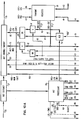
- Fig.10 is a block diagram of apparatus implementing the control functions for slot reuse in an order pad passing system. This control apparatus is provided in each of the nodes of the dual bus system.
- ACF extraction means 27 In the transmission medium 25, there is provided ACF extraction means 27 and, connected to it, ACF processing means 29 which receives and tests the data contained in the Access Control Field (ACF) of each slot passing on the transmission medium.
- ACF change/insertion means 31 allows to change the information contained in a passing ACF, or to insert new information into specific fields of each passing slot ACF.
- Fig.10 Also shown in Fig.10 are the storage for the Local Reservation Queue 33 (which will not be described in detail) and a queue storage accessing control section 35 connected to it.
- the Local Reservation Queue is connected to other portions of the node (which are not shown here) by lines 37.
- a further section contains the transmit requests of the respective node, in particular the desired number of slots and the respective destination, is shown as block 39. It is connected to the queue storage accessing control 35 by lines 41, and to other portions of the node (not shown here) by lines 43. It provides on output lines 45 the desired number of slots as Order Length ORD-LEN S(j), and on lines 47 the node label of the destination as Order Destination ORD-DST D(j).
- control signal on line 59 causes resetting of the Reuse Flag in the entry of the Local Reservation Queue for the respective cycle number.
- the cycle number is provided on lines 63 to queue storage accessing control section 35.
- the Destination Maximum DST-MAX appearing on lines 55, and the order Destination ORD-DST appearing on lines 47, are compared in comparison means 65. If the (locally requested) ORD-DST is greater then the arriving DST-MAX, then a control signal is activated on the output of comparison means 65 and passed through AND gate 67, control line 69 and OR gate 71 to gating means 73 which passes the ORD-DST from lines 47 to a DST-MAX line 75 for insertion into the respective field of the passing slot ACF. If the arriving DST-MAX value was greater then the local ORD-DST, then the DST-MAX in the passing slot ACF is not changed.
- the Requested Length which is contained in the next arriving slot ACF appears on lines 77 (REQ-LEN (IN)). It is augmented by the Order Length ORD-LEN S(j) (appearing on lines 45) in adding means 79 and the new augmented Requested Length is furnished via lines 81 and OR gates 83 to lines 85 (REQ-LEN (OUT)) for insertion into the respective field of the passing slot ACF.
- control signal on line 61 causes the Reuse Flag (REU-FLG) in the entry of the Local Reservation Queue for the respective cycle to be set.
- the locally desired Order Destination (ORD-DST) D(j) appearing on lines 47 is gated via gating means 73 to DST-MAX output lines 75 for insertion into the DST-MAX field of the passing slot ACF (the existing value in this field is overwritten).
- a control signal is furnished to gating means 73 through OR gate 71 from line 61.
- Order Length ORD-LEN S(j) appearing on lines 45 is gated, by gating means 87, through OR gates 83 to the REQ-LEN (OUT) lines 85 to cause insertion of the locally requested Order Length into the REQ-LEN field of the next slot ACF.
- the existing value is overwritten (it was saved already by a previous node into the field REQ-MAX).
- the Requested Maximum REQ-MAX of the slot ACF of the third arriving slot comprising an order pad command, appearing on lines 89 is compared in comparing means 91 to the requested length REQ-LEN appearing on lines 85 which was inserted into the ACF of the previous slot. If the Requested Length REQ-LNG is greater than the existing REQ-MAX, the latter is overwritten by the former, caused by a control signal on line 93. Otherwise, the REQ-MAX value in the passing slot ACF is not changed.
- a respective signal When a cycle start command is detected in a slot ACF, a respective signal will be activated on line 95. This causes interrogation of the entry for the respective cycle in the Local Reservation Queue, and if the Reuse Flag is set for that cycle, a respective signal is activated on line 97. This causes the setting of a Reuse Latch 99. Its output signal on line 101, the activated, will cause the node to insert its n payload segments for that cycle into the next n passing slots. The control signal on line 101 further causes the setting of the free/busy bit in all passing slots to "free", until the next cycle start control signal appears which will cause resetting of the Reuse Latch 99. Thus, the respective node will release only free slots (except for the first n slots which it uses for itself) within the current cycle for use by the following nodes downstream.
- node control circuitry No further details of the node control circuitry are shown here because they are not relevant for the present invention which is concerned with slot reuse, and because they are described already in the aforementioned European patent application.
- Labels are required in order to decide during the order pad passing process whether requested slots will have reached their destination when they pass at a certain node.
- the headend assigns the labels to the nodes via a "label" command which contains a Node Number (NOD-NUM) parameter.
- NOD-NUM Node Number
- the Node Number is initially set to zero.
- Each active node increments the Node Number by one, uses the result as its label, and passes the command with the incremented parameter to the next node.
- the labels are assigned to the nodes such that they correspond to the position of the active nodes down the bus, i.e. the headend gets label "1" and the last node on the bus gets the highest label number.
- the labels on the A-bus and B-bus are different.
- A-Bus label and B-Bus label are equal to the total number of active nodes plus 1 (if the node labels start with 1). Use of the same labels for both buses is possible, but would require slightly different reservation algorithms for the two buses.
- the assignment of the various types of addresses, e.g. IEEE 802 addresses, to the labels is done via higher layer protocols.
- Fig.10 also shows the means necessary in each node for implementing the node label assignment procedure.
- the respective indicator signal on line 103 is activated.
- the current node number (NOD-NUM) of the received label command appears on lines 105. It should represent the node label of the previous node upstream the transmission medium.
- adding means 107 this node number increased by one unit, and furnished on lines 109 for storing it in the local node label register 51 (thereafter appearing as node label j on its output), and for reinserting the new (increased) node number into the ACF field containing the label command, which further propagates down the transmission medium.
- the label command reaches the end of the respective bus, all nodes will have node labels in ascending order.
Landscapes
- Engineering & Computer Science (AREA)
- Computer Networks & Wireless Communication (AREA)
- Signal Processing (AREA)
- Small-Scale Networks (AREA)
- Bus Control (AREA)
Claims (11)
- Procédé de gestion à accès multiple dans un système de communication comprenant des noeuds attachés à un bus de transmission, système dans lequel des tranches de temps sont émises en cycles numérotés et un bloc de commande est passé préalablement pour chaque cycle numéroté, contenant un compte de requêtes (REQ-LEN) qui est augmenté par tout noeud de réservation de tranches de temps, ledit procédé comprenant les étapes suivantes pour réduire le nombre de tranches de temps qui doivent être émises:- porter une identification de destination la plus éloignée (DST- MAX) dans chacun desdits blocs de commande qui est mis à jour par chaque noeud réservant des tranches de temps pour une transmission de données sur un noeud de destination sélectionnée;- déterminer, à partir de l'identification de destination la plus éloignée, des sections du bus de transmission, chacune entre deux desdits noeuds, au-delà desquelles aucune donnée ne doit être transmise dans des tranches de temps du cycle respectif;- redémarrer ledit compte de requêtes pour chaque section de ce type, et garder la valeur maximale du compte de requêtes qui est apparue pour l'une quelconque desdites sections, comme maximum requis (REQ-MAX) du cycle respectif;- émettre, pour chaque cycle, un nombre de tranches de temps correspondant au maximum requis pour ce cycle; et- ré-utiliser, durant chaque cycle, toutes les tranches de temps qui passent dans un noeud placé entre deux quelconques desdites sections qui ont été déterminées pour ce cycle.
- Procédé selon la revendication 1, comprenant les autres étapes suivantes:- attribuer l'identification de labels de noeud (NOD-LBL) à tous les noeuds dans un ordre ascendant;- fournir dans chacun desdits blocs de commande, en plus d'un numéro de cycle (CYC-NUM) et d'un champ pour ledit compte de requêtes (REQ-LEN), un champ pour un label de noeud de destination la plus éloignée (DST-MAX), et un champ pour un maximum requis (REQ-MAX);- dans chaque noeud qui désire réserver des tranches de temps pour une transmission de données:(a) si le label de noeud de destination la plus éloignée (DST-MAX) dans un bloc de commande reçu est inférieur ou égal au propre label de noeud local, instaurer une indication de retard local (REU-FLG), et redémarrer le compte de requêtes (REQ-LEN) dans ledit bloc de commande;(b) mettre à jour, dans un bloc de commande reçu, le compte de requêtes (REQ-LEN) en ajoutant le nombre localement requis de tranches de temps (ORD-LEN), et mettre à jour ledit label de noeud de destination la plus éloignée en insérant le label de noeud de destination sélectionné (ORD-DST) des données locales à transmettre si ce dernier est supérieur au label de noeud de destination la plus éloignée reçu dans le bloc de commande; et(c) transférer le compte requis obtenu (REQ-LEN) dans le champ du maximum requis (REQ-MAX) si le contenu de ce dernier est inférieur à celui du compte de requêtes obtenu.
- Procédé de gestion à accès multiple pour un système de communication comprenant des noeuds attachés à un bus de transmission et des moyens de tête de ligne pour engendrer des tranches de temps et des blocs de commande pour des cycles numérotés, chacun desdits blocs de commande comprenant un numéro de cycle (CYC-NUM), et un compte de requêtes (REQ-LEN) que chaque noeud peut modifier par un nombre de tranches de temps requis (ORD-LEN), chaque noeud utilisant, après le début du cycle opératoire respectif, le nombre requis de tranches de temps libres, et chaque noeud étant identifié par un label (NOD-LBL) indiquant sa position, ledit procédé comprenant les étapes suivantes:
fournir, dans chacun desdits blocs de commande, des champs pour un label de noeud de destination la plus éloignée (DST-MAX) et pour un maximum requis (REQ-MAX), le contenu desdits champs étant initialement zéro;
dans chaque noeud désirant demander des tranches de temps pour transmettre des données locales à une destination sélectionnée:(1) comparer ledit label de noeud de destination la plus éloignée (DST-MAX) au propre label de noeud (NOD-LBL); et soit(a) si le label de noeud de destination la plus éloignée est égal audit propre noeud de label ou identifie un noeud amont:
remplacer le label de noeud de destination la plus éloignée (DST-MAX) par le label du noeud de destination sélectionnée (ORD-DST);- remplacer le compte de requêtes en cours (REQ-LEN) par le nombre de tranches de temps requises (ORD-LEN);- emmagasiner une indication de redémarrage local (REU-FLG) pour le cycle opératoire respectif dans le noeud demandeur; soit(b) si le label de noeud de destination la plus éloignée identifie un noeud aval:- remplacer le label de noeud de destination la plus éloignée (DST-MAX) par le label du noeud de destination sélectionnée (ORD-DST) si ce dernier est supérieur;- modifier le compte de requêtes en cours (REQ-LEN) par le nombre de tranches de temps requis (ORD-LEN); et(2) remplacer le maximum requis (REQ-MAX) par le compte de requêtes obtenu (REQ-LEN) si ce dernier est supérieur. - Procédé selon la revendication 3, caractérisé en ce que chaque bloc de commande est retourné à son moyen de tête de ligne d'origine, et en ce que la valeur du maximum requis (REQ-MAX) contenue dans le bloc de commande retourné, est emmagasinée avec le numéro de cycle opératoire respectif (CYC-NUM) dans une entrée d'une file d'attente de réservations globale maintenue dans ledit moyen de tête de ligne.
- Procédé selon les revendications 2 ou 3, caractérisé en ce que ladite indication de redémarrage locale (REU-FLG) est emmagasinée avec un numéro de cycle respectif (CYC-NUM) et le nombre de tranches de temps requises (ORD-LEN), dans une entrée d'une file d'attente de réservations locale maintenue dans chaque noeud.
- Procédé selon les revendications 2 ou 3, pour une utilisation dans un système où chaque tranche de temps comprend une indication occupé/libre qui est instaurée à l'état occupé lorsqu'un noeud entre des données dans la tranche, et dans lequel chaque cycle opératoire est amorcé par une commande de départ de cycle numéroté, caractérisé en ce qu'un noeud contenant une indication de redémarrage local (REU-FLG) pour tout cycle spécifique, après avoir détecté la commande de départ de cycle pour ce cycle, utilise les premières tranches suivant la commande de départ de cycle pour transmettre ses données locales, et ensuite restaure l'indication occupé/libre dans toutes les tranches de temps suivantes à l'état libre jusqu'à ce qu'il détecte la commande de départ de cycle suivante.
- Procédé selon les revendications 2 ou 3, pour une utilisation dans un système dans lequel chacun desdits blocs de commande est réparti sur les champs de contrôle de plusieurs tranches de temps consécutives, caractérisé en ce que le champ dudit label de noeud de destination la plus éloignée (DST-MAX) est contenu dans le premier desdits champs de contrôle.
- Procédé selon les revendications 2 ou 3, caractérisé en ce que, pour l'attribution de labels de noeud en ordre ascendant auxdits noeuds, il est envoyé une commande de label contenant un numéro de noeud (NOD-NUM) qui est initialement zéro; en ce que chaque noeud recevant la commande de label augmente le numéro de noeud (NOD-NUM) d'une unité et, ensuite, emmagasine la nouvelle valeur du numéro de noeud comme son propre label de noeud (NOD-LBL) et transmette la commande de label au noeud suivant.
- Appareil pour permettre un usage multiple de tranches de temps dans un système de communication comprenant un support de transmission unidirectionnel (11, figure 1); plusieurs noeuds (19-1 ... 19-N) qui lui sont connectés, et un moyen de tête de ligne (15) pour engendrer des tranches de temps de transmission et des informations de contrôle passant sur ledit support de transmission; un bloc de commande étant passé à chaque cycle d'une pluralité de cycles opératoires numérotés, comprenant un compte de requêtes (REQ-LEN) que chaque noeud peut modifier par un nombre de tranches de temps requises (ORD-LEN); chaque noeud utilisant après le départ du cycle opératoire respectif le nombre requis de tranches de temps libres; et chaque noeud étant identifié par un label (NOD-LBL) indiquant sa position, ledit appareil comprenant:
dans ledit moyen de tête de ligne:- un moyen pour engendrer des blocs de commande (figure 6, A, B, C) comprenant, en plus d'un numéro de cycle (CYC-NUM) et d'un champ pour ledit compte de requêtes (REQ-LEN), d'autres champs pour respectivement un label de noeud de destination la plus éloignée (DST-MAX) et pour un maximum requis (REQ-MAX); et
dans chacun desdits noeuds,- un moyen (51, figure 10) pour emmagasiner un label de noeud local (NOD-LBL);- un moyen (39) pour emmagasiner le label (ORD-DST) d'un noeud de destination sélectionnée sur lequel doivent être transmises des données locales;- un moyen (57) pour comparer le label de noeud de destination la plus éloignée dans un bloc de commande reçu avec le label de noeud local;- des moyens (33, 35, 61) pour emmagasiner le numéro de cycle avec l'indicateur de réutilisation (REU-FLG), si le label de destination la plus éloignée est inférieur ou égal au label de noeud local, et des moyens (31, 47, 73, 75) pour insérer le label du noeud de destination sélectionnée dans le champ du label de noeud de destination la plus éloignée (DST-MAX) du bloc de commande; et- des moyens (31, 95, 97, 99, 101) pour rendre disponibles, après le départ d'un cycle opératoire respectif pour lequel le noeud a emmagasiné un indicateur de réutilisation, toutes les tranches de temps de ce cycle opératoire respectif à utiliser par le noeud respectif ou par d'autres noeuds plus en aval. - Appareil selon la revendication 9, caractérisé en ce que chaque noeud comprend en outre:- un moyen (91) pour comparer le maximum requis (REQ-MAX) dans un bloc de commande reçu avec le compte de requêtes en cours (REQ-LEN); et- des moyens ( 31, 85, 93) pour remplacer le maximum requis par le compte de requêtes en cours si ce dernier est supérieur.
- Appareil selon la revendication 9, caractérisé en ce que chaque noeud comprend en outre:- un moyen (45) pour emmagasiner un nombre requis de tranches (ORD-LEN);- des moyens (45, 61, 83, 85, 87) pour remplacer le compte de requêtes en cours (REQ-LEN) dans un bloc de commande reçu par le nombre requis de tranches (ORD-LEN) si le label de noeud de destination la plus éloignée (DST-MAX) est inférieur ou égal au label de noeud local (NOD-LBL), mais pour ajouter le nombre requis de tranches au compte requis en cours si le label de noeud de destination la plus éloignée est supérieur au label de noeud local.
Priority Applications (4)
| Application Number | Priority Date | Filing Date | Title |
|---|---|---|---|
| EP90810294A EP0451426B1 (fr) | 1990-04-11 | 1990-04-11 | Gestion à accès multiple pour un système de communication par passage d'un bloc de commande |
| DE69013886T DE69013886T2 (de) | 1990-04-11 | 1990-04-11 | Mehrfachzugriffssteuerung für ein Kommunikationssystem mit Reservierungsblockübermittlung. |
| JP3070638A JP2500080B2 (ja) | 1990-04-11 | 1991-03-11 | 通信システムにおける多重アクセス制御方法及び装置 |
| US07/672,216 US5173898A (en) | 1990-04-11 | 1991-03-20 | Multiple-access control for a communication system with order pad passing |
Applications Claiming Priority (1)
| Application Number | Priority Date | Filing Date | Title |
|---|---|---|---|
| EP90810294A EP0451426B1 (fr) | 1990-04-11 | 1990-04-11 | Gestion à accès multiple pour un système de communication par passage d'un bloc de commande |
Publications (2)
| Publication Number | Publication Date |
|---|---|
| EP0451426A1 EP0451426A1 (fr) | 1991-10-16 |
| EP0451426B1 true EP0451426B1 (fr) | 1994-11-02 |
Family
ID=8205920
Family Applications (1)
| Application Number | Title | Priority Date | Filing Date |
|---|---|---|---|
| EP90810294A Expired - Lifetime EP0451426B1 (fr) | 1990-04-11 | 1990-04-11 | Gestion à accès multiple pour un système de communication par passage d'un bloc de commande |
Country Status (4)
| Country | Link |
|---|---|
| US (1) | US5173898A (fr) |
| EP (1) | EP0451426B1 (fr) |
| JP (1) | JP2500080B2 (fr) |
| DE (1) | DE69013886T2 (fr) |
Cited By (15)
| Publication number | Priority date | Publication date | Assignee | Title |
|---|---|---|---|---|
| US5838687A (en) * | 1995-12-28 | 1998-11-17 | Dynarc Ab | Slot reuse method and arrangement |
| US5946315A (en) * | 1995-12-28 | 1999-08-31 | Dynarc Inc. | Method and device for synchronizing dynamic synchronous transfer mode in a ring topology |
| US5960002A (en) * | 1995-12-28 | 1999-09-28 | Dynarc Ab | Defragmentation method and arrangement |
| US5982747A (en) * | 1995-12-28 | 1999-11-09 | Dynarc Inc. | Method for managing failures on dynamic synchronous transfer mode dual ring topologies |
| US5982780A (en) * | 1995-12-28 | 1999-11-09 | Dynarc Ab | Resource management scheme and arrangement |
| US6108338A (en) * | 1995-12-28 | 2000-08-22 | Dynarc Inc. | Method and device for dynamic synchronous transfer mode in a dual ring topology |
| WO2002043321A3 (fr) * | 2000-11-21 | 2003-03-13 | Lockheed Martin Company | Systeme et procede d'encapsulation d'informations de transport transparentes a une couche physique |
| US6912339B2 (en) | 2002-09-27 | 2005-06-28 | Lockheed Martin Corporation | Optical interface devices having balanced amplification |
| US7085497B2 (en) | 2002-04-03 | 2006-08-01 | Lockheed Martin Corporation | Vehicular communication system |
| US7283480B1 (en) | 2002-11-12 | 2007-10-16 | Lockheed Martin Corporation | Network system health monitoring using cantor set signals |
| US7349629B1 (en) | 2002-11-26 | 2008-03-25 | Lockheed Martin Corporation | Methods and systems for creating a digital interconnect fabric |
| US7424228B1 (en) | 2003-03-31 | 2008-09-09 | Lockheed Martin Corporation | High dynamic range radio frequency to optical link |
| US7440699B1 (en) | 2004-06-28 | 2008-10-21 | Lockheed Martin Corporation | Systems, devices and methods for transmitting and receiving signals on an optical network |
| US7570887B2 (en) | 2003-03-31 | 2009-08-04 | Lockheed Martin Corporation | Optical network interface systems and devices |
| USRE41247E1 (en) | 1997-04-01 | 2010-04-20 | Lockheed Martin Corporation | Optical transport system |
Families Citing this family (15)
| Publication number | Priority date | Publication date | Assignee | Title |
|---|---|---|---|---|
| US5361262A (en) * | 1993-04-16 | 1994-11-01 | Bell Communications Research, Inc. | Estimated-queue, expanded-bus communication network |
| US5555244A (en) * | 1994-05-19 | 1996-09-10 | Integrated Network Corporation | Scalable multimedia network |
| US5613073A (en) * | 1994-07-25 | 1997-03-18 | International Business Machines Corporation | Apparatus and method for a buffer reservation system |
| JP3595836B2 (ja) * | 1995-05-12 | 2004-12-02 | 株式会社 東芝 | 通信システム |
| US5790806A (en) * | 1996-04-03 | 1998-08-04 | Scientific-Atlanta, Inc. | Cable data network architecture |
| SE506548C2 (sv) * | 1996-03-25 | 1998-01-12 | Net Insight Ab | Metod och anordning för dynamisk signalering i ett tidsmultiplexat system |
| SE508889C2 (sv) * | 1996-03-25 | 1998-11-16 | Net Insight Ab | Metod och anordning för dataöverföring med parallella bitströmmar |
| EP1137151A4 (fr) | 1998-09-07 | 2004-03-31 | Kenichi Suzuki | Circuit economiseur d'energie |
| US6839322B1 (en) * | 2000-02-09 | 2005-01-04 | Nortel Networks Limited | Method and system for optical routing of variable-length packet data |
| US6891855B2 (en) * | 2000-07-27 | 2005-05-10 | Corrigent Systems, Ltd. | Dynamic packet fragmentation |
| US6985510B2 (en) * | 2000-12-22 | 2006-01-10 | Qualcomm, Incorporated | Method and system for data and voice transmission over shared and dedicated channels |
| US6876669B2 (en) * | 2001-01-08 | 2005-04-05 | Corrigent Systems Ltd. | Packet fragmentation with nested interruptions |
| US8072999B1 (en) * | 2007-05-08 | 2011-12-06 | Motion Engineering Inc. | Method and system for removing and returning nodes in a synchronous network |
| US8135893B2 (en) | 2008-09-12 | 2012-03-13 | Honeywell International, Inc. | System, apparatus and method for granting access to a shared communications bus |
| US10230665B2 (en) * | 2013-12-20 | 2019-03-12 | Intel Corporation | Hierarchical/lossless packet preemption to reduce latency jitter in flow-controlled packet-based networks |
Family Cites Families (9)
| Publication number | Priority date | Publication date | Assignee | Title |
|---|---|---|---|---|
| US4387458A (en) * | 1981-05-28 | 1983-06-07 | Bell Telephone Laboratories, Incorporated | High capacity secure address loop network |
| US4460994A (en) * | 1981-10-05 | 1984-07-17 | At&T Bell Laboratories | Loop communication system |
| US4528663A (en) * | 1983-12-09 | 1985-07-09 | Zenith Electronics Corporation | Peak load access in a two-way CATV contention system |
| US4663748A (en) * | 1984-04-12 | 1987-05-05 | Unisearch Limited | Local area network |
| DE3424866C2 (de) * | 1984-07-06 | 1986-04-30 | Messerschmitt-Bölkow-Blohm GmbH, 8012 Ottobrunn | Verfahren und Anordnung zur Übertragung von Daten, insbesondere in einem Flugzeug |
| CA1252549A (fr) * | 1984-12-03 | 1989-04-11 | Robert M. Newman | Protocole de mise en file d'attente |
| DE3580481D1 (de) * | 1985-08-13 | 1990-12-13 | Ibm | Mechanismus zur dynamischen zuordnung von bandbreite zwischen durchschaltkanaelen und paketbitstrom in einem nachrichtennetz. |
| DE68920028T2 (de) * | 1989-04-21 | 1995-07-06 | Ibm | Verfahren und Vorrichtung zum Vielfachzugriff mit zyklischer Reservierung in einem Kommunikationssystem. |
| US5003531A (en) * | 1989-08-11 | 1991-03-26 | Infotron Systems Corporation | Survivable network using reverse protection ring |
-
1990
- 1990-04-11 DE DE69013886T patent/DE69013886T2/de not_active Expired - Fee Related
- 1990-04-11 EP EP90810294A patent/EP0451426B1/fr not_active Expired - Lifetime
-
1991
- 1991-03-11 JP JP3070638A patent/JP2500080B2/ja not_active Expired - Lifetime
- 1991-03-20 US US07/672,216 patent/US5173898A/en not_active Expired - Lifetime
Cited By (17)
| Publication number | Priority date | Publication date | Assignee | Title |
|---|---|---|---|---|
| US5946315A (en) * | 1995-12-28 | 1999-08-31 | Dynarc Inc. | Method and device for synchronizing dynamic synchronous transfer mode in a ring topology |
| US5960002A (en) * | 1995-12-28 | 1999-09-28 | Dynarc Ab | Defragmentation method and arrangement |
| US5982747A (en) * | 1995-12-28 | 1999-11-09 | Dynarc Inc. | Method for managing failures on dynamic synchronous transfer mode dual ring topologies |
| US5982780A (en) * | 1995-12-28 | 1999-11-09 | Dynarc Ab | Resource management scheme and arrangement |
| US6108338A (en) * | 1995-12-28 | 2000-08-22 | Dynarc Inc. | Method and device for dynamic synchronous transfer mode in a dual ring topology |
| US5838687A (en) * | 1995-12-28 | 1998-11-17 | Dynarc Ab | Slot reuse method and arrangement |
| USRE41247E1 (en) | 1997-04-01 | 2010-04-20 | Lockheed Martin Corporation | Optical transport system |
| US6320863B1 (en) | 1998-04-17 | 2001-11-20 | Dynarc Inc. Dba Dynamic Network Architecture Inc. | Backplane architecture for dynamic synchronous transfer mode |
| WO2002043321A3 (fr) * | 2000-11-21 | 2003-03-13 | Lockheed Martin Company | Systeme et procede d'encapsulation d'informations de transport transparentes a une couche physique |
| US7085497B2 (en) | 2002-04-03 | 2006-08-01 | Lockheed Martin Corporation | Vehicular communication system |
| US6912339B2 (en) | 2002-09-27 | 2005-06-28 | Lockheed Martin Corporation | Optical interface devices having balanced amplification |
| USRE40425E1 (en) | 2002-09-27 | 2008-07-08 | Lockheed Martin Corporation | Optical interface devices having balanced amplification |
| US7283480B1 (en) | 2002-11-12 | 2007-10-16 | Lockheed Martin Corporation | Network system health monitoring using cantor set signals |
| US7349629B1 (en) | 2002-11-26 | 2008-03-25 | Lockheed Martin Corporation | Methods and systems for creating a digital interconnect fabric |
| US7424228B1 (en) | 2003-03-31 | 2008-09-09 | Lockheed Martin Corporation | High dynamic range radio frequency to optical link |
| US7570887B2 (en) | 2003-03-31 | 2009-08-04 | Lockheed Martin Corporation | Optical network interface systems and devices |
| US7440699B1 (en) | 2004-06-28 | 2008-10-21 | Lockheed Martin Corporation | Systems, devices and methods for transmitting and receiving signals on an optical network |
Also Published As
| Publication number | Publication date |
|---|---|
| JP2500080B2 (ja) | 1996-05-29 |
| DE69013886D1 (de) | 1994-12-08 |
| DE69013886T2 (de) | 1995-05-18 |
| JPH04250737A (ja) | 1992-09-07 |
| US5173898A (en) | 1992-12-22 |
| EP0451426A1 (fr) | 1991-10-16 |
Similar Documents
| Publication | Publication Date | Title |
|---|---|---|
| EP0451426B1 (fr) | Gestion à accès multiple pour un système de communication par passage d'un bloc de commande | |
| EP0462349B1 (fr) | Système de communication en anneau à large bande et méthode de commande d'accès | |
| US5081622A (en) | Method and apparatus for distributed queue multiple access in a communication system | |
| EP0042447B1 (fr) | Mécanisme de contrôle d'écoulement pour des noeuds de commutation de blocs | |
| US5136582A (en) | Memory management system and method for network controller | |
| US5210750A (en) | Method and apparatus for distributed queue multiple access in a communication system | |
| US7085847B2 (en) | Method and system for scheduling network communication | |
| EP0459757B1 (fr) | Adaptateur de réseau | |
| EP0276349B1 (fr) | Dispositif pour commuter des informations entre des canaux de trafic synchrone et pour commuter des paquets de données asynchrones | |
| US6266702B1 (en) | Method and apparatus to insert and extract data from a plurality of slots of data frames by using access table to identify network nodes and their slots for insertion and extraction data | |
| WO2000019672A1 (fr) | Procede et systeme pour transmettre des informations dans un reseau | |
| EP0424302A2 (fr) | Méthode pour le contrôle des transmissions à trame multiple dans les réseaux à jeton | |
| US6973096B2 (en) | System and method for processing bandwidth allocation messages | |
| EP0339809B1 (fr) | Réseau à division temporelle asynchrone | |
| EP0505658B1 (fr) | Technique d'accès au support de transmission de réseaux locaux | |
| JPH0715448A (ja) | 通信ネットワークおよびこのネットワーク中のバスへのアクセスの調整方法 | |
| US6374314B1 (en) | Method for managing storage of data by storing buffer pointers of data comprising a sequence of frames in a memory location different from a memory location for pointers of data not comprising a sequence of frames | |
| US5214649A (en) | Insert/remove signalling in lan systems | |
| EP0459756A2 (fr) | Réseau à fibre avec interface de données distribuées | |
| EP0707431A1 (fr) | Système pour la transmission de cellules ATM par un réseau local passif |
Legal Events
| Date | Code | Title | Description |
|---|---|---|---|
| PUAI | Public reference made under article 153(3) epc to a published international application that has entered the european phase |
Free format text: ORIGINAL CODE: 0009012 |
|
| AK | Designated contracting states |
Kind code of ref document: A1 Designated state(s): DE FR GB |
|
| 17P | Request for examination filed |
Effective date: 19911219 |
|
| K1C3 | Correction of patent application (complete document) published |
Effective date: 19911016 |
|
| 17Q | First examination report despatched |
Effective date: 19931216 |
|
| GRAA | (expected) grant |
Free format text: ORIGINAL CODE: 0009210 |
|
| AK | Designated contracting states |
Kind code of ref document: B1 Designated state(s): DE FR GB |
|
| REF | Corresponds to: |
Ref document number: 69013886 Country of ref document: DE Date of ref document: 19941208 |
|
| ET | Fr: translation filed | ||
| PGFP | Annual fee paid to national office [announced via postgrant information from national office to epo] |
Ref country code: FR Payment date: 19950328 Year of fee payment: 6 |
|
| PGFP | Annual fee paid to national office [announced via postgrant information from national office to epo] |
Ref country code: DE Payment date: 19950428 Year of fee payment: 6 |
|
| PLBE | No opposition filed within time limit |
Free format text: ORIGINAL CODE: 0009261 |
|
| STAA | Information on the status of an ep patent application or granted ep patent |
Free format text: STATUS: NO OPPOSITION FILED WITHIN TIME LIMIT |
|
| 26N | No opposition filed | ||
| PG25 | Lapsed in a contracting state [announced via postgrant information from national office to epo] |
Ref country code: FR Effective date: 19961227 |
|
| PG25 | Lapsed in a contracting state [announced via postgrant information from national office to epo] |
Ref country code: DE Effective date: 19970101 |
|
| REG | Reference to a national code |
Ref country code: FR Ref legal event code: ST |
|
| PGFP | Annual fee paid to national office [announced via postgrant information from national office to epo] |
Ref country code: GB Payment date: 19980319 Year of fee payment: 9 |
|
| PG25 | Lapsed in a contracting state [announced via postgrant information from national office to epo] |
Ref country code: GB Free format text: LAPSE BECAUSE OF NON-PAYMENT OF DUE FEES Effective date: 19990411 |
|
| GBPC | Gb: european patent ceased through non-payment of renewal fee |
Effective date: 19990411 |