EP0451590B1 - Verfahren zur Herstellung eines ungesättigten Polyesterpolyurethans sowie ein Verfahren zur Herstellung einer wässrigen Lackzusammensetzung. - Google Patents
Verfahren zur Herstellung eines ungesättigten Polyesterpolyurethans sowie ein Verfahren zur Herstellung einer wässrigen Lackzusammensetzung. Download PDFInfo
- Publication number
- EP0451590B1 EP0451590B1 EP91104626A EP91104626A EP0451590B1 EP 0451590 B1 EP0451590 B1 EP 0451590B1 EP 91104626 A EP91104626 A EP 91104626A EP 91104626 A EP91104626 A EP 91104626A EP 0451590 B1 EP0451590 B1 EP 0451590B1
- Authority
- EP
- European Patent Office
- Prior art keywords
- polyester
- acid
- weight
- water
- group
- Prior art date
- Legal status (The legal status is an assumption and is not a legal conclusion. Google has not performed a legal analysis and makes no representation as to the accuracy of the status listed.)
- Expired - Lifetime
Links
Classifications
-
- C—CHEMISTRY; METALLURGY
- C09—DYES; PAINTS; POLISHES; NATURAL RESINS; ADHESIVES; COMPOSITIONS NOT OTHERWISE PROVIDED FOR; APPLICATIONS OF MATERIALS NOT OTHERWISE PROVIDED FOR
- C09D—COATING COMPOSITIONS, e.g. PAINTS, VARNISHES OR LACQUERS; FILLING PASTES; CHEMICAL PAINT OR INK REMOVERS; INKS; CORRECTING FLUIDS; WOODSTAINS; PASTES OR SOLIDS FOR COLOURING OR PRINTING; USE OF MATERIALS THEREFOR
- C09D175/00—Coating compositions based on polyureas or polyurethanes; Coating compositions based on derivatives of such polymers
- C09D175/04—Polyurethanes
- C09D175/14—Polyurethanes having carbon-to-carbon unsaturated bonds
-
- C—CHEMISTRY; METALLURGY
- C08—ORGANIC MACROMOLECULAR COMPOUNDS; THEIR PREPARATION OR CHEMICAL WORKING-UP; COMPOSITIONS BASED THEREON
- C08G—MACROMOLECULAR COMPOUNDS OBTAINED OTHERWISE THAN BY REACTIONS ONLY INVOLVING UNSATURATED CARBON-TO-CARBON BONDS
- C08G18/00—Polymeric products of isocyanates or isothiocyanates
- C08G18/06—Polymeric products of isocyanates or isothiocyanates with compounds having active hydrogen
- C08G18/28—Polymeric products of isocyanates or isothiocyanates with compounds having active hydrogen characterised by the compounds used containing active hydrogen
- C08G18/67—Unsaturated compounds having active hydrogen
- C08G18/68—Unsaturated polyesters
Definitions
- the present invention relates to a method for producing an unsaturated Polyester urethane based on an allyl ether grouping containing polyester A and a polyisocyanate B and a method to produce an aqueous paint composition using of such a polyester urethane.
- Urethane-containing coatings are used to achieve elastic, abrasion-resistant coatings Lacquer raw materials known.
- the urethane groups can be strong Interactions within the polymer chains exert their use as water and chemical resistant coatings favored. It should be emphasized the very good adhesion of polyurethanes to a wide variety of them Substrates due to strong polar interaction with these substrates.
- Raw materials containing urethane groups that are ethylenic are particularly advantageous contain unsaturated groups and are both air-drying and peroxidic and are curable with high-energy rays.
- Such polyurethane products are e.g. in Form of radiation-curable urethane acrylates used (US-A-4 451 509, EP-A-53 749).
- Such paints must be based on reactive thinners based on Acrylic acid can be diluted. However, these show just like the urethane acrylates physiological disadvantages. This can lead to skin irritation and increased sensitization to lead.
- processing viscosities can also be reduced by using inert organic solvents can be set, but during drying lead to increased air pollution and the use more expensive Disposal systems require (see CA-PS 1192331).
- EP-A-0 315 920 describes allyl ether-functional unsaturated ones Described polyester urethanes. These urethanes can only be used in organic Solvents and with the addition of reactive thinners. It a polyester is first produced, followed by a diisocyanate implemented wid. One isocyanate group of the diisocyanate should have one OH group of the polyester react. It is in the nature of the reaction that both some of the diisocyanate molecules remain unreacted in the mixture as well two polyester molecules are connected to each other via a diisocyanate. in the subsequent third reaction step with an allyl group-containing alcohol brought the reaction of the isocyanate groups. It still react in the Diisocyanates present in the reaction mixture, i.a. with two allyl ether groups Alcohols to a low molecular weight compound that the paint properties deteriorated. These products are in water only disproportionately high due to the polyester used Emulsifier insert can be emulsified.
- the most environmentally friendly and physiologically harmless diluent for Adjustment of the processing viscosity of paint binders is water.
- the Production of polyurethane dispersions with ethylenically unsaturated Groups are known. In Ullmann's Encyclopedia of Technical Chemistry, 4. Edition, Volume 19, Weinheim, 1980, are four main manufacturing processes and the basic components required for this are listed. It’s the emulsifier shear method, the prepolymer-ionomer mixing process, the acetone process and the melt dispersing process. The polyaddition reactions are in the The first three processes are mostly carried out in solvents.
- Emulsifier-free ionomer dispersions have the greatest technical importance. Here becomes a polyurethane ionomer with free isocyanate groups in one Solvent produced, dispersed with the solvent and usually extended chain. The solvent must then be distilled off. There remain Residual solvents in the dispersion. The high proportion of ionic groups leads to poor water resistance of the hardened paints.
- DE-A-2 923 338 describes the ripening of an aqueous polyester dispersion described, which is characterized in that this dispersion additionally at least one polyfunctional, aliphatic and / or cycloaliphatic Isocyanate with 0.005 - 0.1 mol NCO / 100 g polyester contains isocyanate Products are physiologically very questionable because they cause severe irritation from Skin, eyes and mucous membranes cause long-term damage can. The handling of paint binders containing isocyanate is also through increased safety regulations difficult. The non-specific reaction of the isocyanate, on the one hand with the paint raw materials, on the other hand with the water, leads to Introduction of hydrophilic groups that impair water resistance. In addition there is strong gas formation. The storage stability is accordingly impaired (see example).
- DE-A-3 829 588 describes allyl urethanes which are produced by reaction a polyglycol mixture or its esterification product with a Polyisocyanate and a hydroxyallyl compound are prepared. At this Reaction can result in the formation of low molecular weight reaction products Diisocyanate and hydroxyallyl compound come. Be in this product high molecular weight polyglycols, such as polyethylene glycol 2000, are used. This is known to reduce the water resistance of the paint, moreover, the Lacquer surface rubber-like blunt.
- DE-A-3 829 590 relates to allyl urethanes which are not water-dispersible, but must be applied in an organic solvent. This requires the use of costly exhaust air combustion systems.
- the object of the present invention was to provide a water-dispersible or water-soluble, polymerizable binder based on unsaturated To provide urethane group-containing polyester, which is due to high-energy Radiation and also peroxidically curable, does not have the disadvantages mentioned above and after curing good paint properties, in particular improved hardness and Adhesion strength, a reduced penetration into wood shows and no free Has isocyanate groups and no solvent residues.
- Another object of the invention is a method for producing a aqueous paint composition.
- Two-phase reactions with chain extension predominantly non-ionic Polymers are manufactured that are in liquid form by mixing with low shear forces can be converted into aqueous dispersions without emulsifiers. This enables 100% products to be transported without ballast.
- allyl ether-functional, unsaturated polyester urethanes based on 80 - 99 parts by weight, preferably 88-98 parts by weight, particularly preferably 88-96 parts by weight of a water-dispersible or water-soluble allyl ether-functional unsaturated polyester A, and 1 - 20 parts by weight, preferably 2 to 12 parts by weight, particularly preferably 2-10 parts by weight of one Polyisocyanates B used.
- allyl ether functional unsaturated polyesters without Emulsifiers are water-dispersible is known from DE-OS 3 441 154 (EP-A-182 147), DE-OS2 905 666, DE-OS 2 804 216, DE-OS-3 218 200.
- polyesters are due to their content of polyalkylene glycols water-dispersible, as is also listed in these patent regulations.
- the allyl ether-functional alcohols D contain at least one esterifiable hydroxy group at least one, preferably two or more allyl ether residues.
- Suitable alcohols D are e.g. Allyl, methallyl, ethallyl, chlorallyl ethers such as oxyethylated or oxpropylated allyl, methallyl, ethallyl or chloroallyl alcohol, Glycerol mono- or diallyl ether, trimethylolethane mono- or -dimethallyl ether, trimethylolpropane mono- or -diallyl ether, 1,3,5-hexanetriol-mono- or dichloroallyl ether, pentacrythritol mono-, di- or triallyl ether, Tetramethylolcyclohexanol tetraallyl ether, butene- (2,3) diol-1,4-monoallyl ether, mixed ethers, such as trimethylolpropane monoallyl monocrotyl ether and pentaerythritol mono- or diallyl monobenzyl ether.
- the polyols G are trivalent to hexavalent oxyalkylated Alcohols.
- Oxalkylated alcohols are oxethylated and / or oxpropylated triols understood, optionally with an alkoxylated four to hexavalent polyol e.g. Trimethylolpropane, trimethylol ethers, Pentaerythritol, erythritol sorbitol, di-trimethylolpropane and dipentaerythritol.
- components A - F are used in the following proportions: Polycarboxylic acid C 15-45 parts by weight, in particular 20 - 35 parts by weight, Allyl ether alcohol B 15-45 parts by weight, in particular 20-40 parts by weight, Alcohols E. 10 - 40 parts by weight, in particular 15 - 35 parts by weight, monohydric alcohols F 0 - 15 parts by weight, Polyols G 0 - 40 parts by weight.
- monohydric alcohols F such as methanol, ethanol, Butanol, pentanol, heptanol, isooctanol, allyl alcohol, benzyl alcohol, all Hexanols, octanols and decanols, cetyl alcohols, hexahydrobenzyl alcohol, ⁇ -phenylethanol and polyalkylene glycol alky
- polyesters can be carried out by known methods, e.g. by melting or azeotropic esterification of the alcohols and acids or their esterifiable Derivatives, e.g. their anhydrides, (compare methods of organic Chemistry, Houben-Weyl, 4th edition, volume 14/2, Georg-Thieme-Verlag, Stuttgart, 1961). Melt condensation under an inert gas atmosphere is preferred Temperatures of 140 - 200 ° C, preferably 150 - 180 ° C.
- Suitable stabilizers are in "Methods of Organic Chemistry ", Houben / Weyl. 4th edition, volume 14/1, page 433, Georg-Thieme-Verlag, Stuttgart, 1961.
- Phenols and phenol derivatives are the usual ones to prevent thermal Compounds used for polymerization, e.g. Phenols and phenol derivatives; preferably sterically hindered phenols, such as 2,6-di-tert-butylphenol, amines, Nitrosamines, quinones, hydroquinone monoalkyl ethers, phenothiazines or Phosphoric acid esters. They are generally sold in quantities of 0.001 - 3.0 wt .-%, preferably used in amounts of 0.005 - 0.5 wt .-%. For example, very suitable Toluhydroquinone in a concentration of 0.01-0.05% by weight
- the allyl ether-functional, unsaturated polyesters A are subsequently reacted with a polyisocyanate B at temperatures of 50-120 ° C., preferably 60-80 ° C., under an inert gas atmosphere.
- a polyisocyanate B at temperatures of 50-120 ° C., preferably 60-80 ° C., under an inert gas atmosphere.
- Aliphatic, cycloaliphatic, araliphatic or aromatic polyisocyanates can be used. Aliphatic and cycloaliphatic polyisocyanates are preferred. Mixtures of these polyisocyanates are also suitable.
- polyisocyanates examples include Ethylene diisocyanate, trimethylene diisocyanate, tetramethylene diisocyanate, pentamethylene diisocyanate, hexamethylene diisocyanate, 2-methylpentamethylene diisocyanate, dodecamethylene diisocyanate, ethylethylene diisocyanate, 2,3-dimethylethylene diisocyanate, 1-methyl-trimethylene diisocyanate 1,3-cyclopentylene diisocyanate diisocyanate, 1,3-cyclopentylene diisocyanate diisocyanate , 1,3-phenylene diisocyanate, 1,4-phenylene diisocyanate, 2,4-tolylene diisocyanate, 2,6-tolylene diisocyanate, 1,5-naphthylene diisocyanate, 1,4-naphthylene diisocyanate, 4,4'-diisocyanatodiphenyl ether,
- the reaction is carried out until the isocyanate groups have reacted completely.
- Catalysts are added. Suitable catalysts are, for example tertiary amines, such as triethylamine, triethylene diamine or diethylene benzylamine, or for example known tin catalysts, such as tin dioctoate or dibutyltin dilaurate. This step is not carried out in the aqueous phase and preferably in Absence of solvents.
- the reaction mixture Prevention of premature polymerization of the allyl group inhibitors, as above described, can be added.
- a polyester polyurethane which is suitable as a paint binder, is obtained Water without the addition of additives, e.g. Emulsifiers, is dilutable.
- the dilution with water without the addition of emulsifiers can, depending on the type of Polyester urethane and the degree of dilution to a clear homogeneous solution (water soluble) up to a dispersion with a max. Particle size of 10 ⁇ m, preferably lead from 5 microns.
- a dispersion with a max. Particle size of 10 ⁇ m preferably lead from 5 microns.
- everyone is required to perform this dilution Dispersing devices with sufficiently high peripheral speeds from 1 to 50 m / s, preferably 3 to 30 m / s.
- the paint binders have in cured state the benefits, such as good flow, scratch resistance, adhesion and hardness of urethane acrylates or two-component polyurethane paints, without their disadvantages, such as physiologically questionable isocyanates or To have acrylic acid esters. This is reduced compared to urethane acrylates Highlight penetration into the wooden surface.
- the paint binders can be used to achieve special components necessary for technical effects, such as fillers, pigments, Dyes, thixotropic agents, smoothing agents, matting agents and leveling agents etc., contained in usual quantities.
- the paint properties can be requested by adding reactive diluents or other high molecular weight Paint binders are changed according to the respective requirements. she can be combined with other common paint raw materials, e.g. Nitrocellulose, polyacrylate resins, alkyd resins, unsaturated polyesters and other radiation-curable components.
- the paint binder can not only be dispersed with water, but on request can also be dissolved in organic solvents and reactive thinners.
- Suitable forms of application are spraying, rolling, knife coating, pouring, brushing and diving.
- the binder can after evaporation of the water be polymerized, whereby you can paint layers with favorable Surface properties, preferably on wood, but also on plastics and Metals.
- the polymerization can be thermal and / or with the addition of Polymerization initiators (e.g. radical formers) take place, but also by high-energy radiation (UV electron, X-ray or gamma rays, where Photoinitiators can be added), UV curing is particularly preferred.
- photoinitiators suitable, e.g. aromatic ketone compounds, benzophenones, Alkylbenzophenones, halogen methylated benzophenones, Michler's ketone, Antron and halogenated benzophenones.
- 2,4,6-Trimethylbenzoyl-diphenylphosphine oxide are also suitable, Phenylglyoxylic acid ester, anthraquinone and its numerous derivatives, especially benzoin and its derivatives, as well as benzil ketals and hydroxyalkylphenones.
- Suitable initiators are in the German Publications 1 769 168, 1 769 853, 1 769 854, 1 807 297, 1 807 301, 1 919 678 and DE-AS 1 694 143. Mixtures of these compounds can also be used.
- the curing can also be carried out using free radical initiators which trigger polymerization.
- Water-soluble peroxides such as hydrogen peroxide and Acetylacetone peroxide, further methyl ethyl ketone hydroperoxide, cyclohexane peroxide or the aqueous emulsions of the non-water-soluble initiators.
- radical formers can be used in a known manner with accelerators, e.g. the Heavy metal salts of carboxylic acids, the chelates of these metals, such as the Acetates, naphthenates or acetylacetonates of cobalt, manganese or Vanadium.
- the accelerators can either, if they are water-soluble, in the form of their aqueous solution, otherwise as aqueous Emulsion can be added.
- the acid number was 20 mg KOH / g polymer, the hydroxyl number was 51 mg KOH / g.
- the acid number was 22 mg KOH / g polymer, the hydroxyl number 50 mg KOH / g.
- the acid number was 25 mg KOH / g polymer, the hydroxyl number 51 mg KOH / g.
- the acid number was 24 mg KOH / g polymer, the hydroxyl number 55 mg KOH / g.
- the acid number was 25 mg KOH / g polymer, the hydroxyl number 50 mg KOH / g.
- the polyester A 1 was made with various polyisocyanates and various Polyisocyanate concentrations, as shown in Table 1 below, at 65 - 70 ° C under nitrogen with stirring until no more isocyanate was detectable.
- the binder according to the invention was in Dissolver added the same amount of water at 60 ° C starting temperature, so that the solids content could be set to 50%.
- Example 8 the binder produced in Example 2 was not mixed with water dispersed, but 80% dissolved in butyl acetate and under identical conditions how the dispersion checked.
- polyester A 1 is no longer mixed with a diisocyanate networked.
- the pendulum hardness is significantly lower and the paint penetrates very strongly into the Underground.
- the polyester A 1 was according to DE-A-2 923 338 before the dispersion 4.5% hexamethylene diisocyanate added and immediately dispersed. The dispersion foamed strongly after a day and was therefore not usable. The paint binder could only be tested after three days. The Pendulum hardness is not clear compared to the starting polyester at 60 sec increased and much less than that of the binders according to the invention. Of the In contrast to the binders according to the invention, lacquer penetrates strongly into the Underground. The pot life was only 7 days, while the dispersions and Solutions of the products according to the invention remained stable for more than three months.
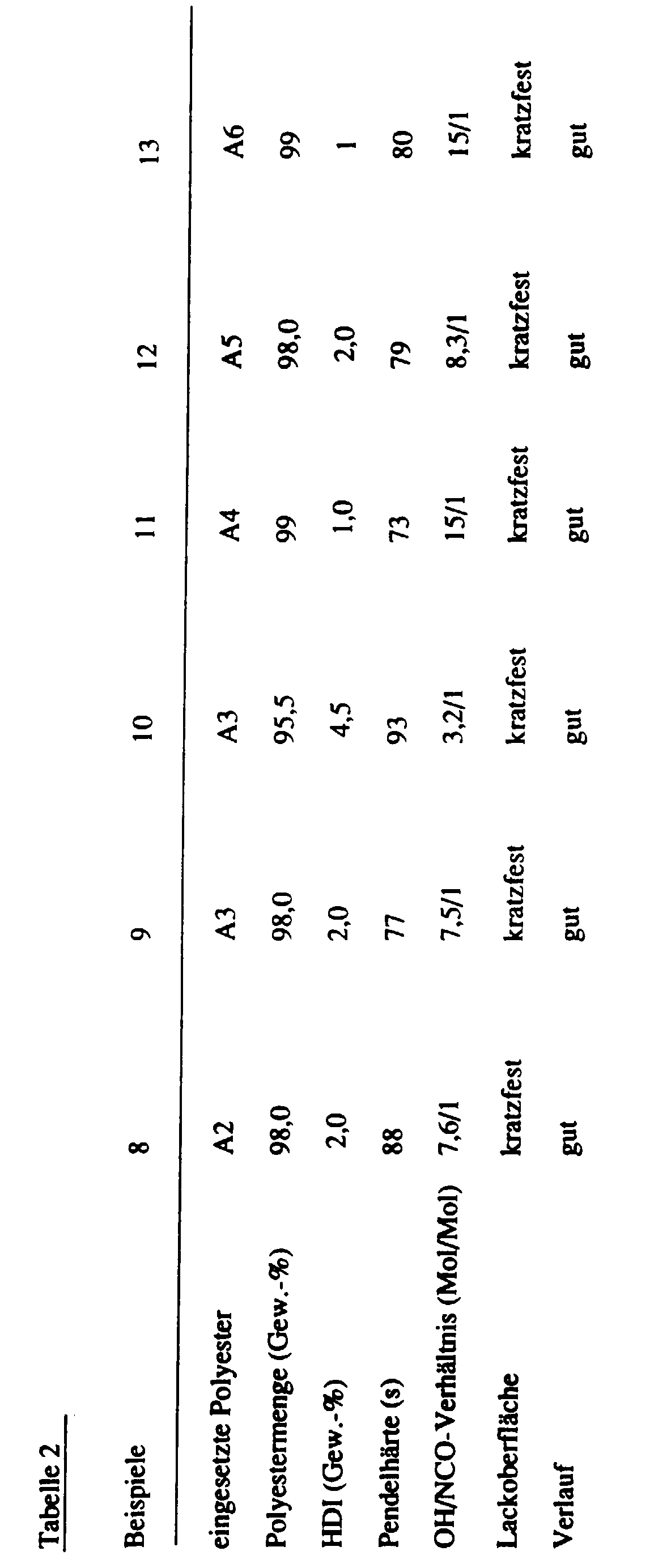
- polyesters A 2 - A 6 were reacted with hexamethylene diisocyanate analogously to Examples 1-7. 80% clear solutions were prepared by adding water and these were tested under identical conditions as the dispersions. In all cases, coatings of high hardness were achieved which were scratch-resistant and did not have the penetration into the substrate described in Comparative Examples 1 + 2.
Landscapes
- Chemical & Material Sciences (AREA)
- Organic Chemistry (AREA)
- Life Sciences & Earth Sciences (AREA)
- Medicinal Chemistry (AREA)
- Polymers & Plastics (AREA)
- Chemical Kinetics & Catalysis (AREA)
- Health & Medical Sciences (AREA)
- Engineering & Computer Science (AREA)
- Materials Engineering (AREA)
- Wood Science & Technology (AREA)
- Polyurethanes Or Polyureas (AREA)
- Paints Or Removers (AREA)
- Macromonomer-Based Addition Polymer (AREA)
Description
- C
- einer α,β-ethylenisch ungesättigten Carbonsäure oder eines Anhydrids ausgewählt aus der Gruppe von Maleinsäure, Chlormaleinsäure, Fumarsäure, Citraconsäure, Itaconsäure, Mesaconsäure.
- D
- eines hydroxylgruppenhaltigen Allylethers,
- E
- eines Polyalkylenglykols ausgewählt aus Polyoxyethylenglykol und/oder Polyoxypropylenglykol mit einem Molgewicht von 300 - 1000,
- G
- einem ethoxylierten und/oder propoxylierten Triol sowie gegebenenfalls einem alkoxylierten 4- bis 6-wertigen Polyol und gegebenenfalls
- F
- einem gesättigten einwertigen Alkohol ausgewählt aus der Gruppe von Methanol, Ethanol, Butanol, Pentanol, Heptanol, Isotanol, Hexanole, Octanole, Decanole, Cetylalkohole, Hexahydrobenzalkohol

- RUP
- Rest eines ungesättigten Polyesterpolyols nach Entfernung einer Carboxyl-Gruppe,
- R1
- Rest eines Polyols nach Entfernung von wenigstens zwei OH-Gruppen, insbesondere ein Trimethylolpropanrest nach Entfernen von zwei OH-Gruppen,
- n
- eine ganze Zahl von 1 bis 4, wobei der Polyester A eine OH-Zahl von wenigstens 30, insbesondere wenigstens 40 aufweist.
- A
- eines allylethermodifizierten Polyesters A mit
- B
- einem Polyisocyanat B erfolgt durch
80 - 99 Gew.-Teilen,
bevorzugt 88 - 98 Gew.-Teilen,
besonders bevorzugt 88 - 96 Gew.-Teilen, eines wasserdispergierbaren bzw. wasserlöslichen allyletherfunktionellen, ungesättigten Polyesters A,
und 1 - 20 Gew.-Teilen,
bevorzugt 2 - 12 Gew.-Teilen,
besonders bevorzugt 2 - 10 Gew.-Teilen eines
Polyisocyanates B, verwendet.
| Polycarbonsäure C | 15 - 45 Gew.-T., insbesondere |
| 20 - 35 Gew.-T., | |
| allyletherhaltiger Alkohol B | 15 - 45 Gew.-T., insbesondere |
| 20-40 Gew.-T., | |
| Alkohole E | 10 - 40 Gew.-T., insbesondere |
| 15 - 35 Gew.-T., | |
| einwertige Alkohole F | 0 - 15 Gew.-T., |
| Polyole G | 0 - 40 Gew.-T.. |
Ethylendiisocyanat, Trimethylendiisocyanat, Tetramethylendiisocyanat, Pentamethylendiisocyanat, Hexamethylendiisocyanat, 2-Methylpentamethylen-diisocyanat, Dodecamethylen-diisocyanat, Ethylethylendiisocyanat, 2,3-Dimethylethylendiisocyanat, 1-Methyl-trimethylendiisocyanat 1,3-Cyclopentylendiisocyanat, 1,4-Cylohexylendiisocyanat, 1,3-Cyclohexylendiisocyanat, 1,3-Phenylendiisocyanat, 1,4-Phenylendiisocyanat, 2,4-Toluylendiisocyanat, 2,6-Toluylendiisocyanat, 1,5-Naphthylendiisocyanat, 1,4-Naphthylendiisocyanat, 4,4'-Diisocyanatodiphenylether, 2,3-Bis-(8-isocyanato-octyl)-4-octyl-5-hexyl-cyclohexen, Isophorondiisocyanat, Diphenylmethan-2,4'- und/oder 4,4'-diisocyanat, cyclobutan- 1,3-diisocyanat, 2,6-Hexahydrotoluylendiisocyanat, 2,4-Hexahydrotoluylendiisocyanat, Hexahydro-1,3- und/oder 1,4-phenylendiisocyanat, Triphenylmethan-4,4',4''-triisocyanat, Trimethylhexandiisocyanat, Dicyclohexyl-methan-, -4,4'- (und/oder -2,4'- und/oder -2,2')-diisocyanat und ihre Mono- und Dimethyl-substituierten Derivate sowie Triisocyanate und Polyisocyanate, die durch Trimerisation oder Oligomerisation von Diisocyanaten oder durch Reaktion von Diisocyanaten mit polyfunktionellen OH- oder NH-gruppenhaltigen Verbindungen entstehen. Hierzu gehören beispielsweise das Biuret von Hexamethylendiisocyanat und Wasser, das Isocyanurat des Hexamethylendiisocyanats und das Addukt von Isophorondiisocyanat an Trimethylolpropan. Besonders bevorzugt ist Hexamethylendiisocyanat.

Claims (2)
- Verfahren zur Herstellung eines ungesättigten Polyesterpolyurethans P auf Basis eines eine Allylether-gruppierung enthaltenden Polyesters A und eines Polyisocyanates B, dadurch gekennzeichnet, daß im Polyester A der Allyletherrest über eine Estergruppierung an den Rest des Polyesters gebunden ist und daß der Polyester A aus folgenden Komponenten besteht
- C
- einer α,β-ethylenisch ungesättigten Carbonsäure oder eines Anhydrids ausgewählt aus der Gruppe von Maleinsäure, Chlormaleinsäure, Fumarsäure, Citraconsäure, Itaconsäure, Mesaconsäure,
- D
- eines hydroxylgruppenhaltigen Allylethers,
- E
- eines Polyalkylenglykols ausgewählt aus Polyoxyethylenglykol und/oder Polyoxypropylenglykol mit einem Molgewicht von 300 - 1000,
- G
- einem ethoxylierten und/oder propoxylierten Triol sowie gegebenenfalls einem alkoxylierten 4- bis 6-wertigen Polyol und gegebenenfalls
- F
- einem gesättigten einwertigen Alkohol ausgewählt aus der Gruppe von Methanol, Ethanol, Butanol, Pentanol, Heptanol, Isotanol, Hexanole, Octanole, Decanole, Cetylalkohole, Hexahydrobenzalkohol
- Verfahren zur Herstellung einer wässrigen Lackzusammensetzung, dadurch gekennzeichnet, daßa) ein Polyesterurethan nach einem Verfahren gemäß Anspruch 1 hergestellt wird und daßb) das so hergestellte Polyesterurethan mit Wasser ohne Zuzsatz von Emulgatoren verdünnt wird.
Applications Claiming Priority (2)
| Application Number | Priority Date | Filing Date | Title |
|---|---|---|---|
| DE4011349 | 1990-04-07 | ||
| DE4011349A DE4011349A1 (de) | 1990-04-07 | 1990-04-07 | Bindemittel mit ethyenisch ungesaettigten gruppen und ihre verwendung zur herstellung von lacken |
Publications (3)
| Publication Number | Publication Date |
|---|---|
| EP0451590A2 EP0451590A2 (de) | 1991-10-16 |
| EP0451590A3 EP0451590A3 (en) | 1992-07-01 |
| EP0451590B1 true EP0451590B1 (de) | 1999-01-13 |
Family
ID=6404002
Family Applications (1)
| Application Number | Title | Priority Date | Filing Date |
|---|---|---|---|
| EP91104626A Expired - Lifetime EP0451590B1 (de) | 1990-04-07 | 1991-03-23 | Verfahren zur Herstellung eines ungesättigten Polyesterpolyurethans sowie ein Verfahren zur Herstellung einer wässrigen Lackzusammensetzung. |
Country Status (3)
| Country | Link |
|---|---|
| US (1) | US5274067A (de) |
| EP (1) | EP0451590B1 (de) |
| DE (2) | DE4011349A1 (de) |
Families Citing this family (13)
| Publication number | Priority date | Publication date | Assignee | Title |
|---|---|---|---|---|
| DE4219767A1 (de) * | 1992-06-17 | 1993-12-23 | Wolff Walsrode Ag | Reaktive, wasseremulgierbare Bindemittel und ihre Verwendung zur Herstellung von Lacken |
| DE4418991A1 (de) | 1994-05-31 | 1995-12-07 | Wolff Walsrode Ag | Wäßrige, reaktive Mikrogeldispersionen, Verfahren zu ihrer Herstellung und ihre Verwendung |
| DE19506737A1 (de) * | 1995-02-27 | 1996-08-29 | Wolff Walsrode Ag | Bindemitteldispersionen, deren Herstellung und Verwendung |
| US5925409A (en) * | 1997-08-27 | 1999-07-20 | Reichhold, Inc. | Resins for lining surfaces |
| US6204342B1 (en) | 1997-08-27 | 2001-03-20 | Reichhold Chemicals | Thickening active H-containing resin with polycarbodiimide |
| US6692802B1 (en) * | 1997-08-27 | 2004-02-17 | Reichhold, Inc. | Resins for lining surfaces |
| US6294254B1 (en) | 1998-08-28 | 2001-09-25 | Wellman, Inc. | Polyester modified with polyethylene glycol and pentaerythritol |
| US6623853B2 (en) | 1998-08-28 | 2003-09-23 | Wellman, Inc. | Polyethylene glycol modified polyester fibers and method for making the same |
| US6555596B1 (en) * | 2000-11-06 | 2003-04-29 | Arco Chemical Technology, L.P. | Multifunctional allyl carbamates and coatings therefrom |
| DE102006049764A1 (de) * | 2006-10-21 | 2008-04-24 | Bayer Materialscience Ag | UV-härtbare Polyurethan-Dispersionen |
| US20090004396A1 (en) * | 2007-06-26 | 2009-01-01 | Valspar Corporation | Highly-Branched, Allyl Ether-Functionalized, Unsaturated Polyester Resins and Coating Compositions of the Same |
| DE102010009896A1 (de) | 2010-03-02 | 2011-09-08 | Bayer Materialscience Ag | Wässrige Polyurethandispersionen |
| US9074040B2 (en) * | 2010-12-20 | 2015-07-07 | Mitsui Chemicals, Inc. | Curable adhesive compositions |
Citations (1)
| Publication number | Priority date | Publication date | Assignee | Title |
|---|---|---|---|---|
| DE2923338A1 (de) * | 1979-06-08 | 1980-12-18 | Bayer Ag | Verfahren zur herstellung duennschichtiger polyesterueberzuege |
Family Cites Families (7)
| Publication number | Priority date | Publication date | Assignee | Title |
|---|---|---|---|---|
| US3898349A (en) * | 1966-07-26 | 1975-08-05 | Grace W R & Co | Polyene/polythiol paint vehicle |
| US3703498A (en) * | 1971-08-16 | 1972-11-21 | Armstrong Cork Co | Polyurethane millable gums based on polyesters having unsaturation in both the acid and alcohol portions |
| US4213837A (en) * | 1977-11-18 | 1980-07-22 | Ici Americas Inc. | Vinyl ester urethanes |
| DE3720984A1 (de) * | 1987-06-25 | 1989-01-05 | Hoechst Ag | Haertbare mischungen und deren verwendung |
| EP0315920A3 (de) * | 1987-11-10 | 1990-03-07 | Ppg Industries, Inc. | Alkylätherfunktionelle Polyesterurethane und reaktive Verdünner enthaltende Überzugszusammensetzungen mit hohem Feststoffgehalt sowie Verfahren zu deren Herstellung und Verwendung |
| US4898620A (en) * | 1988-08-12 | 1990-02-06 | Ecca Calcium Products, Inc. | Dry ground/wet ground calcium carbonate filler compositions |
| DE3829588A1 (de) * | 1988-09-01 | 1990-03-15 | Wolff Walsrode Ag | Wasserdispergierbare allylurethane und ihre verwendung zur herstellung von lacken |
-
1990
- 1990-04-07 DE DE4011349A patent/DE4011349A1/de not_active Withdrawn
-
1991
- 1991-03-23 DE DE59109086T patent/DE59109086D1/de not_active Expired - Fee Related
- 1991-03-23 EP EP91104626A patent/EP0451590B1/de not_active Expired - Lifetime
- 1991-03-29 US US07/677,199 patent/US5274067A/en not_active Expired - Fee Related
Patent Citations (1)
| Publication number | Priority date | Publication date | Assignee | Title |
|---|---|---|---|---|
| DE2923338A1 (de) * | 1979-06-08 | 1980-12-18 | Bayer Ag | Verfahren zur herstellung duennschichtiger polyesterueberzuege |
Also Published As
| Publication number | Publication date |
|---|---|
| US5274067A (en) | 1993-12-28 |
| DE4011349A1 (de) | 1991-10-10 |
| EP0451590A3 (en) | 1992-07-01 |
| DE59109086D1 (de) | 1999-02-25 |
| EP0451590A2 (de) | 1991-10-16 |
Similar Documents
| Publication | Publication Date | Title |
|---|---|---|
| EP0381862B1 (de) | Vervendung von hydrophilen, (Meth)Acryloylgruppen aufweisenden Polyurethanen als reaktive Emulgatoren für radikalisch härtbare Kunstharze, und ein wässriges Beschichtungsmittel auf Basis eines Gemischs radikalisch härtbarer Kunstharze. | |
| EP0510438B1 (de) | Polyisocyanatgemische und ihre Verwendung | |
| EP0033896B1 (de) | Strahlungshärtbare wässrige Bindemitteldispersionen, Verfahren zu ihrer Herstellung und ihre Verwendung | |
| EP0451590B1 (de) | Verfahren zur Herstellung eines ungesättigten Polyesterpolyurethans sowie ein Verfahren zur Herstellung einer wässrigen Lackzusammensetzung. | |
| EP0574776A1 (de) | Polymerisierbare, hochvernetzende Lackbindemittel und ihre Verwendung zur Herstellung von Lacken | |
| EP0870788B1 (de) | Strahlungshärtbare wasserverdünnbare Urethanharze, Verfahren zu ihrer Herstellung und deren Verwendung | |
| EP0557844A1 (de) | Beschichtungsmittel, ein Verfahren zu ihrer Herstellung und ihre Verwendung | |
| EP0584734A2 (de) | Wässrige, strahlenhärtbare Bindemitteldispersionen | |
| EP0356848B1 (de) | Wasserdispergierbare Allylurethane Verfahren zu deren Herstellung und ihre Verwendung zur Herstellung von Lacken | |
| EP1103572A2 (de) | Strahlungshärtbare Isocyanatgruppen enthaltende Urethanacrylate und ihre Verwendung | |
| EP0424745A2 (de) | Verfahren zur Herstellung von ungesättigten, urethanisierten Polyesterharzen, die nach diesem Verfahren erhältlichen Polyesterharze und ihre Verwendung als oder zur Herstellung von Beschichtungsmittel(n) | |
| EP2848637A1 (de) | Wässrige, hydroxylgruppenhaltige Polyurethandispersionen, ein Verfahren zu deren Herstellung und deren Verwendung in Beschichtungsmitteln | |
| EP0475133B1 (de) | Acryloylgruppen enthaltende, aliphatische Polyurethane, ein Verfahren zu ihrer Herstellung und ihre Verwendung | |
| DE4219768A1 (de) | Polymerisierbare, hochvernetzende Lackbindemittel und ihre Verwendung zur Herstellung von Lacken | |
| EP0501247B1 (de) | Hydrophile, olefinisch ungesättigte Polyurethane und ihre Verwendung als reaktive Emulgatoren | |
| EP0574775B1 (de) | Reaktive, wasseremulgierbare Bindemittel und ihre Verwendung zur Herstellung von Lacken | |
| EP1070732B1 (de) | Wässrige Dispersion einer Mischung eines Polyurethans mit einem strahlungshärtbaren (Meth)acrylat-Präpolymer | |
| EP0451588B1 (de) | Wasserlösliche, polymerisierbare Polyester | |
| EP0474041B1 (de) | Acryloylgruppen enthaltende, aliphatische Polyurethane, ein Verfahren zu ihrer Herstellung und ihre Verwendung | |
| EP0554784B1 (de) | Strahlungshärtbare, wässrige Polyurethandispersionen | |
| EP0709417A1 (de) | Reaktive Emulgatoren auf Basis ungesättigter Polyurethane | |
| EP0662487B1 (de) | Feuchtigkeitshärtende Einkomponenten-Beschichtungsmittel | |
| EP0453838B1 (de) | Verwendung von wässrigen Lösungen oder Dispersionen von (Meth)- Acryloylgruppen aufweisenden Oligourethanen zur Herstellung von Beschichtungsmitteln und hierzu geeignete wässrige Lösungen oder Dispersionen | |
| EP0747454A1 (de) | Strahlungshärtbare Zusammensetzungen, enthaltend mehrfunktionelle Acrylate und verkappte Amine |
Legal Events
| Date | Code | Title | Description |
|---|---|---|---|
| PUAI | Public reference made under article 153(3) epc to a published international application that has entered the european phase |
Free format text: ORIGINAL CODE: 0009012 |
|
| AK | Designated contracting states |
Kind code of ref document: A2 Designated state(s): BE DE FR GB IT NL |
|
| PUAL | Search report despatched |
Free format text: ORIGINAL CODE: 0009013 |
|
| AK | Designated contracting states |
Kind code of ref document: A3 Designated state(s): BE DE FR GB IT NL |
|
| 17P | Request for examination filed |
Effective date: 19921001 |
|
| 17Q | First examination report despatched |
Effective date: 19940729 |
|
| GRAG | Despatch of communication of intention to grant |
Free format text: ORIGINAL CODE: EPIDOS AGRA |
|
| GRAG | Despatch of communication of intention to grant |
Free format text: ORIGINAL CODE: EPIDOS AGRA |
|
| GRAH | Despatch of communication of intention to grant a patent |
Free format text: ORIGINAL CODE: EPIDOS IGRA |
|
| GRAH | Despatch of communication of intention to grant a patent |
Free format text: ORIGINAL CODE: EPIDOS IGRA |
|
| GRAA | (expected) grant |
Free format text: ORIGINAL CODE: 0009210 |
|
| AK | Designated contracting states |
Kind code of ref document: B1 Designated state(s): BE DE FR GB IT NL |
|
| PGFP | Annual fee paid to national office [announced via postgrant information from national office to epo] |
Ref country code: DE Payment date: 19990216 Year of fee payment: 9 |
|
| ET | Fr: translation filed | ||
| PGFP | Annual fee paid to national office [announced via postgrant information from national office to epo] |
Ref country code: FR Payment date: 19990223 Year of fee payment: 9 |
|
| REF | Corresponds to: |
Ref document number: 59109086 Country of ref document: DE Date of ref document: 19990225 |
|
| PGFP | Annual fee paid to national office [announced via postgrant information from national office to epo] |
Ref country code: GB Payment date: 19990325 Year of fee payment: 9 |
|
| PGFP | Annual fee paid to national office [announced via postgrant information from national office to epo] |
Ref country code: NL Payment date: 19990331 Year of fee payment: 9 Ref country code: BE Payment date: 19990331 Year of fee payment: 9 |
|
| ITF | It: translation for a ep patent filed | ||
| GBT | Gb: translation of ep patent filed (gb section 77(6)(a)/1977) |
Effective date: 19990414 |
|
| PLBE | No opposition filed within time limit |
Free format text: ORIGINAL CODE: 0009261 |
|
| STAA | Information on the status of an ep patent application or granted ep patent |
Free format text: STATUS: NO OPPOSITION FILED WITHIN TIME LIMIT |
|
| 26N | No opposition filed | ||
| PG25 | Lapsed in a contracting state [announced via postgrant information from national office to epo] |
Ref country code: GB Free format text: LAPSE BECAUSE OF NON-PAYMENT OF DUE FEES Effective date: 20000323 |
|
| PG25 | Lapsed in a contracting state [announced via postgrant information from national office to epo] |
Ref country code: BE Free format text: LAPSE BECAUSE OF NON-PAYMENT OF DUE FEES Effective date: 20000331 |
|
| BERE | Be: lapsed |
Owner name: WOLFF WALSRODE A.G. Effective date: 20000331 |
|
| PG25 | Lapsed in a contracting state [announced via postgrant information from national office to epo] |
Ref country code: NL Free format text: LAPSE BECAUSE OF NON-PAYMENT OF DUE FEES Effective date: 20001001 |
|
| GBPC | Gb: european patent ceased through non-payment of renewal fee |
Effective date: 20000323 |
|
| PG25 | Lapsed in a contracting state [announced via postgrant information from national office to epo] |
Ref country code: FR Free format text: LAPSE BECAUSE OF NON-PAYMENT OF DUE FEES Effective date: 20001130 |
|
| NLV4 | Nl: lapsed or anulled due to non-payment of the annual fee |
Effective date: 20001001 |
|
| REG | Reference to a national code |
Ref country code: FR Ref legal event code: ST |
|
| PG25 | Lapsed in a contracting state [announced via postgrant information from national office to epo] |
Ref country code: DE Free format text: LAPSE BECAUSE OF NON-PAYMENT OF DUE FEES Effective date: 20010103 |
|
| PG25 | Lapsed in a contracting state [announced via postgrant information from national office to epo] |
Ref country code: IT Free format text: LAPSE BECAUSE OF NON-PAYMENT OF DUE FEES;WARNING: LAPSES OF ITALIAN PATENTS WITH EFFECTIVE DATE BEFORE 2007 MAY HAVE OCCURRED AT ANY TIME BEFORE 2007. THE CORRECT EFFECTIVE DATE MAY BE DIFFERENT FROM THE ONE RECORDED. Effective date: 20050323 |