EP0451634A2 - Cycloalkano[b]dihydroindoles and -indolesulphonamides substituted by heterocycles - Google Patents
Cycloalkano[b]dihydroindoles and -indolesulphonamides substituted by heterocycles Download PDFInfo
- Publication number
- EP0451634A2 EP0451634A2 EP91104943A EP91104943A EP0451634A2 EP 0451634 A2 EP0451634 A2 EP 0451634A2 EP 91104943 A EP91104943 A EP 91104943A EP 91104943 A EP91104943 A EP 91104943A EP 0451634 A2 EP0451634 A2 EP 0451634A2
- Authority
- EP
- European Patent Office
- Prior art keywords
- carbon atoms
- formula
- group
- chain
- straight
- Prior art date
- Legal status (The legal status is an assumption and is not a legal conclusion. Google has not performed a legal analysis and makes no representation as to the accuracy of the status listed.)
- Granted
Links
- 0 CC(C(*)C=C1NN)C(C)=C1O* Chemical compound CC(C(*)C=C1NN)C(C)=C1O* 0.000 description 3
- MFSBXNVTTDDWPJ-UHFFFAOYSA-N CCOC(CN1C2=CC=CCC2C2=C1CCCC2)=O Chemical compound CCOC(CN1C2=CC=CCC2C2=C1CCCC2)=O MFSBXNVTTDDWPJ-UHFFFAOYSA-N 0.000 description 1
Classifications
-
- C—CHEMISTRY; METALLURGY
- C07—ORGANIC CHEMISTRY
- C07D—HETEROCYCLIC COMPOUNDS
- C07D403/00—Heterocyclic compounds containing two or more hetero rings, having nitrogen atoms as the only ring hetero atoms, not provided for by group C07D401/00
- C07D403/02—Heterocyclic compounds containing two or more hetero rings, having nitrogen atoms as the only ring hetero atoms, not provided for by group C07D401/00 containing two hetero rings
- C07D403/04—Heterocyclic compounds containing two or more hetero rings, having nitrogen atoms as the only ring hetero atoms, not provided for by group C07D401/00 containing two hetero rings directly linked by a ring-member-to-ring-member bond
-
- C—CHEMISTRY; METALLURGY
- C07—ORGANIC CHEMISTRY
- C07D—HETEROCYCLIC COMPOUNDS
- C07D401/00—Heterocyclic compounds containing two or more hetero rings, having nitrogen atoms as the only ring hetero atoms, at least one ring being a six-membered ring with only one nitrogen atom
- C07D401/02—Heterocyclic compounds containing two or more hetero rings, having nitrogen atoms as the only ring hetero atoms, at least one ring being a six-membered ring with only one nitrogen atom containing two hetero rings
- C07D401/12—Heterocyclic compounds containing two or more hetero rings, having nitrogen atoms as the only ring hetero atoms, at least one ring being a six-membered ring with only one nitrogen atom containing two hetero rings linked by a chain containing hetero atoms as chain links
-
- A—HUMAN NECESSITIES
- A61—MEDICAL OR VETERINARY SCIENCE; HYGIENE
- A61P—SPECIFIC THERAPEUTIC ACTIVITY OF CHEMICAL COMPOUNDS OR MEDICINAL PREPARATIONS
- A61P11/00—Drugs for disorders of the respiratory system
-
- A—HUMAN NECESSITIES
- A61—MEDICAL OR VETERINARY SCIENCE; HYGIENE
- A61P—SPECIFIC THERAPEUTIC ACTIVITY OF CHEMICAL COMPOUNDS OR MEDICINAL PREPARATIONS
- A61P37/00—Drugs for immunological or allergic disorders
- A61P37/08—Antiallergic agents
-
- A—HUMAN NECESSITIES
- A61—MEDICAL OR VETERINARY SCIENCE; HYGIENE
- A61P—SPECIFIC THERAPEUTIC ACTIVITY OF CHEMICAL COMPOUNDS OR MEDICINAL PREPARATIONS
- A61P7/00—Drugs for disorders of the blood or the extracellular fluid
- A61P7/02—Antithrombotic agents; Anticoagulants; Platelet aggregation inhibitors
-
- C—CHEMISTRY; METALLURGY
- C07—ORGANIC CHEMISTRY
- C07D—HETEROCYCLIC COMPOUNDS
- C07D409/00—Heterocyclic compounds containing two or more hetero rings, at least one ring having sulfur atoms as the only ring hetero atoms
- C07D409/02—Heterocyclic compounds containing two or more hetero rings, at least one ring having sulfur atoms as the only ring hetero atoms containing two hetero rings
- C07D409/12—Heterocyclic compounds containing two or more hetero rings, at least one ring having sulfur atoms as the only ring hetero atoms containing two hetero rings linked by a chain containing hetero atoms as chain links
-
- C—CHEMISTRY; METALLURGY
- C07—ORGANIC CHEMISTRY
- C07D—HETEROCYCLIC COMPOUNDS
- C07D417/00—Heterocyclic compounds containing two or more hetero rings, at least one ring having nitrogen and sulfur atoms as the only ring hetero atoms, not provided for by group C07D415/00
- C07D417/02—Heterocyclic compounds containing two or more hetero rings, at least one ring having nitrogen and sulfur atoms as the only ring hetero atoms, not provided for by group C07D415/00 containing two hetero rings
- C07D417/12—Heterocyclic compounds containing two or more hetero rings, at least one ring having nitrogen and sulfur atoms as the only ring hetero atoms, not provided for by group C07D415/00 containing two hetero rings linked by a chain containing hetero atoms as chain links
Definitions
- the invention relates to new cycloalkano[b]dihydroindoles and -indolesulphonamides substituted by heterocycles, to processes for their preparation and to their use in medicaments.
- the cycloalkano[b]dihydroindoles and -indolesulphonamides substituted by heterocycles, according to the invention, have one or more asymmetric carbon atoms and can therefore exist is various stereochemical forms. Regioisomers may also occur.
- the invention relates both to the individual isomers and to their mixtures.
- the compounds according to the invention exist in stereoisomeric forms which behave either as image and mirror image (enantiomers) or which do not behave as image and mirror image (diastereomers).
- the invention relates both to the antipodes and to the racemic modifications and the diastereomer mixtures.
- the racemic modifications like the diastereomers, can be separated into the stereoisomerically uniform constituents in a known manner (compare E.L. Eliel, Stereochemistry of Carbon Compounds, McGraw Hill, 1962).
- cycloalkano[b]dihydroindoles and -indolesulphonamides substituted by heterocycles can also be present in the form of their salts.
- salts with organic or inorganic bases or acids may be mentioned here.
- Physiologically acceptable salts may also be salts of the compounds according to the invention with inorganic or organic acids.
- Preferred salts are those with inorganic acids such as, for example, hydrochloric acid, hydrobromic acid, phosphoric acid or sulphuric acid, or salts with organic carboxylic or sulphonic acids such as, for example, acetic acid, maleic acid, fumaric acid, malic acid, citric acid, tartaric acid, lactic acid, benzoic acid or methanesulphonic acid, ethanesulphonic acid, phenylsulphonic acid, toluenesulphonic acid or naphthalenedisulphonic acid.
- Heterocycle in general represents a 5- to 7-membered, preferably 5- to 6-membered, saturated or unsaturated ring which can contain up to two oxygen, sulphur and/or nitrogen atoms as heteroatoms and to which further aromatic or heterocyclic rings can be fused.
- the substances according to the invention surprisingly show a thrombocyte aggregation-inhibiting action, and additionally cause an inhibition of thromboxane synthase in isolated platelets and can be used for the therapeutic treatment of humans and animals.
- Preferred compounds of the general formula (I) are those in which
- Processes [A] to [D] according to the invention are in general carried out in a temperature range from -20°C to +150°C.
- processes [A] to [D] are carried out at normal pressure. However, it is also possible to work at elevated pressure or at reduced pressure (for example from 0.5 to 5 bar).
- nitriles are hydrolysed in a manner known per se in water or in one of the abovementioned solvents, such as, for example, ethanol, isopropanol, ethylene glycol or glyme or their mixtures, in the presence of bases, acids, hydrogen peroxide or alkali metal or alkaline earth metal peroxides, if appropriate in catalytic amounts.
- solvents such as, for example, ethanol, isopropanol, ethylene glycol or glyme or their mixtures, in the presence of bases, acids, hydrogen peroxide or alkali metal or alkaline earth metal peroxides, if appropriate in catalytic amounts.
- Suitable peroxides are, for example, sodium peroxide or barium peroxide.
- Suitable bases are alkaline earth metal hydroxides or alkali metal hydroxides, such as, for example, sodium hydroxide, potassium hydroxide or barium hydroxide. Sodium hydroxide is preferred.
- Suitable acids are the customary acids. These preferably include inorganic acids such as hydrochloric acid or sulphuric acid.
- the hydrolysis of the nitriles is in general carried out in a temperature range from -20°C to +200°C, preferably from +20°C to +150°C.
- the esters are hydrolysed by a customary method, by treating the esters in inert solvents with customary bases, it being possible to convert the initially resulting salts into the free carboxylic acids by treating with acid.
- Suitable bases for the hydrolysis are the customary inorganic bases. These preferably include alkali metal hydroxides or alkaline earth metal hydroxides such as, for example, sodium hydroxide, potassium hydroxide or barium hydroxide, or alkali metal carbonates such as sodium carbonate or potassium carbonate.
- Suitable solvents for the hydrolysis are water or the organic solvents customary for hydrolysis. These preferably include alcohols such as methanol, ethanol, propanol, isopropanol or butanol, or ethers such as tetrahydrofuran or dioxane, or dimethylformamide or dimethyl sulphoxide. Water or alcohols such as methanol, ethanol, propanol or isopropanol are particularly preferably used.
- the hydrolysis is in general carried out in a temperature range from 0°C to +140°C, preferably from +20°C to +100°C.
- the hydrolysis is carried out at normal pressure. However, it is also possible to work at elevated pressure or at reduced pressure (for example from 0.5 to 5 bar).
- the base When carrying out the hydrolysis, the base is in general employed in an amount from 1 to 10 moles, preferably from 1 to 5 moles, relative to 1 mole of the ester.
- the carboxylates of the compounds according to the invention are formed in the first step as intermediates which can be isolated.
- the acids according to the invention are obtained by treating the carboxylates with customary inorganic acids. These preferably include mineral acids such as, for example, hydrochloric acid, hydrobromic acid, sulphuric acid or phosphoric acid.
- customary inorganic acids preferably include mineral acids such as, for example, hydrochloric acid, hydrobromic acid, sulphuric acid or phosphoric acid.
- the acids can then be isolated in a customary manner.
- the salts of these heterocycles with the inorganic acids can also be obtained by treating the solutions of the carboxylates with the abovementioned acids.
- the acids are esterified according to a customary method, by reacting the acids in the presence of a catalyst with the corresponding alcohols, if appropriate in one of the abovementioned solvents.
- a catalyst e.g., this alcohol is also employed as a solvent.
- Catalysts which can be employed are inorganic acids, such as, for example, sulphuric acid or inorganic acid chlorides, such as, for example, thionyl chloride.
- the amidation is carried out in one of the abovementioned solvents, preferably in alcohols such as ethanol or methanol, in a temperature range from 0°C to +80°C, preferably from +10 to +30°C, and at normal pressure.
- alcohols such as ethanol or methanol
- the compounds of the general formula (II) are new. They can be prepared by a process in which phenylhydrazines of the general formula (IIIa) in which R1, R2, A3 and R4 have the abovementioned meaning, are reacted with cycloalkanonesulphonamides of the general formula (IV) in which A, X, n and z have the abovementioned meaning, in analogy to the reaction conditions given under process [B].
- the phenylhydrazines of the general formulae (III) and (IIIa) are known in some cases or can be prepared by a customary method [compare Houben-Weyl, "Methoden der organischen Chemie” (Methods of Organic Chemistry) X/2, page 1, 123, 693; DOS 2,312,256].
- the enantiomerically pure compounds of the general formula (I) according to the invention can be obtained according to customary methods, for example in analogy to the process described in DOS 3,631,824.
- the reduction of the cycloalkano[b]indolesulphonamides is also described there.
- cycloalkanonesulphonamides of the general formula (IV) are new and can be prepared, however, just like the known cycloalkanonecarbamides of the formula (IVa) according to the process published in DOS 3,631,824.
- the sulphonyl halides of the formula (VI) can be prepared by methods which are known per se [compare Z. Talik and E. PXlazek, Acta Polon. Pharm., 12 , 5 (1955)].
- the cycloalkano[b]dihydroindoles and -indolesulphonamides substituted by heterocycles, their salts and isomers can be employed as active compounds in medicaments.
- the substances have a thrombocyte aggregation-inhibiting and thromboxane A2-antagonistic action and inhibit thromboxane synthase in isolated platelets.
- thromboembolic disorders and ischaemias such as myocardial infarct, stroke, transitory and ischaemic attacks, angina pectoris, peripheral circulatory disorders, prevention of restenoses such as after thrombolytic therapy, percutaneous transluminal angioplasty (PTA), percutaneous transluminal coronary angioplasty (PTCA), bypass and for the treatment of arteriosclerosis, asthma and allergies.
- PTA percutaneous transluminal angioplasty
- PTCA percutaneous transluminal coronary angioplasty
- the range of the minimum effective concentration was given as the threshold concentration.
- the present invention also includes pharmaceutical preparation which contain one or more compounds of the general formula (I), or which consist of one or more active compounds of the formula (I) in addition to inert, non-toxic, pharmaceutically suitable auxiliaries and excipients, and a method for the production of these preparations.
- the active compounds of the formula (I) are intended to be present in these preparations in a concentration of 0.1 to 99.5% by weight, preferably of 0.5 to 95% by weight of the total mixture.
- the pharmaceutical preparations may also contain other pharmaceutical active compounds.
- compositions can be prepared in a customary manner by known methods, for example with the auxiliary (auxiliaries) or excipient(s).
- the active compound(s) of the formula (I) in total amounts of about 0.03 to about 30 mg/kg, preferably to about 5 mg/kg of body weight every 24 hours, if appropriate in the form of several individual doses, to attain the desired result.
- An individual dose contains the active compound(s), preferably in amounts of 0.01 to about 10, particularly preferably 0.1 to 1.0 mg/kg of body weight.
Landscapes
- Organic Chemistry (AREA)
- Chemical & Material Sciences (AREA)
- Health & Medical Sciences (AREA)
- Pharmacology & Pharmacy (AREA)
- Nuclear Medicine, Radiotherapy & Molecular Imaging (AREA)
- Bioinformatics & Cheminformatics (AREA)
- Chemical Kinetics & Catalysis (AREA)
- General Chemical & Material Sciences (AREA)
- Medicinal Chemistry (AREA)
- Life Sciences & Earth Sciences (AREA)
- Veterinary Medicine (AREA)
- Engineering & Computer Science (AREA)
- Public Health (AREA)
- Animal Behavior & Ethology (AREA)
- General Health & Medical Sciences (AREA)
- Pulmonology (AREA)
- Immunology (AREA)
- Diabetes (AREA)
- Hematology (AREA)
- Indole Compounds (AREA)
- Pharmaceuticals Containing Other Organic And Inorganic Compounds (AREA)
- Plural Heterocyclic Compounds (AREA)
Abstract
Description
- The invention relates to new cycloalkano[b]dihydroindoles and -indolesulphonamides substituted by heterocycles, to processes for their preparation and to their use in medicaments.
- It is already known that cycloalkano[b]dihydroindoles and -indolesulphonamides have a thrombocyte aggregation-inhibiting action [compare DOS (German Offenlegungsschrift) 3,631,824].
- New cycloalkano[b]dihydroindoles and -indolesulphonamides, substituted by heterocycles, of the general formula (I)

in which - R¹, R², R³ and R⁴
- are identical or different and
- represent hydrogen, nitro, cyano, halogen, trifluoromethyl, carboxyl, hydroxyl or trifluoromethoxy, or
- represent a group of the formula -S(O)wR⁵,
in which
R⁵ - denotes straight-chain or branched alkyl having up to 8 carbon atoms or aryl having 6 to 10 carbon atoms, which, for its part, is optionally substituted by halogen, nitro, cyano or trifluoromethyl,
w - denotes the number 0, 1 or 2, or - represents straight-chain or branched alkoxy or alkoxycarbonyl in each case having up to 10 carbon atoms, or benzyloxy, or
- represents a group of the formula -NR⁶R⁷,
in which
R⁶ and R⁷ are identical or different and- denote hydrogen, straight-chain or branched alkyl or acyl in each case having up to 8 carbon atoms or
- denote aryl having 6 to 10 carbon atoms, or
- denote a group of the formula -S(O)wR⁵, in which
R⁵ and w have the abovementioned meaning,
- represent cycloalkyl having 3 to 8 carbon atoms or
- represent aryl having 6 to 10 carbon atoms, or
- represent straight-chain or branched alkyl or alkenyl in each case having up to 10 carbon atoms, which are optionally substituted by halogen, hydroxyl, carboxyl, cyano, aryl having 6 to 10 carbon atoms, straight-chain or branched alkyl, alkoxy or alkoxycarbonyl in each case having up to 8 carbon atoms or by a group of the formula

w, R⁵, R⁶ and R⁷ have the abovementioned meaning,
- m
- - represents the number 1, 2, 3 or 4,
- n
- - represents the number 0, 1 or 2,
- z
- - represents the number 1, 2, 3 or 4,
- A
- - represents a bond or the -NH group,
- X
- - represents a heterocycle having heteroatoms from the series comprising nitrogen, sulphur or oxygen, which is optionally monosubstituted to trisubstituted by identical or different substituents from the series comprising halogen, trifluoromethyl, trifluoromethoxy, straight-chain or branched alkyl or alkoxy having up to 8 carbon atoms, phenyl or by a group of the formula -S(O)w-R⁵ or -NR⁶R⁷,
in which
R⁵, R⁶, R⁷ and w have the abovementioned meaning, - Y
- - represents hydroxyl, alkoxy having up to 8 carbon atoms, phenoxy or a group of the formula -NR⁶R⁷,
in which
R⁶ and R⁷ have the abovementioned meaning, - The cycloalkano[b]dihydroindoles and -indolesulphonamides substituted by heterocycles, according to the invention, have one or more asymmetric carbon atoms and can therefore exist is various stereochemical forms. Regioisomers may also occur. The invention relates both to the individual isomers and to their mixtures.
- The compounds according to the invention exist in stereoisomeric forms which behave either as image and mirror image (enantiomers) or which do not behave as image and mirror image (diastereomers). The invention relates both to the antipodes and to the racemic modifications and the diastereomer mixtures. The racemic modifications, like the diastereomers, can be separated into the stereoisomerically uniform constituents in a known manner (compare E.L. Eliel, Stereochemistry of Carbon Compounds, McGraw Hill, 1962).
- The cycloalkano[b]dihydroindoles and -indolesulphonamides substituted by heterocycles, according to the invention, can also be present in the form of their salts. In general, salts with organic or inorganic bases or acids may be mentioned here.
- In the context of the present invention, physiologically acceptable salts are preferred. Physiologically acceptable salts of the cycloalkano[b]dihydroindoles and -indolesulphonamides substituted by heterocycles can be metal salts or ammonium salts of the substances according to the invention which have a free carboxyl group. Particularly preferred salts are, for example, sodium, potassium, magnesium or calcium salts, and also ammonium salts which are derived from ammonia or organic amines, such as, for example, ethylamine, di- or triethylamine, di- or triethanolamine, dicyclohexylamine, dimethylaminoethanol, arginine, lysine or ethylenediamine.
- Physiologically acceptable salts may also be salts of the compounds according to the invention with inorganic or organic acids. Preferred salts are those with inorganic acids such as, for example, hydrochloric acid, hydrobromic acid, phosphoric acid or sulphuric acid, or salts with organic carboxylic or sulphonic acids such as, for example, acetic acid, maleic acid, fumaric acid, malic acid, citric acid, tartaric acid, lactic acid, benzoic acid or methanesulphonic acid, ethanesulphonic acid, phenylsulphonic acid, toluenesulphonic acid or naphthalenedisulphonic acid.
- Heterocycle in general represents a 5- to 7-membered, preferably 5- to 6-membered, saturated or unsaturated ring which can contain up to two oxygen, sulphur and/or nitrogen atoms as heteroatoms and to which further aromatic or heterocyclic rings can be fused.
- 5- and 6-membered rings having an oxygen, sulphur and/or up to two nitrogen atoms are preferred, which may also be fused to benzene.
- The following are mentioned as preferred: thienyl, furyl, pyrrolyl, pyrazolyl, pyridyl, pyrimidyl, pyrazinyl, pyridazinyl, quinolyl, isoquinolyl, quinazolyl, quinoxazolyl, cinnolyl, thiazolyl, benzothiazolyl, isothiazolyl, benzisothiazolyl, oxazolyl, benzoxazolyl, isoxazolyl, imidazolyl, benzimidazolyl indolyl, morpholinyl, pyrrolidinyl, piperidyl or piperazinyl.
- The substances according to the invention surprisingly show a thrombocyte aggregation-inhibiting action, and additionally cause an inhibition of thromboxane synthase in isolated platelets and can be used for the therapeutic treatment of humans and animals.
- Preferred compounds of the general formula (I) are those
in which - R¹, R², R³ and R⁴
- are identical or different and
- represent hydrogen, fluorine, chlorine, bromine, iodine, nitro, cyano, trifluoromethyl, trifluoromethoxy, straight-chain or branched alkyl or alkoxy in each case having up to 6 carbon atoms, or phenyl, or
- represent a group of the formula -NR⁶R⁷,
in which
R⁶ and R⁷ are identical or different and- denote hydrogen, straight-chain or branched alkyl having up to 6 carbon atoms or phenyl,
or
- denote hydrogen, straight-chain or branched alkyl having up to 6 carbon atoms or phenyl,
- represent a group of the formula -S(O)wR⁵,
in which
R⁵ - denotes straight-chain or branched alkyl having up to 6 carbon atoms, or phenyl,
and
w denotes the number 0 or 2,
- m
- - represents the number 1, 2 or 3,
- n
- - represents the number 0 or 1,
- z
- - represents the number 1, 2 or 3,
- A
- - represents a direct bond or the -NH group,
- X
- - represents pyridyl, pyrimidyl, pyridazyl, quinolyl, morpholinyl, piperidinyl, thienyl, pyrryl, oxazolyl, isoxazolyl, imidazolyl, thiazolyl or isothiazolyl, which are optionally monosubstituted or disubstituted by identical or different substituents from the series comprising fluorine, chlorine, bromine, trifluoromethyl, trifluoromethoxy, hydroxyl or straight-chain or branched alkyl having up to 6 carbon atoms,
- Y
- - represents hydroxyl, alkoxy having up to 6 carbon atoms, phenoxy or a group of the formula -NR⁶R⁷,
in which
R⁶ and R⁷ have the abovementioned meaning, - Particularly preferred compounds of the general formula (I) are those
in which - R¹, R², R³ and R⁴
- are identical or different and
- represent hydrogen, fluorine, chlorine, trifluoromethyl or trifluoromethoxy or straight-chain or branched alkyl having up to 4 carbon atoms,
- m
- - represents the number 1 or 2,
- n
- - represents the number 0 or 1,
- z
- - represents the number 1 or 2,
- A
- - represents the -NH group,
- X
- - represents pyridyl, thienyl, pyrryl, imidazolyl, isothiazolyl or thiazolyl, which are optionally substituted by fluorine, chlorine, bromine, trifluoromethyl, trifluoromethoxy or straight-chain or branched alkyl having up to 4 carbon atoms,
- Y
- - represents hydroxyl, alkoxy having up to 4 carbon atoms, phenoxy or a group of the formula -NR⁶R⁷,
in which
R⁶ and R⁷ are identical or different and denote hydrogen or straight-chain or branched alkyl having up to 4 carbon atoms, - Cycloalkano[b]indolesulphonamides are very particularly preferred.
- The compounds of the general formula (I)

in which
R¹, R², R³, R⁴, A, X, Y, m, n and z have the abovementioned meaning,
can be prepared by a process in which - [A] in the case in which m represents the number 2, compounds of the general formula (II)
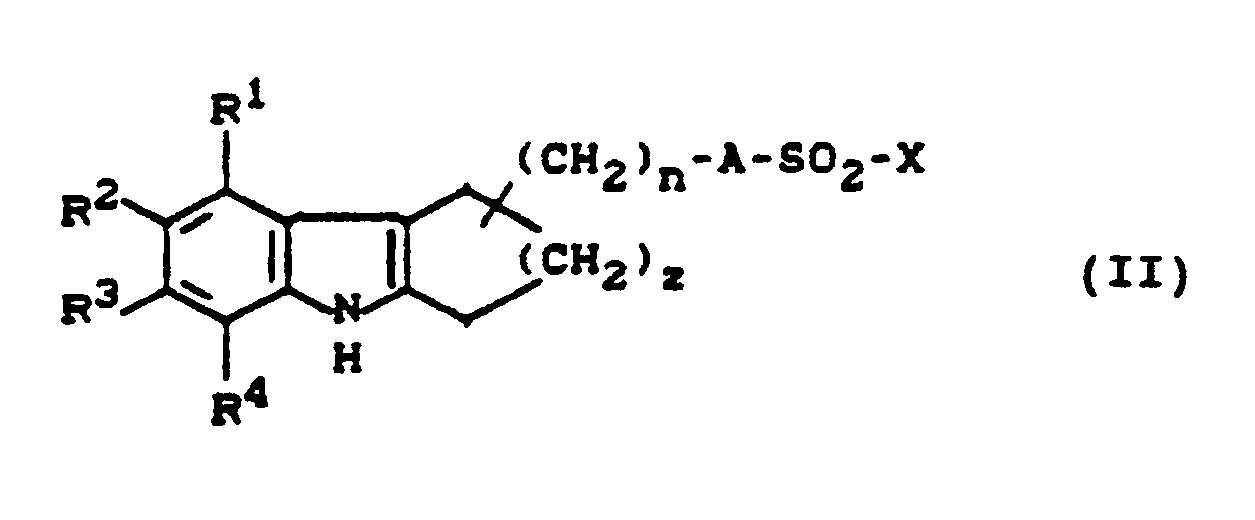
R¹, R², R³, R⁴, A, X, n and z have the abovementioned meaning,
are reacted first with acrylonitrile in inert solvents to give the corresponding cyanoethyl compounds, if appropriate in the presence of a base, and then hydrolysed by a customary method to give the corresponding acids (Y=OH), - [B] compounds of the general formula (III)

R¹, R², R³, R⁴ and m have the abovementioned meaning,
and
Y' - represents carboxyl, (C₁-C₄)-alkoxycarbonyl or cyano,
are reacted directly with cycloalkanonesulphonamides of the general formula (IV)
z, n, A and X have the abovementioned meaning,
in inert solvents, if appropriate in the presence of a catalyst,
or - [C] compounds of the general formula (III)
are reacted first with compounds of the general formula (IVa)
z and n have the abovementioned meaning,
and
R - represents straight-chain or branched (C₁-C₈)-alkyl or phenyl,
with subsequent hydrolysis, to give compounds of the general formula (V)
R¹, R², R³, R⁴, m, n and Z have the abovementioned meaning,
and in a further step are sulphonated with sulphonyl halides of the general formula (VI)
Hal-SO₂-X (VI)
in which- X
- has the abovementioned meaning
and - Hal
- represents fluorine, chlorine or bromine, preferably chlorine,
- [D] or in the case in which m represents the number 2, and A denotes the -NH group,
phenylhydrazines of the general formula (IIIa)
R¹, R², R³ and R⁴ have the abovementioned meaning,
are first reacted with the abovementioned compounds of the general formula (IV) or (IVa) and subsequently with acrylonitrile, then the cyanoethyl compounds are hydrolysed to the corresponding carboxylic acids and in the case of the compounds of the general formula (IVa) sulphonated in a further step with the compounds of the general formula (VI) and additionally in the processes [B] and [C] in the case of the acids (Y=OH), the esters or nitriles are hydrolysed by a customary method,
in the case of the variation of the esters (Y = alkoxy, C₁-C₈-phenoxy), the acids are esterified with the appropriate alcohols in the presence of a catalyst according to a customary method, if appropriate in inert solvents,
in the case of the amides and sulphonamides (Y= -NR⁶R⁷, -NHSO₂-R⁵), either the esters directly or the acids, after customary activation, are reacted with the amines or sulphonamides of the general formulae (VIIa) and (VIIb)
HNR⁶R⁷ (VIIa)
NH₂-SO₂-R⁵ (VIIb)
in which
R⁵, R⁶ and R⁷ have the abovementioned meaning,
if appropriate in the presence of a catalyst, - The processes according to the invention can be illustrated by way of example by the following equations:


- Possible solvents for processes [A] to [D] according to the invention are water or organic solvents which do not change under the reaction conditions. These preferably include chlorinated hydrocarbons, such as, for example, chloroform or methylene chloride, alcohols such as methanol, ethanol, propanol or isopropanol, ethers such as diethyl ether, tetrahydrofuran, dioxane, glycol monomethyl ether or glycol dimethyl ether, hydrocarbons such as benzene, toluene, xylene, cyclohexane, pentane or mineral oil fractions, dimethyl sulphoxide, dimethyl formamide, hexamethylphosphoramide, ethyl acetate, acetonitrile or pyridine. It is also possible to use mixtures of the solvents mentioned.
- Possible bases for processes [A] to [D] according to the invention are customary basic compounds. These preferably include alkali metal hydroxides and alkaline earth metal hydroxides such as lithium hydroxide, sodium hydroxide, potassium hydroxide or barium hydroxide, alkali metal hydrides such as sodium hydride, alkali metal carbonates or alkaline earth metal carbonates such as sodium carbonate, potassium carbonate, or alkali metal alkoxides such as, for example, sodium methoxide or sodium ethoxide, potassium methoxide, potassium ethoxide or potassium tert.-butoxide or amides such as sodium amide or lithium diisopropylamide, or organic amines or ammonium salts such as benzyltrimethylammonium hydroxide, tetrabutylammonium hydroxide, pyridine, triethylamine or N-methylpiperidine.
- Processes [A] to [D] according to the invention are in general carried out in a temperature range from -20°C to +150°C.
- In general, processes [A] to [D] are carried out at normal pressure. However, it is also possible to work at elevated pressure or at reduced pressure (for example from 0.5 to 5 bar).
- The nitriles are hydrolysed in a manner known per se in water or in one of the abovementioned solvents, such as, for example, ethanol, isopropanol, ethylene glycol or glyme or their mixtures, in the presence of bases, acids, hydrogen peroxide or alkali metal or alkaline earth metal peroxides, if appropriate in catalytic amounts.
- Suitable peroxides are, for example, sodium peroxide or barium peroxide.
- Suitable bases are alkaline earth metal hydroxides or alkali metal hydroxides, such as, for example, sodium hydroxide, potassium hydroxide or barium hydroxide. Sodium hydroxide is preferred.
- Suitable acids are the customary acids. These preferably include inorganic acids such as hydrochloric acid or sulphuric acid.
- The hydrolysis of the nitriles is in general carried out in a temperature range from -20°C to +200°C, preferably from +20°C to +150°C.
- The esters are hydrolysed by a customary method, by treating the esters in inert solvents with customary bases, it being possible to convert the initially resulting salts into the free carboxylic acids by treating with acid.
- Suitable bases for the hydrolysis are the customary inorganic bases. These preferably include alkali metal hydroxides or alkaline earth metal hydroxides such as, for example, sodium hydroxide, potassium hydroxide or barium hydroxide, or alkali metal carbonates such as sodium carbonate or potassium carbonate.
- Suitable solvents for the hydrolysis are water or the organic solvents customary for hydrolysis. These preferably include alcohols such as methanol, ethanol, propanol, isopropanol or butanol, or ethers such as tetrahydrofuran or dioxane, or dimethylformamide or dimethyl sulphoxide. Water or alcohols such as methanol, ethanol, propanol or isopropanol are particularly preferably used.
- It is also possible to use mixtures of the solvents mentioned.
- The hydrolysis is in general carried out in a temperature range from 0°C to +140°C, preferably from +20°C to +100°C.
- In general, the hydrolysis is carried out at normal pressure. However, it is also possible to work at elevated pressure or at reduced pressure (for example from 0.5 to 5 bar).
- When carrying out the hydrolysis, the base is in general employed in an amount from 1 to 10 moles, preferably from 1 to 5 moles, relative to 1 mole of the ester.
- When carrying out the reaction, the carboxylates of the compounds according to the invention are formed in the first step as intermediates which can be isolated. The acids according to the invention are obtained by treating the carboxylates with customary inorganic acids. These preferably include mineral acids such as, for example, hydrochloric acid, hydrobromic acid, sulphuric acid or phosphoric acid. In this connection, it has proved advantageous in the preparation of the carboxylic acids to acidify the basic reaction mixture from the hydrolysis in a second step without isolation of the carboxylates. The acids can then be isolated in a customary manner. In the case of the basic heterocycles, the salts of these heterocycles with the inorganic acids can also be obtained by treating the solutions of the carboxylates with the abovementioned acids.
- The acids are esterified according to a customary method, by reacting the acids in the presence of a catalyst with the corresponding alcohols, if appropriate in one of the abovementioned solvents. Preferably, this alcohol is also employed as a solvent.
- Catalysts which can be employed are inorganic acids, such as, for example, sulphuric acid or inorganic acid chlorides, such as, for example, thionyl chloride.
- In general, 0.01 to 1, preferably 0.05 to 0.5 mole of catalyst is employed, relative to 1 mole of reactant.
- The amidation is carried out in one of the abovementioned solvents, preferably in alcohols such as ethanol or methanol, in a temperature range from 0°C to +80°C, preferably from +10 to +30°C, and at normal pressure.
- Both the esterification and the amidation can proceed via the activated stage of the acid halides (I, Y = halogen), which can be prepared from the corresponding acid by reaction with thionyl chloride, phosphorus trichloride, phosphorus pentachloride, phosphorus tribromide or oxalyl chloride.
- The compounds of the general formula (II) are new. They can be prepared by a process in which phenylhydrazines of the general formula (IIIa)

in which
R¹, R², A³ and R⁴ have the abovementioned meaning,
are reacted with cycloalkanonesulphonamides of the general formula (IV)
in which
A, X, n and z have the abovementioned meaning,
in analogy to the reaction conditions given under process [B]. - Hydrazines which are employed for the process according to the invention are, for example: phenylhydrazine, 4-methoxyphenylhydrazine, 4-chlorophenylhydrazine, 4-fluorophenylhydrazine, 4-methylphenylhydrazine, 2,4-difluorophenylhydrazine, 3,5-difluorophenylhydrazine, 3-fluorophenylhydrazine and 2-fluorophenylhydrazine.
- The phenylhydrazines of the general formulae (III) and (IIIa) are known in some cases or can be prepared by a customary method [compare Houben-Weyl, "Methoden der organischen Chemie" (Methods of Organic Chemistry) X/2, page 1, 123, 693; DOS 2,312,256].
- The enantiomerically pure compounds of the general formula (I) according to the invention can be obtained according to customary methods, for example in analogy to the process described in DOS 3,631,824. The reduction of the cycloalkano[b]indolesulphonamides is also described there.
- The cycloalkanonesulphonamides of the general formula (IV) are new and can be prepared, however, just like the known cycloalkanonecarbamides of the formula (IVa) according to the process published in DOS 3,631,824.
- The sulphonyl halides of the formula (VI) can be prepared by methods which are known per se [compare Z. Talik and E. PXlazek, Acta Polon. Pharm., 12, 5 (1955)].
- The amines of the general formula (VIIa) are known (compare Houben-Weyl, "Methoden der organischen Chemie" (Methods of Organic Chemistry), Vol. XI/1 and XI/2].
- The sulphonamides of the general formula (VIIb) are also known [compare Beilstein, 11, 26].
- The cycloalkano[b]dihydroindoles and -indolesulphonamides substituted by heterocycles, their salts and isomers can be employed as active compounds in medicaments. The substances have a thrombocyte aggregation-inhibiting and thromboxane A₂-antagonistic action and inhibit thromboxane synthase in isolated platelets. They can be employed for the treatment of thromboembolic disorders and ischaemias such as myocardial infarct, stroke, transitory and ischaemic attacks, angina pectoris, peripheral circulatory disorders, prevention of restenoses such as after thrombolytic therapy, percutaneous transluminal angioplasty (PTA), percutaneous transluminal coronary angioplasty (PTCA), bypass and for the treatment of arteriosclerosis, asthma and allergies.
- To determine the thrombocyte aggregation-inhibiting action, blood from healthy subjects of both sexes was used. 3.8% strength aqueous sodium citrate solution was admixed to 9 parts of blood as an anticoagulant. Platelet-rich citrate plasma (PRP)¹ was obtained from this blood by means of centrifugation (Jürgens/Beller, Klinische Methoden der Blutgerinnungsanalyse (Clinical Methods of Blood Coagulation Analysis); Thieme Verlag, Stuttgart, 1959).
- For these investigations, 0.8 ml of (PRP)¹ and 0.1 ml of the active compound solution were preincubated in the water bath at 37°C. The thrombocyte aggregation was then determined by the turbidometric method (Born, G.V.R., J. Physiol, (London), 162, 67, 1962) in an aggregometer at 37°C (Therapeutische Berichte 47, 80-86, 1975). For this purpose, 0.1 ml of collagen, an aggregation-inducing agent, was added to the preincubated sample. The change of the optical density in the sample of the (PRP) was recorded for a period of 6 minutes and the deflection determined after 6 minutes. For this purpose, the percentage inhibition compared to the control was calculated.
- The range of the minimum effective concentration was given as the threshold concentration.

Measurement of thromboxane synthase in washed human thrombocytes. - 1. Preparation of thrombocyte suspensions
Blood from healthy donors is taken up in EDTA (1% in 0.9% NaCl, 9 + 1) and centrifuged at 1,000 rpm (150 g) for 20 min. The platelet-rich plasma (PAP)² is siphoned off and in each case 10 ml is centrifuged at 2,500 rpm for 20 min. The platelet-rich plasma² is decanted off. The remaining platelets are suspended in 5 ml of resuspension buffer (0.15 M TRIS / 0.9% NaCl/ 77 mmol EDTA, 8:91:1; adjusted to pH 7.4 with 1 N HCl), centrifuged at 2,500 rpm for 20 min and suspended in 1 ml of resuspension buffer. The thrombocyte number is adjusted to 3 × 10⁵/µl. - 2. Measurement of the thromboxane synthase
1 ml of the platelet suspension and 0.01 ml of the test preparation in 10% DMSO are incubated at 37°C for 2 min. 0.1 ml of ³H-arachidonic acid from Amersham Buchler GmbH and Co. KG (6.6 × 10⁻⁵ mol/l) having a specific activity of 140 MBq/mmol are added to this and the mixture is incubated at 37°C for a further 10 min. After the reaction, the mixture is acidified with about 0.02 ml of 0.5 N citric acid and immediately extracted 3 times with 1 ml portions of ethyl acetate. The supernatants are collected in 10 ml glass tubes and the ethyl acetate is blown off at 25°C under N₂. The residue is taken up in 50 µl of MeOH/CHCl₃ (1:1) and applied to glass TLC plates (silica gel 60, F254, 20 × 20 cm, Merck).
Separation is carried out in an eluant mixture of CHCl₃/MeOH/glacial acetic acid/H₂O (80:8:1:0.8). The distribution of the radioactivity is detected in a Ramona-Ls TLC scanner from Raytest and quantitatively interpreted using an integration programme.
The concentration of the test substances which leads to a 50% inhibition of thromboxane formation compared to the control is determined. -
- a) Membrane preparation
The blood taken the evening before by standard methods was centrifuged at 10°C and 2,800 rpm for 10 min in the morning. 10 µM indomethacin was added to the Buffy coat resulting in the course of this as a layer between the platelet-poor plasma and the erythrocytes. A preparation of thrombocyte membranes was made from the Buffy coat by a method which has been described by Barber and Jamieson (compare Barber, A.J., Jamieson, G.A.: Isolation and characterization of plasma membranes from human blood platelets, J. Biol. Chem. 245, 6357-6365, 1970). As the most important step, thrombocytes are loaded with glycerol in the course of this and brought to lysis by means of osmotic shock.
The washed membranes thus obtained were resuspended in tris-NaCl-glucose buffer (50 mM tris, 100 mM NaCl, 5 mM glucose, pH 7.4), rapidly frozen in dry ice and stored at -70°C. - b) Displacement studies
For the displacement studies, 100 µg of membrane protein and about 5 nM of ³H-(3R)-3-(4-fluorophenylsulphonamido)-9-(2-carboxyethyl)-1,2,3,4-tetrahydro-4a,4β-carbazole [for preparation compare DOS 3,631,824; the radioactive labelling is carried out by a method known from the literature] were incubated in a total volume of 1 ml of tris-NaCl-glucose buffer. Increasing concentrations of the displacing non-labelled compounds according to the invention dissolved in DMSO were added to the starting mixture (final concentration, 0.5% DMSO, relative to the assay volume).
The substance concentration IC₅₀, which is required in order to displace 50% of the specific binding, was determined with the aid of a logit-log plot according to HILL. The inhibition constant KI was determined from the IC₅₀ and the dissociation constants KD (determined by Scatchard analysis). - The present invention also includes pharmaceutical preparation which contain one or more compounds of the general formula (I), or which consist of one or more active compounds of the formula (I) in addition to inert, non-toxic, pharmaceutically suitable auxiliaries and excipients, and a method for the production of these preparations.
- The active compounds of the formula (I) are intended to be present in these preparations in a concentration of 0.1 to 99.5% by weight, preferably of 0.5 to 95% by weight of the total mixture.
- In addition to the active compounds of the formula (I), the pharmaceutical preparations may also contain other pharmaceutical active compounds.
- The abovementioned pharmaceutical preparations can be prepared in a customary manner by known methods, for example with the auxiliary (auxiliaries) or excipient(s).
- In general, it has proved advantageous to administer the active compound(s) of the formula (I) in total amounts of about 0.03 to about 30 mg/kg, preferably to about 5 mg/kg of body weight every 24 hours, if appropriate in the form of several individual doses, to attain the desired result.
- An individual dose contains the active compound(s), preferably in amounts of 0.01 to about 10, particularly preferably 0.1 to 1.0 mg/kg of body weight.
- However, it may be advantageous to deviate from the amounts mentioned, in particular depending on the type and the body weight of the subject to be treated, on individual behaviour towards the medicaments, the type and severity of the disorder, the type of preparation and administration, and the time or interval at which administration takes place.
-

- 0.9 g (2.3 mmol) of 9-(2-carboxyethyl)-3(R)-(4-pyridylsulphonamido)-1,2,3,4-tetrahydrocarbazole is dissolved in 50 ml of ethanol p.a., 3 ml of concentrated sulphuric acid are added and the mixture is boiled under reflux for 1.5 hours with stirring. After cooling to room temperature, 12.0 g of sodium hydrogen carbonate are added, water is added after the evolution of gas has ended and the mixture is extracted several times with ethyl acetate. The combined organic phases are dried with sodium sulphate and the solvent evaporated therefrom. The crude product is purified by chromatography on silica gel 60 (40-63 µm, Merck, eluant: CH₂Cl₂ : CH₃OH = 10:1).
Rf = 0.63 (CH₂Cl₂ : CH₃OH = 10:1) - The examples shown in Table 1 are prepared in analogy to the procedure of Example 1:

-

- 1.3 g (3.4 mmol) of 9-(2-cyanoethyl)-3(R)-(4-pyridylsulphonylamino)-1,2,3,4-tetrahydrocarbazole are dissolved in 10 ml of ethanol, 80 ml of 10% strength sodium hydroxide solution are added and the mixture is heated to reflux for 5 hours. It is then cooled to room temperature and extracted with dichloromethane. After the removal of residual organic solvent from the aqueous phase in vacuo, the solution is cooled to 0°C and acidified to pH = 2 with hydrochloric acid, and the product obtained is filtered off with suction and washed several times with water. The product is dried in a high vacuum over phosphorus pentoxide and sodium hydroxide and purified by chromatography (silica gel 60, 40-63 µm, Merck, eluant: CH₂Cl₂ : CH₃OH = 10:1)
Rf = 0.30 (CH₂Cl₂ = CH₃OH = 10:1) - The examples shown in Table 2 are prepared in analogy to the procedure of Example 6:

if appropriate in an isomeric form, and their salts, have now been found.
if appropriate in an isomeric form, and their salts.
if appropriate in an isomeric form, and their salts.
or by a process in which
and
in the case of the cycloalkano[b]dihydroindolesulphonamides, the cycloalkano[b]indolesulphonamides are reduced in inert solvents in the presence of a reducing agent, if appropriate the isomers are separated and
in the case of the preparation of the salts, reacted with an appropriate base or acid.
Inhibition of the thromboxane synthase in washed platelets from human blood.
Claims (11)
- Cycloalkano[b]dihydroindoles and -indolesulphonamides, substituted by heterocycles, of the general formula
 R¹, R², A³ and R⁴ are identical or different and- represent hydrogen, nitro, cyano, halogen, trifluoromethyl, carboxyl, hydroxyl or trifluoromethoxy, or- represent a group of the formula -S(O)wR⁵,
in which
R⁵ - denotes straight-chain or branched alkyl having up to 8 carbon atoms or aryl having 6 to 10 carbon atoms, which, for its part, is optionally substituted by halogen, nitro, cyano or trifluoromethyl,
w - denotes the number 0, 1 or 2, or- represents straight-chain or branched alkoxy or alkoxycarbonyl in each case having up to 10 carbon atoms, or benzyloxy, or- represents a group of the formula -NR⁶R⁷,
in which
R⁶ and R⁷ are identical or different and- denote hydrogen, straight-chain or branched alkyl or acyl in each case having up to 8 carbon atoms or- denote aryl having 6 to 10 carbon atoms, or- denote a group of the formula -S(O)wR⁵,
in which
R⁵ and w have the abovementioned meaning,- represent cycloalkyl having 3 to 8 carbon atoms or- represent aryl having 6 to 10 carbon atoms, or- represent straight-chain or branched alkyl or alkenyl in each case having up to 10 carbon atoms, which are optionally substituted by halogen, hydroxyl, carboxyl, cyano, aryl having 6 to 10 carbon atoms, straight-chain or branched alkyl, alkoxy or alkoxycarbonyl in each case having up to 8 carbon atoms or by a group of the formula
w, R⁵, R⁶ and R⁷ have the abovementioned meaning,m - represents the number 1, 2, 3 or 4,n - represents the number 0, 1 or 2,z - represents the number 1, 2, 3 or 4,A - represents a bond or the -NH group,X - represents a heterocycle having heteroatoms from the series comprising nitrogen, sulphur or oxygen, which is optionally monosubstituted to trisubstituted by identical or different substituents from the series comprising halogen, trifluoromethyl, trifluoromethoxy, straight-chain or branched alkyl or alkoxy having up to 8 carbon atoms, phenyl or by a group of the formula -S(O)w-R⁵ or -NR⁶R⁷,
in which
R⁵, R⁶, R⁷ and w have the abovementioned meaning,Y - represents hydroxyl, alkoxy having up to 8 carbon atoms, phenoxy or a group of the formula -NR⁶R⁷,if appropriate in an isomeric form, and their salts.
in which
R⁶ and R⁷ have the abovementioned meaning, - Cycloalkano[b]dihydroindoles and -indolesulphonamides, substituted by heterocycles, of the formula according to Claim 1
in whichR¹, R², R³ and R⁴ are identical or different and- represent hydrogen, fluorine, chlorine, bromine, iodine, nitro, cyano, trifluoromethyl, trifluoromethoxy, straight-chain or branched alkyl or alkoxy in each case having up to 6 carbon atoms, or phenyl, or- represent a group of the formula -NR⁶R⁷,
in which
R⁶ and R⁷ are identical or different and- denote hydrogen, straight-chain or branched alkyl having up to 6 carbon atoms or phenyl, or- represent a group of the formula -S(O)wR⁵,
in which
R⁵ - denotes straight-chain or branched alkyl having up to 6 carbon atoms, or phenyl,
and
w denotes the number 0 or 2,m - represents the number 1, 2 or 3,n - represents the number 0 or 1,z - represents a number 1, 2 or 3,A - represents a direct bond or the -NH group,X - represents pyridyl, pyrimidyl, pyridazyl, quinolyl, morpholinyl, piperidinyl, thienyl, pyrryl, oxazolyl, isoxazolyl, imidazolyl, thiazolyl or isothiazolyl, which are optionally monosubstituted or disubstituted by identical or different substituents from the series comprising fluorine, chlorine, bromine, trifluoromethyl, trifluoromethoxy, hydroxyl or straight-chain or branched alkyl having up to 6 carbon atoms,Y - represents hydroxyl, alkoxy having up to 6 carbon atoms, phenoxy or a group of the formula -NR⁶R⁷,if appropriate in an isomeric form, and their salts.
in which
R⁶ and R⁷ have the abovementioned meaning, - Cycloalkano[b]dihydroindoles and -indolesulphonamides, substituted by heterocycles, of the formula according to Claim 1
in whichR¹, R², R³ and R⁴ are identical or different and- represent hydrogen, fluorine, chlorine, trifluoromethyl or trifluoromethoxy or straight-chain or branched alkyl having up to 4 carbon atoms,m - represents the number 1 or 2,n - represents the number 0 or 1,z - represents the number 1 or 2,A - represents the -NH group,X - represents pyridyl, thienyl, pyrryl, imidazolyl, isothiazolyl or thiazolyl, which are optionally substituted by fluorine, chlorine, bromine, trifluoromethyl, trifluoromethoxy or straight-chain or branched alkyl having up to 4 carbon atoms,Y - represents hydroxyl, alkoxy having up to 4 carbon atoms, phenoxy or a group of the formula -NR⁶R⁷,if appropriate in an isomeric form, and their salts.
in which
R⁶ and R⁷ are identical or different and denote hydrogen or straight-chain or branched alkyl having up to 4 carbon atoms, - Cycloalkano[b]dihydroindoles and -indolesulphonamides, substituted by heterocycles, according to Claim 1 to 3 for combating diseases.
- Process for the preparation of cycloalkano[b]dihydroindoles and -indolesulphonamides, substituted by heterocycles, of the general formula
 R¹, R², R³ and R⁴ are identical or different and- represent hydrogen, nitro, cyano, halogen, trifluoromethyl, carboxyl, hydroxyl or trifluoromethoxy, or- represent a group of the formula -S(O)wR⁵,
in which
R⁵ -denotes straight-chain or branched alkyl having up to 8 carbon atoms or aryl having 6 to 10 carbon atoms, which, for its part, is optionally substituted by halogen, nitro, cyano or trifluoromethyl,
w - denotes the number 0, 1 or 2, or- represents straight-chain or branched alkoxy or alkoxycarbonyl in each case having up to 10 carbon atoms, or benzyloxy, or- represents a group of the formula -NR⁶R⁷,
in which
R⁶ and R⁷ are identical or different and- denote hydrogen, straight-chain or branched alkyl or acyl in each case having up to 8 carbon atoms or- denote aryl having 6 to 10 carbon atoms, or- denote a group of the formula -S(O)wR⁵,
in which
R⁵ and w have the abovementioned meaning,- represent cycloalkyl having 3 to 8 carbon atoms or- represent aryl having 6 to 10 carbon atoms, or- represent straight-chain or branched alkyl or alkenyl in each case having up to 10 carbon atoms, which are optionally substituted by halogen, hydroxyl, carboxyl, cyano, aryl having 6 to 10 carbon atoms, straight-chain or branched alkyl, alkoxy or alkoxycarbonyl in each case having up to 8 carbon atoms or by a group of the formula
w, R⁵, R⁶ and R⁷ have the abovementioned meaning,m - represents the number 1, 2, 3 or 4,n - represents the number 0, 1 or 2,z - represents the number 1, 2, 3 or 4,A - represents a bond or the -NH group,X - represents a heterocycle having heteroatoms from the series comprising nitrogen, sulphur or oxygen, which is optionally monosubstituted to trisubstituted by identical or different substituents from the series comprising halogen, trifluoromethyl, trifluoromethoxy, straight-chain or branched alkyl or alkoxy having up to 8 carbon atoms, phenyl or by a group of the formula -S(O)w-R⁵ or -NR⁶R⁷,
in which
R⁵, R⁶, R⁷ and w have the abovementioned meaning,Y - represents hydroxyl, alkoxy having up to 8 carbon atoms, phenoxy or a group of the formula -NR⁶R⁷,
in which
R⁶ and R⁷ have the abovementioned meaning,
if appropriate in an isomeric form, and their salts, characterized in that[A] in the case in which m represents the number 2, compounds of the general formula (II)or by a process in which
R¹, R², R³, R⁴, A, X, n and z have the abovementioned meaning,
are reacted first with acrylonitrile in inert solvents to give the corresponding cyanoethyl compounds, if appropriate in the presence of a base, and then hydrolysed by a customary method to give the corresponding acids (Y=OH),[B] compounds of the general formula (III)
R¹, R², R³, R⁴, and m have the abovementioned meaning,
and
Y' - represents carboxyl, (C₁-C₄)-alkoxycarbonyl or cyano,
are reacted directly with cycloalkanone sulphonamides of the general formula (IV)
z, n, A and X have the abovementioned meaning,
in inert solvents, if appropriate in the presence of a catalyst,
or[C] compounds of the general formula (III)
are reacted first with compounds of the general formula (IVa)
z and n have the abovementioned meaning,
and
R - represents straight-chain or branched (C₁-C₈)-alkyl or phenyl,
with subsequent hydrolysis, to give compounds of the general formula (V)
R¹, R², R³, R⁴, m, n and z have the abovementioned meaning,
and in a further step are sulphonated with sulphonyl halides of the general formula (VI)
Hal-SO₂-X (VI)
in whichX has the abovementioned meaning
andHal represents fluorine, chlorine or bromine, preferably chlorine,[D] or in the case in which m represents the number 2, and A denotes the -NH group,and
phenylhydrazines of the general formula (IIIa)
R¹, R², R³ and R⁴ have the abovementioned meaning,
are first reacted with the abovementioned compounds of the general formula (IV) or (IVa) and subsequently with acrylonitrile, then the cyanoethyl compounds are hydrolysed to the corresponding carboxylic acids and in the case of the compounds of the general formula (IVa) sulphonated in a further step with the compounds of the general formula (VI) and additionally in the processes [B] and [C] in the case of the acids (Y=OH), the esters or nitriles are hydrolysed by a customary method,
in the case of the variation of the esters (Y = alkoxy, C₁-C₈-phenoxy), the acids are esterified with the appropriate alcohols in the presence of a catalyst according to a customary method, if appropriate in inert solvents,
in the case of the amides and sulphonamides (Y = -NR⁶R⁷, -NHSO₂-R⁵), either the esters directly or the acids, after customary activation, are reacted with the amines or sulphonamides of the general formulae (VIIa) and (VIIb)
HNR⁶R⁷ (VIIa)
NH₂-SO₂-R⁵ (VIIb)
in which
R⁵, R⁶ and R⁷ have the abovementioned meaning,
if appropriate in the presence of a catalyst,
in the case of the cycloalkano[b]dihydroindole sulphonamides, the cycloalkano[b]indolesulphonamides are reduced in inert solvents in the presence of a reducing agent, if appropriate the isomers are separated and
in the case of the preparation of the salts, reacted with an appropriate base or acid. - Medicaments containing at least one cycloalkano[b]dihydroindole or -indolesulphonamide, substituted by heterocycles, according to Claim 1 to 3.
- Process for the preparation of a medicament according to Claim 6, characterized in that compounds according to Claim 1 to 3 are brought into a suitable form for administration, if appropriate with the aid of auxiliaries and excipients.
- Use of cycloalkano[b]dihydroindoles and -indolesulphonamides, substituted by heterocycles, according to Claim 1 to 3 for the production of medicaments.
- Use of cycloalkano[b]dihydroindoles and -indolesulphonamides, substituted by heterocycles, according to Claim 1 to 3 for the production of medicaments for the treatment of thromboembolic disorders, ischaemias, arteriosclerosis, asthma and allergies.
- Compounds of the general formula
 R¹, R², R³ and R⁴ are identical or different and- represent hydrogen, nitro, cyano, halogen, trifluoromethyl, carboxyl, hydroxyl or trifluoromethoxy, or- represent a group of the formula -S(O)wR⁵,
in which
R⁵ - denotes straight-chain or branched alkyl having up to 8 carbon atoms or aryl having 6 to 10 carbon atoms, which, for its part, is optionally substituted by halogen, nitro, cyano or trifluoromethyl,
w - denotes the number 0, 1 or 2, or- represents straight-chain or branched alkoxy or alkoxycarbonyl in each case having up to 10 carbon atoms, or benzyloxy, or- represents a group of the formula -NR⁶R⁷,
in which
R⁶ and R⁷ are identical or different and- denote hydrogen, straight-chain or branched alkyl or acyl in each case having up to 8 carbon atoms or- denote aryl having 6 to 10 carbon atoms, or- denote a group of the formula -S(O)wR⁵,
in which
R⁵ and w have the abovementioned meaning,- represent cycloalkyl having 3 to 8 carbon atoms or- represent aryl having 6 to 10 carbon atoms, or- represent straight-chain or branched alkyl or alkenyl in each case having up to 10 carbon atoms, which are optionally substituted by halogen, hydroxyl, carboxyl, cyano, aryl having 6 to 10 carbon atoms, straight-chain or branched alkyl, alkoxy or alkoxycarbonyl in each case having up to 8 carbon atoms or by a group of the formula
w, R⁵, R⁶ and R⁷ have the abovementioned meaning,n - represents the number 0, 1 or 2,z - represents the number 1, 2, 3 or 4,A - represents a bond or the -NH group,X - represents a heterocycle having heteroatoms from the series comprising nitrogen, sulphur or oxygen, which is optionally monosubstituted to trisubstituted by identical or different substituents from the series comprising halogen, trifluoromethyl, trifluoromethoxy, straight-chain or branched alkyl or alkoxy having up to 8 carbon atoms, phenyl or by a group of the formula -S(O)w-R⁵ or -NR⁶R⁷,
in which
R⁵, R⁶, R⁷ and w have the abovementioned meaning,Y - represents hydroxyl, alkoxy having up to 8 carbon atoms, phenoxy or a group of the formula -NR⁶R⁷,
in which
R⁶ and R⁷ have the abovementioned meaning. - Process for the preparation of the compounds of the formula
 R¹, R², R³ and R⁴ are identical or different and- represent hydrogen, nitro, cyano, halogen, trifluoromethyl, carboxyl, hydroxyl or trifluoromethoxy, or- represent a group of the formula -S(O)wR⁵,
in which
R⁵ -denotes straight-chain or branched alkyl having up to 8 carbon atoms or aryl having 6 to 10 carbon atoms, which, for its part, is optionally substituted by halogen, nitro, cyano or trifluoromethyl,
w - denotes the number 0, 1 or 2, or- represents straight-chain or branched alkoxy or alkoxycarbonyl in each case having up to 10 carbon atoms, or benzyloxy, or- represents a group of the formula -NR⁶R⁷,
in which
R⁶ and R⁷ are identical or different and- denote hydrogen, straight-chain or branched alkyl or acyl in each case having up to 8 carbon atoms or- denote aryl having 6 to 10 carbon atoms, or- denote a group of the formula -S(O)wR⁵,
in which
R⁵ and w have the abovementioned meaning,- represent cycloalkyl having 3 to 8 carbon atoms or- represent aryl having 6 to 10 carbon atoms, or- represent straight-chain or branched alkyl or alkenyl in each case having up to 10 carbon atoms, which are optionally substituted by halogen, hydroxyl, carboxyl, cyano, aryl having 6 to 10 carbon atoms, straight-chain or branched alkyl, alkoxy or alkoxycarbonyl in each case having up to 8 carbon atoms or by a group of the formula
w, R⁵, R⁶ and R⁷ have the abovementioned meaning,n - represents the number 0, 1 or 2,z - represents the number 1, 2, 3 or 4,A - represents a bond or the -NH group,
andx - represents a heterocycle having heteroatoms from the series comprising nitrogen, sulphur or oxygen, which is optionally monosubstituted to trisubstituted by identical or different substituents from the series comprising halogen, trifluoromethyl, trifluoromethoxy, straight-chain or branched alkyl or alkoxy having up to 8 carbon atoms, phenyl or by a group of the formula -S(O)wR⁵ or -NR⁶R⁷,in which
R⁵, R⁶, R⁷ and w have the abovementioned meaning, characterized in that phenylhydrazines of the general formula
R¹, R², R³ and R⁴ have the abovementioned meaning,
are reacted with cycloalkanonesulphonamides of the general formula (IV)
A, X, n and z have the abovementioned meaning,
in inert solvents, if appropriate in the presence of a catalyst.
Applications Claiming Priority (2)
| Application Number | Priority Date | Filing Date | Title |
|---|---|---|---|
| GB909008108A GB9008108D0 (en) | 1990-04-10 | 1990-04-10 | Cycloalkano(b)dihydroindoles and-indolesulphonamides substituted by heterocycles |
| GB9008108 | 1990-04-10 |
Publications (3)
| Publication Number | Publication Date |
|---|---|
| EP0451634A2 true EP0451634A2 (en) | 1991-10-16 |
| EP0451634A3 EP0451634A3 (en) | 1992-01-02 |
| EP0451634B1 EP0451634B1 (en) | 1994-03-09 |
Family
ID=10674203
Family Applications (1)
| Application Number | Title | Priority Date | Filing Date |
|---|---|---|---|
| EP91104943A Expired - Lifetime EP0451634B1 (en) | 1990-04-10 | 1991-03-28 | Cycloalkano[b]dihydroindoles and -indolesulphonamides substituted by heterocycles |
Country Status (18)
| Country | Link |
|---|---|
| US (1) | US5204374A (en) |
| EP (1) | EP0451634B1 (en) |
| JP (1) | JPH04234846A (en) |
| KR (1) | KR910018374A (en) |
| AT (1) | ATE102618T1 (en) |
| AU (1) | AU632213B2 (en) |
| CA (1) | CA2039873A1 (en) |
| DE (1) | DE69101330T2 (en) |
| DK (1) | DK0451634T3 (en) |
| ES (1) | ES2062591T3 (en) |
| GB (1) | GB9008108D0 (en) |
| HU (1) | HU209645B (en) |
| IE (1) | IE64843B1 (en) |
| IL (1) | IL97795A (en) |
| NZ (1) | NZ237709A (en) |
| PT (1) | PT97280A (en) |
| TW (1) | TW221995B (en) |
| ZA (1) | ZA912609B (en) |
Cited By (8)
| Publication number | Priority date | Publication date | Assignee | Title |
|---|---|---|---|---|
| EP0728743A1 (en) * | 1995-02-27 | 1996-08-28 | Bayer Ag | 3-Amino-tetrahydrocarbazol propanoic acid esters |
| WO2003097042A1 (en) * | 2002-05-16 | 2003-11-27 | Shionogi & Co., Ltd. | Pgd2 receptor antagonist |
| WO2003097598A1 (en) * | 2002-05-16 | 2003-11-27 | Shionogi & Co., Ltd. | Compound exhibiting pgd 2 receptor antagonism |
| WO2004110999A1 (en) * | 2003-06-10 | 2004-12-23 | Smithkline Beecham Corporation | Tetrahydrocarbazole derivatives and their pharmaceutical use |
| WO2005005386A1 (en) * | 2003-06-12 | 2005-01-20 | Smithkline Beecham Corporation | Tetrahydrocarbazole derivatives and their pharmaceutical use |
| US7601856B2 (en) | 2006-07-27 | 2009-10-13 | Wyeth | Benzofurans as potassium ion channel modulators |
| US7662831B2 (en) | 2006-07-27 | 2010-02-16 | Wyeth Llc | Tetracyclic indoles as potassium channel modulators |
| WO2010008864A3 (en) * | 2008-06-24 | 2010-04-01 | Amira Pharmaceuticals, Inc. | Cycloalkane[b]indole angtagonists of prostaglandin d2 receptors |
Families Citing this family (6)
| Publication number | Priority date | Publication date | Assignee | Title |
|---|---|---|---|---|
| US5464746A (en) * | 1991-12-17 | 1995-11-07 | Abbott Laboratories | Haptens, tracers, immunogens and antibodies for carbazole and dibenzofuran derivatives |
| ES2156128T3 (en) * | 1993-07-20 | 2001-06-16 | Abbott Lab | HAPTENS, TRAZERS, IMMUNOGENS AND ANTIBODIES FOR CARBAZOL AND DIBENZOFURAN DERIVATIVES. |
| MX2007015905A (en) * | 2005-06-24 | 2008-03-06 | Lilly Co Eli | Tetrahydrocarbazole derivatives useful as androgen receptor modulators. |
| UA98777C2 (en) * | 2006-11-20 | 2012-06-25 | Эли Лилли Энд Компани | Tetrahydrocyclopenta[b]indole compounds as androgen receptor modulators |
| CN101434571B (en) * | 2007-11-13 | 2012-05-30 | 杭州容立医药科技有限公司 | Cycloalkano [1,2-b] indole sulfonic acid amide, and method for synthesizing isomer or salt thereof |
| BRPI0912394A2 (en) * | 2008-05-16 | 2016-07-26 | Lilly Co Eli | androgen receptor modulators based on tetrahydrocyclopenta [b] indole |
Family Cites Families (7)
| Publication number | Priority date | Publication date | Assignee | Title |
|---|---|---|---|---|
| US3946021A (en) * | 1970-07-23 | 1976-03-23 | Richardson-Merrell Inc. | Bis-basic ketones of carbazole |
| US3975398A (en) * | 1973-08-01 | 1976-08-17 | Boehringer Mannheim G.M.B.H. | 9-Substituted 3-aminocarbazole compounds |
| US4464379A (en) * | 1981-06-01 | 1984-08-07 | A. Nattermann & Cie Gmbh | Indol acetic acid derivatives and anti-inflamatory and related uses thereof |
| DE3514696A1 (en) * | 1985-04-24 | 1986-11-06 | Bayer Ag, 5090 Leverkusen | N-INDOLYLETHYL SULPHONIC ACID AMIDES, METHOD FOR THE PRODUCTION THEREOF AND THEIR USE |
| DE3631824A1 (en) * | 1986-02-21 | 1988-03-31 | Bayer Ag | CYCLOALKANO (1.2-B) INDOL-SULFONAMIDE |
| US4940719A (en) * | 1986-03-27 | 1990-07-10 | Merck Frosst Canada, Inc. | Tetrahydrocarbazole esters, pharmaceutical compositions and use |
| DE3613623A1 (en) * | 1986-04-23 | 1987-10-29 | Bayer Ag | N-DIHYDROINDOLYLETHYL SULFONAMIDE |
-
1990
- 1990-04-10 GB GB909008108A patent/GB9008108D0/en active Pending
-
1991
- 1991-03-28 DK DK91104943.5T patent/DK0451634T3/en active
- 1991-03-28 DE DE69101330T patent/DE69101330T2/en not_active Expired - Fee Related
- 1991-03-28 ES ES91104943T patent/ES2062591T3/en not_active Expired - Lifetime
- 1991-03-28 EP EP91104943A patent/EP0451634B1/en not_active Expired - Lifetime
- 1991-03-28 AT AT91104943T patent/ATE102618T1/en not_active IP Right Cessation
- 1991-04-03 US US07/679,710 patent/US5204374A/en not_active Expired - Fee Related
- 1991-04-04 JP JP3097906A patent/JPH04234846A/en active Pending
- 1991-04-05 NZ NZ237709A patent/NZ237709A/en unknown
- 1991-04-05 CA CA002039873A patent/CA2039873A1/en not_active Abandoned
- 1991-04-08 PT PT97280A patent/PT97280A/en not_active Application Discontinuation
- 1991-04-08 IL IL9779591A patent/IL97795A/en not_active IP Right Cessation
- 1991-04-09 TW TW080102639A patent/TW221995B/zh active
- 1991-04-09 IE IE118691A patent/IE64843B1/en not_active IP Right Cessation
- 1991-04-09 ZA ZA912609A patent/ZA912609B/en unknown
- 1991-04-09 HU HU911140A patent/HU209645B/en not_active IP Right Cessation
- 1991-04-09 AU AU74252/91A patent/AU632213B2/en not_active Ceased
- 1991-04-09 KR KR1019910005656A patent/KR910018374A/en not_active Withdrawn
Cited By (13)
| Publication number | Priority date | Publication date | Assignee | Title |
|---|---|---|---|---|
| EP0728743A1 (en) * | 1995-02-27 | 1996-08-28 | Bayer Ag | 3-Amino-tetrahydrocarbazol propanoic acid esters |
| US5684158A (en) * | 1995-02-27 | 1997-11-04 | Bayer Aktiengesellschaft | 3-amino!-tetrahydrocarbazole-propanoic acid esters |
| WO2003097042A1 (en) * | 2002-05-16 | 2003-11-27 | Shionogi & Co., Ltd. | Pgd2 receptor antagonist |
| WO2003097598A1 (en) * | 2002-05-16 | 2003-11-27 | Shionogi & Co., Ltd. | Compound exhibiting pgd 2 receptor antagonism |
| EP2423190A1 (en) * | 2002-05-16 | 2012-02-29 | Shionogi&Co., Ltd. | Compounds Exhibiting PGD 2 Receptor Antagonism |
| US7534897B2 (en) | 2002-05-16 | 2009-05-19 | Shionogi & Co., Ltd. | Indole arylsulfonaimide compounds exhibiting PGD 2 receptor antagonism |
| US7351733B2 (en) | 2003-06-10 | 2008-04-01 | Smithkline Beecham Corporation | Tetrahydrocarbazole derivatives and their pharmaceutical use |
| WO2004110999A1 (en) * | 2003-06-10 | 2004-12-23 | Smithkline Beecham Corporation | Tetrahydrocarbazole derivatives and their pharmaceutical use |
| US7419997B2 (en) | 2003-06-12 | 2008-09-02 | Smithkline Beecham Corporation | Tetrahydrocarbazole derivatives and their pharmaceutical use |
| WO2005005386A1 (en) * | 2003-06-12 | 2005-01-20 | Smithkline Beecham Corporation | Tetrahydrocarbazole derivatives and their pharmaceutical use |
| US7601856B2 (en) | 2006-07-27 | 2009-10-13 | Wyeth | Benzofurans as potassium ion channel modulators |
| US7662831B2 (en) | 2006-07-27 | 2010-02-16 | Wyeth Llc | Tetracyclic indoles as potassium channel modulators |
| WO2010008864A3 (en) * | 2008-06-24 | 2010-04-01 | Amira Pharmaceuticals, Inc. | Cycloalkane[b]indole angtagonists of prostaglandin d2 receptors |
Also Published As
| Publication number | Publication date |
|---|---|
| EP0451634B1 (en) | 1994-03-09 |
| ES2062591T3 (en) | 1994-12-16 |
| GB9008108D0 (en) | 1990-06-06 |
| NZ237709A (en) | 1992-10-28 |
| JPH04234846A (en) | 1992-08-24 |
| KR910018374A (en) | 1991-11-30 |
| IE64843B1 (en) | 1995-09-06 |
| DE69101330T2 (en) | 1994-06-16 |
| DE69101330D1 (en) | 1994-04-14 |
| ATE102618T1 (en) | 1994-03-15 |
| AU7425291A (en) | 1991-10-17 |
| US5204374A (en) | 1993-04-20 |
| CA2039873A1 (en) | 1991-10-11 |
| PT97280A (en) | 1992-01-31 |
| AU632213B2 (en) | 1992-12-17 |
| DK0451634T3 (en) | 1994-05-02 |
| IL97795A0 (en) | 1992-06-21 |
| HU911140D0 (en) | 1991-10-28 |
| TW221995B (en) | 1994-04-01 |
| EP0451634A3 (en) | 1992-01-02 |
| IL97795A (en) | 1995-08-31 |
| IE911186A1 (en) | 1991-10-23 |
| ZA912609B (en) | 1992-01-29 |
| HUT57205A (en) | 1991-11-28 |
| HU209645B (en) | 1994-09-28 |
Similar Documents
| Publication | Publication Date | Title |
|---|---|---|
| KR100202463B1 (en) | Aminocoumaran derivatives their production and use | |
| EP0451634B1 (en) | Cycloalkano[b]dihydroindoles and -indolesulphonamides substituted by heterocycles | |
| JP3076003B2 (en) | Substituted 4- (quinolin-2-yl-methoxy) phenylacetic acid derivatives and salts thereof | |
| JP4107687B2 (en) | Substituted N-[(aminoiminomethyl or aminomethyl) phenyl] propylamide | |
| US5705505A (en) | Cyclic amide derivatives for treating asthma | |
| JP5220013B2 (en) | (3-Amino-1,2,3,4-tetrahydro-9H-carbazol-9-yl) -acetic acid derivative | |
| EA001280B1 (en) | Substituted n-[(aminoiminomethyl or aminomethyl)phenyl]propyl amides | |
| JPH10500425A (en) | Pharmaceutical diketopiperazine compounds | |
| SK932003A3 (en) | Cyclopentanoindoles, compositions containing such compounds and methods of treatment | |
| US5223517A (en) | Heterocyclically substituted cycloalkano[b]-indolesulphonamides | |
| CA2073499A1 (en) | Inhibitors of hiv protease useful for the treatment of aids | |
| HU199791B (en) | Process for producing carboxamides comprising indolyl and indazolyl group | |
| US5039670A (en) | Antithrombotic substituted cycloalkano(B)dihydroindole- and -indole-sulphonamides and use | |
| CA2112052A1 (en) | Inhibitors of hiv protease useful for the treatment of aids | |
| HUP0200213A2 (en) | Alkynyl containing hydroxamic acid compounds as tace inhibitors, process for their preparation and pharmaceutical compositions containing them | |
| FR2512019A1 (en) | CARBOSYRYL DERIVATIVES, PROCESSES FOR THEIR PREPARATION AND THERAPEUTIC COMPOSITION CONTAINING SAME | |
| US5296494A (en) | Pyrrolidine compounds having thromboxane A2 receptor antagonistic activity and thromboxane A2 synthase inhibiting activity | |
| JP3162572B2 (en) | Indoloylguanidine derivative | |
| US5155121A (en) | Phenylsulphonamide substituted pyridinealkene- and aminooxyalkanecarboxylic acid derivatives | |
| HU193909B (en) | Process for preparing novel 1-4-dihydropyridine-carboxamide derivatives and pharmaceutics comprising these compounds | |
| FR2687146A1 (en) | NOVEL PYRROLIDINE DERIVATIVES, PROCESS FOR PREPARING THEM AND PHARMACEUTICAL COMPOSITIONS CONTAINING THEM. | |
| US5185348A (en) | Phenylsulphonamide substituted pyridinealkene- and -aminooxyalkanecarboxylic acid derivatives | |
| WO2006108040A1 (en) | Substituted indoles and their use as integrin antagonists | |
| JPH0450301B2 (en) | ||
| JP2000001486A (en) | Guanidine derivative |
Legal Events
| Date | Code | Title | Description |
|---|---|---|---|
| PUAI | Public reference made under article 153(3) epc to a published international application that has entered the european phase |
Free format text: ORIGINAL CODE: 0009012 |
|
| AK | Designated contracting states |
Kind code of ref document: A2 Designated state(s): AT BE CH DE DK ES FR GB GR IT LI LU NL SE |
|
| PUAL | Search report despatched |
Free format text: ORIGINAL CODE: 0009013 |
|
| AK | Designated contracting states |
Kind code of ref document: A3 Designated state(s): AT BE CH DE DK ES FR GB GR IT LI LU NL SE |
|
| 17P | Request for examination filed |
Effective date: 19920205 |
|
| 17Q | First examination report despatched |
Effective date: 19930204 |
|
| GRAA | (expected) grant |
Free format text: ORIGINAL CODE: 0009210 |
|
| AK | Designated contracting states |
Kind code of ref document: B1 Designated state(s): AT BE CH DE DK ES FR GB GR IT LI LU NL SE |
|
| REF | Corresponds to: |
Ref document number: 102618 Country of ref document: AT Date of ref document: 19940315 Kind code of ref document: T |
|
| ITF | It: translation for a ep patent filed | ||
| REF | Corresponds to: |
Ref document number: 69101330 Country of ref document: DE Date of ref document: 19940414 |
|
| ET | Fr: translation filed | ||
| REG | Reference to a national code |
Ref country code: DK Ref legal event code: T3 |
|
| EPTA | Lu: last paid annual fee | ||
| REG | Reference to a national code |
Ref country code: GR Ref legal event code: FG4A Free format text: 3011042 |
|
| REG | Reference to a national code |
Ref country code: ES Ref legal event code: FG2A Ref document number: 2062591 Country of ref document: ES Kind code of ref document: T3 |
|
| PLBE | No opposition filed within time limit |
Free format text: ORIGINAL CODE: 0009261 |
|
| STAA | Information on the status of an ep patent application or granted ep patent |
Free format text: STATUS: NO OPPOSITION FILED WITHIN TIME LIMIT |
|
| EAL | Se: european patent in force in sweden |
Ref document number: 91104943.5 |
|
| PGFP | Annual fee paid to national office [announced via postgrant information from national office to epo] |
Ref country code: DE Payment date: 19950214 Year of fee payment: 5 |
|
| PGFP | Annual fee paid to national office [announced via postgrant information from national office to epo] |
Ref country code: SE Payment date: 19950215 Year of fee payment: 5 |
|
| PGFP | Annual fee paid to national office [announced via postgrant information from national office to epo] |
Ref country code: GR Payment date: 19950227 Year of fee payment: 5 Ref country code: FR Payment date: 19950227 Year of fee payment: 5 |
|
| 26N | No opposition filed | ||
| PGFP | Annual fee paid to national office [announced via postgrant information from national office to epo] |
Ref country code: ES Payment date: 19950307 Year of fee payment: 5 |
|
| PGFP | Annual fee paid to national office [announced via postgrant information from national office to epo] |
Ref country code: AT Payment date: 19950313 Year of fee payment: 5 |
|
| PGFP | Annual fee paid to national office [announced via postgrant information from national office to epo] |
Ref country code: GB Payment date: 19950320 Year of fee payment: 5 |
|
| PGFP | Annual fee paid to national office [announced via postgrant information from national office to epo] |
Ref country code: BE Payment date: 19950322 Year of fee payment: 5 |
|
| PGFP | Annual fee paid to national office [announced via postgrant information from national office to epo] |
Ref country code: DK Payment date: 19950327 Year of fee payment: 5 Ref country code: CH Payment date: 19950327 Year of fee payment: 5 |
|
| PGFP | Annual fee paid to national office [announced via postgrant information from national office to epo] |
Ref country code: NL Payment date: 19950331 Year of fee payment: 5 |
|
| PGFP | Annual fee paid to national office [announced via postgrant information from national office to epo] |
Ref country code: LU Payment date: 19950401 Year of fee payment: 5 |
|
| PG25 | Lapsed in a contracting state [announced via postgrant information from national office to epo] |
Ref country code: LU Free format text: LAPSE BECAUSE OF NON-PAYMENT OF DUE FEES Effective date: 19960328 Ref country code: GB Effective date: 19960328 Ref country code: DK Effective date: 19960328 Ref country code: AT Effective date: 19960328 |
|
| REG | Reference to a national code |
Ref country code: DK Ref legal event code: EBP |
|
| PG25 | Lapsed in a contracting state [announced via postgrant information from national office to epo] |
Ref country code: SE Effective date: 19960329 Ref country code: ES Free format text: LAPSE BECAUSE OF NON-PAYMENT OF DUE FEES Effective date: 19960329 |
|
| PG25 | Lapsed in a contracting state [announced via postgrant information from national office to epo] |
Ref country code: LI Effective date: 19960331 Ref country code: CH Effective date: 19960331 Ref country code: BE Effective date: 19960331 |
|
| BERE | Be: lapsed |
Owner name: BAYER A.G. Effective date: 19960331 |
|
| PG25 | Lapsed in a contracting state [announced via postgrant information from national office to epo] |
Ref country code: GR Free format text: THE PATENT HAS BEEN ANNULLED BY A DECISION OF A NATIONAL AUTHORITY Effective date: 19960930 |
|
| PG25 | Lapsed in a contracting state [announced via postgrant information from national office to epo] |
Ref country code: NL Effective date: 19961001 |
|
| REG | Reference to a national code |
Ref country code: GR Ref legal event code: MM2A Free format text: 3011042 |
|
| REG | Reference to a national code |
Ref country code: CH Ref legal event code: PL |
|
| GBPC | Gb: european patent ceased through non-payment of renewal fee |
Effective date: 19960328 |
|
| PG25 | Lapsed in a contracting state [announced via postgrant information from national office to epo] |
Ref country code: FR Effective date: 19961129 |
|
| NLV4 | Nl: lapsed or anulled due to non-payment of the annual fee |
Effective date: 19961001 |
|
| PG25 | Lapsed in a contracting state [announced via postgrant information from national office to epo] |
Ref country code: DE Effective date: 19961203 |
|
| EUG | Se: european patent has lapsed |
Ref document number: 91104943.5 |
|
| REG | Reference to a national code |
Ref country code: FR Ref legal event code: ST |
|
| REG | Reference to a national code |
Ref country code: ES Ref legal event code: FD2A Effective date: 19990503 |
|
| PG25 | Lapsed in a contracting state [announced via postgrant information from national office to epo] |
Ref country code: IT Free format text: LAPSE BECAUSE OF NON-PAYMENT OF DUE FEES Effective date: 20050328 |