EP0452053B1 - Lentille de relais pour endoscope - Google Patents
Lentille de relais pour endoscope Download PDFInfo
- Publication number
- EP0452053B1 EP0452053B1 EP91303038A EP91303038A EP0452053B1 EP 0452053 B1 EP0452053 B1 EP 0452053B1 EP 91303038 A EP91303038 A EP 91303038A EP 91303038 A EP91303038 A EP 91303038A EP 0452053 B1 EP0452053 B1 EP 0452053B1
- Authority
- EP
- European Patent Office
- Prior art keywords
- lens
- relay
- lenses
- relay lens
- distance
- Prior art date
- Legal status (The legal status is an assumption and is not a legal conclusion. Google has not performed a legal analysis and makes no representation as to the accuracy of the status listed.)
- Expired - Lifetime
Links
- 230000003287 optical effect Effects 0.000 claims abstract description 65
- 230000004323 axial length Effects 0.000 claims abstract description 13
- 238000004519 manufacturing process Methods 0.000 claims description 9
- 239000005304 optical glass Substances 0.000 claims description 3
- 230000005540 biological transmission Effects 0.000 claims 1
- 238000005498 polishing Methods 0.000 claims 1
- 125000006850 spacer group Chemical group 0.000 description 17
- 239000011521 glass Substances 0.000 description 6
- 238000000034 method Methods 0.000 description 4
- 238000012512 characterization method Methods 0.000 description 2
- 238000004353 relayed correlation spectroscopy Methods 0.000 description 2
- 238000000605 extraction Methods 0.000 description 1
- 238000012986 modification Methods 0.000 description 1
- 230000004048 modification Effects 0.000 description 1
Images

Classifications
-
- G—PHYSICS
- G02—OPTICS
- G02B—OPTICAL ELEMENTS, SYSTEMS OR APPARATUS
- G02B23/00—Telescopes, e.g. binoculars; Periscopes; Instruments for viewing the inside of hollow bodies; Viewfinders; Optical aiming or sighting devices
- G02B23/24—Instruments or systems for viewing the inside of hollow bodies, e.g. fibrescopes
- G02B23/2407—Optical details
- G02B23/2446—Optical details of the image relay
Definitions
- the present invention relates to optical lens systems utilized in medical endoscopes.
- endoscopes are utilized to view specific internal areas of the human body.
- endoscopes include a long, thin, rigid, or semi-rigid, optical cylinder affixed to a viewing mechanism.
- the cylinder is sufficiently narrow to be inserted through natural, or small, surgical body openings.
- an image of the object being viewed is formed at an inserted end of the endoscope by an objective lens.
- the image passes through a series of relay lenses down the cylinder to an eye lens or video camera at a viewing end of the endoscope.
- the relay lenses must be very narrow and are typically around 2.4 mm to 3.0 mm in diameter, and 20 mm to 30 mm long. Each relay lens is usually made of two or more elements and a pair of two relay lenses make up a set of relay lenses. Most endoscopes require two or more sets of relay lens pairs for proper operation. The number of sets depends on the length and specific requirements of a particular endoscope.
- each relay lens requires specific spacing distances between a pair of relay lenses within a set, and between sets of relay lens pairs within an endoscope. The required distances are maintained by hollow, cylindrical, inter-lens spacers.
- Known relay lenses generally comprise one or two relatively thin end lenses affixed to a substantially thicker center lens. Where one end lens is affixed to a center lens the resulting relay lens is frequently referred to as a "doublet". And, where two end lenses are affixed to opposed ends of a center lens, the relay lens is referred to as a "triplet". Both doublets and triplets are shown in U.S. Patent 4575195 to Hoogland.
- relay lenses and inter-lens spacers be inserted into the optical cylinder of the endoscope in a specific alignment and in a specific order.
- relay lenses are put in upside down, or in the wrong sequence.
- inter-lens spacers are often inserted in the wrong order. The error may not be detected until the endoscope is tested by an end user. Disassembly and extraction of the lenses and spacers is a difficult, time consuming and costly procedure.
- relay lenses Another problem of known relay lenses is the high cost of manufacture of the end and center lenses.
- Center lenses require very delicate procedures. They are relatively long, extremely thin, and typically made of glass, and therefore crack and break easily. Additionally, precisely curved lens surfaces must be formed on each end surface of the center lens.
- some relay lenses utilize different end lenses attached to the same center lens. Essentially, they require manufacture of three separate lenses for each relay lens.
- relay lenses are difficult to fabricate due to the relatively short axial lengths of their end lenses; they require extreme care in assembly within an endoscope due to the varying alignment and space requirements of the relay lenses and inter-lens spacers; and, they are costly to manufacture due to the relatively long axial lengths of their center lenses and the need for multiple lens surfaces.
- a lens for transmitting an optical image with a centre lens and two end lenses.
- the present invention as defined in claim 1, 3, 5 or 7 relates to a three element relay lens, relay lens sets or a method of fabricating three element relay lenses for transmitting an optical image along a narrow cylinder.
- Sets cf relay lens pairs are typically secured within a narrow optical cylinder of a medical endoscope.
- the invention comprises two identical end lenses that are affixed to opposed ends of a center lens.
- the axial length of each end lens is equal to or greater than one-half its diameter.
- the center lens is spherical so that its radii of curvature are one-half of its axial length.
- the distance from the object being viewed to the exterior surface of the end lens closest to the object is one-half the distance between relay lenses in a pair, and one-half the distance between sets of relay lens pairs.
- the relay lenses are symmetrical about an axis passing through the center of the center lens, perpendicular to the passage of light through the relay lens. Consequently, the relay lenses cannot be improperly inserted into the optical cylinder of an endoscope. They function properly in either axial alignment. Additionally, because the required distance between pairs of relay lenses and sets of relay lens pairs is identical, only one size inter-lens spacer is required. Accordingly, in inserting the relay lenses into the endoscope, an operator simply inserts a relay lens, spacer, relay lens, spacer, etc. An assembly error is virtually impossible because the relay lenses are identical and symmetrical as are the inter-lens spacers.
- the center lens can be made extremely accurately at large volume and low cost because it is made from a ball or sphere.
- the identical end lenses are made in traditional optical shop methods, but in double quantity, and, therefore, lower cost than non-identical end lenses.
- the cementing operation is greatly facilitated because the end lenses, in particular, are quite long, compared to known end lenses. Therefore, they can lie straight and centered in an optical "V-block" during cementing.
- a very advantageous cementing can be utilized by first cementing an end lens anywhere on a sphere of center lens glass. Next, the sphere is polished down to a cylinder having the same diameter as that of the affixed end lens. Then, the delicate operation of properly aligning the last end lens can be undertaken and facilitated through the handling advantages of the long, previously cemented together end lens and center lens.
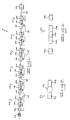
- FIG. 1 is an optical schematic view of an endoscope constructed in accordance with the present invention, wherein three sets of relay lens pairs are disposed between an objective lens and an eye lens.
- FIG. 2 is an optical schematic view of an embodiment of a relay lens of FIG. 1 in accordance with the invention, showing a center lens as a sphere.
- FIG. 3 is an optical schematic view of a relay lens of FIG. 2 showing the center lens as a cylindrical, spherical lens, also showing detached, identical inter-lens spacers.
- FIG. 4 is an optical schematic view of a pair of the relay lenses of FIG. 3, constituting a set of Type 1 relay lenses, showing light rays passing through the set.
- FIG. 5 is an optical schematic view of a a relay lens useful in understanding the present application, also showing detached, identical inter-lens spacers.
- FIG. 6 is an optical schematic view of a pair of the relay lenses of FIG. 5, constituting a set of relay lenses, showing light rays passing through the set.
- the endoscope relay lens of the present invention is suitable for use in standard medical endoscopes of the type disclosed in U.S. Patent 4148551 to MacAnally, which is incorporated herein by reference.
- the relay lens 12a,b,c,d,e,f basically comprises a center lens 14a,b,c,d,e,f with a first end lens 16a,b,c,d,e,f affixed to a first surface 18a,b,c,d,e,f of center lens 14a,b,c,d,e,f and a second end lens 20a,b,c,d,e,f affixed to a second surface 22a,b,c,d,e,f of center lens 14a,b,c,d,e,f.
- relay lenses 12a,b,c,d,e,f are disposed between an objective lens 24 and an eye lens 26.
- objective lens 24 relay lenses 12a,b,c, d,e,f and eye lens 26 share a common central axis 27.
- the relay lenses 12a,b,c,d,e,f are arranged in three sets 28, 30, 32 of relay lens pairs.
- the first set 28 includes a pair of two relay lenses 12a and 12b; the second set includes a pair 12c and 12d; and, the third set includes a pair of relay lenses 12e and 12f.
- FIG. 2 wherein a first end lens 16g and second end lens 20g are shown affixed to center lens 14g when center lens 14g is a sphere.
- the end lenses 16g, 20g are sufficiently long to facilitate manipulation of the relay lens 12g during cementing of the end lenses 16g, 20g to the center lens 14g.
- a first end lens 16g is cemented to a spherical center lens 14g.
- the center lens is polished down to a cylinder by standard optical shop methods.
- the second end lens 20g is aligned properly with the first end lens 16g and center lens 14g and cemented to the center lens 14g in a standard optical "V-block".
- FIG. 2 graphically shows the spherical structure of the center lens 14g in a relay lens 12g and the relatively long end lenses 16g, 20g of all embodiments of the present invention.
- FIG. 3 shows the finished embodiment relay lens 12h, wherein end lenses 16h, 20h are affixed to the cylindrical, spherical center lens 14h. Additionally, detached, identical inter-lens spacers 33a,b are shown in FIG. 3.
- FIG. 4 shows light rays 34 passing through a first set 28 of Type 1 relay lenses 12a, 12b.
- the rays 34 and relay lens set 28 define a specific sequence of eleven optical surfaces shown in vertical lines.
- a first optical surface 36 defines an object plane.
- a second optical surface 38 defines an exterior surface of first end lens 16a.
- a third optical surface 40 defines an interior surface of first end lens 16a.
- a fourth optical surface 42 defines an interior surface of second end lens 20a.
- a fifth optical surface 44 defines an exterior surface of second end lens 20a.
- a sixth optical surface 46 defines an aperture stop plane.
- a seventh optical surface 48 defines an exterior surface of first end lens 16b.
- An eighth optical surface 50 defines an interior surface of first end lens 16b.
- a ninth optical surface 52 defines an interior surface of second end lens 20b.
- a tenth optical surface 54 defines an exterior surface of second end lens 20b.
- An eleventh optical surface 56 defines an image plane.
- a working example of a set of relay lenses is defined with specificity in Table A.
- Tests of the performance characteristics of this working example of a relay lens demonstrate a small fraction of a wavelength of Optical Path Difference (OPD) over the entire image area.
- OPD Optical Path Difference
- the example accumulates less than one wavelength of OPD over several sets.
- Most known relay lenses have at least one wavelength of OPD in some or all of their image area through one set.
- the distance from the first optical surface 36 to the second optical surface 38 is one-half the distance from the fifth optical surface 44 to the seventh optical surface 48; and it is also one-half the distance from the tenth optical surface 54 to the exterior surface 58 of the first end lens 16c of the next relay lens set 30 (as seen in FIG. 1). Consequently, the distance between relay lenses 12a, 12b in a set is the same as the distance between sets of relay lenses 28, 30, 32. Therefore, the length of all inter-lens spacers 33a,b is the same, and the spacers are interchangeable.
- FIGS. 5 and 6 show a different center lens 62 which is not spherical.
- relay lens 60a,b includes center lenses 62a,b first end lenses 64a,b affixed to the center lenses 62a,b and second end lenses 66a,b affixed to center lenses 62a,b.
- Also shown in FIG. 5 are detached, identical inter-lens spacers 67a,b.
- relay lenses 60a,b are arranged in a set 68 of two relay lenses 60a,b.
- eleven optical surfaces are defined by the rays and relay lenses 60 a,b.
- a first optical surface 72 defines an object plane.
- a second optical surface 74 defines an exterior surface of first end lens 64a.
- a third optical surface 76 defines an interior surface of first end lens 64a.
- a fourth optical surface 78 defines an interior surface of second end lens 66a.
- a fifth optical surface 80 defines an exterior surface of second end lens 66a.
- a sixth optical surface 82 defines an aperture stop plane.
- a seventh optical surface 84 defines an exterior surface of first end lens 64b.
- An eighth optical surface 86 defines an interior surface of first end lens 64b.
- a ninth optical surface 88 defines an interior surface of second end lens 66b.
- a tenth optical surface 90 defines an exterior surface of second end lens 66b.
- An eleventh optical surface 92 defines an image plane.
- the working example described in Table B was tested and demonstrated a small fraction of a wavelength of OPD over the entire image area.
- the example accumulates less than one wavelength of OPD over several sets.
- the distance from the first optical surface 72 to the second optical surface 74 is one-half the distance from the fifth optical surface 80 to the seventh optical distance 84; and it is also one-half the distance from the tenth optical surface 90 to the exterior surface of the next relay lens set (not shown). Consequently, the distance between relay lens 60a,b in a set 68 is the same as the distance between sets of relay lens pairs. Therefore, the length of all inter-lens spacers 67a,b is the same, and the spacers are interchangeable.
- relay lenses of the present invention can be utilized in non-medical optical instruments to transmit an image through a rigid or semi-rigid cylinder.
Landscapes
- Physics & Mathematics (AREA)
- Astronomy & Astrophysics (AREA)
- General Physics & Mathematics (AREA)
- Optics & Photonics (AREA)
- Instruments For Viewing The Inside Of Hollow Bodies (AREA)
- Lenses (AREA)
- Endoscopes (AREA)
- Lens Barrels (AREA)
- Materials For Medical Uses (AREA)
Claims (7)
- Lentille de relais à trois éléments (12a) destinée à transmettre une image optique, comprenant :(a) une lentille centrale (14a),(b) deux lentilles d'extrémité identiques (16a, 20a) fixées aux extrémités opposées de la lentille centrale, les lentilles d'extrémité et la lentille centrale formant un cylindre, chacune desdites lentilles d'extrémité présentant une longueur axiale qui est égale, ou supérieure, à la moitié de son diamètre , de sorte que la lentille de relais est symétrique par rapport à un plan passant par le centre de la lentille centrale perpendiculaire à un axe passant par les centres des lentilles d'extrémité opposées, les rayons de courbure des extrémités opposées de la lentille centrale étant identiques et égaux à une moitié de la longueur axiale maximale de la lentille centrale ; la lentille de relais à trois éléments agissant pour fournir une transmission d'image à travers elle, de sorte qu'un objet situé au niveau d'un plan objet adjacent à l'une des lentilles d'extrémité présente son image formée dans un plan image adjacent à l'autre lentille d'extrémité.
- Lentille de relais à trois éléments selon la revendication 1 , dans laquelle la lentille centrale est sphérique, de sorte que les rayons de courbure des extrémités opposées de la lentille centrale représentent une moitié de la longueur axiale de la lentille centrale.
- Ensemble de lentilles de relais (28) destiné à transmettre une image optique d'un objet, lequel comprend une paire de lentilles de relais identiques à trois éléments (12a, 12b) , selon la revendication 1, dans lequel les rayons de courbure et les longueurs axiales des lentilles d'extrémité et de la lentille centrale coopèrent de façon qu'une performance optimale de l'ensemble de lentilles de relais soit obtenue lorsque la distance de l'objet à la lentille de relais la plus proche représente la moitié de la distance comprise entre la paire de lentilles de relais de l'ensemble.
- Ensemble de lentilles de relais selon la revendication 3 dans lequel l'ensemble de lentilles de relais transmet une image optique à un second ensemble identique de lentilles de relais (30) et dans lequel la distance de l'objet à la lentille de relais la plus proche représente la moitié de la distance entre l'ensemble de lentilles de relais et le second ensemble de lentilles de relais .
- Système d'ensembles de lentilles de relais destiné à transmettre une image optique d'un objet à travers une pluralité de lentilles de relais à trois éléments selon la revendication 1, dans lequel les rayons de courbure et les longueurs axiales des lentilles d'extrémité et de la lentille centrale coopèrent de façon qu'une performance optimale du système de l'ensemble de lentilles de relais soit obtenue lorsque la distance de l'objet à la lentille de relais la plus proche représente la moitié de la distance entre la paire de lentilles de relais du premier ensemble de lentilles de relais et la moitié de la distance entre les premier et second ensembles de lentilles de relais.
- Système d'ensembles de lentilles de relais selon la revendication 5, dans lequel la distance de l'objet à la lentille de relais la plus proche représente la moitié de la distance entre des ensembles quelconques adjacents de lentilles de relais .
- Procédé de fabrication de lentilles de relais à trois éléments , lequel comprend les étapes consistant à :(a) coller une première lentille d'extrémité cylindrique à une sphère de verre optique , ladite lentille d'extrémité cylindrique présentant une longueur axiale qui est supérieure ou égale à la moitié de son diamètre ;(b) polir la sphère, de sorte qu'elle forme un cylindre et coïncide avec les dimensions cylindriques de la première lentille d'extrémité ; et(c) coller une seconde lentille d'extrémité cylindrique identique à une extrémité du cylindre formé par la première lentille d'extrémité et la sphère polie, de façon que les première et seconde lentilles d'extrémité soient collées aux extrémités opposées de la sphère polie et que la première lentille d'extrémité , la sphère polie et la seconde lentille d'extrémité partagent un axe central commun.
Applications Claiming Priority (2)
| Application Number | Priority Date | Filing Date | Title |
|---|---|---|---|
| US507877 | 1990-04-12 | ||
| US07/507,877 US5059009A (en) | 1990-04-12 | 1990-04-12 | Endoscope relay lens |
Publications (2)
| Publication Number | Publication Date |
|---|---|
| EP0452053A1 EP0452053A1 (fr) | 1991-10-16 |
| EP0452053B1 true EP0452053B1 (fr) | 1997-10-22 |
Family
ID=24020486
Family Applications (1)
| Application Number | Title | Priority Date | Filing Date |
|---|---|---|---|
| EP91303038A Expired - Lifetime EP0452053B1 (fr) | 1990-04-12 | 1991-04-05 | Lentille de relais pour endoscope |
Country Status (11)
| Country | Link |
|---|---|
| US (1) | US5059009A (fr) |
| EP (1) | EP0452053B1 (fr) |
| JP (1) | JP2534409B2 (fr) |
| AT (1) | ATE159594T1 (fr) |
| AU (1) | AU7414191A (fr) |
| CA (1) | CA2039570C (fr) |
| DE (1) | DE69127988T2 (fr) |
| IE (1) | IE80722B1 (fr) |
| NO (1) | NO911412L (fr) |
| NZ (1) | NZ237778A (fr) |
| ZA (1) | ZA912709B (fr) |
Families Citing this family (25)
| Publication number | Priority date | Publication date | Assignee | Title |
|---|---|---|---|---|
| US5188092A (en) * | 1990-12-13 | 1993-02-23 | United States Surgical Corporation | Disposable rigid endoscope |
| US5731916A (en) * | 1991-01-16 | 1998-03-24 | Olympus Optical Co., Ltd. | Image Transmitting optical system |
| AU3721993A (en) * | 1992-02-19 | 1993-09-13 | United States Surgical Corporation | Optical viewing device |
| US5416634A (en) * | 1992-09-11 | 1995-05-16 | United States Surgical Corporation | Optical viewing device |
| US5369525A (en) * | 1992-12-02 | 1994-11-29 | United States Surgical Corporation | Ring lens assembly for an optical viewing device |
| US5751341A (en) * | 1993-01-05 | 1998-05-12 | Vista Medical Technologies, Inc. | Stereoscopic endoscope system |
| CA2123077C (fr) * | 1994-04-14 | 2001-09-04 | Anthony B. Greening | Systeme d'imagerie stereoscopique a objectif unique |
| US5633754A (en) * | 1994-12-06 | 1997-05-27 | Hoogland; Jan | Integrated optical system for endoscopes and the like |
| US6853485B2 (en) | 1994-12-06 | 2005-02-08 | Jan Hoogland | Integrated optical system for endoscopes and the like |
| US5976076A (en) * | 1995-02-22 | 1999-11-02 | Kolff; Jack | Stereo laparoscope with synchronized optics |
| US5613936A (en) * | 1995-02-22 | 1997-03-25 | Concurrent Technologies Corp. | Stereo laparoscope apparatus |
| US6144762A (en) * | 1998-02-23 | 2000-11-07 | Olympus America Inc. | Stereo video microscope |
| US6163640A (en) * | 1998-06-01 | 2000-12-19 | Metroptic Technologies, Inc. | Stereoscopic sensor |
| DE19910050C2 (de) * | 1999-03-08 | 2003-08-14 | Storz Karl Gmbh & Co Kg | Bildübertragungssystem für Endoskope und dgl. Sehrohre sowie Verfahren zur Herstellung eines Bildübertragungssystems |
| US6767321B2 (en) | 1999-10-04 | 2004-07-27 | Robert Czarnek | Stereo laparoscope with discrete working distance |
| RU2168152C1 (ru) * | 2000-11-03 | 2001-05-27 | Орлов Владимир Сергеевич | Нашлемная система целеуказания |
| US6490085B1 (en) | 2001-02-21 | 2002-12-03 | Richard Wolf Gmbh | Symmetric anastigmatic endoscope relay system |
| US8982203B2 (en) | 2007-06-06 | 2015-03-17 | Karl Storz Gmbh & Co. Kg | Video system for viewing an object on a body |
| US8081364B2 (en) | 2007-11-27 | 2011-12-20 | Duke University | High-speed multi-dimensional beam scanning system with angle amplification |
| EP2452228A4 (fr) | 2009-07-10 | 2015-06-03 | Front Street Invest Man Inc As Manager For Front Street Diversified Income Class | Procédé et appareil de génération d informations d image tridimensionnelle à l aide d un parcours unique d imagerie |
| US9433341B2 (en) * | 2012-03-26 | 2016-09-06 | Karl Storz Imaging, Inc. | Compensated relays for reducing number of elements in rod lens endoscopes |
| WO2019239578A1 (fr) * | 2018-06-15 | 2019-12-19 | オリンパス株式会社 | Système optique à objectif, système optique pour miroir rigide utilisant celui-ci, et miroir rigide |
| EP3941328B1 (fr) | 2019-03-18 | 2024-01-10 | The Regents of the University of Michigan | Endomicroscope confocal à axe unique basé sur des microsystèmes ultra-compacts |
| WO2020191075A1 (fr) | 2019-03-18 | 2020-09-24 | The Regents Of The University Of Michigan | Endomicroscope confocal à trajet de faisceau replié ultra-compact |
| CN111904373B (zh) * | 2020-09-04 | 2025-02-25 | 鹰利视医疗科技有限公司 | 一种4k超高清腹腔镜的转像镜结构 |
Family Cites Families (14)
| Publication number | Priority date | Publication date | Assignee | Title |
|---|---|---|---|---|
| US2828669A (en) * | 1953-07-14 | 1958-04-01 | George P Pilling & Son Company | Lens system for endoscopes |
| GB1443150A (en) * | 1972-12-06 | 1976-07-21 | Nat Res Dev | Optical devices |
| US4168882A (en) * | 1975-04-30 | 1979-09-25 | The Secretary Of State For Social Services In Her Britannic Majesty's Government Of The United Kingdom Of Great Britain And Northern Ireland | Optical systems |
| US4148550A (en) * | 1977-05-09 | 1979-04-10 | American Hospital Supply Corporation | Rod lens assembly and method of making the same |
| US4148551A (en) * | 1977-05-09 | 1979-04-10 | American Hospital Supply Corporation | Modular rod lens assembly and method of making the same |
| US4158475A (en) * | 1978-04-18 | 1979-06-19 | American Optical Corporation | Optical system for inverted microscopes |
| US4358810A (en) * | 1981-01-21 | 1982-11-09 | Westinghouse Electric Corp. | Circuit breaker with alarm |
| US4545652A (en) * | 1981-05-29 | 1985-10-08 | Jan Hoogland | Flat field lenses |
| US4575195A (en) * | 1981-05-29 | 1986-03-11 | Jan Hoogland | Flat field lenses |
| JPS5913721A (ja) * | 1982-07-15 | 1984-01-24 | Tsurui Yakuhin Kogyo Kk | 歯苔形成抑制剤 |
| JPS6042728A (ja) * | 1983-08-18 | 1985-03-07 | Olympus Optical Co Ltd | 結像光学系 |
| JPH0823625B2 (ja) * | 1985-07-25 | 1996-03-06 | オリンパス光学工業株式会社 | 不均質レンズを用いた像伝送光学系 |
| US4779613A (en) * | 1986-03-13 | 1988-10-25 | Olympus Optical Co., Ltd. | Endoscope with means for preventing an observing optical system from being fogged |
| US4993817A (en) * | 1988-05-09 | 1991-02-19 | Jan Hoogland | Endoscope relay optics |
-
1990
- 1990-04-12 US US07/507,877 patent/US5059009A/en not_active Expired - Lifetime
-
1991
- 1991-04-02 CA CA002039570A patent/CA2039570C/fr not_active Expired - Fee Related
- 1991-04-05 AT AT91303038T patent/ATE159594T1/de active
- 1991-04-05 DE DE69127988T patent/DE69127988T2/de not_active Expired - Fee Related
- 1991-04-05 EP EP91303038A patent/EP0452053B1/fr not_active Expired - Lifetime
- 1991-04-08 AU AU74141/91A patent/AU7414191A/en not_active Abandoned
- 1991-04-10 NZ NZ237778A patent/NZ237778A/xx unknown
- 1991-04-10 IE IE119691A patent/IE80722B1/en unknown
- 1991-04-11 NO NO91911412A patent/NO911412L/no unknown
- 1991-04-11 ZA ZA912709A patent/ZA912709B/xx unknown
- 1991-04-12 JP JP3108904A patent/JP2534409B2/ja not_active Expired - Fee Related
Also Published As
| Publication number | Publication date |
|---|---|
| US5059009A (en) | 1991-10-22 |
| DE69127988D1 (de) | 1997-11-27 |
| ZA912709B (en) | 1992-01-29 |
| EP0452053A1 (fr) | 1991-10-16 |
| JP2534409B2 (ja) | 1996-09-18 |
| CA2039570C (fr) | 1995-11-28 |
| DE69127988T2 (de) | 1998-03-12 |
| NZ237778A (en) | 1994-06-27 |
| AU7414191A (en) | 1991-10-17 |
| JPH04230702A (ja) | 1992-08-19 |
| IE80722B1 (en) | 1998-12-30 |
| ATE159594T1 (de) | 1997-11-15 |
| IE911196A1 (en) | 1991-10-23 |
| CA2039570A1 (fr) | 1991-10-13 |
| NO911412D0 (no) | 1991-04-11 |
| NO911412L (no) | 1991-10-14 |
Similar Documents
| Publication | Publication Date | Title |
|---|---|---|
| EP0452053B1 (fr) | Lentille de relais pour endoscope | |
| US5097359A (en) | Endoscope relay lens configuration | |
| US5519532A (en) | Disposable endoscope | |
| US5892630A (en) | Disposable endoscope | |
| US4984878A (en) | Ojective lens for endoscope | |
| US4168882A (en) | Optical systems | |
| US5377047A (en) | Disposable endoscope employing positive and negative gradient index of refraction optical materials | |
| US7621868B2 (en) | Convergence optics for stereoscopic imaging systems | |
| US5933275A (en) | Optical system for non-flexible endoscopes | |
| CN105474066A (zh) | 具有横向观看方向的立体视频内窥镜的光学系统以及具有横向观看方向的立体视频内窥镜 | |
| EP0646821A2 (fr) | Système optique pour endoscope | |
| CN101438197B (zh) | 显微镜物镜 | |
| CN104345429B (zh) | 一种内窥镜用摄像适配器光学系统 | |
| EP3828612B1 (fr) | Système de lentille pour un endoscope vidéo, objectif d'endoscope, endoscope vidéo et procédé d'assemblage | |
| EP0609093A1 (fr) | Relais à gradient radial d'indice à nombre d'Abbe négatif, méthode de sa fabrication et son usage | |
| US5980453A (en) | Endoscope with low distortion | |
| US6853485B2 (en) | Integrated optical system for endoscopes and the like | |
| CA1058436A (fr) | Systeme optique allonge avec lentilles en forme de batonnets | |
| US5891015A (en) | Endoscope including a front lens group and an inner lens group forming a telesystem | |
| US9696537B2 (en) | Opto-mechanical devices with sharp-edge lenses | |
| US4497546A (en) | Wide-field eyepiece | |
| US5625488A (en) | Telecentric relay lens system | |
| US2828669A (en) | Lens system for endoscopes | |
| CA1067736A (fr) | Condensateur pour microscope | |
| US5488512A (en) | Color corrected ocular |
Legal Events
| Date | Code | Title | Description |
|---|---|---|---|
| PUAI | Public reference made under article 153(3) epc to a published international application that has entered the european phase |
Free format text: ORIGINAL CODE: 0009012 |
|
| AK | Designated contracting states |
Kind code of ref document: A1 Designated state(s): AT BE CH DE DK ES FR GB GR IT LI LU NL SE |
|
| 17P | Request for examination filed |
Effective date: 19920415 |
|
| 17Q | First examination report despatched |
Effective date: 19931110 |
|
| GRAG | Despatch of communication of intention to grant |
Free format text: ORIGINAL CODE: EPIDOS AGRA |
|
| GRAH | Despatch of communication of intention to grant a patent |
Free format text: ORIGINAL CODE: EPIDOS IGRA |
|
| GRAH | Despatch of communication of intention to grant a patent |
Free format text: ORIGINAL CODE: EPIDOS IGRA |
|
| GRAA | (expected) grant |
Free format text: ORIGINAL CODE: 0009210 |
|
| AK | Designated contracting states |
Kind code of ref document: B1 Designated state(s): AT BE CH DE DK ES FR GB GR IT LI LU NL SE |
|
| ITF | It: translation for a ep patent filed | ||
| PG25 | Lapsed in a contracting state [announced via postgrant information from national office to epo] |
Ref country code: LI Free format text: LAPSE BECAUSE OF FAILURE TO SUBMIT A TRANSLATION OF THE DESCRIPTION OR TO PAY THE FEE WITHIN THE PRESCRIBED TIME-LIMIT Effective date: 19971022 Ref country code: GR Free format text: LAPSE BECAUSE OF FAILURE TO SUBMIT A TRANSLATION OF THE DESCRIPTION OR TO PAY THE FEE WITHIN THE PRESCRIBED TIME-LIMIT Effective date: 19971022 Ref country code: ES Free format text: THE PATENT HAS BEEN ANNULLED BY A DECISION OF A NATIONAL AUTHORITY Effective date: 19971022 Ref country code: DK Free format text: LAPSE BECAUSE OF NON-PAYMENT OF DUE FEES Effective date: 19971022 Ref country code: CH Free format text: LAPSE BECAUSE OF FAILURE TO SUBMIT A TRANSLATION OF THE DESCRIPTION OR TO PAY THE FEE WITHIN THE PRESCRIBED TIME-LIMIT Effective date: 19971022 Ref country code: BE Free format text: LAPSE BECAUSE OF FAILURE TO SUBMIT A TRANSLATION OF THE DESCRIPTION OR TO PAY THE FEE WITHIN THE PRESCRIBED TIME-LIMIT Effective date: 19971022 Ref country code: AT Free format text: LAPSE BECAUSE OF FAILURE TO SUBMIT A TRANSLATION OF THE DESCRIPTION OR TO PAY THE FEE WITHIN THE PRESCRIBED TIME-LIMIT Effective date: 19971022 |
|
| REF | Corresponds to: |
Ref document number: 159594 Country of ref document: AT Date of ref document: 19971115 Kind code of ref document: T |
|
| REG | Reference to a national code |
Ref country code: CH Ref legal event code: EP |
|
| REF | Corresponds to: |
Ref document number: 69127988 Country of ref document: DE Date of ref document: 19971127 |
|
| ET | Fr: translation filed | ||
| PG25 | Lapsed in a contracting state [announced via postgrant information from national office to epo] |
Ref country code: SE Effective date: 19980122 |
|
| PG25 | Lapsed in a contracting state [announced via postgrant information from national office to epo] |
Ref country code: LU Free format text: LAPSE BECAUSE OF NON-PAYMENT OF DUE FEES Effective date: 19980405 |
|
| PGFP | Annual fee paid to national office [announced via postgrant information from national office to epo] |
Ref country code: NL Payment date: 19980430 Year of fee payment: 8 |
|
| REG | Reference to a national code |
Ref country code: CH Ref legal event code: PL |
|
| PLBE | No opposition filed within time limit |
Free format text: ORIGINAL CODE: 0009261 |
|
| STAA | Information on the status of an ep patent application or granted ep patent |
Free format text: STATUS: NO OPPOSITION FILED WITHIN TIME LIMIT |
|
| 26N | No opposition filed | ||
| PG25 | Lapsed in a contracting state [announced via postgrant information from national office to epo] |
Ref country code: NL Free format text: LAPSE BECAUSE OF NON-PAYMENT OF DUE FEES Effective date: 19991101 |
|
| NLV4 | Nl: lapsed or anulled due to non-payment of the annual fee |
Effective date: 19991101 |
|
| PGFP | Annual fee paid to national office [announced via postgrant information from national office to epo] |
Ref country code: GB Payment date: 20010327 Year of fee payment: 11 |
|
| PGFP | Annual fee paid to national office [announced via postgrant information from national office to epo] |
Ref country code: FR Payment date: 20010412 Year of fee payment: 11 |
|
| REG | Reference to a national code |
Ref country code: GB Ref legal event code: IF02 |
|
| PG25 | Lapsed in a contracting state [announced via postgrant information from national office to epo] |
Ref country code: GB Free format text: LAPSE BECAUSE OF NON-PAYMENT OF DUE FEES Effective date: 20020405 |
|
| GBPC | Gb: european patent ceased through non-payment of renewal fee |
Effective date: 20020405 |
|
| PG25 | Lapsed in a contracting state [announced via postgrant information from national office to epo] |
Ref country code: FR Free format text: LAPSE BECAUSE OF NON-PAYMENT OF DUE FEES Effective date: 20021231 |
|
| REG | Reference to a national code |
Ref country code: FR Ref legal event code: ST |
|
| PG25 | Lapsed in a contracting state [announced via postgrant information from national office to epo] |
Ref country code: IT Free format text: LAPSE BECAUSE OF NON-PAYMENT OF DUE FEES;WARNING: LAPSES OF ITALIAN PATENTS WITH EFFECTIVE DATE BEFORE 2007 MAY HAVE OCCURRED AT ANY TIME BEFORE 2007. THE CORRECT EFFECTIVE DATE MAY BE DIFFERENT FROM THE ONE RECORDED. Effective date: 20050405 |
|
| PGFP | Annual fee paid to national office [announced via postgrant information from national office to epo] |
Ref country code: DE Payment date: 20060419 Year of fee payment: 16 |
|
| PG25 | Lapsed in a contracting state [announced via postgrant information from national office to epo] |
Ref country code: DE Free format text: LAPSE BECAUSE OF NON-PAYMENT OF DUE FEES Effective date: 20071101 |