EP0452094A2 - A method of the preparation of N-hydroxy aspartic acid derivate - Google Patents

A method of the preparation of N-hydroxy aspartic acid derivate Download PDF

Info

Publication number
EP0452094A2
EP0452094A2 EP91303126A EP91303126A EP0452094A2 EP 0452094 A2 EP0452094 A2 EP 0452094A2 EP 91303126 A EP91303126 A EP 91303126A EP 91303126 A EP91303126 A EP 91303126A EP 0452094 A2 EP0452094 A2 EP 0452094A2
Authority
EP
European Patent Office
Prior art keywords
alkyl
substituted
derivative
hydroxylamine
formula
Prior art date
Legal status (The legal status is an assumption and is not a legal conclusion. Google has not performed a legal analysis and makes no representation as to the accuracy of the status listed.)
Withdrawn
Application number
EP91303126A
Other languages
German (de)
French (fr)
Other versions
EP0452094A3 (en
Inventor
Varadaraj Elango
Michael P Bodman
John R Fritch
Donald R Larkin
Werner H Mueller
John C Saukaitis
Bernard Franklin Cupton
Current Assignee (The listed assignees may be inaccurate. Google has not performed a legal analysis and makes no representation or warranty as to the accuracy of the list.)
CNA Holdings LLC
Original Assignee
Hoechst Celanese Corp
Priority date (The priority date is an assumption and is not a legal conclusion. Google has not performed a legal analysis and makes no representation as to the accuracy of the date listed.)
Filing date
Publication date
Application filed by Hoechst Celanese Corp filed Critical Hoechst Celanese Corp
Publication of EP0452094A2 publication Critical patent/EP0452094A2/en
Publication of EP0452094A3 publication Critical patent/EP0452094A3/en
Withdrawn legal-status Critical Current

Links

Classifications

    • CCHEMISTRY; METALLURGY
    • C07ORGANIC CHEMISTRY
    • C07DHETEROCYCLIC COMPOUNDS
    • C07D213/00Heterocyclic compounds containing six-membered rings, not condensed with other rings, with one nitrogen atom as the only ring hetero atom and three or more double bonds between ring members or between ring members and non-ring members
    • C07D213/02Heterocyclic compounds containing six-membered rings, not condensed with other rings, with one nitrogen atom as the only ring hetero atom and three or more double bonds between ring members or between ring members and non-ring members having three double bonds between ring members or between ring members and non-ring members
    • C07D213/04Heterocyclic compounds containing six-membered rings, not condensed with other rings, with one nitrogen atom as the only ring hetero atom and three or more double bonds between ring members or between ring members and non-ring members having three double bonds between ring members or between ring members and non-ring members having no bond between the ring nitrogen atom and a non-ring member or having only hydrogen or carbon atoms directly attached to the ring nitrogen atom
    • C07D213/60Heterocyclic compounds containing six-membered rings, not condensed with other rings, with one nitrogen atom as the only ring hetero atom and three or more double bonds between ring members or between ring members and non-ring members having three double bonds between ring members or between ring members and non-ring members having no bond between the ring nitrogen atom and a non-ring member or having only hydrogen or carbon atoms directly attached to the ring nitrogen atom with hetero atoms or with carbon atoms having three bonds to hetero atoms with at the most one bond to halogen, e.g. ester or nitrile radicals, directly attached to ring carbon atoms
    • C07D213/78Carbon atoms having three bonds to hetero atoms, with at the most one bond to halogen, e.g. ester or nitrile radicals
    • C07D213/79Acids; Esters
    • CCHEMISTRY; METALLURGY
    • C07ORGANIC CHEMISTRY
    • C07CACYCLIC OR CARBOCYCLIC COMPOUNDS
    • C07C239/00Compounds containing nitrogen-to-halogen bonds; Hydroxylamino compounds or ethers or esters thereof
    • C07C239/08Hydroxylamino compounds or their ethers or esters
    • C07C239/18Hydroxylamino compounds or their ethers or esters having nitrogen atoms of hydroxylamino groups further bound to carbon atoms of hydrocarbon radicals substituted by carboxyl groups
    • CCHEMISTRY; METALLURGY
    • C07ORGANIC CHEMISTRY
    • C07DHETEROCYCLIC COMPOUNDS
    • C07D213/00Heterocyclic compounds containing six-membered rings, not condensed with other rings, with one nitrogen atom as the only ring hetero atom and three or more double bonds between ring members or between ring members and non-ring members
    • C07D213/02Heterocyclic compounds containing six-membered rings, not condensed with other rings, with one nitrogen atom as the only ring hetero atom and three or more double bonds between ring members or between ring members and non-ring members having three double bonds between ring members or between ring members and non-ring members
    • C07D213/04Heterocyclic compounds containing six-membered rings, not condensed with other rings, with one nitrogen atom as the only ring hetero atom and three or more double bonds between ring members or between ring members and non-ring members having three double bonds between ring members or between ring members and non-ring members having no bond between the ring nitrogen atom and a non-ring member or having only hydrogen or carbon atoms directly attached to the ring nitrogen atom
    • C07D213/60Heterocyclic compounds containing six-membered rings, not condensed with other rings, with one nitrogen atom as the only ring hetero atom and three or more double bonds between ring members or between ring members and non-ring members having three double bonds between ring members or between ring members and non-ring members having no bond between the ring nitrogen atom and a non-ring member or having only hydrogen or carbon atoms directly attached to the ring nitrogen atom with hetero atoms or with carbon atoms having three bonds to hetero atoms with at the most one bond to halogen, e.g. ester or nitrile radicals, directly attached to ring carbon atoms
    • C07D213/78Carbon atoms having three bonds to hetero atoms, with at the most one bond to halogen, e.g. ester or nitrile radicals
    • C07D213/79Acids; Esters
    • C07D213/80Acids; Esters in position 3
    • CCHEMISTRY; METALLURGY
    • C07ORGANIC CHEMISTRY
    • C07DHETEROCYCLIC COMPOUNDS
    • C07D215/00Heterocyclic compounds containing quinoline or hydrogenated quinoline ring systems
    • C07D215/02Heterocyclic compounds containing quinoline or hydrogenated quinoline ring systems having no bond between the ring nitrogen atom and a non-ring member or having only hydrogen atoms or carbon atoms directly attached to the ring nitrogen atom
    • C07D215/16Heterocyclic compounds containing quinoline or hydrogenated quinoline ring systems having no bond between the ring nitrogen atom and a non-ring member or having only hydrogen atoms or carbon atoms directly attached to the ring nitrogen atom with hetero atoms or with carbon atoms having three bonds to hetero atoms with at the most one bond to halogen, e.g. ester or nitrile radicals, directly attached to ring carbon atoms
    • C07D215/48Carbon atoms having three bonds to hetero atoms with at the most one bond to halogen
    • C07D215/54Carbon atoms having three bonds to hetero atoms with at the most one bond to halogen attached in position 3
    • CCHEMISTRY; METALLURGY
    • C07ORGANIC CHEMISTRY
    • C07DHETEROCYCLIC COMPOUNDS
    • C07D401/00Heterocyclic compounds containing two or more hetero rings, having nitrogen atoms as the only ring hetero atoms, at least one ring being a six-membered ring with only one nitrogen atom
    • C07D401/02Heterocyclic compounds containing two or more hetero rings, having nitrogen atoms as the only ring hetero atoms, at least one ring being a six-membered ring with only one nitrogen atom containing two hetero rings
    • C07D401/04Heterocyclic compounds containing two or more hetero rings, having nitrogen atoms as the only ring hetero atoms, at least one ring being a six-membered ring with only one nitrogen atom containing two hetero rings directly linked by a ring-member-to-ring-member bond

Definitions

  • the present invention pertains to a method preparing substituted and unsubstituted N-hydroxy-2-aminobutane diacid derivatives which can be dehydrated to 2-aminobut-2-ene dioic acid derivatives, which subsequently can be converted to pyridine and quinoline derivatives.
  • Unsubstituted hydroxylamines are reacted with substituted or unsubstituted unsaturated diacid derivatives to produce N-hydroxyaspartic acid derivatives which can be dehydrated to 2-aminobut-2-ene dioic acid derivatives, which can subsequently be reacted with ⁇ , ⁇ -unsaturated carbonyl compounds to produce pyridine derivatives.
  • N-hydroxyamino acids are valuable precursors for natural amino acids, peptides, herbicides, antibiotics, growth promoting agents, antitumor agents, antifungal agents, and polymers. It has been known that the addition of hydroxylamine to an unsaturated monocarboxylic acid derivative can be used to obtain N-hydroxyamino mono carboxylic acid derivative. However, addition of hydroxylamine to an unsaturated dicarboxylic acid, such as fumaric acid, in the presence of an enzyme does not successfully result in the isolation of N-hydroxyaspartic acid, as reported in "Progress in the Chemistry of Organic Natural Products", L. F. Alves et al., Springer-Vedag (1988), page 230.
  • Literature methods for preparing 5,6-dialkyl and 5-alkyl-6-arylpyridine-2,-3-dicarboxylic acids and esters are limited and often require oxidation of alkyl or aryl substituents at positions 2 and 3 in order to obtain diacids.
  • the use of ⁇ -halo- ⁇ -ketoesters is not desired due to the fact that such materials are usually costly and unstable.
  • U.S. Patent No. 4,723,011 discloses preparation of substituted and disubstituted pyridine-2,3-dicarboxylates by the reaction of an ⁇ -halo- ⁇ -ketoester such as chloro-diethyloxaloacetate (chloro-DOX) and an a,P-unsaturated aldehyde or ketone such as 2-ethylacrolein in the presence of at least 2 molar equivalents of an ammonium salt in order to product the desired compounds.
  • chloro-DOX chloro-diethyloxaloacetate
  • 2-ethylacrolein a,P-unsaturated aldehyde or ketone
  • an ammonium salt in order to product the desired compounds.
  • U.S. Patent No. 4,816,588 discloses and claims a process for preparing pyridine-2,3-dicarboxylic acids by the oxidation of 8-substituted quinolines.
  • European Patent Application No. 274,379 published July 13, 1988 discloses two processes for producing pyridine-2,3-dicarboxylic acid compounds.
  • One process seems similar to that previously described in U.S. Patent No. 4,723,011 and the other process involves reacting an ⁇ , ⁇ -unsaturated aldehyde or ketone with various aminomaleates or aminofumarates such as diethyl aminomaleate.
  • the present invention pertains to a method of preparing substituted and unsubstituted N-hydroxy-2-aminobutane diacid derivatives which can be dehydrated to 2-aminobut-2-ene dioic acid derivatives, which subsequently can be converted to pyridine and quinoline derivatives.
  • An unsubstituted hydroxylamine is reacted with an substituted or unsubstituted unsaturated diacid derivative to produce N-hydroxyaspartic acid derivatives which can be dehydrated to 2-aminobut-2-ene dioic acid derivatives, which can subsequently be reacted with ⁇ , ⁇ -unsaturated carbonyl compounds to produce pyridine derivatives.
  • a single pot reaction can be carried out wherein the unsubstituted hydroxyl amine is contacted with a substituted or unsubstituted unsaturated diacid derivative, followed by a dehydration technique, with subsequent addition of the a,(3-unsaturated carbonyl compound, to produce the pyridine derivative directly (without isolation of the 2-aminobut-2-ene dioic acid derivative formed upon the dehydration step).
  • this derivative when the hydroxylamine is substituted with a phenyl group so that N-phenyl-N hydroxy-2-aminobutane dicarboxylic acid is produced, this derivative can be dehydrated to produce substituted and unsubstituted 2-anilinobut-2-ene dicarboxylic acid derivative which can be further reacted with a Vilsmeier reagent to produce quinoline derivatives.
  • the pH of the reaction medium is critical, and should range from about 5 to about 12 and preferably from about 6.5 to about 9.
  • the present invention permits reaction at ambient temperatures (about 25°C) to about 80°C, whereby reaction products which tend to be thermally unstable at higher temperatures are preserved.
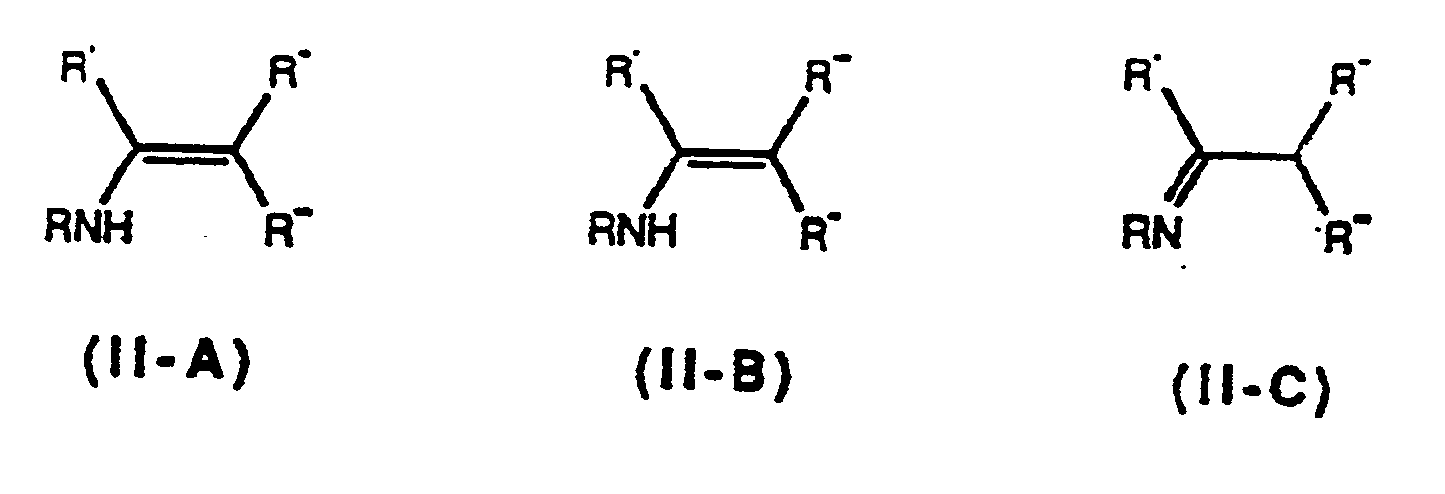
  • Compound 11-A, Compound II-B or the tautomer Compound II-C which have the formulae respectively, wherein R is as described above and wherein R' is R1, R" is R2, and R"' is R4, or R' is R2, R"' is R1, and R"' is R3 including all the geometric isomers of Compounds IIA and IIB, including the compounds (Compounds II-A, II-B, II-C and the geometric isomers of Compounds II-A and II-B are hereinafter collectively referred to as Collective Compound II).
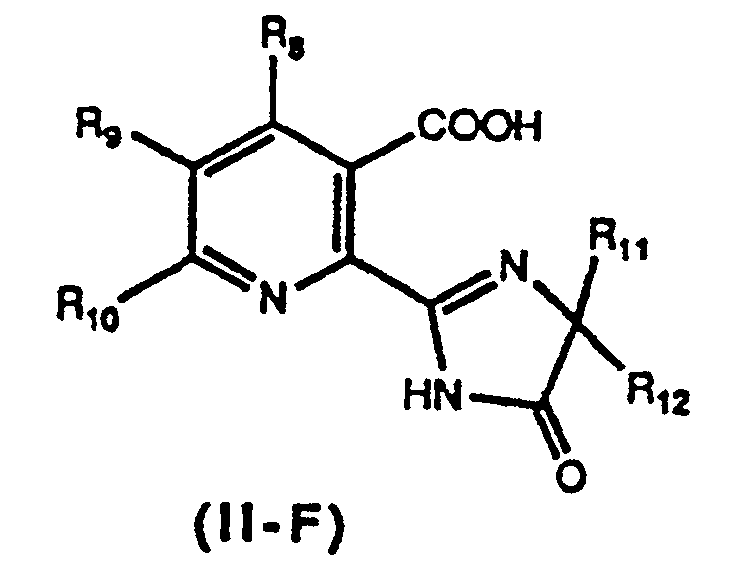
  • Compound II-E is a precursor in the synthesis of Compound II-F of the formula wherein R 11 and R 12 are each independently of the other C 1 -C 6 alkyl, as revealed and defined as corresponding to substituents R 4 and R s in U.S. Patent No. 4,758,667, incorporated hereinto by reference.
  • Compound II-F has herbicidal properties and can be used for controlling undesired plant growth.
  • aryl refers to a monovalent substituent which consists of an aryl group, e.g. phenyl, o-toluyl, m-methoxyphenyl, etc., of the formula X is hydrogen, halogen, lower alkyl, lower alkoxy, CF 3 , and N0 2 and n is an integer of 1 to 5;
  • arylalkyl refers to a monovalent substituent which consists of an aryl group, e.g.
  • alkylene refers to a bivalent radical of the lower branched or unbranched alkyl group it is derived from having valence bonds from two terminal carbons thereof, e.g.
  • alkoxy refers to a monovalent substituent which consists of an alkyl group linked through an ether oxygen having its free valence bond from the ether oxygen, e.g. methoxy, ethoxy, propoxy, butoxy, pentoxy, etc.
  • substituted-aryl preferably is intended to mean phenyl or naphthyl substituted in one or more positions with halogen (bromine, chlorine, fluorine or iodine); C 1 -C 6 alkyl; alkoxy of 1-6 carbon atoms, cyano, nitro, or carboxy.
  • halogen bromine, chlorine, fluorine or iodine
  • C 1 -C 6 alkyl alkoxy of 1-6 carbon atoms, cyano, nitro, or carboxy.
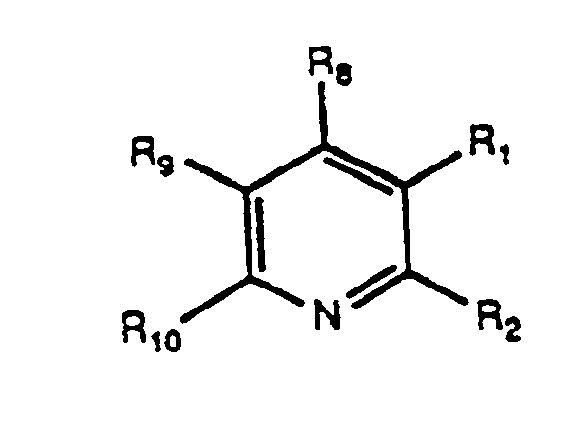
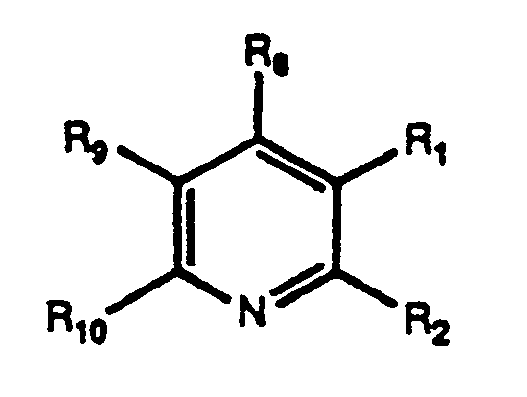
  • the ⁇ , ⁇ -unsaturated carbonyl compounds are preferably aldehyde or ketone wherein R 8 , R 9 , and R 10 are as described above.
  • the acetal and ketal derivatives of the carbonyl compounds, or the Mannich base equivalent to such carbonyl compounds can also be used in the invention.
  • R 1 , R 2 , R 3 , and R 4 are as described in Section III above; wherein R 13 , is H, alkyl (preferably C 1 -C 6 straight or branched, aryl (preferably phenyl or naphthyl), alkoxy, halogen, cyano, carboalkoxy, thioalkoxy, or CF 3 .
  • esters of N-hydroxyaspartic acid and esters of 2-aminobut-2-ene dioic acids such as dialkyl 2-aminomaleate.
  • esters of N-hydroxyaspartic acid and esters of 2-aminobut-2-ene dioic acids such as dialkyl 2-aminomaleate.
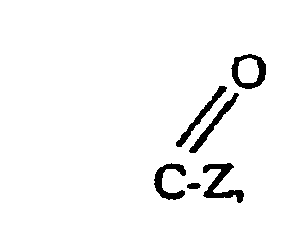
  • This embodiment of the present invention relates to a method of synthesizing a N-hydroxyaspartic acid derivative of the formula: where R 1 and R 2 are each independently when Z is OR 5 or NR 5 R 6 where R 5 and R 6 are each independently H, alkyl (preferably C 1 -C 6 alkyl branched or straight), aryl (preferably phenyl or naphthyl), arylalkyl, or R 5 and R 6 together with the nitrogen atom form a heterocyclic substituent, selected from pyrrolidinyl, piperidinyl, imidazolidyl, hydrogenated pyrimidinyl, including dihydro-, tetrahydro-, and hexahydropyrimidinyl; CN, or R 1 and R 3 together is when R 7 is as defined above; and R 3 and R 4 are each independently H, alkyl (preferably C 1 -C e alkyl branched or straight), aryl (preferably phenyl or naphthyl),
  • alkyl refers to a straight or branched chain hydrocarbon of 1 to 18 carbon atoms containing no unsaturation, e.g. methyl, ethyl, isopropyl, 2-butyl, neopentyl, n-hexyl, a-heptyl, n-nonyl, etc.;
  • aryl refers to a monovalent substituent which consists of an aryl group, e.g.
  • arylalkyl refers to a monovalent substituent which consists of an aryl group, e.g.
  • alkylene refers to a bivalent radical of the lower branched or unbranched alkyl group it is derived from having valence bonds from two terminal carbons thereof, e.g.
  • alkoxy refers to a monovalent substituent which consists of an alkyl group linked through an ether oxygen having its free valence bond from the ether oxygen, e.g. methoxy, ethoxy, propoxy, butoxy, pentoxy, etc.
  • a suitable diacid derivative of the formula is selected.
  • Such diacid derivatives are well known or can be synthesized using conventional techniques well known to those of ordinary skill in the art.
  • Compound I-B or I-C is reacted with substituted hydroxylamine R-NH-OH orwith unsubstituted hydroxylamine, H-NH-OH, or a suitable salt thereof, to produce N-hydroxyaspartic acid derivative.
  • substituted hydroxylamine R-NH-OH orwith unsubstituted hydroxylamine, H-NH-OH, or a suitable salt thereof to produce N-hydroxyaspartic acid derivative.
  • subsequent descriptions will be limited to unsubstituted hydroxylamine, although it is understood the hydroxylamine can be substituted as well.
  • a suitable hydroxylamine salt includes a mineral acid salt such as hydroxylamine hydrochloride, hydroxylamine sulfate, hydroxylamine bisulfate, hydroxylamine phosphate etc. or an organic acid salt, e.g. hydroxylamine acetate, etc.
  • the reaction may be carried out with orwithout a suitable solvent.
  • a suitable solvent includes water, a lower alkanol, e.g. methanol, ethanol, isopropanol, 1-butanol, etc.; a halogenated lower hydrocarbon or alkane e.g. dichloromethane, chloroform, carbontetrachloride, dichloromethane etc.; an aromatic hydrocarbon, e.g.
  • benzene, toluene, etc. an ether, e.g. ethylether, dioxane, tetrahydrofuran, etc.; an ester, e.g. ethyl acetate, isopropyl acetate, butyl acetate, etc.; and an aprotic solvent, e.g. acetonitrile, dimethylformamide, dimethylsulfoxide, etc; and mixtures thereof.
  • an ether e.g. ethylether, dioxane, tetrahydrofuran, etc.
  • an ester e.g. ethyl acetate, isopropyl acetate, butyl acetate, etc.
  • an aprotic solvent e.g. acetonitrile, dimethylformamide, dimethylsulfoxide, etc; and mixtures thereof.
  • the reaction must be carried out under critical pH conditions which are at most weakly acidic, i.e. the upper acid pH range being weakly acid, that is, at a pH region of 5 through about 12, preferably a pH range of about 6.5 to about 9.
  • a suitable base should be employed to achieve the critical pH reaction condition.
  • a suitable base is one selected from an inorganic base, e.g. sodium hydroxide, potassium hydroxide, ammonium hydroxide, sodium carbonate, potassium carbonate etc.; an organic base, e.g.
  • pyridine triethylamine, sodium methoxide, etc., present in an amount ranging from about 1 to about 3 moles of base to one mole of hydroxylamine salt, and preferably from 1 mole of base per one mole of hydroxylamine salt, except in the case of a hydroxylamine salt of a diprotic acid, such as hydroxylamine sulfate, wherein 2 moles of base per mole of salt is preferred.
  • Compound I-B or I-C and the hydroxylamine or its salt are employed in a mole ratio ranging from about 1 : 1 to about 1 : 3, with the preferred mole ratio being between 1 : 1 to 1 : 1.5 of Compound I-B or I-C to the hydroxylamine or its salt.
  • the reaction conducted with the mole ratios of Compound I-B or I-C, hydroxylamine or its salt, and base, as indicated above, is carried out at a temperature ranging between about-10°C to about 80°C, preferably about 10°C to about 50°C, for a time period ranging from about 0.1 to about 15 hours to obtain addition of the NH 2 0H (or RNHOH) across the carbon-carbon double bond of Compound I-B or I-C, typically following Markovnikov's rule, to obtain Compound I-E (or Compound I-D).
  • Compound I-E includes, but is not limited to, dimethyl N-hydroxyaspartate, diethyl N-hydroxyaspartate, dipropyl N-hydroxyaspartate, di-iso-propyl N-hydroxyaspartate, di-n-butyl N-hydroxyaspartate, N-hydroxyaspartonitrile and triethyl 2-(N-hydroxyamino)-ethanetricarboxylate.
  • Compound I-D is an ester, of course it can be hydrolyzed, using convenfional techniques, to obtain the free acid, i.e.
  • Triethyl ethenetricarboxylate (4.0 g, 16.3 mmol), obtained from diethyl malonate and ethyl glyoxalate, was dissolved in ethanol (25 g) and hydroxylamine (50% aqueous solution, 1.3 g, 19.6 mmol) was added to the reaction mixture. A solid precipitated out within 10 minutes indicating the completion of the reaction. The solvent was removed under reduced pressure to give the crude product. The crude product was analyzed by NMR and found to have triethyl 2-(N-hydroxyamino)ethanetricarboxylate.
  • Compound I-D where at least either R3 or R 4 is hydrogen can then be subjected to dehydration using conventional techniques well known to those skilled in the art to obtain a 2-aminobut-2-ene dioic acid derivative (Collective Compound II).
  • the dehydration of Compound I-D can be affected by heating. This dehydration by heating can be conducted with or without a suitable dehydration agent. If a dehydration agent is employed, the agent is typically present in an amount ranging from about 0.1% to about 100% by weight, preferrably about 0.1% to about 10% by weight, to yield the 2-aminobut-2-ene dioic acid derivative.
  • dehydration agent any dehydration agent known in the art can be employed.
  • suitable dehydration agents include an inorganic acid catalyst, e.g. H 2 SO 4 , HCI, phosphoric acid, polyphosphoric acid, etc.; an ion exchange acidic resin, e.g. Amberlyst R , Dowex R , Nafion-H R , etc.; an organic acid e.g. p-toluenesulfonic acid, methanesulfonic acid, etc.; an inorganic base, e.g. potassium bicarbonate, sodium carbonate, etc.; an organic base, e.g. pyridine, triethylamine, etc.; a basic ion exchange resin, e.g. Amberlyst R , Dowex R , etc., or a transition metal catalyst, e.g. palladium, rhodium, etc.
  • an inorganic acid catalyst e.g. H 2 SO 4 , HCI, phospho
  • Dehydration can also be carried out using acylation agents or a combination of acylation agent and an organic base of the kind described above.
  • the acylation agents include carboxylic acid anhydride, e.g. acetic anhydride and trifluoroacetic anhydride; and acid chloride, e.g. acetyl chloride and propanoyl chloride.
  • the dehydration, with or without suitable agent can be carried out in a suitable solvent, e.g. water, alcohols, such as ethanol, butanol, hydrocarbons, such as heptane, parafins; halogenated hydrocarbons such as chloroform and methylene chloride; aromatic hydrocarbons such as toluene, xylene; ethers, polar aprotic solvents such as dimethylformamide, diglyme, tetraglyme, etc., at a temperature ranging from about 25°C to about 300°C, preferrably about 50°C to about 200°C, for about 0.01 to about 48 hours, to obtain 2-aminobut-2-ene dioic acid.
  • a suitable solvent e.g. water, alcohols, such as ethanol, butanol, hydrocarbons, such as heptane, parafins; halogenated hydrocarbons such as chloroform and methylene chloride; aromatic hydrocarbons such as toluene
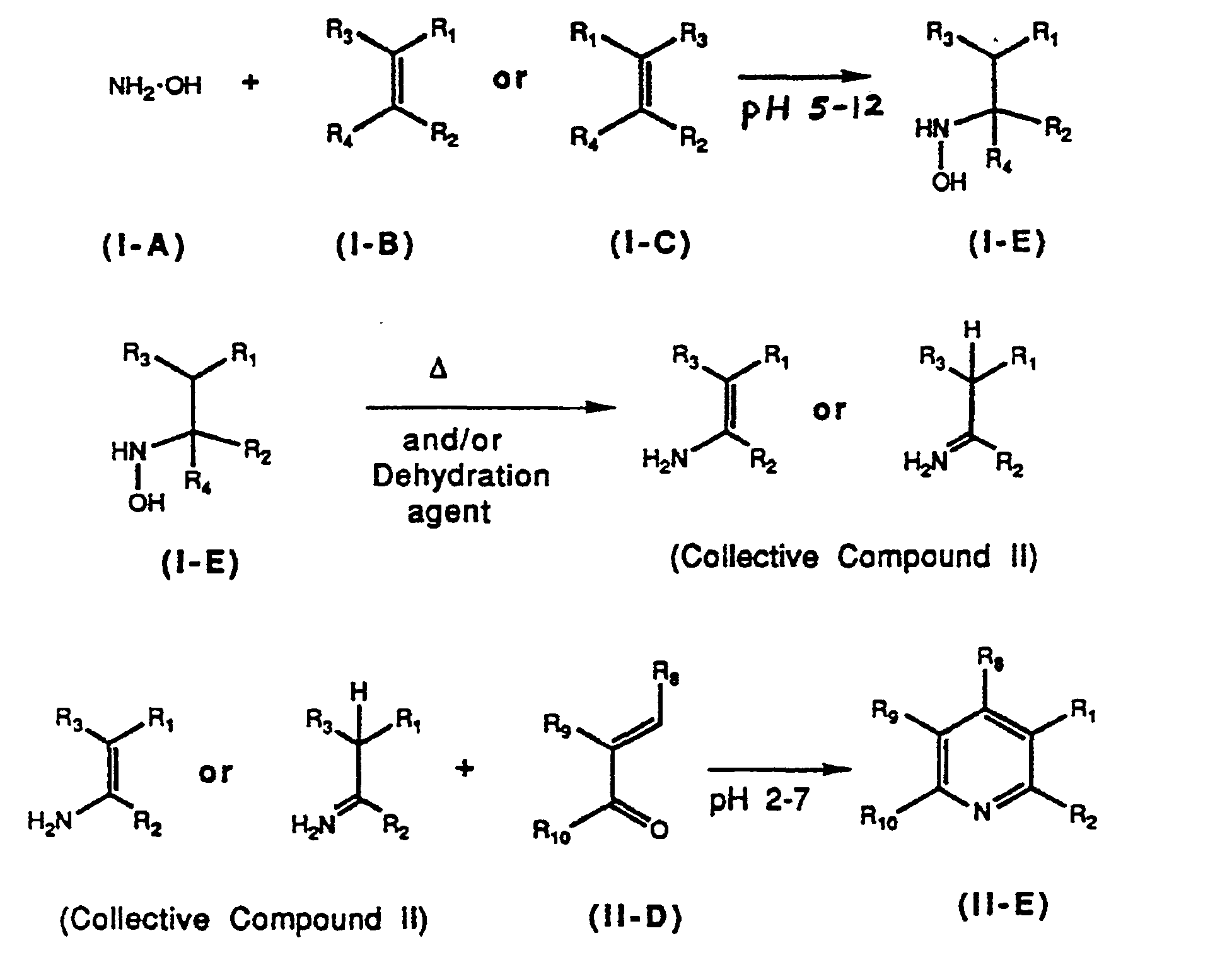
  • Compound I-D is then dehydrated using heat and/or a dehydration agent, as shown under Section II, above to form Collective Compounds II which are subsequently reacted with an ⁇ , ⁇ -unsaturated carbonyl compound such as an aldehyde or ketone (Compound II-D).
  • the mole ratio of the compounds of Formula I-D to the aldehydes or ketones of Formula II-D is not critical and can range from about 1 : 3 to 3 : 1. It is preferred to use approximately from 1 : 1.0 to 1 : 1.3 molar ratios.
  • a dehydrogenation catalyst can be added to the reaction mixture of Collective Compounds 11 and II-D, in order to aid in aromatization of the newly-generated ring.
  • the dehydrogenation catalyst when employed is conventional in the art and includes metals or compounds of platinum, palladium, ruthenium, iridium, nickel, iron, copper, cobalt, rhodium, etc.
  • the dehydrogenation metal or compound thereof deposited on a suitable support, such as alumina carbon, clay, zeolites, chromia, zirconia, etc.
  • a preferred dehydrogenation catalyst is palladium on carbon.
  • an acid is employed to provide an acidic pH range (from about 2 to about 7).
  • Suitable acids include inorganic acids such as hydrochloric, phosphoric, sulfuric, etc. and preferably organic acids such as acetic, trifluoroacetic, p-toluenesulfonic, methanesulfonic, trifluoromethanesulfonic, propionic, butyric or other carboxylic acids including aromatic carboxylic acids.
  • lon-exchange resins such as Amberlyst R , Dowex R , NAFION R can also be used as acidic components.
  • Solvents suitable for use during the reaction of Collective Compounds II with Compounds II-D include: water, alcohols, chlorinated hydrocarbons, hydrocarbons, aromatic hydrocarbons, ethers, organic acids, esters, and aprotic solvents such as acetonitrle.
  • the preferred solvents are lower alkyl alcohols, such as methanol, ethanol, propanol, and butanol and aromatic hydrocarbons, such as benzene and toluene.
  • Particu- lady preferred solvents are 1-butanol and/or ethanol.
  • pyridinecarboxylic acid derivatives containing substituents in the 4-,5-and 6- position may conveniently be prepared by dehydrating Formula I-D N-hydroxyamino derivatives to form at least one of the Collective Compound II compounds which is then admixed with a Formula II-D ⁇ , ⁇ -unsaturated aldehyde or ketone in the presence of an acid and preferably a solvent, and stirring the resulting reaction mixture at a temperature in the range of ambient temperature to the boiling point of the solvent, and preferably at reflux, until the reaction is essentially complete and isolating the formed 4-substituted, 4-5-disubstituted, 4,6-disubstituted, 5-substituted, 6-substituted or 5,6-disubstituted pyridine-2,3-dicarboxylic acid derivatives by standard laboratory techniques such as extraction, evaporation, distillation or column chromatography.
  • Compound II-E which includes 2,3-pyridine carboxylic acid derivatives, can be reacted with a 2-aminoal- kane carboxamide, as defined in U.S. Patent 4,758,667, and reacted as described in this patent to form the 2-(imidazolin-2-yl)-3-pyridine carboxylic acids described therein.
  • a solution (10 ml) of diethyl N-hydroxyaspartate (9.4% solution, 7.8 g, 3.6 mmol) in ethanol was fed in a quartz column (1 inch ID) containing glass beads (3 inches long) at 200°C at the rate of 0.2 ml per minute along with nitrogen at a rate of 1000 ml per minute.
  • the vaporized material escaping at the end of quartz column was collected using a dry-ice trap.
  • the condensate (0.35 g) was analyzed by GLC. The analysis found that the reaction gave diethyl 2-aminomaleate in about 34.5% yield.
  • Triethylamine (6.5 g, 64.4 mmol) was added dropwise to diethyl N-hydroxyaspartate (11.95 g, 58.3 mmol) and stirred at room temperature for 15 minutes.
  • Acetic anhydride (6.58 g, 64.5 mmol) was then added dropwise to the reaction mixture while temperature was maintained below 40°C using an ice bath. The reaction was stirred at room temperature for an hour and at 60-70°C for another hour.
  • the reaction was analyzed by GLC. The analysis found the reaction mixture to contain mainly diethyl 2-aminomaleate with about 10% of diethyl N-acetyl-2-aminomaleate.
  • Another embodiment of the invention involves the single-pot preparation of subsbtuted and disubstituted pyridinecarboxylates of Formula II-E by reacting a diacid derivative of Formula I-B or I-C: wherein R 1 and R 2 are defined above with unsubstituted hydroxylamine of Formula (I-A) or a salt thereof, such as the hydrochloride, salt at ambient temperatures for periods of time ranging from about 30 minutes to about 3 hours at a pH ranging from about 6 to about 12.
  • the resulting reaction product is then subjected to dehydration using heat or a dehydrating agent, or both, at temperatures ranging from about 25°C to about 200°C, for a time period ranging from about 1 second to about 12 hours.
  • an acid is added to lower the pH to 2-7, or preferably 3-4, and an ⁇ , ⁇ -unsaturated aldehyde or ketone of Formula 11-D is added, and the reaction mixture is subjected to elevated temperatures ranging from about 50°C to about 125°C for periods of time ranging from about 1 to about 48 hours.
  • a preferred embodiment of the invention involves the preparation of substituted and disubstituted pyri- dinedicarboxylates of Formula II-F by treating a alkene of Formula I-B or I-C wherein R 1 and R 2 are defined above with a substituted or unsubstituted hydroxylamine or a mixture of a hydroxylamine salt and a base at a temperature of 15°C to 60°C for periods of 0.1 to 2 hours at a pH of 7-9.
  • the resulting reaction product is then subjected to dehydration using heat or a dehydrating agent, or both, at temperatures ranging from about 25°C to about 200°C, for a time period ranging from about 1 second to about 12 hours.
  • the reaction mixture is then cooled to ambient temperature of 20-40°C.
  • the product is concentrated under reduced pressure and can be purified by conventional techniques such as distillation, extraction, evaporation, or column chromatography.
  • a dehydrogenation catalyst can be added to the reaction mixture.
  • the dehydrogenation catalyst when employed is conventional in the art and includes metals or compounds of platinum, palladium, ruthenium, iridium, nickel, iron, copper, antimony, cobalt, rhodium, etc.
  • the dehydrogenation metal or compound thereof deposited on a suitable support such as alumina, carbon, clay, zeolites, chromia zirconia, etc.
  • a preferred dehydrogenation catalyst is palladium on carbon.
  • Solvents suitable for use in the method of this invention include: water, alcohols, chlorinated hydrocarbons, hydrocarbons, aromatic hydrocarbons, ethers, organic acids, esters, and aprotic solvents such as acetonitrile.
  • the preferred solvents are lower alkyl alcohols, such as methanol, ethanol propanol and butanol and aromatic hydrocarbons, such as benzene and toluene.
  • the particularly preferred solvents are 1-butanol, ethanol, or toluene.
  • pyridine-2,3-dicarboxylic acid derivatives containing substituents in the 4-, 5- and 6- position may conveniently be prepared by reacting, at a neutral or slightly basic pH, a Formula I-B or I-C maleate or fumarate with a substituted or unsubstituted hydroxylamine or a salt thereof, then subjecting the reaction product to dehydration using heat or a dehydrating agent or both, and subsequently adding followed by a Formula II-D ⁇ , ⁇ -unsaturated aldehyde, or ketone, at a pH of 2-7 with an acid and preferably a solvent and stirring the resulting reaction mixture at a temperature in the range of ambient temperature to the boiling point of the solvent, and preferably at reflux, until the reaction is essentially complete and isolating the formed 4-substituted, 4,5-disubstituted, 4,6-disubstituted, 5-substituted, 6-substituted or 5-6-disubstituted
  • the amount of substituted or unsubstituted hydroxylamine or salt thereof used ranges from about 1 to about 1.5 mols of hydroxylamine per mol of said maleate or fumarate. Preferred ranges are about 1.0 - 1.2 mols.
  • a base such as sodium hydroxide, potassium hydroxide or ammonium hydroxide, in an amount of 1 to 2 moles, preferably 1 to 1.2 moles per mole of said hydroxylamine salt is needed to liberate the hydroxylamine.
  • the dehydration can be affected by heating. This dehydration by heating can be conducted with or without a suitable dehydration agent. If a agent is employed the agent is typically present in an amount ranging from about 0.1 % to about 100% weight, preferably about 0.1 % to about 10% by weight. Any dehydration agent known in the art can be employed. Some suitable dehydration agent is included in Section II of this application.
  • the mol ratio of the alkene of Formula I-B and I-C to the aldehyde or ketone of Formula II-D is not narrowly critical and can range from about 1 : 1 to about 1 : 3. It is preferred to use approximately 1 : 1.0 to 1 1.3 molar ratios.
  • R 8 is hydrogen or C 1 -C 6 alkyl
  • Rg is hydrogen, halogen, C 1 -C 6 alkyl, C 1 -C 6 hydroxyalkyl, C 1 -C 6 alkoxy, phenyl or phenyl substituted -C 1 -C 6 alkyl, or phenyl or phenyl -C 1 -C 6 alkyl, each substituted by C 1 -C 6 alkyl, C 1 -C 6 alkoxy or halogen
  • R 9 is hydrogen, C 1 -C 6 alkyl, phenyl, phenyl -C 1 -C 6 alkyl, or phenyl or phenyl C 1 -C 6 alkyl each substituted by one C 1 -C 6 alkyl, C 1 -C 6 alkoxy or halogen
  • R 8 and Rg together1,
  • Such compounds in turn are a precursor in the synthesis of compounds of the formula when R 11 and R 12 are each independently of the other C 1 -C 6 alkyl, as revealed and defined as corresponding to substituents R 4 and R 5 in U.S. Patent No. 4,758,667, incorporated hereinto by reference.
  • the latter compound has herbicidal properties and can be used for controlling undesired plant growth.
  • Example 15 The procedure of Example 15 is repeated except that the following 2-aminobut-2-ene dioic acid derivatives and aldehydes or ketones are used:
  • the substituted or unsubstituted hydroxylamine is a phenylhydroxylamine which may have substituent groups on the aromatic ring.
  • R l , R 2 , R3, and R 4 are as described in Section III above; wherein R 13 is H, alkyl (preferably C 1 -C 6 straight or branched, aryl (preferably phenyl or naphthyl), alkoxy, halogen, cyano, carboalkoxy, thioalkoxy, or CF 3 .
  • Diethylmaleate (7.7 g , 0.045 mole) was added to a mixture containing 5.0 g (0.046 mole) N-phenylhydroxylamine in 7.66 g of absolute ethanol. The mixture was allowed to stir for 15 hours at room temperature. GC analysis showed a trace of diethylmaleate remaining. 1.0 g of Norite was added along with 10 ml of additional ethanol. The mixture was allowed to stirfor 10 minutes and then filtered free of the carbon. The carbon was washed with additional ethanol. The filtrate was evaporated under high vacuum temperature to give an oil which crystallized upon cooling in a dry ice/acetone bath. 11.9 g obtained after drying in vacuum desicator at room temperature under high vacuum mp 50-53°C.
  • Triethylamine (4.02 g, 0.0398 mol) was added to a solution of diethyl N-phenyl-N-hydroxyaspartate (10.1 g, 0.0357 mol) in dichloromethane (40 mL) and stirred for 15 minutes.
  • Acetic anhydrode (4.10 g, 0.040 mol) was added to reaction mixture over a period of 10 minutes.
  • the reaction mixture was stirred at room temperature for an hour and refluxed for another hour.
  • the reaction mixture was concentrated under reduced pressure to give the crude product.
  • the crude product was purified by distillation to give diethyl 2-anilinobut-2-ene-2,3-dicarboxylate (7.8 g, 74% yield).
  • NMR (CDCI 3 ) 8 1.03 (t, J 7.2 Hz, 3H), 1.29 (t, J 7.2, 3H), 4.18 (m, 4H), 5.38 (s, 1H), 6.90-7.31 (m, 5H).
  • the Vilsmeier reagent is prepared by adding Diphosgene (3.8g, 19.3 mmol) dropwise to a mixture containing dimethyl foramide (2.75 g, 37.7 mmol) and dichloroethane (50 mL) while the temperature is maintained below 20°C using an ice bath. The reaction mixture is stirred for 45 minutes at room temperature. Then a solution of diethyl 2-anilinobut-2-ene-2,3-dicarboxylate (4.5 g,17.1 mmol) in dichloroethane (20 mL) is added dropwise to the reaction mixture and stirred at 80-84°C for 2.5 hours. The reaction mixture is cooled to room temperature and diluted with ethyl acetate (250 mL).

Landscapes

  • Chemical & Material Sciences (AREA)
  • Organic Chemistry (AREA)
  • Organic Low-Molecular-Weight Compounds And Preparation Thereof (AREA)
  • Pyridine Compounds (AREA)
  • Plural Heterocyclic Compounds (AREA)
  • Quinoline Compounds (AREA)

Abstract

The present invention pertains to a method of preparing substituted and unsubstituted N-hydroxy-2-aminobutane diacid derivatives which can be dehydrated to 2-aminobut-2-ene dioic acid derivatives, which can be subsequently converted to pyridine and quinoline derivatives.

Description

    BACKGROUND OF THE INVENTION 1. Field of the Invention
  • The present invention pertains to a method preparing substituted and unsubstituted N-hydroxy-2-aminobutane diacid derivatives which can be dehydrated to 2-aminobut-2-ene dioic acid derivatives, which subsequently can be converted to pyridine and quinoline derivatives. Unsubstituted hydroxylamines are reacted with substituted or unsubstituted unsaturated diacid derivatives to produce N-hydroxyaspartic acid derivatives which can be dehydrated to 2-aminobut-2-ene dioic acid derivatives, which can subsequently be reacted with α,β-unsaturated carbonyl compounds to produce pyridine derivatives. When the hydroxylamine is substituted, with a phenyl group, for example, so that N-phenyl-N-hydroxy-2-aminobutane dicarboxylic acid derivative is produced, this derivative can be dehydrated to form 2-anilinobut-2-ene dicarboxylic acid derivative which can further reacted with a Vilsmeier reagent such as an immonium salt to produce quinoline derivatives.
  • 2. Background Art
  • N-hydroxyamino acids are valuable precursors for natural amino acids, peptides, herbicides, antibiotics, growth promoting agents, antitumor agents, antifungal agents, and polymers. It has been known that the addition of hydroxylamine to an unsaturated monocarboxylic acid derivative can be used to obtain N-hydroxyamino mono carboxylic acid derivative. However, addition of hydroxylamine to an unsaturated dicarboxylic acid, such as fumaric acid, in the presence of an enzyme does not successfully result in the isolation of N-hydroxyaspartic acid, as reported in "Progress in the Chemistry of Organic Natural Products", L. F. Alves et al., Springer-Vedag (1988), page 230. Indeed the utilization of enzyme extracts, such as Bacillus caderas or Proteus vulgaris also does not yield success in isolating this desired product, but resort must be made, through utilization of a benzyl group, to protect the hydroxylamine moiety as reported by Kolasa, Can. J. Chem., Vol. 63, 2139 (1985). Such methods are cumbersome and involve the removal of protecting groups rather than employing hydroxylamine or a salt thereof directly.
  • K. Bashceruddin et al., Synthetic Communications, 9, 705-712 (1979) reports the questionable result of obtaining of N-hydroxyaspartic acids of greatly different melting points from maleic acid and fumaric acid, utilizing hydroxylamine. The reaction conditions for such conversion(s) are not disclosed, nor is revealed the criti- cality involved for obtaining N-hydroxyaspartic acid or its derivatives, namely a critical pH. Furthermore, the only relevant reaction conditions revealed in this publication, those for preparation of N-hydroxy-3-amino-3-(p-nitrophenyl)propionic acid from p-nitrocinnamic acid, do not yield N-hydroxyaspartic acid.
  • Literature methods for preparing 5,6-dialkyl and 5-alkyl-6-arylpyridine-2,-3-dicarboxylic acids and esters are limited and often require oxidation of alkyl or aryl substituents at positions 2 and 3 in order to obtain diacids. Recently there has been disclosed a method for the preparation of substituted and disubstituted pyridine-2,3-dicarboxylic acid esters and 2-alkylnicotinates utilizing α-halo-β-ketoesters and α,β-unsaturated aldehydes or ketones in the presence of an ammonium salt. The use of α-halo-β-ketoesters is not desired due to the fact that such materials are usually costly and unstable.
  • U.S. Patent No. 4,723,011 discloses preparation of substituted and disubstituted pyridine-2,3-dicarboxylates by the reaction of an α-halo-β-ketoester such as chloro-diethyloxaloacetate (chloro-DOX) and an a,P-unsaturated aldehyde or ketone such as 2-ethylacrolein in the presence of at least 2 molar equivalents of an ammonium salt in order to product the desired compounds.
  • U.S. Patent No. 4,816,588 discloses and claims a process for preparing pyridine-2,3-dicarboxylic acids by the oxidation of 8-substituted quinolines.
  • European Patent Application No. 274,379 published July 13, 1988 discloses two processes for producing pyridine-2,3-dicarboxylic acid compounds. One process seems similar to that previously described in U.S. Patent No. 4,723,011 and the other process involves reacting an α,β-unsaturated aldehyde or ketone with various aminomaleates or aminofumarates such as diethyl aminomaleate.
  • European Patent Application No. 299,362 published January 18, 1989 also discloses the same reaction.
  • U.S. Patent No. 4,675,432 to Donald R. Maulding, issued June 23, 1987 describes a method for the preparation of anilinofumarate. A dichlorosuccinate is reacted with a molar equivalent of aniline in an inert organic solvent and with two or more molar equivalents of an aqueous base in the presence of a phase transfer catalyst to product the anilinofumerate.
  • U.S. Patent no. 4,656,283 to Robert F. Doehner, Jr., issued April 7, 1987 describes a method for the preparation of alkyl esters of substituted 2-methyl-quinoline-3-carboxylic acid and quinoline-2,3-dicarboxylic acid as well as dialkyl 3-(substituted)-phenylaminobut 2-ene-diotes. An appropriately substituted aniline is reacted with approximately an equimolar amount of a keto-ester to produce the products above-described.
  • Although the methods described above are useful for producing some of the reaction products produced by the method of the present invention; due to the broad utility of the reaction products of the present invention, as nutrient supplements, and as intermediaries in the production of pharmaceuticals, dyes and pigments and herbicides, any improvement in the method of production is of tremendous potential economic significance.
  • SUMMARY OF THE INVENTION
  • The present invention pertains to a method of preparing substituted and unsubstituted N-hydroxy-2-aminobutane diacid derivatives which can be dehydrated to 2-aminobut-2-ene dioic acid derivatives, which subsequently can be converted to pyridine and quinoline derivatives. An unsubstituted hydroxylamine is reacted with an substituted or unsubstituted unsaturated diacid derivative to produce N-hydroxyaspartic acid derivatives which can be dehydrated to 2-aminobut-2-ene dioic acid derivatives, which can subsequently be reacted with α,β-unsaturated carbonyl compounds to produce pyridine derivatives. In the alternative, a single pot reaction can be carried out wherein the unsubstituted hydroxyl amine is contacted with a substituted or unsubstituted unsaturated diacid derivative, followed by a dehydration technique, with subsequent addition of the a,(3-unsaturated carbonyl compound, to produce the pyridine derivative directly (without isolation of the 2-aminobut-2-ene dioic acid derivative formed upon the dehydration step).
  • In addition, when the hydroxylamine is substituted with a phenyl group so that N-phenyl-N hydroxy-2-aminobutane dicarboxylic acid is produced, this derivative can be dehydrated to produce substituted and unsubstituted 2-anilinobut-2-ene dicarboxylic acid derivative which can be further reacted with a Vilsmeier reagent to produce quinoline derivatives.
  • The chemical formulae representing the above-described method are shown below:
  • I. Synthesis of N-Hydroxy-2-aminobutane Diacid Derivatives
  • In accordance with the present invention, in preparation of the substituted and unsubstituted N-hydroxy-2-aminobutane diacid derivatives, it was discovered that the pH of the reaction medium is critical, and should range from about 5 to about 12 and preferably from about 6.5 to about 9. In addition, the present invention permits reaction at ambient temperatures (about 25°C) to about 80°C, whereby reaction products which tend to be thermally unstable at higher temperatures are preserved.
  • The reaction is represented by the following formulae:
    Figure imgb0001
    wherein:
    • R = H, alkyl (preferably C1-Ce straight or branched), substituted or unsubstituted aryl (preferably phenyl or naphthyl), and wherein the substituents are selected from alkyl, alkoxy, carboxy, halogen, cyano, and nitro; R1 and R2 = each independently,
      Figure imgb0002
      wherein Z is ORe or NR5Re; or CN; or
    • R1 and R2 together is
      Figure imgb0003
    • R3 and R4 are each independently H; alkyl; halogen; CN; substituted and unsubstituted aryl (preferably phenyl and naphthyl) wherein the substituents are selected from alkyl, arylalkyl, alkoxy, carboxy, halogen, nitro, and cyano;
      Figure imgb0004
    • wherein Z is defined as above;
    • R5 and Re are each independently H, alkyl (preferably C1-C6 straight or branched), aryl (preferably phenyl), arylalkyl (preferably aryl C1-C6 alkyl); or
    • R5 and R6 together with the nitrogen atom form a heterocyclic substituent, selected from pyrrolidinyl, piperidinyl, imidazolidyl, hydrogenated pyrimidinyl, including dihydro-, tetrahydro, and hexahydropyrimidinyl; and
    • R7 is H, alkyl (preferably C1-C6 straight or branched), substituted or unsubstituted aryl (preferably phenyl), or an alkoxy of 1-6 carbon atoms.
    II. Conversion of the N-Hydroxy-2-aminobutane Diacid Derivative to a 2-Aminobut-2-ene Dioic Acid Derivative with Subsequent Conversion to Nitrogen-Comprising Aromatic Compounds
  • Compounds I-D are used in a second embodiment of this invention, wherein Compounds I-D are subjected to dehydration to produce 2-aminobut-2-ene dioic acid derivatives, Collective Compound II.
  • Compound 11-A, Compound II-B or the tautomer Compound II-C which have the formulae
    Figure imgb0005
    respectively, wherein R is as described above and wherein R' is R1, R" is R2, and R"' is R4, or R' is R2, R"' is R1, and R"' is R3 including all the geometric isomers of Compounds IIA and IIB, including the compounds
    Figure imgb0006
    Figure imgb0007
    (Compounds II-A, II-B, II-C and the geometric isomers of Compounds II-A and II-B are hereinafter collectively referred to as Collective Compound II).
  • In another embodiment of the present invention, Collective Compound II, when R is H and R3 and R4 are H or halogen, can be reacted with α,β-unsaturated carbonyl compounds of the formula II-D
    Figure imgb0008
    wherein R8 and R10 = H, alkyl or alkenyl (preferably C1-C6 straight or branched) or substituted or unsubstituted aryl (preferably phenyl or naphthyl), wherein the substituents are selected from alkyl, alkoxy, carboxy, carboalkoxy, halogen, and cyano; wherein R9 = the same as R8 and R10, but also including halogen, and wherein R9 and R10 taken together can be -(CH2)-3 -10; to produce pyridine derivative of the Formula II-E
    Figure imgb0009
    wherein R8, Rg, and R10 are as described above. Particular embodiments of the conversion of specific compounds included in Collective Compounds II to specific compounds included in Compound II-E, wherein R8, R9, and Rio substituents are as revealed and defined as corresponding substituents R1, R2, R3, and R6 of U.S. Patent No. 4,758,667, incorporated by reference hereinto in its entirety.
  • Compound II-E, in turn, is a precursor in the synthesis of Compound II-F of the formula
    Figure imgb0010
    wherein R11 and R12 are each independently of the other C1-C6 alkyl, as revealed and defined as corresponding to substituents R4 and Rs in U.S. Patent No. 4,758,667, incorporated hereinto by reference. Compound II-F has herbicidal properties and can be used for controlling undesired plant growth.
  • Throughout the specification and appended claims, a given chemical formula or name shall encompass all geometric, optical isomers and racemic mixtures thereof where such isomers exist.
  • In the above definitions, the term "aryl" refers to a monovalent substituent which consists of an aryl group, e.g. phenyl, o-toluyl, m-methoxyphenyl, etc., of the formula
    Figure imgb0011
    X is hydrogen, halogen, lower alkyl, lower alkoxy, CF3, and N02 and n is an integer of 1 to 5; the term "arylalkyl" refers to a monovalent substituent which consists of an aryl group, e.g. phenyl, o-toluyl, m-methoxyphenyl, etc., linked through an alkylene group having its free valence bond from a carbon of the lower alkylene group, and having a formula of
    Figure imgb0012
    X and n are is as defined above; the term "alkylene" refers to a bivalent radical of the lower branched or unbranched alkyl group it is derived from having valence bonds from two terminal carbons thereof, e.g. ethylene (-CH2CH2-), propylene (-CH2CH2CHr),
    Figure imgb0013
    etc; the term "alkoxy" refers to a monovalent substituent which consists of an alkyl group linked through an ether oxygen having its free valence bond from the ether oxygen, e.g. methoxy, ethoxy, propoxy, butoxy, pentoxy, etc.
  • In the altemative:
  • III. Single Pot Formation of the Pyridine Derivative from Substituted or Unsubstituted Diacid Derivatives, Unsubstituted Hydroxylamine, and α,β-Unsubstituted Carbonyl Compounds
  • Figure imgb0014
    wherein:
    • R = H;
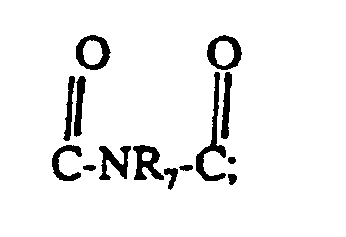
    • R1 and R2 = each independently H, alkyl (preferably C1-C6 straight or branched), aryl (preferably substituted or unsubstituted phenyl or naphthyl), COZ, or CN, provided both are not H, and wherein Z = OR5 or NR5R6, wherein R5 and R6 are as described above; or R1 and R2 are together-CO-NR1-CO, wherein R1 is as described above.
    • R3 and R4 of Collective Compound II= H, or halogen;
    • Rg and R10 are as described above;
    • R9 and Rs and R9 taken together are as described above.
  • The expression substituted-aryl preferably is intended to mean phenyl or naphthyl substituted in one or more positions with halogen (bromine, chlorine, fluorine or iodine); C1-C6 alkyl; alkoxy of 1-6 carbon atoms, cyano, nitro, or carboxy.
  • The α,β-unsaturated carbonyl compounds are preferably aldehyde or ketone wherein R8, R9, and R10 are as described above.
  • The acetal and ketal derivatives of the carbonyl compounds, or the Mannich base equivalent to such carbonyl compounds can also be used in the invention.
  • IV. Preparation of Quinoline Derivatives by Reacting or Substituted or Unsubstituted Phenylhydroxyamine with a Substituted or Unsubstituted Unsaturated Diacid Derivative to Form a Phenylhydroxylamine Adduct, Dehydrating to Form Substituted and Unsubstituted 2-Anilino-But-2-Ene Dicarboxylic Acid Derivative, Followed by Reaction with Vilsmeler Reagent to Form a Quinoline Derivative
  • Figure imgb0015
  • wherein R1, R2, R3, and R4 are as described in Section III above; wherein R13, is H, alkyl (preferably C1-C6 straight or branched, aryl (preferably phenyl or naphthyl), alkoxy, halogen, cyano, carboalkoxy, thioalkoxy, or CF3.
  • DETAILED DESCRIPTION
  • More specifically, the preferred embodiments of the above-described method follow. Throughout the specification and appended claims, a given chemical formula or name shall encompass all geometric, optical isomers and racemic mixtures thereof when such isomers exist.
  • I. Synthesis of N-Hydroxy-2-aminobutane Dicarboxylic Acid Derivatives
  • The present invention is described in terms of synthesizing esters of N-hydroxyaspartic acid and esters of 2-aminobut-2-ene dioic acids, such as dialkyl 2-aminomaleate. However, itshould be understood that such description is exemplary only and is for purposes of exposition and not for purposes of limitation. It will be readily appreciated that the inventive concept described is equally applicable to both substituted and unsubstituted N-hydroxyaspartates as well as esters which are alkyl or aryl.
  • This embodiment of the present invention relates to a method of synthesizing a N-hydroxyaspartic acid derivative of the formula:
    Figure imgb0016
    where R1 and R2 are each independently
    Figure imgb0017
    when Z is OR5 or NR5R6 where R5 and R6 are each independently H, alkyl (preferably C1-C6 alkyl branched or straight), aryl (preferably phenyl or naphthyl), arylalkyl, or R5 and R6 together with the nitrogen atom form a heterocyclic substituent, selected from pyrrolidinyl, piperidinyl, imidazolidyl, hydrogenated pyrimidinyl, including dihydro-, tetrahydro-, and hexahydropyrimidinyl; CN, or R1 and R3 together is
    Figure imgb0018
    when R7 is as defined above; and R3 and R4 are each independently H, alkyl (preferably C1-Ce alkyl branched or straight), aryl (preferably phenyl or naphthyl), arylalkyl,
    Figure imgb0019
    when Z is as defined above; CN, and halogen.
  • The term "alkyl" refers to a straight or branched chain hydrocarbon of 1 to 18 carbon atoms containing no unsaturation, e.g. methyl, ethyl, isopropyl, 2-butyl, neopentyl, n-hexyl, a-heptyl, n-nonyl, etc.; the term "aryl" refers to a monovalent substituent which consists of an aryl group, e.g. phenyl, o-toluyl, m-methoxyphenyl, etc., of the formula
    Figure imgb0020
    where X is hydrogen, halogen, lower alkyl, lower alkoxy, CF3, and N02, and n is an integer of 1 to 5; the term "arylalkyl" refers to a monovalent substituent which consists of an aryl group, e.g. phenyl, o-toluyl, m-methoxyphenyl, etc., linked through an alkylene group having its free valence bond from a carbon of the lower alkylene group, and having a formula of
    Figure imgb0021
    when X and n are is as defined above; the term "alkylene" refers to a bivalent radical of the lower branched or unbranched alkyl group it is derived from having valence bonds from two terminal carbons thereof, e.g. ethylene (-CH2CH2-), propylene (-CH2CH2CHr), isopropylene , etc; the term "alkoxy" refers to a monovalent substituent which consists of an alkyl group linked through an ether oxygen having its free valence bond from the ether oxygen, e.g. methoxy, ethoxy, propoxy, butoxy, pentoxy, etc.
  • The synthesis of N-hydroxyaspartic acid derivative (Compound I-D, when R is H) is made in the following manner. The substituents Ri, R2, R3, R4, Rε, Re, and Z are as defined above unless indicated otherwise.
  • A suitable diacid derivative of the formula
    Figure imgb0022
    is selected. Such diacid derivatives are well known or can be synthesized using conventional techniques well known to those of ordinary skill in the art. Compound I-B or I-C is reacted with substituted hydroxylamine R-NH-OH orwith unsubstituted hydroxylamine, H-NH-OH, or a suitable salt thereof, to produce N-hydroxyaspartic acid derivative. For purposes of simplification, subsequent descriptions will be limited to unsubstituted hydroxylamine, although it is understood the hydroxylamine can be substituted as well. A suitable hydroxylamine salt includes a mineral acid salt such as hydroxylamine hydrochloride, hydroxylamine sulfate, hydroxylamine bisulfate, hydroxylamine phosphate etc. or an organic acid salt, e.g. hydroxylamine acetate, etc. The reaction may be carried out with orwithout a suitable solvent. If carried out in a solvent a suitable solvent includes water, a lower alkanol, e.g. methanol, ethanol, isopropanol, 1-butanol, etc.; a halogenated lower hydrocarbon or alkane e.g. dichloromethane, chloroform, carbontetrachloride, dichloromethane etc.; an aromatic hydrocarbon, e.g. benzene, toluene, etc.; an ether, e.g. ethylether, dioxane, tetrahydrofuran, etc.; an ester, e.g. ethyl acetate, isopropyl acetate, butyl acetate, etc.; and an aprotic solvent, e.g. acetonitrile, dimethylformamide, dimethylsulfoxide, etc; and mixtures thereof.
  • It is critical that the reaction be conducted under weakly acidic to basic conditions (pH = 5-12) since it has been found that when the corresponding dicarboxylic acid of Compound I-B or I-C is employed, e.g. maleic acid or fumaric acid, addition of the hydroxylamine across the double bond leading to the N-hydroxyaspartic acid does not occur. Additionally, where the reaction between Compound I-B or I-C and the hydroxylamine or its salt is conducted under more acidic pH conditions, the desired reaction again does not occur to yield the N-hydroxyaspartic acid derivative. The reaction must be carried out under critical pH conditions which are at most weakly acidic, i.e. the upper acid pH range being weakly acid, that is, at a pH region of 5 through about 12, preferably a pH range of about 6.5 to about 9.
  • During the reaction of hydroxylamine with Compound I-B or I-C, the hydroxylamine itself provides the basic medium. When a hydroxylamine salt is used, a suitable base should be employed to achieve the critical pH reaction condition. A suitable base is one selected from an inorganic base, e.g. sodium hydroxide, potassium hydroxide, ammonium hydroxide, sodium carbonate, potassium carbonate etc.; an organic base, e.g. pyridine, triethylamine, sodium methoxide, etc., present in an amount ranging from about 1 to about 3 moles of base to one mole of hydroxylamine salt, and preferably from 1 mole of base per one mole of hydroxylamine salt, except in the case of a hydroxylamine salt of a diprotic acid, such as hydroxylamine sulfate, wherein 2 moles of base per mole of salt is preferred.
  • It is to be understood that pH values, resulting when there are solvent levelling effects involved, which correspond to the above-identified critical pH range are equally applicable.
  • Compound I-B or I-C and the hydroxylamine or its salt, are employed in a mole ratio ranging from about 1 : 1 to about 1 : 3, with the preferred mole ratio being between 1 : 1 to 1 : 1.5 of Compound I-B or I-C to the hydroxylamine or its salt.
  • Typically the reaction, conducted with the mole ratios of Compound I-B or I-C, hydroxylamine or its salt, and base, as indicated above, is carried out at a temperature ranging between about-10°C to about 80°C, preferably about 10°C to about 50°C, for a time period ranging from about 0.1 to about 15 hours to obtain addition of the NH20H (or RNHOH) across the carbon-carbon double bond of Compound I-B or I-C, typically following Markovnikov's rule, to obtain Compound I-E (or Compound I-D).
    Figure imgb0023
    Compound I-E includes, but is not limited to, dimethyl N-hydroxyaspartate, diethyl N-hydroxyaspartate, dipropyl N-hydroxyaspartate, di-iso-propyl N-hydroxyaspartate, di-n-butyl N-hydroxyaspartate, N-hydroxyaspartonitrile and triethyl 2-(N-hydroxyamino)-ethanetricarboxylate.
  • If Compound I-D is an ester, of course it can be hydrolyzed, using convenfional techniques, to obtain the free acid, i.e.
    Figure imgb0024
  • The examples which follow are for purposes of illustrating the embodiment of the present method described under I above, and are not to be construed as limiting the invention disclosed herein.
  • Example 1 Diethyl N-Hydroxyaspartate
  • Hydroxylamine free base (50% aqueous solution, 45.0 g, 0.68 mol) was added dropwise to diethyl maleate (100.0 g, 0.56 mol) under nitrogen. The reaction temperature was maintained below 55°C with an ice bath. The mixture was stirred for 30 minutes. Dichloromethane (100 ml) was added to the reaction mixture and the organic layer was collected. The organic layer was concentrated under reduced pressure to give crude diethyl N-hydroxyaspartate (103 g, 89% yield). The product was analyzed by NMR spectroscopy and found to be greater than 95% pure.
  • Example 2 Diethyl N-Hydroxyaspartate
  • Sodium hydroxide (40% aqueous solution, 12.9 g, 0.129 mol) was added over 20 minutes to a stirred mixture of diethyl maleate (17.3 g, 0.1 mol) and hydroxylamine sulfate (25% aqueous, 39.0 g, 0.059 mol) during which the reaction temperature rose from 28°C to 53°C. The reaction mixture was stirred for 30 minutes under nitrogen. The mixture was transferred to separating funnel, methylene chloride was added (50 ml), the organic layer was collected and concentrated to give diethyl N-hydroxyaspartate (18.5 g, 0.99 mol, 90% yield).
  • Example 3 Diethyl N-Hydroxyaspartate
  • Sodium hydroxide solution (50% aqueous, 96.0 g, 1.2 mol) was added over 30 minutes to an aqueous solution of hydroxylamine sulfate (25%, 394.2 g, 0.6 mol). The temperature was kept below 40°C during the caustic addition. The reaction pH was about 9 at the end of caustic addition.
  • Diethyl maleate (172.0 g, 1.0 mol) was then added to the reaction and stirred for 60 minutes at which time the pH was about 7.4. The reaction mixture was transferred to a separatory funnel, the layers were allowed to separate, and the organic phase containing diethyl N-hydroxyaspartate was separated. The crude product was analyzed by NMR and found to be > 90% pure (207 g).
  • Example 4 Preparation of Diethyl N-hydroxyaspartate
  • Hydroxylamine Free base (50% aq. soln., 45.0 g, 0.68 mol) was added dropwise to a solution of diethyl maleate (100.0 g, 0.56 mol) in ethanol (100 mL) in a 3-neck flask blanketed with nitrogen. The reaction temperature was maintained below 55°C with an ice bath. The mixture was stirred for 30 minutes. The reaction mixture was concentrated under reduced pressure to give crude diethyl N-hydroxyaspartate (103 g, 89% yield). The product was analyzed by nuclear magnetic resonance spectroscopy (NMR) and shown to be at least 95% pure. NMR (acetone-d6) 1.20 (m, 6H), 2.59 (dd, J 6.8, 16.1 Hz, 1H), 2.76 (dd, J 6.8, 16.1 Hz, 1H), 3.89 (t, J 6.8 Hz, 1 H), and 4.11 (m, 4H).
  • Example 5 Dimethyl N-Hydroxyaspartate
  • Hydroxylamine free base (50% aqueous solution, 7.3 g, 0.11 mol) was added over a 30 minute period to dimethyl maleate (15.0 g, 0.1 mol) under nitrogen. The reaction temperature was maintained below 55°C with an ice bath. The mixture was stirred for 30 minutes. The reaction mixture was added to dichloromethane (200 ml) and the organic phase was separated. The organic phase was dried with magnesium sulfate and concentrated to give dimethyl N-hydroxyasparate (16.2 g, 90% yield).
  • Example 6 Dibutyl N-Hydroxyaspartate
  • Hydroxylamine free base (50% aqueous solution, 8.0 g, 0.12 mol) was added dropwise to dibutyl maleate (25.0 g, 0.1 mol) in a 3-neck 250 ml flask blanketed with nitrogen. The reaction temperature was maintained below 55°C with an ice bath. The mixture was stirred for 30 minutes. The gas liquid chromatography (GLC) analysis of the reaction mixture indicated 96% conversion of dibutyl maleate. The NMR analysis showed that the reaction mixture contained dibutyl N-hydroxyaspartate in greater than 95% purity.
  • Example 7 N-Hydroxyaspartonitrile
  • Hydroxylamine free base (50% aqueous solution, 2.0 g, 30.3 mmol) was added over 2 minutes to a suspension of fumaronitrile (2.0 g, 25.6 mmol) in ethanol (15.0 g). During the course of the hydroxylamine addition, the reaction temperature changed from 18°C to 48°C. The reaction mixture was cooled to room temperature and stirred for one hour. The GLC analysis of the reaction mixture showed that the reaction proceeded with complete conversion of fumaronitrile to give N-hydroxyaspartonitrile in 90% selectivity. The solvent was removed and the product was characterized by NMR.
  • Example 8 Triethyl 2-(N-hydroxyamino)-1,1,2-ethanetricarboxylate or Diethyl 3-(Carboethoxy)-N-hydroxyaspartate
  • Triethyl ethenetricarboxylate (4.0 g, 16.3 mmol), obtained from diethyl malonate and ethyl glyoxalate, was dissolved in ethanol (25 g) and hydroxylamine (50% aqueous solution, 1.3 g, 19.6 mmol) was added to the reaction mixture. A solid precipitated out within 10 minutes indicating the completion of the reaction. The solvent was removed under reduced pressure to give the crude product. The crude product was analyzed by NMR and found to have triethyl 2-(N-hydroxyamino)ethanetricarboxylate.
  • II. Conversion of the N-Hydroxy-2-Aminobutane Diacid Derivative to a 2-Aminobut-2-ene Dioic Acid Derivative with Subsequent Conversion to Nitrogen-Comprising Aromatic Compounds
  • Compound I-D, where at least either R3 or R4 is hydrogen can then be subjected to dehydration using conventional techniques well known to those skilled in the art to obtain a 2-aminobut-2-ene dioic acid derivative (Collective Compound II). The dehydration of Compound I-D can be affected by heating. This dehydration by heating can be conducted with or without a suitable dehydration agent. If a dehydration agent is employed, the agent is typically present in an amount ranging from about 0.1% to about 100% by weight, preferrably about 0.1% to about 10% by weight, to yield the 2-aminobut-2-ene dioic acid derivative.
  • Any dehydration agent known in the art can be employed. Some suitable dehydration agents include an inorganic acid catalyst, e.g. H2SO4, HCI, phosphoric acid, polyphosphoric acid, etc.; an ion exchange acidic resin, e.g. AmberlystR, DowexR, Nafion-HR, etc.; an organic acid e.g. p-toluenesulfonic acid, methanesulfonic acid, etc.; an inorganic base, e.g. potassium bicarbonate, sodium carbonate, etc.; an organic base, e.g. pyridine, triethylamine, etc.; a basic ion exchange resin, e.g. AmberlystR, DowexR, etc., or a transition metal catalyst, e.g. palladium, rhodium, etc.
  • Dehydration can also be carried out using acylation agents or a combination of acylation agent and an organic base of the kind described above. The acylation agents include carboxylic acid anhydride, e.g. acetic anhydride and trifluoroacetic anhydride; and acid chloride, e.g. acetyl chloride and propanoyl chloride.
  • Typically the dehydration, with or without suitable agent, can be carried out in a suitable solvent, e.g. water, alcohols, such as ethanol, butanol, hydrocarbons, such as heptane, parafins; halogenated hydrocarbons such as chloroform and methylene chloride; aromatic hydrocarbons such as toluene, xylene; ethers, polar aprotic solvents such as dimethylformamide, diglyme, tetraglyme, etc., at a temperature ranging from about 25°C to about 300°C, preferrably about 50°C to about 200°C, for about 0.01 to about 48 hours, to obtain 2-aminobut-2-ene dioic acid.
  • Compound I-D is then dehydrated using heat and/or a dehydration agent, as shown under Section II, above to form Collective Compounds II which are subsequently reacted with an α,β-unsaturated carbonyl compound such as an aldehyde or ketone (Compound II-D).
  • The resultant Collective Compound II, represented in part by the compounds of the formulae as previously described on Pages 7 and 8
    Figure imgb0025
    can be isolated. When R is H and when at least R3 is hydrogen or halogen, then Collective Compound II can be reacted with a substituted α,β-unsaturated carbonyl compound of the formula
    Figure imgb0026
    where R8, Rg, and Rio are as defined above (and which correspond to R1, R2, and R3, respectively, of U.S. Patent No. 4,758,667), to obtain a compound of the formula
    Figure imgb0027
    which includes 2,3-pyridinedicarboxylic acid derivatives such as 5-alkylpyridine-2,3-dicarboxylic acid.
  • The reaction between Collective Compounds II and those of Formula II-D is conveniently carried out by heating the same in the presence of an acid and suitable solvent preferably at reflux for periods of time ranging from 0.5 to 48 hours. Although the preferred temperature is at reflux, any temperature from ambient up to the boiling point of the solvent can be employed. A relative pH between 3-4 appears optimal although a pH ranging from 2-7 can be used.
  • The mole ratio of the compounds of Formula I-D to the aldehydes or ketones of Formula II-D is not critical and can range from about 1 : 3 to 3 : 1. It is preferred to use approximately from 1 : 1.0 to 1 : 1.3 molar ratios.
  • If desired a dehydrogenation catalyst can be added to the reaction mixture of Collective Compounds 11 and II-D, in order to aid in aromatization of the newly-generated ring. The dehydrogenation catalyst when employed is conventional in the art and includes metals or compounds of platinum, palladium, ruthenium, iridium, nickel, iron, copper, cobalt, rhodium, etc. The dehydrogenation metal or compound thereof deposited on a suitable support, such as alumina carbon, clay, zeolites, chromia, zirconia, etc. A preferred dehydrogenation catalyst is palladium on carbon.
  • As has been previously stated, an acid is employed to provide an acidic pH range (from about 2 to about 7). Suitable acids include inorganic acids such as hydrochloric, phosphoric, sulfuric, etc. and preferably organic acids such as acetic, trifluoroacetic, p-toluenesulfonic, methanesulfonic, trifluoromethanesulfonic, propionic, butyric or other carboxylic acids including aromatic carboxylic acids. lon-exchange resins such as AmberlystR, DowexR, NAFIONR can also be used as acidic components.
  • When an acid is used which is also a solvent i.e. acetic acid, no additional solvent is required.
  • Solvents suitable for use during the reaction of Collective Compounds II with Compounds II-D include: water, alcohols, chlorinated hydrocarbons, hydrocarbons, aromatic hydrocarbons, ethers, organic acids, esters, and aprotic solvents such as acetonitrle. The preferred solvents are lower alkyl alcohols, such as methanol, ethanol, propanol, and butanol and aromatic hydrocarbons, such as benzene and toluene. Particu- lady preferred solvents are 1-butanol and/or ethanol.
  • Thus, pyridinecarboxylic acid derivatives containing substituents in the 4-,5-and 6- position may conveniently be prepared by dehydrating Formula I-D N-hydroxyamino derivatives to form at least one of the Collective Compound II compounds which is then admixed with a Formula II-D α,β-unsaturated aldehyde or ketone in the presence of an acid and preferably a solvent, and stirring the resulting reaction mixture at a temperature in the range of ambient temperature to the boiling point of the solvent, and preferably at reflux, until the reaction is essentially complete and isolating the formed 4-substituted, 4-5-disubstituted, 4,6-disubstituted, 5-substituted, 6-substituted or 5,6-disubstituted pyridine-2,3-dicarboxylic acid derivatives by standard laboratory techniques such as extraction, evaporation, distillation or column chromatography.
  • Compound II-E, which includes 2,3-pyridine carboxylic acid derivatives, can be reacted with a 2-aminoal- kane carboxamide, as defined in U.S. Patent 4,758,667, and reacted as described in this patent to form the 2-(imidazolin-2-yl)-3-pyridine carboxylic acids described therein.
  • The examples which follow are for purposes of illustrating the embodiment of the present method described under II above, and are not to be construed as limiting the invention disclosed herein.
  • Example 9 Diethyl 3-Aminomaleate by Thermolysis
  • A solution (10 ml) of diethyl N-hydroxyaspartate (9.4% solution, 7.8 g, 3.6 mmol) in ethanol was fed in a quartz column (1 inch ID) containing glass beads (3 inches long) at 200°C at the rate of 0.2 ml per minute along with nitrogen at a rate of 1000 ml per minute. The vaporized material escaping at the end of quartz column was collected using a dry-ice trap. The condensate (0.35 g) was analyzed by GLC. The analysis found that the reaction gave diethyl 2-aminomaleate in about 34.5% yield.
  • Example 10 Diethyl 2-Aminomaleate using an Acid Dehydration Agent
  • Hydroxylamine free base (50% aqueous solution, 2.0 g, 30.3 mmol) was dropwise added to diethyl maleate (4.41 g, 25.6 mmol) and stirred for 60 minutes at 40-45°C to give diethyl N-hydroxyaspartate. Toluene (5.02 g) and p-toluenesulfonic acid (0.05 g, 0.26 mmol) were added to the reaction mixture and refluxed for 4.5 hours. The reaction mixture was analyzed by GLC, which showed that the reaction proceeded to give 89% diethyl 2-aminomaleate (80% yield based on the external standard).
  • Example 11 Preparation of Diethyl 2-aminomaleate Using Acetic Anhydride
  • Triethylamine (6.5 g, 64.4 mmol) was added dropwise to diethyl N-hydroxyaspartate (11.95 g, 58.3 mmol) and stirred at room temperature for 15 minutes. Acetic anhydride (6.58 g, 64.5 mmol) was then added dropwise to the reaction mixture while temperature was maintained below 40°C using an ice bath. The reaction was stirred at room temperature for an hour and at 60-70°C for another hour. The reaction was analyzed by GLC. The analysis found the reaction mixture to contain mainly diethyl 2-aminomaleate with about 10% of diethyl N-acetyl-2-aminomaleate.
  • Example 12 Diethyl 2-Aminomaleate and Diethyl 2-lminosuccinate
  • Hydroxylamine (50% aqueous solution, 2.05 g, 31.1 mmol) was added to a solution of diethyl maleate (4.3 g, 25.0 mmol) in ethanol (10 ml) at room temperature. The reaction mixture temperature increased to 70°C within five minutes. The reaction mixture was cooled to room temperature and stirred for 48 hows. The GLC analysis showed that the reaction mixture contained 33% diethyl N-hydroxyaspartate, 32% diethyl 2-aminomaleate, and 21 % diethyl 2-iminosuccinate.
  • Example 13 Aminomaleate Conversion to 5-Ethylpyridine-2,3-Dicarboxylate
  • Acetic acid (10 ml) was added to a solution of diethyl 2-aminomaleate (18.7 g, 0.10 mol) in ethanol (38 ml) in a 250 ml flask. The reaction pH was measured and found to be 3.9. The reaction flask was equipped with a reflux condenser, thermometer, heating mantle, stirrer, and dropping funnels. Then, 2-ethylacrolein (12.8 g, 0.13 mol) was added all at once and the reaction mixture was heated to reflux for 3 to 5 hours. The solvent was removed on a vacuum rotary evaporator and the residue was vacuum distilled. The yield of diethyl 5-ethylpyridine-2,3-dicarboxylate was 13.8 g (55% of theoretical).
  • Example 14 Aminomaleate Conversion to 5-Methylpyridine-2,3-Dicarboxylate
  • Repeating the process described in Example 13 with 2-methylacrolein (10.9 g, 0.13 mol) gave 9.0 g (38% yield) of diethyl 5-methylpyridine-2,3-dicarboxylate.
  • III. Single Pot Formation of the Pyridine Derivative from Substituted or Unsubstituted Diacid Derivatives, Unsubstituted Hydroxylamine, and a,f3-Unsaturated Carbonyl Compounds
  • Another embodiment of the invention involves the single-pot preparation of subsbtuted and disubstituted pyridinecarboxylates of Formula II-E by reacting a diacid derivative of Formula I-B or I-C:
    Figure imgb0028
    wherein R1 and R2 are defined above with unsubstituted hydroxylamine of Formula (I-A) or a salt thereof, such as the hydrochloride, salt at ambient temperatures for periods of time ranging from about 30 minutes to about 3 hours at a pH ranging from about 6 to about 12. The resulting reaction product is then subjected to dehydration using heat or a dehydrating agent, or both, at temperatures ranging from about 25°C to about 200°C, for a time period ranging from about 1 second to about 12 hours. After dehydration, an acid is added to lower the pH to 2-7, or preferably 3-4, and an α,β-unsaturated aldehyde or ketone of Formula 11-D is added, and the reaction mixture is subjected to elevated temperatures ranging from about 50°C to about 125°C for periods of time ranging from about 1 to about 48 hours.
  • A preferred embodiment of the invention involves the preparation of substituted and disubstituted pyri- dinedicarboxylates of Formula II-F by treating a alkene of Formula I-B or I-C wherein R1 and R2 are defined above with a substituted or unsubstituted hydroxylamine or a mixture of a hydroxylamine salt and a base at a temperature of 15°C to 60°C for periods of 0.1 to 2 hours at a pH of 7-9. The resulting reaction product is then subjected to dehydration using heat or a dehydrating agent, or both, at temperatures ranging from about 25°C to about 200°C, for a time period ranging from about 1 second to about 12 hours. After dehydration, sufficient acid to take the pH to 2-7, preferably 3-4, and preferably a solvent, is added. Then an α,β-unsaturated aldehyde or ketone of Formula II-D is added, and the resulting mixture is stirred at a temperature in the range of ambient temperature to the boiling point of the solvent, until the reaction is essentially complete.
  • The reaction mixture is then cooled to ambient temperature of 20-40°C. The product is concentrated under reduced pressure and can be purified by conventional techniques such as distillation, extraction, evaporation, or column chromatography.
  • If desired a dehydrogenation catalyst can be added to the reaction mixture.
  • The dehydrogenation catalyst when employed is conventional in the art and includes metals or compounds of platinum, palladium, ruthenium, iridium, nickel, iron, copper, antimony, cobalt, rhodium, etc. The dehydrogenation metal or compound thereof deposited on a suitable support, such as alumina, carbon, clay, zeolites, chromia zirconia, etc. A preferred dehydrogenation catalyst is palladium on carbon.
  • When an acid is used which is also a solvent i.e. acetic acid, no additional solvent is required.
  • Solvents suitable for use in the method of this invention include: water, alcohols, chlorinated hydrocarbons, hydrocarbons, aromatic hydrocarbons, ethers, organic acids, esters, and aprotic solvents such as acetonitrile. The preferred solvents are lower alkyl alcohols, such as methanol, ethanol propanol and butanol and aromatic hydrocarbons, such as benzene and toluene. The particularly preferred solvents are 1-butanol, ethanol, or toluene.
  • In another embodient pyridine-2,3-dicarboxylic acid derivatives containing substituents in the 4-, 5- and 6- position may conveniently be prepared by reacting, at a neutral or slightly basic pH, a Formula I-B or I-C maleate or fumarate with a substituted or unsubstituted hydroxylamine or a salt thereof, then subjecting the reaction product to dehydration using heat or a dehydrating agent or both, and subsequently adding followed by a Formula II-D α,β-unsaturated aldehyde, or ketone, at a pH of 2-7 with an acid and preferably a solvent and stirring the resulting reaction mixture at a temperature in the range of ambient temperature to the boiling point of the solvent, and preferably at reflux, until the reaction is essentially complete and isolating the formed 4-substituted, 4,5-disubstituted, 4,6-disubstituted, 5-substituted, 6-substituted or 5-6-disubstituted pyridine-2,3-dicarboxylic acid derivatives by standard laboratory techniques such as extraction, evaporation column chromatography, or distillation.
  • The amount of substituted or unsubstituted hydroxylamine or salt thereof used ranges from about 1 to about 1.5 mols of hydroxylamine per mol of said maleate or fumarate. Preferred ranges are about 1.0 - 1.2 mols.
  • If a hydroxylamine salt is used, a base such as sodium hydroxide, potassium hydroxide or ammonium hydroxide, in an amount of 1 to 2 moles, preferably 1 to 1.2 moles per mole of said hydroxylamine salt is needed to liberate the hydroxylamine.
  • The dehydration can be affected by heating. This dehydration by heating can be conducted with or without a suitable dehydration agent. If a agent is employed the agent is typically present in an amount ranging from about 0.1 % to about 100% weight, preferably about 0.1 % to about 10% by weight. Any dehydration agent known in the art can be employed. Some suitable dehydration agent is included in Section II of this application.
  • The mol ratio of the alkene of Formula I-B and I-C to the aldehyde or ketone of Formula II-D is not narrowly critical and can range from about 1 : 1 to about 1 : 3. It is preferred to use approximately 1 : 1.0 to 1 1.3 molar ratios.
  • It is believed that the reaction of the I-B and I-C maleates with the substituted or unsubstituted hydroxylamine or salt thereof inherently produces the N-hydroxyamino derivatives of Formula I-D, which upon dehydration produces 2-aminobut-2-ene dioic acid derivatives.
  • One of the preferred embodiments of the present invention pertains to the synthesis of 2,3-pyridine-dicarboxylic acid derivative of the formula:
    Figure imgb0029
    where R8 is hydrogen or C1-C6 alkyl; Rg is hydrogen, halogen, C1-C6 alkyl, C1-C6 hydroxyalkyl, C1-C6 alkoxy, phenyl or phenyl substituted -C1-C6 alkyl, or phenyl or phenyl -C1-C6 alkyl, each substituted by C1-C6 alkyl, C1-C6 alkoxy or halogen; R9 is hydrogen, C1-C6 alkyl, phenyl, phenyl -C1-C6 alkyl, or phenyl or phenyl C1-C6 alkyl each substituted by one C1-C6 alkyl, C1-C6 alkoxy or halogen; R8 and Rg together1,3-butadienylene which can be substituted by halogen, C1-C6 alkyl, C1-C6 alkoxy, C1-C6 haloalkyl, C1-C6 alkylsulfonyl, nitro, cyano, phenyl, phenoxy, or phenyl or phenoxy, each substituted by one C1-C6 alkyl, C1-C6 alkyoxy or halogen, and R14 is C1-C8 alkyl, phenyl or C1-C8 phenyl alkyl; where embodiments of the compound of the preceeding formula and R8, Rg, and R10 substituents are as revealed and defined as corresponding substituents Ri, R2, R3, and Re of U.S. Patent No. 4,758,667, incorporated by reference hereinto in its entirety.
  • Such compounds in turn are a precursor in the synthesis of compounds of the formula
    Figure imgb0030
    when R11 and R12 are each independently of the other C1-C6 alkyl, as revealed and defined as corresponding to substituents R4 and R5 in U.S. Patent No. 4,758,667, incorporated hereinto by reference. The latter compound has herbicidal properties and can be used for controlling undesired plant growth.
  • The reactions described under Section III above are illustrated by the Examples which follow:
  • Example 15 Procedure without Pd/C
  • Hydroxylamine free base (50% aqueous solution, 2.0 g, 30.3 mmol) is added dropwise to diethyl maleate (4.41 g, 25.6 mmol) and stirred for 60 minutes to give diethyl N-hydroxyaspartate. Toluene (25.02 g) and p-toluenesulfonic acid (0.05 g, 0.26 mmol) are added to the reaction mixture and refluxed for 4.5 hours to afford diethyl 2-aminomaleate. The reaction mixture is cooled to room temperature and added acetic acid (7.0 g) and 2-ethylacrolein (2.13 g, 25, 0 mmol). The reaction mixture is stirred at 80-90°C for 24 hours. It is concentrated under reduced pressure and analyzed by GLC using an extemal standard. The analysis showed the yield of diethyl 5-ethylpyridine-2,3-dicarboxylate is about 35%.
  • EXAMPLES 16-23
  • The procedure of Example 15 is repeated except that the following 2-aminobut-2-ene dioic acid derivatives and aldehydes or ketones are used:
    Figure imgb0031
    Figure imgb0032
  • IV. Preparation of Quinoline Derivatives by Reacting a Substituted or Unsubstituted Phenylhydroxyamine with a Substituted or Unsubstituted Diacid Derivative to Form a Phenylhydroxylamine Adduct, Dehydrating to Form Substituted and Unsubstituted 2-Anilino-But-2-Ene Dicarboxylic Acid Derivative, Followed by Reaction with Vilsmeier Reagent to Form a Quinoline Derivative
  • The reaction descriptions which follow actually are preferred embodiments fall under the subject matter described in Section I above, wherein the substituted or unsubstituted hydroxylamine is a phenylhydroxylamine which may have substituent groups on the aromatic ring.
    Figure imgb0033
    wherein Rl, R2, R3, and R4, are as described in Section III above; wherein R13 is H, alkyl (preferably C1-C6 straight or branched, aryl (preferably phenyl or naphthyl), alkoxy, halogen, cyano, carboalkoxy, thioalkoxy, or CF3.
  • The reaction conditions fall within the ranges previously provided in Section I and Section II above, and the following examples art provided for purposes of illustration.
  • EXAMPLE 24 Synthesis of N-Phenylhydroxylamine
  • Prepared by the method of O. Kamm, Organic Synthesis, Vol. 1, pages 445-447, the crude product was dissolved in ether filtered free of salts. The solvent was partially evaporated and hexane added. The resultant white material was dried in vacuum oven mp. 82-84°C.
  • EXAMPLE 25 Synthesis of Diethyl-N-Phenyl-N-Hydroxyaspartate
  • Diethylmaleate (7.7 g , 0.045 mole) was added to a mixture containing 5.0 g (0.046 mole) N-phenylhydroxylamine in 7.66 g of absolute ethanol. The mixture was allowed to stir for 15 hours at room temperature. GC analysis showed a trace of diethylmaleate remaining. 1.0 g of Norite was added along with 10 ml of additional ethanol. The mixture was allowed to stirfor 10 minutes and then filtered free of the carbon. The carbon was washed with additional ethanol. The filtrate was evaporated under high vacuum temperature to give an oil which crystallized upon cooling in a dry ice/acetone bath. 11.9 g obtained after drying in vacuum desicator at room temperature under high vacuum mp 50-53°C.
  • EXAMPLE 26 Preparation of Diethyl-N-Phenyl-N-Hydroxyaspartate
  • A solution of diethyl maleate (20.65 g, 0.117 mol) in ethanol (25.0 g) was added dropwise to a solution of N-phenylhydroxylamine (14.6 g, 0.129 mol) in ethanol (46.3 g). The reaction mixture was stirred at room temperature for an hour. The analysis of the reaction mixture by thin layer chromatography indicated the completion of the reaction. The reaction mixture was concentrated under reduced pressure to give the crude product (37.46 g). The crude product was crystallized from ethylacetate-hexane (28.0 g, 85.0% yield).
  • EXAMPLE 27 Preparation of Diethyl 2-Anilinobut-2-ene-2,3-dicarboxylate
  • 2.81 g (.01 mole) of diethyl N-phenyl-N-hydroxy aspartate was dissolved in 20 ml chloroform. To this solution was added 1.8 g (.018 mole) of triethylamine. To this solution, 1.0 g (.0125 mole) acetyl chloride was added at room temperature, 22-25°C. This mixture was allowed to stir for 30 minutes before 1.8 g (.018 mole) of triethylamine was added. The resultant solution was heated to 55°C for 4 hours. L.C. shows conversion to diethyl-N-phenylaminomaleate.
  • Example 28 Preparation of Diethyl 2-Anifinobut-2-ene-2,3-dicarboxylate
  • Triethylamine (4.02 g, 0.0398 mol) was added to a solution of diethyl N-phenyl-N-hydroxyaspartate (10.1 g, 0.0357 mol) in dichloromethane (40 mL) and stirred for 15 minutes. Acetic anhydrode (4.10 g, 0.040 mol) was added to reaction mixture over a period of 10 minutes. The reaction mixture was stirred at room temperature for an hour and refluxed for another hour. The reaction mixture was concentrated under reduced pressure to give the crude product. The crude product was purified by distillation to give diethyl 2-anilinobut-2-ene-2,3-dicarboxylate (7.8 g, 74% yield). NMR (CDCI3) 8 1.03 (t, J 7.2 Hz, 3H), 1.29 (t, J 7.2, 3H), 4.18 (m, 4H), 5.38 (s, 1H), 6.90-7.31 (m, 5H).
  • Example 29 Preparation of Diethyl Quinoline-2,3-dicarboxylate
  • The Vilsmeier reagent is prepared by adding Diphosgene (3.8g, 19.3 mmol) dropwise to a mixture containing dimethyl foramide (2.75 g, 37.7 mmol) and dichloroethane (50 mL) while the temperature is maintained below 20°C using an ice bath. The reaction mixture is stirred for 45 minutes at room temperature. Then a solution of diethyl 2-anilinobut-2-ene-2,3-dicarboxylate (4.5 g,17.1 mmol) in dichloroethane (20 mL) is added dropwise to the reaction mixture and stirred at 80-84°C for 2.5 hours. The reaction mixture is cooled to room temperature and diluted with ethyl acetate (250 mL). The reaction mixture is washed twice with brine (50 mL each) and once with water (100 mL). The organic layer is concentrated under reduced pressure to give the crude product which is purified by crystallization using ethyl acetate and hexane to give diethyl quinoline-2,3-dicarboxylate (2.9 g, 62% yield).
  • The above-described preferred embodiments are intended to be illustrative of the process of the present invention, as one skilled in the art can introduce modifications which provide equivalent functions and which are intended to fall within the scope of the present invention as defined by the claims which follow.

Claims (43)

1. A method for the preparation of a N-hydroxy-2-aminobutane diacid derivatives of the formula
Figure imgb0034
wherein R is H, alkyl, substituted or unsubstituted aryl, and wherein substituents are selected from alkyl, alkoxy, carboxy, halogen, cyano, and nitro; wherein R1 and R2 are each independently
Figure imgb0035
wherein Z is OR5 or NR5R6; or CN; or wherein R1 and R2 together is
Figure imgb0036
wherein R3 and R4 are each independently H; alkyl; substituted and unsubstitubd aryl, wherein said substituents are selected from alkyl, arylalkyl, alkoxy, carboxy, halogen, nitro, and cyano;
Figure imgb0037
wherein Z is defined as above; CN; or halogen; wherein R5 and Re are each independently H, alkyl, aryl, arylalkyl; wherein R6 and R6 together with the nitrogen atom form a heterocyclic substituent, selected from pyrrolidinyl, piperidinyl, imidazolidyl, and hydrogenated pyrimidinyl; wherein R7 is H, alkyl, aryl, or an alkoxy of 1-6 carbon atoms; which method comprises the steps of:
a) providing an unsaturated diacid derivative of the formula
Figure imgb0038
or an isomer thereof, wherein Ri, R2, R3, and R4 are defined as above,
b) contacting said unsaturated diacid derivative with a substituted or unsubstituted hydroxylamine of the formula R-NH-OH wherein R is defined as above, or a suitable salt thereof, in a reaction medium having a pH ranging from about 5 to about 12.
2. The method of Claim 1, wherein said pH ranges from about 6.5 to about 9.
3. The method of Claim 1, wherein said reaction medium includes a solvent selected from the group consisting of water, a Cl-Ce alkanol, a halogenated C1-C6 hydrocarbon, an aromatic hydrocarbon, an ether, an ester, an aprotic solvent, and mixtures thereof.
4. The method of Claim 1, wherein said hydroxylamine is unsubstituted.
5. The method of Claim 1, wherein said hydroxylamine is a substituted or unsubstituted aryl hydroxylamine.
6. The method of Claim 6, wherein said hydroxylamine is substituted or unsubstituted phenylhydroxylamine.
7. The method of Claim 1, Claim 4, Claim 5, or Claim 6, wherein said diacid derivative is selected from the group consisting of diethyl maleate, dimethyl maleate, dibutyl maleate, dimethyl fumarate, diethyl fumarate, dibutyl fumarate, fumaronitrile, and triethylethanetricarboxylate.
8. The method of Claim 1, wherein said suitable salt of said substituted or unsubstituted hydroxylamine of said formula is used in combination with a suitable base.
9. The method of Claim 8, wherein said suitable salt comprises a sulfate or a hydrochloride and wherein said suitable base is selected from sodium hydroxide or potassium hydroxide.
10. The method of Claim 1, wherein said unsaturated diacid derivative is dimethyl maleate and said substitued or unsubstituted hydroxylamine is hydroxylamine or a suitable salt thereof, to prepare dimethyl N-hydroxyaspartate.
11. The method of Claim 1, wherein said unsaturated diacid derivative is diethyl maleate and said substitued or unsubstituted hydroxylamine is hydroxylamine or a suitable salt thereof to prepare diethyl N-hydroxyaspartate.
12. The method of Claim 1, wherein said unsaturated diacid derivative is dibutyl maleate and said substitued or unsubstituted hydroxylamine is hydroxylamine or a suitable salt thereof to prepare dibutyl N-hydroxyaspartate.
13. The method of Claim 1, wherein said unsaturated diacid derivative is fumaronitrile and said substitued or unsubstituted hydroxylamine is hydroxylamine or a suitable salt thereof to prepare N-hydroxyaspartonitrile.
14. The method of Claim 1, wherein said unsaturated diacid derivative is triethyl ethenetricarboxylate and said substitued or unsubstituted hydroxylamine is hydroxylamine or a suitable salt thereof to prepare triethyl-2 (N-hydroxyamino)-ethanetricarboxyiate.
15. The method of Claim 1, wherein said unsaturated diacid derivative is diethylmaleate and said substitued or unsubstituted hydroxylamine is β-phenylhydroxylamine to prepare diethyl-N-phenyl-N-hydroxyaspartate.
16. A method for the preparation of 2-aminobut-2-enedioic acid derivatives of the formula
Figure imgb0039
or the tautomer of the foregoing, of the formula
Figure imgb0040
wherein R is selected from H, alkyl and substituted orunsubstituted aryl, wherein the substituents are selected from alkyl, alkoxy, carboxy, halogen, cyano, and nitro; wherein R' is R1, R" is R2, and R"' is R4, or wherein R' is R2, R" is R1, and R"' is R3; or wherein R1 and R2 are each independently
Figure imgb0041
where Z is OR5 or NR5R6; or CN; or wherein R1 and R2 together is
Figure imgb0042
wherein R3 and R4 are each independently H; alkyl; substituted are selected from alkyl, arylalkyl, alkoxy, carboxy, halogen, and cyano;
Figure imgb0043
wherein Z is defined as above; CN; halogen; wherein Rs and Re are each independently H, alkyl, aryl, arylalkyl; or wherein R5 and R6 together with the nitrogen atom form a heterocyclic substituent, selected from pyrrolidinyl, peperidinyl, imidazolidyl, hydrogenated pyrimidinyl; and wherein R7 is H, alkyl, substituted or unsubstituted aryl, or an alkoxy of 1-6 carbon atoms; which method comprises:
a) providing an N-hydroxy-2-aminobutane diacid derivative of the formula
Figure imgb0044
wherein R, R1, R2, R3, and R4 are as defined above; and
b) dehydrating said N-hydroxy-2-aminobutane diacid derivative.
17. The method of Claim 16, wherein said dehydration is accomplished by heating said N-hydroxy-2-aminobutane diacid derivative for form a 2-aminobut-2-ene dioic acid derivative.
18. The method of Claim 16, wherein said N-hydroxy-2-aminobutane diacid derivative is dehydrated in the presence of a dehydration agent.
19. The method of Claim 18, wherein said dehydration is carried out using an acid dehydration agent.
20. The method of Claim 18, wherein said dehydration is carried out using an acid anhydride dehydrating agent in combination with an organic base.
21. The method as defined in Claim 16 which further comprises reacting the 2-aminobut-2-ene dioic acid with a substituted acrolein of the formula
Figure imgb0045
where R8 is hydrogen or C1-C4 alkyl; R9 is hydrogen, halogen, C1-C4 alkyl, C1-C4 hydroxyakyl, C1-C4 alkoxy, phenyl or phenyl substituted -C1-C4 alkyl, or phenyl or phenyl -C1-C4 alkyl, each substituted by C1-C4 alkyl, C1-C4 alkoxy or halogen; Rio is hydrogen. Ci-C4 alkyl, phenyl, phenyl -C1-C4 alkyl, or phenyl or phenyl C1-C4 alkyl each substituted by one Ci-C4C1-C4 alkyl, C1-C4 alkoxy or halogen; R9 and Rio together are 1,3-butadienylene which can be substituted by halogen, C1-C4 alkyl, Ci-C4 alkoxy, C1-C4 haloalkyl, C1-C4 alkylsulfonyl, nitro, cyano, phenyl, phenoxy, or phenyl or phenoxy, each substituted by one C1-C4 alkyl, Ci-C4 alkyoxy or halogen, to obtain a 2,3-substituted pyridine compound of the formula
Figure imgb0046
22. The method as defined in Claim 21, wherein R1 and R2 are each COOH; and which further comprises reacting said 2,3-substituted pyridine compound with a 2-aminoalkenecarboxamide of the formula
Figure imgb0047
where R11 and R12 are each independently of the other C1-C4 alkyl, to obtain a compound of the formula
Figure imgb0048
23. The method as defined in Claim 16 which comprises dehydrating a compound selected from dimethyl N-hydroxyaspartate, diethyl N-hydroxyaspartate and dibutyl N-hydroxyaspartate to obtain the respective 2-aminobut-2-ene dioic acid of dimethyl 2-aminomaleate, diethyl 2-aminomaleate and dibutyl 2-aminomaleate.
24. A method of obtaining at least a first compound of the formula
Figure imgb0049
, where R1 and R2 are each independently
Figure imgb0050
Z is ORS or NR5R6 where R5 and Re are each independently H, alkyl, aryl, arylalkyl or R5 and Re together with the nitrogen atom form a heterocyclic substituent selected from pyrrolidinyl, piperidinyl, imidazolinyl and hydrogenated pyrimidinyl; CN, and R1 and R2 together is
Figure imgb0051
R5 is as defined above; and R3 and R4 are each independently H, alkyl, aryl, arylalkyl, where Z is as defined above, CN and halogen, which comprises reacting a compound of the formula
Figure imgb0052
where R1, R2, R3, and R4 are as defined above, with hydroxylamine or a suitable salt thereof under a suitable pH condition, which is at most weedy acidic, to obtain a mixture comprising the first compound and at least a compound selected from
Figure imgb0053
or
Figure imgb0054
, and (d) a mixture of (a), (b) and (c), where R' is either R1 or R2 and R" is either R3 or R4, respectively.
25. The method as defined in Claim 24 which further comprises isolating at least one of the resulting compounds from the resultant mixture.
26. The method as defined in Claim 24 which further comprises converting the compounds of the mixture to one compound thereof.
27. The method as defined in Claim 26 wherein said converting is carried out by heating.
28. A method for the preparation of pyridine derivatives having the formula
Figure imgb0055
wherein R1 and R2 are each independently CN;
Figure imgb0056
wherein Z is OR5 or NR5R6; or wherein R1 and R2 together is
Figure imgb0057
wherein R5 and R6 are each independently H, alkyl, aryl, arylalkyl, or R5 and R6 together with the nitrogen atom form a heterocyclic substituent selected from pyrrolidinyl, piperidinyl, imidazolidyl, and hydrogenated pyrimidinyl;
wherein R8 and R10 are H; or C1-C6 straight or branched alkyl; or C1-C6 straight or branched alkenyl; or substituted orunsubstituted phenyl or naphthyl, wherein said substituent is selected from alkyl, alkoxy, carboxy, carboalkoxy, halogen, and cyano;
wherein R9 is the same as R8 and R10 above, but also including halogen, and wherein R9 and R10 taken together can be -(CH2)-3 -10;
which method comprises the steps of:
a) providing an N-hydroxy-2-aminobutane diacid derivative prepared by the method described in Claim 1, wherein R is H, and R3 and R4 art H or halogen;
b) dehydrating said diacid derivative to produce a 2-aminobut-2-enedioic acid derivative; and
c) contacting said dioic acid derivative with an α,β-unsaturated carbonyl compound of the formula
Figure imgb0058
wherein, R8, R8, and R10 are defined as above in the presence of a reaction medium comprising an acid and a solvent at a temperature ranging from about 25°C to the boiling point of the solvent at the contacting pressure, until the reaction is essentially complete.
29. The method of Claim 28, wherein said solvent is a C1-Ce alkyl alcohol.
30. The method of Claim 28, wherein said contacting is carried out in said reaction medium at a pH ranging from about 2 to about 7.
31. The method of Claim 30, wherein said pH ranges from about 3 to about 4.
32. A N-hydroxyaspartic acid derivative of the formula
Figure imgb0059
where R1 and R2 are each independ
Figure imgb0060
where Z is ORS where R5 is alkyl, aryl, CN, arylalkyl; or NR5R6 where R5 and R6 are independently H, alkyl, aryl, arylalkyl or R5 and R6 together with the nitrogen atom form a heterocyclic substituent selected from pyrrolidinyl, piperidinyl, imidazolinyl and hydrogenated pyrimidinyl; CN, and R1 and R2 together is;
Figure imgb0061
where R5 is as defined above; and R3 and R4 are each independently H, alkyl, aryl, arylalkyl,
Figure imgb0062
where Z is as defined above, CN and halogen.
33. A N-hydroxyaspartic acid derivative of the formula
Figure imgb0063
where R1 and R2 are each independently
Figure imgb0064
where Z is OR5 where R6 is alkyl other than t-butyl, aryl, CN, arylalkyl; or NR5R6 where R5 and R6 are independently H, alkyl, aryl, arylalkyl or R5 and Re together with the nitrogen atom form a heterocyclic substituent selected from pyrrolidinyl, piperidinyl, imidazolinyl and hydrogenated pyrimidinyl; CN, and R1 and R2 together is
Figure imgb0065
where R5 is as defined above; and R3 and R4 are each independently H, alkyl, aryl, arylalkyl,
Figure imgb0066
where Z is as defined above, CN and halogen.
34. The derivative of Claim 33 which is dimethyl N-hydroxyaspartate.
35. The derivative of Claim 33 which is diethyl N-hydroxyaspartate.
36. The derivative of Claim 33 which is di-n-propyl N-hydroxyaspartate.
37. The derivative of Claim 33 which is di-isopropyl N-hydroxyaspartate.
38. The derivative of Claim 33 which is di-n-butyl N-hydroxyaspartate.
39. The derivative of Claim 33 which is di-i-butyl N-hydroxyaspartate.
40. The derivative of Claim 33 which is N-hydroxyaspartonitrile.
41. The derivative of Claim 33 which is triethyl 2-(N-hydroxyamino)-ethanetricarboxylate.
42. The method of Claim 28, wherein said method is carried out in a series of steps without the isolation of major intermediary products.
43. A method for the preparation of quinoline derivatives of the formula
Figure imgb0067
wherein R1 and R2 are each independently
Figure imgb0068
wherein Z if OR5 or NR5R6; or CN; or wherein R1 and R2 together is
Figure imgb0069
wherein R5 and R6 are each independently H, alkyl aryl, arylalkyl; or wherein R5 and R6 together with the nitrogen atom form a heterocyclic substituent, selected from pyrrolidinyl, piperidinyl, imidazolidyl, and hydrogenated pyrimidinyl; wherein R7 is H, alkyl, or an alkoxy of 1-6 carbon atoms; wherein R13 is H, alkyl, aryl, alkylaryl, alkoxy, halogen, cyano, carboalkoxy, thioalkoxy, or CF3; which method comprises the steps of:
a) providing an unsaturated diacid derivative of the formula
Figure imgb0070
or an isomer thereof, wherein R1 and R2 are defined above, and wherein R3 and R4 are each independently H; alkyl: substituted and unsubstituted aryl, wherein said substituents are selected from alkyl, arylalkyl, alkoxy, carboxy, halogen, nitro, and cyano;
Figure imgb0071
wherein Z is as defined above; CN; or halogen;
b) contacting said unsaturated diacid derivative with a substituted or unsubstituted phenylhydroxylamine of the formula
Figure imgb0072
wherein R13 is as defined above, or a suitable salt thereof, in a reaction medium having a pH ranging from about 5 to about 12, whereby a substituted or unsubstituted N-phenyl-N-hydroxy-2-aminobutane dicarboxylic acid derivative is produced;
c) dehydrating said N-phenyl-N-hydroxy-2-aminobutane dicarboxylic acid derivative, using heat or a dehydrating agent, or both, whereby substituted or unsubstituted 2-anilinobut-2-ene dicarboxylic acid derivative is produced;
d) reacting said 2-anilinobut-2-enedicarboxylic acid derivative with a Vilsmeier reagent, whereby quinoline derivatives are produced.
EP19910303126 1990-04-10 1991-04-09 A method of the preparation of n-hydroxy aspartic acid derivate Withdrawn EP0452094A3 (en)

Applications Claiming Priority (4)

Application Number Priority Date Filing Date Title
US676683 1984-11-30
US50733090A 1990-04-10 1990-04-10
US507330 1990-04-10
US07/676,683 US5405987A (en) 1989-08-31 1991-03-28 Process for preparing pyridine and quinoline derivatives

Publications (2)

Publication Number Publication Date
EP0452094A2 true EP0452094A2 (en) 1991-10-16
EP0452094A3 EP0452094A3 (en) 1993-08-11

Family

ID=27055804

Family Applications (1)

Application Number Title Priority Date Filing Date
EP19910303126 Withdrawn EP0452094A3 (en) 1990-04-10 1991-04-09 A method of the preparation of n-hydroxy aspartic acid derivate

Country Status (9)

Country Link
US (2) US5405987A (en)
EP (1) EP0452094A3 (en)
JP (1) JPH06128205A (en)
CN (1) CN1058205A (en)
CA (1) CA2040110A1 (en)
CS (1) CS101891A2 (en)
HU (1) HUT57703A (en)
IE (1) IE911180A1 (en)
IL (1) IL97807A0 (en)

Cited By (2)

* Cited by examiner, † Cited by third party
Publication number Priority date Publication date Assignee Title
EP0511446A3 (en) * 1991-04-29 1993-04-28 Hoechst Celanese Corporation Process for preparing pyridinecarboxylic acid derivatives
US5322948A (en) * 1989-08-31 1994-06-21 Hoechst Celanese Corporation Process for preparing pyridinecarboxylic acid derivatives

Families Citing this family (3)

* Cited by examiner, † Cited by third party
Publication number Priority date Publication date Assignee Title
JP4164247B2 (en) * 2001-08-07 2008-10-15 独立行政法人科学技術振興機構 Sugar-derived gelling agent
JP3660282B2 (en) * 2001-08-20 2005-06-15 独立行政法人科学技術振興機構 Hydrogelator
CN113912538A (en) * 2020-07-10 2022-01-11 沈阳中化农药化工研发有限公司 Preparation method of quinoline compound

Family Cites Families (12)

* Cited by examiner, † Cited by third party
Publication number Priority date Publication date Assignee Title
US4656283A (en) * 1982-05-25 1987-04-07 American Cyanamid Company Alkyl esters of substituted 2-methyl-3-quinolinecarboxylic acid and quinoline-2,3-dicarboxylic acid
US4723011A (en) * 1985-10-28 1988-02-02 American Cyanamid Company Preparation of substituted and disubstituted-pyridine-2,3-dicarboxylate esters
ATE82279T1 (en) * 1986-02-10 1992-11-15 Ciba Geigy Ag PROCESS FOR THE PREPARATION OF 2-(IMIDAZOLINE-2-YL)-PYRIDINE AND -QUINOLINE-3-CARBONIC ACIDS.
IT1189092B (en) * 1986-04-29 1988-01-28 Ausimont Spa POLYMERIZATION PROCESS IN WATER DISPERSION OF FLUORINATED MONOMERS
US4675432A (en) * 1986-08-29 1987-06-23 American Cyanamid Company Method for the preparation of anilinofumarate
ATE57912T1 (en) * 1986-08-29 1990-11-15 American Cyanamid Co PROCESS FOR THE PREPARATION OF ANILINOFUMARATE AND 2,3-QUINOLINDICARBONIC ACID.
US4816588A (en) * 1986-09-12 1989-03-28 American Cyanamid Company Method for the preparation of pyridine-2,3-dicarboxylic acids
EP0274379B1 (en) * 1987-01-06 1993-06-30 Sugai Chemical Industry Co., Ltd. Process for preparing pyridine-2,3-dicarboxylic acid compounds
JPH0625116B2 (en) * 1987-07-08 1994-04-06 ダイソー株式会社 Process for producing pyridine-2,3-dicarboxylic acid derivative
DE3840554A1 (en) * 1988-12-01 1990-06-13 Wacker Chemie Gmbh METHOD FOR PRODUCING PYRIDINE-2,3-DICARBONIC ACID ESTERS
CA2022408A1 (en) * 1989-08-31 1991-03-01 Michael P. Bodman Process for preparing pyridine carboxylic acid derivatives
US5322948A (en) * 1989-08-31 1994-06-21 Hoechst Celanese Corporation Process for preparing pyridinecarboxylic acid derivatives

Cited By (2)

* Cited by examiner, † Cited by third party
Publication number Priority date Publication date Assignee Title
US5322948A (en) * 1989-08-31 1994-06-21 Hoechst Celanese Corporation Process for preparing pyridinecarboxylic acid derivatives
EP0511446A3 (en) * 1991-04-29 1993-04-28 Hoechst Celanese Corporation Process for preparing pyridinecarboxylic acid derivatives

Also Published As

Publication number Publication date
IE911180A1 (en) 1991-10-23
HU911134D0 (en) 1991-10-28
JPH06128205A (en) 1994-05-10
US5808067A (en) 1998-09-15
EP0452094A3 (en) 1993-08-11
CS101891A2 (en) 1991-11-12
US5405987A (en) 1995-04-11
HUT57703A (en) 1991-12-30
CA2040110A1 (en) 1991-10-11
CN1058205A (en) 1992-01-29
IL97807A0 (en) 1992-06-21

Similar Documents

Publication Publication Date Title
KR940001774B1 (en) Method for preparing substituted and disubstituted pyridine-2,3-dicarboxylate and method for preparing substituted nicotinate
RO111078B1 (en) Preparation process for some derivates of 3-(alpha-methoxi)-methylene-benzofuranones and intermediaries for the process making thereof
US4870175A (en) 6-substituted alkoxy-2-oxo-1,2-dihydroquinoxaline derivatives
KR20040010720A (en) Process for the production of the piperidine derivative fexofenadine
US5405987A (en) Process for preparing pyridine and quinoline derivatives
GB2039484A (en) Aminoalkyl and aminoalkoxy diphenylhydantoin derivatives and their preparation
US5008384A (en) Process for the production of O.sup. 2,2'-anhydro-1-(β-D-arabinofuranosyl)thymine
US4925944A (en) Process for the preparation of o-carboxypyridyl- and o-carboxyquinolylimidazolinones
US4831190A (en) Trifluorohydroxyaromatic acid and preparation thereof
US4182880A (en) 1,8-Naphthyridine compounds and process for preparing the same
KR930006767B1 (en) Method for preparing pyridine carboxylic acid derivative
US4894457A (en) 7-bromo-beta-carboline compound and method for producing same
EP0275971A1 (en) Process and intermediates for quinolonecaboxylic acid
US5322948A (en) Process for preparing pyridinecarboxylic acid derivatives
EP1098882B1 (en) A process for preparing benzocycloheptapyridin-11-ones
CA1050988A (en) Process for preparation of benzoylpyridines and derivatives
EP0511446A2 (en) Process for preparing pyridinecarboxylic acid derivatives
JPS63264439A (en) Method for producing 3,5,6-trifluoro-4-hydroxyphthalic acid
US5578728A (en) Process for the preparation of a benzo(a)quinolizione derivative
SU549078A3 (en) The method of obtaining derivatives of 1phenoxy-3-amino-propan-2-ol or their salts
JPH04290883A (en) Quinolinium salt and process for producing same
KR880001850B1 (en) Method for preparing 5-fluoro pyridone derivative
EP0215477A1 (en) Process and intermediates for antiarrhytmic 1,3-diazabicyclo/4.4.0/dec-2-en-4-ones
EP0747369B1 (en) Method of producing 2-naphthamide derivative, and compounds for producing 2-naphthamide derivative
KR20250103481A (en) Novel preparation method for Flavonoid derivatives

Legal Events

Date Code Title Description
PUAI Public reference made under article 153(3) epc to a published international application that has entered the european phase

Free format text: ORIGINAL CODE: 0009012

AK Designated contracting states

Kind code of ref document: A2

Designated state(s): AT BE CH DE DK ES FR GB GR IT LI LU NL SE

PUAL Search report despatched

Free format text: ORIGINAL CODE: 0009013

AK Designated contracting states

Kind code of ref document: A3

Designated state(s): AT BE CH DE DK ES FR GB GR IT LI LU NL SE

17P Request for examination filed

Effective date: 19940114

17Q First examination report despatched

Effective date: 19941005

STAA Information on the status of an ep patent application or granted ep patent

Free format text: STATUS: THE APPLICATION IS DEEMED TO BE WITHDRAWN

18D Application deemed to be withdrawn

Effective date: 19951103