EP0452156A2 - Composant solide et catalyseur à base de titane pour polymérisation d'oléfines, catalyseur prépolymérisé et procédé de préparation de polyoléfines - Google Patents
Composant solide et catalyseur à base de titane pour polymérisation d'oléfines, catalyseur prépolymérisé et procédé de préparation de polyoléfines Download PDFInfo
- Publication number
- EP0452156A2 EP0452156A2 EP91303283A EP91303283A EP0452156A2 EP 0452156 A2 EP0452156 A2 EP 0452156A2 EP 91303283 A EP91303283 A EP 91303283A EP 91303283 A EP91303283 A EP 91303283A EP 0452156 A2 EP0452156 A2 EP 0452156A2
- Authority
- EP
- European Patent Office
- Prior art keywords
- compound
- catalyst
- catalyst component
- olefin
- ether linkages
- Prior art date
- Legal status (The legal status is an assumption and is not a legal conclusion. Google has not performed a legal analysis and makes no representation as to the accuracy of the status listed.)
- Granted
Links
- 0 CC1(C)NC(C)(C)CC(*)C1 Chemical compound CC1(C)NC(C)(C)CC(*)C1 0.000 description 2
- VDVUCLWJZJHFAV-UHFFFAOYSA-N CC(C)(C1)NC(C)(C)CC1O Chemical compound CC(C)(C1)NC(C)(C)CC1O VDVUCLWJZJHFAV-UHFFFAOYSA-N 0.000 description 1
- NFKSQZQAWUIIAJ-UHFFFAOYSA-N CC(C)C(C1)NC(C)(C)CC1O Chemical compound CC(C)C(C1)NC(C)(C)CC1O NFKSQZQAWUIIAJ-UHFFFAOYSA-N 0.000 description 1
Images


Classifications
-
- C—CHEMISTRY; METALLURGY
- C08—ORGANIC MACROMOLECULAR COMPOUNDS; THEIR PREPARATION OR CHEMICAL WORKING-UP; COMPOSITIONS BASED THEREON
- C08F—MACROMOLECULAR COMPOUNDS OBTAINED BY REACTIONS ONLY INVOLVING CARBON-TO-CARBON UNSATURATED BONDS
- C08F10/00—Homopolymers and copolymers of unsaturated aliphatic hydrocarbons having only one carbon-to-carbon double bond
-
- C—CHEMISTRY; METALLURGY
- C08—ORGANIC MACROMOLECULAR COMPOUNDS; THEIR PREPARATION OR CHEMICAL WORKING-UP; COMPOSITIONS BASED THEREON
- C08F—MACROMOLECULAR COMPOUNDS OBTAINED BY REACTIONS ONLY INVOLVING CARBON-TO-CARBON UNSATURATED BONDS
- C08F4/00—Polymerisation catalysts
-
- C—CHEMISTRY; METALLURGY
- C08—ORGANIC MACROMOLECULAR COMPOUNDS; THEIR PREPARATION OR CHEMICAL WORKING-UP; COMPOSITIONS BASED THEREON
- C08F—MACROMOLECULAR COMPOUNDS OBTAINED BY REACTIONS ONLY INVOLVING CARBON-TO-CARBON UNSATURATED BONDS
- C08F110/00—Homopolymers of unsaturated aliphatic hydrocarbons having only one carbon-to-carbon double bond
- C08F110/04—Monomers containing three or four carbon atoms
- C08F110/06—Propene
-
- C—CHEMISTRY; METALLURGY
- C08—ORGANIC MACROMOLECULAR COMPOUNDS; THEIR PREPARATION OR CHEMICAL WORKING-UP; COMPOSITIONS BASED THEREON
- C08F—MACROMOLECULAR COMPOUNDS OBTAINED BY REACTIONS ONLY INVOLVING CARBON-TO-CARBON UNSATURATED BONDS
- C08F110/00—Homopolymers of unsaturated aliphatic hydrocarbons having only one carbon-to-carbon double bond
- C08F110/04—Monomers containing three or four carbon atoms
- C08F110/08—Butenes
Definitions
- This invention relates to solid catalyst components, prepolymerized polyolefin-containing catalysts, catalysts and method of polymerization for the preparation of homopolymer of ethylene or ⁇ -olefin, or copolymers thereof.
- Catalysts containing activated titanium compounds supported by magnesium halides are hitherto known as those for use in the preparation of homopolymer of ethylene or ⁇ -olefin, or olefin polymers such as an ethylene/ ⁇ -olefin copolymers.
- the olefin polymerization catalysts as referred to above are known to include such catalysts as comprising a solid titanium catalyst component containing magnesium, titanium, halogen and an electron donor, and an organometallic compound catalyst component.
- the catalysts mentioned above have high activities in polymerization or copolymerization of ⁇ -olefin such as propylene or butene-1 (hereinafter the term polymerization is sometimes used, including also copolymerization) as well as in polymerization of ethylene.
- polymerization is sometimes used, including also copolymerization
- the polymers or copolymers obtained by the use of these catalysts are high in stereospecificity.
- an electron donor selected from carboxylic esters, a typical example of which is phthalic ester, an aluminum-alkyl compound as a co-catalyst and a silicon compound having at least one Si-OR linkage (wherein R is a hydrocarbon radical)
- the present inventors conducted researches with the view of obtaining olefin polymerization catalysts excellent by far in polymerization activity and stereospecificity, and have eventually accomplished the present invention on the basis of their finding that an object of the invention can be best attained by using a catalyst comprising a solid titanium catalyst component containing magnesium, halogen, titanium and a compound having two or more ether linkages with a plurality of intermediately existing bonding atoms, or a catalyst comprising a solid titanium catalyst component containing magnesium, titanium, halogen and an electron donor, an organometallic compound and the above-mentioned compound having two or more ether linkages.
- the present invention has been made in view of such circumstances as mentioned above, and an object of the invention is to provide a solid titanium catalyst component, a prepolymerized polyolefin-containing catalyst and a olefin polymerization catalyst, which are prepared by using a specific electron donor, high in catalytic activity and capable of giving olefin (co-)polymers high in stereospecificity, and methods of olefin polymerization using said olefin polymerization catalysts.
- the first solid titanium catalyst component [I] for use in olefin polymerization of the present invention is characterized in that said catalyst component is formed by bringing (A) a solid titanium component containing titanium, magnesium, halogen and an electron donor (a0) into contact with (B) an electron donor (b0), wherein either the electron donor (a0) or electron donor (b0) is a compound having two or more ether linkages with a plurality of intermediately existing bonding atoms.
- the solid titanium catalyst component of the invention it is possible to obtain an olefin polymerization catalyst which is capable of giving polymers higher by far in stereospecificity by using the above-mentioned compound having two or more ether linkages or a specific electron donor at the time of polymerization.
- the first olefin polymerization catalyst of the invention is characterized in that said catalyst is formed from;
- the first method of olefin polymerization of the invention is characterized by polymerizing or copolymerizing ethylene and/or ⁇ -olefin in the presence of the first olefin polymerization catalyst mentioned above.
- the polymerization reaction efficiently proceeds with high catalytic activity, giving polymers high in stereospecificity.
- the catalyst used contains the above compound containing at least two ether linkages and/or a specific electron donor, namely, electron doner (c) [III] in addition to the components [I] and [IIa], the polymers obtained are higher by far in stereospecificity.
- the second olefin polymerization catalyst of the invention contains
- the second method of olefin polymerization of the invention comprises polymerizing ethylene and/or ⁇ -olefin in the presence of the second olefin polymerization catalyst of the invention.
- the polymerization reaction efficiently proceeds with high catalytic activity, giving polymers high in stereospecificity.
- the third olefin polymerization catalyst of the invention contains
- the third method of olefin polymerization of the invention comprises polymerizing or copolymerizing ethylene and/or ⁇ -olefin in the presence of the third olefin polymerization catalyst of the invention.
- the polymerization reaction efficiently proceeds with high catalytic activity, giving polymers high in stereospecificity.
- the first prepolymerized polyolefin-containing catalyst of the invention is prepared by prepolymerizing olefin on an olefin polymerization catalyst formed from a solid titanium catalyst component [Ia] containing titanium, magnesium, halogen and a compound having at least two ether linkages with a plurality of intermediately existing bonding atoms, and an organometallic compound catalyst component [IIa] containing a metal selected from among those belonging to Groups I-III of the periodic table.
- the first prepolymerized polyolefin-containing catalyst of the invention it is possible to obtain an olefin polymerization catalyst which is high in activity even when an electron donor is further used at the time of polymerization (unless specified otherwise in the present invention, this electron donor does not include the above-mentioned compound having at least two ether linkages), and capable of giving polymers high in stereospecificity.
- the fourth olefin polymerization catalyst of the invention contains [Ia-IIa] the first prepolymerized polyolefin-containing catalyst, [IIa] an organometallic compound catalyst component containing a metal selected from among those belonging to Groups I-III of the periodic table and, if necessary, [III] the above-mentioned electron donor (c).
- the fourth method of olefin polymerization of the invention comprises polymerizing ethylene and/or ⁇ -olefin in the presence of the fourth olefin polymerization catalyst of the invention.
- the polymerization reaction efficiently proceeds with high catalytic activity, giving polymers high in stereospecificity.
- the catalyst used contains the above-mentioned electron donors (c) in addition to the above-mentioned two components, the polymers obtained are higher by far in stereospecificity.
- the second prepolymerized polyolefin-containing catalyst of the invention is prepared by polymerizing olefin on an olefin polymerization catalyst formed from [Ib] a solid titanium catalyst component containing titanium, magnesium, halogen and an electron donor (a1), [IIa] an organometallic compound catalyst component containing a metal selected from among those belonging to Groups I-III of the periodic table and [IIIa] the above-mentioned compound having at least two ether linkages.
- the second prepolymerized polyolefin-containing catalyst of the invention it is possible to obtain an olefin polymerization catalyst which is high in activity even when an electron donor is further used at the time of polymerization, and capable of giving the polymers high in stereospecificity.
- the fifth olefin polymerization catalyst of the invention contains [Ib-IIa-IIIa] the second prepolymerized polyolefin-containing catalyst, [IIa] an organometallic compound catalyst component containing a metal selected from among those belonging to Groups I-III of the periodic table and, if necessary, [III] the above-mentioned electron donor (c) including the compound having at least two ether linkages.
- the fifth method of olefin polymerization of the invention comprises polymerizing or copolymerizing ethylene and/or ⁇ -olefin in the presence of the fifth olefin polymerization catalyst of the invention.
- the polymerization reaction efficiently proceeds with high catalytic activity, giving polymers high in stereospecificity in that case, when the organometallic compound [IIa] and [III].the electron donor (c) are used in addition to the prepolymerized olefin-containing catalyst [Ib-IIa-III].
- the sixth method of olefin polymerization of the invention comprises a step of carryng out polymerization or copolymerization of at least one alpha-olefin selected from those among alpha-olefins having not less than 2 carbon atoms to obtain a polymer or copolymer containing not less than 70 % of alpha-olefin having not less than 4 carbon atoms in the presence of an olefin polymerization catalyst formed from a solid titanium catalyst component [Ia] containing titanium, magnesium, halogen and a compound having at least two ether linkages with a plurality of intermediately existing bonding atoms, and an organometallic compound catalyst component [IIa] containing a metal selected from among those belonging to Groups I-III of the periodic table.
- the polymerization reaction efficiently proceeds with high catalytic activity, giving polymers high in stereospecificity.
- the seventh method of olefin polymerization of the invention comprises a step of carryng out polymerization or copolymerization of at least one alpha-olefin selected from those among alpha-olefins having not less than 2 carbon atoms to obtain a polymer or copolymer containing not less than 70 % of alpha-olefin having not less than 4 carbon atoms in the presence of an olefin polymerization catalyst formed from a solid titanium catalyst component [Ib] containing titanium, magnesium, halogen and a donor (a1) provided that this electron donor (a1) does not include a compound having at least two ether linkages with a plurality of intermediately existing bonding atoms, an organometallic compound catalyst component [IIa] containing a metal selected from among those belonging to Groups I-III of the periodic table and a compound having at least two ether linkages with a plurality of intermediately existing bonding atoms [IIIa].
- the polymerization reaction efficiently proceeds with high catalytic activity, giving polymers high in stereospecificity.
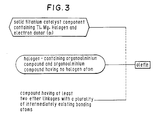
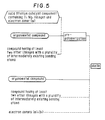
- Figs. 1-5 are given to illustrate concrete examples of the processes for the preparation of the first to fifth olefin polymerization catalysts.
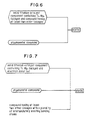
- Figs. 6 and 7 are given to illustrate concrete examples of the processes for the preparation of olefin polymerization catalysts used in the sixth or seventh olefin polymerizaiton method.
- the first to third olefin polymerization catalysts and catalysts used for the first and second prepolymerized polyolefin-containing catalysts and the sixth and seventh olefin polymerization method of the present invention are prepared by using specific solid titanium catalyst components [I], [Ia] and [Ib], respectively.
- the above-mentioned solid titanium catalyst component [I] of the present invention is used.
- This solid titanium catalyst component [I] is obtained by the contact of a solid titanium component (A) containing titanium, magnesium, halogen and an electron donor (a0) with an electron donor (b0), wherein either said electron donor (a0) or electron donor (b0) is a compound having at least two ether linkages with a plurality of intermediately existing bonding atoms.
- the first olefin polymerization catalyst of the invention is formed by the contact of this solid titanium catalyst component [I] with an organoaluminum catalyst component [IIa] which will be mentioned later.
- the solid titanium component (A) used in the preparation of this solid titanium catalyst component [I] is prepared, for example, by bringing a magnesium compound, a titanium compound and the above-mentioned electron donor (a0) into contact with one another, said electron donor (a0) may be a compound having at least two ether linkages.
- the magnesium compound used in the preparation of the solid titanium component (A) includes those having reducing ability or those having no reducing ability.
- the magnesium compounds having reducing ability referred to above include, for example, organomagnesium compounds represented by the formula X n MgR 2-n wherein n is 0 ⁇ n ⁇ 2, R is hydrogen, alkyl of 1-20 carbon atom, aryl or cycloalkyl, when n is 0, Rs may be the same or different, and X is halogen.
- organomagnesium compounds as having reducing ability include dimethylmagnesium, diethylmagnesium, dipropylmagnesium, dibutylmagnesium, diamylmagnesium, dihexylmagnesium, didecylmagnesium, methylmagnesium chloride, propylmagnesium chloride, butylmagnesium chloride, hexylmagnesium chloride, amylmagnesium chloride, butylethoxymagnesium, ethylbutylmagnesium, octylbutylmagnesium, butylmagnesium hydride.
- These magnesium compounds exemplified above may be singly, or they may form complex compounds with organoaluminum compounds which will be mentioned later.
- These magnesium compounds used may be either a liquid or a solid.
- magnesium compounds having no reducing ability include; magnesium halides such as magnesium chloride, magnesium bromide, magnesium iodide and magnesium fluoride; alkoxymagnesium halides such as methoxymagnesium chloride, ethoxymagnesium chloride, isopropoxymagnesium chloride, butoxymagnesium chloride and octoxymagnesium chloride; aryloxymagnesium halides such as phenoxymagnesium chloride and methylphenoxymagnesium chloride; alkoxymagnesiums such as ethoxymagnesium, isopropoxy magnesium, butoxymagnesium, n-octoxymagnesium and 2-ethylhexoxymagnesium; aryloxymagnesiums such as phenoxymagnesium and dimethylphenoxymagnesium; magnesium carboxylates such as magnesium laurate and magnesium stearate.
- magnesium halides such as magnesium chloride, magnesium bromide, magnesium iodide and magnesium fluoride
- the magnesium compounds having no reducing ability exemplified above may be those derived from the above-mentioned magnesium compounds having reducing ability or may be those derived at the time of preparation of the catalyst component.
- the magnesium compounds having no reducing ability may be derived from the magnesium compounds having reducing ability, for example, by bringing the magnesium compounds having reducing ability into contact with a halogen containing compound or a compound having OH group or active carbon-oxygen bond such as polysiloxane compounds, halogen containing silane compounds, halogen containing aluminum compounds, esters or alcohols.
- the magnesium compounds used for the purposes intended may be complex compounds or double compounds with other metals or mixtures with other metals. Furthermore, the magnesium compounds used may be mixtures of two or more kinds of the above-mentioned compounds, and they may be used either in a liquid or solid state. When the magnesium compounds used are solid, they may be liquefied with alcohols, carboxylic acids, aldehydes, amines and esters of metallic salts.
- magnesium compounds preferred are those having no reducing ability, especially those containing halogen.
- halogen containing magnesium compounds preferred are magnesium chloride, alkoxy magnesium chloride and aryloxy magnesium chloride.
- a titanium compound in the liquid state is preffered and includes, for example, tetravalent titanium compound represented by the general formula Ti (OR) g X 4-g wherein R is a hydrocarbon radical, X is halogen, and 0 ⁇ g ⁇ 4.
- titanium compounds in the lipuid state include titanium tetrahalide such as TiCl4, TiBr4 or TiI4; alkoxy titanium trihalide such as Ti (OCH3)Cl3, Ti(OC2H5)Cl3, Ti(On-C4H9)Cl3, Ti(OC2H5)Br3 or Ti(Oiso-C4H9)Br3; alkoxy titanium dihalide such as Ti(OCH3)2Cl2, Ti(OC2H5)2Cl2, Ti(On-C4H9)2Cl2 or Ti(OC2H5)2Br2; alkoxy titanium monohalide such as Ti(OCH3)3Cl, Ti(OC2H5)3Cl, Ti(On-C4H9)3Cl or Ti(OC2H5)3Br; and tetraalkoxy titanium such as Ti(OCH3)4, Ti(OC2H5)4, Ti(On-C4H9)4, Ti(Oiso-C4H9)4, Ti(O-2-ethylhex
- titanium tetrahalides especially titanium tetrachloride.
- These titanium compounds may be used either singly or in admixture, or may be used after dilution in hydrocarbon or halogenated hydrocarbon.
- solid titanium component (A) used in the olefin polymerization catalyst of the invention there is used a compound having at least two ether linkages with a plurality of intermediately existing bonding atoms and/or an electron donor (a1) other than said compound having at least two ether linkages as an electron donor (a0), in addition to the above-mentioned magnesium and titanium compounds.
- Such compound having at least two ether linkages as mentioned above includes, for example, those represented by the following formula wherein n is an integer of 2 ⁇ n ⁇ 10, R1-R26 are each a substituent having at least one element selected from among carbon, hydrogen, halogen, nitrogen, sulfur, phosphorus, boron and silicon, any of R1-R26, preferably R1-R 2n may form, together a ring other than a benzene ring, and the main chain of the compound may contain atoms other than carbon.
- the compound having at least two ether linkages as illustrated above includes 2-(2-ethylhexyl)-1,3-dimethoxypropane, 2-isopropyl-1,3-dimethoxypropane, 2-butyl-1,3-dimethoxypropane, 2-s-butyl-1,3-dimethoxypropane, 2-cyclohexyl-1,3-dimethoxypropane, 2-phenyl-1,3-dimethoxypropane, 2-cumyl-1,3-dimethoxypropane, 2-(2-phenylethyl)-1,3-dimethoxypropane, 2-(2-cyclohexylethyl)-1,3-dimethoxypropane, 2-(p-chlorophenyl)-1,3-dimethoxypropane, 2-(diphenylmethyl)-1,3-dimethoxypropane, 2-(1-naphthyl)-1,3-dimethoxypropane
- 1,3-diethers espesially, 2,2-di-iso-butyl-1,3-dimethoxypropane, 2-iso-propyl-2-iso-pentyl-1,3-dimethoxypropane, 2,2-dicyclohexyl-1,3 dimethoxypropane and 2,2-bis(cyclohexylmethyl)1,3-dimethoxypropane.
- the electron donor (a1) used in the solid titanium component (A) in addition to the above-mentioned compound having at least two ether linkages includes organic ester, organic acid halide, organic acid anhydride, ether, ketone, aldehyde, tertiary amine, phosphorous ester, phosphate ester, phosphate amide, carboxylic acid amide, nitryl.
- ketones having 3-15 of carbon atoms such as acetone, methyl ethyl ketone, methyl iso-butyl ketone, acetophenone, benzophenone, cyclohexanone and benzoquinone; aldehydes having 2-15 of carbon atoms such as acetaldehyde, propionaldehyde, octylaldehyde, benzaldehyde, tolualdehyde and naphthoaldehyde; organic esters such as methyl formate, methyl acetate, ethyl acetate, vinyl acetate, propyl acetate, octyl acetate, cyclohexyl acetate, ethyl propionate, methyl butyrate, ethyl valerate, methyl chloroacetate, ethyl dichloroacetate, methyl methacrylate, ethyl crot
- polycarboxylic acid esters may be mentioned as particularly preferred examples of the organic acid esters mentioned above, and they include such compounds as having a skeleton represented by the following general formula.
- R1 is a substituted or unsubstituted hydrocarbon radical
- R2, R5 and R6 are each hydrogen or a substituted or unsubstituted hydrocarbon radical
- R3 and R4 are each hydrogen or a substituted or unsubstituted hydrocarbon radical, preferably at least one of R2, R5 and R6, and at least one of R3 and R4 is a substituted or unsubstituted hydrocarbon radical
- R3 and R4 may be connected to each other, and when R1-R6 are each a substituted hydrocarbon radical, the substituent thereof includes such groups as containing at least one atom different from carbon atom such as N, O, or S, for example, C-O-C, COOR, COOH, OH, SO3H, -C-N-C- and NH2.
- Such polycarboxylic acid esters as illustrated above include concretely; aliphatic polycarboxylates such as diethyl succinate, dibutyl succinate, diethyl methylsuccinate, di-iso-butyl alpha-methylglutamate, diethyl methylmalonate, diethyl ethylmalonate, diethyl iso-propylmalonate, diethyl butylmalonate, diethyl phenylmalonate, diethyl diethylmalonate, diethyl dibutylmalonate, monooctyl maleate, dioctyl maleate, dibutyl maleate, dibutyl butylmaleate, diethyl butylmaleate, di-iso-propyl beta-metylglutarate, diallyl ethylsuccinate, di-2-ethylhexyl fumarate diethyl itaconate and diocty
- polycarboxylic acid esters other than those exemplified above examples include long dicarboxylic acid esters such as diethyl adipate, di-iso-butyl adipate, di-iso-propyl sebacate, di-n-butyl sebacate, di-n-octyl sebacate, di-2-ethylhexyl sebacate.
- long dicarboxylic acid esters such as diethyl adipate, di-iso-butyl adipate, di-iso-propyl sebacate, di-n-butyl sebacate, di-n-octyl sebacate, di-2-ethylhexyl sebacate.
- carboxylic acid esters especially polycarboxylic acid esters and, in particular, phthalic esters.
- the solid titanium component (A) used in the invention may also be prepared by bringing the above-mentioned magnesium compound, liquid titanium compound and electron donor (a0) into contact with a carrier compound and an organic and inorganic compound containing silicon, phosphorus or aluminum used as a reaction assistant.
- carrier compound referred to above there may be mentioned Al2O3, SiO2, B2O3, MgO, CaO, TiO2, ZnO, ZnO2, SnO2, BaO, ThO, and such resins as styrene/divinylbenzene copolymers.
- carrier compounds preferred are, Al2O3, SiO2 and styrene/divinylbenzene copolymers.
- the electron donor (a0) is not always used as a starting material, and it may also be formed in the course of preparation of the solid titanium component (A).
- the solid titanium component (A) used in the invention is prepared by bringing the above-mentioned magnesium compound, liquid titanium compound and electron donor (a0) into contact with one another.
- the amounts of the magnesium compound, titanium compound in the liquid state and electron donor (a0) used in the preparation of the solid titanium component (A) by the above-illustrated processes vary depending upon the kind of each compound used, conditions, and contacting order. Generally, however, there are used, based on 1 mole of the magnesium compound, the electron donor (a0) in an amount of 0.01-5 moles, preferably 0.1-1 mole, and the liquid titanium compound in an amount of 0.1-1000 moles, preferably 1-200 moles.
- the temperature at which these compounds are brought into contact with one another is usually from -70° to 200°C, preferably -30-150°C.
- the solid titanium component (A) thus obtained contains titanium, magnesium, halogen and electron donor (a0).
- halogen/titanium (atomic ratio) is 2-100, preferably 4-90
- electron donor (a0)/titanium (molar ratio) is 0.01-100, preferably 0.2-10
- magnesium/titanium (atomic ratio) is 2-100, preferably 4-50.
- the solid titanium catalyst component [I] for olefin polymerization of the present invention is formed by bringing the above-mentioned solid titanium component (A) into contact with (B) an electron donor (b0).
- the electron donor (b0) used herein includes, in addition to the above-mentioned electron donor (a0), that is, the compound having at least two ether linkages and the electron donor (a1), an electron donor (b1) including an organosilicon compound, a nitrogen containing compound, an oxygen containing compound and a phosphorus containing compound. Of these compound, preferred are the compound having at least two ether linkages and the organosilicon compound.
- the organosilicon compound used as the electron donor (b1) includes those represented by the following general formula. R n Si (OR′) 4-n wherein R and R′ are each a hydrocarbon radical, and 0 ⁇ n ⁇ 4.
- the organosilicon compound represented by the above-mentioned general formula includes concretely trimethylmethoxysilane, trimetylethoxysilane, dimetyldimethoxysilane, dimethyldiethoxysilane, di-iso-propyldimethyoxysilane, t-butylmethyldimethoxysilane, t-butylethyldimethoxysilane, t-amylmethyldiethoxysilane, diphenyldimethoxysilane, phenylmethyldimethoxysilane, diphenyldiethoxysilane, bis-o-tolyldimethoxysilane, bis-m-tolyldimethoxysilane, bis-p-tolyldimethoxysilane, bis-p-tolyldiethoxysilane, bis(ethylphenyl)dimethoxysilane, dicyclohexyldimethoxysilane, cycl
- ethyltriethoxysilane n-propyltriethoxysilane, t-butyltriethoxysilane, vinyl triethoxysilane, phenyl triethoxysilane, vinyl tribytoxysilane, diphenyldimethoxysilane, phenylmethyldimethoxysilane, bis-p-tolyldimethoxysilane, p-tolylmethyldimethoxysilane, dicyclohexylmethoxysilane, cyclohexylmethyldimethoxysilane, 2-norbornanetriethoxysilane, 2-norbornanemethyldimethoxysilane, phenyltriethoxysilane, dicyclopentyldimethoxysilane, hexenyltrimethoxysilane, cyclopentyltriethoxysilane, tricyclopent
- the electron donor (b1) a nitrogen containing compound, an oxygen containing compound and a phosphorus containing compound.
- the nitrogen containing compound mentioned above includes concretely 2,6-substituted piperidines such as those having the following structural formulas 2.5-substituted piperidines such as those having the following structural formula substituted methylenediamines such as N,N,N′,N′-tetramethylmethylenediamine and N,N,N′,N′-tetraethylmethylenediamine; and substituted imidazolidine such as 1,3-dibenzylimidazolidine and 1,3-dibenzyl-2-phenylimidazolidine.
- the phosphorus containing compound used herein includes concretely phosphorous acid esters such as triethyl phosphite, tri-n-propyl phosphite, triisopropyl phosphite, tri-n-butyl phosphite, triisobutyl phosphite, diethyl-n-butyl phosphite and diethylphenyl phosphite.
- the oxygen containing compound used herein includes 2,6-substituted tetrahydropyranes such as those having the following structural formulas and 2,5-substituted tetrahydropyranes such as having the following formula.
- the amount of the electron donor (b0) used is 0.1-50 moles, preferably 0.5-30 moles and especially 1-10 moles based on 1 mole of titanium atom of the solid titanium component (A).
- an organometallic compound [IIa] as will be mentioned later may be used in an amount of 0.1-300 moles, preferably 0.5-100 moles and especially 1-50 moles based on 1 mole of titanium atom of the solid titanium component (A).
- the electron donor (a0) and (b0) used in the preparation of the solid titanium component (A) may be electron donors other than the above-mentioned compounds having at least two ether linkages, and at least one of the electron donors (a0) and (b0) used in the solid titanium component (A) must contain the compound having at least two ether linkages.
- the second olefin polymerization catalyst of the present invention contains a solid titanium catalyst component [Ia] containing titanium, magnesium, halogen and a compound having at least two ether linkages with a plurality of intermediately existing bonding atoms
- the third olefin polymerization catalyst of the invention contains a solid titanium catalyst component [Ib] containing titanium, magnesium, halogen and the electron donor (a1).
- the solid titanium catalyst component [Ia] or [Ib] may be prepared by the contact of the magnesium compound, a titanium compound, the above-mentioned compound having at least two ether linkages or the electron donor (a1) with one another, and said compounds are used in the preparation of the above-mentioned solid titanium component (A).
- the electron donor (a1) may be used together with the compound having at least two ether linkages.
- solid titanium catalyst component [Ia] or [Ib] may also be prepared by the manner as mentioned above while using also the same organic and inorganic compounds as the carrier compounds or reaction assistants as used in the case of the preparation of the above-mentioned solid titanium component (A).
- the above-mentioned electron donor (a1) is not always used as a starting material, and can also be formed in the course of the preparation of the solid catalyst component [Ia] or [Ib].
- the solid titanium catalyst component [Ia] is prepared, as illustrated above, by bringing the above-mentioned magnesium compound, liquid titanium compound, compound having at least two ether linkages and, if necessary, carrier compound and electron donor (a1) into contact with one another.
- the amounts of the magnesium compound, liquid titanium compound and compound having at least two ether linkages vary depending upon the kind of the compounds used, contact conditions and contacting order employed. Generally, however, there may be used, based on 1 mole of magnesium atom of the magnesium compound, the compound having at least two ether linkages in an amount of 0.01-5 moles, preferably 0.1-1 mole, and the titanium compound in the liquid state in an amount of 0.1-1000 moles, preferably 1-200 moles.
- the temperature at which these compounds are brought into contact with one another is usually from -70°C to 200°C, preferably 10-150°C.
- the solid titanium catalyst component [Ia] contains titanium, magnesium, halogen and the above-mentioned compound having at least two ether linkages.
- halogen/titanium (atomic ratio) is 2-100, preferably 4-90
- the compound having at least two ether linkages/titanium (molar ratio) is 0.01-100, preferably 0.2-10
- magnesium/titanium (atomic ratio) is 2-100, preferably 4-50.
- the solid titanium catalyst component [Ib] used in the present invention may be prepared by bringing the magnesium compound, titanium compound in the liquid state, electron donor (a1) and, if necessary, the carrier compound or the like into contact with one another.
- the amounts of the magnesium compound, the titanium compound in the liquid state and the electron donor (a1) used vary depending on the kind of the compound used, contacting conditions and contacting order. Generally, however, there may be used, based on 1 mole of magnesium, the electron donor (a1) in an amount of 0.01-5 moles, preferably 0.1-1 mole, and the titanium compound in the liquid state in an amount of 0.1-1000 moles, preferably 1-200 moles.
- the temperature at which these compounds are brought into contact with one another is usually from -70 to 200°C, preferably 10-150°C.
- the solid titanium catalyst component [Ib] contains titanium, magnesium, halogen and the electron donor (a1).
- halogen/titanium (atomic ratio) is 1-100, preferably 4-90
- electron donor (a1)/titanium (molar ratio) is 0.01-100, preferably 0.2-10
- magnesium/titanium (atomic ratio) is 2-100, preferably 4-50.
- the first prepolymerized polyolefin-containing catalyst of the present invention is prepared by using an olefin polymerization catalyst containing a solid titanium catalyst component [Ia] containing titanium, magnesium, halogen and a compound having at least two ether linkages with a plurality of intermediately existing bonding atoms.
- the second prepolymerized polyolefin-containing catalyst of the invention in prepared by using a solid titanium catalyst component [Ib] containing titanium, magnesium, halogen and an electron donor (a1).
- the solid titanium catalyst component [Ia] or [Ib] mentioned above may be prepared by the same process for the preparation of the solid titanium catalyst component as employed in the case of the second and third olefin polymerization catalyst of the invention, and the composition ratio thereof is the same as in the solid titanium catalyst component used in the second or third olefin polymerization catalyst of the invention.
- the first to third olefin polymerization catalysts and the first and second prepolymerized polyolefin-containing catalysts are formed by using the above-illustrated solid titanium catalyst components [I], [Ia] and [Ib], the organometallic compound catalyst components [IIa] and [IIb], and the electron donor components [III] and [IIIa] in specific combination.
- olefin polymerization methods there are used for polymerization of olefin catalysts or prepolymerized olefin cantaining catalysts formed by using the above-illustrated solid titanium catalyst components [I], [Ia] and [Ib], the organometallic compound catalyst components [IIa] and [IIb], and the electron donor components [III] and [IIIa] in specific combination.
- the first olefin polymerization catalyst of the invention may be formed from the solid titanium catalyst component [I], the organometallic compound catalyst component [IIa] containing a metal selected from those belonging to Groups I to III of the periodic table and, if necessary, the electron donor (c) [III] including the above-mentioned compound having at least two ether linkages.
- Fig. 1 is given to illustrate the concrete example of the step for preparing the olefin polymerization catalyst of the invention.
- the organometallic compound catalyst component [IIa] as used herein includes, for example, an organoaluminum compound, a complex alkylation product of a metal of Group I with aluminum, and an organometallic compound of a metal of Group II.
- the organoaluminum compound mentioned above includes those represented by the formula R a n AlX 3-n wherein R a is a hydrocarbon radical of 1-12 carbon atoms, X is halogen or hydrogen, and n is 1-3.
- R a is a hydrocarbon radical of 1-12 carbon atoms, for example, alkyl, cycloalkyl or aryl, and concretely includes methyl, ethyl, n-propyl, isopropyl, isobutyl, pentyl, hexyl, octyl, cyclopentyl, cyclohexyl, phenyl or tolyl.
- the organoaluminum compound illustrated above includes concretely such compounds as exemplified below.
- trialkyl alminiums such as trimethylalminium, tri-iso-butylalminium, trioctylalminium, tri-ethylalminium, tri-iso-propylalminium, tri-2-ethylhexylalminium; alkenylalminium such as iso-prenylalminium; dialkylalminium halides such as dimethylalminium chloride, diethylalminium chloride, di-iso-propylalminium chloride, di-iso-butylalminium chloride, dimethylalminium bromide; alkylalminium sesquihalide such as methylalminium sesquichloride, ethylalminiumsesquichloride, iso-propylalminium sesquichloride, butylalminium sesquichloride, ethylal
- organoaluminum compound there may also be used such compounds as may be represented by the formula R a n AlY 3-n wherein R a is as defined above, Y is -OR b , -OSiR c 3, -OAlR d 2, -NR e 2, SiR f 3 or n is 1-2, R b , R c , R d and R h are each methyl, ethyl, isopropyl, isobutyl, cyclohexyl, or phenyl, R e is hydrogen, methyl, ethyl, isopropyl, phenyl or trimethylsilyl, and R f and R g are each methyl or ethyl.
- organoaluminum compounds as illustrated above include those having the following formulas.
- Preferred examples of the above-exemplified organoaluminium compounds are those represented by the formula R a 3Al, R a n Al(OR b ) 3-n and R a n Al(OAlR d 2) 3-n .
- the complex alkylation product of a metal of Group I with aluminum is exemplified by a compound represented by the general formula M1 Al R j 4 wherein M1 is Li, Na or K, and R j is a hydrocarbon radical of 1-15 carbon atoms, and includes concretely LiAl(C2H5)4 and LiAl(C7H15)4.
- the organometallic compound containing a metal of Group II is exemplified by a compound represented by the general formula R1R k M2 wherein R k and R1 are each a hydrocarbon radical of 1-15 atoms or halogen, provided that both R k and R1 do not represent halogen, though may be the same or different, M2 is Mg, Zn or Cd, and includes concretely diethylzinc, diethylmagnesium, butylethylmagnesium, ethylmagnesium chloride and butylmagnesium chloride. These compounds may be used in admixture of two or more.
- the electron donor (c) [III] including a compound having at least two ether linkages with a plurality of intermediately existing bonding atoms.
- the electron donors (a1) and (b1) used in the preparation of the solid titanium catalyst component [I] of the invention.
- the second olefin polymerization catalyst of the invention which is used in the second polymerization method, contains the above-mentioned solid titanium catalyst component [Ia] along with as the organometallic compound catalyst component the organoaluminum compound catalyst component [IIb] comprising a halogen containing organoaluminum compound and an organoaluminum compound containing no halogen.
- Fig. 2 is given to illustrate a concrete example of a step for preparing the second olefin polymerization catalyst of the invention.
- organoaluminum compound containing no halogen may be exemplified by the compound represented by the aforementioned formula R a n AlY 3-n .
- organoaluminum compound represented by the aforementioned formula R a n AlX 3-n in which 1 ⁇ n ⁇ 3, for example, dialkylaluminum halide, alkylaluminum sesquihalide and alkylaluminum dihalide.
- the organoaluminum compound catalyst component [IIb] used in the invention may be prepared by using the organoaluminum compound containing no halogen in an amount, based on 1 mole of the halogen containing organoaluminum compound, of usually 0.01-19 moles, preferably 0.1-5 moles.
- the electron donor (c) that is, any one of the above-mentioned compound having at least two ether linkages, the electron donor (a1) and electron donor (b1) in addition to the above-mentioned organometallic compound catalyst compornent [IIb].
- the compound having at least two ether linkages and the organosilicon compound (R n Si(OR′) 4-n ) exemplified as the electon donor (b1).
- the third olefin polymerization catalyst of the invention which is used in the third olefin polymerizaiton method, contains the above-mentioned solid titanium catalyst component [Ib], organoaluminum compound catalyst component [IIb] and compound [IIIa] having at least two ether linkages with a plurality of intermediately existing bonding atoms.
- Fig. 3 is given to illustrate a concrete examlpe of a step for preparing the third olefin polymerization catalyst of the invention.
- organoaluminum compound catalyst component [IIb] there may be used, for example, the same catalyst component comprising the halogen containing organoaluminum compound and the organoaluminum compound containing no halogen as used in the preparation of the second olefin polymerization catalyst of the invention.
- the above-mentioned compound [IIIa] having at least two ether linkages used in the third olefin polymerization catalyst of the invention includes the same compound having at least two ether linkages as used in the preparation of the solid titanium catalyst component of the first olefin polymerization catalyst of the invention.
- the third olefin polymerization catalyst of the invention may contain an electron donor in addition to the above-mentioned compound having at least two ether linkages, and such electron donor as used herein includes, for example, the electron donors (a1) and (b1) used in the preparation of the first olefin polymerization catalyst of the invention.
- the electron donors (a1) and (b1) used in the preparation of the first olefin polymerization catalyst of the invention.
- the electron donors (a1) and (b1) used in the preparation of the first olefin polymerization catalyst of the invention.
- the organo silicon compound (R n Si (OR′) 4-n ) examplified as the electron doner (b1).
- the first prepolymerized polyolefin-containing catalyst of the present invention which is used in the fourth olefin polymerization method, is prepared by polymerizing olefin by using an olefin polymerization catalyst containing the solid titanium catalyst component [Ia] and the organometallic compound catalyst component [IIa] containing a metal selected from among those belonging to Groups I to III of the periodic table.
- the solid titanium catalyst component [Ia] mentioned above is the same component [Ia] as used in the second olefin polymerization catalyst of the invention.
- organometallic compound catalyst component [IIa] mentioned above is the same component [IIa] as used in the first olefin polymerization catalyst of the invention.
- the electron donor (c) that is, the compound having at least two ether linkages, the electron donor (a1) and the electron donor (b1) together with the above-mentioned organometallic compound catalyst component [IIa].
- the second prepolymerized polyolefin-containing catalyst of the invention which is used in the fifth olefin polymerization method, contains an olefin polymerization catalyst containing the above-mentioned solid titanium catalyst component [Ib], the organometallic compound catalyst component [IIa] and the compound [IIIa] having at least two ether linkages with a plurality of intermediately existing bonding atoms.
- organometallic compound catalyst component [IIa] as used in the above-mentioned olefin polymerization catalyst, there may be mentioned, for example, the same catalyst component containing the organometallic compound as used in the preparation of the first olefin polymerization catalyst of the invention.
- the second prepolymerized polyolefin-containing catalyst of the invention may contain an electron donor in addition to the above-mentioned compound having at least two ether linkages, for example, the electron donors (a1) and (b1) used in the preparation of the first olefin polymerization catalyst of the invention.
- the first prepolymerized polyolefin-containing catalyst [Ia-IIa-IIIa] of the invention may be formed by polymerizing ⁇ -olefin on an olefin polymerization catalyst containing the above-mentioned solid titanium catalyst component [Ia] and organometallic compound catalyst component [IIa].
- the second prepolymerized polyolefin-containing catalyst [Ib-IIa-IIIa] of the invention may be formed by polymerizing ⁇ -olefin on an olefin polymerization catalyst containing the above-mentioned solid titanium catalyst component [Ib], organometallic compound catalyst component [IIa] and the compound [IIIa] having at least two ether linkages.
- the first to third olefin polymerization catalysts of the invention may be prepolymerized when used in olefin polymerization.
- the prepolymerization of the olefin polymerization catalyst may be carried out by prepolymerizing ⁇ -olefin in an amount, based on 1 g of the catalyst, of 0.1-1000 g, preferably 0.3-500 g and especially 1-200 g on said catalyst.
- the catalyst may be used in a concentration higher than that of the catalyst used in the system of the main polymerization.
- the solid titanium catalyst component [I], [Ia] or [Ib] is used in the prepolymerization in an amount, per liter of a liquid medium, of usually 0.001-100 mmoles, preferably 0.01-50 mmoles, and especially 0.1-20 mmoles in terms of titanium atom.
- the organometallic compound catalyst component [IIa] or [IIb] may be used in the prepolymerization in such an amount that the prepolymer is formed in an amount, based on 1 g of the solid titanium catalyst component [I], [Ia] or [Ib], of 0.1-1000 g, preferably 0.3-500 g, said amount being usually about 0.1-300 moles, preferably about 0.5-100 moles and especially 1-50 moles based on 1 mole of titanium atom in the solid titanium catalyst component [I], [Ia] or [Ib].
- the electron donor [III] or [IIIa] may be used in the polymerization in an amount, based on 1 mole of titanium atom in the solid titanium catalyst component [I], [Ia] or [Ib], of 0.1-50 moles, preferably 0.5-30 moles and especially 1-10 moles.
- the prepolymerization may be carried out using a mixture of an inert hydrocarbon solvent, ⁇ -olefin and the above-mentioned catalyst components under mild conditions.
- the inert hydrocarbon solvent used herein includes concretely aliphatic hydrocarbons such as propane, butane, pentane, hexane, heptane, octane, decane, dodecane and kerosine; alicyclic hydrocarbons such as cyclopentane, cyclohexane and methylcyclopentane; aromatic hydrocarbons such as benzene, toluene and xylene; and halogenated hydrocarbons such as ethylene chloride and chlorobenzene, or mixtures thereof.
- aliphatic hydrocarbons such as propane, butane, pentane, hexane, heptane, octane, decane, dodecane and kerosine
- alicyclic hydrocarbons such as cyclopentane, cyclohexane and methylcyclopentane
- aromatic hydrocarbons such as benzene, toluene and x
- the prepolymerization is carried out using the inert hydrocarbon media as aforesaid, it is preferably carried out batchwise.
- the prepolymerization may also be carried out using ⁇ -olefin itself as a solvent or in a state where substantially no solvent is present. In that case, the prepolymerization is preferably carried out continuously.
- the ⁇ -olefin used in the prepolymerization may be the same as or different from that used in the main polymerization as will be mentioned later, but in practice propylene is preferred.
- the reaction temperature at which the prepolymerization is carried out is usually from about -20 to +100°C, preferably from about -20 to +80°C and especially from 0 to +40°C.
- a molecular weight modifier such as hydrogen may be used. It is desirable to use in this case the molecular weight modifier in such an amount that an intrinsic viscosity [ ⁇ ], as measured in decalin at 135°C, of the polymer resulting from the prepolymerization is more than about 0.2 dl/g, preferably about 0.5-10 dl/g.
- the prepolymerization as illustrated above is desirably carried out in such a manner that the polymer resulting therefrom amounts to about 0.1-1000 g, preferably about 0.3-500 g and especially 1-200 g based on 1 g of the solid titanium catalyst component [I], [Ia] or [Ib].
- the fourth or fifth method of olefin polymerization of the invention comprises polymerizing olefin using a catalyst containing the first or second prepolymerized polyolefin-containing catalyst, that is, the fourth or fifth olefin polymerization catalyst of the invention as will be mentioned later.
- the fourth olefin polymerization catalyst of the invention contains the above-mentioned prepolymerized polyolefin-containing catalyst [Ia-IIa], the organometallic compound [IIa] containing a metal selected from among those belonging to Groups I to III and, if necessary, the electron donor [IIIb], that is, at least one compound selected from among the compound having at least two ether linkages with a plurality of intermediately existing bonding atoms, the electron donors (a1) and (b1).
- the fifth olefin polymerization catalyst of the invention contains the above-mentioned prepolymerized polyolefin-containing catalyst [Ib-IIa-IIIb], the organometallic compound [IIa] containing a metal selected from among those belonging to Groups I to III of the periodic table and, if necessary, the electron donor [IIIb], that is, at least one compound selected from among the compound having at least two ether linkages with a plurality of intermediately existing bonding atoms, the electron donors (a1) and (b1) .
- organometallic compound catalyst component [IIa] used in the above-mentioned olefin polymerization catalysts is the same as that used in the preparation of the above-mentioned prepolymerized polyolefin-containing catalyst.
- the compound having at least two ether linkages mentioned above, and the electron donors (a1) and (b1) used therein are also the same as those used in the preparation of the above-mentioned prepolymerized polyolefin-containing catalyst.
- Figs. 4 and 5 are given to illustrate concrete examples of the steps for preparing the fourth and fifth olefin polymerization catalysts of the invention.
- At least one ⁇ -olefin is polymerized by using a catalyst containing the solid titanium catalyst component [Ia] and the organometallic compound [IIa] to obtain a specific polymer or copolymer.
- At least one ⁇ -olefin is polymerized by using a catalyst containing the solid titanium catalyst component [Ib], the organometallic compound [IIa] and the compound having at least two ether linkages [IIIa] to obtain a specific polymer or copolymer.
- Figs. 6 and 7 are given to illastrate concrete examples of the steps for preparing the catalysts used in the sixth and seventh method for polymerization of ⁇ -olefin.
- At least one ⁇ -olefin sellected from among ⁇ -olefins having at least 2 carbon atoms is polymerized to obtain a polymer or copolymer containing at least 70 % of ⁇ -olefin having at least 4 carbon atoms by using the polymerization catalyst containing the solid titanium catalyst component [Ia] and the organometallic compound [IIa], the polymerization catalyst containing the solid titanium catalyst component [Ib], the organometallic compound [IIa] and the compound having at least two ether linkages [IIIa], or the first or second prepolymerized polyolefin-containing catalyst.
- the above polymerization catalysts are the catalysts used for preparing the first or second prepolymerized polyolefin-containing catalyst.
- Useful olefins in the first to fifth methods of olefin polymerization include ethylene and ⁇ -olefins of 3-20 carbon atoms, for example, propylene, 1-butene, 1-pentene, 1-hexene, 4-methyl-1-pentene, 1-octene, 1-decene, 1-dodecene, 1-tetradecene, 1-hexadecene, 1-octadecene and 1-eicosane.
- the sixth and seventh olefin polymerization methods of the present invention of these alpha-olefins are sellected the ⁇ -olefin having at least 2 carbon atoms so as to make the ⁇ -olefin having at least 4 carbon atoms be the main compornent.
- at least one ⁇ -olefin having at least 4 carbon atoms sellected from the ⁇ -olefin having at least 2 carbon atoms are used in such an amount that the polymer or copolymer obtained are containing at least 70 mol% of the ⁇ -olefin having at least 4 carbon atoms.
- aromatic vinyl compounds such as styrene and allyl benzene
- alicyclic vinyl compounds such as vinyl cyclohexane
- cycloolefins such as cyclopentene, cycloheptene, norbornene, 5-methyl-2-norbornene, tetracyclodecene and 2-methyl-1,4,5,8-dimethano-1,2,3,4,4a,5,8,8a-octahydronaphthalene
- compounds having poly-unsaturation bonds such as conjugated diene or non-conjugated diene, for example, 6-methyl-1,6-octadiene, 7-methyl-1,6-octadiene, 6-ethyl-1,6-octadiene, 6-propyl-1,6-octadiene, 6-butyl-1,6-octadiene, 6-methyl-1,6-n
- the polymerization may be carried out by liquid phase polymerization technique such as solution polymerization or suspension polymerization, or by vapor phase polymerization technique.
- the reaction solvent used may be either the above-mentioned inert hydrocarbon or an olefin which is liquid at the reaction temperature.
- the solid titanium catalyst component [I], [Ia] or [Ib] is used in an amount, based on 1 liter of the polymerization volume, of usually about 0.001-0.5 mmole, preferably about 0.005-0.1 mmole in terms of titanium atom.
- the organometallic compound catalyst component [IIa] or [IIb] is used in such an amount that the metallic atom thereof amounts usually to about 1-2000 moles, preferably about 5-500 moles per 1 mole of titanium atom of the prepolymerized polyolefin-containing catalyst present in the polymerization system.
- the above-mentioned compound having at least two ether linkages is used in such an amount that said compound amounts usually to about 0.001-10 moles, preferably 0.01-2 moles based on 1 mole of the metallic atom of the compound [IIa] or [IIb].
- an electron donor namely, the compound having at least two ether linkages and/or electron donoer (a1), (b1) may be used in the above-mentioned amount.
- the molecular weight of the polymer resulting therefrom can be modified, and polymers high in melt flow rate can be obtained.
- the polymerization temperature of olefin is usually about 20-200°C, preferably about 50-150°C, and the polymerization pressure is usually from ordinary pressure to 100 kg/cm2, preferably about 2-50 kg/cm2.
- the polymerization may also be carried out batchwise, semi-continuously or continuously, or may be carried out in two or more stages under varied reaction conditions.
- the olefin polymer thus obtained may be a homopolymer, random copolymer or block copolymer.
- the resulting propylene polymer will come to have an isotactic index (I I) shown by a boiling heptane extraction residue of more than 70%, preferably more than 85% and especially more than 95%.
- I I isotactic index
- steric regularity of the resulting polymer can be easily controlled by adjusting the amount of the above-mentioned compound having at least two ether linkages or electron donor to a desired level.
- the polymer obtained in the first to fifth olefin polymerization methods has an indication Mw/Mn of molecular weight distribution as measured by GPC (gel permeation chromatography) of usually not more than 5, said value being smaller than that of the polymer obtained by the prior art method.
- the olefin polymerization catalyst of the invention may contain other useful components for olefin polymerization in addition to the components as mentioned above.
- ⁇ -olefin having at least 2 carbon atoms is polymerized in the presence of the specific catalyst so as to obtain a poymer or copolymer containing at least 70 mol% of ⁇ -olefin having at least 4 carbon atom, there can be obtain a polymer or copolymer has an intrinsic viscosity [ ⁇ ] of 0.01-100 dl/g, prefferably 0.1-50 dl/g.
- the alpha-olefin type polymer thus obtained may be blended, if neccesary, with a heat stabilizer, a weathering stabilizer, a chemical destaticzer,an anti-blocking agent, a lubricant, a nucleating agent, a pigment, a dye and an organic or inorganic filler.
- solid titanium catalyst components for olefin polymerization of the invention it is possible, when used along with the above-mentioned compound having at least two ether linkages as an electron donor, to obtain olefin polymerization catalyst having high activities and capable of giving polymers high in stereospecificity, even when an electron donor is not used further at the time of polymerization of olefin.
- solid titanium catalyst components for , olefin polymerization of the invention moreover, it is possible to obtain olefin polymerization catalysts capable of giving polymers higher in steric regularity by using further the above-mentioned compound having at least two ether linkages or a specific electron donor at the time of polymerization of olefin.
- the first method of olefin polymerization using the first olefin polymerization catalyst of the invention containing the organometallic compound catalyst component [IIa] and the above-mentioned compound having at least two ether linkages or a specific electron donor in addition to the above-mentioned two components it is possible to obtain polymers higher in steric regularity.
- the solid titanium catalyst component containing the above-mentioned compound having at least two ether linkages as an electron donor and the organoaluminum compound catalyst component [IIb] it is possible to carry out the polymerization reaction efficiently with high catalytic activities, and obtain polymers high in stereospecificity.
- the third method of olefin polymerization using the third olefin polymerization catalyst of the invention containing the solid titanium catalyst component [Ib], the organometallic compound catalyst component [IIb] and the above-mentioned compound [IIIa] having at least two ether linkages it is possible to carry out the polymerization reaction efficiently with high catalytic activities, and obtain polymers high in stereospecificity.
- the solid titanium catalyst component [Ib] containing the compound having at least two ether linkages [IIb] as an electron donor it is possible, when used the solid titanium catalyst component [Ib] containing the compound having at least two ether linkages [IIb] as an electron donor, to obtain olefin polymerization catalysts high in activities and capable of giving polymers high in stereospecificity, even when an electron donor is not used further at the time of olefin polymerization.
- the second prepolymerized polyolefin-containing catalyst of the invention containing the above-mentioned compound having at least two ether linkages as an electron donor, it is possible to obtain olefin polymerization catalyst high in activities and capable of giving polymers high in stereospecificity even when an electron donor is further used at the time of olefin polymerization.
- the polymerization reaction efficiently proceeds with high catalytic activity, giving polymers containing at least 70 mol% of ⁇ -olefin having at least 4 carbon atoms high in stereospecificity and crystallinity.
- the polymerization reaction efficiently proceeds with high catalytic activity, giving polymers containing at least 70 mol% of ⁇ -olefin having at least 4 carbon atoms high in stereospecificity and crystallinity.
- a mixture of 95.2 g of anhydrous magnesium chloride, 442 ml of decane and 390.6 g of 2-ethylhexyl alcohol was reacted with heating at 130°C for 2 hours to prepare a homogeneous solution.
- the homogeneous solution thus obtained was cooled to room temperature, and 75 ml of the homogeneous solution was added dropwise to 200 ml of titanium tetrachloride kept at -20°C over a period of one hour.
- the temperature of the mixed solution was elevated to 110°C and over a period of 4 hours.
- the temperature of the mixture reached 110°C, 5.22 g of di-iso-butyl phthalate was added thereto, and the mixture was held with stirring at that temperature for 2 hours.
- the resulting solid was collected by hot filtration and re-suspended in 275 ml of titanium tetrachloride, followed by reaction with heating at 110°C for 2 hours. After completion of the reaction, the solid was collected by hot filtration and thoroughly washed with decane and hexane kept at 110°C until no free titanium compound was detected in the washing liquid.
- the solid titanium catalyst component [A] prepared in the manner mentioned above was stored as a decane slurry. A part thereof was dried to examine the catalyst composition. It was found that the thus-obtained solid titanium catalyst component [A] contained 2.4% by weight of titanium, 60% by weight of chlorine, 20% by weight of magnesium and 13.0% by weight of di-iso-butyl phthalate.
- the solid was washed two times by a washing treatment consisting of adding purified hexane to re-suspend the solid and leaving to stand followed by removal of the supernatant.
- the solid obtained was re-suspended in purified hexane and the whole amount of the resulting slurry was transferred to a catalyst bottle. In this transfer operation, the whole volume of the slurry was measured and at the same time, the concentration of the catalyst in the slurry was measured.
- Mw/Mn measured by GPC gel permeation chromatography
- the pretreatment of the catalyst component [A] was repeated in the same manner as in Example 1 except that 10 mmol of IPAMP was used in the pretreatment of the solid titanium catalyst component [A], and thus obtained a pretreated catalyst component [A2].
- the polymerization of propylene was repeated in the same manner as in Example 1 except that the catalyst component [A2] obtained by the above-described pretreatment of was used.
- the activity was 21,700 g-pp/mmol-Ti
- t-II was 98.3%
- MFR of white powder was 4.9
- the apparent bulk density was 0.46 g/ml.
- a mixture of 95.2 g of anhydrous magnesium chloride, 442 ml of decane and 390.6 g of 2-ethylhexyl alcohol were reacted with heating at 130°C for 2 hours to prepare a homogeneous solution.
- To the homogeneous solution was added 21.3 g of phthalic anhydride, and the mixture was stirred at 130°C for one hour to dissolve phthalic anhydride in the homogeneous solution.
- the thus-obtained homogeneous solution was cooled to room temperature, and 75 ml of the homogeneous solution was added dropwise to 200 ml of titanium tetrachloride kept at -20°C over a period of one hour.
- the temperature of the mixed solution was elevated to 110°C over a period of 4 hours.
- the temperature reached 110°C 4.79 ml of 2-isopropyl-2-isopentyl-1,3-dimethoxypropane (IPAMP) was added thereto, and the mixture was held with stirring at that temperature for 2 hours.
- IPAMP 2-isopropyl-2-isopentyl-1,3-dimethoxypropane
- the resulting solid was collected by hot filtration and re-suspended in 275 ml of titanium tetrachloride.
- the mixture was again reacted with heating at 110°C for 2 hours.
- the solid was collected by hot filtration and thoroughly washed with decane and hexane kept at 110°C until no free titanium compound was detected in the washing liquid.
- the solid titanium catalyst component [B1] prepared above was stored as a decane slurry. A part thereof was dried to examine the catalyst composition. It was found that the thus-obtained solid titanium catalyst component [B1] contained 2.3% by weight of titanium, 63% by weight of chlorine, 22% by weight of magnesium and 9.8% by weight of IPAMP.
- a high-speed mixer having an internal volume of 2 liter (manufactured by Tokushu Kika Kogyo KK) was thoroughly purged with N2, and 700 ml of refined kerosine, 10 g of commercial available MgCl2, 24.2 g of ethanol and 3 g of Emasol 320 (sorbitan distearate, a product of Kao-Atlas KK) were placed therein. While stirring the mixture, the temperature thereof was elevated and the mixture was stirred at 120°C and 800 rpm for 30 minutes.
- the resulting solution was transferred to a 2-liter glass flask (equipped with a stirrer) which was previously charged with 1 liter of refined kerosine cooled to -10°C by using a Teflon tube having an inner diameter of 5 mm under high-speed stirring.
- the resulting solid was collected by filtration and thoroughly washed with hexane to obtain a carrier.
- CMMS cyclohexylmethyldimethoxysilane
- IPAMP 2-isopropyl-2-isopentyl-1,3-dimethoxypropane
- a solid titanium catalyst component [B3] was prepared in the same manner as in Example 3 except that diisobutyl phthalate (DIBP) was used in place of IPAMP used in the preparation of the solid titanium catalyst component of Example 3.
- DIBP diisobutyl phthalate
- the resulting catalyst component contained, on a weight basis, 2.4% of titanium, 20% of magnesium, 60% of chlorine and 13.0% of DIBP.
- the solid was washed by a washing treatment consisting of adding purified hexane to re-suspend the solid and leaving to stand followed by removal of supernatant.
- the solid was re-suspended in purified hexane and the whole amount of the suspension was transferred to a catalyst bottle.
- a solid titanium catalyst component [B4] was prepared in the same manner as in Example 4 except that an equimolar amount of diisobutyl phthalate (DIBP) was used in place of IPAMP used in the preparation of the solid titanium catalyst component of Example 4.
- DIBP diisobutyl phthalate
- the resulting catalyst component contained, on a weight basis, 2.3% of titanium, 17% of magnesium, 63% of chlorine and 5.5% of DIBP.
- the solid was washed two times by a washing treatment consisting of adding purified hexane to resuspend the solid and leave to stand followed by removal of supernatant.
- the solid was re-suspended in purified hexane and the whole amount of the suspension was transferred to a catalyst bottle.
- the solid titanium catalyst component [A] was used and prepolymerized by the following procedure to obtain a prepolymerized polyolefin-containing catalyst (C1).
- the solid was washed two times by a washing treatment consisting of adding purified hexane to re-suspend the solid and leaving to stand followed by removal of supernatant.
- the solid was re-suspended in purified hexane and the whole amount of the suspension was transferred to a catalyst bottle.
- the prepolymerized olefin-containing catalyst [C1] was obtained.
- a prepolymerized olefin-containing catalyst [C2] was obtained in the same manner as in Example 9 except that 1 mmol of IPAMP was used in the prepolymerization of Example 9.
- a prepolymerized olefin-containing catalyst [C3] was obtained in the same manner as in Example 9 except that 0.5 mmol of IPAMP was used in the prepolymerization of Example 9.
- the polymerization of propylene was carried out in the same manner as in Example 11 except that the prepolymerized olefin-containing catalyst [C1] or [C2] was used.
- a high-speed mixer having an internal volume of 2 liter (manufactured by Tokushu Kika Kogyo KK) was thoroughly purged with N2, and 700 ml of refined kerosine, 10 g of commercially available MgCl2, 24.2 g of ethanol and 3 g of Emasol 320 (sorbitan distearate, a product of Kao-Atlas KK) were placed therein. While stirring the mixture, the temperature of the mixture was elevated and the mixture was stirred at 120°C and 800 rpm for 30 minutes.
- the resulting solution was transferred to a 2-liter glass flask (equipped with a stirrer) which was previously charged with 1 liter of refined kerosine cooled to -10°C by using a Teflon tube having an inner diameter of 5 mm.
- the resulting solid was collected by filtration and thoroughly washed with hexane to obtain a carrier.
- the solid was washed two times by a washing treatment consisting of adding purified hexane to re-suspend the solid and leaving to stand followed by removal of supernatant.
- the solid was re-suspended in purified hexane.
- the whole amount of the suspension was transferred to a catalyst bottle. In this way, the prepolymerized olefin-containing catalyst [C4] was obtained.
- Mw/Mn measured by GPC was 4.48.
- the polymerization of propylene was carried out in the same manner as in Example 11 except that the prepolymerized olefin-containing catalyst [C4] was used.
- Buten-1 was polymerized by the following procedure wherein the prepolymerized polyolefin-containing catalyst (C1) was used.
- the polymerization activity, the isotactic index (the ratio of the insoluble component in n-decane at 3°C, hereinafter reffered as II), MFR, the intrinsic viscosity [ ⁇ ] in decaline at 135°C of the butene-1 polymer obtained are shown in Table 3
- Butene-1 was polymerized by the following procedure wherein the prepolymerized polyolefin-containing catalyst (C1) was used.
- the preparation of the solid titanium catalyst component was repeated in the same manner as in Example 1 except that 1.0 mmol of diphenylmethoxysilane (DPMS) was used in the pretreatment of the solid titanium catalyst component [D]. Subsequently, the prepolymerization was repeated in the same manner as in Example 9 except that the solid titanium catalyst component [D] was used to obtain a prepolymerized polyolefin-containing catalyst (D).
- DPMS diphenylmethoxysilane
- the solid was washed two times by a washing treatment consisting of adding purified hexane to resuspend the solid and leave to stand followed by removal of supernatant.
- the solid was re-suspended in purified hexane and the whole amount of the suspension was transferred to a catalyst bottle to obtain the prepolymerized polyolefin-containing catalyst (C5).
- CMMS cyclohexylmethyldimethoxysilane
- C5 the prepolymerized polyolefin-containing catalyst
- a mixture of 95.2 g of anhydrous magnesium chloride, 442 ml of decane and 390.6 g of 2-ethylhexyl alcohol was reacted with heating at 130°C for 2 hours to prepare a homogeneous solution.
- the homogeneous solution thus obtained was cooled to room temperature, and 75 ml of the homogeneous solution was added dropwise to 200 ml of titanium tetrachloride kept at -20°C over a period of one hour.
- the temperature of the mixed solution was elevated to 110°C and over a period of 4 hours.
- the temperature of the mixture reached 110°C, 4.79 ml of 2-isopropyl-1,3-dimethoxypropane (IPAMP) was added thereto, and the mixture was held with stirring at that temperature for 2 hours.
- IPAMP 2-isopropyl-1,3-dimethoxypropane
- the resulting solid was collected by hot filtration and re-suspended in 275 ml of titanium tetrachloride, followed by reaction with heating at 110°C for 2 hours.
- the solid was collected by hot filtration and thoroughly washed with decane and hexane kept at 110°C until no free titanium compound was detected in the washing liquid.
- the solid titanium catalyst component [G] prepared in the manner mentioned above was stored as a decane slurry. A part thereof was tried to examine the catalyst composition. It was found that the thus-obtained solid titanium catalyst component [G] contained 2.3% by weight of titanium, 63% by weight of chlorine, 22% by weight of magnesium and 9.8% by weight of IPAMP.
- a prepolymerized olefin-containing catalyst (H) was obtained in the same manner as in Example 9 except that 1 mmol, in terms of titanium atom, of triethylalminium was used in the prepolymerization of Example 9.
- the polymerization of propylene was carried out in the same manner as in Example 9 except that 0.0075 mmol, in terms of titanium atom, of the prepolymerized olefin-containing catalyst (H) was used in place of the prepolymerized olefin-containing catalyst (C1), 150 ml of oxygen was used and 0.075 mmol of IPAMP (Example 20) or 0.075 mmol of cyclohexylmethyldimethoxysilane (CMMS) (Example 21) as an electron donor was used in the polymerization of Example 9.
- CMMS cyclohexylmethyldimethoxysilane
- the polymerization of propylene was carried out in the same manner as in Example 20 except that 300 ml of hydrogen and 0.075 mmol of dicyclopentyldimethoxysilane (DCPMS) as an electron donor were used in the polymerization of Example 20.
- DCPMS dicyclopentyldimethoxysilane
- the polymerization of propylene was carried out in the same manner as in Example 20 except that triisobutylalminium was used in place of triethylalminium in the polymerization of Example 20.
- the prepolymerization are carried out in the following proceture by using the solid titanium catalyst component [G].
- a prepolymerized olefin-containing catalyst (G3) was obtained in the same manner as in Example 16 except that 3.0 mmol of triethylalminium, 1.0 mmol, in terms of titanium atom, of the solid titanium catalyst component [G3] was used and IPAMP was not used in the prepolymerization of Example 16.
- the polymerization of propylene was carried out in the same manner as in Example 16 except that the prepolymerized olefin-containing catalyst [C3] was used in place of the prepolymerized olefin-containing catalyst [C1] and further 200 ml of hydrogen was used.
Landscapes
- Chemical & Material Sciences (AREA)
- Health & Medical Sciences (AREA)
- Chemical Kinetics & Catalysis (AREA)
- Medicinal Chemistry (AREA)
- Polymers & Plastics (AREA)
- Organic Chemistry (AREA)
- Engineering & Computer Science (AREA)
- Materials Engineering (AREA)
- Transition And Organic Metals Composition Catalysts For Addition Polymerization (AREA)
Applications Claiming Priority (8)
| Application Number | Priority Date | Filing Date | Title |
|---|---|---|---|
| JP97911/90 | 1990-04-13 | ||
| JP97906/90 | 1990-04-13 | ||
| JP9791090 | 1990-04-13 | ||
| JP9790290 | 1990-04-13 | ||
| JP97902/90 | 1990-04-13 | ||
| JP9790690 | 1990-04-13 | ||
| JP97910/90 | 1990-04-13 | ||
| JP9791190A JP2940993B2 (ja) | 1990-04-13 | 1990-04-13 | オレフィン重合用固体状チタン触媒成分、オレフィン重合用触媒およびオレフィンの重合方法 |
Publications (3)
| Publication Number | Publication Date |
|---|---|
| EP0452156A2 true EP0452156A2 (fr) | 1991-10-16 |
| EP0452156A3 EP0452156A3 (en) | 1992-05-06 |
| EP0452156B1 EP0452156B1 (fr) | 1997-08-13 |
Family
ID=27468584
Family Applications (1)
| Application Number | Title | Priority Date | Filing Date |
|---|---|---|---|
| EP91303283A Expired - Lifetime EP0452156B1 (fr) | 1990-04-13 | 1991-04-12 | Composant solide et catalyseur à base de titane pour polymérisation d'oléfines, catalyseur prépolymérisé et procédé de préparation de polyoléfines |
Country Status (7)
| Country | Link |
|---|---|
| EP (1) | EP0452156B1 (fr) |
| KR (1) | KR940006215B1 (fr) |
| CN (2) | CN1145645C (fr) |
| AT (1) | ATE156843T1 (fr) |
| CA (1) | CA2040336C (fr) |
| DE (1) | DE69127220T2 (fr) |
| GR (1) | GR3024753T3 (fr) |
Cited By (29)
| Publication number | Priority date | Publication date | Assignee | Title |
|---|---|---|---|---|
| EP0451645A3 (en) * | 1990-03-30 | 1992-09-02 | Himont Inc | Components and catalysts for the polymerization of olefins |
| WO1993024542A1 (fr) * | 1992-06-04 | 1993-12-09 | Bp Chemicals Limited | Procede de preparation d'un catalyseur |
| EP0585869A1 (fr) * | 1992-08-31 | 1994-03-09 | Mitsui Petrochemical Industries, Ltd. | Composant catalytique à base de titanium pour polymérisation d'oléfines, procédé pour le préparer, catalyseur pour polymérisation et procédé de polymérisation d'oléfines |
| EP0641807A3 (fr) * | 1993-08-13 | 1995-04-26 | Mitsui Petrochemical Ind | Catalyseur pour la polymérisation d'oléfines et procédé pour la préparation de polypropylène et d'un polymère séquencé de propylène. |
| NL9401645A (nl) * | 1993-11-10 | 1995-06-01 | Chisso Corp | Continue bereidingswijze van een propeen-etheen-blokcopolymeer. |
| EP0668296A1 (fr) * | 1994-02-18 | 1995-08-23 | Mitsui Petrochemical Industries, Ltd. | Polymère d'éthylène et son procédé de préparation |
| US5518973A (en) * | 1993-10-15 | 1996-05-21 | Exxon Chemical Patents Inc. | Titanium trichloride catalyst system for polymerizing olefins |
| EP0719798A1 (fr) * | 1994-12-29 | 1996-07-03 | Montell Technology Company bv | Procédé de (co)polymérisation d'éthylène |
| US5731393A (en) * | 1994-02-18 | 1998-03-24 | Mitsui Petrochemical Industries, Ltd. | Ethylene polymer, process for preparing the same, solid titanium catalyst component for ethylene polymerization and ethylene polymerization catalyst |
| EP0821012A3 (fr) * | 1994-05-12 | 1998-04-01 | Showa Denko Kabushiki Kaisha | Polymère à base de propylène, son procédé de production et sa composition |
| EP0844259A1 (fr) * | 1993-12-06 | 1998-05-27 | Sumitomo Chemical Company, Limited | Polymères d'alpha oléfine, catalyseur pour la polymérisation d'alpha oléfines et procédé de préparation d'un polymère d'alpha oléfine |
| US5916990A (en) * | 1994-05-12 | 1999-06-29 | Showa Denko K.K. | Propylene-based polymer, method of its production, composition thereof, catalyst component for polymerization, and method for its production |
| WO1999057160A1 (fr) * | 1998-05-06 | 1999-11-11 | Montell Technology Company B.V. | Constituants catalytiques servant a polymeriser des olefines |
| EP0796872A4 (fr) * | 1995-10-11 | 2000-08-09 | Mitsui Chemicals Inc | Catalyseur solide contenant un compose du titane et son utilisation comme catalyseur de la polymerisation d'olefines |
| WO2000055215A1 (fr) * | 1999-03-15 | 2000-09-21 | Basell Technology Company B.V. | Composants et catalyseurs pour la polymerisation d'olefines |
| WO2000058373A1 (fr) * | 1999-03-30 | 2000-10-05 | Eastman Chemical Company | Procede de production de polyolefines |
| WO2000058371A1 (fr) * | 1999-03-30 | 2000-10-05 | Eastman Chemical Company | Procede de production de polyolefines |
| US6184328B1 (en) | 1994-09-07 | 2001-02-06 | Showa Denko Kabushiki Kaisha | Propylene-based polymer, method for its production, composition thereof, catalyst component for polymerization, and method for its production |
| US6300273B1 (en) * | 1993-07-07 | 2001-10-09 | Basell Technology Company B.V. | Catalysts for the (co)polymerization of ethylene |
| US6365685B1 (en) * | 1996-02-27 | 2002-04-02 | Remall North America | Process for the preparation of random propylene copolymers and products obtained therefrom |
| US6521725B2 (en) | 2000-03-30 | 2003-02-18 | Sumitomo Chemical Company, Limited | Process for producing catalyst for olefin polymerization and process for producing olefin polymer |
| US6664208B1 (en) | 1999-09-07 | 2003-12-16 | Sumitomo Chemical Company, Limited | Modified aluminum oxy compound, polymerization catalyst and process for producing olefin polymer and alkenyl aromatic hydrocarbon polymer |
| US7022640B2 (en) | 1995-02-21 | 2006-04-04 | Basell Poliolefine Italia S.R.L. | 1,3-diethers and components and catalysts for the polymerization of olefins, containing said diethers |
| EP1490413A4 (fr) * | 2002-04-04 | 2008-05-14 | Mitsui Chemicals Inc | Composant solide de catalyseur au titane permettant de polymeriser des olefines, et catalyseur et procede de polymerisation desdites olefines |
| WO2008061662A1 (fr) * | 2006-11-21 | 2008-05-29 | Basell Poliolefine Italia S.R.L. | Composé catalyseur pour la polymérisation des oléfines |
| US7592286B2 (en) | 2003-05-29 | 2009-09-22 | Basell Poliolefine Italia S.R.L. | Process for the preparation of a catalyst component and components therefrom obtained |
| EP1980576A4 (fr) * | 2006-02-03 | 2012-11-21 | Japan Polypropylene Corp | Polymere de propylene, son procede de fabrication, composition de polymere de propylene et article moule fabrique a partir de la composition |
| EP2264075B1 (fr) * | 2008-04-08 | 2016-05-25 | Mitsui Chemicals, Inc. | Composant de catalyseur au titane solide pour la polymérisation de l'éthylène, catalyseur de polymérisation de l'éthylène et procédé de polymérisation de l'éthylène |
| WO2019149636A1 (fr) | 2018-02-05 | 2019-08-08 | Basell Poliolefine Italia S.R.L. | Constituants et catalyseurs pour la polymérisation d'oléfines |
Families Citing this family (7)
| Publication number | Priority date | Publication date | Assignee | Title |
|---|---|---|---|---|
| CA2121721C (fr) * | 1993-04-29 | 2004-11-23 | Giampiero Morini | Polypropylenes cristallins a taux de fluage eleve et a plage de poids moleculaire etroite |
| IL117114A (en) * | 1995-02-21 | 2000-02-17 | Montell North America Inc | Components and catalysts for the polymerization ofolefins |
| CN1772771A (zh) * | 2000-03-30 | 2006-05-17 | 住友化学株式会社 | 烯烃聚合用催化剂的制备方法和烯烃聚合物的制备方法 |
| ATE482027T1 (de) * | 2006-06-22 | 2010-10-15 | Basell Poliolefine Srl | Katalysatorkomponente für die olefinpolymerisation |
| CN103649131B (zh) * | 2011-07-06 | 2016-05-25 | 东邦钛株式会社 | 烯烃类聚合用固体催化剂成分、烯烃类聚合用催化剂及烯烃类聚合物的制造方法 |
| CN111040054A (zh) * | 2018-10-15 | 2020-04-21 | 中国石油化工股份有限公司 | 用于烯烃聚合的催化剂组分、制备方法和催化剂及其应用 |
| CN113773422A (zh) * | 2020-06-09 | 2021-12-10 | 中国石油化工股份有限公司 | 用于烯烃聚合的固体催化剂组分及其制备方法和应用 |
Family Cites Families (5)
| Publication number | Priority date | Publication date | Assignee | Title |
|---|---|---|---|---|
| NL258909A (fr) * | 1958-09-17 | |||
| US4397763A (en) * | 1977-12-13 | 1983-08-09 | Phillips Petroleum Company | Catalyst and process of polymerization of alpha-monoolefins |
| IT1227258B (it) * | 1988-09-30 | 1991-03-28 | Himont Inc | Componenti e catalizzatori per la polimerizzazione di olefine |
| IT1227259B (it) * | 1988-09-30 | 1991-03-28 | Himont Inc | Catalizzatori per la polimerizzazione di olefine. |
| IT1241093B (it) * | 1990-03-30 | 1993-12-29 | Himont Inc | Componenti e catalizzatori per la polimerizzazione di olefine |
-
1991
- 1991-04-12 DE DE69127220T patent/DE69127220T2/de not_active Expired - Lifetime
- 1991-04-12 AT AT91303283T patent/ATE156843T1/de not_active IP Right Cessation
- 1991-04-12 EP EP91303283A patent/EP0452156B1/fr not_active Expired - Lifetime
- 1991-04-12 CA CA002040336A patent/CA2040336C/fr not_active Expired - Lifetime
- 1991-04-13 KR KR1019910005971A patent/KR940006215B1/ko not_active Expired - Lifetime
- 1991-04-13 CN CNB981078818A patent/CN1145645C/zh not_active Expired - Lifetime
- 1991-04-13 CN CN91102527A patent/CN1043771C/zh not_active Expired - Lifetime
-
1997
- 1997-09-17 GR GR970402398T patent/GR3024753T3/el unknown
Cited By (48)
| Publication number | Priority date | Publication date | Assignee | Title |
|---|---|---|---|---|
| EP0451645A3 (en) * | 1990-03-30 | 1992-09-02 | Himont Inc | Components and catalysts for the polymerization of olefins |
| WO1993024542A1 (fr) * | 1992-06-04 | 1993-12-09 | Bp Chemicals Limited | Procede de preparation d'un catalyseur |
| EP0585869A1 (fr) * | 1992-08-31 | 1994-03-09 | Mitsui Petrochemical Industries, Ltd. | Composant catalytique à base de titanium pour polymérisation d'oléfines, procédé pour le préparer, catalyseur pour polymérisation et procédé de polymérisation d'oléfines |
| US5780378A (en) * | 1992-08-31 | 1998-07-14 | Mitsui Petrochemical Industries, Ltd. | Solid titanium catalyst component for olefin polymerization, process for preparing the same, catalyst for olefin polymerization and process for olefin polymerization |
| US6300273B1 (en) * | 1993-07-07 | 2001-10-09 | Basell Technology Company B.V. | Catalysts for the (co)polymerization of ethylene |
| US5618886A (en) * | 1993-08-13 | 1997-04-08 | Mitsui Petrochemical Industries, Ltd. | Olefin polymerization catalyst and process for preparing polypropylene and propylene block copolymers |
| US6537942B2 (en) | 1993-08-13 | 2003-03-25 | Mitsui Chemicals Inc | Olefin polymerization catalyst and process for preparing polypropylene and propylene block copolymer |
| EP0854156A3 (fr) * | 1993-08-13 | 1998-08-12 | Mitsui Petrochemical Industries, Ltd. | Catalyseur pour la polymérisation d'oléfines et procédé pour la préparation de polypropylène et d'un polymer séquencé de propylène |
| US6271166B1 (en) | 1993-08-13 | 2001-08-07 | Mitsui Chemicals Inc | Olefin polymerization catalyst and process for preparing polypropylene and propylene block copolymers |
| US6214939B1 (en) | 1993-08-13 | 2001-04-10 | Mitsui Chemicals | Olefin polymerization catalyst and process for preparing polypropylene and propylene block copolymer |
| EP0641807A3 (fr) * | 1993-08-13 | 1995-04-26 | Mitsui Petrochemical Ind | Catalyseur pour la polymérisation d'oléfines et procédé pour la préparation de polypropylène et d'un polymère séquencé de propylène. |
| US5518973A (en) * | 1993-10-15 | 1996-05-21 | Exxon Chemical Patents Inc. | Titanium trichloride catalyst system for polymerizing olefins |
| BE1007948A5 (nl) * | 1993-11-10 | 1995-11-21 | Chisso Corp | Continue bereidingswijze van een propeen-etheen-blokcopolymeer. |
| NL9401645A (nl) * | 1993-11-10 | 1995-06-01 | Chisso Corp | Continue bereidingswijze van een propeen-etheen-blokcopolymeer. |
| EP0844259A1 (fr) * | 1993-12-06 | 1998-05-27 | Sumitomo Chemical Company, Limited | Polymères d'alpha oléfine, catalyseur pour la polymérisation d'alpha oléfines et procédé de préparation d'un polymère d'alpha oléfine |
| US5731393A (en) * | 1994-02-18 | 1998-03-24 | Mitsui Petrochemical Industries, Ltd. | Ethylene polymer, process for preparing the same, solid titanium catalyst component for ethylene polymerization and ethylene polymerization catalyst |
| US6054542A (en) * | 1994-02-18 | 2000-04-25 | Mitsui Petrochemical Industries, Ltd. | Ethylene polymer and process for preparing the same |
| EP0668296A1 (fr) * | 1994-02-18 | 1995-08-23 | Mitsui Petrochemical Industries, Ltd. | Polymère d'éthylène et son procédé de préparation |
| US5916990A (en) * | 1994-05-12 | 1999-06-29 | Showa Denko K.K. | Propylene-based polymer, method of its production, composition thereof, catalyst component for polymerization, and method for its production |
| US6323298B1 (en) | 1994-05-12 | 2001-11-27 | Showa Denko K.K. | Propylene-based polymer, method for its production, composition thereof, catalyst component for polymerization, and method for its production |
| EP0821012A3 (fr) * | 1994-05-12 | 1998-04-01 | Showa Denko Kabushiki Kaisha | Polymère à base de propylène, son procédé de production et sa composition |
| US6184328B1 (en) | 1994-09-07 | 2001-02-06 | Showa Denko Kabushiki Kaisha | Propylene-based polymer, method for its production, composition thereof, catalyst component for polymerization, and method for its production |
| EP0719798A1 (fr) * | 1994-12-29 | 1996-07-03 | Montell Technology Company bv | Procédé de (co)polymérisation d'éthylène |
| US7022640B2 (en) | 1995-02-21 | 2006-04-04 | Basell Poliolefine Italia S.R.L. | 1,3-diethers and components and catalysts for the polymerization of olefins, containing said diethers |
| KR100539288B1 (ko) * | 1995-10-11 | 2006-04-28 | 미쓰이 가가쿠 가부시키가이샤 | 고체상티타늄촉매성분및그의올레핀중합촉매로의이용 |
| EP0796872A4 (fr) * | 1995-10-11 | 2000-08-09 | Mitsui Chemicals Inc | Catalyseur solide contenant un compose du titane et son utilisation comme catalyseur de la polymerisation d'olefines |
| US6693161B2 (en) | 1996-02-27 | 2004-02-17 | Bsell North America Inc. | Process for the preparation of random propylene copolymers and products obtained therefrom |
| US6365685B1 (en) * | 1996-02-27 | 2002-04-02 | Remall North America | Process for the preparation of random propylene copolymers and products obtained therefrom |
| AU759295B2 (en) * | 1998-05-06 | 2003-04-10 | Montell Technology Company B.V. | Catalyst components for the polymerization of olefins |
| WO1999057160A1 (fr) * | 1998-05-06 | 1999-11-11 | Montell Technology Company B.V. | Constituants catalytiques servant a polymeriser des olefines |
| US6395670B1 (en) | 1998-05-06 | 2002-05-28 | Basell Technology Company Bv | Catalyst components for the polmerization of olefins |
| US7211537B2 (en) | 1998-09-09 | 2007-05-01 | Sumitomo Chemical Company Limited | Modified aluminum oxy compound, polymerization catalyst and process for producing olefin polymer and alkenyl aromatic hydrocarbon polymer |
| US6921800B2 (en) | 1998-09-09 | 2005-07-26 | Sumitomo Chemical Company, Limited | Modified aluminum oxy compound, polymerization catalyst and process for producing olefin polymer and alkenyl |
| US6541582B1 (en) | 1999-03-15 | 2003-04-01 | Basell Poliolefine Italia S.P.A. | Components and catalysts for the polymerization of olefins |
| WO2000055215A1 (fr) * | 1999-03-15 | 2000-09-21 | Basell Technology Company B.V. | Composants et catalyseurs pour la polymerisation d'olefines |
| US6300432B1 (en) | 1999-03-30 | 2001-10-09 | Eastman Chemical Company | Process for producing polyolefins |
| WO2000058373A1 (fr) * | 1999-03-30 | 2000-10-05 | Eastman Chemical Company | Procede de production de polyolefines |
| US6313236B1 (en) | 1999-03-30 | 2001-11-06 | Eastman Chemical Company | Process for producing polyolefins |
| WO2000058371A1 (fr) * | 1999-03-30 | 2000-10-05 | Eastman Chemical Company | Procede de production de polyolefines |
| US6664208B1 (en) | 1999-09-07 | 2003-12-16 | Sumitomo Chemical Company, Limited | Modified aluminum oxy compound, polymerization catalyst and process for producing olefin polymer and alkenyl aromatic hydrocarbon polymer |
| US6521725B2 (en) | 2000-03-30 | 2003-02-18 | Sumitomo Chemical Company, Limited | Process for producing catalyst for olefin polymerization and process for producing olefin polymer |
| EP1490413A4 (fr) * | 2002-04-04 | 2008-05-14 | Mitsui Chemicals Inc | Composant solide de catalyseur au titane permettant de polymeriser des olefines, et catalyseur et procede de polymerisation desdites olefines |
| US7592286B2 (en) | 2003-05-29 | 2009-09-22 | Basell Poliolefine Italia S.R.L. | Process for the preparation of a catalyst component and components therefrom obtained |
| EP1980576A4 (fr) * | 2006-02-03 | 2012-11-21 | Japan Polypropylene Corp | Polymere de propylene, son procede de fabrication, composition de polymere de propylene et article moule fabrique a partir de la composition |
| WO2008061662A1 (fr) * | 2006-11-21 | 2008-05-29 | Basell Poliolefine Italia S.R.L. | Composé catalyseur pour la polymérisation des oléfines |
| EP2264075B1 (fr) * | 2008-04-08 | 2016-05-25 | Mitsui Chemicals, Inc. | Composant de catalyseur au titane solide pour la polymérisation de l'éthylène, catalyseur de polymérisation de l'éthylène et procédé de polymérisation de l'éthylène |
| US9593175B2 (en) | 2008-04-08 | 2017-03-14 | Mitsui Chemicals, Inc. | Solid titanium catalyst component for ethylene polymerization, ethylene polymerization catalyst and ethylene polymerization method |
| WO2019149636A1 (fr) | 2018-02-05 | 2019-08-08 | Basell Poliolefine Italia S.R.L. | Constituants et catalyseurs pour la polymérisation d'oléfines |
Also Published As
| Publication number | Publication date |
|---|---|
| EP0452156A3 (en) | 1992-05-06 |
| GR3024753T3 (en) | 1997-12-31 |
| CA2040336A1 (fr) | 1991-10-14 |
| EP0452156B1 (fr) | 1997-08-13 |
| ATE156843T1 (de) | 1997-08-15 |
| CN1274731A (zh) | 2000-11-29 |
| CN1057656A (zh) | 1992-01-08 |
| DE69127220T2 (de) | 1998-01-02 |
| DE69127220D1 (de) | 1997-09-18 |
| KR940006215B1 (ko) | 1994-07-13 |
| CN1043771C (zh) | 1999-06-23 |
| CN1145645C (zh) | 2004-04-14 |
| KR910018413A (ko) | 1991-11-30 |
| CA2040336C (fr) | 1998-01-20 |
Similar Documents
| Publication | Publication Date | Title |
|---|---|---|
| US5726262A (en) | Solid titanium catalyst component for olefin polymerization, olefin polymerization catalyst, prepolymerized polyolefin-containing catalyst and method of olefin polymerization | |
| EP0452156A2 (fr) | Composant solide et catalyseur à base de titane pour polymérisation d'oléfines, catalyseur prépolymérisé et procédé de préparation de polyoléfines | |
| US5618886A (en) | Olefin polymerization catalyst and process for preparing polypropylene and propylene block copolymers | |
| US6323150B1 (en) | Process for preparing solid titanium catalyst component, olefin polymerization catalyst, and olefin polymerization process | |
| EP0585869A1 (fr) | Composant catalytique à base de titanium pour polymérisation d'oléfines, procédé pour le préparer, catalyseur pour polymérisation et procédé de polymérisation d'oléfines | |
| US7220696B2 (en) | Solid titanium catalyst component for olefin polymerization, catalyst for olefin polymerization, and process for olefin polymerization | |
| JPH04218508A (ja) | α−オレフィン系重合体の製造方法 | |
| JP2003105022A (ja) | α−オレフィン系重合体の製造方法 | |
| EP0683175B1 (fr) | Composition de catalyseur solide contenant du titane pour la polymérisation d'oléfine, procédé pour sa préparation, catalyseur de polymérisation d'oléfine et procédé pour la polymérisation d'oléfine | |
| JP2940993B2 (ja) | オレフィン重合用固体状チタン触媒成分、オレフィン重合用触媒およびオレフィンの重合方法 | |
| JP3529894B2 (ja) | オレフィン重合用固体状チタン触媒成分、これを含むオレフィン重合用触媒およびオレフィンの重合方法 | |
| JP3512529B2 (ja) | オレフィン重合用予備重合触媒、これを含むオレフィン重合用触媒およびオレフィンの重合方法 | |
| JPH04218509A (ja) | 予備重合触媒、オレフィン重合用触媒およびオレフィンの重合方法 | |
| JPH0834813A (ja) | オレフィン重合用固体状チタン触媒成分、その調製方法、これを含むオレフィン重合用触媒およびオレフィンの重合方法 | |
| JP2945067B2 (ja) | プロピレン系ランダム共重合体の製造方法 | |
| JP3529908B2 (ja) | オレフィン重合用予備重合触媒、これを含むオレフィン重合用触媒およびオレフィンの重合方法 | |
| JPH03294319A (ja) | プロピレン系ブロック共重合体の製造方法 | |
| JP3091531B2 (ja) | 予備重合触媒、オレフィン重合用触媒およびオレフィンの重合方法 | |
| JP3195383B2 (ja) | 炭素数が3〜20のα−オレフィン重合用固体状触媒成分、これを含む重合用触媒および炭素数が3〜20のα−オレフィンの重合方法 | |
| JPH03294308A (ja) | 低結晶性または非晶性α―オレフィン共重合体の製造方法 | |
| JPH06279527A (ja) | オレフィン重合用触媒およびこれを用いるオレフィンの重合方法 | |
| JPH07109313A (ja) | プロピレン系ブロック共重合体の製造方法 | |
| HK1003713B (en) | Solid titanium catalyst component for olefin polymerization, process for preparation of the same, olefin polymerization catalyst and process for olefin polymerization | |
| JPH04218510A (ja) | オレフィン重合用触媒およびオレフィンの重合方法 | |
| JPH07109309A (ja) | オレフィン重合用触媒およびこれを用いるプロピレン系重合体の製造方法 |
Legal Events
| Date | Code | Title | Description |
|---|---|---|---|
| PUAI | Public reference made under article 153(3) epc to a published international application that has entered the european phase |
Free format text: ORIGINAL CODE: 0009012 |
|
| AK | Designated contracting states |
Kind code of ref document: A2 Designated state(s): AT BE CH DE DK ES FR GB GR IT LI LU NL SE |
|
| PUAL | Search report despatched |
Free format text: ORIGINAL CODE: 0009013 |
|
| AK | Designated contracting states |
Kind code of ref document: A3 Designated state(s): AT BE CH DE DK ES FR GB GR IT LI LU NL SE |
|
| 17P | Request for examination filed |
Effective date: 19920709 |
|
| 17Q | First examination report despatched |
Effective date: 19950330 |
|
| GRAG | Despatch of communication of intention to grant |
Free format text: ORIGINAL CODE: EPIDOS AGRA |
|
| GRAH | Despatch of communication of intention to grant a patent |
Free format text: ORIGINAL CODE: EPIDOS IGRA |
|
| GRAH | Despatch of communication of intention to grant a patent |
Free format text: ORIGINAL CODE: EPIDOS IGRA |
|
| GRAA | (expected) grant |
Free format text: ORIGINAL CODE: 0009210 |
|
| AK | Designated contracting states |
Kind code of ref document: B1 Designated state(s): AT BE CH DE DK ES FR GB GR IT LI LU NL SE |
|
| PG25 | Lapsed in a contracting state [announced via postgrant information from national office to epo] |
Ref country code: ES Free format text: THE PATENT HAS BEEN ANNULLED BY A DECISION OF A NATIONAL AUTHORITY Effective date: 19970813 Ref country code: DK Free format text: LAPSE BECAUSE OF NON-PAYMENT OF DUE FEES Effective date: 19970813 Ref country code: LI Free format text: LAPSE BECAUSE OF FAILURE TO SUBMIT A TRANSLATION OF THE DESCRIPTION OR TO PAY THE FEE WITHIN THE PRESCRIBED TIME-LIMIT Effective date: 19970813 Ref country code: CH Free format text: LAPSE BECAUSE OF FAILURE TO SUBMIT A TRANSLATION OF THE DESCRIPTION OR TO PAY THE FEE WITHIN THE PRESCRIBED TIME-LIMIT Effective date: 19970813 Ref country code: BE Effective date: 19970813 |
|
| REF | Corresponds to: |
Ref document number: 156843 Country of ref document: AT Date of ref document: 19970815 Kind code of ref document: T |
|
| REG | Reference to a national code |
Ref country code: CH Ref legal event code: EP |
|
| REF | Corresponds to: |
Ref document number: 69127220 Country of ref document: DE Date of ref document: 19970918 |
|
| ITF | It: translation for a ep patent filed | ||
| ET | Fr: translation filed | ||
| PG25 | Lapsed in a contracting state [announced via postgrant information from national office to epo] |
Ref country code: SE Effective date: 19971113 |
|
| REG | Reference to a national code |
Ref country code: GR Ref legal event code: FG4A Free format text: 3024753 |
|
| REG | Reference to a national code |
Ref country code: CH Ref legal event code: PL |
|
| PG25 | Lapsed in a contracting state [announced via postgrant information from national office to epo] |
Ref country code: LU Free format text: LAPSE BECAUSE OF NON-PAYMENT OF DUE FEES Effective date: 19980412 |
|
| PLBE | No opposition filed within time limit |
Free format text: ORIGINAL CODE: 0009261 |
|
| STAA | Information on the status of an ep patent application or granted ep patent |
Free format text: STATUS: NO OPPOSITION FILED WITHIN TIME LIMIT |
|
| RAP2 | Party data changed (patent owner data changed or rights of a patent transferred) |
Owner name: MITSUI CHEMICALS, INC. |
|
| 26N | No opposition filed | ||
| NLT2 | Nl: modifications (of names), taken from the european patent patent bulletin |
Owner name: MITSUI CHEMICALS, INC. |
|
| NLT1 | Nl: modifications of names registered in virtue of documents presented to the patent office pursuant to art. 16 a, paragraph 1 |
Owner name: IDEM |
|
| REG | Reference to a national code |
Ref country code: GB Ref legal event code: IF02 |
|
| PGFP | Annual fee paid to national office [announced via postgrant information from national office to epo] |
Ref country code: GB Payment date: 20100325 Year of fee payment: 20 |
|
| PGFP | Annual fee paid to national office [announced via postgrant information from national office to epo] |
Ref country code: FR Payment date: 20100521 Year of fee payment: 20 |
|
| PGFP | Annual fee paid to national office [announced via postgrant information from national office to epo] |
Ref country code: DE Payment date: 20100430 Year of fee payment: 20 Ref country code: IT Payment date: 20100419 Year of fee payment: 20 Ref country code: NL Payment date: 20100416 Year of fee payment: 20 Ref country code: AT Payment date: 20100413 Year of fee payment: 20 |
|
| PGFP | Annual fee paid to national office [announced via postgrant information from national office to epo] |
Ref country code: GR Payment date: 20100322 Year of fee payment: 20 |
|
| REG | Reference to a national code |
Ref country code: DE Ref legal event code: R071 Ref document number: 69127220 Country of ref document: DE |
|
| REG | Reference to a national code |
Ref country code: NL Ref legal event code: V4 Effective date: 20110412 |
|
| REG | Reference to a national code |
Ref country code: GB Ref legal event code: PE20 Expiry date: 20110411 |
|
| PG25 | Lapsed in a contracting state [announced via postgrant information from national office to epo] |
Ref country code: NL Free format text: LAPSE BECAUSE OF EXPIRATION OF PROTECTION Effective date: 20110412 Ref country code: GB Free format text: LAPSE BECAUSE OF EXPIRATION OF PROTECTION Effective date: 20110411 |
|
| PG25 | Lapsed in a contracting state [announced via postgrant information from national office to epo] |
Ref country code: DE Free format text: LAPSE BECAUSE OF EXPIRATION OF PROTECTION Effective date: 20110412 |