EP0452289A1 - Procédé de sélection de la meilleure antenne de deux ou plusieurs antennes de réception - Google Patents
Procédé de sélection de la meilleure antenne de deux ou plusieurs antennes de réception Download PDFInfo
- Publication number
- EP0452289A1 EP0452289A1 EP91850068A EP91850068A EP0452289A1 EP 0452289 A1 EP0452289 A1 EP 0452289A1 EP 91850068 A EP91850068 A EP 91850068A EP 91850068 A EP91850068 A EP 91850068A EP 0452289 A1 EP0452289 A1 EP 0452289A1
- Authority
- EP
- European Patent Office
- Prior art keywords
- antenna
- time slot
- signal
- signal strength
- strength
- Prior art date
- Legal status (The legal status is an assumption and is not a legal conclusion. Google has not performed a legal analysis and makes no representation as to the accuracy of the status listed.)
- Granted
Links
- 238000000034 method Methods 0.000 title claims description 16
- 238000005259 measurement Methods 0.000 claims abstract description 29
- 238000004891 communication Methods 0.000 claims abstract description 4
- 230000001419 dependent effect Effects 0.000 claims description 5
- 230000005540 biological transmission Effects 0.000 description 6
- 238000010586 diagram Methods 0.000 description 5
- 238000009795 derivation Methods 0.000 description 3
- 238000005562 fading Methods 0.000 description 3
- 230000007423 decrease Effects 0.000 description 1
- 230000003247 decreasing effect Effects 0.000 description 1
Images
Classifications
-
- H—ELECTRICITY
- H04—ELECTRIC COMMUNICATION TECHNIQUE
- H04B—TRANSMISSION
- H04B7/00—Radio transmission systems, i.e. using radiation field
- H04B7/02—Diversity systems; Multi-antenna system, i.e. transmission or reception using multiple antennas
- H04B7/04—Diversity systems; Multi-antenna system, i.e. transmission or reception using multiple antennas using two or more spaced independent antennas
- H04B7/08—Diversity systems; Multi-antenna system, i.e. transmission or reception using multiple antennas using two or more spaced independent antennas at the receiving station
- H04B7/0802—Diversity systems; Multi-antenna system, i.e. transmission or reception using multiple antennas using two or more spaced independent antennas at the receiving station using antenna selection
- H04B7/0817—Diversity systems; Multi-antenna system, i.e. transmission or reception using multiple antennas using two or more spaced independent antennas at the receiving station using antenna selection with multiple receivers and antenna path selection
- H04B7/082—Diversity systems; Multi-antenna system, i.e. transmission or reception using multiple antennas using two or more spaced independent antennas at the receiving station using antenna selection with multiple receivers and antenna path selection selecting best antenna path
Definitions
- the present invention relates to a method of selecting the most suitable antenna of two or more antennas in a receiver of a mobile radio station included in a time-multiplexed radio communication system for each time slot intended for the station concerned, wherein the received signal strength for each antenna is measured during a time slot which immediately precedes the time slot intended for the station concerned, and wherein the selection of the antenna is effected in dependence on these signal strengths.
- the transmitted radio signals are subjected to so-called Rayleigh fading.
- Rayleigh fading This means that the radio wave transmitted directly from a transmitter to a receiver will interfere with a large number of reflected waves, for instance waves that have been reflected by buildings, hills and vehicles, for instance.
- One characteristic feature of such fading is that the strength of the signal received can be very low over short periods of time, although still have a high mean value.
- the strength of the signals received may be very low when communicating between two stationary stations. Consequently, a connection may be interrupted or broken when a mobile station, for instance a vehicular mobile telephone stops at a location in which the received signal strength is low.
- two antennas located only a short distance from one another may exhibit totally different fading patterns.
- the received signal strength in the one antenna may be high while, at the same time, the signal strength in the other antenna is low, whereas the conditions may be the reverse only a short time thereafter.
- so-called diversity reception there is used at least two receiver antennas and the signals from these antennas are added in some suitable manner, or alternatively only the strongest signal at that moment in time is chosen. The procedure of adding several signals in a manner such so that the signals will coact mutually and not extinguish one another is complicated, however.
- EP, A2, 0 318 665 teaches two methods of selecting one of two receiver antennas continuously. According to one method, the strength of the signal received on the antenna used during a time slot in which transmission is effected to the receiver concerned is measured and stored. During a following time slot, when transmission is effected to another receiver, the strength of the signal for the other antenna is measured, and the measured value is then compared with the stored value of the antenna previously used. The antenna to be used during the next time slot, where transmission is to be effected to the receiver concerned, is then chosen on the basis of the highest value obtained.
- the signal strengths of both antennas are measured during a time slot in which transmission is effected to another receiver, whereafter the antenna having the highest signal strength is used during the time slot in which transmission shall be effected to the receiver concerned.
- the object of the present invention is to provide a method of the kind defined in the introduction which will reduce the risk of selecting a less suitable antenna manifest with known methods. This is achieved by measuring the signal strengths of each respective antenna at different moments during the time slot which immediately precedes the time slot intended for the station concerned, and by combining the values of the measured signal strengths linearly in an appropriate manner. In this way, there is formed for each antenna a suitability measurement which, for instance, is proportional to the mean value of the signal strength or which is more dependent on the signal strength values at the end of a measuring period than at the beginning of a measuring period during which the signal strength is measured several times, or which is dependent on both the magnitude of the signal strength and its time derivation.
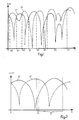
- Figure 1 is a diagram which exemplifies how the strengths of the signals received by two separate antennas can vary with time.
- the antennas are located at a relatively short distance apart and may, for instance, be mounted on a moving vehicle.
- the signal strength is designated s(t) in the diagram.
- the full line curve, s1 illustrates the signal strength on one of the antennas, in this instance the antenna 1, and the broken-line curve s2, illustrates the signal strength on the other of said antennas, in this case the antenna 2.
- the reference signs A1 and A2 on the time axis indicate which of the antennas 1 and 2 has the highest received signal strength at that moment in time. As is evident from the curves, the received signal strength can be relatively low over short time periods.
- the time distance between such pronounced decreases in signal strength are of the same order as the duration of a time slot.
- the risk of the wrong antenna being selected is reduced by measuring the signal strength of each of the two antennas on several occasions during a measuring period which falls in the time slot in which the measurements are taken. For instance, a suitability measurement in the form of a mean value of the signal strength of each antenna can thereafter be calculated and these mean values compared with one another.
- the antenna chosen is the antenna which has the largest calculated mean value.
- At least ten signal strength measurements should be made with each antenna.
- a suitable value of the duration of a measuring period is about 30% of the duration of a time slot.
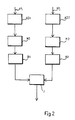
- Figure 2 is a block schematic which illustrates an example of an arrangement for carrying out the inventive method.
- the measured values of the signal strengths from two receiver antennas, antenna 1 and antenna 2 are referenced s1 i and s2 j respectively.
- the values are delivered to two analog-digital converters AD1, AD2 and are then transmitted, in digital form, to two storage devices M1, M2.
- the signal-strength values are transmitted from the storage devices M1, M2 to two processing means B1, B2, in which a suitability measurement for each antenna is calculated, by processing these values in a predetermined manner.
- the mean value of the signal-strength values can be calculated, for instance.
- the measurement values may alternatively be simply summated for each antenna per se, thereby obtaining for each antenna a suitability measurement which is proportional to the mean value of the signal-strength values, without disclosing the actual mean value itself.
- the two quality measurements are finally compared in a comparison means J, wherewith an antenna is selected on the basis of the highest suitability measurement.
- the signal strength of the antenna 1 is preferably measured at slightly different time points in relation to the signal strength of the antenna 2, therewith reducing the need of receiver devices.
- FIG 3 is a second diagram showing examples of the strengths of signals received by two separate antennas. Similar to the Figure 1 illustration, the signal strengths are referenced s1 and s2.
- the reference sign T signifies a time slot during which information shall be transmitted to a station for which one of two receiver antennas shall be selected.
- the decision as to which of the antenna shall be selected is made at the end of a measuring period M which lies at the end of a time slot which immediately precedes the time slot T and during which information is transmitted to another station.
- the signal strengths s1 and s2 are each measured an appropriate number of times during the measuring period M. As evident from the Figure, the signal strength s2 has a higher mean value than the signal strength s1 during the measuring period M.
- the antenna 1 having the signal strength s1 than the antenna 2 since the signal strength s1 is higher than the signal strength s2 over the major part of the time slot T.
- the measuring period M is short in relation to the duration of a time slot.
- a suitable value is about 5% of the duration of a time slot. It is therefore appropriate that the suitability measurements calculated in the processing means B1, B2 in Figure 2 are, in this case, dependent on both signal strength and its time derivation.
- This expression can be simplified to (1-b) ⁇ x + (1-a+b) ⁇ y + (1+a) ⁇ z, which is a linear combination of x, y and z.
- the three terms x, y and z at the beginning of the formula may, of course, each be multiplied by a constant which is analogous with what was mentioned earlier. This will only change the coefficients in the linear combination to be carried out in each of the processing means B1, B2.
- the signal strength should also be measured at least about ten times with each antenna, in order to prevent the choice of antenna being influenced unduly by noise.
- This expression is a linear combination of the signal-strength samples R1-R4.
- the illustrated example can be generalized for any selected number of signal-strength samples.
- A the initial value of the line which, when the line is short, corresponds approxi-mately to the level of the signal strength
- B the slope of the line.
- the aforedescribed inventive method can also be applied in stations which include more than two antennas, wherein a suitability measurement is calculated for each antenna, as in the case with solely two antennas.
Landscapes
- Engineering & Computer Science (AREA)
- Computer Networks & Wireless Communication (AREA)
- Signal Processing (AREA)
- Mobile Radio Communication Systems (AREA)
- Radio Transmission System (AREA)
Applications Claiming Priority (2)
| Application Number | Priority Date | Filing Date | Title |
|---|---|---|---|
| SE9001311 | 1990-04-10 | ||
| SE9001311A SE465991B (sv) | 1990-04-10 | 1990-04-10 | Foerfarande foer att i en mottagare vaelja den laempligaste av tvaa eller flera antenner |
Publications (2)
| Publication Number | Publication Date |
|---|---|
| EP0452289A1 true EP0452289A1 (fr) | 1991-10-16 |
| EP0452289B1 EP0452289B1 (fr) | 1994-04-20 |
Family
ID=20379149
Family Applications (1)
| Application Number | Title | Priority Date | Filing Date |
|---|---|---|---|
| EP91850068A Expired - Lifetime EP0452289B1 (fr) | 1990-04-10 | 1991-03-14 | Procédé de sélection de la meilleure antenne de deux ou plusieurs antennes de réception |
Country Status (10)
| Country | Link |
|---|---|
| US (1) | US5203026A (fr) |
| EP (1) | EP0452289B1 (fr) |
| JP (1) | JP3161742B2 (fr) |
| KR (1) | KR960015281B1 (fr) |
| AU (1) | AU633415B2 (fr) |
| CA (1) | CA2040102C (fr) |
| DE (1) | DE69101733T2 (fr) |
| HK (1) | HK81294A (fr) |
| NZ (1) | NZ237436A (fr) |
| SE (1) | SE465991B (fr) |
Cited By (9)
| Publication number | Priority date | Publication date | Assignee | Title |
|---|---|---|---|---|
| US5444745A (en) * | 1992-02-14 | 1995-08-22 | Nokia Mobile Phones Ltd. | Diversity reception arrangement |
| WO1995035600A1 (fr) * | 1994-06-21 | 1995-12-28 | Siemens Aktiengesellschaft | Systeme radiorecepteur a reception en diversite d'antennes pour systemes de telecommunications a transmission de messages radio orientes par blocs |
| EP0741466A3 (fr) * | 1995-05-03 | 1996-12-18 | Hughes Aircraft Co | Procédé et dispositif de sélection d'antenne adaptatif dans un système de communication radio-mobile |
| EP0798878A3 (fr) * | 1996-03-29 | 1998-05-20 | Nokia Mobile Phones Ltd. | Circuit de commande de sélection d'antenne |
| EP0806851A3 (fr) * | 1996-05-09 | 1998-08-12 | BECKER GmbH | Récepteur pour émissions radiophoniques pour automobile, comportant une pluralité de récepteurs, avec décodage des données supplémentaires contenues dans l'émission |
| EP0721715A4 (fr) * | 1993-09-30 | 1998-12-23 | Pacific Comm Sciences Inc | Station de base de rattachement a antennes multiples pour telephones numeriques sans fil |
| WO2002071646A1 (fr) * | 2001-03-01 | 2002-09-12 | Koninklijke Philips Electronics N.V. | Diversite d'antenne dans un reseau local sans fil |
| US6574461B1 (en) * | 1997-06-19 | 2003-06-03 | Telefonaktiebolaget Lm Ericsson (Publ) | Balanced diversity |
| WO2003107563A1 (fr) * | 2002-06-14 | 2003-12-24 | Philips Intellectual Property & Standards Gmbh | Reseau d'antennes a recepteur de diversite et procede permettant de selectionner une antenne parmi plusieurs antennes |
Families Citing this family (19)
| Publication number | Priority date | Publication date | Assignee | Title |
|---|---|---|---|---|
| JP2552928B2 (ja) * | 1990-01-31 | 1996-11-13 | 三菱電機株式会社 | アンテナ選択ダイバーシチ受信装置 |
| US5561673A (en) * | 1993-04-16 | 1996-10-01 | Matsushita Electric Industrial Co., Ltd. | Antenna switched diversity reciever |
| GB2281479B (en) * | 1993-08-27 | 1997-09-03 | Nokia Telecommunications Oy | Radio receiving apparatus |
| US5481571A (en) * | 1993-11-12 | 1996-01-02 | Pacific Communication Sciences, Inc. | Method and apparatus for switching between radio frequency circuits |
| US5550872A (en) * | 1994-10-24 | 1996-08-27 | Motorola, Inc. | Method and apparatus for Fast Fourier Transform based maximal ratio combining |
| GB2297013B (en) | 1995-01-10 | 1999-09-15 | Nokia Mobile Phones Ltd | Portable radio telephones and methods of operation |
| US5577031A (en) * | 1995-03-22 | 1996-11-19 | Smith; Jeffrey W. | Wideband channelizer incorporating diversity switch |
| US5748676A (en) * | 1995-05-01 | 1998-05-05 | Norand Corporation | Network utilizing modified preambles that support antenna diversity |
| US5796777A (en) * | 1996-02-27 | 1998-08-18 | Motorola, Inc. | Apparatus and method for digitizing and detecting a received radio frequency signal |
| US6128355A (en) * | 1997-05-21 | 2000-10-03 | Telefonaktiebolget Lm Ericsson | Selective diversity combining |
| US6115367A (en) * | 1997-08-05 | 2000-09-05 | Vlsi Technology, Inc. | Methods of analyzing a radio signal and methods of analyzing a personal handy-phone system radio signal |
| US7740257B2 (en) * | 1998-07-29 | 2010-06-22 | Angela Kate Haire | Vehicle suspension with linked air bags |
| DE19935675A1 (de) * | 1999-07-29 | 2001-02-15 | Bosch Gmbh Robert | Schaltung zum Umschalten zwischen Empfangsantennen |
| DE10034039A1 (de) * | 2000-07-13 | 2002-01-31 | Harman Becker Automotive Sys | Runddfunkempfangssystem, Empfänger und Betriebsverfahren dafür |
| US20020052201A1 (en) * | 2000-10-31 | 2002-05-02 | Leif Wilhelmsson | Method and system for dynamic carrier selection |
| US7747232B2 (en) * | 2001-07-13 | 2010-06-29 | Harman Becker Automotive Systems Gmbh | Radio reception system with automatic tuning |
| JP4178096B2 (ja) | 2003-11-12 | 2008-11-12 | 京セラ株式会社 | 無線基地局 |
| US20080285686A1 (en) * | 2005-07-29 | 2008-11-20 | Norman Beaulieu | Antenna Selection Apparatus and Methods |
| DE102023135774B3 (de) | 2023-12-19 | 2025-05-22 | Pinpoint Gmbh | Verfahren zur Bestimmung von Zeitslots in einem drahtlosen Kommunikationssystem |
Citations (2)
| Publication number | Priority date | Publication date | Assignee | Title |
|---|---|---|---|---|
| US3475688A (en) * | 1966-01-18 | 1969-10-28 | Us Army | Multichannel receiving system in which each channel's weight in the combined output depends on the rate of fading in said channels |
| EP0318665A2 (fr) * | 1987-11-30 | 1989-06-07 | Motorola, Inc. | Circuit de commande de sélection d'antenne |
Family Cites Families (7)
| Publication number | Priority date | Publication date | Assignee | Title |
|---|---|---|---|---|
| US4328591A (en) * | 1979-04-23 | 1982-05-04 | Baghdady Elie J | Method and apparatus for signal detection, separation and suppression |
| US4549311A (en) * | 1982-08-03 | 1985-10-22 | Motorola, Inc. | Method and apparatus for measuring the strength of a radio signal frequency |
| JPS59181732A (ja) * | 1983-03-31 | 1984-10-16 | Toshiba Corp | 携帯用無線機におけるダイバ−シチ−受信方式 |
| US4513412A (en) * | 1983-04-25 | 1985-04-23 | At&T Bell Laboratories | Time division adaptive retransmission technique for portable radio telephones |
| US4531235A (en) * | 1983-06-20 | 1985-07-23 | Motorola, Inc. | Diversity signal strength indicator and site selection apparatus for using same |
| US4710945A (en) * | 1986-04-30 | 1987-12-01 | Motorola, Inc. | Signal selection by statistical comparison |
| US4977616A (en) * | 1987-11-30 | 1990-12-11 | Motorola, Inc. | Antenna selection control circuit |
-
1990
- 1990-04-10 SE SE9001311A patent/SE465991B/sv not_active IP Right Cessation
-
1991
- 1991-03-14 EP EP91850068A patent/EP0452289B1/fr not_active Expired - Lifetime
- 1991-03-14 DE DE69101733T patent/DE69101733T2/de not_active Expired - Fee Related
- 1991-03-14 NZ NZ237436A patent/NZ237436A/xx unknown
- 1991-03-22 US US07/673,304 patent/US5203026A/en not_active Expired - Lifetime
- 1991-04-08 KR KR1019910005602A patent/KR960015281B1/ko not_active Expired - Fee Related
- 1991-04-09 CA CA002040102A patent/CA2040102C/fr not_active Expired - Fee Related
- 1991-04-09 JP JP07611991A patent/JP3161742B2/ja not_active Expired - Fee Related
- 1991-04-09 AU AU74170/91A patent/AU633415B2/en not_active Ceased
-
1994
- 1994-08-11 HK HK81294A patent/HK81294A/en not_active IP Right Cessation
Patent Citations (2)
| Publication number | Priority date | Publication date | Assignee | Title |
|---|---|---|---|---|
| US3475688A (en) * | 1966-01-18 | 1969-10-28 | Us Army | Multichannel receiving system in which each channel's weight in the combined output depends on the rate of fading in said channels |
| EP0318665A2 (fr) * | 1987-11-30 | 1989-06-07 | Motorola, Inc. | Circuit de commande de sélection d'antenne |
Cited By (12)
| Publication number | Priority date | Publication date | Assignee | Title |
|---|---|---|---|---|
| US5444745A (en) * | 1992-02-14 | 1995-08-22 | Nokia Mobile Phones Ltd. | Diversity reception arrangement |
| EP0721715A4 (fr) * | 1993-09-30 | 1998-12-23 | Pacific Comm Sciences Inc | Station de base de rattachement a antennes multiples pour telephones numeriques sans fil |
| EP0989697A1 (fr) * | 1993-09-30 | 2000-03-29 | Conexant Systems, Inc. | Station de base de rattachement à antennes multiples pour téléphones numériques sans fil |
| WO1995035600A1 (fr) * | 1994-06-21 | 1995-12-28 | Siemens Aktiengesellschaft | Systeme radiorecepteur a reception en diversite d'antennes pour systemes de telecommunications a transmission de messages radio orientes par blocs |
| US6317424B1 (en) | 1994-06-21 | 2001-11-13 | Siemens Aktiengesellschaft | Antenna diversity radio receiving arrangement for telecommunications systems using block-oriented transmission of radio messages |
| EP0741466A3 (fr) * | 1995-05-03 | 1996-12-18 | Hughes Aircraft Co | Procédé et dispositif de sélection d'antenne adaptatif dans un système de communication radio-mobile |
| EP0798878A3 (fr) * | 1996-03-29 | 1998-05-20 | Nokia Mobile Phones Ltd. | Circuit de commande de sélection d'antenne |
| US6330433B1 (en) | 1996-03-29 | 2001-12-11 | Nokia Mobile Phones Limited | Antenna selection control circuitry |
| EP0806851A3 (fr) * | 1996-05-09 | 1998-08-12 | BECKER GmbH | Récepteur pour émissions radiophoniques pour automobile, comportant une pluralité de récepteurs, avec décodage des données supplémentaires contenues dans l'émission |
| US6574461B1 (en) * | 1997-06-19 | 2003-06-03 | Telefonaktiebolaget Lm Ericsson (Publ) | Balanced diversity |
| WO2002071646A1 (fr) * | 2001-03-01 | 2002-09-12 | Koninklijke Philips Electronics N.V. | Diversite d'antenne dans un reseau local sans fil |
| WO2003107563A1 (fr) * | 2002-06-14 | 2003-12-24 | Philips Intellectual Property & Standards Gmbh | Reseau d'antennes a recepteur de diversite et procede permettant de selectionner une antenne parmi plusieurs antennes |
Also Published As
| Publication number | Publication date |
|---|---|
| JP3161742B2 (ja) | 2001-04-25 |
| KR960015281B1 (ko) | 1996-11-07 |
| SE465991B (sv) | 1991-11-25 |
| SE9001311D0 (sv) | 1990-04-10 |
| DE69101733T2 (de) | 1994-08-11 |
| NZ237436A (en) | 1992-11-25 |
| AU633415B2 (en) | 1993-01-28 |
| SE9001311L (sv) | 1991-10-11 |
| DE69101733D1 (de) | 1994-05-26 |
| CA2040102A1 (fr) | 1991-10-11 |
| JPH0795183A (ja) | 1995-04-07 |
| US5203026A (en) | 1993-04-13 |
| AU7417091A (en) | 1991-10-17 |
| CA2040102C (fr) | 1999-09-21 |
| HK81294A (en) | 1994-08-19 |
| EP0452289B1 (fr) | 1994-04-20 |
Similar Documents
| Publication | Publication Date | Title |
|---|---|---|
| EP0452289B1 (fr) | Procédé de sélection de la meilleure antenne de deux ou plusieurs antennes de réception | |
| AU723533B2 (en) | Method for determining speed of terminal, and receiver | |
| AU755746B2 (en) | Method and system for determining position of mobile radio terminals | |
| US7218934B2 (en) | Mobile station speed estimation | |
| RU2107395C1 (ru) | Устройство для объединения принятых сигналов с указателями фаз и радиотелефон | |
| US6990351B2 (en) | Equipment for the calculation of mobile handset position | |
| US6636729B1 (en) | Apparatus and method for receiving radio signals according to variable weighting factors | |
| EP0780995A2 (fr) | Circuit de contrÔle pour la sélection d'antenne | |
| EP0989697B1 (fr) | Station de base de rattachement à antennes multiples pour téléphones numériques sans fil | |
| JPS61240725A (ja) | 無線伝送チヤネルの品質測定方法および装置 | |
| CA2169332A1 (fr) | Evaluation des canaux radio | |
| US6118806A (en) | Signal synthesis method and apparatus under diversity reception | |
| US6032052A (en) | Apparatus and method for data transmission | |
| CA2285884A1 (fr) | Methode de determination de reponse, methode de communication et emetteur-recepteur sans fil | |
| JP3095305B2 (ja) | 受信レベル測定回路 | |
| CA2119864A1 (fr) | Methode pour mesurer la qualite des salves de signaux | |
| US3997844A (en) | Signal selection in diversity transmission systems | |
| JP3270816B2 (ja) | 符号化マーカ処理方法及び移動電話装置 | |
| Suwa et al. | Transmitter diversity characteristics in microcellular TDMA/TDD mobile radio | |
| EP0479741B1 (fr) | Procédé de sélection d'antenne dans un système de communication mobile | |
| AU728020B2 (en) | Synchronization method and receiver comprising multiplication means, transform and comparison means | |
| EP0783802B1 (fr) | Procede et dispositif permettant une commande d'acces en fonction de l'evanouissement dans un systeme a faisceau hertzien numerique | |
| JPH0918399A (ja) | 検波後ダイバーシチ受信回路 | |
| JPS62195935A (ja) | ダイバ−シチ受信方式 | |
| JPH04223723A (ja) | ダイバーシティ受信装置 |
Legal Events
| Date | Code | Title | Description |
|---|---|---|---|
| PUAI | Public reference made under article 153(3) epc to a published international application that has entered the european phase |
Free format text: ORIGINAL CODE: 0009012 |
|
| AK | Designated contracting states |
Kind code of ref document: A1 Designated state(s): DE FR GB |
|
| 17P | Request for examination filed |
Effective date: 19920320 |
|
| 17Q | First examination report despatched |
Effective date: 19931008 |
|
| GRAA | (expected) grant |
Free format text: ORIGINAL CODE: 0009210 |
|
| AK | Designated contracting states |
Kind code of ref document: B1 Designated state(s): DE FR GB |
|
| REF | Corresponds to: |
Ref document number: 69101733 Country of ref document: DE Date of ref document: 19940526 |
|
| ET | Fr: translation filed | ||
| K2C3 | Correction of patent specification (complete document) published |
Effective date: 19940420 |
|
| PLBE | No opposition filed within time limit |
Free format text: ORIGINAL CODE: 0009261 |
|
| STAA | Information on the status of an ep patent application or granted ep patent |
Free format text: STATUS: NO OPPOSITION FILED WITHIN TIME LIMIT |
|
| 26N | No opposition filed | ||
| PGFP | Annual fee paid to national office [announced via postgrant information from national office to epo] |
Ref country code: FR Payment date: 20010219 Year of fee payment: 11 |
|
| PGFP | Annual fee paid to national office [announced via postgrant information from national office to epo] |
Ref country code: DE Payment date: 20010220 Year of fee payment: 11 |
|
| REG | Reference to a national code |
Ref country code: GB Ref legal event code: IF02 |
|
| PG25 | Lapsed in a contracting state [announced via postgrant information from national office to epo] |
Ref country code: DE Free format text: LAPSE BECAUSE OF NON-PAYMENT OF DUE FEES Effective date: 20021001 |
|
| PG25 | Lapsed in a contracting state [announced via postgrant information from national office to epo] |
Ref country code: FR Free format text: LAPSE BECAUSE OF NON-PAYMENT OF DUE FEES Effective date: 20021129 |
|
| REG | Reference to a national code |
Ref country code: FR Ref legal event code: ST |
|
| PGFP | Annual fee paid to national office [announced via postgrant information from national office to epo] |
Ref country code: GB Payment date: 20100326 Year of fee payment: 20 |
|
| REG | Reference to a national code |
Ref country code: GB Ref legal event code: PE20 Expiry date: 20110313 |
|
| PG25 | Lapsed in a contracting state [announced via postgrant information from national office to epo] |
Ref country code: GB Free format text: LAPSE BECAUSE OF EXPIRATION OF PROTECTION Effective date: 20110313 |