EP0452351B1 - Corps moule en indat de strontium/calcium fritte et son utilisation - Google Patents
Corps moule en indat de strontium/calcium fritte et son utilisation Download PDFInfo
- Publication number
- EP0452351B1 EP0452351B1 EP90900862A EP90900862A EP0452351B1 EP 0452351 B1 EP0452351 B1 EP 0452351B1 EP 90900862 A EP90900862 A EP 90900862A EP 90900862 A EP90900862 A EP 90900862A EP 0452351 B1 EP0452351 B1 EP 0452351B1
- Authority
- EP
- European Patent Office
- Prior art keywords
- indate
- molding
- sintered
- temperatures
- in2o4
- Prior art date
- Legal status (The legal status is an assumption and is not a legal conclusion. Google has not performed a legal analysis and makes no representation as to the accuracy of the status listed.)
- Expired - Lifetime
Links
- 238000000465 moulding Methods 0.000 title claims abstract description 16
- 229910052791 calcium Inorganic materials 0.000 title claims abstract description 12
- 239000011575 calcium Substances 0.000 title claims description 20
- 229910052712 strontium Inorganic materials 0.000 title claims description 20
- CIOAGBVUUVVLOB-UHFFFAOYSA-N strontium atom Chemical compound [Sr] CIOAGBVUUVVLOB-UHFFFAOYSA-N 0.000 title claims description 15
- OYPRJOBELJOOCE-UHFFFAOYSA-N Calcium Chemical compound [Ca] OYPRJOBELJOOCE-UHFFFAOYSA-N 0.000 title claims description 6
- 238000006243 chemical reaction Methods 0.000 claims abstract description 11
- 238000005245 sintering Methods 0.000 claims abstract description 9
- 229910000287 alkaline earth metal oxide Inorganic materials 0.000 claims abstract description 6
- 239000000463 material Substances 0.000 claims description 10
- 239000000203 mixture Substances 0.000 claims description 9
- 239000000843 powder Substances 0.000 claims description 8
- 239000000155 melt Substances 0.000 claims description 7
- WMWLMWRWZQELOS-UHFFFAOYSA-N bismuth(III) oxide Inorganic materials O=[Bi]O[Bi]=O WMWLMWRWZQELOS-UHFFFAOYSA-N 0.000 claims description 5
- PJXISJQVUVHSOJ-UHFFFAOYSA-N indium(III) oxide Inorganic materials [O-2].[O-2].[O-2].[In+3].[In+3] PJXISJQVUVHSOJ-UHFFFAOYSA-N 0.000 claims description 5
- 238000000034 method Methods 0.000 claims description 5
- 238000010438 heat treatment Methods 0.000 claims description 3
- 239000011230 binding agent Substances 0.000 claims description 2
- MSBGPEACXKBQSX-UHFFFAOYSA-N (4-fluorophenyl) carbonochloridate Chemical compound FC1=CC=C(OC(Cl)=O)C=C1 MSBGPEACXKBQSX-UHFFFAOYSA-N 0.000 claims 1
- 238000002844 melting Methods 0.000 abstract description 5
- 230000008018 melting Effects 0.000 abstract description 5
- 239000013078 crystal Substances 0.000 description 9
- 229910052593 corundum Inorganic materials 0.000 description 6
- 238000000227 grinding Methods 0.000 description 6
- PNEYBMLMFCGWSK-UHFFFAOYSA-N aluminium oxide Inorganic materials [O-2].[O-2].[O-2].[Al+3].[Al+3] PNEYBMLMFCGWSK-UHFFFAOYSA-N 0.000 description 5
- 229910052797 bismuth Inorganic materials 0.000 description 5
- 239000000758 substrate Substances 0.000 description 5
- 239000002887 superconductor Substances 0.000 description 5
- 229910001845 yogo sapphire Inorganic materials 0.000 description 5
- VYPSYNLAJGMNEJ-UHFFFAOYSA-N Silicium dioxide Chemical compound O=[Si]=O VYPSYNLAJGMNEJ-UHFFFAOYSA-N 0.000 description 3
- MCMNRKCIXSYSNV-UHFFFAOYSA-N ZrO2 Inorganic materials O=[Zr]=O MCMNRKCIXSYSNV-UHFFFAOYSA-N 0.000 description 3
- 230000015572 biosynthetic process Effects 0.000 description 3
- JCXGWMGPZLAOME-UHFFFAOYSA-N bismuth atom Chemical compound [Bi] JCXGWMGPZLAOME-UHFFFAOYSA-N 0.000 description 3
- 239000000919 ceramic Substances 0.000 description 3
- 238000005229 chemical vapour deposition Methods 0.000 description 3
- 239000010949 copper Substances 0.000 description 3
- 230000008020 evaporation Effects 0.000 description 3
- 238000001704 evaporation Methods 0.000 description 3
- 229910052738 indium Inorganic materials 0.000 description 3
- 238000004519 manufacturing process Methods 0.000 description 3
- 239000004570 mortar (masonry) Substances 0.000 description 3
- 230000007704 transition Effects 0.000 description 3
- CSCPPACGZOOCGX-UHFFFAOYSA-N Acetone Chemical compound CC(C)=O CSCPPACGZOOCGX-UHFFFAOYSA-N 0.000 description 2
- 229910004382 CaIn2O4 Inorganic materials 0.000 description 2
- RYGMFSIKBFXOCR-UHFFFAOYSA-N Copper Chemical compound [Cu] RYGMFSIKBFXOCR-UHFFFAOYSA-N 0.000 description 2
- LFQSCWFLJHTTHZ-UHFFFAOYSA-N Ethanol Chemical compound CCO LFQSCWFLJHTTHZ-UHFFFAOYSA-N 0.000 description 2
- 229910000416 bismuth oxide Inorganic materials 0.000 description 2
- 239000012876 carrier material Substances 0.000 description 2
- 150000001768 cations Chemical class 0.000 description 2
- 238000011109 contamination Methods 0.000 description 2
- 238000001816 cooling Methods 0.000 description 2
- 229910052802 copper Inorganic materials 0.000 description 2
- 238000010586 diagram Methods 0.000 description 2
- TYIXMATWDRGMPF-UHFFFAOYSA-N dibismuth;oxygen(2-) Chemical compound [O-2].[O-2].[O-2].[Bi+3].[Bi+3] TYIXMATWDRGMPF-UHFFFAOYSA-N 0.000 description 2
- 239000002270 dispersing agent Substances 0.000 description 2
- 238000010304 firing Methods 0.000 description 2
- APFVFJFRJDLVQX-UHFFFAOYSA-N indium atom Chemical compound [In] APFVFJFRJDLVQX-UHFFFAOYSA-N 0.000 description 2
- 238000010884 ion-beam technique Methods 0.000 description 2
- 238000007750 plasma spraying Methods 0.000 description 2
- 238000003825 pressing Methods 0.000 description 2
- 238000007650 screen-printing Methods 0.000 description 2
- 239000007787 solid Substances 0.000 description 2
- 239000002904 solvent Substances 0.000 description 2
- 238000004544 sputter deposition Methods 0.000 description 2
- XLYOFNOQVPJJNP-UHFFFAOYSA-N water Substances O XLYOFNOQVPJJNP-UHFFFAOYSA-N 0.000 description 2
- QGZKDVFQNNGYKY-UHFFFAOYSA-O Ammonium Chemical compound [NH4+] QGZKDVFQNNGYKY-UHFFFAOYSA-O 0.000 description 1
- 229910015901 Bi-Sr-Ca-Cu-O Inorganic materials 0.000 description 1
- UXVMQQNJUSDDNG-UHFFFAOYSA-L Calcium chloride Chemical compound [Cl-].[Cl-].[Ca+2] UXVMQQNJUSDDNG-UHFFFAOYSA-L 0.000 description 1
- 239000000654 additive Substances 0.000 description 1
- 238000000137 annealing Methods 0.000 description 1
- QVGXLLKOCUKJST-UHFFFAOYSA-N atomic oxygen Chemical compound [O] QVGXLLKOCUKJST-UHFFFAOYSA-N 0.000 description 1
- -1 bismuth aluminates Chemical class 0.000 description 1
- 229910001628 calcium chloride Inorganic materials 0.000 description 1
- 239000001110 calcium chloride Substances 0.000 description 1
- 150000001875 compounds Chemical class 0.000 description 1
- 239000010431 corundum Substances 0.000 description 1
- 238000001125 extrusion Methods 0.000 description 1
- 230000002349 favourable effect Effects 0.000 description 1
- 229910052602 gypsum Inorganic materials 0.000 description 1
- 239000010440 gypsum Substances 0.000 description 1
- 238000011835 investigation Methods 0.000 description 1
- 239000007788 liquid Substances 0.000 description 1
- 238000005259 measurement Methods 0.000 description 1
- 229910044991 metal oxide Inorganic materials 0.000 description 1
- 150000004706 metal oxides Chemical class 0.000 description 1
- NNKVPIKMPCQWCG-UHFFFAOYSA-N methamidophos Chemical compound COP(N)(=O)SC NNKVPIKMPCQWCG-UHFFFAOYSA-N 0.000 description 1
- 238000003801 milling Methods 0.000 description 1
- 238000002156 mixing Methods 0.000 description 1
- TWNQGVIAIRXVLR-UHFFFAOYSA-N oxo(oxoalumanyloxy)alumane Chemical compound O=[Al]O[Al]=O TWNQGVIAIRXVLR-UHFFFAOYSA-N 0.000 description 1
- 229910052760 oxygen Inorganic materials 0.000 description 1
- 239000001301 oxygen Substances 0.000 description 1
- RVTZCBVAJQQJTK-UHFFFAOYSA-N oxygen(2-);zirconium(4+) Chemical compound [O-2].[O-2].[Zr+4] RVTZCBVAJQQJTK-UHFFFAOYSA-N 0.000 description 1
- 239000011505 plaster Substances 0.000 description 1
- 229920000058 polyacrylate Polymers 0.000 description 1
- 238000002360 preparation method Methods 0.000 description 1
- 239000000376 reactant Substances 0.000 description 1
- 239000011541 reaction mixture Substances 0.000 description 1
- 238000007493 shaping process Methods 0.000 description 1
- 238000007873 sieving Methods 0.000 description 1
- 150000004760 silicates Chemical class 0.000 description 1
- 238000005507 spraying Methods 0.000 description 1
- LEDMRZGFZIAGGB-UHFFFAOYSA-L strontium carbonate Chemical compound [Sr+2].[O-]C([O-])=O LEDMRZGFZIAGGB-UHFFFAOYSA-L 0.000 description 1
- 229910000018 strontium carbonate Inorganic materials 0.000 description 1
- 229910052716 thallium Inorganic materials 0.000 description 1
- 238000010792 warming Methods 0.000 description 1
Images



Classifications
-
- C—CHEMISTRY; METALLURGY
- C04—CEMENTS; CONCRETE; ARTIFICIAL STONE; CERAMICS; REFRACTORIES
- C04B—LIME, MAGNESIA; SLAG; CEMENTS; COMPOSITIONS THEREOF, e.g. MORTARS, CONCRETE OR LIKE BUILDING MATERIALS; ARTIFICIAL STONE; CERAMICS; REFRACTORIES; TREATMENT OF NATURAL STONE
- C04B35/00—Shaped ceramic products characterised by their composition; Ceramics compositions; Processing powders of inorganic compounds preparatory to the manufacturing of ceramic products
-
- C—CHEMISTRY; METALLURGY
- C01—INORGANIC CHEMISTRY
- C01G—COMPOUNDS CONTAINING METALS NOT COVERED BY SUBCLASSES C01D OR C01F
- C01G15/00—Compounds of gallium, indium or thallium
- C01G15/006—Compounds containing gallium, indium or thallium, with or without oxygen or hydrogen, and containing two or more other elements
-
- C—CHEMISTRY; METALLURGY
- C01—INORGANIC CHEMISTRY
- C01G—COMPOUNDS CONTAINING METALS NOT COVERED BY SUBCLASSES C01D OR C01F
- C01G15/00—Compounds of gallium, indium or thallium
-
- C—CHEMISTRY; METALLURGY
- C04—CEMENTS; CONCRETE; ARTIFICIAL STONE; CERAMICS; REFRACTORIES
- C04B—LIME, MAGNESIA; SLAG; CEMENTS; COMPOSITIONS THEREOF, e.g. MORTARS, CONCRETE OR LIKE BUILDING MATERIALS; ARTIFICIAL STONE; CERAMICS; REFRACTORIES; TREATMENT OF NATURAL STONE
- C04B35/00—Shaped ceramic products characterised by their composition; Ceramics compositions; Processing powders of inorganic compounds preparatory to the manufacturing of ceramic products
- C04B35/01—Shaped ceramic products characterised by their composition; Ceramics compositions; Processing powders of inorganic compounds preparatory to the manufacturing of ceramic products based on oxide ceramics
-
- C—CHEMISTRY; METALLURGY
- C04—CEMENTS; CONCRETE; ARTIFICIAL STONE; CERAMICS; REFRACTORIES
- C04B—LIME, MAGNESIA; SLAG; CEMENTS; COMPOSITIONS THEREOF, e.g. MORTARS, CONCRETE OR LIKE BUILDING MATERIALS; ARTIFICIAL STONE; CERAMICS; REFRACTORIES; TREATMENT OF NATURAL STONE
- C04B35/00—Shaped ceramic products characterised by their composition; Ceramics compositions; Processing powders of inorganic compounds preparatory to the manufacturing of ceramic products
- C04B35/622—Forming processes; Processing powders of inorganic compounds preparatory to the manufacturing of ceramic products
- C04B35/653—Processes involving a melting step
-
- Y—GENERAL TAGGING OF NEW TECHNOLOGICAL DEVELOPMENTS; GENERAL TAGGING OF CROSS-SECTIONAL TECHNOLOGIES SPANNING OVER SEVERAL SECTIONS OF THE IPC; TECHNICAL SUBJECTS COVERED BY FORMER USPC CROSS-REFERENCE ART COLLECTIONS [XRACs] AND DIGESTS
- Y10—TECHNICAL SUBJECTS COVERED BY FORMER USPC
- Y10S—TECHNICAL SUBJECTS COVERED BY FORMER USPC CROSS-REFERENCE ART COLLECTIONS [XRACs] AND DIGESTS
- Y10S505/00—Superconductor technology: apparatus, material, process
- Y10S505/775—High tc, above 30 k, superconducting material
- Y10S505/776—Containing transition metal oxide with rare earth or alkaline earth
- Y10S505/782—Bismuth-, e.g. BiCaSrCuO
-
- Y—GENERAL TAGGING OF NEW TECHNOLOGICAL DEVELOPMENTS; GENERAL TAGGING OF CROSS-SECTIONAL TECHNOLOGIES SPANNING OVER SEVERAL SECTIONS OF THE IPC; TECHNICAL SUBJECTS COVERED BY FORMER USPC CROSS-REFERENCE ART COLLECTIONS [XRACs] AND DIGESTS
- Y10—TECHNICAL SUBJECTS COVERED BY FORMER USPC
- Y10S—TECHNICAL SUBJECTS COVERED BY FORMER USPC CROSS-REFERENCE ART COLLECTIONS [XRACs] AND DIGESTS
- Y10S505/00—Superconductor technology: apparatus, material, process
- Y10S505/775—High tc, above 30 k, superconducting material
- Y10S505/785—Composition containing superconducting material and diverse nonsuperconducting material
Definitions
- the present invention relates to moldings made of sintered strontium indate of the formula (Sr, Ca) In2O4, a process for their preparation and the use of these moldings as a vessel material for chemical reactions in which bismuth oxide, optionally together with alkaline earth metal oxides, occur as a reactant at high temperatures.
- the compound strontium indate has long been known (Z. Naturaba 19b (1964) 955) CaIn2O4 is isotypic to SrIn2O4.
- the crystal structure of these indates is known (Z. Anorg. Allg. Chemie 398 (1973) 24).
- the indates can be obtained from In2O3 and alkaline earth metal oxide by annealing at 1200 ° C.
- Bismuth oxide behaves clearly basic, especially at higher temperatures. It melts at 824 ° C and strongly attacks melting pots and silicates. According to observations by Arpe and Müller-Buschbaum (J. Inorg. Nucl. Chem. 39 (1977) 233), Al2O3 is also dissolved and converted into bismuth aluminates.
- the object was therefore to find a crucible material which is resistant to molten bismuth 3-oxide at high temperatures, in particular at temperatures above 800 ° C.
- the present invention solves this problem.
- the invention is based on the knowledge that shaped bodies made of sintered strontium / calcium indate, (Sr, Ca) In2O4, are stable even at high temperatures against molten bismuth-3-oxide.
- Such moldings can be produced by pressing a fine powder of strontium indate, calcium indate and / or mixed crystals of the formula Sr x Ca 1-x In2O4 with O ⁇ x ⁇ 1, optionally with the addition of binders, to give a molded body and this for several hours heated to temperatures of 1000 to 1500 ° C. This leads to sintering.
- the sintering time is at least 2 hours even at 1500 ° C. Sintering takes longer at lower temperatures. It should not be continued unnecessarily, otherwise the formation of large crystals is promoted, which worsens the strength of the shaped bodies.
- Strontium indate only melts above 1600 ° C. It is advantageous to finely grind the strontium indate powder used for sintering.
- the shaping can be done by known methods, e.g. B. by extrusion (bars, tubes) or by pressing (uniaxial or isostatic). It is also possible to melt strontium indate and allow it to solidify in molds in order to obtain moldings.
- the moldings obtained can take the form of spheres, tubes, bars or rods, preferably reaction vessels such as crucibles, or the shape of plates.
- Crucibles can also be produced from a bar by milling.
- a main difficulty in the production of thin superconducting layers from the previously known oxidic materials on a carrier is the contamination of the superconductor by the carrier material. After the oxide materials have been applied, a thermal aftertreatment is generally necessary in order to adjust the oxygen content in the superconducting layer.
- the superconductor reacts with the substrate material. This can be demonstrated by measuring the concentration profile of the cations of the carrier material in the superconductor layer depending on the distance from the surface of the carrier. Layers contaminated by cations have very poor superconducting properties (low T c , wide transitions).
- In2O4 is inert to the known oxidic superconducting materials (containing Bi2O3, SrO, CaO, CuO) even at 1000 ° C. It is therefore suitable in the form of ceramic sintered bodies or bodies solidified from the melting point, in particular in the form of plates, or in the form of single crystals as substrate material in the production of thin superconducting layers using processes such as CVD (Chemical Vapor Deposition), spray coating, Sputtering or ion beam evaporation, in which a thermal aftertreatment of the coated substrates is necessary.
- CVD Chemical Vapor Deposition
- spray coating Sputtering or ion beam evaporation
- thin oxide layers (less than 5 ⁇ m) can be applied by ion beam evaporation, sputtering, laser evaporation or CVD and thick oxide layers (thicker than 5 ⁇ m, in particular thicker than 10 ⁇ m) by screen printing or plasma spraying.
- Sintered indate (Sr, Ca) In2O4 is also ideal as a crucible for the solid reaction of the oxides of bismuth, strontium, calcium and copper to form phases with HT superconductivity and generally for the production of ceramics containing Bi, In or Tl
- This is of interest insofar as the formation of the superconducting phase in the Bi-Sr-Ca-Cu-O system, which has a transition temperature of 110 K, only takes place at temperatures just below the melting point of the mixture. If you carry out such sintering tests in crucibles or on support plates made of Al2O3, they are severely attacked and contaminated products with unsatisfactory quality, ie a small proportion of the 110 K phase, are obtained.
- the reaction is carried out on a support made of sintered strontium indate, calcium indate or a Sr-Ca indate, among other things same conditions, the proportion of the sought 110 K phase increased.
- the carrier consist of solid indate. It is preferably made of ceramic, for example Al2O3, to which a thin layer of indate has been applied, for example by plasma spraying or by screen printing.
- the mixed crystals of the formula Sr x Ca 1-x In2O4 with O ⁇ x ⁇ 1, in particular 0.91 ⁇ x ⁇ 1, in particular 0.91 ⁇ x ⁇ 1, can also be used.
- Shaped bodies from these mixed crystals can be produced by mixing the two indates or starting from the mixture of the three oxides in a molar ratio of In2O3: alkaline earth oxide of 1: 1 by sintering or melting and can be used as well as shaped bodies made from pure strontium indate.
- Powder from SrIn2O4 is according to H. Schwarz, D. Bommert; Z. Naturforsch. 19b (1964) 955. It is then ground in acetone as the grinding medium together with zirconium dioxide balls (ten times the mass) in an amidor mill for 3 hours at 1000 rpm. The grinding balls are sieved off and the solvent is distilled off in a rotary evaporator. The remaining powder is dried at 80 ° C. It can be easily pressed into plates or bars both isostatically and uniaxially without additives. Further investigations showed that the material sinters from 1000 ° C.
- An ingot pressed with 300 MPa (approx. 1x2x6 cm) has a green density of 63% of the theoretical achievable density (density of the single crystal 6.907 g / cm3). It is sintered according to the following program: heat to 1000 ° C in 2 h, further heat to 1500 ° C in 5 h, maintain this temperature for 5 h and then cool to 100 ° C in 5 h. The sintered ingot has a density of 6,413 g / cm3 (ie 93% of the theoretically achievable density). B. sawn into plates.
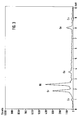
- a plate made according to Example 1 from SrIn2O4 (diameter 40 mm, 3 mm thick) is used as a firing base for a uniaxially pressed molded body consisting of the mixture of metal oxides (diameter 10 mm, thickness 1 mm) with the gross composition Bi4Sr3Ca3Cu6O 18 + ⁇ used. After a 100 hour treatment at 845 ° C, the sample is removed from the oven. The molded body does not react with the substrate material. Melt emerging from the molded body does not wet the SrIn2O4 plate. The sintered body does not stick to the surface of the plate after cooling. No indium can be detected in the sintered body.
- the conductivity measurement shows a superconducting transition at 105 K (FIG. 1 measured when warming up, 0.01 A).
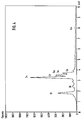
- a sample sintered under the same conditions on a firing support made of aluminum oxide has a critical temperature of approximately 60 K with only a small proportion of a phase which becomes superconducting at 105 K (FIG. 2 measured like FIG. 1).
- FIG. 5 A sample produced in this way shows a critical temperature of 110 K (FIG. 5).
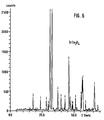
- the X-ray diagram essentially shows SrIn2O4 and Bi-containing superconducting phases.
- the X-ray diagram of SrIn2O4 is shown in Fig. 6.
- the comparison of Fig. 5 with Fig. 2 shows that the presence of SrIn2O4 in the reaction mixture has a favorable influence on the formation of the 110 K phase.
- the gypsum absorbs the water from the slip, forming an indate layer. After approx. 15 - 30 minutes, the still liquid part of the slip is poured off again. A moist cake with a wall thickness of 1 - 4 mm remains. After another 1 - 2 hours, this deep blank has shrunk to the extent that it can be removed from the mold. It is dried over calcium chloride in the desicator for 5 hours and then sintered.
- the following temperature program is used: Heat up to 200 ° C in 90 minutes; Hold at 200 ° C for 1 hour; continue heating to 400 ° C in 90 minutes; Hold at 400 ° C for 90 minutes; heat up to 1200 ° C in 10 hours; continue heating to 1500 ° C in one hour; Hold for 2 hours at 1500 ° C and cool down to 100 ° C in 5 hours.
- a crucible is made of sintered SrIn2O founded with a density of 95% of theory.
- Example 5 is repeated, but using Ca indate instead of Sr indate.
- the tempering program for the dried crucible blank looks as follows: Heat up to 150 ° C in 5 hours, raise the temperature to 400 ° C in a further 5 hours (this removes the dispersant and moisture). The temperature is then raised to 1200 ° C. in 5.5 hours and to 1500 ° C. in one hour, held at 1500 ° C. for two hours and cooled to 20 ° C. in 5 hours.
- an equimolar mixture of CaO and In2O3 was annealed at 1200 ° C for 8 hours, the powder was homogenized in an agate mortar and then annealed at 1200 ° C for a further 12 hours.
Landscapes
- Chemical & Material Sciences (AREA)
- Engineering & Computer Science (AREA)
- Organic Chemistry (AREA)
- Ceramic Engineering (AREA)
- Manufacturing & Machinery (AREA)
- Inorganic Chemistry (AREA)
- Materials Engineering (AREA)
- Structural Engineering (AREA)
- Compositions Of Oxide Ceramics (AREA)
- Inorganic Compounds Of Heavy Metals (AREA)
Abstract
Claims (7)
- Corps moulé en indate polycristallin compact de formule
SrxCa1-xIn₂0₄ avec 0 ≦ x ≦ 1 - Corps moulé selon la revendication 1, sous forme d'un récipient pour réaction ou réacteur.
- Utilisation d'un corps moulé en indate fritté ou solidifié à partir de la masse fondue, selon la revendication 1, à titre de réacteur pour des réactions chimiques en présence de 3-oxyde de bismuth fondu, à des températures d'au moins 800°C.
- Utilisation d'un corps moulé en indate fritté ou solidifié à partir de la masse fondue, selon la revendication 1, comme réacteur pour des réactions chimiques en présence d'oxydes alcalino terreux à des températures d'au moins 800°C.
- Utilisation d'un corps moulé, en particulier d'une plaque, en indate de strontium compact, SrIn₂0₄, pour produire des couches en une matière oxydique supraconductrice.
- Procédé pour produire un corps moulé fritté, procédé caractérisé en ce qu'on comprime une fine poudre consistant en de l'indate de calcium, de l'indate de strontium et/ou un indate de formule SrxCa1-xIn₂0₄, avec 0≦x≦1, éventuellement avec addition d'un liant, pour obtenir un corps moulé et l'on chauffe celui-ci durant plusieurs heures à des températures de 1 000 à 1 500°C.
- Procédé pour produire un corps moulé fritté consistant en SrxCa 1-xIn₂O₄ avec <x<1, procédé caractérisé en ce qu'on met en forme un mélange équimolaire pulvérulent de In₂O₃ et d'au moins un oxyde alcalino terreux de l'ensemble formé par CaO et SrO, et on le fritte ou on le laisse durcir à partir de la masse fondue.
Applications Claiming Priority (2)
| Application Number | Priority Date | Filing Date | Title |
|---|---|---|---|
| DE3844208 | 1988-12-29 | ||
| DE3844208A DE3844208A1 (de) | 1988-12-29 | 1988-12-29 | Formkoerper aus gesintertem strontiumindat und seine verwendung |
Publications (2)
| Publication Number | Publication Date |
|---|---|
| EP0452351A1 EP0452351A1 (fr) | 1991-10-23 |
| EP0452351B1 true EP0452351B1 (fr) | 1994-01-26 |
Family
ID=6370454
Family Applications (1)
| Application Number | Title | Priority Date | Filing Date |
|---|---|---|---|
| EP90900862A Expired - Lifetime EP0452351B1 (fr) | 1988-12-29 | 1990-07-04 | Corps moule en indat de strontium/calcium fritte et son utilisation |
Country Status (6)
| Country | Link |
|---|---|
| US (1) | US5346538A (fr) |
| EP (1) | EP0452351B1 (fr) |
| JP (1) | JPH04502449A (fr) |
| KR (1) | KR910700209A (fr) |
| DE (2) | DE3844208A1 (fr) |
| WO (1) | WO1990007476A1 (fr) |
Family Cites Families (2)
| Publication number | Priority date | Publication date | Assignee | Title |
|---|---|---|---|---|
| GB977835A (en) * | 1962-03-20 | 1964-12-16 | Gen Electric Co Ltd | Improvements in or relating to ceramic materials |
| JPS5639462A (en) * | 1979-09-08 | 1981-04-15 | Matsushita Electric Works Ltd | Inflammable gas sensing element |
-
1988
- 1988-12-29 DE DE3844208A patent/DE3844208A1/de not_active Withdrawn
-
1989
- 1989-12-23 WO PCT/EP1989/001606 patent/WO1990007476A1/fr not_active Ceased
- 1989-12-23 US US07/720,494 patent/US5346538A/en not_active Expired - Fee Related
- 1989-12-23 DE DE90900862T patent/DE58906850D1/de not_active Expired - Fee Related
- 1989-12-23 JP JP2501473A patent/JPH04502449A/ja active Pending
-
1990
- 1990-07-04 EP EP90900862A patent/EP0452351B1/fr not_active Expired - Lifetime
- 1990-08-28 KR KR1019900701914A patent/KR910700209A/ko not_active Withdrawn
Non-Patent Citations (1)
| Title |
|---|
| Z. anorg. allg. Chem., volume 435, 1977, W. Muschnik et al.: "Zur Kenntnis von SrCa2In206", see page 56 - page 60 * |
Also Published As
| Publication number | Publication date |
|---|---|
| EP0452351A1 (fr) | 1991-10-23 |
| DE58906850D1 (de) | 1994-03-10 |
| JPH04502449A (ja) | 1992-05-07 |
| DE3844208A1 (de) | 1990-07-05 |
| WO1990007476A1 (fr) | 1990-07-12 |
| US5346538A (en) | 1994-09-13 |
| KR910700209A (ko) | 1991-03-14 |
Similar Documents
| Publication | Publication Date | Title |
|---|---|---|
| DE3830092C2 (fr) | ||
| DE3210987C2 (fr) | ||
| DE3887478T2 (de) | Methode zur Herstellung eines Oxid-Supraleiters. | |
| DE69103177T2 (de) | Synthese von Bi-Pb-Ca-Sr-Cu-O-orientierten polykristallinen Supraleitern. | |
| DE69601256T2 (de) | Aluminiumnitrrid-sinterkörper und verfahren zu dessen herstellung | |
| EP0611737B1 (fr) | Procédé de préparation d'un matériau précurseur de supraconducteur à haute température pour la méthode "oxide-powder-in-tube" (OPIT) | |
| DE3853856T2 (de) | Verfahren zur Herstellung eines supraleitenden Oxyds und Verfahren zur Herstellung eines gemischten Oxydpulvers, das das Vorprodukt dieses supraleitenden Oxyds ist. | |
| DE69024244T2 (de) | Verfahren zur Herstellung von supraleitendem Material auf Bismuth-Basis | |
| DE68915462T2 (de) | Supraleitendes Pulver und Verfahren zur Herstellung von supraleitendem Pulver. | |
| DE69121457T2 (de) | Supraleitendes Oxid und Verfahren zu seiner Herstellung | |
| EP0372382B1 (fr) | Poudres frittables en céramique, procédé de leur fabrication et céramique en nitrure de silicium obtenue, son procédé de fabrication et son utilisation | |
| DE3882498T2 (de) | Material aus Metalloxyd. | |
| DE3739886A1 (de) | Supraleiter und verfahren zu seiner herstellung | |
| DE69031586T2 (de) | Supraleitende 247-Metalloxidzusammensetzungen | |
| EP0452351B1 (fr) | Corps moule en indat de strontium/calcium fritte et son utilisation | |
| DE68905108T2 (de) | Yttrium-barium-kupfer-oxidpulver und verfahren zur herstellung eines supraleitenden gesinterten koerpers daraus. | |
| NZ228820A (en) | Superconducting metal oxide and its preparation | |
| EP0384342A1 (fr) | Céramique en nitrure de silicium et procédé pour sa production | |
| DE3727381C2 (fr) | ||
| EP0389962B1 (fr) | Poudre en céramique apte au frittage et son procédé de fabrication, céramique en nitrure de silicium obtenue, son procédé de fabrication et son utilisation | |
| DE3727910C2 (de) | Dichter supraleitender keramischer Formkörper und Verfahren zu seiner Herstellung sowie seine Verwendungen | |
| DE3805954C1 (fr) | ||
| JPH0687611A (ja) | 酸化物系超電導体、その製造方法及び線材 | |
| EP0389960B1 (fr) | Corps superconducteur dense à texture | |
| DE19544698C1 (de) | Kupferoxid enthaltendes Magnesiumoxid-Substrat für einen Hochtemperatursupraleiter und Verfahren zu dessen Herstellung |
Legal Events
| Date | Code | Title | Description |
|---|---|---|---|
| PUAI | Public reference made under article 153(3) epc to a published international application that has entered the european phase |
Free format text: ORIGINAL CODE: 0009012 |
|
| 17P | Request for examination filed |
Effective date: 19910608 |
|
| AK | Designated contracting states |
Kind code of ref document: A1 Designated state(s): CH DE FR GB IT LI NL SE |
|
| 17Q | First examination report despatched |
Effective date: 19930209 |
|
| GRAA | (expected) grant |
Free format text: ORIGINAL CODE: 0009210 |
|
| AK | Designated contracting states |
Kind code of ref document: B1 Designated state(s): CH DE FR GB IT LI NL SE |
|
| REF | Corresponds to: |
Ref document number: 58906850 Country of ref document: DE Date of ref document: 19940310 |
|
| ITF | It: translation for a ep patent filed | ||
| GBT | Gb: translation of ep patent filed (gb section 77(6)(a)/1977) |
Effective date: 19940407 |
|
| ET | Fr: translation filed | ||
| PGFP | Annual fee paid to national office [announced via postgrant information from national office to epo] |
Ref country code: FR Payment date: 19941118 Year of fee payment: 6 |
|
| PLBE | No opposition filed within time limit |
Free format text: ORIGINAL CODE: 0009261 |
|
| STAA | Information on the status of an ep patent application or granted ep patent |
Free format text: STATUS: NO OPPOSITION FILED WITHIN TIME LIMIT |
|
| PGFP | Annual fee paid to national office [announced via postgrant information from national office to epo] |
Ref country code: GB Payment date: 19941128 Year of fee payment: 6 |
|
| PG25 | Lapsed in a contracting state [announced via postgrant information from national office to epo] |
Ref country code: SE Effective date: 19941224 |
|
| PG25 | Lapsed in a contracting state [announced via postgrant information from national office to epo] |
Ref country code: LI Effective date: 19941231 Ref country code: CH Effective date: 19941231 |
|
| 26N | No opposition filed | ||
| EAL | Se: european patent in force in sweden |
Ref document number: 90900862.5 |
|
| PGFP | Annual fee paid to national office [announced via postgrant information from national office to epo] |
Ref country code: DE Payment date: 19950216 Year of fee payment: 6 |
|
| PG25 | Lapsed in a contracting state [announced via postgrant information from national office to epo] |
Ref country code: NL Effective date: 19950701 |
|
| REG | Reference to a national code |
Ref country code: CH Ref legal event code: PL |
|
| NLV4 | Nl: lapsed or anulled due to non-payment of the annual fee |
Effective date: 19950701 |
|
| EUG | Se: european patent has lapsed |
Ref document number: 90900862.5 |
|
| PG25 | Lapsed in a contracting state [announced via postgrant information from national office to epo] |
Ref country code: GB Effective date: 19951223 |
|
| GBPC | Gb: european patent ceased through non-payment of renewal fee |
Effective date: 19951223 |
|
| PG25 | Lapsed in a contracting state [announced via postgrant information from national office to epo] |
Ref country code: FR Effective date: 19960830 |
|
| PG25 | Lapsed in a contracting state [announced via postgrant information from national office to epo] |
Ref country code: DE Effective date: 19960903 |
|
| REG | Reference to a national code |
Ref country code: FR Ref legal event code: ST |
|
| PG25 | Lapsed in a contracting state [announced via postgrant information from national office to epo] |
Ref country code: IT Free format text: LAPSE BECAUSE OF NON-PAYMENT OF DUE FEES;WARNING: LAPSES OF ITALIAN PATENTS WITH EFFECTIVE DATE BEFORE 2007 MAY HAVE OCCURRED AT ANY TIME BEFORE 2007. THE CORRECT EFFECTIVE DATE MAY BE DIFFERENT FROM THE ONE RECORDED. Effective date: 20051223 |