EP0452473B1 - Procede de stockage et d'affichage hierarchique pour images numeriques a haute resolution dans un environnement a usages multiples - Google Patents
Procede de stockage et d'affichage hierarchique pour images numeriques a haute resolution dans un environnement a usages multiples Download PDFInfo
- Publication number
- EP0452473B1 EP0452473B1 EP90917391A EP90917391A EP0452473B1 EP 0452473 B1 EP0452473 B1 EP 0452473B1 EP 90917391 A EP90917391 A EP 90917391A EP 90917391 A EP90917391 A EP 90917391A EP 0452473 B1 EP0452473 B1 EP 0452473B1
- Authority
- EP
- European Patent Office
- Prior art keywords
- image
- resolution
- images
- residual
- displaying
- Prior art date
- Legal status (The legal status is an assumption and is not a legal conclusion. Google has not performed a legal analysis and makes no representation as to the accuracy of the status listed.)
- Expired - Lifetime
Links
Images






Classifications
-
- H—ELECTRICITY
- H04—ELECTRIC COMMUNICATION TECHNIQUE
- H04N—PICTORIAL COMMUNICATION, e.g. TELEVISION
- H04N9/00—Details of colour television systems
- H04N9/79—Processing of colour television signals in connection with recording
- H04N9/80—Transformation of the television signal for recording, e.g. modulation, frequency changing; Inverse transformation for playback
- H04N9/808—Transformation of the television signal for recording, e.g. modulation, frequency changing; Inverse transformation for playback involving pulse code modulation of the composite colour video-signal
-
- G—PHYSICS
- G06—COMPUTING OR CALCULATING; COUNTING
- G06T—IMAGE DATA PROCESSING OR GENERATION, IN GENERAL
- G06T3/00—Geometric image transformations in the plane of the image
- G06T3/40—Scaling of whole images or parts thereof, e.g. expanding or contracting
- G06T3/4007—Scaling of whole images or parts thereof, e.g. expanding or contracting based on interpolation, e.g. bilinear interpolation
-
- H—ELECTRICITY
- H04—ELECTRIC COMMUNICATION TECHNIQUE
- H04N—PICTORIAL COMMUNICATION, e.g. TELEVISION
- H04N19/00—Methods or arrangements for coding, decoding, compressing or decompressing digital video signals
- H04N19/30—Methods or arrangements for coding, decoding, compressing or decompressing digital video signals using hierarchical techniques, e.g. scalability
- H04N19/36—Scalability techniques involving formatting the layers as a function of picture distortion after decoding, e.g. signal-to-noise [SNR] scalability
-
- H—ELECTRICITY
- H04—ELECTRIC COMMUNICATION TECHNIQUE
- H04N—PICTORIAL COMMUNICATION, e.g. TELEVISION
- H04N19/00—Methods or arrangements for coding, decoding, compressing or decompressing digital video signals
- H04N19/60—Methods or arrangements for coding, decoding, compressing or decompressing digital video signals using transform coding
- H04N19/63—Methods or arrangements for coding, decoding, compressing or decompressing digital video signals using transform coding using sub-band based transform, e.g. wavelets
-
- H—ELECTRICITY
- H04—ELECTRIC COMMUNICATION TECHNIQUE
- H04N—PICTORIAL COMMUNICATION, e.g. TELEVISION
- H04N5/00—Details of television systems
- H04N5/76—Television signal recording
- H04N5/91—Television signal processing therefor
- H04N5/92—Transformation of the television signal for recording, e.g. modulation, frequency changing; Inverse transformation for playback
- H04N5/926—Transformation of the television signal for recording, e.g. modulation, frequency changing; Inverse transformation for playback by pulse code modulation
- H04N5/9261—Transformation of the television signal for recording, e.g. modulation, frequency changing; Inverse transformation for playback by pulse code modulation involving data reduction
-
- H—ELECTRICITY
- H04—ELECTRIC COMMUNICATION TECHNIQUE
- H04N—PICTORIAL COMMUNICATION, e.g. TELEVISION
- H04N9/00—Details of colour television systems
- H04N9/79—Processing of colour television signals in connection with recording
- H04N9/797—Processing of colour television signals in connection with recording for recording the signal in a plurality of channels, the bandwidth of each channel being less than the bandwidth of the signal
Definitions
- the present invention is related to a method of storing and displaying digital images and more particularly to a multiresolution method which makes available reduced resolution versions of original images for quick display and full resolution original images for making photographic quality hardcopies.
- a multiuse environment is one where the user has the option of selecting the type of display medium and the desired resolution on this medium.
- two types of display media are considered: video monitors and photographic hardcopies. Versions of an original digital image are made available at various resolutions to allow for the display of an HDTV quality image on video, an NTSC quality image with PAL/SECAM compatibility on video, and a sub-NTSC quality image on video, as well as a very high quality image on photographic hardcopies.
- video monitors and photographic hardcopies.
- Versions of an original digital image are made available at various resolutions to allow for the display of an HDTV quality image on video, an NTSC quality image with PAL/SECAM compatibility on video, and a sub-NTSC quality image on video, as well as a very high quality image on photographic hardcopies.
- the techniques described herein are not limited to these display media or resolutions.
- the present invention uses a multiresolution or hierarchical structuring of the image data to allow for rapid access to the various image formats. It is also desirable to encode this hierarchical image data in an efficient manner so as to reduce the storage requirements on the digital storage media, e.g., optical discs or magnetic tape, and to allow for the rapid transfer of the image data from the storage media to an output device. Furthermore, it is desirable to minimize the hardware required to implement such a system. In particular, it is desirable to minimize the hardware required to access the lower resolution images along with its cost. Systems which use a hierarchical structuring of the image data are often termed progressive transmission since they allow image quality to be progressively refined; however, they are generally not designed specifically for a multiuse environment.
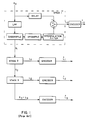
- the publication by Burt et al. teaches an encoding method for images termed either the Laplacian pyramid or the Burt pyramid.
- the original image G0 is lowpass filtered (LPF), and this lowpass image is subsampled to take advantage of its reduced bandwidth to provide the image G1.
- LPF lowpass filtered
- This process of lowpass filtering and subsampling is repeated three times to generate a hierarchical structure, or pyramid, of images (G0, G1, G2, and G3) of successively smaller dimensions. Although four resolution levels are shown, more or less can be used, depending upon the application.
- each lowpass image in this pyramid is then expanded to the dimensions of the next higher level by upsampling (inserting zeros) and filtering to form a prediction image for that level.
- This prediction image is subtracted from its corresponding lowpass image in a subtractor to generate difference, or residual, images L0, L1, and L2.
- the residual images corresponding to the levels of the lowpass pyramid form another pyramid which is termed either the Laplacian or Burt pyramid.
- the encoded residuals are denoted L ⁇ 0, L ⁇ 1, L ⁇ 2, and L ⁇ 3.
- Reconstruction is performed by interpolating the decoded lowpass image at the bottom of the lowpass pyramid and adding in the corresponding decoded residual to generate the next level in the lowpass pyramid. This process is iterated until the original image size is reached; the decoding process is illustrated in Figure 2.
- a progressive improvement in reconstructed image quality and resolution can thus be obtained by displaying the reconstructed lowpass filtered image at each level of the pyramid, i.e., ⁇ 3, ⁇ 2, ⁇ 1, and ⁇ 0. Note that errors introduced in the encoding process are propagated from one level to the next higher level.
- the patent to Anderson (US-A-4,718,104) teaches a modification of the Burt pyramid scheme in which the lowpass filtered image is subtracted directly from the image at the previous level and then subsampled; it is not decimated and interpolated prior to subtraction as in the Burt pyramid.
- This technique is termed the filter-subtract-decimate (FSD) pyramid.
- FSD filter-subtract-decimate
- subband coding an encoding method for images termed subband coding.
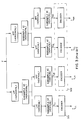
- the original image X is decomposed into a number of overlapping frequency bands, generally by using a set of 1-D lowpass (LPF) and highpass (HPF) quadrature mirror filters (QMFs).
- LPF lowpass
- HPF highpass quadrature mirror filters
- the filtered images representing these frequency subbands have a reduced bandwidth compared to the original image and can thus be subsampled, generally by a factor of two in each dimension.
- each subband is further decomposed into smaller subbands by repeated filtering and subsampling to form a total of 16 subbands.
- the subbands are then encoded using standard techniques such as differential pulse code modulation (DPCM), vector quantization (VQ), or entropy coding.
- subband coding has similarities to the Burt pyramid scheme in that the subband scheme results in a subsampled lowpass filtered image at each level of the subband decomposition, e.g., Y LL , Y LL-LL , etc.
- the remaining subbands at each level are analogous to a decomposition of the residual images in the Burt pyramid.
- a progressive improvement in image quality can thus be obtained in subband coding by displaying the various levels of lowpass filtered images in manner similar to the Burt pyramid.
- reconstruction errors at one level will propagate to the next level.
- the present invention overcomes these limitations by using a method as in claim 1 incorporating a hybrid scheme which permits fast reconstruction of the lower resolution images with relatively simple hardware while yielding very high reconstruction quality at the highest resolution level. Furthermore, the image hierarchy can still be encoded efficiently, i.e., at a low bit rate, and stored in such a manner that it can be accessed efficiently when being read from the storage medium. It is assumed that all image data is encoded using an entropy coding technique such as Huffman coding or Q-coding with some quantization prior to encoding.
- DPCM differential pulse code modulation
- Figure 1 is a block diagram illustrating a prior art pyramid residual image encoder method.
- Figure 2 is a block diagram illustrating a prior art pyramid residual image decoder method.
- Figure 3 is a block diagram illustrating a first prior art subband encoder method.
- Figure 4 is a block diagram illustrating a second prior art subband encoder method.
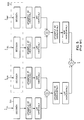
- Figure 5 is a diagram illustrating a first prior art subband decoder method.
- Figure 6 is a block diagram illustrating a second prior art subband decoder method.
- Figure 7 is a block diagram illustrating a third prior art subband encoder method.
- Figure 8 is a block diagram illustrating a third prior art subband decoder method.
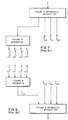
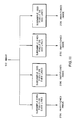
- Figure 9 is a block diagram illustrating the hierarchical storage and display method.
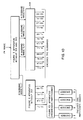
- Figure 10 is a block diagram illustrating the encoder portion of a first preferred embodiment of the present invention using subband coding with progressive partitioning.
- Figure 11 is a block diagram illustrating the progressive partitioning of a full resolution image into lesser resolution images.
- Figure 12 is a block diagram illustrating the decoder portion of a first preferred embodiment of the present invention using subband coding with progressive partitioning.
- Figure 13 is a block diagram illustrating the encoder portion of a second preferred embodiment of the present invention using subband coding with direct access to multiresolution images.
- Figure 14 is a block diagram illustrating the decoder portion of a second preferred embodiment of the present invention using subband coding with direct access to multiresolution images.
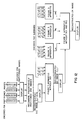
- Figure 15 is a block diagram illustrating the encoder portion of a third preferred embodiment of the present invention using subband coding with a lossless residual image process.
- Figure 16 is a block diagram illustrating the decoder portion of a third preferred embodiment of the present invention using subband coding with a lossless residual image process.
- Figure 17 is a block diagram illustrating the encoder portion of a fourth preferred embodiment of the present invention using subband coding with a lossless residual image process and CD-I compatibility.
- Figure 18 is a block diagram illustrating the decoder portion of a fourth preferred embodiment of the present invention using subband coding with a lossless residual image process and CD-I compatibility.
- the highest resolution image is composed of 2048 x 3072 pixels and that this resolution is adequate to produce photographic quality originals on an appropriate digital output device. It is also assumed that the lowest resolution level is composed of 256 x 384 pixels and that this resolution is adequate for preliminary, but relatively low quality, display on an NTSC-quality video monitor.
- the other resolution levels are 512 x 768 pixels for high quality display on an NTSC-quality video monitor and 1024 x 1536 for high quality display on proposed HDTV video monitors. These resolutions will be denoted as 256 (for 256 x 384), 512 (for 512 x 768), 1K (for 1024 x 1536), and 2K (for 2048 x 3072) for convenience.
- FIG. 9 The basic diagram for the hierarchical storage and display method is illustrated in Figure 9.
- the invention is not limited to these resolutions or output devices. Indeed, many variations with other resolutions and output devices may be used, and these resolutions may not necessarily be related to each other by some power of two as the previously described resolutions are (assuming some form of interpolation is available.)
- the number of resolution levels and the type of decomposition at each level may vary to some extent, yet still be consistent with the described embodiments.
- the systems are described for a single channel image, i.e., one color or luminance image, but the systems may be extended to handle full color images.
- the 2K image is decomposed using a full two-level subband tree structure to generate sixteen 512 subband images.
- a separate technique is used, namely, progressive partitioning, where the lowest frequency 512 image is partitioned into four 256 images by subsampling the 512 image in a staggered fashion as shown in Figure 11.
- the information to be stored is then composed of the four 256 images (which can be used to reconstruct the lowest frequency 512 image) and the remaining 512 subbands.
- This information is then used to reconstruct the 1K images and the 2K images, the reconstruction process is illustrated in Figure 12.
- the lowest frequency subband image at any resolution level is the one used for the purpose of display. This technique is motivated by the following:
- the problem of many filtering operations is reduced somewhat by using the subband tree structure to a lesser extent.
- the 2K image is broken into four 1K subbands, and then only the three higher frequency 1K subbands are further decomposed into a total of twelve 512 subbands.
- the lowest frequency 1K subband is not decomposed into a multitude of 512 images, but is merely prefiltered and subsampled to create a 512 image suitable for display.
- This 512 image is then prefiltered and subsampled to generate the 256 image.
- the information to be stored consists of the 256 image, the 512 image, the 1K image, and the twelve 512 higher frequency subbands.
- the reconstruction process for this information is illustrated in Figure 14.
- the advantages of this approach are:
- the third embodiment illustrated in Figure 15 is similar to the previous approach in that the 2K image is decomposed into four 1K subband images, and then the three higher frequency 1K subbands are decomposed into twelve 512 subbands. Also, as before, the lowest frequency 1K subband is then prefiltered and subsampled to yield a 512 image, and this 512 image is also prefiltered and subsampled to yield a 256 image. However, in this embodiment, the 512 and 1K images are not stored for direct access. Instead, the 256 image is replicated or interpolated up to a 512 size, and this interpolated image is used as a prediction image to generate a 512 residual image.
- the 512 image is interpolated or replicated to a 1K size, and this interpolated image is used as a prediction image to generate a 1K residual image.
- these residual images are coded in a lossless manner so that the 512 and 1K images can be recovered exactly.
- This approach is a combination of the Burt pyramid with lossless residuals for the lowpass images and subband coding for the remaining data.
- the information to be stored consists of the 256 base image, the 512 residual image, the 1K residual image, and twelve 512 subband images. The reconstruction process using this information is illustrated in Figure 16. The advantages of this approach are:
- the fourth embodiment has a structure similar to the previous embodiment, but also incorporates the Philips CD-I (Compact Disc-Interactive) real-time video data format (as referenced in the publication by A. C. Luther in Prior Art) at the 256 and 512 levels in order to provide compatibility with this format.
- the 2K image is decomposed into four 1K subbands, and the three higher frequency 1K subbands are further decomposed to form twelve 512 subbands.
- the lowest frequency 1K subband is then prefiltered and subsampled to form the 512 image.
- This 512 image is interpolated to form a 1K prediction image, and a 1K lossless residual image is created.
- the 512 image is prefiltered and subsampled to form a 256 base image which can be interpolated or replicated to form a 512 prediction image and 512 residual image.
- the technique differs in the encoding of the 256 base image and the 512 residual image in order to be compatible with the CD-I format.
- the 256 base image is encoded using the CD-I encoding scheme, namely, differential pulse code modulation (DPCM), rather than an entropy coding technique as was used in the other embodiments.
- DPCM differential pulse code modulation
- the 512 residual image is not initially encoded in a lossless manner, but is first encoded using the CD-I "extended resolution" format which is a 7-bit quantization of the residual. A second 512 residual is then formed as the difference between the original 512 residual and the 7-bit CD-I residual. This second residual is losslessly encoded.
- the information to be stored thus consists of the CD-I 256 base image, the CD-I 512 extended resolution residual, the 512 lossless residual, the 1K lossless residual, and the twelve 512 subband images.
- the reconstruction process using this information is illustrated in Figure 18.
- the advantage of this technique over the previous one is the compatibility with the CD-I format at the 256 and 512 levels.
Landscapes
- Engineering & Computer Science (AREA)
- Multimedia (AREA)
- Signal Processing (AREA)
- Physics & Mathematics (AREA)
- General Physics & Mathematics (AREA)
- Theoretical Computer Science (AREA)
- Compression Or Coding Systems Of Tv Signals (AREA)
- Compression Of Band Width Or Redundancy In Fax (AREA)
- Storing Facsimile Image Data (AREA)
Abstract
Claims (19)
- Procédé de stockage hiérarchisé comprenant les opérations suivantes :a) former une représentation numérique d'une image ;b) décomposer ladite représentation numérique en images multiples de sous-bandes, constituées chacune d'une bande de fréquences spatiales, à un ou plusieurs niveaux de résolution qui vont de la sous-bande ayant la fréquence spatiale la plus basse à celle ayant la plus élevée qui est définie par la représentation numérique de a) ;c) décomposer encore la sous-bande de plus basse fréquence de b) en une pluralité d'images de plus faible résolution par une technique de décomposition qui est différente de celle de l'opération b) ;d) coder et mémoriser au moins les images ayant la plus faible résolution de l'opération c) ; ete) coder et mémoriser les sous-bandes restantes de l'opération b).
- Procédé de stockage hiérarchisé selon la revendication 1, où l'opération c) comprend les opérations suivantes :1) sous-échantillonner les pixels à numérotation paire présents sur les lignes à numérotation paire afin de créer la première image partagée ;2) sous-échantillonner les pixels à numérotation impaire se trouvant sur les lignes à numérotation paire afin de créer la deuxième image partagée ;3) sous-échantillonner les pixels à numérotation paire se trouvant sur les lignes à numérotation impaire afin de créer la troisième image partagée ;4) sous-échantillonner les pixels à numérotation impaire se trouvant sur les lignes à numérotation impaire afin de créer la quatrième image partagée ; et l'opération d) comprend le codage et la mémorisation de chacune des images partagées.
- Procédé de stockage hiérarchisé selon la revendication 1, où l'opération c) comprend l'opération qui consiste à, de façon itérative, filtrer en passe-bas et sous-échantillonner la sous-bande qui possède la fréquence la plus basse afin de créer une ou plusieurs images de résolution inférieure ; et l'opération d) comprend l'opération qui consiste à coder et mémoriser lesdites images à résolution inférieure.
- Procédé de stockage hiérarchisé selon la revendication 1, où l'opération c) comprend l'opération qui consiste à, de façon itérative, filtrer en passe-bas et sous-échantillonner ladite sous-bande ayant la fréquence spatiale la plus basse, et l'opération d) comprend l'opération qui consiste à coder et mémoriser l'image ayant la résolution la plus basse de l'opération c) seulement, et où il comprend en outre l'opération consistant à :1) décoder l'image ayant la résolution la plus basse de l'opération d) ;2) interpoler ou reproduire ladite image aux dimensions du niveau de résolution immédiatement supérieur afin de former une image de prédiction ;3) soustraire ladite image de prédiction de l'image à résolution immédiatement supérieure qui est formée dans l'opération c) afin de créer une image résiduelle ;4) coder sans pertes et mémoriser ladite image résiduelle ; et5) répéter les opérations 2), 3) et 4) pour chaque image restante de l'opération c) afin de créer une hiérarchie d'images résiduelles codées sans pertes qui ont été codées et mémorisées dans l'opération 4).
- Procédé de stockage hiérarchisé selon la revendication 1, où l'opération c) comprend l'opération qui consiste à, de façon itérative, filtrer en passe-bas et sous-échantillonner la sous-bande ayant la fréquence spatiale la plus basse, et l'opération d) comprend l'opération qui consiste à coder et mémoriser l'image ayant la résolution la plus basse de l'opération c) seulement, et où il comprend en outre l'opération suivante :1) décoder l'image ayant la résolution la plus basse de l'opération d) ;2) interpoler ou reproduire ladite image aux dimensions du niveau de résolution immédiatement supérieur afin de former une image de prédiction ;3) soustraire ladite image de prédiction de l'image ayant la résolution immédiatement supérieure qui est formée dans l'opération c) afin de créer une image résiduelle ;4) quantifier ladite image résiduelle en utilisant le schéma de quantification de niveau 7 "Philips CD-I" afin de former une image résiduelle à résolution étendue CD-I ;5) coder et mémoriser ladite image résiduelle à résolution étendue CD-I en utilisant le format de données vidéo en temps réel Philips CD-I ;6) soustraire ladite image à résolution étendue CD-I de l'image résiduelle de l'opération 3) afin de former une autre image résiduelle ;7) coder sans pertes et mémoriser l'image résiduelle ; et8) répéter les opérations 2), 3) et 7) pour chaque image restante de l'opération c) afin de créer une hiérarchie d'images résiduelles codées sans perte.
- Procédé d'affichage hiérarchisé permettant d'afficher une image mémorisée comme indiqué dans l'une quelconque des revendications 1 à 5, comprenant les opérations suivantes :
extraire et décoder ladite image ayant la résolution la plus basse ou l'une desdites images à résolution inférieure de l'opération c) ; et
afficher ladite image extraite. - Procéder d'affichage hiérarchisé selon la revendication 6, permettant d'afficher une image mémorisée comme indiqué dans la revendication 2, qui comprend en outre les opérations suivantes :
extraire et décoder au moins l'une des images restantes parmi lesdites images à résolution inférieure de l'opération c) ;
combiner toutes lesdites images extraites afin de former, en vue de l'affichage, une image à résolution supérieure ; et
afficher ladite image extraite combinée. - Procédé d'affichage hiérarchisé selon la revendication 7, comprenant en outre les opérations suivantes :
extraire et décoder toutes lesdites images à résolution inférieure de l'opération c) ;
combiner toutes lesdites images à résolution inférieure extraites afin de former une image à résolution supérieure en vue de l'affichage ; et
afficher ladite image extraite combinée. - Procédé d'affichage hiérarchisé selon l'une quelconque des revendications 6 à 8, comprenant en outre les opérations suivantes :
extraire et décoder la sous-bande ayant la fréquence la plus basse de l'opération b) ; et
afficher ladite image extraite. - Procédé d'affichage hiérarchisé selon la revendication 9, comprenant en outre les opérations suivantes :
extraire et décoder les sous-bandes à un ou plusieurs niveaux de résolution ;
combiner ladite image extraite avec lesdites sous-bandes extraites et décodées afin de former, en vue de l'affichage, une image à résolution supérieure ; et
afficher ladite image à résolution supérieure. - Procédé d'affichage hiérarchisé selon la revendication 10, comprenant en outre l'opération suivante :
répéter les opérations de la revendication 10 jusqu'à ce qu'une représentation à résolution complète de l'image de l'opération a) ait été reconstruite et affichée. - Procédé d'affichage hiérarchisé selon la revendication 6, permettant d'afficher une image mémorisée comme indiqué dans la revendication 4, comprenant en outre les opérations suivantes :
interpoler ou reproduire ladite image extraite aux dimensions du niveau de résolution immédiatement supérieur afin de former une image de prédiction ;
extraire et décoder l'image résiduelle ayant la résolution la plus basse de l'opération e) ;
ajouter ladite image de prédiction à ladite image résiduelle décodée afin de reconstruire une image en vue de l'affichage ; et
afficher ladite image reconstruite. - Procédé d'affichage hiérarchisé selon la revendication 6, permettant d'afficher une image mémorisée comme indiqué dans la revendication 5, comprenant en outre les opérations suivantes :
interpoler ou reproduire ladite image extraite aux dimensions du niveau de résolution immédiatement supérieur afin de former une image de prédiction ;
extraire et décoder l'image résiduelle à résolution étendue CD-I de l'opération e) ;
ajouter ladite image de prédiction à ladite image résiduelle décodée afin de reconstruire une image en vue de l'affichage ; et
afficher ladite image reconstruite. - Procédé d'affichage hiérarchisé selon la revendication 13, comprenant en outre les opérations suivantes :
interpoler ou reproduire ladite image reconstruite aux dimensions du niveau de résolution immédiatement supérieur afin de former une image de prédiction ;
extraire et décoder l'image résiduelle codée sans perte de l'opération e) ;
ajouter ladite image de prédiction à ladite image résiduelle décodée afin de reconstruire une image en vue de l'affichage ; et
afficher ladite image reconstruite. - Procédé d'affichage hiérarchisé selon la revendication 14 ou 12, comprenant en outre les opérations suivantes :
répéter les opérations de la revendication 14 ou 12 en ce qui concerne les images résiduelles restantes de l'opération e) jusqu'à ce que l'image de la sous-bande ayant la fréquence la plus basse de l'opération b) ait été reconstruite ; et
afficher ladite image reconstruite. - Procédé d'affichage hiérarchisé selon la revendication 15, comprenant en outre les opérations suivantes :
extraire et décoder les sous-bandes à un ou plusieurs niveaux de résolution ;
combiner ladite image reconstruite avec lesdites sous-bandes extraites et décodées afin de former, en vue de l'affichage, une image ayant une résolution supérieure ; et
afficher ladite image à résolution supérieure qui a été formée. - Procédé d'affichage hiérarchisé selon la revendication 16, comprenant en outre l'opération suivante :
répéter les opérations de la revendication 16 jusqu'à ce qu'une représentation à résolution complète de l'image de l'opération a) ait été reconstruite et affichée. - Base de données numériques placée sur un support de mémorisation pour être utilisée dans un appareil d'extraction et d'affichage d'images destiné à fournir des images ayant des résolutions différentes, ladite base de données mémorisant les données produites selon le procédé de mémorisation de l'une quelconque des revendications 1 à 5.
- Système servant à afficher des données d'images mémorisées, le système comprenant une base de données numériques qui contient les données mémorisées et un appareil permettant de lire lesdites données mémorisées dans la base de données et de produire et afficher des représentations à résolutions différentes des images, où lesdites données d'images mémorisées comprennent :a) une pluralité d'images de sous-bandes obtenues par décomposition d'une représentation numérique d'une image, chaque sous-bande étant constituée d'une bande de fréquences spatiales ; etb) au moins une image à résolution basse obtenue par une décomposition supplémentaire de la sous-bande ayant la fréquence la plus basse, ladite décomposition supplémentaire utilisant une technique différente de celle utilisée pour décomposer la représentation numérique de ladite image.
Applications Claiming Priority (3)
| Application Number | Priority Date | Filing Date | Title |
|---|---|---|---|
| US432293 | 1989-11-06 | ||
| US07/432,293 US5048111A (en) | 1989-11-06 | 1989-11-06 | Hybrid subband-based hierarchical storage and display method for high resolution digital images in a multiuse environment |
| PCT/US1990/006234 WO1991007061A2 (fr) | 1989-11-06 | 1990-11-01 | Procede de stockage et d'affichage hierarchique pour images numeriques a haute resolution dans un environnement a usages multiples |
Publications (2)
| Publication Number | Publication Date |
|---|---|
| EP0452473A1 EP0452473A1 (fr) | 1991-10-23 |
| EP0452473B1 true EP0452473B1 (fr) | 1995-08-09 |
Family
ID=23715550
Family Applications (1)
| Application Number | Title | Priority Date | Filing Date |
|---|---|---|---|
| EP90917391A Expired - Lifetime EP0452473B1 (fr) | 1989-11-06 | 1990-11-01 | Procede de stockage et d'affichage hierarchique pour images numeriques a haute resolution dans un environnement a usages multiples |
Country Status (5)
| Country | Link |
|---|---|
| US (1) | US5048111A (fr) |
| EP (1) | EP0452473B1 (fr) |
| JP (1) | JPH04502843A (fr) |
| DE (1) | DE69021551T2 (fr) |
| WO (1) | WO1991007061A2 (fr) |
Families Citing this family (61)
| Publication number | Priority date | Publication date | Assignee | Title |
|---|---|---|---|---|
| US5122873A (en) * | 1987-10-05 | 1992-06-16 | Intel Corporation | Method and apparatus for selectively encoding and decoding a digital motion video signal at multiple resolution levels |
| FR2643531B1 (fr) * | 1989-02-21 | 1996-04-26 | Thomson Csf | Procede et dispositif de compression de l'information destine au decodage compatible d'une famille de signaux de television de resolutions croissantes |
| US5255105A (en) * | 1990-03-17 | 1993-10-19 | International Computers Limited | Encoding image data |
| KR950000830B1 (ko) * | 1990-06-25 | 1995-02-02 | 미쯔비시덴끼 가부시끼가이샤 | 디지탈 비디오 신호의 부호화 방법 및 이를 이용한 고능률 부호화장치 |
| KR930003204B1 (ko) * | 1990-06-30 | 1993-04-23 | 삼성전자 주식회사 | 영상신호의 3x3신호밴드 코딩 디코딩회로 및 방식 |
| JPH04101278A (ja) * | 1990-08-20 | 1992-04-02 | Fuji Photo Film Co Ltd | 画像ファイリング装置 |
| US5218455A (en) * | 1990-09-14 | 1993-06-08 | Eastman Kodak Company | Multiresolution digital imagery photofinishing system |
| US5307143A (en) * | 1991-01-11 | 1994-04-26 | Samsung Electronics Co., Ltd. | Method and circuit for transmitting a direct current component of a color signal |
| US5148272A (en) * | 1991-02-27 | 1992-09-15 | Rca Thomson Licensing Corporation | Apparatus for recombining prioritized video data |
| DE69213511T2 (de) * | 1991-03-07 | 1997-04-17 | Mitsubishi Electric Corp | Kodiervorrichtung zum Kodieren eines digitalen Bildsignals |
| US5276525A (en) * | 1991-03-22 | 1994-01-04 | Bell Communications Research, Inc. | Two-dimensional block scanning for subband image and video coding |
| AU1996292A (en) * | 1991-05-17 | 1992-12-30 | Analytic Sciences Corporation, The | Continuous-tone image compression |
| US5414469A (en) * | 1991-10-31 | 1995-05-09 | International Business Machines Corporation | Motion video compression system with multiresolution features |
| US5521717A (en) * | 1992-02-03 | 1996-05-28 | Canon Kabushiki Kaisha | Image processing apparatus and method therefor |
| US5262854A (en) * | 1992-02-21 | 1993-11-16 | Rca Thomson Licensing Corporation | Lower resolution HDTV receivers |
| US5321776A (en) * | 1992-02-26 | 1994-06-14 | General Electric Company | Data compression system including successive approximation quantizer |
| US5262855A (en) * | 1992-03-25 | 1993-11-16 | Intel Corporation | Method and apparatus for encoding selected images at lower resolution |
| US5305438A (en) | 1992-05-19 | 1994-04-19 | Sony Electronics Inc. | Video storage, processing, and distribution system using recording format independent hierarchical storages and processors |
| US6181826B1 (en) * | 1992-07-22 | 2001-01-30 | Eastman Kodak Company | Method and associated apparatus for achieving additional signal level resolution from a quantized digital representation of an image |
| GB2272126A (en) * | 1992-10-28 | 1994-05-04 | Quantel Ltd | Image processing system in which a high resolution image is stored as a plurality of low resolution images. |
| JPH06165151A (ja) * | 1992-11-25 | 1994-06-10 | Matsushita Electric Ind Co Ltd | 映像符号量制御装置 |
| US5412741A (en) | 1993-01-22 | 1995-05-02 | David Sarnoff Research Center, Inc. | Apparatus and method for compressing information |
| EP0610604A1 (fr) * | 1993-02-11 | 1994-08-17 | Agfa-Gevaert N.V. | Traitement multiple d'images radiographiques à l'aide d'une décomposition pyramidale |
| EP0610602B2 (fr) * | 1993-02-11 | 2010-11-24 | Agfa HealthCare N.V. | Procédé de visualisation d'images radiographiques |
| JP2605598B2 (ja) * | 1993-08-20 | 1997-04-30 | 日本電気株式会社 | 指紋画像の伝送装置 |
| JPH0766913A (ja) * | 1993-08-24 | 1995-03-10 | Fuji Xerox Co Ltd | 画像通信装置 |
| US6084978A (en) * | 1993-12-16 | 2000-07-04 | Eastman Kodak Company | Hierarchical storage and display of digital images used in constructing three-dimensional image hard copy |
| JP2956464B2 (ja) * | 1993-12-29 | 1999-10-04 | 日本ビクター株式会社 | 画像情報圧縮伸長装置 |
| US6137922A (en) * | 1994-03-02 | 2000-10-24 | Raytheon Company | Method and apparatus for compressing and expanding digital data |
| AUPM768794A0 (en) * | 1994-08-25 | 1994-09-15 | Wright Technologies Pty Ltd | Data representation and access method |
| US5821986A (en) * | 1994-11-03 | 1998-10-13 | Picturetel Corporation | Method and apparatus for visual communications in a scalable network environment |
| US5754702A (en) * | 1994-12-02 | 1998-05-19 | Allied Signal Inc. | Scale oriented interband prediction method for image data compression and reconstruction |
| US5835637A (en) * | 1995-03-20 | 1998-11-10 | Eastman Kodak Company | Method and apparatus for sharpening an image by scaling spatial residual components during image reconstruction |
| US5982982A (en) * | 1995-07-13 | 1999-11-09 | Matsushita Electric Industrial Co., Ltd. | Video signal processing apparatus |
| EP1156451B1 (fr) * | 1995-09-29 | 2004-06-02 | Fuji Photo Film Co., Ltd. | Méthode et appareil de traitement d'images |
| EP0767576A1 (fr) * | 1995-10-05 | 1997-04-09 | Agfa-Gevaert N.V. | Procédé de production de diapositives pour images radiographiques |
| US5682441A (en) * | 1995-11-08 | 1997-10-28 | Storm Technology, Inc. | Method and format for storing and selectively retrieving image data |
| US6487317B1 (en) * | 1996-01-16 | 2002-11-26 | Eastman Kodak Company | Conjugate-channel compression of images to be multitoned |
| US5764235A (en) * | 1996-03-25 | 1998-06-09 | Insight Development Corporation | Computer implemented method and system for transmitting graphical images from server to client at user selectable resolution |
| JPH1023426A (ja) * | 1996-07-01 | 1998-01-23 | Sony Corp | 画像予測方法及び画像符号化方法 |
| US6094453A (en) * | 1996-10-11 | 2000-07-25 | Digital Accelerator Corporation | Digital data compression with quad-tree coding of header file |
| US5984514A (en) * | 1996-12-20 | 1999-11-16 | Analog Devices, Inc. | Method and apparatus for using minimal and optimal amount of SRAM delay line storage in the calculation of an X Y separable mallat wavelet transform |
| US5838377A (en) * | 1996-12-20 | 1998-11-17 | Analog Devices, Inc. | Video compressed circuit using recursive wavelet filtering |
| US5917964A (en) * | 1996-12-23 | 1999-06-29 | Lg Electronics, Inc. | Method and apparatus for pre-processing image data of encoders |
| US6005621A (en) * | 1996-12-23 | 1999-12-21 | C-Cube Microsystems, Inc. | Multiple resolution video compression |
| US6545687B2 (en) * | 1997-01-09 | 2003-04-08 | Canon Kabushiki Kaisha | Thumbnail manipulation using fast and aspect ratio zooming, compressing and scaling |
| US6157746A (en) | 1997-02-12 | 2000-12-05 | Sarnoff Corporation | Apparatus and method for encoding wavelet trees generated by a wavelet-based coding method |
| US6021224A (en) * | 1997-03-28 | 2000-02-01 | International Business Machines Corporation | Multiresolution lossless/lossy compression and storage of data for efficient processing thereof |
| JPH1132287A (ja) | 1997-07-08 | 1999-02-02 | Fuji Photo Film Co Ltd | 画像ファイル作成方法および装置 |
| US6229850B1 (en) | 1997-07-22 | 2001-05-08 | C-Cube Semiconductor Ii, Inc. | Multiple resolution video compression |
| US6640015B1 (en) * | 1998-06-05 | 2003-10-28 | Interuniversitair Micro-Elektronica Centrum (Imec Vzw) | Method and system for multi-level iterative filtering of multi-dimensional data structures |
| US6546143B1 (en) * | 1999-03-12 | 2003-04-08 | Hewlett-Packard Development Company | Efficient wavelet-based compression of large images |
| JP3969981B2 (ja) * | 2000-09-22 | 2007-09-05 | キヤノン株式会社 | 電子源の駆動方法、駆動回路、電子源および画像形成装置 |
| JP3969985B2 (ja) | 2000-10-04 | 2007-09-05 | キヤノン株式会社 | 電子源及び画像形成装置の駆動方法、並びに画像形成装置 |
| JP2003069998A (ja) * | 2001-08-28 | 2003-03-07 | Canon Inc | 画像処理装置及び画像処理方法 |
| CA2499163A1 (fr) * | 2004-03-03 | 2005-09-03 | Her Majesty The Queen In Right Of Canada, As Represented By The Minister Of Industry, Through The Communication Research Centre Canada | Transformee en ondelettes le long d'une courbe pour la compression image et video |
| JP2005286472A (ja) * | 2004-03-29 | 2005-10-13 | Sanyo Electric Co Ltd | 画像処理装置および画像処理方法 |
| JP4822396B2 (ja) * | 2005-03-29 | 2011-11-24 | 株式会社メガチップス | 画像強調装置 |
| JP4671354B2 (ja) * | 2006-03-15 | 2011-04-13 | 株式会社リコー | 画像圧縮装置および画像圧縮方法 |
| US8687698B2 (en) | 2006-05-09 | 2014-04-01 | Massachusetts Institute Of Technology | Using multiple transform/subband representations for video encoding |
| US8411970B2 (en) * | 2010-03-16 | 2013-04-02 | Pixia Corp. | Method and system for determining statistical data for image pixels having a higher bit depth per band |
Family Cites Families (5)
| Publication number | Priority date | Publication date | Assignee | Title |
|---|---|---|---|---|
| JPS60148279A (ja) * | 1983-12-28 | 1985-08-05 | インタ−ナショナル ビジネス マシ−ンズ コ−ポレ−ション | 画像処理システム |
| US4742558A (en) * | 1984-02-14 | 1988-05-03 | Nippon Telegraph & Telephone Public Corporation | Image information retrieval/display apparatus |
| GB8429879D0 (en) * | 1984-11-27 | 1985-01-03 | Rca Corp | Signal processing apparatus |
| US4829453A (en) * | 1987-03-05 | 1989-05-09 | Sharp Kabushiki Kaisha | Apparatus for cataloging and retrieving image data |
| US4817182A (en) * | 1987-05-04 | 1989-03-28 | General Electric Company | Truncated subband coding of images |
-
1989
- 1989-11-06 US US07/432,293 patent/US5048111A/en not_active Expired - Lifetime
-
1990
- 1990-11-01 EP EP90917391A patent/EP0452473B1/fr not_active Expired - Lifetime
- 1990-11-01 DE DE69021551T patent/DE69021551T2/de not_active Expired - Fee Related
- 1990-11-01 WO PCT/US1990/006234 patent/WO1991007061A2/fr not_active Ceased
- 1990-11-01 JP JP3500447A patent/JPH04502843A/ja active Pending
Also Published As
| Publication number | Publication date |
|---|---|
| JPH04502843A (ja) | 1992-05-21 |
| US5048111A (en) | 1991-09-10 |
| DE69021551D1 (de) | 1995-09-14 |
| EP0452473A1 (fr) | 1991-10-23 |
| WO1991007061A2 (fr) | 1991-05-16 |
| DE69021551T2 (de) | 1996-04-04 |
| WO1991007061A3 (fr) | 1991-06-13 |
Similar Documents
| Publication | Publication Date | Title |
|---|---|---|
| EP0452473B1 (fr) | Procede de stockage et d'affichage hierarchique pour images numeriques a haute resolution dans un environnement a usages multiples | |
| US4969204A (en) | Hybrid residual-based hierarchical storage and display method for high resolution digital images in a multiuse environment | |
| US5050230A (en) | Hybrid residual-based hierarchical storage and display method for high resolution digital images in a multiuse environment | |
| Egger et al. | High-performance compression of visual information-a tutorial review. I. Still pictures | |
| US5020120A (en) | Methods for reducing quantization error in hierarchical decomposition and reconstruction schemes | |
| JP5149310B2 (ja) | クロマ・サンプル位置決め情報のシグナリングおよび使用 | |
| Jasmi et al. | Comparison of image compression techniques using huffman coding, DWT and fractal algorithm | |
| JP3392946B2 (ja) | 電子スチルカメラ及び画像再生装置 | |
| WO2004052000A2 (fr) | Procedes et appareil de codage de vecteurs de mouvement | |
| JPH10155153A (ja) | 符号化方法及びその装置、復号化方法及びその装置、ディジタルカメラ、データベース管理システム、コンピュータ、及び記憶媒体 | |
| US6934420B1 (en) | Wave image compression | |
| Jones et al. | Digital image compression | |
| Strobel et al. | Approach to efficient storage, retrieval, and browsing of large-scale image databases | |
| Khalifa et al. | Wavelets image data compression | |
| JPH07322255A (ja) | ディジタル画像信号の階層符号化装置 | |
| Panchanathan et al. | Scalable image compression using combined wavelet transform and vector quantization | |
| Joung et al. | JPEG Browse using Block Transform Domain Filtering in Subband Filter Banks | |
| Deng | An interpolative subband coding algorithm for lossless image compression | |
| Yu | Adaptive compression of images using high-order entropy coding | |
| Jain | Scalable Image Compression for Database Storage and Transmission Applications | |
| Memon | Approximate trigonometric expansions with applications to signal decomposition and coding | |
| Oktem et al. | Image compression using pyramidal distance order statistic filtering | |
| Kiselyov | Multiresolutional/fractal compression of still and moving pictures | |
| Akrouf | Application of multirate digital signal processing to image compression | |
| BILGIN et al. | JPEG2000: Highly Scalable Image |
Legal Events
| Date | Code | Title | Description |
|---|---|---|---|
| PUAI | Public reference made under article 153(3) epc to a published international application that has entered the european phase |
Free format text: ORIGINAL CODE: 0009012 |
|
| AK | Designated contracting states |
Kind code of ref document: A1 Designated state(s): DE FR GB |
|
| 17P | Request for examination filed |
Effective date: 19911031 |
|
| 17Q | First examination report despatched |
Effective date: 19931025 |
|
| GRAA | (expected) grant |
Free format text: ORIGINAL CODE: 0009210 |
|
| AK | Designated contracting states |
Kind code of ref document: B1 Designated state(s): DE FR GB |
|
| REF | Corresponds to: |
Ref document number: 69021551 Country of ref document: DE Date of ref document: 19950914 |
|
| PGFP | Annual fee paid to national office [announced via postgrant information from national office to epo] |
Ref country code: FR Payment date: 19951115 Year of fee payment: 6 |
|
| ET | Fr: translation filed | ||
| PLBE | No opposition filed within time limit |
Free format text: ORIGINAL CODE: 0009261 |
|
| STAA | Information on the status of an ep patent application or granted ep patent |
Free format text: STATUS: NO OPPOSITION FILED WITHIN TIME LIMIT |
|
| 26N | No opposition filed | ||
| PG25 | Lapsed in a contracting state [announced via postgrant information from national office to epo] |
Ref country code: FR Effective date: 19970731 |
|
| REG | Reference to a national code |
Ref country code: FR Ref legal event code: ST |
|
| PGFP | Annual fee paid to national office [announced via postgrant information from national office to epo] |
Ref country code: GB Payment date: 19991004 Year of fee payment: 10 |
|
| PGFP | Annual fee paid to national office [announced via postgrant information from national office to epo] |
Ref country code: DE Payment date: 19991125 Year of fee payment: 10 |
|
| PG25 | Lapsed in a contracting state [announced via postgrant information from national office to epo] |
Ref country code: GB Free format text: LAPSE BECAUSE OF NON-PAYMENT OF DUE FEES Effective date: 20001101 |
|
| GBPC | Gb: european patent ceased through non-payment of renewal fee |
Effective date: 20001101 |
|
| PG25 | Lapsed in a contracting state [announced via postgrant information from national office to epo] |
Ref country code: DE Free format text: LAPSE BECAUSE OF NON-PAYMENT OF DUE FEES Effective date: 20010801 |