EP0452571A1 - Aufrichteschachtel - Google Patents
Aufrichteschachtel Download PDFInfo
- Publication number
- EP0452571A1 EP0452571A1 EP90250095A EP90250095A EP0452571A1 EP 0452571 A1 EP0452571 A1 EP 0452571A1 EP 90250095 A EP90250095 A EP 90250095A EP 90250095 A EP90250095 A EP 90250095A EP 0452571 A1 EP0452571 A1 EP 0452571A1
- Authority
- EP
- European Patent Office
- Prior art keywords
- fold
- diagonal fold
- stacking
- end walls
- tab
- Prior art date
- Legal status (The legal status is an assumption and is not a legal conclusion. Google has not performed a legal analysis and makes no representation as to the accuracy of the status listed.)
- Granted
Links
- 210000002105 tongue Anatomy 0.000 claims description 8
- 238000005452 bending Methods 0.000 description 1
- 230000006835 compression Effects 0.000 description 1
- 238000007906 compression Methods 0.000 description 1
- 238000011161 development Methods 0.000 description 1
- 230000018109 developmental process Effects 0.000 description 1
- 230000000694 effects Effects 0.000 description 1
Images

Classifications
-
- B—PERFORMING OPERATIONS; TRANSPORTING
- B65—CONVEYING; PACKING; STORING; HANDLING THIN OR FILAMENTARY MATERIAL
- B65D—CONTAINERS FOR STORAGE OR TRANSPORT OF ARTICLES OR MATERIALS, e.g. BAGS, BARRELS, BOTTLES, BOXES, CANS, CARTONS, CRATES, DRUMS, JARS, TANKS, HOPPERS, FORWARDING CONTAINERS; ACCESSORIES, CLOSURES, OR FITTINGS THEREFOR; PACKAGING ELEMENTS; PACKAGES
- B65D5/00—Rigid or semi-rigid containers of polygonal cross-section, e.g. boxes, cartons or trays, formed by folding or erecting one or more blanks made of paper
- B65D5/36—Rigid or semi-rigid containers of polygonal cross-section, e.g. boxes, cartons or trays, formed by folding or erecting one or more blanks made of paper specially constructed to allow collapsing and re-erecting without disengagement of side or bottom connections
- B65D5/3607—Rigid or semi-rigid containers of polygonal cross-section, e.g. boxes, cartons or trays, formed by folding or erecting one or more blanks made of paper specially constructed to allow collapsing and re-erecting without disengagement of side or bottom connections formed by folding or erecting a single blank
- B65D5/3635—Rigid or semi-rigid containers of polygonal cross-section, e.g. boxes, cartons or trays, formed by folding or erecting one or more blanks made of paper specially constructed to allow collapsing and re-erecting without disengagement of side or bottom connections formed by folding or erecting a single blank by folding-up portions connected to a central panel from all sides to form a container body
- B65D5/3642—Rigid or semi-rigid containers of polygonal cross-section, e.g. boxes, cartons or trays, formed by folding or erecting one or more blanks made of paper specially constructed to allow collapsing and re-erecting without disengagement of side or bottom connections formed by folding or erecting a single blank by folding-up portions connected to a central panel from all sides to form a container body the secured corners presenting diagonal, bissecting or similar folding lines, the central panel presenting no folding line
-
- B—PERFORMING OPERATIONS; TRANSPORTING
- B65—CONVEYING; PACKING; STORING; HANDLING THIN OR FILAMENTARY MATERIAL
- B65D—CONTAINERS FOR STORAGE OR TRANSPORT OF ARTICLES OR MATERIALS, e.g. BAGS, BARRELS, BOTTLES, BOXES, CANS, CARTONS, CRATES, DRUMS, JARS, TANKS, HOPPERS, FORWARDING CONTAINERS; ACCESSORIES, CLOSURES, OR FITTINGS THEREFOR; PACKAGING ELEMENTS; PACKAGES
- B65D5/00—Rigid or semi-rigid containers of polygonal cross-section, e.g. boxes, cartons or trays, formed by folding or erecting one or more blanks made of paper
- B65D5/001—Rigid or semi-rigid containers of polygonal cross-section, e.g. boxes, cartons or trays, formed by folding or erecting one or more blanks made of paper stackable
- B65D5/0015—Rigid or semi-rigid containers of polygonal cross-section, e.g. boxes, cartons or trays, formed by folding or erecting one or more blanks made of paper stackable the container being formed by folding up portions connected to a central panel
- B65D5/003—Rigid or semi-rigid containers of polygonal cross-section, e.g. boxes, cartons or trays, formed by folding or erecting one or more blanks made of paper stackable the container being formed by folding up portions connected to a central panel having ledges formed by extensions of the side walls
Definitions
- the invention relates to an erection box according to the preamble of claim 1.
- connecting flaps are connected to the end walls laterally via folds, each of which is divided by a diagonal fold.
- the part of these connecting straps connected via the diagonal fold is fastened to the outside of the adjacent side wall.
- a stacking flap that can be folded inwards via a fold is connected, each of which is provided with lateral extension flaps via a fold. These are fastened to the part of the associated connecting strap located within the diagonal fold.
- an inclined fold is arranged, which ends in the corner at which the end wall, the connecting flap and collide the stack tab.
- the diagonal folds in the stacking flaps are required in order to be able to bring the box from the folded state into the ready-to-use state by simply erecting it. However, they lead to a loss of stability in the erected box.
- the bottom 1 of the erection box is over folds 2 and 3 with side walls 4 and 5 and over folds 6 and 7 connected to end walls 8 and 9.
- the side walls 4 and 5 each have a fold 4.1 or 5.1, through which the upper edge area 4.2. or 5.2 folded inwards and to reinforce the side wall 4 or 5 can be glued to the area below the fold 4.1 or 5.1.
- the connection of the side and end walls to one another takes place by means of connecting lugs 10, each of which is divided by a diagonal fold 11 starting from the base 1 into a part 10.1 located within the diagonal fold 11 and a part 10.2 connected via the diagonal fold 11.
- the connecting tabs 10 are each connected to the associated end wall 8 or 9 via a fold 12. As can be seen from FIG.
- the part 10.2 of the connecting tab 10 connected via the diagonal fold 11 is bent back inward about the diagonal fold 11 to the associated end wall 8 or 9 and its outside is glued to the outside of the adjacent side wall 4 or 5 .
- the two parts 10.1 and 10.2 are thus in the erected state of the box, starting from the common diagonal fold 11, with their inner sides facing one another.
- a stack tab 14 is connected via a fold 13.
- Each stacking flap 14 has at both ends an inclined fold 14.1, which starts from the corner in which the end wall 8 or 9, the connecting flap 10 and the stacking flap 14 meet.
- Each stacking tab 14 carries at each end via a fold 15 an extension tab 16, the outside of which with the The inside of part 10.1 of the connecting tab 10 is glued.
- the ends of the side walls 4 and 5 are each provided with a protruding tongue 4.3 and 5.3, the effect of which is explained below.
- the parts 10.1 and 10.2 of the connecting tab 10 are slightly spread apart starting from the diagonal fold 11 due to the elasticity of the material.
- the spread is limited by the rigidity of the side wall 4 or 5 glued to the part 10.2.
- the tongues 4.3 are designed such that they rest on the associated end wall 8 or 9 with a certain clamping force when the parts 10.1 and 10.2 are spread.
- the spread can only be reduced against the resistance of the increasing clamping force. In this way, a certain degree of spreading can be set permanently.
- the desired spread is preferably chosen so that the part 10.2 and the glued side wall 4 or 5 directly below the stacking tab 14 cross the oblique fold 14.1 approximately in the middle thereof.
- a downward deflection of the stack flap 14 in the region of the oblique fold 14.1, which affects the stability of the box, can thereby be effectively avoided.
- the tongues ensuring the spreading can also be arranged on the sides of the parts 10.2 facing the end walls 4 and 5; Furthermore it may be appropriate to provide such tongues both on the side walls 4 and 5 and on the parts 10.2.
Landscapes
- Engineering & Computer Science (AREA)
- Mechanical Engineering (AREA)
- Cartons (AREA)
- Bridges Or Land Bridges (AREA)
- Wrapping Of Specific Fragile Articles (AREA)
Abstract
Description
- Die Erfindung betrifft eine Aufrichteschachtel nach dem Oberbegriff des Anspruchs 1.
- Eine derartige Schachtel ist aus der DE 33 02 972 C2 bekannt. Bei dieser sind an die Stirnwände seitlich über Falze Verbindungslaschen angeschlossen, die jeweils durch einen Diagonalfalz unterteilt sind. Der über den Diagonalfalz angeschlossene Teil dieser Verbindungslaschen ist an der Außenseite der jeweils angrenzenden Seitenwand befestigt. An der Oberkante der Stirnwände ist jeweils eine über einen Falz nach innen faltbare Stapellasche angeschlossen, die über je einen Falz mit seitlichen Verlängerungslaschen versehen sind. Diese sind an dem innerhalb des Diagonalfalzes liegenden Teil der zugeordneten Verbindungslasche befestigt. In den beiden Endbereichen einer Stapellasche ist je ein Schrägfalz angeordnet, der in der Ecke ausläuft, an der die Stirnwand, die Verbindungslasche und die Stapellasche zusammenstoßen.
- Die Schrägfalze in den Stapellaschen sind erforderlich, um die Schachtel durch einfaches Aufrichten aus dem zusammengelegten Zustand in den gebrauchsfertigen Zustand bringen zu können. Sie führen jedoch bei der aufgerichteten Schachtel zu einer Stabilitätseinbuße.
- Es ist daher die Aufgabe der vorliegenden Erfindung, die bekannte Aufrichteschachtel so weiter zu entwickeln, daß ihre Stabilität ohne zusätzlichen Materialaufwand auf einfache Weise erhöht wird.
- Diese Aufgabe wird erfindungsgemäß gelöst durch die im kennzeichnenden Teil des Anspruchs 1 angegebenen Merkmale. Vorteilhafte Weiterbildungen der erfindungsgemäßen Aufrichteschachtel ergeben sich aus den Unteransprüchen.
- Dadurch, daß jeweils der über den Diagonalfalz angeschlossene Teil einer Verbindungslasche zur zugehörigen Stirnwand zurückgebogen ist, derart, daß die beiden Teile der Verbindungslasche zumindest im an den Diagonalfalz angrenzenden Bereich gegeneinander spreizbar einander gegenüberliegen, wird, da der innerhalb des Diagonalfalzes liegende Teil der Verbindungslasche durch die Befestigung an der Stirnwand und an der Verlängerungslasche der Stapellasche weitgehend fixiert ist, durch eine gewisse Flexibilität des Materials in der im Diagonalfalz liegenden Biegelinie der über den Diagonalfalz angeschlossene Teil der Verbindungslasche mit der daran befestigten Seitenwand leicht nach innen gedrückt, so daß sie im Bereich des Schrägfalzes unter der Stapellasche liegen und diese im Falle der Durchbiegung nach unten stützen.
- Es befinden sich vorzugsweise an den den Stirnwänden zugewandten Enden der Seitenwände vorstehende Zungen, die im leicht gespreizten Zustand der beiden Teile der zugehörigen Verbindungslasche in einer Klemmberührung mit der jeweiligen Stirnwand stehen. Dadurch werden die beiden Teile der Verbindungslasche in diesem leicht gespreizten Zustand gehalten, da einerseits die Zunge einem Zusammendrücken Widerstand entgegensetzt und andererseits ein weiteres Auseinanderspreizen durch die Steifheit der Seitenwand verhindert wird.
- Die Erfindung wird im folgenden anhand eines in Figuren dargestellten Ausführungsbeispiels näher erläutert. Es zeigen:
- Fig. 1
- eine Draufsicht auf den ebenen Zuschnitt der Aufrichteschachtel, und
- Fig. 2
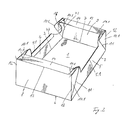
- eine perspektivische Darstellung der Aufrichteschachtel in der Gebrauchsstellung, wobei in der hinteren linken Ecke ein Stück der Seitenwand und ein Stück des an den Diagonalfalz angeschlossenen Teils der Verbindungslasche weggelassen sind.
- Der Boden 1 der Aufrichteschachtel ist über Falze 2 und 3 mit Seitenwänden 4 und 5 sowie über Falze 6 und 7 mit Stirnwänden 8 und 9 verbunden. Die Seitenwände 4 und 5 weisen je einen Falz 4.1 bzw. 5.1 auf, durch den der obere Randbereich 4.2. bzw. 5.2 nach innen geklappt und zur Verstärkung der Seitenwand 4 bzw. 5 mit deren unterhalb des Falzes 4.1 bzw. 5.1 liegendem Bereich verklebt werden kann. Die Verbindung der Seiten- und Stirnwände untereinander erfolgt durch Verbindungslaschen 10, die durch je einen vom Boden 1 ausgehenden Diagonalfalz 11 in einen innerhalb des Diagonalfalzes 11 liegenden Teil 10.1 und einen über den Diagonalfalz 11 angeschlossenen Teil 10.2 unterteilt sind. Die Verbindungslaschen 10 sind über je einen Falz 12 mit der zugehörigen Stirnwand 8 bzw. 9 verbunden. Wie aus Fig. 2 ersichtlich ist, wird der über den Diagonalfalz 11 angeschlossene Teil 10.2 der Verbindungslasche 10 um den Diagonalfalz 11 nach innen zur zugehörigen Stirnwand 8 bzw. 9 hin zurückgebogen und mit seiner Außenseite mit der Außenseite der angrenzenden Seitenwand 4 bzw. 5 verklebt. Die beiden Teile 10.1 und 10.2 liegen somit im aufgerichteten Zustand der Schachtel von dem gemeinsamen Diagonalfalz 11 ausgehend mit ihren Innenseiten zugewandt einander gegenüber.
- An den oberen Längskanten der Stirnwände 8 und 9 ist über jeweils einen Falz 13 eine Stapellasche 14 angeschlossen. Jede Stapellasche 14 weist an ihren beiden Enden je einen Schrägfalz 14.1 auf, der von der Ecke ausgeht, in der die Stirnwand 8 bzw. 9, die Verbindungslasche 10 und die Stapellasche 14 zusammenstoßen. Jede Stapellasche 14 trägt an jedem Ende über einen Falz 15 eine Verlängerungslasche 16, deren Außenseite mit der Innenseite des Teils 10.1 der Verbindungslasche 10 verklebt ist.
- Die Enden der Seitenwände 4 und 5 sind jeweils mit einer vorstehenden Zunge 4.3 bzw. 5.3 versehen, deren Wirkung nachstehend erläutert wird.
- Im aufgerichteten Zustand der Schachtel (Fig. 2) sind die Teile 10.1 und 10.2 der Verbindungslasche 10 aufgrund der Elastizität des Materials vom Diagonalfalz 11 ausgehend leicht gespreizt. Die Spreizung wird durch die Steifheit der mit dem Teil 10.2 verklebten Seitenwand 4 bzw. 5 begrenzt. Um jedoch eine bestimmte Spreizung auch nach längerer Zeit sicherzustellen, sind die Zungen 4.3 so ausgebildet, daß sie bei einer gewünschten Spreizung der Teile 10.1 und 10.2 mit einer bestimmten Klemmkraft an der zugehörigen Stirnwand 8 bzw. 9 anliegen. Eine Verringerung der Spreizung kann nur gegen den Widerstand der hierbei ansteigenden Klemmkraft erfolgen. Auf diese Weise kann ein bestimmter Spreizungsgrad dauerhaft eingestellt werden.
- Die gewünschte Spreizung wird vorzugsweise so gewählt, daß das Teil 10.2 und die mit dem verklebte Seitenwand 4 bzw. 5 unmittelbar unterhalb der Stapellasche 14 den Schrägfalz 14.1 etwa in dessen Mitte kreuzen. Eine die Stabilität der Schachtel beeinträchtigende Auslenkung der Stapellasche 14 im Bereich des Schrägfalzes 14.1 nach unten kann dadurch wirksam vermieden werden.
- Die die Spreizung sicherstellenden Zungen können auch an den den Stirnwänden 4 bzw. 5 zugewandten Seiten der Teile 10.2 angeordnet sein; darüber hinaus kann es zweckmäßig sein, derartige Zungen sowohl an den Seitenwänden 4 bzw. 5 als auch an den Teilen 10.2 vorzusehen.
Claims (3)
- Aufrichteschachtel mit Stirn- und Seitenwänden, die durch Falze mit einem Boden verbunden sind, wobei an die Stirnwände seitlich über Falze Verbindungslaschen angeschlossen sind, die jeweils durch einen Diagonalfalz unterteilt sind und deren über den Diagonalfalz angeschlossener Teil jeweils an der Außenseite der Seitenwand befestigt ist, wobei an die Stirnwände über Falze nach innen faltbare Stapellaschen angeschlossen sind, die über je einen Falz mit seitlichen, jeweils an dem innerhalb des Diagonalfalzes liegenden Teil einer Verbindungslasche befestigten Verlängerungslaschen versehen sind, und wobei in den Endbereichen der Stapellaschen je ein Schrägfalz angeordnet ist, der in der Ecke ausläuft, an der die Stirnwand, die Verbindungslasche und die Stapellasche zusammenstoßen,
dadurch gekennzeichnet,
daß jeweils der über den Diagonalfalz (11) angeschlossene Teil (10.2) einer Verbindungslasche (10) zur zugehörigen Stirnwand (8,9) zurückgebogen ist, derart, daß die beiden Teile (10.1,10.2) der Verbindungslasche (10) zumindest im an den Diagonalfalz (11) angrenzenden Bereich gegeneinander spreizbar einander gegenüberliegen. - Aufrichteschachtel nach Anspruch 1, dadurch gekennzeichnet, daß sich an den den Stirnwänden (8,9) zugewandten Enden der Seitenwände (4,5) vorstehende Zungen (4.3) befinden, die im leicht gespreizten Zustand der beiden Teile (10.1,10.2) der zugehörigen Verbindungslasche (10) in einer Klemmberührung mit der jeweiligen Stirnwand (8,9) stehen.
- Aufrichteschachtel nach Anspruch 1 oder 2, dadurch gekennzeichnet, daß sich an den den Stirnwänden (8,9) zugewandten Seiten der über den Diagonalfalz (11) angeschlossenen Teile (10.2) der Verbindungslaschen (10) vorstehende Zungen befinden, die im leicht gespreizten Zustand der beiden Teile (10.1,10.2) der zugehörigen Verbindungslasche (10) in einer Klemmberührung mit der jeweiligen Stirnwand (8,9) stehen.
Priority Applications (4)
| Application Number | Priority Date | Filing Date | Title |
|---|---|---|---|
| EP90250095A EP0452571B1 (de) | 1990-04-10 | 1990-04-10 | Aufrichteschachtel |
| DE90250095T DE59003805D1 (de) | 1990-04-10 | 1990-04-10 | Aufrichteschachtel. |
| ES90250095T ES2049410T3 (es) | 1990-04-10 | 1990-04-10 | Caja de carton erigible. |
| AT90250095T ATE98184T1 (de) | 1990-04-10 | 1990-04-10 | Aufrichteschachtel. |
Applications Claiming Priority (1)
| Application Number | Priority Date | Filing Date | Title |
|---|---|---|---|
| EP90250095A EP0452571B1 (de) | 1990-04-10 | 1990-04-10 | Aufrichteschachtel |
Publications (2)
| Publication Number | Publication Date |
|---|---|
| EP0452571A1 true EP0452571A1 (de) | 1991-10-23 |
| EP0452571B1 EP0452571B1 (de) | 1993-12-08 |
Family
ID=8205227
Family Applications (1)
| Application Number | Title | Priority Date | Filing Date |
|---|---|---|---|
| EP90250095A Expired - Lifetime EP0452571B1 (de) | 1990-04-10 | 1990-04-10 | Aufrichteschachtel |
Country Status (4)
| Country | Link |
|---|---|
| EP (1) | EP0452571B1 (de) |
| AT (1) | ATE98184T1 (de) |
| DE (1) | DE59003805D1 (de) |
| ES (1) | ES2049410T3 (de) |
Cited By (1)
| Publication number | Priority date | Publication date | Assignee | Title |
|---|---|---|---|---|
| DE202012010231U1 (de) | 2012-10-26 | 2013-10-28 | Baypack Gmbh | Transportsteige, insbesondere für Gemüse oder Obst |
Citations (4)
| Publication number | Priority date | Publication date | Assignee | Title |
|---|---|---|---|---|
| US2345810A (en) * | 1941-04-11 | 1944-04-04 | Raoul J Gruenberg | Folding box |
| US2678152A (en) * | 1951-12-08 | 1954-05-11 | Sutherland Paper Co | Collapsible carton member |
| FR2055951A5 (de) * | 1969-08-11 | 1971-05-14 | Thiolat Robert | |
| DE3302972A1 (de) * | 1982-03-13 | 1983-09-22 | Allgäuer Holzspanschachtelfabrik und Kartonagenwerk Albert Frey, 8949 Dirlewang | Stapelbare aufrichteschachtel |
-
1990
- 1990-04-10 ES ES90250095T patent/ES2049410T3/es not_active Expired - Lifetime
- 1990-04-10 AT AT90250095T patent/ATE98184T1/de active
- 1990-04-10 EP EP90250095A patent/EP0452571B1/de not_active Expired - Lifetime
- 1990-04-10 DE DE90250095T patent/DE59003805D1/de not_active Expired - Fee Related
Patent Citations (4)
| Publication number | Priority date | Publication date | Assignee | Title |
|---|---|---|---|---|
| US2345810A (en) * | 1941-04-11 | 1944-04-04 | Raoul J Gruenberg | Folding box |
| US2678152A (en) * | 1951-12-08 | 1954-05-11 | Sutherland Paper Co | Collapsible carton member |
| FR2055951A5 (de) * | 1969-08-11 | 1971-05-14 | Thiolat Robert | |
| DE3302972A1 (de) * | 1982-03-13 | 1983-09-22 | Allgäuer Holzspanschachtelfabrik und Kartonagenwerk Albert Frey, 8949 Dirlewang | Stapelbare aufrichteschachtel |
Cited By (2)
| Publication number | Priority date | Publication date | Assignee | Title |
|---|---|---|---|---|
| DE202012010231U1 (de) | 2012-10-26 | 2013-10-28 | Baypack Gmbh | Transportsteige, insbesondere für Gemüse oder Obst |
| WO2014063827A1 (de) | 2012-10-26 | 2014-05-01 | Baypack Gmbh | Transportsteige, insbesondere für gemüse oder obst |
Also Published As
| Publication number | Publication date |
|---|---|
| ATE98184T1 (de) | 1993-12-15 |
| DE59003805D1 (de) | 1994-01-20 |
| ES2049410T3 (es) | 1994-04-16 |
| EP0452571B1 (de) | 1993-12-08 |
Similar Documents
| Publication | Publication Date | Title |
|---|---|---|
| DE2728365A1 (de) | Faltschachtel, insbesondere fuer fruechte und gemuese | |
| DE2004456C3 (de) | Stapelbarer Kasten aus faltbarem Blattmaterial | |
| EP0452571B1 (de) | Aufrichteschachtel | |
| DE3321614C2 (de) | Stapelfähige Aufrichteschachtel und Zuschnitt hierfür | |
| DE68902471T2 (de) | Faltschachtel und zuschnitt dafuer. | |
| DE1235799B (de) | Stuelpschachtel | |
| EP0101854B1 (de) | Bodenaufsteller | |
| EP1341698B1 (de) | Faltschachtel | |
| DE9305904U1 (de) | Zusammenlegbarer Lager- und Transportkasten | |
| DE3835359C1 (en) | Collapsible display box | |
| DE7924243U1 (de) | Aufrichteschachtel | |
| EP0413986B1 (de) | Verpackungsträger | |
| DE9216776U1 (de) | Palette aus Wellpappe | |
| EP0663170B1 (de) | Zusammenlegbares Etagendisplay | |
| DE9314930U1 (de) | Verpackung zum Aufbewahren und gleichzeitigen Exponieren einer Flasche | |
| EP3567570A1 (de) | Werbeaufsteller | |
| DE9205177U1 (de) | Obst- oder Gemüsekiste | |
| DE2444180C3 (de) | Ständer für die Aufstellung eines steifen Plakats | |
| EP0331972A1 (de) | Faltbehälter | |
| DE9414856U1 (de) | Warenträger | |
| DE2356466A1 (de) | Stapelbare verpackungspalette | |
| AT403794B (de) | Zuschnitt für eine faltschachtel | |
| DE8435641U1 (de) | Steige | |
| DE3148286C2 (de) | ||
| DE29701240U1 (de) | Faltkarton |
Legal Events
| Date | Code | Title | Description |
|---|---|---|---|
| PUAI | Public reference made under article 153(3) epc to a published international application that has entered the european phase |
Free format text: ORIGINAL CODE: 0009012 |
|
| AK | Designated contracting states |
Kind code of ref document: A1 Designated state(s): AT CH DE ES FR GB IT LI NL |
|
| 17P | Request for examination filed |
Effective date: 19911205 |
|
| 17Q | First examination report despatched |
Effective date: 19920715 |
|
| RAP1 | Party data changed (applicant data changed or rights of an application transferred) |
Owner name: ALBERT FREY VERPACKUNGSENTWICKLUNGEN UND VERTRIEBS |
|
| GRAA | (expected) grant |
Free format text: ORIGINAL CODE: 0009210 |
|
| AK | Designated contracting states |
Kind code of ref document: B1 Designated state(s): AT CH DE ES FR GB IT LI NL |
|
| PG25 | Lapsed in a contracting state [announced via postgrant information from national office to epo] |
Ref country code: GB Effective date: 19931208 |
|
| REF | Corresponds to: |
Ref document number: 98184 Country of ref document: AT Date of ref document: 19931215 Kind code of ref document: T |
|
| ITF | It: translation for a ep patent filed | ||
| REF | Corresponds to: |
Ref document number: 59003805 Country of ref document: DE Date of ref document: 19940120 |
|
| ET | Fr: translation filed | ||
| PGFP | Annual fee paid to national office [announced via postgrant information from national office to epo] |
Ref country code: FR Payment date: 19940225 Year of fee payment: 5 |
|
| PG25 | Lapsed in a contracting state [announced via postgrant information from national office to epo] |
Ref country code: AT Effective date: 19940410 |
|
| REG | Reference to a national code |
Ref country code: ES Ref legal event code: FG2A Ref document number: 2049410 Country of ref document: ES Kind code of ref document: T3 |
|
| PGFP | Annual fee paid to national office [announced via postgrant information from national office to epo] |
Ref country code: ES Payment date: 19940421 Year of fee payment: 5 |
|
| PG25 | Lapsed in a contracting state [announced via postgrant information from national office to epo] |
Ref country code: LI Effective date: 19940430 Ref country code: CH Effective date: 19940430 |
|
| PGFP | Annual fee paid to national office [announced via postgrant information from national office to epo] |
Ref country code: NL Payment date: 19940430 Year of fee payment: 5 |
|
| GBV | Gb: ep patent (uk) treated as always having been void in accordance with gb section 77(7)/1977 [no translation filed] |
Effective date: 19931208 |
|
| PLBE | No opposition filed within time limit |
Free format text: ORIGINAL CODE: 0009261 |
|
| STAA | Information on the status of an ep patent application or granted ep patent |
Free format text: STATUS: NO OPPOSITION FILED WITHIN TIME LIMIT |
|
| 26N | No opposition filed | ||
| REG | Reference to a national code |
Ref country code: CH Ref legal event code: PL |
|
| PG25 | Lapsed in a contracting state [announced via postgrant information from national office to epo] |
Ref country code: ES Free format text: LAPSE BECAUSE OF NON-PAYMENT OF DUE FEES Effective date: 19950411 |
|
| PG25 | Lapsed in a contracting state [announced via postgrant information from national office to epo] |
Ref country code: NL Effective date: 19951101 |
|
| PGFP | Annual fee paid to national office [announced via postgrant information from national office to epo] |
Ref country code: DE Payment date: 19951228 Year of fee payment: 6 |
|
| PG25 | Lapsed in a contracting state [announced via postgrant information from national office to epo] |
Ref country code: FR Effective date: 19951229 |
|
| NLV4 | Nl: lapsed or anulled due to non-payment of the annual fee |
Effective date: 19951101 |
|
| REG | Reference to a national code |
Ref country code: FR Ref legal event code: ST |
|
| PG25 | Lapsed in a contracting state [announced via postgrant information from national office to epo] |
Ref country code: DE Effective date: 19970101 |
|
| REG | Reference to a national code |
Ref country code: ES Ref legal event code: FD2A Effective date: 19990503 |
|
| PG25 | Lapsed in a contracting state [announced via postgrant information from national office to epo] |
Ref country code: IT Free format text: LAPSE BECAUSE OF NON-PAYMENT OF DUE FEES Effective date: 20050410 |