EP0452694A2 - Process of forming a stable colloidal dispersion - Google Patents
Process of forming a stable colloidal dispersion Download PDFInfo
- Publication number
- EP0452694A2 EP0452694A2 EP91104429A EP91104429A EP0452694A2 EP 0452694 A2 EP0452694 A2 EP 0452694A2 EP 91104429 A EP91104429 A EP 91104429A EP 91104429 A EP91104429 A EP 91104429A EP 0452694 A2 EP0452694 A2 EP 0452694A2
- Authority
- EP
- European Patent Office
- Prior art keywords
- dispersion
- alkanolamine
- derivative
- polyglycol derivative
- polyglycol
- Prior art date
- Legal status (The legal status is an assumption and is not a legal conclusion. Google has not performed a legal analysis and makes no representation as to the accuracy of the status listed.)
- Granted
Links
Images
Classifications
-
- C—CHEMISTRY; METALLURGY
- C08—ORGANIC MACROMOLECULAR COMPOUNDS; THEIR PREPARATION OR CHEMICAL WORKING-UP; COMPOSITIONS BASED THEREON
- C08J—WORKING-UP; GENERAL PROCESSES OF COMPOUNDING; AFTER-TREATMENT NOT COVERED BY SUBCLASSES C08B, C08C, C08F, C08G or C08H
- C08J3/00—Processes of treating or compounding macromolecular substances
- C08J3/02—Making solutions, dispersions, lattices or gels by other methods than by solution, emulsion or suspension polymerisation techniques
- C08J3/09—Making solutions, dispersions, lattices or gels by other methods than by solution, emulsion or suspension polymerisation techniques in organic liquids
- C08J3/091—Making solutions, dispersions, lattices or gels by other methods than by solution, emulsion or suspension polymerisation techniques in organic liquids characterised by the chemical constitution of the organic liquid
- C08J3/096—Nitrogen containing compounds
-
- B—PERFORMING OPERATIONS; TRANSPORTING
- B01—PHYSICAL OR CHEMICAL PROCESSES OR APPARATUS IN GENERAL
- B01F—MIXING, e.g. DISSOLVING, EMULSIFYING OR DISPERSING
- B01F23/00—Mixing according to the phases to be mixed, e.g. dispersing or emulsifying
- B01F23/40—Mixing liquids with liquids; Emulsifying
- B01F23/49—Mixing systems, i.e. flow charts or diagrams
-
- B—PERFORMING OPERATIONS; TRANSPORTING
- B01—PHYSICAL OR CHEMICAL PROCESSES OR APPARATUS IN GENERAL
- B01F—MIXING, e.g. DISSOLVING, EMULSIFYING OR DISPERSING
- B01F25/00—Flow mixers; Mixers for falling materials, e.g. solid particles
- B01F25/50—Circulation mixers, e.g. wherein at least part of the mixture is discharged from and reintroduced into a receptacle
- B01F25/51—Circulation mixers, e.g. wherein at least part of the mixture is discharged from and reintroduced into a receptacle in which the mixture is circulated through a set of tubes, e.g. with gradual introduction of a component into the circulating flow
-
- C—CHEMISTRY; METALLURGY
- C08—ORGANIC MACROMOLECULAR COMPOUNDS; THEIR PREPARATION OR CHEMICAL WORKING-UP; COMPOSITIONS BASED THEREON
- C08J—WORKING-UP; GENERAL PROCESSES OF COMPOUNDING; AFTER-TREATMENT NOT COVERED BY SUBCLASSES C08B, C08C, C08F, C08G or C08H
- C08J3/00—Processes of treating or compounding macromolecular substances
- C08J3/02—Making solutions, dispersions, lattices or gels by other methods than by solution, emulsion or suspension polymerisation techniques
- C08J3/09—Making solutions, dispersions, lattices or gels by other methods than by solution, emulsion or suspension polymerisation techniques in organic liquids
-
- C—CHEMISTRY; METALLURGY
- C08—ORGANIC MACROMOLECULAR COMPOUNDS; THEIR PREPARATION OR CHEMICAL WORKING-UP; COMPOSITIONS BASED THEREON
- C08J—WORKING-UP; GENERAL PROCESSES OF COMPOUNDING; AFTER-TREATMENT NOT COVERED BY SUBCLASSES C08B, C08C, C08F, C08G or C08H
- C08J2371/00—Characterised by the use of polyethers obtained by reactions forming an ether link in the main chain; Derivatives of such polymers
- C08J2371/02—Polyalkylene oxides
Definitions
- This invention concerns a process for combining liquid materials which are generally incompatible. More particularly, it concerns a process for combining, under pressure, a water-insoluble, liquid polyalkylene glycol derivative in relatively small amounts with a water-soluble, nonaqueous alkanolamine wherein the glycol derivative is repeatedly added under shear stress to the recycled alkanolamine in amounts proportionate to the total amount to be added until the desired colloidal dispersion is obtained.
- liquid materials to be combined in accordance with this process are not mutually soluble in any concentration. Because of the differences in polarity and molecular weight, they are not, under ordinary circumstances, even mutually miscible. Accordingly, to provide a stable, uniform colloidal dispersion, the components must be combined under strong mechanical forces. However, even at the low, additive amounts of the glycol derivative to be combined with the alkanolamine, a single pass at combining under pressure and applied shear stress the total amount of the derivative with the alkanolamine to obtain the desired dispersion has been unsuccessful.
- the dispersions of this invention are generally used in the gas treatment industry wherein recovered natural gas is sweetened by removal of hydrogen sulfide and/or carbon dioxide to reduce corrosiveness of the gas product.
- Alkanolamines and alkyl alkanolamines are used as solvents in aqueous systems to absorb the acidic components of the gas. Occasionally, foaming develops in the aqueous alkanolamine system and anti-foam agents are added to overcome the problem.
- Polyalkylene glycols are widely used antifoam agents for alkanolamine sweeteners but attempts to combine the high viscosity, water-insoluble polyglycol derivatives with the nonaqueous alkanolamine at the formulator's plant have met with difficulties.
- This invention is a process for uniformly dispersing an additive amount of a water-insoluble, liquid polyalkylene glycol derivative thereof having a viscosity (100°F-SUS) of at least about 150, and preferably at least about 200, in a substantially nonaqueous, water-soluble alkanolamine, said process comprising feeding under pressure a first proportion of the total additive amount of said glycol derivative into a pressurized stream of said alkanolamine and subjecting the mixture to shear stress to form a first dispersion, recycling said first dispersion to the glycol derivative feed, feeding under pressure a second proportion of said glycol derivative into a pressurized stream of said first dispersion and subjecting the mixture to shear stress to form a second dispersion, optionally, recycling said second dispersion to said glycol derivative feed, and feeding another proportion of any remaining glycol derivative into a pressurized stream of said second dispersion and subjecting the mixture to shear stress to form a third dispersion, whereby a stable, colloidal dis
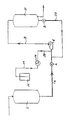
- the sole figure of the drawing is a flow sheet of the process as it maybe used in a formulation plant showing tanks, pumps and flow lines for carrying out the process.
- the process of this invention employs, as the additive to be uniformly dispersed into an alkanolamine, a water-insoluble, liquid polyalkylene glycol derivative having a viscosity (100°F-SUS) of at least about 200.
- a water-insoluble, liquid polyalkylene glycol derivative having a viscosity (100°F-SUS) of at least about 200.
- the polyalkylene glycol derivatives have the following general formula: where R is C1-C25 alkyl or C6-C24 aryl, R1, R2 and R3 are independently hydrogen or C1-C25 alkyl or C6-C24 aryl, and x and y independently have values of zero and higher provided that x or y is at least 1.
- Typical of such materials are polypropylene glycol monobutyl ether, polyethylene glycol monomethyl ether, poly (ethylene oxide - propylene oxide) monoethyl ether, poly (propylene oxide - butylene oxide) monooctyl ether, polypropylene glycol monomethyl ether, polybutylene glycol monophenyl ether, polypropylene glycol monomethylphenyl ether, polypropylene glycol monohexyl ether, polypropylene glycol diethyl ether and polyethylene glycol dimethyl ether.
- the glycols or their derivatives are dispersed in the alkanolamine in an additive amount, preferably from about 0.01 to 2% based on the weight of the amine formulation. More preferably, an amount in the range of from 0.05 to 0.5% is used.
- alkanolamines which are useful for this invention are monoethanolamine, diethanolamine, methylethanolamine, diisopropanolamine, ethylpropanolamine, methyldipropanolamine, methyldiethanolamine, ethyldiethanolamine, propyldiethanolamine, isopropyldiethanolamine, methyldiisopropanolamine, ethyldiisopropanolamine, propyldiisopropanolamine, diethylethanolamine, dimethylethanolamine, dipropylethanolamine, triethanolamine, and mixtures of the foregoing.
- the amines form the dispersant phase of the dispersion in non-aqueous form, ie, containing substantially no water.
- alkanolamine-polyglycol derivative formulation may be incorporated into the alkanolamine-polyglycol derivative formulation, if desired.
- the dispersions formed in the process of this invention may be recycled to receive proportionate amounts of the glycol derivative as many times as is necessary to complete the addition of the total additive amount and to obtain a uniform, stable dispersion.
- MDEA methyldiethanolamine
- MDEA from a 23,000 gallon capacity tank 2
- MDEA is transferred under pressure through line 4, open valve A, pump 6 and line 8 into 23,000 gallon capacity holding tank 10.
- Valve B is kept closed during this phase of the operation.
- Pump 6 is Model 3926 "ST” sold by Gould Pumps, Inc. having an impeller which rotates at 3500 r.p.m. and is powered by a 7.5 horsepower electric motor. The pump moves 52 gallons of amine per minute against a viscosity correct total head of 150 feet.
- the polyglycol derivative is passed from drum 12 through line 14 by means of a positive pressure metering pump 16 (FMI RP650) supplied by Fluid Metering, Inc. of Oyster Bay, N. Y., and then through line 18. It is injected at the rate of 0.12 lbs./hour into the stream of MDEA flowing through line 4 by means of a tee in line 4 positioned six inches up stream from the suction flange of pump 6.
- the MDEA stream with the injected polyglycol derivative is passed into the vortex of the centrifugal pump 6 to subject the mixture to shear stress. At this rate, 173 lbs.
- the glycol derivative is dispersed in 173,000 lbs of MDEA which provides a partial additive concentration of 0.0266 weight percent in the 6.4 hours required to transfer all of the 20,000 gallons of MDEA from tank 2 to tank 10.
- the metering pump 16 may be turned off.
- valve A is closed and valve B is opened to permit the MDEA and the partial amount of polyglycol derivative dispersed therein to recycle back through line 20 to line 4 through a tee disposed between valve A and the tee connecting line 18 to line 4.
- Metering pump 16 is restarted, or alternatively, if recycling is begun in sufficient time to provide a continuous flow of MDEA through line 4 as it approaches pump 6, metering pump 16 may run continuously until addition of the polyglycol derivative is finalized.
- the contents of tank 10 are recycled 3.75 times as the polyglycol derivative is added at the controlled rate of 0.12 lbs/min. This provides a uniform, stable dispersion of 0.1% of polyglycol derivative in the MDEA, based on the weight of the formulation.
Landscapes
- Chemical & Material Sciences (AREA)
- Chemical Kinetics & Catalysis (AREA)
- Dispersion Chemistry (AREA)
- Health & Medical Sciences (AREA)
- Medicinal Chemistry (AREA)
- Polymers & Plastics (AREA)
- Organic Chemistry (AREA)
- General Chemical & Material Sciences (AREA)
- Colloid Chemistry (AREA)
- Processes Of Treating Macromolecular Substances (AREA)
- Organic Low-Molecular-Weight Compounds And Preparation Thereof (AREA)
- Compositions Of Macromolecular Compounds (AREA)
Abstract
Description
- This invention concerns a process for combining liquid materials which are generally incompatible. More particularly, it concerns a process for combining, under pressure, a water-insoluble, liquid polyalkylene glycol derivative in relatively small amounts with a water-soluble, nonaqueous alkanolamine wherein the glycol derivative is repeatedly added under shear stress to the recycled alkanolamine in amounts proportionate to the total amount to be added until the desired colloidal dispersion is obtained.
- The liquid materials to be combined in accordance with this process are not mutually soluble in any concentration. Because of the differences in polarity and molecular weight, they are not, under ordinary circumstances, even mutually miscible. Accordingly, to provide a stable, uniform colloidal dispersion, the components must be combined under strong mechanical forces. However, even at the low, additive amounts of the glycol derivative to be combined with the alkanolamine, a single pass at combining under pressure and applied shear stress the total amount of the derivative with the alkanolamine to obtain the desired dispersion has been unsuccessful. Repeated additions of proportionate amounts of the total amount of glycol derivative to be added to the alkanolamine must be made to provide a facile commercial process for preparing a stable dispersion of an alkanolamine containing the desired or additive amount of glycol or its derivative.
- The dispersions of this invention are generally used in the gas treatment industry wherein recovered natural gas is sweetened by removal of hydrogen sulfide and/or carbon dioxide to reduce corrosiveness of the gas product. Alkanolamines and alkyl alkanolamines, are used as solvents in aqueous systems to absorb the acidic components of the gas. Occasionally, foaming develops in the aqueous alkanolamine system and anti-foam agents are added to overcome the problem. Polyalkylene glycols are widely used antifoam agents for alkanolamine sweeteners but attempts to combine the high viscosity, water-insoluble polyglycol derivatives with the nonaqueous alkanolamine at the formulator's plant have met with difficulties.
- This invention is a process for uniformly dispersing an additive amount of a water-insoluble, liquid polyalkylene glycol derivative thereof having a viscosity (100°F-SUS) of at least about 150, and preferably at least about 200, in a substantially nonaqueous, water-soluble alkanolamine, said process comprising feeding under pressure a first proportion of the total additive amount of said glycol derivative into a pressurized stream of said alkanolamine and subjecting the mixture to shear stress to form a first dispersion, recycling said first dispersion to the glycol derivative feed, feeding under pressure a second proportion of said glycol derivative into a pressurized stream of said first dispersion and subjecting the mixture to shear stress to form a second dispersion, optionally, recycling said second dispersion to said glycol derivative feed, and feeding another proportion of any remaining glycol derivative into a pressurized stream of said second dispersion and subjecting the mixture to shear stress to form a third dispersion, whereby a stable, colloidal dispersion of an additive amount of said glycol derivative is dispersed in said alkanolamine.
- The sole figure of the drawing is a flow sheet of the process as it maybe used in a formulation plant showing tanks, pumps and flow lines for carrying out the process.
- The process of this invention employs, as the additive to be uniformly dispersed into an alkanolamine, a water-insoluble, liquid polyalkylene glycol derivative having a viscosity (100°F-SUS) of at least about 200. Preferably, the polyalkylene glycol derivatives have the following general formula:

where R is C₁-C₂₅ alkyl or C₆-C₂₄ aryl, R¹, R² and R³ are independently hydrogen or C₁-C₂₅ alkyl or C₆-C₂₄ aryl, and x and y independently have values of zero and higher provided that x or y is at least 1. Typical of such materials are polypropylene glycol monobutyl ether, polyethylene glycol monomethyl ether, poly (ethylene oxide - propylene oxide) monoethyl ether, poly (propylene oxide - butylene oxide) monooctyl ether, polypropylene glycol monomethyl ether, polybutylene glycol monophenyl ether, polypropylene glycol monomethylphenyl ether, polypropylene glycol monohexyl ether, polypropylene glycol diethyl ether and polyethylene glycol dimethyl ether. - The glycols or their derivatives are dispersed in the alkanolamine in an additive amount, preferably from about 0.01 to 2% based on the weight of the amine formulation. More preferably, an amount in the range of from 0.05 to 0.5% is used.
- Examples of alkanolamines which are useful for this invention are monoethanolamine, diethanolamine, methylethanolamine, diisopropanolamine, ethylpropanolamine, methyldipropanolamine, methyldiethanolamine, ethyldiethanolamine, propyldiethanolamine, isopropyldiethanolamine, methyldiisopropanolamine, ethyldiisopropanolamine, propyldiisopropanolamine, diethylethanolamine, dimethylethanolamine, dipropylethanolamine, triethanolamine, and mixtures of the foregoing. The amines form the dispersant phase of the dispersion in non-aqueous form, ie, containing substantially no water.
- Other additives and organic solvents may be incorporated into the alkanolamine-polyglycol derivative formulation, if desired.
- The dispersions formed in the process of this invention may be recycled to receive proportionate amounts of the glycol derivative as many times as is necessary to complete the addition of the total additive amount and to obtain a uniform, stable dispersion.
- In the preferred embodiment of this invention, a 20,000 gallon batch of a formulation of methyldiethanolamine (MDEA) (99% minimum; 0.3%·water maximum) having dispersed therein 0.1%, based on the weight of the formulation, of water-insoluble, polypropylene glycol monobutyl ether (avg. mol. wt = 1040; viscosity = 285 SUS at 100°F), is prepared.
- Referring to the drawing, MDEA, from a 23,000 gallon capacity tank 2, is transferred under pressure through line 4, open valve A, pump 6 and line 8 into 23,000 gallon
capacity holding tank 10. Valve B is kept closed during this phase of the operation. - Pump 6 is Model 3926 "ST" sold by Gould Pumps, Inc. having an impeller which rotates at 3500 r.p.m. and is powered by a 7.5 horsepower electric motor. The pump moves 52 gallons of amine per minute against a viscosity correct total head of 150 feet.
- The polyglycol derivative is passed from
drum 12 through line 14 by means of a positive pressure metering pump 16 (FMI RP650) supplied by Fluid Metering, Inc. of Oyster Bay, N. Y., and then throughline 18. It is injected at the rate of 0.12 lbs./hour into the stream of MDEA flowing through line 4 by means of a tee in line 4 positioned six inches up stream from the suction flange of pump 6. The MDEA stream with the injected polyglycol derivative is passed into the vortex of the centrifugal pump 6 to subject the mixture to shear stress. At this rate, 173 lbs. of the glycol derivative is dispersed in 173,000 lbs of MDEA which provides a partial additive concentration of 0.0266 weight percent in the 6.4 hours required to transfer all of the 20,000 gallons of MDEA from tank 2 totank 10. As the last of the MDEA passes thetee connecting line 18 to line 4, themetering pump 16 may be turned off. When the entire 20,000 gallon of MDEA has been transferred totank 10, valve A is closed and valve B is opened to permit the MDEA and the partial amount of polyglycol derivative dispersed therein to recycle back throughline 20 to line 4 through a tee disposed between valve A and thetee connecting line 18 to line 4.Metering pump 16 is restarted, or alternatively, if recycling is begun in sufficient time to provide a continuous flow of MDEA through line 4 as it approaches pump 6,metering pump 16 may run continuously until addition of the polyglycol derivative is finalized. To complete the addition of the polyglycol derivative to the MDEA, the contents oftank 10 are recycled 3.75 times as the polyglycol derivative is added at the controlled rate of 0.12 lbs/min. This provides a uniform, stable dispersion of 0.1% of polyglycol derivative in the MDEA, based on the weight of the formulation.
Claims (8)
- A process for uniformly dispersing an additive amount of a water-insoluble, liquid polyalkylene glycol derivative having a viscosity (100°F - SUS) of at least about 150 in a substantially nonaqueous, water-soluble alkanolamine, said process comprising feeding under pressure a first proportion of the total additive amount of the polyglycol derivative into a pressurized stream of said alkanolamine and subjecting the mixture to shear stress to form a first dispersion, recycling said first dispersion to the polyglycol derivative feed, feeding under pressure a second proportion of said polyglycol derivative into a pressurized stream of said first dispersion and subjecting the mixture to shear stress to form a second dispersion, optionally, recycling said second dispersion to said polyglycol derivative feed, and feeding another proportion of any remaining polyglycol derivative into a pressurized stream of said second dispersion and subjecting the mixture to shear stress to form a third dispersion, whereby a stable, colloidal dispersion of an additive amount of said polyglycol derivative is uniformly dispersed in said alkanolamine.
- The process of claim 1 wherein at least said first dispersion is stored in a holding tank until said first dispersion is completely formed.
- The process of claim 1 wherein the dispersion is recycled at least three times to provide a final dispersion containing the total additive amount of said polyglycol derivative.
- The process of claim 1 wherein said polyglycol derivative has the following general formula:

- The process of claim 4 wherein said alkanolamine is methyldiethanolamine.
- The process of claim 5 wherein said polyglycol derivative is polypropylene glycol monobutylether dispersed in said alkanolamine in a total amount ranging from about 0.01 to about 2% based on the combined weight of the alkanolamine and the polyglycol derivative.
- The process of claim 1 wherein the shear stress is produced by passing the mixture into the vortex of a centrifugal pump.
- The process of claim 7 wherein the polyglycol derivative is polypropylene glycol monobutyl ether in an amount ranging from 0.05 to 0.5% based on the combined weight of the alkanolamine and the polyglycol derivative, and the alkanolamine is methyldiethanolamine.
Applications Claiming Priority (2)
| Application Number | Priority Date | Filing Date | Title |
|---|---|---|---|
| US07/510,648 US5051205A (en) | 1990-04-18 | 1990-04-18 | Process of forming a stable colloidal dispersion |
| US510648 | 2000-02-23 |
Publications (3)
| Publication Number | Publication Date |
|---|---|
| EP0452694A2 true EP0452694A2 (en) | 1991-10-23 |
| EP0452694A3 EP0452694A3 (en) | 1992-11-19 |
| EP0452694B1 EP0452694B1 (en) | 1995-08-09 |
Family
ID=24031596
Family Applications (1)
| Application Number | Title | Priority Date | Filing Date |
|---|---|---|---|
| EP91104429A Expired - Lifetime EP0452694B1 (en) | 1990-04-18 | 1991-03-21 | Process of forming a stable colloidal dispersion |
Country Status (7)
| Country | Link |
|---|---|
| US (1) | US5051205A (en) |
| EP (1) | EP0452694B1 (en) |
| AR (1) | AR245013A1 (en) |
| BR (1) | BR9101429A (en) |
| CA (1) | CA2040176A1 (en) |
| DE (1) | DE69111873T2 (en) |
| ES (1) | ES2075240T3 (en) |
Cited By (2)
| Publication number | Priority date | Publication date | Assignee | Title |
|---|---|---|---|---|
| WO1995013128A1 (en) * | 1993-11-09 | 1995-05-18 | Union Carbide Chemicals & Plastics Technology Corporation | Absorption of mercaptans |
| EP1004344A1 (en) * | 1998-11-25 | 2000-05-31 | Clariant GmbH | Process for purifying gases |
Families Citing this family (2)
| Publication number | Priority date | Publication date | Assignee | Title |
|---|---|---|---|---|
| JPWO2025004800A1 (en) * | 2023-06-29 | 2025-01-02 | ||
| WO2025004799A1 (en) * | 2023-06-29 | 2025-01-02 | Agc株式会社 | Acidic gas-absorbing liquid and acidic gas reduction method |
Family Cites Families (8)
| Publication number | Priority date | Publication date | Assignee | Title |
|---|---|---|---|---|
| US3565404A (en) * | 1968-10-15 | 1971-02-23 | Pako Corp | Device for mixing fluids |
| US4044100A (en) * | 1969-12-08 | 1977-08-23 | Allied Chemical Corporation | Separation of acidic gas constituents from gaseous mixtures containing the same |
| IT1132170B (en) * | 1980-07-04 | 1986-06-25 | Snam Progetti | SELECTIVE SEPARATION PROCESS OF HYDROGEN SULFURATED FROM GASEOUS MIXTURES CONTAINING ALSO CARBON DIOXIDE |
| US4439405A (en) * | 1980-09-24 | 1984-03-27 | Unc Recovery Corporation | Method for varying the mixing time and proportions in the contacting of substantially immiscible liquids |
| US4430251A (en) * | 1981-09-29 | 1984-02-07 | Hoffert Manufacturing Co., Inc. | High energy emulsifier |
| GB8410393D0 (en) * | 1984-04-24 | 1984-05-31 | Ici Plc | Fluid compositions |
| US4654155A (en) * | 1985-03-29 | 1987-03-31 | Reynolds Metals Company | Microemulsion lubricant |
| DE3643934A1 (en) * | 1986-12-22 | 1988-06-23 | Henkel Kgaa | USE OF SELECTED ALKYL AND / OR ALKENYL DIETHANOLAMINE COMPOUNDS AS SOLUTIONS FOR LOW-FOAM SURFACES |
-
1990
- 1990-04-18 US US07/510,648 patent/US5051205A/en not_active Expired - Fee Related
-
1991
- 1991-03-21 ES ES91104429T patent/ES2075240T3/en not_active Expired - Lifetime
- 1991-03-21 DE DE69111873T patent/DE69111873T2/en not_active Expired - Fee Related
- 1991-03-21 EP EP91104429A patent/EP0452694B1/en not_active Expired - Lifetime
- 1991-04-07 AR AR91319474A patent/AR245013A1/en active
- 1991-04-10 CA CA002040176A patent/CA2040176A1/en not_active Abandoned
- 1991-04-10 BR BR919101429A patent/BR9101429A/en not_active Application Discontinuation
Cited By (4)
| Publication number | Priority date | Publication date | Assignee | Title |
|---|---|---|---|---|
| WO1995013128A1 (en) * | 1993-11-09 | 1995-05-18 | Union Carbide Chemicals & Plastics Technology Corporation | Absorption of mercaptans |
| US5589149A (en) * | 1993-11-09 | 1996-12-31 | Union Carbide Chemicals & Plastics Technology Corporation | Process for absorption of mercaptans |
| EP1004344A1 (en) * | 1998-11-25 | 2000-05-31 | Clariant GmbH | Process for purifying gases |
| US6277345B1 (en) | 1998-11-25 | 2001-08-21 | Clariant Gmbh | Process for the purification of gases |
Also Published As
| Publication number | Publication date |
|---|---|
| AR245013A1 (en) | 1993-12-30 |
| ES2075240T3 (en) | 1995-10-01 |
| US5051205A (en) | 1991-09-24 |
| BR9101429A (en) | 1991-11-26 |
| CA2040176A1 (en) | 1991-10-19 |
| DE69111873D1 (en) | 1995-09-14 |
| EP0452694A3 (en) | 1992-11-19 |
| EP0452694B1 (en) | 1995-08-09 |
| DE69111873T2 (en) | 1995-12-07 |
Similar Documents
| Publication | Publication Date | Title |
|---|---|---|
| RU2182589C2 (en) | Method of preparing aqueous resinous suspension-emulsion (variants), method of regeneration of sulfuric acid, method of resin liquefaction and their removal | |
| US5466746A (en) | Emulsions of organopolysiloxanes containing polar groups with alkyl polyglycosides as emulsifiers | |
| EP0452694B1 (en) | Process of forming a stable colloidal dispersion | |
| US7179775B2 (en) | Coating removal compositions | |
| CN102942835B (en) | A kind of high throwing power cathode electrophoresis dope and preparation method thereof and using method | |
| FI94256B (en) | Use of an aqueous concentrate containing an ethylene acrylic acid copolymer and process for coagulating varnish and other organic coatings | |
| JP2007525566A (en) | New oil-in-water emulsifier | |
| US7338604B2 (en) | Process for recycling paint flush solution | |
| US4404362A (en) | Block polymers of alkanolamines | |
| JPH06320103A (en) | Method of reusing separated liquid of recovered paint | |
| CN113454191B (en) | Multifunctional additive compounds | |
| US11230476B2 (en) | Dissolved air flotation use with cationic metal processing fluids | |
| US4459220A (en) | Block polymers of alkanolamines as demulsifiers for O/W emulsions | |
| US4303780A (en) | Ureylenes and uses thereof | |
| ES2307500T3 (en) | SUSPENSION OF ACETOACETILARILIDE IN PIGMENTARY APPLICATIONS. | |
| US7637651B2 (en) | Process for making slurries | |
| CN108843293A (en) | A kind of reusable construction method for dropping the system that blocks water | |
| CN1954020B (en) | batch preparation method of silicon emulsion | |
| US4569785A (en) | Thioureylenes and uses thereof | |
| CN117101451B (en) | Multi-working-condition formula test and blending method for green friction lubricating fluid | |
| US4376708A (en) | Flotation processes using ureylenes | |
| CN110484377A (en) | A kind of safe and efficient UV resin detergent and its preparation process and application method | |
| CN215610619U (en) | Waterborne polyurethane emulsification device of zero wastewater discharge | |
| CN220637893U (en) | Scribing equipment for ship | |
| MX2013001162A (en) | Compositions and methods for separating emulsions using the same. |
Legal Events
| Date | Code | Title | Description |
|---|---|---|---|
| PUAI | Public reference made under article 153(3) epc to a published international application that has entered the european phase |
Free format text: ORIGINAL CODE: 0009012 |
|
| AK | Designated contracting states |
Kind code of ref document: A2 Designated state(s): BE DE ES FR GB IT NL |
|
| PUAL | Search report despatched |
Free format text: ORIGINAL CODE: 0009013 |
|
| AK | Designated contracting states |
Kind code of ref document: A3 Designated state(s): BE DE ES FR GB IT NL |
|
| 17P | Request for examination filed |
Effective date: 19930506 |
|
| 17Q | First examination report despatched |
Effective date: 19930716 |
|
| GRAA | (expected) grant |
Free format text: ORIGINAL CODE: 0009210 |
|
| ITF | It: translation for a ep patent filed | ||
| AK | Designated contracting states |
Kind code of ref document: B1 Designated state(s): BE DE ES FR GB IT NL |
|
| PGFP | Annual fee paid to national office [announced via postgrant information from national office to epo] |
Ref country code: FR Payment date: 19950831 Year of fee payment: 6 |
|
| REF | Corresponds to: |
Ref document number: 69111873 Country of ref document: DE Date of ref document: 19950914 |
|
| ET | Fr: translation filed | ||
| REG | Reference to a national code |
Ref country code: ES Ref legal event code: FG2A Ref document number: 2075240 Country of ref document: ES Kind code of ref document: T3 |
|
| RAP2 | Party data changed (patent owner data changed or rights of a patent transferred) |
Owner name: ELF ATOCHEM NORTH AMERICA, INC. |
|
| RAP4 | Party data changed (patent owner data changed or rights of a patent transferred) |
Owner name: ELF ATOCHEM NORTH AMERICA, INC. |
|
| NLT2 | Nl: modifications (of names), taken from the european patent patent bulletin |
Owner name: ELF ATOCHEM NORTH AMERICA, INC. |
|
| PG25 | Lapsed in a contracting state [announced via postgrant information from national office to epo] |
Ref country code: GB Effective date: 19960321 |
|
| PG25 | Lapsed in a contracting state [announced via postgrant information from national office to epo] |
Ref country code: ES Free format text: LAPSE BECAUSE OF NON-PAYMENT OF DUE FEES Effective date: 19960322 |
|
| PG25 | Lapsed in a contracting state [announced via postgrant information from national office to epo] |
Ref country code: BE Effective date: 19960331 |
|
| PLBE | No opposition filed within time limit |
Free format text: ORIGINAL CODE: 0009261 |
|
| STAA | Information on the status of an ep patent application or granted ep patent |
Free format text: STATUS: NO OPPOSITION FILED WITHIN TIME LIMIT |
|
| 26N | No opposition filed | ||
| BERE | Be: lapsed |
Owner name: ATOCHEM NORTH AMERICA INC. Effective date: 19960331 |
|
| PG25 | Lapsed in a contracting state [announced via postgrant information from national office to epo] |
Ref country code: NL Effective date: 19961001 |
|
| GBPC | Gb: european patent ceased through non-payment of renewal fee |
Effective date: 19960321 |
|
| NLV4 | Nl: lapsed or anulled due to non-payment of the annual fee |
Effective date: 19961001 |
|
| PG25 | Lapsed in a contracting state [announced via postgrant information from national office to epo] |
Ref country code: DE Effective date: 19961203 |
|
| PG25 | Lapsed in a contracting state [announced via postgrant information from national office to epo] |
Ref country code: FR Free format text: LAPSE BECAUSE OF NON-PAYMENT OF DUE FEES Effective date: 19971128 |
|
| REG | Reference to a national code |
Ref country code: FR Ref legal event code: ST |
|
| REG | Reference to a national code |
Ref country code: ES Ref legal event code: FD2A Effective date: 19970410 |
|
| PG25 | Lapsed in a contracting state [announced via postgrant information from national office to epo] |
Ref country code: IT Free format text: LAPSE BECAUSE OF NON-PAYMENT OF DUE FEES;WARNING: LAPSES OF ITALIAN PATENTS WITH EFFECTIVE DATE BEFORE 2007 MAY HAVE OCCURRED AT ANY TIME BEFORE 2007. THE CORRECT EFFECTIVE DATE MAY BE DIFFERENT FROM THE ONE RECORDED. Effective date: 20050321 |