EP0452694B1 - Verfahren zur Herstellung einer stabilen kolloidalen Dispersion - Google Patents
Verfahren zur Herstellung einer stabilen kolloidalen Dispersion Download PDFInfo
- Publication number
- EP0452694B1 EP0452694B1 EP91104429A EP91104429A EP0452694B1 EP 0452694 B1 EP0452694 B1 EP 0452694B1 EP 91104429 A EP91104429 A EP 91104429A EP 91104429 A EP91104429 A EP 91104429A EP 0452694 B1 EP0452694 B1 EP 0452694B1
- Authority
- EP
- European Patent Office
- Prior art keywords
- derivative
- alkanolamine
- dispersion
- polyglycol
- polyglycol derivative
- Prior art date
- Legal status (The legal status is an assumption and is not a legal conclusion. Google has not performed a legal analysis and makes no representation as to the accuracy of the status listed.)
- Expired - Lifetime
Links
- 238000000034 method Methods 0.000 title claims description 18
- 238000001246 colloidal dispersion Methods 0.000 title claims description 5
- 229920000151 polyglycol Polymers 0.000 claims description 21
- 239000010695 polyglycol Substances 0.000 claims description 21
- 239000006185 dispersion Substances 0.000 claims description 19
- CRVGTESFCCXCTH-UHFFFAOYSA-N methyl diethanolamine Chemical group OCCN(C)CCO CRVGTESFCCXCTH-UHFFFAOYSA-N 0.000 claims description 16
- 239000000654 additive Substances 0.000 claims description 14
- 230000000996 additive effect Effects 0.000 claims description 13
- 239000000203 mixture Substances 0.000 claims description 13
- 150000002334 glycols Chemical class 0.000 claims description 11
- 229920001451 polypropylene glycol Polymers 0.000 claims description 8
- 229920001515 polyalkylene glycol Polymers 0.000 claims description 6
- POAOYUHQDCAZBD-UHFFFAOYSA-N 2-butoxyethanol Chemical compound CCCCOCCO POAOYUHQDCAZBD-UHFFFAOYSA-N 0.000 claims description 4
- 239000007788 liquid Substances 0.000 claims description 4
- 238000004064 recycling Methods 0.000 claims description 3
- 229910052739 hydrogen Inorganic materials 0.000 claims description 2
- 239000001257 hydrogen Substances 0.000 claims description 2
- 125000004435 hydrogen atom Chemical class [H]* 0.000 claims 1
- 238000009472 formulation Methods 0.000 description 6
- RTZKZFJDLAIYFH-UHFFFAOYSA-N Diethyl ether Chemical compound CCOCC RTZKZFJDLAIYFH-UHFFFAOYSA-N 0.000 description 4
- 238000007792 addition Methods 0.000 description 4
- 150000001412 amines Chemical class 0.000 description 3
- 239000007789 gas Substances 0.000 description 3
- XNWFRZJHXBZDAG-UHFFFAOYSA-N 2-METHOXYETHANOL Chemical compound COCCO XNWFRZJHXBZDAG-UHFFFAOYSA-N 0.000 description 2
- CURLTUGMZLYLDI-UHFFFAOYSA-N Carbon dioxide Chemical compound O=C=O CURLTUGMZLYLDI-UHFFFAOYSA-N 0.000 description 2
- LYCAIKOWRPUZTN-UHFFFAOYSA-N Ethylene glycol Chemical compound OCCO LYCAIKOWRPUZTN-UHFFFAOYSA-N 0.000 description 2
- 239000002202 Polyethylene glycol Substances 0.000 description 2
- 239000002518 antifoaming agent Substances 0.000 description 2
- 239000003795 chemical substances by application Substances 0.000 description 2
- VNWKTOKETHGBQD-UHFFFAOYSA-N methane Chemical compound C VNWKTOKETHGBQD-UHFFFAOYSA-N 0.000 description 2
- 229920001223 polyethylene glycol Polymers 0.000 description 2
- XLYOFNOQVPJJNP-UHFFFAOYSA-N water Substances O XLYOFNOQVPJJNP-UHFFFAOYSA-N 0.000 description 2
- NKJOXAZJBOMXID-UHFFFAOYSA-N 1,1'-Oxybisoctane Chemical compound CCCCCCCCOCCCCCCCC NKJOXAZJBOMXID-UHFFFAOYSA-N 0.000 description 1
- YWYHGNUFMPSTTR-UHFFFAOYSA-N 1-methyl-4-(4-methylphenoxy)benzene Chemical compound C1=CC(C)=CC=C1OC1=CC=C(C)C=C1 YWYHGNUFMPSTTR-UHFFFAOYSA-N 0.000 description 1
- SWKPGMVENNYLFK-UHFFFAOYSA-N 2-(dipropylamino)ethanol Chemical compound CCCN(CCC)CCO SWKPGMVENNYLFK-UHFFFAOYSA-N 0.000 description 1
- HZAXFHJVJLSVMW-UHFFFAOYSA-N 2-Aminoethan-1-ol Chemical compound NCCO HZAXFHJVJLSVMW-UHFFFAOYSA-N 0.000 description 1
- HHRGNKUNRVABBN-UHFFFAOYSA-N 2-[2-hydroxyethyl(propan-2-yl)amino]ethanol Chemical compound OCCN(C(C)C)CCO HHRGNKUNRVABBN-UHFFFAOYSA-N 0.000 description 1
- OZICRFXCUVKDRG-UHFFFAOYSA-N 2-[2-hydroxyethyl(propyl)amino]ethanol Chemical compound CCCN(CCO)CCO OZICRFXCUVKDRG-UHFFFAOYSA-N 0.000 description 1
- BFSVOASYOCHEOV-UHFFFAOYSA-N 2-diethylaminoethanol Chemical compound CCN(CC)CCO BFSVOASYOCHEOV-UHFFFAOYSA-N 0.000 description 1
- UPGSWASWQBLSKZ-UHFFFAOYSA-N 2-hexoxyethanol Chemical compound CCCCCCOCCO UPGSWASWQBLSKZ-UHFFFAOYSA-N 0.000 description 1
- KMBMQZQZBOLJHN-UHFFFAOYSA-N 2-methyloxirane;oxolane Chemical compound CC1CO1.C1CCOC1 KMBMQZQZBOLJHN-UHFFFAOYSA-N 0.000 description 1
- QCDWFXQBSFUVSP-UHFFFAOYSA-N 2-phenoxyethanol Chemical compound OCCOC1=CC=CC=C1 QCDWFXQBSFUVSP-UHFFFAOYSA-N 0.000 description 1
- RWSOTUBLDIXVET-UHFFFAOYSA-N Dihydrogen sulfide Chemical compound S RWSOTUBLDIXVET-UHFFFAOYSA-N 0.000 description 1
- XTHFKEDIFFGKHM-UHFFFAOYSA-N Dimethoxyethane Chemical compound COCCOC XTHFKEDIFFGKHM-UHFFFAOYSA-N 0.000 description 1
- UFHFLCQGNIYNRP-UHFFFAOYSA-N Hydrogen Chemical compound [H][H] UFHFLCQGNIYNRP-UHFFFAOYSA-N 0.000 description 1
- UEEJHVSXFDXPFK-UHFFFAOYSA-N N-dimethylaminoethanol Chemical compound CN(C)CCO UEEJHVSXFDXPFK-UHFFFAOYSA-N 0.000 description 1
- AKNUHUCEWALCOI-UHFFFAOYSA-N N-ethyldiethanolamine Chemical compound OCCN(CC)CCO AKNUHUCEWALCOI-UHFFFAOYSA-N 0.000 description 1
- OPKOKAMJFNKNAS-UHFFFAOYSA-N N-methylethanolamine Chemical compound CNCCO OPKOKAMJFNKNAS-UHFFFAOYSA-N 0.000 description 1
- 241000237502 Ostreidae Species 0.000 description 1
- RVGRUAULSDPKGF-UHFFFAOYSA-N Poloxamer Chemical compound C1CO1.CC1CO1 RVGRUAULSDPKGF-UHFFFAOYSA-N 0.000 description 1
- GSEJCLTVZPLZKY-UHFFFAOYSA-N Triethanolamine Chemical compound OCCN(CCO)CCO GSEJCLTVZPLZKY-UHFFFAOYSA-N 0.000 description 1
- 230000002378 acidificating effect Effects 0.000 description 1
- 125000000217 alkyl group Chemical group 0.000 description 1
- 238000013459 approach Methods 0.000 description 1
- 229910002092 carbon dioxide Inorganic materials 0.000 description 1
- 239000001569 carbon dioxide Substances 0.000 description 1
- 238000010960 commercial process Methods 0.000 description 1
- 229960002887 deanol Drugs 0.000 description 1
- ZBCBWPMODOFKDW-UHFFFAOYSA-N diethanolamine Chemical compound OCCNCCO ZBCBWPMODOFKDW-UHFFFAOYSA-N 0.000 description 1
- LVTYICIALWPMFW-UHFFFAOYSA-N diisopropanolamine Chemical compound CC(O)CNCC(C)O LVTYICIALWPMFW-UHFFFAOYSA-N 0.000 description 1
- 229940043276 diisopropanolamine Drugs 0.000 description 1
- 239000012972 dimethylethanolamine Substances 0.000 description 1
- 239000002270 dispersing agent Substances 0.000 description 1
- 239000012530 fluid Substances 0.000 description 1
- 238000005187 foaming Methods 0.000 description 1
- 235000003599 food sweetener Nutrition 0.000 description 1
- 229910000037 hydrogen sulfide Inorganic materials 0.000 description 1
- WGCNASOHLSPBMP-UHFFFAOYSA-N hydroxyacetaldehyde Natural products OCC=O WGCNASOHLSPBMP-UHFFFAOYSA-N 0.000 description 1
- 239000011344 liquid material Substances 0.000 description 1
- 239000000463 material Substances 0.000 description 1
- 239000003345 natural gas Substances 0.000 description 1
- 239000003960 organic solvent Substances 0.000 description 1
- 235000020636 oyster Nutrition 0.000 description 1
- -1 polybutylene Polymers 0.000 description 1
- 229920001748 polybutylene Polymers 0.000 description 1
- 239000002904 solvent Substances 0.000 description 1
- 239000003765 sweetening agent Substances 0.000 description 1
Images
Classifications
-
- C—CHEMISTRY; METALLURGY
- C08—ORGANIC MACROMOLECULAR COMPOUNDS; THEIR PREPARATION OR CHEMICAL WORKING-UP; COMPOSITIONS BASED THEREON
- C08J—WORKING-UP; GENERAL PROCESSES OF COMPOUNDING; AFTER-TREATMENT NOT COVERED BY SUBCLASSES C08B, C08C, C08F, C08G or C08H
- C08J3/00—Processes of treating or compounding macromolecular substances
- C08J3/02—Making solutions, dispersions, lattices or gels by other methods than by solution, emulsion or suspension polymerisation techniques
- C08J3/09—Making solutions, dispersions, lattices or gels by other methods than by solution, emulsion or suspension polymerisation techniques in organic liquids
- C08J3/091—Making solutions, dispersions, lattices or gels by other methods than by solution, emulsion or suspension polymerisation techniques in organic liquids characterised by the chemical constitution of the organic liquid
- C08J3/096—Nitrogen containing compounds
-
- B—PERFORMING OPERATIONS; TRANSPORTING
- B01—PHYSICAL OR CHEMICAL PROCESSES OR APPARATUS IN GENERAL
- B01F—MIXING, e.g. DISSOLVING, EMULSIFYING OR DISPERSING
- B01F23/00—Mixing according to the phases to be mixed, e.g. dispersing or emulsifying
- B01F23/40—Mixing liquids with liquids; Emulsifying
- B01F23/49—Mixing systems, i.e. flow charts or diagrams
-
- B—PERFORMING OPERATIONS; TRANSPORTING
- B01—PHYSICAL OR CHEMICAL PROCESSES OR APPARATUS IN GENERAL
- B01F—MIXING, e.g. DISSOLVING, EMULSIFYING OR DISPERSING
- B01F25/00—Flow mixers; Mixers for falling materials, e.g. solid particles
- B01F25/50—Circulation mixers, e.g. wherein at least part of the mixture is discharged from and reintroduced into a receptacle
- B01F25/51—Circulation mixers, e.g. wherein at least part of the mixture is discharged from and reintroduced into a receptacle in which the mixture is circulated through a set of tubes, e.g. with gradual introduction of a component into the circulating flow
-
- C—CHEMISTRY; METALLURGY
- C08—ORGANIC MACROMOLECULAR COMPOUNDS; THEIR PREPARATION OR CHEMICAL WORKING-UP; COMPOSITIONS BASED THEREON
- C08J—WORKING-UP; GENERAL PROCESSES OF COMPOUNDING; AFTER-TREATMENT NOT COVERED BY SUBCLASSES C08B, C08C, C08F, C08G or C08H
- C08J3/00—Processes of treating or compounding macromolecular substances
- C08J3/02—Making solutions, dispersions, lattices or gels by other methods than by solution, emulsion or suspension polymerisation techniques
- C08J3/09—Making solutions, dispersions, lattices or gels by other methods than by solution, emulsion or suspension polymerisation techniques in organic liquids
-
- C—CHEMISTRY; METALLURGY
- C08—ORGANIC MACROMOLECULAR COMPOUNDS; THEIR PREPARATION OR CHEMICAL WORKING-UP; COMPOSITIONS BASED THEREON
- C08J—WORKING-UP; GENERAL PROCESSES OF COMPOUNDING; AFTER-TREATMENT NOT COVERED BY SUBCLASSES C08B, C08C, C08F, C08G or C08H
- C08J2371/00—Characterised by the use of polyethers obtained by reactions forming an ether link in the main chain; Derivatives of such polymers
- C08J2371/02—Polyalkylene oxides
Definitions
- This invention concerns a process for combining, under pressure, a water-insoluble, liquid polyalkylene glycol derivative in relatively small amounts with a water-soluble, nonaqueous alkanolamine wherein the glycol derivative is repeatedly added under shear stress to the recycled alkanolamine in amounts proportionate to the total amount to be added until the desired colloidal dispersion is obtained.
- liquid materials to be combined in accordance with this process are not mutually soluble in any concentration. Because of the differences in polarity and molecular weight, they are not, under ordinary circumstances, even mutually miscible. Accordingly, to provide a stable, uniform colloidal dispersion, the components must be combined under strong mechanical forces. However, even at the low, additive amounts of the glycol derivative to be combined with the alkanolamine, a single pass at combining under pressure and applied shear stress the total amount of the derivative with the alkanolamine to obtain the desired dispersion has been unsuccessful.
- the dispersions of this invention are generally used in the gas treatment industry wherein recovered natural gas is sweetened by removal of hydrogen sulfide and/or carbon dioxide to reduce corrosiveness of the gas product.
- Alkanolamines and alkyl alkanolamines are used as solvents in aqueous systems to absorb the acidic components of the gas. Occasionally, foaming develops in the aqueous alkanolamine system and anti-foam agents are added to overcome the problem.
- Polyalkylene glycols are widely used antifoam agents for alkanolamine sweeteners but attempts to combine the high viscosity, water-insoluble polyglycol derivatives with the nonaqueous alkanolamine at the formulator's plant have met with difficulties.
- This invention is a process for uniformly dispersing an additive amount of a water-insoluble, liquid polyalkylene glycol derivative thereof having a viscosity (37.8°C (100°F)) of at least about 0.0311 Nsm ⁇ 2 (of at least about 150 SUS), and preferably at least 0.0622 Nsm ⁇ 2 (about 200 SUS), in a substantially nonaqueous, water-soluble alkanolamine, said process comprising feeding under pressure a first proportion of the total additive amount of the polyglycol derivative into a pressurized stream of the entire amount of said alkanolamine and subjecting the mixture to shear stress to form a first dispersion, and then, as long as necessary to obtain a uniform, stable dispersion of the total derivative, continuously recycling the dispersion of the derivative in the alkanolamine to the polyglycol derivative feed and feeding under pressure an additional proportion of said derivative into a pressurized stream of said dispersion and subjecting the mixture to shear stress, whereby a stable, colloidal
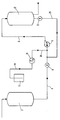
- the sole figure of the drawing is a flow sheet of the process as it maybe used in a formulation plant showing tanks, pumps and flow lines for carrying out the process.
- the process of this invention employs, as the additive to be uniformly dispersed into an alkanolamine, a water-insoluble, liquid polyalkylene glycol derivative having a viscosity (100°F-SUS) of at least about 200.
- a water-insoluble, liquid polyalkylene glycol derivative having a viscosity (100°F-SUS) of at least about 200.
- the polyalkylene glycol derivatives have the following general formula: where R is C1-C25 alkyl or C6-C24 aryl, R1, R2 and R3 are independently hydrogen or C1-C25 alkyl or C6-C24 aryl, and x and y independently have values of zero and higher provided that x or y is at least 1.
- Typical of such materials are polypropylene glycol monobutyl ether, polyethylene glycol monomethyl ether, poly (ethylene oxide - propylene oxide) monoethyl ether, poly (propylene oxide - butylene oxide) monooctyl ether, polypropylene glycol monomethyl ether, polybutylene glycol monophenyl ether, polypropylene glycol monomethylphenyl ether, polypropylene glycol monohexyl ether, polypropylene glycol diethyl ether and polyethylene glycol dimethyl ether.
- the glycols or their derivatives are dispersed in the alkanolamine in an additive amount, preferably from about 0.01 to 2% based on the weight of the amine formulation. More preferably, an amount in the range of from 0.05 to 0.5% is used.
- alkanolamines which are useful for this invention are monoethanolamine, diethanolamine, methylethanolamine, diisopropanolamine, ethylpropanolamine, methyldipropanolamine, methyldiethanolamine, ethyldiethanolamine, propyldiethanolamine, isopropyldiethanolamine, methyldiisopropanolamine, ethyldiisopropanolamine, propyldiisopropanolamine, diethylethanolamine, dimethylethanolamine, dipropylethanolamine, triethanolamine, and mixtures of the foregoing.
- the amines form the dispersant phase of the dispersion in non-aqueous form, ie, containing substantially no water.
- alkanolamine-polyglycol derivative formulation may be incorporated into the alkanolamine-polyglycol derivative formulation, if desired.
- the dispersions formed in the process of this invention may be recycled to receive proportionate amounts of the glycol derivative as many times as is necessary to complete the addition of the total additive amount and to obtain a uniform, stable dispersion.
- MDEA methyldiethanolamine
- MDEA from a 87,100 l (23,000 gallon) capacity tank 2
- MDEA is transferred under pressure through line 4, open valve A, pump 6 and line 8 into 87,100 l (23,000 gallon) capacity holding tank 10.
- Valve B is kept closed during this phase of the operation.
- Pump 6 is Model 3926 "ST” sold by Gould Pumps, Inc. having an impeller which rotates at 3500 r.p.m. and is powered by a 7.5 horsepower electric motor. The pump moves 197 l (52 gallons) of amine per minute against a viscosity correct total head of 45.8 m (150 feet).
- the polyglycol derivative is passed from drum 12 through line 14 by means of a positive pressure metering pump 16 (FMI RP650) supplied by Fluid Metering, Inc. of Oyster Bay, N. Y., and then through line 18. It is injected at the rate of 0.054 kg/min (0.12 lbs./ min) into the stream of MDEA flowing through line 4 by means of a tee in line 4 positioned 15.24 cm (6 inches) up stream from the suction flange of pump 6. The MDEA stream with the injected polyglycol derivative is passed into the vortex of the centrifugal pump 6 to subject the mixture to shear stress.
- FMI RP650 positive pressure metering pump 16 supplied by Fluid Metering, Inc. of Oyster Bay, N. Y.
- valve A When the entire 75,700 l (20,000 gallons) of MDEA has been transferred to tank 10, valve A is closed and valve B is opened to permit the MDEA and the partial amount of polyglycol derivative dispersed therein to recycle back through line 20 to line 4 through a tee disposed between valve A and the tee connecting line 18 to line 4.
- Metering pump 16 is restarted, or alternatively, if recycling is begun in sufficient time to provide a continuous flow of MDEA through line 4 as it approaches pump 6, metering pump 16 may run continuously until addition of the polyglycol derivative is finalized.
- the contents of tank 10 are recycled 3.75 times as the polyglycol derivative is added at the controlled rate of 0.054 kg/min (0.12 lbs./min). This provides a uniform, stable dispersion of 0.1% of polyglycol derivative in the MDEA, based on the weight of the formulation.
Landscapes
- Chemical & Material Sciences (AREA)
- Chemical Kinetics & Catalysis (AREA)
- Dispersion Chemistry (AREA)
- Health & Medical Sciences (AREA)
- Medicinal Chemistry (AREA)
- Polymers & Plastics (AREA)
- Organic Chemistry (AREA)
- General Chemical & Material Sciences (AREA)
- Colloid Chemistry (AREA)
- Processes Of Treating Macromolecular Substances (AREA)
- Compositions Of Macromolecular Compounds (AREA)
- Organic Low-Molecular-Weight Compounds And Preparation Thereof (AREA)
Claims (8)
- Verfahren zur einheitlichen Dispersion einer additiven Menge eines wasserunlöslichen flüssigen Polyalkylenglykolderivats mit einer Viskosität [37,8°C (100°F)] von mindestens etwa 0,0311 Nsm⁻² 150 SUS in einem im wesentlichen nichtwäßrigen, wasserlöslichen Alkanolamin, wobei das Verfahren umfaßt: Zufuhr unter Druck eines ersten Anteils der gesamten additiven Menge des Polyglykolderivats in einen unter Druck gesetzten Strom aus der Gesamtmenge des Alkanolamins und Unterwerfen des Gemisches einer Scherspannung unter Bildung einer ersten Dispersion und dann kontinuierliche Recyclisierung der Dispersion des Derivats in dem Alkanolamin zu der Polyglykolderivatbeschickung und Zufuhr unter Druck eines zusätzlichen Anteils des Derivats in den unter Druck stehenden Strom der Dispersion und Einwirkung von Scherspannung auf das Gemisch, solange es erforderlich ist, um eine einheitliche stabile Dispersion des gesamten Derivats zu erhalten, wodurch eine stabile kolloidale Dispersion einer additiven Menge des Polyglykolderivats einheitlich in dem Alkanolamin dispergiert wird.
- Verfahren nach Anspruch 1, dadurch gekennzeichnet, daß mindestens die erste Dispersion in einem Aufbewahrungstank gelagert wird, bis die erste Dispersion vollständig gebildet ist.
- Verfahren nach Anspruch 1, dadurch gekennzeichnet, daß die Dispersion recyclisiert wird und daß ein Teil des Derivats mindestens dreimal zugeführt wird, um eine Enddispersion zu ergeben, die die gesamte additive Menge des Polyglykolderivats enthält.
- Verfahren nach Anspruch 1, dadurch gekennzeichnet, daß das Polyglykolderivat die folgende allgemeine Formel:

- Verfahren nach Anspruch 4, dadurch gekennzeichnet, daß das Alkanolamin Methyldiethanolamin ist.
- Verfahren nach Anspruch 5, dadurch gekennzeichnet, daß das Polyglykolderivat Polypropylenglykolmonobutylether ist, der in dem Alkanolamin in einer Gesamtmenge im Bereich von etwa 0,01 bis etwa 2 %, bezogen auf das Gesamtgewicht des Alkanolamins und des Polyglykolderivats, dispergiert ist.
- Verfahren nach Anspruch 1, dadurch gekennzeichnet, daß die Scherspannung erzeugt wird, indem das Gemisch in den Vortex einer Zentrifugenpumpe geleitet wird.
- Verfahren nach Anspruch 7, dadurch gekennzeichnet, daß das Polyglykolderivat Polypropylenglykolmonobutylether ist, in einer Menge im Bereich von 0,05 bis 0,5 %, bezogen auf das Gesamtgewicht von Alkanolamin und Polyglykolderivat, und daß das Alkanolamin Methyldiethanolamin ist.
Applications Claiming Priority (2)
| Application Number | Priority Date | Filing Date | Title |
|---|---|---|---|
| US510648 | 1990-04-18 | ||
| US07/510,648 US5051205A (en) | 1990-04-18 | 1990-04-18 | Process of forming a stable colloidal dispersion |
Publications (3)
| Publication Number | Publication Date |
|---|---|
| EP0452694A2 EP0452694A2 (de) | 1991-10-23 |
| EP0452694A3 EP0452694A3 (en) | 1992-11-19 |
| EP0452694B1 true EP0452694B1 (de) | 1995-08-09 |
Family
ID=24031596
Family Applications (1)
| Application Number | Title | Priority Date | Filing Date |
|---|---|---|---|
| EP91104429A Expired - Lifetime EP0452694B1 (de) | 1990-04-18 | 1991-03-21 | Verfahren zur Herstellung einer stabilen kolloidalen Dispersion |
Country Status (7)
| Country | Link |
|---|---|
| US (1) | US5051205A (de) |
| EP (1) | EP0452694B1 (de) |
| AR (1) | AR245013A1 (de) |
| BR (1) | BR9101429A (de) |
| CA (1) | CA2040176A1 (de) |
| DE (1) | DE69111873T2 (de) |
| ES (1) | ES2075240T3 (de) |
Families Citing this family (4)
| Publication number | Priority date | Publication date | Assignee | Title |
|---|---|---|---|---|
| AU8132494A (en) * | 1993-11-09 | 1995-05-29 | Union Carbide Chemicals & Plastics Technology Corporation | Absorption of mercaptans |
| DE19854353A1 (de) | 1998-11-25 | 2000-06-21 | Clariant Gmbh | Verfahren zur Reinigung von Gasen |
| WO2025004800A1 (ja) * | 2023-06-29 | 2025-01-02 | Agc株式会社 | 酸性ガス吸収液及び酸性ガス低減方法 |
| WO2025004799A1 (ja) * | 2023-06-29 | 2025-01-02 | Agc株式会社 | 酸性ガス吸収液及び酸性ガス低減方法 |
Family Cites Families (8)
| Publication number | Priority date | Publication date | Assignee | Title |
|---|---|---|---|---|
| US3565404A (en) * | 1968-10-15 | 1971-02-23 | Pako Corp | Device for mixing fluids |
| US4044100A (en) * | 1969-12-08 | 1977-08-23 | Allied Chemical Corporation | Separation of acidic gas constituents from gaseous mixtures containing the same |
| IT1132170B (it) * | 1980-07-04 | 1986-06-25 | Snam Progetti | Processo di separazione selettiva di idrogeno solforato da miscele gassose contenenti anche anidride carbonica |
| US4439405A (en) * | 1980-09-24 | 1984-03-27 | Unc Recovery Corporation | Method for varying the mixing time and proportions in the contacting of substantially immiscible liquids |
| US4430251A (en) * | 1981-09-29 | 1984-02-07 | Hoffert Manufacturing Co., Inc. | High energy emulsifier |
| GB8410393D0 (en) * | 1984-04-24 | 1984-05-31 | Ici Plc | Fluid compositions |
| US4654155A (en) * | 1985-03-29 | 1987-03-31 | Reynolds Metals Company | Microemulsion lubricant |
| DE3643934A1 (de) * | 1986-12-22 | 1988-06-23 | Henkel Kgaa | Verwendung ausgewaehlter alkyl- und/oder alkenyl-diethanolaminverbindungen als loesungsvermittler fuer schaumarme tenside |
-
1990
- 1990-04-18 US US07/510,648 patent/US5051205A/en not_active Expired - Fee Related
-
1991
- 1991-03-21 DE DE69111873T patent/DE69111873T2/de not_active Expired - Fee Related
- 1991-03-21 EP EP91104429A patent/EP0452694B1/de not_active Expired - Lifetime
- 1991-03-21 ES ES91104429T patent/ES2075240T3/es not_active Expired - Lifetime
- 1991-04-07 AR AR91319474A patent/AR245013A1/es active
- 1991-04-10 BR BR919101429A patent/BR9101429A/pt not_active Application Discontinuation
- 1991-04-10 CA CA002040176A patent/CA2040176A1/en not_active Abandoned
Also Published As
| Publication number | Publication date |
|---|---|
| AR245013A1 (es) | 1993-12-30 |
| ES2075240T3 (es) | 1995-10-01 |
| DE69111873D1 (de) | 1995-09-14 |
| EP0452694A3 (en) | 1992-11-19 |
| CA2040176A1 (en) | 1991-10-19 |
| EP0452694A2 (de) | 1991-10-23 |
| BR9101429A (pt) | 1991-11-26 |
| DE69111873T2 (de) | 1995-12-07 |
| US5051205A (en) | 1991-09-24 |
Similar Documents
| Publication | Publication Date | Title |
|---|---|---|
| RU2182589C2 (ru) | Способ приготовления водной смоляной суспензоэмульсии (варианты), способ регенерирования серной кислоты, способ ожижения смол и их удаления | |
| EP0452694B1 (de) | Verfahren zur Herstellung einer stabilen kolloidalen Dispersion | |
| RU98117465A (ru) | Способ ожижения смол | |
| JP2021534198A (ja) | ポリアミンおよびそれらの組成物から誘導される多重荷電イオン性化合物、および石油およびガス操作における逆エマルジョン破壊剤としての使用 | |
| CN104893398B (zh) | 一种水溶性油漆废弃漆渣的回收利用方法 | |
| US7179775B2 (en) | Coating removal compositions | |
| KR200487924Y1 (ko) | 날개 높이조절이 가능한 교반장치 | |
| FI94256B (fi) | Etyleeniakryylihappokopolymeeriä sisältävän vesipitoisen konsentraatin käyttö ja menetelmä lakkojen ja muiden orgaanisten pinnoitusaineiden koaguloimiseksi | |
| US20040084373A1 (en) | Process for recycling paint flush solution | |
| CN218596201U (zh) | 全地下式零排放砂石分离污水处理系统 | |
| EP1169393B1 (de) | Suspensionen von acetoacetylaryliden in pigmentanwendungen | |
| US4459220A (en) | Block polymers of alkanolamines as demulsifiers for O/W emulsions | |
| US4303780A (en) | Ureylenes and uses thereof | |
| ES2241629T3 (es) | Pastas de pigmentos, su produccion y agentes de recubrimiento que pueden depositarse catodicamente que contienen a estas. | |
| SE500534C2 (sv) | Förfarande för rengöring och avfettning | |
| CN102153181B (zh) | 一种用于废弃钻井液的乳化油去除剂及其制备方法 | |
| US7637651B2 (en) | Process for making slurries | |
| CN1954020B (zh) | 硅乳液的分批制备方法 | |
| CN108843293A (zh) | 一种可重复利用降阻水体系的施工方法 | |
| US4569785A (en) | Thioureylenes and uses thereof | |
| US20150218440A1 (en) | Systems and methods for providing polymers to a fracturing operation | |
| CN215610619U (zh) | 一种零废水排放的水性聚氨酯乳化装置 | |
| CN110484377A (zh) | 一种安全高效的uv树脂清洁剂及其制备工艺与使用方法 | |
| CN213286536U (zh) | 一种移动式消泡剂喷淋装置 | |
| CN206549469U (zh) | 一种酱料乳化机 |
Legal Events
| Date | Code | Title | Description |
|---|---|---|---|
| PUAI | Public reference made under article 153(3) epc to a published international application that has entered the european phase |
Free format text: ORIGINAL CODE: 0009012 |
|
| AK | Designated contracting states |
Kind code of ref document: A2 Designated state(s): BE DE ES FR GB IT NL |
|
| PUAL | Search report despatched |
Free format text: ORIGINAL CODE: 0009013 |
|
| AK | Designated contracting states |
Kind code of ref document: A3 Designated state(s): BE DE ES FR GB IT NL |
|
| 17P | Request for examination filed |
Effective date: 19930506 |
|
| 17Q | First examination report despatched |
Effective date: 19930716 |
|
| GRAA | (expected) grant |
Free format text: ORIGINAL CODE: 0009210 |
|
| ITF | It: translation for a ep patent filed | ||
| AK | Designated contracting states |
Kind code of ref document: B1 Designated state(s): BE DE ES FR GB IT NL |
|
| PGFP | Annual fee paid to national office [announced via postgrant information from national office to epo] |
Ref country code: FR Payment date: 19950831 Year of fee payment: 6 |
|
| REF | Corresponds to: |
Ref document number: 69111873 Country of ref document: DE Date of ref document: 19950914 |
|
| ET | Fr: translation filed | ||
| REG | Reference to a national code |
Ref country code: ES Ref legal event code: FG2A Ref document number: 2075240 Country of ref document: ES Kind code of ref document: T3 |
|
| RAP2 | Party data changed (patent owner data changed or rights of a patent transferred) |
Owner name: ELF ATOCHEM NORTH AMERICA, INC. |
|
| RAP4 | Party data changed (patent owner data changed or rights of a patent transferred) |
Owner name: ELF ATOCHEM NORTH AMERICA, INC. |
|
| NLT2 | Nl: modifications (of names), taken from the european patent patent bulletin |
Owner name: ELF ATOCHEM NORTH AMERICA, INC. |
|
| PG25 | Lapsed in a contracting state [announced via postgrant information from national office to epo] |
Ref country code: GB Effective date: 19960321 |
|
| PG25 | Lapsed in a contracting state [announced via postgrant information from national office to epo] |
Ref country code: ES Free format text: LAPSE BECAUSE OF NON-PAYMENT OF DUE FEES Effective date: 19960322 |
|
| PG25 | Lapsed in a contracting state [announced via postgrant information from national office to epo] |
Ref country code: BE Effective date: 19960331 |
|
| PLBE | No opposition filed within time limit |
Free format text: ORIGINAL CODE: 0009261 |
|
| STAA | Information on the status of an ep patent application or granted ep patent |
Free format text: STATUS: NO OPPOSITION FILED WITHIN TIME LIMIT |
|
| 26N | No opposition filed | ||
| BERE | Be: lapsed |
Owner name: ATOCHEM NORTH AMERICA INC. Effective date: 19960331 |
|
| PG25 | Lapsed in a contracting state [announced via postgrant information from national office to epo] |
Ref country code: NL Effective date: 19961001 |
|
| GBPC | Gb: european patent ceased through non-payment of renewal fee |
Effective date: 19960321 |
|
| NLV4 | Nl: lapsed or anulled due to non-payment of the annual fee |
Effective date: 19961001 |
|
| PG25 | Lapsed in a contracting state [announced via postgrant information from national office to epo] |
Ref country code: DE Effective date: 19961203 |
|
| PG25 | Lapsed in a contracting state [announced via postgrant information from national office to epo] |
Ref country code: FR Free format text: LAPSE BECAUSE OF NON-PAYMENT OF DUE FEES Effective date: 19971128 |
|
| REG | Reference to a national code |
Ref country code: FR Ref legal event code: ST |
|
| REG | Reference to a national code |
Ref country code: ES Ref legal event code: FD2A Effective date: 19970410 |
|
| PG25 | Lapsed in a contracting state [announced via postgrant information from national office to epo] |
Ref country code: IT Free format text: LAPSE BECAUSE OF NON-PAYMENT OF DUE FEES;WARNING: LAPSES OF ITALIAN PATENTS WITH EFFECTIVE DATE BEFORE 2007 MAY HAVE OCCURRED AT ANY TIME BEFORE 2007. THE CORRECT EFFECTIVE DATE MAY BE DIFFERENT FROM THE ONE RECORDED. Effective date: 20050321 |