EP0452696A2 - Wässrige Lösungen oder Dispersionen von hydroxyfunktionellen Copolymerisaten, ein Verfahren zu ihrer Herstellung und ihrer Verwendung - Google Patents
Wässrige Lösungen oder Dispersionen von hydroxyfunktionellen Copolymerisaten, ein Verfahren zu ihrer Herstellung und ihrer Verwendung Download PDFInfo
- Publication number
- EP0452696A2 EP0452696A2 EP91104487A EP91104487A EP0452696A2 EP 0452696 A2 EP0452696 A2 EP 0452696A2 EP 91104487 A EP91104487 A EP 91104487A EP 91104487 A EP91104487 A EP 91104487A EP 0452696 A2 EP0452696 A2 EP 0452696A2
- Authority
- EP
- European Patent Office
- Prior art keywords
- weight
- parts
- amino
- structural units
- copolymers
- Prior art date
- Legal status (The legal status is an assumption and is not a legal conclusion. Google has not performed a legal analysis and makes no representation as to the accuracy of the status listed.)
- Granted
Links
- 0 C*(*(C)[N+](*1*I)[O-])[N+]1[O-] Chemical compound C*(*(C)[N+](*1*I)[O-])[N+]1[O-] 0.000 description 3
Classifications
-
- C—CHEMISTRY; METALLURGY
- C08—ORGANIC MACROMOLECULAR COMPOUNDS; THEIR PREPARATION OR CHEMICAL WORKING-UP; COMPOSITIONS BASED THEREON
- C08F—MACROMOLECULAR COMPOUNDS OBTAINED BY REACTIONS ONLY INVOLVING CARBON-TO-CARBON UNSATURATED BONDS
- C08F8/00—Chemical modification by after-treatment
- C08F8/44—Preparation of metal salts or ammonium salts
Definitions
- the invention relates to aqueous solutions or dispersions of hydroxy-functional copolymers with imide structural units, a process for their preparation and their use for the production of coating compositions, sealing compounds or adhesives.
- Binders based on organically dissolved acrylate copolymers, in combination with crosslinking resins, are characterized by a number of outstanding properties such as resistance to hydrolysis and weather, yellowing resistance and gloss retention.
- the incorporation of hydroxyl groups gives valuable substances in terms of paint technology, which are used in large quantities for paints, coatings, adhesives, printing inks and sealants.
- Hydroxy-functional monomers such as e.g. Hydroxyethyl acrylate built in.
- Hydroxyethyl acrylate built in.
- relatively large amounts of hydroxy-functional monomers have to be incorporated, which limits the range of variation of the other monomers and also results in relatively expensive products.
- Polyimides can e.g. from bisanhydrides such as pyromellitic anhydride and from diamines. They are characterized, among other things, by excellent electrical insulation properties and high thermal stability under continuous load. A serious disadvantage of the technically usable polyimides is their poor solubility. There are large amounts of physiologically unacceptable solvents such as Dimethylacetamide required.
- the economy of the coating systems made from the binders can be significantly impaired by the solvents used, since the solvents are not incorporated into the coatings, but also e.g. must be eliminated by post-combustion to reduce the impact on the environment as much as possible.
- aqueous coating systems based on water-thinnable or water-soluble binders have the advantage that they contain relatively small amounts of organic solvents and therefore do not require any complex absorption or combustion systems.
- the object of the invention was to provide hydroxy-functional copolymers with imide structural units in water-dissolved or dispersed form which are simple to prepare and, due to a composition which can be varied within wide limits, for a wide range of uses, e.g. in or as aqueous coating compositions, sealing compounds or adhesives are suitable.
- the object was surprisingly achieved in that special anhydride- and optionally carboxyl-functional copolymers by reaction with suitable amino alcohols and optionally amino carboxylic acids to non-crosslinked, after at least partial neutralization of the carboxyl groups, water-dilutable, hydroxy-functional copolymers with imide structural units are modified and thus dissolved or dispersed in water.
- the invention also relates to a process for the preparation of these aqueous solutions or dispersions of hydroxyl-functional copolymers with imide structural units, which is characterized in that copolymers corresponding to the hydroxyl-functional copolymers with anhydride and optionally carboxyl-functional copolymers with amino alcohols of the formula VIII H2N-R1- (OH) n (VIII), and optionally with amino carboxylic acids of formula IX H2N-R1 (COOH) m (IX), where R1, n and m have the meaning given above, while maintaining an equivalent ratio of amino groups to anhydride groups of 0.8: 1 to 2: 1 with imide formation at 100 to 200 ° C, simultaneously and / or subsequently the water of reaction is distilled off azeotropically, the polymer solution is dissolved or dispersed in water after and / or with simultaneous, at least partial neutralization of the carboxyl groups, and then, if appropriate, the organic solvent still present is partially or completely azeo
- the invention also relates to a further development of this process, which is characterized in that the hydroxyl-functional polyimide copolymers obtained by reacting the anhydride- and optionally carboxyl-functional copolymers with the amino alcohols and optionally aminocarboxylic acids before dissolving or dispersing by reaction with 0.05 to 5 Modified moles of lactones per mole of hydroxyl groups present in the polyimide copolymers with ring-opening ester formation.
- the invention also relates to the use of the aqueous solutions or dispersions according to the invention for the production of coating compositions, sealing compounds or adhesives.
- the hydroxy-functional copolymers present in the solutions or dispersions according to the invention generally have a number average molecular weight Mn, determined by gel permeation chromatography using calibrated polystyrenes, of 500 to 30,000, preferably 1,700 to 15,000 and particularly preferably 2,600 to 10,000 with acid numbers from 15 to 125, preferably from 25 to 75 and a hydroxyl group content of 0.1 to 25, preferably 0.5 to 6 wt .-%.
- Mn number average molecular weight Mn, determined by gel permeation chromatography using calibrated polystyrenes, of 500 to 30,000, preferably 1,700 to 15,000 and particularly preferably 2,600 to 10,000 with acid numbers from 15 to 125, preferably from 25 to 75 and a hydroxyl group content of 0.1 to 25, preferably 0.5 to 6 wt .-%.
- Mn number average molecular weight Mn, determined by gel permeation chromatography using calibrated polystyrenes, of 500 to 30,000, preferably 1,700 to
- the anhydride- and optionally carboxyl-functional copolymers on which the hydroxyl-functional copolymers are based have a molecular weight which corresponds to the stated molecular weight of the hydroxyl-functional copolymers minus the molecular weight of the starting materials incorporated into the anhydride-functional copolymers when the process according to the invention is carried out.
- the anhydride equivalent ratio of the anhydride-functional copolymers to be used as starting materials in the process according to the invention (amount in “g” which contains 1 mol of anhydride groups) is 196-9,800, preferably 245 to 1,960.
- the anhydride- and optionally carboxyl-functional starting materials are prepared in a manner known per se by a radical-initiated copolymerization, preferably in the presence of organic solvents. All solvents which are customary in the paint industry and which are inert to the monomers and the copolymers under the polymerization conditions are suitable as the polymerization medium.
- Suitable or preferred monomers a) are maleic anhydride, itaconic anhydride, citraconic anhydride, maleic anhydride being particularly preferred.
- Suitable or preferred monomers b) are e.g. Styrene, vinyltoluene, ⁇ -methylstyrene, ⁇ -ethylstyrene, nucleus-substituted, optionally isomer mixtures diethylstyrenes, isopropylstyrenes, butyl styrenes and methoxystyrenes, ethyl vinyl ether, n-propyl, isopropyl, n-butyl vinyl ether, isobutyl vinyl ether, vinyl acetate, vinyl propionate, vinyl butyrate, 1-octene, 1 -Decene, 1-hexene, 2-methyl-1-heptene, 2,4,4-trimethyl-1-pentene, 1-nonene, 1-dodecene, 1-tridecene, 1-tetradecene, vinylcyclohexene, cyclooctene, cyclohex
- Suitable or preferred monomers c) are methyl acrylate, methyl methacrylate, ethyl acrylate, ethyl methacrylate, n-butyl acrylate, n-butyl methacrylate, isobutyl acrylate, isobutyl methacrylate, tert-butyl acrylate, tert-butyl methacrylate, 2-ethylhexyl acrylate, 2-ethyl acrylate Octyl acrylate, octyl methacrylate, lauryl acrylate, lauryl methacrylate, dodecyl acrylate, dodecyl methacrylate, cyclohexyl acrylate, cyclohexyl methacrylate, benzyl acrylate, benzyl methacrylate, 4-tert.-butylcyclohexyl acrylate, 4-tert.-butylcyclohexyl methoxy-3
- Suitable or preferred monomers d) are e.g. Hexanediol bisacrylic acid ester, trimethylolpropane trisacrylic acid ester, pentaerythritol trisacrylic acid ester, neopentylglycol bisacrylic acid ester, divinylbenzene.
- Suitable or preferred monomers c) are e.g. Acrylic acid, methacrylic acid or maleic acid.
- Suitable solvents for carrying out the copolymerization and the process according to the invention are, for example, esters such as butyl acetate, isopropyl acetate, isobutyl acetate, sec-butyl acetate, amyl acetate, hexyl acetate, ethyl propionate, butyl propionate, isobutyl isobutyrate, methyl glycol acetate, ethyl glycol acetate, butyl glycol acetate, ethyl acetate, ethyl acetate, ethyl acetate, ethyl acetate, ethyl acetate, ethyl acetate, ethyl acetate, ethyl acetate, ethyl acetate, ethyl acetate, ethyl acetate, ethyl acetate, , Propylene glycol methyl ether
- Ethers such as dibutyl ether, dimethyl diglycol, hydrocarbons such as gasoline, turpentine oil, solvent naphtha, terpenes, octane, cyclohexane, toluene, xylene, ethylbenzene, ketones such as acetone, methyl isobutyl ketone, diethyl ketone, cyclohexanone, methylcyclohexanone or any mixture of such solvents.
- hydrocarbons such as gasoline, turpentine oil, solvent naphtha, terpenes, octane, cyclohexane, toluene, xylene, ethylbenzene, ketones such as acetone, methyl isobutyl ketone, diethyl ketone, cyclohexanone, methylcyclohexanone or any mixture of such solvents.
- Preferred solvents are those whose boiling point under normal conditions is ⁇ 110 ° C and those solvents which form an azeotrope with water, e.g. Xylene, butyl acetate, solvent naphtha, oxohexyl acetate.
- the copolymerization is usually carried out at a content of 30 to 95% by weight.
- part or all of the solvent is placed in the reaction vessel and the monomer mixture, initiator and, if appropriate, part of the solvent are metered in continuously. After the addition is complete, stirring is continued for a while.
- the polymerization is ended after a monomer conversion of more than 96%, preferably more than 99%. It may be necessary to reactivate by subsequently adding small amounts of initiator in order to achieve the desired monomer conversion. With certain starting monomer compositions it is possible that after the polymerization larger amounts of residual monomers are contained in the copolymer. For reasons of cost and in the event that this should have a disruptive effect on the desired application or on the property level, it is advantageous to reduce this residual monomer content either by distillation or by reactivation with an initiator.
- the monomer conversion is determined by determining the solids content of the reaction mixture and checked by gas chromatographic residual monomer analysis.
- Radical formers are preferably used which are suitable for the reaction temperatures generally maintained in the polymerization reaction of 60 to 180 ° C., such as organic peroxides, for example: dibenzoyl peroxide, di-tert-butyl peroxide, dilauryl peroxide, tert-butyl peroxy-2-ethylhexanoate , tert-butyl peroxymaleinate, tert-butyl peroxybenzoate, dicumyl peroxide, didecanoyl peroxide such as azo compounds, for example 2,2'-azobis (2,4-dimethylvaleronitrile), 2,2'-azobis (isobutyronitrile), 2,2'-azobis (2,3-dimethylbutyronitrile), 1,1'-azobis (1st -cyclohexanenitrile).
- organic peroxides for example: dibenzoyl peroxide, di-tert-butyl peroxide, dilauryl
- the initiators can be used in amounts of 1 to 10% by weight, based on the total monomers. If appropriate, molecular weight regulating substances, such as n-dodecyl mercaptan, tert-dodecyl mercaptan, etc., can be used in amounts of 0 to 5% by weight.
- An essential point of the invention now consists in converting the anhydride groups present in the copolymers into imide groups. This is preferably done in 25 to 85% organic solution by reaction with amino alcohols of the general formula VIII already mentioned and, if appropriate, amino carboxylic acids of the general formula IX also already mentioned above.
- the "amino alcohols” have a calculated molecular weight of 61-500 and contain in addition a primary amino group at least one, but preferably at most 3, particularly preferably also one hydroxyl group per molecule.
- Suitable amino alcohols are, for example: 2-aminoethanol, 1-aminoethanol, 3-amino-1-propanol, 2-amino-1-propanol, 1-amino-2-propanol, 2-amino-2-methyl-1-propanol, 2 -Amino-2-methyl-1,3-propanediol, 2-amino-2-hydroxymethyl-1,3-propanediol, 2- (2-amino-ethoxy) ethanol, 2-amino-1-butanol, 4-amino- 1-butanol, 1-amino-2-butanol, 1-amino-3-butanol, 3-amino-1-butanol, 2-amino-1-cyclohexanol, 3-amino-1-cyclohexanol, 4-amino-1- cyclohexanol, 2-amino-1- (hydroxymethyl) cyclopentane, galactosamine, 2-amino-1-hexan
- amino alcohols are aminoethanol and 1-amino-2-propanol.
- anhydride-functional copolymers and amino alcohols are generally used in amounts such that 0.8 - 2.0, preferably 1.0 - 1.5 and particularly preferably 1.0 - 1.1 amino groups of the amino alcohol are eliminated.
- Suitable solvents for the imidization reaction are, for example, the solvents preferably used in the preparation of the anhydride-functional copolymers.
- the process according to the invention can be carried out, for example, in such a way that the amino alcohol component, if appropriate initially introduced together with suitable solvents, is heated to temperatures of ⁇ 100 ° C. and then the solution is dissolved at temperatures of 100 to 200 ° C., preferably at 120 to 148 ° C. anhydride-functional copolymer added, the reaction can be chosen so that parallel to the addition of the polymer, the water of reaction is distilled off azeotropically on the water separator. According to a process variant, the entire amount of anhydride-functional copolymer can also be added first and then the water of reaction can be split off.
- the elimination of water is carried out at 100 to 200.degree. C., preferably at 120 to 148.degree. C., until either the theoretical amount of water has been eliminated or no more water is eliminated.
- the anhyride-functional polymer can also be introduced and the amino alcohol can be metered in.
- a preliminary test must be carried out to determine whether a copolymer is suitable for this, since in these process variants gel particles can be formed under unfavorable conditions.
- Triphenyl phosphite, phosphorous acid, dicyclopentadiene, antracene, isoprene can be added.
- the carboxyl groups required to achieve water dilutability can be incorporated or generated in the polymer in different ways.
- One possibility is the use of carboxyl-functional monomers e) already mentioned above in the production of the anhydride-functional copolymers (incorporation of structural units IV or V).
- a further possibility consists in a hydrolytic ring opening of part of the andridial groups present in the copolymer. This can be done, for example, by reaction with a calculated amount of water at 60 to 100 ° C., if appropriate in the presence of a catalytic amount of a tertiary amine (for example 0.01-0.3% by weight) eg triethylamine or triethylenediamine, take place (incorporation of structural units V).
- Another possibility is the use of aminocarboxylic acids IX already mentioned above in the imidization reaction, part of the original anhydride groups being converted into imide carboxyl groups II.
- Suitable amino carboxylic acids are e.g. Aminoacetic acid, 2-aminopropanoic acid, 3-aminopropanoic acid, 4-aminobutanoic acid, 5-aminopentanoic acid, 6-aminohexanoic acid, 5-aminohexanoic acid, 8-aminooctanoic acid, 10-aminodecanoic acid, 4-aminobenzoic acid, 1-aminocyclohexane carboxylic acid or mixtures of these or other aminocarboxylic acids.
- the exemplified aliphatic monoamino monocarboxylic acids with terminal amino or carboxyl groups are among the particularly preferred amino carboxylic acids.
- the carboxyl groups are to be at least partially incorporated into the copolymers by using aminocarboxylic acids, care must of course be taken to ensure that the amino groups in the aminocarboxylic acids have a sufficiently high concentration of anhydride groups is available. This can be ensured, for example, that the modification of the anhydride-functional copolymers with the amino carboxylic acids is carried out before the modification with the amino alcohols while maintaining a large excess of acid anhydride groups to amino groups of the amino carboxylic acids, or, if the amino alcohols and the amino carboxylic acids are used simultaneously, in that an excess of amino groups compared to acid anhydride groups is largely dispensed with.
- a further, less preferred possibility of introducing carboxyl groups into the polymer is an incomplete imidation reaction in the reaction of anhydride groups with the amino alcohols, which gives rise to structural units III.
- Such structural units are e.g. obtained if the imidation reaction is stopped before the theoretical amount of water is split off.
- the amount of carboxyl groups incorporated into the copolymers by these methods is such that the polymers, based on 100% resin, have acid numbers of 15-125, preferably 20-75.
- the hydroxyl-functional copolymers are modified before dissolving or dispersing them in water by reaction with lactones with the lactone ring opening and chain extension.
- Suitable lactones are e.g. those containing 3 to 15 carbon atoms in the ring, where the rings can also have different substituents.
- Preferred lactones are gamma-butyrolactone, delta-valerolactone, epsilon-caprolactone, beta-hydroxy-beta-methyl-delta-valerolactone.
- the lactones can be used in amounts of 0.05-5.0 mol, preferably 0.25-2.5 mol, of lactone per mole of hydroxyl groups in the polyimide copolymer.
- the implementation takes place e.g. at 100 - 150 ° C for 0.5 to 5 hours, with suitable catalysts such as e.g. para-toluenesulfonic acid, dibutyltin oxide, dibutyltin dilaurate can be added in amounts of 0.01 to 1.0%.
- the modification reaction with the lactones can of course also be carried out in the presence of the solvents already mentioned as examples.
- the next step of the process according to the invention is to neutralize the hydroxy-functional copolymers, which are generally dissolved in organic solvents of the type mentioned above by way of example, if appropriate after lactone modification, by adding a neutralizing agent and to dissolve or disperse them in water.
- the neutralizing agent is used in such amounts that 20-100%, preferably 35-80%, of the carboxyl groups present are neutralized.
- the neutralization can take place before the addition of water or simultaneously with the addition of water using aqueous solutions of the neutralizing agent.
- Suitable neutralizing agents can e.g. be: ammonia, triethylamine, diethanolamine, methyldiethanolamine, 2-amino-2-methyl-1-propanol, dimethylethanolamine, N-methylmorpholine, sodium hydroxide or potassium hydroxide.
- aqueous systems are (optionally colloidal) solutions or dispersions depending on the molecular weight of the dissolved or dispersed particles and, in particular, on their carboxylate group content.
- the aqueous systems are preferably dispersions.
- the organic solvent present is generally distilled off, preferably azeotropically with water.
- the distillation step can be accelerated by an inert gas stream (for example N2) or by applying a slight vacuum. In general, distillation is continued until an azeotropic mixture is no longer formed.
- N2 inert gas stream
- Water or additional neutralizing agents are added to dilute the aqueous solution or dispersion to a ready-to-use viscosity. In general, the total amount of water used is chosen so that ultimately 20-45% by weight solutions or dispersions of the copolymers result.
- crosslinking resins b) can be water-dilutable or water-dispersible substances, but it is also possible to use hydrophobic substances which are not themselves dispersible in water as crosslinking resins, since the resins a) can take over the function of an emulsifier for the crosslinking resins b).
- Suitable crosslinking resins b) are, for example, water-dilutable or water-dispersible melamine or urea-formaldehyde condensation products, such as, for example in DH Solomon, The Chemistry of Organic Filmformers, pp. 235 ff, John Wiley & Sons, Inc., New York, 1967.
- the melamine resins can also be wholly or partly by other crosslinking aminoplasts, as described, for example, in "Methods of Organic Chemistry” (Houben-Weyl). Vol. 14/2, Part 2, 4th edition, Georg-Thieme-Verlag, Stuttgart 1963, p. 319 ff.
- crosslinking resins are blocked polyisocyanates, for example based on isophorone diisocyanate, hexamethylene diisocyanate, 1,4-diisocyanatocyclohexane, bis (4-isocyanato-cyclohexyl) methane, 2,4-diisocyanato-1-methylbenzene, bis (4-isocyanatophenyl) propane, tris (4-isocyanatophenyl) methane, or based on lacquer polyisocyanates such as biisocyanates containing biuret groups based on 1,6-diisocyanatohexane, isocyanurate groups containing polyisocyanates based on 1,6-diisocyanatohexane or urethane groups containing lacquer polyisocyanates based on 2 , 4-and / or 2,6-diisocyanatotoluene or isophorone diisocyanate on the one hand
- Suitable blocking agents for these polyisocyanates are, for example, monohydric alcohols such as methanol, ethanol, butanol, hexanol, Cyclohexanol, benzylal alcohol, oximes such as acetoxime, methyl ethyl ketoxime, lactams such as ⁇ -caprolactam or phenols.
- Preferred crosslinking resins are melamine and urea resins, especially alkylated melamine-formaldehyde resins with 1-8 carbon atoms in the alkyl chain, such as e.g. butylated and / or methoxymethylated melamine resins.
- the aqueous solutions or dispersions according to the invention or their combinations with the crosslinking resins mentioned by way of example can be used for the production of coating compositions, sealing compounds or adhesives.
- the preferred area of application is the production of coating compositions.
- the aqueous solutions or dispersions or their combinations with crosslinking resins can optionally contain auxiliaries and additives customary in coating technology.
- auxiliaries and additives customary in coating technology For example, customary pigments and fillers which can be used in amounts of, for example, 30-180% by weight, based on binder solids, may be mentioned as examples. Titanium dioxides, iron oxides, zinc oxides, calcium and magnesium silicates, aluminum bronze, carbon black, lime or organic dyes or pigments such as azo dyes, phthalocyanine complexes and the like. The like.
- Coating compositions which contain, as binder combinations of the type mentioned above, from hydroxy-functional copolymers and crosslinking resins which are essential to the invention, are suitable for coating any heat-resistant substrates such as, for example, iron, steel, aluminum, titanium, magnesium and other metals, paper and plastic films.
- the coating agents can be processed using customary technologies. After evaporation or evaporation of the water, coatings result that can be cured at 90 to 180 ° C to high-quality paint films.
- the binder dispersions prepared according to Examples 1 to 7 were mixed in a weight ratio of 80:20 (100% each) with an amino crosslinking resin (Melamin resin ®Sacopal M 232, Krems Chemie) and applied to degreased steel sheets.
- the wet film thickness was 180 ⁇ m, the dry film thickness was approximately 25 to 30 ⁇ m.
- the coatings were baked at 150 ° C. for 30 minutes. After cooling, clear, hard, cross-linked films were obtained. All coatings passed a wipe test with a cotton ball soaked in methyl isobutyl ketone (at least 200 double strokes) without any findings.
Landscapes
- Chemical & Material Sciences (AREA)
- General Chemical & Material Sciences (AREA)
- Health & Medical Sciences (AREA)
- Chemical Kinetics & Catalysis (AREA)
- Medicinal Chemistry (AREA)
- Polymers & Plastics (AREA)
- Organic Chemistry (AREA)
- Addition Polymer Or Copolymer, Post-Treatments, Or Chemical Modifications (AREA)
- Paints Or Removers (AREA)
- Compositions Of Macromolecular Compounds (AREA)
- Macromolecular Compounds Obtained By Forming Nitrogen-Containing Linkages In General (AREA)
- Polysaccharides And Polysaccharide Derivatives (AREA)
Abstract
Description
- Die Erfindung betrifft waßrige Lösungen oder Dispersionen von hydroxyfunktionellen Copolymerisaten mit Imidstruktureinheiten, ein Verfahren zur ihrer Herstellung und ihre Verwendung zur Herstellung von Beschichtungsmitteln, Dichtmassen oder Klebstoffen.
- Bindemittel auf Basis von organisch gelösten Acrylatcopolymerisaten zeichnen sich in Kombination mit Vernetzerharzen durch eine Reihe hervorragender Eigenschaften aus wie z.B. Hydrolyse- und Wetterbeständigkeit, Vergilbungsresistenz und Glanzhaltung. Durch den Einbau von Hydroxylgruppen erhält man lacktechnisch wertvolle Substanzen, die in großen Mengen für Lacke, Beschichtungen, Klebstoffe, Druckfarben und Dichtmassen eingesetzt werden.
- Zur Einführung von Hydroxygruppen werden üblicherweise hydroxyfunktionelle Monomere wie z.B. Hydroxyethylacrylsäureester eingebaut. Zur Erzielung hoher Vernetzungsdichten müssen relativ große Mengen hydroxyfunktioneller Monomere eingebaut werden, wodurch die Variationsbreite der übrigen Monomeren eingeschränkt wird und außerdem relativ teure Produkte erhalten werden.
- Polyimide können z.B. aus Bisanhydriden wie Pyromellithsäureanhydrid und aus Diaminen hergestellt werden. Sie zeichnen sich unter anderem durch hervorragende elektrische Isoliereigenschaften und hohe Thermostabilität bei Dauerbelastung aus. Ein gravierender Nachteil der technisch verwendbaren Polyimide ist ihre schlechte Löslichkeit. Es sind große Mengen an physiologisch nicht unbedenklichen Lösemitteln wie z.B. Dimethylacetamid erforderlich.
- Durch die verwendeten Lösungsmittel kann die Wirtschaftlichkeit der aus den Bindemitteln hergestellten Beschichtungssysteme erheblich beeinträchtigt werden, da die Lösungsmittel nicht mit in die Überzüge eingebaut werden, sondern zusätzlich z.B. durch eine Nachverbrennung beseitigt werden müssen, um die Belastung der Umwelt soweit wie möglich zu verringern.
- Wäßrige Anstrichsysteme auf Basis von wasserverdünnbaren bzw. -löslichen Bindemitteln haben demgegenüber den Vorteil, daß sie relativ geringe Mengen organischer Lösemittel enthalten und somit keine aufwendigen Absorptions- oder Verbrennungsanlagen erfordern.
- Aufgabe der Erfindung war die Bereitstellung von hydroxyfunktionellen Copolymerisaten mit Imidstruktureinheiten in in Wasser gelöster oder dispergierter Form, die einfach herstellbar und aufgrund einer innerhalb weiter Grenzen variablen Zusammensetzung für vielfältige Anwendungsbereiche, z.B. in oder als wäßrige Beschichtungsmittel, Dichtmassen oder Klebstoffe geeignet sind.
- Die Aufgabe konnte überraschenderweise dadurch gelöst werden, daß spezielle anhydrid- und gegebenenfalls carboxylfunktionelle Copolymerisate durch Reaktion mit geeigneten Aminoalkoholen und gegebenenfalls Aminocarbonsäuren zu nichtvernetzten, nach mindestens teilweiser Neutralisation der Carboxylgruppen wasserverdünnbaren, hydroxyfunktionellen Copolymerisaten mit Imidstruktureinheiten modifiziert und so in Wasser gelöst oder dispergiert werden.
- Dies ist überraschend, da anhydridfunktionelle Copolymere bekanntlich mit Aminoalkoholen zu vernetzten, unlöslichen Produkten abreagieren. Die Vernetzung wird dadurch verursacht, daß Anhydride sehr schnell mit Amino- und auch mit Hydroxygruppen unter Ausbildung von Amid- bzw. Esterbindungen abreagieren.
- Dieses Reaktionsprinzip wird z.B. in der EP-A-48128 beschrieben, um 2-Komponentenbindemittel herzustellen, die nach dem Vermischen der Einzel-Komponente rasch zu vernetzten Produkten aushärten.
- Gegenstand der Erfindung sind wäßrige Lösungen oder Dispersionen von hydroxyfunktionellen Copolymerisaten mit Imidstruktureinheiten, dadurch gekennzeichnet, daß in den Copolymerisaten pro 100 Gew.-Teilen
- a) 1 - 70 Gew.-Teile an chemisch eingebauten Struktureinheiten I

- b) insgesamt 2 - 25 Gew.-Teile an chemisch eingebauten, zumindest teilweise in neutralisierter Form vorliegenden Struktureinheiten II und/ oder III und/oder IV und/oder V

- c) 1 - 75 Gew.-Teile an chemisch eingebauten Struktureinheiten der Formel (VI)

- d) 15 - 95 Gew.-Teile an chemisch eingebauten Struktureinheiten (VII)

- e) 0 - 15, vorzugsweise 0 bis 5 Gew.-Teilen an anderen, von mehrfach olefinisch ungesättigten Monomeren herrührenden Struktureinheiten
vorliegen, wobei die Summe der genannten Gewichtsteile 100 beträgt, und wobei- n
- für 1, 2 oder 3 steht,
- m
- für 1 oder 2 steht,
- R₁
- für aliphatische, cycloaliphatische, araliphatische, aromatische Kohlenwasserstoffreste mit 2 bis 20 Kohlenstoffatomen steht, die ein oder mehrere Heteroatome aus der Gruppe bestehend aus Sauerstoff und Stickstoff in Form von z.B. Ether-, Ester-, Amid-, Imid-, Urethan-, Harnstoff-, Keto-, Nitrilgruppen und darüber hinaus auch Fluor und Chlor enthalten können.
- R₂
- für Wasserstoff oder eine Methylgruppe steht,
- R₃
- für einen aliphatischen Kohlenwasserstoffrest mit 2 bis 15 Kohlenstoffatomen, einen cycloaliphatischen Kohlenwasserstoffrest mit 5 bis 10 Kohlenstoffatomen, einen araliphatischen Kohlenwasserstoffrest von 7 bis 18 Kohlenstoffatomen, einen aromatischen Kohlenwasserstoffrest mit 6 bis 12 Kohlenstoffatomen, Chlor, Fluor, eine Nitrilgruppe oder einen Kohlenwasserstoffrest mit 2 bis 18 Kohlenstoffatomen steht, der ein oder mehrere Heteroatome aus der Gruppe bestehend aus Sauerstoff, Schwefel und Stickstoff in Form von Ether-, Ester-, Amid-, Urethan-, Harnstoff-, Thioester-, Thioether-, Oxiran-, Keton-, Lactam- oder Lactongruppen enthält,
- R₄
- für Wasserstoff, oder zusammen mit R₃ und den beiden C-Atomen der Struktureinheiten VI für einen cycloaliphatischen Rest steht,
- R₅
- für Wasserstoff, eine Methyl- oder Ethylgruppe oder für Chlor oder Fluor steht,
- R₆
- für einen aliphatischen oder cycloaliphatischen gegebenenfalls Sauerstoff, Schwefel oder Stickstoff als Heteroatom enthaltenden Kohlenwasserstoffrest mit 1 bis 18 Kohlenstoffatomen steht.
- Gegenstand der Erfindung ist auch ein Verfahren zur Herstellung dieser wäßrigen Lösungen oder Dispersionen von hydroxyfunktionellen Copolymerisaten mit Imidstruktureinheiten, welches dadurch gekennzeichnet ist, daß man den hydroxyfunktionellen Copolymerisaten entsprechende, anhydrid- und gegebenenfalls carboxylfunktionelle Copolymerisate mit Aminoalkoholen der Formel VIII
H₂N-R₁-(OH)n (VIII),
und gegebenenfalls mit Aminocarbonsäuren der Formel IX
H₂N-R₁(COOH)m (IX),
wobei R₁, n und m die oben genannte Bedeutung haben,
unter Einhaltung eines Äquivalentverhältnisses von Aminogruppen zur Anhydridgruppen von 0,8:1 bis 2:1 unter Imidbildung bei 100 bis 200°C zur Reaktion bringt, gleichzeitig und/oder anschließend das Reaktionswasser azeotrop abdestilliert, die Polymerlösung nach und/oder unter gleichzeitiger, mindestens teilweiser Neutralisation der Carboxylgruppen in Wasser löst oder dispergiert und dann gegebenenfalls noch vorliegendes organisches Lösungsmittel teilweise oder ganz azeotrop abdestilliert. - Gegenstand der Erfindung ist auch eine weitere Ausbildung dieses Verfahrens, welche dadurch gekennzeichnet ist, daß man die durch Umsetzung der anhydrid- und gegebenenfalls carboxylfunktionellen Copolymerisate mit den Aminoalkoholen und gegebenenfalls Aminocarbonsäuren erhaltenen hydroxyfunktionellen Polyimidcopolymerisate vor dem Lösen oder Dispergieren durch Umsetzung mit 0,05 bis 5 Mol an Lactonen pro Mol an in den Polyimidcopolymerisaten vorliegenden Hydroxylgruppen unter ringöffnender Esterbildung modifiziert.
- Gegenstand der Erfindung ist schließlich auch die Verwendung der erfindungsgemäßen wäßrigen Lösungen oder Dispersionen zur Herstellung von Beschichtungsmitteln, Dichtmassen oder Klebstoffen.
- In den bevorzugten erfindungsgemäßen Lösungen bzw. Dispersionen liegen solche hydroxyfunktionelle Copolymerisate vor, in denen pro 100 Gew.-Teilen
- a) 8 - 35 Gew.-Teile an chemisch eingebauten Struktureinheiten I
- b) insgesamt 3 - 15 Gew.-Teile an chemisch eingebauten, zumindest teilweise in neutralisierter Form vorliegenden Struktureinheiten II und/oder III und/oder 1V und/oder V,
- c) 5 - 50 Gew.-Teile an chemisch eingebauten Struktureinheiten VI sowie
- d) 20 - 80 Gew.-Teile an chemisch eingebauten Struktureinheiten VII
vorliegen, wobei die Summe dieser Gewichtsteile 100 ergibt und wobei- n
- für 1, 2 oder 3 steht,
- m
- für 1 steht,
- R₁
- für einen aliphatischen, gegebenenfalls Estergruppen aufweisenden Kohlenwasserstoffrest mit insgesamt 2 bis 12 Kohlenstoffatomen steht,
- R₂
- für Wasserstoff oder eine Methylgruppe steht,
- R₃
- für einen gegebenenfalls substituierten Phenylrest steht,
- R₄
- für Wasserstoff steht,
- R₅
- für Wasserstoff oder eine Methylgruppe steht,
- R₆
- für einen aliphatischen, gegebenenfalls Sauerstoff als Heteroatom enthaltenden Kohlenwasserstoffrest mit 1 bis 10 Kohlenstoffatomen steht.
- Unter den bevorzugten erfindungsgemäßen Lösungen oder Dispersionen sind jene besonders bevorzugt, deren hydroxyfunktionelle Copolymerisate pro 100 Gew.-Teilen
- a) 8 - 35 Gew.-Teile an chemisch eingebauten Struktureinheiten der Formel Ia

- b) 3 - 15 Gew.-Teile an chemisch eingebauten, zumindest teilweise in neutralisierter Form vorliegenden Struktureinheiten der Formeln IIa und/oder IV

- c) 5 - 50 Gew.- Teile an chemisch eingebauten Struktureinheiten VIa

- b) 20 - 80 Gew.-Teile an chemisch eingebauten Struktureinheiten der oben genannten Formel VII
vorliegen, wobei- R₂ und R₆
- die zuletzt genannte Bedeutung haben und
- r
- für eine ganze Zahl von 2 bis 12 steht.
- Die in den erfindungsgemäßen Lösungen oder Dispersionen vorliegenden hydroxyfunktionellen Copolymerisate weisen im allgemeinen ein als Zahlenmittel bestimmtes, nach der Gelpermeationschromatographie mittels geeichter Polystyrole ermittelbares Molekulargewicht Mn von 500 bis 30.000, vorzugsweise 1.700 bis 15.000 und besonders bevorzugt von 2.600 bis 10.000 bei Säurezahlen von 15 bis 125, vorzugsweise von 25 bis 75 und einen Hydroxylgruppengehalt von 0,1 bis 25, vorzugsweise 0,5 bis 6 Gew.-% auf. Im allgemeinen liegen 10 bis 100 %, vorzugsweise 30 bis 80 % der chemisch eingebauten Carboxylgruppen in mit einer Base neutralisierter Form, d.h. als Carboxylatgruppen vor. Die gemachten Angaben bezüglich der Säurezahl beziehen sich sowohl auf unneutralisierte als auch auf neutralisierte Carboxylgruppen.
- Die den hydroxyfunktionellen Copolymerisaten zugrundeliegenden anhydrid- und gegebenenfalls carboxylfunktionellen Copolymerisate weisen ein Molekulargewicht auf, welches dem genannten Molekulargewicht der hydroxyfunktionellen Copolymerisate abzüglich dem Molekulargewicht der bei der Durchführung des erfindungsgemäßen Verfahrens in die anhydridfunktionellen Copolymerisate eingebauten Ausgangsmaterialien entspricht. Das Anhydridäquivalentverhältnis der beim erfindungsgemäßen Verfahren als Ausgangsmaterialien einzusetzenden anhydridfunktionellen Copolymerisate (Menge in "g" die 1 Mol Anhydridgruppen enthält) liegt bei 196 - 9.800, vorzugsweise 245 bis 1.960. Die anhydrid- und gegebenenfalls carboxylfunktionellen Ausgangsmaterialien werden in an sich bekannter Weise durch eine radikalisch initiierte Copolymerisation, vorzugsweise in Anwesenheit von organischen Lösungsmitteln hergestellt. Als Polymerisationsmedium sind sämtliche in der Lackindustrie gebräuchlichen Lösungsmittel geeignet, die unter den Polymerisationsbedingungen gegenüber den Monomeren und den Copolymerisaten inert sind.
- Die anhydridfunktionellen Copolymerisate werden im allgemeinen durch Copolymerisation folgender Monomerer hergestellt (die Angaben in "Gew.-Teilen" beziehen sich jeweils auf 100 Gew.-Teile Monomerengemisch, d.h. die Summe der Gewichtsteile ergibt jeweils 100):
- a) 1 - 40, bevorzugt 3 - 18 Gew.-Teilen anhydridfunktioneller Monomere,
- b) 1 - 75, bevorzugt 5 - 50 Gew.-Teile Monomere der Formel X

- c) 15 - 95, bevorzugt 20 - 80 Gew.-Teile Monomere der Formel XI

- d) 0 - 15, bevorzugt 0 - 5 Gew.-Teile mehrfachfunktionelle Monomere, die 2 oder mehr copolymerisierbare, ungesättigte Bindungen enthalten,
- e) 0 - 20, vorzugsweise 0 - 10 Gew.-Teile carboxylfunktionelle Monomere.
- Geeignete bzw. bevorzugte Monomere a) sind Maleinsäureanhydrid, Itaconsäureanhydrid, Citraconsäureanhydrid, wobei Maleinsäureanhydrid besonders bevorzugt ist.
- Geeignete bzw. bevorzugte Monomere b) sind z.B. Styrol, Vinyltoluol, α-Methylstyrol, α-Ethylstyrol, kernsubstituierte, gegebenenfalls Isomerengemische darstellende Diethylstyrole, Isopropylstyrole, Butylstyrole und Methoxystyrole, Ethylvinylether, n-Propylvinylether, Isopropylvinylether, n-Butylvinylether, Isobutylvinylether, Vinylacetat, Vinylpropionat, Vinylbutyrat, 1-Octen, 1-Decen, 1-Hexen, 2-Methyl-1-hepten, 2,4,4-Trimethyl-1-penten, 1-Nonen, 1-Dodecen, 1-Tridecen, 1-Tetradecen, Vinylcyclohexen, Cycloocten, Cyclohexen und beliebige Gemische dieser Monomeren, wobei Styrol besonders bevorzugt ist.
- Geeignete bzw. bevorzugte Monomere c) sind Methylacrylat, Methylmethacrylat, Ethylacrylat, Ethylmethacrylat, n-Butylacrylat, n-Butylmethacrylat, iso-Butylacrylat, iso-Butylmethacrylat, tert.-Butylacrylat, tert.-Butylmethacrylat, 2-Ethylhexylacrylat, 2-Ethylhexylmethacrylat, Octylacrylat, Octylmethacrylat, Laurylacrylat, Laurylmethacrylat, Dodecylacrylat, Dodecylmethacrylat, Cyclohexylacrylat, Cyclohexylmethacrylat, Benzylacrylat, Benzylmethacrylat, 4-tert.-Butylcyclohexylacrylat, 4-tert.-Butylcyclohexylmethacrylat, 3-Cyclohexylpropyl-1-methacrylat, 3-Methoxybutylacrylat, 3-Methoxybutylmethacrylat, 2-Phenylethylacrylat, 2-Phenylethylmethacrylat, 2,2,3,3-Tetrafluorpropylmethacrylat, Tetrahydrofurfuryl-2-acrylat, Tetrahydrofurfuryl-2-methacrylat und beliebige Gemische dieser Monomeren, wobei Methylmethacrylat, n-Butylacrylat, Ethylacrylat, 2-Ethylhexylmethacrylat, n-Butylmethacrylat und 2-Ethylhexylacrylat besonders geeignet sind.
- Geeignete bzw. bevorzugte Monomere d) sind z.B. Hexandiolbisacrylsäureester, Trimethylolpropantrisacrylsäureester, Pentaerythrittrisacrylsäureester, Neopentylglykolbisacrylsäureester, Divinylbenzol.
- Geeignete bzw. bevorzugte Monomere c) sind z.B. Acrylsäure, Methacrylsäure oder Maleinsäure.
- Geeignete Lösungsmittel zur Durchführung der Copolymerisation und des erfindungsgemäßen Verfahrens sind beispielsweise Ester wie Butylacetat, Isopropylacetat, Isobutylacetat, sec.-Butylacetat, Amylacetat, Hexylacetat, Ethylpropionat, Butylpropionat, Isobutylisobutyrat, Methylglykolacetat, Ethylglykolacetat, Butylglykolacetat, Ethoxypropylacetat, Ethyldiglykolacetat, Methyldiglykolacetat, Butyldiglykolacetat, Butyrolacton, Propylenglylkolmethyletheracetat, Oxohexylacetat, (®Exxate 600), Oxoheptylacetat (®Exxate 700), z.B. Ether wie Dibutylether, Dimethyldiglykol, Kohlenwasserstoffe wie Benzin, Terpentinöl, Solventnaphta, Terpene, Octan, Cyclohexan, Toluol, Xylol, Ethylbenzol, Ketone wie Aceton, Methylisobutylketon, Diethylketon, Cyclohexanon, Methylcyclohexanon oder beliebige Gemische derartiger Lösemittel.
- Bevorzugt sind solche Lösemittel, deren Siedepunkt bei Normalbedingungen ≧ 110°C beträgt und solche Lösemittel, die mit Wasser ein Azeotrop bilden wie z.B. Xylol, Butylacetat, Solvent Naphta, Oxohexylacetat.
- Die Copolymerisation wird üblicherweise bei Festgehalten von 30 bis 95 Gew.-% durchgeführt.
- Im allgemeinen wird ein Teil oder die Gesamtmenge an Lösungsmittel im Reaktionsgefäß vorgelegt und Monomerenmischung, Initiator und gegebenenfalls ein Teil des Lösungsmittels kontinuierlich zudosiert. Nach beendeter Zugabe wird noch einige Zeit nachgerührt. Die Polymerisation wird nach einem Monomerenumsatz von mehr als 96 %, bevorzugt mehr als 99 % beendet. Gegebenenfalls ist es erforderlich durch nachträgliche Zugabe von geringen Initiatormengen eine Nachaktivierung vorzunehmen, um den gewünschten Monomerenumsatz zu erreichen. Bei bestimmten Monomerausgangszusammensetzungen ist es möglich, daß nach der Polymerisation größere Mengen an Restmonomeren im Copolymerisat enthalten sind. Aus Kostengründen und für den Fall, daß sich dies auf den gewünschten Anwendungszweck bzw. auf das Eigenschaftsniveau störend auswirken sollte, ist es vorteilhaft, diesen Restmonomerengehalt entweder durch Destillation oder durch Nachaktivieren mit Initiator zu reduzieren.
- Es ist auch möglich, einen Teil der anhydridfunktionellen Monomeren mit dem Lösungsmittel vorzulegen, oder das anhydridfunktionelle Monomer schneller als die anderen Monomeren zuzutropfen. Diese geänderten Herstellverfahren können in gewissen Fällen die Verträglichkeit bzw. andere Eigenschaften der Bindemittel verbessern.
- Der Monomerenumsatz wird durch eine Bestimmung des Festgehaltes der Reaktionsmischung ermittelt und durch eine gaschromatographische Restmonomerenanalyse überprüft.
- Vorzugsweise werden solche Radikalbildner eingesetzt, die für die bei der Polymerisationsreaktion im allgemeinen eingehaltenen Reaktionstemperaturen von 60 bis 180°C geeignet sind, wie organische Peroxide, z.B.: Dibenzoylperoxid, Di-tert.-butylperoxid, Dilaurylperoxid, tert.-Butylperoxy-2-ethylhexanoat, tert.-Butylperoxymaleinat, tert.-Butylperoxybenzoat, Dicumylperoxid, Didecanoylperoxid wie Azoverbindungen z.B. 2,2'-Azobis-(2,4-dimethylvaleronitril), 2,2'-Azobis-(isobutyronitril), 2,2'-Azobis-(2,3-dimethylbutyronitril), 1,1'-Azobis-(1-cyclohexannitril).
- Die Initiatoren können in Mengen von 1 bis 10 Gew.-%, bezogen auf Gesamtmonomere, eingesetzt werden. Gegebenenfalls können molekulargewichtsregelnde Substanzen, wie n-Dodecylmercaptan, tert.-Dodecylmercaptan usw. in Mengen von 0 bis 5 Gew.-% eingesetzt werden.
- Ein erfindungswesentlicher Punkt besteht nun darin, die in den Copolymerisaten vorliegenden Anhydridgruppen in Imidgruppen zu überführen. Dies geschieht vorzugsweise in 25 bis 85 %iger organischer Lösung durch Umsetzung mit Aminoalkoholen der bereits oben genannten allgemeinen Formel VIII und gegegbenenfalls Aminocarbonsäuren der ebenfalls bereits oben genannten allgemeinen Formel IX.
- Der Begriff "Aminoalkohole" soll im Rahmen der Erfindung auch Aminophenole (R₁ = aromatischer Kohlenwasserstoffrest). Die "Aminoalkohole" weisen ein berechnetes Molekulargewicht von 61 - 500 auf und enthalten neben einer primären Aminogruppe mindestens eine, Vorzugsweise jedoch höchstens 3, besonders bevorzugt ebenfalls eine Hydroxylgruppe pro Molekül.
- Geeignete Aminoalkohole sind z.B.: 2-Aminoethanol, 1-Aminoethanol, 3-Amino-1-propanol, 2-Amino-1-propanol, 1-Amino-2-propanol, 2-Amino-2-methyl-1-propanol, 2-Amino-2-methyl-1,3-propandiol, 2-Amino-2-hydroxymethyl-1,3-propandiol, 2-(2-Amino-ethoxy)ethanol, 2-Amino-1-butanol, 4-Amino-1-butanol, 1-Amino-2-butanol, 1-Amino-3-butanol, 3-Amino-1-butanol, 2-Amino-1-cyclohexanol, 3-Amino-1-cyclohexanol, 4-Amino-1-cyclohexanol, 2-Amino-1-(hydroxymethyl)cyclopentan, Galactosamin, 2-Amino-1-hexanol, 6-Amino-1-hexanol, 2-Amino-1-phenylethanol, 2-Amino-3-methyl-1-butanol, 1-(Aminomethyl)-cyclohexanol, Noradrenalin, 6-Amino-2-methyl-2-heptanol, Norphenylephedrin, Norpseudoephedrin, 2-Amino-3-methyl-1-pentanol, 2-Amino-4-methyl-1-pentanol, (5-Hydroxy-1,3,3-trimethyl-1-cyclohexylmethyl)-amin, 2-(Aminomethyl)-3,3,5-triethylcyclopentanol, 2-Amino-1-pentanol, 5-Amino-1-pentanol, 2-Amino-2-phenylethanol, 2-Amino-1-phenyl-1,3-propandiol, 2-Amino-1-phenyl-propanol-1, 2-Amino-3-phenyl-propanol-1, 1-Amino-2,3-propandiol, 2-Amino-1,3-propandiol, 2-Amino-1,3-propandiol, 3,4-Dihydroxynorephedrin, 4-Aminophenol, 2-(4-Aminophenoxy)ethanol, 4-Aminobenzylalkohol, 3-Aminobenzylalkohol, 2-Aminobenzylalkohol, 2-Amino-9-fluorenol, 1-Amino-3-hydroxypyridin, 2-Amino-1-(4-hydroxy-3-methoxyophenyl)-ethanol, 1-Amino-2-naphtol, 1-Amino-4-naphtol, 1-Amino-7-naphtol, 2-Amino-3-naphtol, 2-Amino-1-(4-nitrophenyl)-1,3-propandiol, 1-(3-Aminophenyl)-ethanol, 2-(2-Aminophenyl)-ethanol, 2-(4-Aminophenyl)-ethanol, 2-((3-Aminopropyl)-methyl-amino)-ethanol oder deren Gemische.
- Die bevorzugten Aminoalkohole sind solche der oben genannten allgemeinen Formel VIII, für welche
- R₁
- für einen aliphatischen Kohlenwasserstoffrest mit 2 bis 13 Kohlenstoffatomen steht und
- n
- für eine ganze Zahl von 1 bis 3 steht.
- Die besonders bevorzugten Aminoalkohole sind solche der allgemeinen Formel VIII, für welche
- R₁
- für einen Ethylen- oder 1,2-Propylenrest steht und
- n
- für 1 steht, wobei die Hydroxylgruppe im Falle von R₁ = 1,2-Propylen mit dem sekundären Kohlenstoffatom verbunden ist.
- Besonders bevorzugte Aminoalkohole sind demzufolge Aminoethanol und 1-Amino-2-propanol.
- Bei der Durchführung des erfindungsgemäßen Verfahrens ohne Mitverwendung von Aminocarbonsäuren IX werden anhydridfunktionelle Copolymerisate und Aminoalkohole im allgemeinen in solchen Mengen eingesetzt, daß auf jede Anhydridgruppe 0,8 - 2,0, vorzugsweise 1,0 - 1,5 und besonders bevorzugt 1,0 - 1,1 Aminogruppen des Aminoalkohols entfallen.
- Geeignete Lösungsmittel für die Imidisierungsreaktion sind z.B. die bei der Herstellung der anhydridfunktionellen Copolymerisate bevorzugt verwendeten Lösungsmittel.
- Das erfindungsgemäße Verfahren kann beispielsweise so durchgeführt werden, daß man die Aminoalkohol-Komponente, gegebenenfalls zusammen mit geeigneten Lösemitteln vorgelegt, auf Temperaturen ≧ 100°C erhitzt und dann bei Temperaturen von 100 bis 200°C, bevorzugt bei 120 bis 148°C das gelöste anhydridfunktionelle Copolymerisat zudosiert, Dabei kann die Reaktionsführung so gewählt werden, daß parallel zur Zugabe des Polymerisats das Reaktionswasser am Wasserabscheider azeotrop abdestilliert wird, Nach einer Verfahrensvariante kann auch zunächst die ganze Menge anhydridfunktionelles Copolymerisat zugegeben und im Anschluß daran das Reaktionswasser abgespalten werden.
- Die Wasserabspaltung wird bei 100 bis 200°C, bevorzugt bei 120 bis 148°C solange durchgeführt, bis entweder die theoretische Wassermenge abgespalten ist, oder kein Wasser mehr abgespalten wird.
- Beim Vermischen von anhydridfunktionellen Copolymerisaten und Aminoalkoholen können in Abhängigkeit von den Reaktionsbedingungen hochviskose Zwischenprodukte entstehen, insbesondere dann, wenn anhydridfunktionelle Copolymerisate mit hohem Molekulargewicht und/oder hohem Anhydridäquivalentgewicht eingesetzt werden, In diesen Fallen kann es angebracht sein, durch geeignete Verfahrensvarianten, beispielsweise durch Arbeiten bei einer niedrigen Konzentration der Reaktionslösung, diesen Viskositätsanstieg unter Kontrolle zu halten, Im Verlaufe der Umsetzung fällt die Viskosität wieder auf niedrigeres Niveau ab.
- Bei bestimmten Copolymerisaten und der Verwendung eines Überschusses an Aminoalkohol kann auch das anhyridfunktionelle Polymerisat vorgelegt und der Aminoalkohol zudosiert werden. Ob ein Copolymerisat dafür geeignet ist, muß durch einen Vorversuch geprüft werden, da bei diesen Verfahrensvarianten unter ungünstigen Bedingungen Gelteilchen gebildet werden können.
- Nach Abschluß der Imidierungsreaktion kann, falls erforderlich, überschüssiger Aminoalkohol, bevorzugt azeotrop mit einem geeigneten Lösemittel, durch kurzes Andestillieren aus dem Endprodukt entfernt werden.
- Bei der Imidierungsreaktion können z.B. zur Reduzierung von Verfärbungsreaktionen geringe Mengen an Stabilisatoren wie z.B. Triphenylphosphit, phosphorige Säure, Dicyclopentadien, Antracen, Isopren zugesetzt werden.
- Die zur Erzielung der Wasserverdünnbarkeit erforderlichen Carboxylgruppen können auf unterschiedliche Art und Weise in das Polymer eingebaut bzw. erzeugt werden. Eine Möglichkeit besteht in der bereits oben angesprochenen Mitverwendung von carboxylfunktionellen Monomeren e) bei der Herstellung der anhydridfunktionellen Copolymerisate (Einbau von Struktureinheiten IV bzw. V). Eine weitere Möglichkeit besteht in einer hydrolytischen Ringöffnung eines Teils der im Copolymerisat vorliegenden Andridgruppen. Dies kann beispielsweise durch Umsetzung mit einer berechneten Menge an Wasser bei 60 bis 100°C, gegebenenfalls in Anwesenheit einer katalytischen Menge eines tertiären Amins (z.B. 0,01 - 0,3 Gew.-%) wie z.B. Triethylamin oder Triethylendiamin, erfolgen (Einbau von Struktureinheiten V). Eine weitere Möglichkeit besteht in der bereits oben angesprochenen Mitverwendung von Aminocarbonsäuren IX bei der Imidisierungsreaktion, wobei ein Teil der ursprünglichen Anhydridgruppen in Imid-Carboxylgruppen II überführt wird.
- Geeignete Aminocarbonsäuren sind z.B. Aminoessigsäure, 2-Aminopropansäure, 3-Aminopropansäure, 4-Aminobutansäure, 5-Aminopentansäure, 6-Aminohexansäure, 5-Aminohexansäure, 8-Aminooctansäure, 10-Aminodecansäure, 4-Aminobenzoesäure, 1-Aminocyclohexancarbonsäure oder Mischungen dieser oder anderer Aminocarbonsäuren.
- Zu den bevorzugten Aminocarbonsäuren IX gehören solche, für welche
- R₁
- für einen aliphatischen, vorzugsweise linearen Kohlenwasserstoffrest mit 2 - 12 Kohlenstoffatomen steht und
- m
- 1 oder 2, vorzugsweise 1, bedeutet.
- Demzufolge gehören die beispielhaft genannten aliphatischen Monoamino-monocarbonsäuren mit endständigen Amino- bzw. Carboxylgruppen zu den besonders bevorzugten Aminocarbonsäuren.
- Falls die Carboxylgruppen zumindest teilweise durch Mitverwendung von Aminocarbonsäuren in die Copolymerisate eingebaut werden sollen, muß natürlich dafür Sorge getragen werden, daß für die Aminogruppen der Aminocarbonsäuren eine ausreichend hohe Konzentration an Anhydridgruppen zur Verfügung steht. Dies kann beispielsweise dadurch sichergestellt werden, daß die Modifizierung der anhydridfunktionellen Copolymerisate mit den Aminocarbonsäuren vor der Modifizierung mit den Aminoalkoholen unter Einhaltung eines hohen Überschusses an Säureanhydridgruppen zu Aminogruppen der Aminocarbonsäuren durchgeführt wird, oder, bei gleichzeitigem Einsatz der Aminoalkohole und der Aminocarbonsäuren dadurch, daß auf ein Überschuß an Aminogruppen gegenüber Säureanhydridgruppen weitgehend verzichtet wird.
- Eine weitere, weniger bevorzugte Möglichkeit Carboxylgruppen in das Polymer einzuzführen, ist eine unvollständige Imidierungsreaktion bei der Umsetzung von Anhydridgruppen mit den Aminoalkoholen, dabei entstehen anteilig Struktureinheiten III.
- Solche Struktureinheiten werden z.B. erhalten, wenn man die Imidierungsreaktion vor dem Abspalten der theoretischen Wassermenge abbricht.
- Wie bereits ausgeführt, wird die Menge der nach diesen Methoden in die Copolymerisate eingebauten Carboxylgruppen so bemessen, daß die Polymerisate, bezogen auf 100 %iges Harz, Säurezahlen von 15 - 125, vorzugsweise von 20 - 75 aufweisen.
- Gemäß einer weiteren Ausbildung des erfindungsgemäßen Verfahrens werden die hydroxyfunktionellen Copolymerisate vor dem Lösen bzw. Dispergieren in Wasser durch Umsetzung mit Lactonen unter Lactonringöffnung und Kettenverlängerung modifiziert.
- Geeignete Lactone sind z.B. solche, die 3 bis 15 Kohlenstoffatome im Ring enhalten, wo bie Ringe auch verschiedene Substituenten aufweisen können. Bevorzugte Lactone sind gamma-Butyrolacton, delta-Valerolacton, epsilon-Caprolacton, beta-Hydroxy-beta-methyl-delta-Valerolacton.
- Die Lactone können in Mengen von 0,05 - 5,0 Mol, bevorzugt 0,25 - 2,5 Mol Lacton pro Mol Hydroxylgruppen im Polyimidcopolymerisat eingesetzt werden. Die Umsetzung erfolgt z.B. bei 100 - 150°C während 0,5 bis 5 Stunden, wobei gegebenenfalls geeignete Katalysatoren wie z.B. para-Toluolsulfonsäure, Dibutylzinnoxid, Dibutylzinndilaurat in Mengen von 0,01 bis 1,0 % zugesetzt werden können.
- Die Modizifierungsreaktion mit den Lactonen kann selbstverständlich auch in Gegenwart der bereits beispielhaft genannten Lösungsmittel durchgeführt werden.
- Der nächste Schritt des erfindungsgemäßen Verfahrens besteht darin, die im allgemeinen in organischen Lösungsmittel der oben beispielhaft genannten Art gelösten hydroxyfunktionellen Copolymerisate, gegebenenfalls nach erfolgter Lactonmodifizierung, durch Zugabe eines Neutralisationsmittels zu neutralisieren und in Wasser zu lösen bzw. dispergieren. Das Neutralisationsmittel wird dabei in solchen Mengen eingesetzt, daß 20 - 100, vorzugsweise 35 - 80 % der vorliegenden Carboxylgruppen neutralisiert werden. Die Neutralisation kann vor der Wasserzugabe oder auch gleichzeitig mit der Wasserzugabe unter Verwendung von wäßrigen Lösungen des Neutralisationsmittels erfolgen. Gewünschtenfalls können den Lösungen der Copolymerisate vor der Neutralisation auch noch weitere Lösungsmittel wie z.B. N-Methylpyrrolidon, N,N'-Dimethylpropylenharnstoff, Ethanol, Propanol, Butanol, Pentanol, Hexanol, Methoxybutanol, Diacetanalkohol, Methylglykol, Ethylglykol, Butylglykol, Methyldiglykol, Ethyldiglykol, Butyldiglykol, Propylenglykolmonomethylether, Methoxypropanol, N-Methylcaproplacton oder N,N'-Dimethylimidazolidinon zugegeben werden.
- Geeignete Neutralisationsmittel können z.B. sein: Ammoniak, Triethylamin, Diethanolamin, Methyldiethanolamin, 2-Amino-2-mehyl-1-propanol, Dimethylethanolamin, N-Methylmorpholin, Natriumhydroxid oder Kaliumhydroxid.
- Die Frage, ob es sich bei den wäßrigen Systemen um (gegebenenfalls kolloidale) Lösungen oder um Dispersionen handelt hängt vom Molekulargewicht der gelösten bzw. dispergierten Teilchen und insbesondere von ihrem Gehalt an Carboxylatgruppen ab. Vorzugsweise handelt es sich bei den wäßrigen Systemen um Dispersionen.
- Im Anschluß an den Löse- bzw. Dispergierschritt wird im allgemeinen das vorliegende organische Lösungsmittel, vorzugsweise azeotrop mit Wasser, abdestilliert. Durch einen Inertgasstrom (z.B. N₂) bzw. durch Anlegen eines leichten Vakuums kann der Destillationsschritt beschleunigt werden. Im allgemeinen wird solange destilliert, bis kein azeotropes Gemisch mehr gebildet wird. Durch Wasserzugabe bzw. Zugabe von weiteren Neutralisationsmitteln wird die wäßrige Lösung bzw. Dispersion auf eine gebrauchsfertige Viskosität verdünnt. Im allgemeinen wird die Gesamtmenge des verwendeten Wassers so gewählt, daß letztendlich 20 - 45 Gew.-%ige Lösungen oder Dispersionen der Copolymerisate resultieren.
- Die so hergestellten erfindungsgemäßen Lösungen oder Dispersionen können mit geeigneten, gegenüber Hydroxylgruppen reaktiven Vernetzerharzen zu gebrauchsfertigen Bindemittelgemischen kombiniert werden. Diese Bindemittelgemische bestehen im allgemeinen, bezogen auf Feststoff, aus
- a) 30 - 98, vorzugsweise 60 - 95 Gew.-Teilen erfindungsgemäßen, hydroxylfunktionellen Polyimidcopolymerisaten und
- b) 2 - 70, vorzugsweise 5 - 40 Gew.-Teilen eines oder mehrerer Vernetzterharze.
- Die Vernetzerharze b) können wasserverdünnbare bzw. -dispergierbare Susbtanzen darstellen, es ist jedoch auch möglich, als Vernetzerharze hydrophobe, für sich allein im Wasser nicht dispergierbare Substanzen einzusetzen, da die Harze a) die Funktion eines Emulgators für die Vernetzerharze b) übernehmen können.
- Geeignete Vernetzerharze b) sind beispielsweise wasserverdünnbare bzw. -dispergierbare Melamin- bzw. Harnstoff-Formaldehyd-Kondensationsprodukte, wie sie z.B. bei D.H. Solomon, The Chemistry of Organic Filmformers, S. 235 ff, John Wiley & Sons, Inc., New York, 1967, beschrieben sind. Die Melaminharze können jedoch auch ganz oder teilweise durch andere vernetzende Aminoplaste, wie sie z.B. in "Methoden der organischen Chemie" (Houben-Weyl),. Bd. 14/2, Teil 2, 4.Auflage, Georg-Thieme-Verlag, Stuttgart 1963, S. 319 ff, beschrieben sind, ersetzt werden.
- Ebenfalls geeignete Vernetzerharze sind blockierte Polyisocyanate, beispielsweise auf Basis von Isophorondiisocyanat, Hexamethylendiisocyanat, 1,4-Diisocyanatocyclohexan, Bis-(4-isocyanato-cyclohexyl)-methan, 2,4-Diisocyanato-1-methylbenzol, Bis-(4-isocyanatophenyl)-propan, Tris-(4-isocyanatophenyl)-methan, oder auf Basis von Lackpolyisocyanaten wie Biuretgruppen aufweisenden Polyisocyanaten auf Basis von 1,6-Diisocyanatohexan, Isocyanuratgruppen aufweisenen Polyisocyanaten auf Basis von 1,6-Diisocyanatohexan oder Urethangruppen aufweisenden Lackpolyisocyanaten auf Basis von 2,4-und/oder 2,6-Diisocyanatotoluol oder Isophorondiisocyanat einerseits und niedermolekularen Polyhydroxylverbindungen wie Trimethylolpropan, den isomeren Propandiolen oder Butandiolen oder beliebige Gemische derartiger Polyhydroxylverbindungen andererseits, Geeignete Blockierungsmittel für diese Polyisocyanate sind beispielsweise einwertige Alkohole wie Methanol, Ethanol, Butanol, Hexanol, Cyclohexanol, Benzylalkohol, Oxime wie Acetoxim, Methylethylketoxim, Lactame wie ε-Caprolactam oder Phenole.
- Bevorzugte Vernetzerharze sind Melamin- und Harnstoffharze, insbesondere alkylierte Melamin-Formaldehydharze mit 1 - 8 Kohlenstoffatomen in der Alkylkette wie z.B. butylierte und/oder methoxymethylierte Melaminharze.
- Die erfindungsgemäßen wäßrigen Lösungen oder Dispersionen bzw. deren Kombinationen mit den beispielhaft genannten Vernetzerharzen können zur Herstellung von Beschichtungsmitteln, Dichtmassen oder Klebstoffen verwendet werden. Bevorzugtes Einsatzgebiet ist die Herstellung von Beschichtungsmitteln. Die wäßrigen Lösungen oder Dispersionen bzw. ihre Kombinationen mit Vernetzerharzen können gegebenenfalls aus der Lacktechnologie übliche Hilfs- und Zusatzmittel enthalten. In Betracht kommen z.B, übliche Pigmente und Füllstoffe, die in Mengen von beispielsweise 30 - 180 Gew.-%, bezogen auf Bindemittelfeststoff, eingesetzt werden können, Beispielhaft genannt seien Titandioxide, Eisenoxide, Zinkoxide, Calcium- und Magnesiumsilikate, Alumiumbronze, Ruß, Kalk oder organische Farbstoffe bzw, Pigmente wie Azofarbstoffe, Phthalocyaninkomplexe u. dgl. Auch andere, an sich übliche Zusatzstoffe, wie Antioxidantien, Verlaufshilfsmittel, Antischaummittel, UV-Absorber, Antiabsetzmittel u. dgl. können in den Beschichtungsmitteln auf Basis der erfindungsgemäßen wäßrigen Lösungen oder Dispersionen eingesetzt werden.
- Beschichtungsmittel, die als Bindemittel-Kombinationen der oben genannten Art aus erfindungswesentlichen hydroxyfunktionellen Copolymerisaten und Vernetzerharzen enthalten, eignen sich zur Beschichtung beliebiger hitzeresistenter Substrate wie beispielsweise Eisen, Stahl, Aluminium, Titan, Magnesium und andere Metalle, Papier- und Kunststoffolien.
- Die Verarbeitung der Beschichtungsmittel kann nach den üblichen Technologien erfolgen. Nach Abdampfen bzw. Verdunsten des Wassers resultieren Beschichtungen, die bei 90 bis 180°C zu hochwertigen Lackfilmen ausgehärtet werden können.
- In den nachfolgenden Beispielen beziehen sich alle Prozentangaben auf das Gewicht.
-
- a) In einem 5-1-Reaktionsgefäß mit Rühr-, Kühl- und Heizvorrichtung werden unter N₂-Atmosphäre 983 g Solvent Naphta und 983 g Butylacetat vorgelegt und auf 125°C erhitzt. Eine Mischung aus 200 g Maleinsäureanhydrid, 380 g Methylmethacrylat, 600 g Butylacrylat, 140 g Acrylsäure, 400 g 2-Ethylhexylacrylat und 200 g Styrol wird in 3 Stunden und parallel dazu 114 g tert.-Butyl-peroktoat (70 %ig in einem Kohlenwasserstoffgemisch) in 3 1/2 Stunden zudosiert. Nach weiteren 2 Stunden Nachrührzeit erhält man ein etwa 50 %iges carboxyl- und anhydridfunktionelles Copolymerisat mit einem Anhydridäquivalentgewicht von 980 g (100 %ig).
- b) In einem 5-1-Reaktionsgefäß mit Rühr-, Kühl- und Heizvorrichtung und einem Wasserabscheider werden unter N₂-Atmosphäre 151,2 g 1-Amino-2-propanol und 585 g Solvent Naphta vorgelegt und auf 140°C erhitzt. 3.600 g der anhydridfunktionellen Copolymerisatlösung werden in 1 Stunde zudosiert. Dann wird für etwa 5 Stunden die Reaktionsmischung bei 140 - 148°C gehalten und dabei das Reaktionswasser abgespalten.
Anschließend wird die Harzlösung in einem Gemisch aus 60,3 g Dimethylethanolamin und 3.700 g Wasser dispergiert, die organischen Lösemittel werden azeotrop abdestilliert und am Ende der Destillation nochmals 900 g Wasser zugegeben.
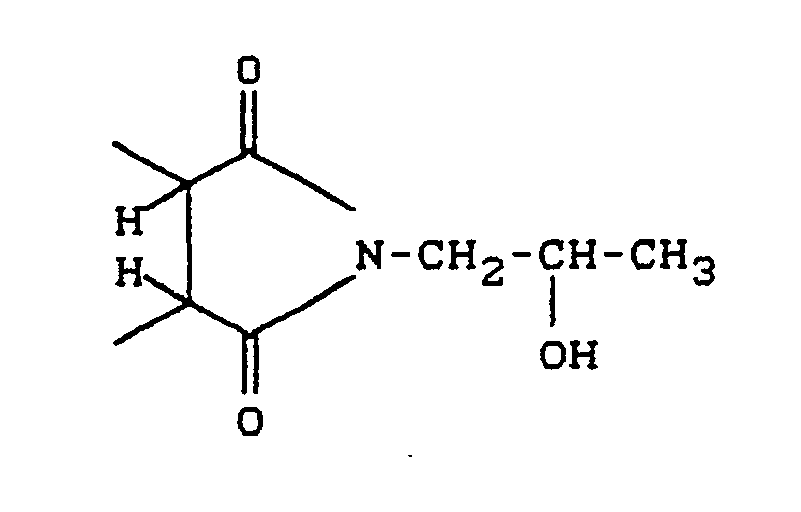
Man erhält auf diese Weise eine erfindungsgemäße wäßrige Dispersion eines hydroxylfunktionellen Copolymerisats mit einem Feststoffgehalt von 36 % und einer Säurezahl des dispergierten Feststoffs von 56 bei einem Neutralisationsgrad der Carboxylgruppen von 39 % (Neutralisationsgrad = Prozentsatz der Carboxylgruppen, die unter Neutralisation in Carboxylatgruppen überführt worden sind). Der Festkörper enthält 15 % folgender Struktureinheit: -
- a) In einem 5-1-Reaktionsgefäß mit Rühr-, Kühl- und Heizvorrichtung werden unter N₂-Atmosphäre 983 g Solvent Naphta und 983 g Butylacetat vorgelegt und auf 125°C erhitzt. Eine Mischung aus 300 g Maleinsäureanhydrid, 180 g Methylmethacrylat, 500 g Butylacrylat, 140 g Acrylsäure, 500 g 2-Ethylhexylacrylat und 300 g Styrol wird in 3 Stunden und parallel dazu 114 g tert.-Butyl-peroktoat (70 %ig in einem Kohlenwaserstoffen) in 3 1/2 Stunden zudosiert. Nach weiteren 2 Stunden Rühren bei 125°C erhält man ein etwa 50 %iges carboxyl- und anhydridfunktionelles Copolymerisat mit einem Anhydridäquivalentgewicht von 654 g (100 %ig).
- b) In einem 2-1-Reaktionsgefäß mit Rühr-, Kühl- und Heizvorrichtung und einem Wasserabscheider werden 101,2 g 1-Amino-2-propanol und 281 g Solvent Naphta vorgelegt und auf 140°C erhitzt. Bei 140°C werden 1.600 g anhydridfunktionelles Copolymerisat 2 a) in 2 Stunden zudosiert und die Reakionsmischung solange am Wasserabscheider erhitzt, bis das Produkt eine Säurezahl von 54 aufweist.
Die Harzlösung wird dann in einem Gemisch aus 28,5 g Dimethylethanolamin und 2.500 g Wasser dispergiert und das organische Lösemittel azeotrop abdestilliert.
Durch Zugabe von Wasser wird ein Festgehalt der wäßrigen Dispersion von 37,5 % eingestellt. Das Polymer hat eine Säurezahl von 54 (100 %ig) bei einem Neutralisationsgrad von 41 %. Der dispergierte Festkörper enthält 23 % folgender Struktureinheit: - In einem 2-1-Reaktionsgefäß mit Rühr-, Kühl- und Heizvorrichtung werden 54,8 Aminoethanol und 245 g Solvent Naphta vorgelegt und auf 140°C erhitzt. Dann werden 1.600 g des anhydridfunktionellen Copolymerisats 1 a) in einer Stunde zudosiert und die Reaktionsmischung solange am Wasserabscheider erhitzt, bis kein Wasser mehr abgespalten wird. Die Harzlösung wird in einem Gemisch aus 26,8 g Dimethylethanolamin und 1.900 g Wasser dispergiert und dann das organische Lösungsmittel azeotrop abdestilliert . Durch Zugabe von Wasser wird ein Festgehalt der wäßrigen Bindemitteldispersion von 36 % eingestellt. Das Polymer hat eine Säurezahl von 70 (100 %ig) bei einem Neutralisationsgrad von 30 %. Der dispergierte Festkörper enthält 14 % folgender Struktureinheit:

-
- a) In einem 5-1-Reaktionsgefäß mit Rühr-, Kühl- und Heizvorrichtung werden unter N₂-Atmosphäre 1980 g Xylol auf 120°C erhitzt. Eine Mischung aus 230 g Maleinsäureanhydrid, 1120 g Methylmethacrylat, 300 g 2-Ethylhexylacrylat und 300 g Styrol wird in 3 Stunden und parallel dazu 71 g tert.-Butyl-peroktoat (70 %ige Lösung in Kohlenwasserstoffen) in 3 1/2 Stunden zudosiert. Anschließend wird 2 Stunden nachgerührt und man erhält man ein 50 %iges anhydridfunktionelles Copolymerisat mit einem Anhydridäquivalentgewicht von 852 g (100 %ig).
- b) In einem 1-1-Reaktionsgefäß mit Rühr-, Kühl- und Heizvorrichtung und einem Wasserabscheider werden 13,8 g 1-Amino-2-propanol, 24,2 g 6-Aminohexansäure und 113,2 g Xylol vorgelegt und auf 132°C erhitzt. 600 g anhydridfunktionelles Copolymerisat 4a) werden in einer Stunde zudosiert und das Reaktionsgemisch solange am Wasserabscheider erhitzt, bis kein Wasser mehr abgespalten wird. Die Harzlösung wird dann in einem Gemisch aus 10,8 g Dimethylethanolamin und 600 g Wasser dispergiert. Das organische Lösemittel wird abdestilliert und die Bindemitteldispersion durch Zugabe von Wasser auf ein Festgehalt von 34 % eingestellt. Das Polymer hat eine Säurezahl von 45 bei einem Neutralisationsgrad von 45 %. Das dispergierte Polymer enhält etwa 8,5 % folgender Struktureinheit:
-
- a) In einem 1-1-Reaktionsgefäß mit Rühr-, Kühl- und Heizvorrichtung und einem Wasserabscheider werden unter N₂-Atmosphäre 16,8 g 1-Amino-2-propanol und 65 g Solvent Naphta vorgelegt und auf 120°C erhitzt. Während 1 Stunde werden dann 400 g des anhydrid- und carboxylfunktionellen Copolymerisats aus Beispiel 1) zudosiert, und die Reaktionsmischung solange erhitzt, bis kein Wasser mehr abgespalten wird. Die Polymerlösung wird dann auf 120°C abgekühlt und mit 23,2 g ε-Caprolacton in Gegenwart von 0,24 g Dibutylzinndilaurat während 3 Stunden zur Reaktion gebracht.
- Anschließend wird das Harz in einem Gemisch aus 600 g Wasser und 12 g Dimethylethanolamin dispergiert, das organische Lösemittel abdestilliert und die Polymerdispersion durch Zugabe von Wasser auf einen Festgehalt von 27,5 % eingestellt. Das Polymer hat eine Säurezahl von 55 (100 %ig) bei einem Neutralisationsgrad von 70 %. Der dispergierte Festkörper enthält etwa 23 % folgender Struktureinheiten

-
- a) In einem 2-1-Reaktionsgefäß mit Rühr-, Kühl- und Heizvorrichtung werden 300 g Oxohexylacetat (®Exxate 600) auf 140°C erhitzt. Unter N₂-Atmosphäre wird eine Mischung aus 160 g Maleinsäureanhydrid, 160 g Methylmethacrylat, 208 g Butylacrylat, 80 g 2-Ethylhexylmethacrylat und 160 g Styrol in 3 Stunden und parallel dazu eine Mischung aus 45,9 g tert.-Butyl-peroktoat (70 %ig in einem Kohlenwasserstoffgemisch) und 29 g Oxohexylacetat zudosiert. Nach 2 Stunden Nachrührzeit bei 140°C erhält man ein anhydridfunktionelles Copolymerisat als 70%ige Lösung mit einem Anhydridäquivalentgewicht von 490 g (100 %ig).
- b) In einem 0,5-1-Reaktionsgefäß mit Rühr-, Kühl-, Heizvorrichtung und Wasserabscheider werden 88,6 g Oxohexylacetat, 14,4 g 1-Amino-2-propanol und 12,6 g 6-Aminohexansäure bei 130°C vorgelegt und 250 g des anhydridfunktionellen Copolymerisats 6 a) zudosiert. Die Reaktion wird solange durchgeführt, wie kein Wasser mehr abgespalten wird, dann wird das Reaktionsgemisch in einem Gemisch aus 6,3 g Dimethylethanolamin und 360 g Wasser dispergiert. Nachdem das organische Lösemittel azeotrop abdestilliert ist, wird die wäßrige Bindemitteldispersion mit Wasser auf einen Festgehalt von 27 % eingestellt. Das Polymer hat eine Säurezahl von 48 (100 %ig) bei einem Neutralisationsgrad von 50 %. Der dispergierte Festkörper enthält etwa 21 % folgender Struktureinheit:
-
- a) In einem 4-1-Reaktionsgefäß mit Rühr-, Kühl- und Heizvorrichtung werden 1.300 g Xylol unter N₂-Atmosphäre auf 120°C erhitzt. Eine Mischung aus 300 g Maleinsäureanhydrid, 600 g Butylacrylat, 420 g 2-Ethylhexylacrylat und 600 g Styrol wird in 3 Stunden und parallel dazu 114 g tert.-Butylperoktoat in 3 1/2 Stunden zudosiert. Nach weiteren 2 Stunden Nachrührzeit erhält man ein etwa 60 %iges anhydridfunktionelles Copolymerisat mit einem Anhydridäquivalentgewicht von 654 g (100 %ig).
- b) In einem 1-1-Reaktionsgefäß mit Rühr-, Kühl- und Heizvorrichtung und einem Wasserabscheider werden 29,6 g 1-Amino-2-propanol, 23,6 g 6-Aminohexansäure und 265 g Xylol vorgelegt. 300 g des anhydridfunktionellen Copolymerisats 7a) werden bei 130°C in 1 Stunde zudosiert und die Reaktionsmischung solange erhitzt, bis die Wasserabspaltung beendet ist. Das Harz wird dann in einem Gemisch aus 700 g Wasser und 16 g Dimethylethanolamin dispergiert. Nach dem Abdestillieren des Xylols werden 21 g Butylglykol zugegeben und die Harzdispersion auf einen Festgehalt von 25 % durch Zugabe von Wasser eingestellt. Das Polymer hat eine Säurezahl von 32 (100 %ig) bei einem Neutralisationsgrad von 90 %. Der dispergierte Festkörper enthält 15 % folgender Struktureinheit:
- Die nach den Beispielen 1 bis 7 hergestellten Bindemitteldispersionen wurden im Gewichtsverhältnis 80 : 20 (jeweils 100 %ig) mit einem Aminovernetzerharz (Melaminharz ®Sacopal M 232, Krems Chemie) abgemischt und auf entfettete Stahlbleche appliziert. Die Naßfilmstärke betrug 180 µm, die Trockenfilmstärke ca. 25 bis 30 µm. Nach 10 Minuten Ablüften bei Raumtemperatur wurden die Überzüge für 30 Minuten bei 150°C eingebrannt. Nach dem Abkühlen erhielt man klare, harte, vernetzte Filme. Alle Überzüge überstanden einen Wischtest mit einem mit Methylisobutylketon getränkten Wattebausch (mindestens 200 Doppelhübe) ohne Befund.


Claims (9)
- Wäßrige Lösungen oder Dispersionen von hydroxyfunktionellen Copolymerisaten mit Imidstruktureinheiten, dadurch gekennzeichnet, daß in den Copolymerisaten pro 100 Gew.-Teilena) 1 - 70 Gew.-Teile an chemisch eingebauten Strukturheiten I
 b) insgesamt 2 - 25 Gew.-Teile an chemisch eingebauten, zumindest teilweise in neutralisierter Form vorliegenden Struktureinheiten II und/oder III und/oder IV und/oder V
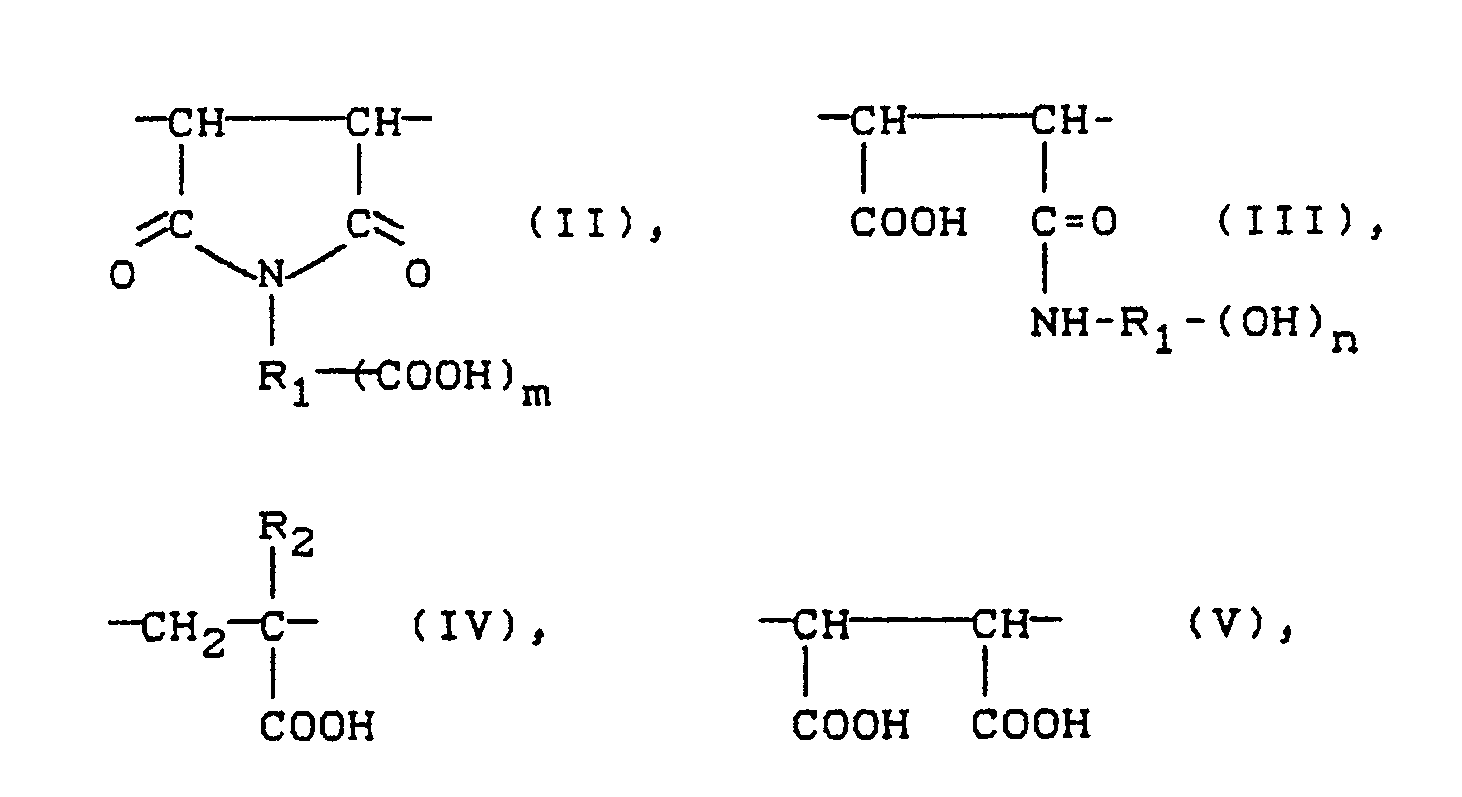 c) 1 - 75 Gew.-Teile an chemisch eingebauten Struktureinheiten der Formel (VI)
 d) 15 - 95 Gew.-Teile an chemisch eingebauten Struktureinheiten (VII)
 e) 0 - 15 Gew.-Teile an anderen, von mehrfach olefinisch ungesättigten Monomeren herrührenden Struktureinheiten
vorliegen, wobei die Summe der genannten Gewichtsteile 100 beträgt, und wobein für 1, 2 oder 3 steht,m für 1 oder 2 steht,R₁ für aliphatische, cycloaliphatische, araliphatische, aromatische Kohlenwasserstoffreste mit 2 bis 20 Kohlenstoffatomen steht, die ein oder mehrere Heteroatome aus der Gruppe bestehend aus Sauerstoff und Stickstoff in Form von z.B. Ether-, Ester-, Amid-, Imid-, Urethan-, Harnstoff-, Keto-, Nitrilgruppen und darüber hinaus auch Fluor und Chlor enthalten können.R₂ für Wasserstoff oder eine Methylgruppe steht,R₃ für einen aliphatischen Kohlenwasserstoffrest mit 2 bis 15 Kohlenstoffatomen, einen cycloaliphatischen Kohlenwasserstoffrest mit 5 bis 10 Kohlenstoffatomen, einen araliphatischen Kohlenwasserstoffrest mit 7 bis 18 Kohlenstoffatomen, einen aromatischen Kohlenwasserstoffrest mit 6 bis 12 Kohlenstoffatomen, Chlor, Fluor, eine Nitrilgruppe oder einen Kohlenwasserstoffrest mit 2 bis 18 Kohlenstoffatomen steht, der ein oder mehrere Heteroatome aus der Gruppe bestehend aus Sauerstoff, Schwefel und Stickstoff in Form von Ether-, Ester-, Amid-, Urethan-, Harnstoff-, Thioester-, Thioether-, Oxiran-, Keton-, Lactam- oder Lactongruppen enthält,R₄ für Wasserstoff, oder zusammen mit R₃ und den beiden C-Atomen der Struktureinheiten VI für einen cycloaliphatischen Rest steht,R₅ für Wasserstoff, eine Methyl- oder Ethylgruppe oder für Chlor oder Fluor steht,R₆ für einen aliphatischen oder cycloaliphatischen gegebenenfalls Sauerstoff, Schwefel oder Stickstoff als Heteroatom enthaltenden Kohlenwasserstoffrest mit 1 bis 18 Kohlenstoffatomen steht. - Wäßrige Lösungen oder Dispersionen von Copolymerisaten gemäß Anspruch 1, dadurch gekennzeichnet, daß in den Copolymerisaten pro 100 Gew.-Teilena) 8 - 35 Gew.-Teile an chemisch eingebauten Struktureinheiten Ib) insgesamt 3 - 15 Gew.-Teile an chemisch eingebauten, zumindest teilweise in neutralisierter Form vorliegenden Struktureinheiten II und/oder III und/oder IV und/oder V,c) 5 - 50 Gew.-Teile an chemisch eingebauten Struktureinheiten VI sowied) 20 - 80 Gew.-Teile an chemisch eingebauten Struktureinheiten VII vorliegen, wobei die Summe dieser Gewichtsteile 100 ergibt, und wobein für 1, 2 oder 3 steht,m für 1 steht,R₁ für einen aliphatischen, gegebenenfalls Estergruppen aufweisenden Kohlenwasserstoffrest mit insgesamt 2 bis 12 Kohlenstoffatomen steht,R₂ für Wasserstoff oder eine Methylgruppe steht,R₃ für einen gegebenenfalls substituierten Phenylrest steht,R₄ für Wasserstoff steht,R₅ für Wasserstoff oder eine Methylgruppe steht,R₆ für einen aliphatischen, gegebenenfalls Sauerstoff als Heteroatom enthaltenden Kohlenwasserstoffrest mit 1 bis 10 Kohlenstoffatomen steht.
- Wäßrige Lösungen oder Dispersionen von Copolymerisaten gemäß Anspruch 2, dadurch gekennzeichnet, daß in den Copolymerisaten pro 100 Gew.-Teilena) 8 - 35 Gew.-Teile an chemisch eingebauten Struktureinheiten der Formel Ia
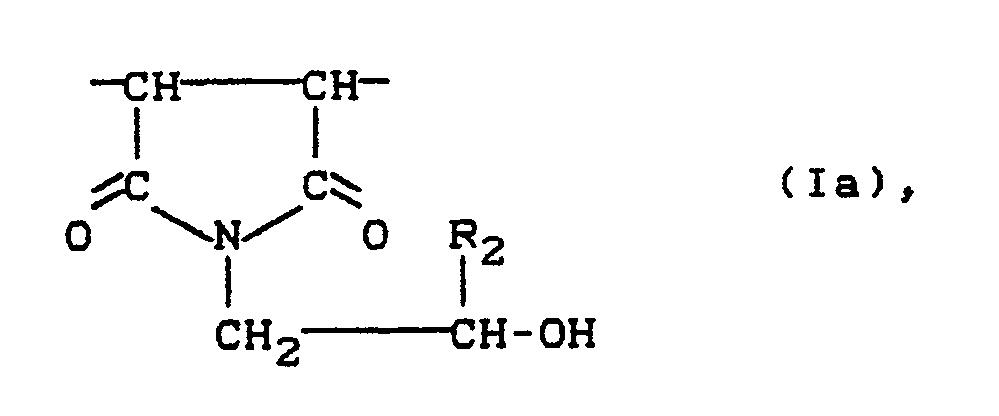 b) 3 - 15 Gew.-Teile an chemisch eingebauten, zumindest teilweise in neutralisierter Form vorliegenden Struktureinheiten der Formeln IIa und/oder IV
 c) 5 - 50 Gew.- Teile an chemisch eingebauten Struktureinheiten VIa
 d) 20 - 80 Gew.-Teile an chemisch eingebauten Struktureinheiten der Formel VII
vorliegen, wobei die Summe dieser Gewichtsteile 100 ergibt, und wobeiR₂ und R₆ die in Anspruch 2 genannte Bedeutung haben undr für eine ganze Zahl von 2 bis 12 steht. - Wäßrige Lösungen oder Dispersionen von Copolymerisaten gemäß Anspruch 1 bis 3, dadurch gekennzeichnet, daß die gelösten bzw, dispergierten Copolymerisate ein Molekulargewicht Mn von 2.600 bis 10.000 und Säurezahlen, bezogen auf neutralisierte und unneutralisierte Carboxylgruppen, von 20 - 75 bei einem Neutralisationsgrad der Carboxylgruppen von 30 - 80 % aufweisen.
- Verfahren zur Herstellung von wäßrigen Lösungen oder Dispersionen von hydroxyfunktionellen Copolymerisaten mit Imidstruktureinheiten gemäß Anspruch 1, dadurch gekennzeichnet, daß man, den hydroxyfunktionellen Copolymerisaten entsprechende, anhydrid- und gegebenenfalls carboxylfunktionelle Copolymerisate mit Aminoalkoholen der Formel VIII
H₂N-R₁-(OH)n (VIII),
und gegebenenfalls mit Aminocarbonsäuren der Formel
H₂N-R₁(COOH)m (IX),
wobei R₁, n und m die in Anspruch 1 genannte Bedeutung haben,
unter Einhaltung eines Äquivalentverhältnisses von Aminogruppen zur Anhydridgruppen von 0,8:1 bis 2:1 unter Imidbildung bei 100 bis 200°C zur Reaktion bringt, gleichzeitig und/oder anschließend das Reaktionswasser azeotrop abdestilliert, die Polymerlösung nach und/oder unter gleichzeitiger, mindestens teilweiser Neutralisation der Carboxylgruppen in Wasser löst oder dispergiert und dann gegebenenfalls noch vorliegendes organisches Lösungsmittel teilweise oder ganz azeotrop abdestilliert. - Verfahren gemäß Anspruch 5, dadurch gekennzeichnet, daß man Aminoalkohole VIII mit einem Molekulargewicht von mindestens 61 sowie gegebenenfalls Aminocarbonsäuren IX zusammen mit Lösungsmittel vorlegt, auf Temperaturen von mindestens 100°C erhitzt, das gelöste anhydrid- und gegebenenfalls carboxylfunktionelle Copolymerisat zudosiert, das Reaktionswasser abdestilliert bis das Produkt eine Säurezahl von 20 bis 75 aufweist, dann das Reaktionsgemisch in einem Wasser-/Neutralisationsmittelgemisch dispergiert und das organische Lösemittel azeotrop abdestilliert.
- Verfahren gemäß den Ansprüchen 5 und 6, dadurch gekennzeichnet, daß man als Aminoalkohol VII 2-Amino-1-ethanol, 2-Amino-1-propanol, 3-Amino-1-propanol, 1-Amino-2-propanol, sowie als gegebenenfalls einzusetzende Aminocarbonsäure IX, 6-Aminohexansäure, 2-Aminoessigsäure, 12-Aminododecansäure verwendet.
- Weitere Ausbildung der Verfahren gemäß Ansprüchen 5 bis 7, dadurch gekennzeichnet, daß man die durch Umsetzung der anhydrid- und gegebenenfalls carboxylfunktionellen Copolymerisate mit den Aminoalkoholen und gegebenenfalls Aminocarbonsäuren erhaltenen hydroxyfunktionellen Polyimidcopolymerisate vor dem Lösen oder Dispergieren durch Umsetzung mit 0,05 bis 5 Mol an Lactonen pro Mol an in den Polyimidcopolymerisaten vorliegenden Hydroxylgruppen unter ringöffnender Esterbildung modifiziert.
- Verwendung der in Wasser gelöst oder dispergiert vorliegenden hydroxyfunktionellen Copolymerisate gemäß Anspruch 1 bis 4 zur Herstellung von Beschichtungsmitteln, Dichtmassen oder Klebstoffen.
Applications Claiming Priority (2)
| Application Number | Priority Date | Filing Date | Title |
|---|---|---|---|
| DE4010794A DE4010794A1 (de) | 1990-04-04 | 1990-04-04 | Waessrige loesungen oder dispersionen von hydroxyfunktionellen copolymerisaten, ein verfahren zu ihrer herstellung und ihrer verwendung |
| DE4010794 | 1990-04-04 |
Publications (3)
| Publication Number | Publication Date |
|---|---|
| EP0452696A2 true EP0452696A2 (de) | 1991-10-23 |
| EP0452696A3 EP0452696A3 (en) | 1992-09-16 |
| EP0452696B1 EP0452696B1 (de) | 1995-01-18 |
Family
ID=6403702
Family Applications (1)
| Application Number | Title | Priority Date | Filing Date |
|---|---|---|---|
| EP91104487A Expired - Lifetime EP0452696B1 (de) | 1990-04-04 | 1991-03-22 | Wässrige Lösungen oder Dispersionen von hydroxyfunktionellen Copolymerisaten, ein Verfahren zu ihrer Herstellung und ihrer Verwendung |
Country Status (7)
| Country | Link |
|---|---|
| US (1) | US5134188A (de) |
| EP (1) | EP0452696B1 (de) |
| JP (1) | JPH05339314A (de) |
| AT (1) | ATE117322T1 (de) |
| CA (1) | CA2037373A1 (de) |
| DE (2) | DE4010794A1 (de) |
| ES (1) | ES2069762T3 (de) |
Cited By (3)
| Publication number | Priority date | Publication date | Assignee | Title |
|---|---|---|---|---|
| WO1994021695A1 (de) * | 1993-03-17 | 1994-09-29 | Basf Aktiengesellschaft | Polycokondensate auf basis von asparaginsäure, verfahren zu ihrer herstellung und ihre verwendung |
| WO1997023513A1 (en) * | 1995-12-21 | 1997-07-03 | Ppg Industries, Inc. | Aqueous solutions of phenolic polymers from amino phenols and anhydride polymers or di-epoxides |
| CN103998472A (zh) * | 2011-12-22 | 2014-08-20 | 拜耳知识产权有限责任公司 | 低溶剂型聚丙烯酸酯共聚物分散体 |
Families Citing this family (6)
| Publication number | Priority date | Publication date | Assignee | Title |
|---|---|---|---|---|
| WO1996026976A1 (en) * | 1995-02-27 | 1996-09-06 | W.R. Grace & Co.-Conn. | Thermoplastic block copolymer with inherent anti-fog properties |
| FR2795076B1 (fr) * | 1999-06-21 | 2001-08-10 | Atofina | Dispersions cationiques hydrophobes stabilisees par des copolymeres maleimides de faible masse moleculaire, pour le collage du papier |
| EP1311563A4 (de) * | 2000-08-16 | 2006-09-06 | Brewer Science Inc | Photosensitive harzzusammensetzungen für farbfilteranwendungen |
| US9169157B2 (en) * | 2006-06-16 | 2015-10-27 | Georgia-Pacific Chemicals Llc | Formaldehyde free binder |
| US7803879B2 (en) * | 2006-06-16 | 2010-09-28 | Georgia-Pacific Chemicals Llc | Formaldehyde free binder |
| US7795354B2 (en) * | 2006-06-16 | 2010-09-14 | Georgia-Pacific Chemicals Llc | Formaldehyde free binder |
Family Cites Families (9)
| Publication number | Priority date | Publication date | Assignee | Title |
|---|---|---|---|---|
| NL194077A (de) * | 1954-01-18 | |||
| DE1745954A1 (de) * | 1968-02-13 | 1971-09-16 | Hoechst Ag | Verfahren zur Herstellung von AEthanolimidderivaten von Styrol-Maleinsaeureanhydrid-Cotelomerisaten |
| US3676404A (en) * | 1970-06-09 | 1972-07-11 | Ici Ltd | Methyl methacrylate copolymers |
| CA1065988A (en) * | 1974-05-16 | 1979-11-06 | Roger M. Christenson | Water-based liners for beverage containers |
| US4452948A (en) * | 1980-09-10 | 1984-06-05 | The International Paint Company Limited | Coating composition comprising a hydroxy component, an anhydride component and a catalyst |
| FR2535723A1 (fr) * | 1982-11-09 | 1984-05-11 | Inst Francais Du Petrole | Additifs azotes utilisables comme agents d'abaissement du point de trouble des distillats moyens d'hydrocarbures et compositions de distillats moyens d'hydrocarbures renfermant lesdits additifs |
| DE3319014A1 (de) * | 1983-05-26 | 1984-11-29 | Bayer Ag, 5090 Leverkusen | Copolymere und ihre verwendung als leimungsmittel |
| US4740561A (en) * | 1985-12-25 | 1988-04-26 | Ube Industries, Ltd. | Process for the preparation of N-(hydroxyphenyl)malemide copolymer |
| DE3929163A1 (de) * | 1989-09-02 | 1991-03-07 | Bayer Ag | Sekundaere aminogruppen aufweisende copolymerisate, ein verfahren zu ihrer herstellung und ihre verwendung als bindemittel oder bindemittelkomponente |
-
1990
- 1990-04-04 DE DE4010794A patent/DE4010794A1/de not_active Withdrawn
-
1991
- 1991-02-28 CA CA002037373A patent/CA2037373A1/en not_active Abandoned
- 1991-03-22 ES ES91104487T patent/ES2069762T3/es not_active Expired - Lifetime
- 1991-03-22 AT AT91104487T patent/ATE117322T1/de not_active IP Right Cessation
- 1991-03-22 EP EP91104487A patent/EP0452696B1/de not_active Expired - Lifetime
- 1991-03-22 DE DE59104284T patent/DE59104284D1/de not_active Expired - Fee Related
- 1991-03-26 US US07/675,388 patent/US5134188A/en not_active Expired - Fee Related
- 1991-03-29 JP JP3091560A patent/JPH05339314A/ja active Pending
Cited By (4)
| Publication number | Priority date | Publication date | Assignee | Title |
|---|---|---|---|---|
| WO1994021695A1 (de) * | 1993-03-17 | 1994-09-29 | Basf Aktiengesellschaft | Polycokondensate auf basis von asparaginsäure, verfahren zu ihrer herstellung und ihre verwendung |
| US5574113A (en) * | 1993-03-17 | 1996-11-12 | Basf Aktiengesellschaft | Polycocondensates based on aspartic acid, their preparation and their use |
| WO1997023513A1 (en) * | 1995-12-21 | 1997-07-03 | Ppg Industries, Inc. | Aqueous solutions of phenolic polymers from amino phenols and anhydride polymers or di-epoxides |
| CN103998472A (zh) * | 2011-12-22 | 2014-08-20 | 拜耳知识产权有限责任公司 | 低溶剂型聚丙烯酸酯共聚物分散体 |
Also Published As
| Publication number | Publication date |
|---|---|
| DE4010794A1 (de) | 1991-10-10 |
| EP0452696B1 (de) | 1995-01-18 |
| EP0452696A3 (en) | 1992-09-16 |
| JPH05339314A (ja) | 1993-12-21 |
| ES2069762T3 (es) | 1995-05-16 |
| US5134188A (en) | 1992-07-28 |
| CA2037373A1 (en) | 1991-10-05 |
| DE59104284D1 (de) | 1995-03-02 |
| ATE117322T1 (de) | 1995-02-15 |
Similar Documents
| Publication | Publication Date | Title |
|---|---|---|
| EP0758007B1 (de) | Wässrige, vernetzbare Bindemitteldispersionen mit niedrigem Lösemittelgehalt | |
| DE69508038T2 (de) | Hydroxyfunctionelle Acrylatharze, Verfahren zu deren Herstellung und deren Reaktionsprodukte | |
| EP0401627B1 (de) | Hydroxyfunktionelle Copolymerisate, Verfahren zu ihrer Herstellung und ihre Verwendung als Bindemittel oder Bindemittelkomponente | |
| TW201223990A (en) | Radiation curable aqueous compositions | |
| EP1391469A1 (de) | Wässrige Bindemittel-Dispersionen als Überzugsmittel | |
| EP0324334B1 (de) | Wasserverdünnbare Bindemittel, ein Verfahren zu ihrer Herstellung und ihre Verwendung | |
| WO2001064766A1 (de) | Wässrige überzugsmittel für festkörperreiche einbrennlackierungen und deren verwendung | |
| EP0452696B1 (de) | Wässrige Lösungen oder Dispersionen von hydroxyfunktionellen Copolymerisaten, ein Verfahren zu ihrer Herstellung und ihrer Verwendung | |
| EP0276649B1 (de) | Vernetzbare, fluorhaltige Copolymere als Bindemittel für hochwitterungsstabile Lacke | |
| EP1657271B1 (de) | Polyester-Polyacrylat-Dispersionen mit Reaktivverdünner auf Basis von hydroxyfunktionellen Estern | |
| EP1657270B1 (de) | Polyester-Polyacrylat-Dispersionen mit Reaktivverdünnern auf Basis von Lactongruppenhaltigen Verbindungen | |
| EP0416360A2 (de) | Sekundäre Aminogruppen aufweisende Copolymerisate, ein Verfahren zu ihrer Herstellung und ihre Verwendung als Bindemittel oder Bindemittelkomponente | |
| EP0006204B1 (de) | Wässrige Dispersionen von oligomeren oder polymeren Kunststoffen, ein Verfahren zu ihrer Herstellung sowie ihre Verwendung | |
| EP1270619A2 (de) | Wässrige Sekundärdispersionen | |
| DE69507099T2 (de) | Polymere aus Allylestern mit Allylalkohol oder Allyl-Alkohol-Propoxylate | |
| EP0372295B1 (de) | Wässrige Lösungen oder Dispersionen von selbstvernetzenden Bindemitteln, ein Verfahren zu ihrer Herstellung und ihre Verwendung | |
| EP1699835B1 (de) | Lösemittelarme, oh-funktionelle dispersionen | |
| DE3406473A1 (de) | Verfahren zur herstellung waessriger dispersionen von kondesationsprodukten aus harnstoff und ch-aciden aldehyden sowie deren verwendung | |
| EP0841352B1 (de) | Verfahren zur Herstellung von Polyacrylatsekundär-dispersionen | |
| EP0350684B1 (de) | Oxidativ vernetzbare, wasserverdünnbare Bindemittel, Verfahren zu ihrer Herstellung und ihre Verwendung | |
| DE4222256A1 (de) | Wäßriges Beschichtungsmittel und seine Verwendung | |
| EP0415213A2 (de) | Aminogruppen aufweisende Copolymerisate, ein Verfahren zu ihrer Herstellung und ihre Verwendung als Bindemittel oder Bindemittelkomponente | |
| EP0302373A1 (de) | Verfahren zur Herstellung von feuchtigkeitshärtenden Bindemittelkompositionen und ihre Verwendung | |
| DE102004003894A1 (de) | Lösemittelarme, OH-funktionelle Dispersionen II | |
| DE4032783A1 (de) | Zur oxidativen vernetzung befaehigte polymere |
Legal Events
| Date | Code | Title | Description |
|---|---|---|---|
| PUAI | Public reference made under article 153(3) epc to a published international application that has entered the european phase |
Free format text: ORIGINAL CODE: 0009012 |
|
| AK | Designated contracting states |
Kind code of ref document: A2 Designated state(s): AT BE CH DE ES FR GB IT LI NL SE |
|
| PUAL | Search report despatched |
Free format text: ORIGINAL CODE: 0009013 |
|
| AK | Designated contracting states |
Kind code of ref document: A3 Designated state(s): AT BE CH DE ES FR GB IT LI NL SE |
|
| 17P | Request for examination filed |
Effective date: 19920929 |
|
| 17Q | First examination report despatched |
Effective date: 19940531 |
|
| GRAA | (expected) grant |
Free format text: ORIGINAL CODE: 0009210 |
|
| AK | Designated contracting states |
Kind code of ref document: B1 Designated state(s): AT BE CH DE ES FR GB IT LI NL SE |
|
| REF | Corresponds to: |
Ref document number: 117322 Country of ref document: AT Date of ref document: 19950215 Kind code of ref document: T |
|
| EAL | Se: european patent in force in sweden |
Ref document number: 91104487.3 |
|
| GBT | Gb: translation of ep patent filed (gb section 77(6)(a)/1977) |
Effective date: 19950128 |
|
| REF | Corresponds to: |
Ref document number: 59104284 Country of ref document: DE Date of ref document: 19950302 |
|
| ITF | It: translation for a ep patent filed | ||
| ET | Fr: translation filed | ||
| REG | Reference to a national code |
Ref country code: ES Ref legal event code: FG2A Ref document number: 2069762 Country of ref document: ES Kind code of ref document: T3 |
|
| PLBE | No opposition filed within time limit |
Free format text: ORIGINAL CODE: 0009261 |
|
| STAA | Information on the status of an ep patent application or granted ep patent |
Free format text: STATUS: NO OPPOSITION FILED WITHIN TIME LIMIT |
|
| 26N | No opposition filed | ||
| PGFP | Annual fee paid to national office [announced via postgrant information from national office to epo] |
Ref country code: SE Payment date: 19960216 Year of fee payment: 6 |
|
| PGFP | Annual fee paid to national office [announced via postgrant information from national office to epo] |
Ref country code: ES Payment date: 19960313 Year of fee payment: 6 |
|
| PGFP | Annual fee paid to national office [announced via postgrant information from national office to epo] |
Ref country code: AT Payment date: 19960318 Year of fee payment: 6 Ref country code: CH Payment date: 19960318 Year of fee payment: 6 |
|
| PGFP | Annual fee paid to national office [announced via postgrant information from national office to epo] |
Ref country code: BE Payment date: 19960327 Year of fee payment: 6 |
|
| PG25 | Lapsed in a contracting state [announced via postgrant information from national office to epo] |
Ref country code: AT Effective date: 19970322 |
|
| PG25 | Lapsed in a contracting state [announced via postgrant information from national office to epo] |
Ref country code: SE Effective date: 19970323 |
|
| PG25 | Lapsed in a contracting state [announced via postgrant information from national office to epo] |
Ref country code: ES Free format text: LAPSE BECAUSE OF NON-PAYMENT OF DUE FEES Effective date: 19970324 |
|
| PG25 | Lapsed in a contracting state [announced via postgrant information from national office to epo] |
Ref country code: CH Effective date: 19970331 Ref country code: BE Effective date: 19970331 Ref country code: LI Effective date: 19970331 |
|
| BERE | Be: lapsed |
Owner name: BAYER A.G. Effective date: 19970331 |
|
| REG | Reference to a national code |
Ref country code: CH Ref legal event code: PL |
|
| EUG | Se: european patent has lapsed |
Ref document number: 91104487.3 |
|
| REG | Reference to a national code |
Ref country code: ES Ref legal event code: FD2A Effective date: 19990503 |
|
| REG | Reference to a national code |
Ref country code: GB Ref legal event code: IF02 |
|
| PGFP | Annual fee paid to national office [announced via postgrant information from national office to epo] |
Ref country code: DE Payment date: 20060215 Year of fee payment: 16 |
|
| PGFP | Annual fee paid to national office [announced via postgrant information from national office to epo] |
Ref country code: GB Payment date: 20060322 Year of fee payment: 16 Ref country code: FR Payment date: 20060322 Year of fee payment: 16 |
|
| PGFP | Annual fee paid to national office [announced via postgrant information from national office to epo] |
Ref country code: IT Payment date: 20060331 Year of fee payment: 16 Ref country code: NL Payment date: 20060331 Year of fee payment: 16 |
|
| GBPC | Gb: european patent ceased through non-payment of renewal fee |
Effective date: 20070322 |
|
| NLV4 | Nl: lapsed or anulled due to non-payment of the annual fee |
Effective date: 20071001 |
|
| REG | Reference to a national code |
Ref country code: FR Ref legal event code: ST Effective date: 20071130 |
|
| PG25 | Lapsed in a contracting state [announced via postgrant information from national office to epo] |
Ref country code: DE Free format text: LAPSE BECAUSE OF NON-PAYMENT OF DUE FEES Effective date: 20071002 Ref country code: NL Free format text: LAPSE BECAUSE OF NON-PAYMENT OF DUE FEES Effective date: 20071001 |
|
| PG25 | Lapsed in a contracting state [announced via postgrant information from national office to epo] |
Ref country code: GB Free format text: LAPSE BECAUSE OF NON-PAYMENT OF DUE FEES Effective date: 20070322 |
|
| PG25 | Lapsed in a contracting state [announced via postgrant information from national office to epo] |
Ref country code: FR Free format text: LAPSE BECAUSE OF NON-PAYMENT OF DUE FEES Effective date: 20070402 |
|
| PG25 | Lapsed in a contracting state [announced via postgrant information from national office to epo] |
Ref country code: IT Free format text: LAPSE BECAUSE OF NON-PAYMENT OF DUE FEES Effective date: 20070322 |