EP0452718B1 - Glühbehälter für Wärmebehandlung von Füllgut - Google Patents
Glühbehälter für Wärmebehandlung von Füllgut Download PDFInfo
- Publication number
- EP0452718B1 EP0452718B1 EP91104864A EP91104864A EP0452718B1 EP 0452718 B1 EP0452718 B1 EP 0452718B1 EP 91104864 A EP91104864 A EP 91104864A EP 91104864 A EP91104864 A EP 91104864A EP 0452718 B1 EP0452718 B1 EP 0452718B1
- Authority
- EP
- European Patent Office
- Prior art keywords
- receptacle
- annealing
- heat treatment
- carbon
- fact
- Prior art date
- Legal status (The legal status is an assumption and is not a legal conclusion. Google has not performed a legal analysis and makes no representation as to the accuracy of the status listed.)
- Expired - Lifetime
Links
Images
Classifications
-
- C—CHEMISTRY; METALLURGY
- C21—METALLURGY OF IRON
- C21D—MODIFYING THE PHYSICAL STRUCTURE OF FERROUS METALS; GENERAL DEVICES FOR HEAT TREATMENT OF FERROUS OR NON-FERROUS METALS OR ALLOYS; MAKING METAL MALLEABLE, e.g. BY DECARBURISATION OR TEMPERING
- C21D9/00—Heat treatment, e.g. annealing, hardening, quenching or tempering, adapted for particular articles; Furnaces therefor
- C21D9/0006—Details, accessories not peculiar to any of the following furnaces
- C21D9/0025—Supports; Baskets; Containers; Covers
-
- F—MECHANICAL ENGINEERING; LIGHTING; HEATING; WEAPONS; BLASTING
- F27—FURNACES; KILNS; OVENS; RETORTS
- F27D—DETAILS OR ACCESSORIES OF FURNACES, KILNS, OVENS OR RETORTS, IN SO FAR AS THEY ARE OF KINDS OCCURRING IN MORE THAN ONE KIND OF FURNACE
- F27D1/00—Casings; Linings; Walls; Roofs
- F27D1/0003—Linings or walls
- F27D1/0006—Linings or walls formed from bricks or layers with a particular composition or specific characteristics
Definitions
- the invention relates to annealing containers for the heat treatment of filling material arranged therein with a bottom and side walls made of carbon reinforced with carbon fibers.
- the object of the invention is to provide annealing containers which avoid the disadvantages of the known boxes.
- This object is achieved by annealing containers for the heat treatment of contents arranged therein with bottom and side walls, which are characterized in that the container made of carbon fiber reinforced carbon with a porosity of 2-30 vol.% And a carbon fiber content of 30-70 vol. % consists.
- the container which is preferably open at the top, can also have a lid made of CFC material.
- the reinforcing fibers are endless stretched carbon fibers.
- Fiber fabrics, woven fabrics or nonwovens made from endless stretched carbon fibers are impregnated with polymer resins, pitches, bitumen and so-called prepregs are produced, from which open, preferably rectangular or square containers are formed by deep drawing or pressing.
- Flat lids or lids with a rim in a dimensioning corresponding to the container size can be produced in the same way.
- the blanks of the containers produced in this way are subjected to a heat treatment in order to convert the materials used to impregnate the fiber fabrics, woven or non-woven fabrics into carbon.
- Carbonization is usually carried out at a temperature of 200 to 1000 ° C.
- the porous structure of the material is then compacted by liquid impregnation with phenolic resins, furan resins, polyphenylenes, pitch or mixtures thereof. This is followed by a heat treatment at 200 ° C to 2900 ° C to graphitize the wall and floor material or the lid of the container.
- the material structure can also be compressed by chemical deposition of carbon in the pores under vacuum.
- the proportion of reinforcing carbon fibers in the graphitized material is 30-70% by volume, preferably 45-60% by volume.
- the compacted material has a low porosity or a low pore content of 2-30, preferably 5-15 vol.%.
- the surfaces of the container and the lid are metallized by deposition of metals under vacuum, for example with tantalum, niobium, molybdenum, copper / Nickel alloys.
- metal oxide layers such as zirconium oxide, aluminum oxide, can also be deposited for surface protection.
- Good surface protection can also be achieved by siliconizing and / or converting it to SiC or glazing with silicon dioxide and / or boron compounds of the surface of the CFC material can be achieved. Protection is also possible by applying ceramic layers.
- Particularly suitable materials are TiN, BN and TiC.
- CFC material is already sufficiently inert to the filling material and is heat-stable when used, in which the filling material to be annealed or sintered is subjected to a heat treatment of 500 ° C to 2500 ° C in a reducing or inert atmosphere in push-through ovens or deck ovens.
- the containers according to the invention can be produced in different sizes up to about 100 x 100 cm with side wall heights of 1-50 cm.
- the size depends on the size of the furnaces in which the annealing container for the heat treatment of the filling material is to be made later.
- a standard size is 30 x 40 x 10 cm.
- Preferred wall thicknesses are 1-8 mm.
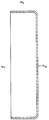
- the attached figure shows an annealing container 1 according to the invention in longitudinal section with bottom 2 and side walls 3 made of carbon material reinforced with carbon fibers.
Landscapes
- Engineering & Computer Science (AREA)
- Chemical & Material Sciences (AREA)
- Mechanical Engineering (AREA)
- Materials Engineering (AREA)
- Crystallography & Structural Chemistry (AREA)
- Thermal Sciences (AREA)
- Physics & Mathematics (AREA)
- Metallurgy (AREA)
- Organic Chemistry (AREA)
- General Engineering & Computer Science (AREA)
- Furnace Charging Or Discharging (AREA)
- Ceramic Products (AREA)
- Manufacture Of Alloys Or Alloy Compounds (AREA)
Description
- Gegenstand der Erfindung sind Glühbehälter für die Wärmebehandlung von darin angeordnetem Füllgut mit Boden und Seitenwänden aus mit Kohlenstoffasern verstärktem Kohlenstoff.
- Offene Behälter zum Glühen und Sintern von Formkörpern und Teilen aus pulvermetallurgischen Werkstoffen sind bekannt und werden in der Praxis eingesetzt. Derartige Behälter oder Kästen sind aus Metall, Keramik, SiC-Keramik und anderen Materialien. Die Kästen sind im Falle von Metall nicht ausreichend korrosionsbeständig und verformen sich durch Wärmespannungen. Keramikkästen sind spröde und haben infolge der erforderlichen dicken Materialwände hohes Gewicht.
- Aufgabe der Erfindung ist es, Glühbehälter zu schaffen, die die Nachteile der bekannten Kästen vermeiden.
- Diese Aufgabe wird gelöst durch Glühbehälter für die Wärmebehandlung von darin angeordnetem Füllgut mit Boden- und Seitenwänden, die dadurch gekennzeichnet sind, daß der Behälter aus mit Kohlenstoffasern verstärktem Kohlenstoff einer Porosität von 2-30 Vol.% und einem Kohlenstoffaseranteil von 30-70 Vol.% besteht.
- Der vorzugsweise oben offene Behälter kann auch einen Deckel aus CFC-Material aufweisen. Bei den Verstärkungsfasern handelt es sich um endlose gereckte Kohlenstoffasern.
- Die Verwendung von mit Kohlenstoffasern verstärktem Kohlenstoff zur Herstellung von derartigen Behältern hat den Vorteil, daß dünnwandige Behälter hergestellt werden können, die eine gute chemische Beständigkeit aufweisen, nicht spröde sind und in der Steifigkeit auch Metallbehältern überlegen sind.
- Fasergelege, Gewebe oder Vliese aus endlosen gereckten Kohlenstoffasern werden mit Polymerharzen, Pechen, Bitumen getränkt und sogenannte Prepregs hergestellt, aus denen durch Tiefziehen oder Pressen offene, vorzugsweise rechteckige oder quadratische Behälter ausgebildet werden. Flache Deckel oder Deckel mit Rand in einer der Behältergröße entsprechenden Dimensionierung können auf die gleiche Weise hergestellt werden. Die auf diese Art und Weise hergestellten Rohlinge der Behälter werden einer Wärmebehandlung unterzogen, um die zum Imprägnieren der Fasergelege, Gewebe oder Vliese verwendeten Materialien in Kohlenstoff zu überführen. Das Karbonisieren erfolgt üblicherweise bei einer Temperatur von 200 bis 1000°C. Anschließend wird die poröse Struktur des Materials verdichtet durch Flüssigimprägnierung mit Phenolharzen, Furanharzen, Polyphenylenen, Pech oder Mischungen derselben. Danach erfolgt eine Wärmebehandlung bei 200°C bis 2900°C, um das Wand- und Bodenmaterial bzw. den Deckel der Behälter zu graphitieren. Die Verdichtung der Materialstruktur kann auch durch chemische Abscheidung von Kohlenstoff in den Poren unter Vakuum erfolgen.
- Der Anteil an verstärkenden Kohlenstoffasern im graphitierten Material beträgt 30-70 Vol.%, vorzugsweise 45-60 Vol.%. Das verdichtete Material weist eine geringe Porosität oder einen geringen Porenanteil von 2-30, vorzugsweise von 5-15 Vol.% auf.
- Um die Oberfläche der Behälter und gegebenenfalls den Deckel gegen chemischen Angriff besser zu schützen, insbesondere gegen Oxidation, ist es bevorzugt, daß die Oberflächen des Behälters und des Deckels durch Ablagerung von Metallen unter Vakuum metallisiert sind, z.B. mit Tantal, Niob, Molybdän, Kupfer/Nickellegierungen. Es können aber auch Metalloxidschichten, wie Zirkonoxid, Aluminiumoxid, zum Oberflächenschutz abgeschieden werden. Ein guter Oberflächenschutz kann auch durch Silizieren und/oder Umwandeln in SiC oder Verglasen mit Siliciumdioxid und/oder Borverbindungen der Oberfläche des CFC-Materials erreicht werden. Ein Schutz ist auch durch Aufbringen keramischer Schichten möglich. Besonders geeignete Materialien sind TiN, BN und TiC. Der geeignete Oberflächenschutz richtet sich nach dem späteren Verwendungszweck, d.h. den in den Behältern zu behandelnden Füllgütern. Kleben des Füllgutes an den Wänden oder chemische Reaktionen des Materials mit dem Füllgut müssen verhindert werden. In der Regel ist CFC-Material bereits ausreichend inert gegenüber Füllgut und wärmestabil bei der Verwendung, bei denen das zu glühende oder zu sinternde Füllgut in Durchschuböfen oder Etagenöfen einer Wärmebehandlung von 500°C bis 2500°C in reduzierender oder inerter Atmosphäre unterzogen wird.
- Im Falle der späteren Verwendung unter oxidierenden Bedingungen ist ein Oberflächenschutz des CFC-Materials gegenüber Oxidation bevorzugt.
- Die erfindungsgemäßen Behälter können in unterschiedlichen Größen bis zu etwa 100 x 100 cm mit Seitenwandhöhen von 1-50 cm hergestellt werden. Die Größe hängt von der Größe der Öfen ab, in denen später die Glühbehälter zur Wärmebehandlung des Füllgutes erfolgen soll. Eine Standardgröße ist beispielsweise 30 x 40 x 10 cm. Bevorzugte Wandstärken sind 1-8 mm.
- Die beigefügte Figur zeigt einen erfindungsgemäßen Glühbehälter 1 im Längsschnitt mit Boden 2 und Seitenwänden 3 aus mit Kohlenstoffasern verstärktem Kohlenstoffmaterial.
Claims (4)
- Glühbehälter für die Wärmebehandlung von darin anzuordnendem Füllgut mit Boden und Seitenwänden,
dadurch gekennzeichnet,
daß der Behälter aus mit Kohlenstoffasern verstärktem Kohlenstoff einer Porosität von 2-30 Vol.% und einem Kohlenstoffaseranteil von 30-70 Vol.% besteht. - Glühbehälter nach Anspruch 1,
dadurch gekennzeichnet,
daß der oben offene Behälter einen Deckel aufweist. - Glühbehälter nach Ansprüchen 1 oder 2,
dadurch gekennzeichnet,
daß er eine rechteckige oder quadratische Form aufweist. - Glühbehälter nach jedem der Ansprüche 1 bis 3,
dadurch gekennzeichnet,
daß das mit Kohlenstoffasern verstärkte Material eine dünne Oberflächenschutzschicht aus Metall, Metalloxid aufweist oder die Oberfläche siliziert oder mit SiO₂ oder Borverbindungen verglast ist oder durch keramische Schichten geschützt ist.
Applications Claiming Priority (2)
| Application Number | Priority Date | Filing Date | Title |
|---|---|---|---|
| DE9004458U DE9004458U1 (de) | 1990-04-19 | 1990-04-19 | Glühbehälter für Wärmebehandlung von Füllgut |
| DE9004458U | 1990-04-19 |
Publications (2)
| Publication Number | Publication Date |
|---|---|
| EP0452718A1 EP0452718A1 (de) | 1991-10-23 |
| EP0452718B1 true EP0452718B1 (de) | 1994-06-22 |
Family
ID=6853030
Family Applications (1)
| Application Number | Title | Priority Date | Filing Date |
|---|---|---|---|
| EP91104864A Expired - Lifetime EP0452718B1 (de) | 1990-04-19 | 1991-03-27 | Glühbehälter für Wärmebehandlung von Füllgut |
Country Status (2)
| Country | Link |
|---|---|
| EP (1) | EP0452718B1 (de) |
| DE (2) | DE9004458U1 (de) |
Cited By (1)
| Publication number | Priority date | Publication date | Assignee | Title |
|---|---|---|---|---|
| DE102020000510A1 (de) | 2020-01-28 | 2021-07-29 | Saint-Gobain Industriekeramik Rödental GmbH | Transportwanne zum Transportieren und Erhitzen chemischer Substanzen |
Families Citing this family (7)
| Publication number | Priority date | Publication date | Assignee | Title |
|---|---|---|---|---|
| DE29512569U1 (de) * | 1995-08-04 | 1995-11-30 | Schunk Kohlenstofftechnik GmbH, 35452 Heuchelheim | Träger für Härtegut |
| DE19647248C2 (de) * | 1996-11-15 | 2002-05-08 | Aichelin Gmbh | Anlage zur Wärmebehandlung von Werkstücken |
| DE19651408C2 (de) * | 1996-12-11 | 2001-04-19 | Fraunhofer Ges Forschung | Werkstückträger zum Wärmebehandeln von Werkstücken und Verwendung des Werkstückträgers |
| DE19737212A1 (de) * | 1997-08-27 | 1999-03-04 | Fraunhofer Ges Forschung | Werkstückträger zum Wärmebehandeln von Werkstücken |
| DE10117987A1 (de) * | 2001-04-10 | 2002-10-31 | Ald Vacuum Techn Ag | Chargiergestell für die Wärme- und/oder Kühlbehandlung von zu härtenden Metallteilen |
| DE10205877A1 (de) | 2002-02-13 | 2003-09-04 | Epcos Ag | Keramisches Vielschichtbauelement, Verfahren zu dessen Herstellung und Haltevorrichtung |
| EP2452651A1 (de) * | 2010-11-15 | 2012-05-16 | Ivoclar Vivadent AG | Dentalofen mit Suszeptor-Behälter |
Family Cites Families (3)
| Publication number | Priority date | Publication date | Assignee | Title |
|---|---|---|---|---|
| JPS5829129Y2 (ja) * | 1977-12-14 | 1983-06-25 | 呉羽化学工業株式会社 | 真空炉用多層成形断熱材 |
| FR2475970A1 (fr) * | 1980-02-01 | 1981-08-21 | Voisin & Pascal Carton | Procede de fabrication d'un carton thermoformable a base de fibres inorganiques, produit et pieces fabriquees suivant ce procede |
| JPH0322710Y2 (de) * | 1988-05-26 | 1991-05-17 |
-
1990
- 1990-04-19 DE DE9004458U patent/DE9004458U1/de not_active Expired - Lifetime
-
1991
- 1991-03-27 DE DE59101974T patent/DE59101974D1/de not_active Expired - Fee Related
- 1991-03-27 EP EP91104864A patent/EP0452718B1/de not_active Expired - Lifetime
Cited By (4)
| Publication number | Priority date | Publication date | Assignee | Title |
|---|---|---|---|---|
| DE102020000510A1 (de) | 2020-01-28 | 2021-07-29 | Saint-Gobain Industriekeramik Rödental GmbH | Transportwanne zum Transportieren und Erhitzen chemischer Substanzen |
| WO2021151917A1 (de) | 2020-01-28 | 2021-08-05 | Saint-Gobain Industriekeramik Rödental GmbH | Transportwanne zum transportieren und erhitzen chemischer substanzen |
| US12270608B2 (en) | 2020-01-28 | 2025-04-08 | Saint-Gobain Industriekeramik Rödental GmbH | Transportation tray for transporting and heating chemical substances |
| DE102020000510B4 (de) * | 2020-01-28 | 2026-01-15 | Saint-Gobain Industriekeramik Rödental GmbH | Transportwanne zum Transportieren und Erhitzen chemischer Substanzen |
Also Published As
| Publication number | Publication date |
|---|---|
| DE9004458U1 (de) | 1990-06-28 |
| EP0452718A1 (de) | 1991-10-23 |
| DE59101974D1 (de) | 1994-07-28 |
Similar Documents
| Publication | Publication Date | Title |
|---|---|---|
| DE60004899T2 (de) | SiC-C/C Verbundwerkstoff und seine Verwendungen | |
| US6110535A (en) | Method for delivering a molten silicon composition into porous substrates | |
| EP0976698B1 (de) | Verfahren zum Erzeugen einer Siliziumkarbid enthaltenden Schutzschicht | |
| DE3850523T2 (de) | Verbundwerkstoffe mit Metallmatrix. | |
| DE69309109T2 (de) | Verfahren zur herstellung von gegenständen aus kohlenstoffsiliziumkarbid-verbundwerkstoff, und kohlenstoff-siliziumkarbid-verbundwerkstoff | |
| DE68910082T2 (de) | Verfahren zur Verbindung der Oberflächen von Materialien unter Verwendung einer Metallmatrixzusammensetzung und dadurch hergestellte Produkte. | |
| DE69017544T2 (de) | Verfahren zur Herstellung von Verbundwerkstoff-Körpern mit Metallmatrix durch ein Verfahren mit selbsterzeugtem Vakuum. | |
| DE10257683B4 (de) | Anfertigung einer genadelten Faservorform zur Herstellung eines Verbundmaterialteils | |
| DE602004003345T2 (de) | Verfahren zur silizierung von thermostrukturellen verbundwerkstoffen und so hergestellte teile | |
| JPS6353231A (ja) | 炭化硼素−、硼素−および硼化物−反応性金属サ−メットの溶浸処理 | |
| DE69110243T2 (de) | Gegen Oxidation geschütztes kohlenstoffhaltiges Kompositmaterial, und dessen Herstellungsverfahren. | |
| DE69828168T2 (de) | Kohlenstoffverbundwerkstoffe | |
| DE3616578A1 (de) | Aluminiumoxid-verbundkoerper und verfahren zu seiner herstellung | |
| DE3822578A1 (de) | Beschichteter keramischer Füllstoff | |
| EP0452718B1 (de) | Glühbehälter für Wärmebehandlung von Füllgut | |
| DE68922702T2 (de) | Verfahren zum Modifizieren der Eigenschaften eines Verbundwerkstoff-Körpers mit Metallmatrix. | |
| DE3933039A1 (de) | Verfahren zur herstellung von oxidationsgeschuetzten cfc-formkoerpern | |
| DE68917087T2 (de) | Verfahren zum Formen von Verbundstoff- Körpern mit Metallmatrix durch Dispersionsgiessen und Produkte daraus. | |
| DD286135A5 (de) | Verfahren zur herstellung eines selbsttragenden keramischen verbundstoffes | |
| DE3855100T2 (de) | Verfahren zur Herstellung von Kohlenstoffmaterial und Kohlenstoff-Kohlenstoff-Verbundwerkstoffen | |
| FI92925C (fi) | Menetelmä itsekantavan kappaleen valmistamiseksi ja itsekantava materiaali | |
| DE69406434T2 (de) | Herstellung von kompositwerkstoffen auf kohlenstoffbasis als bauteile für zellen zur aluminiumherstellung | |
| DE68913433T2 (de) | Verfahren zur Herstellung von Verbundwerkstoff-Körpern durch Immersionsgiessen und Produkte daraus. | |
| DE69503644T2 (de) | Verfahren zur herstellung von keramischen gegenständen aus bornitrid | |
| DE69925789T3 (de) | Bauteil für Bremsen |
Legal Events
| Date | Code | Title | Description |
|---|---|---|---|
| PUAI | Public reference made under article 153(3) epc to a published international application that has entered the european phase |
Free format text: ORIGINAL CODE: 0009012 |
|
| 17P | Request for examination filed |
Effective date: 19910819 |
|
| AK | Designated contracting states |
Kind code of ref document: A1 Designated state(s): DE FR GB IT |
|
| 17Q | First examination report despatched |
Effective date: 19930913 |
|
| GRAA | (expected) grant |
Free format text: ORIGINAL CODE: 0009210 |
|
| ITF | It: translation for a ep patent filed | ||
| AK | Designated contracting states |
Kind code of ref document: B1 Designated state(s): DE FR GB IT |
|
| GBT | Gb: translation of ep patent filed (gb section 77(6)(a)/1977) |
Effective date: 19940622 |
|
| REF | Corresponds to: |
Ref document number: 59101974 Country of ref document: DE Date of ref document: 19940728 |
|
| ET | Fr: translation filed | ||
| PGFP | Annual fee paid to national office [announced via postgrant information from national office to epo] |
Ref country code: FR Payment date: 19950127 Year of fee payment: 5 |
|
| PGFP | Annual fee paid to national office [announced via postgrant information from national office to epo] |
Ref country code: GB Payment date: 19950316 Year of fee payment: 5 |
|
| PLBE | No opposition filed within time limit |
Free format text: ORIGINAL CODE: 0009261 |
|
| STAA | Information on the status of an ep patent application or granted ep patent |
Free format text: STATUS: NO OPPOSITION FILED WITHIN TIME LIMIT |
|
| 26N | No opposition filed | ||
| PG25 | Lapsed in a contracting state [announced via postgrant information from national office to epo] |
Ref country code: GB Effective date: 19960327 |
|
| GBPC | Gb: european patent ceased through non-payment of renewal fee |
Effective date: 19960327 |
|
| PG25 | Lapsed in a contracting state [announced via postgrant information from national office to epo] |
Ref country code: FR Effective date: 19961129 |
|
| REG | Reference to a national code |
Ref country code: FR Ref legal event code: ST |
|
| PG25 | Lapsed in a contracting state [announced via postgrant information from national office to epo] |
Ref country code: IT Free format text: LAPSE BECAUSE OF NON-PAYMENT OF DUE FEES;WARNING: LAPSES OF ITALIAN PATENTS WITH EFFECTIVE DATE BEFORE 2007 MAY HAVE OCCURRED AT ANY TIME BEFORE 2007. THE CORRECT EFFECTIVE DATE MAY BE DIFFERENT FROM THE ONE RECORDED. Effective date: 20050327 |
|
| PGFP | Annual fee paid to national office [announced via postgrant information from national office to epo] |
Ref country code: DE Payment date: 20060308 Year of fee payment: 16 |
|
| PG25 | Lapsed in a contracting state [announced via postgrant information from national office to epo] |
Ref country code: DE Free format text: LAPSE BECAUSE OF NON-PAYMENT OF DUE FEES Effective date: 20071002 |