EP0452783A2 - Thermoplastische Formmassen auf Basis von Polyphenylenethern und Polyamiden - Google Patents
Thermoplastische Formmassen auf Basis von Polyphenylenethern und Polyamiden Download PDFInfo
- Publication number
- EP0452783A2 EP0452783A2 EP91105641A EP91105641A EP0452783A2 EP 0452783 A2 EP0452783 A2 EP 0452783A2 EP 91105641 A EP91105641 A EP 91105641A EP 91105641 A EP91105641 A EP 91105641A EP 0452783 A2 EP0452783 A2 EP 0452783A2
- Authority
- EP
- European Patent Office
- Prior art keywords
- weight
- block
- molding compositions
- acid
- compositions according
- Prior art date
- Legal status (The legal status is an assumption and is not a legal conclusion. Google has not performed a legal analysis and makes no representation as to the accuracy of the status listed.)
- Granted
Links
- 229920001955 polyphenylene ether Polymers 0.000 title claims abstract description 31
- 239000004952 Polyamide Substances 0.000 title description 25
- 229920002647 polyamide Polymers 0.000 title description 25
- 239000004415 thermoplastic moulding composition Substances 0.000 title 1
- 239000000203 mixture Substances 0.000 claims abstract description 55
- 229920001971 elastomer Polymers 0.000 claims abstract description 30
- 239000005060 rubber Substances 0.000 claims abstract description 27
- 229920001400 block copolymer Polymers 0.000 claims abstract description 26
- 239000005062 Polybutadiene Substances 0.000 claims abstract description 13
- 229920002857 polybutadiene Polymers 0.000 claims abstract description 13
- 238000005984 hydrogenation reaction Methods 0.000 claims abstract description 12
- 238000009757 thermoplastic moulding Methods 0.000 claims abstract description 11
- 239000000654 additive Substances 0.000 claims abstract description 7
- 229920006216 polyvinyl aromatic Polymers 0.000 claims abstract description 4
- 229920006345 thermoplastic polyamide Polymers 0.000 claims abstract description 4
- -1 ß-unsaturated dicarbonyl compound Chemical class 0.000 claims description 46
- 239000000178 monomer Substances 0.000 claims description 39
- 229920000642 polymer Polymers 0.000 claims description 36
- 238000000465 moulding Methods 0.000 claims description 25
- 229920002554 vinyl polymer Polymers 0.000 claims description 11
- 238000004519 manufacturing process Methods 0.000 claims description 8
- 150000003951 lactams Chemical group 0.000 claims description 6
- 150000001875 compounds Chemical class 0.000 claims description 5
- 125000003368 amide group Chemical group 0.000 claims description 3
- 238000006243 chemical reaction Methods 0.000 claims description 3
- 239000007858 starting material Substances 0.000 claims description 2
- PPBRXRYQALVLMV-UHFFFAOYSA-N Styrene Chemical compound C=CC1=CC=CC=C1 PPBRXRYQALVLMV-UHFFFAOYSA-N 0.000 description 32
- NAQMVNRVTILPCV-UHFFFAOYSA-N hexane-1,6-diamine Chemical compound NCCCCCCN NAQMVNRVTILPCV-UHFFFAOYSA-N 0.000 description 18
- KAKZBPTYRLMSJV-UHFFFAOYSA-N Butadiene Chemical group C=CC=C KAKZBPTYRLMSJV-UHFFFAOYSA-N 0.000 description 17
- 238000000034 method Methods 0.000 description 16
- 238000006116 polymerization reaction Methods 0.000 description 14
- 239000002253 acid Substances 0.000 description 13
- JBKVHLHDHHXQEQ-UHFFFAOYSA-N epsilon-caprolactam Chemical compound O=C1CCCCCN1 JBKVHLHDHHXQEQ-UHFFFAOYSA-N 0.000 description 13
- NIXOWILDQLNWCW-UHFFFAOYSA-N 2-Propenoic acid Natural products OC(=O)C=C NIXOWILDQLNWCW-UHFFFAOYSA-N 0.000 description 12
- RTZKZFJDLAIYFH-UHFFFAOYSA-N Diethyl ether Chemical compound CCOCC RTZKZFJDLAIYFH-UHFFFAOYSA-N 0.000 description 12
- KKEYFWRCBNTPAC-UHFFFAOYSA-N Terephthalic acid Chemical compound OC(=O)C1=CC=C(C(O)=O)C=C1 KKEYFWRCBNTPAC-UHFFFAOYSA-N 0.000 description 12
- WNLRTRBMVRJNCN-UHFFFAOYSA-N adipic acid Chemical compound OC(=O)CCCCC(O)=O WNLRTRBMVRJNCN-UHFFFAOYSA-N 0.000 description 12
- SMZOUWXMTYCWNB-UHFFFAOYSA-N 2-(2-methoxy-5-methylphenyl)ethanamine Chemical compound COC1=CC=C(C)C=C1CCN SMZOUWXMTYCWNB-UHFFFAOYSA-N 0.000 description 11
- RRHGJUQNOFWUDK-UHFFFAOYSA-N Isoprene Chemical compound CC(=C)C=C RRHGJUQNOFWUDK-UHFFFAOYSA-N 0.000 description 10
- 125000004432 carbon atom Chemical group C* 0.000 description 10
- 229920001577 copolymer Polymers 0.000 description 10
- 239000003365 glass fiber Substances 0.000 description 10
- CERQOIWHTDAKMF-UHFFFAOYSA-N Methacrylic acid Chemical class CC(=C)C(O)=O CERQOIWHTDAKMF-UHFFFAOYSA-N 0.000 description 9
- 229910052751 metal Inorganic materials 0.000 description 9
- 239000002184 metal Substances 0.000 description 9
- VGGSQFUCUMXWEO-UHFFFAOYSA-N Ethene Chemical compound C=C VGGSQFUCUMXWEO-UHFFFAOYSA-N 0.000 description 8
- VZCYOOQTPOCHFL-OWOJBTEDSA-N Fumaric acid Chemical compound OC(=O)\C=C\C(O)=O VZCYOOQTPOCHFL-OWOJBTEDSA-N 0.000 description 8
- UFHFLCQGNIYNRP-UHFFFAOYSA-N Hydrogen Chemical compound [H][H] UFHFLCQGNIYNRP-UHFFFAOYSA-N 0.000 description 8
- 239000004793 Polystyrene Substances 0.000 description 8
- WYURNTSHIVDZCO-UHFFFAOYSA-N Tetrahydrofuran Chemical compound C1CCOC1 WYURNTSHIVDZCO-UHFFFAOYSA-N 0.000 description 8
- 150000001993 dienes Chemical class 0.000 description 8
- 229920002223 polystyrene Polymers 0.000 description 8
- 239000005977 Ethylene Substances 0.000 description 7
- OAICVXFJPJFONN-UHFFFAOYSA-N Phosphorus Chemical compound [P] OAICVXFJPJFONN-UHFFFAOYSA-N 0.000 description 7
- XYLMUPLGERFSHI-UHFFFAOYSA-N alpha-Methylstyrene Chemical compound CC(=C)C1=CC=CC=C1 XYLMUPLGERFSHI-UHFFFAOYSA-N 0.000 description 7
- 239000002585 base Substances 0.000 description 7
- 150000002148 esters Chemical class 0.000 description 7
- 238000002156 mixing Methods 0.000 description 7
- 239000000243 solution Substances 0.000 description 7
- NLHHRLWOUZZQLW-UHFFFAOYSA-N Acrylonitrile Chemical compound C=CC#N NLHHRLWOUZZQLW-UHFFFAOYSA-N 0.000 description 6
- HEDRZPFGACZZDS-UHFFFAOYSA-N Chloroform Chemical compound ClC(Cl)Cl HEDRZPFGACZZDS-UHFFFAOYSA-N 0.000 description 6
- 229920002943 EPDM rubber Polymers 0.000 description 6
- YXFVVABEGXRONW-UHFFFAOYSA-N Toluene Chemical compound CC1=CC=CC=C1 YXFVVABEGXRONW-UHFFFAOYSA-N 0.000 description 6
- 150000007513 acids Chemical class 0.000 description 6
- 239000001361 adipic acid Substances 0.000 description 6
- 235000011037 adipic acid Nutrition 0.000 description 6
- 125000003118 aryl group Chemical group 0.000 description 6
- 125000003178 carboxy group Chemical group [H]OC(*)=O 0.000 description 6
- 239000003063 flame retardant Substances 0.000 description 6
- 239000001257 hydrogen Substances 0.000 description 6
- 229910052739 hydrogen Inorganic materials 0.000 description 6
- 239000003999 initiator Substances 0.000 description 6
- 230000008569 process Effects 0.000 description 6
- 125000001424 substituent group Chemical group 0.000 description 6
- 229910019142 PO4 Inorganic materials 0.000 description 5
- VLKZOEOYAKHREP-UHFFFAOYSA-N n-Hexane Chemical compound CCCCCC VLKZOEOYAKHREP-UHFFFAOYSA-N 0.000 description 5
- 150000002989 phenols Chemical class 0.000 description 5
- 235000021317 phosphate Nutrition 0.000 description 5
- VZCYOOQTPOCHFL-UHFFFAOYSA-N trans-butenedioic acid Natural products OC(=O)C=CC(O)=O VZCYOOQTPOCHFL-UHFFFAOYSA-N 0.000 description 5
- IJGRMHOSHXDMSA-UHFFFAOYSA-N Atomic nitrogen Chemical compound N#N IJGRMHOSHXDMSA-UHFFFAOYSA-N 0.000 description 4
- XDTMQSROBMDMFD-UHFFFAOYSA-N Cyclohexane Chemical compound C1CCCCC1 XDTMQSROBMDMFD-UHFFFAOYSA-N 0.000 description 4
- XEEYBQQBJWHFJM-UHFFFAOYSA-N Iron Chemical compound [Fe] XEEYBQQBJWHFJM-UHFFFAOYSA-N 0.000 description 4
- KFZMGEQAYNKOFK-UHFFFAOYSA-N Isopropanol Chemical compound CC(C)O KFZMGEQAYNKOFK-UHFFFAOYSA-N 0.000 description 4
- 125000000217 alkyl group Chemical group 0.000 description 4
- 150000001412 amines Chemical class 0.000 description 4
- 238000004132 cross linking Methods 0.000 description 4
- 239000001530 fumaric acid Substances 0.000 description 4
- 229920000578 graft copolymer Polymers 0.000 description 4
- 229930195733 hydrocarbon Natural products 0.000 description 4
- QQVIHTHCMHWDBS-UHFFFAOYSA-N isophthalic acid Chemical compound OC(=O)C1=CC=CC(C(O)=O)=C1 QQVIHTHCMHWDBS-UHFFFAOYSA-N 0.000 description 4
- 238000004898 kneading Methods 0.000 description 4
- WGOPGODQLGJZGL-UHFFFAOYSA-N lithium;butane Chemical compound [Li+].CC[CH-]C WGOPGODQLGJZGL-UHFFFAOYSA-N 0.000 description 4
- FPYJFEHAWHCUMM-UHFFFAOYSA-N maleic anhydride Chemical compound O=C1OC(=O)C=C1 FPYJFEHAWHCUMM-UHFFFAOYSA-N 0.000 description 4
- 229910052757 nitrogen Inorganic materials 0.000 description 4
- 150000003013 phosphoric acid derivatives Chemical class 0.000 description 4
- 150000003254 radicals Chemical class 0.000 description 4
- 239000002904 solvent Substances 0.000 description 4
- 125000000999 tert-butyl group Chemical group [H]C([H])([H])C(*)(C([H])([H])[H])C([H])([H])[H] 0.000 description 4
- YLQBMQCUIZJEEH-UHFFFAOYSA-N tetrahydrofuran Natural products C=1C=COC=1 YLQBMQCUIZJEEH-UHFFFAOYSA-N 0.000 description 4
- NIXOWILDQLNWCW-UHFFFAOYSA-M Acrylate Chemical compound [O-]C(=O)C=C NIXOWILDQLNWCW-UHFFFAOYSA-M 0.000 description 3
- WKBOTKDWSSQWDR-UHFFFAOYSA-N Bromine atom Chemical compound [Br] WKBOTKDWSSQWDR-UHFFFAOYSA-N 0.000 description 3
- 239000004215 Carbon black (E152) Substances 0.000 description 3
- LFQSCWFLJHTTHZ-UHFFFAOYSA-N Ethanol Chemical compound CCO LFQSCWFLJHTTHZ-UHFFFAOYSA-N 0.000 description 3
- OKKJLVBELUTLKV-UHFFFAOYSA-N Methanol Chemical compound OC OKKJLVBELUTLKV-UHFFFAOYSA-N 0.000 description 3
- ZMXDDKWLCZADIW-UHFFFAOYSA-N N,N-Dimethylformamide Chemical compound CN(C)C=O ZMXDDKWLCZADIW-UHFFFAOYSA-N 0.000 description 3
- PXHVJJICTQNCMI-UHFFFAOYSA-N Nickel Chemical compound [Ni] PXHVJJICTQNCMI-UHFFFAOYSA-N 0.000 description 3
- 229920002292 Nylon 6 Polymers 0.000 description 3
- NBIIXXVUZAFLBC-UHFFFAOYSA-N Phosphoric acid Chemical compound OP(O)(O)=O NBIIXXVUZAFLBC-UHFFFAOYSA-N 0.000 description 3
- 229910052782 aluminium Inorganic materials 0.000 description 3
- QVGXLLKOCUKJST-UHFFFAOYSA-N atomic oxygen Chemical compound [O] QVGXLLKOCUKJST-UHFFFAOYSA-N 0.000 description 3
- CQEYYJKEWSMYFG-UHFFFAOYSA-N butyl acrylate Chemical compound CCCCOC(=O)C=C CQEYYJKEWSMYFG-UHFFFAOYSA-N 0.000 description 3
- 239000003054 catalyst Substances 0.000 description 3
- KRKNYBCHXYNGOX-UHFFFAOYSA-N citric acid Chemical compound OC(=O)CC(O)(C(O)=O)CC(O)=O KRKNYBCHXYNGOX-UHFFFAOYSA-N 0.000 description 3
- 238000000354 decomposition reaction Methods 0.000 description 3
- 239000000806 elastomer Substances 0.000 description 3
- HQQADJVZYDDRJT-UHFFFAOYSA-N ethene;prop-1-ene Chemical group C=C.CC=C HQQADJVZYDDRJT-UHFFFAOYSA-N 0.000 description 3
- 125000001495 ethyl group Chemical group [H]C([H])([H])C([H])([H])* 0.000 description 3
- 229920001038 ethylene copolymer Polymers 0.000 description 3
- 239000000945 filler Substances 0.000 description 3
- 125000000524 functional group Chemical group 0.000 description 3
- 230000009477 glass transition Effects 0.000 description 3
- VOZRXNHHFUQHIL-UHFFFAOYSA-N glycidyl methacrylate Chemical compound CC(=C)C(=O)OCC1CO1 VOZRXNHHFUQHIL-UHFFFAOYSA-N 0.000 description 3
- 125000005843 halogen group Chemical group 0.000 description 3
- 229920001519 homopolymer Polymers 0.000 description 3
- 229910052744 lithium Inorganic materials 0.000 description 3
- 239000000155 melt Substances 0.000 description 3
- 150000002739 metals Chemical class 0.000 description 3
- 125000002496 methyl group Chemical group [H]C([H])([H])* 0.000 description 3
- RPQRDASANLAFCM-UHFFFAOYSA-N oxiran-2-ylmethyl prop-2-enoate Chemical compound C=CC(=O)OCC1CO1 RPQRDASANLAFCM-UHFFFAOYSA-N 0.000 description 3
- 229910052760 oxygen Inorganic materials 0.000 description 3
- 239000001301 oxygen Substances 0.000 description 3
- 125000001997 phenyl group Chemical group [H]C1=C([H])C([H])=C(*)C([H])=C1[H] 0.000 description 3
- 229920001195 polyisoprene Polymers 0.000 description 3
- 125000001436 propyl group Chemical group [H]C([*])([H])C([H])([H])C([H])([H])[H] 0.000 description 3
- 150000003839 salts Chemical class 0.000 description 3
- 229920006395 saturated elastomer Polymers 0.000 description 3
- 229920006024 semi-aromatic copolyamide Polymers 0.000 description 3
- 238000012360 testing method Methods 0.000 description 3
- XZZNDPSIHUTMOC-UHFFFAOYSA-N triphenyl phosphate Chemical compound C=1C=CC=CC=1OP(OC=1C=CC=CC=1)(=O)OC1=CC=CC=C1 XZZNDPSIHUTMOC-UHFFFAOYSA-N 0.000 description 3
- 239000010456 wollastonite Substances 0.000 description 3
- 229910052882 wollastonite Inorganic materials 0.000 description 3
- WQJUBZMZVKITBU-UHFFFAOYSA-N (3,4-dimethyl-4-phenylhexan-3-yl)benzene Chemical compound C=1C=CC=CC=1C(C)(CC)C(C)(CC)C1=CC=CC=C1 WQJUBZMZVKITBU-UHFFFAOYSA-N 0.000 description 2
- 125000000008 (C1-C10) alkyl group Chemical group 0.000 description 2
- 125000006832 (C1-C10) alkylene group Chemical group 0.000 description 2
- 125000004209 (C1-C8) alkyl group Chemical group 0.000 description 2
- HECLRDQVFMWTQS-RGOKHQFPSA-N 1755-01-7 Chemical compound C1[C@H]2[C@@H]3CC=C[C@@H]3[C@@H]1C=C2 HECLRDQVFMWTQS-RGOKHQFPSA-N 0.000 description 2
- RNFJDJUURJAICM-UHFFFAOYSA-N 2,2,4,4,6,6-hexaphenoxy-1,3,5-triaza-2$l^{5},4$l^{5},6$l^{5}-triphosphacyclohexa-1,3,5-triene Chemical compound N=1P(OC=2C=CC=CC=2)(OC=2C=CC=CC=2)=NP(OC=2C=CC=CC=2)(OC=2C=CC=CC=2)=NP=1(OC=1C=CC=CC=1)OC1=CC=CC=C1 RNFJDJUURJAICM-UHFFFAOYSA-N 0.000 description 2
- QQOMQLYQAXGHSU-UHFFFAOYSA-N 2,3,6-Trimethylphenol Chemical compound CC1=CC=C(C)C(O)=C1C QQOMQLYQAXGHSU-UHFFFAOYSA-N 0.000 description 2
- BSWWXRFVMJHFBN-UHFFFAOYSA-N 2,4,6-tribromophenol Chemical compound OC1=C(Br)C=C(Br)C=C1Br BSWWXRFVMJHFBN-UHFFFAOYSA-N 0.000 description 2
- NXXYKOUNUYWIHA-UHFFFAOYSA-N 2,6-Dimethylphenol Chemical compound CC1=CC=CC(C)=C1O NXXYKOUNUYWIHA-UHFFFAOYSA-N 0.000 description 2
- SSIZLKDLDKIHEV-UHFFFAOYSA-N 2,6-dibromophenol Chemical compound OC1=C(Br)C=CC=C1Br SSIZLKDLDKIHEV-UHFFFAOYSA-N 0.000 description 2
- GOXQRTZXKQZDDN-UHFFFAOYSA-N 2-Ethylhexyl acrylate Chemical compound CCCCC(CC)COC(=O)C=C GOXQRTZXKQZDDN-UHFFFAOYSA-N 0.000 description 2
- SBYMUDUGTIKLCR-UHFFFAOYSA-N 2-chloroethenylbenzene Chemical compound ClC=CC1=CC=CC=C1 SBYMUDUGTIKLCR-UHFFFAOYSA-N 0.000 description 2
- 239000005995 Aluminium silicate Substances 0.000 description 2
- ZAMOUSCENKQFHK-UHFFFAOYSA-N Chlorine atom Chemical compound [Cl] ZAMOUSCENKQFHK-UHFFFAOYSA-N 0.000 description 2
- ASMQGLCHMVWBQR-UHFFFAOYSA-N Diphenyl phosphate Chemical compound C=1C=CC=CC=1OP(=O)(O)OC1=CC=CC=C1 ASMQGLCHMVWBQR-UHFFFAOYSA-N 0.000 description 2
- BRLQWZUYTZBJKN-UHFFFAOYSA-N Epichlorohydrin Chemical compound ClCC1CO1 BRLQWZUYTZBJKN-UHFFFAOYSA-N 0.000 description 2
- 239000004593 Epoxy Substances 0.000 description 2
- PEDCQBHIVMGVHV-UHFFFAOYSA-N Glycerine Chemical compound OCC(O)CO PEDCQBHIVMGVHV-UHFFFAOYSA-N 0.000 description 2
- QIGBRXMKCJKVMJ-UHFFFAOYSA-N Hydroquinone Chemical compound OC1=CC=C(O)C=C1 QIGBRXMKCJKVMJ-UHFFFAOYSA-N 0.000 description 2
- 239000004609 Impact Modifier Substances 0.000 description 2
- VQTUBCCKSQIDNK-UHFFFAOYSA-N Isobutene Chemical compound CC(C)=C VQTUBCCKSQIDNK-UHFFFAOYSA-N 0.000 description 2
- OFOBLEOULBTSOW-UHFFFAOYSA-N Malonic acid Chemical compound OC(=O)CC(O)=O OFOBLEOULBTSOW-UHFFFAOYSA-N 0.000 description 2
- GYCMBHHDWRMZGG-UHFFFAOYSA-N Methylacrylonitrile Chemical compound CC(=C)C#N GYCMBHHDWRMZGG-UHFFFAOYSA-N 0.000 description 2
- 239000004677 Nylon Substances 0.000 description 2
- 229920002302 Nylon 6,6 Polymers 0.000 description 2
- VYPSYNLAJGMNEJ-UHFFFAOYSA-N Silicium dioxide Chemical compound O=[Si]=O VYPSYNLAJGMNEJ-UHFFFAOYSA-N 0.000 description 2
- QAOWNCQODCNURD-UHFFFAOYSA-N Sulfuric acid Chemical compound OS(O)(=O)=O QAOWNCQODCNURD-UHFFFAOYSA-N 0.000 description 2
- WFDIJRYMOXRFFG-UHFFFAOYSA-N acetic acid anhydride Natural products CC(=O)OC(C)=O WFDIJRYMOXRFFG-UHFFFAOYSA-N 0.000 description 2
- 150000001298 alcohols Chemical class 0.000 description 2
- 125000001931 aliphatic group Chemical group 0.000 description 2
- XAGFODPZIPBFFR-UHFFFAOYSA-N aluminium Chemical compound [Al] XAGFODPZIPBFFR-UHFFFAOYSA-N 0.000 description 2
- 235000012211 aluminium silicate Nutrition 0.000 description 2
- 150000001408 amides Chemical class 0.000 description 2
- 150000008064 anhydrides Chemical class 0.000 description 2
- ADCOVFLJGNWWNZ-UHFFFAOYSA-N antimony trioxide Chemical compound O=[Sb]O[Sb]=O ADCOVFLJGNWWNZ-UHFFFAOYSA-N 0.000 description 2
- 150000004945 aromatic hydrocarbons Chemical class 0.000 description 2
- IISBACLAFKSPIT-UHFFFAOYSA-N bisphenol A Chemical compound C=1C=C(O)C=CC=1C(C)(C)C1=CC=C(O)C=C1 IISBACLAFKSPIT-UHFFFAOYSA-N 0.000 description 2
- GDTBXPJZTBHREO-UHFFFAOYSA-N bromine Substances BrBr GDTBXPJZTBHREO-UHFFFAOYSA-N 0.000 description 2
- 229910052794 bromium Inorganic materials 0.000 description 2
- 150000007942 carboxylates Chemical class 0.000 description 2
- 239000003795 chemical substances by application Substances 0.000 description 2
- 239000000460 chlorine Substances 0.000 description 2
- 229910052801 chlorine Inorganic materials 0.000 description 2
- 238000009833 condensation Methods 0.000 description 2
- 230000005494 condensation Effects 0.000 description 2
- 238000007334 copolymerization reaction Methods 0.000 description 2
- ZSWFCLXCOIISFI-UHFFFAOYSA-N cyclopentadiene Chemical compound C1C=CC=C1 ZSWFCLXCOIISFI-UHFFFAOYSA-N 0.000 description 2
- 238000007872 degassing Methods 0.000 description 2
- LSXWFXONGKSEMY-UHFFFAOYSA-N di-tert-butyl peroxide Chemical compound CC(C)(C)OOC(C)(C)C LSXWFXONGKSEMY-UHFFFAOYSA-N 0.000 description 2
- 239000006185 dispersion Substances 0.000 description 2
- TVIDDXQYHWJXFK-UHFFFAOYSA-N dodecanedioic acid Chemical compound OC(=O)CCCCCCCCCCC(O)=O TVIDDXQYHWJXFK-UHFFFAOYSA-N 0.000 description 2
- 125000003700 epoxy group Chemical group 0.000 description 2
- 239000003822 epoxy resin Substances 0.000 description 2
- 125000004185 ester group Chemical group 0.000 description 2
- 150000002170 ethers Chemical class 0.000 description 2
- 238000005227 gel permeation chromatography Methods 0.000 description 2
- 239000008187 granular material Substances 0.000 description 2
- 229910052736 halogen Inorganic materials 0.000 description 2
- 150000002367 halogens Chemical class 0.000 description 2
- LNEPOXFFQSENCJ-UHFFFAOYSA-N haloperidol Chemical compound C1CC(O)(C=2C=CC(Cl)=CC=2)CCN1CCCC(=O)C1=CC=C(F)C=C1 LNEPOXFFQSENCJ-UHFFFAOYSA-N 0.000 description 2
- 150000002430 hydrocarbons Chemical class 0.000 description 2
- 150000002431 hydrogen Chemical class 0.000 description 2
- 125000002887 hydroxy group Chemical group [H]O* 0.000 description 2
- 150000003949 imides Chemical class 0.000 description 2
- 239000012535 impurity Substances 0.000 description 2
- 229910052742 iron Inorganic materials 0.000 description 2
- 125000000959 isobutyl group Chemical group [H]C([H])([H])C([H])(C([H])([H])[H])C([H])([H])* 0.000 description 2
- QWTDNUCVQCZILF-UHFFFAOYSA-N isopentane Chemical compound CCC(C)C QWTDNUCVQCZILF-UHFFFAOYSA-N 0.000 description 2
- NLYAJNPCOHFWQQ-UHFFFAOYSA-N kaolin Chemical compound O.O.O=[Al]O[Si](=O)O[Si](=O)O[Al]=O NLYAJNPCOHFWQQ-UHFFFAOYSA-N 0.000 description 2
- 239000000314 lubricant Substances 0.000 description 2
- BJEPYKJPYRNKOW-UHFFFAOYSA-N malic acid Chemical compound OC(=O)C(O)CC(O)=O BJEPYKJPYRNKOW-UHFFFAOYSA-N 0.000 description 2
- FQPSGWSUVKBHSU-UHFFFAOYSA-N methacrylamide Chemical compound CC(=C)C(N)=O FQPSGWSUVKBHSU-UHFFFAOYSA-N 0.000 description 2
- 125000005397 methacrylic acid ester group Chemical group 0.000 description 2
- UAEPNZWRGJTJPN-UHFFFAOYSA-N methylcyclohexane Chemical compound CC1CCCCC1 UAEPNZWRGJTJPN-UHFFFAOYSA-N 0.000 description 2
- 230000004048 modification Effects 0.000 description 2
- 238000012986 modification Methods 0.000 description 2
- 239000006082 mold release agent Substances 0.000 description 2
- 125000004108 n-butyl group Chemical group [H]C([H])([H])C([H])([H])C([H])([H])C([H])([H])* 0.000 description 2
- 229920001778 nylon Polymers 0.000 description 2
- GLDOVTGHNKAZLK-UHFFFAOYSA-N octadecan-1-ol Chemical compound CCCCCCCCCCCCCCCCCCO GLDOVTGHNKAZLK-UHFFFAOYSA-N 0.000 description 2
- TVMXDCGIABBOFY-UHFFFAOYSA-N octane Chemical compound CCCCCCCC TVMXDCGIABBOFY-UHFFFAOYSA-N 0.000 description 2
- 230000003647 oxidation Effects 0.000 description 2
- 238000007254 oxidation reaction Methods 0.000 description 2
- 239000002245 particle Substances 0.000 description 2
- 230000035515 penetration Effects 0.000 description 2
- WXZMFSXDPGVJKK-UHFFFAOYSA-N pentaerythritol Chemical compound OCC(CO)(CO)CO WXZMFSXDPGVJKK-UHFFFAOYSA-N 0.000 description 2
- PNJWIWWMYCMZRO-UHFFFAOYSA-N pent‐4‐en‐2‐one Natural products CC(=O)CC=C PNJWIWWMYCMZRO-UHFFFAOYSA-N 0.000 description 2
- 230000000737 periodic effect Effects 0.000 description 2
- 150000003014 phosphoric acid esters Chemical class 0.000 description 2
- 229910052698 phosphorus Inorganic materials 0.000 description 2
- 239000011574 phosphorus Substances 0.000 description 2
- 150000003018 phosphorus compounds Chemical class 0.000 description 2
- XNGIFLGASWRNHJ-UHFFFAOYSA-N phthalic acid Chemical compound OC(=O)C1=CC=CC=C1C(O)=O XNGIFLGASWRNHJ-UHFFFAOYSA-N 0.000 description 2
- 229920000647 polyepoxide Polymers 0.000 description 2
- 229920000098 polyolefin Polymers 0.000 description 2
- 229920013636 polyphenyl ether polymer Polymers 0.000 description 2
- 125000002924 primary amino group Chemical group [H]N([H])* 0.000 description 2
- KIDHWZJUCRJVML-UHFFFAOYSA-N putrescine Chemical compound NCCCCN KIDHWZJUCRJVML-UHFFFAOYSA-N 0.000 description 2
- GHMLBKRAJCXXBS-UHFFFAOYSA-N resorcinol Chemical compound OC1=CC=CC(O)=C1 GHMLBKRAJCXXBS-UHFFFAOYSA-N 0.000 description 2
- 239000003381 stabilizer Substances 0.000 description 2
- 229920003048 styrene butadiene rubber Polymers 0.000 description 2
- 239000000126 substance Substances 0.000 description 2
- CIHOLLKRGTVIJN-UHFFFAOYSA-N tert‐butyl hydroperoxide Chemical compound CC(C)(C)OO CIHOLLKRGTVIJN-UHFFFAOYSA-N 0.000 description 2
- 229920001169 thermoplastic Polymers 0.000 description 2
- 239000004416 thermosoftening plastic Substances 0.000 description 2
- 230000007704 transition Effects 0.000 description 2
- 125000000391 vinyl group Chemical group [H]C([*])=C([H])[H] 0.000 description 2
- XLYOFNOQVPJJNP-UHFFFAOYSA-N water Substances O XLYOFNOQVPJJNP-UHFFFAOYSA-N 0.000 description 2
- JIAARYAFYJHUJI-UHFFFAOYSA-L zinc dichloride Chemical compound [Cl-].[Cl-].[Zn+2] JIAARYAFYJHUJI-UHFFFAOYSA-L 0.000 description 2
- BHHYHSUAOQUXJK-UHFFFAOYSA-L zinc fluoride Chemical compound F[Zn]F BHHYHSUAOQUXJK-UHFFFAOYSA-L 0.000 description 2
- PUPZLCDOIYMWBV-UHFFFAOYSA-N (+/-)-1,3-Butanediol Chemical compound CC(O)CCO PUPZLCDOIYMWBV-UHFFFAOYSA-N 0.000 description 1
- OJOWICOBYCXEKR-APPZFPTMSA-N (1S,4R)-5-ethylidenebicyclo[2.2.1]hept-2-ene Chemical compound CC=C1C[C@@H]2C[C@@H]1C=C2 OJOWICOBYCXEKR-APPZFPTMSA-N 0.000 description 1
- RRKODOZNUZCUBN-CCAGOZQPSA-N (1z,3z)-cycloocta-1,3-diene Chemical class C1CC\C=C/C=C\C1 RRKODOZNUZCUBN-CCAGOZQPSA-N 0.000 description 1
- HGTUJZTUQFXBIH-UHFFFAOYSA-N (2,3-dimethyl-3-phenylbutan-2-yl)benzene Chemical compound C=1C=CC=CC=1C(C)(C)C(C)(C)C1=CC=CC=C1 HGTUJZTUQFXBIH-UHFFFAOYSA-N 0.000 description 1
- WRXCBRHBHGNNQA-UHFFFAOYSA-N (2,4-dichlorobenzoyl) 2,4-dichlorobenzenecarboperoxoate Chemical compound ClC1=CC(Cl)=CC=C1C(=O)OOC(=O)C1=CC=C(Cl)C=C1Cl WRXCBRHBHGNNQA-UHFFFAOYSA-N 0.000 description 1
- KDGNCLDCOVTOCS-UHFFFAOYSA-N (2-methylpropan-2-yl)oxy propan-2-yl carbonate Chemical compound CC(C)OC(=O)OOC(C)(C)C KDGNCLDCOVTOCS-UHFFFAOYSA-N 0.000 description 1
- JNUCNIFVQZYOCP-UHFFFAOYSA-N (4-methylphenyl) dihydrogen phosphate Chemical compound CC1=CC=C(OP(O)(O)=O)C=C1 JNUCNIFVQZYOCP-UHFFFAOYSA-N 0.000 description 1
- PRBHEGAFLDMLAL-GQCTYLIASA-N (4e)-hexa-1,4-diene Chemical compound C\C=C\CC=C PRBHEGAFLDMLAL-GQCTYLIASA-N 0.000 description 1
- 125000004178 (C1-C4) alkyl group Chemical group 0.000 description 1
- 125000004169 (C1-C6) alkyl group Chemical group 0.000 description 1
- PMJHHCWVYXUKFD-SNAWJCMRSA-N (E)-1,3-pentadiene Chemical compound C\C=C\C=C PMJHHCWVYXUKFD-SNAWJCMRSA-N 0.000 description 1
- QRFALSDGOMLVIR-UHFFFAOYSA-N 1,2,3,4-tetrabromobenzene Chemical compound BrC1=CC=C(Br)C(Br)=C1Br QRFALSDGOMLVIR-UHFFFAOYSA-N 0.000 description 1
- SPTHWAJJMLCAQF-UHFFFAOYSA-N 1,2-di(propan-2-yl)benzene;hydrogen peroxide Chemical compound OO.CC(C)C1=CC=CC=C1C(C)C SPTHWAJJMLCAQF-UHFFFAOYSA-N 0.000 description 1
- KOMNUTZXSVSERR-UHFFFAOYSA-N 1,3,5-tris(prop-2-enyl)-1,3,5-triazinane-2,4,6-trione Chemical compound C=CCN1C(=O)N(CC=C)C(=O)N(CC=C)C1=O KOMNUTZXSVSERR-UHFFFAOYSA-N 0.000 description 1
- UBRWPVTUQDJKCC-UHFFFAOYSA-N 1,3-bis(2-tert-butylperoxypropan-2-yl)benzene Chemical compound CC(C)(C)OOC(C)(C)C1=CC=CC(C(C)(C)OOC(C)(C)C)=C1 UBRWPVTUQDJKCC-UHFFFAOYSA-N 0.000 description 1
- 150000005207 1,3-dihydroxybenzenes Chemical class 0.000 description 1
- 150000005208 1,4-dihydroxybenzenes Chemical class 0.000 description 1
- FYBFGAFWCBMEDG-UHFFFAOYSA-N 1-[3,5-di(prop-2-enoyl)-1,3,5-triazinan-1-yl]prop-2-en-1-one Chemical compound C=CC(=O)N1CN(C(=O)C=C)CN(C(=O)C=C)C1 FYBFGAFWCBMEDG-UHFFFAOYSA-N 0.000 description 1
- HIDBROSJWZYGSZ-UHFFFAOYSA-N 1-phenylpyrrole-2,5-dione Chemical compound O=C1C=CC(=O)N1C1=CC=CC=C1 HIDBROSJWZYGSZ-UHFFFAOYSA-N 0.000 description 1
- PYEQMLYFGNRZIP-UHFFFAOYSA-N 2,3,3-triphenylbutan-2-ylbenzene Chemical compound C=1C=CC=CC=1C(C(C)(C=1C=CC=CC=1)C=1C=CC=CC=1)(C)C1=CC=CC=C1 PYEQMLYFGNRZIP-UHFFFAOYSA-N 0.000 description 1
- BJELTSYBAHKXRW-UHFFFAOYSA-N 2,4,6-triallyloxy-1,3,5-triazine Chemical compound C=CCOC1=NC(OCC=C)=NC(OCC=C)=N1 BJELTSYBAHKXRW-UHFFFAOYSA-N 0.000 description 1
- SRSOFSNWIZOUGJ-UHFFFAOYSA-N 2,5-dibromo-7-oxabicyclo[2.2.1]hepta-1(6),2,4-triene Chemical compound O1C2=CC(Br)=C1C=C2Br SRSOFSNWIZOUGJ-UHFFFAOYSA-N 0.000 description 1
- DSAYAFZWRDYBQY-UHFFFAOYSA-N 2,5-dimethylhexa-1,5-diene Chemical compound CC(=C)CCC(C)=C DSAYAFZWRDYBQY-UHFFFAOYSA-N 0.000 description 1
- STMDPCBYJCIZOD-UHFFFAOYSA-N 2-(2,4-dinitroanilino)-4-methylpentanoic acid Chemical compound CC(C)CC(C(O)=O)NC1=CC=C([N+]([O-])=O)C=C1[N+]([O-])=O STMDPCBYJCIZOD-UHFFFAOYSA-N 0.000 description 1
- XMNIXWIUMCBBBL-UHFFFAOYSA-N 2-(2-phenylpropan-2-ylperoxy)propan-2-ylbenzene Chemical compound C=1C=CC=CC=1C(C)(C)OOC(C)(C)C1=CC=CC=C1 XMNIXWIUMCBBBL-UHFFFAOYSA-N 0.000 description 1
- JAHNSTQSQJOJLO-UHFFFAOYSA-N 2-(3-fluorophenyl)-1h-imidazole Chemical compound FC1=CC=CC(C=2NC=CN=2)=C1 JAHNSTQSQJOJLO-UHFFFAOYSA-N 0.000 description 1
- JJRUAPNVLBABCN-UHFFFAOYSA-N 2-(ethenoxymethyl)oxirane Chemical compound C=COCC1CO1 JJRUAPNVLBABCN-UHFFFAOYSA-N 0.000 description 1
- IMSODMZESSGVBE-UHFFFAOYSA-N 2-Oxazoline Chemical compound C1CN=CO1 IMSODMZESSGVBE-UHFFFAOYSA-N 0.000 description 1
- LIZVXGBYTGTTTI-UHFFFAOYSA-N 2-[(4-methylphenyl)sulfonylamino]-2-phenylacetic acid Chemical compound C1=CC(C)=CC=C1S(=O)(=O)NC(C(O)=O)C1=CC=CC=C1 LIZVXGBYTGTTTI-UHFFFAOYSA-N 0.000 description 1
- NGNBDVOYPDDBFK-UHFFFAOYSA-N 2-[2,4-di(pentan-2-yl)phenoxy]acetyl chloride Chemical compound CCCC(C)C1=CC=C(OCC(Cl)=O)C(C(C)CCC)=C1 NGNBDVOYPDDBFK-UHFFFAOYSA-N 0.000 description 1
- YTVQIZRDLKWECQ-UHFFFAOYSA-N 2-benzoylcyclohexan-1-one Chemical compound C=1C=CC=CC=1C(=O)C1CCCCC1=O YTVQIZRDLKWECQ-UHFFFAOYSA-N 0.000 description 1
- KRDXTHSSNCTAGY-UHFFFAOYSA-N 2-cyclohexylpyrrolidine Chemical compound C1CCNC1C1CCCCC1 KRDXTHSSNCTAGY-UHFFFAOYSA-N 0.000 description 1
- KKAIGCQMFWHUGP-UHFFFAOYSA-N 2-formyl-4-oxobutanoyl chloride Chemical compound ClC(=O)C(C=O)CC=O KKAIGCQMFWHUGP-UHFFFAOYSA-N 0.000 description 1
- OZTWDFWAMMUDHQ-UHFFFAOYSA-N 2-hydroperoxy-4-methyl-1-propan-2-ylcyclohexane Chemical compound CC(C)C1CCC(C)CC1OO OZTWDFWAMMUDHQ-UHFFFAOYSA-N 0.000 description 1
- GQPZHNGYFYMRTD-UHFFFAOYSA-N 2-hydroxy-4-phenyl-1,3,2$l^{5}-dioxaphospholane 2-oxide Chemical compound O1P(O)(=O)OCC1C1=CC=CC=C1 GQPZHNGYFYMRTD-UHFFFAOYSA-N 0.000 description 1
- ROGIWVXWXZRRMZ-UHFFFAOYSA-N 2-methylbuta-1,3-diene;styrene Chemical compound CC(=C)C=C.C=CC1=CC=CC=C1 ROGIWVXWXZRRMZ-UHFFFAOYSA-N 0.000 description 1
- QTWJRLJHJPIABL-UHFFFAOYSA-N 2-methylphenol;3-methylphenol;4-methylphenol Chemical compound CC1=CC=C(O)C=C1.CC1=CC=CC(O)=C1.CC1=CC=CC=C1O QTWJRLJHJPIABL-UHFFFAOYSA-N 0.000 description 1
- XIRDTMSOGDWMOX-UHFFFAOYSA-N 3,4,5,6-tetrabromophthalic acid Chemical compound OC(=O)C1=C(Br)C(Br)=C(Br)C(Br)=C1C(O)=O XIRDTMSOGDWMOX-UHFFFAOYSA-N 0.000 description 1
- BODRLKRKPXBDBN-UHFFFAOYSA-N 3,5,5-Trimethyl-1-hexanol Chemical compound OCCC(C)CC(C)(C)C BODRLKRKPXBDBN-UHFFFAOYSA-N 0.000 description 1
- GRXOKDOOUFYKLX-UHFFFAOYSA-N 3,5-dichloro-7-oxabicyclo[2.2.1]hepta-1(6),2,4-triene Chemical compound ClC1=C(O2)C(Cl)=CC2=C1 GRXOKDOOUFYKLX-UHFFFAOYSA-N 0.000 description 1
- XETJNNRAHDIJLJ-UHFFFAOYSA-N 3,5-didodecyl-7-oxabicyclo[2.2.1]hepta-1(6),2,4-triene Chemical compound CCCCCCCCCCCCC1=C(O2)C(CCCCCCCCCCCC)=CC2=C1 XETJNNRAHDIJLJ-UHFFFAOYSA-N 0.000 description 1
- IJAJGQIUSCYZPR-UHFFFAOYSA-N 3,5-diethyl-7-oxabicyclo[2.2.1]hepta-1(6),2,4-triene Chemical compound CCC1=C(O2)C(CC)=CC2=C1 IJAJGQIUSCYZPR-UHFFFAOYSA-N 0.000 description 1
- MJTCBJUSKONKGC-UHFFFAOYSA-N 3,5-dimethoxy-7-oxabicyclo[2.2.1]hepta-1(6),2,4-triene Chemical compound COC1=C(O2)C(OC)=CC2=C1 MJTCBJUSKONKGC-UHFFFAOYSA-N 0.000 description 1
- GVLZQVREHWQBJN-UHFFFAOYSA-N 3,5-dimethyl-7-oxabicyclo[2.2.1]hepta-1,3,5-triene Chemical compound CC1=C(O2)C(C)=CC2=C1 GVLZQVREHWQBJN-UHFFFAOYSA-N 0.000 description 1
- LBCHYKTUUMRFHG-UHFFFAOYSA-N 3,5-diphenyl-7-oxabicyclo[2.2.1]hepta-1(6),2,4-triene Chemical compound C=1C(C=2C=CC=CC=2)=C2OC=1C=C2C1=CC=CC=C1 LBCHYKTUUMRFHG-UHFFFAOYSA-N 0.000 description 1
- PTRQSJPGZBGYIW-UHFFFAOYSA-N 3,5-dipropyl-7-oxabicyclo[2.2.1]hepta-1(6),2,4-triene Chemical compound CCCC1=C(O2)C(CCC)=CC2=C1 PTRQSJPGZBGYIW-UHFFFAOYSA-N 0.000 description 1
- FRIBMENBGGCKPD-UHFFFAOYSA-N 3-(2,3-dimethoxyphenyl)prop-2-enal Chemical compound COC1=CC=CC(C=CC=O)=C1OC FRIBMENBGGCKPD-UHFFFAOYSA-N 0.000 description 1
- NMSZFQAFWHFSPE-UHFFFAOYSA-N 3-(oxiran-2-ylmethoxycarbonyl)but-3-enoic acid Chemical compound OC(=O)CC(=C)C(=O)OCC1CO1 NMSZFQAFWHFSPE-UHFFFAOYSA-N 0.000 description 1
- NAHKOLWGAFSCDM-UHFFFAOYSA-N 3-chloro-7-oxabicyclo[2.2.1]hepta-1,3,5-triene Chemical compound C1=C(O2)C(Cl)=CC2=C1 NAHKOLWGAFSCDM-UHFFFAOYSA-N 0.000 description 1
- LVKWETQHJRWAQQ-UHFFFAOYSA-N 3-ethoxy-5-methoxy-7-oxabicyclo[2.2.1]hepta-1(6),2,4-triene Chemical compound COC1=C(O2)C(OCC)=CC2=C1 LVKWETQHJRWAQQ-UHFFFAOYSA-N 0.000 description 1
- KXRLIZRDCCQKDZ-UHFFFAOYSA-N 3-ethyl-5-methyl-7-oxabicyclo[2.2.1]hepta-1,3,5-triene Chemical compound CC1=C(O2)C(CC)=CC2=C1 KXRLIZRDCCQKDZ-UHFFFAOYSA-N 0.000 description 1
- DEOAUPOSQUNSJM-UHFFFAOYSA-N 3-prop-2-enoylazepan-2-one Chemical compound C=CC(=O)C1CCCCNC1=O DEOAUPOSQUNSJM-UHFFFAOYSA-N 0.000 description 1
- JLBJTVDPSNHSKJ-UHFFFAOYSA-N 4-Methylstyrene Chemical compound CC1=CC=C(C=C)C=C1 JLBJTVDPSNHSKJ-UHFFFAOYSA-N 0.000 description 1
- DZIHTWJGPDVSGE-UHFFFAOYSA-N 4-[(4-aminocyclohexyl)methyl]cyclohexan-1-amine Chemical compound C1CC(N)CCC1CC1CCC(N)CC1 DZIHTWJGPDVSGE-UHFFFAOYSA-N 0.000 description 1
- FUGYGGDSWSUORM-UHFFFAOYSA-N 4-hydroxystyrene Chemical compound OC1=CC=C(C=C)C=C1 FUGYGGDSWSUORM-UHFFFAOYSA-N 0.000 description 1
- NWPQAENAYWENSD-UHFFFAOYSA-N 5-butylidenebicyclo[2.2.1]hept-2-ene Chemical compound C1C2C(=CCCC)CC1C=C2 NWPQAENAYWENSD-UHFFFAOYSA-N 0.000 description 1
- LSLCAJOUZZUEGS-UHFFFAOYSA-N 5-ethyl-3-octadecoxy-7-oxabicyclo[2.2.1]hepta-1(6),2,4-triene Chemical compound CCC1=C(O2)C(OCCCCCCCCCCCCCCCCCC)=CC2=C1 LSLCAJOUZZUEGS-UHFFFAOYSA-N 0.000 description 1
- BOLVXBAXRSJQMP-UHFFFAOYSA-N 5-ethyl-3-propyl-7-oxabicyclo[2.2.1]hepta-1(6),2,4-triene Chemical compound CCC1=C(O2)C(CCC)=CC2=C1 BOLVXBAXRSJQMP-UHFFFAOYSA-N 0.000 description 1
- NGNBLQAYJAKWKR-UHFFFAOYSA-N 5-methyl-3-phenyl-7-oxabicyclo[2.2.1]hepta-1,3,5-triene Chemical compound O1C=2C(C)=CC1=CC=2C1=CC=CC=C1 NGNBLQAYJAKWKR-UHFFFAOYSA-N 0.000 description 1
- QMZCVQNGASCJAX-UHFFFAOYSA-N 5-methyl-3-propyl-7-oxabicyclo[2.2.1]hepta-1,3,5-triene Chemical compound CC1=C(O2)C(CCC)=CC2=C1 QMZCVQNGASCJAX-UHFFFAOYSA-N 0.000 description 1
- DMGCMUYMJFRQSK-UHFFFAOYSA-N 5-prop-1-en-2-ylbicyclo[2.2.1]hept-2-ene Chemical compound C1C2C(C(=C)C)CC1C=C2 DMGCMUYMJFRQSK-UHFFFAOYSA-N 0.000 description 1
- XVMSFILGAMDHEY-UHFFFAOYSA-N 6-(4-aminophenyl)sulfonylpyridin-3-amine Chemical compound C1=CC(N)=CC=C1S(=O)(=O)C1=CC=C(N)C=N1 XVMSFILGAMDHEY-UHFFFAOYSA-N 0.000 description 1
- HRPVXLWXLXDGHG-UHFFFAOYSA-N Acrylamide Chemical compound NC(=O)C=C HRPVXLWXLXDGHG-UHFFFAOYSA-N 0.000 description 1
- OMPJBNCRMGITSC-UHFFFAOYSA-N Benzoylperoxide Chemical compound C=1C=CC=CC=1C(=O)OOC(=O)C1=CC=CC=C1 OMPJBNCRMGITSC-UHFFFAOYSA-N 0.000 description 1
- WVDDGKGOMKODPV-UHFFFAOYSA-N Benzyl alcohol Chemical compound OCC1=CC=CC=C1 WVDDGKGOMKODPV-UHFFFAOYSA-N 0.000 description 1
- ZOXJGFHDIHLPTG-UHFFFAOYSA-N Boron Chemical compound [B] ZOXJGFHDIHLPTG-UHFFFAOYSA-N 0.000 description 1
- 229920000049 Carbon (fiber) Polymers 0.000 description 1
- RYGMFSIKBFXOCR-UHFFFAOYSA-N Copper Chemical compound [Cu] RYGMFSIKBFXOCR-UHFFFAOYSA-N 0.000 description 1
- 239000004908 Emulsion polymer Substances 0.000 description 1
- JOYRKODLDBILNP-UHFFFAOYSA-N Ethyl urethane Chemical compound CCOC(N)=O JOYRKODLDBILNP-UHFFFAOYSA-N 0.000 description 1
- 241001441571 Hiodontidae Species 0.000 description 1
- 238000004566 IR spectroscopy Methods 0.000 description 1
- DGAQECJNVWCQMB-PUAWFVPOSA-M Ilexoside XXIX Chemical compound C[C@@H]1CC[C@@]2(CC[C@@]3(C(=CC[C@H]4[C@]3(CC[C@@H]5[C@@]4(CC[C@@H](C5(C)C)OS(=O)(=O)[O-])C)C)[C@@H]2[C@]1(C)O)C)C(=O)O[C@H]6[C@@H]([C@H]([C@@H]([C@H](O6)CO)O)O)O.[Na+] DGAQECJNVWCQMB-PUAWFVPOSA-M 0.000 description 1
- 241001076195 Lampsilis ovata Species 0.000 description 1
- YIVJZNGAASQVEM-UHFFFAOYSA-N Lauroyl peroxide Chemical compound CCCCCCCCCCCC(=O)OOC(=O)CCCCCCCCCCC YIVJZNGAASQVEM-UHFFFAOYSA-N 0.000 description 1
- WHXSMMKQMYFTQS-UHFFFAOYSA-N Lithium Chemical compound [Li] WHXSMMKQMYFTQS-UHFFFAOYSA-N 0.000 description 1
- FYYHWMGAXLPEAU-UHFFFAOYSA-N Magnesium Chemical compound [Mg] FYYHWMGAXLPEAU-UHFFFAOYSA-N 0.000 description 1
- BGRDGMRNKXEXQD-UHFFFAOYSA-N Maleic hydrazide Chemical compound OC1=CC=C(O)N=N1 BGRDGMRNKXEXQD-UHFFFAOYSA-N 0.000 description 1
- 239000005983 Maleic hydrazide Substances 0.000 description 1
- CERQOIWHTDAKMF-UHFFFAOYSA-M Methacrylate Chemical compound CC(=C)C([O-])=O CERQOIWHTDAKMF-UHFFFAOYSA-M 0.000 description 1
- VVQNEPGJFQJSBK-UHFFFAOYSA-N Methyl methacrylate Chemical compound COC(=O)C(C)=C VVQNEPGJFQJSBK-UHFFFAOYSA-N 0.000 description 1
- KWYHDKDOAIKMQN-UHFFFAOYSA-N N,N,N',N'-tetramethylethylenediamine Chemical compound CN(C)CCN(C)C KWYHDKDOAIKMQN-UHFFFAOYSA-N 0.000 description 1
- WHNWPMSKXPGLAX-UHFFFAOYSA-N N-Vinyl-2-pyrrolidone Chemical compound C=CN1CCCC1=O WHNWPMSKXPGLAX-UHFFFAOYSA-N 0.000 description 1
- BVMWIXWOIGJRGE-UHFFFAOYSA-N NP(O)=O Chemical class NP(O)=O BVMWIXWOIGJRGE-UHFFFAOYSA-N 0.000 description 1
- 229920000305 Nylon 6,10 Polymers 0.000 description 1
- 229920000572 Nylon 6/12 Polymers 0.000 description 1
- 229920000393 Nylon 6/6T Polymers 0.000 description 1
- RDIAJEHJYNYWGJ-UHFFFAOYSA-N P(=O)(OC1=C(C=CC=C1)CCCCCCCCC)(O)O.P(=O)(O)(O)O Chemical compound P(=O)(OC1=C(C=CC=C1)CCCCCCCCC)(O)O.P(=O)(O)(O)O RDIAJEHJYNYWGJ-UHFFFAOYSA-N 0.000 description 1
- ABLZXFCXXLZCGV-UHFFFAOYSA-N Phosphorous acid Chemical class OP(O)=O ABLZXFCXXLZCGV-UHFFFAOYSA-N 0.000 description 1
- 239000002202 Polyethylene glycol Substances 0.000 description 1
- ZLMJMSJWJFRBEC-UHFFFAOYSA-N Potassium Chemical compound [K] ZLMJMSJWJFRBEC-UHFFFAOYSA-N 0.000 description 1
- 239000005700 Putrescine Substances 0.000 description 1
- 239000007868 Raney catalyst Substances 0.000 description 1
- 229910000564 Raney nickel Inorganic materials 0.000 description 1
- BQCADISMDOOEFD-UHFFFAOYSA-N Silver Chemical compound [Ag] BQCADISMDOOEFD-UHFFFAOYSA-N 0.000 description 1
- 235000021355 Stearic acid Nutrition 0.000 description 1
- NINIDFKCEFEMDL-UHFFFAOYSA-N Sulfur Chemical compound [S] NINIDFKCEFEMDL-UHFFFAOYSA-N 0.000 description 1
- YSMRWXYRXBRSND-UHFFFAOYSA-N TOTP Chemical compound CC1=CC=CC=C1OP(=O)(OC=1C(=CC=CC=1)C)OC1=CC=CC=C1C YSMRWXYRXBRSND-UHFFFAOYSA-N 0.000 description 1
- ATJFFYVFTNAWJD-UHFFFAOYSA-N Tin Chemical compound [Sn] ATJFFYVFTNAWJD-UHFFFAOYSA-N 0.000 description 1
- RTAQQCXQSZGOHL-UHFFFAOYSA-N Titanium Chemical compound [Ti] RTAQQCXQSZGOHL-UHFFFAOYSA-N 0.000 description 1
- FYAMXEPQQLNQDM-UHFFFAOYSA-N Tris(1-aziridinyl)phosphine oxide Chemical compound C1CN1P(N1CC1)(=O)N1CC1 FYAMXEPQQLNQDM-UHFFFAOYSA-N 0.000 description 1
- 239000012963 UV stabilizer Substances 0.000 description 1
- XTXRWKRVRITETP-UHFFFAOYSA-N Vinyl acetate Chemical compound CC(=O)OC=C XTXRWKRVRITETP-UHFFFAOYSA-N 0.000 description 1
- HCHKCACWOHOZIP-UHFFFAOYSA-N Zinc Chemical compound [Zn] HCHKCACWOHOZIP-UHFFFAOYSA-N 0.000 description 1
- 150000001242 acetic acid derivatives Chemical class 0.000 description 1
- 150000008065 acid anhydrides Chemical class 0.000 description 1
- 150000003926 acrylamides Chemical class 0.000 description 1
- BAPJBEWLBFYGME-UHFFFAOYSA-N acrylic acid methyl ester Natural products COC(=O)C=C BAPJBEWLBFYGME-UHFFFAOYSA-N 0.000 description 1
- 239000002318 adhesion promoter Substances 0.000 description 1
- 230000000274 adsorptive effect Effects 0.000 description 1
- 150000001335 aliphatic alkanes Chemical class 0.000 description 1
- 229910052783 alkali metal Inorganic materials 0.000 description 1
- 150000001339 alkali metal compounds Chemical class 0.000 description 1
- 150000001340 alkali metals Chemical class 0.000 description 1
- 150000004703 alkoxides Chemical class 0.000 description 1
- 125000003545 alkoxy group Chemical group 0.000 description 1
- 125000005250 alkyl acrylate group Chemical group 0.000 description 1
- 229910000147 aluminium phosphate Inorganic materials 0.000 description 1
- 229920003180 amino resin Polymers 0.000 description 1
- 150000003863 ammonium salts Chemical class 0.000 description 1
- 229920006127 amorphous resin Polymers 0.000 description 1
- 238000004458 analytical method Methods 0.000 description 1
- 150000001448 anilines Chemical class 0.000 description 1
- 125000000129 anionic group Chemical group 0.000 description 1
- 229910052787 antimony Inorganic materials 0.000 description 1
- WATWJIUSRGPENY-UHFFFAOYSA-N antimony atom Chemical compound [Sb] WATWJIUSRGPENY-UHFFFAOYSA-N 0.000 description 1
- 239000004760 aramid Substances 0.000 description 1
- 229920006231 aramid fiber Polymers 0.000 description 1
- 150000004984 aromatic diamines Chemical class 0.000 description 1
- UXJHQBVRZUANLK-UHFFFAOYSA-N azanylidyne(dichloro)-$l^{5}-phosphane Chemical compound ClP(Cl)#N UXJHQBVRZUANLK-UHFFFAOYSA-N 0.000 description 1
- 229920005601 base polymer Polymers 0.000 description 1
- 239000012965 benzophenone Chemical class 0.000 description 1
- 150000008366 benzophenones Chemical class 0.000 description 1
- 125000003354 benzotriazolyl group Chemical class N1N=NC2=C1C=CC=C2* 0.000 description 1
- 235000019400 benzoyl peroxide Nutrition 0.000 description 1
- YTFJQDNGSQJFNA-UHFFFAOYSA-N benzyl dihydrogen phosphate Chemical compound OP(O)(=O)OCC1=CC=CC=C1 YTFJQDNGSQJFNA-UHFFFAOYSA-N 0.000 description 1
- 230000015572 biosynthetic process Effects 0.000 description 1
- 229910052796 boron Inorganic materials 0.000 description 1
- 150000001649 bromium compounds Chemical class 0.000 description 1
- NTXGQCSETZTARF-UHFFFAOYSA-N buta-1,3-diene;prop-2-enenitrile Chemical compound C=CC=C.C=CC#N NTXGQCSETZTARF-UHFFFAOYSA-N 0.000 description 1
- HAISMSJTPGJFIP-UHFFFAOYSA-N butyl 4-tert-butyl-4,5,5-trimethylhexaneperoxoate Chemical compound CCCCOOC(=O)CCC(C)(C(C)(C)C)C(C)(C)C HAISMSJTPGJFIP-UHFFFAOYSA-N 0.000 description 1
- UPIWXMRIPODGLE-UHFFFAOYSA-N butyl benzenecarboperoxoate Chemical compound CCCCOOC(=O)C1=CC=CC=C1 UPIWXMRIPODGLE-UHFFFAOYSA-N 0.000 description 1
- QYMGIIIPAFAFRX-UHFFFAOYSA-N butyl prop-2-enoate;ethene Chemical compound C=C.CCCCOC(=O)C=C QYMGIIIPAFAFRX-UHFFFAOYSA-N 0.000 description 1
- 229910052793 cadmium Inorganic materials 0.000 description 1
- BDOSMKKIYDKNTQ-UHFFFAOYSA-N cadmium atom Chemical compound [Cd] BDOSMKKIYDKNTQ-UHFFFAOYSA-N 0.000 description 1
- 235000012241 calcium silicate Nutrition 0.000 description 1
- 238000011088 calibration curve Methods 0.000 description 1
- 229910052799 carbon Inorganic materials 0.000 description 1
- 239000004917 carbon fiber Substances 0.000 description 1
- 150000004649 carbonic acid derivatives Chemical class 0.000 description 1
- 125000002915 carbonyl group Chemical group [*:2]C([*:1])=O 0.000 description 1
- 150000001732 carboxylic acid derivatives Chemical class 0.000 description 1
- 150000001733 carboxylic acid esters Chemical class 0.000 description 1
- 238000012512 characterization method Methods 0.000 description 1
- 150000001805 chlorine compounds Chemical class 0.000 description 1
- 125000002668 chloroacetyl group Chemical group ClCC(=O)* 0.000 description 1
- YACLQRRMGMJLJV-UHFFFAOYSA-N chloroprene Chemical compound ClC(=C)C=C YACLQRRMGMJLJV-UHFFFAOYSA-N 0.000 description 1
- HNEGQIOMVPPMNR-IHWYPQMZSA-N citraconic acid Chemical compound OC(=O)C(/C)=C\C(O)=O HNEGQIOMVPPMNR-IHWYPQMZSA-N 0.000 description 1
- 238000004140 cleaning Methods 0.000 description 1
- 229910017052 cobalt Inorganic materials 0.000 description 1
- 239000010941 cobalt Substances 0.000 description 1
- GUTLYIVDDKVIGB-UHFFFAOYSA-N cobalt atom Chemical compound [Co] GUTLYIVDDKVIGB-UHFFFAOYSA-N 0.000 description 1
- 239000012141 concentrate Substances 0.000 description 1
- 229920001940 conductive polymer Polymers 0.000 description 1
- 239000000470 constituent Substances 0.000 description 1
- 238000007796 conventional method Methods 0.000 description 1
- 229910052802 copper Inorganic materials 0.000 description 1
- 239000010949 copper Substances 0.000 description 1
- 238000010168 coupling process Methods 0.000 description 1
- 229930003836 cresol Natural products 0.000 description 1
- 125000000753 cycloalkyl group Chemical group 0.000 description 1
- IFDVQVHZEKPUSC-UHFFFAOYSA-N cyclohex-3-ene-1,2-dicarboxylic acid Chemical compound OC(=O)C1CCC=CC1C(O)=O IFDVQVHZEKPUSC-UHFFFAOYSA-N 0.000 description 1
- MGNZXYYWBUKAII-UHFFFAOYSA-N cyclohexa-1,3-diene Chemical class C1CC=CC=C1 MGNZXYYWBUKAII-UHFFFAOYSA-N 0.000 description 1
- 125000000113 cyclohexyl group Chemical group [H]C1([H])C([H])([H])C([H])([H])C([H])(*)C([H])([H])C1([H])[H] 0.000 description 1
- 239000004914 cyclooctane Substances 0.000 description 1
- XJOBOFWTZOKMOH-UHFFFAOYSA-N decanoyl decaneperoxoate Chemical compound CCCCCCCCCC(=O)OOC(=O)CCCCCCCCC XJOBOFWTZOKMOH-UHFFFAOYSA-N 0.000 description 1
- 125000002704 decyl group Chemical group [H]C([H])([H])C([H])([H])C([H])([H])C([H])([H])C([H])([H])C([H])([H])C([H])([H])C([H])([H])C([H])([H])C([H])([H])* 0.000 description 1
- 150000001470 diamides Chemical class 0.000 description 1
- 229920000359 diblock copolymer Polymers 0.000 description 1
- YICSVBJRVMLQNS-UHFFFAOYSA-N dibutyl phenyl phosphate Chemical compound CCCCOP(=O)(OCCCC)OC1=CC=CC=C1 YICSVBJRVMLQNS-UHFFFAOYSA-N 0.000 description 1
- 150000001991 dicarboxylic acids Chemical class 0.000 description 1
- RYSCVIAVOSESIU-UHFFFAOYSA-N didodecyl (4-methylphenyl) phosphate Chemical compound CCCCCCCCCCCCOP(=O)(OCCCCCCCCCCCC)OC1=CC=C(C)C=C1 RYSCVIAVOSESIU-UHFFFAOYSA-N 0.000 description 1
- 150000005690 diesters Chemical class 0.000 description 1
- GYZLOYUZLJXAJU-UHFFFAOYSA-N diglycidyl ether Chemical compound C1OC1COCC1CO1 GYZLOYUZLJXAJU-UHFFFAOYSA-N 0.000 description 1
- AFABGHUZZDYHJO-UHFFFAOYSA-N dimethyl butane Natural products CCCC(C)C AFABGHUZZDYHJO-UHFFFAOYSA-N 0.000 description 1
- NJLLQSBAHIKGKF-UHFFFAOYSA-N dipotassium dioxido(oxo)titanium Chemical compound [K+].[K+].[O-][Ti]([O-])=O NJLLQSBAHIKGKF-UHFFFAOYSA-N 0.000 description 1
- 238000009826 distribution Methods 0.000 description 1
- 239000000975 dye Substances 0.000 description 1
- 229920001198 elastomeric copolymer Polymers 0.000 description 1
- 238000001493 electron microscopy Methods 0.000 description 1
- 238000006735 epoxidation reaction Methods 0.000 description 1
- 125000005448 ethoxyethyl group Chemical group [H]C([H])([H])C([H])([H])OC([H])([H])C([H])([H])* 0.000 description 1
- SUPCQIBBMFXVTL-UHFFFAOYSA-N ethyl 2-methylprop-2-enoate Chemical compound CCOC(=O)C(C)=C SUPCQIBBMFXVTL-UHFFFAOYSA-N 0.000 description 1
- JSPBAVGTJNAVBJ-UHFFFAOYSA-N ethyl diphenyl phosphate Chemical compound C=1C=CC=CC=1OP(=O)(OCC)OC1=CC=CC=C1 JSPBAVGTJNAVBJ-UHFFFAOYSA-N 0.000 description 1
- 229920006245 ethylene-butyl acrylate Polymers 0.000 description 1
- BLHLJVCOVBYQQS-UHFFFAOYSA-N ethyllithium Chemical compound [Li]CC BLHLJVCOVBYQQS-UHFFFAOYSA-N 0.000 description 1
- 238000001125 extrusion Methods 0.000 description 1
- 239000010433 feldspar Substances 0.000 description 1
- 239000000835 fiber Substances 0.000 description 1
- 239000010419 fine particle Substances 0.000 description 1
- 239000007789 gas Substances 0.000 description 1
- 235000011187 glycerol Nutrition 0.000 description 1
- 125000003055 glycidyl group Chemical group C(C1CO1)* 0.000 description 1
- 238000004442 gravimetric analysis Methods 0.000 description 1
- 150000004820 halides Chemical class 0.000 description 1
- 125000006277 halobenzyl group Chemical group 0.000 description 1
- 239000012760 heat stabilizer Substances 0.000 description 1
- 125000005842 heteroatom Chemical group 0.000 description 1
- 125000000623 heterocyclic group Chemical group 0.000 description 1
- PYGSKMBEVAICCR-UHFFFAOYSA-N hexa-1,5-diene Chemical compound C=CCCC=C PYGSKMBEVAICCR-UHFFFAOYSA-N 0.000 description 1
- CAYGQBVSOZLICD-UHFFFAOYSA-N hexabromobenzene Chemical compound BrC1=C(Br)C(Br)=C(Br)C(Br)=C1Br CAYGQBVSOZLICD-UHFFFAOYSA-N 0.000 description 1
- CKAPSXZOOQJIBF-UHFFFAOYSA-N hexachlorobenzene Chemical compound ClC1=C(Cl)C(Cl)=C(Cl)C(Cl)=C1Cl CKAPSXZOOQJIBF-UHFFFAOYSA-N 0.000 description 1
- FUZZWVXGSFPDMH-UHFFFAOYSA-M hexanoate Chemical compound CCCCCC([O-])=O FUZZWVXGSFPDMH-UHFFFAOYSA-M 0.000 description 1
- 125000004051 hexyl group Chemical group [H]C([H])([H])C([H])([H])C([H])([H])C([H])([H])C([H])([H])C([H])([H])* 0.000 description 1
- 125000004435 hydrogen atom Chemical group [H]* 0.000 description 1
- 150000002432 hydroperoxides Chemical class 0.000 description 1
- 150000004679 hydroxides Chemical class 0.000 description 1
- 229910052738 indium Inorganic materials 0.000 description 1
- 239000011261 inert gas Substances 0.000 description 1
- 238000002329 infrared spectrum Methods 0.000 description 1
- 239000003112 inhibitor Substances 0.000 description 1
- 238000002347 injection Methods 0.000 description 1
- 239000007924 injection Substances 0.000 description 1
- 150000004694 iodide salts Chemical class 0.000 description 1
- 229920000554 ionomer Polymers 0.000 description 1
- 125000001449 isopropyl group Chemical group [H]C([H])([H])C([H])(*)C([H])([H])[H] 0.000 description 1
- 239000007788 liquid Substances 0.000 description 1
- 238000004811 liquid chromatography Methods 0.000 description 1
- SZAVVKVUMPLRRS-UHFFFAOYSA-N lithium;propane Chemical compound [Li+].C[CH-]C SZAVVKVUMPLRRS-UHFFFAOYSA-N 0.000 description 1
- 150000004668 long chain fatty acids Chemical class 0.000 description 1
- 229910052749 magnesium Inorganic materials 0.000 description 1
- 239000011777 magnesium Substances 0.000 description 1
- ZLNQQNXFFQJAID-UHFFFAOYSA-L magnesium carbonate Chemical compound [Mg+2].[O-]C([O-])=O ZLNQQNXFFQJAID-UHFFFAOYSA-L 0.000 description 1
- 239000001095 magnesium carbonate Substances 0.000 description 1
- 229910000021 magnesium carbonate Inorganic materials 0.000 description 1
- VZCYOOQTPOCHFL-UPHRSURJSA-N maleic acid Chemical compound OC(=O)\C=C/C(O)=O VZCYOOQTPOCHFL-UPHRSURJSA-N 0.000 description 1
- 239000011976 maleic acid Substances 0.000 description 1
- WPBNNNQJVZRUHP-UHFFFAOYSA-L manganese(2+);methyl n-[[2-(methoxycarbonylcarbamothioylamino)phenyl]carbamothioyl]carbamate;n-[2-(sulfidocarbothioylamino)ethyl]carbamodithioate Chemical compound [Mn+2].[S-]C(=S)NCCNC([S-])=S.COC(=O)NC(=S)NC1=CC=CC=C1NC(=S)NC(=O)OC WPBNNNQJVZRUHP-UHFFFAOYSA-L 0.000 description 1
- 239000000463 material Substances 0.000 description 1
- 238000005259 measurement Methods 0.000 description 1
- 238000002844 melting Methods 0.000 description 1
- 230000008018 melting Effects 0.000 description 1
- GYNNXHKOJHMOHS-UHFFFAOYSA-N methyl-cycloheptane Natural products CC1CCCCCC1 GYNNXHKOJHMOHS-UHFFFAOYSA-N 0.000 description 1
- LVHBHZANLOWSRM-UHFFFAOYSA-N methylenebutanedioic acid Natural products OC(=O)CC(=C)C(O)=O LVHBHZANLOWSRM-UHFFFAOYSA-N 0.000 description 1
- DVSDBMFJEQPWNO-UHFFFAOYSA-N methyllithium Chemical compound C[Li] DVSDBMFJEQPWNO-UHFFFAOYSA-N 0.000 description 1
- 239000010445 mica Substances 0.000 description 1
- 229910052618 mica group Inorganic materials 0.000 description 1
- 150000007522 mineralic acids Chemical class 0.000 description 1
- 239000003607 modifier Substances 0.000 description 1
- 239000012778 molding material Substances 0.000 description 1
- GOQYKNQRPGWPLP-UHFFFAOYSA-N n-heptadecyl alcohol Natural products CCCCCCCCCCCCCCCCCO GOQYKNQRPGWPLP-UHFFFAOYSA-N 0.000 description 1
- 125000001624 naphthyl group Chemical group 0.000 description 1
- 230000006855 networking Effects 0.000 description 1
- 229910052759 nickel Inorganic materials 0.000 description 1
- BMGNSKKZFQMGDH-FDGPNNRMSA-L nickel(2+);(z)-4-oxopent-2-en-2-olate Chemical compound [Ni+2].C\C([O-])=C\C(C)=O.C\C([O-])=C\C(C)=O BMGNSKKZFQMGDH-FDGPNNRMSA-L 0.000 description 1
- 229920003986 novolac Polymers 0.000 description 1
- HYBLFDUGSBOMPI-UHFFFAOYSA-N octa-1,4-diene Chemical compound CCCC=CCC=C HYBLFDUGSBOMPI-UHFFFAOYSA-N 0.000 description 1
- QIQXTHQIDYTFRH-UHFFFAOYSA-N octadecanoic acid Chemical compound CCCCCCCCCCCCCCCCCC(O)=O QIQXTHQIDYTFRH-UHFFFAOYSA-N 0.000 description 1
- OQCDKBAXFALNLD-UHFFFAOYSA-N octadecanoic acid Natural products CCCCCCCC(C)CCCCCCCCC(O)=O OQCDKBAXFALNLD-UHFFFAOYSA-N 0.000 description 1
- 125000002347 octyl group Chemical group [H]C([*])([H])C([H])([H])C([H])([H])C([H])([H])C([H])([H])C([H])([H])C([H])([H])C([H])([H])[H] 0.000 description 1
- 239000003921 oil Substances 0.000 description 1
- 150000007524 organic acids Chemical class 0.000 description 1
- 125000001190 organyl group Chemical group 0.000 description 1
- 229910000489 osmium tetroxide Inorganic materials 0.000 description 1
- 239000012285 osmium tetroxide Substances 0.000 description 1
- 238000005691 oxidative coupling reaction Methods 0.000 description 1
- 238000010525 oxidative degradation reaction Methods 0.000 description 1
- MPQXHAGKBWFSNV-UHFFFAOYSA-N oxidophosphanium Chemical class [PH3]=O MPQXHAGKBWFSNV-UHFFFAOYSA-N 0.000 description 1
- TWNQGVIAIRXVLR-UHFFFAOYSA-N oxo(oxoalumanyloxy)alumane Chemical compound O=[Al]O[Al]=O TWNQGVIAIRXVLR-UHFFFAOYSA-N 0.000 description 1
- QYZLKGVUSQXAMU-UHFFFAOYSA-N penta-1,4-diene Chemical compound C=CCC=C QYZLKGVUSQXAMU-UHFFFAOYSA-N 0.000 description 1
- 150000002978 peroxides Chemical class 0.000 description 1
- 229920006287 phenoxy resin Polymers 0.000 description 1
- 239000013034 phenoxy resin Substances 0.000 description 1
- NBIIXXVUZAFLBC-UHFFFAOYSA-K phosphate Chemical compound [O-]P([O-])([O-])=O NBIIXXVUZAFLBC-UHFFFAOYSA-K 0.000 description 1
- 239000010452 phosphate Substances 0.000 description 1
- 150000003003 phosphines Chemical class 0.000 description 1
- ACVYVLVWPXVTIT-UHFFFAOYSA-N phosphinic acid Chemical compound O[PH2]=O ACVYVLVWPXVTIT-UHFFFAOYSA-N 0.000 description 1
- 125000005538 phosphinite group Chemical group 0.000 description 1
- AQSJGOWTSHOLKH-UHFFFAOYSA-N phosphite(3-) Chemical class [O-]P([O-])[O-] AQSJGOWTSHOLKH-UHFFFAOYSA-N 0.000 description 1
- 150000003012 phosphoric acid amides Chemical class 0.000 description 1
- XKJCHHZQLQNZHY-UHFFFAOYSA-N phthalimide Chemical class C1=CC=C2C(=O)NC(=O)C2=C1 XKJCHHZQLQNZHY-UHFFFAOYSA-N 0.000 description 1
- 239000000049 pigment Substances 0.000 description 1
- 229920003023 plastic Polymers 0.000 description 1
- 239000004033 plastic Substances 0.000 description 1
- 239000004014 plasticizer Substances 0.000 description 1
- 229920006111 poly(hexamethylene terephthalamide) Polymers 0.000 description 1
- 229920001083 polybutene Polymers 0.000 description 1
- 239000004417 polycarbonate Substances 0.000 description 1
- 229920000515 polycarbonate Polymers 0.000 description 1
- 229920000728 polyester Polymers 0.000 description 1
- 229920001223 polyethylene glycol Polymers 0.000 description 1
- 150000008442 polyphenolic compounds Polymers 0.000 description 1
- 229920001451 polypropylene glycol Polymers 0.000 description 1
- 229920002635 polyurethane Polymers 0.000 description 1
- 239000004814 polyurethane Substances 0.000 description 1
- 239000011591 potassium Substances 0.000 description 1
- 229910052700 potassium Inorganic materials 0.000 description 1
- 239000000843 powder Substances 0.000 description 1
- 238000001556 precipitation Methods 0.000 description 1
- 230000002250 progressing effect Effects 0.000 description 1
- HJWLCRVIBGQPNF-UHFFFAOYSA-N prop-2-enylbenzene Chemical compound C=CCC1=CC=CC=C1 HJWLCRVIBGQPNF-UHFFFAOYSA-N 0.000 description 1
- KOPQZJAYZFAPBC-UHFFFAOYSA-N propanoyl propaneperoxoate Chemical compound CCC(=O)OOC(=O)CC KOPQZJAYZFAPBC-UHFFFAOYSA-N 0.000 description 1
- 125000004805 propylene group Chemical group [H]C([H])([H])C([H])([*:1])C([H])([H])[*:2] 0.000 description 1
- 239000010453 quartz Substances 0.000 description 1
- 239000012779 reinforcing material Substances 0.000 description 1
- 238000007142 ring opening reaction Methods 0.000 description 1
- 150000003902 salicylic acid esters Chemical class 0.000 description 1
- 229910052709 silver Inorganic materials 0.000 description 1
- 239000004332 silver Substances 0.000 description 1
- 239000011734 sodium Substances 0.000 description 1
- 229910052708 sodium Inorganic materials 0.000 description 1
- 239000008117 stearic acid Substances 0.000 description 1
- 125000004079 stearyl group Chemical group [H]C([*])([H])C([H])([H])C([H])([H])C([H])([H])C([H])([H])C([H])([H])C([H])([H])C([H])([H])C([H])([H])C([H])([H])C([H])([H])C([H])([H])C([H])([H])C([H])([H])C([H])([H])C([H])([H])C([H])([H])C([H])([H])[H] 0.000 description 1
- 150000003440 styrenes Chemical class 0.000 description 1
- 229910052717 sulfur Inorganic materials 0.000 description 1
- 239000011593 sulfur Substances 0.000 description 1
- 150000003467 sulfuric acid derivatives Chemical class 0.000 description 1
- 239000000454 talc Substances 0.000 description 1
- 229910052623 talc Inorganic materials 0.000 description 1
- KXYJPVZMZBJJBZ-UHFFFAOYSA-N tert-butyl 2-ethylbutaneperoxoate Chemical compound CCC(CC)C(=O)OOC(C)(C)C KXYJPVZMZBJJBZ-UHFFFAOYSA-N 0.000 description 1
- PFBLRDXPNUJYJM-UHFFFAOYSA-N tert-butyl 2-methylpropaneperoxoate Chemical compound CC(C)C(=O)OOC(C)(C)C PFBLRDXPNUJYJM-UHFFFAOYSA-N 0.000 description 1
- SWAXTRYEYUTSAP-UHFFFAOYSA-N tert-butyl ethaneperoxoate Chemical compound CC(=O)OOC(C)(C)C SWAXTRYEYUTSAP-UHFFFAOYSA-N 0.000 description 1
- ISXSCDLOGDJUNJ-UHFFFAOYSA-N tert-butyl prop-2-enoate Chemical compound CC(C)(C)OC(=O)C=C ISXSCDLOGDJUNJ-UHFFFAOYSA-N 0.000 description 1
- 150000003509 tertiary alcohols Chemical class 0.000 description 1
- 150000003512 tertiary amines Chemical class 0.000 description 1
- UFDHBDMSHIXOKF-UHFFFAOYSA-N tetrahydrophthalic acid Natural products OC(=O)C1=C(C(O)=O)CCCC1 UFDHBDMSHIXOKF-UHFFFAOYSA-N 0.000 description 1
- 229920002725 thermoplastic elastomer Polymers 0.000 description 1
- 150000003573 thiols Chemical class 0.000 description 1
- 229910052718 tin Inorganic materials 0.000 description 1
- 239000011135 tin Substances 0.000 description 1
- 239000010936 titanium Substances 0.000 description 1
- 229910052719 titanium Inorganic materials 0.000 description 1
- 238000004448 titration Methods 0.000 description 1
- QXJQHYBHAIHNGG-UHFFFAOYSA-N trimethylolethane Chemical compound OCC(C)(CO)CO QXJQHYBHAIHNGG-UHFFFAOYSA-N 0.000 description 1
- FIQMHBFVRAXMOP-UHFFFAOYSA-N triphenylphosphane oxide Chemical compound C=1C=CC=CC=1P(C=1C=CC=CC=1)(=O)C1=CC=CC=C1 FIQMHBFVRAXMOP-UHFFFAOYSA-N 0.000 description 1
- 150000003672 ureas Chemical class 0.000 description 1
- 229910052720 vanadium Inorganic materials 0.000 description 1
- GPPXJZIENCGNKB-UHFFFAOYSA-N vanadium Chemical compound [V]#[V] GPPXJZIENCGNKB-UHFFFAOYSA-N 0.000 description 1
- 229920001567 vinyl ester resin Polymers 0.000 description 1
- 229910052725 zinc Inorganic materials 0.000 description 1
- 239000011701 zinc Substances 0.000 description 1
- 239000011592 zinc chloride Substances 0.000 description 1
- 235000005074 zinc chloride Nutrition 0.000 description 1
Classifications
-
- C—CHEMISTRY; METALLURGY
- C08—ORGANIC MACROMOLECULAR COMPOUNDS; THEIR PREPARATION OR CHEMICAL WORKING-UP; COMPOSITIONS BASED THEREON
- C08L—COMPOSITIONS OF MACROMOLECULAR COMPOUNDS
- C08L71/00—Compositions of polyethers obtained by reactions forming an ether link in the main chain; Compositions of derivatives of such polymers
- C08L71/08—Polyethers derived from hydroxy compounds or from their metallic derivatives
- C08L71/10—Polyethers derived from hydroxy compounds or from their metallic derivatives from phenols
- C08L71/12—Polyphenylene oxides
- C08L71/126—Polyphenylene oxides modified by chemical after-treatment
-
- C—CHEMISTRY; METALLURGY
- C08—ORGANIC MACROMOLECULAR COMPOUNDS; THEIR PREPARATION OR CHEMICAL WORKING-UP; COMPOSITIONS BASED THEREON
- C08L—COMPOSITIONS OF MACROMOLECULAR COMPOUNDS
- C08L77/00—Compositions of polyamides obtained by reactions forming a carboxylic amide link in the main chain; Compositions of derivatives of such polymers
Definitions
- the invention relates to the use of these molding compositions for the production of moldings and to the moldings which can be obtained as essential components using these molding compositions.
- Shaped articles based on blends of polyphenylene ethers and polyamides generally have good performance properties if, on the one hand, there is sufficient phase adhesion of the two polymer matrices and, on the other hand, appropriate impact-modifying rubbers are present for the various uses.
- impact-modifying rubbers is described in very general terms, mostly A-B-A three-block copolymers based on vinylaromatic polymers A) and diene polymers B) being mentioned in the preferred embodiments.
- EP-A-297 633 discloses mixtures of partially hydrogenated A-B and A-B-A block copolymers as impact-modifying rubber in PPE / PA blends.
- the A-B block copolymers consist of polystyrene blocks and partially hydrogenated polyisoprene blocks.
- the present invention was therefore based on the object of providing thermoplastic molding compositions whose moldings which can be produced therefrom have the greatest possible deformation until ductile breakage and also have good toughness and flowability.
- the polyamides present as component A) in the compositions are known per se and comprise the partially crystalline and amorphous resins with molecular weights (weight average values) of at least 5000, which are usually referred to as nylon.
- Such polyamides are e.g. in U.S. Patents 2,071,250, 2,071,251, 2,130,523, 2,130,948, 2,241,322, 2,312,966, 2,512,606, and 3,393,210.
- the polyamides can, for example, by condensation of equimolar amounts of a saturated or an aromatic dicarboxylic acid having 4 to 12 carbon atoms, with a saturated or aromatic diamine which has up to 14 carbon atoms or by condensation of ⁇ -aminocarboxylic acids or polyaddition of lactams.
- polyamides examples include polyhexamethylene adipic acid amide (nylon 66), polyhexamethylene azelaic acid amide (nylon 69), polyhexamethylene sebacic acid amide (nylon 610), polyhexamethylene dodecanedioic acid amide (nylon 612), the polyamides obtained by ring opening of lactams, such as polycaprolactam, polylaurecanoic acid lactam and a polyamide and polyamide and amine amine amine Di (p-aminocyclohexyl) methane and dodecanedioic acid.
- polyamides which have been produced by copolycondensation of two or more of the above-mentioned polymers or their components, e.g. Copolymers of adipic acid, isophthalic acid or terephthalic acid and hexamethylenediamine or copolymers of caprolactam, terephthalic acid and hexamethylenediamine.
- Such partially aromatic copolyamides contain as component a1) 40 to 90% by weight of units which are derived from terephthalic acid and hexamethylenediamine.
- a small proportion of the terephthalic acid preferably not more than 10% by weight of the total aromatic dicarboxylic acids used, can be replaced by isophthalic acid or other aromatic dicarboxylic acids, preferably those in which the carboxyl groups are in the para position.
- the partially aromatic copolyamides contain units derived from ⁇ -caprolactam (a2) and / or units derived from adipic acid and hexamethylene diamine (a3).
- the proportion of units derived from ⁇ -caprolactam is up to 50% by weight, preferably 20 to 50% by weight, in particular 25 to 40% by weight, while the proportion of units derived from adipic acid and Derive hexamethylenediamine, is up to 60 wt .-%, preferably 30 to 60 wt .-% and in particular 35 to 55 wt .-%.
- the copolyamides can also contain units of ⁇ -caprolactam as well as units of adipic acid and hexamethylenediamine; in this case care must be taken to ensure that the proportion of units which are free from aromatic groups is at least 10% by weight, preferably at least 20% by weight.
- the ratio of the units derived from ⁇ -caprolactam and from adipic acid and hexamethylenediamine is not subject to any particular restriction.
- polyamides with 50 to 80, especially 60 to 75 wt .-% units derived from terephthalic acid and hexamethylenediamine (units a1)) and 20 to 50, preferably 25 to 40 wt .-% units , which are derived from ⁇ -caprolactam (units a2)).
- the production of the partially aromatic copolyamides can e.g. according to the method described in EP-A-129 195 and EP 129 196.
- Linear polyamides with a melting point above 200 ° C. are preferred.
- Preferred polyamides are polyhexamethylene adipic acid amide, polyhexamethylene sebacic acid amide and polycaprolactam as well as polyamide 6 / 6T and polyamide 66 / 6T.
- the polyamides generally have a relative viscosity of 2.0 to 5, determined on a 1% by weight solution in 96% sulfuric acid at 23 ° C., which corresponds to a molecular weight of about 15,000 to 45,000.
- Polyamides with a relative viscosity of 2.4 to 3.5, in particular 2.5 to 3.4, are preferably used.
- Polyamides may also be mentioned, e.g. can be obtained by condensing 1,4-diaminobutane with adipic acid at elevated temperature (polyamide-4,6). Manufacturing processes for polyamides of this structure are e.g. in EP-A 38 094, EP-A 38 582 and EP-A 39 524.
- the proportion of polyamides A) in the molding compositions according to the invention is 5 to 95, preferably 17 to 75 and in particular 25 to 65% by weight.
- the molding compositions according to the invention contain 3 to 80, preferably 22 to 75 and in particular 20 to 50% by weight of a modified polyphenylene ether.
- the polyphenylene ethers generally have a molecular weight (weight average) in the range from 10,000 to 80,000, preferably from 20,000 to 60,000.
- the unmodified polyphenylene ethers b 1) are known per se and are preferably prepared by oxidative coupling of phenols disubstituted in the o-position.
- substituents are halogen atoms such as chlorine or bromine and alkyl radicals with 1 to 4 carbon atoms, which preferably do not have an ⁇ -position tertiary hydrogen atom, e.g. To name methyl, ethyl, propyl or butyl radicals.
- the alkyl radicals can in turn be substituted by halogen atoms such as chlorine or bromine or by a hydroxyl group.
- alkoxy radicals preferably having up to 4 carbon atoms or phenyl radicals optionally substituted by halogen atoms and / or alkyl groups.
- Copolymers of various phenols such as e.g. Copolymers of 2,6-dimethylphenol and 2,3,6-trimethylphenol. Mixtures of different polyphenylene ethers can of course also be used.
- those polyphenylene ethers are used which are compatible with vinyl aromatic polymers, i.e. are wholly or largely soluble in these polymers (cf. A. Noshay, Block Copolymers, pp. 8 to 10, Academic Press, 1977 and O. Olabisi, Polymer-Polymer Miscibility, 1979, pp. 117 to 189).
- polyphenylene ethers examples include poly (2,6-dilauryl-1,4-phenylene ether), poly (2,6-diphenyl-1,4-phenylene ether), poly (2,6-dimethoxy-1,4-phenylene ether), poly (2,6-diethoxi-1,4-polyphenylene ether), poly (2-methoxy-6-ethoxy-1,4-phenylene ether), poly (2-ethyl-6-stearyloxy-1,4-phenylene ether), poly ( 2,6-dichloro-1,4-phenylene ether), poly (2-methyl-6-phenyl-1,4-phenylene ether, poly (2,6-dibenzyl-1,4-phenylene) ether, poly (2-ethoxy 1,4-phenylene ether), poly (2-chloro-1,4-phenylene ether), poly (2,5-dibromo-1,4-phenylene ether) .Polyphenylene ethers in which the substitu
- Graft copolymers of polyphenylene ether and vinylaromatic polymers such as styrene, ⁇ -methylstyrene, vinyltoluene and chlorostyrene are also suitable.
- Functionalized or modified polyphenylene ethers B) are known per se, e.g. from WO-A 86/02086, WO-A 87/00540, EP-A-222 246, EP-A-223 116 and EP-A-254 048.
- the polyphenylene ether b1) by incorporating at least one carbonyl, carboxylic acid, acid anhydride, acid amide, acid imide, carboxylic acid ester, carboxylate, amino, hydroxyl, epoxy, oxazoline, urethane, Modified urea, lactam or halobenzyl group so that a sufficient compatibility with the second polymer of the mixture, the polyamide, is guaranteed.
- the modification is generally carried out by reacting a polyphenylene ether b 1) with a modifying agent which contains at least one of the abovementioned groups, in solution (WO-A 86/2086), in aqueous dispersion, in a gas phase process (EP-A-25 200) or in the melt, if appropriate in the presence of suitable vinylaromatic polymers or impact modifiers, it being possible for free radical initiators to be present.
- Suitable modifiers (b3) are, for example, maleic acid, methyl maleic acid, itaconic acid, tetrahydrophthalic acid, their anhydrides and imides, fumaric acid, the mono- and diesters of these acids, e.g.
- the vinyl aromatic polymer (b2) should preferably be compatible with the polyphenylene ether used.
- the molecular weight of these known polymers is generally in the range from 1500 to 2,000,000, preferably in the range from 70,000 to 1,000,000.
- vinyl aromatic polymers compatible with polyphenylene ethers can be found in the already mentioned monograph by Olabisi, pp. 224 to 230 and 245.
- Vinyl aromatic polymers made from styrene, chlorostyrene, ⁇ -methylstyrene and p-methylstyrene are only representative here; In minor proportions (preferably not more than 20, in particular not more than 8% by weight), comonomers such as (meth) acrylonitrile or (meth) acrylic acid esters can also be involved in the structure.
- Particularly preferred vinyl aromatic polymers are polystyrene and impact modified polystyrene. It is understood that mixtures of these polymers can also be used. The production is preferably carried out according to the method described in EP-A-302 485.
- Radical starters (b4) are: Di- (2,4-dichlorobenzoyl) peroxide, tert-butyl peroxide, di- (3,5,5-trimethylhexanol) peroxide, dilauroyl peroxide, didecanoyl peroxide, dipropionyl peroxide, dibenzoyl peroxide, tert-butyl peroxy-2-ethylhexoate, tert-butyl peroxydiethylacetate , tert-butyl peroxy isobutyrate, 1,1-di-tert-butyl peroxy-3,3,5-trimethylcyclohexane, tert-butyl peroxy isopropyl carbonate, tert-butyl peroxy-3,3,5-trimethyl hexoate, tert-butyl peracetate, tert.
- Organic hydroperoxides such as di-isopropylbenzene monohydroperoxide, cumene hydroperoxide, tert-butyl hydroperoxide, p-menthyl hydroperoxide and pinane hydroperoxide and highly branched alkanes of the general structure may also be mentioned wherein R1 to R6 are alkyl groups with 1-8 C atoms, alkoxy groups with 1-8 C atoms, aryl groups such as phenyl, naphthyl or 5- or 6-membered heterocycles with a ⁇ -electron system and nitrogen, oxygen or sulfur as heteroatoms.
- the substituents R1 to R6 can in turn contain functional groups as substituents, such as carboxyl, Carboxyl derivative, hydroxyl, amino, thiol or epoxy groups. Examples are 2,3-dimethyl-2,3-diphenylbutane, 3,4-dimethyl-3,4-diphenylhexane and 2, 2, 3, 3-tetraphenylbutane.
- block copolymers are understood to mean those copolymers in which the different monomers are not statistically incorporated in the chain, but in which homopolymer chain sections (polymer blocks) of the different monomers are linked to one another.
- homopolymeric chain section A is linked to the homopolymeric chain section B of another monomer.
- the block copolymers C consist of 10 to 50, preferably 12 to 45% by weight of at least one vinylaromatic hydrocarbon which forms the block A and 90 to 50, preferably 88 to 55% by weight of a butadiene monomer which forms the rubber block.
- the weight ratio of the monomers in the block copolymer can be determined by conventional methods, e.g. by oxidative degradation of the unhydrogenated block copolymers with osmium tetroxide and gravimetric analysis, IR spectroscopy or by determining the refractive index.
- the average molecular weight of the block copolymer which in the context of this invention means the number average molecular weight, should be greater than 75,000, preferably greater than 100,000 g / mol, in particular greater than 120,000. It is determined by gel permeation chromatography as described below.
- the average molecular weight of block B is not critical in a wide range. However, it has proven to be advantageous if B has a higher molecular weight than block A.
- the average molecular weight of the polymer block B can be obtained, for example, by forming the difference between the molecular weights of A and the average molecular weight of the block copolymer A-B.
- Polymer block A can be made from vinyl aromatic hydrocarbons such as e.g. Styrene, ⁇ -methylstyrene and alkylated styrenes exist, styrene being preferred.
- the elastomer block B is made up of butadiene, to which small amounts of up to 5% by weight, so that copolymerizable monomers can be added.
- the copolymerizable monomers are preferably styrene and isoprene.
- polybutadiene blocks B without comonomers are preferably used.
- the block copolymers C can be prepared by known methods of anionic block polymerization by sequential addition of the monomers or coupling techniques. Such methods are e.g. in U.S. Patent Nos. 3,251,905, 3,390,207, 3,598,887, and 4,219,627.
- Suitable initiators for the polymerization are organic alkali metal compounds, preferably lithium alkyls such as e.g. Methyl lithium, ethyl lithium, n-, s-butyllithium or isopropyllithium. N- or s-butyllithium is particularly preferably used.
- Straight-chain or branched alphatic hydrocarbons such as e.g.
- n-octane or n-hexane as well as simple or substituted cycloaliphatic and aromatic hydrocarbons such as e.g. Cyclohexane, methylcyclohexane or toluene as well as any mixture of the aliphatic, cycloaliphatic and aromatic hydrocarbons. Cyclohexane is advantageously used as the solvent.
- ethers such as tetrahydrofuran or diethyl ether and tertiary amines such as e.g. Tetramethylethylenediamine or pyridine in concentrations of 0.01 to 20, preferably 0.01 to 2 wt .-% suitable. Tetrahydrofuran is preferred.
- All feedstocks must be freed from oxygen and proton-active impurities, which can be done, for example, by contacting them with metal organyls or by adsorptive cleaning, for example on aluminum oxide.
- the polymerization is carried out under inert gas conditions at temperatures from -20 to + 130 ° C, preferably at 25 to 80 ° C. It works at pressures in which the monomers and solvents do not evaporate at the polymerization temperature. After the polymerization has ended, a sufficient amount of water, methanol or isopropanol is added to the polymerization mixture in order to deactivate the active end groups or excess initiator.
- the procedure is such that in a first polymerization stage the vinyl aromatic hydrocarbon to form the A block is completely polymerized out, in the second polymerization stage the diene hydrocarbon is completely converted to form the B block. This creates sharp transitions between the individual blocks.
- the block copolymers thus obtained are converted into polymers in which the aliphatic unsaturated bonds are partially saturated, i.e. which have a degree of hydrogenation of 50 to 99% by weight, preferably 70 to 99 and in particular 90 to 99% by weight.
- the hydrogenation is preferably carried out using molecular hydrogen and catalysts based on metals or metal salts of the eighth group of the periodic table.
- a heterogeneous phase it can e.g. with Raney nickel or preferably in a homogeneous phase with catalysts based on salts, in particular carboxylates, alkoxides or enolates of cobalt, nickel or iron, which are combined with metal alkyls, in particular with aluminum alkyls.
- Processes for the selective hydrogenation of block copolymers are i.a. in U.S. Patents 3,113,986 and 4,226,952.
- the polymerization mixture can either be heated directly to dryness by known methods or treated with steam, the solvent being distilled off. It may also be in excess nonsolvent such as e.g. Ethanol is precipitated and mechanically separated and dried or worked up by extruder degassing.
- nonsolvent such as e.g. Ethanol is precipitated and mechanically separated and dried or worked up by extruder degassing.
- the residual double bond content of the olefinically unsaturated bonds is determined by Fourier analysis of the infrared spectra or by iodometric titration according to Wijs.
- the average molecular weights M are determined by gel permeation chromatography using calibration curves for polystyrene (calibration substances with a very narrow molecular weight distribution: M w / M n approx. 1) at 23 ° C. in 0.125 wt. -% tetrahydrofuran solution at a flow rate of 1.5 ml / min [cf. G. Glöckner, "Polymer Characterization by Liquid Chromatography", published by A. Wegig, Heidelberg, 1982].
- the molding compositions according to the invention can contain 0 to 20, preferably 0 to 10 and in particular 0 to 8% by weight of a rubber-elastic polymer different from C.
- Customary impact modifiers D which are suitable for polyamides (component A) and rubbers D which usually modify polyphenylene ether (component B) with high impact strength can be used.
- Preferred rubber-elastic polymers D for polyamides A are those which have reactive groups on the surface.
- the graft monomers described in EP-A 208 187 are also suitable for introducing reactive groups on the surface.
- Examples of monomers with which the functional groups mentioned can be introduced are methacrylic acid glycidyl ester, acrylic acid glycidyl ester, allyl glycidyl ether, vinyl glycidyl ether, itaconic acid glycidyl ester, acrylic acid, methacrylic acid and their metal, in particular alkali metal and ammonium salts, vinyl acid, fumaric acid acid, fumaric acid acid these acids with C1-C30 alcohols such as methyl, ethyl, propyl, isopropyl, n-butyl, i-butyl, hexyl, cyclohexyl, octyl, 2-ethylhexyl, decyl, stearyl , Methoxyethyl, ethoxyethyl or hydroxyethyl alcohol.
- acrylamide, methacrylamide and substituted esters of acrylic acid or methacrylic acid such as (Nt-butylamino) ethyl methacrylate, (N, N-dimethylamino) ethyl acrylate, (N, N-dimethylamino) methyl acrylate and (N, N-diethylamino) ethyl acrylate .
- the proportion of the groups derived from the monomers listed above is generally 0.5 to 40, preferably 0.5 to 25,% by weight, based on the total weight of the rubber.
- These monomers can either be copolymerized with the other monomers already during the production of the rubber or can be grafted onto an already unmodified rubber, preferably with the use of radical initiators.
- the rubbers are generally polymers which are preferably composed of at least two of the following monomers as main components: ethylene, propylene, butadiene, isobutene, isoprene, chloroprene, Vinyl acetate, styrene, acrylonitrile, acrylic acid, methacrylic acid and acrylic and methacrylic acid esters with 1 to 18 carbon atoms in the alcohol component.
- the first preferred group is the so-called ethylene-propylene (EPM) or ethylene-propylene-diene (EPDM) rubbers, which preferably have a ratio of ethylene to propylene units in the range from 40:60 to 90:10.
- EPM ethylene-propylene
- EPDM ethylene-propylene-diene
- the Mooney viscosities (ML1 + 4/100 ° C.) of such uncrosslinked EPM or EPDM rubbers are preferably in the range from 25 to 100, in particular from 35 to 90 (measured on the large rotor after 4 minutes running time at 100 ° C according to DIN 53 523).
- EPM rubbers generally have practically no more double bonds, while EPDM rubbers can have 1 to 20 double bonds / 100 carbon atoms.
- diene monomers for EPDM rubbers are conjugated dienes such as isoprene and butadiene, non-conjugated dienes having 5 to 25 carbon atoms such as penta-1,4-diene, hexa-1,4-diene, hexa-1,5- diene, 2,5-dimethylhexa-1,5-diene and octa-1,4-diene, cyclic dienes such as cyclopentadiene, cyclohexadienes, cyclooctadienes and dicyclopentadiene as well as alkenylnorbornenes such as 5-ethylidene-2-norbornene, 5-butylidene-2-norbornene , 2-methallyl-5-norbornene, 2-isopropenyl-5-norbornene and tricyclodienes such as 3-methyl-tricyclo (5.2.1.0.2.6) -3,8-decadiene or mixtures thereof.
- Hexadiene-1,5,5-ethylidene-norbornene and dicyclopentadiene are preferred.
- the diene content of the EPDM rubbers is generally 0.5 to 50, in particular 3 to 15,% by weight, based on the total weight of the rubber.
- EPM or EPDM rubbers are usually grafted with the above-mentioned reactive group-bearing monomers. Only acrylic acid, methacrylic acid and their derivatives and maleic anhydride are mentioned here.
- Another group of rubbers are copolymers of ethylene with esters of acrylic or methacrylic acid, for example with the methyl, ethyl, propyl, n-, i- or t-butyl and 2-ethylhexyl esters.
- the rubbers can also contain the reactive groups mentioned above, for example in the form of dicarboxylic acids, derivatives of these acids, vinyl esters and ethers.
- the ethylene content of the copolymers is generally in the range from 50 to 98% by weight, the proportion of monomers containing epoxy groups and the proportion of the acrylic acid and / or methacrylic acid ester in each case in the range from 1 to 49% by weight.
- the ethylene copolymers described above can be prepared by processes known per se, preferably by random copolymerization under high pressure and elevated temperature. Appropriate methods are generally known.
- the melt index of the ethylene copolymers is generally in the range from 1 to 80 g / 10 min (measured at 190 ° C. and 2.16 kg load).
- Suitable elastomers for impact modification of polyamide are also graft copolymers containing reactive groups with butadiene, butadiene / styrene, butadiene / acrylonitrile and acrylic ester rubbers as the graft base, as described e.g. can be described in DE-A 16 94 173, DE-A 23 48 377, DE-A 24 44 584 and DE-A 27 26 256. Of these, the so-called ABS polymers may be mentioned, as are described in DE-A-20 35 390, DE-A-22 48 242 and EP-A-22 216.
- the graft base is an acrylate or methacrylate rubber, which may contain up to 40% by weight of other comonomers.
- the C1-C8 esters of acrylic acid or methacrylic acid and their halogenated derivatives as well as aromatic acrylic acid esters and their mixtures are usually used.
- As comonomers in the graft base are acrylonitrile, methacrylonitrile, styrene, ⁇ -methylstyrene, acrylamides, methacrylamides and vinyl-C1-C6-alkyl ethers.
- the graft base can be uncrosslinked or partially or fully crosslinked.
- Networking is e.g. achieved by copolymerization of preferably 0.02 to 5% by weight, in particular 0.05 to 2% by weight, of a crosslinking monomer with more than one double bond.
- Suitable crosslinking monomers are e.g. described in DE-A 27 26 256 and EP-A 50 265.
- Preferred crosslinking monomers are triallyl cyanurate, triallyl isocyanurate, triacryloylhexahydro-s-triazine and triallylbenzenes.
- crosslinking monomers have more than 2 polymerizable double bonds, it is advantageous to limit their amount to not more than 1% by weight, based on the graft base.
- Emulsion polymers with a gel content of more than 60% by weight are very suitable graft bases.
- Particularly suitable graft monomers are styrene, ⁇ -methylstyrene, acrylonitrile, methacrylonitrile and methyl methacrylate or mixtures thereof, in particular those of styrene and acrylonitrile in a weight ratio of 1: 1 to 9: 1.
- the reactive groups can be introduced into graft copolymers, for example, by using the corresponding monomers in the production of the graft shell.
- their proportion in the graft monomer mixture is preferably 0.5 to 30, in particular 1 to 25,% by weight. It is also possible to apply the corresponding monomers separately as the last graft shell.
- the graft yield i.e. the quotient of the amount of the grafted monomer and the amount of the graft monomer used is generally in the range from 20 to 90%.
- thermoplastic rubbers such as polybutadiene, polybutene, polyisoprene, acrylonitrile butadiene, ethylene propylene, polyester or ethylene rubbers and elastomeric copolymers of ethylene and esters of acrylic acid or methacrylic acid, e.g. Ethylene butyl acrylate copolymers mentioned.
- Ionomers polyoctenylenes, graft rubbers with a graft core made of butadiene or isoprene or alkyl acrylates or alkyl methacrylates and a graft shell made of styrene or / and ⁇ -methylstyrene and preferably styrene-butadiene block copolymers including ABA and ABAB block copolymers, styrene-isoprene are also mentioned.
- Block copolymers including AB, ABA and ABAB block copolymers, which may also have smeared transitions, star block copolymers and similar, (partially) hydrogenated block copolymers and AB-styrene-butadiene block copolymers.
- These rubbers can also be used in the form grafted with vinyl aromatic monomers such as styrene (EP-A 234 063 and US-A 4 681 915).
- the rubbers D preferably have a glass transition temperature of below -30 ° C., in particular of below -40 ° C. Mixtures of the rubber types listed above can of course also be used.
- the molding compositions according to the invention can contain 0 to 60, preferably 0 to 50 and in particular 0 to 35% by weight of customary additives.
- Preferred fibrous reinforcing materials are carbon fibers, potassium titanate whiskers, aramid fibers and particularly preferably glass fibers. If glass fibers are used, they can be equipped with a size and an adhesion promoter for better compatibility with the thermoplastic polyamide (component A) or the polyphenylene ether (component B). In general, the glass fibers used have a diameter in the range from 6 to 20 ⁇ m.
- glass fibers can be incorporated both in the form of short glass fibers and in the form of endless strands (rovings).
- the average length of the glass fibers is preferably in the range from 0.08 to 0.5 mm.
- Amorphous silica, magnesium carbonate (chalk), powdered quartz, mica, talc, feldspar and in particular calcium silicates such as wollastonite and kaolin (in particular calcined kaolin) are suitable as particulate fillers E.
- Preferred combinations of fillers are e.g. 20% by weight of glass fibers with 15% by weight of wollastonite and 15% by weight of glass fibers with 15% by weight of wollastonite.
- the molding compositions according to the invention can also contain flame retardants. in a concentration of 0 to 20% by weight, preferably 0 to 12.5% by weight, based on the total weight of the molding composition.
- All known flame retardants can be used, e.g. Polyhalodiphenyl, polyhalodiphenyl ether, polyhalophthalic acid and its derivatives, polyhalo oligo- and polycarbonates, the corresponding bromine compounds being particularly effective.
- Examples include polymers of 2,6,2 ', 6'-tetrabromobisphenol A, tetrabromophthalic acid, 2,6-dibromophenol and 2,4,6-tribromophenol and their derivatives.
- the preferred flame retardant is elemental phosphorus.
- the elementary phosphorus can e.g. Polyurethanes or other aminoplasts are desensitized or coated.
- concentrates of red phosphorus are e.g. in a polyamide, elastomer or polyolefin.
- phosphorus compounds such as organic phosphoric acid, phosphinates, phosphonates, phosphinites, phosphine oxides, phosphines, phosphites or phosphates are also preferred.
- Triphenylphosphine oxide may be mentioned as an example. This can be used alone or in a mixture with red phosphorus.
- Examples of preferred phosphorus compounds are phosphoric acid esters or partial phosphoric acid esters with identical or different hydrocarbon radicals such as alkyl, cycloalkyl, aryl, alkyl-substituted aryl and aryl-substituted alkyl. Up to two ester groups can be replaced by halogen or hydrogen or combinations thereof, provided that there is at least one further ester group with an aromatic alcohol.
- Suitable phosphates are phenylbisdodecylphosphate, phenylbisneopentylphosphate, phenylethylene hydrogenphosphate, phenyl- (bis-3,5,5'-trimethylhexylphosphate), ethyldiphenylphosphate, 2-ethylhexyldi (p-tolyl) phosphate, diphenylhydrogenphosphate, bis- (2-phenyl) phosphate (nonylphenyl) phosphate, phenylmethyl hydrogen phosphate, di (dodecyl) p-tolyl phosphate, tricresyl phosphate, triphenyl phosphate, dibutylphenyl phosphate and diphenyl hydrogen phosphate.
- the preferred phosphates are esters with only aromatic alcohols.
- the most preferred phosphate is triphenyl phosphate.
- the combination of triphenyl phosphate with red phosphorus is also preferred
- flame retardants are compounds which contain phosphorus-nitrogen bonds, such as phosphonitrile chloride, phosphoric acid ester amides, phosphoric acid ester amines, phosphoric acid amides, phosphonic acid amides, phosphinic acid amides, tris (N-aziridinyl) phosphine oxide or tetrakis (hydroxymethyl) phosphonium chloride. Most of these flame retardant additives are commercially available.
- halogen-containing flame retardants are tetrabromobenzene, hexachlorobenzene and hexabromobenzene as well as halogenated polystyrenes and polyphenylene ethers.
- halogenated phthalimides described in DE-A-19 46 924 can also be used. Of these, N, N'-ethylene bistetrabromophthalimide in particular has gained importance.
- Usual additives are, for example, stabilizers and oxidation inhibitors, agents against heat decomposition and decomposition by ultraviolet light, lubricants and mold release agents, dyes, pigments and plasticizers, which are present in amounts of up to 20% by weight, preferably up to 10% by weight the molding compositions of the invention may be included.
- Oxidation retarders and heat stabilizers which can be added to the thermoplastic compositions according to the invention are, for example, halides of metals of group I of the periodic table, for example sodium, potassium, lithium halides, if appropriate in combination with copper (I) halides, eg chlorides, bromides or iodides.
- Zinc fluoride and zinc chloride can also be used.
- Sterically hindered phenols, hydroquinones, Substituted representatives of this group and mixtures of these compounds, preferably in concentrations of up to 1% by weight, based on the weight of the mixture, can be used.
- UV stabilizers are various substituted resorcinols, salicylates, benzotriazoles and benzophenones, which are generally used in amounts of up to 2% by weight.
- Materials for increasing the shield against electromagnetic waves such as metal flakes, powders, fibers, metal-coated fillers and conductive polymers can also be used.
- Lubricants and mold release agents which are generally added in amounts of up to 1% by weight to the thermoplastic composition, are stearic acid, stearyl alcohol, alkyl stearates and amides, and also esters of pentaerythritol with long-chain fatty acids.
- the additives also include stabilizers that prevent the decomposition of the red phosphorus in the presence of moisture and atmospheric oxygen.
- stabilizers include compounds of cadmium, zinc, aluminum, silver, iron, copper, antimony, tin, magnesium, manganese, vanadium, boron and titanium.
- Particularly suitable connections are e.g. Oxides of the metals mentioned, also carbonates or oxicarbonates, hydroxides and salts of organic or inorganic acids such as acetates or phosphates or hydrogen phosphates and sulfates.
- the molding compositions according to the invention can additionally contain up to 20% by weight of a phase mediator which increases the compatibility between polyamide and polyphenylene ether.
- phase mediator which increases the compatibility between polyamide and polyphenylene ether.
- diene polymers such as liquid polybutadiene, polyisoprene, poly-1,3-pentadiene or their copolymers with styrene, ⁇ -methylstyrene and p-hydroxystyrene with a number average molecular weight of 150 to 10,000.
- Epoxy resins made from epichlorohydrin and polyhydroxyphenols such as bisphenol A, hydroquinone or resorcinol and glycidether-modified phenol or cresol novolaks, phenoxy resins are also suitable.
- epoxy resins made from epichlorohydrin and polyhydroxy alcohols such as ethylene, propylene or butylene glycol, polyethylene glycol, polypropylene glycol, glycerin, trimethylolethane and pentaerythritol and glycidyl ether of phenols or aliphatic alcohols, glycidyl derivatives of amines, for example the diglycidyl derivative of anilines, can be used.
- Epoxidized natural unsaturated oils and epoxidation products of the above-mentioned low molecular weight diene polymers can also be used.
- phase mediators are e.g. in EP-A-24 120, DE-A-3 619 224 and EP-A-164 767 and EP-A-182 163.
- thermoplastic molding compositions according to the invention can be produced by processes known per se by mixing the starting components in conventional mixing devices such as screw extruders, preferably twin-screw extruders, Brabender mills or Banbury mills, and then extruding them. After the extrusion, the extrudate is cooled and crushed.
- Intensive mixing is necessary to obtain the most homogeneous molding material possible. This generally requires average mixing times of 0.2 to 30 minutes at temperatures of 280 to 380 ° C. Mixing times which allow good dispersion are preferred, so that components B) with C) are in the form of fine particles in A).
- the average particle diameter determined by electron microscopy is preferably less than 2 ⁇ m, in particular less than 1 ⁇ m.
- the mixing order of the components can be varied, so two or possibly three components can be premixed, but all components can also be mixed together.
- component B2 it may be advantageous to prepare the modified polyphenylene ether B2 in a first zone of an extruder and to mix it with the other components of the molding composition according to the invention in one or more subsequent zones of the extruder. Such a method is described in DE-A 37 02 582.
- compositions according to the invention can also be produced by a pultrusion process as described in EP-A-56 703.
- the glass fiber strand is impregnated with the polymer mass and then cooled and crushed.
- the glass fiber length is identical to the granulate length and is between 3 and 20 mm.
- the molding compositions according to the invention are easy to process. Shaped bodies that can be produced from this are distinguished by an increased multiaxial toughness and notched impact strength.
- the molded articles are characterized by high deformability under impact stress.
- the moldings which can be produced from the molding compositions according to the invention are particularly suitable for body parts and functional parts in the motor area of motor vehicles and for the electrical sector.
- Filled or reinforced molded articles are mainly used as wheel covers.
- the polymerization temperatures were held at 40 ° C for 1 hour to form the first block of polystyrene lithium.
- Butadiene was first polymerized at 40 ° C. for 1 h and then the styrene was added at 40 ° C. After 1 hour at 40 ° C the polymerization was complete.
- the two products had a higher 1,2 content than those described above.
- the selective hydrogenation of the block copolymers C1-C1 * was carried out by adding a catalyst solution of 1.4 g of nickel (II) acetylacetonate in 80 g of toluene, mixed with 30 ml of a 20% by weight solution of aluminum triisobutyl in hexane and a hydrogen pressure of 15 bar at 80 ° C hydrogenation temperature.
- the progressing hydrogenation reaction could be followed via the hydrogen uptake (pressure drop in the reactor).
- the molding compositions according to Table 3 were mixed on a twin-screw extruder at a cylinder temperature of 280 ° C.
- the melt strand was passed through a water bath and granulated.
- the dried granules were sprayed at 300 ° C to round discs (60 x 2 mm) and at 280 ° C to standard small bars.
- the notched impact strength a K was determined in accordance with DIN 53 453, the puncture work in accordance with DIN 53 443 and the flowability MVI in accordance with DIN 57 735 (at 275 ° C., 10 kg load).
- the deformation of the circular discs under impact stress was determined in accordance with DIN 53 443.
- the measured variable was obtained from the instrumented puncture test (DIN 53 443); the force deformation curve, which results in the penetration work, was evaluated.
- the deformation at maximum force (deformation F max ) is the distance covered by the bolt of the test device at which the transmitted force passes through the maximum (cf. DIN pocket book 18: "Plastics 1 - mechanical, thermal and electrical properties, test standards ", 8th edition 1984; Beuth Verlag GmbH, Berlin, Cologne, page 138).
Landscapes
- Chemical & Material Sciences (AREA)
- Health & Medical Sciences (AREA)
- Chemical Kinetics & Catalysis (AREA)
- Medicinal Chemistry (AREA)
- Polymers & Plastics (AREA)
- Organic Chemistry (AREA)
- General Chemical & Material Sciences (AREA)
- Compositions Of Macromolecular Compounds (AREA)
Abstract
Description
- Die Erfindung betrifft thermoplastische Formmassen, enthaltend
- A) 5 bis 95 Gew.-% eines thermoplastischen Polyamids,
- B) 3 bis 80 Gew.-% eines modifizierten Polyphenylenethers,
- C) 2 bis 20 Gew.-% eines Blockcopolymeren der allgemeinen Formel A-B, bestehend aus einem vinylaromatischen Block A und einem teilhydrierten Polybutadienblock B,
- D) 0 bis 20 Gew.-% eines von C) verschiedenen schlagzähmodifizierenden Kautschuks und
- E) 0 bis 60 Gew.-% üblicher Zusatzstoffe,
- -
- ein mittleres Molekulargewicht von mindestens 75.000 aufweist und
- -
- der polyvinylaromatische Block A 10 bis 50 Gew.-%, bezogen auf 100 Gew.-% der gesamten Komponente C) ausmacht und
- -
- der Polybutadienblock B) einen Hydrierungsgrad von 50 bis 99 Gew.-%
- Weiterhin betrifft die Erfindung die Verwendung dieser Formmassen zur Herstellung von Formkörpern sowie die Formkörper, die unter Verwendung dieser Formmassen als wesentliche Komponenten erhältlich sind.
- Formkörper auf der Basis von Blends aus Polyphenylenethern und Polyamiden weisen allgemein gute Gebrauchseigenschaften auf, wenn zum einen eine ausreichende Phasenhaftung der beiden Polymermatrices gegeben ist und zum anderen bei den verschiedenen Einsatzzwecken entsprechende schlagzäh modifizierende Kautschuke enthalten sind.
- Aus den EP-A-46 040, WO 87/540, EP-A-236 593, EP-A- 24 120, EP-A-147 874 und WO 86/020086 sind Methoden zur Verbesserung der Phasenhaftung bekannt.
- Der Zusatz von schlagzäh modifizierenden Kautschuken wird sehr allgemein beschrieben, wobei meist A-B-A-Dreiblockcopolymere auf Basis von vinylaromatischen Polymeren A) und Dienpolymeren B) in den bevorzugten Ausführungsformen genannt werden.
- Aus der EP-A-297 633 sind Mischungen von teilhydrierten A-B und A-B-A-Blockcopolymeren als schlagzähmodifizierender Kautschuk in PPE/PA-Blends bekannt. Nach der bevorzugten Ausführungsform bestehen die A-B-Blockcopolymere aus Polystyrolblöcken und teilhydrierten Polyisoprenblöcken.
- Aus der WO 87/05311 sind Blends aus PPE/PA bekannt, die ein selektiv hydriertes Diblockcopolymer des A-B-Typs enthalten, wobei Block A ein alkenylaromatisches Polymer und Block B ein Isoprenpolymer ist, aus welchem durch Hydrierung ein Ethylenpropylen-Block entsteht.
- Bei den bislang bekannten Blends sind die mechanischen Eigenschaften zwar punktuell verbessert worden, jedoch zeigen daraus hergestellte Formkörper eine nicht ausreichende Verformung bei maximaler Durchstoßkraft, wie sie für hochbeanspruchte Formteile im Kfz-Bereich gefordert wird.
- Der vorliegenden Erfindung lag daher die Aufgabe zugrunde, thermoplastische Formmassen zur Verfügung zu stellen, deren daraus herstellbare Formkörper eine möglichst große Verformung bis zum duktilen Bruch und zudem eine gute Zähigkeit und Fließfähigkeit aufweisen.
- Demgemäß wurden die eingangs definierten Formmassen gefunden.
- Bevorzugte Massen dieser Art und ihre Verwendung sind den Unteransprüchen zu entnehmen.
- Die als Komponente A) in den Massen enthaltenen Polyamide sind an sich bekannt und umfassen die teilkristallinen und amorphen Harze mit Molekulargewichten (Gewichtsmittelwerten) von mindestens 5000, die gewöhnlich als Nylon bezeichnet werden. Solche Polyamide sind z.B. in den amerikanischen Patentschriften 2 071 250, 2 071 251, 2 130 523, 2 130 948, 2 241 322, 2 312 966, 2 512 606 und 3 393 210 beschrieben.
- Die Polyamide können z.B. durch Kondensation äquimolarer Mengen einer gesättigten oder einer aromatischen Dicarbonsäure mit 4 bis 12 Kohlenstoffatomen, mit einem gesättigten oder aromatischen Diamin, welches bis 14 Kohlenstoffatome aufweist oder durch Kondensation von ω-Aminocarbonsäuren oder Polyaddition von Lactamen hergestellt werden.
- Beispiele für Polyamide sind Polyhexamethylenadipinsäureamid (Nylon 66), Polyhexamethylenazelainsäureamid (Nylon 69), Polyhexamethylensebacinsäureamid (Nylon 610), Polyhexamethylendodecandisäureamid (Nylon 612), die durch Ringöffnung von Lactamen erhaltenen Polyamide wie Polycaprolactam, Polylaurinsäurelactam, ferner Poly-11-aminoundecansäure und ein Polyamid aus Di(p-aminocyclohexyl)-methan- und Dodecandisäure.
- Es ist auch möglich, gemäß der Erfindung Polyamide zu verwenden, die durch Copolykondensation von zwei oder mehr der obengenannten Polymeren oder ihrer Komponenten hergestellt worden sind, z.B. Copolymere aus Adipinsäure, Isophthalsäure oder Terephthalsäure und Hexamethylendiamin oder Copolymere aus Caprolactam, Terephthalsäure und Hexamethylendiamin. Derartige teilaromatische Copolymaide enthalten als Komponente a1) 40 bis 90 Gew.-% Einheiten, die sich von Terephthalsäure und Hexamethylendiamin ableiten. Ein geringer Anteil der Terephthalsäure, vorzugsweise nicht mehr als 10 Gew.-% der gesamten eingesetzten aromatischen Dicarbonsäuren können durch Isophthalsäure oder andere aromatische Dicarbonsäuren, vorzugsweise solche, in denen die Carboxylgruppen in para-Stellung stehen, ersetzt werden.
- Neben den Einheiten, die sich von Terephthalsäure und Hexamethylendiamin ableiten, enthalten die teilaromatischen Copolyamide Einheiten, die sich von ε-Caprolactam ableiten (a₂) und/oder Einheiten, die sich von Adipinsäure und Hexamethylendiamin (a₃) ableiten.
- Der Anteil an Einheiten die sich von ε-Caprolactam ableiten, beträgt bis zu 50 Gew.-%, vorzugsweise 20 bis 50 Gew.-%, insbesondere 25 bis 40 Gew.-%, während der Anteil an Einheiten, die sich von Adipinsäure und Hexamethylendiamin ableiten, bis zu 60 Gew.-%, vorzugsweise 30 bis 60 Gew.-% und insbesondere 35 bis 55 Gew.-% beträgt.
- Die Copolyamide können auch sowohl Einheiten von ε-Caprolactam als auch Einheiten von Adipinsäure und Hexamethylendiamin enthalten; in diesem Fall ist darauf zu achten, daß der Anteil an Einheiten, die frei von aromatischen Gruppen sind, mindestens 10 Gew.-% beträgt, vorzugsweise mindestens 20 Gew.-%. Das Verhältnis der Einheiten, die sich von ε-Caprolactam und von Adipinsäure und Hexamethylendiamin ableiten, unterliegt dabei keiner besonderen Beschränkung.
- Als besonders vorteilhaft für viele Anwendungszwecke haben sich Polyamide mit 50 bis 80, insbesondere 60 bis 75 Gew.-% Einheiten, die sich von Terephthalsäure und Hexamethylendiamin ableiten (Einheiten a₁)) und 20 bis 50, vorzugsweise 25 bis 40 Gew. -% Einheiten, die sich von ε-Caprolactam ableiten (Einheiten a₂)), erwiesen.
- Die Herstellung der teilaromatischen Copolyamide kann z.B. nach dem in den EP-A-129 195 und EP 129 196 beschrienen Verfahren erfolgen.
- Bevorzugt werden lineare Polyamide mit einem Schmelzpunkt über 200°C.
- Bevorzugte Polyamide sind Polyhexamethylenadipinsäureamid, Polyhexamethylensebacinsäureamid und Polycaprolactam sowie Polyamid 6/6T und Polyamid 66/6T. Die Polyamide weisen im allgemeinen eine relative Viskosität von 2,0 bis 5 auf, bestimmt an einer 1 gew.%igen Lösung in 96 %iger Schwefelsäure bei 23°C, was einem Molekulargewicht von etwa 15 000 bis 45 000 entspricht. Polyamide mit einer relativen Viskosität von 2,4 bis 3,5, insbesondere 2,5 bis 3,4 werden bevorzugt verwendet.
- Außerdem seien noch Polyamide erwähnt, die z.B. durch Kondensation von 1,4-Diaminobutan mit Adipinsäure unter erhöhter Temperatur erhältlich sind (Polyamid-4,6). Herstellungsverfahren für Polyamide dieser Struktur sind z.B. in den EP-A 38 094, EP-A 38 582 und EP-A 39 524 beschrieben.
- Der Anteil der Polyamide A) an den erfindungsgemäßen Formmassen beträgt 5 bis 95, vorzugsweise 17 bis 75 und insbesondere 25 bis 65 Gew.-%.
- Als Komponente B) enthalten die erfindungsgemäßen Formmassen 3 bis 80, bevorzugt 22 bis 75 und insbesondere 20 bis 50 Gew.-% eines modifizierten Polyphenylenethers.
- Die Polyphenylenether weisen im allgemeinen ein Molekulargewicht (Gewichtsmittelwert) im Bereich von 10 000 bis 80 000, vorzugsweise von 20 000 bis 60 000 auf.
- Dies entspricht einer reduzierten spezifischen Viskosität ηred von 0,2 bis 0,9 dl/g, vorzugsweise von 0,35 bis 0,8 und insbesondere 0,45 bis 0,6, gemessen in einer 1 gew.%igen Lösung in Chloroform bei 25°C nach DIN 53 726.
- Die unmodifizierten Polyphenylenether b₁) sind an sich bekannt und werden vorzugsweise durch oxidative Kupplung von in o-Position disubstituierten Phenolen hergestellt.
- Als Beispiele für Substituenten sind Halogenatome wie Chlor oder Brom und Alkylreste mit 1 bis 4 Kohlenstoffatomen, die vorzugsweise kein α-ständiges tertiäres Wasserstoffatom aufweisen, z.B. Methyl-, Ethyl-, Propyl- oder Butylreste zu nennen. Die Alkylreste können wiederum durch Halogenatome wie Chlor oder Brom oder durch eine Hydroxylgruppe substituiert sein. Weitere Beispiele möglicher Substituenten sind Alkoxireste, vorzugsweise mit bis zu 4 Kohlenstoffatomen oder gegebenenfalls durch Halogenatome und/oder Alkylgruppen substituierte Phenylreste. Ebenfalls geeignet sind Copolymere verschiedener Phenole wie z.B. Copolymere von 2,6-Dimethylphenol und 2,3,6-Trimethylphenol. Selbstverständlich können auch Gemische verschiedener Polyphenylenether eingesetzt werden.
- Vorzugsweise werden solche Polyphenylenether eingesetzt, die mit vinylaromatischen Polymeren verträglich, d.h. ganz oder weitestgehend in diesen Polymeren löslich sind (vgl. A. Noshay, Block Copolymers, S. 8 bis 10, Academic Press, 1977 und O. Olabisi, Polymer-Polymer Miscibility, 1979, S. 117 bis 189).
- Beispiele für Polyphenylenether sind poly(2,6-dilauryl-1,4-phenylenether), Poly(2,6-diphenyl-1,4-phenylenether), Poly(2,6-dimethoxi-1,4-phenylenether), Poly(2,6-diethoxi-1,4-polyphenylenether), Poly(2-methoxi-6-ethoxi-1,4-phenylenether), Poly(2-ethyl-6-stearyloxi-1,4-phenylenether), Poly(2,6-dichlor-1,4-phenylenether), Poly(2-methyl-6-phenyl-1,4-phenylenether, Poly(2,6-dibenzyl-1,4-phenylen)ether, Poly(2-ethoxi-1,4-phenylenether), Poly(2-chlor-1,4-phenylenether), Poly(2,5-dibrom-1,4-phenylenether). Bevorzugt werden Polyphenylenether eingesetzt, bei denen die Substituenten Alkylreste mit 1 bis 4 Kohlenstoffatomen sind, wie Poly(2,6-dimethyl-1,4-phenylenether), Poly(2,6-diethyl-1,4-phenylenether), Poly(2-methyl-6-ethyl-1,4-phenylenether), Poly(2-methyl-6-propyl-1,4-phenylenether), Poly(2,6-dipropyl-1,4-phenylenether) und Poly(2-ethyl-6-propyl-1,4-phenylenether).
- Weiterhin sind Pfropfcopolymere aus Polyphenylenether und vinylaromatischen Polymeren wie Styrol, α-Methylstyrol, Vinyltoluol und Chlorstyrol geeignet.
- Funktionalisierte oder modifizierte Polyphenylenether B) sind an sich bekannt, z.B. aus WO-A 86/02086, WO-A 87/00540, EP-A-222 246, EP-A-223 116 und EP-A-254 048.
- Üblicherweise wird der Polyphenylenether b₁) durch Einbau mindestens einer Carbonyl-, Carbonsäure-, Säureanhydrid-, Säureamid-, Säureimid, Carbonsäureester-, Carboxylat-, Amino-, Hydroxyl-, Epoxi-, Oxazolin-, Urethan-, Harnstoff-, Lactam- oder Halogenbenzylgruppe modifiziert, so daß eine hinreichende Verträglichkeit mit dem 2. Polymeren der Mischung, dem Polyamid, gewährleistet ist.
- Die Modifizierung wird im allgemeinen durch Umsetzung eines Polyphenylenethers b₁) mit einem Modifiziermittel, das mindestens eine der oben genannten Gruppen enthält, in Lösung (WO-A 86/2086), in wäßriger Dispersion, in einem Gasphasenverfahren (EP-A-25 200) oder in der Schmelze gegebenenfalls in Gegenwart von geeigneten vinylaromatischen Polymeren oder Schlagzähmodifiern durchgeführt, wobei wahlweise Radikalstarter zugegen sein können.
- Geeignete Modifiziermittel (b₃) sind beispielsweise Maleinsäure, Methylmaleinsäure, Itaconsäure, Tetrahydrophthalsäure, deren Anhydride und Imide, Fumarsäure, die Mono- und Diester dieser Säuren, z.B. von C₁- und C₂-C₈-Alkanolen (Monomere b₃₁), die Mono- oder Diamide dieser Säuren wie N-Phenylmaleinimid (Monomere b₃₂), Maleinhydrazid, das Säurechlorid des Trimelithsäureanhydrids, Benzol-1,2-dicarbonsäureanhydrid-4-carbonsäureessigsäureanhydrid, Chlorethanoylsuccinaldehyd, Chlorformylsuccinaldehyd, Zitronensäure und Hydroxysuccinsäure. Als Monomere b₃₃) seien beispielsweise N-Vinylpyrrolidon und (Meth)acryloylcaprolactam genannt.
- Bevorzugt wird in den erfindungsgemäßen Formmassen als Komponente B) ein modifizierter Polyphenylenether eingesetzt, der durch Umsetzen von
- b₁)
- 70 bis 99,95 Gew.-% eines unmodifizierten Polyphenylenethers,
- b₂)
- 0 bis 40 Gew.-% eines vinylaromatischen Polymeren,
- b₃)
- 0,05 bis 30 Gew.-% mindestens einer Verbindung aus der Gruppe gebildet aus
- b₃₁)
- einer α,β-ungesättigten Dicarbonylverbindung,
- b₃₂)
- eines Amid-Gruppen- enthaltenden Monomeren mit einer polymerisierbaren Doppelbindung und
- b₃₃)
- eines Lactam-Gruppen enthaltenden Monomeren mit einer polymerisierbaren Doppelbindung,
- b₄)
- 0 bis 5 Gew.-% eines Radikalstarters
- Das vinylaromatische Polymer (b₂) soll vorzugsweise mit dem eingesetzten Polyphenylenether verträglich sein.
- Das Molekulargewicht dieser an sich bekannten Polymeren liegt im allgemeinen im Bereich von 1500 bis 2 000 000, vorzugsweise im Bereich von 70 000 bis 1 000 000.
- Beispiele für bevorzugte, mit Polyphenylenethern verträgliche vinylaromatische Polymere sind der bereits erwähnten Monographie von Olabisi, S. 224 bis 230 und 245 zu entnehmen. Nur stellvertretend seien hier vinylaromatische Polymere aus Styrol, Chlorstyrol, α-Methylstyrol und p-Methylstyrol genannt; in untergeordneten Anteilen (vorzugsweise nicht mehr als 20, insbesondere nicht mehr als 8 Gew.-%), können auch Comonomere wie (Meth)acrylnitril oder (Meth)acrylsäureester am Aufbau beteiligt sein. Besonders bevorzugte vinylaromatische Polymere sind Polystyrol und schlagzäh modifiziertes Polystyrol. Es versteht sich, daß auch Mischungen dieser Polymeren eingesetzt werden können. Die Herstellung erfolgt vorzugsweise nach dem in der EP-A-302 485 beschriebenen Verfahren.
- Als Radikalstarter (b₄) seien genannt:
Di-(2,4-dichlorbenzoyl)peroxid, tert.-Butylperoxid, Di-(3,5,5-trimethylhexanol)peroxid, Dilauroylperoxid, Didecanoylperoxid, Dipropionylperoxid, Dibenzoylperoxid, tert.-Butylperoxy-2-ethylhexoat, tert.-Butylperoxydiethylacetat, tert.-Butylperoxyisobutyrat, 1,1-Di-tert.-butylperoxy-3,3,5-trimethylcyclohexan, tert.-Butylperoxyisopropylcarbonat, tert.-Butylperoxy-3,3,5-trimethylhexoat, tert.-Butylperacetat, tert.-Butylperbenzoat, 4,4-Di-tert.-butylperoxyvaleriansäure-butylester, 2,2-Ditert.-butylperoxybutan, Dicumylperoxid, tert.-Butylcumylperoxid, 1,3-Di(tert.-butylperoxyisopropyl)benzol und Di-tert.-butylperoxid. Genannt seien ebenfalls organische Hydroperoxide wie Di-isopropylbenzolmonohydroperoxid, Cumolhydroperoxid, tert.-Butylhydroperoxid, p-Menthylhydroperoxid und Pinanhydroperoxid sowie hochverzweigte Alkane der allgemeinen Struktur
wobei R¹ bis R⁶ Alkylgruppen mit 1 - 8 C-Atomen, Alkoxygruppen mit 1 - 8 C-Atomen, Arylgruppen wie Phenyl, Naphthyl oder 5- oder 6-gliedrige Heterocyclen mit einem π-Elektronensystem und Stickstoff, Sauerstoff oder Schwefel als Heteroatomen darstellen. Die Substituenten R¹ bis R⁶ können ihrerseits funktionelle Gruppen als Substituenten enthalten, wie Carboxyl-, Carboxylderivat-, Hydroxyl-, Amino-, Thiol- oder Epoxidgruppen. Beispiele sind 2,3-Dimethyl-2,3-diphenylbutan, 3,4-Dimethyl-3,4-diphenylhexan und 2, 2, 3, 3-Tetraphenylbutan. - Als Komponente C) enthalten die erfindungsgemäßen Formmassen 2 bis 20, bevorzugt 3 bis 17 und insbesondere 4 bis 15 Gew.-% eines Blockcopolymeren der allgemeinen Formel A-B, bestehend aus einem vinylaromatischen Block A und einem teilhydrierten Polybutadienblock B, wobei die Komponente C)
- ein mittleres Molekulargewicht von mindestens 75.000, bevorzugt mindestens 100.000 und insbesondere mindestens 120.000 aufweist, und
- der polyvinylaromatische Block A 10 bis 50, vorzugsweise 12 bis 45 und insbesondere 15 bis 40 Gew.-%, bezogen auf 100 Gew.-% der gesamten Komponente c) ausmacht und
- der Polybutadienblock B einen Hydrierungsgrad von 50 bis 99, bevorzugt von 70 bis 99 und insbesondere von 90 bis 99 Gew.-% aufweist.
- Unter Blockcopolymeren werden bekanntlich solche Copolymere verstanden, bei denen die unterschiedlichen Monomeren nicht statistisch in der Kette eingebaut sind, sondern in denen homopolymere Kettenabschnitte (Polymerblöcke) der verschiedenen Monomeren miteinander verknüpft sind. Bei Zweiblockcopolymeren der allgemeinen Formel A-B ist der homopolymere Kettenabschnitt A mit dem homopolymeren Kettenabschnitt B eines anderen Monomeren verbunden.
- Die Blockcopolymeren C bestehen aus 10 bis 50, bevorzugt 12 bis 45 Gew.-% mindestens eines vinylaromatischen Kohlenwasserstoffs, der den Block A bildet und 90 bis 50, bevorzugt 88 bis 55 Gew.-% eines Butadien-Monomeren, das den Kautschukblock bildet. Das Gewichtsverhältnis der Monomeren im Blockcopolymeren kann nach üblichen Methoden bestimmt werden, z.B. durch oxidativen Abbau der unhydrierten Blockcopolymeren mit Osmiumtetroxid und gravimetrischer Analyse, IR-spektroskopisch oder über eine Bestimmung des Brechungsindex.
- Das mittlere Molekulargewicht des Blockcopolymeren, worunter im Rahmen dieser Erfindung das Zahlenmittel des Molekulargewichtes verstanden wird, soll größer 75.000, bevorzugt größer 100.000 g/Mol, insbesondere größer als 120.000 sein. Es wird, wie unten beschrieben, durch Gelpermeationschromatographie bestimmt.
- Das mittlere Molekulargewicht des Blockes B ist in weiten Bereichen unkritisch. Es hat Sich jedoch als vorteilhaft herausgestellt, wenn B ein höheres Molekulargewicht als der Block A aufweist. Das mittlere Molekulargewicht des Polymerblockes B ist beispielsweise durch Differenzbildung der Molekulargewichte von A zum mittleren Molekulargewicht des Blockcopolymeren A-B erhältlich.
- Der Polymerblock A kann aus vinylaromatischen Kohlenwasserstoffen, wie z.B. Styrol, α-Methylstyrol und kernalkylierten Styrolen bestehen, wobei Styrol bevorzugt ist. Der Elastomerblock B wird aus Butadien, dem geringe Mengen bis zu 5 Gew.-%, damit copolymerisierbarer Monomere zugesetzt werden können, aufgebaut. Die copolymerisierbaren Monomeren sind vorzugsweise Styrol und Isopren.
- Bevorzugt werden jedoch Polybutadienblöcke B ohne Comonomere verwendet.
- Es hat sich als vorteilhaft erwiesen, wenn 25 bis 95 Gew.-%, vorzugsweise 35 bis 60 Gew.-% dieser Monomeren des Kautschukblockes B in 1,2-Konfiguration polymerisiert sind.
- Die Herstellung der Blockcopolymeren C kann nach bekannten Methoden der anionischen Blockpolymerisation durch sequentielle Addition der Monomeren oder Kopplungstechniken erfolgen. Derartige Verfahren werden z.B. in den US-Patentschriften 3 251 905, 3 390 207, 3 598 887 und 4 219 627 ausführlich beschrieben. Als Initiatoren für die Polymerisation eignen sich alkalimetallorganische Verbindungen, vorzugsweise Lithiumalkyle wie z.B. Methyllithium, Ethyllithium, n-, s-Butyllithium oder Isopropyllithium. Besonders bevorzugt wird n- oder s-Butyllithium eingesetzt. Als Lösungsmittel für die Polymerisation eignen sich zweckmäßig geradkettige oder verzweigte alphatische Kohlenwasserstoffe, wie z.B. n-Octan oder n-Hexan, sowie einfache oder substituierte cycloaliphatische und aromatische Kohlenwasserstoffe wie z.B. Cyclohexan, Methylcyclohexan oder Toluol sowie jede beliebige Mischung der aliphatischen, cycloaliphatischen und aromatischen Kohlenwasserstoffe. Vorteilhaft wird Cyclohexan als Lösungsmittel verwendet.
- Als Lösungsmittelkomponenten sind ferner Ether wie Tetrahydrofuran oder Diethylether sowie tertiäre Amine wie z.B. Tetramethylethylendiamin oder Pyridin in Konzentrationen von 0,01 bis 20, vorzugsweise 0,01 bis 2 Gew.-% geeignet. Bevorzugt ist Tetrahydrofuran.
- Alle Einsatzstoffe müssen von sauerstoff- und protonenaktiven Verunreinigungen befreit werden, was z.B. durch Kontaktieren mit Metallorganylen oder durch adsorptive Reinigung, z.B. an Aluminiumoxid erfolgen kann. Die Durchführung der Polymerisation erfolgt unter Inertgasbedingungen bei Temperaturen von -20 bis +130°C, vorzugsweise bei 25 bis 80°C. Es wird bei Drucken gearbeitet, bei denen die Monomeren und Lösungsmittel bei der Polymerisationstemperatur nicht verdampfen. Nach beendeter Polymerisation wird das Polymerisationsgemisch mit einer ausreichenden Menge Wasser, Methanol oder Isopropanol versetzt, um die aktiven Endgruppen bzw. überschüssigen Initiator zu desaktivieren.
- Im allgemeinen wird so vorgegangen, daß in einer ersten Polymerisationsstufe der vinylaromatische Kohlenwasserstoff zur Bildung des A-Blocks vollständig auspolymerisiert wird, im zweiten Polymerisationsschritt der Dienkohlenwasserstoff zur Bildung des B-Blocks vollständig umgesetzt wird. Dabei entstehen scharfe Übergänge zwischen den einzelnen Blöcken.
- Es ist ebenso möglich, die Reihenfolge der Polymerisation der Blöcke A und B umzukehren.
- Die so erhaltenen Blockcopolymeren werden nach üblichem Verfahren durch Hydrierbehandlung in Polymere übergeführt, in denen die aliphatischen ungesättigten Bindungen teilweise abgesättigt sind, d.h. die einen Hydrierungsgrad von 50 bis 99 Gew.-% aufweisen, bevorzugt 70 bis 99 und insbesondere 90 bis 99 Gew.-%.
- Die Hydrierung wird vorzugsweise mit molekularem Wasserstoff und Katalysatoren auf Basis von Metallen oder Metallsalzen der achten Gruppe des Periodensystems durchgeführt. Sie kann in heterogener Phase z.B. mit Raney-Nickel oder bevorzugt in homogener Phase mit Katalysatoren auf Basis von Salzen, insbesondere Carboxylaten, Alkoxiden oder Enolaten des Kobalts, Nickels oder Eisens, die mit Metallalkylen, insbesondere mit Aluminiumalkylen, kombiniert sind, erfolgen. Verfahren zur selektiven Hydrierung von Blockcopolymeren werden u.a. in den US-Patentschriften 3 113 986 und 4 226 952 beschrieben.
- Das Polymerisationsgemisch kann zur Isolierung des Polymeren nach bekannten Verfahren wahlweise direkt zur Trockne erhitzt oder mit Wasserdampf behandelt werden, wobei das Lösungsmittel abdestilliert wird. Es kann gleichfalls in einem Überschuß Nichtlösungsmittel wie z.B. Ethanol gefällt und mechanisch abgetrennt und getrocknet oder durch Extruderentgasung aufgearbeitet werden.
- Der Restdoppelbindungsgehalt der olefinisch ungesättigten Bindungen wird durch Fourier-Analyse der Infrarotspektren oder durch iodometrische Titration nach Wijs ermittelt.
- Bei der Charakterisierung der Blockcopolymeren C werden die folgenden Methoden verwendet:
- Die mittleren Molekulargewichte M (Zahlenmittel Mn) werden durch Gelpermeationschromatographie anhand von Eichkurven für Polystyrol (Eichsubstanzen mit sehr enger Molekulargewichtsverteilung: Mw/Mn ca. 1) bei 23°C in 0,125 gew. -%iger Tetrahydrofuranlösung bei einer Durchflußgeschwindigkeit von 1,5 ml/min [vgl. G. Glöckner, "Polymercharakterisierung durch Flüssigkeitschromatographie", Verlag A. Hütig, Heidelberg, 1982] gemessen.
- Neben den wesentlichen Komponenten A, B und C können die erfindungsgemäßen Formmassen 0 bis 20, bevorzugt 0 bis 10 und insbesondere 0 bis 8 Gew.-% eines von C verschiedenen kautschukelastischen Polymerisates enthalten. Es können übliche Schlagzähmodifier D verwendet werden, die für Polyamide (Komponente A) geeignet sind und Kautschuke D, die üblicherweise Polyphenylenether (Komponente B) schlagzäh modifizieren.
- Als kautschukelastische Polymerisate D für Polyamide A werden solche bevorzugt, die an der Oberfläche reaktive Gruppen aufweisen.
- Derartige Gruppen sind z.B. Epoxy-, Carboxyl-, latente Carboxyl-, Amino- oder Amidgruppen sowie funktionelle Gruppen, die durch Mitverwendung von Monomeren der allgemeinen Formel
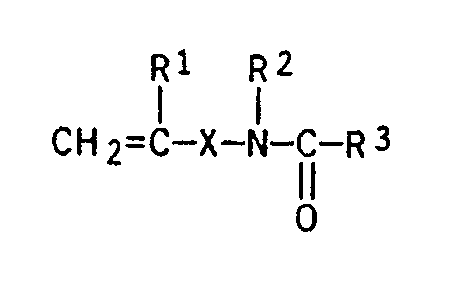
eingeführt werden können,
wobei die Substituenten folgende Bedeutung haben können: - R¹
- Wasserstoff oder eine C₁-C₄-Alkylgruppe,
- R²
- Wasserstoff, eine C₁-C₈-Alkylgruppe oder eine Arylgruppe, insbesondere Phenyl,
- R³
- Wasserstoff, eine C₁-C₁₀-Alkyl-, eine C₆-C₁₂-Arylgruppe oder OR⁴, worin R⁴ eine C₁-C₈-Alkyl- oder C₆-C₁₂-Arylgruppe ist, die gegebenenfalls mit O- oder N-haltigen Gruppen substituiert sein kann,
- X
- eine chemische Bindung, eine C₁-C₁₀-Alkylen- oder C₆-C₁₂-Arylengruppe oder
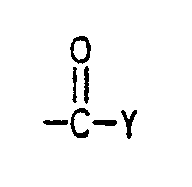
- Auch die in der EP-A 208 187 beschriebenen Pfropfmonomeren sind zur Einführung reaktiver Gruppen an der Oberfläche geeignet.
- Beispiele für Monomere, mit denen die erwähnten funktionellen Gruppen eingeführt werden können, sind Methacrylsäureglycidylester, Acrylsäureglycidylester, Allylglycidylether, Vinylglycidylether, Itaconsäureglycidylester, Acrylsäure, Methacrylsäure und ihre Metall-, insbesondere Alkalimetall- und Ammoniumsalze, Maleinsäure, Fumarsäure, Itaconsäure, Vinylbenzoesäure, Vinylphthalsäure, Monoester dieser Säuren mit C₁-C₃₀-Alkoholen wie Methyl-, Ethyl-, Propyl-, Isopropyl-, n-Butyl-, i-Butyl-, Hexyl-, Cyclohexyl-, Octyl-, 2-Ethylhexyl-, Decyl-, Stearyl-, Methoxyethyl-, Ethoxyethyl- oder Hydroxyethylalkohol. Maleinsäureanhydrid sowie Ester der Acrylsäure oder Methacrylsäure mit tertiären Alkoholen, z.B. tert.-Butylacrylat, weisen zwar keine freien Carboxylgruppen auf, kommen in ihrem Verhalten aber den freien Säuren nahe und werden deshalb als Monomere mit latenten Säuregruppen bezeichnet.
- Als weitere Beispiele seien noch Acrylamid, Methacrylamid und substituierte Ester der Acrylsäure oder Methacrylsäure wie (N-t-Butylamino)ethylmethacrylat, (N,N-Dimethylamino)ethylacrylat, (N,N-Dimethylamino)methylacrylat und (N,N-Diethylamino)ethylacrylat genannt.
- Der Anteil der von den vorstehend aufgeführten Monomeren abgeleiteten Gruppen beträgt im allgemeinen 0,5 bis 40, vorzugsweise 0,5 bis 25 Gew.%, bezogen auf das Gesamtgewicht des Kautschuks.
- Diese Monomeren können entweder mit den anderen Monomeren bereits bei der Herstellung des Kautschuks copolymerisiert werden oder aber auf einen bereits fertig vorliegenden, nicht modifizierten Kautschuk aufgepfropft werden, und zwar vorzugsweise unter Mitverwendung von Radikalstartern.
- Bei den Kautschuken handelt es sich im allgemeinen um Polymerisate, die bevorzugt aus mindestens zwei der folgenden Monomeren als Hauptkomponenten aufgebaut sind: Ethylen, Propylen, Butadien, Isobuten, Isopren, Chloropren, Vinylacetat, Styrol, Acrylnitril, Acrylsäure, Methacrylsäure und Acryl- und Methacrylsäureester mit 1 bis 18 C-Atomen in der Alkoholkomponente.
- Als erste bevorzugte Gruppe sind die sogenannten Ethylen-Propylen (EPM) bzw. Ethylen-Propylen-Dien-(EPDM)-Kautschuke zu nennen, die vorzugsweise ein Verhältnis von Ethylen- zu Propyleneinheiten im Bereich von 40:60 bis 90:10 aufweisen.
- Die Mooney-Viskositäten (ML1+4/100°C) solcher unvernetzter EPM bzw. EPDM-Kautschuke (Gelgehalte im allgemeinen unter 1 Gew.%) liegen bevorzugt im Bereich von 25 bis 100, insbesondere von 35 bis 90 (gemessen am großen Rotor nach 4 Minuten Laufzeit bei 100°C nach DIN 53 523).
- EPM-Kautschuke haben im allgemeinen praktisch keine Doppelbindungen mehr, während EPDM-Kautschuke 1 bis 20 Doppelbindungen/100 C-Atome aufweisen können.
- Als Dien-Monomere für EPDM-Kautschuke seien beispielsweise konjugierte Diene wie Isopren und Butadien, nicht konjugierte Diene mit 5 bis 25 C-Atomen wie Penta-1,4-dien, Hexa-1,4-dien, Hexa-1,5-dien, 2,5-Dimethylhexa-1,5-dien und Octa-1,4-dien, cyclische Diene wie Cyclopentadien, Cyclohexadiene, Cyclooctadiene und Dicyclopentadien sowie Alkenylnorbornene wie 5-Ethyliden-2-norbornen, 5-Butyliden-2-norbornen, 2-Methallyl-5-norbornen, 2-Isopropenyl-5-norbornen und Tricyclodiene wie 3-Methyl-tricyclo(5.2.1.0.2.6)-3,8-decadien oder deren Mischungen genannt. Bevorzugt werden Hexadien-1,5, 5-Ethyliden-norbornen und Dicyclopentadien. Der Diengehalt der EPDM-Kautschuke beträgt im allgemeinen 0,5 bis 50, insbesondere 3 bis 15 Gew.%, bezogen auf das Gesamtgewicht des Kautschuks.
- EPM- bzw. EPDM-Kautschuke werden üblicherweise mit den oben genannten, reaktive Gruppen tragenden Monomeren gepfropft. Hier seien nur Acrylsäure, Methacrylsäure und deren Derivate sowie Maleinsäureanhydrid genannt.
- Eine weitere Gruppe von Kautschuken sind Copolymere des Ethylens mit Estern der Acryl- bzw. Methacrylsäure, z.B. mit den Methyl-, Ethyl-, Propyl-, n-, i- bzw. t-Butyl- und 2-Ethylhexylestern. Zusätzlich können die Kautschuke noch die oben genannten reaktiven Gruppen z.B. in Form von Dicarbonsäuren, Derivate dieser Säuren, Vinylestern und -ethern enthalten.
- Der Ethylengehalt der Copolymeren liegt im allgemeinen im Bereich von 50 bis 98 Gew.%, der Anteil an Epoxidgruppen enthaltenden Monomeren und der Anteil des Acrylsäure- und/oder Methacrylsäureesters jeweils im Bereich von 1 bis 49 Gew.%.
- Bevorzugt sind Olefinpolymerisate aus
- 50 bis 98,9
- insbesondere 60 bis 95 Gew.% Ethylen,
- 0,1 bis 20,
- insbesondere 0,15 bis 15 Gew.% Glycidylacrylat und/oder Glycidylmethacrylat, Acrylsäure und/oder Maleinsäure anhydrid,
- 1 bis 45,
- insbesondere 10 bis 35 Gew.% n-Butylacrylat und/oder 2-Ethylhexylacrylat.
- Die Herstellung der vorstehend beschriebenen Ethylencopolymeren kann nach an sich bekannten Verfahren erfolgen, vorzugsweise durch statistische Copolymerisation unter hohem Druck und erhöhter Temperatur. Entsprechende Verfahren sind allgemein bekannt.
- Der Schmelzindex der Ethylencopolymeren liegt im allgemeinen im Bereich von 1 bis 80 g/10 min (gemessen bei 190°C und 2,16 kg Belastung).
- Geeignete Elastomere zur Schlagzähmodifizierung von Polyamid sind weiterhin reaktive Gruppen enthaltende Pfropfcopolymerisate mit Butadien, Butadien/Styrol-, Butadien/Acrylnitril- und Acrylesterkautschuken als Pfropfgrundlage, wie sie z.B. in den DE-A 16 94 173, DE-A 23 48 377, DE-A 24 44 584 und DE-A 27 26 256 beschrieben werden. Von diesen seien die sogenannten ABS-Polymerisate erwähnt, wie sie in den DE-A-20 35 390, DE-A-22 48 242 und der EP-A-22 216 beschrieben werden.
- Derartige Pfropfpolymerisate sind vorzugsweise aus
- 25 bis 98 Gew.%
- eines Acrylatkautschuks mit einer Glasübergangstemperatur von unter -20°C als Pfropfgrundlage (Basispolymer) und
- 2 bis 75 Gew.%
- eines copolymerisierbaren ethylenisch ungesättigten Monomeren, dessen Homo- bzw. Copolymerisate eine Glasübergangstemperatur von mehr als 25°C aufweisen, als Pfropfauflage (Pfropfhülle)
- Die Pfropfgrundlage ist ein Acrylat oder Methacrylatkautschuk, wobei bis zu 40 Gew.% weiterer Comonomerer enthalten sein können. Die C₁-C₈-Ester der Acrylsäure bzw. Methacrylsäure sowie deren halogenierte Derivate wie auch aromatische Acrylsäureester und deren Mischungen werden üblicherweise eingesetzt. Als Comonomere in der Pfropfgrundlage seien Acrylnitril, Methacrylnitril, Styrol, α-Methylstyrol, Acrylamide, Methacrylamide sowie Vinyl-C₁-C₆-Alkylether angeführt.
- Die Pfropfgrundlage kann unvernetzt oder teilweise oder vollständig vernetzt sein. Die Vernetzung wird z.B. durch Copolymerisation von vorzugsweise 0,02 bis 5 Gew.%, insbesondere 0,05 bis 2 Gew.% eines vernetzenden Monomeren mit mehr als einer Doppelbindung erzielt. Geeignete vernetzende Monomere werden z.B. in der DE-A 27 26 256 und der EP-A 50 265 beschrieben.
- Bevorzugte vernetzende Monomere sind Triallylcyanurat, Triallylisocyanurat, Triacryloylhexahydro-s-triazin und Triallylbenzole.
- Falls die vernetzenden Monomeren mehr als 2 polymerisierbare Doppelbindungen aufweisen, ist es vorteilhaft, ihre Menge auf nicht mehr als 1 Gew.%, bezogen auf die Pfropfgrundlage, zu beschränken.
- Gut geeignete Pfropfgrundlagen sind Emulsionspolymerisate mit einem Gelgehalt von mehr als 60 Gew.% (bestimmt in Dimethylformamid bei 25°C nach M. Hoffmann, H. Krömer, R. Kuhn, Polymeranalytik, Georg-Thieme-Verlag, Stuttgart, 1977).
- Ebenfalls geeignet als Pfropfgrundlage sind Acrylat-Kautschuke mit einem Dienkern, wie sie z.B. in der EP-A 50 262 beschrieben werden.
- Als Pfropfmonomere eignen sich besonders Styrol, α-Methylstyrol, Acrylnitril, Methacrylnitril und Methylmethacrylat oder deren Mischungen, insbesondere solche aus Styrol und Acrylnitril im Gewichtsverhältnis von 1:1 bis 9:1.
- Die Einführung der reaktiven Gruppen in Pfropfcopolymerisate kann z.B. durch Mitverwendung der entsprechenden Monomeren bei der Herstellung der Pfropfhülle erfolgen. In diesem Fall beträgt deren Anteil an der Pfropfmonomermischung vorzugsweise 0,5 bis 30, insbesondere 1 bis 25 Gew.%. Es ist auch möglich, die entsprechenden Monomeren als letzte Pfropfhülle getrennt aufzubringen.
- Die Pfropfausbeute, d.h. der Quotient aus der Menge des aufgepfropften Monomeren und der Menge des eingesetzten Pfropfmonomeren liegt im allgemeinen im Bereich von 20 bis 90 %.
- Als weitere Kautschuke sind solche zu nennen, die den Polyphenylenether (Komponente B) schlagzäh modifizieren.
- Beispielhaft seien thermoplastische Kautschuke, wie Polybutadien-, Polybuten-, Polyisopren-, Acrylnitrilbutadien-, Ethylenpropylen-, Polyester- oder Ethylenkautschuke und elastomere Copolymere aus Ethylen und Estern der Acrylsäure oder Methacrylsäure, z.B. Ethylenbutylacrylatcopolymere erwähnt. Weiterhin seien genannt Ionomere, Polyoctenylene, Pfropfkautschuke mit einem Pfropfkern aus Butadien oder Isopren oder Alkylacrylaten oder Alkylmethacrylaten und einer Pfropfhülle aus Styrol oder/und α-Methylstyrol sowie vorzugsweise Styrol-Butadien-Blockcopolymere einschließlich ABA-, und ABAB-Blockcopolymere, Styrol-Isopren-Blockcopolymere einschließlich AB, ABA und ABAB-Blockcopolymere, die auch verschmierte Übergänge haben können, Sternblockcopolymere und ähnliche, analoge (teil)hydrierte Blockcopolymerisate sowie A-B-Styrol-Butadien-Blockcopolymere. Diese Kautschuke können auch in mit vinylaromatischen Monomeren wie Styrol gepfropfter Form eingesetzt werden (EP-A 234 063 und US-A 4 681 915).
- Die Kautschuke D weisen vorzugsweise eine Glasübergangstemperatur von unter -30°C, insbesondere von unter -40°C auf. Selbstverständlich können auch Mischungen der vorstehend aufgeführten Kautschuktypen eingesetzt werden.
- Als weiteren Bestandteil können die erfindungsgemäßen Formmassen 0 bis 60, vorzugsweise 0 bis 50 und insbesondere 0 bis 35 Gew.-% üblicher Zusatzstoffe enthalten.
- Bevorzugte faserförmige Verstärkungsstoffe (Komponente E) sind Kohlenstoffasern, Kaliumtitanatwhisker, Aramidfasern und besonders bevorzugt Glasfasern. Bei der Verwendung von Glasfasern können diese zur besseren Verträglichkeit mit dem thermoplastischen Polyamid (Komponente A) oder dem Polyphenylenether (Komponente B) mit einer Schlichte und einem Haftvermittler ausgerüstet sein. Im allgemeinen haben die verwendeten Glasfasern einen Durchmesser im Bereich von 6 bis 20 µm.
- Die Einarbeitung dieser Glasfasern kann sowohl in Form von Kurzglasfasern als auch in Form von Endlossträngen (Rovings) erfolgen. Im fertigen Spritzgußteil liegt die mittlere Länge der Glasfasern vorzugsweise im Bereich von 0,08 bis 0,5 mm.
- Als teilchenförmige Füllstoffe E eignen sich amorphe Kieselsäure, Magnesiumcarbonat (Kreide), gepulverter Quarz, Glimmer, Talkum, Feldspat und insbesondere Calciumsilikate wie Wollastonit und Kaolin (insbesondere kalzinierter Kaolin).
- Bevorzugte Kombinationen von Füllstoffen sind z.B. 20 Gew.% Glasfasern mit 15 Gew.% Wollastonit und 15 Gew.% Glasfasern mit 15 Gew.% Wollastonit.
- Die erfindungsgemäßen Formmassen können weiterhin Flammschutzmittel . in einer Konzentration von 0 bis 20 Gew.%, bevorzugt von 0 bis 12,5 Gew.%, bezogen auf das Gesamtgewicht der Formmasse, enthalten.
- Es kommen alle bekannten Flammschutzmittel in Betracht, wie z.B. Polyhalogendiphenyl, Polyhalogendiphenylether, Polyhalogenphthalsäure und ihre Derivate, Polyhalogenoligo- und -polycarbonate, wobei die entsprechenden Bromverbindungen besonders wirksam sind.
- Beispiele hierfür sind Polymere des 2,6,2',6'-Tetrabrombisphenols A, der Tetrabromphthalsäure, des 2,6-Dibromphenols und 2,4,6-Tribromphenols und deren Derivate.
- Bevorzugtes Flammschutzmittel ist elementarer Phosphor. In der Regel kann der elementare Phosphor mit z.B. Polyurethanen oder anderen Aminoplasten phlegmatisiert oder gecoatet werden. Außerdem sind Konzentrate von rotem Phosphor z.B. in einem Polyamid, Elastomeren oder Polyolefin geeignet.
- Besonders bevorzugt ist weiterhin 1,2,3,4,7,8,9,10,13,13,14,14-Dodecachloro-1,4,4a,5,6,6a,7,10,10a,11,12,12a-dodecahydro-1,4:7,10-dimethanodibenzo(a,e)-cyclooctan und gegebenenfalls einem Synergisten z.B. Antimontrioxid.
- Weitere Phosphorverbindungen wie organische Phosphorsäure, Phosphinate, Phosphonate, Phosphinite, Phosphinoxide, Phosphine, Phosphite oder Phosphate sind ebenfalls bevorzugt. Als Beispiel sei Triphenylphosphinoxid genannt. Dieses kann allein oder in Mischung mit rotem Phosphor verwendet werden.
- Beispiele für bevorzugte Phosphorverbindungen sind Phosphorsäureester oder partielle Phosphorsäureester mit gleichen oder verschiedenen Kohlenwasserstoffresten wie Alkyl, Cycloalkyl, Aryl, alkylsubstituiertes Aryl und arylsubstituiertes Alkyl. Bis zu zwei Estergruppen können durch Halogen oder Wasserstoff oder deren Kombinationen ersetzt sein, vorausgesetzt, daß mindestens eine weitere Estergruppe mit einem aromatischen Alkohol vorhanden ist.
- Beispiele solcher geeigneter Phosphate sind Phenylbisdodecylphosphat, Phenylbisneopentylphosphat, Phenylethylenhydrogenphosphat, Phenyl-(bis-3,5,5'-trimethylhexylphosphat), Ethyldiphenylphosphat, 2-Ethylhexyldi(p-tolyl)phosphat, Diphenylhydrogenphosphat, Bis-(2-ethylhexyl)phenylphosphat, Tri(nonylphenyl)phosphat, Phenylmethylhydrogenphosphat, Di(dodecyl)-p-tolylphosphat, Tricresylphosphat, Triphenylphosphat, Dibutylphenylphosphat und Diphenylhydrogenphosphat. Die bevorzugten Phosphate sind Ester mit ausschließlich aromatischen Alkoholen. Das am meisten bevorzugte Phosphat ist Triphenylphosphat. Weiter ist die Kombination von Triphenylphosphat mit rotem Phosphor bevorzugt.
- Als Flammschutzmittel sind auch solche Verbindungen geeignet, die Phosphor-Stickstoff-Bindungen enthalten, wie Phosphonnitrilchlorid, Phosphorsäureesteramide, Phosphorsäureesteramine, Phosphorsäureamide, Phosphonsäureamide, Phosphinsäureamide, Tris(N-Aziridinyl)-phosphinoxid oder Tetrakis(hydroxymethyl)phosphoniumchlorid. Diese entflammungshemmenden Additive sind größtenteils im Handel erhältlich.
- Weitere halogenhaltige Flammschutzmittel sind Tetrabrombenzol, Hexachlorbenzol und Hexabrombenzol sowie halogenierte Polystyrole und Polyphenylenether.
- Auch die in der DE-A-19 46 924 beschriebenen halogenierten Phthalimide können verwendet werden. Von diesen hat insbesondere N,N'-Ethylenbistetrabromphthalimid Bedeutung erlangt.
- Übliche Zusatzstoffe sind darüber hinaus beispielsweise Stabilisatoren und Oxidationsinhibitoren, Mittel gegen Wärmezersetzung und Zersetzung durch ultraviolettes Licht, Gleit- und Entformungsmittel, Farbstoffe, Pigmente und Weichmacher, die in Mengen bis zu 20 Gew.-%, vorzugsweise bis zu 10 Gew.-% in den erfindungsgemäßen Formmassen enthalten sein können.
- Oxidationsverzögerer und Wärmestabilisatoren, die den thermoplastischen Massen gemäß der Erfindung zugesetzt werden können, sind z.B. Halogenide von Metallen der Gruppe I des Periodensystems, z.B. Natrium-, Kalium-, Lithium-Halogenide, ggf. in Verbindung mit Kupfer-(I)-Halogeniden, z.B. Chloriden, Bromiden oder Iodiden. Weiterhin können Zinkfluorid und Zinkchlorid verwendet werden. Ferner sind sterisch gehinderte Phenole, Hydrochinone, substituierte Vertreter dieser Gruppe und Mischungen dieser Verbindungen, vorzugsweise in Konzentrationen bis zu 1 Gew.%, bezogen auf das Gewicht der Mischung, einsetzbar.
- Beispiele für UV-Stabilisatoren sind verschiedene substituierte Resorcine, Salicylate, Benzotriazole und Benzophenone, die im allgemeinen in Mengen bis zu 2 Gew.% eingesetzt werden.
- Materialien zur Erhöhung der Abschirmung gegen elektromagnetische Wellen, wie Metallflocken, -pulver, -fasern, metallbeschichtete Füllstoffe und leitfähige Polymere können mitverwendet werden.
- Gleit- und Entformungsmittel, die in der Regel in Mengen bis zu 1 Gew.% der thermoplastischen Masse zugesetzt werden, sind Stearinsäure, Stearylalkohol, Stearinsäurealkylester und -amide sowie Ester des Pentaerythrits mit langkettigen Fettsäuren.
- Unter den Zusatzstoffen sind auch Stabilisatoren, die die Zersetzung des roten Phosphors in Gegenwart von Feuchtigkeit und Luftsauerstoff verhindern. Als Beispiele seien Verbindungen des Cadmiums, Zinks, Aluminiums, Silbers, Eisens, Kupfers, Antimons, Zinns, Magnesiums, Mangans, Vanadiums, Bors und Titans genannt. Besonders geeignete Verbindungen sind z.B. Oxide der genannten Metalle, ferner Carbonate oder Oxicarbonate, Hydroxide sowie Salze organischer oder anorganischer Säuren wie Acetate oder Phosphate bzw. Hydrogenphosphate und Sulfate.
- Die erfindungsgemäßen Formmassen können zusätzlich bis zu 20 Gew.-% eines Phasenvermittlers enthalten, der die Verträglichkeit zwischen Polyamid und Polyphenylenether erhöht. Darunter versteht man im allgemeinen Dienpolymere wie flüssiges Polybutadien, Polyisopren, Poly-1,3-pentadien oder deren Copolymere mit Styrol, α-Methylstyrol und p-Hydroxystyrol mit einem Zahlenmittel des Molekulargewichtes von 150 bis 10.000.
- Ebenso geeignet sind Epoxidharze aus Epichlorhydrin und Polyhydroxyphenolen wie Bisphenol A, Hydrochinon oder Resorcin sowie Glycidethermodifizierte Phenol- oder Kresolnovolake, Phenoxyharze. Weiterhin können Epoxidharze aus Epichlorhydrin und Polyhydroxyalkoholen wie Ethylen-, Propylen- oder Butylenglykol, Polyethylenglykol, Polypropylenglykol, Glycerin, Trimethylolethan und Pentaerythrit sowie Glycidether von Phenolen oder aliphatischen Alkoholen, Glycidylderivate von Aminen z.B. das Diglycidylderivat von Anilin verwendet werden. Außerdem können epoxidierte natürliche ungesättigte Öle und Epoxidierungsprodukte der oben erwähnten niedermolekularen Dienpolymeren eingesetzt werden.
- Weitere geeignete Phasenvermittler werden z.B. in den EP-A-24 120, DE-A-3 619 224 und EP-A-164 767 sowie EP-A-182 163 beschrieben.
- Die erfindungsgemäßen thermoplastischen Formmassen können nach an sich bekannten Verfahren hergestellt werden, indem man die Ausgangskomponenten in üblichen Mischvorrichtungen wie Schneckenextrudern vorzugsweise Zweischneckenextruder, Brabender-Mühlen oder Banbury-Mühlen mischt und anschließend extrudiert. Nach der Extrusion wird das Extrudat abgekühlt und zerkleinert.
- Um eine möglichst homogene Formmasse zu erhalten, ist eine intensive Durchmischung notwendig. Dazu sind im allgemeinen mittlere Mischzeiten von 0,2 bis 30 Minuten bei Temperaturen von 280 bis 380°C erforderlich. Bevorzugt sind Mischzeiten, die eine gute Dispergierung ermöglicht, so daß die Komponenten B) mit C) in Form feiner Partikel in A) vorliegen. Der mittlere Partikeldurchmesser bestimmt durch Elektronenmikroskopie ist vorzugsweise kleiner 2 µm, insbesondere kleiner 1 µm. Die Abmischreihenfolge der Komponenten kann variiert werden, so können zwei oder ggf. drei Komponenten vorgemischt werden, es können aber auch alle Komponenten gemeinsam gemischt werden. Wird die Komponente B₂ eingesetzt, so kann es von Vorteil sein, den modifizierten Polyphenylenether B₂ in einer ersten Zone eines Extruders herzustellen und in einer oder mehreren nachfolgenden Zonen des Extruders mit den übrigen Komponenten der erfindungsgemäßen Formmasse zu vermischen. Ein solches Verfahren ist in der DE-A 37 02 582 beschrieben.
- Erfindungsgemäße Massen können auch durch einen Pultrusionsvorgang hergestellt werden, wie er in der EP-A-56 703 beschrieben ist. Dabei wird der Glasfaserstrang mit der Polymermasse durchtränkt und anschließend abgekühlt und zerkleinert. Die Glasfaserlänge ist in diesem Fall identisch mit der Granulatlänge und liegt zwischen 3 und 20 mm.
- Die erfindungsgemäßen Formmassen sind gut verarbeitbar. Daraus herstellbare Formkörper zeichnen sich durch eine erhöhte multiaxiale Zähigkeit und Kerbschlagzähigkeit aus.
- Darüber hinaus zeichnen sich die Formkörper durch eine hohe Verformbarkeit bei Schlagbeanspruchung aus.
- Infolge dieses Eigenschaftsspektrums eignen sich die aus den erfindungsgemäßen Formmassen herstellbaren Formkörper besonders für Karosserieteile und Funktionsteile im Motorbereich von Kraftfahrzeugen sowie für den Elektrosektor.
- Füllstoffhaltige bzw. verstärkte Formkörper werden vor allem als Radblenden verwendet.
- Folgende Komponenten wurden für verschiedene Mischungen verwendet:
-
- A1:
- Polyamid 6, Zahlenmittel des Molekulargewichts Mn = 18.000
- A2:
- Polyamid 6,6, Mn = 22000
-
- B1:
- 90 Gew.-% Poly-(2,6-dimethyl-1,4-phenylen)ether mit einer reduzierten, spezifischen Viskosität von 0,60 dl/g (1 gew.%ig in CHCl₃ bei 25°C) und 10 Gew.-% Polystyrol.
- B2:
- 90 Gew.-% Poly-(2,6-dimethyl-1,4-phenylen)ether mit einer reduzierten spezifischen Viskosität von 0,60 dl/g (1 gew.-%ig in CHCl₃ bei 25°C) und 8 Gew.-% Polystyrol (Schmelzflußindex MFI bei 200°C/5 kg Belastung = 24 g/10 min), 1,95 Gew.-% Fumarsäure und 0,05 Gew.-% 3,4-Dimethyl-3,4-diphenylhexan wurden in einem Zweischneckenextruder (ZSK 30, Fa. Werner & Pfleiderer) dosiert, in einem ersten Teil unter Verwendung von Knetelementen bei 270°C aufgeschmolzen, in einem zweiten Teil unter Kneten und Verwendung von Knetelementen bei 280°C umgesetzt und anschließend in einer Entgasungszone bei 300°C unter Anlegen von Vakuum entgast. Die mittlere Verweilzeit im Extruder betrug 1,5 min.
- Die in Tabelle 2 angegebenen Blockcopolymeren Cl-C2* wurden entsprechend der allgemeinen Arbeitsvorschrift hergestellt:
- In einem thermostatisierten Rührkessel wurden unter Reinstickstoff 4800 g gereinigtes, wasserfreies Cyclohexan, 48 ml Tetrahydrofuran und monomeres Styrol zur Bildung des A-Blocks (Mengen gemäß Tabelle 1) vorgelegt. Nach dem Austitrieren der noch vorhandenen protonenaktiven Verunreinigungen mit sek.-Butyllithium wurde die berechnete Menge Initiator sek.-Butyllithium (1,4-molare Lösung in Cyclohexan/Isopentan) zugesetzt.
- Die Temperaturen der Polymerisation wurden bei 40°C 1 h gehalten, um den ersten Block aus Polystyrollithium zu bilden.
- Sodann wurde in den Rührkessel gereinigtes monomeres 1,3-Butadien (gemäß Tabelle 1) eingespeist und bei Temperaturen zwischen 40 und 75°C bis zur vollständigen Umsetzung unter Bildung von Ketten aus zwei Segmenten Polystyrol-Polybutadienyllithium polymerisiert. Die Polymerisation war nach 1 h vollständig.
- Danach wurden 15 ml Isopropanol zugesetzt, um den Abbruch der lebenden Polymerketten sicherzustellen.
- Nach jeder Polymerisationsstufe wurde dem Reaktionsgefäß eine Probemenge für analytische Zwecke entnommen.
- Es wurde zunächst Butadien bei 40°C 1 h polymerisiert und anschließend bei 40°C das Styrol zugegeben. Nach 1 weiteren Stunde bei 40°C war die Polymerisation beendet. Die beiden Produkte hatten einen höheren 1,2-Gehalt als die oben beschriebenen.

- Die selektive Hydrierung der Blockcopolymeren C1-C1* erfolgte durch Zugabe einer Katalysatorlösung aus 1,4 g Nickel (II) acetylacetonat in 80 g Toluol, versetzt mit 30 ml einer 20 gew.-%igen Lösung von Aluminiumtriisobutyl in Hexan und einem Wasserstoffdruck von 15 bar bei 80°C Hydriertemperatur. Die fortschreitende Hydrierreaktion konnte dabei über die Wasserstoffaufnahme (Druckabfall im Reaktor) verfolgt werden.
- Die Aufarbeitung erfolgte durch Fällung der Polymeren.

- Ein Ethylencopolymer aufgebaut aus
70 Gew.-% Ethylen
25 Gew.-% n-Butylacrylat und
5 Gew.-% Acrylsäure
mit einem MFI von 20 g/10 min bei 190°C und 2,16 kg Belastung - Roter Phosphor der mittleren Teilchengröße (D₅₀) von 45 µm.
- Ein Copolymer aus
98 Gew.-% Styrol und
2 Gew.-% Maleinsäureanhydrid - Die Formmassen gemäß Tabelle 3 wurden auf einem Zweischneckenextruder bei einer Zylindertemperatur von 280°C gemischt. Der Schmelzstrang wurde durch ein Wasserbad geführt und granuliert. Das getrocknete Granulat wurde bei 300°C zu Rundscheiben (60 x 2 mm) und bei 280°C zu Normkleinstäben gespritzt.
- Die Kerbschlagzähigkeit aK (Charpy) wurde nach DIN 53 453, die Durchstoßarbeit nach DIN 53 443 und die Fließfähigkeit MVI nach DIN 57 735 (bei 275°C, 10 kg Belastung) bestimmt.
- Die Verformung der Rundscheiben bei Schlagbeanspruchung wurde nach DIN 53 443 bestimmt. Die Meßgröße wurde aus dem instrumentierten Durchstoßtest (DIN 53 443) erhalten; dabei wurde die Kraftverformungskurve, die integriert die Durchstoßarbeit ergibt, ausgewertet. Die Verformung bei maximaler Kraft (Verformung Fmax) ist diejenige Strecke, die der Bolzen des Prüfgerätes zurücklegt, an dem die übertragene Kraft das Maximum durchläuft (vgl. hierzu DIN-Taschenbuch 18: "Kunststoffe 1 - mechanische, thermische und elektrische Eigenschaften, Prüfnormen", 8. Auflage 1984; Beuth Verlag GmbH, Berlin, Köln, Seite 138).
- Die Zusammensetzung der Formmassen sowie die Ergebnisse der Messungen sind der nachfolgenden Tabelle 3 zu entnehmen.

wobei die Summen der Komponenten A) bis E) 100 Gew.-% ergibt, dadurch gekennzeichnet, daß die Komponente C)
aufweist.
wobei sich die Gewichtsprozente auf die Summe von b₁) bis b₄) beziehen, im Verlaufe von 0,5 bis 15 Minuten bei 240 bis 375°C in geeigneten Misch- und Knetaggregaten wie Zweischneckenextrudern erhältlich ist.
aufgebaut.
Claims (7)
- Thermoplastische Formmassen, enthaltendA) 5 bis 95 Gew.-% eines thermoplastischen Polyamids,B) 3 bis 80 Gew.-% eines modifizierten Polyphenylenethers,C) 2 bis 20 Gew.-% eines Blockcopolymeren der allgemeinen Formel A-B, bestehend aus einem vinylaromatischen Block A und einem teilhydrierten Polybutadienblock B,D) 0 bis 20 Gew.-% eines von C) verschiedenen schlagzähmodifizierenden Kautschuks undE) 0 bis 60 Gew.-% üblicher Zusatzstoffe,wobei die Summen der Komponenten A) bis E) 100 Gew.-% ergibt, dadurch gekennzeichnet, daß die Komponente C)- ein mittleres Molekulargewicht von mindestens 75.000 aufweist und- der polyvinylaromatische Block A 10 bis 50 Gew.-%, bezogen auf 100 Gew.-% der gesamten Komponente C) ausmacht und- der Polybutadienblock B) einen Hydrierungsgrad von 50 bis 99 Gew.-%aufweist.
- Thermoplastische Formmassen nach Anspruch 1, in denen die Komponente C) ein mittleres Molekulargewicht von mindestens 100.000 aufweist.
- Thermoplastische Formmassen nach den Ansprüchen 1 und 2, in denen der Polybutadienblock B einen Hydrierungsgrad von 70 bis 99 % aufweist.
- Thermoplastische Formmassen nach den Ansprüchen 1 bis 3, in denen der modifizierte Polyphenylenether B) durch Umsetzung vonb₁) 70 bis 99,95 Gew.-% eines Polyphenylenethersb₂) 0 bis 40 Gew.-% eines vinylaromatischen Polymerenb₃) 0,05 bis 30 Gew.-% mindestens einer Verbindung aus der Gruppe, gebildet ausb₃₁) einer α,ß-ungesättigten Dicarbonylverbindung undb₃₂) eines Amid-Gruppen enthaltenden Monomeren mit einer polymerisierbaren Doppelbindung undb₃₃) eines Lactam-Gruppen enthaltenden Monomeren mit einer polymerisierbaren Doppelbindungb₄) 0 bis 5 Gew.-% eines Radikalstartersim Verlaufe von 0,2 bis 15 Minuten bei 240°C bis 375°C erhältlich ist.
- Thermoplastische Formmassen nach den Ansprüchen 1 bis 4, in denen der teilhydrierte Polybutadienblock B einen 1.2-Gehalt von 25 bis 95 Gew.-% aufweist.
- Verwendung der thermoplastischen Formmassen gemäß den Ansprüchen 1 bis 4 zur Herstellung von Formkörpern.
- Formkörper, erhältlich aus den thermoplastischen Formmassen gemäß den Ansprüchen 1 bis 4.
Applications Claiming Priority (2)
| Application Number | Priority Date | Filing Date | Title |
|---|---|---|---|
| DE4012448A DE4012448A1 (de) | 1990-04-19 | 1990-04-19 | Thermoplastische formmassen auf basis von polyphenylenethern und polyamiden |
| DE4012448 | 1990-04-19 |
Publications (3)
| Publication Number | Publication Date |
|---|---|
| EP0452783A2 true EP0452783A2 (de) | 1991-10-23 |
| EP0452783A3 EP0452783A3 (en) | 1992-08-05 |
| EP0452783B1 EP0452783B1 (de) | 1995-03-01 |
Family
ID=6404639
Family Applications (1)
| Application Number | Title | Priority Date | Filing Date |
|---|---|---|---|
| EP91105641A Expired - Lifetime EP0452783B1 (de) | 1990-04-19 | 1991-04-10 | Thermoplastische Formmassen auf Basis von Polyphenylenethern und Polyamiden |
Country Status (2)
| Country | Link |
|---|---|
| EP (1) | EP0452783B1 (de) |
| DE (2) | DE4012448A1 (de) |
Family Cites Families (3)
| Publication number | Priority date | Publication date | Assignee | Title |
|---|---|---|---|---|
| DE3707796A1 (de) * | 1987-03-11 | 1988-09-22 | Basf Ag | Thermoplastische formmassen auf der basis von polyphenylenethern und polyamiden |
| DE3726283A1 (de) * | 1987-08-07 | 1989-02-16 | Basf Ag | Thermoplastische formmassen |
| DE3828497A1 (de) * | 1988-08-23 | 1990-03-01 | Basf Ag | Thermoplastische formmassen auf basis von polyphenylenether und polyamid |
-
1990
- 1990-04-19 DE DE4012448A patent/DE4012448A1/de not_active Withdrawn
-
1991
- 1991-04-10 DE DE59104735T patent/DE59104735D1/de not_active Expired - Lifetime
- 1991-04-10 EP EP91105641A patent/EP0452783B1/de not_active Expired - Lifetime
Also Published As
| Publication number | Publication date |
|---|---|
| DE4012448A1 (de) | 1991-10-24 |
| EP0452783A3 (en) | 1992-08-05 |
| DE59104735D1 (de) | 1995-04-06 |
| EP0452783B1 (de) | 1995-03-01 |
Similar Documents
| Publication | Publication Date | Title |
|---|---|---|
| EP0416436B1 (de) | Füllstoffhaltige thermoplastische Formmassen | |
| EP0654505B1 (de) | PPE/PA-Formmassen zur Herstellung von Formkörpern mittels Blasformen, Profilextrusion und Rohrextrusion | |
| EP0407832A2 (de) | Verstärkte farbige thermoplastische Formmassen auf der Basis von Polyphenylenethern und Polyamiden | |
| EP0925328B1 (de) | Flammgeschützte thermoplastische formmassen | |
| EP0678555B1 (de) | Polyphenylenether/Polyamid-Formmassen | |
| EP0530693A1 (de) | Hochschlagzähe, flammgeschützte Polyphenylenether/Polyamidformmassen | |
| EP0501175A1 (de) | Faserverstärkte thermoplastische Formmassen | |
| EP0828773B1 (de) | Funktionalisierte copolymere, verfahren zu ihrer herstellung, diese enthaltende formmassen und formkörper | |
| EP0387824A2 (de) | Thermoplastische Formmassen auf Basis von schlagzäh modifiziertem Polyamid und funktionalisiertem Polyphenylenäther | |
| EP0529378B1 (de) | Thermoplastische Formmasse auf Basis von Polyamiden und Polyphenylenethern | |
| EP0416430B1 (de) | Thermoplastische Formmasse mit erhöhter Wärmeformsbeständigkeit | |
| EP0416435B1 (de) | Stabilisierte thermoplastische Formmassen auf der Basis von Polyphenylenethern und Polyamiden | |
| EP0452783B1 (de) | Thermoplastische Formmassen auf Basis von Polyphenylenethern und Polyamiden | |
| DE4015533A1 (de) | Thermoplastische formmassen auf der basis von polyestern und polyphenylenethern | |
| EP0586985B1 (de) | Stabilisierte Polyamid/Polyphenylenetherformmassen | |
| DE19610362A1 (de) | Funktionalisierte Polymere, Verfahren zu ihrer Herstellung, diese enthaltende Formmassen und Formkörper | |
| EP0400418A1 (de) | Thermoplastische Formmassen auf der Basis von Polyamiden und Polyphenylenethern | |
| DE4129499A1 (de) | Thermoplastische polyphenylenether/polyamidformmassen mit duktilem bruchverhalten bei tiefen temperaturen | |
| EP0480228A2 (de) | Thermoplastische Formmassen auf der Basis von Polyamid | |
| EP0510383A2 (de) | Hochschlagzähe Formmassen | |
| DE3831992A1 (de) | Flammfeste thermoplastische formmassen auf basis von polyphenylenether und polyamid | |
| EP0534196A1 (de) | Thermoplastische Formmassen auf Basis von Polyamiden und Polyphenylenethern | |
| WO1999011714A1 (de) | Thermoplastische formmassen auf basis von polyamid und styrol/diphenylethylen-copolymeren | |
| DE19805586A1 (de) | Glasfaserverstärkte Styrol/Diphenylethen-Copolymere | |
| DE9205402U1 (de) | Schlagzähe thermoplastische Formmassen |
Legal Events
| Date | Code | Title | Description |
|---|---|---|---|
| PUAI | Public reference made under article 153(3) epc to a published international application that has entered the european phase |
Free format text: ORIGINAL CODE: 0009012 |
|
| AK | Designated contracting states |
Kind code of ref document: A2 Designated state(s): BE DE FR GB NL |
|
| PUAL | Search report despatched |
Free format text: ORIGINAL CODE: 0009013 |
|
| AK | Designated contracting states |
Kind code of ref document: A3 Designated state(s): BE DE FR GB NL |
|
| 17P | Request for examination filed |
Effective date: 19920701 |
|
| 17Q | First examination report despatched |
Effective date: 19940208 |
|
| GRAA | (expected) grant |
Free format text: ORIGINAL CODE: 0009210 |
|
| AK | Designated contracting states |
Kind code of ref document: B1 Designated state(s): BE DE FR GB NL |
|
| REF | Corresponds to: |
Ref document number: 59104735 Country of ref document: DE Date of ref document: 19950406 |
|
| GBT | Gb: translation of ep patent filed (gb section 77(6)(a)/1977) |
Effective date: 19950316 |
|
| ET | Fr: translation filed | ||
| PLBE | No opposition filed within time limit |
Free format text: ORIGINAL CODE: 0009261 |
|
| STAA | Information on the status of an ep patent application or granted ep patent |
Free format text: STATUS: NO OPPOSITION FILED WITHIN TIME LIMIT |
|
| 26N | No opposition filed | ||
| REG | Reference to a national code |
Ref country code: GB Ref legal event code: IF02 |
|
| PGFP | Annual fee paid to national office [announced via postgrant information from national office to epo] |
Ref country code: FR Payment date: 20030324 Year of fee payment: 13 |
|
| PGFP | Annual fee paid to national office [announced via postgrant information from national office to epo] |
Ref country code: NL Payment date: 20030325 Year of fee payment: 13 |
|
| PGFP | Annual fee paid to national office [announced via postgrant information from national office to epo] |
Ref country code: GB Payment date: 20030331 Year of fee payment: 13 |
|
| PGFP | Annual fee paid to national office [announced via postgrant information from national office to epo] |
Ref country code: BE Payment date: 20030425 Year of fee payment: 13 |
|
| PGFP | Annual fee paid to national office [announced via postgrant information from national office to epo] |
Ref country code: DE Payment date: 20030522 Year of fee payment: 13 |
|
| PG25 | Lapsed in a contracting state [announced via postgrant information from national office to epo] |
Ref country code: GB Free format text: LAPSE BECAUSE OF NON-PAYMENT OF DUE FEES Effective date: 20040410 |
|
| PG25 | Lapsed in a contracting state [announced via postgrant information from national office to epo] |
Ref country code: BE Free format text: LAPSE BECAUSE OF NON-PAYMENT OF DUE FEES Effective date: 20040430 |
|
| PG25 | Lapsed in a contracting state [announced via postgrant information from national office to epo] |
Ref country code: DE Free format text: LAPSE BECAUSE OF THE APPLICANT RENOUNCES Effective date: 20040602 |
|
| BERE | Be: lapsed |
Owner name: *BASF A.G. Effective date: 20040430 |
|
| PG25 | Lapsed in a contracting state [announced via postgrant information from national office to epo] |
Ref country code: NL Free format text: LAPSE BECAUSE OF NON-PAYMENT OF DUE FEES Effective date: 20041101 |
|
| GBPC | Gb: european patent ceased through non-payment of renewal fee |
Effective date: 20040410 |
|
| PG25 | Lapsed in a contracting state [announced via postgrant information from national office to epo] |
Ref country code: FR Free format text: LAPSE BECAUSE OF NON-PAYMENT OF DUE FEES Effective date: 20041231 |
|
| NLV4 | Nl: lapsed or anulled due to non-payment of the annual fee |
Effective date: 20041101 |
|
| REG | Reference to a national code |
Ref country code: FR Ref legal event code: ST |