EP0452833B1 - Boîte de vitesses à plusieures étages - Google Patents
Boîte de vitesses à plusieures étages Download PDFInfo
- Publication number
- EP0452833B1 EP0452833B1 EP91105909A EP91105909A EP0452833B1 EP 0452833 B1 EP0452833 B1 EP 0452833B1 EP 91105909 A EP91105909 A EP 91105909A EP 91105909 A EP91105909 A EP 91105909A EP 0452833 B1 EP0452833 B1 EP 0452833B1
- Authority
- EP
- European Patent Office
- Prior art keywords
- planet
- ring gear
- wheel assembly
- planet wheel
- teeth
- Prior art date
- Legal status (The legal status is an assumption and is not a legal conclusion. Google has not performed a legal analysis and makes no representation as to the accuracy of the status listed.)
- Expired - Lifetime
Links
Images


Classifications
-
- F—MECHANICAL ENGINEERING; LIGHTING; HEATING; WEAPONS; BLASTING
- F16—ENGINEERING ELEMENTS AND UNITS; GENERAL MEASURES FOR PRODUCING AND MAINTAINING EFFECTIVE FUNCTIONING OF MACHINES OR INSTALLATIONS; THERMAL INSULATION IN GENERAL
- F16H—GEARING
- F16H3/00—Toothed gearings for conveying rotary motion with variable gear ratio or for reversing rotary motion
- F16H3/44—Toothed gearings for conveying rotary motion with variable gear ratio or for reversing rotary motion using gears having orbital motion
- F16H3/62—Gearings having three or more central gears
- F16H3/66—Gearings having three or more central gears composed of a number of gear trains without drive passing from one train to another
Definitions
- the present invention relates to a multi-speed powershift and reversing transmission for vehicles covering a wide speed range, in particular to a transmission with a large number of speed switching stages, such as those used in industrial or agricultural vehicles such as agricultural tractors and the like, according to the features the preamble of claim 1 or 2.
- EP-B1-0 036 656 Such a transmission is known from EP-B1-0 036 656, which covers a wide speed range and theoretically has 27 gear ratios. However, it has been shown that some of the gear ratios are very close together and that in practice not all 27 gears can be used. However, it is not easy to add more brakes or clutches in the construction according to EP-B1-0 036 656, since this would lead to some of the clutch cutting disks and brake disks moving in the opposite direction with some gear settings. Such a construction would cause a high degree of turbulence in the oil system and would tend to malfunction.
- the object to be achieved with the invention is seen in providing a multi-stage vehicle transmission according to the features of the preamble of patent claim 1 or 2, which has a large number of gear ratios with a gear division that is practical in practice. In particular, 19 forward and 7 reverse gears should result.
- the gearbox should not be bigger fail, for example as a transmission according to EP-B1-0 036 656.
- At least the first and second planetary gear sets include double gears with first and second toothings.
- Each of the two toothings of the first planetary gear set are in engagement with their own ring gear, which can be braked independently of one another with respect to the transmission housing, and with their own sun gear.
- These two sun gears are driven from the input shaft on the one hand via a direct drive path or via the powershift planetary gear (second drive path).
- the first toothings of the second planetary gear set mesh with a ring gear that can be braked independently of the transmission housing and with a sun gear connected to the output shaft.
- the second toothing of the second planetary gear set meshes only with planetary gears of a third planetary gear set, which have simple toothing.
- the planet gears of the third planetary gear set mesh with their own ring gear and their own sun gear, which can each be braked independently of the gear housing.
- This construction has the advantage that it delivers the desired 26 transmission ratios, the transmission having an outline very similar to the transmission according to EP-B1-0 036 656.
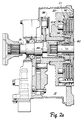
- a Hi-Lo brake BHI and a Hi-Lo clutch CLO are located in the Hi-Lo planetary gear chamber 14.
- a first brake B1, a second brake B2, a third Brake B3, a fourth brake B4 and a third clutch C3 are located in the main planetary gear chamber 16.
- the fifth brake B5 is located outside of the main planetary gear chamber 16, but is shown to be driven by components located in the main planetary gear chamber 16. If desired, it can also be arranged within the main planetary gear chamber 16.
- a common clutch drum 20 for the clutches C1 and C2 is rotatably attached to the input shaft 18.
- An extension 22 of the input shaft 18 extends through the entire transmission and emerges from its right side as shown in FIG. 1 in order to transmit power directly, e.g. B. to a PTO drive.
- a first intermediate shaft 24 is rotatably arranged on the input shaft extension 22 and extends from the input clutch chamber 12 to the main planetary gear chamber 16.
- a second intermediate shaft 26 is rotatably arranged on the first intermediate shaft 24, but only extends from the input clutch chamber 12 into the Hi-Lo planetary gear chamber 14.
- an intermediate drum 28 is further arranged after the right end of the second intermediate shaft 26 according to FIG. 1, which extends from the Hi-Lo planetary gear chamber 14 into the main planetary gear chamber 16.
- the main planet gear carrier 30 is rotatably disposed on the right end of the first intermediate shaft 24 in the main planetary gear chamber 16.
- an output shaft 32 is rotatably arranged to the right of the first intermediate shaft 24 and extends from the main planetary gear chamber 16 out of the housing 10.
- a brake shaft 34 is rotatably disposed over the output shaft 32 and extends from the inside of the main planetary gear chamber 16 to the brake B5. It is understood that although the shaft 18 is referred to here as the input shaft and the shaft 32 as the output shaft, the power flow through the transmission could also take place in the opposite direction. These terms have been used in the description and claims only for simplification and are not intended to limit the scope of the present invention.
- the left end of the second intermediate shaft 26 is engaged with the driven part of the second clutch C2.
- the opposite end of the second intermediate shaft 26 is connected to the planet carrier 38 of the Hi-Lo planetary gear 40.
- the Hi-Lo planet carrier 38 carries a plurality of rotatable planet gears 42, each of which has two toothings 44, 48.
- the left toothings 44 mesh with the sun gear 46 of the Hi-Lo planetary gear 40.
- the rotation of the sun gear 46 can be braked by the Hi-Lo brake BHI relative to the housing 10 or by the clutch CLO against rotation with the second intermediate shaft 26 and so that can be coupled with the Hi-Lo planet carrier 38.
- the right toothings 48 of the planet gears 42 mesh with an internally toothed Hi-Lo ring gear 50, which is fastened in a rotationally fixed manner to one end of the intermediate drum 28.
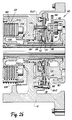
- the main planet carrier 30 of the main planetary gear 52 carries three sets of rotatable planet gears.
- the first planetary gear set is formed by a plurality of planet gears 54, each with two toothings 56, 62.
- the left toothings 56 of the first planetary gear set 54 mesh on the outside with a first internally toothed ring gear 58, the rotation of which can be braked relative to the housing 10 by the first brake B1.
- the left toothing 56 mesh on the inside with the first sun gear 60, which is rotationally fixed is connected to the intermediate drum 28, namely at its end opposite to the Hi-Lo ring gear 50.
- the right toothings 62 of the first planetary gear set 54 mesh on the outside with a second internally toothed ring gear 64, the rotation of which can be braked relative to the housing 10 by the second brake B2.
- the right toothing 62 mesh on the inside with the second sun gear 66, which is non-rotatably connected to the first intermediate shaft 24.
- the opposite end 68 of the first intermediate shaft 24 is rotatably connected to the driven part of the first clutch C1.
- the second planetary gear set is also formed by a plurality of planet gears 70, each with two toothings 72, 80.
- the left toothing 72 mesh on the outside with a third internally toothed ring gear 74, the rotation of which can be braked relative to the housing 10 by the third brake B3.
- the left toothing 72 mesh on the inside with the third sun gear 76, which is rotatably connected to the output shaft 32.
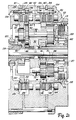
- the third planetary gear set is formed by a plurality of individual gear wheels 78, which are nested between the planet gears 70 of the second planetary gear set.
- the right toothing 80 of the planet gears 70 of the second planetary gear set mesh with the individual gears 78 of the third planetary gear set, as can be seen in FIG. 3.
- the individual gears 78 mesh on the outside with a fourth internally toothed ring gear 82, the rotation of which can be braked relative to the housing 10 by the fourth brake B4 or can be coupled to the main planet carrier 30 against rotation by means of the third clutch C3.
- the individual gears 78 of the third planetary gear set mesh with the fourth sun gear 84, which is fixed in a rotationally fixed manner on the brake shaft 34 and against rotation can be braked relative to the housing 10 by a fifth brake B5.
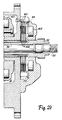
- the input shaft 18 includes a cam surface 86 which drives a pump 88.
- the pump 88 maintains a suitable oil level in the individual gear chambers 12, 14, 16 of the gear housing 10.
- the cam surface 86 and the pump 88 are the subject of EP-A1-0 406 649, which is hereby incorporated by reference for the purposes of the disclosure.
- the right end of the input shaft 18 is connected to the clutch drum 20 of the first and second clutch C1, C2 via a spline 90.
- the clutch drum 20 is in turn wedged with clutch disks 92 of the first clutch C1 and clutch disks 94 of the second clutch C2.
- the clutch plates 96 of the first clutch C1 are keyed to the clutch hub 98 of the first clutch C1, and the clutch plates 100 of the second clutch C2 are keyed to the hub 102 of the second clutch C2.
- the first clutch hub 98 is keyed to the first intermediate shaft 24 and the second clutch hub 102 is keyed to the second intermediate shaft 26.
- the first clutch C1 contains a piston 104, by means of which the clutch disks 96 and clutch disks 92 of the first clutch C1 can be pressed against one another for actuating the clutch.
- the second clutch C2 contains a piston 106, by means of which the clutch disks 100 and clutch disks 94 of the second clutch C2 can be pressed together to actuate the clutch.
- a spring 108 extends between the pressure plates of the pistons 104, 106 and biases the clutches C1, C2 so that they are not engaged unless the pistons 104, 106 are pressurized.
- the clutch pistons 104, 106 as well as the other pistons described below are actuated hydraulically or pneumatically in the usual manner.
- the planet gear carrier 38 of the Hi-Lo planetary gear 40 and the clutch plate 110 of the Hi-Lo clutch CLO are non-rotatably wedged with the second intermediate shaft 26.
- a clutch piston 111 is provided to engage the clutch CLO.
- a spring 112 biases the clutch piston 111 so that the clutch CLO does not engage.
- a brake disc 113 of the Hi-Lo brake BHI is fixed to the planet gear carrier 38 by at least one screw 114 and rotates with the planet gear carrier 38.
- a plate 115 is pressed against the brake disc 113 by a spring 116 in order to engage the brake BHI.
- a brake piston 117 is provided which presses the plate 115 away from the brake disk 113 and disengages the brake BHI.
- the Hi-Lo clutch piston 111 and the Hi-Lo brake piston 117 are controlled by switching a single pressure source from one piston to the other. In this way, only one of the two pistons can be actuated.
- the main planet gear carrier 30 of the main planetary gear 52 is supported by the housing 10 via the bearings 120.
- the bearing 122 supports the first intermediate shaft 24 and sets its correct position with respect to the main planet carrier 30.
- the first brake B1 and the second brake B2 share a large central partition plate 125, which is attached to the housing 10.
- An additional partition plate 126 for the first brake B1 and an additional separating plate 124 for the second brake B2 are inserted between the brake disks 130 of the first brake B1 and the brake disks 132 of the second brake B2.
- the brake discs 130 are keyed to the first ring gear 58 and the brake discs 132 are keyed to the second ring gear 64.
- the first brake B1 is actuated by a piston 134 and the second brake B2 is actuated by a further piston 136.
- the two brakes B1, B2 are opened by a spring 138, so that no braking action occurs.
- the third brake B3 and the fourth brake B4 share a common large, central separating plate 140, which is fixed to the housing 10.
- additional separating plates 142 for the third brake B3 and additional separating plates 144 for the fourth brake B4 are inserted between the brake discs 146 of the third brake B3 and the brake discs 146 of the fourth brake B4.
- the brake discs 146 are keyed to the third ring gear 74 and the brake discs 148 are keyed to the fourth ring gear 82.
- the pistons 150, 152 serve to actuate the third and fourth brakes B3, B4.
- the third and fourth brakes B3, B4 are opened by a spring 154, so that no braking action occurs.
- the fourth ring gear 82 also includes an extension 155 with which the clutch plates 156 of the third clutch C3 are keyed.
- the cutting discs 158 of the third clutch C3 are keyed to the main planet carrier 30.
- the third clutch C3 is actuated by a piston 160.
- the third clutch C3 is opened by a spring 162.
- the brake cutting discs 165 of the fifth brake B5 are wedged with the housing 10 and the brake discs 166 with the brake shaft 34.
- a piston 168 the fifth brake B5 is applied.
- the fifth brake B5 is opened by a spring 170, so that no braking action occurs.
- Each gear described above preferably has the number of teeth specified in Table 1: TABLE I description Reference numerals Number of teeth Left Hi-Lo serration 44 42 Sun gear 46 33 Right Hi-Lo toothing 48 18th Hi-Lo sprocket 50 93 Left toothing of the 1st planet gear 56 36 First ring gear 58 16 First sun gear 60 69 Right toothing of the 1st planet gear 62 26 Second ring gear 64 72 Second sun gear 66 21 Left toothing of the 2nd planet gear 72 17th Third ring gear 74 63 Third sun gear 76 30th Interlocking of the 3rd planet gear 78 24th Right toothing of the 2nd planet gear 80 15 Fourth ring gear 82 69 Fourth sun gear 84 21
Landscapes
- Engineering & Computer Science (AREA)
- General Engineering & Computer Science (AREA)
- Mechanical Engineering (AREA)
- Structure Of Transmissions (AREA)
Claims (10)
- Boîte de vitesses de véhicule automobile, notamment pour un véhicule industriel ou agricole, constitué para) un carter (10),b) un arbre d'entrée (18), qui s'étend dans le carter (10) de la boîte de vitesses,c) un support principal (30) de roues satellites, qui est disposé dans le carter (10) de la boîte de vitesses et qui porte des premier, second et troisième ensembles (54, 70, 78) de pignons satellites, le premier ensemble de pignons satellites (54) étant constitué de pignons doubles comportant des première et seconde dentures (56, 62), et les pignons satellites du second ensemble de pignons satellites (70) engrenant avec les pignons satellites du troisième ensemble de pignons satellites (78),d) des premiers et seconds moyens d'accouplement (C1, C2), à l'aide desquels peut être commandé le flux de force qui part de l'arbre d'entrée (18) pour aboutir au support (30) des pignons satellites, par l'intermédiaire de premier et second trajets d'entraînement principal,e) un engrenage satellite commandé en charge (40) dans le second trajet d'entraînement principal,f) une première couronne dentée (58) et une première roue planétaire (60), qui engrènent avec les premières dentures (56) du premier ensemble de pignons satellites (54), l'application d'une force à la première roue planétaire (60) s'effectuant par l'intermédiaire du second trajet d'entraînement principal,g) des premiers moyens de freinage (B1) pour freiner au choix le mouvement de rotation de la première couronne dentée (58) par rapport au carter (10) de la boîte de vitesses,h) une seconde couronne dentée (64) et une seconde roue planétaire (66), qui engrènent avec les secondes dentures (62) du premier ensemble de pignons satellites (54), l'application d'une force à la seconde roue planétaire (66) s'effectuant par l'intermédiaire du premier trajet d'entraînement principal,i) des seconds moyens de freinage (B2) pour freiner au choix le mouvement de rotation de la seconde couronne dentée (64) par rapport au carter (10) de la boîte de vitesses,j) une troisième roue planétaire (76), qui engrène avec les pignons satellites du second ensemble de pignons satellites (70),k) une quatrième couronne dentée (82) et une quatrième roue planétaire (84), qui engrènent avec des pignons satellites du troisième ensemble de pignons satellites (78),l) des quatrièmes moyens de freinage (B4) pour freiner au choix le mouvement de rotation de la quatrième couronne dentée (82) par rapport au carter (10) de la boîte de vitesses,m) des cinquièmes moyens de freinage (B5) pour freiner au choix le mouvement de rotation de la quatrième roue planétaire (84) par rapport au carter (10) de la boîte de vitesses,caractérisée par le faitn) qu'au moins le second ensemble de pignons satellites (70) est constitué par des pignons doubles possédant des première et seconde dentures (72,80), dont les premières dentures (72) engrènent avec la troisième roue planétaire (76) et une troisième couronne dentée (74) et dont les secondes dentures (80) engrènent avec des pignons satellites du troisième ensemble de pignons satellites (78),o) que des troisièmes moyens de freinage (C3) sont prévus pour le freinage au choix du mouvement de rotation de la troisième couronne dentée (74) par rapport au carter (10) de la boîte de vitesses,p) que des troisièmes moyens d'embrayage (C3) sont prévus pour réaliser l'embrayage au choix du mouvement de rotation de la quatrième couronne dentée (82) au support principal (30) des pignons satellites, etq) qu'un arbre de sortie (32) est relié avec blocage en rotation à la quatrième roue planétaire (84) et fait saillie hors du carter (10) de la boîte de vitesses.
- Boîte de vitesses pour véhicule, notamment pour un véhicule industriel ou agricole, constituée para) un carter (10),b) un arbre d'entrée (18), qui s'étend dans le carter (10) de la boîte de vitesses,c) un premier arbre intermédiaire (24),d) des premiers moyens d'embrayage (C1) pour l'embrayage au choix du mouvement de rotation de l'arbre d'entrée (18) au premier arbre intermédiaire (24),e) un second arbre intermédiaire creux (26), qui est disposé de manière à pouvoir tourner autour du premier arbre intermédiaire (24),f) des seconds moyens d'embrayage (C2) pour réaliser l'embrayage au choix du mouvement de rotation de l'arbre d'entrée (18) au second arbre intermédiaire (26),g) un tambour intermédiaire creux (28), qui est disposé à la suite du second arbre intermédiaire (26) de manière à pouvoir tourner autour du premier arbre intermédiaire (24),h) un arbre de sortie (32), qui est raccordé au premier arbre intermédiaire (24),i) un arbre creux de freinage (24), qui est monté de manière à pouvoir tourner autour de l'arbre de sortie (32),j) un engrenage satellite (40) commandé en charge, qui est disposé autour du second arbre intermédiaire (26) et dont l'entrée peut être reliée avec blocage en rotation au second arbre intermédiaire (26) et dont la sortie peut être reliée avec blocage en rotation au tambour intermédiaire (28), etk) un engrenage satellite principal (52), comportant1) un support principal (30) de pignons satellites, qui est monté de manière à pouvoir tourner autour du premier arbre intermédiaire (24), du tambour intermédiaire (28), de l'arbre de sortie (32) et de l'arbre de freinage (34),2) un premier ensemble de pignons satellites (54), qui est constitué par des pignons doubles comportant des première et seconde dentures (56,62) et qui sont montés respectivement de manière à pouvoir tourner sur le support principal (30) des pignons satellites,3) une première roue planétaire (60), qui est montée avec blocage en rotation sur le tambour intermédiaire (28) et engrène avec les premières dentures (56) du premier ensemble de pignons satellites (54),4) une première couronne dentée (58), qui engrène avec les premières dentures (56) du premier ensemble de pignons satellites (54),5) des premiers moyens de freinage (B1) pour freiner au choix le mouvement de rotation de la première couronne dentée (58) par rapport au carter (10) de la boîte de vitesses,6) une seconde roue planétaire (66), qui est montée avec blocage en rotation sur le premier arbre intermédiaire (24) et engrène avec les secondes dentures (62) du premier ensemble de pignons satellites,7) une seconde couronne dentée (64) qui engrène avec les secondes dentures (62) du premier ensemble de pignons satellites (54),8) des seconds moyens de freinage (B2) pour freiner au choix le mouvement de rotation de la seconde couronne dentée (64) par rapport au carter (10) de la boîte de vitesses,9) un second ensemble de pignons satellites (70), dont les pignons satellites sont montés de manière à pouvoir tourner sur le support principal (30) des pignons satellites,10) une troisième roue planétaire (76), qui est montée avec blocage en rotation sur l'arbre de sortie (32) et engrène avec les pignons satellites du second ensemble de pignons satellites (70),11) un troisième ensemble de pignons satellites (78), dont les pignons satellites sont montés de manière à pouvoir tourner sur le support principal (30) des pignons satellites et engrènent avec les pignons satellites du second ensemble de pignons satellites (70),12) une quatrième roue planétaire (84), qui est montée avec blocage en rotation sur l'arbre de freinage (34) et engrène avec les pignons satellites du troisième ensemble de pignons satellites (78),13) une quatrième couronne dentée (82), qui engrène avec les pignons satellites du troisième ensemble de pignons satellites (78),14) des quatrièmes moyens de freinage (B4) pour freiner au choix le mouvement de rotation de la quatrième couronne dentée (82) par rapport au carter (10) de la boîte de vitesses,15) des cinquièmes moyens de freinage (B5) pour freiner au choix le mouvement de rotation de l'arbre de freinage (34) par rapport au carter (10) de la boîte de vitesses,caractérisée en ce16) que le second ensemble de pignons satellites (70) de l'engrenage satellite principal (52) est constitué par des pignons doubles comportant des première et seconde dentures (72,80), dont les premières dentures (72) engrènent avec la troisième roue planétaire (76) et avec une troisième couronne dentée (74) et dont les secondes dentures (80) engrènent avec des pignons satellites du troisième ensemble de pignons satellites (78),17) que des troisièmes moyens de freinage (B3) sont prévus pour freiner au choix le mouvement de rotation de la troisième couronne dentée (74) par rapport au carter (10) de la boîte de vitesses,18) que des troisièmes moyens de couplage (C3) sont prévus pour l'embrayage au choix du mouvement de rotation de la quatrième couronne dentée (82) au support principal (30) des pignons satellites,l) que l'arbre d'entrée (18) comprend au choix un prolongement (22) et s'étend à travers l'ensemble du carter (10) de la boîte de vitesses, etm) que le premier arbre intermédiaire (24) et l'arbre de sortie (32) sont creux et sont montés de manière à pouvoir tourner autour de l'arbre d'entrée (18,22).
- Boîte de vitesses pour véhicule selon la revendication 1 ou 2, caractérisée en ce que les premiers, seconds, troisièmes, quatrièmes et cinquièmes moyens de freinage (B1,B2,B3,B4,B5) et les premiers, seconds et troisièmes moyens d'embrayage (C1,C2,C3) sont précontraints dans la direction de l'état débrayé.
- Boîte de vitesses pour véhicule selon l'une des revendications 1 à 3, caractérisée en ce que les premiers et seconds moyens d'embrayage (C1,C2) se partagent un tambour d'embrayage commun (20).
- Boîte de vitesses pour véhicule selon l'une des revendications 1 à 4, caractérisée par le fait que les premiers et seconds moyens de freinage (B1,B2) se partagent un tambour de frein commun.
- Boîte de vitesses pour véhicule selon l'une des revendications 1 à 5, caractérisée en ce que les pignons satellites du troisième ensemble de pignons satellites (78) ne possèdent qu'une seule denture.
- Boîte de vitesses pour véhicule selon l'une des revendications 1 à 6, caractérisée par un engrenage planétaire commandé en charge (40) comprenanta) un support (38) de pignons satellites Hi-Lo, sur lequel les pignons satellites d'un ensemble de pignons satellites Hi-Lo (42) sont disposés de manière à pouvoir tourner et qui est relié avec blocage en rotation à un côté mené du second embrayage (C2),b) une couronne dentée Hi-Lo (50), qui engrène avec les pignons satellites de l'ensemble de pignons satellites Hi-Lo (42) et est reliée avec blocage en rotation au premier pignon satellite (60) de l'engrenage planétaire principal (52),c) une roue planétaire Hi-Lo (46), qui engrène avec les pignons satellites de l'ensemble de pignons satellites Hi-Lo (42),d) des moyens de freinage Hi-Lo (BHI) pour freiner au choix le mouvement de rotation de la roue planétaire Hi-Lo (46) par rapport au carter (10) de la boîte de vitesses, ete) des moyens d'embrayage Hi-Lo (CLO) pour l'embrayage au choix du mouvement de rotation de la roue planétaire Hi-Lo (46) avec le support (38) des pignons satellites.
- Boîte de vitesses pour véhicule selon l'une des revendications 2 à 7, caractérisée par un engrenage satellite (40) commandé en charge comprenanta) un support (38) de pignons satellites Hi-Lo, qui est monté avec blocage en rotation sur le second arbre intermédiaire (26) et est utilisé comme partie d'entrée,b) une roue planétaire Hi-Lo (46), qui est montée de manière à pouvoir tourner sur le second arbre intermédiaire (26),c) une couronne dentée Hi-Lo (50), qui est montée avec blocage en rotation sur le tambour intermédiaire (28) et est utilisée comme partie de sortie,d) un ensemble de pignons satellites Hi-Lo (42), dont les pignons satellites sont montés de manière à pouvoir tourner sur la couronne dentée Hi-Lo (50) et engrènent avec la roue planétaire Hi-Lo (46) et avec la couronne dentée Hi-Lo (50),e) des moyens de freinage Hi-Lo (BHI) pour freiner au choix le mouvement de rotation de la roue planétaire Hi-Lo (46) par rapport au carter (10) de la boîte de vitesses, etf) des moyens d'embrayage Hi-Lo (CLO) pour l'embrayage au choix du mouvement de rotation de la roue planétaire Hi-Lo (46) avec le support (38) des pignons satellites Hi-Lo.
- Boîte de vitesses pour véhicule selon la revendication 7 ou 8, caractérisée en ce que les pignons satellites de l'ensemble de pignons satellites Hi-Lo (42) sont des pignons satellites comportant des première et seconde dentures (44,48) et que la roue planétaire Hi-Lo (46) engrène avec la première denture (44), et la couronne dentée Hi-Lo (50) engrène avec la seconde denture (48).
- Boîte de vitesses pour véhicule selon l'une des revendications 7 à 9, caractérisée en ce que des freins Hi-Lo (BHI) sont précontraints dans le sens desserré et l'embrayage Hi-Lo (CLO) est précontraint dans le sens de la position enclenchée.
Applications Claiming Priority (2)
| Application Number | Priority Date | Filing Date | Title |
|---|---|---|---|
| US511697 | 1990-04-20 | ||
| US07/511,697 US5011465A (en) | 1990-04-20 | 1990-04-20 | Wide speed-range multi-speed power shift transmission |
Publications (3)
| Publication Number | Publication Date |
|---|---|
| EP0452833A2 EP0452833A2 (fr) | 1991-10-23 |
| EP0452833A3 EP0452833A3 (en) | 1993-03-17 |
| EP0452833B1 true EP0452833B1 (fr) | 1995-03-15 |
Family
ID=24036050
Family Applications (1)
| Application Number | Title | Priority Date | Filing Date |
|---|---|---|---|
| EP91105909A Expired - Lifetime EP0452833B1 (fr) | 1990-04-20 | 1991-04-13 | Boîte de vitesses à plusieures étages |
Country Status (3)
| Country | Link |
|---|---|
| US (1) | US5011465A (fr) |
| EP (1) | EP0452833B1 (fr) |
| DE (1) | DE59104926D1 (fr) |
Families Citing this family (12)
| Publication number | Priority date | Publication date | Assignee | Title |
|---|---|---|---|---|
| US5224577A (en) * | 1992-07-09 | 1993-07-06 | Deere & Company | Calibration method for transmission control clutches |
| US6374700B1 (en) * | 1993-12-03 | 2002-04-23 | Chrysler Corporation | Transmission/transfer case extensionless output arrangement |
| US6022292A (en) * | 1999-02-12 | 2000-02-08 | Deere & Company | Method of adjusting an engine load signal used by a transmission controller |
| US6254509B1 (en) | 1999-11-29 | 2001-07-03 | Deere & Company | Engine throttle control for improved shifting |
| US7278953B2 (en) | 2005-07-06 | 2007-10-09 | Deere & Company | Transmission shift control method |
| US7252623B2 (en) | 2005-08-03 | 2007-08-07 | Deere & Company | Method of using a PTO clutch for auxiliary load measurement |
| DE102010041884B4 (de) * | 2010-05-28 | 2023-02-02 | Bayerische Motoren Werke Aktiengesellschaft | Fahrzeuggetriebe |
| US9752500B2 (en) | 2013-03-14 | 2017-09-05 | Pratt & Whitney Canada Corp. | Gas turbine engine with transmission and method of adjusting rotational speed |
| US9879761B2 (en) * | 2014-10-30 | 2018-01-30 | Deere & Company | Powershift transmission with twenty-seven forward modes |
| CN108340776B (zh) * | 2018-03-02 | 2023-09-19 | 第一拖拉机股份有限公司 | 一种用于水田型履带拖拉机的传动系后箱 |
| DE102020121209A1 (de) | 2020-08-12 | 2022-02-17 | Deere & Company | Lastschaltgetriebe und Fahrzeug |
| US12044296B2 (en) | 2021-12-20 | 2024-07-23 | Deere & Company | Power shift transmission |
Family Cites Families (10)
| Publication number | Priority date | Publication date | Assignee | Title |
|---|---|---|---|---|
| US3124974A (en) * | 1964-03-17 | Power transmission apparatus | ||
| US3021729A (en) * | 1959-03-18 | 1962-02-20 | Caterpillar Tractor Co | Planetary transmission for tractors or the like |
| US3234821A (en) * | 1961-07-05 | 1966-02-15 | Caterpillar Tractor Co | Planetary transmission |
| US3290962A (en) * | 1962-10-17 | 1966-12-13 | Giddings & Lewis | Planetary transmission |
| US3298252A (en) * | 1964-01-17 | 1967-01-17 | Deere & Co | Transmission |
| US4345490A (en) * | 1980-03-26 | 1982-08-24 | Deere & Company | Multi-speed powershift transmission |
| FR2483552A1 (fr) * | 1980-05-30 | 1981-12-04 | Soma Minerva Procedes Etudes | Boite de vitesses perfectionnee pour vehicules de forte puissance |
| DE3131138C2 (de) * | 1981-08-06 | 1983-06-01 | Zahnradfabrik Friedrichshafen Ag, 7990 Friedrichshafen | "Lastschaltbares Planetenrad-Wechselgetriebe" |
| US4660439A (en) * | 1983-09-08 | 1987-04-28 | Nissan Motor Co., Ltd. | Planetary gear train for automatic transmission |
| ZA853198B (en) * | 1984-05-26 | 1985-12-24 | Zahnradfabrik Friedrichshafen | Epicyclic gear unit |
-
1990
- 1990-04-20 US US07/511,697 patent/US5011465A/en not_active Expired - Lifetime
-
1991
- 1991-04-13 EP EP91105909A patent/EP0452833B1/fr not_active Expired - Lifetime
- 1991-04-13 DE DE59104926T patent/DE59104926D1/de not_active Expired - Fee Related
Also Published As
| Publication number | Publication date |
|---|---|
| US5011465A (en) | 1991-04-30 |
| EP0452833A2 (fr) | 1991-10-23 |
| DE59104926D1 (de) | 1995-04-20 |
| EP0452833A3 (en) | 1993-03-17 |
Similar Documents
| Publication | Publication Date | Title |
|---|---|---|
| DE3741746C2 (de) | Automatikgetriebe | |
| DE19747617C2 (de) | Differentialvorrichtung | |
| DE3610578A1 (de) | Automatisches getriebe | |
| DE2619500C2 (de) | Planeten-Wechselgetriebe mit mehr als vier Vorwärtsgängen, insbesondere für Lastkraftwagen oder Erdbewegungfahrzeuge | |
| DE69405336T2 (de) | Mechanisches Getriebe für Antriebsräder, insbesondere für fahrbare Arbeitmaschine | |
| EP2591935B1 (fr) | Boîte de transfert | |
| DE2325699A1 (de) | Getriebe fuer kraftfahrzeuge, insbesondere fuer schlepper | |
| DE3200276A1 (de) | "allradantrieb fuer fahrzeuge" | |
| DE2215165A1 (de) | Mehrscheibenreibungseingriffvorrichtung fuer eine automatische kraftfahrzeugkraftuebertragungsanlage | |
| EP0516010B1 (fr) | Transmission | |
| DE4122126C2 (de) | Antriebsanordnung für ein vierradgetriebenes Kraftfahrzeug | |
| EP0452833A2 (fr) | Boîte de vitesses À plusieures étages | |
| DE3634327A1 (de) | Getriebe mit mehreren vorwaerts- und rueckwaertsgaengen | |
| DE2802368A1 (de) | Planetengetriebe | |
| DE3610579A1 (de) | Automatisches getriebe | |
| DE69513077T2 (de) | Automatisches Getriebe | |
| DE3325523A1 (de) | Stufenlos einstellbares kegelscheiben-umschlingungsgetriebe | |
| DE3638422A1 (de) | Planetenrad-uebertragungsgetriebe | |
| DE2758556A1 (de) | Hydrostatischer trommelantrieb | |
| DE3500095A1 (de) | Getriebeeinheit mit gegenwelle | |
| DE4126866C2 (fr) | ||
| EP1634756A2 (fr) | Ensemble d'entraînement | |
| DE69423115T2 (de) | Automatisches getriebe mit verbesserter kraftübertragung | |
| EP0045022B1 (fr) | Transmission hydro-mécanique | |
| DE2017716C3 (de) | Lenkgetriebe für Gleiskettenfahrzeuge, insbesondere für Pistenraupen |
Legal Events
| Date | Code | Title | Description |
|---|---|---|---|
| PUAI | Public reference made under article 153(3) epc to a published international application that has entered the european phase |
Free format text: ORIGINAL CODE: 0009012 |
|
| AK | Designated contracting states |
Kind code of ref document: A2 Designated state(s): DE FR GB IT |
|
| PUAL | Search report despatched |
Free format text: ORIGINAL CODE: 0009013 |
|
| AK | Designated contracting states |
Kind code of ref document: A3 Designated state(s): DE FR GB IT |
|
| 17P | Request for examination filed |
Effective date: 19930302 |
|
| 17Q | First examination report despatched |
Effective date: 19940616 |
|
| ITF | It: translation for a ep patent filed | ||
| GRAA | (expected) grant |
Free format text: ORIGINAL CODE: 0009210 |
|
| AK | Designated contracting states |
Kind code of ref document: B1 Designated state(s): DE FR GB IT |
|
| GBT | Gb: translation of ep patent filed (gb section 77(6)(a)/1977) |
Effective date: 19950313 |
|
| REF | Corresponds to: |
Ref document number: 59104926 Country of ref document: DE Date of ref document: 19950420 |
|
| ET | Fr: translation filed | ||
| PLBE | No opposition filed within time limit |
Free format text: ORIGINAL CODE: 0009261 |
|
| STAA | Information on the status of an ep patent application or granted ep patent |
Free format text: STATUS: NO OPPOSITION FILED WITHIN TIME LIMIT |
|
| 26N | No opposition filed | ||
| REG | Reference to a national code |
Ref country code: GB Ref legal event code: IF02 |
|
| PGFP | Annual fee paid to national office [announced via postgrant information from national office to epo] |
Ref country code: FR Payment date: 20030410 Year of fee payment: 13 |
|
| PGFP | Annual fee paid to national office [announced via postgrant information from national office to epo] |
Ref country code: GB Payment date: 20030417 Year of fee payment: 13 |
|
| PGFP | Annual fee paid to national office [announced via postgrant information from national office to epo] |
Ref country code: DE Payment date: 20030430 Year of fee payment: 13 |
|
| PG25 | Lapsed in a contracting state [announced via postgrant information from national office to epo] |
Ref country code: GB Free format text: LAPSE BECAUSE OF NON-PAYMENT OF DUE FEES Effective date: 20040413 |
|
| PG25 | Lapsed in a contracting state [announced via postgrant information from national office to epo] |
Ref country code: DE Free format text: LAPSE BECAUSE OF NON-PAYMENT OF DUE FEES Effective date: 20041103 |
|
| GBPC | Gb: european patent ceased through non-payment of renewal fee |
Effective date: 20040413 |
|
| PG25 | Lapsed in a contracting state [announced via postgrant information from national office to epo] |
Ref country code: FR Free format text: LAPSE BECAUSE OF NON-PAYMENT OF DUE FEES Effective date: 20041231 |
|
| REG | Reference to a national code |
Ref country code: FR Ref legal event code: ST |
|
| PG25 | Lapsed in a contracting state [announced via postgrant information from national office to epo] |
Ref country code: IT Free format text: LAPSE BECAUSE OF NON-PAYMENT OF DUE FEES Effective date: 20050413 |