EP0452907A2 - Verfahren zum Modifizieren der Anfärbbarkeit von Polyamiden durch Zuführung von Polyamidflocken - Google Patents
Verfahren zum Modifizieren der Anfärbbarkeit von Polyamiden durch Zuführung von Polyamidflocken Download PDFInfo
- Publication number
- EP0452907A2 EP0452907A2 EP91106148A EP91106148A EP0452907A2 EP 0452907 A2 EP0452907 A2 EP 0452907A2 EP 91106148 A EP91106148 A EP 91106148A EP 91106148 A EP91106148 A EP 91106148A EP 0452907 A2 EP0452907 A2 EP 0452907A2
- Authority
- EP
- European Patent Office
- Prior art keywords
- polyamide
- flake
- dyeability
- amine
- polymer
- Prior art date
- Legal status (The legal status is an assumption and is not a legal conclusion. Google has not performed a legal analysis and makes no representation as to the accuracy of the status listed.)
- Granted
Links
- 239000004952 Polyamide Substances 0.000 title claims abstract description 78
- 229920002647 polyamide Polymers 0.000 title claims abstract description 78
- 238000000034 method Methods 0.000 title claims abstract description 30
- 230000008569 process Effects 0.000 title claims abstract description 21
- 229920000642 polymer Polymers 0.000 claims abstract description 49
- 239000000835 fiber Substances 0.000 claims description 25
- 239000000203 mixture Substances 0.000 claims description 15
- 238000002156 mixing Methods 0.000 claims description 12
- 238000012546 transfer Methods 0.000 claims description 9
- 229920002302 Nylon 6,6 Polymers 0.000 claims description 8
- 238000002844 melting Methods 0.000 claims description 8
- 230000008018 melting Effects 0.000 claims description 8
- 230000006872 improvement Effects 0.000 claims description 5
- 238000002074 melt spinning Methods 0.000 claims description 5
- 238000005086 pumping Methods 0.000 claims description 2
- 239000000654 additive Substances 0.000 abstract description 22
- 230000000996 additive effect Effects 0.000 abstract description 22
- 150000001412 amines Chemical class 0.000 abstract description 13
- 230000000694 effects Effects 0.000 abstract description 2
- 239000000243 solution Substances 0.000 description 12
- 238000012360 testing method Methods 0.000 description 10
- HEMHJVSKTPXQMS-UHFFFAOYSA-M Sodium hydroxide Chemical compound [OH-].[Na+] HEMHJVSKTPXQMS-UHFFFAOYSA-M 0.000 description 9
- 230000008859 change Effects 0.000 description 7
- 229920005601 base polymer Polymers 0.000 description 6
- 239000008188 pellet Substances 0.000 description 6
- 238000006116 polymerization reaction Methods 0.000 description 5
- 239000007853 buffer solution Substances 0.000 description 4
- XLYOFNOQVPJJNP-UHFFFAOYSA-N water Substances O XLYOFNOQVPJJNP-UHFFFAOYSA-N 0.000 description 4
- OKKJLVBELUTLKV-UHFFFAOYSA-N Methanol Chemical compound OC OKKJLVBELUTLKV-UHFFFAOYSA-N 0.000 description 3
- 229920002292 Nylon 6 Polymers 0.000 description 3
- 238000013459 approach Methods 0.000 description 3
- 230000001143 conditioned effect Effects 0.000 description 3
- 150000004985 diamines Chemical class 0.000 description 3
- WSALIDVQXCHFEG-UHFFFAOYSA-L disodium;4,8-diamino-1,5-dihydroxy-9,10-dioxoanthracene-2,6-disulfonate Chemical compound [Na+].[Na+].O=C1C2=C(N)C=C(S([O-])(=O)=O)C(O)=C2C(=O)C2=C1C(O)=C(S([O-])(=O)=O)C=C2N WSALIDVQXCHFEG-UHFFFAOYSA-L 0.000 description 3
- 238000009826 distribution Methods 0.000 description 3
- 238000009991 scouring Methods 0.000 description 3
- IAYPIBMASNFSPL-UHFFFAOYSA-N Ethylene oxide Chemical compound C1CO1 IAYPIBMASNFSPL-UHFFFAOYSA-N 0.000 description 2
- 239000004677 Nylon Substances 0.000 description 2
- PYKYMHQGRFAEBM-UHFFFAOYSA-N anthraquinone Natural products CCC(=O)c1c(O)c2C(=O)C3C(C=CC=C3O)C(=O)c2cc1CC(=O)OC PYKYMHQGRFAEBM-UHFFFAOYSA-N 0.000 description 2
- 150000004056 anthraquinones Chemical class 0.000 description 2
- 239000003599 detergent Substances 0.000 description 2
- 238000007865 diluting Methods 0.000 description 2
- 238000004043 dyeing Methods 0.000 description 2
- 238000011067 equilibration Methods 0.000 description 2
- 239000007788 liquid Substances 0.000 description 2
- 239000000463 material Substances 0.000 description 2
- 238000005259 measurement Methods 0.000 description 2
- 229910000403 monosodium phosphate Inorganic materials 0.000 description 2
- 235000019799 monosodium phosphate Nutrition 0.000 description 2
- 229920001778 nylon Polymers 0.000 description 2
- VLTRZXGMWDSKGL-UHFFFAOYSA-N perchloric acid Chemical compound OCl(=O)(=O)=O VLTRZXGMWDSKGL-UHFFFAOYSA-N 0.000 description 2
- 229920002959 polymer blend Polymers 0.000 description 2
- 230000009467 reduction Effects 0.000 description 2
- 150000003839 salts Chemical class 0.000 description 2
- AJPJDKMHJJGVTQ-UHFFFAOYSA-M sodium dihydrogen phosphate Chemical compound [Na+].OP(O)([O-])=O AJPJDKMHJJGVTQ-UHFFFAOYSA-M 0.000 description 2
- 239000001488 sodium phosphate Substances 0.000 description 2
- 238000009987 spinning Methods 0.000 description 2
- 238000007056 transamidation reaction Methods 0.000 description 2
- 229920000305 Nylon 6,10 Polymers 0.000 description 1
- 239000004687 Nylon copolymer Substances 0.000 description 1
- ISWSIDIOOBJBQZ-UHFFFAOYSA-N Phenol Chemical compound OC1=CC=CC=C1 ISWSIDIOOBJBQZ-UHFFFAOYSA-N 0.000 description 1
- 239000002253 acid Substances 0.000 description 1
- 239000002518 antifoaming agent Substances 0.000 description 1
- 230000002902 bimodal effect Effects 0.000 description 1
- 238000006243 chemical reaction Methods 0.000 description 1
- 238000012937 correction Methods 0.000 description 1
- 230000001419 dependent effect Effects 0.000 description 1
- 238000001514 detection method Methods 0.000 description 1
- 238000010586 diagram Methods 0.000 description 1
- 238000001125 extrusion Methods 0.000 description 1
- 239000012467 final product Substances 0.000 description 1
- 239000008187 granular material Substances 0.000 description 1
- 238000002347 injection Methods 0.000 description 1
- 239000007924 injection Substances 0.000 description 1
- 238000009533 lab test Methods 0.000 description 1
- 238000004519 manufacturing process Methods 0.000 description 1
- 229920001296 polysiloxane Polymers 0.000 description 1
- 238000003918 potentiometric titration Methods 0.000 description 1
- 239000002243 precursor Substances 0.000 description 1
- 238000002360 preparation method Methods 0.000 description 1
- 230000004044 response Effects 0.000 description 1
- 239000012266 salt solution Substances 0.000 description 1
- 239000007787 solid Substances 0.000 description 1
- 239000002904 solvent Substances 0.000 description 1
- 230000006641 stabilisation Effects 0.000 description 1
- 238000011105 stabilization Methods 0.000 description 1
- 238000010998 test method Methods 0.000 description 1
- -1 without limitation Polymers 0.000 description 1
- 238000009970 yarn dyeing Methods 0.000 description 1
Images
Classifications
-
- D—TEXTILES; PAPER
- D01—NATURAL OR MAN-MADE THREADS OR FIBRES; SPINNING
- D01F—CHEMICAL FEATURES IN THE MANUFACTURE OF ARTIFICIAL FILAMENTS, THREADS, FIBRES, BRISTLES OR RIBBONS; APPARATUS SPECIALLY ADAPTED FOR THE MANUFACTURE OF CARBON FILAMENTS
- D01F1/00—General methods for the manufacture of artificial filaments or the like
- D01F1/02—Addition of substances to the spinning solution or to the melt
- D01F1/06—Dyes
-
- D—TEXTILES; PAPER
- D01—NATURAL OR MAN-MADE THREADS OR FIBRES; SPINNING
- D01F—CHEMICAL FEATURES IN THE MANUFACTURE OF ARTIFICIAL FILAMENTS, THREADS, FIBRES, BRISTLES OR RIBBONS; APPARATUS SPECIALLY ADAPTED FOR THE MANUFACTURE OF CARBON FILAMENTS
- D01F6/00—Monocomponent artificial filaments or the like of synthetic polymers; Manufacture thereof
- D01F6/58—Monocomponent artificial filaments or the like of synthetic polymers; Manufacture thereof from homopolycondensation products
- D01F6/60—Monocomponent artificial filaments or the like of synthetic polymers; Manufacture thereof from homopolycondensation products from polyamides
Definitions
- This invention relates to a process for modifying the dyeability of polyamide polymers by addition of co-fed polyamide flake of the same type of polyamide as the base polyamide, the co-fed flake having a significant effect on the final dyeability.
- the additive flake comprises high- or low-amine-end polyamide flake which is mixed and melted with the base polyamide to adjust the total number of amine ends in the polymer, thereby controlling the polymer dyeability.
- the process steps comprise introducing the additive polyamide pellets into a stream of base polyamide pellets at the inlet to a twin-screw melter extruder in a suitable ratio to control the polyamide dyeability within specified limits, mixing and melting in the screw melter, and extruding the modified polyamide into fibers.
- the concentration of amine ends (usually expressed as meq/kg polymer) in polyamide polymers affects the affinity of shaped articles made of these polymers for certain dyestuffs.
- the amine-end concentration determines the dye capacity of polyamide materials and variations in amine-end concentration will cause nonuniformities in the depth of shade after dyeing.
- Light-dye polyamide yarn has about 10 + 5 meq/kg amine ends, normal mid-dye polymer about 40 + 5 meq/kg amine ends, and deep-dye polymer about 70 + 5 meq/kg amine ends.
- the dyeability of a polyamide may be measured in dye units, as described in the ABB dye test given below. A value of 180 units is used to adjust and normalize sample dyeability to a known base.
- Control is typically 180 + 13 dye units for bulk continuous filament polyamide fiber and future trade requirements will demand control within about + 6 dye units.
- a change in amine-end concentration of 1 meq/kg will result in a change in fiber dyeability of about 12 dye units.
- amine-end groups must be controlled to within + 0.5 meq/kg.
- a polyamide precursor salt is concentrated in a batch evaporator, the concentrated salt polymerized in a batch autoclave, extruded into a solid ribbon, and chipped into pellets or granules commonly referred to as polymer flake.
- the polymer flake is melted in an extruder and extruded into various shapes depending on the desired end use. If the properties of the extruded material are not within specifications, the composition of the next batch of polymer can be appropriately adjusted.
- the amount of diamine or diacid can be adjusted in the autoclave during the preparation of the base polymer flake to control the amine-end concentration and bring the dyeability within specified limits.
- large quantities of fiber may be produced with out-of-limits dyeability, resulting in either yield loss or increased dye variability.
- the polyamide base flake is not manufactured in-house, but rather shipped from a supplier at another location, a new shipment must be ordered if the properties are not within the desired limits which can involve lag times of weeks to months.
- U.S. Serial No. 07/425,388 describes a process whereby batch-produced polyamide dyeability is modified by injecting a diamine into a low pressure region of a screw melter extruder to increase the total amine end-group concentration. This permits quick response to deviations in polyamide dyeability. However, it requires a special injection system to accomplish the diamine addition.
- the improvement for modifying the dyeability of the fibers comprises the steps of:
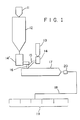
- Figure 1 is a schematic diagram of a preferred embodiment of the process of the current invention.
- One embodiment of the current invention provides a method for controlling polyamide dyeability using commercially available equipment which comprises adding high- or low-amine-end polyamide flake to base polyamide flake in an extruder to adjust the total amine end-group concentration to a predefined level to achieve improved dye uniformity, with much shorter lag times than conventional processes.
- This may be accomplished by using an additive feeder system which feeds additive polyamide pellets into the throat of an extruder at a controlled feed rate, the feed rate being a function of the total polymer throughput and the desired amine-end group concentration in the final polymer.
- the additive polyamide flake is mixed with base polyamide flake that is supplied from a main feeder, as in a conventional process, to provide a polyamide with modified dyeability.
- twin-screw extruder In order to achieve uniform mixing, it is preferable that a twin-screw extruder be used. A single-screw or a rotary type extruder may also be used, however mixing may not be as complete resulting in a reduction in the yarn dye-uniformity. The melt-blended polyamide is then melt-spun to form fibers.
- the process of the current invention may also be useful when a large screw melter or continuous polymerization unit is used to feed more than one spinning machine, and it is desired to spin polymers having different dyeability, e.g., a deep-dye polymer on one spinning machine and a light-dye polymer on the other.
- a light-dye polymer base flake is used (or a comparable polymer is polymerized in the continuous unit) and melted deep-dye additive flake injected into one of the transfer lines.
- additional mixing means in the transfer line to ensure complete mixing of the additive and base polyamides.
- base polyamide refers to the flake supplied from the main feeder or the polymer formed in the continuous polymerization unit, the dyeability of which is to be adjusted and controlled by use of the additive flake.
- the base polyamide may be any polyamide, including, without limitation, nylon 6,6, nylon 6, nylon 6,10, nylon 6,12, and nylon copolymers.
- the additive flake should generally be of the same polymer type as the base polyamide, differing only in its amine-end concentration, the amine-end concentration being either greater or less than that of the base polymer.
- standard polymer type it is intended to mean a polymer having the same repeating unit, though not necessarily having the same molecular weight.
- a nylon 6,6 additive flake should be used to adjust the dyeability of nylon 6,6 base polymer, a nylon 6 flake used to adjust nylon 6 base polymer, etc.
- a supply hopper 11 supplies base polyamide pellets of known amine-end concentration at a controlled temperature to a conditioner 12 where moisture is removed from the pellets to the extent required to achieve the desired molecular weight of the final product.
- An additive hopper 13 is filled with the additive polyamide flake of pre-determined amine-end group concentration and fed with a feeder 14 , capable of accurately feeding flake at a controlled pre-determined feed rate calculated to achieve the desired concentration of amine ends in the final polymer, into a piping 15 connected to the throat 16 of a twin-screw extruder 17 .
- the base polyamide flake is also fed into 16 via a separate feeder 14' , where it mixes with the additive flake and enters the twin-screw extruder 17 .
- the ABB dyeability or amine-end concentration of the fibers is monitored, and if the values deviate from the on-aim limits, the rate of addition of the additive polymer flake is adjusted to bring the values within predefined specifications.
- ABB measurements may be substituted for aim and measured amine end levels, using the conversion factor of 1NH2 end being approximately equivalent to 13 ABB dye units.) If the desired change is not achieved upon adjustment of feed rate, other process parameters may be responsible for the measured deviations and should be investigated.
- the MBB dye test uses a high molecular weight dye (Anthraquinone Milling Blue B) so that the rate of dye uptake is sensitive to structural changes, such as degree of orientation and crystallinity, induced in the fiber due to variations in process parameters.
- the ABB dye test is run using a less structurally sensitive dye (Anthraquinone Blue B) at a higher temperature and for a longer time than the MBB dye test so that the dyeing process approaches equilibrium and the dyeability measured is dependent on the amine-end group concentration.
- the MBB measurement is not significantly affected by changes in ABB dyeability. For example, experience has shown that an ABB dye change of 15-20 dye units will result in a MBB dye change of approximately 5 dye units.
- the MBB dye test is performed by placing 16 pads of yarn, 4 grams each in a scouring solution prepared from 90 ml 18% sodium hydroxide solution and 100 ml of 10% Merpol HCS (a liquid, nonionic detergent, E. I. du Pont de Nemours & Co.). The temperature of the bath is increased at a rate of 3 °C/min to 40 °C and held at temperature for 15 minutes. The bath is drained and filled with a dye solution prepared from 200 ml of an MBB buffer solution having a pH of 5.28-5.32 and 500 ml of 0.18% Anthraquinone Milling Blue BL (C.I. Acid Blue 122) dye solution.
- a scouring solution prepared from 90 ml 18% sodium hydroxide solution and 100 ml of 10% Merpol HCS (a liquid, nonionic detergent, E. I. du Pont de Nemours & Co.).
- the temperature of the bath is increased at a rate of 3 °C/min to 40 °C
- the MBB buffer solution is prepared by first mixing 49000 gm monosodium phosphate (FMC Corp., Philadelphia, Pa.) and 620 gm of a 50% sodium hydroxide solution in 88 liters of water, taking 8 gms of this combined solution, and diluting with 992 gms of water.
- the dye bath temperature is increased at 3 °C/min to 60 °C and held at temperature for 10 min.
- the dyed samples are rinsed, dried, and measured for dye depth using a reflecting colorimeter.
- the ABB dye test involves scouring 16 pads of yarn, 2.5 gm each in a solution containing 200 ml of a 10% solution of Merpol HCS (a liquid, nonionic detergent, from E. I. du Pont de Nemours & Co.), 5 ml of Depuma (a silicone defoaming agent), and 100 ml of an ABB buffer solution.
- This ABB buffer solution is prepared by first mixing 49,000 gms of monosodium phosphate (FMC Corp., Philadelphia, Pa.) and 2,500 gms of a 50% sodium hydroxide solution in 88 liters of water, taking 4 grams of this combined solution, and diluting with 996 grams of water.
- the scouring solution has a pH of 5.88-5.92.
- the bath containing the yarn is held at room temperature for 2 minutes, after which 300 ml of 0.1% Anthraquinone Blue B (C.I. Acid Blue 45) dye solution is added and the bath temperature is increased at a rate of 3 °C/min to 95 °C and held at temperature for 90 minutes.
- the dyed samples are rinsed, dried, and measured for dye depth using a reflecting colorimeter.
- Both MBB and ABB dye numbers are calculated from the reflectance values using the method described in Holfeld et al., U.S. Patent No. 4,030,880.
- the goal of the current invention is to control only the ABB dyeability without significantly affecting the MBB dyeability.
- the conditioned base flake was fed into the throat of a 120 mm twin-screw extruder manufactured by Warner & Pfleiderer (Ramsey, N.J.) using a 2500 lb/hr capacity MD II Series 400 gravimetric feeder manufactured by Acrison, Inc.
- the rate of addition of the high amine-end additive flake was 3% of the total throughput of the process and was controlled using a Honeywell DCS system using a control scheme linking feed rate of the additive feeder to total throughput.
- the total throughput for the system was 2000 lb/hr.
- the nylon flake was blended and melted in the extruder with the temperature increasing as the polymer progressed through the extruder from approximately 267 °C to approximately 289 °C. The temperature was then maintained constant at approximately 290 °C as the polymer passed through the transfer line.
- the residence time of the polymer melt in line from the point of blending in the throat of the extruder to the point of extrusion at the spinneret was approximately 5.5 minutes.
- the additive feed rate should be maintained within about + 10% of the aim, e.g. 3% + 0.3% for the example shown above. This is within the accuracy range of commercially available feeders.
Landscapes
- Engineering & Computer Science (AREA)
- Chemical & Material Sciences (AREA)
- Chemical Kinetics & Catalysis (AREA)
- General Chemical & Material Sciences (AREA)
- Textile Engineering (AREA)
- Manufacturing & Machinery (AREA)
- Artificial Filaments (AREA)
- Polyamides (AREA)
- Spinning Methods And Devices For Manufacturing Artificial Fibers (AREA)
- Processes Of Treating Macromolecular Substances (AREA)
- Compositions Of Macromolecular Compounds (AREA)
Applications Claiming Priority (2)
| Application Number | Priority Date | Filing Date | Title |
|---|---|---|---|
| US07/511,178 US5166278A (en) | 1990-04-17 | 1990-04-17 | Process for modifying polyamide dyeability using co-fed polyamide flake |
| US511178 | 1990-04-17 |
Publications (3)
| Publication Number | Publication Date |
|---|---|
| EP0452907A2 true EP0452907A2 (de) | 1991-10-23 |
| EP0452907A3 EP0452907A3 (en) | 1992-01-29 |
| EP0452907B1 EP0452907B1 (de) | 1999-03-31 |
Family
ID=24033777
Family Applications (1)
| Application Number | Title | Priority Date | Filing Date |
|---|---|---|---|
| EP91106148A Expired - Lifetime EP0452907B1 (de) | 1990-04-17 | 1991-04-17 | Verfahren zum Modifizieren der Anfärbbarkeit von Polyamiden durch Zuführung von Polyamidflocken |
Country Status (7)
| Country | Link |
|---|---|
| US (1) | US5166278A (de) |
| EP (1) | EP0452907B1 (de) |
| JP (1) | JP2955391B2 (de) |
| AR (1) | AR246314A1 (de) |
| AU (1) | AU638323B2 (de) |
| CA (1) | CA2039266C (de) |
| DE (1) | DE69131056T2 (de) |
Cited By (2)
| Publication number | Priority date | Publication date | Assignee | Title |
|---|---|---|---|---|
| US10293289B2 (en) | 2013-02-14 | 2019-05-21 | Nanopareil, Llc | Hybrid felts of electrospun nanofibers |
| EP4060100A4 (de) * | 2019-11-14 | 2023-11-15 | Kuraray Co., Ltd. | Polyamidfasern, verfahren zum produzieren derselben und faserstruktur |
Families Citing this family (11)
| Publication number | Priority date | Publication date | Assignee | Title |
|---|---|---|---|---|
| WO1995011788A1 (en) * | 1992-03-26 | 1995-05-04 | E.I. Du Pont De Nemours And Company | Process for the manufacture of polyamide resin composition |
| EP0804806A1 (de) * | 1994-12-22 | 1997-11-05 | Benedict G. Pace | Invertiertes chip modul hoher packungsdichte |
| CA2214194C (en) * | 1997-01-10 | 2002-04-09 | Basf Corporation | Multiple domain fibers having inter-domain boundary compatibilizing layer and methods of making the same |
| US5879801A (en) * | 1997-01-10 | 1999-03-09 | Basf Corporation | Multiple domain fibers having inter-domain boundary compatibilizing layer and methods and apparatus for making the same |
| AU2002249597B2 (en) * | 2001-04-18 | 2007-02-15 | Kabushikikaisha Igaki Iryo Sekkei | Melting and spinning device and melting and spinning method |
| US7838617B2 (en) * | 2003-05-05 | 2010-11-23 | Invista North America S.àr.l. | Dyeable spandex |
| US20090136704A1 (en) * | 2007-11-27 | 2009-05-28 | Invista North America S. A R. I. | Dual acid/cationic dyeable polyamide polymer fibers and yarns, methods of making the same, and textile articles including dual acid/cationic dyeable polyamide polymer fibers |
| IL195283A (en) * | 2008-11-13 | 2013-01-31 | Nilit Ltd | Process for manufacturing polyamide yarns utilizing polyamide waste |
| CN101498056B (zh) * | 2009-02-04 | 2010-12-08 | 浙江华欣新材料股份有限公司 | 一种熔体直接纺丝在线多元添加生产彩色及功能性纤维的设备及方法 |
| EP2723811B1 (de) | 2011-06-21 | 2015-08-26 | E. I. du Pont de Nemours and Company | Thermostabilisiertes polyamid-gefülltes acrylat copolymer und verfahren zu dessen herstellung |
| US8664317B2 (en) | 2011-06-21 | 2014-03-04 | E I Du Pont De Nemours And Company | Process for production of a heat-stabilized acrylate polymer |
Family Cites Families (10)
| Publication number | Priority date | Publication date | Assignee | Title |
|---|---|---|---|---|
| US3357955A (en) * | 1964-02-14 | 1967-12-12 | Du Pont | Continuous preparation of polyamides wherein relative viscosity and amineend value of final product are maintained constant |
| BE756454A (fr) * | 1969-09-23 | 1971-03-22 | Fiber Industries Inc | Procede et appareil de production de polyamides par polymerisation continue |
| US3985714A (en) * | 1973-01-17 | 1976-10-12 | E. I. Du Pont De Nemours And Company | Polyamidation process by maintaining temperature and pressure differential controls |
| US3884582A (en) * | 1973-12-06 | 1975-05-20 | Du Pont | Method for predicting dyeability of yarn |
| CA1024294A (en) * | 1974-02-27 | 1978-01-10 | Du Pont Of Canada Limited | Control in preparing polyamides by continuous polymerization |
| DE2642980A1 (de) * | 1976-09-24 | 1978-03-30 | Bayer Ag | Tiefanfaerbende polycaprolactamfasern und -faeden |
| JPS5615404A (en) * | 1979-07-09 | 1981-02-14 | Nippon Ester Co Ltd | Double-headed spinning device |
| JPS6189316A (ja) * | 1984-10-03 | 1986-05-07 | Teijin Ltd | 溶融混合紡糸装置 |
| DE3506635A1 (de) * | 1985-02-26 | 1986-08-28 | Simar Fördertechnik GmbH, 7145 Markgröningen | Vorrichtung zum dosieren und zufuehren mehrerer granulat- und/oder pulverfoermiger komponenten fuer einen extruder |
| US4937034A (en) * | 1989-04-03 | 1990-06-26 | E. I. Du Pont De Nemours And Company | Apparatus and method for cofeeding additives with polymer flake |
-
1990
- 1990-04-17 US US07/511,178 patent/US5166278A/en not_active Expired - Lifetime
-
1991
- 1991-03-27 CA CA002039266A patent/CA2039266C/en not_active Expired - Fee Related
- 1991-04-15 AU AU74382/91A patent/AU638323B2/en not_active Ceased
- 1991-04-16 JP JP3109642A patent/JP2955391B2/ja not_active Expired - Fee Related
- 1991-04-17 DE DE69131056T patent/DE69131056T2/de not_active Expired - Fee Related
- 1991-04-17 AR AR91319473A patent/AR246314A1/es active
- 1991-04-17 EP EP91106148A patent/EP0452907B1/de not_active Expired - Lifetime
Cited By (3)
| Publication number | Priority date | Publication date | Assignee | Title |
|---|---|---|---|---|
| US10293289B2 (en) | 2013-02-14 | 2019-05-21 | Nanopareil, Llc | Hybrid felts of electrospun nanofibers |
| USRE49773E1 (en) | 2013-02-14 | 2024-01-02 | Nanopareil, Llc | Hybrid felts of electrospun nanofibers |
| EP4060100A4 (de) * | 2019-11-14 | 2023-11-15 | Kuraray Co., Ltd. | Polyamidfasern, verfahren zum produzieren derselben und faserstruktur |
Also Published As
| Publication number | Publication date |
|---|---|
| CA2039266A1 (en) | 1991-10-18 |
| CA2039266C (en) | 2001-01-02 |
| JP2955391B2 (ja) | 1999-10-04 |
| AR246314A1 (es) | 1994-07-29 |
| EP0452907B1 (de) | 1999-03-31 |
| AU638323B2 (en) | 1993-06-24 |
| US5166278A (en) | 1992-11-24 |
| AU7438291A (en) | 1991-10-24 |
| JPH04228616A (ja) | 1992-08-18 |
| DE69131056T2 (de) | 1999-11-11 |
| DE69131056D1 (de) | 1999-05-06 |
| EP0452907A3 (en) | 1992-01-29 |
Similar Documents
| Publication | Publication Date | Title |
|---|---|---|
| EP0452907B1 (de) | Verfahren zum Modifizieren der Anfärbbarkeit von Polyamiden durch Zuführung von Polyamidflocken | |
| EP0683828B2 (de) | Verfahren zur herstellung von polyamidfaser verwendbar als stapel für papiermaschinenfilz | |
| US5756020A (en) | Method for producing solution dyed articles from thermoplastic polymers | |
| EP0852531B1 (de) | Verfahren zum herstellen von eingefärbten extrudierten gegenständen | |
| WO2008007879A1 (en) | Polyurethaneurea elastic fiber and method for preparation thereof | |
| US4992487A (en) | Method for determining flow behavior index and using index to control polymer rheology and physical properties | |
| CN113214471B (zh) | 聚酰胺5x树脂及其制备方法和高强高模纤维 | |
| CN113260655A (zh) | 通过高度端基封端获得的耐污染性聚酰胺聚合物 | |
| EP0750690B1 (de) | Verfahren zur herstellung von polycarbonat enthaltenden gefärbten polyamidfasern sowie die hergestellten fasern | |
| CN1048710A (zh) | 高粘度聚对苯二甲酰对苯二胺的制备方法 | |
| US5459195A (en) | Polyamide pigment dispersion | |
| US4668453A (en) | Cospinning process | |
| CN112941641A (zh) | 一种功能型阻燃涤纶工业丝的加工方法 | |
| US5741867A (en) | Process for adjusting the viscosity of highly concentrated elastane solutions for the dry spinning or wet spinning of elastane fibres | |
| US6719937B1 (en) | Method for making polyamide fibers | |
| US5014545A (en) | Apparatus for determining flow behavior index | |
| AU628891B2 (en) | Process and apparatus for modifying polyamide dyeability or amine end content | |
| TW454052B (en) | Process for the manufacture of spandex and the spandex made thereby | |
| KR100230906B1 (ko) | 제지기 펠트용 스테이플로서 유용한 폴리아미드 섬유의 제조방법 | |
| CA2002023A1 (en) | Process and apparatus for modifying polyamide amine end content |
Legal Events
| Date | Code | Title | Description |
|---|---|---|---|
| PUAI | Public reference made under article 153(3) epc to a published international application that has entered the european phase |
Free format text: ORIGINAL CODE: 0009012 |
|
| AK | Designated contracting states |
Kind code of ref document: A2 Designated state(s): DE FR GB NL |
|
| PUAL | Search report despatched |
Free format text: ORIGINAL CODE: 0009013 |
|
| AK | Designated contracting states |
Kind code of ref document: A3 Designated state(s): DE FR GB NL |
|
| 17P | Request for examination filed |
Effective date: 19920616 |
|
| 17Q | First examination report despatched |
Effective date: 19950927 |
|
| GRAG | Despatch of communication of intention to grant |
Free format text: ORIGINAL CODE: EPIDOS AGRA |
|
| GRAG | Despatch of communication of intention to grant |
Free format text: ORIGINAL CODE: EPIDOS AGRA |
|
| GRAH | Despatch of communication of intention to grant a patent |
Free format text: ORIGINAL CODE: EPIDOS IGRA |
|
| GRAG | Despatch of communication of intention to grant |
Free format text: ORIGINAL CODE: EPIDOS AGRA |
|
| GRAG | Despatch of communication of intention to grant |
Free format text: ORIGINAL CODE: EPIDOS AGRA |
|
| GRAH | Despatch of communication of intention to grant a patent |
Free format text: ORIGINAL CODE: EPIDOS IGRA |
|
| GRAH | Despatch of communication of intention to grant a patent |
Free format text: ORIGINAL CODE: EPIDOS IGRA |
|
| GRAA | (expected) grant |
Free format text: ORIGINAL CODE: 0009210 |
|
| AK | Designated contracting states |
Kind code of ref document: B1 Designated state(s): DE FR GB NL |
|
| REF | Corresponds to: |
Ref document number: 69131056 Country of ref document: DE Date of ref document: 19990506 |
|
| ET | Fr: translation filed | ||
| PLBE | No opposition filed within time limit |
Free format text: ORIGINAL CODE: 0009261 |
|
| STAA | Information on the status of an ep patent application or granted ep patent |
Free format text: STATUS: NO OPPOSITION FILED WITHIN TIME LIMIT |
|
| 26N | No opposition filed | ||
| REG | Reference to a national code |
Ref country code: GB Ref legal event code: IF02 |
|
| REG | Reference to a national code |
Ref country code: GB Ref legal event code: 732E |
|
| REG | Reference to a national code |
Ref country code: GB Ref legal event code: 732E |
|
| NLS | Nl: assignments of ep-patents |
Owner name: INVISTA TECHNOLOGIES S.A.R.L. Effective date: 20050922 |
|
| PGFP | Annual fee paid to national office [announced via postgrant information from national office to epo] |
Ref country code: NL Payment date: 20060403 Year of fee payment: 16 |
|
| PGFP | Annual fee paid to national office [announced via postgrant information from national office to epo] |
Ref country code: FR Payment date: 20060410 Year of fee payment: 16 |
|
| PGFP | Annual fee paid to national office [announced via postgrant information from national office to epo] |
Ref country code: GB Payment date: 20060412 Year of fee payment: 16 |
|
| PGFP | Annual fee paid to national office [announced via postgrant information from national office to epo] |
Ref country code: DE Payment date: 20060413 Year of fee payment: 16 |
|
| GBPC | Gb: european patent ceased through non-payment of renewal fee |
Effective date: 20070417 |
|
| NLV4 | Nl: lapsed or anulled due to non-payment of the annual fee |
Effective date: 20071101 |
|
| PG25 | Lapsed in a contracting state [announced via postgrant information from national office to epo] |
Ref country code: NL Free format text: LAPSE BECAUSE OF NON-PAYMENT OF DUE FEES Effective date: 20071101 Ref country code: DE Free format text: LAPSE BECAUSE OF NON-PAYMENT OF DUE FEES Effective date: 20071101 |
|
| PG25 | Lapsed in a contracting state [announced via postgrant information from national office to epo] |
Ref country code: GB Free format text: LAPSE BECAUSE OF NON-PAYMENT OF DUE FEES Effective date: 20070417 |
|
| PG25 | Lapsed in a contracting state [announced via postgrant information from national office to epo] |
Ref country code: FR Free format text: LAPSE BECAUSE OF NON-PAYMENT OF DUE FEES Effective date: 20070430 |