EP0452955B1 - Kondensator und Verfahren zu seiner Herstellung - Google Patents
Kondensator und Verfahren zu seiner Herstellung Download PDFInfo
- Publication number
- EP0452955B1 EP0452955B1 EP91106343A EP91106343A EP0452955B1 EP 0452955 B1 EP0452955 B1 EP 0452955B1 EP 91106343 A EP91106343 A EP 91106343A EP 91106343 A EP91106343 A EP 91106343A EP 0452955 B1 EP0452955 B1 EP 0452955B1
- Authority
- EP
- European Patent Office
- Prior art keywords
- film
- liquid crystal
- active agent
- surface active
- crystal molecules
- Prior art date
- Legal status (The legal status is an assumption and is not a legal conclusion. Google has not performed a legal analysis and makes no representation as to the accuracy of the status listed.)
- Expired - Lifetime
Links
Images




Classifications
-
- H—ELECTRICITY
- H01—ELECTRIC ELEMENTS
- H01G—CAPACITORS; CAPACITORS, RECTIFIERS, DETECTORS, SWITCHING DEVICES, LIGHT-SENSITIVE OR TEMPERATURE-SENSITIVE DEVICES OF THE ELECTROLYTIC TYPE
- H01G4/00—Fixed capacitors; Processes of their manufacture
- H01G4/002—Details
- H01G4/018—Dielectrics
- H01G4/20—Dielectrics using combinations of dielectrics from more than one of groups H01G4/02 - H01G4/06
-
- B—PERFORMING OPERATIONS; TRANSPORTING
- B82—NANOTECHNOLOGY
- B82Y—SPECIFIC USES OR APPLICATIONS OF NANOSTRUCTURES; MEASUREMENT OR ANALYSIS OF NANOSTRUCTURES; MANUFACTURE OR TREATMENT OF NANOSTRUCTURES
- B82Y10/00—Nanotechnology for information processing, storage or transmission, e.g. quantum computing or single electron logic
-
- B—PERFORMING OPERATIONS; TRANSPORTING
- B82—NANOTECHNOLOGY
- B82Y—SPECIFIC USES OR APPLICATIONS OF NANOSTRUCTURES; MEASUREMENT OR ANALYSIS OF NANOSTRUCTURES; MANUFACTURE OR TREATMENT OF NANOSTRUCTURES
- B82Y30/00—Nanotechnology for materials or surface science, e.g. nanocomposites
-
- H—ELECTRICITY
- H01—ELECTRIC ELEMENTS
- H01G—CAPACITORS; CAPACITORS, RECTIFIERS, DETECTORS, SWITCHING DEVICES, LIGHT-SENSITIVE OR TEMPERATURE-SENSITIVE DEVICES OF THE ELECTROLYTIC TYPE
- H01G4/00—Fixed capacitors; Processes of their manufacture
- H01G4/002—Details
- H01G4/018—Dielectrics
- H01G4/06—Solid dielectrics
- H01G4/14—Organic dielectrics
-
- Y—GENERAL TAGGING OF NEW TECHNOLOGICAL DEVELOPMENTS; GENERAL TAGGING OF CROSS-SECTIONAL TECHNOLOGIES SPANNING OVER SEVERAL SECTIONS OF THE IPC; TECHNICAL SUBJECTS COVERED BY FORMER USPC CROSS-REFERENCE ART COLLECTIONS [XRACs] AND DIGESTS
- Y10—TECHNICAL SUBJECTS COVERED BY FORMER USPC
- Y10T—TECHNICAL SUBJECTS COVERED BY FORMER US CLASSIFICATION
- Y10T29/00—Metal working
- Y10T29/43—Electric condenser making
- Y10T29/435—Solid dielectric type
Definitions
- This invention relates to a capacitor and a process for producing the same. More particularly, it pertains to a method for forming a dielectric thin film on a film electrode in the production of a capacitor.
- the dielectric films formed according to the conventional methods are poor in performance and unsatisfactory in reliability.
- JP-A-62221103 What is known from JP-A-62221103, is a capacitor wherein a dielectric thin film is sandwiched by two layers of thin film electrodes.
- the dielectric thin film is made from a chlorosilane surface active agent and is applied to the electrodes by chemical adsorption.
- the present inventions has for its object to provide a small-size high-performance thin film capacitor at low cost.
- a capacitor comprises a thin film electrode and a dielectric thin film formed on one or both surfaces, respectively, of said thin film electrode directly or through interposition of a thin oxide film, and lead electrodes connected to said thin film electrode, said dielectric thin film being a chemically adsorbed monomomecular film made from a chlorosilane surface active agent or a chemically adsorbed multi-monomolecular film comprising two or more monomolecular films made from a chlorosilane surface active agent, said adsorption being effected by siloxane bonding, wherein the chlorosilane surface active agent is a compound in which chlorosilyl groups are bonded to liquid crystal molecules through a carbon chain.
- the invention provides for a process for producing a capacitor, comprising a step of forming a single layer of monomolecular film on one or both surfaces of a metallic electrode-forming film by letting a chlorosilane surface active agent in a non-aqueous organic solvent be chemically adsorbed on the surface of the electrode-forming film either directly or by interposing therebetween a thin oxide film , and thereby effecting the adsorption by chemical siloxane bonding, wherein the chlorosilane surface active agent has a structure in which chlorosilyl groups are bonded to liquid crystal molecules through a carbon chain.
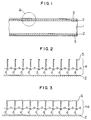
- FIG. 1 is a diagrammatic illustration of a thin film electrode for capacitor having a chemical adsorption monomolecular film formed thereon as a dielectric film.
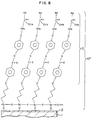
- FIGS. 2 to 8 are diagrammatic representations of the steps shown by magnifying the encircled portion A in FIG. 1 to the molecular level.
- FIG. 9 is a schematic illustration of a process for continuously producing the thin film electrodes for capacitor having a dielectric film formed thereon.
- FIG. 10 is a perspective view of a capacitor produced in an embodiment of the present invention.
- FIG. 11 is a schematic sectional view of a capacitor produced in another embodiment of the present invention.
- the present invention provides a capacitor as defined in claim 1, wherein the electrode surface is coated, either directly or through a medium of an appropriate thin film, with a monomolecular chemically adsorbed film or a monomolecular built-up chemically adsorbed film composed of a chlorosilane surface active agent, and a process for producing such a capacitor.
- the capacitor of this invention can be produced with ease and at low cost since the production process merely comprises chemical adsorption of a chlorosilane surface active agent on substrates for thin film metallic electrodes.
- a monomolecular dielectric film 3 made of a chlorosilane surface active agent by having said chlorosilane surface active agent adsorbed on said metallic film 1 by a chemical adsorption method either directly or with the intermedium therebetween of a suitable thin film such as a natural oxide film 2.
- an electrolytic oxide film may be formed on said metallic film surface by means of electrolytic oxidation or a thin film of an oxide such as Al2O3, SnO2, Cu2O, or Fe2O3 may be formed on said metallic film surface to a thickness of several thousands of angstroms by suitable means such as sputtering deposition. This enables obtainment of a capacitor with even higher performance.
- Chemical adsorption in the above operation can be performed in the following way.
- a hydrophilic metallic film 1 is dried well.
- 80:12:8 mixture by weight ratio of n-hexadecane, tetrachlorocarbon and chlor
- a fluorine-containing surface active agent such as CF3-(CF2) n -(CH2) m -SiCl3 (m and n are the integers the sum of which is preferably from about 10 to about 25 for best handling quality) or CF3-(CF2) n -(CH2) m -O-SiCl3 (m and n are the integers the sum cf which is preferably from about 10 to about 25 for best handling quality) is used as said chlorosilane surface active agent as shown in FIG. 4, there can be obtained a fluorine-containing adsorption film which is improved in dielectric constant.
- numeral 7 denotes a fluorine atom.
- a metallic film formed with a single layer of monomolecular film 4 shown by FIG. 2 is dipped in a THF solution of diborane in a concentration of 1 mol/l at room temperature and then further dipped in a 30% H2O2 aqueous solution of sodium hydroxide (NaOH) in a concentration of 0.1 mol/l at room temperature for about one hour to add the hydroxyl groups (OH) 8 to the vinyl groups in the monomolecular film surface as shown in FIG. 5.
- a THF solution of diborane in a concentration of 1 mol/l at room temperature
- a 30% H2O2 aqueous solution of sodium hydroxide (NaOH) in a concentration of 0.1 mol/l at room temperature for about one hour to add the hydroxyl groups (OH) 8 to the vinyl groups in the monomolecular film surface as shown in FIG. 5.
- the active groups such as OH groups, amino groups (NH2) or imino groups (NH) can be added to the portion of vinyl groups, so that by repeating the chemical adsorption step using the same reaction solution and the addition step by irradiation of energy beams, it is possible to obtain a required film thickness for use as a dielectric film.
- the similar effect can be obtained by conducting a plasma treatment in an active gas atmosphere at 100 W for about 10 minutes instead of applying radiation as in the above embodiment.
- Increase of dielectric constant of the monomolecular chemically adsorbed film is effected by using as adsorbing reagent a chlorosilane surface active agent having a chemical structure with liquid crystal molecules as molecules with large dipoles at a part of the linear carbon chain of the chlorosilane surface active agent.
- R1 or R2 in the molecule of the chlorosilane surface active agent for chemical adsorption in FIG. 7 or 8 is defined to be a vinyl group, acetylene group or cyano group, it is possible to obtain a monomolecular dielectric built-up film containing the liquid crystal molecules in the whole structure of the monomolecular film by using the above-mentioned monomolecular film build-up method in which chemical adsorption is performed by treatments with a chemical agent or by irradiation.
- the dielectric film thus obtained has a structure in which the dipoles in the molecules constituting each layer of monomolecular adsorption film are arranged in order, the obtained dielectric film can have a very high dielectric constant.
- a metal ingot 11 e.g., Al or Al-containing alloy
- a capstan 13 the film is subjected to the successive treatments in an adsorption tank 14, a washing cistern 15, an electron ray irradiator 16, an adsorption tank 17, a washing cistern 18 ..., and lastly, after a desired number of layers of monomolecular film were obtained by repeatedly conducting said successive treatments, the thin film electrode for capacitor 20 comprising the thus formed dielectric film is taken up on a drum 19.
- This process can be conducted continuously.
- the natural oxide film is not sufficiently formed on the metallic film surface immediately after rolling, it needs to set, in the rear of the rolling mill, a tank containing an aqueous solution of dilute nitric acid or such for dipping the film therein for a short period of time. It is possible to add a step or steps before the adsorption step, such as a step for electrolytically oxidizing said metallic film surface or a step for sputter-depositing a thin film of an oxide such as SiO2.
- CH2 CH-(CH2) n -SiCl3
- the vinyl group is replaced by acetylene or cyano group, or the trichlorosilyl group is replaced by dichlorosilyl or monochlorosilyl group, or a reaction group is allowed to coexist with said groups.
- an electrolytic capacitor prepared by dissolving water or boric acid in an amount of a few percents in glycerin or ethylene glycol is held between the electrodes each or having a coat of a monomolecular film or monomolecular built-up film, there can be obtained an electrolytic capacitor.
- the present invention provides a capacitor characterized by the features of claim 1, wherein the electrode surface is coated, either directly or indirectly by interposing a suitable thin film, with a chemically adsorbed film or a chemically adsorbed monomolecular built-up film composed of a chlorosilane surface active agent, and a process for producing such a capacitor defined by the features of claim 11, so that according to this invention it is possible to easily form an extremely thin, high-density faultless dielectric film having a high dielectric constant on the surface of a metallic thin film electrode.
- this dielectric film is bonded to the electrode surface through a strong siloxane bond, a small-sized high-performance capacitor with excellent moisture resistance and dielectric strength can be offered at notably low cost.
- the dielectric film formed by said chemical adsorption method is incorporated with a chemical structure having e.g., nematic liquid crystal molecules or ferroelectric liquid crystal molecules as molecules with large dipoles , it is possible to control the dielectric constant of the dielectric film.
Landscapes
- Engineering & Computer Science (AREA)
- Chemical & Material Sciences (AREA)
- Nanotechnology (AREA)
- Power Engineering (AREA)
- Crystallography & Structural Chemistry (AREA)
- Microelectronics & Electronic Packaging (AREA)
- Manufacturing & Machinery (AREA)
- Physics & Mathematics (AREA)
- Condensed Matter Physics & Semiconductors (AREA)
- Theoretical Computer Science (AREA)
- Composite Materials (AREA)
- Mathematical Physics (AREA)
- General Physics & Mathematics (AREA)
- Materials Engineering (AREA)
- Fixed Capacitors And Capacitor Manufacturing Machines (AREA)
- Organic Insulating Materials (AREA)
- Liquid Crystal (AREA)
- Addition Polymer Or Copolymer, Post-Treatments, Or Chemical Modifications (AREA)
- Laminated Bodies (AREA)
Claims (21)
- Kondensator mit einer Dünnfilmelektrode (1) und einem auf einer bzw. beiden Oberflächen der Dünnfilmelektrode (1) direkt oder durch Zwischenlegen eines dünnen Oxidfilms (2) gebildeten dielektrischen Dünnfilm (3) und mit der Dünnfilmelektrode (1) verbundenen Leitungselektroden (21, 22), wobei der dielektrische Dünnfilm ein aus einem oberflächenaktiven Chlorsilanmittel oder einem chemisch adsorbierten multimonomolekularen Film mit zwei oder mehr monomolekularen, aus einem oberflächenaktiven Chlorsilanmittel hergestellten Filmen hergestellter, chemisch adsorbierter monomolekularer Film (4E, 4F) ist und die Adsorption durch Siloxanbindung ausgeführt ist, wobei das oberflächenaktive Chlorsilanmittel eine Verbindung ist, bei der Chlorsilylgruppen über eine Kohlenstoffkette an Flüssigkristallmoleküle gebunden sind.
- Kondensator nach Anspruch 1, bei dem die Kohlenstoffkette linear ist.
- Kondensator nach Anspruch 2, bei dem die Kohlenstoffketten 10 bis 25 Kohlenstoffatome aufweisen.
- Kondensator nach einem der vorstehenden Ansprüche, bei dem das oberflächenaktive Chlorsilanmittel an seinem einen Molekülende einen aus der Gruppe aus einer Vinylgruppe, einer Acetylengruppe oder einer Cyangruppe ausgewählten Substituenten und an seinem anderen Molekülende eine Chlorsilylgruppe aufweist.
- Kondensator nach einem der vorstehenden Ansprüche, bei dem die Flüssigkristallmoleküle nematische Flüssigkristallmoleküle sind.
- Kondensator nach einem der Ansprüche 1 bis 4, bei dem die Flüssigkristallmoleküle ferroelektrische Flüssigkristallmoleküle sind.
- Kondensator nach Anspruch 6, bei dem der ferroelektrische Flüssigkristall vom Azomethintyp, Azoxytyp oder Estertyp ist.
- Kondensator nach einem der vorstehenden Ansprüche, bei dem CH₂ = CH - (CH₂)n- SiCl₃ (wobei n eine ganze Zahl ist) als oberflächenaktives Chlorsilanmittel verwendet ist.
- Kondensator nach einem der vorstehenden Ansprüche, bei dem ein Paar gegenüberliegender Elektroden vorgesehen ist und dazwischen ein Elektrolyt gehalten ist.
- Kondensator nach einem der vorstehenden Ansprüche, bei dem der metallische, elektrodenbildende Film (1) aus Al oder einer Al enthaltenden Legierung hergestellt ist.
- Prozeß zum Herstellen eines Kondensators, mit einem Schritt der Herstellung einer Einzelschicht (4) aus einem monomolekularen Film auf einer oder beiden Oberflächen eines metallischen, elektrodenbildenden Films (1) durch chemisch Adsorbierenlassen eines oberflächenaktiven Chlorsilanmittels auf der Oberfläche des elektrodenbildenden Films (1) in einem nichtwäßrigen organischen Lösungsmittel entweder direkt oder durch Dazwischenlegen eines Oxiddünnfilms (2) und dadurch Ausführen der Adsorption durch chemische Siloxanbindung, wobei das oberflächenaktive Chlorsilanmittel eine Struktur aufweist, bei der Chlorsilylgruppen über eine Kohlenstoffkette an Flüssigkristallmoleküle gebunden sind.
- Prozeß nach Anspruch 11, bei dem ein metallischer, elektrodenbildender Film (1) aus Al oder einer Al enthaltenden Legierung hergestellt ist.
- Prozeß nach Anspruch 11 oder 12, bei dem die Kohlenwasserstoffkette linear ist.
- Prozeß nach Anspruch 13, bei dem die Kohlenstoffkette 10 bis 25 Kohlenstoffatome aufweist.
- Prozeß nach Anspruch 13 oder 14, bei dem die lineare Kohlenstoffkette an ihrem einen Ende mit einem aus der Gruppe aus einer Vinylgruppe, einer Acetylengruppe oder einer Cyangruppe ausgewählten Substituenten und an ihrem anderen Ende mit einer Chlorsilylgruppe abgeschlossen ist.
- Prozeß nach einem der Ansprüche 11 bis 15, bei dem die Flüssigkristallmoleküle nematische Flüssigkristallmoleküle sind.
- Prozeß nach einem der Ansprüche 11 bis 15, bei dem die Flüssigkristallmoleküle ferroelektrische Flüssigkristallmoleküle sind.
- Prozeß nach Anspruch 17, bei dem der ferroelektrische Flüssigkristall vom Azomethintyp, Azoxytyp oder Estertyp ist.
- Prozeß nach Anspruch 15, ferner mit einem Schritt des Reagierenlassens des Substituenten durch Behandlung mit einem chemischen Mittel zum Hinzufügen einer Hydroxylgruppe und dann Ausführen einer chemischen Adsorption des oberflächenaktiven Chlorsilanmittels, wobei der Schritt nach dem Schritt des Bildens einer Einzelschicht aus einem monomolekularen Film durch chemisch Adsorbierenlassen des oberflächenaktiven Chlorsilanmittels auf der metallischen Elektrodenoberfläche durchgeführt wird.
- Prozeß nach Anspruch 15, bei dem die Reaktion des Substituenten durch Anwendung einer Bestrahlung oder einer Plasmabehandlung ausgeführt wird und der Prozeß einen Schritt des Bewirkens einer chemischen Adsorption des oberflächenaktiven Chlorsilanmittels beinhaltet.
- Prozeß nach einem der Ansprüche 11 bis 20, bei dem CH₂ = CH - (CH₂)n - SiCl₃ (wobei n eine ganze Zahl ist) als oberflächenaktives Chlorsilanmittel verwendet wird.
Applications Claiming Priority (2)
| Application Number | Priority Date | Filing Date | Title |
|---|---|---|---|
| JP106163/90 | 1990-04-20 | ||
| JP2106163A JPH0752699B2 (ja) | 1990-04-20 | 1990-04-20 | コンデンサーとその製造方法 |
Publications (3)
| Publication Number | Publication Date |
|---|---|
| EP0452955A2 EP0452955A2 (de) | 1991-10-23 |
| EP0452955A3 EP0452955A3 (en) | 1992-08-19 |
| EP0452955B1 true EP0452955B1 (de) | 1996-01-31 |
Family
ID=14426616
Family Applications (1)
| Application Number | Title | Priority Date | Filing Date |
|---|---|---|---|
| EP91106343A Expired - Lifetime EP0452955B1 (de) | 1990-04-20 | 1991-04-19 | Kondensator und Verfahren zu seiner Herstellung |
Country Status (4)
| Country | Link |
|---|---|
| US (1) | US5103371A (de) |
| EP (1) | EP0452955B1 (de) |
| JP (1) | JPH0752699B2 (de) |
| DE (1) | DE69116717T2 (de) |
Cited By (1)
| Publication number | Priority date | Publication date | Assignee | Title |
|---|---|---|---|---|
| DE102004005082A1 (de) * | 2004-02-02 | 2005-08-18 | Infineon Technologies Ag | Kondensator mit einem Dielektrikum aus einer selbstorganisierten Monoschicht einer organischen Verbindung |
Families Citing this family (18)
| Publication number | Priority date | Publication date | Assignee | Title |
|---|---|---|---|---|
| SE463077B (sv) * | 1988-06-03 | 1990-10-08 | Boliden Contech Ab | Emissionselektrod |
| CA2060294C (en) * | 1991-02-06 | 2000-01-18 | Kazufumi Ogawa | Chemically absorbed film and method of manufacturing the same |
| JP2741804B2 (ja) * | 1991-06-14 | 1998-04-22 | 松下電器産業株式会社 | コンデンサ及びその製造方法 |
| JPH0517595A (ja) * | 1991-07-15 | 1993-01-26 | Matsushita Electric Ind Co Ltd | 高分子超薄膜エレクトレツト及びその製造方法 |
| JPH0786493B2 (ja) * | 1992-04-24 | 1995-09-20 | 松下電器産業株式会社 | 湿度センサー |
| JP3098651B2 (ja) * | 1993-03-31 | 2000-10-16 | 松下電器産業株式会社 | 高分子電気デバイス |
| GB9724235D0 (en) * | 1997-11-05 | 1998-01-14 | Secr Defence | High storage capacitors |
| US6265058B1 (en) | 1998-03-11 | 2001-07-24 | Tpl, Inc. | Polymer/paper capacitor film |
| US6483694B1 (en) * | 1999-06-22 | 2002-11-19 | Showa Denko Kabushiki Kaisha | Electrode for electrolytic capacitor, electrolytic capacitor, and manufacturing method therefor |
| US20050067532A1 (en) * | 2003-09-25 | 2005-03-31 | Hindel James T. | Radar absorbing electrothermal de-icer |
| US7658975B2 (en) * | 2003-12-12 | 2010-02-09 | Intel Corporation | Sealing porous dielectric materials |
| JP4383227B2 (ja) * | 2004-03-31 | 2009-12-16 | 三洋電機株式会社 | 固体電解コンデンサおよびその製造方法 |
| EP1866202B1 (de) * | 2005-04-04 | 2012-11-21 | Goodrich Corporation | Elektrothermische enteisungsvorrichtung und heizleitung mit zwei funktionen zur verwendung damit |
| US7633450B2 (en) * | 2005-11-18 | 2009-12-15 | Goodrich Corporation | Radar altering structure using specular patterns of conductive material |
| US7455261B2 (en) * | 2006-03-08 | 2008-11-25 | Prudential Co., Ltd. | Tightening mechanism for adjustably setting a tape holder to an immovable state on a tape dispenser |
| JP5831140B2 (ja) * | 2011-11-02 | 2015-12-09 | 株式会社村田製作所 | コンデンサ |
| US10784049B2 (en) * | 2014-02-03 | 2020-09-22 | Lg Chem, Ltd. | Winding-type stacked body for condenser with high electrostatic capacitance and stacked winding-type condenser using the same |
| JP7673985B2 (ja) * | 2020-08-14 | 2025-05-09 | 国立研究開発法人理化学研究所 | 誘電体材料およびキャパシタ |
Family Cites Families (4)
| Publication number | Priority date | Publication date | Assignee | Title |
|---|---|---|---|---|
| DE1266671B (de) * | 1964-09-30 | 1968-04-18 | Dr Hans Kuhn | Verfahren zum Herstellen von Vorrichtungen fuer optische und/oder elektrische Zwecke, wie Duennfilmkondensatoren, Interferenzfilter und Photowiderstaende |
| JPS5084860A (de) * | 1973-11-30 | 1975-07-09 | ||
| JPS62221103A (ja) * | 1986-03-24 | 1987-09-29 | 松下電器産業株式会社 | コンデンサ−およびその製造方法 |
| JPH0697571B2 (ja) * | 1987-12-07 | 1994-11-30 | 信越化学工業株式会社 | 有機高誘電体 |
-
1990
- 1990-04-20 JP JP2106163A patent/JPH0752699B2/ja not_active Expired - Lifetime
-
1991
- 1991-04-11 US US07/683,857 patent/US5103371A/en not_active Expired - Lifetime
- 1991-04-19 DE DE69116717T patent/DE69116717T2/de not_active Expired - Lifetime
- 1991-04-19 EP EP91106343A patent/EP0452955B1/de not_active Expired - Lifetime
Cited By (3)
| Publication number | Priority date | Publication date | Assignee | Title |
|---|---|---|---|---|
| DE102004005082A1 (de) * | 2004-02-02 | 2005-08-18 | Infineon Technologies Ag | Kondensator mit einem Dielektrikum aus einer selbstorganisierten Monoschicht einer organischen Verbindung |
| DE102004005082B4 (de) * | 2004-02-02 | 2006-03-02 | Infineon Technologies Ag | Kondensator mit einem Dielektrikum aus einer selbstorganisierten Monoschicht einer organischen Verbindung und Verfahren zu dessen Herstellung |
| US7202547B2 (en) | 2004-02-02 | 2007-04-10 | Infineon Technologies, Ag | Capacitor with a dielectric including a self-organized monolayer of an organic compound |
Also Published As
| Publication number | Publication date |
|---|---|
| JPH0752699B2 (ja) | 1995-06-05 |
| US5103371A (en) | 1992-04-07 |
| JPH043907A (ja) | 1992-01-08 |
| DE69116717D1 (de) | 1996-03-14 |
| DE69116717T2 (de) | 1996-08-14 |
| EP0452955A2 (de) | 1991-10-23 |
| EP0452955A3 (en) | 1992-08-19 |
Similar Documents
| Publication | Publication Date | Title |
|---|---|---|
| EP0452955B1 (de) | Kondensator und Verfahren zu seiner Herstellung | |
| DE69216692T2 (de) | Kondensator und Verfahren zu seiner Herstellung | |
| EP0523503B1 (de) | Ultradünner Polymerfilm-Elektret und Verfahren zu seiner Herstellung | |
| Ishibashi et al. | Permeability of alkanethiol self-assembled monolayers adsorbed on copper electrodes to molecular oxygen dissolved in 0.5 M Na2SO4 solution | |
| KR20050115406A (ko) | 태양전지 및 그 제조방법 | |
| Dauginet et al. | Surface modification of polycarbonate and poly (ethylene terephthalate) films and membranes by polyelectrolyte deposition | |
| JPH0271873A (ja) | 単分子累積膜の製造方法 | |
| JP2506973B2 (ja) | 光記録媒体の製造方法 | |
| JPH0513530B2 (de) | ||
| JP7461091B1 (ja) | 電極材料、電解コンデンサ用陰極箔、及び電解コンデンサ | |
| JP3405564B2 (ja) | イオン伝導性薄膜の製造方法 | |
| EP1712298B1 (de) | Organischer dünnschichtiger Isolator | |
| EP0344799B1 (de) | Selektiv-Permeabler Film und Verfahren zu seiner Herstellung | |
| US5277772A (en) | Chemical modification of surfaces using heterocyclic azides | |
| JP3192194B2 (ja) | コンデンサ | |
| KR102785963B1 (ko) | 틈새형 이종 혼합 단분자 박막 및 분자 반복치환 방법을 이용한 이의 제조방법 | |
| JPH04223315A (ja) | コンデンサおよびその製造方法 | |
| JP3074903B2 (ja) | コンデンサ用誘電体フィルム | |
| JP4084673B2 (ja) | 電解コンデンサ | |
| JPH0629147A (ja) | 積層フィルムコンデンサ用積層体 | |
| JPH07192970A (ja) | コンデンサ及びその製造方法 | |
| JPH01275614A (ja) | ポリアセチレン又はポリアセン型超長共役ポリマーの製造方法 | |
| JPS6339664A (ja) | 半導性ないし導電性薄膜の製造方法 | |
| JPH0651756B2 (ja) | 金属化ポリアセチレン又は金属化ポリアセン型超長共役ポリマーの製造方法 | |
| JPH08124797A (ja) | 誘電体薄膜及びその製造方法及びコンデンサ |
Legal Events
| Date | Code | Title | Description |
|---|---|---|---|
| PUAI | Public reference made under article 153(3) epc to a published international application that has entered the european phase |
Free format text: ORIGINAL CODE: 0009012 |
|
| AK | Designated contracting states |
Kind code of ref document: A2 Designated state(s): DE FR GB |
|
| PUAL | Search report despatched |
Free format text: ORIGINAL CODE: 0009013 |
|
| AK | Designated contracting states |
Kind code of ref document: A3 Designated state(s): DE FR GB |
|
| 17P | Request for examination filed |
Effective date: 19920925 |
|
| 17Q | First examination report despatched |
Effective date: 19940725 |
|
| GRAA | (expected) grant |
Free format text: ORIGINAL CODE: 0009210 |
|
| AK | Designated contracting states |
Kind code of ref document: B1 Designated state(s): DE FR GB |
|
| REF | Corresponds to: |
Ref document number: 69116717 Country of ref document: DE Date of ref document: 19960314 |
|
| ET | Fr: translation filed | ||
| PLBE | No opposition filed within time limit |
Free format text: ORIGINAL CODE: 0009261 |
|
| STAA | Information on the status of an ep patent application or granted ep patent |
Free format text: STATUS: NO OPPOSITION FILED WITHIN TIME LIMIT |
|
| 26N | No opposition filed | ||
| REG | Reference to a national code |
Ref country code: GB Ref legal event code: IF02 |
|
| PGFP | Annual fee paid to national office [announced via postgrant information from national office to epo] |
Ref country code: GB Payment date: 20100325 Year of fee payment: 20 |
|
| PGFP | Annual fee paid to national office [announced via postgrant information from national office to epo] |
Ref country code: FR Payment date: 20100521 Year of fee payment: 20 |
|
| PGFP | Annual fee paid to national office [announced via postgrant information from national office to epo] |
Ref country code: DE Payment date: 20100430 Year of fee payment: 20 |
|
| REG | Reference to a national code |
Ref country code: DE Ref legal event code: R071 Ref document number: 69116717 Country of ref document: DE |
|
| REG | Reference to a national code |
Ref country code: GB Ref legal event code: PE20 Expiry date: 20110418 |
|
| PG25 | Lapsed in a contracting state [announced via postgrant information from national office to epo] |
Ref country code: GB Free format text: LAPSE BECAUSE OF EXPIRATION OF PROTECTION Effective date: 20110418 |
|
| PG25 | Lapsed in a contracting state [announced via postgrant information from national office to epo] |
Ref country code: DE Free format text: LAPSE BECAUSE OF EXPIRATION OF PROTECTION Effective date: 20110419 |