EP0453036B1 - Analysegerät und Verfahren zur Eichung eines Analysegerätes - Google Patents
Analysegerät und Verfahren zur Eichung eines Analysegerätes Download PDFInfo
- Publication number
- EP0453036B1 EP0453036B1 EP91200880A EP91200880A EP0453036B1 EP 0453036 B1 EP0453036 B1 EP 0453036B1 EP 91200880 A EP91200880 A EP 91200880A EP 91200880 A EP91200880 A EP 91200880A EP 0453036 B1 EP0453036 B1 EP 0453036B1
- Authority
- EP
- European Patent Office
- Prior art keywords
- standards
- measured
- determining
- atomic absorption
- line
- Prior art date
- Legal status (The legal status is an assumption and is not a legal conclusion. Google has not performed a legal analysis and makes no representation as to the accuracy of the status listed.)
- Expired - Lifetime
Links
- 238000000034 method Methods 0.000 title claims description 71
- 238000010521 absorption reaction Methods 0.000 claims description 37
- 238000011088 calibration curve Methods 0.000 claims description 17
- 230000000052 comparative effect Effects 0.000 claims description 6
- 239000011159 matrix material Substances 0.000 claims description 5
- 239000000470 constituent Substances 0.000 claims description 2
- 238000005259 measurement Methods 0.000 description 23
- 238000012360 testing method Methods 0.000 description 21
- 238000002835 absorbance Methods 0.000 description 14
- 238000004458 analytical method Methods 0.000 description 10
- 238000001479 atomic absorption spectroscopy Methods 0.000 description 9
- 238000010586 diagram Methods 0.000 description 4
- 238000000441 X-ray spectroscopy Methods 0.000 description 3
- 241000272194 Ciconiiformes Species 0.000 description 2
- 238000002441 X-ray diffraction Methods 0.000 description 2
- 239000012490 blank solution Substances 0.000 description 2
- 238000001514 detection method Methods 0.000 description 2
- 238000003745 diagnosis Methods 0.000 description 2
- 238000012986 modification Methods 0.000 description 2
- 230000004048 modification Effects 0.000 description 2
- 239000000126 substance Substances 0.000 description 2
- 230000009897 systematic effect Effects 0.000 description 2
- 238000012951 Remeasurement Methods 0.000 description 1
- 238000000559 atomic spectroscopy Methods 0.000 description 1
- 239000008280 blood Substances 0.000 description 1
- 210000004369 blood Anatomy 0.000 description 1
- 238000010276 construction Methods 0.000 description 1
- 238000013461 design Methods 0.000 description 1
- 230000000694 effects Effects 0.000 description 1
- 230000008030 elimination Effects 0.000 description 1
- 238000003379 elimination reaction Methods 0.000 description 1
- 238000011835 investigation Methods 0.000 description 1
- 238000000691 measurement method Methods 0.000 description 1
- 239000012086 standard solution Substances 0.000 description 1
- 210000002700 urine Anatomy 0.000 description 1
- 238000010200 validation analysis Methods 0.000 description 1
Images
Classifications
-
- G—PHYSICS
- G01—MEASURING; TESTING
- G01N—INVESTIGATING OR ANALYSING MATERIALS BY DETERMINING THEIR CHEMICAL OR PHYSICAL PROPERTIES
- G01N21/00—Investigating or analysing materials by the use of optical means, i.e. using sub-millimetre waves, infrared, visible or ultraviolet light
- G01N21/17—Systems in which incident light is modified in accordance with the properties of the material investigated
- G01N21/25—Colour; Spectral properties, i.e. comparison of effect of material on the light at two or more different wavelengths or wavelength bands
- G01N21/27—Colour; Spectral properties, i.e. comparison of effect of material on the light at two or more different wavelengths or wavelength bands using photo-electric detection ; circuits for computing concentration
- G01N21/274—Calibration, base line adjustment, drift correction
-
- G—PHYSICS
- G01—MEASURING; TESTING
- G01N—INVESTIGATING OR ANALYSING MATERIALS BY DETERMINING THEIR CHEMICAL OR PHYSICAL PROPERTIES
- G01N21/00—Investigating or analysing materials by the use of optical means, i.e. using sub-millimetre waves, infrared, visible or ultraviolet light
- G01N21/17—Systems in which incident light is modified in accordance with the properties of the material investigated
- G01N21/25—Colour; Spectral properties, i.e. comparison of effect of material on the light at two or more different wavelengths or wavelength bands
- G01N21/31—Investigating relative effect of material at wavelengths characteristic of specific elements or molecules, e.g. atomic absorption spectrometry
- G01N21/3103—Atomic absorption analysis
-
- G—PHYSICS
- G01—MEASURING; TESTING
- G01N—INVESTIGATING OR ANALYSING MATERIALS BY DETERMINING THEIR CHEMICAL OR PHYSICAL PROPERTIES
- G01N2201/00—Features of devices classified in G01N21/00
- G01N2201/12—Circuits of general importance; Signal processing
- G01N2201/129—Using chemometrical methods
Definitions
- the invention relates to a method of calibrating an analytical instrument which uses a comparative technique for determining a constituent of a sample, the method comprising the steps of
- a comparative technique is used to determine properties of a sample. This involves the measurement of one or more characteristics of a plurality of standards to produce a calibration curve. For example in atomic absorption spectroscopy a series of standards containing a known range of concentrations of a given element are measured to determine their absorption and a graph of absorption against concentration is plotted. The absorption of an unknown sample is then measured and the concentration of the element to be detected is then determined using the calibration curve. It is generally assumed that at least at lower concentrations the calibration curve will be linear and will pass through the origin.
- the invention provides a method of calibrating an analytical instrument as set forth in the opening paragraph, characterised by the performance of the further steps, when the quality of the calibration line is not acceptable, of
- the number of calibration standards used may be between four and six inclusive. With fewer than four measured points the statistical basis of the invention becomes less valid and as the number of standards increase the computational effort involved increases. There is no absolute upper limit apart from the set by the computational speed and the time allowable for computation of the results. At present it is considered that, particularly for atomic absorption spectroscopy, an upper limit of six standards gives an acceptable calibration without requiring unreasonable computation effort. That is, it can be carried out on an IBM PC compatible computer in an acceptable time.
- the statistical technique in step c) may be the least squares method. It is generally not desired to use a robust regression method to obtain the calibration function but the robust methods are generally employed in the diagnosis of the reasons for lack of quality and for the elimination of outliers.
- the analytical instrument may be an atomic absorption spectrophotometer, the measured characteristic being the absorbence of the standard and the nominal value the concentration of the standard. In which case if an outlier is detected at the maximum standard concentration then curvature of the calibration line at higher concentrations may be indicated and if the absorbence at zero concentration is detected as an outlier then a blank problem may be indicated.
- the analytical instrument may be an X-ray spectrometer, the measured characteristic being the intensity of the X-rays received by the detector from the standard, and the nominal value being the concentration of the standard.
- the invention further provides an atomic absorption spectrophotometer comprising means for storing measured absorbance values of a plurality of standards in association with the concentration values of corresponding standards, means for determining, using statistical techniques, a best straight calibration line, means for determining the quality of the calibration line, means for determining the ratio of absorbance to concentration for each of the measured standards, means for determining whether the ratios have a given order and means for determining whether the slope of each of the measured standards with respect to the first measured standard are in a given order.
- the number of standards may lie between four and six inclusive. This gives sufficient statistical validity without requiring unreasonable computing power.
- the statistical technique may be the least squares method. If an outlier(s) is/are detected at the highest concentration standard(s) curvature of the calibration line at high concentrations maybe indicated and the atomic absorption spectrophotometer may comprise means for indicating the region of a linear calibration curve. The atomic absorption spectrophotometer may further comprise means for indicating a blank problem if zero concentration, zero absorbance is detected as an outlier.
- This provides an alternative method of detecting a blank problem which may be used, for example when only four standards are measured and consequently there are insufficient slopes with respect to the first standard point to give proper statistical validity to the determination of whether the line is straight or curved by noting the order of the slopes.
- the atomic absorption spectrophotometer may comprise means for storing measured absorption values of a plurality of standards added to the sample, means for determining, using statistical techniques, a best straight standards addition line, means for determining whether the slopes of each measured sample plus standard point with respect to the sample point is in a given order.
- the atomic absorption spectrophotometer may further comprise means for determining the quality of the standards addition line and for comparing its slope with that of the calibration line if both are satisfactory to determine whether matrix interference problems exist.
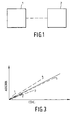
- Figure 1 shows an atomic absorption spectrophotometer according to the invention which comprises a commercial atomic absorption spectrophotometer 1, which may be any convenient instrument, for example that sold by Philips Scientific under the type reference PU9400X.
- the atomic absorption spectrophotometer is connected to a computer 2 which may be an IBM PC compatible computer available from many manufacturers and which will include an input device such as a keyboard and a video display unit (VDU) for numerical or graphical display of measurements and/or instrument parameters.
- the computer 2 is arranged to receive the analytical results from the spectrophotometer 1 either by direct connection or by entry of the results read from the spectrophotometer by an analyst and entered into the computer 2 via its keyboard.
- the computer 2 may contain software for enabling the analysis of results and storage means for storing the results either temporarily in RAM or semi-permanently on floppy or hard discs. Further, a printer may be provided to enable hard copies of the results to be obtained.
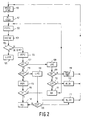
- the computer 2 also contains software for carrying out parts of the method illustrated in the flow diagram shown in Figure 2.
- the analysis of samples by atomic absorption spectroscopy is a comparative technique, that is the determination of the concentration of a given element in a sample is carried out by comparing the absorption produced by the sample with that produced by a standard.
- the absorption of a number of standards of differing concentrations typically between 4 and 6 inclusive, is measured and a graph of absorption against concentration is obtained. The absorption of the sample is then measured and the concentration determined by means of the graph.
- the present invention is concerned with the validation of the calibration line and the determination of the reasons causing a non-valid calibration line.
- the method in its various aspects can diagnose the calibration line as one of the following:
- the analyst can then decide on the next appropriate steps to take.
- the analyst will proceed to measuring the unknown samples confident that the calibration curve can be relied on.
- the analyst may repeat the measurement of the standards and if that does not produce a satisfactory line will then investigate whether the standards have been properly prepared or have become contaminated or whether different instrumental parameters might give better precision.
- a remeasurement of the standards may be undertaken together with investigation of the blank solution and instrumental parameters.
- the analyst may again remeasure and/or change instrumental parameters in an attempt to obtain a straight line calibration curve or may accept a curved line and use a polynomial curve fitting routine.
- the analyst may restrict the measurement of samples to the linear portion of the calibration curve, that is only accept as a valid measurement samples of a concentration which lie on the straight line portion.
- the analyst may use a calibration line which ignores the outlier point(s).
- aqueous standards In atomic absorption spectroscopy it is often convenient to use aqueous standards but the samples may be in other matrices. For example, when measuring say lead in blood or in urine. These other matrices may interfere with the measured results giving erroneous values if a comparison with aqueous standards is used.
- the use of the technique of standards addition is known. This involves the construction of a further calibration line based on the measurement of the absorption of the sample to which has been added a given volume of a standard of known concentration. A plurality of these measurements are made with standards having different concentrations and a calibration line known as the standards addition line is produced. This is tested in a similar way to the normal calibration line.
- FIG. 2 is a flow diagram illustrating the method according to the invention when applied to atomic absorption spectroscopy.
- the first step of the method MEAS.STAN (Box 100) is to measure the absorbance of each of a plurality of standards of different known concentrations.
- the second step PL.STAN (Box 101) is to plot the measured absorbance against concentration.
- this step may be purely conceptual in that a hard copy graph may not exist but merely be represented by data within the computer memory.
- the next step F.ST.L (Box 102) is to fit a straight line through the measured points and the origin using appropriate statistical techniques, for example the least squares method.
- a quality co-efficient is then calculated CALC.QC (Box 103).
- the quality co-efficient may for example be based on the co-efficient of quality proposed by Knecht and Stork.
- the quality co-efficient (QC) is defined as where y i is the measurement at each data point, y and i is the value predicted by the least squares line and N is the number of points, not including the zero point.
- Q.C O/K? (Box 104) to determine whether the calculated quality co-efficient is within a given limit, for example 5%. If the answer is YES then an indication is given that the calibration line is satisfactory and may be used for performing sample measurements U.LFM (Box 105).
- a proceed lamp may be illuminated on the spectrophotometer.
- the analyst can then re-measure the appropriate standard or ignore the outlier. If curvature of the line at high concentrations is detected then the procedure from box 102 may be repeated with the last point deleted. This procedure may be repeated a number of times provided that a sufficient number of calibration points remain.
- test 107 and 115 cannot be used with fewer than four standards since the probability of the occurrence of each permutation is too high. Consequently, with four standards only test 107 can be used since for test 115 only three slopes are left.
- n ⁇ 4? is YES then the calibration line is fitted using a robust regression method, such as the least medium of squares, LMS (Box 118) and a test is then made to determine whether the zero concentration absorbance is an outlier 00? (Box 120). If it is then a blank problem is indicated BL.PR (Box 117) and if it is not then a non-linear calibration line is indicated NLL (Box 116).
- LMS least medium of squares
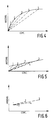
- the tests 107 and 115 are based on the probability that if the calibration line is linear the measured points will be randomly distributed around the regression line as illustrated in Figure 3. This has the consequence that the slope of the line joining the measurement points to the origin will be ranked randomly. That is in Figure 3 slope 1>slope 4>slope 5>slope 2> slope 3. However, when there is systematic curvature as in Figure 4 there will be ordered ranking. That is slope 1>slope 2> slope 3>slope 4>slope 5. There are n! different permutations possible where n is the number of measurement points. In other words, the slopes can be ranked in n! different ways. Consequently, each of these rankings has a probability of 1/n!.
- permutations containg up to three inversions of successive slopes, for example 2>1>4>3>6>5, may be allowed while maintaining a probability of rejecting a straight line incorrectly of less than 5%.
- the test 115 is used to distinguish between a curved calibration line and a straight line which does not pass through the origin and hence is either a standards addition line or is a calibration line where a blank problem exists.
- the curve shown in Figure 5 is considered the slopes of standards 1 to 5 are ordered. That is slope 1>slope 2>slope 3> slope 4>slope 5.
- the slopes are now measured with respect to standard 1, then they become random. That is slope 3> slope 5>slope 4>slope 2.
- this test In order for this test to be valid at least four standards need to be measured. If less than four standards are measured, the probability of incorrectly rejecting a straight line becomes high and test 115 is less useful.
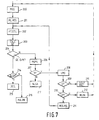
- a similar procedure is followed for a standards addition line and is illustrated in Figure 7.
- the first step is to measure the absorbance of a sample and the absorbance of a plurality of standards added to the sample MSS (Box 200).
- the measured results are then plotted PL.RES (Box 201) and a straight line fitted to the plotted points using an appropriate statistical technique FT.ST.L (Box 202).
- a quality co-efficient is then calculated CALC.QC (Box 203) and then tested to determine whether it falls within a given limit QC O/K? (Box 204). If it does then the slope of the standards addition line is compared with that of the aqueous standards calibration line SLSA?
- reference 1 represents an X-ray spectrometer such as that sold by Philips Analytical under the type reference PW 1480 rather than an atomic absorption spectrometer.
- X-ray spectrometry is, like atomic absorption spectrometry, a comparative technique and the intensity of X-rays received by the detector is an indication of the concentration of the sample.
- a calibration curve is required in order to determine the concentration of a selected substance in a sample.
- the intensity of the X-rays received by the detector for a series of standards of varying concentrations is measured and plotted to produce a graph of intensity against concentration in similar fashion to the atomic absorption calibration curve of absorption against concentration.
- the concentration of a given sample can then be determined by measuring the received X-ray intensity and reading off the calibration curve the corresponding concentration.
- the same conditions apply when producing the calibration curve for X-ray spectrometry as when producing that for atomic absorption spectroscopy though the steps taken to correct for unsatisfactory calibration curves may differ in view of the different analytical techniques and physical principles on which they are founded.
Landscapes
- Physics & Mathematics (AREA)
- Engineering & Computer Science (AREA)
- Mathematical Physics (AREA)
- Theoretical Computer Science (AREA)
- Spectroscopy & Molecular Physics (AREA)
- Health & Medical Sciences (AREA)
- Life Sciences & Earth Sciences (AREA)
- Chemical & Material Sciences (AREA)
- Analytical Chemistry (AREA)
- Biochemistry (AREA)
- General Health & Medical Sciences (AREA)
- General Physics & Mathematics (AREA)
- Immunology (AREA)
- Pathology (AREA)
- Investigating Or Analysing Materials By Optical Means (AREA)
- Analysing Materials By The Use Of Radiation (AREA)
Claims (17)
- Verfahren zur Eichung eines Analysegerätes, bei dem eine vergleichende Technik angewendet wird, um einen Bestandteil einer Probe zu ermitteln, wobei das Verfahren die folgenden Schritte umfaßt:a) Messen eines Merkmals von einer Vielzahl von Standards mit unterschiedlichen nominalen Werten;b) Speichern des gemessenen Merkmals in Verbindung mit seinem entsprechenden nominalen Wert;c) Ermitteln einer besten geraden Eichkurve unter Verwendung der gespeicherten Werte mit Hilfe statistischer Verfahren; undd) Bestimmen der Qualität der Eichkurve, gekennzeichnet durch die Durchführung der folgenden weiteren Schritte, wenn die Qualität der Eichkurve nicht akzeptabel ist:e) Bestimmen der Steigungen der Linien, die jeden der Punkte, welche die gespeicherten gemessenen Merkmale und die nominalen Werte darstellen, mit dem Ursprung verbinden;f) Bestimmen, ob die Steigungen eine bestimmte Reihenfolge haben und, wenn dies der Fall ist,g) Bestimmen der Steigung von jeder der Linien, die die Punkte verbinden, welche die gespeicherten Meßwerte und die nominalen Werte in Bezug auf den Punkt darstellen, der das erste gespeicherte gemessene Merkmal und den nominalen Wert darstellt;h) Bestimmen, ob die Steigungen eine bestimmte Reihenfolge haben, und wenn dies der Fall ist,i) Angeben der Krümmung der Eichkurve, oder, wenn dies nicht der Fall ist,j) Angeben, dass die Eichkurve nicht durch den Ursprung verläuft.
- Verfahren nach Anspruch 1, bei dem die Vielzahl größer oder gleich vier ist.
- Verfahren nach Anspruch 1 oder 2, bei dem die Vielzahl kleiner oder gleich 6 ist.
- Verfahren nach einem der vorhergehenden Ansprüche, bei dem das statistische Verfahren aus Schritt c) das Verfahren der kleinsten Quadrate ist.
- Verfahren nach einem der vorhergehenden Ansprüche, bei dem das Analysegerät ein Atomabsorptionsspektrophotometer ist, der gemessene charakteristische Wert die Absorption des Standards ist und der nominale Wert die Konzentration des Standards ist.
- Verfahren nach Anspruch 5, bei dem ein robustes Regressionsverfahren angewendet wird, um die gerade Linie an die Kurve anzupassen, und bei dem auf die Krümmung der Eichkurve bei höheren Konzentrationen hingewiesen wird, wenn (ein) Ausreißer bei den maximalen Standardkonzentrationen erkannt (wird) werden.
- Verfahren nach Anspruch 6, bei dem auf ein Blindlösungsproblem hingewiesen wird, wenn eine Konzentration und eine Absorption von null als Ausreißer erkannt werden.
- Verfahren nach einem der Ansprüche 1 bis 4, bei dem das Analysegerät ein Röntgenspektrometer ist, das gemessene Merkmal die Intensität der durch den Detektor erfaßten Röntgenstrahlung vom Standard ist und der nominale Wert die Konzentration des Standards ist.
- Atomabsorptionsspektrophotometer mit Mitteln zum Speichern der gemessenen Absorptionswerte einer Vielzahl von Standards in Verbindung mit den Konzentrationswerten der jeweiligen Standards, mit Mitteln zum Bestimmen der besten geraden Eichkurve mit Hilfe statistischer Verfahren, mit Mitteln zum Bestimmen der Qualität der Eichkurve, Mitteln zum Bestimmen des Verhältnisses der Absorption zur Konzentration für jeden der gemessenen Standards, Mitteln zum Bestimmen, ob die Verhältnisse eine bestimmte Reihenfolge haben, und mit Mitteln zum Bestimmen, ob das Verhältnis von jedem der gemessenen Standards in Bezug auf den ersten gemessenen Standard eine bestimmte Reihenfolge hat.
- Atomabsorptionsspektrophotometer nach Anspruch 9, bei dem zwischen vier und sechs Proben vorliegen.
- Atomabsorptionsspektrophotometer nach den Ansprüchen 9 und 10, bei dem das statistische Verfahren das Verfahren der kleinsten Quadrate ist.
- Atomabsorptionsspektrophotometer nach einem der vorhergehenden Ansprüche 9 bis 11 mit Mitteln zur Anwendung eines robusten Regressionsverfahrens auf die gemessenen Punkte, wenn die Qualität der Eichkurve nicht akzeptabel ist und die Verhältnisse nicht geordnet sind, und mit Mitteln zum Erkennen, ob und an welcher Stelle ein Ausreißer auftritt, wobei, wenn ein Ausreißer bei der Probe mit der höchsten Konzentration erkannt wird, auf eine Krümmung der Eichkurve bei hohen Konzentrationen hingewiesen wird.
- Atomabsorptionsspektrophotometer nach Anspruch 12 mit Mitteln zum Angeben der Region einer linearen Eichkurve.
- Atomabsorptionsspektrophotometer nach Anspruch 11 oder 12 mit Mitteln zum Angeben eines Blindlösungsproblems, wenn bei einer Konzentration von null eine Absorption von null als Ausreißer erkannt wird.
- Atomabsorptionspektrophotometer nach einem der Ansprüche 9 bis 14 mit Mitteln zum Speichern der gemessenen Absorptionswerte einer Vielzahl von Standards, die zu der Probe hinzugefügt wurden, mit Mitteln, um mit Hilfe von statistischen Verfahren eine beste gerade Standardadditionslinie zu bestimmen, und mit Mitteln, um zu bestimmen, ob die Steigungen von jeder gemessenen Probe plus Standard-Punkt in Bezug auf den Probenpunkt in einer bestimmten Reihenfolge liegen.
- Atomabsorptionsspektrophotometer nach Anspruch 15 mit Mitteln, um die Qualität der Standardadditionslinie zu bestimmen und um ihre Steigung mit der Steigung der Eichkurve zu vergleichen, wenn beide ausreichend sind, um zu bestimmen, ob Matrixinterferenzprobleme existieren.
- Atomabsorptionsspektrophotometer nach Anspruch 16, bei dem das statistische Verfahren das Verfahren der kleinsten Quadrate ist.
Applications Claiming Priority (2)
| Application Number | Priority Date | Filing Date | Title |
|---|---|---|---|
| GB9008922A GB2243211A (en) | 1990-04-20 | 1990-04-20 | Analytical instrument and method of calibrating an analytical instrument |
| GB9008922 | 1990-04-20 |
Publications (3)
| Publication Number | Publication Date |
|---|---|
| EP0453036A2 EP0453036A2 (de) | 1991-10-23 |
| EP0453036A3 EP0453036A3 (en) | 1991-12-11 |
| EP0453036B1 true EP0453036B1 (de) | 1999-12-01 |
Family
ID=10674743
Family Applications (1)
| Application Number | Title | Priority Date | Filing Date |
|---|---|---|---|
| EP91200880A Expired - Lifetime EP0453036B1 (de) | 1990-04-20 | 1991-04-15 | Analysegerät und Verfahren zur Eichung eines Analysegerätes |
Country Status (6)
| Country | Link |
|---|---|
| US (2) | US5210778A (de) |
| EP (1) | EP0453036B1 (de) |
| JP (1) | JP3081270B2 (de) |
| AU (1) | AU648545B2 (de) |
| DE (1) | DE69131806T2 (de) |
| GB (1) | GB2243211A (de) |
Families Citing this family (159)
| Publication number | Priority date | Publication date | Assignee | Title |
|---|---|---|---|---|
| CA2133412A1 (en) * | 1992-04-16 | 1993-10-28 | Kenneth R. Beebe | Improved method for interpreting complex data and detecting abnormal instrument or process behavior |
| US5325314A (en) * | 1992-09-11 | 1994-06-28 | Delco Electronics Corporation | Electronic gauge transform |
| JP3658778B2 (ja) * | 1993-08-27 | 2005-06-08 | 日立工機株式会社 | 遠心分離機及び遠心分離機制御方法 |
| US5606164A (en) * | 1996-01-16 | 1997-02-25 | Boehringer Mannheim Corporation | Method and apparatus for biological fluid analyte concentration measurement using generalized distance outlier detection |
| US6240306B1 (en) | 1995-08-09 | 2001-05-29 | Rio Grande Medical Technologies, Inc. | Method and apparatus for non-invasive blood analyte measurement with fluid compartment equilibration |
| US5732231A (en) * | 1996-04-26 | 1998-03-24 | Harry Evans, III | Funeral home display monitor apparatus |
| US5866899A (en) * | 1996-09-12 | 1999-02-02 | Advanced Micro Devices, Inc. | Concentration measurement apparatus calibration method |
| US5841016A (en) * | 1996-09-12 | 1998-11-24 | Advanced Micro Devices, Inc. | Ultra-low level standard for concentration measurements |
| US5838008A (en) * | 1996-12-18 | 1998-11-17 | University Of Wollongong | Method and apparatus for measuring gas concentrations and isotope ratios in gases |
| AU738477B2 (en) * | 1996-12-18 | 2001-09-20 | University Of Wollongong, The | Method and apparatus for measuring gas concentrations and isotope ratios in gases |
| US7890158B2 (en) | 2001-06-05 | 2011-02-15 | Lumidigm, Inc. | Apparatus and method of biometric determination using specialized optical spectroscopy systems |
| US6628809B1 (en) | 1999-10-08 | 2003-09-30 | Lumidigm, Inc. | Apparatus and method for identification of individuals by near-infrared spectrum |
| DE19729546C1 (de) * | 1997-07-10 | 1998-12-10 | Karlsruhe Forschzent | Verfahren zur Messung von Chrom in Gerbereilösungen und Berechnung der Chromkonzentration im Leder, sowie die Verwendung des Verfahrens |
| US7098037B2 (en) | 1998-10-13 | 2006-08-29 | Inlight Solutions, Inc. | Accommodating subject and instrument variations in spectroscopic determinations |
| US6157041A (en) | 1998-10-13 | 2000-12-05 | Rio Grande Medical Technologies, Inc. | Methods and apparatus for tailoring spectroscopic calibration models |
| US6441388B1 (en) | 1998-10-13 | 2002-08-27 | Rio Grande Medical Technologies, Inc. | Methods and apparatus for spectroscopic calibration model transfer |
| RU2161791C2 (ru) * | 1998-12-30 | 2001-01-10 | Василевский Александр Михайлович | Устройство для мониторинга жидкой биологической среды |
| US6816605B2 (en) | 1999-10-08 | 2004-11-09 | Lumidigm, Inc. | Methods and systems for biometric identification of individuals using linear optical spectroscopy |
| US6519543B1 (en) | 2000-05-09 | 2003-02-11 | Agere Systems Inc. | Calibration method for quantitative elemental analysis |
| US6603119B1 (en) | 2000-05-09 | 2003-08-05 | Agere Systems Inc. | Calibration method for quantitative elemental analysis |
| US6519542B1 (en) * | 2000-05-09 | 2003-02-11 | Agere Systems Inc | Method of testing an unknown sample with an analytical tool |
| US6574490B2 (en) | 2001-04-11 | 2003-06-03 | Rio Grande Medical Technologies, Inc. | System for non-invasive measurement of glucose in humans |
| US6865408B1 (en) | 2001-04-11 | 2005-03-08 | Inlight Solutions, Inc. | System for non-invasive measurement of glucose in humans |
| US7126682B2 (en) | 2001-04-11 | 2006-10-24 | Rio Grande Medical Technologies, Inc. | Encoded variable filter spectrometer |
| US6983176B2 (en) | 2001-04-11 | 2006-01-03 | Rio Grande Medical Technologies, Inc. | Optically similar reference samples and related methods for multivariate calibration models used in optical spectroscopy |
| US6862091B2 (en) | 2001-04-11 | 2005-03-01 | Inlight Solutions, Inc. | Illumination device and method for spectroscopic analysis |
| RU2212029C1 (ru) * | 2001-12-03 | 2003-09-10 | Общество с ограниченной ответственностью "Клиника экстракорпоральной гемокоррекции" | Способ анализа жидкой биологической среды в процессе мониторинга |
| US7027848B2 (en) | 2002-04-04 | 2006-04-11 | Inlight Solutions, Inc. | Apparatus and method for non-invasive spectroscopic measurement of analytes in tissue using a matched reference analyte |
| US7620212B1 (en) | 2002-08-13 | 2009-11-17 | Lumidigm, Inc. | Electro-optical sensor |
| US20040254479A1 (en) * | 2003-02-20 | 2004-12-16 | John Fralick | Bio-photonic feedback control software and database |
| US7627151B2 (en) | 2003-04-04 | 2009-12-01 | Lumidigm, Inc. | Systems and methods for improved biometric feature definition |
| US7394919B2 (en) | 2004-06-01 | 2008-07-01 | Lumidigm, Inc. | Multispectral biometric imaging |
| US7668350B2 (en) | 2003-04-04 | 2010-02-23 | Lumidigm, Inc. | Comparative texture analysis of tissue for biometric spoof detection |
| WO2004090786A2 (en) | 2003-04-04 | 2004-10-21 | Lumidigm, Inc. | Multispectral biometric sensor |
| US7347365B2 (en) | 2003-04-04 | 2008-03-25 | Lumidigm, Inc. | Combined total-internal-reflectance and tissue imaging systems and methods |
| US7545963B2 (en) | 2003-04-04 | 2009-06-09 | Lumidigm, Inc. | Texture-biometrics sensor |
| US7751594B2 (en) | 2003-04-04 | 2010-07-06 | Lumidigm, Inc. | White-light spectral biometric sensors |
| US7539330B2 (en) | 2004-06-01 | 2009-05-26 | Lumidigm, Inc. | Multispectral liveness determination |
| US7460696B2 (en) | 2004-06-01 | 2008-12-02 | Lumidigm, Inc. | Multispectral imaging biometrics |
| US20190357827A1 (en) | 2003-08-01 | 2019-11-28 | Dexcom, Inc. | Analyte sensor |
| US8060173B2 (en) | 2003-08-01 | 2011-11-15 | Dexcom, Inc. | System and methods for processing analyte sensor data |
| US7299082B2 (en) * | 2003-10-31 | 2007-11-20 | Abbott Diabetes Care, Inc. | Method of calibrating an analyte-measurement device, and associated methods, devices and systems |
| US7263213B2 (en) | 2003-12-11 | 2007-08-28 | Lumidigm, Inc. | Methods and systems for estimation of personal characteristics from biometric measurements |
| US20050197580A1 (en) | 2004-02-19 | 2005-09-08 | Scott Ferguson | Synthetic calibration standard for photonic response of tissues |
| US20050278184A1 (en) * | 2004-06-10 | 2005-12-15 | John Fralick | Bio-photonic feedback control software and database |
| US7508965B2 (en) | 2004-06-01 | 2009-03-24 | Lumidigm, Inc. | System and method for robust fingerprint acquisition |
| US8229185B2 (en) | 2004-06-01 | 2012-07-24 | Lumidigm, Inc. | Hygienic biometric sensors |
| US7039561B2 (en) * | 2004-06-10 | 2006-05-02 | Dade Behring Inc. | Outlier rejection method in an automatic clinical analyzer |
| US8787630B2 (en) | 2004-08-11 | 2014-07-22 | Lumidigm, Inc. | Multispectral barcode imaging |
| MX2007002213A (es) * | 2004-08-25 | 2007-05-04 | Environmental Syst Prod | Sistema y metodo para calibrar instrumentos detectores de emisiones remotas. |
| US9636450B2 (en) | 2007-02-19 | 2017-05-02 | Udo Hoss | Pump system modular components for delivering medication and analyte sensing at seperate insertion sites |
| US20100331646A1 (en) * | 2009-06-30 | 2010-12-30 | Abbott Diabetes Care Inc. | Health Management Devices and Methods |
| US20070103678A1 (en) * | 2005-02-14 | 2007-05-10 | Sterling Bernhard B | Analyte detection system with interferent identification and correction |
| US7801338B2 (en) | 2005-04-27 | 2010-09-21 | Lumidigm, Inc. | Multispectral biometric sensors |
| JP4951216B2 (ja) * | 2005-07-05 | 2012-06-13 | シスメックス株式会社 | 臨床検査情報処理装置及びシステム、分析装置、並びに臨床検査情報処理用のプログラム |
| CA2620586A1 (en) | 2005-08-31 | 2007-03-08 | Boris P. Kovatchev | Improving the accuracy of continuous glucose sensors |
| US8880138B2 (en) | 2005-09-30 | 2014-11-04 | Abbott Diabetes Care Inc. | Device for channeling fluid and methods of use |
| DE102005054443B4 (de) * | 2005-11-15 | 2013-09-26 | Fachhochschule Münster | Standardsatz zur Kalibrierung, Verfahren zur Herstellung und Verwendung von Standardsätzen |
| US7736310B2 (en) | 2006-01-30 | 2010-06-15 | Abbott Diabetes Care Inc. | On-body medical device securement |
| US7885698B2 (en) | 2006-02-28 | 2011-02-08 | Abbott Diabetes Care Inc. | Method and system for providing continuous calibration of implantable analyte sensors |
| US7826879B2 (en) | 2006-02-28 | 2010-11-02 | Abbott Diabetes Care Inc. | Analyte sensors and methods of use |
| US7981034B2 (en) | 2006-02-28 | 2011-07-19 | Abbott Diabetes Care Inc. | Smart messages and alerts for an infusion delivery and management system |
| US8219173B2 (en) | 2008-09-30 | 2012-07-10 | Abbott Diabetes Care Inc. | Optimizing analyte sensor calibration |
| US9675290B2 (en) | 2012-10-30 | 2017-06-13 | Abbott Diabetes Care Inc. | Sensitivity calibration of in vivo sensors used to measure analyte concentration |
| US8346335B2 (en) | 2008-03-28 | 2013-01-01 | Abbott Diabetes Care Inc. | Analyte sensor calibration management |
| US8473022B2 (en) | 2008-01-31 | 2013-06-25 | Abbott Diabetes Care Inc. | Analyte sensor with time lag compensation |
| US8224415B2 (en) | 2009-01-29 | 2012-07-17 | Abbott Diabetes Care Inc. | Method and device for providing offset model based calibration for analyte sensor |
| US8478557B2 (en) | 2009-07-31 | 2013-07-02 | Abbott Diabetes Care Inc. | Method and apparatus for providing analyte monitoring system calibration accuracy |
| US7630748B2 (en) | 2006-10-25 | 2009-12-08 | Abbott Diabetes Care Inc. | Method and system for providing analyte monitoring |
| US7618369B2 (en) | 2006-10-02 | 2009-11-17 | Abbott Diabetes Care Inc. | Method and system for dynamically updating calibration parameters for an analyte sensor |
| US7653425B2 (en) | 2006-08-09 | 2010-01-26 | Abbott Diabetes Care Inc. | Method and system for providing calibration of an analyte sensor in an analyte monitoring system |
| US8374668B1 (en) | 2007-10-23 | 2013-02-12 | Abbott Diabetes Care Inc. | Analyte sensor with lag compensation |
| US8140312B2 (en) | 2007-05-14 | 2012-03-20 | Abbott Diabetes Care Inc. | Method and system for determining analyte levels |
| US9392969B2 (en) | 2008-08-31 | 2016-07-19 | Abbott Diabetes Care Inc. | Closed loop control and signal attenuation detection |
| KR101349892B1 (ko) | 2006-07-19 | 2014-01-13 | 루미다임 인크. | 다중 생체인식 다중 스펙트럼 이미저 |
| US7995808B2 (en) | 2006-07-19 | 2011-08-09 | Lumidigm, Inc. | Contactless multispectral biometric capture |
| US8175346B2 (en) | 2006-07-19 | 2012-05-08 | Lumidigm, Inc. | Whole-hand multispectral biometric imaging |
| US8355545B2 (en) | 2007-04-10 | 2013-01-15 | Lumidigm, Inc. | Biometric detection using spatial, temporal, and/or spectral techniques |
| US7804984B2 (en) | 2006-07-31 | 2010-09-28 | Lumidigm, Inc. | Spatial-spectral fingerprint spoof detection |
| US7801339B2 (en) | 2006-07-31 | 2010-09-21 | Lumidigm, Inc. | Biometrics with spatiospectral spoof detection |
| US8206296B2 (en) | 2006-08-07 | 2012-06-26 | Abbott Diabetes Care Inc. | Method and system for providing integrated analyte monitoring and infusion system therapy management |
| US8932216B2 (en) | 2006-08-07 | 2015-01-13 | Abbott Diabetes Care Inc. | Method and system for providing data management in integrated analyte monitoring and infusion system |
| AU2007308804A1 (en) | 2006-10-26 | 2008-05-02 | Abbott Diabetes Care, Inc. | Method, system and computer program product for real-time detection of sensitivity decline in analyte sensors |
| US8732188B2 (en) | 2007-02-18 | 2014-05-20 | Abbott Diabetes Care Inc. | Method and system for providing contextual based medication dosage determination |
| US8930203B2 (en) | 2007-02-18 | 2015-01-06 | Abbott Diabetes Care Inc. | Multi-function analyte test device and methods therefor |
| KR101484566B1 (ko) | 2007-03-21 | 2015-01-20 | 루미다임 인크. | 국소적으로 일관된 피처를 기초로 하는 생체인식 |
| CA2683959C (en) | 2007-04-14 | 2017-08-29 | Abbott Diabetes Care Inc. | Method and apparatus for providing data processing and control in medical communication system |
| WO2008130898A1 (en) | 2007-04-14 | 2008-10-30 | Abbott Diabetes Care, Inc. | Method and apparatus for providing data processing and control in medical communication system |
| ES2461090T3 (es) | 2007-04-14 | 2014-05-16 | Abbott Diabetes Care Inc. | Procedimiento y aparato para proporcionar tratamiento y control de datos en un sistema de comunicación médica |
| WO2009096992A1 (en) | 2007-04-14 | 2009-08-06 | Abbott Diabetes Care, Inc. | Method and apparatus for providing data processing and control in medical communication system |
| US10002233B2 (en) | 2007-05-14 | 2018-06-19 | Abbott Diabetes Care Inc. | Method and apparatus for providing data processing and control in a medical communication system |
| US8103471B2 (en) | 2007-05-14 | 2012-01-24 | Abbott Diabetes Care Inc. | Method and apparatus for providing data processing and control in a medical communication system |
| US8239166B2 (en) | 2007-05-14 | 2012-08-07 | Abbott Diabetes Care Inc. | Method and apparatus for providing data processing and control in a medical communication system |
| US8444560B2 (en) | 2007-05-14 | 2013-05-21 | Abbott Diabetes Care Inc. | Method and apparatus for providing data processing and control in a medical communication system |
| US8560038B2 (en) | 2007-05-14 | 2013-10-15 | Abbott Diabetes Care Inc. | Method and apparatus for providing data processing and control in a medical communication system |
| US8600681B2 (en) | 2007-05-14 | 2013-12-03 | Abbott Diabetes Care Inc. | Method and apparatus for providing data processing and control in a medical communication system |
| US8260558B2 (en) | 2007-05-14 | 2012-09-04 | Abbott Diabetes Care Inc. | Method and apparatus for providing data processing and control in a medical communication system |
| US9125548B2 (en) | 2007-05-14 | 2015-09-08 | Abbott Diabetes Care Inc. | Method and apparatus for providing data processing and control in a medical communication system |
| US8026382B2 (en) * | 2007-05-18 | 2011-09-27 | Heidi Kay | Lipid raft, caveolin protein, and caveolar function modulation compounds and associated synthetic and therapeutic methods |
| US8597190B2 (en) | 2007-05-18 | 2013-12-03 | Optiscan Biomedical Corporation | Monitoring systems and methods with fast initialization |
| US8160900B2 (en) | 2007-06-29 | 2012-04-17 | Abbott Diabetes Care Inc. | Analyte monitoring and management device and method to analyze the frequency of user interaction with the device |
| US8834366B2 (en) | 2007-07-31 | 2014-09-16 | Abbott Diabetes Care Inc. | Method and apparatus for providing analyte sensor calibration |
| WO2009049245A1 (en) * | 2007-10-11 | 2009-04-16 | Optiscan Biomedical Corporation | Synchronization and configuration of patient monitoring devices |
| US8216138B1 (en) | 2007-10-23 | 2012-07-10 | Abbott Diabetes Care Inc. | Correlation of alternative site blood and interstitial fluid glucose concentrations to venous glucose concentration |
| US8409093B2 (en) | 2007-10-23 | 2013-04-02 | Abbott Diabetes Care Inc. | Assessing measures of glycemic variability |
| US8377031B2 (en) | 2007-10-23 | 2013-02-19 | Abbott Diabetes Care Inc. | Closed loop control system with safety parameters and methods |
| US20090164239A1 (en) | 2007-12-19 | 2009-06-25 | Abbott Diabetes Care, Inc. | Dynamic Display Of Glucose Information |
| US8591410B2 (en) | 2008-05-30 | 2013-11-26 | Abbott Diabetes Care Inc. | Method and apparatus for providing glycemic control |
| US8924159B2 (en) | 2008-05-30 | 2014-12-30 | Abbott Diabetes Care Inc. | Method and apparatus for providing glycemic control |
| US8876755B2 (en) | 2008-07-14 | 2014-11-04 | Abbott Diabetes Care Inc. | Closed loop control system interface and methods |
| US8734422B2 (en) | 2008-08-31 | 2014-05-27 | Abbott Diabetes Care Inc. | Closed loop control with improved alarm functions |
| US9943644B2 (en) | 2008-08-31 | 2018-04-17 | Abbott Diabetes Care Inc. | Closed loop control with reference measurement and methods thereof |
| US20100057040A1 (en) | 2008-08-31 | 2010-03-04 | Abbott Diabetes Care, Inc. | Robust Closed Loop Control And Methods |
| US8622988B2 (en) * | 2008-08-31 | 2014-01-07 | Abbott Diabetes Care Inc. | Variable rate closed loop control and methods |
| US8986208B2 (en) | 2008-09-30 | 2015-03-24 | Abbott Diabetes Care Inc. | Analyte sensor sensitivity attenuation mitigation |
| US9326707B2 (en) | 2008-11-10 | 2016-05-03 | Abbott Diabetes Care Inc. | Alarm characterization for analyte monitoring devices and systems |
| US8103456B2 (en) | 2009-01-29 | 2012-01-24 | Abbott Diabetes Care Inc. | Method and device for early signal attenuation detection using blood glucose measurements |
| US8497777B2 (en) | 2009-04-15 | 2013-07-30 | Abbott Diabetes Care Inc. | Analyte monitoring system having an alert |
| EP2419015A4 (de) | 2009-04-16 | 2014-08-20 | Abbott Diabetes Care Inc | Kalibrierung eines analytsensors |
| US8483967B2 (en) | 2009-04-29 | 2013-07-09 | Abbott Diabetes Care Inc. | Method and system for providing real time analyte sensor calibration with retrospective backfill |
| US8597274B2 (en) | 2009-05-22 | 2013-12-03 | Abbott Diabetes Care Inc. | Usability features for integrated insulin delivery system |
| US8538727B2 (en) | 2009-07-21 | 2013-09-17 | George S. Cembrowski | Method and apparatus for calibration and testing of scientific measurement equipment |
| US11042605B2 (en) | 2009-07-21 | 2021-06-22 | Ccqcc Corp. | Method and apparatus for calibration and testing of scientific measurement equipment |
| DK3173014T4 (da) | 2009-07-23 | 2026-03-30 | Abbott Diabetes Care Inc | Realtidsstyring af data vedrørende fysiologisk kontrol af glucoseniveauer |
| EP3689237B1 (de) | 2009-07-23 | 2021-05-19 | Abbott Diabetes Care, Inc. | Herstellungsverfahren und system zur kontinuierlichen analytmessung |
| US8872908B2 (en) | 2009-08-26 | 2014-10-28 | Lumidigm, Inc | Dual-imager biometric sensor |
| EP4070727B1 (de) | 2009-08-31 | 2023-07-05 | Abbott Diabetes Care, Inc. | Anzeigeeinheiten für ein medizinisches gerät |
| US9320461B2 (en) | 2009-09-29 | 2016-04-26 | Abbott Diabetes Care Inc. | Method and apparatus for providing notification function in analyte monitoring systems |
| WO2011053881A1 (en) | 2009-10-30 | 2011-05-05 | Abbott Diabetes Care Inc. | Method and apparatus for detecting false hypoglycemic conditions |
| US20110184265A1 (en) * | 2010-01-22 | 2011-07-28 | Abbott Diabetes Care Inc. | Method and Apparatus for Providing Notification in Analyte Monitoring Systems |
| WO2011112753A1 (en) | 2010-03-10 | 2011-09-15 | Abbott Diabetes Care Inc. | Systems, devices and methods for managing glucose levels |
| US8570149B2 (en) | 2010-03-16 | 2013-10-29 | Lumidigm, Inc. | Biometric imaging using an optical adaptive interface |
| US8635046B2 (en) | 2010-06-23 | 2014-01-21 | Abbott Diabetes Care Inc. | Method and system for evaluating analyte sensor response characteristics |
| US10092229B2 (en) | 2010-06-29 | 2018-10-09 | Abbott Diabetes Care Inc. | Calibration of analyte measurement system |
| WO2012048168A2 (en) | 2010-10-07 | 2012-04-12 | Abbott Diabetes Care Inc. | Analyte monitoring devices and methods |
| US10136845B2 (en) | 2011-02-28 | 2018-11-27 | Abbott Diabetes Care Inc. | Devices, systems, and methods associated with analyte monitoring devices and devices incorporating the same |
| EP3575796B1 (de) | 2011-04-15 | 2020-11-11 | DexCom, Inc. | Erweiterte analytsensorkalibrierung und fehlererkennung |
| EP4122384A1 (de) | 2011-06-16 | 2023-01-25 | Abbott Diabetes Care, Inc. | Analytüberwachungsvorrichtungen, -verfahren und -systeme mit temperaturkompensation |
| US9622691B2 (en) | 2011-10-31 | 2017-04-18 | Abbott Diabetes Care Inc. | Model based variable risk false glucose threshold alarm prevention mechanism |
| US9317656B2 (en) | 2011-11-23 | 2016-04-19 | Abbott Diabetes Care Inc. | Compatibility mechanisms for devices in a continuous analyte monitoring system and methods thereof |
| US8710993B2 (en) | 2011-11-23 | 2014-04-29 | Abbott Diabetes Care Inc. | Mitigating single point failure of devices in an analyte monitoring system and methods thereof |
| WO2013078426A2 (en) | 2011-11-25 | 2013-05-30 | Abbott Diabetes Care Inc. | Analyte monitoring system and methods of use |
| US10132793B2 (en) | 2012-08-30 | 2018-11-20 | Abbott Diabetes Care Inc. | Dropout detection in continuous analyte monitoring data during data excursions |
| EP2901153A4 (de) | 2012-09-26 | 2016-04-27 | Abbott Diabetes Care Inc | Verfahren und vorrichtung zur verbesserung einer verzögerungskorrekturfunktion während der in-vivo-messung einer analytkonzentration mit analytkonzentrationsvariabilität und bereichsdaten |
| JP6328655B2 (ja) | 2012-11-15 | 2018-05-23 | オーソ・クリニカル・ダイアグノスティックス・インコーポレーテッド | 反応時間を使用してアッセイを較正すること |
| US9474475B1 (en) | 2013-03-15 | 2016-10-25 | Abbott Diabetes Care Inc. | Multi-rate analyte sensor data collection with sample rate configurable signal processing |
| US10076285B2 (en) | 2013-03-15 | 2018-09-18 | Abbott Diabetes Care Inc. | Sensor fault detection using analyte sensor data pattern comparison |
| US10433773B1 (en) | 2013-03-15 | 2019-10-08 | Abbott Diabetes Care Inc. | Noise rejection methods and apparatus for sparsely sampled analyte sensor data |
| AU2014374361B9 (en) | 2013-12-31 | 2019-07-04 | Abbott Diabetes Care Inc. | Self-powered analyte sensor and devices using the same |
| US20170185748A1 (en) | 2014-03-30 | 2017-06-29 | Abbott Diabetes Care Inc. | Method and Apparatus for Determining Meal Start and Peak Events in Analyte Monitoring Systems |
| US11553883B2 (en) | 2015-07-10 | 2023-01-17 | Abbott Diabetes Care Inc. | System, device and method of dynamic glucose profile response to physiological parameters |
| KR101999260B1 (ko) * | 2016-09-30 | 2019-07-12 | 삼성전자주식회사 | 검체 분석 장치 및 그 측정방법 |
| US11596330B2 (en) | 2017-03-21 | 2023-03-07 | Abbott Diabetes Care Inc. | Methods, devices and system for providing diabetic condition diagnosis and therapy |
| US11382540B2 (en) | 2017-10-24 | 2022-07-12 | Dexcom, Inc. | Pre-connected analyte sensors |
| US11331022B2 (en) | 2017-10-24 | 2022-05-17 | Dexcom, Inc. | Pre-connected analyte sensors |
| CN110940371B (zh) * | 2019-12-13 | 2020-08-21 | 浙江禾川科技股份有限公司 | 一种旋转磁电编码器的校准方法、装置及设备 |
| US12596084B2 (en) * | 2020-04-03 | 2026-04-07 | Decision Tree, Llc | Machine learning for high-energy interactions analysis |
| CN112462312B (zh) * | 2020-11-04 | 2021-08-06 | 胜达克半导体科技(上海)有限公司 | 一种用于芯片测试机的自动校准方法及其应用 |
| CN115060306B (zh) * | 2022-08-16 | 2022-11-08 | 北京万维盈创科技发展有限公司 | 模拟量校准方法、装置及模拟量采集设备 |
Family Cites Families (4)
| Publication number | Priority date | Publication date | Assignee | Title |
|---|---|---|---|---|
| JPS59157538A (ja) * | 1983-02-25 | 1984-09-06 | Hitachi Ltd | 標準添加法を適用し得る分析計 |
| FI74549C (fi) * | 1986-02-13 | 1988-02-08 | Vaisala Oy | Maetningsfoerfarande foer impedanser, saerskilt smao kapacitanser. |
| US4779216A (en) * | 1986-03-07 | 1988-10-18 | The Perkin-Elmer Corporation | System for calibrating a monochromator |
| US4892405A (en) * | 1988-10-12 | 1990-01-09 | Ntd Laboratories, Inc. | Method and apparatus for providing quality assurance and calibration assurance in a spectrophotometer |
-
1990
- 1990-04-20 GB GB9008922A patent/GB2243211A/en not_active Withdrawn
-
1991
- 1991-04-12 US US07/685,266 patent/US5210778A/en not_active Expired - Lifetime
- 1991-04-15 DE DE69131806T patent/DE69131806T2/de not_active Expired - Fee Related
- 1991-04-15 EP EP91200880A patent/EP0453036B1/de not_active Expired - Lifetime
- 1991-04-18 AU AU75073/91A patent/AU648545B2/en not_active Ceased
- 1991-04-20 JP JP03115229A patent/JP3081270B2/ja not_active Expired - Fee Related
-
1994
- 1994-07-14 US US08/275,099 patent/US5552997A/en not_active Expired - Lifetime
Also Published As
| Publication number | Publication date |
|---|---|
| GB9008922D0 (en) | 1990-06-20 |
| DE69131806T2 (de) | 2000-08-17 |
| AU648545B2 (en) | 1994-04-28 |
| GB2243211A (en) | 1991-10-23 |
| EP0453036A2 (de) | 1991-10-23 |
| US5552997A (en) | 1996-09-03 |
| US5210778A (en) | 1993-05-11 |
| JPH04230834A (ja) | 1992-08-19 |
| AU7507391A (en) | 1991-10-24 |
| DE69131806D1 (de) | 2000-01-05 |
| EP0453036A3 (en) | 1991-12-11 |
| JP3081270B2 (ja) | 2000-08-28 |
Similar Documents
| Publication | Publication Date | Title |
|---|---|---|
| EP0453036B1 (de) | Analysegerät und Verfahren zur Eichung eines Analysegerätes | |
| US5124932A (en) | Method for analyzing asymmetric clusters in spectral analysis | |
| Hancock et al. | The reliability paradox in assessing structural relations within covariance structure models | |
| JP3245157B2 (ja) | スペクトルデータの測定および補正 | |
| Frank et al. | Partial least squares solutions for multicomponent analysis | |
| WO1992007326A1 (en) | Method of estimating property and/or composition data of a test sample | |
| JPH08500898A (ja) | 複合データを解釈して異常な器機または処理挙動を検出する改良法 | |
| Master et al. | Compendium of international methods of wine and must analysis | |
| Penninckx et al. | Validation of the calibration procedure in atomic absorption spectrometric methods | |
| US7277807B2 (en) | Method for processing a set of spectra, particularly NMR spectra | |
| US4231663A (en) | Device for calibrating the photometric linearity of optical instruments | |
| US6787361B1 (en) | Clinical assay calibration adjustment method | |
| Westerhaus | Equation development | |
| JPH07151677A (ja) | 濃度計 | |
| JP2006023214A (ja) | 測定反応過程の異常の有無判定方法,該方法を実行可能な自動分析装置及び該方法のプログラムを記憶した記憶媒体 | |
| JP2005127757A (ja) | 自動分析装置 | |
| US5729342A (en) | Method of analyzing the concentration of components in a solution | |
| Lemeshko et al. | Extending the application of Grubbs-type tests in rejecting anomalous measurements | |
| US6671629B2 (en) | Method and device for measuring characteristics of a sample | |
| Synek et al. | Uncertainties of mercury determinations in biological materials using an atomic absorption spectrometer–AMA 254 | |
| Vankeerberghen et al. | Decision support system for run suitability checking and explorative method validation in electrothermal atomic absorption spectrometry | |
| Wolters et al. | Criterion for quantifying the reliability of analytical results in method development and evaluation | |
| Lendl et al. | Advancing from unsupervised, single variable-based to supervised, multivariate-based methods: A challenge for qualitative analysis | |
| Heydorn et al. | Verification of uncertainty budgets | |
| Vandeginste et al. | Multivariate calibration |
Legal Events
| Date | Code | Title | Description |
|---|---|---|---|
| PUAI | Public reference made under article 153(3) epc to a published international application that has entered the european phase |
Free format text: ORIGINAL CODE: 0009012 |
|
| AK | Designated contracting states |
Kind code of ref document: A2 Designated state(s): CH DE FR GB LI |
|
| PUAL | Search report despatched |
Free format text: ORIGINAL CODE: 0009013 |
|
| AK | Designated contracting states |
Kind code of ref document: A3 Designated state(s): CH DE FR GB LI |
|
| RAP3 | Party data changed (applicant data changed or rights of an application transferred) |
Owner name: N.V. PHILIPS' GLOEILAMPENFABRIEKEN Owner name: PHILIPS ELECTRONICS UK LIMITED |
|
| 17P | Request for examination filed |
Effective date: 19920610 |
|
| 17Q | First examination report despatched |
Effective date: 19950517 |
|
| RAP3 | Party data changed (applicant data changed or rights of an application transferred) |
Owner name: KONINKLIJKE PHILIPS ELECTRONICS N.V. Owner name: PHILIPS ELECTRONICS UK LIMITED |
|
| GRAG | Despatch of communication of intention to grant |
Free format text: ORIGINAL CODE: EPIDOS AGRA |
|
| GRAG | Despatch of communication of intention to grant |
Free format text: ORIGINAL CODE: EPIDOS AGRA |
|
| GRAG | Despatch of communication of intention to grant |
Free format text: ORIGINAL CODE: EPIDOS AGRA |
|
| GRAH | Despatch of communication of intention to grant a patent |
Free format text: ORIGINAL CODE: EPIDOS IGRA |
|
| RIC1 | Information provided on ipc code assigned before grant |
Free format text: 6G 01N 21/31 A, 6G 06F 19/00 B |
|
| GRAH | Despatch of communication of intention to grant a patent |
Free format text: ORIGINAL CODE: EPIDOS IGRA |
|
| GRAA | (expected) grant |
Free format text: ORIGINAL CODE: 0009210 |
|
| AK | Designated contracting states |
Kind code of ref document: B1 Designated state(s): CH DE FR GB LI |
|
| REG | Reference to a national code |
Ref country code: CH Ref legal event code: EP |
|
| REF | Corresponds to: |
Ref document number: 69131806 Country of ref document: DE Date of ref document: 20000105 |
|
| ET | Fr: translation filed | ||
| PLBE | No opposition filed within time limit |
Free format text: ORIGINAL CODE: 0009261 |
|
| STAA | Information on the status of an ep patent application or granted ep patent |
Free format text: STATUS: NO OPPOSITION FILED WITHIN TIME LIMIT |
|
| 26N | No opposition filed | ||
| REG | Reference to a national code |
Ref country code: GB Ref legal event code: IF02 |
|
| REG | Reference to a national code |
Ref country code: CH Ref legal event code: PUE Owner name: PANALYTICAL B.V. Free format text: KONINKLIJKE PHILIPS ELECTRONICS N.V.#GROENEWOUDSEWEG 1#5621 BA EINDHOVEN (NL) -TRANSFER TO- PANALYTICAL B.V.#LELYWEG 1#7602 EA ALMELO (NL) Ref country code: CH Ref legal event code: NV Representative=s name: INTERPAT LAW AG |
|
| REG | Reference to a national code |
Ref country code: GB Ref legal event code: 732E |
|
| REG | Reference to a national code |
Ref country code: FR Ref legal event code: TP |
|
| PGFP | Annual fee paid to national office [announced via postgrant information from national office to epo] |
Ref country code: GB Payment date: 20040414 Year of fee payment: 14 |
|
| PGFP | Annual fee paid to national office [announced via postgrant information from national office to epo] |
Ref country code: FR Payment date: 20040416 Year of fee payment: 14 |
|
| PGFP | Annual fee paid to national office [announced via postgrant information from national office to epo] |
Ref country code: CH Payment date: 20040505 Year of fee payment: 14 |
|
| PGFP | Annual fee paid to national office [announced via postgrant information from national office to epo] |
Ref country code: DE Payment date: 20040526 Year of fee payment: 14 |
|
| PG25 | Lapsed in a contracting state [announced via postgrant information from national office to epo] |
Ref country code: GB Free format text: LAPSE BECAUSE OF NON-PAYMENT OF DUE FEES Effective date: 20050415 |
|
| PG25 | Lapsed in a contracting state [announced via postgrant information from national office to epo] |
Ref country code: LI Free format text: LAPSE BECAUSE OF NON-PAYMENT OF DUE FEES Effective date: 20050430 Ref country code: CH Free format text: LAPSE BECAUSE OF NON-PAYMENT OF DUE FEES Effective date: 20050430 |
|
| PG25 | Lapsed in a contracting state [announced via postgrant information from national office to epo] |
Ref country code: DE Free format text: LAPSE BECAUSE OF NON-PAYMENT OF DUE FEES Effective date: 20051101 |
|
| REG | Reference to a national code |
Ref country code: CH Ref legal event code: PL |
|
| GBPC | Gb: european patent ceased through non-payment of renewal fee |
Effective date: 20050415 |
|
| PG25 | Lapsed in a contracting state [announced via postgrant information from national office to epo] |
Ref country code: FR Free format text: LAPSE BECAUSE OF NON-PAYMENT OF DUE FEES Effective date: 20051230 |
|
| REG | Reference to a national code |
Ref country code: FR Ref legal event code: ST Effective date: 20051230 |