EP0453093A2 - Speicherverwaltungsverfahren - Google Patents
Speicherverwaltungsverfahren Download PDFInfo
- Publication number
- EP0453093A2 EP0453093A2 EP91302278A EP91302278A EP0453093A2 EP 0453093 A2 EP0453093 A2 EP 0453093A2 EP 91302278 A EP91302278 A EP 91302278A EP 91302278 A EP91302278 A EP 91302278A EP 0453093 A2 EP0453093 A2 EP 0453093A2
- Authority
- EP
- European Patent Office
- Prior art keywords
- memory
- block
- blocks
- dimensions
- free
- Prior art date
- Legal status (The legal status is an assumption and is not a legal conclusion. Google has not performed a legal analysis and makes no representation as to the accuracy of the status listed.)
- Granted
Links
Images


Classifications
-
- G—PHYSICS
- G06—COMPUTING OR CALCULATING; COUNTING
- G06F—ELECTRIC DIGITAL DATA PROCESSING
- G06F12/00—Accessing, addressing or allocating within memory systems or architectures
- G06F12/02—Addressing or allocation; Relocation
- G06F12/0207—Addressing or allocation; Relocation with multidimensional access, e.g. row/column, matrix
-
- G—PHYSICS
- G06—COMPUTING OR CALCULATING; COUNTING
- G06F—ELECTRIC DIGITAL DATA PROCESSING
- G06F12/00—Accessing, addressing or allocating within memory systems or architectures
- G06F12/02—Addressing or allocation; Relocation
- G06F12/0223—User address space allocation, e.g. contiguous or non contiguous base addressing
- G06F12/023—Free address space management
-
- Y—GENERAL TAGGING OF NEW TECHNOLOGICAL DEVELOPMENTS; GENERAL TAGGING OF CROSS-SECTIONAL TECHNOLOGIES SPANNING OVER SEVERAL SECTIONS OF THE IPC; TECHNICAL SUBJECTS COVERED BY FORMER USPC CROSS-REFERENCE ART COLLECTIONS [XRACs] AND DIGESTS
- Y10—TECHNICAL SUBJECTS COVERED BY FORMER USPC
- Y10S—TECHNICAL SUBJECTS COVERED BY FORMER USPC CROSS-REFERENCE ART COLLECTIONS [XRACs] AND DIGESTS
- Y10S707/00—Data processing: database and file management or data structures
- Y10S707/99951—File or database maintenance
- Y10S707/99956—File allocation
Definitions
- the present invention relates to resource management, and particularly to management of three dimensional resources, such as three dimensional memory space.
- Memory space within a computer can be allocated for exclusive use by a particular application or process. Once the process is complete, the memory is deallocated and made available for subsequent allocation. Status information is maintained for each portion of the memory space. The status information indicates whether memory currently allocated, i.e., not available. When a process requires a block of memory, a suitable portion of available memory is first identified and then allocated to the process. Memory allocation is normally performed on a block basis where a block, i.e., a contiguous portion of memory locations, is allocated to a given process.
- Management of a memory resource includes three basic operations: allocation, deallocation and consolidation.
- allocation phase the computer receives a request for a block of memory, identifies a suitable non-allocated block of memory, and allocates the identified block by first marking the block as allocated and then communicating to the requesting process which block of memory is available for use.
- deallocation phase the computer receives a communication indicating that a process is done with a previously allocated block of memory and then marks that block a being available for subsequent allocation.
- the computer In dividing or partitioning a memory resource for allocation, the computer necessarily fragments the memory into a number of blocks. If this process continues unchecked, eventually the memory is divided into many small blocks of memory and the computer is unable to satisfy allocation requests for memory portions larger than the largest fragment. Thus, in the consolidation phase, the computer attempts to join one or several contiguous blocks of available memory to form a larger contiguous memory block.
- a three dimensional block of free memory space is managed by selecting a portion of that memory space for allocation and dividing the remaining space into free memory blocks.
- the allocated block and the free memory blocks are then associated in a tree structure where the allocated block is the root element, and the remaining free blocks are the immediate descendants of the allocated block and equal siblings of one another.
- each leaf of the tree is available for allocation.
- reference to the leaves of the tree structure identifies free memory space.
- the block to be allocated from that leaf element is first identified and substituted for the original block in the tree structure with the remaining free blocks attached thereto as leaves. Again, all leaves of the tree structure remain available as free memory blocks.
- a three dimensional block of free memory space is managed by selecting a portion of that memory space for allocation and dividing the remaining space into free memory blocks.
- the allocated block and the remaining free memory blocks are then associated with the original block of memory in a tree structure where the original block of memory is the root element, and the allocated memory block together with the remaining free memory blocks are the immediate descendants thereof.
- all free and allocated memory space is found in the leaf elements of the tree structure.
- the free memory block when allocating a block of memory from a free memory block, is first selectively divided into three major blocks in order to maximize particular dimensions thereof. One of the major blocks is then further partitioned into minor blocks with one minor block being the allocated block and the remaining minor blocks being additional free blocks after the allocation procedure.
- the method of three dimensional resource management will be described relative to a three dimensional memory space addressed by X, Y, and Z values.
- a memory space is useful in graphic displays where elements in an XY plane of the three dimensional space correspond to pixels of a display device, and each corresponding vector of Z values stores such information as pixel color or other screen attributes.
- This three dimensional memory space is managed by responding to allocation requests and providing contiguous blocks of such memory as allocated blocks for exclusive use. The following discussion will describe the method of managing such allocation requests for this three dimensional memory resource in accordance with the present invention. It will be recognized, however, that the invention is equally applicable to memory resources dimensioned in four or more dimensions.
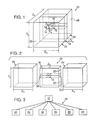
- a free memory block 10 has dimensions Xs, Ys, and Zs.
- the block 10 is taken as the entire three dimensional memory space. However, block 10 is representative of any free portion of the three dimensional memory space. In either case, then, the block 10 is a free block, having no portions thereof allocated for use.
- An allocation block 12 having dimensions Xa, Ya, and Za must be allocated from the memory block 10. Block 12 may be needed, for example, to store a screen image for caching purposes. Other uses might include storage of screen text fonts.
- the position of block 12 within block 10 is determined by constraints imposed by the requesting process.
- the requesting process may require allocation of a memory block having size dimensions Xa, Ya, and Za, e.g., sufficient to hold a screen image.
- the requesting process may require that one or all of the X, Y, or Z dimensions begin at particular address offsets.
- the requesting process may require that the X and Y dimensions coincide with certain memory segment boundaries. Accordingly, the first step in allocating the block 12 from a portion of the block 10 is to determine the position of block 12 relative to address constraints imposed by the requesting process.
- Memory block 10 is first divided into three major blocks, each having X and Y dimensions of Xs and Ys, respectively, and Z dimensions which sum to Zs.
- This partitioning can be visualized as two vertical slices along XY planes. More particularly, the vertical slices coincide with the front face 14 and rear face 16 of block 12 as viewed in FIG. 1.
- a middle block 18 includes the block 12 and has a Z dimension of Za.
- a front block 20 occupies the space between the front face 22 of block 10 and the front face 14 of block 12.
- a back block 24 occupies the space between rear face 16 of block 12 and the rear face 26 of block 10. Accordingly, the sum of the Z dimensions of the front block 20 and rear block 24 equal the value (Zs - Za).
- FIG. 2 again illustrates the memory block 10, but broken into the major blocks 18, 20, and 24. It will be appreciated that the blocks 20 and 24 have X and Y dimensions of Xs and Ys, respectively, equal to the original block 10 and remain as free memory space.
- the middle block 18 is next divided into minor blocks 30, 32, 34, and 36.
- the blocks 30 and 32 are those immediately below and above, respectively, block 12.
- the blocks 34 and 36 are those to the right and left, respectively, of block 12. It may be appreciated that, in so dividing block 18, the X dimensions of blocks 30 and 32 are fully maximized, i.e., equal to Xs.
- the smaller blocks 34 and 36 fill the remaining space adjacent block 12.
- X and Y dimensions of such blocks are maximized as will be more fully explained hereafter, other methods of partitioning block 10 may be used to selectively maximize other dimensions of the remaining free blocks.
- the allocated memory block may have one or more dimensions equal to the corresponding dimensions of the given free memory block.
- the dimension Za of block 12 was equal to Zs
- the front and rear blocks 20 and 24, respectively would be null blocks with the memory block 10 being the same as the middle block 18. Null blocks are therefore maintained to preserve consistency within allocation algorithms. Accordingly, as used herein and in the appended claims, the term "memory block", and the like, shall refer to both memory blocks of non-zero dimensions and null memory blocks of zero dimension.
- the allocated block 12 is taken as a root element of a tree structure 40 and each of the blocks 20, 24, 30, 32, 34, and 36 are attached as immediate descendants, and siblings of one another. It will be understood that each of the blocks 20, 30, 32, 34, 36, and 24 may be later taken as free blocks for subsequent allocation and divided in accordance with the method described in conjunction with FIGS. 1 and 2.
- a subsequent allocation request may specify a block of memory which may be taken from block 20.
- the requesting process may specify size, memory offsets, or other such constraints which, it is determined, can be satisfied by a block of memory taken from block 20.
- Block 20 is then divided into major and minor blocks, as described in connection with the division of block 10 in FIGS. 1 and 2.
- Block 20 is first divided into three major blocks 50, 52 and 54. More particularly, block 20 is divided into a front block 50, a middle block 52 containing the block 46, and a rear block 54.
- Middle block 52 is then divided into minor blocks 60, 62, 64, and 66.
- the division of block 52 then corresponds to the division of block 18 in FIG. 2 where blocks 60, 62, 64, and 66 correspond to the blocks 30, 32, 34, and 36, respectively.
- FIG. 6 illustrates the incorporation of the newly divided block 20 into the tree structure 40.
- the allocated block 46 is attached as an immediate descendant to the allocated block 12 and takes the place of the block 20 as seen in FIG. 3.
- the major blocks 50 and 52, along with the minor blocks 60, 62, 64, and 66, are attached to block 46 as immediate descendants and siblings of one another.
- a subtree structure 70 having the block 46 as its root and the blocks 50, 52, 60, 62, 64, and 66 as its descendants, now represents the block 20 in the tree structure 40 of FIG. 6.
- the configuration of tree structure 40 includes as leaf elements the blocks 50, 52, 60, 62, 64, 66, 30, 32, 34, 36, and 24 as free blocks remaining available for allocation.
- tree structure 40 may be traversed to identify leaf elements and thereby identify free memory blocks. Furthermore, it will be appreciated that upon deallocation of a given memory block, it is possible to immediately determine whether the associated free blocks, i.e., those blocks remaining after the given block was allocated, may be coalesced into a larger block for subsequent allocation.
- block 46 For example, consider deallocation of the block 46. Upon determining that the block 46 is to be deallocated, it is possible to identify the immediate descendants of block 46 and determine whether block 46 may be consolidated back into the block 20. More particularly, if block 46 has as all of its immediate dependents leaf elements, it is known that these elements may be coalesced into a contiguous block of memory, including block 46. This new block of memory is the original block 20. In such case, the tree structure 40 returns to its condition as illustrated in FIG. 3. Similarly, upon subsequently determining that block 12 is to be deallocated, it is possible to identify all its immediate descendants as free memory space, i.e., leaf elements, and consolidate blocks 12, 20, 30, 32, 34, 36, and 24 into the original memory block 10.
- a simple tree structure is obtained where allocated blocks are always related to the free blocks resulting from the allocation process.
- all nodes are blocks potentially in use and all leaves are free blocks.
- the tree shrinks when leaves are combined with nodes.
- the processing algorithm threads the tree, such that lists of free blocks of allocated blocks are maintained.
- This tree data structure has the advantages of simplicity and ease of use. It relates all the components or fragments of memory in an orderly fashion allowing for efficient consolidation.
- FIGS. 7 and 8 illustrate a second method of dividing a memory block into major and minor blocks.
- the Z and X dimensions are maximized in creating major blocks and minor blocks. More particularly, consider a memory block 80 from which an allocated block 82 is to be partitioned for allocation. In dividing memory block 80 into three major blocks, horizontal slices through XZ planes coincide with the top face 84 and bottom face 86 of block 82. More particularly, a middle block 88 contains the block 82, a top block 90 occupies the space between top face 84 of block 82 and top face 93 of block 80, and a bottom block 92 occupies the space between bottom face 86 of block 82 and bottom face 94 of block 80.
- the X and Z dimensions of blocks 90 and 92 equal Xs and Zs, respectively, i.e., the X and Z dimensions of original block 80.
- Middle block 88 is then further divided into minor blocks 96, 98, 100, and 102.
- the block 96 lies in front of the block 82 and the block 98 lies behind the block 82.
- the X dimensions of blocks 96 and 98 are maximized, i.e., equal to Xs, the X dimension of original block 80.
- Blocks 100 and 102 occupy the remaining space of middle block 88.
- memory blocks may be selectively divided in order to maximize particular dimensions. Determining the appropriateness of each method depends on the nature of how memory is to be allocated in general. If allocations have completely random depths, i.e., Z dimensions, there may be no reason to use any method other than the method described in connection with FIGS. 7 and 8. If, however, a majority of the allocations are full depth allocations, i.e., equal to Xs, the method described in connection with FIGS. 1 and 2 should be used in conjunction with the method described in conjunction with FIGS. 7 and 8 to cut down on memory fragmentation due to partial depth allocations.
- the two methods can be combined in the following manner.
- a free block is taken for a use that is of full depth, then the method of FIGS. 7 and 8 should be used, since most of the resulting free blocks will also be of full depth.
- the method of FIGS. 1 and 2 should be used. Using the method of FIGS. 1 and 2 leaves at least two large (in X and Y dimensions) partial depth blocks that are more likely to be used in future partial depth allocations. If the method of FIGS. 7 and 8 is used, one obtains only small partial depth blocks. Thus, by maximizing the XY area of partial depth blocks, it is more likely that such blocks can be efficiently used in future partial depth allocations.
- FIG. 9 illustrates a computer, including a processor 120, a display device 122 and the three dimensional memory space 10.
- Processor 120, display device 122, and memory 10 communicate by way of a bus 124.
- processor 120 makes use of memory space 10 for storing screen images and text font data.
- processor 120 performs the tasks of memory allocation, deallocation, and consolidation. For example, processor 120 may require a number of text screen fonts for use on display 122. In loading such text screen fonts into memory 10, memory allocation is required. Certain portions of memory 10 are then dedicated to the storage of such text screen fonts. Also, processor 120 may require caching of screen images in memory 10 for temporary storage. In loading such text screen fonts and moving screen images within memory space 10, memory space 10 is dynamically partitioned into allocated and free memory space in accordance with the present invention.
- FIG. 10 illustrates an allocation routine used by processor 120 in allocating a portion of memory space 10.
- processor 120 locates a suitable free block in memory space 10. In locating such suitable free block, processor 120 threads the tree structure 40 in order to find an available block of memory.
- Processor 120 may determine that partitioning in accordance with the method described in FIGS. 1 and 2 is appropriate and processing branches from block 132 to block 136 where the located free block is so partitioned. In the alternative, it may be determined that partitioning according to the method of FIGS. 7 and 8 is preferred in which case processing advances from block 132 to block 134 where the located free block is so partitioned.
- processor 120 builds a subtree structure.
- the subtree structure includes as its root the allocated block of memory taken from the located free block and has its immediate descendants leaf elements comprising free memory space.
- Processing then continues to block 140 where processor 120 removes the located free block from the tree structure 40.
- processor 120 then attaches the newly constructed subtree structure to the tree structure 40 in place of the removed block as described in connection with FIG. 6.
- processor 120 returns to the requesting process an identification of the block allocated for its use.
- FIG. 11 illustrates a deallocation procedure used by processor 120 in making available, as free memory space, previously allocated memory blocks.
- processor 120 locates the memory block to be deallocated. More particularly, the deallocation procedure of FIG. 11 receives an identification of a memory block which is to be deallocated. Processor 120 then locates the identified deallocated block within the tree structure 40. In block 152, processor 120 marks, as available memory space, the located deallocated memory block.
- processor 120 determines whether the located deallocated memory block has its dependents free blocks. More particularly, processor 120 determines whether all the dependents of the located deallocated block are leaf elements. If all such dependents are leaf elements, processing continues to block 156 where processor 120 consolidates the tree structure comprising the located deallocated block and its immediate descendants into a single memory block. The subtree structure is then removed from tree structure 40 and the single consolidated memory block is substituted therefore.
- Processor 120 determines whether further consolidation is possible.
- Processor 120 determines whether the newly substituted memory block is the dependent of a parent block having all dependents as free blocks. In other words, processor 120 determines whether the newly inserted memory block has all leaf elements as its siblings. If the newly substituted memory block has all leaf elements as its siblings, processing returns to block 156 where consolidation of the parent of that newly substituted block, together with the descendant leaf elements, occurs. If, in block 158, it is determined that the newly substituted memory block does not have all leaf elements as its siblings, processing branches to return block 160.
- FIG. 12 illustrates the deallocation of memory blocks of the tree structure 40.
- a subtree structure 181 having the block 180 as its root element, and the free memory blocks 182, 184, 186, 188, 190, and 192 as its dependents, forms a portion of tree structure 40.
- the allocated block 180 is attached as a descendant node of block 46.
- all leaf elements of tree structure 40 remain as available free memory space, while node elements, i.e., non-leaf elements, represent potentially allocated memory blocks.
- node elements i.e., non-leaf elements
- the subtree structure representing the block 64 may be consolidated back into the block 64 and attached as a leaf element to the block 46.
- the subtree structure representing the block 20 may be consolidated back into the block 20 and attached as a leaf element of the block 12.
- FIG. 13 illustrates a second method of maintaining a tree structure 200 for associating the free and allocated memory blocks of memory block 10. More particularly, the tree structure 200 of FIG. 13 represents the same state of memory 10 as depicted in FIG. 12, but employs a different tree structure method. In using the tree structure 200, memory partitioning in response to a given allocation request is similar. In other words, for each memory allocation request, a suitable block of free memory is first identified and then partitioned into seven memory blocks, one allocated block and six free blocks according to a partitioning method for maximizing selected dimensions. The tree structure 200 differs from the previously described tree structure 40 in that each of the seven blocks of memory so partitioned is represented as a separate descendent from the original free memory block.
- This second method of maintaining a tree structure representing memory allocation status is desirable because a given tree node, representing a previously allocated but currently available memory block, may be again partitioned without first memory block rep[resented by its descendant tree elements.
- tree structure 200 maintains a root element representing the block 10 and attaches to that root element seven descendants, each corresponding to one of the memory partitions created in allocating the memory block 12 therefrom. Furthermore, in allocating the memory block 46 from the memory block 20, leaf elements corresponding to the allocated block and the free blocks 50, 52, 60, 62, 64, and 66 are attached as descendants to the tree element representing the block 20. Finally, in allocating the memory block 180 from the memory block 64, seven descendent leaf elements are attached to the tree element representing the block 64. One of the seven such leaf elements attached to block 64 is the allocated block 180 and the remaining six descendants represent the free memory blocks 182, 184, 186, 188, 190, and 192.
- each leaf element is marked as representing either free memory space or allocated memory space. It is suggested that in manipulating the tree structure 200, lists of allocated and free memory space be maintained in order to efficiently thread the tree structure 200.
- FIG. 14 illustrates an allocation routine used for the tree structure 200.
- processor 120 locates a suitable free block in, for example, memory space 10 as described herein above.
- processor 120 determines a method of memory partitioning in accordance with external constraints as described previously. The located free block is so partitioned in one of process blocks 224 and 226 in accordance with a selected method of partitioning to maximize certain dimensions if remaining free memory. Processing then proceeds to block 228 where processor 120 attaches leaf elements to the tree structure element representing the located free block. More particularly, processor 120 attaches seven leaf elements to the tree element representing the located free block. One such leaf element represents the allocated memory block as taken from the located free block.
- processor 120 returns to the requesting process an identification of the block allocated for use.
- FIG. 15 illustrates a deallocation procedure used by processor 120 in connection with the tree structure 200.
- processor 120 locates the identified deallocated memory block. Then, in block 252 processor 120 marks the located deallocated memory block as available memory space. Processing continues to block 254 where processor 120 inspects the siblings of the located deallocated block for purposes of potential consolidation. Based on its inspection of such siblings, processor 120 determines in decision block 256 whether all the siblings of the located deallocated block are marked as representing free memory space. If this test returns a negative result, processing branches to return block 258. Otherwise, upon determining that all siblings of the located deallocated block represent free memory space, in block 260 processor 120 removes such siblings from tree structure 200 and marks the parent of such siblings as representing free memory space.
- Processing then returns to block 254 where the parent of the located deallocated block is taken as the current located block.
- the siblings of such current located block are inspected for potential consolidation with continued processing then proceeding to decision block 256 as described above. In this manner, all portions of the tree structure 200 representing free space following a given deallocation are consolidated by removing groups of siblings representing free space.
- Memory may be allocated from any leaf element of tree structure 40 and from any node element of tree structure 40 marked as being available.
- three dimensional memory space may be managed in responding to allocation, deallocation, and consolidation procedures.
Landscapes
- Engineering & Computer Science (AREA)
- Theoretical Computer Science (AREA)
- Physics & Mathematics (AREA)
- General Engineering & Computer Science (AREA)
- General Physics & Mathematics (AREA)
- Mathematical Physics (AREA)
- Memory System Of A Hierarchy Structure (AREA)
- Memory System (AREA)
Applications Claiming Priority (2)
| Application Number | Priority Date | Filing Date | Title |
|---|---|---|---|
| US07/496,482 US5247634A (en) | 1990-03-20 | 1990-03-20 | Method of managing memory allocation by association of memory blocks with a tree structure |
| US496482 | 2000-02-02 |
Publications (3)
| Publication Number | Publication Date |
|---|---|
| EP0453093A2 true EP0453093A2 (de) | 1991-10-23 |
| EP0453093A3 EP0453093A3 (en) | 1992-02-05 |
| EP0453093B1 EP0453093B1 (de) | 1997-07-30 |
Family
ID=23972829
Family Applications (1)
| Application Number | Title | Priority Date | Filing Date |
|---|---|---|---|
| EP91302278A Expired - Lifetime EP0453093B1 (de) | 1990-03-20 | 1991-03-18 | Speicherverwaltungsverfahren mit Hilfe einer Baumstruktur |
Country Status (4)
| Country | Link |
|---|---|
| US (1) | US5247634A (de) |
| EP (1) | EP0453093B1 (de) |
| JP (1) | JP3183901B2 (de) |
| DE (1) | DE69127011T2 (de) |
Cited By (2)
| Publication number | Priority date | Publication date | Assignee | Title |
|---|---|---|---|---|
| EP0703534A1 (de) * | 1994-09-19 | 1996-03-27 | Siemens Aktiengesellschaft | Speicherverwaltungssystem eines Rechnersystems |
| EP0632365A3 (de) * | 1993-06-30 | 2000-03-01 | Microsoft Corporation | Modifiziertes "buddy" System zur Verwaltung des Festplattenräums |
Families Citing this family (47)
| Publication number | Priority date | Publication date | Assignee | Title |
|---|---|---|---|---|
| US5566283A (en) * | 1990-09-03 | 1996-10-15 | Dainippon Printing Co., Ltd. | Computer graphic image storage, conversion and generating apparatus |
| US5659744A (en) * | 1991-10-15 | 1997-08-19 | International Computers Limited | Data file store system with means for efficiently managing freeing of data blocks |
| US5742793A (en) * | 1991-12-18 | 1998-04-21 | Intel Corporation | Method and apparatus for dynamic memory management by association of free memory blocks using a binary tree organized in an address and size dependent manner |
| US5561785A (en) * | 1992-10-29 | 1996-10-01 | International Business Machines Corporation | System for allocating and returning storage and collecting garbage using subpool of available blocks |
| US5675790A (en) * | 1993-04-23 | 1997-10-07 | Walls; Keith G. | Method for improving the performance of dynamic memory allocation by removing small memory fragments from the memory pool |
| US5555405A (en) * | 1993-07-06 | 1996-09-10 | Digital Equipment Corporation | Method and apparatus for free space management in a forwarding database having forwarding entry sets and multiple free space segment queues |
| DE4334313A1 (de) * | 1993-10-08 | 1995-04-13 | Sel Alcatel Ag | Verfahren zum Verwalten eines Sprachspeichers und Vorrichtung dafür |
| US5493652A (en) * | 1994-04-29 | 1996-02-20 | International Business Machines Corporation | Management system for a buffer memory having buffers of uniform size in which the buffers are divided into a portion of contiguous unused buffers and a portion of contiguous buffers in which at least some are used |
| US5463776A (en) * | 1994-09-22 | 1995-10-31 | Hewlett-Packard Company | Storage management system for concurrent generation and fair allocation of disk space among competing requests |
| US5652864A (en) * | 1994-09-23 | 1997-07-29 | Ibm | Concurrent storage allocations or returns without need to lock free storage chain |
| US5604902A (en) * | 1995-02-16 | 1997-02-18 | Hewlett-Packard Company | Hole plugging garbage collection for a data storage system |
| US5768562A (en) * | 1995-09-26 | 1998-06-16 | Altera Corporation | Methods for implementing logic in auxiliary components associated with programmable logic array devices |
| US7146479B2 (en) * | 2001-07-18 | 2006-12-05 | City U Research Limited | Method and apparatus of storage allocation/de-allocation in object-oriented programming environment |
| US5784698A (en) * | 1995-12-05 | 1998-07-21 | International Business Machines Corporation | Dynamic memory allocation that enalbes efficient use of buffer pool memory segments |
| US5781924A (en) * | 1996-09-30 | 1998-07-14 | Sun Microsystems, Inc. | Computer caching methods and apparatus |
| US5950231A (en) * | 1996-11-25 | 1999-09-07 | Northern Telecom Limited | Memory manager system |
| US5930829A (en) * | 1997-03-31 | 1999-07-27 | Bull Hn Information Systems Inc. | Dynamic memory allocation for a random access memory employing separately stored space allocation information using a tree structure |
| US5999709A (en) * | 1997-04-18 | 1999-12-07 | Adobe Systems Incorporated | Printer memory boost |
| US6442584B1 (en) | 1997-05-16 | 2002-08-27 | Sybase, Inc. | Methods for resource consolidation in a computing environment |
| US6065019A (en) * | 1997-10-20 | 2000-05-16 | International Business Machines Corporation | Method and apparatus for allocating and freeing storage utilizing multiple tiers of storage organization |
| US6018789A (en) * | 1997-11-24 | 2000-01-25 | Western Digital Corporation | Disk drive with cache segment providing adaptively managed chunks |
| US6209066B1 (en) | 1998-06-30 | 2001-03-27 | Sun Microsystems, Inc. | Method and apparatus for memory allocation in a multi-threaded virtual machine |
| US6279093B1 (en) * | 1998-11-24 | 2001-08-21 | Dell Usa, L.P. | Computer system and method for preparing a computer-readable medium |
| US6657955B1 (en) * | 1999-05-27 | 2003-12-02 | Alcatel Canada Inc. | Buffering system employing per traffic flow accounting congestion control |
| US6600493B1 (en) | 1999-12-29 | 2003-07-29 | Intel Corporation | Allocating memory based on memory device organization |
| US6724390B1 (en) * | 1999-12-29 | 2004-04-20 | Intel Corporation | Allocating memory |
| US7143413B2 (en) * | 2002-05-15 | 2006-11-28 | Hewlett-Packard Development Company, L.P. | Method and system for allocating system resources among applications using weights |
| US7322034B2 (en) | 2002-06-14 | 2008-01-22 | Hewlett-Packard Development Company, L.P. | Method and system for dynamically allocating computer system resources |
| CA2426619A1 (en) * | 2003-04-25 | 2004-10-25 | Ibm Canada Limited - Ibm Canada Limitee | Defensive heap memory management |
| US7827375B2 (en) * | 2003-04-30 | 2010-11-02 | International Business Machines Corporation | Defensive heap memory management |
| US7313552B2 (en) * | 2004-03-19 | 2007-12-25 | Sybase, Inc. | Boolean network rule engine |
| US7623547B2 (en) * | 2004-12-13 | 2009-11-24 | Bt Ins, Inc. | Internet protocol address management system and method |
| US7903678B2 (en) * | 2004-12-13 | 2011-03-08 | Bt Ins, Inc. | Internet protocol address management system and method |
| US7793040B2 (en) * | 2005-06-01 | 2010-09-07 | Microsoft Corporation | Content addressable memory architecture |
| US7856523B2 (en) * | 2005-06-01 | 2010-12-21 | Microsoft Corporation | Random Access Memory (RAM) based Content Addressable Memory (CAM) management |
| US10026140B2 (en) | 2005-06-10 | 2018-07-17 | Nvidia Corporation | Using a scalable graphics system to enable a general-purpose multi-user computer system |
| US9601199B2 (en) | 2007-01-26 | 2017-03-21 | Intel Corporation | Iterator register for structured memory |
| CN103473181B (zh) | 2007-01-26 | 2017-06-13 | 英特尔公司 | 分级式不可变内容可寻址存储器处理器 |
| WO2009085253A1 (en) * | 2007-12-21 | 2009-07-09 | Hicamp Systems | Hierarchical block-identified data communication for unified handling of structured data and data compression |
| US8245011B2 (en) * | 2008-02-08 | 2012-08-14 | Texas Instruments Incorporated | Method and system for geometry-based virtual memory management in a tiled virtual memory |
| US8195915B2 (en) * | 2008-02-29 | 2012-06-05 | International Business Machines Corporation | Mechanism for visualizing memory fragmentation |
| US8924632B2 (en) | 2011-09-16 | 2014-12-30 | Apple Inc. | Faster tree flattening for a system having non-volatile memory |
| US9753860B2 (en) * | 2012-06-14 | 2017-09-05 | International Business Machines Corporation | Page table entry consolidation |
| US9811472B2 (en) | 2012-06-14 | 2017-11-07 | International Business Machines Corporation | Radix table translation of memory |
| US9092359B2 (en) * | 2012-06-14 | 2015-07-28 | International Business Machines Corporation | Identification and consolidation of page table entries |
| DE102019215291A1 (de) * | 2019-10-04 | 2021-04-08 | Robert Bosch Gmbh | Verfahren, Computerprogramm, elektronisches Speichermedium und Vorrichtung zum Bereitstellen von einem Datum |
| US11580013B2 (en) | 2020-10-30 | 2023-02-14 | Nutanix, Inc. | Free space management in a block store |
Family Cites Families (10)
| Publication number | Priority date | Publication date | Assignee | Title |
|---|---|---|---|---|
| US4468728A (en) * | 1981-06-25 | 1984-08-28 | At&T Bell Laboratories | Data structure and search method for a data base management system |
| US4511964A (en) * | 1982-11-12 | 1985-04-16 | Hewlett-Packard Company | Dynamic physical memory mapping and management of independent programming environments |
| EP0187240A3 (de) * | 1984-11-28 | 1988-03-23 | Hewlett-Packard Company | Addressierungsmatrix |
| US4855903A (en) * | 1984-12-20 | 1989-08-08 | State University Of New York | Topologically-distributed-memory multiprocessor computer |
| JPH069116B2 (ja) * | 1985-05-24 | 1994-02-02 | 日立超エル・エス・アイエンジニアリング株式会社 | 半導体集積回路装置 |
| NL8600848A (nl) * | 1986-04-03 | 1987-11-02 | Philips Nv | Geheugen met gelijktijdig adresseerbare geheugenelementen. |
| GB8613069D0 (en) * | 1986-05-29 | 1986-07-02 | Univ Manchester | Parallel storage allocation |
| JPS63271578A (ja) * | 1987-04-30 | 1988-11-09 | Hitachi Ltd | 領域の集合演算装置 |
| US5119317A (en) * | 1988-03-16 | 1992-06-02 | Kabushiki Kaisha Toshiba | Routing method and system |
| US5109336A (en) * | 1989-04-28 | 1992-04-28 | International Business Machines Corporation | Unified working storage management |
-
1990
- 1990-03-20 US US07/496,482 patent/US5247634A/en not_active Expired - Lifetime
-
1991
- 1991-03-18 DE DE69127011T patent/DE69127011T2/de not_active Expired - Lifetime
- 1991-03-18 EP EP91302278A patent/EP0453093B1/de not_active Expired - Lifetime
- 1991-03-20 JP JP08151591A patent/JP3183901B2/ja not_active Expired - Lifetime
Cited By (4)
| Publication number | Priority date | Publication date | Assignee | Title |
|---|---|---|---|---|
| EP0632365A3 (de) * | 1993-06-30 | 2000-03-01 | Microsoft Corporation | Modifiziertes "buddy" System zur Verwaltung des Festplattenräums |
| EP0703534A1 (de) * | 1994-09-19 | 1996-03-27 | Siemens Aktiengesellschaft | Speicherverwaltungssystem eines Rechnersystems |
| US5864867A (en) * | 1994-09-19 | 1999-01-26 | Siemens Aktiengesellschaft | Memory management system of a computer system |
| CN1085863C (zh) * | 1994-09-19 | 2002-05-29 | 西门子公司 | 计算机系统的存储器管理系统 |
Also Published As
| Publication number | Publication date |
|---|---|
| US5247634A (en) | 1993-09-21 |
| DE69127011D1 (de) | 1997-09-04 |
| DE69127011T2 (de) | 1997-11-13 |
| EP0453093A3 (en) | 1992-02-05 |
| EP0453093B1 (de) | 1997-07-30 |
| JPH04223539A (ja) | 1992-08-13 |
| JP3183901B2 (ja) | 2001-07-09 |
Similar Documents
| Publication | Publication Date | Title |
|---|---|---|
| US5247634A (en) | Method of managing memory allocation by association of memory blocks with a tree structure | |
| JP3844370B2 (ja) | 多次元データを格納しかつアクセスするコンピュータ方法及び格納構造 | |
| JP4250190B2 (ja) | ファイルシステムにおけるオブジェクトの効率的な記憶 | |
| DE69737709T2 (de) | Verfahren und Vorrichtung für Informationsverarbeitung und Speicherzuordnungsanordnung | |
| US5313611A (en) | Method and apparatus for maintaining a lookup table for storing function values | |
| US5561786A (en) | Computer method and system for allocating and freeing memory utilizing segmenting and free block lists | |
| US7205994B2 (en) | Synchronized two-level graphics processing cache | |
| US5490274A (en) | Modified buddy system for managing disk space | |
| US8099421B2 (en) | File system, and method for storing and searching for file by the same | |
| DE102007052853B4 (de) | Zeilentauschschema zur Verringerung von Rückinvalidierungen in einem Snoopfilter | |
| JPH0695954A (ja) | コンサーバティブ・スタックとジェネレイショナル・ヒープガーベージ・コレクション用コンピュータシステム及び方法 | |
| US8041918B2 (en) | Method and apparatus for improving parallel marking garbage collectors that use external bitmaps | |
| DE60001170T2 (de) | Betriebsystemsseitenplazierung zum maximieren der cachedatenwiederverwendung | |
| DE112018005404T5 (de) | Vereinfachen des zugriffs auf lokalitätsdomäneninformationen eines speichers | |
| US20050007377A1 (en) | Dynamic allocation of texture cache memory | |
| US5142615A (en) | System and method of supporting a plurality of color maps in a display for a digital data processing system | |
| US20010043227A1 (en) | Priority methods for texture map storage | |
| US20050154851A1 (en) | Fast, high reliability dynamic memory manager | |
| US20010042184A1 (en) | Converting non-contiguous memory into contiguous memory for a graphics processor | |
| CN114840792A (zh) | 基于网格化处理的Web端疫情分布可视化系统与方法 | |
| DE112017007323T5 (de) | Cache-speicher und verfahren zur steuerung desselben | |
| US7499961B2 (en) | Method and apparatus for limiting the size and facilitating maintenance of remembered sets in a space incremental garbage collector | |
| CN117724991B (zh) | 嵌入式系统的动态内存管理方法、系统、终端及存储介质 | |
| CN105677577A (zh) | 一种系统的内存管理方法及装置 | |
| CN114254163B (zh) | 三维场景管理方法、装置、设备及存储介质 |
Legal Events
| Date | Code | Title | Description |
|---|---|---|---|
| PUAI | Public reference made under article 153(3) epc to a published international application that has entered the european phase |
Free format text: ORIGINAL CODE: 0009012 |
|
| AK | Designated contracting states |
Kind code of ref document: A2 Designated state(s): DE FR GB IT |
|
| PUAL | Search report despatched |
Free format text: ORIGINAL CODE: 0009013 |
|
| AK | Designated contracting states |
Kind code of ref document: A3 Designated state(s): DE FR GB IT |
|
| 17P | Request for examination filed |
Effective date: 19920504 |
|
| 17Q | First examination report despatched |
Effective date: 19950221 |
|
| GRAG | Despatch of communication of intention to grant |
Free format text: ORIGINAL CODE: EPIDOS AGRA |
|
| GRAH | Despatch of communication of intention to grant a patent |
Free format text: ORIGINAL CODE: EPIDOS IGRA |
|
| GRAH | Despatch of communication of intention to grant a patent |
Free format text: ORIGINAL CODE: EPIDOS IGRA |
|
| GRAA | (expected) grant |
Free format text: ORIGINAL CODE: 0009210 |
|
| AK | Designated contracting states |
Kind code of ref document: B1 Designated state(s): DE FR GB IT |
|
| PG25 | Lapsed in a contracting state [announced via postgrant information from national office to epo] |
Ref country code: IT Free format text: LAPSE BECAUSE OF FAILURE TO SUBMIT A TRANSLATION OF THE DESCRIPTION OR TO PAY THE FEE WITHIN THE PRE;WARNING: LAPSES OF ITALIAN PATENTS WITH EFFECTIVE DATE BEFORE 2007 MAY HAVE OCCURRED AT ANY TIME BEFORE 2007. THE CORRECT EFFECTIVE DATE MAY BE DIFFERENT FROM THE ONE RECORDED.SCRIBED TIME-LIMIT Effective date: 19970730 |
|
| REF | Corresponds to: |
Ref document number: 69127011 Country of ref document: DE Date of ref document: 19970904 |
|
| ET | Fr: translation filed | ||
| PLBE | No opposition filed within time limit |
Free format text: ORIGINAL CODE: 0009261 |
|
| STAA | Information on the status of an ep patent application or granted ep patent |
Free format text: STATUS: NO OPPOSITION FILED WITHIN TIME LIMIT |
|
| 26N | No opposition filed | ||
| REG | Reference to a national code |
Ref country code: GB Ref legal event code: 732E |
|
| REG | Reference to a national code |
Ref country code: FR Ref legal event code: TP |
|
| REG | Reference to a national code |
Ref country code: GB Ref legal event code: IF02 |
|
| PGFP | Annual fee paid to national office [announced via postgrant information from national office to epo] |
Ref country code: FR Payment date: 20100406 Year of fee payment: 20 |
|
| PGFP | Annual fee paid to national office [announced via postgrant information from national office to epo] |
Ref country code: GB Payment date: 20100326 Year of fee payment: 20 |
|
| PGFP | Annual fee paid to national office [announced via postgrant information from national office to epo] |
Ref country code: DE Payment date: 20100329 Year of fee payment: 20 |
|
| REG | Reference to a national code |
Ref country code: DE Ref legal event code: R071 Ref document number: 69127011 Country of ref document: DE |
|
| REG | Reference to a national code |
Ref country code: GB Ref legal event code: PE20 Expiry date: 20110317 |
|
| PG25 | Lapsed in a contracting state [announced via postgrant information from national office to epo] |
Ref country code: GB Free format text: LAPSE BECAUSE OF EXPIRATION OF PROTECTION Effective date: 20110317 |
|
| PG25 | Lapsed in a contracting state [announced via postgrant information from national office to epo] |
Ref country code: DE Free format text: LAPSE BECAUSE OF EXPIRATION OF PROTECTION Effective date: 20110318 |