EP0453257A1 - Feuille pour le transfert thermique - Google Patents
Feuille pour le transfert thermique Download PDFInfo
- Publication number
- EP0453257A1 EP0453257A1 EP91303415A EP91303415A EP0453257A1 EP 0453257 A1 EP0453257 A1 EP 0453257A1 EP 91303415 A EP91303415 A EP 91303415A EP 91303415 A EP91303415 A EP 91303415A EP 0453257 A1 EP0453257 A1 EP 0453257A1
- Authority
- EP
- European Patent Office
- Prior art keywords
- thermal transfer
- transfer sheet
- heat
- substrate film
- carbon black
- Prior art date
- Legal status (The legal status is an assumption and is not a legal conclusion. Google has not performed a legal analysis and makes no representation as to the accuracy of the status listed.)
- Granted
Links
Images
Classifications
-
- B—PERFORMING OPERATIONS; TRANSPORTING
- B41—PRINTING; LINING MACHINES; TYPEWRITERS; STAMPS
- B41M—PRINTING, DUPLICATING, MARKING, OR COPYING PROCESSES; COLOUR PRINTING
- B41M5/00—Duplicating or marking methods; Sheet materials for use therein
- B41M5/26—Thermography ; Marking by high energetic means, e.g. laser otherwise than by burning, and characterised by the material used
- B41M5/382—Contact thermal transfer or sublimation processes
- B41M5/385—Contact thermal transfer or sublimation processes characterised by the transferable dyes or pigments
-
- Y—GENERAL TAGGING OF NEW TECHNOLOGICAL DEVELOPMENTS; GENERAL TAGGING OF CROSS-SECTIONAL TECHNOLOGIES SPANNING OVER SEVERAL SECTIONS OF THE IPC; TECHNICAL SUBJECTS COVERED BY FORMER USPC CROSS-REFERENCE ART COLLECTIONS [XRACs] AND DIGESTS
- Y10—TECHNICAL SUBJECTS COVERED BY FORMER USPC
- Y10S—TECHNICAL SUBJECTS COVERED BY FORMER USPC CROSS-REFERENCE ART COLLECTIONS [XRACs] AND DIGESTS
- Y10S428/00—Stock material or miscellaneous articles
- Y10S428/913—Material designed to be responsive to temperature, light, moisture
-
- Y—GENERAL TAGGING OF NEW TECHNOLOGICAL DEVELOPMENTS; GENERAL TAGGING OF CROSS-SECTIONAL TECHNOLOGIES SPANNING OVER SEVERAL SECTIONS OF THE IPC; TECHNICAL SUBJECTS COVERED BY FORMER USPC CROSS-REFERENCE ART COLLECTIONS [XRACs] AND DIGESTS
- Y10—TECHNICAL SUBJECTS COVERED BY FORMER USPC
- Y10S—TECHNICAL SUBJECTS COVERED BY FORMER USPC CROSS-REFERENCE ART COLLECTIONS [XRACs] AND DIGESTS
- Y10S428/00—Stock material or miscellaneous articles
- Y10S428/914—Transfer or decalcomania
-
- Y—GENERAL TAGGING OF NEW TECHNOLOGICAL DEVELOPMENTS; GENERAL TAGGING OF CROSS-SECTIONAL TECHNOLOGIES SPANNING OVER SEVERAL SECTIONS OF THE IPC; TECHNICAL SUBJECTS COVERED BY FORMER USPC CROSS-REFERENCE ART COLLECTIONS [XRACs] AND DIGESTS
- Y10—TECHNICAL SUBJECTS COVERED BY FORMER USPC
- Y10T—TECHNICAL SUBJECTS COVERED BY FORMER US CLASSIFICATION
- Y10T428/00—Stock material or miscellaneous articles
- Y10T428/24—Structurally defined web or sheet [e.g., overall dimension, etc.]
- Y10T428/24802—Discontinuous or differential coating, impregnation or bond [e.g., artwork, printing, retouched photograph, etc.]
- Y10T428/24893—Discontinuous or differential coating, impregnation or bond [e.g., artwork, printing, retouched photograph, etc.] including particulate material
- Y10T428/24901—Discontinuous or differential coating, impregnation or bond [e.g., artwork, printing, retouched photograph, etc.] including particulate material including coloring matter
Definitions
- the present invention relates to a thermal transfer sheet, and more particularly, to a thermal transfer sheet capable of providing printed letters improved in blackness and durability such as solvent resistance, etc..
- thermal transfer sheet comprising a substrate film and a heat-fusible ink layer disposed on one surface side thereof.
- Such a conventional thermal transfer sheet comprises a substrate film formed of a paper having a thickness of 10 to 20 ⁇ m such as capacitor paper and paraffin paper, or formed of a plastic film having a thickness of 3 to 20 ⁇ m such as polyester film and cellophane film.
- the above-mentioned thermal transfer sheet has been prepared by coating the substrate film with a heat-fusible ink composed of a wax and a colorant such as dye or pigment mixed therein, to form a heat-fusible ink layer on the substrate film.
- the thermal transfer sheet used in black letter printing has a heat-fusible ink layer composed of a carbon black.
- a conventional carbon black has been used as a recording material such as an ink for newpapers, a printing ink, a thermal transfer sheet, a copying toner and a writing ink, a coating material, and a black pigment for colored resin, etc..
- Such conventional carbon blacks having many kinds of color tones and particle-sizes are commercially produced by the carbonization of various kinds of hydrocarbon.
- such each of conventional carbon blacks is insufficient in blackness and solvent resistance in the case of using it as a recording material.
- a thermal transfer layer of a conventional black thermal transfer sheet is formed on a substrate film by applying thereonto a liquid of melted ink which includes a carbon black and a vehicle predominantly comprising a wax.
- a viscosity of the liquid of melted ink is changeable, so that it is apt to occur an unevenness of the ink layer in coating step and a severe control of coating condition is required.
- printed letters formed by using the conventional black thermal transfer sheet tend to have a color of brown black, so that a blue pigment have to be added to the ink layer.
- the printed letters are insufficient in hue stability.
- An object of the present invention is to solve the above-mentioned problems encountered in the prior art and to provide a thermal transfer sheet containing a heat-fusible ink layer having an uniform thickness and being capable of providing printed letters improved in blackness and durability such as solvent resistance.
- a thermal transfer sheet comprising a substrate film, a heat-fusible ink layer formed on one surface side of a substrate film, and optionally an antisticking layer formed on another surface side of the substrate film, said heat-fusible ink layer containing a carbon black having toluene-coloring transmittance of 60 % or more.
- thermo transfer sheet containing a heat-fusible ink layer having an uniform thickness and being capable of providing printed letters improved in blackness and durability such as solvent resistance.
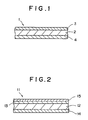
- FIG. 1 is a schematic sectional view showing an embodiment of a thermal transfer sheet according to the present invention.
- the thermal transfer sheet 1 comprises a substrate film 2, a heat-fusible ink layer 3 formed on one surface side of the substrate film 2, and an antisticking layer 4 formed on the other surface side of the substrate film 2.
- the substrate film 2 to be used in the present invention may be one selected from those used in the conventional thermal transfer sheet.
- the above-mentioned substrate film 2 is not restricted thereto and any of other films can be used.
- the substrate film 2 may include: plastic films such as those comprising polyester, polypropylene, cellophane, polycarbonate, cellulose acetate, polyethylene, polyvinyl chloride, polystyrene, nylon, polyimide, polyvinylidene chloride, polyvinyl alcohol, fluorine-containing resin, chlorinated rubber, and ionomer resin; papers such as capacitor paper and paraffin paper; non-woven fabric; etc..
- the substrate film 2 can also comprise a composite or laminate of the above-mentioned films.
- the substrate film 2 may preferably have a thickness of 2 to 25 ⁇ m, while the thickness can appropriately be changed correspondingly to the materials thereof so as to provide suitable strength and heat conductivity.
- the heat-fusible ink layer 3 formed on one surface side of the above-mentioned substrate film 2 comprises carbon black, vehicle and optional additive.
- the carbon black can be used in the present invention has impurities having a solubility to toluene less than a specified content.
- a conventional carbon black includes many kinds of hydro-carbons formed in production step which comprises a carbonization of various kinds of hydrocarbons. According to our detailed investigations, it has been found that the impurities having the solubility to toluene cause the above-mentioned problems encountered in the prior art.
- impurities having the solubility in toluene may include; pyrene, fluoranthene, 3,4-benzpyrene, 1,2-benzpyrene, anthanthrene, benzperylene, coronene, polycyclic aromatic hydrocarbon, or oxygen-compound thereof including carboxyl group, hydroxyl group, and quinone group.
- the carbon black can be used in the present invention has a low content of the above-mentioned impurities, and, therefore, has a toluene-coloring transmittance of 60 % or more.
- the toluene coloring transmittance may be measured by the manner mentioned hereinafter.
- the toluene-coloring transmittance can be measured in the same manner as JIS (Japanese Industrial Standard) K 6 221- 1970 - 5, 4 (measurement of benzene-coloring transmittance) except that benzene is replaced with toluene and a measuring light having a wave length of 420 ⁇ 5 nm is replaced with one having a wave length of 335 ⁇ 5 nm.
- a dried sample of carbon black having a weight of 5.0 ⁇ 0.1 g and a toluene of 50 ml are put into an erlenmeyer flask provided in JIS R 3503 instrument, and kept in a gently boiling condition for 20 seconds. Then, the content of the erlenmeyer flask is immediately filtered through a filter paper and the resultant filtrate is put into an absorption cell so as to measure a toluene-coloring transmittance at a wave length of 335 ⁇ 5 nm. The measurement may be indicated by percentages (%).
- the above-mentioned wave length (335 ⁇ 5 nm) of the measuring light is selected on the basis of the reason that 3,4-benzpyrene can be accurately measured in volume by using the measuring light having the above-mentioned wave length, and an absorption band of a mixture of the above-mentioned impurities exist in a range of wave length of 200 nm to 350 nm.
- the carbon black can be used in the present invention may be obtained by using a wash-treatment wherein the conventional carbon black is washed with an organic solvent such as toluene, xylene, benzene, etc., or by using a heat-treatment wherein the conventional carbon black is heated in atmospheric air for 1 to 60 minutes at 150 to 350 °C so as to evaporate the impurities as the degradation products therefrom.
- an organic solvent such as toluene, xylene, benzene, etc.
- the concentration of the carbon black in the heat-fusible ink layer 3 may preferably be in the range of 5 to 50 wt.%.
- the vehicle to be used for forming the heat-fusible ink layer 3 may predominantly comprise a wax or a mixture of a wax and another component such as drying oil, resin, mineral oil, and derivatives of cellulose and rubber.
- wax may include microcrystalline wax, carnauba wax, paraffin wax, etc.
- specific examples of the wax may include: various species thereof such as Fischer-tropsch wax, various low-molecular weight polyethylenes, Japan wax, beeswax, whale wax, insect wax, lanolin, shellac wax, candelilla wax, petrolactam, partially modified wax, fatty acid ester, and fatty acid amide.
- thermoplastic resin having a relative low softening point into the above-mentioned wax so as to enhance the adhesion property of the heat-fusible ink layer to a transfer-receiving material.
- thermoplastic resin may include; ethylene-vinylacetate copolymer (EVA), ethylene-acrylic ester copolymer (EEA), ethylene-acrylic acid copolymer (EAA), ionomer resin, polyethylene, polystyrene, polypropylene, polybutene, petroleum resin, vinyl chloride, vinyl chloride-vinyl acetate copolymer, polyvinyl alcohol, vinylidene chloride, methacrylic resin, polyamide, polyester, polyether, polycarbonate, fluorocarbon resin, polyvinylformal, polyvinyl butyral, acetyl cellulose, nitrocellulose, polyvinyl acetate, polyisobutylene, ethyl cellulose, polyacetal, etc.
- EVA ethylene-vinylacetate copolymer
- EAA ethylene-acrylic ester copolymer
- EAA ethylene-acrylic acid copolymer
- ionomer resin polyethylene, polystyrene,
- thermoplastic resin which can be use as a heat-sensitive adhesive having a softening point of 50 to 80 °C is particularly perferred. It is preferred to use the thermoplastic resin in an amount of 5 to 300 wt. parts per 100 wt. parts of the wax.
- a method such as hot-melt coating, hot-lacquer coating, gravure coating, gravure reverse coating and roller coating.
- the thickness of the ink layer 3 may preferably be 0.5 to 5 ⁇ m in the case of using the thermal transfer sheet 1 for one time use, and may preferably be 5 to 15 ⁇ m in the case of using the thermal transfer sheet 1 for multiple use or an n-fold (n: natural number) recording. .
- the antisticking layer 4 formed on the other surface side of the above-mentioned substrate film 2 comprises a heat resistance resin and a material such as a lubricant or a heat mold release agent.
- the heat resistance resin may include; a synthetic resin having a glass transition point of at least 60 °C; a compound of a thermoplastic resin having an OH group or COOH group and containing at least two amino groups; and a substrate prepared by crosslinked reaction by adding a di-isocyanate or a tri-isocyanate to the compound, etc..
- the heat resistance resin may include: cellulose resins such as ethylcellulose, hydroxyethyl cellulose, ethyl-hydroxy-ethylcellulose, hydroxypropyl cellulose, methylcellulose, cellulose acetate, cellulose acetate butyrate, and nitrocellulose; vinyl-type resins such as polyvinyl alcohol, polyvinyl accetate, polyvinyl butyral, polyvinyl acetal, polyvinyl pyrrolidone, acrylic resin, polyacrylamide, and acrylonitrile-styrene copolymer; polyester resin, poly-urethane resin, silicone-modified or fluorine-modified urethane resin, etc..
- cellulose resins such as ethylcellulose, hydroxyethyl cellulose, ethyl-hydroxy-ethylcellulose, hydroxypropyl cellulose, methylcellulose, cellulose acetate, cellulose acetate butyrate, and nitrocellulose
- vinyl-type resins
- a resin having a little reactivity e.g., one having hydroxyl group, carboxyl group, or epoxy group
- a crosslinking agent such as polyisocyanate
- a lubricant or a heat mold release agent may include; a material such as wax, higher fatty acid amide, higher fatty acid ester, higher fatty acid salt, etc., which achieve their own function under a melting condition; and a material such as a fluorocarbon resin, a particle of an inorganic material, etc., which achieve their own function under a solid condition.
- the heat resistance resin constituting the antisticking layer 4 may predominantly comprise a styrene-acrylonitrile copolymer.
- styrene-acrylonitrile copolymers of various grades it is preferred to use one having a molecular weight of 10 ⁇ 104 (more preferably 15 ⁇ 104 to 19 ⁇ 104), and/or an acrylonitrile content of 20 to 40 mol% (more preferably 25 to 30 mol%).
- Such a copolymer may preferably have a softening temperature of 400°C or higher according to differential thermal analysis, in view of heat resistance and dissolution stability to an organic solvent.
- the adhesive resin may preferably comprise an amorphous linear saturated polyester resin having a glass transition point of 50°C or higher.
- Further antisticking layer 4 may comprise a heat resistance resin as described above, and at least two species of heat-resistant particles having different particle sizes.
- the antisticking layer 4 may comprise a heat resistance resin as described above, and a lubricating agent (or lubricant) comprises an alkylphosphate (or alkylphosphoric acid ester) multi-valent metal salt.
- alkylphosphate multi-valent metal salt may include those represented by the following formula: wherein R denotes an alkyl group having 12 or more carbon atoms such as cetyl, lauryl, and stearyl (particularly, stearyl); M denotes an alkaline earth metal such as barium, calcium, and magnesium, and zinc, aluminum, etc.; and n denotes the valance of M .
- the above-mentioned antisticking layer 4 can prevent a substrate film having an insufficient heat-resistance from sticking. Therefore, the properties of an anticut-off and a easy-processing of the plastic film to be used for the substrate film 2 can be utilized.
- the thermal transfer sheet 11 may also comprise a substrate film 12, a heat-fusible ink layer 13 and a surface layer 15 formed on one surface side of the substrate film 12, and an antisticking layer 14 formed on the other surface side of the substrate film 12.
- the surface layer 15 is formed of the wax described above and prevents a ground staining of a transfer-receiving paper.
- the surface layer 15 may comprise a wax which is the same as that used in the above-mentioned heat-fusible transferable ink layer 3.
- the surface layer 15 may be formed by using various techniques in the same manner as in the formation of the ink layer.
- the surface layer 15 may be selected so that the sensitivity does not become insufficient even in the case of a high-speed type printer using a low printing energy.
- the surface layer 15 may perferably have a thickness which is not smaller than 0.1 ⁇ m and smaller than 5 ⁇ m. If the thickness is too small, a problem such ground staining occurs.
- the surface layer of transferred (printed) letters may perferably be substantially colorless. Further, the surface layer 15 can be colored white by addition of an appropriate amount of extender pigment to the surface layer 15.
- thermal transfer sheet according to the present invention is described in more detail with reference to experimental Examples.
- "part(s)” and “%” are “part(s) by weight” and “% by weight”, respectively, unless otherwise noted specifically.
- the above-mentioned ink was applied onto one surface side of a 6 ⁇ m-thick polyester film (Lumirror F-53, mfd. by Toray K.K.) by means of a wire bar coater so as to provide coating amounts of 0.5 g/m2 (based on solid content), and then dried by using hot air, whereby a substrate film having the antisticking layer was obtained.
- a 6 ⁇ m-thick polyester film Limirror F-53, mfd. by Toray K.K.
- a carbon black (MA7, mfd. by Mitsubishi Kasei K.K.) of 100 parts was added to toluene of 2000 parts, and the mixture was vigorously stirred for 3 hours at 60 °C.
- the resultant mixture was then filtered through a filter paper and the residue was washed with toluene and dried at a room temperature.
- the toluene-coloring transmittance of the prepared carbon black was 85 %.
- the above ink composition was heated at 120 °C and applied onto the surface of the above-mentioned substrate film having an antisticking layer on the back surface thereof by means of a hot-melt roll coating method so as to provide a coating amount (after drying) of about 3 g/m2, to form a heat-fusible ink layer, whereby a thermal transfer sheet (Sample 1) according to the present invention was obtained.
- a thermal transfer sheet (Sample 2) according to the present invention was prepared in the same manner as in Example 1 except that a heat-fusible ink layer was formed by using a carbon black obtained by the following manner.
- a carbon black (MA8, mfd. by Mitsubishi Kasei K.K.) of 100 parts was added to xylene of 2000 parts, and the mixture was vigorously stirred for 2 hours at 80 °C. And then, the resultant mixture was filtered through a filter paper and the residue was washed with xylene and dried at a room temperature.
- the toluene-coloring transmittance of the prepared carbon black was 70 %.
- a thermal transfer sheet (Sample 3) according to the present invention was prepared in the same manner as in Example 1 except that a heat-fusible ink layer was formed by using a carbon black obtained as the following manner
- a carbon black (Seast SO, mfd. by Tokai Carbon K.K.) of 100 parts was added to a solvent (MEK/toluene 1/1) of 1000 parts, and the mixture was vigorously stirred for 2 hours at 30 °C. The resultant mixture was then filtered through a filter paper and the residue was washed with methanol and dried at a room temperature. The toluene-coloring transmittance of the prepared carbon black was 63 %.
- a thermal transfer sheet (Sample 4) according to the present invention was prepared in the same manner as in Example 1 except that a heat-fusible ink layer was formed by using a carbon black obtained by the following manner.
- a carbon black (MA7, mfd. by Mitsubishi Kasei K.K.) was heated in atmospheric air for 30 minutes at 300°C by means of an electric drier. The resultant carbon black was then cooled to a room temperature. The toluene-coloring transmittance of the prepared carbon black was 80 %.
- a thermal transfer sheet (Sample 5) according to the present invention was prepared in the same manner as in Example 1 except that a heat-fusible ink layer was formed by using a carbon black obtained in the following manner.
- a carbon black (MA7, mfd. by Mitsubishi Kasei K.K.) at 200 °C by means of an electric drier. The resultant carbon black was then cooled to a room temperature. The toluene-coloring transmittance of the prepared carbon black was 70 %.
- Line type printer provided with a thin-film thermal head (10 dot/mm)
- Solvent resistance A drop of toluene was added dropwise to the printed letters. o: Non coloration happened around the printed letters ⁇ : Coloration to brown happened around the printed letters:
Landscapes
- Physics & Mathematics (AREA)
- Optics & Photonics (AREA)
- Thermal Transfer Or Thermal Recording In General (AREA)
Applications Claiming Priority (2)
| Application Number | Priority Date | Filing Date | Title |
|---|---|---|---|
| JP104300/90 | 1990-04-19 | ||
| JP2104300A JP2939636B2 (ja) | 1990-04-19 | 1990-04-19 | 熱転写シート |
Publications (2)
| Publication Number | Publication Date |
|---|---|
| EP0453257A1 true EP0453257A1 (fr) | 1991-10-23 |
| EP0453257B1 EP0453257B1 (fr) | 1995-08-23 |
Family
ID=14377076
Family Applications (1)
| Application Number | Title | Priority Date | Filing Date |
|---|---|---|---|
| EP91303415A Expired - Lifetime EP0453257B1 (fr) | 1990-04-19 | 1991-04-17 | Feuille pour le transfert thermique |
Country Status (5)
| Country | Link |
|---|---|
| US (1) | US5134033A (fr) |
| EP (1) | EP0453257B1 (fr) |
| JP (1) | JP2939636B2 (fr) |
| CA (1) | CA2040821C (fr) |
| DE (1) | DE69112254T2 (fr) |
Cited By (1)
| Publication number | Priority date | Publication date | Assignee | Title |
|---|---|---|---|---|
| EP0542207A1 (fr) * | 1991-11-15 | 1993-05-19 | Fujicopian Co., Ltd. | Feuille d'encre réutilisable pour le transfert thermique |
Families Citing this family (3)
| Publication number | Priority date | Publication date | Assignee | Title |
|---|---|---|---|---|
| JP2939636B2 (ja) | 1990-04-19 | 1999-08-25 | 大日本印刷株式会社 | 熱転写シート |
| US5574078A (en) * | 1994-11-10 | 1996-11-12 | Lasermaster Corporation | Thermal compositions |
| TWI432490B (zh) * | 2007-04-11 | 2014-04-01 | Sekisui Chemical Co Ltd | Method for producing crosslinked polyethylene acetal resin and cross - linked polyvinyl acetal resin |
Citations (3)
| Publication number | Priority date | Publication date | Assignee | Title |
|---|---|---|---|---|
| WO1989010845A1 (fr) * | 1988-05-10 | 1989-11-16 | Ncr Corporation | Ruban de transfert thermique |
| EP0354293A2 (fr) * | 1988-08-12 | 1990-02-14 | Fujicopian Co., Ltd. | Ruban encré réutilisable pour le transfert thermique |
| EP0362640A1 (fr) * | 1988-09-30 | 1990-04-11 | Eastman Kodak Company | Matériaux polycycliques aromatiques fluorescents transférables par la chaleur |
Family Cites Families (1)
| Publication number | Priority date | Publication date | Assignee | Title |
|---|---|---|---|---|
| JP2939636B2 (ja) | 1990-04-19 | 1999-08-25 | 大日本印刷株式会社 | 熱転写シート |
-
1990
- 1990-04-19 JP JP2104300A patent/JP2939636B2/ja not_active Expired - Lifetime
-
1991
- 1991-04-16 US US07/686,252 patent/US5134033A/en not_active Expired - Lifetime
- 1991-04-17 DE DE69112254T patent/DE69112254T2/de not_active Expired - Lifetime
- 1991-04-17 EP EP91303415A patent/EP0453257B1/fr not_active Expired - Lifetime
- 1991-04-19 CA CA002040821A patent/CA2040821C/fr not_active Expired - Lifetime
Patent Citations (3)
| Publication number | Priority date | Publication date | Assignee | Title |
|---|---|---|---|---|
| WO1989010845A1 (fr) * | 1988-05-10 | 1989-11-16 | Ncr Corporation | Ruban de transfert thermique |
| EP0354293A2 (fr) * | 1988-08-12 | 1990-02-14 | Fujicopian Co., Ltd. | Ruban encré réutilisable pour le transfert thermique |
| EP0362640A1 (fr) * | 1988-09-30 | 1990-04-11 | Eastman Kodak Company | Matériaux polycycliques aromatiques fluorescents transférables par la chaleur |
Non-Patent Citations (2)
| Title |
|---|
| PATENT ABSTRACTS OF JAPAN vol. 10, no. 333 (M-534)(2389) 12 November 1986, & JP-A-61 137786 (MATSUSHITA ELECTRIC INDUSTRIAL COMPANY LIMITED) 25 June 1986, * |
| PATENT ABSTRACTS OF JAPAN vol. 10, no. 44 (M-455)(2101) 21 February 1986, & JP-A-60 196393 (MATSUSHITA DENKI SANGYO K.K.) 04 October 1985, * |
Cited By (2)
| Publication number | Priority date | Publication date | Assignee | Title |
|---|---|---|---|---|
| EP0542207A1 (fr) * | 1991-11-15 | 1993-05-19 | Fujicopian Co., Ltd. | Feuille d'encre réutilisable pour le transfert thermique |
| US5733665A (en) * | 1991-11-15 | 1998-03-31 | Fujicopian Co., Ltd. | Multi-usable thermal transfer ink sheet |
Also Published As
| Publication number | Publication date |
|---|---|
| JPH044186A (ja) | 1992-01-08 |
| CA2040821C (fr) | 1997-03-18 |
| US5134033A (en) | 1992-07-28 |
| DE69112254T2 (de) | 1996-03-14 |
| JP2939636B2 (ja) | 1999-08-25 |
| DE69112254D1 (de) | 1995-09-28 |
| EP0453257B1 (fr) | 1995-08-23 |
| CA2040821A1 (fr) | 1991-10-20 |
Similar Documents
| Publication | Publication Date | Title |
|---|---|---|
| US5019549A (en) | Donor element for thermal imaging containing infra-red absorbing squarylium compound | |
| US4572860A (en) | Thermal transfer recording medium | |
| EP0411924B1 (fr) | Feuille pour le transfert thermique | |
| JPH053990B2 (fr) | ||
| CA2040821C (fr) | Feuille de transfert thermique | |
| EP0672543A1 (fr) | Feuille pour le transfert par la chaleur | |
| EP0365392B1 (fr) | Elément donneur de colorant magenta utilisé pour le transfert thermique et feuille de transfert thermique l'utilisant | |
| EP0375517B1 (fr) | Elément donneur de colorant cyan utilisé pour le transfert thermique et feuille pour le transfert thermique l'utilisant | |
| DE60216928T2 (de) | Thermotransferdruckverfahren und Kennzeichenschild | |
| JP4467851B2 (ja) | 熱転写シート | |
| US5100727A (en) | Thermal transfer sheet | |
| JP2521885B2 (ja) | 感熱転写シ―ト | |
| JP4489332B2 (ja) | 熱転写シート | |
| JP2000108524A (ja) | 熱転写シート | |
| JP4504589B2 (ja) | 熱転写シートおよび熱転写印字方法 | |
| JP2922734B2 (ja) | 熱転写記録媒体 | |
| JP4170470B2 (ja) | 熱転写シート | |
| JPH0585062A (ja) | 感熱転写型記録材の製造方法 | |
| DE19954103A1 (de) | Bildübertragungs-Aufzeichungsmaterial | |
| JP3711641B2 (ja) | 熱転写用印画紙 | |
| JP2958063B2 (ja) | 熱転写シート | |
| JPH02164589A (ja) | 熱転写シート | |
| JPH0234393A (ja) | 熱転写シート | |
| JPH10230688A (ja) | 熱転写シート | |
| JP2000052660A (ja) | 熱転写シート |
Legal Events
| Date | Code | Title | Description |
|---|---|---|---|
| PUAI | Public reference made under article 153(3) epc to a published international application that has entered the european phase |
Free format text: ORIGINAL CODE: 0009012 |
|
| AK | Designated contracting states |
Kind code of ref document: A1 Designated state(s): DE FR GB IT NL |
|
| 17P | Request for examination filed |
Effective date: 19920110 |
|
| 17Q | First examination report despatched |
Effective date: 19931123 |
|
| GRAA | (expected) grant |
Free format text: ORIGINAL CODE: 0009210 |
|
| AK | Designated contracting states |
Kind code of ref document: B1 Designated state(s): DE FR GB IT NL |
|
| ITF | It: translation for a ep patent filed | ||
| REF | Corresponds to: |
Ref document number: 69112254 Country of ref document: DE Date of ref document: 19950928 |
|
| ET | Fr: translation filed | ||
| PLBE | No opposition filed within time limit |
Free format text: ORIGINAL CODE: 0009261 |
|
| STAA | Information on the status of an ep patent application or granted ep patent |
Free format text: STATUS: NO OPPOSITION FILED WITHIN TIME LIMIT |
|
| 26N | No opposition filed | ||
| REG | Reference to a national code |
Ref country code: GB Ref legal event code: IF02 |
|
| PGFP | Annual fee paid to national office [announced via postgrant information from national office to epo] |
Ref country code: GB Payment date: 20100329 Year of fee payment: 20 |
|
| PGFP | Annual fee paid to national office [announced via postgrant information from national office to epo] |
Ref country code: FR Payment date: 20100415 Year of fee payment: 20 |
|
| PGFP | Annual fee paid to national office [announced via postgrant information from national office to epo] |
Ref country code: DE Payment date: 20100609 Year of fee payment: 20 Ref country code: NL Payment date: 20100406 Year of fee payment: 20 Ref country code: IT Payment date: 20100421 Year of fee payment: 20 |
|
| REG | Reference to a national code |
Ref country code: DE Ref legal event code: R071 Ref document number: 69112254 Country of ref document: DE |
|
| REG | Reference to a national code |
Ref country code: NL Ref legal event code: V4 Effective date: 20110417 |
|
| REG | Reference to a national code |
Ref country code: GB Ref legal event code: PE20 Expiry date: 20110416 |
|
| PG25 | Lapsed in a contracting state [announced via postgrant information from national office to epo] |
Ref country code: GB Free format text: LAPSE BECAUSE OF EXPIRATION OF PROTECTION Effective date: 20110416 Ref country code: NL Free format text: LAPSE BECAUSE OF EXPIRATION OF PROTECTION Effective date: 20110417 |
|
| PG25 | Lapsed in a contracting state [announced via postgrant information from national office to epo] |
Ref country code: DE Free format text: LAPSE BECAUSE OF EXPIRATION OF PROTECTION Effective date: 20110417 |