EP0453383A1 - Untersetzungsreibrollgetriebe der Bauart mit zwei Planetenradsätzen für hochtourig drehende Maschinen - Google Patents
Untersetzungsreibrollgetriebe der Bauart mit zwei Planetenradsätzen für hochtourig drehende Maschinen Download PDFInfo
- Publication number
- EP0453383A1 EP0453383A1 EP91440030A EP91440030A EP0453383A1 EP 0453383 A1 EP0453383 A1 EP 0453383A1 EP 91440030 A EP91440030 A EP 91440030A EP 91440030 A EP91440030 A EP 91440030A EP 0453383 A1 EP0453383 A1 EP 0453383A1
- Authority
- EP
- European Patent Office
- Prior art keywords
- planetary
- wheels
- friction
- mass
- speed reducer
- Prior art date
- Legal status (The legal status is an assumption and is not a legal conclusion. Google has not performed a legal analysis and makes no representation as to the accuracy of the status listed.)
- Granted
Links
- 230000009467 reduction Effects 0.000 title claims description 20
- 238000005096 rolling process Methods 0.000 claims abstract description 24
- 239000003638 chemical reducing agent Substances 0.000 claims abstract description 15
- 230000000694 effects Effects 0.000 claims abstract description 14
- 239000000463 material Substances 0.000 claims description 5
- 239000002184 metal Substances 0.000 claims description 5
- 238000010276 construction Methods 0.000 claims description 4
- 239000002131 composite material Substances 0.000 claims description 2
- 238000006073 displacement reaction Methods 0.000 claims description 2
- 239000007769 metal material Substances 0.000 claims description 2
- 230000009347 mechanical transmission Effects 0.000 claims 1
- 230000001902 propagating effect Effects 0.000 claims 1
- 230000000284 resting effect Effects 0.000 abstract description 3
- 230000000644 propagated effect Effects 0.000 abstract 1
- 230000002829 reductive effect Effects 0.000 description 11
- 239000013598 vector Substances 0.000 description 10
- 230000005540 biological transmission Effects 0.000 description 5
- 238000005461 lubrication Methods 0.000 description 5
- 230000008901 benefit Effects 0.000 description 4
- 230000005674 electromagnetic induction Effects 0.000 description 4
- 229910000831 Steel Inorganic materials 0.000 description 3
- 238000003825 pressing Methods 0.000 description 3
- 239000010959 steel Substances 0.000 description 3
- 229920000297 Rayon Polymers 0.000 description 2
- 235000021183 entrée Nutrition 0.000 description 2
- 230000000670 limiting effect Effects 0.000 description 2
- 239000002964 rayon Substances 0.000 description 2
- 230000000717 retained effect Effects 0.000 description 2
- 230000001360 synchronised effect Effects 0.000 description 2
- 229920000049 Carbon (fiber) Polymers 0.000 description 1
- 235000008612 Gnetum gnemon Nutrition 0.000 description 1
- 240000000018 Gnetum gnemon Species 0.000 description 1
- 229910000760 Hardened steel Inorganic materials 0.000 description 1
- 230000009471 action Effects 0.000 description 1
- 230000009286 beneficial effect Effects 0.000 description 1
- 239000004917 carbon fiber Substances 0.000 description 1
- 239000000969 carrier Substances 0.000 description 1
- 239000000919 ceramic Substances 0.000 description 1
- 238000006243 chemical reaction Methods 0.000 description 1
- 230000006835 compression Effects 0.000 description 1
- 238000007906 compression Methods 0.000 description 1
- 238000001816 cooling Methods 0.000 description 1
- 230000008878 coupling Effects 0.000 description 1
- 238000010168 coupling process Methods 0.000 description 1
- 238000005859 coupling reaction Methods 0.000 description 1
- 230000006866 deterioration Effects 0.000 description 1
- 238000010586 diagram Methods 0.000 description 1
- 229920001971 elastomer Polymers 0.000 description 1
- 239000000806 elastomer Substances 0.000 description 1
- 230000002349 favourable effect Effects 0.000 description 1
- 230000006872 improvement Effects 0.000 description 1
- 230000006698 induction Effects 0.000 description 1
- 238000009434 installation Methods 0.000 description 1
- 238000005304 joining Methods 0.000 description 1
- 238000012423 maintenance Methods 0.000 description 1
- 230000007246 mechanism Effects 0.000 description 1
- 238000000034 method Methods 0.000 description 1
- 239000000203 mixture Substances 0.000 description 1
- 230000008520 organization Effects 0.000 description 1
- 230000002093 peripheral effect Effects 0.000 description 1
- 239000004033 plastic Substances 0.000 description 1
- 229920003023 plastic Polymers 0.000 description 1
- 230000002028 premature Effects 0.000 description 1
- 230000000135 prohibitive effect Effects 0.000 description 1
- 125000006850 spacer group Chemical group 0.000 description 1
- 230000007480 spreading Effects 0.000 description 1
- 238000003892 spreading Methods 0.000 description 1
- 238000005728 strengthening Methods 0.000 description 1
Images


Classifications
-
- F—MECHANICAL ENGINEERING; LIGHTING; HEATING; WEAPONS; BLASTING
- F16—ENGINEERING ELEMENTS AND UNITS; GENERAL MEASURES FOR PRODUCING AND MAINTAINING EFFECTIVE FUNCTIONING OF MACHINES OR INSTALLATIONS; THERMAL INSULATION IN GENERAL
- F16H—GEARING
- F16H13/00—Gearing for conveying rotary motion with constant gear ratio by friction between rotary members
- F16H13/06—Gearing for conveying rotary motion with constant gear ratio by friction between rotary members with members having orbital motion
Definitions
- the present invention relates to a speed reducer with friction wheels in which the application force necessary for the latter is generated by its own operation.
- the technical sector of the invention is that of devices capable of capturing the rotary mechanical energy produced by any motive machine, but more particularly when the speed of rotation of said machine is very fast, as is the case for turbines. steam and gas.
- compactness and lightness have very high rotational speeds as a counterpart, exceeding the limit of use of the existing conventional coupling and reduction means, in particular those with gears.
- a device intended for this type of application is already known: it is an epicyloidal induction coupler-reducer for machines with very high rotational speed, described in European patent 0 161 194 in which the electromagnetic induction is mainly used to capture, at the cost of a slip, mechanical energy at very high speed of rotation in the primary part.
- the electromagnetic induction is mainly used to capture, at the cost of a slip, mechanical energy at very high speed of rotation in the primary part.
- electro-magnetic transmits the captured torque, but with the assistance of a purely mechanical rolling effect and rotary friction supported by the centrifugal force exerted on its satellite-inductors, which are relatively massive.
- the present invention aims to bring an improvement to this prior device by a simple design and better performance by avoiding electromagnetism, because the latter involves not only a delicate and expensive construction, but above all energy losses that cannot be reduced by sliding , Joule effect, hysteresis and eddy currents, therefore a significant release of heat which requires a means of cooling.
- the reducing device object of the present invention mainly implements friction wheels strongly applied against each other by the radial forces generated from the rotation of its movable assembly.
- friction wheels to capture and transmit torque
- many friction speed reduction devices are known, in particular from French patent 2,205,974 and its certificate of addition 2,211,088 which relate to a reduction gear.
- epicyclic friction which also includes planets, but in which the force of application of the friction wheels comes from the tightening of elastic belts and not from the forces linked to the operation of the device due to its rotation.
- the present invention essentially resides in the means of reversing the direction of the centrifugal force generated by the orbital rotation of the planets so that it s' also exerts, but centripetally, on the high-speed drive shaft located in the central position and that finally, all these primary and secondary friction wheels are applied energetically enough against each other to be able to effectively capture and transmit the torque- motor without slippage, at least up to a certain limit, fixed among other factors by the materials used and the dimensioning chosen.
- the teeth of the auxiliary gears lining the friction wheels theoretically do not support any torque load, so that their failure threshold is carried over to higher rotational speeds, even with poor lubrication. It follows that the device according to the present invention can be mixed, that is to say with gears completing the friction wheels in order to eliminate any risk of accidental or accidental slippage, especially during launching at low speed.
- the device according to the invention can also be used inversely as a speed multiplier, from any engine at low speed to drive receivers fast rotating such as centrifuges, centrifugal compressors, and others.
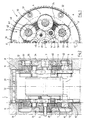
- the active rotating part of the reduction gear according to the invention is contained in a cylindrical casing-envelope 1 provided with two circular rolling tracks 10 of large diameter D5 each fixed concentrically in one of its two lateral covers 11.
- the central driving rotor 2 is supported at its two ends each furnished with a rolling ring of diameter D0 by three idle rollers 4 of diameter D1, arranged at 120 ° from one another, freely rotating on three axes 40 implanted in each of the two lateral cheeks 31.
- each end 20 of the central drive rotor 2 rests on these idle rollers 4 at three points spaced at 120 ° which constitute a rolling bearing, without any harmful passive resistance, because thus all friction actively participates in the transmission of movement.
- the central driving rotor 2 transmits by rotary friction its movement to the idle rollers 4 which transmit it to the wheels 64 therefore to the hubs 61 of the outer satellites 6 which roll in the two circular tracks of bearings 10 of the casing casing 1, thus causing the carrier cage - satellite 30.
- the ends of shafts or hubs of all the planetary ones have bearing rings similar to those of diameter D0 equipping the central driving rotor 2, but their diameters, d2 for the planetary-mass 5 and d3 for the external planetary 6 can be either equal to D0 is different, the diameter d3 intervening in the final reduction ratio, but not d2.
- the radial clearance of the idle rollers 4 on their axes 40 is such that the latter do not support any force, especially as these idle rollers 4 are self-centered by the symmetry of the radial forces exerted therein.
- These axes 40 therefore also have only a positioning role, so that the only passive resistances are located at the two ball bearings constituting the bearing bearings 34 of the cage 30 and at the six open housings 33 of each lateral cheek 31.
- idler rollers 4 as well as the large wheels 62 of the outer planet wheels 6 constitute intermediate wheels between the hubs 20 of the central drive shaft 2 and the hubs 51 of the planet wheels-masses 5, so that if the diameter d2 of the latter is equal at D0, the planetary-masses 5 rotate at the speed N0 of the central drive shaft 2, which may be arbitrary because, apart from their role synchronizing the wheels 62, they do not transmit the movement they receive to any other .
- d3 smaller than D0, which implies to keep the same D1 to magnify D3 accordingly as well as d2 if RM must remain unchanged: because RM is such that the center of the planetary-mass 5 is found, all radial games caught up, at the center of the equilateral triangle formed by the axis of the central drive shaft 2 and those of the two outer planetary 6 neighbors.
- the largest possible diameter is obtained for the cylindrical mass M carried by each planetary-mass 5 and on which depends, with RM, the value of the centrifugal force generated.
- the choice of the diameters d2, d3, D3 and the orbital radius RM also determines the diameter D1 of the idler rollers 4.
- the radial clearance in the housings 35 of the ends of the shafts 51 of the planetary-masses 5 allows a sufficient reduction in RM to allow the installation of all the wheels 62 of the outer planet wheels 6.
- their energetic support on the latter results in slight angular displacements and slightly different eccentricities, shown in broken lines in FIG. 3.
- the centrifugal force used to apply the set of friction wheels against each other comes mainly from the drive in orbital rotation of the three planetary-masses 5, each of these three radial forces breaking down into two equal symmetrical forces, oblique at 60 °, all games caught up. While participating predominantly in the application of the hubs 61 of the outer sun gear 6 on their running track 10, the force resulting from these two oblique forces is transferred in a centripetal direction to the central drive shaft 2.
- each of the planetary-masses 5 being in abutment on the rolling support bearing formed by the large wheels 62 of the two outer planetary 6 neighboring, the centrifugal force developed radially breaks down into two equal vectors, oblique and symmetrical at 60 °, which tend to move them away from each other. It follows that each one tends to approach the next outer sun gear 6, which is also subject, with its neighbor, to the same spreading effect by the second sun gear, and so on for the others.
- this two-by-two bringing together of the outer planets 6 is limited by the presence, on each of the two wheels 62, of the idler roller 4 which is thus pushed towards the center by the two equal converging forces, the result of which is a force centripetal radial.
- the centrifugal force generated by each of the three planetary masses 5 is transmitted towards the center in three equal vectors offset by 120 ° by the idle rollers 4 resting on the rings 20 of the central drive rotor 2.
- the latter is then pinched as in a three-jaw chuck, so that while being supported by the idle rollers 4 as in a bearing it transmits their rotation at high speed by rotary friction effect.
- the rotary friction drive is done by the six outer planets 6 and also differently from the fact that the application force here combines two distinct centrifugal effects: that generated by the planetary-masses 5 and that specific to the mass m of each outside planet 8.
- the forces at play in the device according to the invention are as follows. Let the vector Fc of radial direction whose size corresponds to the centrifugal force generated by each planetary-mass 5: it breaks down into two equal and symmetrical vectors Fc ′, each directed towards the center of the outer planetary 6 located on either side other, forming with the initial vector Fc an angle of 60 °. The parallelogram of the forces thus being made up of two equilateral triangles, it follows that these two vectors Fc ′ are equal in magnitude to Fc.
- Each of the forces Fc ′ is transmitted to the outer planets 6 by pressing on their large wheels 62, therefore can be translated in their center, in the direction defined by the line of centers passing through the point of contact on the large wheel 62 of the hub 51 corresponding to the planetary-mass 5.
- the vectors Fc ′ are then decomposed into two forces: one Fa, radial, presses the hub 61 of this outer sun gear 6 on the raceway 10 and is exerted on the raceway 10, thus generating a support reaction Ra equal and of opposite direction; the other, Rp, exerts a push towards the neighboring outer planetary 6, perpendicular to the vector Fc′ previously translated.
- the two forces Ra and Rp applied to the center of the outer sun gear 6 considered can be composed in the direction of the rolling contact point between the large wheel 62 and idler roller 4, giving a result Rf which can be carried over to the center of the latter, joining another force there.
- the inductor satellites roll directly in the bore of the raceway, but here, with identical general dimensioning, the planetary-mass 5 are necessarily on a circular orbit reduced by about half, as well as their own diameter and therefore their mass: the centrifugal force to which they are subjected is therefore four times less.
- the friction conditions of the first depend on the capacity of the engine's torque through the primary of the device, while on those of the second depend the transmission capacity through its secondary: however the application forces Er and Q result from the importance of the masses M and m, so that obtaining the equivalence between the capture capacity and that of transmission leads to optimizing the ratio M / m.
- this planetary can be designed with a hollow body ballasted with very dense metal, for example lead.
- Make-up gears may be adopted for the sole purpose of avoiding the slip of the hubs 61 of the outer sun gear 6 during their rolling in the raceways 10, by means of, on each, a pinion 63 of pitch diameter d3 driving an internal gear 12 of pitch diameter D5.
- a gear ratio d2 / D3 with a work rate as low if not zero.
- the present invention thus makes it possible to discharge the gear teeth of a reducer operating at very high rotational speeds, by transferring their work to friction wheels, so that they only have to play a role of synchronization and possible back-up.
- this system dodges any subjection of construction of fixed bearings. Moreover being rolling they are active here because the passive resistances participate in the transmission of the movement.
- the reduction ratio is established as follows: the kinematic chain starts from the central drive shaft 2 rotating at high speed N0 and ends, via the cage 30, at the output shaft 3 which runs at reduced speed N2. It passes successively through the friction wheels characterized by their diameter, from D0 to D1, from D1 to D3 which is integral with d3, from d3 to the cage 30 by the tangential thrust resulting from the rolling of d3 on D5: therefore do not intervene in the expression of the reduction ratio as the diameters D0, D3, d3 and D5, and not d2, nor D1.
- the second speed reduction takes place between the previous hubs 61 of diameter d3 rotating at speed N1 and the rolling track 10 on which they roll, driving in this movement the cage 30 at speed N2.
- N2 N1 x (d3 / D5)
- the assembly in order to find concordant directions of rotation and to benefit from the best reduction ratio, the assembly is modified as follows.
- the two series of three idle rollers 4 serving as a bearing for the driving rotor are replaced by two series of three other rollers 4 ′ of much smaller diameter, that of the hubs of the planetary-masses. These rollers are still in rolling contact with the large wheels 62 of the outer planetaries 6 and constitute, as before, their spacing limiting stop. But because of their reduced diameter and the more eccentric position of their carrier axis, they are no longer in rolling contact with the hubs 20 of the central driving rotor 2, thus losing their former role of bearing carrier, assigned to two sets of six additional rollers 7.
- rollers 7 are intermediate wheels inserted in the annular space cleared around the central driving rotor 2, carried with play by pins implanted in each lateral cheek 31 of the cage 30. It follows that the number of rollers carrying the central drive rotor goes from two series of three at 120 ° to two series of six at 60 °, ie six rolling bearing points instead of three previously.
- the rolling contacts between these two series of six rollers 7 and the two series of three more eccentric rollers 4 ′ are located on each side: for a first group of three at 120 °, between the hubs 20 of the driving rotor 2 and the series of three idler rollers 4 ′ pushed centripetally each by a pair of large wheels 62 of two outer planet wheels 6 which are supported thereon; for the second group of the three others, also at 120 ° but alternated with the previous ones, between the hubs 20 of the central driving rotor 2 and the hubs 51 of the planetary-mass 5, all of these rollers 7 also resting on the two series of rollers 4 ′ pushed inwardly each by a pair of large wheels 62 from two consecutive outer planetaries 6.
- each of these two rollers 7 constitutes a double support under the effect of these thrusts, on the one hand on a hub 20 of the driving rotor 2, on the other hand on a hub 51 of a sun gear 5, so that these two hubs prevent them from moving further apart from each other.
- each hub of the driving rotor is thus surrounded at six points at 60 ° by the same centripetal force resulting from the centrifugal force generated by the three planetary-masses.
- the result is the same as in the first embodiment, but the direction of rotation of the driven shaft becoming that of the driving the reduction ratio is more interesting, being increased by 2 to equal wheel diameters.
- the doubling of the number of contact points rolling on the driving rotor is beneficial, dividing by half the unit pressing pressure, so that the planetary-mass can be increased as much to increase the capacity of capture-transmission of the leading tree.
- gears can all be grouped on the same side, the organization of their lubrication is easier and the overall length is significantly reduced.
- this second embodiment may be preferred for these advantages, in particular if a higher reduction ratio is necessary.
Landscapes
- Engineering & Computer Science (AREA)
- General Engineering & Computer Science (AREA)
- Mechanical Engineering (AREA)
- Friction Gearing (AREA)
- Retarders (AREA)
- General Details Of Gearings (AREA)
Applications Claiming Priority (2)
| Application Number | Priority Date | Filing Date | Title |
|---|---|---|---|
| FR9005094A FR2660979B1 (fr) | 1990-04-17 | 1990-04-17 | Reducteur de vitesse a roues de friction. |
| FR9005094 | 1990-04-17 |
Publications (2)
| Publication Number | Publication Date |
|---|---|
| EP0453383A1 true EP0453383A1 (de) | 1991-10-23 |
| EP0453383B1 EP0453383B1 (de) | 1995-07-05 |
Family
ID=9395954
Family Applications (1)
| Application Number | Title | Priority Date | Filing Date |
|---|---|---|---|
| EP91440030A Expired - Lifetime EP0453383B1 (de) | 1990-04-17 | 1991-04-17 | Untersetzungsreibrollgetriebe der Bauart mit zwei Planetenradsätzen für hochtourig drehende Maschinen |
Country Status (6)
| Country | Link |
|---|---|
| US (1) | US5238459A (de) |
| EP (1) | EP0453383B1 (de) |
| AT (1) | ATE124763T1 (de) |
| DE (1) | DE69110956T2 (de) |
| FR (1) | FR2660979B1 (de) |
| WO (1) | WO1991016558A1 (de) |
Cited By (1)
| Publication number | Priority date | Publication date | Assignee | Title |
|---|---|---|---|---|
| US5782754A (en) * | 1992-04-22 | 1998-07-21 | Korf; Jakob | Non-invasive monitoring of a constituent of a physiological fluid |
Families Citing this family (14)
| Publication number | Priority date | Publication date | Assignee | Title |
|---|---|---|---|---|
| US5489244A (en) * | 1990-07-25 | 1996-02-06 | Yunzao Li | Centrifugal planetary friction transmission |
| AU2001288824A1 (en) * | 2000-09-08 | 2002-03-22 | Iowa State University Research Foundation Inc. | Self-actuating, traction-drive speed changer |
| KR100534198B1 (ko) * | 2005-06-24 | 2005-12-07 | 박종헌 | 동력전달장치 |
| DE102005049173B4 (de) * | 2005-10-14 | 2010-01-21 | Vojacek, Herbert, Prof. Dr.-Ing. | Reibradgetriebe |
| JP5060454B2 (ja) * | 2007-11-13 | 2012-10-31 | 京セラドキュメントソリューションズ株式会社 | トラクション動力伝達装置及びこれを搭載した画像形成装置 |
| US20100295782A1 (en) * | 2009-05-21 | 2010-11-25 | Yehuda Binder | System and method for control based on face ore hand gesture detection |
| WO2013173928A1 (en) | 2012-05-25 | 2013-11-28 | Genesis Advanced Technology Inc. | Speed change device |
| WO2014182546A2 (en) * | 2013-05-09 | 2014-11-13 | United Technologies Corporation | Turbofan engine front section |
| CN106523592B (zh) | 2015-09-09 | 2021-05-07 | Fev有限责任公司 | 用于平衡发动机壳体的旋转加速度的离心质量装置 |
| RU2611673C2 (ru) * | 2016-03-16 | 2017-02-28 | Александр Васильевич Дегтярев | Сцепление с универсальной самоцентрирующейся системой |
| RU2612357C2 (ru) * | 2016-04-10 | 2017-03-07 | Александр Васильевич Дегтярев | Передача с универсальной самоцентрирующейся системой с изменяемой геометрией |
| CN110671472A (zh) * | 2019-10-11 | 2020-01-10 | 杭州耐巡客车变速箱有限公司 | 轮边减速器及其装配方法 |
| CN110985609A (zh) * | 2020-01-07 | 2020-04-10 | 北京万创兴达科技有限公司 | 一种双齿轮组消隙减速器 |
| JP7350033B2 (ja) * | 2021-09-28 | 2023-09-25 | Toto株式会社 | トイレ装置 |
Citations (2)
| Publication number | Priority date | Publication date | Assignee | Title |
|---|---|---|---|---|
| FR1451418A (fr) * | 1965-07-15 | 1966-01-07 | Trw Inc | Dispositif de commande par frottement planétaire |
| EP0161194A1 (de) * | 1984-04-12 | 1985-11-13 | Jean André Bech | Epizykloidale Induktionsreduzierkupplung für Maschinen mit sehr hoher Drehgeschwindigkeit |
Family Cites Families (5)
| Publication number | Priority date | Publication date | Assignee | Title |
|---|---|---|---|---|
| US3254546A (en) * | 1962-11-14 | 1966-06-07 | Trw Inc | Toggle action planetary friction drive |
| US3364761A (en) * | 1963-07-19 | 1968-01-23 | Trw Inc | Torque sensitive multi-roller friction drive |
| US3267771A (en) * | 1964-03-09 | 1966-08-23 | Kendick Mfg Company Inc | Motion transmitting mechanism |
| US3367214A (en) * | 1966-02-17 | 1968-02-06 | Trw Inc | Double toggle action planetary friction drive |
| US3433099A (en) * | 1967-11-21 | 1969-03-18 | Trw Inc | Multi-roller friction drive with conical preload mechanism |
-
1990
- 1990-04-17 FR FR9005094A patent/FR2660979B1/fr not_active Expired - Lifetime
-
1991
- 1991-04-17 EP EP91440030A patent/EP0453383B1/de not_active Expired - Lifetime
- 1991-04-17 AT AT91440030T patent/ATE124763T1/de not_active IP Right Cessation
- 1991-04-17 WO PCT/FR1991/000321 patent/WO1991016558A1/fr not_active Ceased
- 1991-04-17 DE DE69110956T patent/DE69110956T2/de not_active Expired - Fee Related
- 1991-04-17 US US07/834,300 patent/US5238459A/en not_active Expired - Fee Related
Patent Citations (2)
| Publication number | Priority date | Publication date | Assignee | Title |
|---|---|---|---|---|
| FR1451418A (fr) * | 1965-07-15 | 1966-01-07 | Trw Inc | Dispositif de commande par frottement planétaire |
| EP0161194A1 (de) * | 1984-04-12 | 1985-11-13 | Jean André Bech | Epizykloidale Induktionsreduzierkupplung für Maschinen mit sehr hoher Drehgeschwindigkeit |
Cited By (1)
| Publication number | Priority date | Publication date | Assignee | Title |
|---|---|---|---|---|
| US5782754A (en) * | 1992-04-22 | 1998-07-21 | Korf; Jakob | Non-invasive monitoring of a constituent of a physiological fluid |
Also Published As
| Publication number | Publication date |
|---|---|
| FR2660979A1 (fr) | 1991-10-18 |
| EP0453383B1 (de) | 1995-07-05 |
| FR2660979B1 (fr) | 1992-07-10 |
| ATE124763T1 (de) | 1995-07-15 |
| WO1991016558A1 (fr) | 1991-10-31 |
| US5238459A (en) | 1993-08-24 |
| DE69110956T2 (de) | 1996-04-04 |
| DE69110956D1 (de) | 1995-08-10 |
Similar Documents
| Publication | Publication Date | Title |
|---|---|---|
| EP0453383B1 (de) | Untersetzungsreibrollgetriebe der Bauart mit zwei Planetenradsätzen für hochtourig drehende Maschinen | |
| EP0756675B1 (de) | Stufenloses, automatisches, mechanisches getriebe und seine arbeitsweise | |
| FR2708068A1 (fr) | Transmission à friction continûment variable. | |
| FR2634848A1 (fr) | Transmission a variation continue a courroie plate | |
| FR3128263A1 (fr) | Motoréducteur et cycle associé | |
| EP0300905B1 (de) | Untersetzungsgetriebe mit parallelen oder rechtwinkligen Achsen und Leistungsverzweigung und Spielausgleich | |
| EP3908511A2 (de) | Untersetzungsgetriebe | |
| FR2632037A1 (fr) | Transmission a variation continue a courroie plate | |
| FR2771153A1 (fr) | Reducteur epicycloidal ou cycloidal et articulation de robot equipee d'un tel reducteur | |
| FR2537684A1 (fr) | Mecanisme rotatif a came donnant de longues periodes de repos avec une rotation continue a l'entree | |
| FR2822198A1 (fr) | Moteur gravifique a differentiels de couples constants sur trains d'engrenages epicycloidaux | |
| FR2926860A1 (fr) | Actionneur de frein de stationnement | |
| EP0319354B1 (de) | Antriebsvorrichtung eines Zahnrades mittels eines selbstausrichtenden fliegenden Ritzels | |
| EP0656104B1 (de) | Mechanische vorrichtung zur untersetzung, übersetzung und änderung der drehzahl | |
| EP0200205B1 (de) | Kupplung um zwei gleichachsige Wellen zu kuppeln mit teleskopischem Zwischenteil | |
| BE372800A (de) | ||
| FR2631420A1 (en) | Variable-diameter pulley for variable speed drive - has belt bearing segments engaged in flanges with leaf spring and pin fixing | |
| FR2770602A1 (fr) | Procede de transmission permettant une variation continue de vitesse de rotation par un engrenage toujours en prise | |
| BE351955A (de) | ||
| BE470848A (de) | ||
| FR3077612A3 (fr) | Train epicycloidal a geometrie variable | |
| FR3078379A3 (fr) | Train epicycloidal a geometrie variable | |
| FR2945601A1 (fr) | Appareil de transmission mecanique a variation continue et automatique du rapport de transmission | |
| EP1147329A1 (de) | Kontinuierlich verstellbares, mechanisches getriebe | |
| BE449588A (de) |
Legal Events
| Date | Code | Title | Description |
|---|---|---|---|
| PUAI | Public reference made under article 153(3) epc to a published international application that has entered the european phase |
Free format text: ORIGINAL CODE: 0009012 |
|
| AK | Designated contracting states |
Kind code of ref document: A1 Designated state(s): AT BE CH DE DK ES FR GB GR IT LI LU NL SE |
|
| 17P | Request for examination filed |
Effective date: 19920422 |
|
| 17Q | First examination report despatched |
Effective date: 19931119 |
|
| GRAA | (expected) grant |
Free format text: ORIGINAL CODE: 0009210 |
|
| AK | Designated contracting states |
Kind code of ref document: B1 Designated state(s): AT BE CH DE DK ES FR GB GR IT LI LU NL SE |
|
| PG25 | Lapsed in a contracting state [announced via postgrant information from national office to epo] |
Ref country code: IT Free format text: LAPSE BECAUSE OF FAILURE TO SUBMIT A TRANSLATION OF THE DESCRIPTION OR TO PAY THE FEE WITHIN THE PRE;WARNING: LAPSES OF ITALIAN PATENTS WITH EFFECTIVE DATE BEFORE 2007 MAY HAVE OCCURRED AT ANY TIME BEFORE 2007. THE CORRECT EFFECTIVE DATE MAY BE DIFFERENT FROM THE ONE RECORDED.SCRIBED TIME-LIMIT Effective date: 19950705 Ref country code: NL Free format text: LAPSE BECAUSE OF FAILURE TO SUBMIT A TRANSLATION OF THE DESCRIPTION OR TO PAY THE FEE WITHIN THE PRESCRIBED TIME-LIMIT Effective date: 19950705 Ref country code: AT Effective date: 19950705 Ref country code: DK Effective date: 19950705 Ref country code: ES Free format text: THE PATENT HAS BEEN ANNULLED BY A DECISION OF A NATIONAL AUTHORITY Effective date: 19950705 Ref country code: GR Free format text: LAPSE BECAUSE OF FAILURE TO SUBMIT A TRANSLATION OF THE DESCRIPTION OR TO PAY THE FEE WITHIN THE PRESCRIBED TIME-LIMIT Effective date: 19950705 |
|
| REF | Corresponds to: |
Ref document number: 124763 Country of ref document: AT Date of ref document: 19950715 Kind code of ref document: T |
|
| REF | Corresponds to: |
Ref document number: 69110956 Country of ref document: DE Date of ref document: 19950810 |
|
| PG25 | Lapsed in a contracting state [announced via postgrant information from national office to epo] |
Ref country code: SE Effective date: 19951005 |
|
| GBT | Gb: translation of ep patent filed (gb section 77(6)(a)/1977) |
Effective date: 19951010 |
|
| NLV1 | Nl: lapsed or annulled due to failure to fulfill the requirements of art. 29p and 29m of the patents act | ||
| PG25 | Lapsed in a contracting state [announced via postgrant information from national office to epo] |
Ref country code: CH Effective date: 19960430 Ref country code: LI Effective date: 19960430 Ref country code: LU Free format text: LAPSE BECAUSE OF NON-PAYMENT OF DUE FEES Effective date: 19960430 Ref country code: BE Effective date: 19960430 |
|
| PLBE | No opposition filed within time limit |
Free format text: ORIGINAL CODE: 0009261 |
|
| STAA | Information on the status of an ep patent application or granted ep patent |
Free format text: STATUS: NO OPPOSITION FILED WITHIN TIME LIMIT |
|
| 26N | No opposition filed | ||
| BERE | Be: lapsed |
Owner name: BECH JEAN ANDRE Effective date: 19960430 |
|
| REG | Reference to a national code |
Ref country code: CH Ref legal event code: PL |
|
| PGFP | Annual fee paid to national office [announced via postgrant information from national office to epo] |
Ref country code: FR Payment date: 19990430 Year of fee payment: 9 |
|
| PG25 | Lapsed in a contracting state [announced via postgrant information from national office to epo] |
Ref country code: FR Free format text: LAPSE BECAUSE OF NON-PAYMENT OF DUE FEES Effective date: 20001229 |
|
| REG | Reference to a national code |
Ref country code: FR Ref legal event code: ST |
|
| REG | Reference to a national code |
Ref country code: FR Ref legal event code: RN |
|
| REG | Reference to a national code |
Ref country code: GB Ref legal event code: IF02 |
|
| PGFP | Annual fee paid to national office [announced via postgrant information from national office to epo] |
Ref country code: GB Payment date: 20040329 Year of fee payment: 14 Ref country code: DE Payment date: 20040329 Year of fee payment: 14 |
|
| REG | Reference to a national code |
Ref country code: FR Ref legal event code: FC |
|
| PG25 | Lapsed in a contracting state [announced via postgrant information from national office to epo] |
Ref country code: GB Free format text: LAPSE BECAUSE OF NON-PAYMENT OF DUE FEES Effective date: 20050417 |
|
| PG25 | Lapsed in a contracting state [announced via postgrant information from national office to epo] |
Ref country code: DE Free format text: LAPSE BECAUSE OF NON-PAYMENT OF DUE FEES Effective date: 20051101 |
|
| GBPC | Gb: european patent ceased through non-payment of renewal fee |
Effective date: 20050417 |