EP0453592B1 - Fabrication d'articles en carbure de silicium - Google Patents
Fabrication d'articles en carbure de silicium Download PDFInfo
- Publication number
- EP0453592B1 EP0453592B1 EP90107736A EP90107736A EP0453592B1 EP 0453592 B1 EP0453592 B1 EP 0453592B1 EP 90107736 A EP90107736 A EP 90107736A EP 90107736 A EP90107736 A EP 90107736A EP 0453592 B1 EP0453592 B1 EP 0453592B1
- Authority
- EP
- European Patent Office
- Prior art keywords
- silicon carbide
- sprue
- porous
- carbon
- silicon
- Prior art date
- Legal status (The legal status is an assumption and is not a legal conclusion. Google has not performed a legal analysis and makes no representation as to the accuracy of the status listed.)
- Expired - Lifetime
Links
- HBMJWWWQQXIZIP-UHFFFAOYSA-N silicon carbide Chemical compound [Si+]#[C-] HBMJWWWQQXIZIP-UHFFFAOYSA-N 0.000 title claims description 24
- 229910010271 silicon carbide Inorganic materials 0.000 title claims description 22
- 238000004519 manufacturing process Methods 0.000 title claims description 7
- OKTJSMMVPCPJKN-UHFFFAOYSA-N Carbon Chemical compound [C] OKTJSMMVPCPJKN-UHFFFAOYSA-N 0.000 claims description 21
- 229910052799 carbon Inorganic materials 0.000 claims description 19
- 229910052710 silicon Inorganic materials 0.000 claims description 18
- 239000010703 silicon Substances 0.000 claims description 18
- 239000000203 mixture Substances 0.000 claims description 12
- 239000002245 particle Substances 0.000 claims description 12
- 239000011230 binding agent Substances 0.000 claims description 11
- 238000000034 method Methods 0.000 claims description 11
- 239000000463 material Substances 0.000 claims description 8
- 238000007789 sealing Methods 0.000 claims description 8
- 238000001746 injection moulding Methods 0.000 claims description 7
- 230000009969 flowable effect Effects 0.000 claims description 3
- 238000010438 heat treatment Methods 0.000 claims description 3
- 229910021426 porous silicon Inorganic materials 0.000 claims description 3
- 208000015943 Coeliac disease Diseases 0.000 description 18
- XUIMIQQOPSSXEZ-UHFFFAOYSA-N Silicon Chemical compound [Si] XUIMIQQOPSSXEZ-UHFFFAOYSA-N 0.000 description 14
- 238000000465 moulding Methods 0.000 description 4
- 229910002804 graphite Inorganic materials 0.000 description 2
- 239000010439 graphite Substances 0.000 description 2
- 229920001169 thermoplastic Polymers 0.000 description 2
- 239000004416 thermosoftening plastic Substances 0.000 description 2
- 239000006229 carbon black Substances 0.000 description 1
- 238000006243 chemical reaction Methods 0.000 description 1
- 238000010586 diagram Methods 0.000 description 1
- 239000008187 granular material Substances 0.000 description 1
- 238000003780 insertion Methods 0.000 description 1
- 230000037431 insertion Effects 0.000 description 1
- 239000012774 insulation material Substances 0.000 description 1
- 239000013067 intermediate product Substances 0.000 description 1
- 239000007788 liquid Substances 0.000 description 1
- 238000002844 melting Methods 0.000 description 1
- 230000008018 melting Effects 0.000 description 1
- 229910052753 mercury Inorganic materials 0.000 description 1
- 239000002184 metal Substances 0.000 description 1
- 239000011148 porous material Substances 0.000 description 1
- 239000000047 product Substances 0.000 description 1
- 238000000197 pyrolysis Methods 0.000 description 1
- 230000035939 shock Effects 0.000 description 1
- 239000012899 standard injection Substances 0.000 description 1
- 239000000126 substance Substances 0.000 description 1
- 239000002699 waste material Substances 0.000 description 1
Images


Classifications
-
- C—CHEMISTRY; METALLURGY
- C04—CEMENTS; CONCRETE; ARTIFICIAL STONE; CERAMICS; REFRACTORIES
- C04B—LIME, MAGNESIA; SLAG; CEMENTS; COMPOSITIONS THEREOF, e.g. MORTARS, CONCRETE OR LIKE BUILDING MATERIALS; ARTIFICIAL STONE; CERAMICS; REFRACTORIES; TREATMENT OF NATURAL STONE
- C04B35/00—Shaped ceramic products characterised by their composition; Ceramics compositions; Processing powders of inorganic compounds preparatory to the manufacturing of ceramic products
- C04B35/515—Shaped ceramic products characterised by their composition; Ceramics compositions; Processing powders of inorganic compounds preparatory to the manufacturing of ceramic products based on non-oxide ceramics
- C04B35/56—Shaped ceramic products characterised by their composition; Ceramics compositions; Processing powders of inorganic compounds preparatory to the manufacturing of ceramic products based on non-oxide ceramics based on carbides or oxycarbides
- C04B35/565—Shaped ceramic products characterised by their composition; Ceramics compositions; Processing powders of inorganic compounds preparatory to the manufacturing of ceramic products based on non-oxide ceramics based on carbides or oxycarbides based on silicon carbide
- C04B35/573—Shaped ceramic products characterised by their composition; Ceramics compositions; Processing powders of inorganic compounds preparatory to the manufacturing of ceramic products based on non-oxide ceramics based on carbides or oxycarbides based on silicon carbide obtained by reaction sintering or recrystallisation
Definitions
- This invention relates to the manufacture of silicon carbide articles, and in particular to manufacture by injection moulding followed by siliconisation.
- Articles resistant to thermal shock and with good mechanical properties can be made from particles of the highly refractory substance silicon carbide by a variety of methods.
- a mixture flowable under heat and pressure which comprises a major proportion of silicon carbide particles and a minor proportion of organic binder material is injected through a narrow orifice to fill a shaped cavity in a mould at lower temperature.
- the article thus formed is then removed from the mould, and the sprue (ie the waste piece corresponding to the passage in the mould tool between the moulding orifice and the mould cavity) is machined off.
- the moulded article is then heated to remove the organic binder material from it and leave a porous silicon carbide body containing elemental carbon which (at this stage) weakly binds together the highly refractory silicon carbides particles.
- the elemental carbon may be present as a result of generation by pyrolysis of the original organic binder material in the mixture submitted to moulding (as in GB-1,454,622) or as a result of its inclusion per se in that mixture.
- the porous body thus produced is then impregnated with molten silicon to convert the carbon present to silicon carbide.
- the carbon present dissolves in and reacts with the molten silicon which is drawn up into the pores of the body, and the silicon carbide thus formed bonds together the original silicon carbide particles into a unitary structure of great strength.
- This step is conventionally carried out in a furnace at high temperature, eg 1500-1600°C, and low pressure, eg 0.5mm Hg, as mentioned in the UK Patent No 1,454,622.
- the present invention is concerned with improving the method just described so as to avoid excessive contact between the surface of the weakly bonded porous shaped body obtained as intermediate product and the molten silicon employed for siliconisation, and thus reduce the possibility of damage to that body.
- elemental carbon for example in the form of finely divided graphite or carbon black, is included in the mixture in step (i) above.
- Step (iii) is carried out under the usual conditions, eg in a furnace under very low pressure.
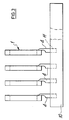
- the sprue is used as a wick to pick up molten silicon from a block of porous carbon.
- the sprue may be inserted in a suitable sized hole in the block of porous carbon, which is supplied with molten silicon, for example either by locating the block in direct contact with molten silicon in a reservoir, or by using the block itself as a reservoir.
- the porous carbon block may conveniently be a block of porous carbon insulation material, which we have found to function effectively as a medium for mounting components by means of their sprues during siliconisation and for transferring molten silicon into the sprues, which rest in holes in the block and are arranged to be a snug fit to facilitate transfer of silicon from block to sprue.
- the siliconised sprue that results from operation of the method is of course very strong, and can if desired be left as it is. It may, however, be cut down flush with the surface of the article, or only partly, so as to leave a stub, of maximum length no more than a few mm, say up to 5-10mm, to serve as a location or alignment means, as explained later in this specification.
- the invention has particular application to the manufacture of sealing rings, but may be used for the manufacture of other, more complex, components, for example turbocharger rotors.
- the ring-shaped injection-moulded silicon carbide article 1 has an interior shoulder 2 and an exterior shoulder 3, and has the sprue 4 formed during injection moulding still integral with it.
- the article 1 can be made as follows.
- a mixture of conventional composition (suitably 61% by weight silicon carbide, particle size below 20 ⁇ m; 18% by weight graphite, particle agglomerate size below 20 ⁇ m; remainder a thermoplastic binder material) is prepared and granulated, and the granules are injection-moulded in a standard injection moulding machine, to form rings of height 6.5mm, external diameter 72.4mm and internal diameter 61mm, with a sprue length of about 40mm.
- the ring is removed from the mould and, to avoid distortion, is supported while it cools to room temperature.
- the article is then heated, while still under support, in an air oven. Once the temperature has reached a value at which the binder is soft, the rate of increase is limited to 2°C per hour until a temperature of about 300°C is attained. This heating first oxidises, and then pyrolyses, the thermoplastic binder while leaving the original elemental carbon in the resulting porous structure as a weak binder for the original silicon carbide particles.
- the density of the porous body formed is about 2.2g/cm3.
- the sprue can be severed by grinding. If this is done so as to leave a stub, say about 3mm high, protruding above the surface of ring 1 (the upper surface in Fig.2), the stub can serve as a location or alignment means for the ring in a metal or other housing of which it is to form a sealing component.
- FIG. 4 A further alignment means derived from a sprue is illustrated in Figures 4 and 5, Figure 5 being a cross-sectional view of the sealing ring of Figure 4.
- the sealing ring 12 shown in Figures 4 and 5 has two internal shoulders 15, 16 and the two external shoulders 17, 18 and has been produced as described above with a moulding sprue 13 (shown in dotted lines) having been used for siliconisation. However, the moulding sprue in this embodiment has been ground down to form an anti-rotation lug 14 on the sealing ring, extending between the two external shoulders 17 and 18.
Landscapes
- Chemical & Material Sciences (AREA)
- Engineering & Computer Science (AREA)
- Ceramic Engineering (AREA)
- Chemical Kinetics & Catalysis (AREA)
- Manufacturing & Machinery (AREA)
- Materials Engineering (AREA)
- Structural Engineering (AREA)
- Organic Chemistry (AREA)
- Ceramic Products (AREA)
Claims (6)
- Procédé pour fabriquer un article en carbure de silicium siliciuré par les phases consistant à :(i) mouler par injection un mélange qui comprend une majeure partie de particules de carbure de silicium et une petite partie de liant organique, le mélange étant fluide sous l'effet de la chaleur et de la pression,(ii) chauffer l'article moulé ainsi formé pour le débarrasser du liant organique et obtenir un corps de carbure de silicium poreux contenant du carbone élémentaire, et(iii) imprégner le corps poreux de silicium fondu pour transformer ledit carbone en carbure de silicium qui lie les particules de carbure de silicium originales,caractérisé en ce que la phase (iii) du procédé est effectuée en utilisant comme conduit pour ledit silicium fondu la carotte (4, 13) qui est formée d'un seul tenant avec l'article moulé par injection à la phase (i).
- Procédé selon la revendication 1, caractérisé en ce que le mélange utilisé à la phase (i) comprend également du carbone élémentaire.
- Procédé selon la revendication 1ou 2, caractérisé en ce qu'à la phase (iii) la carotte est utilisée comme mèche pour recueillir le silicium fondu à partir d'un bloc de carbone poreux.
- Procédé selon la revendication 3, caractérisé en ce que la carotte est insérée dans un trou de taille appropriée dans le bloc de carbone poreux, qui reçoit du silicium fondu.
- Procédé selon l'une quelconque des revendications précédentes, caractérisé en ce que la carotte siliciurée qui résulte est coupée de manière à laisser une projection, longue de quelques millimètres au maximum, en saillie depuis l'article.
- Procédé selon l'une quelconque des revendications précédentes, caractérisé en ce qu'il est appliqué à la fabrication d'un anneau d'étanchéité.
Priority Applications (3)
| Application Number | Priority Date | Filing Date | Title |
|---|---|---|---|
| EP90107736A EP0453592B1 (fr) | 1990-04-24 | 1990-04-24 | Fabrication d'articles en carbure de silicium |
| DE90107736T DE69003091T2 (de) | 1990-04-24 | 1990-04-24 | Herstellung von Siliciumcarbidgegenständen. |
| US07/514,208 US5037588A (en) | 1990-04-24 | 1990-04-25 | Manufacture of silicon carbide articles |
Applications Claiming Priority (1)
| Application Number | Priority Date | Filing Date | Title |
|---|---|---|---|
| EP90107736A EP0453592B1 (fr) | 1990-04-24 | 1990-04-24 | Fabrication d'articles en carbure de silicium |
Publications (2)
| Publication Number | Publication Date |
|---|---|
| EP0453592A1 EP0453592A1 (fr) | 1991-10-30 |
| EP0453592B1 true EP0453592B1 (fr) | 1993-09-01 |
Family
ID=8203904
Family Applications (1)
| Application Number | Title | Priority Date | Filing Date |
|---|---|---|---|
| EP90107736A Expired - Lifetime EP0453592B1 (fr) | 1990-04-24 | 1990-04-24 | Fabrication d'articles en carbure de silicium |
Country Status (3)
| Country | Link |
|---|---|
| US (1) | US5037588A (fr) |
| EP (1) | EP0453592B1 (fr) |
| DE (1) | DE69003091T2 (fr) |
Families Citing this family (5)
| Publication number | Priority date | Publication date | Assignee | Title |
|---|---|---|---|---|
| GB2250800A (en) * | 1990-12-13 | 1992-06-17 | T & N Technology Ltd | Brake piston |
| WO1999005338A2 (fr) | 1997-07-24 | 1999-02-04 | Toyo Tanso Usa, Inc. | Composants en graphite a surface convertie et leurs procedes de fabrication |
| US6187197B1 (en) * | 1998-10-28 | 2001-02-13 | Marvin Haddock | Multi-stage engine coolant recycling process |
| DE102006009388B4 (de) * | 2006-03-01 | 2009-02-26 | Audi Ag | Vorrichtung zur Silicierung von kohlenstoffhaltigen Werkstoffen und darin durchführbares Verfahren |
| DE102007044783A1 (de) * | 2007-09-19 | 2009-04-09 | Audi Ag | Verfahren und Vorrichtung zur Silicierung von kohlenstoffhaltigen Werkstoffen |
Family Cites Families (5)
| Publication number | Priority date | Publication date | Assignee | Title |
|---|---|---|---|---|
| GB1370478A (en) * | 1971-11-19 | 1974-10-16 | Rolls Royce | Injection of a ceramic into a mould |
| GB1454622A (en) * | 1973-08-20 | 1976-11-03 | Ford Motor Co | Method of making a silicon carbide article |
| US4044110A (en) * | 1975-10-03 | 1977-08-23 | Ford Motor Company | Method of forming a silicon carbide article - III |
| US4294788A (en) * | 1979-12-05 | 1981-10-13 | General Electric Company | Method of making a shaped silicon carbide-silicon matrix composite and articles made thereby |
| US4446085A (en) * | 1982-08-30 | 1984-05-01 | Earsley Melvin L | Molding of seal rings |
-
1990
- 1990-04-24 EP EP90107736A patent/EP0453592B1/fr not_active Expired - Lifetime
- 1990-04-24 DE DE90107736T patent/DE69003091T2/de not_active Expired - Fee Related
- 1990-04-25 US US07/514,208 patent/US5037588A/en not_active Expired - Fee Related
Also Published As
| Publication number | Publication date |
|---|---|
| DE69003091D1 (de) | 1993-10-07 |
| US5037588A (en) | 1991-08-06 |
| EP0453592A1 (fr) | 1991-10-30 |
| DE69003091T2 (de) | 1994-04-14 |
Similar Documents
| Publication | Publication Date | Title |
|---|---|---|
| US4737328A (en) | Infiltration of material with silicon | |
| US4431449A (en) | Infiltrated molded articles of spherical non-refractory metal powders | |
| CN101544851B (zh) | 一种金属结合剂空心球形超硬复合材料及其制造方法 | |
| EP0805729B1 (fr) | Procede de construction de moules et de pieces metalliques de pleine densite | |
| US4242106A (en) | Composite of polycrystalline diamond and/or cubic boron nitride body/silicon carbide substrate | |
| EP0277085B1 (fr) | Fabrication d'objets en carbure métallique | |
| US3882210A (en) | Injection of a ceramic into a mould | |
| EP0888199B1 (fr) | Manchons, leur preparation et utilisation | |
| EP0933825A3 (fr) | Séparateur pour pile à combustible et son procédé de fabrication | |
| CA1073709A (fr) | Fabrication de pieces metallurgiques pittees au moyen de moules thermodegradables | |
| US4491558A (en) | Austenitic manganese steel-containing composite article | |
| EP0012966B1 (fr) | Composé intégré comprenant une phase polycristalline à base de diamant et/ou de nitrure de bore cubique et une phase de support et procédé pour sa préparation | |
| US6776955B1 (en) | Net shaped articles having complex internal undercut features | |
| EP0453592A1 (fr) | Fabrication d'articles en carbure de silicium | |
| US4320079A (en) | Method for making shaped carbon fiber structures | |
| US4793859A (en) | Infiltration of mo-containing material with silicon | |
| US2922255A (en) | Mold apparatus for casting glass | |
| CA1119847A (fr) | Articles moules infiltres faits de poudres de metal spheroides non refractaires | |
| GB2243601A (en) | Siliconised silicon carbide article | |
| EP0189181A3 (fr) | Procédé de fabrication d'un matériau fritté à base de carbure de silicium contenant du bore comme auxiliaire de frittage | |
| GB2163780A (en) | Method of moulding powder materials | |
| KR870008648A (ko) | 주조용 노즐과 그 노즐의 제조방법 | |
| KR100495289B1 (ko) | 발열및(또는)단열특성을갖는슬리브의제조방법,상기방법으로제조된슬리브,상기슬리브를사용하여주조물을제조하는방법,상기방법으로제조된주조물 | |
| GB2096928A (en) | Method of casting grey iron | |
| JP4177491B2 (ja) | 坩台 |
Legal Events
| Date | Code | Title | Description |
|---|---|---|---|
| PUAI | Public reference made under article 153(3) epc to a published international application that has entered the european phase |
Free format text: ORIGINAL CODE: 0009012 |
|
| AK | Designated contracting states |
Kind code of ref document: A1 Designated state(s): DE FR IT |
|
| 17P | Request for examination filed |
Effective date: 19920409 |
|
| 17Q | First examination report despatched |
Effective date: 19921030 |
|
| ITF | It: translation for a ep patent filed | ||
| GRAA | (expected) grant |
Free format text: ORIGINAL CODE: 0009210 |
|
| AK | Designated contracting states |
Kind code of ref document: B1 Designated state(s): DE FR IT |
|
| REF | Corresponds to: |
Ref document number: 69003091 Country of ref document: DE Date of ref document: 19931007 |
|
| ET | Fr: translation filed | ||
| PLBE | No opposition filed within time limit |
Free format text: ORIGINAL CODE: 0009261 |
|
| STAA | Information on the status of an ep patent application or granted ep patent |
Free format text: STATUS: NO OPPOSITION FILED WITHIN TIME LIMIT |
|
| 26N | No opposition filed | ||
| PGFP | Annual fee paid to national office [announced via postgrant information from national office to epo] |
Ref country code: FR Payment date: 19950309 Year of fee payment: 6 |
|
| PGFP | Annual fee paid to national office [announced via postgrant information from national office to epo] |
Ref country code: DE Payment date: 19950322 Year of fee payment: 6 |
|
| PG25 | Lapsed in a contracting state [announced via postgrant information from national office to epo] |
Ref country code: FR Effective date: 19961227 |
|
| PG25 | Lapsed in a contracting state [announced via postgrant information from national office to epo] |
Ref country code: DE Effective date: 19970101 |
|
| REG | Reference to a national code |
Ref country code: FR Ref legal event code: ST |
|
| PG25 | Lapsed in a contracting state [announced via postgrant information from national office to epo] |
Ref country code: IT Free format text: LAPSE BECAUSE OF NON-PAYMENT OF DUE FEES;WARNING: LAPSES OF ITALIAN PATENTS WITH EFFECTIVE DATE BEFORE 2007 MAY HAVE OCCURRED AT ANY TIME BEFORE 2007. THE CORRECT EFFECTIVE DATE MAY BE DIFFERENT FROM THE ONE RECORDED. Effective date: 20050424 |