EP0453694A1 - Cupule destinée à être fixée sans ciment pour prothèse totale de la hanche - Google Patents
Cupule destinée à être fixée sans ciment pour prothèse totale de la hanche Download PDFInfo
- Publication number
- EP0453694A1 EP0453694A1 EP90420209A EP90420209A EP0453694A1 EP 0453694 A1 EP0453694 A1 EP 0453694A1 EP 90420209 A EP90420209 A EP 90420209A EP 90420209 A EP90420209 A EP 90420209A EP 0453694 A1 EP0453694 A1 EP 0453694A1
- Authority
- EP
- European Patent Office
- Prior art keywords
- cap
- slots
- handle
- levers
- cup
- Prior art date
- Legal status (The legal status is an assumption and is not a legal conclusion. Google has not performed a legal analysis and makes no representation as to the accuracy of the status listed.)
- Withdrawn
Links
- 210000002105 tongue Anatomy 0.000 claims abstract description 57
- 239000000463 material Substances 0.000 claims abstract description 14
- 239000000560 biocompatible material Substances 0.000 claims abstract description 5
- 210000000588 acetabulum Anatomy 0.000 claims description 19
- 238000004873 anchoring Methods 0.000 claims description 11
- 238000005452 bending Methods 0.000 claims description 6
- 229910001220 stainless steel Inorganic materials 0.000 claims description 5
- 239000010935 stainless steel Substances 0.000 claims description 5
- 239000013013 elastic material Substances 0.000 claims description 4
- PNEYBMLMFCGWSK-UHFFFAOYSA-N Alumina Chemical compound [O-2].[O-2].[O-2].[Al+3].[Al+3] PNEYBMLMFCGWSK-UHFFFAOYSA-N 0.000 claims description 3
- 239000004568 cement Substances 0.000 claims description 3
- 210000001624 hip Anatomy 0.000 claims description 3
- 239000004698 Polyethylene Substances 0.000 claims description 2
- RTAQQCXQSZGOHL-UHFFFAOYSA-N Titanium Chemical compound [Ti] RTAQQCXQSZGOHL-UHFFFAOYSA-N 0.000 claims description 2
- 229920003023 plastic Polymers 0.000 claims description 2
- 239000004033 plastic Substances 0.000 claims description 2
- -1 polyethylene Polymers 0.000 claims description 2
- 229920000573 polyethylene Polymers 0.000 claims description 2
- 229910052719 titanium Inorganic materials 0.000 claims description 2
- 239000010936 titanium Substances 0.000 claims description 2
- 238000002513 implantation Methods 0.000 abstract 1
- 238000006073 displacement reaction Methods 0.000 description 5
- 230000000694 effects Effects 0.000 description 5
- MCMNRKCIXSYSNV-UHFFFAOYSA-N Zirconium dioxide Chemical compound O=[Zr]=O MCMNRKCIXSYSNV-UHFFFAOYSA-N 0.000 description 4
- 239000000919 ceramic Substances 0.000 description 4
- 238000009434 installation Methods 0.000 description 4
- 230000002093 peripheral effect Effects 0.000 description 4
- 230000035939 shock Effects 0.000 description 4
- 238000013016 damping Methods 0.000 description 3
- 238000006243 chemical reaction Methods 0.000 description 2
- 230000000295 complement effect Effects 0.000 description 2
- 230000006866 deterioration Effects 0.000 description 2
- 230000035515 penetration Effects 0.000 description 2
- 230000008685 targeting Effects 0.000 description 2
- 239000011324 bead Substances 0.000 description 1
- 230000005540 biological transmission Effects 0.000 description 1
- 210000000988 bone and bone Anatomy 0.000 description 1
- 239000000470 constituent Substances 0.000 description 1
- 230000005484 gravity Effects 0.000 description 1
- 229920001903 high density polyethylene Polymers 0.000 description 1
- 239000004700 high-density polyethylene Substances 0.000 description 1
- 238000003780 insertion Methods 0.000 description 1
- 230000037431 insertion Effects 0.000 description 1
- 229920001684 low density polyethylene Polymers 0.000 description 1
- 239000004702 low-density polyethylene Substances 0.000 description 1
- 238000012423 maintenance Methods 0.000 description 1
- 238000000034 method Methods 0.000 description 1
- 239000000203 mixture Substances 0.000 description 1
- 230000001737 promoting effect Effects 0.000 description 1
- 210000000689 upper leg Anatomy 0.000 description 1
Images


Classifications
-
- A—HUMAN NECESSITIES
- A61—MEDICAL OR VETERINARY SCIENCE; HYGIENE
- A61F—FILTERS IMPLANTABLE INTO BLOOD VESSELS; PROSTHESES; DEVICES PROVIDING PATENCY TO, OR PREVENTING COLLAPSING OF, TUBULAR STRUCTURES OF THE BODY, e.g. STENTS; ORTHOPAEDIC, NURSING OR CONTRACEPTIVE DEVICES; FOMENTATION; TREATMENT OR PROTECTION OF EYES OR EARS; BANDAGES, DRESSINGS OR ABSORBENT PADS; FIRST-AID KITS
- A61F2/00—Filters implantable into blood vessels; Prostheses, i.e. artificial substitutes or replacements for parts of the body; Appliances for connecting them with the body; Devices providing patency to, or preventing collapsing of, tubular structures of the body, e.g. stents
- A61F2/02—Prostheses implantable into the body
- A61F2/30—Joints
- A61F2/32—Joints for the hip
- A61F2/34—Acetabular cups
-
- A—HUMAN NECESSITIES
- A61—MEDICAL OR VETERINARY SCIENCE; HYGIENE
- A61F—FILTERS IMPLANTABLE INTO BLOOD VESSELS; PROSTHESES; DEVICES PROVIDING PATENCY TO, OR PREVENTING COLLAPSING OF, TUBULAR STRUCTURES OF THE BODY, e.g. STENTS; ORTHOPAEDIC, NURSING OR CONTRACEPTIVE DEVICES; FOMENTATION; TREATMENT OR PROTECTION OF EYES OR EARS; BANDAGES, DRESSINGS OR ABSORBENT PADS; FIRST-AID KITS
- A61F2/00—Filters implantable into blood vessels; Prostheses, i.e. artificial substitutes or replacements for parts of the body; Appliances for connecting them with the body; Devices providing patency to, or preventing collapsing of, tubular structures of the body, e.g. stents
- A61F2/02—Prostheses implantable into the body
- A61F2/30—Joints
- A61F2/46—Special tools for implanting artificial joints
- A61F2/4603—Special tools for implanting artificial joints for insertion or extraction of endoprosthetic joints or of accessories thereof
- A61F2/4609—Special tools for implanting artificial joints for insertion or extraction of endoprosthetic joints or of accessories thereof of acetabular cups
-
- A—HUMAN NECESSITIES
- A61—MEDICAL OR VETERINARY SCIENCE; HYGIENE
- A61F—FILTERS IMPLANTABLE INTO BLOOD VESSELS; PROSTHESES; DEVICES PROVIDING PATENCY TO, OR PREVENTING COLLAPSING OF, TUBULAR STRUCTURES OF THE BODY, e.g. STENTS; ORTHOPAEDIC, NURSING OR CONTRACEPTIVE DEVICES; FOMENTATION; TREATMENT OR PROTECTION OF EYES OR EARS; BANDAGES, DRESSINGS OR ABSORBENT PADS; FIRST-AID KITS
- A61F2/00—Filters implantable into blood vessels; Prostheses, i.e. artificial substitutes or replacements for parts of the body; Appliances for connecting them with the body; Devices providing patency to, or preventing collapsing of, tubular structures of the body, e.g. stents
- A61F2/02—Prostheses implantable into the body
- A61F2/30—Joints
- A61F2/46—Special tools for implanting artificial joints
- A61F2/4603—Special tools for implanting artificial joints for insertion or extraction of endoprosthetic joints or of accessories thereof
-
- A—HUMAN NECESSITIES
- A61—MEDICAL OR VETERINARY SCIENCE; HYGIENE
- A61F—FILTERS IMPLANTABLE INTO BLOOD VESSELS; PROSTHESES; DEVICES PROVIDING PATENCY TO, OR PREVENTING COLLAPSING OF, TUBULAR STRUCTURES OF THE BODY, e.g. STENTS; ORTHOPAEDIC, NURSING OR CONTRACEPTIVE DEVICES; FOMENTATION; TREATMENT OR PROTECTION OF EYES OR EARS; BANDAGES, DRESSINGS OR ABSORBENT PADS; FIRST-AID KITS
- A61F2/00—Filters implantable into blood vessels; Prostheses, i.e. artificial substitutes or replacements for parts of the body; Appliances for connecting them with the body; Devices providing patency to, or preventing collapsing of, tubular structures of the body, e.g. stents
- A61F2/02—Prostheses implantable into the body
- A61F2/30—Joints
- A61F2002/30001—Additional features of subject-matter classified in A61F2/28, A61F2/30 and subgroups thereof
- A61F2002/30316—The prosthesis having different structural features at different locations within the same prosthesis; Connections between prosthetic parts; Special structural features of bone or joint prostheses not otherwise provided for
- A61F2002/30329—Connections or couplings between prosthetic parts, e.g. between modular parts; Connecting elements
- A61F2002/30331—Connections or couplings between prosthetic parts, e.g. between modular parts; Connecting elements made by longitudinally pushing a protrusion into a complementarily-shaped recess, e.g. held by friction fit
- A61F2002/30362—Connections or couplings between prosthetic parts, e.g. between modular parts; Connecting elements made by longitudinally pushing a protrusion into a complementarily-shaped recess, e.g. held by friction fit with possibility of relative movement between the protrusion and the recess
- A61F2002/30364—Rotation about the common longitudinal axis
- A61F2002/30367—Rotation about the common longitudinal axis with additional means for preventing said rotation
-
- A—HUMAN NECESSITIES
- A61—MEDICAL OR VETERINARY SCIENCE; HYGIENE
- A61F—FILTERS IMPLANTABLE INTO BLOOD VESSELS; PROSTHESES; DEVICES PROVIDING PATENCY TO, OR PREVENTING COLLAPSING OF, TUBULAR STRUCTURES OF THE BODY, e.g. STENTS; ORTHOPAEDIC, NURSING OR CONTRACEPTIVE DEVICES; FOMENTATION; TREATMENT OR PROTECTION OF EYES OR EARS; BANDAGES, DRESSINGS OR ABSORBENT PADS; FIRST-AID KITS
- A61F2/00—Filters implantable into blood vessels; Prostheses, i.e. artificial substitutes or replacements for parts of the body; Appliances for connecting them with the body; Devices providing patency to, or preventing collapsing of, tubular structures of the body, e.g. stents
- A61F2/02—Prostheses implantable into the body
- A61F2/30—Joints
- A61F2002/30001—Additional features of subject-matter classified in A61F2/28, A61F2/30 and subgroups thereof
- A61F2002/30316—The prosthesis having different structural features at different locations within the same prosthesis; Connections between prosthetic parts; Special structural features of bone or joint prostheses not otherwise provided for
- A61F2002/30329—Connections or couplings between prosthetic parts, e.g. between modular parts; Connecting elements
- A61F2002/30426—Bayonet coupling
-
- A—HUMAN NECESSITIES
- A61—MEDICAL OR VETERINARY SCIENCE; HYGIENE
- A61F—FILTERS IMPLANTABLE INTO BLOOD VESSELS; PROSTHESES; DEVICES PROVIDING PATENCY TO, OR PREVENTING COLLAPSING OF, TUBULAR STRUCTURES OF THE BODY, e.g. STENTS; ORTHOPAEDIC, NURSING OR CONTRACEPTIVE DEVICES; FOMENTATION; TREATMENT OR PROTECTION OF EYES OR EARS; BANDAGES, DRESSINGS OR ABSORBENT PADS; FIRST-AID KITS
- A61F2/00—Filters implantable into blood vessels; Prostheses, i.e. artificial substitutes or replacements for parts of the body; Appliances for connecting them with the body; Devices providing patency to, or preventing collapsing of, tubular structures of the body, e.g. stents
- A61F2/02—Prostheses implantable into the body
- A61F2/30—Joints
- A61F2002/30001—Additional features of subject-matter classified in A61F2/28, A61F2/30 and subgroups thereof
- A61F2002/30316—The prosthesis having different structural features at different locations within the same prosthesis; Connections between prosthetic parts; Special structural features of bone or joint prostheses not otherwise provided for
- A61F2002/30329—Connections or couplings between prosthetic parts, e.g. between modular parts; Connecting elements
- A61F2002/30428—Connections or couplings between prosthetic parts, e.g. between modular parts; Connecting elements made by inserting a protrusion into a slot
- A61F2002/30429—Connections or couplings between prosthetic parts, e.g. between modular parts; Connecting elements made by inserting a protrusion into a slot made by inserting a hook into a cooperating slot
-
- A—HUMAN NECESSITIES
- A61—MEDICAL OR VETERINARY SCIENCE; HYGIENE
- A61F—FILTERS IMPLANTABLE INTO BLOOD VESSELS; PROSTHESES; DEVICES PROVIDING PATENCY TO, OR PREVENTING COLLAPSING OF, TUBULAR STRUCTURES OF THE BODY, e.g. STENTS; ORTHOPAEDIC, NURSING OR CONTRACEPTIVE DEVICES; FOMENTATION; TREATMENT OR PROTECTION OF EYES OR EARS; BANDAGES, DRESSINGS OR ABSORBENT PADS; FIRST-AID KITS
- A61F2/00—Filters implantable into blood vessels; Prostheses, i.e. artificial substitutes or replacements for parts of the body; Appliances for connecting them with the body; Devices providing patency to, or preventing collapsing of, tubular structures of the body, e.g. stents
- A61F2/02—Prostheses implantable into the body
- A61F2/30—Joints
- A61F2002/30001—Additional features of subject-matter classified in A61F2/28, A61F2/30 and subgroups thereof
- A61F2002/30316—The prosthesis having different structural features at different locations within the same prosthesis; Connections between prosthetic parts; Special structural features of bone or joint prostheses not otherwise provided for
- A61F2002/30329—Connections or couplings between prosthetic parts, e.g. between modular parts; Connecting elements
- A61F2002/30476—Connections or couplings between prosthetic parts, e.g. between modular parts; Connecting elements locked by an additional locking mechanism
- A61F2002/30484—Mechanically expandable devices located on the first prosthetic part for locking into or onto the second prosthetic part
-
- A—HUMAN NECESSITIES
- A61—MEDICAL OR VETERINARY SCIENCE; HYGIENE
- A61F—FILTERS IMPLANTABLE INTO BLOOD VESSELS; PROSTHESES; DEVICES PROVIDING PATENCY TO, OR PREVENTING COLLAPSING OF, TUBULAR STRUCTURES OF THE BODY, e.g. STENTS; ORTHOPAEDIC, NURSING OR CONTRACEPTIVE DEVICES; FOMENTATION; TREATMENT OR PROTECTION OF EYES OR EARS; BANDAGES, DRESSINGS OR ABSORBENT PADS; FIRST-AID KITS
- A61F2/00—Filters implantable into blood vessels; Prostheses, i.e. artificial substitutes or replacements for parts of the body; Appliances for connecting them with the body; Devices providing patency to, or preventing collapsing of, tubular structures of the body, e.g. stents
- A61F2/02—Prostheses implantable into the body
- A61F2/30—Joints
- A61F2002/30001—Additional features of subject-matter classified in A61F2/28, A61F2/30 and subgroups thereof
- A61F2002/30316—The prosthesis having different structural features at different locations within the same prosthesis; Connections between prosthetic parts; Special structural features of bone or joint prostheses not otherwise provided for
- A61F2002/30329—Connections or couplings between prosthetic parts, e.g. between modular parts; Connecting elements
- A61F2002/30476—Connections or couplings between prosthetic parts, e.g. between modular parts; Connecting elements locked by an additional locking mechanism
- A61F2002/30492—Connections or couplings between prosthetic parts, e.g. between modular parts; Connecting elements locked by an additional locking mechanism using a locking pin
-
- A—HUMAN NECESSITIES
- A61—MEDICAL OR VETERINARY SCIENCE; HYGIENE
- A61F—FILTERS IMPLANTABLE INTO BLOOD VESSELS; PROSTHESES; DEVICES PROVIDING PATENCY TO, OR PREVENTING COLLAPSING OF, TUBULAR STRUCTURES OF THE BODY, e.g. STENTS; ORTHOPAEDIC, NURSING OR CONTRACEPTIVE DEVICES; FOMENTATION; TREATMENT OR PROTECTION OF EYES OR EARS; BANDAGES, DRESSINGS OR ABSORBENT PADS; FIRST-AID KITS
- A61F2/00—Filters implantable into blood vessels; Prostheses, i.e. artificial substitutes or replacements for parts of the body; Appliances for connecting them with the body; Devices providing patency to, or preventing collapsing of, tubular structures of the body, e.g. stents
- A61F2/02—Prostheses implantable into the body
- A61F2/30—Joints
- A61F2002/30001—Additional features of subject-matter classified in A61F2/28, A61F2/30 and subgroups thereof
- A61F2002/30316—The prosthesis having different structural features at different locations within the same prosthesis; Connections between prosthetic parts; Special structural features of bone or joint prostheses not otherwise provided for
- A61F2002/30329—Connections or couplings between prosthetic parts, e.g. between modular parts; Connecting elements
- A61F2002/30476—Connections or couplings between prosthetic parts, e.g. between modular parts; Connecting elements locked by an additional locking mechanism
- A61F2002/305—Snap connection
-
- A—HUMAN NECESSITIES
- A61—MEDICAL OR VETERINARY SCIENCE; HYGIENE
- A61F—FILTERS IMPLANTABLE INTO BLOOD VESSELS; PROSTHESES; DEVICES PROVIDING PATENCY TO, OR PREVENTING COLLAPSING OF, TUBULAR STRUCTURES OF THE BODY, e.g. STENTS; ORTHOPAEDIC, NURSING OR CONTRACEPTIVE DEVICES; FOMENTATION; TREATMENT OR PROTECTION OF EYES OR EARS; BANDAGES, DRESSINGS OR ABSORBENT PADS; FIRST-AID KITS
- A61F2/00—Filters implantable into blood vessels; Prostheses, i.e. artificial substitutes or replacements for parts of the body; Appliances for connecting them with the body; Devices providing patency to, or preventing collapsing of, tubular structures of the body, e.g. stents
- A61F2/02—Prostheses implantable into the body
- A61F2/30—Joints
- A61F2002/30001—Additional features of subject-matter classified in A61F2/28, A61F2/30 and subgroups thereof
- A61F2002/30316—The prosthesis having different structural features at different locations within the same prosthesis; Connections between prosthetic parts; Special structural features of bone or joint prostheses not otherwise provided for
- A61F2002/30535—Special structural features of bone or joint prostheses not otherwise provided for
- A61F2002/30563—Special structural features of bone or joint prostheses not otherwise provided for having elastic means or damping means, different from springs, e.g. including an elastomeric core or shock absorbers
-
- A—HUMAN NECESSITIES
- A61—MEDICAL OR VETERINARY SCIENCE; HYGIENE
- A61F—FILTERS IMPLANTABLE INTO BLOOD VESSELS; PROSTHESES; DEVICES PROVIDING PATENCY TO, OR PREVENTING COLLAPSING OF, TUBULAR STRUCTURES OF THE BODY, e.g. STENTS; ORTHOPAEDIC, NURSING OR CONTRACEPTIVE DEVICES; FOMENTATION; TREATMENT OR PROTECTION OF EYES OR EARS; BANDAGES, DRESSINGS OR ABSORBENT PADS; FIRST-AID KITS
- A61F2/00—Filters implantable into blood vessels; Prostheses, i.e. artificial substitutes or replacements for parts of the body; Appliances for connecting them with the body; Devices providing patency to, or preventing collapsing of, tubular structures of the body, e.g. stents
- A61F2/02—Prostheses implantable into the body
- A61F2/30—Joints
- A61F2002/30001—Additional features of subject-matter classified in A61F2/28, A61F2/30 and subgroups thereof
- A61F2002/30316—The prosthesis having different structural features at different locations within the same prosthesis; Connections between prosthetic parts; Special structural features of bone or joint prostheses not otherwise provided for
- A61F2002/30535—Special structural features of bone or joint prostheses not otherwise provided for
- A61F2002/30579—Special structural features of bone or joint prostheses not otherwise provided for with mechanically expandable devices, e.g. fixation devices
-
- A—HUMAN NECESSITIES
- A61—MEDICAL OR VETERINARY SCIENCE; HYGIENE
- A61F—FILTERS IMPLANTABLE INTO BLOOD VESSELS; PROSTHESES; DEVICES PROVIDING PATENCY TO, OR PREVENTING COLLAPSING OF, TUBULAR STRUCTURES OF THE BODY, e.g. STENTS; ORTHOPAEDIC, NURSING OR CONTRACEPTIVE DEVICES; FOMENTATION; TREATMENT OR PROTECTION OF EYES OR EARS; BANDAGES, DRESSINGS OR ABSORBENT PADS; FIRST-AID KITS
- A61F2/00—Filters implantable into blood vessels; Prostheses, i.e. artificial substitutes or replacements for parts of the body; Appliances for connecting them with the body; Devices providing patency to, or preventing collapsing of, tubular structures of the body, e.g. stents
- A61F2/02—Prostheses implantable into the body
- A61F2/30—Joints
- A61F2002/30001—Additional features of subject-matter classified in A61F2/28, A61F2/30 and subgroups thereof
- A61F2002/30316—The prosthesis having different structural features at different locations within the same prosthesis; Connections between prosthetic parts; Special structural features of bone or joint prostheses not otherwise provided for
- A61F2002/30535—Special structural features of bone or joint prostheses not otherwise provided for
- A61F2002/30594—Special structural features of bone or joint prostheses not otherwise provided for slotted, e.g. radial or meridian slot ending in a polar aperture, non-polar slots, horizontal or arcuate slots
-
- A—HUMAN NECESSITIES
- A61—MEDICAL OR VETERINARY SCIENCE; HYGIENE
- A61F—FILTERS IMPLANTABLE INTO BLOOD VESSELS; PROSTHESES; DEVICES PROVIDING PATENCY TO, OR PREVENTING COLLAPSING OF, TUBULAR STRUCTURES OF THE BODY, e.g. STENTS; ORTHOPAEDIC, NURSING OR CONTRACEPTIVE DEVICES; FOMENTATION; TREATMENT OR PROTECTION OF EYES OR EARS; BANDAGES, DRESSINGS OR ABSORBENT PADS; FIRST-AID KITS
- A61F2/00—Filters implantable into blood vessels; Prostheses, i.e. artificial substitutes or replacements for parts of the body; Appliances for connecting them with the body; Devices providing patency to, or preventing collapsing of, tubular structures of the body, e.g. stents
- A61F2/02—Prostheses implantable into the body
- A61F2/30—Joints
- A61F2/30767—Special external or bone-contacting surface, e.g. coating for improving bone ingrowth
- A61F2/30771—Special external or bone-contacting surface, e.g. coating for improving bone ingrowth applied in original prostheses, e.g. holes or grooves
- A61F2002/30795—Blind bores, e.g. of circular cross-section
-
- A—HUMAN NECESSITIES
- A61—MEDICAL OR VETERINARY SCIENCE; HYGIENE
- A61F—FILTERS IMPLANTABLE INTO BLOOD VESSELS; PROSTHESES; DEVICES PROVIDING PATENCY TO, OR PREVENTING COLLAPSING OF, TUBULAR STRUCTURES OF THE BODY, e.g. STENTS; ORTHOPAEDIC, NURSING OR CONTRACEPTIVE DEVICES; FOMENTATION; TREATMENT OR PROTECTION OF EYES OR EARS; BANDAGES, DRESSINGS OR ABSORBENT PADS; FIRST-AID KITS
- A61F2/00—Filters implantable into blood vessels; Prostheses, i.e. artificial substitutes or replacements for parts of the body; Appliances for connecting them with the body; Devices providing patency to, or preventing collapsing of, tubular structures of the body, e.g. stents
- A61F2/02—Prostheses implantable into the body
- A61F2/30—Joints
- A61F2/30767—Special external or bone-contacting surface, e.g. coating for improving bone ingrowth
- A61F2/30771—Special external or bone-contacting surface, e.g. coating for improving bone ingrowth applied in original prostheses, e.g. holes or grooves
- A61F2002/30841—Sharp anchoring protrusions for impaction into the bone, e.g. sharp pins, spikes
-
- A—HUMAN NECESSITIES
- A61—MEDICAL OR VETERINARY SCIENCE; HYGIENE
- A61F—FILTERS IMPLANTABLE INTO BLOOD VESSELS; PROSTHESES; DEVICES PROVIDING PATENCY TO, OR PREVENTING COLLAPSING OF, TUBULAR STRUCTURES OF THE BODY, e.g. STENTS; ORTHOPAEDIC, NURSING OR CONTRACEPTIVE DEVICES; FOMENTATION; TREATMENT OR PROTECTION OF EYES OR EARS; BANDAGES, DRESSINGS OR ABSORBENT PADS; FIRST-AID KITS
- A61F2/00—Filters implantable into blood vessels; Prostheses, i.e. artificial substitutes or replacements for parts of the body; Appliances for connecting them with the body; Devices providing patency to, or preventing collapsing of, tubular structures of the body, e.g. stents
- A61F2/02—Prostheses implantable into the body
- A61F2/30—Joints
- A61F2/30767—Special external or bone-contacting surface, e.g. coating for improving bone ingrowth
- A61F2/30771—Special external or bone-contacting surface, e.g. coating for improving bone ingrowth applied in original prostheses, e.g. holes or grooves
- A61F2002/30878—Special external or bone-contacting surface, e.g. coating for improving bone ingrowth applied in original prostheses, e.g. holes or grooves with non-sharp protrusions, for instance contacting the bone for anchoring, e.g. keels, pegs, pins, posts, shanks, stems, struts
- A61F2002/30891—Plurality of protrusions
- A61F2002/30892—Plurality of protrusions parallel
-
- A—HUMAN NECESSITIES
- A61—MEDICAL OR VETERINARY SCIENCE; HYGIENE
- A61F—FILTERS IMPLANTABLE INTO BLOOD VESSELS; PROSTHESES; DEVICES PROVIDING PATENCY TO, OR PREVENTING COLLAPSING OF, TUBULAR STRUCTURES OF THE BODY, e.g. STENTS; ORTHOPAEDIC, NURSING OR CONTRACEPTIVE DEVICES; FOMENTATION; TREATMENT OR PROTECTION OF EYES OR EARS; BANDAGES, DRESSINGS OR ABSORBENT PADS; FIRST-AID KITS
- A61F2/00—Filters implantable into blood vessels; Prostheses, i.e. artificial substitutes or replacements for parts of the body; Appliances for connecting them with the body; Devices providing patency to, or preventing collapsing of, tubular structures of the body, e.g. stents
- A61F2/02—Prostheses implantable into the body
- A61F2/30—Joints
- A61F2/30767—Special external or bone-contacting surface, e.g. coating for improving bone ingrowth
- A61F2/30771—Special external or bone-contacting surface, e.g. coating for improving bone ingrowth applied in original prostheses, e.g. holes or grooves
- A61F2002/30878—Special external or bone-contacting surface, e.g. coating for improving bone ingrowth applied in original prostheses, e.g. holes or grooves with non-sharp protrusions, for instance contacting the bone for anchoring, e.g. keels, pegs, pins, posts, shanks, stems, struts
- A61F2002/30891—Plurality of protrusions
- A61F2002/30894—Plurality of protrusions inclined obliquely with respect to each other
-
- A—HUMAN NECESSITIES
- A61—MEDICAL OR VETERINARY SCIENCE; HYGIENE
- A61F—FILTERS IMPLANTABLE INTO BLOOD VESSELS; PROSTHESES; DEVICES PROVIDING PATENCY TO, OR PREVENTING COLLAPSING OF, TUBULAR STRUCTURES OF THE BODY, e.g. STENTS; ORTHOPAEDIC, NURSING OR CONTRACEPTIVE DEVICES; FOMENTATION; TREATMENT OR PROTECTION OF EYES OR EARS; BANDAGES, DRESSINGS OR ABSORBENT PADS; FIRST-AID KITS
- A61F2/00—Filters implantable into blood vessels; Prostheses, i.e. artificial substitutes or replacements for parts of the body; Appliances for connecting them with the body; Devices providing patency to, or preventing collapsing of, tubular structures of the body, e.g. stents
- A61F2/02—Prostheses implantable into the body
- A61F2/30—Joints
- A61F2/32—Joints for the hip
- A61F2/34—Acetabular cups
- A61F2002/3412—Acetabular cups with pins or protrusions, e.g. non-sharp pins or protrusions projecting from a shell surface
- A61F2002/3414—Polar protrusion, e.g. for centering two concentric shells
-
- A—HUMAN NECESSITIES
- A61—MEDICAL OR VETERINARY SCIENCE; HYGIENE
- A61F—FILTERS IMPLANTABLE INTO BLOOD VESSELS; PROSTHESES; DEVICES PROVIDING PATENCY TO, OR PREVENTING COLLAPSING OF, TUBULAR STRUCTURES OF THE BODY, e.g. STENTS; ORTHOPAEDIC, NURSING OR CONTRACEPTIVE DEVICES; FOMENTATION; TREATMENT OR PROTECTION OF EYES OR EARS; BANDAGES, DRESSINGS OR ABSORBENT PADS; FIRST-AID KITS
- A61F2/00—Filters implantable into blood vessels; Prostheses, i.e. artificial substitutes or replacements for parts of the body; Appliances for connecting them with the body; Devices providing patency to, or preventing collapsing of, tubular structures of the body, e.g. stents
- A61F2/02—Prostheses implantable into the body
- A61F2/30—Joints
- A61F2/32—Joints for the hip
- A61F2/34—Acetabular cups
- A61F2002/3445—Acetabular cups having a number of shells different from two
- A61F2002/3448—Multiple cups made of three or more concentric shells fitted or nested into one another
-
- A—HUMAN NECESSITIES
- A61—MEDICAL OR VETERINARY SCIENCE; HYGIENE
- A61F—FILTERS IMPLANTABLE INTO BLOOD VESSELS; PROSTHESES; DEVICES PROVIDING PATENCY TO, OR PREVENTING COLLAPSING OF, TUBULAR STRUCTURES OF THE BODY, e.g. STENTS; ORTHOPAEDIC, NURSING OR CONTRACEPTIVE DEVICES; FOMENTATION; TREATMENT OR PROTECTION OF EYES OR EARS; BANDAGES, DRESSINGS OR ABSORBENT PADS; FIRST-AID KITS
- A61F2220/00—Fixations or connections for prostheses classified in groups A61F2/00 - A61F2/26 or A61F2/82 or A61F9/00 or A61F11/00 or subgroups thereof
- A61F2220/0025—Connections or couplings between prosthetic parts, e.g. between modular parts; Connecting elements
-
- A—HUMAN NECESSITIES
- A61—MEDICAL OR VETERINARY SCIENCE; HYGIENE
- A61F—FILTERS IMPLANTABLE INTO BLOOD VESSELS; PROSTHESES; DEVICES PROVIDING PATENCY TO, OR PREVENTING COLLAPSING OF, TUBULAR STRUCTURES OF THE BODY, e.g. STENTS; ORTHOPAEDIC, NURSING OR CONTRACEPTIVE DEVICES; FOMENTATION; TREATMENT OR PROTECTION OF EYES OR EARS; BANDAGES, DRESSINGS OR ABSORBENT PADS; FIRST-AID KITS
- A61F2220/00—Fixations or connections for prostheses classified in groups A61F2/00 - A61F2/26 or A61F2/82 or A61F9/00 or A61F11/00 or subgroups thereof
- A61F2220/0025—Connections or couplings between prosthetic parts, e.g. between modular parts; Connecting elements
- A61F2220/0033—Connections or couplings between prosthetic parts, e.g. between modular parts; Connecting elements made by longitudinally pushing a protrusion into a complementary-shaped recess, e.g. held by friction fit
-
- A—HUMAN NECESSITIES
- A61—MEDICAL OR VETERINARY SCIENCE; HYGIENE
- A61F—FILTERS IMPLANTABLE INTO BLOOD VESSELS; PROSTHESES; DEVICES PROVIDING PATENCY TO, OR PREVENTING COLLAPSING OF, TUBULAR STRUCTURES OF THE BODY, e.g. STENTS; ORTHOPAEDIC, NURSING OR CONTRACEPTIVE DEVICES; FOMENTATION; TREATMENT OR PROTECTION OF EYES OR EARS; BANDAGES, DRESSINGS OR ABSORBENT PADS; FIRST-AID KITS
- A61F2310/00—Prostheses classified in A61F2/28 or A61F2/30 - A61F2/44 being constructed from or coated with a particular material
- A61F2310/00005—The prosthesis being constructed from a particular material
- A61F2310/00011—Metals or alloys
- A61F2310/00017—Iron- or Fe-based alloys, e.g. stainless steel
-
- A—HUMAN NECESSITIES
- A61—MEDICAL OR VETERINARY SCIENCE; HYGIENE
- A61F—FILTERS IMPLANTABLE INTO BLOOD VESSELS; PROSTHESES; DEVICES PROVIDING PATENCY TO, OR PREVENTING COLLAPSING OF, TUBULAR STRUCTURES OF THE BODY, e.g. STENTS; ORTHOPAEDIC, NURSING OR CONTRACEPTIVE DEVICES; FOMENTATION; TREATMENT OR PROTECTION OF EYES OR EARS; BANDAGES, DRESSINGS OR ABSORBENT PADS; FIRST-AID KITS
- A61F2310/00—Prostheses classified in A61F2/28 or A61F2/30 - A61F2/44 being constructed from or coated with a particular material
- A61F2310/00005—The prosthesis being constructed from a particular material
- A61F2310/00011—Metals or alloys
- A61F2310/00023—Titanium or titanium-based alloys, e.g. Ti-Ni alloys
-
- A—HUMAN NECESSITIES
- A61—MEDICAL OR VETERINARY SCIENCE; HYGIENE
- A61F—FILTERS IMPLANTABLE INTO BLOOD VESSELS; PROSTHESES; DEVICES PROVIDING PATENCY TO, OR PREVENTING COLLAPSING OF, TUBULAR STRUCTURES OF THE BODY, e.g. STENTS; ORTHOPAEDIC, NURSING OR CONTRACEPTIVE DEVICES; FOMENTATION; TREATMENT OR PROTECTION OF EYES OR EARS; BANDAGES, DRESSINGS OR ABSORBENT PADS; FIRST-AID KITS
- A61F2310/00—Prostheses classified in A61F2/28 or A61F2/30 - A61F2/44 being constructed from or coated with a particular material
- A61F2310/00005—The prosthesis being constructed from a particular material
- A61F2310/00179—Ceramics or ceramic-like structures
- A61F2310/00185—Ceramics or ceramic-like structures based on metal oxides
- A61F2310/00203—Ceramics or ceramic-like structures based on metal oxides containing alumina or aluminium oxide
Definitions
- the present invention relates to a cup intended to be fixed without cement, for total hip prosthesis.
- these cups consisted of an outer spherical cap made of rigid biocompatible material, such as stainless steel, carrying, on its external face, means of fixing in the bone of the acetabular cavity, such as anchor pins, cylindrical or conical thread, or the like, outer cap in the inner cavity of which is fixed, in any suitable manner, an inner spherical cap made of a material, such as high density polyethylene, having a low coefficient friction with respect to the material constituting the head of the femoral element which, generally, is made of stainless steel or ceramic.
- cups have been designed comprising an intermediate spherical cap made of flexible and elastic material, such as those described in European patent 0066092 and in PCT patent applications WO 86/02261 and European patent 0253941.
- the inner spherical caps which have proved to be too mobile with respect to the outer spherical caps fixed in the acetabulum, from which it results in increased risks of dislocation.
- European patent applications 0169978 and 0242633 describe a cup comprising two elements, namely: - an outer spherical cap made of rigid biocompatible material, such as stainless steel, the outer face of which is provided with substantially radial asperities or "spikes" intended to allow it to be fixed in the acetabular cavity, - an inner spherical cap made of biocompatible, semi-rigid and preferably elastic material, such as a plastic material such as polyethylene, high density, cup whose external cap is made expandable by the presence of tongues in the form of portions of spherical cap sectors, separated from each other by slots in arcs of a circle, having a regular angular distribution and capable of '' be moved radially outward during the establishment and fixing of this cap in the acetabular cavity.
- an outer spherical cap made of rigid biocompatible material, such as stainless steel, the outer face of which is provided with substantially radial asperities or "spikes" intended to allow it to be fixed in the ace
- This cup was to improve its hold in the acetabulum by causing the radial expansion of its outer cap after its installation.
- the slots in arcs of a circle which define the radially movable tongues do not reach the top of this cap and open into the peripheral edge of the opening of its cavity so that the tongues are not held that by their narrow end close to the top of the cap and that, consequently, the diameter of the opening of the cavity of this cap can expand when it is subjected to significant efforts, and the permanent repetition of this expansion has Obviously the effect of gradually shaking the cup whose holding in the acetabulum gradually deteriorates.
- the deformation of the opening of this cup has the disadvantage of promoting the loosening of the cap in the acetabular cavity. Indeed, the diametrical flare under the effort, causes by reaction the lifting of the cap. In addition, this lack of diametrical rigidity increases the risk of dislocation and practically prohibits the use of an intermediate cap made of sufficiently flexible and elastic material to absorb the shocks and large forces received by a rigid inner cap.
- the present invention aims to remedy all these drawbacks.
- the cup which is of the 3-element type, composed of three caps nested one inside the other, including the outer one, has tongues movable radially, in the form of portions of sectors.
- spherical cap defined by slots in arcs of a circle, having a regular angular distribution, the slots in arcs of a circle extend between two circles parallel to the plane of the opening of this cap, one of which is located nearby of this plane and the other of which is located near the top of the cap, the ends of these slots located near the top of the cap being, moreover, connected, two by two, by partially annular slots coinciding with that of the circles above located near the top of the cap, so that all of the above tabs are held by their end of large dimension located near the opening of the cap and the end of small dimension of a tongue, that is to say of a portion on two of sector of spherical cap, is displaceable, radially, inwards or outwards, only the tongues, radially movable, bearing, on their external face, anchoring pins.
- the presence of the secondary tongues the external face of which carries anchoring pins which are liable to be erased by bending these secondary tongues in the direction of the interior of the cap, allows them to be put in place and removed. easy of this cup, despite the presence of anchoring pins carried by the secondary tabs, near the base of the main tabs, that is to say near the opening of this outer cap, this presence considerably improving holding this cup in the cup.
- the means for placing or removing this cup include, on the one hand, notches or meridian slots formed in the tongues, main and secondary, close to their free end and, on the other hand, an apparatus comprising, in addition to a tubular handle adaptable to traditional known means for targeting and adjusting the angle of orientation of the cup, a head in the form of a circular plate carrying, on its face opposite to that of the handle, on the one hand, a cylindrical shoulder for centering the outer cap and having, for this purpose, the same diameter as the inner edge of its opening and, on the other hand, hook levers whose articulation axes orthogonal to that of the handle allow them to pivot between a position erased from the hooks, that is to say close to the axis of the handle and an active attachment position at the bottom of the notch or light lang uettes, that is to say distant from the axis of the handle, each lever carrying two hooks and the levers and their hooks having the same angular distribution as the notches
- This device can therefore be used both for the installation of this outer cap and for its removal.
- the means for moving the axes of articulation of the hook levers in both directions, parallel to the axis of the handle comprise, in combination, a ring supporting these axes and mounted , axially movable in a cylindrical recess of a cylindrical part coaxial with the plate and having radial notches each of which is used for housing and guiding a hook lever, a control rod coaxial with the plate and the handle in the bore of which it is housed, one end of which is connected axially by a pin or the like, to the ring supporting the hinge pins of the hook levers and the other end of which is connected axially to a threaded ring mounted in a bore threaded with an operating wheel carried by the handle, this threaded ring being, in addition, linked in rotation to the handle, for example by a pin passing through the threaded ring, the end considered e of the control rod and diametrically opposed longitudinal slots of the tubular sleeve.
- the means for pivoting the hook levers, from their retracted position to their hooking position comprise, on the one hand, a boss carried by each bottom d '' radial notch used for housing and guiding a hook lever with which is associated an opposite boss carried by the innermost face radially of each hook lever, these bosses being arranged so that the second mounts on the first as soon as , from their position furthest from the plate, the hinge pins of the levers are moved in the direction of the plate and, on the other hand, an annular spring means surrounding the hook levers and acting on them to constantly tend to bring them back in the erased position.
- the intermediate cap is fixed to the outer cap by a bayonet hooking system or by snap-fastening of a bead in a groove, allowing a faster and easier fixing than with a thread, and the inner cap is fixed to the intermediate cap by snap-fastening.
- composition of this cup allows constant maintenance of intimate contact not only between its three caps but also with the acetabular cavity, which virtually eliminates any risk of displacement and guarantees excellent load distribution. Indeed, any thrust applied to the anchoring tabs causes, by reaction, the support of the cap in the bottom of the acetabular cavity.
- the cup according to the invention is of the type consisting of 3 elements, namely: - an outer spherical cap 2 made of biocompatible rigid material, such as stainless steel or titanium, intended to be anchored in the acetabular cavity of the patient, an inner spherical cap 3 made of bio-compatible hard material, such as alumina or zirconia ceramic or the like, at least the inner face 3b of which has a low coefficient of friction compared to the material constituting the head of the head of the femoral element associated with this cup and which is generally of suitably chosen ceramic, an intermediate spherical cap 4 made of a flexible material such as low density polyethylene, which is intended to play the damping role between the inner cap 3 and the outer cap, to avoid sudden transmission to the latter, significant vertical forces liable to shake it until the quality of its fixation deteriorates.
- an outer spherical cap 2 made of biocompatible rigid material, such as stainless steel or titanium, intended to be anchored in the acetabular cavity of the patient
- the outer cap 2 has radially movable tongues 5, in the form of portions of spherical cap sectors and each of which is delimited by two slots in arcs of a circle 6, of regular angular distribution and the ends of which are located, respectively, near the edge 2a of the opening 2b of this cap, and near its top 2c.
- the ends of the two slots 6, delimiting the same tongue 5 and located near the top 2c of the cap 2 are, in addition, connected by a partially annular slot 7 located on the same circle as the slots 7 of the other tongues 5, this circle being concentric at the top 2c of the cap 2.
- each tongue 5 of the cap 2 which in this example has three, is linked to the cap 2 by its large end located near the opening 2b of the cap. It can be noted that two adjacent tongues 5 are separated from each other by a portion of sector of a spherical cap 8 similar to the tongues 5 but not movable, having the effect of retaining, at the cap 8, sufficient rigidity to prevent its deformation.
- Each tongue 5 which is capable of pivoting around its long side or its large base, as indicated by the double arrow 9 in FIG. 2, carries, on its external face, anchoring pins 11 oriented substantially radially, it that is to say along the radius of rotation of the tongue which has its pivot axis its edge adjacent to the opening 2b of this cap 2.
- the arrangement of the pins and their pyramidal shape favor their penetration along this radius into the acetabular cavity.
- Figures 2 and 5 also show an advantageous embodiment of the means of assembly of the intermediate cap 4 to the outer cap 2.
- the cap 2 carries, on its internal face and near the edge of its opening 2b, three rib segments 12 belonging to the same circle 12a parallel to the plane of the opening 2b and each of which is intended to constitute one of the male latching notches of a latching system of the bayonet type.
- Each rib segment 12 extends over an arc of a circle less than 60 °.
- the intermediate cap 4 has, on its outer face, 3 groove segments 13 having the same regular angular distribution as the rib segments 12, but of length substantially equal to twice.
- An entry notch 14 is provided at each of the corresponding ends of each of the grooves 13, to allow the engagement of each of them on one of the ribs 12 by an axial insertion movement, that is to say - say in the direction of arrow 15, followed by a rotational movement around its radius perpendicular to the plane of its opening 4a.
- This attachment or assembly system of the bayonet type, has the advantage of being implemented much faster than any other known system by cylindrical or conical threading which obviously requires performing several complete turns. of rotation to obtain the assembly.
- Figure 2 also shows the method of assembling the inner cap 3 to the intermediate cap 4 and which is of the snap type.
- the inner cap 3 has a circular peripheral rib 16, parallel to the plane of its opening 3a, while the intermediate cap 4 has, in its spherical cavity 4b, a peripheral circular groove 17, of section transverse complementary to that of the rib 16, the engagement of the rib 16 in the groove 17 being facilitated by the elasticity of the material constituting the cap 4. It is easily understood that the assembly of these inner caps 3 and intermediate 4 can also be done instantly.
- the inner cap 3 has an inner cavity 3b offering a very low coefficient of friction to the material constituting the cephalic head of the femoral element.
- this interior cavity 3b is advantageously made of an alumina ceramic, zirconia or any other suitable ceramic.
- this cup clearly shows that, thanks to the constitution of its outer cap 2, it has an opening diameter 2b which is practically non-deformable, which considerably reduces any risk of relative movement of this outer cap 2 with respect to the acetabular cavity, in which it is fixed, as well as the risk of dislocation.
- each tongue 5 is cut a secondary tongue 21, inverted with respect to the first, each secondary tongue 21 being linked to the main tongue 5, which carries it by its end closest to the top 2c of the outer cap 2.
- each secondary tongue 21 is located in the vicinity of the free edge of this cap 2, surrounding its opening 2b.
- these secondary tongues 21 capable of being bent towards the interior of the outer cap 2 by pivoting around their base or end closest to the top 2c of this cap, allows to erase the pins 11 which they carry in the vicinity of their free end, that is to say in the vicinity of the opening 2b of the cap 2 and which, therefore, do not hinder the establishment of the cap 2. Subsequently, after impaction, the engagement of these pins in the cup considerably improves the holding of the cap external 2, and consequently of the cup, in the acetabulum of the patient.
- this device essentially comprises a tubular handle 22, the rear end 22a of which carries a stud 23 allowing it to be adapted to a device of a known type of aiming and of adjusting the angle of orientation of the external cap 2 in the patient's acetabulum.
- the tubular handle 22 carries a head in the form of a circular plate 24.
- the plate 24 On its face opposite to that of the handle 22, the plate 24 has a cylindrical shoulder 24a intended for centering the outer cap 2 and having, for this purpose, the same diameter as the inner edge of its opening 2b.
- the plate 24 carries a cylindrical part 25 coaxial with itself and with the tubular handle 22, which is fixed to it by engagement in a central bore 24b, which it presents to receive it.
- This cylindrical part 25 has, at its end engaged in the bore 24b of the plate 24, an axial cylindrical recess 25a used for housing, with the possibility of axial displacement of a ring 26 carried by the tubular sleeve 22.
- This ring 26 carries three axes 27, only one of which is visible in FIGS. 9 to 11, and which are arranged orthogonally to the handle 22, with a regular angular distribution around this handle.
- a lever 28 normally parallel to the axis 22c of the tubular handle 22 and oriented in the direction opposite to that of the tubular handle 22.
- Each lever 28 is housed in a radial notch 29, arranged to receive it, in the cylindrical part 25.
- Each lever 28 has, at its end opposite to that by which it is articulated to the corresponding axis 27, two hooks, respectively 31 and 32, the hooking spout of which is oriented radially outward relative to the axis 22c of the tubular handle 22.
- Each hook 31 and 32 is intended to be engaged, respectively, in a notch 33 and a light 34 provided for receiving it, respectively, in each main tongue 5 and in each secondary tongue 21, and the mode of use of which will be described later.
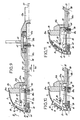
- Each notch bottom 29 has a boss 30 directed radially outwards and each lever 28 has, on its face facing the bottom of the notch 29 serving as a housing, a reverse boss 40, these two bosses 30 and 40 being arranged so that when the levers 28 are in the most advanced position on the outside, that is to say in the position corresponding to the end of travel of the ring 26 against the bottom of its most distant housing 25a from the rear end 22a of the tubular handle 22, as illustrated in FIG. 9, the boss 40 carried by each lever 28 is disposed just in front of the boss 30 carried by the bottom of the corresponding notch 29.
- levers 28 are constantly returned to their position parallel to the axis 22c of the tubular handle 22, so that their hooks 31 and 32 are able to be engaged in the notches 33 and lights 34, despite, in particular, the action of gravity tending to rotate some of them in the direction illustrated by arrow 36.
- the means for actuating the ring 26, in the direction of the arrow 35 and in the opposite direction consist of a control rod 38, housed in the bore 22d of the tubular handle 22, the front end 38a of which is axially connected by a pin 39 to the ring 26 and the rear end 38b of which is axially connected, by a pin 41, to a threaded ring 42 mounted in a tapped bore 43a a handwheel 43 carried by the tubular handle 22.
- the handwheel 43 having been pivoted by the practitioner in the direction corresponding to the movement of the threaded ring 42 and of the ring 26, in the direction opposite to that of the arrow 35, that is to say in the direction arrow 44, the levers 28 and their hooks 31 and 32 are brought into their most advanced position.
- each hook 31 and 32 protrudes beyond the tongues, respectively 5 and 21, through the notches 33 and the slots 34 and secondly, that the peripheral edge of its opening 2b is centered relative to the plate 24, by its engagement on the shoulder 24a of the latter.
- the practitioner can maneuver the flywheel 43 in the opposite direction, to move the threaded ring 42 and the ring 26 in the opposite direction, that is to say in the direction of the arrow 35 .
- the pins 11 of the main 5 and secondary 21 tongues then being brought into the erased position, as illustrated in FIG. 11, the practitioner can then mount the device, by the stud 23 of its rear end 22a, on an aiming and targeting device. guidance allowing it to position the cap 2 very correctly in the acetabular cavity of the patient.
- the intermediate cap 4 is then engaged and fixed in the outer cap 2, preferably after the cap 3 has been preassembled. Naturally, the establishment of the intermediate cap 4 locks the tabs 5 of the outer cap 2, preventing them from tilting in the direction of the interior of this cap, which contributes to ensuring that it is held in the anchoring position.
- This non-deformable character of the diameter of the opening 2b of the outer cap 2 makes it possible to use, without the risk of untimely displacement or dislocation, an intermediate cap 4 having relatively important qualities of flexibility and elasticity which have the effect of considerably improve the damping function of this intermediate cap 4 compared to the known anterior cups.
- the flexibility of this intermediate cap 4 also contributes to ensuring intimate contact between the three elements of this cup, so that an excellent distribution of the stresses transmitted by the femur to the hip of the patient is thus obtained.
Landscapes
- Health & Medical Sciences (AREA)
- Orthopedic Medicine & Surgery (AREA)
- Transplantation (AREA)
- Heart & Thoracic Surgery (AREA)
- Cardiology (AREA)
- Oral & Maxillofacial Surgery (AREA)
- Engineering & Computer Science (AREA)
- Biomedical Technology (AREA)
- Vascular Medicine (AREA)
- Life Sciences & Earth Sciences (AREA)
- Animal Behavior & Ethology (AREA)
- General Health & Medical Sciences (AREA)
- Public Health (AREA)
- Veterinary Medicine (AREA)
- Physical Education & Sports Medicine (AREA)
- Prostheses (AREA)
Abstract
Cette cupule est du type composé de trois calottes sphériques (2, 3, 4), à savoir :
- une calotte extérieure (2) en matériau rigide dont la face externe est pourvue d'aspérités radiales (11) destinées à permettre sa fixation dans la cavité cotyloïdienne,
- une calotte intérieure (3) en matériau dur, bio-compatible, à faible coefficient de frottement,
- et une calotte sphérique intermédiaire (4), en une matière semi-rigide; et dans la calotte extérieure (2) de laquelle sont découpées des languettes (5) mobiles radialement, en forme de portions de secteurs de calotte sphérique, définies par des fentes (5) en arc de cercle.
- une calotte extérieure (2) en matériau rigide dont la face externe est pourvue d'aspérités radiales (11) destinées à permettre sa fixation dans la cavité cotyloïdienne,
- une calotte intérieure (3) en matériau dur, bio-compatible, à faible coefficient de frottement,
- et une calotte sphérique intermédiaire (4), en une matière semi-rigide; et dans la calotte extérieure (2) de laquelle sont découpées des languettes (5) mobiles radialement, en forme de portions de secteurs de calotte sphérique, définies par des fentes (5) en arc de cercle.
Les fentes (5) en arc de cercle s'étendent entre deux cercles parallèles au plan de l'ouverture (2b) de cette calotte, dont l'un est situé à proximité de ce plan et dont l'autre est situé près du sommet (2c) de la calotte, les extrémités de ces fentes (5) situées près du sommet (2c) de la calotte (2) étant, en outre, reliées, deux par deux, par des fentes (7) partiellement annulaires coïncidant avec celui des cercles précités situé près du sommet (2c) de la calotte (2).
Pour la pose de la calotte exteriéure (2), on a conçu un appareil comportant des leviers (28) à crochets (31, 32), qui sont destinés à être engagés dans des encoches (33) et des lumières (34) dans les languettes (5,21).
Description
- La présente invention concerne une cupule destinée, à être fixée sans ciment, pour prothèse totale de la hanche.
- Souvent, les cupules, actuellement fixées sans ciment outre les difficultés de pose qu'elles présentent notamment pour les vissées, ne donnent pas satisfaction car elles ne présentent pas une stabilité suffisante dans le temps
- A l'origine, ces cupules étaient constituées d'une calotte sphérique exterieure en matériau rigide bio-compatible, tel qu'en acier inoxydable, portant, sur sa face externe, des moyens de fixation dans l'os de la cavité cotyloïdienne, tels que picots d'ancrage, filetage cylindrique ou conique, ou autre similaire, calotte extérieure dans la cavité intérieure de laquelle est fixée, de toute manière appropriée, une calotte sphérique intérieure en une matière, telle que le polyéthylène haute densité, présentant un faible coefficient de frottement par rapport au matériau constitutif de la tête céphalique de l'élément fémoral qui, généralement, est en acier inoxydable ou céramique.
- Or, il est vraisemblable que le manque de stabilité dans le temps de ces cupules, provient essentiellement du fait que les efforts verticaux, directs ou résultants, sont transmis aux cupules sans amortissement par une couche élastique.
- Pour tenter de remédier à cet inconvénient, on a conçu des cupules comportant une calotte sphérique intermédiaire en matériau souple et élastique, comme celles décrites dans le brevet européen 0066092 et dans les demandes de brevets PCT WO 86/02261 et européen 0253941. Cependant, dans ces cupules, ce sont les calottes sphériques interieures qui se sont révélées trop mobiles par rapport aux calottes sphériques externes fixées dans le cotyle, d'où il résultait des risques accrus de luxation.
- Par ailleurs, les demandes de brevets européens 0169978 et 0242633 décrivent une cupule comportant deux éléments à savoir :
- une calotte sphérique extérieure en matériau rigide bio-compatible, tel qu'en acier inoxydable, dont la face externe est pourvue d'aspérités sensiblement radiales ou "picots" destinés à permettre sa fixation dans la cavité cotyloïdienne,
- une calotte sphérique intérieure en matériau bio-compatible, semi-rigide et, de préférence, élastique, telle qu'une matière plastique comme le polyéthylène, haute densité, cupule dont la calotte externe est rendue expansible par la présence de languettes en forme de portions de secteurs de calotte sphérique, séparées les unes des autres par des fentes en arcs de cercle, ayant une répartition angulaire régulière et susceptibles d'être déplacées radialement, vers l'extérieur, lors de la mise en place et de la fixation de cette calotte dans la cavité cotyloïdienne. - L'objectif visé par cette cupule était d'améliorer sa tenue dans le cotyle en provoquant l'expansion radiale de sa calotte externe après sa mise en place. Cependant, dans cette cupule, les fentes en arcs de cercle qui définissent les languettes radialement mobiles, n'atteignent pas le sommet de cette calotte et débouchent dans le bord périphérique de l'ouverture de sa cavité de telle sorte que les languettes ne sont tenues que par leur extrémité étroite voisine du sommet de la calotte et que, par conséquent, le diamètre de l'ouverture de la cavité de cette calotte peut se dilater lorsqu'elle est soumise à des efforts importants, et la répétition permanente de cette dilatation a évidemment pour effet d'ébranler peu à peu la cupule dont la tenue, dans le cotyle, se détériore progressivement.
- En outre, la déformation de l'ouverture de cette cupule a pour inconvénient de favoriser le déscellement de la calotte dans la cavité cotyloïdienne. En effet, l'évasement diamétral sous l'effort, provoque par réaction le soulèvement de la calotte. De plus ce manque de rigidité diamétrale augmente les risques de luxation et interdit pratiquement l'utilisation d'une calotte intermédiaire en matériau suffisamment souple et élastique pour amortir les chocs et les efforts importants reçus par une calotte intérieure rigide.
- La présente invention vise à remédier à tous ces inconvénients. A cet effet, dans la cupule qu'elle concerne, et qui est du type à 3 éléments, composé de trois calottes emboîtées l'une dans l'autre, dont celle extérieure, présente des languettes mobiles radialement, en forme de portions de secteurs de calotte sphérique, définies par des fentes en arcs de cercle, ayant une répartition angulaire régulière, les fentes en arcs de cercle s'étendent entre deux cercles parallèles au plan de l'ouverture de cette calotte, dont l'un est situé à proximité de ce plan et dont l'autre est situé près du sommet de la calotte, les extrémités de ces fentes situées près du sommet de la calotte étant, en outre, reliées, deux par deux, par des fentes partiellement annulaires coïncidant avec celui des cercles précités situé près du sommet de la calotte, de telle sorte que toutes les languettes précitées sont tenues par leur extrémité de grande dimension située près de l'ouverture de la calotte et que l'extrémité de petite dimension d'une languette, c'est-à-dire d'une portion sur deux de secteur de calotte sphérique, est déplaçable, radialement, vers l'intérieur ou l'extérieur, seules les languettes, mobiles radialement, portant, sùr leur face externe, des picots d'ancrage.
- Ainsi, les fentes en arcs de cercle qui délimitent les languettes de cette calotte ne débouchent pas dans le bord de son ouverture, de sorte que cette dernière ne peut pas être dilatée, ce qui procure à cette cupule, une excellente tenue dans le cotyle par sa ceinture diamétrale.
- Il faut cependant remarquer que la course d'effacement quasiment nulle des extrémités des languettes les plus proches de l'ouverture de la cupule, s'oppose à la présence de picots près de cette extrémité des languettes.
- Pour y remédier, suivant une forme d'exécution perfectionnée de cette cupule, visant à obtenir sensiblement une même valeur d'ancrage sur toute la surface externe de cette cupule, dans chaque languette liée à la calotte extérieure par son extrémité de grande dimension, la plus proche de l'ouverture de cette calotte, c'est-à-dire dans chaque languette principale, est découpée une languette secondaire inversée par rapport à la première, c'est-à-dire liée à cette dernière par son extrémité la plus proche du sommet de cette calotte dont l'extrémité libre est proche de l'ouverture de cette calotte et dont la face externe est couverte de picots d'ancrage jusqu'à proximité de son bord libre.
- La présence des languettes secondaires permet donc, après mise en place de la calotte extérieure, de provoquer son expansion à proximité de son ouverture, ce que ne permet pas la seule présence des languettes principales et de lui procurer, ainsi, une meilleure fixation dans le cotyle.
- En outre, la présence des languettes secondaires dont la face externe porte des picots d'ancrage qui sont susceptibles de s'effacer par une flexion de ces languettes secondaires en direction de l'intérieur de la calotte, permet une mise en place et un retrait faciles de cette cupule, malgré la présence de picots d'ancrage portés par les languettes secondaires, à proximité de la base des languettes principales, c'est-à-dire à proximité de l'ouverture de cette calotte extérieure, cette présence améliorant considérablement la tenue de cette cupule dans le cotyle.
- Lors de la pose de cette cupule, sa calotte extérieure est parfaitement sphérique et ne présente aucun point saillant, toutes les languettes portant les picots étant en position rétractée par un système mécanique approprié. La mise en place de la calotte externe est aisée, puisqu'elle se déplace sans obstacle dans la cavité sphérique concordante pratiquée dans la cavité cotyloïdienne. Du fait de ce déplacement aisé, il est facile d'ajuster l'angle de la cupule avec précision. En fin d'engagement de cette calotte dans l'emplacement aménagé pour la recevoir, dans la cavité cotyloïdienne, ses languettes mobiles maintenues à l'intérieur sont alors libérées et mises en place par l'engagement, dans sa cavité, d'un outil d'impactage ou impacteur, avant que les calottes intermédiaire et intérieure, préassemblées, ne soient mises en place dans cette cavité.
- Suivant une forme d'exécution simple de l'invention, les moyens pour la mise en place ou le retrait de cette cupule comprennent, d'une part, des encoches ou lumières méridiennes ménagées dans les languettes, principales et secondaires, à proximité de leur extrémité libre et, d'autre part, un appareil comportant, outre un manche tubulaire adaptable aux moyens traditionnels connus de visée et de réglage de l'angle d'orientation de la cupule, une tête en forme de plateau circulaire portant, sur sa face opposée à celle du manche, d'une part, un épaulement cylindrique de centrage de la calotte externe et présentant, à cet effet, le même diamètre que le bord intérieur de son ouverture et, d'autre part, des leviers à crochets dont les axes d'articulation orthogonaux à celui du manche leur permettent de pivoter entre une position effacée des crochets, c'est-à-dire rapprochée de l'axe du manche et une position active d'accrochage en fond d'encoche ou de lumière de languettes, c'est-à-dire éloignée de l'axe du manche, chaque levier portant deux crochets et les leviers et leurs crochets ayant la même répartition angulaire que les encoches ou lumières et chaque crochet étant lui-même disposé de manière à pouvoir être engagé, en position effacée, dans une encoche ou lumière d'une languette lorsque le levier qui le porte est déplacé dans un sens correspondant à son éloignement du plateau précité, des moyens étant prévus pour permettre de déplacer les axes d'articulation des leviers dans un sens ou dans l'autre, parallèlement à l'axe du manche, tandis que d'autres moyens sont prévus pour faire pivoter les leviers en position d'accrochage lorsqu'après leur engagement dans les encoches ou lumières, leurs axes d'articulation sont déplacés en direction du plateau, provoquant, de ce fait, une flexion de toutes les languettes en position effacée.
- Cet appareil peut donc être utilisé aussi bien pour la mise en place de cette calotte externe que pour son retrait.
- Suivant une forme d'exécution préférée de l'invention, les moyens pour déplacer les axes d'articulation des leviers à crochets dans les deux sens, parallèlement à l'axe du manche, comprennent, en combinaison, une bague supportant ces axes et montée, axialement mobile dans un évidement cylindrique d'une pièce cylindrique coaxiale au plateau et présentant des encoches radiales dont chacune sert au logement et au guidage d'un levier à crochets, une tige de commande coaxiale au plateau et au manche dans l'alésage duquel elle est logée, dont une extrémité est liée, axialement, par goupille ou autre similaire, à la bague supportant les axes d'articulation des leviers à crochets et dont l'autre extrémité est liée, axialement, à un anneau fileté monté dans un alésage taraudé d'un volant de manoeuvre porté par le manche, cet anneau fileté étant, en outre, lié en rotation au manche, par exemple par une goupille traversant l'anneau fileté, l'extrémité considérée de la tige de commande et des lumières longitudinales diamétralement opposées du manche tubulaire.
- Ainsi, pour déplacer les axes d'articulation des leviers parallèlement à l'axe du manche, il suffit de faire pivoter le volant de manoeuvre dans le sens correspondant à la direction du déplacement désiré, tout en tenant le manche pour l'empêcher de pivoter.
- Par ailleurs, suivant une forme d'exécution simple de l'invention, les moyens pour faire pivoter les leviers à crochets, de leur position effacée à leur position d'accrochage, comprennent, d'une part, un bossage porté par chaque fond d'encoche radiale servant au logement et au guidage d'un levier à crochets auquel est associé un bossage opposé porté par la face la plus interne radialement de chaque levier à crochets, ces bossages étant disposés de manière que le second monte sur le premier dès que, depuis leur position la plus éloignée du plateau, les axes d'articulation des leviers sont déplacés en direction du plateau et, d'autre part, un moyen à ressort annulaire entourant les leviers à crochets et agissant sur eux pour tendre constamment à les ramener en position effacée.
- Avec cet appareil, lorsque la calotte externe est correctement positionnée dans le cotyle, il suffit alors de faire tourner le volant de manoeuvre en sens inverse pour libérer toutes les languettes et les laisser reprendre leur position d'origine. Cependant, la résistance que leurs picots rencontrent dans le cotyle n'autorise pas leur retour à leur position d'origine, de sorte qu'il est nécessaire qu'au fur et à mesure de ce retour, le praticien cesse de faire pivoter le volant de manoeuvre et applique, sur le manche, par exemple à l'aide d'une masselotte, quelques chocs dirigés axialement.
- Suivant une caractéristique préférée de l'invention, visant à réduire le temps de pose de cette cupule, la calotte intermédiaire est fixée à la calotte extérieure par un système d'accrochage à baïonnette ou par encliquetage d'un bourrelet dans une gorge, permettant une fixation plus rapide et plus aisée qu'avec un filetage, et la calotte intérieure est fixée à la calotte intermédiaire par encliquetage.
- Il faut noter que la composition de cette cupule permet le maintien constant d'un contact intime non seulement entre ses trois calottes mais aussi avec la cavité cotyloïdienne, ce qui élimine pratiquement tout risque de déplacement et garantit une excellente répartition des charges. En effet, toute poussée appliquée aux languettes d'ancrage provoque, par réaction, l'appui de la calotte dans le fond de la cavité cotyloïdienne.
- De toute façon, l'invention sera bien comprise à l'aide de la description qui suit en référence aux dessins schématiques annexés, représentant, à titre d'exemple non limitatif, une forme d'exécution de cette cupule :
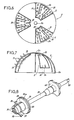
- - Figure 1 en est une vue en plan par-dessus ;
- - Figure 2 en est une vue éclatée de côté en coupe axiale ;
- - Figure 3 en est une vue en coupe suivant 3-3 de figure 1 montrant la calotte extérieure, seule, après son introduction dans la cavité cotyloïdienne ;
- - Figure 4 montre la cupule complète après fixation dans la cavité cotyloïdienne ;
- - Figure 5 est, et à échelle agrandie, une vue partielle en coupe suivant 5-5 de figure 2.
- - Figure 6 en est une vue en plan par-dessus similaire à figure 1, illustrant une variante d'exécution de cette cupule ;
- - Figure 7 est une vue en coupe suivant VII-VII de figure 6, montrant toutes les languettes en position effacée ;
- - Figure 8 est une vue en perspective d'un appareil pour la mise en place ou le retrait de la calotte externe de cette cupule ;
- - Figure 9 est une vue en coupe axiale de l'appareil de figure 8, avec les languettes en position normale ;
- - Figure 10 et 11 sont des vues partielles en coupe, montrant la tête de l'appareil d'impaction en deux positions successives de mise en position effacée des languettes.
- Comme le montrent plus particulièrement les figures 2 et 4, la cupule selon l'invention est du type constitué de 3 éléments à savoir :
- une calotte sphérique extérieure 2 en matériau rigide bio-compatible, tel qu'en acier inoxydable ou en titane, destinée à être ancrée dans la cavité cotyloïdienne du patient,
- une calotte sphérique intérieure 3 en matériau dur bio-compatible, tel qu'en céramique d'alumine ou de zircone ou autre similaire, dont au moins la face intérieure 3b présente un faible coefficient de frottement par rapport au matériau constitutif de la tête céphalique de l'élément fémoral associé à cette cupule et qui est généralement en céramique convenablement choisie,
- une calotte sphérique intermédiaire 4 en une matière souple telle qu'en polyéthylène à basse densité, et qui est destinée à jouer le rôle d'amortissement entre la calotte intérieure 3 et la calotte extérieure, pour éviter la transmission brutale, à cette dernière, des efforts verticaux importants susceptibles de l'ébranler jusqu'à détérioration de la qualité de sa fixation. - La calotte extérieure 2 présente des languettes 5 mobiles radialement, en forme de portions de secteurs de calotte sphérique et dont chacune est délimitée par deux fentes en arcs de cercle 6, de répartition angulaire régulière et dont les extrémités sont situées, respectivement, près du bord 2a de l'ouverture 2b de cette calotte, et près de son sommet 2c. Les extrémités des deux fentes 6, délimitant une même languette 5 et situées près du sommet 2c de la calotte 2 sont, en outre, reliées par une fente 7 partiellement annulaire située sur le même cercle que les fentes 7 des autres languettes 5, ce cercle étant concentrique au sommet 2c de la calotte 2.
- Comme le montre plus particulièrement la figure 1, chaque languette 5 de la calotte 2, qui dans cet exemple en comporte trois, est liée à la calotte 2 par son extrémité de grande dimension située près de l'ouverture 2b de la calotte. On peut noter que deux languettes 5, adjacentes, sont séparées l'une de l'autre par une portion de secteur de calotte sphérique 8 similaire aux languettes 5 mais non mobile, ayant pour effet de conserver, à la calotte 8, une rigidité suffisante pour empêcher sa déformation.
- Chaque languette 5, qui est apte à pivoter autour de son grand côté ou de sa grande base, comme indiqué par la double flèche 9 de figure 2, porte, sur sa face externe, des picots d'ancrage 11 orientés sensiblement radialement, c'est-à-dire suivant le rayon de rotation de la languette qui a pour axe de pivotement son bord adjacent à l'ouverture 2b de cette calotte 2. La disposition des picots et leur forme pyramidale favorisent leur pénétration suivant ce rayon dans la cavité cotyloïdienne.
- Les figures 2 et 5 montrent aussi une forme d'exécution avantageuse des moyens d'assemblage de la calotte intermédiaire 4 à la calotte extérieure 2. A cet effet, la calotte 2 porte, sur sa face interne et à proximité du bord de son ouverture 2b, trois segments de nervure 12 appartenant à un même cercle 12a parallèle au plan de l'ouverture 2b et dont chacun est destiné à constituer l'un des crans d'accrochage mâles d'un système d'accrochage du type à baïonnette. Chaque segment de nervure 12 s'étend sur un arc de cercle inférieur à 60°.
- De son côté, la calotte intermédiaire 4 présente, sur sa face externe, 3 segments de rainure 13 ayant la même répartition angulaire régulière que les segments de nervure 12, mais de longueur sensiblement égale au double. Une encoche d'entrée 14 est ménagée à chacune des extrémités se correspondant de chacune des gorges 13, pour permettre l'engagement de chacune d'elles sur l'une des nervures 12 par un mouvement d'introduction axial, c'est-à-dire dans le sens de la flèche 15, suivi d'un mouvement de rotation autour de son rayon perpendiculaire au plan de son ouverture 4a.
- Ce système d'accrochage ou d'assemblage, du type à baïonnette, présente l'avantage d'être d'une mise en oeuvre beaucoup plus rapide que tout autre système connu par filetage cylindrique ou conique qui nécessite évidemment d'effectuer plusieurs tours complets de rotation pour obtenir l'assemblage.
- La figure 2 montre aussi le mode d'assemblage de la calotte intérieure 3 à la calotte intermédiaire 4 et qui est du type encliquetage. A cet effet, d'une part, la calotte intérieure 3 présente une nervure périphérique 16 circulaire, parallèle au plan de son ouverture 3a, tandis que la calotte intermédiaire 4 présente, dans sa cavité sphérique 4b, une gorge circulaire périphérique 17, de section transversale complémentaire de celle de la nervure 16, l'engagement de la nervure 16 dans la rainure 17 étant facilité par l'élasticité de la matière constitutive de la calotte 4. On conçoit aisément que l'assemblage de ces calottes intérieure 3 et intermédiaire 4 peut aussi être réalisé de manière instantanée.
- Pour améliorer la liaison mécanique entre la calotte intérieure 3 et la calotte intermédiaire 4, il est possible de prévoir, en outre, comme le montre la figure 2 sur le sommet de la face externe de la calotte intérieure 3, un téton 18 engageable dans un logement 19, ménagé pour le recevoir, au sommet ou pôle de la cavité 4b de l'élément intermédiaire 4.
- Il est indiqué précédemment que la calotte intérieure 3 présente une cavité intérieure 3b offrant un très faible coefficient de frottement au matériau constitutif de la tête céphalique de l'élément fémoral. A cet effet, cette cavité intérieure 3b est avantageusement constituée d'une céramique d'alumine, de zircone ou de tout autre céramique appropriée.
- La conception de cette cupule montre à l'évidence que, grâce à la constitution de sa calotte extérieure 2, elle présente un diamètre d'ouverture 2b pratiquement indéformable, ce qui diminue considérablement tout risque de mouvement relatif de cette calotte extérieure 2 par rapport à la cavité cotyloïdienne, dans laquelle elle est fixée, ainsi que le risque d'une luxation.
- Pour permettre la pose et le retrait de cette cupule sans endommager le cotyle, comme le montre très bien la figure 1, il est préférable de ne pas prévoir de picots 11 au voisinage de la base de chaque languette 5, c'est-à-dire à proximité de son extrémité par laquelle elle est liée à la calotte extérieure 2. En effet, du fait de sa liaison avec la calotte 2, cette partie de chaque languette 5 ne peut subir qu'un mouvement de basculement de faible amplitude, de sorte que si elle était couverte de picots, ces derniers ne seraient pas effaçables et gêneraient le mise en place de la calotte. Il en résulte qu'à proximité de son ouverture, l'ancrage de la calotte extérieure dans le cotyle n'est pas excellent. Pour y remédier, suivant une variante d'exécution perfectionnée de l'invention, dans chaque languette principale 5 est découpée une languette secondaire 21, inversée par rapport à la première, chaque languette secondaire 21 étant liée à la languette principale 5, qui la porte par son extrémité la plus proche du sommet 2c de la calotte externe 2.
- En outre, l'extrémité libre de chaque languette secondaire 21 est située au voisinage du bord libre de cette calotte 2, entourant son ouverture 2b.
- Comme le montre plus particulièrement la figure 7, la présence de ces languettes secondaires 21 susceptibles d'être fléchies en direction de l'intérieur de la calotte externe 2 par pivotement autour de leur base ou extrémité la plus proche du sommet 2c de cette calotte, permet d'effacer les picots 11 qu'elles portent au voisinage de leur extrémité libre, c'est-à-dire au voisinage de l'ouverture 2b de la calotte 2 et qui, de ce fait, ne gênent pas la mise en place de la calotte 2. Par la suite, après impaction, l'engagement de ces picots dans le cotyle améliore considérablement la tenue de la calotte externe 2, et par conséquent de la cupule, dans la cavité cotyloïdienne du patient.
- La pose de cette calotte externe dans la cavité cotyloïdienne nécessite donc d'amener préalablement les languettes principale 5 et secondaire 21 en position effacée, comme illustré sur la figure 7, de manière à ne pas être gêné par la présence des picots d'ancrage 11 sur leur face extérieure. A cet effet, on peut utiliser l'appareil représenté sur les figures 8 à 11, spécialement conçu pour cette opération.
- Comme le montrent ces figures, cet appareil comprend essentiellement un manche tubulaire 22, dont l'extrémité postérieure 22a porte un tenon 23 permettant son adaptation à un appareil d'un type connu de visée et de réglage de l'angle d'orientation de la calotte externe 2 dans le cotyle du patient.
- A son extrémité antérieure 22b, le manche tubulaire 22 porte une tête en forme de plateau circulaire 24.
- Sur sa face opposée à celle du manche 22, le plateau 24 présente un épaulement cylindrique 24a destiné au centrage de la calotte externe 2 et présentant, à cet effet, le même diamètre que le bord intérieur de son ouverture 2b.
- Sur cette même face, le plateau 24 porte une pièce cylindrique 25 coaxiale à lui-même et au manche tubulaire 22, qui lui est fixé par engagement dans un alésage central 24b, qu'il présente pour la recevoir.
- Cette pièce cylindrique 25 présente, à son extrémité engagée dans l'alésage 24b du plateau 24, un évidement cylindrique axial 25a servant au logement, avec possibilité de déplacement axial d'une bague 26 portée par le manchon tubulaire 22.
- La différence entre la longueur de la bague 26 et celle de son logement 25a, détermine sa course axiale.
- Cette bague 26 porte trois axes 27, dont un seul est visible sur les figures 9 à 11, et qui sont disposés orthogonalement au manche 22, avec une répartition angulaire régulière autour de ce manche.
- Sur chaque axe 27, est articulé un levier 28 normalement parallèle à l'axe 22c du manche tubulaire 22 et orienté dans la direction opposée à celle du manche tubulaire 22.
- Chaque levier 28 est logé dans une encoche radiale 29, ménagée pour le recevoir, dans la pièce cylindrique 25.
- Chaque levier 28 présente, à son extrémité opposée à celle par laquelle il est articulé à l'axe correspondant 27, deux crochets, respectivement 31 et 32, dont le bec d'accrochage est orienté radialement vers l'extérieur par rapport à l'axe 22c du manche tubulaire 22. Chaque crochet 31 et 32 est destiné à être engagé, respectivement, dans une encoche 33 et une lumière 34 prévues pour le recevoir, respectivement, dans chaque languette principale 5 et dans chaque languette secondaire 21, et dont le mode d'utilisation sera décrit ultérieurement.
- Ces encoches 33 et lumières 34 sont centrées sur le méridien central des languettes correspondantes 5 et 21.
- Chaque fond d'encoche 29 présente un bossage 30 dirigé radialement vers l'extérieur et chaque levier 28 présente, sur sa face tournée vers le fond de l'encoche 29 lui servant de logement, un bossage inverse 40, ces deux bossages 30 et 40 étant disposés de manière que lorsque les leviers 28 sont en position la plus avancée à l'extérieur, c'est-à-dire dans la position correspondant à la fin de course de la bague 26 contre le fond de son logement 25a le plus éloigné de l'extrémité postérieure 22a du manche tubulaire 22, comme illustré sur la figure 9, le bossage 40 porté par chaque levier 28 soit disposé juste en avant du bossage 30 porté par le fond de l'encoche 29 correspondante.
- On conçoit aisément qu'un déplacement axial de la bague 26 en direction du fond opposé de son logement 25a, c'est-à-dire dans le sens de la flèche 35, a pour effet de faire monter les bossages 40 des leviers 28 sur les bossages 30 des fonds de leurs encoches 29 et par conséquent, de faire pivoter chaque levier 28 radialement vers l'extérieur, c'est-à-dire dans le sens de la flèche 36 pour le levier 28 visible sur les figures 9 à 11.
- Ce pivotement, qui n'est provoqué que par une très faible fraction de la course axiale de la bague 26, dans le sens de la flèche 35, provoque l'engagement des crochets 31 et 32, respectivement sur le fond d'encoche 33 et sur le fond de lumière 34, de telle sorte que chaque crochet 28, par la poursuite de son déplacement dans le sens de la flèche 35, provoque le cintrage des languettes principale 5 et secondaire 21 correspondantes, en direction de l'intérieur de la calotte externe 2, comme illustré sur les figures 10 et 11, jusqu'à ce que leurs picots 11 soient totalement effacés par rapport à la face externe de la calotte 2, c'est-à-dire dans la position illustrée par la figure 11.
- Comme le montrent les figures 10 et 11, l'engagement des crochets 31 et 32 dans les fonds d'encoches 33 et de lumières 34, combiné à la flexion des languettes principale 5 et secondaire 21, rend impossible tout désengagement intempestif des crochets, malgré la présence d'un ressort annulaire 37 entourant les leviers 28 et tendant, constamment, à les ramener dans leur position d'origine parallèle à l'axe 22c du manche tubulaire 22.
- Il est en effet indispensable que les leviers 28 soient constamment rappelés dans leur position parallèle à l'axe 22c du manche tubulaire 22, pour que leurs crochets 31 et 32 soient aptes à être engagés dans les encoches 33 et lumières 34, malgré, notamment, l'action de la pesanteur tendant à faire pivoter certains d'entre eux dans le sens illustré par la flèche 36.
- Dans l'exemple illustré sur les figures 8 à 11, les moyens d'actionnement de la bague 26, dans le sens de la flèche 35 et en sens inverse, sont constitués par une tige de commande 38, logée dans l'alésage 22d du manche tubulaire 22, dont l'extrémité antérieure 38a est liée axialement, par une goupille 39, à la bague 26 et dont l'extrémité postérieure 38b est liée axialement, par une goupille 41, à un anneau fileté 42 monté dans un alésage taraudé 43a d'un volant de manoeuvre 43 porté par le manche tubulaire 22.
- Le mode d' utilisation de cet appareil est donc le suivant :
- Le volant de manoeuvre 43 ayant été pivoté par le praticien dans le sens correspondant au déplacement de l'anneau fileté 42 et de la bague 26, dans le sens opposé à celui de la flèche 35, c'est-à-dire dans le sens de la flèche 44, les leviers 28 et leurs crochets 31 et 32 sont amenés dans leur position la plus avancée.
- Le praticien peut alors engager la calotte externe 2 sur les leviers 28, jusqu'à ce que d'une part, chaque crochet 31 et 32 saille au-delà des languettes, respectivement 5 et 21, à travers les encoches 33 et les lumières 34 et d'autre part, que le bord périphérique de son ouverture 2b soit centré par rapport au plateau 24, par son engagement sur l'épaulement 24a de ce dernier.
- Tout en maintenant la calotte 2 dans cette position, le praticien peut manoeuvrer le volant 43 en sens inverse, pour déplacer l'anneau fileté 42 et la bague 26 en sens inverse, c'est-à-dire dans le sens de la flèche 35.
- Comme indiqué précédemment lors du déplacement des leviers 28 dans le sens de la flèche 35, et par suite de leur pivotement radialement vers l'extérieur, leurs crochets 31 et 32 s'engagent sur les fonds d'encoches 33 et de lumières 34 des languettes principale 5 et secondaire 21, comme indiqué précédemment et comme illustré sur les figures 10 et 11. La poursuite de ce déplacement des leviers 28 dans le sens de la flèche 35, provoque donc le cintrage des languettes 5 et 21.
- Les picots 11 des languettes principale 5 et secondaire 21 étant alors amenés en position effacée, comme illustré sur la figure 11, le praticien peut alors monter l'appareil, par le tenon 23 de son extrémité postérieure 22a, sur un appareil de visée et de guidage lui permettant de positionner très correctement la calotte 2 dans la cavité cotyloïdienne du patient.
- Cette opération se fait d'autant plus aisément que tous les picots 11 sont effacés.
- La calotte 2 étant dans sa position angulaire correcte, il faut alors que le praticien manoeuvre à nouveau le volant 43 en sens inverse de celui indiqué précédemment pour faire déplacer l'anneau fileté 42, la bague 26 et les leviers 28 en sens inverse, c'est-à-dire dans le sens illustré par la flèche 44.
- Il en résulte que, par leur déplacement dans ce sens, les leviers 28 et leurs crochets 31 et 32 libèrent progressivement les languettes principale 5 et secondaire 21, qui ont alors tendance à reprendre leur position d'origine, illustrée sur la figure 9, par suite de l'élasticité de leur matière constitutive.
- Etant donné que leurs picots 11 rencontrent une résistance au contact du cotyle du patient, la manoeuvre du volant 43 sera freinée, la course de toutes les languettes, 5 et 21, en direction de leur position de repos, étant empêchée par cette résistance. Il faudra alors que le praticien applique sur l'appareil des chocs, par exemple à l'aide de la masselotte, dont l'ensemble de visée et de réglage est généralement équipé, chocs qui forceront les picots 11 à pénétrer dans le cotyle.
- En répétant plusieurs fois, successivement, la manoeuvre du volant 43 dans le sens dernièrement précité, et celle de la masselotte, le praticien pourra obtenir la fixation totale de la calotte 2 dans le cotyle.
- Il est bon de remarquer que le sens de pivotement des languettes principales et la pénétration de leurs picots 11 dans le cotyle, a pour effet d'exercer sur la calotte 2 une traction orientée dans le sens de la flèche 44, qui assure une excellente application de la calotte 2 contre le cotyle.
- Naturellement, par des manoeuvres similaires à celles précitées, il sera possible de retirer, sans aucune difficulté, une calotte 2 du cotyle d'un patient, si par exemple cette calotte doit être remplacée, par suite d'une quelconque détérioration, et notamment par suite d'une détérioration du cotyle de ce patient.
- La calotte intermédiaire 4 est ensuite engagée et fixée dans la calotte extérieure 2, de préférence après que la calotte 3 lui ait été préassemblée. Naturellement, la mise en place de la calotte intermédiaire 4 verrouille les languettes 5 de la calotte extérieure 2, les empêchant de basculer en direction de l'intérieur de cette calotte, ce qui contribue à en assurer le maintien en position d'ancrage.
- Etant donné que la forme extérieure de la calotte extérieure 2, après pose de la cupule, correspond à la forme qu'elle occupe, naturellement avant sa pose, il est tout à fait possible et facile d'aménager, dans la cavité cotyloïdienne du patient, un berceau de forme complémentaire contre lequel la calotte extérieure 2 de cette cupule sera appliquée avec contact intime.
- Ce caractère indéformable du diamètre de l'ouverture 2b de la calotte extérieure 2 permet d'utiliser, sans risque de déplacement intempestif ni de luxation, une calotte intermédiaire 4 possédant des qualités relativement importantes de souplesse et d'élasticité qui ont pour effet d'améliorer considérablement la fonction amortisseur de cette calotte intermédiaire 4 par rapport aux cupules antérieures connues. La souplesse de cette calotte intermédiaire 4 contribue aussi à assurer un contact intime entre les trois éléments de cette cupule, de telle sorte qu'on obtient ainsi une excellente répartition des contraintes transmises par le fémur à la hanche du patient.
Claims (7)
1. Cupule destinée à être fixée sans ciment pour prothèse totale de la hanche du type composé de trois calottes sphériques (2, 3, 4) emboîtées l'une dans l'autre, à savoir :
- une calotte sphérique extérieure (2) en matériau rigide bio-compatible, tel qu'en acier inoxydable, ou titane, dont la face externe est pour vue d'aspérités radiales (11) ou "picots" destinés à permettre sa fixation dans la cavité cotyloïdienne ;
- une calotte sphérique intérieure (3) en matériau dur, bio-compatible, à faible coefficient de frottement par rapport au matériau constitutif de la tête céphalique, tel que, par exemple, une céramique d'alumine ou autre similaire ;
- et une calotte sphérique intermédiaire (4), en une matière semi-rigide et de préférence élastique, telle qu'une matière plastique comme le polyéthylène, et dans la calotte extérieure (2) de laquelle sont découpées dans languettes (5) mobiles radialement, en forme de portions de secteurs de calotte sphérique, définies par des fentes (5) en arcs de cercle, ayant une répartition angulaire régulière, cupule caractérisée en ce que les fentes (5) en arcs de cercle s'étendent entre deux cercles parallèles au plan de l'ouverture (2b) de cette calotte, dont l'un est situé à proximité de ce plan et dont l'autre est situé près du sommet (2c) de la calotte, les extrémités de ces fentes (5) situées près du sommet (2c) de la calotte (2) étant, en outre, reliées, deux par deux, par des fentes (7) partiellement annulaires coïncidant avec celui des cercles précités situé près du sommet (2c) de la calotte (2), de telle sorte que toutes les languettes (5) sont tenues par leur extrémité de grande dimension située près de l'ouverture (2b) de la calotte (2) et que l'extrémité de petite dimension d'une languette (5), c'est-à-dire d'une portion sur deux de secteur de calotte sphérique, est déplaçable, radialement, vers l'intérieur ou l'extérieur, seules les languettes (5) mobiles radialement, portant, sur leur face externe, des picots d'ancrage (11).
- une calotte sphérique extérieure (2) en matériau rigide bio-compatible, tel qu'en acier inoxydable, ou titane, dont la face externe est pour vue d'aspérités radiales (11) ou "picots" destinés à permettre sa fixation dans la cavité cotyloïdienne ;
- une calotte sphérique intérieure (3) en matériau dur, bio-compatible, à faible coefficient de frottement par rapport au matériau constitutif de la tête céphalique, tel que, par exemple, une céramique d'alumine ou autre similaire ;
- et une calotte sphérique intermédiaire (4), en une matière semi-rigide et de préférence élastique, telle qu'une matière plastique comme le polyéthylène, et dans la calotte extérieure (2) de laquelle sont découpées dans languettes (5) mobiles radialement, en forme de portions de secteurs de calotte sphérique, définies par des fentes (5) en arcs de cercle, ayant une répartition angulaire régulière, cupule caractérisée en ce que les fentes (5) en arcs de cercle s'étendent entre deux cercles parallèles au plan de l'ouverture (2b) de cette calotte, dont l'un est situé à proximité de ce plan et dont l'autre est situé près du sommet (2c) de la calotte, les extrémités de ces fentes (5) situées près du sommet (2c) de la calotte (2) étant, en outre, reliées, deux par deux, par des fentes (7) partiellement annulaires coïncidant avec celui des cercles précités situé près du sommet (2c) de la calotte (2), de telle sorte que toutes les languettes (5) sont tenues par leur extrémité de grande dimension située près de l'ouverture (2b) de la calotte (2) et que l'extrémité de petite dimension d'une languette (5), c'est-à-dire d'une portion sur deux de secteur de calotte sphérique, est déplaçable, radialement, vers l'intérieur ou l'extérieur, seules les languettes (5) mobiles radialement, portant, sur leur face externe, des picots d'ancrage (11).
2. Cupule selon la revendication 1, caractérisée en ce que, dans chaque languette (5), liée à la calotte extérieure (2) par son extrémité la plus proche de l'ouverture (2b) de cette calotte (2), c'est-à-dire dans chaque languette principale, est découpée une languette secondaire inversée (21), c'est-à-dire liée à la languette principale (5), par son extrémité la plus proche du sommet (2c) de la calotte extérieure (2) et dont l'extrémité libre est proche du bord libre entourant l'ouverture (2b) de cette calotte (2), la face externe de chaque languette secondaire (21) étant couverte de picoits d'ancrage (11) jusqu'au voisinage de son extrémité libre.
3. Cupule selon la revendication 1 ou 2, caractérisée en ce que la calotte intermédiaire (4) est fixée à la calotte extérieure (2) par un système d'accrochage à baïonnette (12, 13, 14) permettant un assemblage très rapide.
4. Cupule selon l'une des revendications 1 à 3, caractérisée en ce que la calotte intérieure (3) est fixée à la calotte intermédiaire (4) par encliquetage d'une nervure circulaire (16), dans une gorge (17) également circulaire, et par l'engagement d'un têton (18) dans une cavité conique (19) évitant tout mouvement relatif des surfaces sphériques en présence.
5. Moyens pour la mise en place, dans le cotyle d'un patient, d'une cupule selon l'une quelconque des revendications 1 à 4, ou son retrait, caractérisé en ce qu'ils comprennent, d'une part, des encoches (33) ou lumières (34) méridiennes ménagées dans les languettes, principale (5) et secondaire (21), à proximité de leur extrémité libre et, d'autre part, un appareil comportant, outre un manche tubulaire (22) adaptable aux moyens traditionnels connus de visée et de réglage de l'angle d'orientation de la cupule, une tête en forme de plateau circulaire (24) portant, sur sa face opposée à celle du manche (22), d'une part, un épaulement cylindrique (24a) de centrage de la calotte externe (2) et présentant, à cet effet, le même diamètre que le bord intérieur de son ouverture (22) et, d'autre part, des leviers (28) à crochets (31, 32) dont les axes d'articulation (27) orthogonaux à celui (22c) du manche (22) leur permettent de pivoter entre une position effacée des crochets (31, 32), c'est-à-dire rapprochée de l'axe (22c) du manche (22) et une position active d'accrochage en fond d'encoche (33) ou de lumière (34) de languettes (5, 21), c'est-à-dire éloignée de l'axe (22c) du manche (22), chaque levier (28) portant deux crochets (31, 32) et les leviers (28) et leurs crochets (31, 32) ayant la même répartition angulaire que les encoches (33) ou lumières (34) et chaque crochet (31, 32) étant lui-même disposé de manière à pouvoir être engagé, en position effacée, dans une encoche (33) ou lumière (34) d'une languette (5, 21) lorsque le levier (28) qui le porte est déplacé dans un sens (44) correspondant à son éloignement du plateau (24), des moyens étant prévus pour permettre de déplacer les axes d'articulation (27) des leviers (28) dans un sens ou dans l'autre, parallèlement à l'axe (22c) du manche (22), tandis que d'autres moyens sont prévus pour faire pivoter les leviers (28) en position d'accrochage lorsqu'après leur engagement dans les encoches (33) ou lumières (34), leurs axes d'articulation (27) sont déplacés en direction du plateau (24) provoquant, de ce fait, une flexion de toutes les languettes (5, 21) en position effacée.
6. Moyen selon la revendication 5, caractérisé en ce que les moyens qui, dans l'appareil, permettent de déplacer les axes d'articulation (27) des leviers (28) à crochets (31, 32) dans les deux sens (35, 44), parallèlement à l'axe (22c) du manche (22), comprennent, en combinaison, une bague (26) supportant ces axes (28) et montée, axialement mobile, dans un évidement cylindrique (25a) d'une pièce cylindrique (25) coaxiale au plateau (24) et présentant des encoches radiales (29) dont chacune sert au logement et au guidage d'un levier (28) à crochets (31, 32), une tige de commande (38) coaxiale au plateau (24) et au manche (22) dans l'alésage (22d) duquel elle est logée, dont une extrémité antérieure (38a) est liée, axialement, par goupille (39) ou autre similaire, à la bague (26) supportant les axes d'articulation (27) des leviers (28) à crochets (31, 32), et dont l'extrémité postérieure (38b) est liée, axialement, à un anneau fileté (42) monté dans un alésage taraudé (43a) d'un volant de manoeuvre (43) porté par le manche (22), cet anneau fileté (42) étant, en outre, lié en rotation au manche (22), par exemple par une goupille (41) traversant l'anneau fileté (42), l'extrémité considérée (38b) de la tige de commande (38) et des lumières longitudinales (45) diamétralement opposées du manche tubulaire (22).
7. Moyen selon la revendication 5 ou 6, caractérisé en ce que les moyens qui, dans l'appareil, permettent de faire pivoter les leviers (28) à crochets (31, 32), de leur position effacée à leur position d'accrochage, comprennent, d'une part, un bossage (30) porté par chaque fond d'encoche radiale (29) servant au logement et au guidage d'un levier (28), auquel est associé un bossage opposé (40) porté par la face la plus interne radialement de chaque levier (28), ces bossages (30, 40) étant disposés de manière que le second (40) monte sur le premier (30) dès que, depuis leur position la plus éloignée du plateau (24), les axes d'articulation (27) des leviers (28) sont déplacés en direction (35) du plateau (24) et, d'autre part, un moyen à ressort annulaire (37) entourant les leviers (28) et agissant sur eux pour tendre constamment à les ramener en position effacée.
Priority Applications (8)
| Application Number | Priority Date | Filing Date | Title |
|---|---|---|---|
| FR8904699A FR2645433B1 (fr) | 1989-04-05 | 1989-04-05 | Cupule destinee a etre fixee sans ciment pour prothese totale de la hanche |
| US07/500,876 US5108448A (en) | 1989-04-05 | 1990-03-29 | Cup intended to be fixed cementlessly for a total hip prosthesis |
| JP2088414A JPH02286159A (ja) | 1989-04-05 | 1990-04-04 | 股関節補綴材用の接合剤なしに固定されるようなカップ及び該カップを位置決めし、取外す手段 |
| PT93667A PT93667A (pt) | 1989-04-05 | 1990-04-04 | Cupula destinada a ser fixada sem cimento, para protese total da anca |
| CA002013844A CA2013844A1 (fr) | 1989-04-05 | 1990-04-04 | Cupule destinee a etre fixee sans ciment pour prothese totale de la hanche |
| BR909001586A BR9001586A (pt) | 1989-04-05 | 1990-04-05 | Cupula destinada a ser fixada sem cimento para protese total da anca e elemento para sua colocacao no cotilo de um paciente |
| CN90101884A CN1047028A (zh) | 1989-04-05 | 1990-04-05 | 非粘结固定的人工关节窝及其装卸装置 |
| EP90420209A EP0453694A1 (fr) | 1989-04-05 | 1990-04-27 | Cupule destinée à être fixée sans ciment pour prothèse totale de la hanche |
Applications Claiming Priority (2)
| Application Number | Priority Date | Filing Date | Title |
|---|---|---|---|
| FR8904699A FR2645433B1 (fr) | 1989-04-05 | 1989-04-05 | Cupule destinee a etre fixee sans ciment pour prothese totale de la hanche |
| EP90420209A EP0453694A1 (fr) | 1989-04-05 | 1990-04-27 | Cupule destinée à être fixée sans ciment pour prothèse totale de la hanche |
Publications (1)
| Publication Number | Publication Date |
|---|---|
| EP0453694A1 true EP0453694A1 (fr) | 1991-10-30 |
Family
ID=26127645
Family Applications (1)
| Application Number | Title | Priority Date | Filing Date |
|---|---|---|---|
| EP90420209A Withdrawn EP0453694A1 (fr) | 1989-04-05 | 1990-04-27 | Cupule destinée à être fixée sans ciment pour prothèse totale de la hanche |
Country Status (8)
| Country | Link |
|---|---|
| US (1) | US5108448A (fr) |
| EP (1) | EP0453694A1 (fr) |
| JP (1) | JPH02286159A (fr) |
| CN (1) | CN1047028A (fr) |
| BR (1) | BR9001586A (fr) |
| CA (1) | CA2013844A1 (fr) |
| FR (1) | FR2645433B1 (fr) |
| PT (1) | PT93667A (fr) |
Cited By (31)
| Publication number | Priority date | Publication date | Assignee | Title |
|---|---|---|---|---|
| WO1992018067A1 (fr) * | 1991-04-16 | 1992-10-29 | Depuy International Limited | Coupelle acetabulaire |
| EP0554214A1 (fr) * | 1992-01-31 | 1993-08-04 | SULZER Medizinaltechnik AG | Procédé de fabrication d'une cupule cotyloidienne implantable |
| EP0617932A1 (fr) * | 1993-03-30 | 1994-10-05 | Etablissements TORNIER | Prothèse cotyloidienne élastiquement déformable |
| FR2719465A1 (fr) * | 1994-05-04 | 1995-11-10 | Medinov Sa | Implant cotyloïdien perfectionné. |
| EP0699425A1 (fr) * | 1994-09-01 | 1996-03-06 | SULZER Medizinaltechnik AG | Coque acétabulaire artificielle pour l'articulation de la hanche ainsi que procédé de fabrication |
| DE19616059A1 (de) * | 1996-04-23 | 1997-10-30 | Cerasiv Gmbh | Verfahren zum Erneuern einer prothetischen Gelenkpfanne |
| WO1997042915A1 (fr) * | 1996-05-09 | 1997-11-20 | Waldemar Link (Gmbh & Co.) | Prothese cotyloidienne et instrument chirurgical pour son implantation |
| EP0811360A3 (fr) * | 1996-06-07 | 1998-11-11 | Johnson & Johnson Medical Limited | Dispositif d'extraction |
| EP0888759A1 (fr) * | 1997-07-04 | 1999-01-07 | Sulzer Orthopädie AG | Instrument pour introduire une pièce d'insertion d'un implant dans sa coupe associée |
| US5871547A (en) * | 1996-03-01 | 1999-02-16 | Saint-Gobain/Norton Industrial Ceramics Corp. | Hip joint prosthesis having a zirconia head and a ceramic cup |
| EP0931523A1 (fr) * | 1998-01-22 | 1999-07-28 | Sulzer Orthopädie AG | Instrument pour la manutention d'un élément articulaire artificiel |
| EP0958797A1 (fr) * | 1998-05-22 | 1999-11-24 | Osteonics Corp. | Assemblage de prothèse pour acétabule comportant une coquille de support sélectionnée |
| EP1025814A1 (fr) * | 1999-02-04 | 2000-08-09 | Norton Desmarquest Fine Ceramics | Prothèse fémorale céramique/céramique de petit diamètre. |
| WO2001005338A1 (fr) * | 1999-07-15 | 2001-01-25 | Ceramtec Ag Innovative Ceramic Engineering | Insertion en sandwich en ceramique pour rotule artificielle |
| EP1181909A1 (fr) | 2000-08-21 | 2002-02-27 | Bone & Joint Research S.A. | Armature d'ancrage acétabulaire élastique pour insert articulaire cotyloidien de hanche en matériau rigide |
| US6368354B2 (en) * | 1999-10-07 | 2002-04-09 | Exactech, Inc. | Acetabular bearing assembly for total hip joints |
| FR2830746A1 (fr) * | 2001-10-11 | 2003-04-18 | Sud Implant Chirurgie | Instrument pour prothese cotyloidienne |
| FR2834630A1 (fr) * | 2002-01-17 | 2003-07-18 | Implant Reduction Eurl | Cupule pour implant cotyloidien |
| WO2009098491A1 (fr) * | 2008-02-07 | 2009-08-13 | T J Smith & Nephew Limited | Dispositif médical et procédé |
| EP2345392A1 (fr) * | 2011-01-17 | 2011-07-20 | Greatbatch Medical SA | Impacteur droit de coupule acétabulaire |
| US8123815B2 (en) | 2008-11-24 | 2012-02-28 | Biomet Manufacturing Corp. | Multiple bearing acetabular prosthesis |
| US8236004B2 (en) | 2006-05-01 | 2012-08-07 | Greatbatch Medical S.A. | Inserter for minimally invasive joint surgery having an interchangeable prosthesis engaging piston |
| US8277457B1 (en) | 2004-12-09 | 2012-10-02 | Greatbatch Medical S.A. | Orthopaedic inserter using a collet mechanism |
| US8308810B2 (en) | 2009-07-14 | 2012-11-13 | Biomet Manufacturing Corp. | Multiple bearing acetabular prosthesis |
| US8398650B1 (en) | 2009-01-27 | 2013-03-19 | Greatbatch Medical S.A. | Offset cup impactor with an expandable dome for double mobility implants |
| WO2013088176A1 (fr) * | 2011-12-15 | 2013-06-20 | Thorwald Springer | Cotyle prothétique |
| US8585709B2 (en) | 2011-01-17 | 2013-11-19 | Greatbatch Medical S.A. | Straight cup impactor with lever arm |
| US8679187B2 (en) | 2006-03-20 | 2014-03-25 | Smith & Nephew, Inc. | Acetabular cup assembly for multiple bearing materials |
| US8961528B2 (en) | 2010-08-27 | 2015-02-24 | Greatbatch Medical S.A. | Offset cup impactor with a grasping plate for double mobility implants |
| US9028502B2 (en) | 2011-09-23 | 2015-05-12 | Greatbatch Medical S.A. | Ceramic implant holder |
| US9119731B2 (en) | 2011-01-17 | 2015-09-01 | Greatbach Medical S.A. | Straight cup impactor |
Families Citing this family (48)
| Publication number | Priority date | Publication date | Assignee | Title |
|---|---|---|---|---|
| FR2668057B1 (fr) * | 1990-10-18 | 1993-02-05 | Fixano Sa | Prothese cotylouidienne. |
| FR2672205B1 (fr) * | 1991-02-06 | 1993-04-30 | Science Medecine | Cupule cotylouidienne expansible. |
| FR2680674A1 (fr) * | 1991-09-04 | 1993-03-05 | Materiel Chirurgical Ste Inter | Prothese cotylouidienne a cupule expansible. |
| FR2682588B1 (fr) * | 1991-10-22 | 1995-09-08 | Lepine Groupe | Implant cotylouidien. |
| FR2692139B1 (fr) * | 1992-06-10 | 1999-11-05 | Deckner Andre | Dispositif prothetique articulaire. |
| FR2700686B1 (fr) * | 1993-01-22 | 1995-03-24 | Gilles Voydeville | Cotyle de prothèse de hanche. |
| FR2700946B1 (fr) * | 1993-02-04 | 1995-04-21 | Chauvin Jean Luc | Prothèse cotyloïdienne expansible. |
| ATE168256T1 (de) * | 1993-08-30 | 1998-08-15 | Sulzer Orthopaedie Ag | Mehrteilige künstliche gelenkpfanne und hüftgelenkprothese mit einer derartigen gelenkpfanne |
| ATE166220T1 (de) * | 1993-08-30 | 1998-06-15 | Sulzer Orthopaedie Ag | Künstliche hüftgelenkpfanne |
| DE4337936A1 (de) * | 1993-11-06 | 1995-05-11 | Cerasiv Gmbh | Sphärische Hüftgelenkpfanne |
| US5486181A (en) * | 1994-08-04 | 1996-01-23 | Implex Corporation | Acetabular cup, method and tool and installing the same |
| PL174976B1 (pl) * | 1994-09-16 | 1998-10-30 | Piotr Rogala | Sposób i endoproteza do implantacji w chirurgii kostnej |
| DE19501771A1 (de) * | 1995-01-21 | 1996-07-25 | Aldinger Guenther | Künstliches Gelenk, insbesondere Hüftgelenk-Endoprothese |
| FR2735356B1 (fr) * | 1995-06-16 | 1997-11-28 | Tornier Sa | Implant cotyloidien destine notamment a la cavite articulaire iliaque |
| RU2132663C1 (ru) * | 1997-07-23 | 1999-07-10 | Научно-исследовательский центр Татарстана "Восстановительная травматология и ортопедия" | Протез вертлужной впадины |
| US5904688A (en) * | 1997-12-30 | 1999-05-18 | Bristol-Myers Squibb Co. | Orthopaedic assembly including an acetabular cup and cup inserter |
| DE10000521A1 (de) * | 1999-07-15 | 2001-03-01 | Ceramtec Ag | Sandwich-Insert aus Keramik für ein künstliches Hüftgelenk |
| FR2801193B1 (fr) * | 1999-11-19 | 2002-02-15 | Proconcept | Prothese cotyloidienne expansible a double mobilite |
| DE10103482C2 (de) * | 2001-01-26 | 2002-12-19 | Mathys Medizinaltechnik Ag Bet | Spreizpfanne |
| US6723102B2 (en) * | 2001-06-14 | 2004-04-20 | Alexandria Research Technologies, Llc | Apparatus and method for minimally invasive total joint replacement |
| CA2467800C (fr) * | 2002-02-12 | 2009-04-21 | Alexandria Research Technologies, Llc | Appareil et procede, a invasion minimale, pour remplacement total d'articulation |
| US20030229352A1 (en) | 2002-06-10 | 2003-12-11 | Penenberg Brad L. | Apparatus for and method of providing a hip replacement |
| US6997928B1 (en) | 2002-06-10 | 2006-02-14 | Wright Medical Technology, Inc. | Apparatus for and method of providing a hip replacement |
| CA2400955A1 (fr) * | 2002-08-22 | 2004-02-22 | Roger Bacon | Cotyle prothetique expansible |
| GB2396561A (en) * | 2002-12-27 | 2004-06-30 | Biomet Merck Ltd | Hip prosthesis with ceramic bearing |
| US7247158B2 (en) * | 2003-02-04 | 2007-07-24 | Wright Medical Technology, Inc. | Acetabular impactor |
| ITMI20030274A1 (it) * | 2003-02-14 | 2004-08-15 | Sergio Romagnoli | Elemento correttore per l'articolazione tra femore e bacino. |
| US7037310B2 (en) * | 2003-10-21 | 2006-05-02 | Wright Medical Technology Inc | Acetabular impactor |
| US7105028B2 (en) * | 2003-10-21 | 2006-09-12 | Wright Medical Technology, Inc. | Tissue preserving and minimally invasive hip replacement surgical procedure |
| US20060235542A1 (en) * | 2005-04-15 | 2006-10-19 | Zimmer Technology, Inc. | Flexible segmented bearing implant |
| EP2010107B1 (fr) * | 2006-04-19 | 2012-08-15 | Peter Brehm | Implant modulaire de la hanche |
| GB0608756D0 (en) * | 2006-05-03 | 2006-06-14 | Benoist Girard Sas | Prosthetic acetabular cup with outwardly projecting flange |
| DE202006010069U1 (de) * | 2006-06-28 | 2007-11-08 | Waldemar Link Gmbh & Co. Kg | Einsetzinstrument für Gelenkpfannen von Prothesen |
| DE102007031669A1 (de) * | 2006-08-04 | 2008-09-11 | Ceramtec Ag Innovative Ceramic Engineering | Asymmetrische Gestaltung von Hüftpfannen zur Verringerung der Pfannendeformationen |
| US7780740B2 (en) * | 2007-05-21 | 2010-08-24 | Active Implants Corporation | Methods, systems, and apparatus for implanting prosthetic devices into cartilage |
| DE102008047627A1 (de) * | 2008-08-01 | 2010-02-04 | Smith & Nephew Orthopaedics Ag | Positionierhilfe in Form einer selbstfixierenden Probehüftgelenkpfanne |
| US20100191246A1 (en) * | 2009-01-29 | 2010-07-29 | Zimmer, Gmbh | Tool and method for implanting acetabular cup with external screw retention features |
| US9820853B2 (en) * | 2009-05-06 | 2017-11-21 | Biomet Manufacturing, Llc | Acetabular cup system |
| US9180013B2 (en) * | 2011-09-27 | 2015-11-10 | DePuy Synthes Products, Inc. | Deflection resistant acetabular cup |
| CN103957845A (zh) * | 2011-11-23 | 2014-07-30 | 德普伊(爱尔兰)有限公司 | 医疗植入物、器械头部、和组件 |
| GB201317285D0 (en) * | 2013-09-30 | 2013-11-13 | Depuy Ireland | An instrument for positioning a cup component of an orthopaedic joint prosthesis |
| GB201317287D0 (en) | 2013-09-30 | 2013-11-13 | Depuy Ireland Ltd | An instrument for positioning a cup component of an orthopaedic joint prosthesis |
| TWI571252B (zh) * | 2015-12-29 | 2017-02-21 | 財團法人金屬工業研究發展中心 | Acetabular cup structure |
| US10588756B2 (en) | 2017-03-31 | 2020-03-17 | DePuy Synthes Products, Inc. | System and method for implanting an acetabular prosthetic component |
| US10596011B2 (en) | 2018-01-31 | 2020-03-24 | Depuy Ireland Unlimited Company | Orthopaedic surgical instrument and method for positioning an acetabular prosthetic component |
| GB2576490B (en) * | 2018-07-12 | 2022-11-09 | Matortho Ltd | Prosthesis impactor assembly |
| CN116172759B (zh) * | 2023-04-24 | 2023-08-04 | 北京纳通医疗科技控股有限公司 | 一体式髋臼杯 |
| CN118557339B (zh) * | 2024-08-01 | 2024-10-22 | 吉林大学 | 一种具有缓冲功能的刚柔耦合骨盆假体 |
Citations (5)
| Publication number | Priority date | Publication date | Assignee | Title |
|---|---|---|---|---|
| FR2266491A1 (en) * | 1974-04-08 | 1975-10-31 | Garonne Ets Auriol & Cie | Hip prosthesis requiring reduced selection of pins - eliminating need to unfasten pin for replacement with more suitable prosthesis |
| FR2416004A1 (fr) * | 1978-02-01 | 1979-08-31 | Sejourne Pierre Dominique | Prothese cotyloidienne de hanche sans ciment a garniture amovible |
| WO1986005679A1 (fr) * | 1985-03-29 | 1986-10-09 | Licencia Találmányokat Értékesito^" És Innovációs | Systeme articule en forme de coupelle, sans adhesif, pour protheses, et dispositif permettant son implantation |
| FR2595562A1 (fr) * | 1986-03-13 | 1987-09-18 | Rhenter Jean Luc | Cupule de prothese |
| FR2617040A1 (fr) * | 1987-06-23 | 1988-12-30 | Erato | Prothese cotyloidienne |
Family Cites Families (8)
| Publication number | Priority date | Publication date | Assignee | Title |
|---|---|---|---|---|
| US4687487A (en) * | 1978-07-21 | 1987-08-18 | Association Suisse Pour La Recherches Horlogere | Joint implant |
| US4535486A (en) * | 1981-05-18 | 1985-08-20 | Rensselaer Polytechnic Institute | Low friction bearing surfaces and structures particularly for artificial prosthetic joints |
| GR79970B (fr) * | 1983-08-15 | 1984-10-31 | Personal Products Co | |
| CH669903A5 (fr) * | 1986-04-15 | 1989-04-28 | Sulzer Ag | |
| US4795469A (en) * | 1986-07-23 | 1989-01-03 | Indong Oh | Threaded acetabular cup and method |
| FR2620022A1 (fr) * | 1987-09-08 | 1989-03-10 | Teinturier Pierre | Prothese articulaire totale, notamment de la hanche |
| CH672985A5 (fr) * | 1987-11-11 | 1990-01-31 | Sulzer Ag | |
| FR2639822B1 (fr) * | 1988-12-07 | 1997-04-04 | Implants Instr Ch Fab | Anneau visse dans les cotyles osseux |
-
1989
- 1989-04-05 FR FR8904699A patent/FR2645433B1/fr not_active Expired - Fee Related
-
1990
- 1990-03-29 US US07/500,876 patent/US5108448A/en not_active Expired - Fee Related
- 1990-04-04 PT PT93667A patent/PT93667A/pt not_active Application Discontinuation
- 1990-04-04 JP JP2088414A patent/JPH02286159A/ja active Pending
- 1990-04-04 CA CA002013844A patent/CA2013844A1/fr not_active Abandoned
- 1990-04-05 CN CN90101884A patent/CN1047028A/zh active Pending
- 1990-04-05 BR BR909001586A patent/BR9001586A/pt unknown
- 1990-04-27 EP EP90420209A patent/EP0453694A1/fr not_active Withdrawn
Patent Citations (5)
| Publication number | Priority date | Publication date | Assignee | Title |
|---|---|---|---|---|
| FR2266491A1 (en) * | 1974-04-08 | 1975-10-31 | Garonne Ets Auriol & Cie | Hip prosthesis requiring reduced selection of pins - eliminating need to unfasten pin for replacement with more suitable prosthesis |
| FR2416004A1 (fr) * | 1978-02-01 | 1979-08-31 | Sejourne Pierre Dominique | Prothese cotyloidienne de hanche sans ciment a garniture amovible |
| WO1986005679A1 (fr) * | 1985-03-29 | 1986-10-09 | Licencia Találmányokat Értékesito^" És Innovációs | Systeme articule en forme de coupelle, sans adhesif, pour protheses, et dispositif permettant son implantation |
| FR2595562A1 (fr) * | 1986-03-13 | 1987-09-18 | Rhenter Jean Luc | Cupule de prothese |
| FR2617040A1 (fr) * | 1987-06-23 | 1988-12-30 | Erato | Prothese cotyloidienne |
Cited By (42)
| Publication number | Priority date | Publication date | Assignee | Title |
|---|---|---|---|---|
| WO1992018067A1 (fr) * | 1991-04-16 | 1992-10-29 | Depuy International Limited | Coupelle acetabulaire |
| EP0554214A1 (fr) * | 1992-01-31 | 1993-08-04 | SULZER Medizinaltechnik AG | Procédé de fabrication d'une cupule cotyloidienne implantable |
| EP0617932A1 (fr) * | 1993-03-30 | 1994-10-05 | Etablissements TORNIER | Prothèse cotyloidienne élastiquement déformable |
| FR2703240A1 (fr) * | 1993-03-30 | 1994-10-07 | Tornier Sa | Prothèse cotyloïdienne élastiquement déformable. |
| FR2719465A1 (fr) * | 1994-05-04 | 1995-11-10 | Medinov Sa | Implant cotyloïdien perfectionné. |
| EP0699425A1 (fr) * | 1994-09-01 | 1996-03-06 | SULZER Medizinaltechnik AG | Coque acétabulaire artificielle pour l'articulation de la hanche ainsi que procédé de fabrication |
| US5658345A (en) * | 1994-09-01 | 1997-08-19 | Sulzer Medizinaltechnik Ag | Artificial acetabulum and method for manufacture |
| US5871547A (en) * | 1996-03-01 | 1999-02-16 | Saint-Gobain/Norton Industrial Ceramics Corp. | Hip joint prosthesis having a zirconia head and a ceramic cup |
| DE19616059A1 (de) * | 1996-04-23 | 1997-10-30 | Cerasiv Gmbh | Verfahren zum Erneuern einer prothetischen Gelenkpfanne |
| WO1997042915A1 (fr) * | 1996-05-09 | 1997-11-20 | Waldemar Link (Gmbh & Co.) | Prothese cotyloidienne et instrument chirurgical pour son implantation |
| US5928287A (en) * | 1996-05-09 | 1999-07-27 | Waldemar Link (Gmbh & Co.) | Acetabular cup and surgical instrument for implanting same |
| US6013082A (en) * | 1996-06-07 | 2000-01-11 | Johnson & Johnson Professional, Inc. | Extraction device |
| EP0811360A3 (fr) * | 1996-06-07 | 1998-11-11 | Johnson & Johnson Medical Limited | Dispositif d'extraction |
| EP0888759A1 (fr) * | 1997-07-04 | 1999-01-07 | Sulzer Orthopädie AG | Instrument pour introduire une pièce d'insertion d'un implant dans sa coupe associée |
| EP0931523A1 (fr) * | 1998-01-22 | 1999-07-28 | Sulzer Orthopädie AG | Instrument pour la manutention d'un élément articulaire artificiel |
| EP0958797A1 (fr) * | 1998-05-22 | 1999-11-24 | Osteonics Corp. | Assemblage de prothèse pour acétabule comportant une coquille de support sélectionnée |
| US6475243B1 (en) | 1998-05-22 | 2002-11-05 | Howmedica Osteonics Corp. | Acetabular cup assembly with selected bearing |
| EP1025814A1 (fr) * | 1999-02-04 | 2000-08-09 | Norton Desmarquest Fine Ceramics | Prothèse fémorale céramique/céramique de petit diamètre. |
| FR2789295A1 (fr) * | 1999-02-04 | 2000-08-11 | Norton Desmarquest Fine Cerami | Prothese femorale ceramique/ceramique de petit diametre |
| WO2001005338A1 (fr) * | 1999-07-15 | 2001-01-25 | Ceramtec Ag Innovative Ceramic Engineering | Insertion en sandwich en ceramique pour rotule artificielle |
| US6368354B2 (en) * | 1999-10-07 | 2002-04-09 | Exactech, Inc. | Acetabular bearing assembly for total hip joints |
| EP1181909A1 (fr) | 2000-08-21 | 2002-02-27 | Bone & Joint Research S.A. | Armature d'ancrage acétabulaire élastique pour insert articulaire cotyloidien de hanche en matériau rigide |
| FR2830746A1 (fr) * | 2001-10-11 | 2003-04-18 | Sud Implant Chirurgie | Instrument pour prothese cotyloidienne |
| FR2834630A1 (fr) * | 2002-01-17 | 2003-07-18 | Implant Reduction Eurl | Cupule pour implant cotyloidien |
| US8277457B1 (en) | 2004-12-09 | 2012-10-02 | Greatbatch Medical S.A. | Orthopaedic inserter using a collet mechanism |
| US8679187B2 (en) | 2006-03-20 | 2014-03-25 | Smith & Nephew, Inc. | Acetabular cup assembly for multiple bearing materials |
| US8236004B2 (en) | 2006-05-01 | 2012-08-07 | Greatbatch Medical S.A. | Inserter for minimally invasive joint surgery having an interchangeable prosthesis engaging piston |
| CN101969887B (zh) * | 2008-02-07 | 2016-01-20 | T.J.史密夫及内修有限公司 | 医疗设备和方法 |
| WO2009098491A1 (fr) * | 2008-02-07 | 2009-08-13 | T J Smith & Nephew Limited | Dispositif médical et procédé |
| CN101969887A (zh) * | 2008-02-07 | 2011-02-09 | T.J.史密夫及内修有限公司 | 医疗设备和方法 |
| US8834478B2 (en) | 2008-02-07 | 2014-09-16 | T. J. Smith & Nephew Limited | Medical device and method |
| US8123815B2 (en) | 2008-11-24 | 2012-02-28 | Biomet Manufacturing Corp. | Multiple bearing acetabular prosthesis |
| US9445903B2 (en) | 2008-11-24 | 2016-09-20 | Biomet Manufacturing, Llc | Multi-bearing acetabular prosthesis |
| US8398650B1 (en) | 2009-01-27 | 2013-03-19 | Greatbatch Medical S.A. | Offset cup impactor with an expandable dome for double mobility implants |
| US9445904B2 (en) | 2009-07-14 | 2016-09-20 | Biomet Manufacturing, Llc | Multiple bearing acetabular prosthesis |
| US8308810B2 (en) | 2009-07-14 | 2012-11-13 | Biomet Manufacturing Corp. | Multiple bearing acetabular prosthesis |
| US8961528B2 (en) | 2010-08-27 | 2015-02-24 | Greatbatch Medical S.A. | Offset cup impactor with a grasping plate for double mobility implants |
| US9119731B2 (en) | 2011-01-17 | 2015-09-01 | Greatbach Medical S.A. | Straight cup impactor |
| US8585709B2 (en) | 2011-01-17 | 2013-11-19 | Greatbatch Medical S.A. | Straight cup impactor with lever arm |
| EP2345392A1 (fr) * | 2011-01-17 | 2011-07-20 | Greatbatch Medical SA | Impacteur droit de coupule acétabulaire |
| US9028502B2 (en) | 2011-09-23 | 2015-05-12 | Greatbatch Medical S.A. | Ceramic implant holder |
| WO2013088176A1 (fr) * | 2011-12-15 | 2013-06-20 | Thorwald Springer | Cotyle prothétique |
Also Published As
| Publication number | Publication date |
|---|---|
| JPH02286159A (ja) | 1990-11-26 |
| FR2645433A1 (fr) | 1990-10-12 |
| CA2013844A1 (fr) | 1990-10-05 |
| US5108448A (en) | 1992-04-28 |
| FR2645433B1 (fr) | 1991-06-21 |
| CN1047028A (zh) | 1990-11-21 |
| PT93667A (pt) | 1990-11-20 |
| BR9001586A (pt) | 1991-05-07 |
Similar Documents
| Publication | Publication Date | Title |
|---|---|---|
| CA2013844A1 (fr) | Cupule destinee a etre fixee sans ciment pour prothese totale de la hanche | |
| EP0880340B1 (fr) | Instrument de pose de prothese de hanche | |
| EP1543801B1 (fr) | Prothèse d'épaule ou de hanche et son procédé de montage | |
| EP1229872B1 (fr) | Prothese cotyloidienne expansible a double mobilite | |
| EP1267754A1 (fr) | Insert cotyloidien pour prothese totale de hanche | |
| EP0470912A2 (fr) | Ensemble prothétique comprenant notamment une cupule et un appareil impacteur | |
| EP0399920B1 (fr) | Tige intramédullaire pour prothèse vissée | |
| EP0532439B1 (fr) | Cotyle pour prothèse de hanche | |
| EP0581667A1 (fr) | Prothèse de glène vissée | |
| FR2715828A3 (fr) | Cupule destinée à être fixée sans ciment pour prothèse totale de la hanche. | |
| FR2897528A1 (fr) | Ancillaire de pose d'un cotyle prothetique, et ensemble comprenant cet ancillaire et ce cotyle | |
| FR2948013A1 (fr) | Cupule metallique pour implant cotyloidien | |
| EP1646562B1 (fr) | Nacelle a verrouillage de bras deployables | |
| EP0192081A1 (fr) | Dispositif de butée d'embrayage tirée | |
| FR2650174A1 (fr) | Cotyle artificiel pour protheses de hanche et systeme pour sa mise en place | |
| EP2155446B1 (fr) | Dispositif permettant de procéder au découpage de matière telle que le papier ou le carton | |
| FR2883723A1 (fr) | Prothese d'articulation trapezo-metacarpienne et ensemble d'elements permettant la constitution de cette prothese | |
| EP4255355B1 (fr) | Dispositif de préhension d'un élément prothétique telle une cupule et procédé d'utilisation d'un dispositif de préhension comme insert d'essai | |
| FR2765100A1 (fr) | Prothese articulaire retentive | |
| EP1469755B1 (fr) | Parasol a fermeture automatique | |
| WO2003013398A1 (fr) | Prothese d'articulation, notamment digitale | |
| EP0514263B1 (fr) | Dispositif intra-oculaire implantable dans le sac capsulaire | |
| FR2833478A1 (fr) | Implant cotyloidien de reprise et dispositif de fraisage du site osseux destine a recevoir cet implant | |
| FR2668057A1 (fr) | Prothese cotylouidienne. | |
| EP1381414B1 (fr) | Seringue |
Legal Events
| Date | Code | Title | Description |
|---|---|---|---|
| PUAI | Public reference made under article 153(3) epc to a published international application that has entered the european phase |
Free format text: ORIGINAL CODE: 0009012 |
|
| AK | Designated contracting states |
Kind code of ref document: A1 Designated state(s): AT BE CH DE DK ES FR GB GR IT LI LU NL SE |
|
| 17P | Request for examination filed |
Effective date: 19920710 |
|
| 18D | Application deemed to be withdrawn |
Effective date: 19921105 |
|
| STAA | Information on the status of an ep patent application or granted ep patent |
Free format text: STATUS: THE APPLICATION HAS BEEN WITHDRAWN |
|
| 18W | Application withdrawn |
Withdrawal date: 19930916 |