EP0453908B1 - Séparation chromatographique des isotopes de zirconium - Google Patents
Séparation chromatographique des isotopes de zirconium Download PDFInfo
- Publication number
- EP0453908B1 EP0453908B1 EP91105878A EP91105878A EP0453908B1 EP 0453908 B1 EP0453908 B1 EP 0453908B1 EP 91105878 A EP91105878 A EP 91105878A EP 91105878 A EP91105878 A EP 91105878A EP 0453908 B1 EP0453908 B1 EP 0453908B1
- Authority
- EP
- European Patent Office
- Prior art keywords
- zirconium
- column
- isotopes
- eluant
- feed
- Prior art date
- Legal status (The legal status is an assumption and is not a legal conclusion. Google has not performed a legal analysis and makes no representation as to the accuracy of the status listed.)
- Expired - Lifetime
Links
Images



Classifications
-
- B—PERFORMING OPERATIONS; TRANSPORTING
- B01—PHYSICAL OR CHEMICAL PROCESSES OR APPARATUS IN GENERAL
- B01D—SEPARATION
- B01D59/00—Separation of different isotopes of the same chemical element
- B01D59/28—Separation by chemical exchange
- B01D59/30—Separation by chemical exchange by ion exchange
-
- G—PHYSICS
- G01—MEASURING; TESTING
- G01N—INVESTIGATING OR ANALYSING MATERIALS BY DETERMINING THEIR CHEMICAL OR PHYSICAL PROPERTIES
- G01N30/00—Investigating or analysing materials by separation into components using adsorption, absorption or similar phenomena or using ion-exchange, e.g. chromatography or field flow fractionation
- G01N30/02—Column chromatography
- G01N30/50—Conditioning of the sorbent material or stationary liquid
- G01N30/58—Conditioning of the sorbent material or stationary liquid the sorbent moving as a whole
-
- Y—GENERAL TAGGING OF NEW TECHNOLOGICAL DEVELOPMENTS; GENERAL TAGGING OF CROSS-SECTIONAL TECHNOLOGIES SPANNING OVER SEVERAL SECTIONS OF THE IPC; TECHNICAL SUBJECTS COVERED BY FORMER USPC CROSS-REFERENCE ART COLLECTIONS [XRACs] AND DIGESTS
- Y10—TECHNICAL SUBJECTS COVERED BY FORMER USPC
- Y10S—TECHNICAL SUBJECTS COVERED BY FORMER USPC CROSS-REFERENCE ART COLLECTIONS [XRACs] AND DIGESTS
- Y10S423/00—Chemistry of inorganic compounds
- Y10S423/07—Isotope separation
Definitions
- the present invention is concerned with processing zirconium to obtain a lower average thermal neutron capture cross section by a partial or complete separation of its isotopes thus improving its suitability as an internal material of construction, for instance, as a fuel rod cladding, for a nuclear reactor.
- Zirconium metal has historically been a material of construction, in particular cladding for fuel rods, for nuclear reactors, and there has been a continuing interest in reducing its tendency to adsorb thermal neutrons.
- Early efforts were directed to separating zirconium from hafnium. The two elements occur together naturally but the hafnium has a substantially larger capture section for thermal neutrons. Such efforts involved both chromatographic techniques using an ion exchange resin see, for instance, US-A-4 915 843 or EP-A-0 173 484 and various solvent extraction technique.
- the process according to the invention preferably involves the use of a continuous annular chromatograph.
- the stationary phase is a cation exchange resin with a strong affinity for zirconium cations - typically in aqueous solution as ZrO +2 but which may also be complexed depending on the acid solvent. It is preferred that the cation exchange resin be capable of displaying a very strong affinity for such cations as reflected by a large solid to liquid distribution coefficient in dilute mineral acid solutions. It is particularly preferred that this coefficient be in excess of about 100 in acid solutions of less than about 0.3 Normal. It is particularly preferred to utilize cation exchange resins with a most probable capacity of about 0.1 milliequivalents per milliliter under elution conditions.
- An especially preferred stationary phase is sulfonated cross linked polystyrene beads.
- a preferred feed phase is that obtained from hydrolyzing chlorinated zirconium tetrachloride.
- Crude zirconium is commercially obtained by chlorinating zircon sand in the presence of coke at about 1000°C and separating the resulting zirconium tetrachloride from the resulting silicon tetrachloride by means of a differential condenser.
- the zirconium fraction typically contains a natural distribution of isotopes and also contains hafnium tetrachloride. Both compounds are readily hydrolyzed to yield an aqueous solution suitable for use in a chromatographic process. It is preferred to adjust the pH of this solution to the acid side, particularly to between about 3 and 4 to reduce the chemical shock to the stationary phase in elution with a highly acidic eluent.
- An especially preferred eluent is between about 2 and 6 more preferably between about 3 and 6 Normal aqueous hydrochloric acid, particularly when the mobile phase contains hafnium ions.
- the effective column height needed for a given resolution can be estimated from an application of the Kremser-Brown-Sounders equation, to empirical data on the separation capacity of a given stationary phase, mobile phase, eluent and flow conditions.
- a separation factor, ⁇ is used to define this separation capacity.
- the effective column length required for any desired degree of purification is then determined from this data. For instance, if a 25 cm test column yields a separation factor, ⁇ , of 1.085 this can be used as the separation factor for a theoretical stage, ⁇ S , in applying the Kremser-Brown-Sounders equation in estimating the number of theoretical stages, N, required.
- 95.4 theoretical stages of 25 cm each are required which implies an effective column length of about 24 M.
- the effective column height can be vertical but it may have other orientations. What is important is the effective path over which the mobile phase travels.
- the path is provided in such a way that the chromatographic separation can be operated continuously.
- a continuously operating procedure which has reached steady state so that a particular product fraction reproducibly has a certain isotope distribution.
- random variations between runs may make it difficult to reproducibly collect product fractions with the same isotope distributions from run to run. For instance, if a single vertical column is loaded in a batch manner the elution time of the product fraction rich in a particular isotope may vary from run to run due to random variables difficult to control such as feed concentration fluctuations, etc.
- a particularly preferred continuously operating chromatograph is the continuous annular chromatograph.
- This device was developed by Oak Ridge National Laboratory and comprises an annular stationary phase which is rotated about the axis of the annulus.
- the annulus is provided by packing the stationary phase material, such as resin beads, between two concentric cylinders of differing diameters with vertical axes.
- a feed port is provided at a given angular position and one or more eluent ports are provided at some angular offset from the feed port. It is preferred to place a layer of glass beads above the stationary phase, and to feed the eluent to the glass beads while feeding the zirconium feedstock directly to the top of the stationary phase. This should prevent any undesired mixing effects.
- This device is provided with a number of product ports set at a number of angular positions which can be set arbitrarily to accommodate a particular set of operating condition.
- Each product port collects an elution volume which has had a particular residence time on the column.
- the stationary phase is typically rotated at a constant speed so that any vertical segment of the annular bed is above a particular fixed product collection port at a given time after this segment has been loaded with zirconium feedstock and eluent.
- each product collection port has an angular position which corresponds to a particular elution time for a particular rate of rotation of the stationary phase and for a particular flow rate through the stationary phase.
- the flow rate through the stationary phase is controlled by the pressure drop across the effective height of the stationary phase and the physical characteristics of the stationary phase, i.e., particle size and packing void volume.
- This pressure drop may be provided by the hydrostatic head of the feedstock and eluent but it is preferably provided by pressurizing the device.
- the pressure required to achieve a particular flow rate is governed by the nature of the stationary phase; the smaller the average particle of the resin beads making up the stationary phase the larger the pressure drop required to obtain a particular flow rate over a particular effective height.
- the separation factor for any given theoretical stage is improved as the average particle size of the resin beads is decreased.
- the effective height needed to effect a given degree of separation is decreased as the separation capacity of a unit length (or theoretical stage height) is increased by decreasing the average particle size of the resin beads.
- the flow rate across the effective height of the stationary phase and the rotational speed of the stationary phase should be coordinated such that a particular product fraction always elutes at the same angular position and thus is always delivered to the same product collection port.
- the chromatograph be operated in a displacement mode wherein no more than about 5 percent, more preferably no more than about 1 percent of the effective column height, is loaded with feed solution before elution is initiated.
- This is conveniently effected by using a feed solution which has insufficient acid strength to release the zirconium cations from ionic bonding with the cation exchange resin and loading no more than about 5 percent, preferably about 1 percent of the effective height, before adding an eluent of sufficient strength to cause the zirconium cations to migrate down the column at a reasonable rate.
- this end is achieved by coordinating the angular displacement between the feed port and the eluent port and the speed of rotation of the annular bed so that the time interval between loading and elution is just sufficient for the desired degree of penetration.
- the relationship between the time for loading and the depth of penetration is in turn governed by the flow rate through the annular bed.
- the displacement may be effected by either an isocratic or a gradient supply of eluent.
- the eluent can simply be supplied from a single port while in the latter case, several ports at successively greater angular displacements from the feed port are utilized.
- the gradient mode elution under the influence of the initial eluent is permitted to proceed until some separation of the zirconium isotopes has been effected and then a higher acid strength eluent is supplied. This increases the migration speed of the zirconium cations down the column and minimizes the range of elution volumes or times over which a given component or product fraction will exit the column or, in other words, this procedure minimizes the band spreading.
- the flow rate down the column is governed by the pressure drop from the top to the bottom of the column and the nature of the stationary phase.
- the suppliers of such resins rate them in terms of flow rate per given pressure drop and maximum attainable flow rate.
- a stationary phase which will permit flow rates between about 20 and 80, more preferably between about 30 and 50 gallons per minute per square foot of cross sectional area.
- ⁇ s the theoretical stage separation factor
- the pressure required to achieve the desired flow rate not exceed the capability of available pumps, seals and feed tubing.
- the required pressure is a function of both the pressure drop needed per unit of effective height and the total effective height required for the desired degree of separation.
- the required effective height and the required overall pressure drop are both increased.
- the theoretical stage separation factor, ⁇ s is increased by a change in the resin bead size distribution and consequently the flow capacity of the stationary phase is decreased, the pressure drop for a given effective height is increased.
- a pressure drop of less than about 2758 kPa (400 psi) more especially between about 345 and 1042 kPa (50 and 150 psi) is preferred.
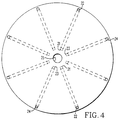
- FIG. 1 A particular preferred device for use in practicing the present invention is illustrated in Figures 1 through 5.
- the continuous annular chromatograph 10 illustrated in Figure 1 comprises two concentric cylinders 30 and 35 which define the annular space 32 seen in Figure 2.
- Atop this annular space 32 is a distributor plate 20.
- Feed pipes or channels 21 and 23 run through the distributor plate 20 and terminate in feed nozzles 22 and 24, respectively.
- the feed nozzles 22 are intended to supply the feed phase to the exchange resin beads 27 which are packed in the annular space 32.
- these beads are shown as only partially filling the annular space 32.
- the feed nozzles 24 are intended to feed the eluent to the layer of glass beads 26 which sits atop the exchange resin beads 27.
- the feed nozzles 24 are somewhat shorter than the feed nozzles 22. This feed arrangement serves to avoid any back mixing of the feed phase.
- the central cavity defined by the inner cylinder 35 is sealed by a cap 31 so that pipe or channel 25 can be used to apply pressure to the annular bed of resin beads 22.
- the bottom of the annular space 32 is defined by a product plate 40. As seen in Figure 5, a large number of product delivery channels or pipes 41 pass through this plate. This allows the collection of a variety Of product fractions and also facilitates adjustments to the operating conditions to allow product collection at various angular displacements.
- the distributor plate 20 is held in a fixed position above the annular space 32 by a bracket 62 which is turn connected to a support rod 61 which is affixed to a base plate 60. Also affixed to this base plate 60 is a support column 63 on which the product plate 40 rotatably rests. A shaft 70 passes through this support column 63 and base plate 60 and connects the product plate 40 to a motivating means not shown. Also affixed to the base plate 60 is an annular collection trough 50 which can be subdivided into any number of convenient segments, each with its own exit port 51.
- the continuous annular chromatograph 10 is operated by rotating the annular space 32 packed with the resin beads 27 beneath the fixed distributor plate 20 and its associated feed nozzles 22 and 24. The rotational force is supplied by the shaft 70.
Landscapes
- Chemical & Material Sciences (AREA)
- Chemical Kinetics & Catalysis (AREA)
- Treatment Of Liquids With Adsorbents In General (AREA)
- Inorganic Compounds Of Heavy Metals (AREA)
- Treatment Of Water By Ion Exchange (AREA)
- Organic Low-Molecular-Weight Compounds And Preparation Thereof (AREA)
- Solid-Sorbent Or Filter-Aiding Compositions (AREA)
Claims (6)
- Procédé de chromatographie continue pour isoler simultanément du zirconium 90 et du zirconium 94 à partir d'une solution contenant un mélange d'isotopes du zirconium et produire des fractions sensiblement pures de chacun desdits isotopes séparés, ledit procédé comprenant les étapes consistant à :a) utiliser une colonne de séparation chromatographique dont la hauteur utile de colonne est suffisante pour séparer chacun desdits isotopes du zirconium en une fraction de produit distincte ayant une pureté supérieure à 90 % à l'aide d'une résine échangeuse de cations qui a une forte affinité pour les cations du zirconium, ladite résine contenant une distribution monodispersée de perles sphériques avec une taille moyenne de particules de un micromètre ou moins et une capacité pour les cations du zirconium comprise entre 0,01 et 0,5 milliéquivalents/ml,b) préparer une solution aqueuse d'alimentation d'un composé de chlorure de zirconium hydrolisé ayant une limite de solubilité d'environ 90 g/l et faire entrer cette solution au sommet de la colonne de séparation chromatographique,c) préparer un éluant qui est une solution aqueuse d'acide chlorhydrique ayant une valeur de normalité comprise entre 2N et 6N et faire entrer cet éluant au sommet de ladite colonne de séparation chromatographique pour amener chaque isotope du zirconium se trouvant dans ladite solution d'alimentation à descendre dans la colonne à une vitesse différente, etd) recueillir en continu et en simultané lesdites fractions sensiblement pures au bas de ladite colonne.
- Procédé selon la revendication 1, caractérisé en ce que le facteur de séparation α est, pour le zirconium 90, d'au moins 1,05 pour un plateau théorique d'une hauteur de 25 cm.
- Procédé selon la revendication 1 ou 2, caractérisé en ce que la solution d'alimentation du composé de chlorure de zirconium hydrolisé contient aussi un composé du hafnium et la chromatographie sépare pratiquement totalement le composé du hafnium des fractions d'isotopes du zirconium.
- Procédé selon l'une quelconque des revendications 1 à 3, caractérisé en ce que l'opération de chromatographie continue se fait dans un chromatographe annulaire fonctionnant en continu.
- Procédé selon la revendication 4, caractérisé en ce que le chromatographe annulaire fonctionnant en continu est exploité de telle sorte que la solution d'alimentation pénètre sur 1 % environ de la hauteur utile de la colonne avant que l'éluant ne soit ajouté.
- Procédé selon la revendication 5, caractérisé en ce que l'éluant entre en plus d'un emplacement de la circonférence du chromatographe annulaire et la concentration de l'éluant en acide chlorhydrique augmente à chaque emplacement successif d'entrée de l'éluant quand on se déplace dans la direction de rotation du chromatographe annulaire fonctionnant en continu.
Applications Claiming Priority (2)
| Application Number | Priority Date | Filing Date | Title |
|---|---|---|---|
| US07/515,965 US5098678A (en) | 1990-04-27 | 1990-04-27 | Chromatographic separation of zirconium isotopes |
| US515965 | 1990-04-27 |
Publications (3)
| Publication Number | Publication Date |
|---|---|
| EP0453908A2 EP0453908A2 (fr) | 1991-10-30 |
| EP0453908A3 EP0453908A3 (en) | 1991-11-27 |
| EP0453908B1 true EP0453908B1 (fr) | 1996-08-14 |
Family
ID=24053548
Family Applications (1)
| Application Number | Title | Priority Date | Filing Date |
|---|---|---|---|
| EP91105878A Expired - Lifetime EP0453908B1 (fr) | 1990-04-27 | 1991-04-12 | Séparation chromatographique des isotopes de zirconium |
Country Status (7)
| Country | Link |
|---|---|
| US (1) | US5098678A (fr) |
| EP (1) | EP0453908B1 (fr) |
| JP (1) | JP2847583B2 (fr) |
| KR (1) | KR0181515B1 (fr) |
| CA (1) | CA2027357C (fr) |
| DE (1) | DE69121280T2 (fr) |
| ES (1) | ES2090164T3 (fr) |
Families Citing this family (11)
| Publication number | Priority date | Publication date | Assignee | Title |
|---|---|---|---|---|
| US5174971A (en) * | 1990-10-10 | 1992-12-29 | Westinghouse Electric Corp. | Continuous anion exchange chromatography for the separation of zirconium isotopes |
| USD340198S (en) | 1991-04-30 | 1993-10-12 | Shimadzu Corporation | Chromatograph |
| US5443732A (en) * | 1994-04-01 | 1995-08-22 | Westinghouse Electric Corporation | Boron isotope separation using continuous ion exchange chromatography |
| US5437795A (en) * | 1994-06-23 | 1995-08-01 | Westinghouse Electric Corporation | Chromatographic separation of erbium isotopes |
| US5470479A (en) * | 1994-06-23 | 1995-11-28 | Westinghouse Electric Corporation | Continuous, steady-state, chromatographic separation of gadolinium isotopes |
| WO1997004141A1 (fr) * | 1995-07-17 | 1997-02-06 | Westinghouse Electric Corporation | Separation du zirconium et du hafnium dans des solutions chlorurees, par chromatographie a echange ionique continu |
| US5618502A (en) * | 1995-07-17 | 1997-04-08 | Westinghouse Electric Corporation | Zirconium and hafnium separation in sulfate solutions using continuous ion exchange chromatography |
| ATE329259T1 (de) * | 2000-03-07 | 2006-06-15 | A L P Technology Ag | Autoklavierbarer annularchromatograph |
| US6737030B2 (en) | 2002-01-29 | 2004-05-18 | Ati Properties, Inc. | Method for separating hafnium from zirconium |
| TWI382427B (zh) * | 2009-06-18 | 2013-01-11 | Atomic Energy Council | 放射性同位素鉈-201之分離裝置 |
| USD645570S1 (en) * | 2010-07-19 | 2011-09-20 | Hitachi High-Technologies Corporation | Control panel of detector for liquid chromatograph analyzer |
Family Cites Families (7)
| Publication number | Priority date | Publication date | Assignee | Title |
|---|---|---|---|---|
| US2546953A (en) * | 1949-11-25 | 1951-03-27 | Jr Kenneth Street | Zirconium-hafnium separation process |
| US2759793A (en) * | 1951-02-21 | 1956-08-21 | Lister Bryan Alfred Jack | Separating hafnium from zirconium |
| US3971842A (en) * | 1974-08-08 | 1976-07-27 | Atlantic Richfield Company | Continuous displacement chromatographic separation |
| JPS562834A (en) * | 1979-06-22 | 1981-01-13 | Asahi Chem Ind Co Ltd | New separation of isotope |
| US4584183A (en) * | 1983-12-21 | 1986-04-22 | Westinghouse Electric Corp. | Process for separating zirconium isotopes |
| DE3580721D1 (de) * | 1984-08-06 | 1991-01-10 | Westinghouse Electric Corp | Verfahren zur trennung von gadoliniumisotopen. |
| US4915843A (en) * | 1988-11-28 | 1990-04-10 | Union Oil Company Of California | Continuous displacement chromatographic method |
-
1990
- 1990-04-27 US US07/515,965 patent/US5098678A/en not_active Expired - Fee Related
- 1990-10-11 CA CA002027357A patent/CA2027357C/fr not_active Expired - Fee Related
-
1991
- 1991-04-12 ES ES91105878T patent/ES2090164T3/es not_active Expired - Lifetime
- 1991-04-12 DE DE69121280T patent/DE69121280T2/de not_active Expired - Fee Related
- 1991-04-12 EP EP91105878A patent/EP0453908B1/fr not_active Expired - Lifetime
- 1991-04-26 JP JP3124963A patent/JP2847583B2/ja not_active Expired - Lifetime
- 1991-04-26 KR KR1019910006738A patent/KR0181515B1/ko not_active Expired - Fee Related
Non-Patent Citations (1)
| Title |
|---|
| Journal of chromatography, 259 (1983) 480-486, Kazumi Kogure, Masao Nomura and Makoto Okamoto * |
Also Published As
| Publication number | Publication date |
|---|---|
| JPH0623237A (ja) | 1994-02-01 |
| KR910018310A (ko) | 1991-11-30 |
| CA2027357C (fr) | 2001-01-02 |
| JP2847583B2 (ja) | 1999-01-20 |
| ES2090164T3 (es) | 1996-10-16 |
| EP0453908A2 (fr) | 1991-10-30 |
| DE69121280T2 (de) | 1997-01-02 |
| DE69121280D1 (de) | 1996-09-19 |
| US5098678A (en) | 1992-03-24 |
| EP0453908A3 (en) | 1991-11-27 |
| KR0181515B1 (ko) | 1999-04-15 |
| CA2027357A1 (fr) | 1991-10-28 |
Similar Documents
| Publication | Publication Date | Title |
|---|---|---|
| EP0464513B1 (fr) | Séparation chromatographique d'isotopes de zirconium à l'aide d'éluants anhydre facilement recyclable | |
| US5098678A (en) | Chromatographic separation of zirconium isotopes | |
| EP0480374B1 (fr) | Chromatographie continue par échange d'anion pour la séparation des isotopes de zirconium | |
| US5045209A (en) | Method for chromatographically recovering scandium and yttrium | |
| US5130001A (en) | Uranium isotope separation by continuous anion exchange chromatography | |
| US4915843A (en) | Continuous displacement chromatographic method | |
| US5470479A (en) | Continuous, steady-state, chromatographic separation of gadolinium isotopes | |
| CA2047359C (fr) | Separation chromatographique d'isotopes de zirconium a volume d'effluent reduit | |
| KR100367443B1 (ko) | 연속이온교환크로마토그래피를사용하는붕소동위원소의분리방법 | |
| Michaelis et al. | High pressure liquid chromatography | |
| US5437795A (en) | Chromatographic separation of erbium isotopes | |
| EP0464783B1 (fr) | Séparation chromatographique, d'isotopos de zirconium avec réduction d'effluents liquides | |
| Caruel et al. | Chromatographic separation of polyols by ligand exchange: effects of the ion-exchange resin cross-linking and size | |
| Nunn et al. | Components for the Design of a Radio-HPLC System | |
| DeStefano | LARGER DIAMETER COLUMNS FOR MODERN HIGH-SPEED LIQUID CHROMATOGRAPHY. |
Legal Events
| Date | Code | Title | Description |
|---|---|---|---|
| PUAI | Public reference made under article 153(3) epc to a published international application that has entered the european phase |
Free format text: ORIGINAL CODE: 0009012 |
|
| PUAL | Search report despatched |
Free format text: ORIGINAL CODE: 0009013 |
|
| AK | Designated contracting states |
Kind code of ref document: A2 Designated state(s): BE CH DE ES FR GB IT LI SE |
|
| AK | Designated contracting states |
Kind code of ref document: A3 Designated state(s): BE CH DE ES FR GB IT LI SE |
|
| 17P | Request for examination filed |
Effective date: 19920324 |
|
| 17Q | First examination report despatched |
Effective date: 19931008 |
|
| GRAH | Despatch of communication of intention to grant a patent |
Free format text: ORIGINAL CODE: EPIDOS IGRA |
|
| GRAH | Despatch of communication of intention to grant a patent |
Free format text: ORIGINAL CODE: EPIDOS IGRA |
|
| GRAA | (expected) grant |
Free format text: ORIGINAL CODE: 0009210 |
|
| AK | Designated contracting states |
Kind code of ref document: B1 Designated state(s): BE CH DE ES FR GB IT LI SE |
|
| REG | Reference to a national code |
Ref country code: CH Ref legal event code: NV Representative=s name: A. BRAUN, BRAUN, HERITIER, ESCHMANN AG PATENTANWAE |
|
| ET | Fr: translation filed | ||
| REF | Corresponds to: |
Ref document number: 69121280 Country of ref document: DE Date of ref document: 19960919 |
|
| REG | Reference to a national code |
Ref country code: ES Ref legal event code: FG2A Ref document number: 2090164 Country of ref document: ES Kind code of ref document: T3 |
|
| ITF | It: translation for a ep patent filed | ||
| REG | Reference to a national code |
Ref country code: ES Ref legal event code: FG2A Ref document number: 2090164 Country of ref document: ES Kind code of ref document: T3 |
|
| PLBE | No opposition filed within time limit |
Free format text: ORIGINAL CODE: 0009261 |
|
| STAA | Information on the status of an ep patent application or granted ep patent |
Free format text: STATUS: NO OPPOSITION FILED WITHIN TIME LIMIT |
|
| 26N | No opposition filed | ||
| K1C3 | Correction of patent application (complete document) published |
Effective date: 19911030 |
|
| REG | Reference to a national code |
Ref country code: GB Ref legal event code: IF02 |
|
| PGFP | Annual fee paid to national office [announced via postgrant information from national office to epo] |
Ref country code: GB Payment date: 20020315 Year of fee payment: 12 |
|
| PGFP | Annual fee paid to national office [announced via postgrant information from national office to epo] |
Ref country code: FR Payment date: 20020404 Year of fee payment: 12 |
|
| PGFP | Annual fee paid to national office [announced via postgrant information from national office to epo] |
Ref country code: SE Payment date: 20020405 Year of fee payment: 12 |
|
| PGFP | Annual fee paid to national office [announced via postgrant information from national office to epo] |
Ref country code: ES Payment date: 20020411 Year of fee payment: 12 |
|
| PGFP | Annual fee paid to national office [announced via postgrant information from national office to epo] |
Ref country code: DE Payment date: 20020430 Year of fee payment: 12 |
|
| PGFP | Annual fee paid to national office [announced via postgrant information from national office to epo] |
Ref country code: BE Payment date: 20020523 Year of fee payment: 12 |
|
| PGFP | Annual fee paid to national office [announced via postgrant information from national office to epo] |
Ref country code: CH Payment date: 20020618 Year of fee payment: 12 |
|
| PG25 | Lapsed in a contracting state [announced via postgrant information from national office to epo] |
Ref country code: GB Free format text: LAPSE BECAUSE OF NON-PAYMENT OF DUE FEES Effective date: 20030412 |
|
| PG25 | Lapsed in a contracting state [announced via postgrant information from national office to epo] |
Ref country code: SE Free format text: LAPSE BECAUSE OF NON-PAYMENT OF DUE FEES Effective date: 20030413 |
|
| PG25 | Lapsed in a contracting state [announced via postgrant information from national office to epo] |
Ref country code: ES Free format text: LAPSE BECAUSE OF NON-PAYMENT OF DUE FEES Effective date: 20030414 |
|
| PG25 | Lapsed in a contracting state [announced via postgrant information from national office to epo] |
Ref country code: LI Free format text: LAPSE BECAUSE OF NON-PAYMENT OF DUE FEES Effective date: 20030430 Ref country code: CH Free format text: LAPSE BECAUSE OF NON-PAYMENT OF DUE FEES Effective date: 20030430 Ref country code: BE Free format text: LAPSE BECAUSE OF NON-PAYMENT OF DUE FEES Effective date: 20030430 |
|
| BERE | Be: lapsed |
Owner name: *WESTINHOUSE ELECTRIC CY LLC Effective date: 20030430 |
|
| PG25 | Lapsed in a contracting state [announced via postgrant information from national office to epo] |
Ref country code: DE Free format text: LAPSE BECAUSE OF NON-PAYMENT OF DUE FEES Effective date: 20031101 |
|
| EUG | Se: european patent has lapsed | ||
| GBPC | Gb: european patent ceased through non-payment of renewal fee |
Effective date: 20030412 |
|
| REG | Reference to a national code |
Ref country code: CH Ref legal event code: PL |
|
| PG25 | Lapsed in a contracting state [announced via postgrant information from national office to epo] |
Ref country code: FR Free format text: LAPSE BECAUSE OF NON-PAYMENT OF DUE FEES Effective date: 20031231 |
|
| REG | Reference to a national code |
Ref country code: FR Ref legal event code: ST |
|
| REG | Reference to a national code |
Ref country code: ES Ref legal event code: FD2A Effective date: 20030414 |
|
| PG25 | Lapsed in a contracting state [announced via postgrant information from national office to epo] |
Ref country code: IT Free format text: LAPSE BECAUSE OF NON-PAYMENT OF DUE FEES;WARNING: LAPSES OF ITALIAN PATENTS WITH EFFECTIVE DATE BEFORE 2007 MAY HAVE OCCURRED AT ANY TIME BEFORE 2007. THE CORRECT EFFECTIVE DATE MAY BE DIFFERENT FROM THE ONE RECORDED. Effective date: 20050412 |