EP0454330A1 - Benzimidazolinone derivatives - Google Patents
Benzimidazolinone derivatives Download PDFInfo
- Publication number
- EP0454330A1 EP0454330A1 EP91303264A EP91303264A EP0454330A1 EP 0454330 A1 EP0454330 A1 EP 0454330A1 EP 91303264 A EP91303264 A EP 91303264A EP 91303264 A EP91303264 A EP 91303264A EP 0454330 A1 EP0454330 A1 EP 0454330A1
- Authority
- EP
- European Patent Office
- Prior art keywords
- benzimidazol
- group
- dihydro
- compound
- dimethylaminoethyl
- Prior art date
- Legal status (The legal status is an assumption and is not a legal conclusion. Google has not performed a legal analysis and makes no representation as to the accuracy of the status listed.)
- Withdrawn
Links
- SILNNFMWIMZVEQ-UHFFFAOYSA-N 1,3-dihydrobenzimidazol-2-one Chemical class C1=CC=C2NC(O)=NC2=C1 SILNNFMWIMZVEQ-UHFFFAOYSA-N 0.000 title claims abstract description 13
- 150000001875 compounds Chemical class 0.000 claims abstract description 148
- 229910052739 hydrogen Inorganic materials 0.000 claims abstract description 116
- -1 cyano, carboxyl Chemical group 0.000 claims abstract description 95
- 238000000034 method Methods 0.000 claims abstract description 31
- 239000003580 lung surfactant Substances 0.000 claims abstract description 26
- 239000001257 hydrogen Substances 0.000 claims abstract description 19
- 150000003839 salts Chemical class 0.000 claims abstract description 18
- UFHFLCQGNIYNRP-UHFFFAOYSA-N Hydrogen Chemical compound [H][H] UFHFLCQGNIYNRP-UHFFFAOYSA-N 0.000 claims abstract description 17
- 125000005843 halogen group Chemical group 0.000 claims abstract description 16
- 230000028327 secretion Effects 0.000 claims abstract description 12
- 125000002252 acyl group Chemical group 0.000 claims abstract description 11
- 125000000449 nitro group Chemical group [O-][N+](*)=O 0.000 claims abstract description 10
- 125000003917 carbamoyl group Chemical group [H]N([H])C(*)=O 0.000 claims abstract description 9
- 125000004070 6 membered heterocyclic group Chemical group 0.000 claims abstract description 8
- 125000004104 aryloxy group Chemical group 0.000 claims abstract description 8
- 125000004435 hydrogen atom Chemical group [H]* 0.000 claims abstract description 8
- 125000000587 piperidin-1-yl group Chemical group [H]C1([H])N(*)C([H])([H])C([H])([H])C([H])([H])C1([H])[H] 0.000 claims abstract description 8
- 125000000816 ethylene group Chemical group [H]C([H])([*:1])C([H])([H])[*:2] 0.000 claims abstract description 6
- 125000002887 hydroxy group Chemical group [H]O* 0.000 claims abstract description 6
- 125000004573 morpholin-4-yl group Chemical group N1(CCOCC1)* 0.000 claims abstract description 5
- 125000000719 pyrrolidinyl group Chemical group 0.000 claims abstract description 5
- 125000001664 diethylamino group Chemical group [H]C([H])([H])C([H])([H])N(*)C([H])([H])C([H])([H])[H] 0.000 claims abstract description 4
- 229910052757 nitrogen Inorganic materials 0.000 claims abstract description 4
- 125000004433 nitrogen atom Chemical group N* 0.000 claims abstract description 4
- 239000008194 pharmaceutical composition Substances 0.000 claims abstract description 3
- 230000001737 promoting effect Effects 0.000 claims abstract description 3
- 239000007858 starting material Substances 0.000 claims description 71
- VEXZGXHMUGYJMC-UHFFFAOYSA-N Hydrochloric acid Chemical compound Cl VEXZGXHMUGYJMC-UHFFFAOYSA-N 0.000 claims description 35
- 230000008569 process Effects 0.000 claims description 22
- 239000003795 chemical substances by application Substances 0.000 claims description 15
- 230000006315 carbonylation Effects 0.000 claims description 8
- 238000005810 carbonylation reaction Methods 0.000 claims description 8
- MYONAGGJKCJOBT-UHFFFAOYSA-N benzimidazol-2-one Chemical class C1=CC=CC2=NC(=O)N=C21 MYONAGGJKCJOBT-UHFFFAOYSA-N 0.000 claims description 7
- BDHFUVZGWQCTTF-UHFFFAOYSA-M sulfonate Chemical compound [O-]S(=O)=O BDHFUVZGWQCTTF-UHFFFAOYSA-M 0.000 claims description 7
- JSTZYOFLAQAJDC-UHFFFAOYSA-N 3-[2-(dimethylamino)ethyl]-1h-benzimidazol-2-one Chemical compound C1=CC=C2NC(=O)N(CCN(C)C)C2=C1 JSTZYOFLAQAJDC-UHFFFAOYSA-N 0.000 claims description 6
- QGZKDVFQNNGYKY-UHFFFAOYSA-N Ammonia Chemical compound N QGZKDVFQNNGYKY-UHFFFAOYSA-N 0.000 claims description 6
- 150000001412 amines Chemical class 0.000 claims description 6
- 125000002915 carbonyl group Chemical group [*:2]C([*:1])=O 0.000 claims description 5
- 150000004820 halides Chemical class 0.000 claims description 5
- 238000002360 preparation method Methods 0.000 claims description 4
- YOOLZGSGQBBZPM-UHFFFAOYSA-N 5,7-dibromo-3-[2-(dimethylamino)ethyl]-1h-benzimidazol-2-one Chemical compound BrC1=CC(Br)=C2NC(=O)N(CCN(C)C)C2=C1 YOOLZGSGQBBZPM-UHFFFAOYSA-N 0.000 claims description 3
- RIYGUVGJFNCUEE-UHFFFAOYSA-N 5-bromo-3-[2-(dimethylamino)ethyl]-1h-benzimidazol-2-one Chemical compound BrC1=CC=C2NC(=O)N(CCN(C)C)C2=C1 RIYGUVGJFNCUEE-UHFFFAOYSA-N 0.000 claims description 3
- WBTWHZDYGDXTTE-UHFFFAOYSA-N 5-chloro-3-(2-pyrrolidin-1-ylethyl)-1h-benzimidazol-2-one Chemical compound C12=CC(Cl)=CC=C2NC(=O)N1CCN1CCCC1 WBTWHZDYGDXTTE-UHFFFAOYSA-N 0.000 claims description 3
- 125000004029 hydroxymethyl group Chemical group [H]OC([H])([H])* 0.000 claims description 3
- 229910021529 ammonia Inorganic materials 0.000 claims description 2
- 125000002147 dimethylamino group Chemical group [H]C([H])([H])N(*)C([H])([H])[H] 0.000 claims description 2
- 230000002140 halogenating effect Effects 0.000 claims description 2
- 230000003301 hydrolyzing effect Effects 0.000 claims description 2
- 125000001449 isopropyl group Chemical group [H]C([H])([H])C([H])(*)C([H])([H])[H] 0.000 claims description 2
- 238000006396 nitration reaction Methods 0.000 claims description 2
- 125000004169 (C1-C6) alkyl group Chemical group 0.000 claims 10
- 125000004191 (C1-C6) alkoxy group Chemical group 0.000 claims 5
- 150000004986 phenylenediamines Chemical class 0.000 claims 3
- 125000003903 2-propenyl group Chemical group [H]C([*])([H])C([H])=C([H])[H] 0.000 claims 2
- 239000003937 drug carrier Substances 0.000 claims 1
- 238000006798 ring closing metathesis reaction Methods 0.000 claims 1
- 125000000542 sulfonic acid group Chemical group 0.000 claims 1
- 125000000217 alkyl group Chemical group 0.000 abstract description 20
- 125000003545 alkoxy group Chemical group 0.000 abstract description 8
- 125000004453 alkoxycarbonyl group Chemical group 0.000 abstract description 4
- OKKJLVBELUTLKV-UHFFFAOYSA-N Methanol Chemical compound OC OKKJLVBELUTLKV-UHFFFAOYSA-N 0.000 description 105
- XEKOWRVHYACXOJ-UHFFFAOYSA-N Ethyl acetate Chemical compound CCOC(C)=O XEKOWRVHYACXOJ-UHFFFAOYSA-N 0.000 description 90
- HEMHJVSKTPXQMS-UHFFFAOYSA-M Sodium hydroxide Chemical compound [OH-].[Na+] HEMHJVSKTPXQMS-UHFFFAOYSA-M 0.000 description 87
- 238000005481 NMR spectroscopy Methods 0.000 description 85
- 238000001819 mass spectrum Methods 0.000 description 84
- 239000000243 solution Substances 0.000 description 76
- HEDRZPFGACZZDS-UHFFFAOYSA-N Chloroform Chemical compound ClC(Cl)Cl HEDRZPFGACZZDS-UHFFFAOYSA-N 0.000 description 68
- LFQSCWFLJHTTHZ-UHFFFAOYSA-N Ethanol Chemical compound CCO LFQSCWFLJHTTHZ-UHFFFAOYSA-N 0.000 description 56
- 239000002904 solvent Substances 0.000 description 44
- FAPWRFPIFSIZLT-UHFFFAOYSA-M Sodium chloride Chemical compound [Na+].[Cl-] FAPWRFPIFSIZLT-UHFFFAOYSA-M 0.000 description 36
- 239000011541 reaction mixture Substances 0.000 description 36
- 238000004458 analytical method Methods 0.000 description 34
- YMWUJEATGCHHMB-UHFFFAOYSA-N Dichloromethane Chemical compound ClCCl YMWUJEATGCHHMB-UHFFFAOYSA-N 0.000 description 33
- 239000000203 mixture Substances 0.000 description 29
- 229910001868 water Inorganic materials 0.000 description 29
- XLYOFNOQVPJJNP-UHFFFAOYSA-N water Substances O XLYOFNOQVPJJNP-UHFFFAOYSA-N 0.000 description 27
- PMZURENOXWZQFD-UHFFFAOYSA-L Sodium Sulfate Chemical compound [Na+].[Na+].[O-]S([O-])(=O)=O PMZURENOXWZQFD-UHFFFAOYSA-L 0.000 description 26
- KFZMGEQAYNKOFK-UHFFFAOYSA-N Isopropanol Chemical compound CC(C)O KFZMGEQAYNKOFK-UHFFFAOYSA-N 0.000 description 24
- ZMANZCXQSJIPKH-UHFFFAOYSA-N Triethylamine Chemical compound CCN(CC)CC ZMANZCXQSJIPKH-UHFFFAOYSA-N 0.000 description 24
- 238000006243 chemical reaction Methods 0.000 description 20
- 239000003480 eluent Substances 0.000 description 20
- 239000000460 chlorine Substances 0.000 description 19
- 238000010898 silica gel chromatography Methods 0.000 description 19
- ZMXDDKWLCZADIW-UHFFFAOYSA-N N,N-Dimethylformamide Chemical compound CN(C)C=O ZMXDDKWLCZADIW-UHFFFAOYSA-N 0.000 description 18
- 229920006395 saturated elastomer Polymers 0.000 description 18
- 239000011780 sodium chloride Substances 0.000 description 17
- 0 Nc1ccccc1*CC*I Chemical compound Nc1ccccc1*CC*I 0.000 description 16
- IAZDPXIOMUYVGZ-WFGJKAKNSA-N Dimethyl sulfoxide Chemical compound [2H]C([2H])([2H])S(=O)C([2H])([2H])[2H] IAZDPXIOMUYVGZ-WFGJKAKNSA-N 0.000 description 14
- 239000012044 organic layer Substances 0.000 description 14
- QAOWNCQODCNURD-UHFFFAOYSA-N Sulfuric acid Chemical compound OS(O)(=O)=O QAOWNCQODCNURD-UHFFFAOYSA-N 0.000 description 13
- QTBSBXVTEAMEQO-UHFFFAOYSA-N Acetic acid Chemical compound CC(O)=O QTBSBXVTEAMEQO-UHFFFAOYSA-N 0.000 description 12
- UHOVQNZJYSORNB-UHFFFAOYSA-N Benzene Chemical compound C1=CC=CC=C1 UHOVQNZJYSORNB-UHFFFAOYSA-N 0.000 description 12
- 239000002585 base Substances 0.000 description 11
- 239000013078 crystal Substances 0.000 description 11
- ZNQVEEAIQZEUHB-UHFFFAOYSA-N 2-ethoxyethanol Chemical compound CCOCCO ZNQVEEAIQZEUHB-UHFFFAOYSA-N 0.000 description 10
- RTZKZFJDLAIYFH-UHFFFAOYSA-N Diethyl ether Chemical compound CCOCC RTZKZFJDLAIYFH-UHFFFAOYSA-N 0.000 description 10
- KDLHZDBZIXYQEI-UHFFFAOYSA-N Palladium Chemical compound [Pd] KDLHZDBZIXYQEI-UHFFFAOYSA-N 0.000 description 10
- WYURNTSHIVDZCO-UHFFFAOYSA-N Tetrahydrofuran Chemical compound C1CCOC1 WYURNTSHIVDZCO-UHFFFAOYSA-N 0.000 description 10
- 238000010792 warming Methods 0.000 description 10
- KEAYESYHFKHZAL-UHFFFAOYSA-N Sodium Chemical compound [Na] KEAYESYHFKHZAL-UHFFFAOYSA-N 0.000 description 9
- YXFVVABEGXRONW-UHFFFAOYSA-N Toluene Chemical compound CC1=CC=CC=C1 YXFVVABEGXRONW-UHFFFAOYSA-N 0.000 description 9
- RIFGWPKJUGCATF-UHFFFAOYSA-N ethyl chloroformate Chemical compound CCOC(Cl)=O RIFGWPKJUGCATF-UHFFFAOYSA-N 0.000 description 9
- 125000006239 protecting group Chemical group 0.000 description 9
- XNWFRZJHXBZDAG-UHFFFAOYSA-N 2-METHOXYETHANOL Chemical compound COCCO XNWFRZJHXBZDAG-UHFFFAOYSA-N 0.000 description 8
- VTYYLEPIZMXCLO-UHFFFAOYSA-L Calcium carbonate Chemical compound [Ca+2].[O-]C([O-])=O VTYYLEPIZMXCLO-UHFFFAOYSA-L 0.000 description 8
- YNAVUWVOSKDBBP-UHFFFAOYSA-N Morpholine Chemical compound C1COCCN1 YNAVUWVOSKDBBP-UHFFFAOYSA-N 0.000 description 8
- 239000012298 atmosphere Substances 0.000 description 8
- 239000003960 organic solvent Substances 0.000 description 8
- 238000010992 reflux Methods 0.000 description 8
- 239000002552 dosage form Substances 0.000 description 7
- 125000001424 substituent group Chemical group 0.000 description 7
- WFDIJRYMOXRFFG-UHFFFAOYSA-N Acetic anhydride Chemical compound CC(=O)OC(C)=O WFDIJRYMOXRFFG-UHFFFAOYSA-N 0.000 description 6
- 208000032571 Infant acute respiratory distress syndrome Diseases 0.000 description 6
- JLTDJTHDQAWBAV-UHFFFAOYSA-N N,N-dimethylaniline Chemical compound CN(C)C1=CC=CC=C1 JLTDJTHDQAWBAV-UHFFFAOYSA-N 0.000 description 6
- 206010028974 Neonatal respiratory distress syndrome Diseases 0.000 description 6
- KWYUFKZDYYNOTN-UHFFFAOYSA-M Potassium hydroxide Chemical compound [OH-].[K+] KWYUFKZDYYNOTN-UHFFFAOYSA-M 0.000 description 6
- JUJWROOIHBZHMG-UHFFFAOYSA-N Pyridine Chemical compound C1=CC=NC=C1 JUJWROOIHBZHMG-UHFFFAOYSA-N 0.000 description 6
- VYPSYNLAJGMNEJ-UHFFFAOYSA-N Silicium dioxide Chemical compound O=[Si]=O VYPSYNLAJGMNEJ-UHFFFAOYSA-N 0.000 description 6
- 239000002775 capsule Substances 0.000 description 6
- 125000001495 ethyl group Chemical group [H]C([H])([H])C([H])([H])* 0.000 description 6
- 239000010410 layer Substances 0.000 description 6
- 201000002652 newborn respiratory distress syndrome Diseases 0.000 description 6
- FGIUAXJPYTZDNR-UHFFFAOYSA-N potassium nitrate Chemical compound [K+].[O-][N+]([O-])=O FGIUAXJPYTZDNR-UHFFFAOYSA-N 0.000 description 6
- BDERNNFJNOPAEC-UHFFFAOYSA-N propan-1-ol Chemical compound CCCO BDERNNFJNOPAEC-UHFFFAOYSA-N 0.000 description 6
- 201000004193 respiratory failure Diseases 0.000 description 6
- 239000000741 silica gel Substances 0.000 description 6
- 229910002027 silica gel Inorganic materials 0.000 description 6
- 239000012312 sodium hydride Substances 0.000 description 6
- 229910000104 sodium hydride Inorganic materials 0.000 description 6
- GETQZCLCWQTVFV-UHFFFAOYSA-N trimethylamine Chemical compound CN(C)C GETQZCLCWQTVFV-UHFFFAOYSA-N 0.000 description 6
- KTLFENNEPHBKJD-UHFFFAOYSA-K benzyl(trimethyl)azanium;tribromide Chemical compound [Br-].[Br-].[Br-].C[N+](C)(C)CC1=CC=CC=C1.C[N+](C)(C)CC1=CC=CC=C1.C[N+](C)(C)CC1=CC=CC=C1 KTLFENNEPHBKJD-UHFFFAOYSA-K 0.000 description 5
- PFYXSUNOLOJMDX-UHFFFAOYSA-N bis(2,5-dioxopyrrolidin-1-yl) carbonate Chemical compound O=C1CCC(=O)N1OC(=O)ON1C(=O)CCC1=O PFYXSUNOLOJMDX-UHFFFAOYSA-N 0.000 description 5
- 239000003054 catalyst Substances 0.000 description 5
- IXCSERBJSXMMFS-UHFFFAOYSA-N hydrogen chloride Substances Cl.Cl IXCSERBJSXMMFS-UHFFFAOYSA-N 0.000 description 5
- 229910000041 hydrogen chloride Inorganic materials 0.000 description 5
- 239000012442 inert solvent Substances 0.000 description 5
- 238000002955 isolation Methods 0.000 description 5
- 238000006722 reduction reaction Methods 0.000 description 5
- 210000002345 respiratory system Anatomy 0.000 description 5
- 238000003756 stirring Methods 0.000 description 5
- YLQBMQCUIZJEEH-UHFFFAOYSA-N tetrahydrofuran Natural products C=1C=COC=1 YLQBMQCUIZJEEH-UHFFFAOYSA-N 0.000 description 5
- RYHBNJHYFVUHQT-UHFFFAOYSA-N 1,4-Dioxane Chemical compound C1COCCO1 RYHBNJHYFVUHQT-UHFFFAOYSA-N 0.000 description 4
- OISVCGZHLKNMSJ-UHFFFAOYSA-N 2,6-dimethylpyridine Chemical compound CC1=CC=CC(C)=N1 OISVCGZHLKNMSJ-UHFFFAOYSA-N 0.000 description 4
- LQLJZSJKRYTKTP-UHFFFAOYSA-N 2-dimethylaminoethyl chloride hydrochloride Chemical compound Cl.CN(C)CCCl LQLJZSJKRYTKTP-UHFFFAOYSA-N 0.000 description 4
- 206010001052 Acute respiratory distress syndrome Diseases 0.000 description 4
- IAZDPXIOMUYVGZ-UHFFFAOYSA-N Dimethylsulphoxide Chemical compound CS(C)=O IAZDPXIOMUYVGZ-UHFFFAOYSA-N 0.000 description 4
- MHAJPDPJQMAIIY-UHFFFAOYSA-N Hydrogen peroxide Chemical compound OO MHAJPDPJQMAIIY-UHFFFAOYSA-N 0.000 description 4
- JGFZNNIVVJXRND-UHFFFAOYSA-N N,N-Diisopropylethylamine (DIPEA) Chemical compound CCN(C(C)C)C(C)C JGFZNNIVVJXRND-UHFFFAOYSA-N 0.000 description 4
- GRYLNZFGIOXLOG-UHFFFAOYSA-N Nitric acid Chemical compound O[N+]([O-])=O GRYLNZFGIOXLOG-UHFFFAOYSA-N 0.000 description 4
- 208000013616 Respiratory Distress Syndrome Diseases 0.000 description 4
- UIIMBOGNXHQVGW-UHFFFAOYSA-M Sodium bicarbonate Chemical compound [Na+].OC([O-])=O UIIMBOGNXHQVGW-UHFFFAOYSA-M 0.000 description 4
- WQDUMFSSJAZKTM-UHFFFAOYSA-N Sodium methoxide Chemical compound [Na+].[O-]C WQDUMFSSJAZKTM-UHFFFAOYSA-N 0.000 description 4
- DKGAVHZHDRPRBM-UHFFFAOYSA-N Tert-Butanol Chemical compound CC(C)(C)O DKGAVHZHDRPRBM-UHFFFAOYSA-N 0.000 description 4
- XSQUKJJJFZCRTK-UHFFFAOYSA-N Urea Chemical compound NC(N)=O XSQUKJJJFZCRTK-UHFFFAOYSA-N 0.000 description 4
- 239000002253 acid Substances 0.000 description 4
- 208000011341 adult acute respiratory distress syndrome Diseases 0.000 description 4
- 201000000028 adult respiratory distress syndrome Diseases 0.000 description 4
- 239000007864 aqueous solution Substances 0.000 description 4
- 239000012267 brine Substances 0.000 description 4
- GDTBXPJZTBHREO-UHFFFAOYSA-N bromine Chemical compound BrBr GDTBXPJZTBHREO-UHFFFAOYSA-N 0.000 description 4
- 206010006451 bronchitis Diseases 0.000 description 4
- 229910000019 calcium carbonate Inorganic materials 0.000 description 4
- PFKFTWBEEFSNDU-UHFFFAOYSA-N carbonyldiimidazole Chemical compound C1=CN=CN1C(=O)N1C=CN=C1 PFKFTWBEEFSNDU-UHFFFAOYSA-N 0.000 description 4
- 238000001816 cooling Methods 0.000 description 4
- UAHZNUMFWWREFZ-UHFFFAOYSA-N ethyl n-[2-(dimethylamino)ethyl]-n-[2-(ethoxycarbonylamino)phenyl]carbamate Chemical compound CCOC(=O)NC1=CC=CC=C1N(CCN(C)C)C(=O)OCC UAHZNUMFWWREFZ-UHFFFAOYSA-N 0.000 description 4
- 239000008187 granular material Substances 0.000 description 4
- 229910052736 halogen Inorganic materials 0.000 description 4
- 230000026030 halogenation Effects 0.000 description 4
- 238000005658 halogenation reaction Methods 0.000 description 4
- 150000002367 halogens Chemical class 0.000 description 4
- HQKMJHAJHXVSDF-UHFFFAOYSA-L magnesium stearate Chemical compound [Mg+2].CCCCCCCCCCCCCCCCCC([O-])=O.CCCCCCCCCCCCCCCCCC([O-])=O HQKMJHAJHXVSDF-UHFFFAOYSA-L 0.000 description 4
- JSNWIWQOIKRWAK-UHFFFAOYSA-N n',n'-dimethyl-n-(2-nitrophenyl)ethane-1,2-diamine Chemical compound CN(C)CCNC1=CC=CC=C1[N+]([O-])=O JSNWIWQOIKRWAK-UHFFFAOYSA-N 0.000 description 4
- 230000000144 pharmacologic effect Effects 0.000 description 4
- BWHMMNNQKKPAPP-UHFFFAOYSA-L potassium carbonate Chemical compound [K+].[K+].[O-]C([O-])=O BWHMMNNQKKPAPP-UHFFFAOYSA-L 0.000 description 4
- HPALAKNZSZLMCH-UHFFFAOYSA-M sodium;chloride;hydrate Chemical compound O.[Na+].[Cl-] HPALAKNZSZLMCH-UHFFFAOYSA-M 0.000 description 4
- 230000004936 stimulating effect Effects 0.000 description 4
- JIAARYAFYJHUJI-UHFFFAOYSA-L zinc dichloride Chemical compound [Cl-].[Cl-].[Zn+2] JIAARYAFYJHUJI-UHFFFAOYSA-L 0.000 description 4
- BSKHPKMHTQYZBB-UHFFFAOYSA-N 2-methylpyridine Chemical compound CC1=CC=CC=N1 BSKHPKMHTQYZBB-UHFFFAOYSA-N 0.000 description 3
- GCVPBKWXUXEQPZ-UHFFFAOYSA-N 2-n-[2-(dimethylamino)ethyl]benzene-1,2-diamine;hydrochloride Chemical compound Cl.CN(C)CCNC1=CC=CC=C1N GCVPBKWXUXEQPZ-UHFFFAOYSA-N 0.000 description 3
- WEZVQBSWCGTSCU-UHFFFAOYSA-N 3-[2-(dimethylamino)ethyl]-6-methoxy-1h-benzimidazol-2-one Chemical compound COC1=CC=C2N(CCN(C)C)C(=O)NC2=C1 WEZVQBSWCGTSCU-UHFFFAOYSA-N 0.000 description 3
- VAMHFXKZEPEZCW-UHFFFAOYSA-N 4-[2-(dimethylamino)ethylamino]-3-nitrobenzonitrile Chemical compound CN(C)CCNC1=CC=C(C#N)C=C1[N+]([O-])=O VAMHFXKZEPEZCW-UHFFFAOYSA-N 0.000 description 3
- PTCPUGKKWNMITF-UHFFFAOYSA-N 4-chloro-2-fluoro-1-nitrobenzene Chemical compound [O-][N+](=O)C1=CC=C(Cl)C=C1F PTCPUGKKWNMITF-UHFFFAOYSA-N 0.000 description 3
- NGPRHMOQBVKRAQ-UHFFFAOYSA-N 4-chloro-2-n-(2-piperidin-1-ylethyl)benzene-1,2-diamine Chemical compound NC1=CC=C(Cl)C=C1NCCN1CCCCC1 NGPRHMOQBVKRAQ-UHFFFAOYSA-N 0.000 description 3
- ZCWXYZBQDNFULS-UHFFFAOYSA-N 5-chloro-2-nitroaniline Chemical compound NC1=CC(Cl)=CC=C1[N+]([O-])=O ZCWXYZBQDNFULS-UHFFFAOYSA-N 0.000 description 3
- CSCPPACGZOOCGX-UHFFFAOYSA-N Acetone Chemical compound CC(C)=O CSCPPACGZOOCGX-UHFFFAOYSA-N 0.000 description 3
- WEVYAHXRMPXWCK-UHFFFAOYSA-N Acetonitrile Chemical compound CC#N WEVYAHXRMPXWCK-UHFFFAOYSA-N 0.000 description 3
- NLXLAEXVIDQMFP-UHFFFAOYSA-N Ammonia chloride Chemical compound [NH4+].[Cl-] NLXLAEXVIDQMFP-UHFFFAOYSA-N 0.000 description 3
- PIICEJLVQHRZGT-UHFFFAOYSA-N Ethylenediamine Chemical class NCCN PIICEJLVQHRZGT-UHFFFAOYSA-N 0.000 description 3
- GUBGYTABKSRVRQ-QKKXKWKRSA-N Lactose Natural products OC[C@H]1O[C@@H](O[C@H]2[C@H](O)[C@@H](O)C(O)O[C@@H]2CO)[C@H](O)[C@@H](O)[C@H]1O GUBGYTABKSRVRQ-QKKXKWKRSA-N 0.000 description 3
- CTQNGGLPUBDAKN-UHFFFAOYSA-N O-Xylene Chemical compound CC1=CC=CC=C1C CTQNGGLPUBDAKN-UHFFFAOYSA-N 0.000 description 3
- RWRDLPDLKQPQOW-UHFFFAOYSA-N Pyrrolidine Chemical compound C1CCNC1 RWRDLPDLKQPQOW-UHFFFAOYSA-N 0.000 description 3
- HEDRZPFGACZZDS-MICDWDOJSA-N Trichloro(2H)methane Chemical compound [2H]C(Cl)(Cl)Cl HEDRZPFGACZZDS-MICDWDOJSA-N 0.000 description 3
- 230000001154 acute effect Effects 0.000 description 3
- 206010001053 acute respiratory failure Diseases 0.000 description 3
- 229910052782 aluminium Inorganic materials 0.000 description 3
- XAGFODPZIPBFFR-UHFFFAOYSA-N aluminium Chemical compound [Al] XAGFODPZIPBFFR-UHFFFAOYSA-N 0.000 description 3
- 208000006673 asthma Diseases 0.000 description 3
- 125000001797 benzyl group Chemical group [H]C1=C([H])C([H])=C(C([H])=C1[H])C([H])([H])* 0.000 description 3
- 229910052794 bromium Inorganic materials 0.000 description 3
- 229910052801 chlorine Inorganic materials 0.000 description 3
- 230000000694 effects Effects 0.000 description 3
- 238000010828 elution Methods 0.000 description 3
- 150000002148 esters Chemical class 0.000 description 3
- DDNLJCJJBFIGRY-UHFFFAOYSA-N ethyl n-(2-aminophenyl)-n-[2-(dimethylamino)ethyl]carbamate Chemical compound CCOC(=O)N(CCN(C)C)C1=CC=CC=C1N DDNLJCJJBFIGRY-UHFFFAOYSA-N 0.000 description 3
- 238000001914 filtration Methods 0.000 description 3
- XLYOFNOQVPJJNP-ZSJDYOACSA-N heavy water Substances [2H]O[2H] XLYOFNOQVPJJNP-ZSJDYOACSA-N 0.000 description 3
- SHFJWMWCIHQNCP-UHFFFAOYSA-M hydron;tetrabutylazanium;sulfate Chemical compound OS([O-])(=O)=O.CCCC[N+](CCCC)(CCCC)CCCC SHFJWMWCIHQNCP-UHFFFAOYSA-M 0.000 description 3
- 239000005457 ice water Substances 0.000 description 3
- 150000007529 inorganic bases Chemical class 0.000 description 3
- 239000008101 lactose Substances 0.000 description 3
- 239000007788 liquid Substances 0.000 description 3
- XMEJSEBSUUTSMG-UHFFFAOYSA-N methyl 1-[2-(dimethylamino)ethyl]-2-oxo-3h-benzimidazole-5-carboxylate Chemical compound COC(=O)C1=CC=C2N(CCN(C)C)C(=O)NC2=C1 XMEJSEBSUUTSMG-UHFFFAOYSA-N 0.000 description 3
- DILRJUIACXKSQE-UHFFFAOYSA-N n',n'-dimethylethane-1,2-diamine Chemical compound CN(C)CCN DILRJUIACXKSQE-UHFFFAOYSA-N 0.000 description 3
- 150000002828 nitro derivatives Chemical class 0.000 description 3
- 125000001997 phenyl group Chemical group [H]C1=C([H])C([H])=C(*)C([H])=C1[H] 0.000 description 3
- 235000010333 potassium nitrate Nutrition 0.000 description 3
- 239000004323 potassium nitrate Substances 0.000 description 3
- 239000000843 powder Substances 0.000 description 3
- 239000000047 product Substances 0.000 description 3
- UMJSCPRVCHMLSP-UHFFFAOYSA-N pyridine Natural products COC1=CC=CN=C1 UMJSCPRVCHMLSP-UHFFFAOYSA-N 0.000 description 3
- 230000009467 reduction Effects 0.000 description 3
- 208000023504 respiratory system disease Diseases 0.000 description 3
- 239000008096 xylene Substances 0.000 description 3
- VBUPHKXHMSRRER-UHFFFAOYSA-N 1-[2-(dimethylamino)ethyl]-2-oxo-3h-benzimidazole-5-carbonitrile Chemical compound C1=C(C#N)C=C2NC(=O)N(CCN(C)C)C2=C1 VBUPHKXHMSRRER-UHFFFAOYSA-N 0.000 description 2
- FBNPDAWPKKGSJX-UHFFFAOYSA-N 1-[2-(dimethylamino)ethyl]-2-oxo-3h-benzimidazole-5-carboxamide Chemical compound C1=C(C(N)=O)C=C2NC(=O)N(CCN(C)C)C2=C1 FBNPDAWPKKGSJX-UHFFFAOYSA-N 0.000 description 2
- HZAXFHJVJLSVMW-UHFFFAOYSA-N 2-Aminoethan-1-ol Chemical compound NCCO HZAXFHJVJLSVMW-UHFFFAOYSA-N 0.000 description 2
- SMZIKDBMCTUBEO-UHFFFAOYSA-N 2-n-[2-(dimethylamino)ethyl]benzene-1,2-diamine;dihydrochloride Chemical compound Cl.Cl.CN(C)CCNC1=CC=CC=C1N SMZIKDBMCTUBEO-UHFFFAOYSA-N 0.000 description 2
- DYTVCSKPYOHQAE-UHFFFAOYSA-N 2-nitro-5-phenoxyaniline Chemical compound C1=C([N+]([O-])=O)C(N)=CC(OC=2C=CC=CC=2)=C1 DYTVCSKPYOHQAE-UHFFFAOYSA-N 0.000 description 2
- LNZXTPOFEUGXLP-UHFFFAOYSA-N 3-[2-(dimethylamino)ethyl]-5,6-dimethoxy-1h-benzimidazol-2-one Chemical compound C1=C(OC)C(OC)=CC2=C1N(CCN(C)C)C(=O)N2 LNZXTPOFEUGXLP-UHFFFAOYSA-N 0.000 description 2
- SGCNJCZARPGUPI-UHFFFAOYSA-N 3-[2-(dimethylamino)ethyl]-5-fluoro-1h-benzimidazol-2-one Chemical compound FC1=CC=C2NC(=O)N(CCN(C)C)C2=C1 SGCNJCZARPGUPI-UHFFFAOYSA-N 0.000 description 2
- OTCXGVFKQBPMSR-UHFFFAOYSA-N 3-[2-(dimethylamino)ethyl]-5-imidazol-1-yl-1h-benzimidazol-2-one Chemical compound C=1C=C2NC(=O)N(CCN(C)C)C2=CC=1N1C=CN=C1 OTCXGVFKQBPMSR-UHFFFAOYSA-N 0.000 description 2
- NHYJXYJFBCPTQZ-UHFFFAOYSA-N 3-[2-(dimethylamino)ethyl]-5-methoxy-1h-benzimidazol-2-one Chemical compound COC1=CC=C2NC(=O)N(CCN(C)C)C2=C1 NHYJXYJFBCPTQZ-UHFFFAOYSA-N 0.000 description 2
- WCSJDEKZUXGDPB-UHFFFAOYSA-N 3-[2-(dimethylamino)ethyl]-5-nitro-1h-benzimidazol-2-one Chemical compound [O-][N+](=O)C1=CC=C2NC(=O)N(CCN(C)C)C2=C1 WCSJDEKZUXGDPB-UHFFFAOYSA-N 0.000 description 2
- GEGGKRSSARKGFC-UHFFFAOYSA-N 3-[2-(dimethylamino)ethyl]-5-phenoxy-1h-benzimidazol-2-one Chemical compound C=1C=C2NC(=O)N(CCN(C)C)C2=CC=1OC1=CC=CC=C1 GEGGKRSSARKGFC-UHFFFAOYSA-N 0.000 description 2
- QPZRLJQWKQPRGK-UHFFFAOYSA-N 3-[2-(dimethylamino)ethyl]-6-(hydroxymethyl)-1h-benzimidazol-2-one Chemical compound C1=C(CO)C=C2NC(=O)N(CCN(C)C)C2=C1 QPZRLJQWKQPRGK-UHFFFAOYSA-N 0.000 description 2
- VDHCCQXNKLPXOV-UHFFFAOYSA-N 3-[2-(dimethylamino)ethyl]-6-(trifluoromethyl)-1h-benzimidazol-2-one Chemical compound C1=C(C(F)(F)F)C=C2NC(=O)N(CCN(C)C)C2=C1 VDHCCQXNKLPXOV-UHFFFAOYSA-N 0.000 description 2
- DCRIKSBUXZFINQ-UHFFFAOYSA-N 3-[2-(dimethylamino)ethyl]-6-methyl-1h-benzimidazol-2-one Chemical compound C1=C(C)C=C2NC(=O)N(CCN(C)C)C2=C1 DCRIKSBUXZFINQ-UHFFFAOYSA-N 0.000 description 2
- DDPDYGKYIJFQRP-UHFFFAOYSA-N 3-[2-(dimethylamino)ethyl]-6-nitro-1h-benzimidazol-2-one Chemical compound C1=C([N+]([O-])=O)C=C2NC(=O)N(CCN(C)C)C2=C1 DDPDYGKYIJFQRP-UHFFFAOYSA-N 0.000 description 2
- LDAJFLKWQVYIFG-UHFFFAOYSA-N 4,5-dimethoxy-2-nitroaniline Chemical compound COC1=CC(N)=C([N+]([O-])=O)C=C1OC LDAJFLKWQVYIFG-UHFFFAOYSA-N 0.000 description 2
- ZQLYNWVYDSVRAF-UHFFFAOYSA-N 4-[2-(dimethylamino)ethylamino]-3-nitrobenzamide Chemical compound CN(C)CCNC1=CC=C(C(N)=O)C=C1[N+]([O-])=O ZQLYNWVYDSVRAF-UHFFFAOYSA-N 0.000 description 2
- JAHADAZIDZMHOP-UHFFFAOYSA-N 4-amino-3-nitrobenzonitrile Chemical compound NC1=CC=C(C#N)C=C1[N+]([O-])=O JAHADAZIDZMHOP-UHFFFAOYSA-N 0.000 description 2
- YBAZINRZQSAIAY-UHFFFAOYSA-N 4-aminobenzonitrile Chemical compound NC1=CC=C(C#N)C=C1 YBAZINRZQSAIAY-UHFFFAOYSA-N 0.000 description 2
- KJHONNYARAORHI-UHFFFAOYSA-N 4-chloro-2-n-(2-pyrrolidin-1-ylethyl)benzene-1,2-diamine Chemical compound NC1=CC=C(Cl)C=C1NCCN1CCCC1 KJHONNYARAORHI-UHFFFAOYSA-N 0.000 description 2
- KMJBAUWQMUSJPD-UHFFFAOYSA-N 5,6-dibromo-3-[2-(dimethylamino)ethyl]-1h-benzimidazol-2-one Chemical compound BrC1=C(Br)C=C2NC(=O)N(CCN(C)C)C2=C1 KMJBAUWQMUSJPD-UHFFFAOYSA-N 0.000 description 2
- CNRFJGORNIDATA-UHFFFAOYSA-N 5-benzoyl-3-[2-(dimethylamino)ethyl]-1-[(4-methoxyphenyl)methyl]benzimidazol-2-one Chemical compound C1=CC(OC)=CC=C1CN1C(=O)N(CCN(C)C)C2=CC(C(=O)C=3C=CC=CC=3)=CC=C21 CNRFJGORNIDATA-UHFFFAOYSA-N 0.000 description 2
- AOQFWHCNHFGECK-UHFFFAOYSA-N 5-benzoyl-3-[2-(dimethylamino)ethyl]-1h-benzimidazol-2-one Chemical compound C=1C=C2NC(=O)N(CCN(C)C)C2=CC=1C(=O)C1=CC=CC=C1 AOQFWHCNHFGECK-UHFFFAOYSA-N 0.000 description 2
- IOBVBYFOVNNVLK-UHFFFAOYSA-N 5-chloro-3-(2-morpholin-4-ylethyl)-1h-benzimidazol-2-one Chemical compound C12=CC(Cl)=CC=C2NC(=O)N1CCN1CCOCC1 IOBVBYFOVNNVLK-UHFFFAOYSA-N 0.000 description 2
- ICZLRVKCLOJXJP-UHFFFAOYSA-N 5-chloro-3-(2-piperidin-1-ylethyl)-1h-benzimidazol-2-one Chemical compound C12=CC(Cl)=CC=C2NC(=O)N1CCN1CCCCC1 ICZLRVKCLOJXJP-UHFFFAOYSA-N 0.000 description 2
- DMGRCJYFGHMPRT-UHFFFAOYSA-N 5-chloro-3-[2-(dimethylamino)ethyl]-1h-benzimidazol-2-one Chemical compound ClC1=CC=C2NC(=O)N(CCN(C)C)C2=C1 DMGRCJYFGHMPRT-UHFFFAOYSA-N 0.000 description 2
- PEDMFCHWOVJDNW-UHFFFAOYSA-N 5-fluoro-2-nitroaniline Chemical compound NC1=CC(F)=CC=C1[N+]([O-])=O PEDMFCHWOVJDNW-UHFFFAOYSA-N 0.000 description 2
- QEHVRGACCVLLNN-UHFFFAOYSA-N 5-methoxy-2-nitroaniline Chemical compound COC1=CC=C([N+]([O-])=O)C(N)=C1 QEHVRGACCVLLNN-UHFFFAOYSA-N 0.000 description 2
- CLHXKSVLPCOPHR-UHFFFAOYSA-N 5-nitrobenzimidazol-2-one Chemical compound C1=C([N+](=O)[O-])C=CC2=NC(=O)N=C21 CLHXKSVLPCOPHR-UHFFFAOYSA-N 0.000 description 2
- CJZYDAJVUMGXIX-UHFFFAOYSA-N 6-benzoyl-3-[(4-methoxyphenyl)methyl]-1h-benzimidazol-2-one Chemical compound C1=CC(OC)=CC=C1CN1C(=O)NC2=CC(C(=O)C=3C=CC=CC=3)=CC=C21 CJZYDAJVUMGXIX-UHFFFAOYSA-N 0.000 description 2
- JXBOMSNEBXVJHB-UHFFFAOYSA-N 6-bromo-3-[2-(dimethylamino)ethyl]-1h-benzimidazol-2-one Chemical compound C1=C(Br)C=C2NC(=O)N(CCN(C)C)C2=C1 JXBOMSNEBXVJHB-UHFFFAOYSA-N 0.000 description 2
- WKBOTKDWSSQWDR-UHFFFAOYSA-N Bromine atom Chemical compound [Br] WKBOTKDWSSQWDR-UHFFFAOYSA-N 0.000 description 2
- 206010006458 Bronchitis chronic Diseases 0.000 description 2
- ZAMOUSCENKQFHK-UHFFFAOYSA-N Chlorine atom Chemical compound [Cl] ZAMOUSCENKQFHK-UHFFFAOYSA-N 0.000 description 2
- 206010009126 Chronic respiratory failure Diseases 0.000 description 2
- FBPFZTCFMRRESA-KVTDHHQDSA-N D-Mannitol Chemical compound OC[C@@H](O)[C@@H](O)[C@H](O)[C@H](O)CO FBPFZTCFMRRESA-KVTDHHQDSA-N 0.000 description 2
- JOYRKODLDBILNP-UHFFFAOYSA-N Ethyl urethane Chemical compound CCOC(N)=O JOYRKODLDBILNP-UHFFFAOYSA-N 0.000 description 2
- QUSNBJAOOMFDIB-UHFFFAOYSA-N Ethylamine Chemical compound CCN QUSNBJAOOMFDIB-UHFFFAOYSA-N 0.000 description 2
- LYCAIKOWRPUZTN-UHFFFAOYSA-N Ethylene glycol Chemical compound OCCO LYCAIKOWRPUZTN-UHFFFAOYSA-N 0.000 description 2
- CSNNHWWHGAXBCP-UHFFFAOYSA-L Magnesium sulfate Chemical compound [Mg+2].[O-][S+2]([O-])([O-])[O-] CSNNHWWHGAXBCP-UHFFFAOYSA-L 0.000 description 2
- 241001465754 Metazoa Species 0.000 description 2
- BAVYZALUXZFZLV-UHFFFAOYSA-N Methylamine Chemical compound NC BAVYZALUXZFZLV-UHFFFAOYSA-N 0.000 description 2
- MZRVEZGGRBJDDB-UHFFFAOYSA-N N-Butyllithium Chemical compound [Li]CCCC MZRVEZGGRBJDDB-UHFFFAOYSA-N 0.000 description 2
- ISWSIDIOOBJBQZ-UHFFFAOYSA-N Phenol Chemical compound OC1=CC=CC=C1 ISWSIDIOOBJBQZ-UHFFFAOYSA-N 0.000 description 2
- 206010037423 Pulmonary oedema Diseases 0.000 description 2
- 239000007868 Raney catalyst Substances 0.000 description 2
- NPXOKRUENSOPAO-UHFFFAOYSA-N Raney nickel Chemical compound [Al].[Ni] NPXOKRUENSOPAO-UHFFFAOYSA-N 0.000 description 2
- 229910000564 Raney nickel Inorganic materials 0.000 description 2
- YTXIOTFBLCYYTN-UHFFFAOYSA-N [3-amino-4-[(4-methoxyphenyl)methylamino]phenyl]-phenylmethanone Chemical compound C1=CC(OC)=CC=C1CNC1=CC=C(C(=O)C=2C=CC=CC=2)C=C1N YTXIOTFBLCYYTN-UHFFFAOYSA-N 0.000 description 2
- QQYQPAVOFRGJAU-UHFFFAOYSA-N [4-[(4-methoxyphenyl)methylamino]-3-nitrophenyl]-phenylmethanone Chemical compound C1=CC(OC)=CC=C1CNC1=CC=C(C(=O)C=2C=CC=CC=2)C=C1[N+]([O-])=O QQYQPAVOFRGJAU-UHFFFAOYSA-N 0.000 description 2
- 125000002777 acetyl group Chemical group [H]C([H])([H])C(*)=O 0.000 description 2
- 230000002378 acidificating effect Effects 0.000 description 2
- 230000009471 action Effects 0.000 description 2
- 239000000443 aerosol Substances 0.000 description 2
- 150000001298 alcohols Chemical class 0.000 description 2
- 229910052783 alkali metal Inorganic materials 0.000 description 2
- JBDGDEWWOUBZPM-XYPYZODXSA-N ambroxol Chemical compound NC1=C(Br)C=C(Br)C=C1CN[C@@H]1CC[C@@H](O)CC1 JBDGDEWWOUBZPM-XYPYZODXSA-N 0.000 description 2
- 229960005174 ambroxol Drugs 0.000 description 2
- 235000001014 amino acid Nutrition 0.000 description 2
- 150000001413 amino acids Chemical class 0.000 description 2
- 238000005915 ammonolysis reaction Methods 0.000 description 2
- PKSROMPNLONTJT-UHFFFAOYSA-N azanium;chloroform;methanol;hydroxide Chemical compound N.O.OC.ClC(Cl)Cl PKSROMPNLONTJT-UHFFFAOYSA-N 0.000 description 2
- 230000008901 benefit Effects 0.000 description 2
- FFBHFFJDDLITSX-UHFFFAOYSA-N benzyl N-[2-hydroxy-4-(3-oxomorpholin-4-yl)phenyl]carbamate Chemical compound OC1=C(NC(=O)OCC2=CC=CC=C2)C=CC(=C1)N1CCOCC1=O FFBHFFJDDLITSX-UHFFFAOYSA-N 0.000 description 2
- 239000004202 carbamide Substances 0.000 description 2
- 125000004432 carbon atom Chemical group C* 0.000 description 2
- XMPZTFVPEKAKFH-UHFFFAOYSA-P ceric ammonium nitrate Chemical compound [NH4+].[NH4+].[Ce+4].[O-][N+]([O-])=O.[O-][N+]([O-])=O.[O-][N+]([O-])=O.[O-][N+]([O-])=O.[O-][N+]([O-])=O.[O-][N+]([O-])=O XMPZTFVPEKAKFH-UHFFFAOYSA-P 0.000 description 2
- 239000007795 chemical reaction product Substances 0.000 description 2
- WORJEOGGNQDSOE-UHFFFAOYSA-N chloroform;methanol Chemical compound OC.ClC(Cl)Cl WORJEOGGNQDSOE-UHFFFAOYSA-N 0.000 description 2
- 208000007451 chronic bronchitis Diseases 0.000 description 2
- ORTQZVOHEJQUHG-UHFFFAOYSA-L copper(II) chloride Chemical compound Cl[Cu]Cl ORTQZVOHEJQUHG-UHFFFAOYSA-L 0.000 description 2
- 239000013058 crude material Substances 0.000 description 2
- SBZXBUIDTXKZTM-UHFFFAOYSA-N diglyme Chemical compound COCCOCCOC SBZXBUIDTXKZTM-UHFFFAOYSA-N 0.000 description 2
- HPYNZHMRTTWQTB-UHFFFAOYSA-N dimethylpyridine Natural products CC1=CC=CN=C1C HPYNZHMRTTWQTB-UHFFFAOYSA-N 0.000 description 2
- ROORDVPLFPIABK-UHFFFAOYSA-N diphenyl carbonate Chemical compound C=1C=CC=CC=1OC(=O)OC1=CC=CC=C1 ROORDVPLFPIABK-UHFFFAOYSA-N 0.000 description 2
- 201000010099 disease Diseases 0.000 description 2
- 208000037265 diseases, disorders, signs and symptoms Diseases 0.000 description 2
- 239000006185 dispersion Substances 0.000 description 2
- HFISSHLQKDEHAW-UHFFFAOYSA-N ethyl n-(2-amino-3,5-dibromophenyl)-n-[2-(dimethylamino)ethyl]carbamate Chemical compound CCOC(=O)N(CCN(C)C)C1=CC(Br)=CC(Br)=C1N HFISSHLQKDEHAW-UHFFFAOYSA-N 0.000 description 2
- DDWJEEKQZHHIMR-UHFFFAOYSA-N ethyl n-[2-(dimethylamino)ethyl]-n-(2-nitrophenyl)carbamate Chemical compound CCOC(=O)N(CCN(C)C)C1=CC=CC=C1[N+]([O-])=O DDWJEEKQZHHIMR-UHFFFAOYSA-N 0.000 description 2
- VWQGEYSEMOYFQT-UHFFFAOYSA-N ethyl n-[2-(dimethylamino)ethyl]-n-[2-(ethoxycarbonylamino)-4,5-dimethoxyphenyl]carbamate Chemical compound CCOC(=O)NC1=CC(OC)=C(OC)C=C1N(CCN(C)C)C(=O)OCC VWQGEYSEMOYFQT-UHFFFAOYSA-N 0.000 description 2
- WQLYITGZCFAONW-UHFFFAOYSA-N ethyl n-[2-(dimethylamino)ethyl]-n-[2-(ethoxycarbonylamino)-4-methoxyphenyl]carbamate Chemical compound CCOC(=O)NC1=CC(OC)=CC=C1N(CCN(C)C)C(=O)OCC WQLYITGZCFAONW-UHFFFAOYSA-N 0.000 description 2
- BFHVMXJBYZDKQR-UHFFFAOYSA-N ethyl n-[2-(dimethylamino)ethyl]-n-[2-(ethoxycarbonylamino)-5-fluorophenyl]carbamate Chemical compound CCOC(=O)NC1=CC=C(F)C=C1N(CCN(C)C)C(=O)OCC BFHVMXJBYZDKQR-UHFFFAOYSA-N 0.000 description 2
- PRIXOKGAMNARTC-UHFFFAOYSA-N ethyl n-[2-(dimethylamino)ethyl]-n-[2-(ethoxycarbonylamino)-5-methoxyphenyl]carbamate Chemical compound CCOC(=O)NC1=CC=C(OC)C=C1N(CCN(C)C)C(=O)OCC PRIXOKGAMNARTC-UHFFFAOYSA-N 0.000 description 2
- SBOSKMAZSROIMP-UHFFFAOYSA-N ethyl n-[2-[2-(dimethylamino)ethylamino]phenyl]carbamate Chemical compound CCOC(=O)NC1=CC=CC=C1NCCN(C)C SBOSKMAZSROIMP-UHFFFAOYSA-N 0.000 description 2
- JCGHHUSQDJMQED-UHFFFAOYSA-N ethyl n-[2-amino-4-(trifluoromethyl)phenyl]-n-[2-(dimethylamino)ethyl]carbamate Chemical compound CCOC(=O)N(CCN(C)C)C1=CC=C(C(F)(F)F)C=C1N JCGHHUSQDJMQED-UHFFFAOYSA-N 0.000 description 2
- DHUVTPBMIWVMIG-UHFFFAOYSA-N ethyl n-[4-bromo-2-(ethoxycarbonylamino)phenyl]-n-[2-(dimethylamino)ethyl]carbamate Chemical compound CCOC(=O)NC1=CC(Br)=CC=C1N(CCN(C)C)C(=O)OCC DHUVTPBMIWVMIG-UHFFFAOYSA-N 0.000 description 2
- CLMRBUXYXURBEJ-UHFFFAOYSA-N ethyl n-[5-bromo-2-(ethoxycarbonylamino)phenyl]-n-[2-(dimethylamino)ethyl]carbamate Chemical compound CCOC(=O)NC1=CC=C(Br)C=C1N(CCN(C)C)C(=O)OCC CLMRBUXYXURBEJ-UHFFFAOYSA-N 0.000 description 2
- 238000011049 filling Methods 0.000 description 2
- 239000000706 filtrate Substances 0.000 description 2
- 239000012530 fluid Substances 0.000 description 2
- 125000002485 formyl group Chemical group [H]C(*)=O 0.000 description 2
- 239000007789 gas Substances 0.000 description 2
- 150000002431 hydrogen Chemical class 0.000 description 2
- 208000015181 infectious disease Diseases 0.000 description 2
- PNDPGZBMCMUPRI-UHFFFAOYSA-N iodine Chemical compound II PNDPGZBMCMUPRI-UHFFFAOYSA-N 0.000 description 2
- 150000002632 lipids Chemical class 0.000 description 2
- 239000012280 lithium aluminium hydride Substances 0.000 description 2
- ZCSHNCUQKCANBX-UHFFFAOYSA-N lithium diisopropylamide Chemical compound [Li+].CC(C)[N-]C(C)C ZCSHNCUQKCANBX-UHFFFAOYSA-N 0.000 description 2
- 210000004072 lung Anatomy 0.000 description 2
- 235000019359 magnesium stearate Nutrition 0.000 description 2
- SFUDPFSNTANJKS-UHFFFAOYSA-N methyl 4-[2-(dimethylamino)ethylamino]-3-nitrobenzoate Chemical compound COC(=O)C1=CC=C(NCCN(C)C)C([N+]([O-])=O)=C1 SFUDPFSNTANJKS-UHFFFAOYSA-N 0.000 description 2
- QKWTXJSLAZKYGV-UHFFFAOYSA-N methyl 4-acetamidobenzoate Chemical compound COC(=O)C1=CC=C(NC(C)=O)C=C1 QKWTXJSLAZKYGV-UHFFFAOYSA-N 0.000 description 2
- CWNMNVHDDCDSPU-UHFFFAOYSA-N methyl 4-amino-2-nitrobenzoate Chemical compound COC(=O)C1=CC=C(N)C=C1[N+]([O-])=O CWNMNVHDDCDSPU-UHFFFAOYSA-N 0.000 description 2
- 239000002480 mineral oil Substances 0.000 description 2
- 235000010446 mineral oil Nutrition 0.000 description 2
- 239000011259 mixed solution Substances 0.000 description 2
- AJCPOROPGFNHFT-UHFFFAOYSA-N n',n'-dimethyl-n-(2-nitro-5-phenoxyphenyl)ethane-1,2-diamine Chemical compound C1=C([N+]([O-])=O)C(NCCN(C)C)=CC(OC=2C=CC=CC=2)=C1 AJCPOROPGFNHFT-UHFFFAOYSA-N 0.000 description 2
- DGAAQTGQRDJKLO-UHFFFAOYSA-N n',n'-dimethyl-n-(4-methyl-2-nitrophenyl)ethane-1,2-diamine Chemical compound CN(C)CCNC1=CC=C(C)C=C1[N+]([O-])=O DGAAQTGQRDJKLO-UHFFFAOYSA-N 0.000 description 2
- XQHQLXXAPXAGSZ-UHFFFAOYSA-N n',n'-dimethyl-n-[2-nitro-5-(trifluoromethyl)phenyl]ethane-1,2-diamine Chemical compound CN(C)CCNC1=CC(C(F)(F)F)=CC=C1[N+]([O-])=O XQHQLXXAPXAGSZ-UHFFFAOYSA-N 0.000 description 2
- UFKRTEWFEYWIHD-UHFFFAOYSA-N n-(4-cyanophenyl)acetamide Chemical compound CC(=O)NC1=CC=C(C#N)C=C1 UFKRTEWFEYWIHD-UHFFFAOYSA-N 0.000 description 2
- LZPFDZOOXVWPHR-UHFFFAOYSA-N n-(4-methoxy-2-nitrophenyl)-n',n'-dimethylethane-1,2-diamine Chemical compound COC1=CC=C(NCCN(C)C)C([N+]([O-])=O)=C1 LZPFDZOOXVWPHR-UHFFFAOYSA-N 0.000 description 2
- LDVDBIXYFBCDGC-UHFFFAOYSA-N n-(5-chloro-2-nitrophenyl)-n',n'-dimethylethane-1,2-diamine Chemical compound CN(C)CCNC1=CC(Cl)=CC=C1[N+]([O-])=O LDVDBIXYFBCDGC-UHFFFAOYSA-N 0.000 description 2
- YNJHWNSWHUEMEJ-UHFFFAOYSA-N n-(5-fluoro-2-nitrophenyl)-n',n'-dimethylethane-1,2-diamine Chemical compound CN(C)CCNC1=CC(F)=CC=C1[N+]([O-])=O YNJHWNSWHUEMEJ-UHFFFAOYSA-N 0.000 description 2
- FSGGKIJVNRSZIO-UHFFFAOYSA-N n-(5-methoxy-2-nitrophenyl)-n',n'-dimethylethane-1,2-diamine Chemical compound COC1=CC=C([N+]([O-])=O)C(NCCN(C)C)=C1 FSGGKIJVNRSZIO-UHFFFAOYSA-N 0.000 description 2
- 229910017604 nitric acid Inorganic materials 0.000 description 2
- 150000008105 phosphatidylcholines Chemical class 0.000 description 2
- 229910000027 potassium carbonate Inorganic materials 0.000 description 2
- NTTOTNSKUYCDAV-UHFFFAOYSA-N potassium hydride Chemical compound [KH] NTTOTNSKUYCDAV-UHFFFAOYSA-N 0.000 description 2
- 229910000105 potassium hydride Inorganic materials 0.000 description 2
- 239000003380 propellant Substances 0.000 description 2
- 125000001501 propionyl group Chemical group O=C([*])C([H])([H])C([H])([H])[H] 0.000 description 2
- LVTJOONKWUXEFR-FZRMHRINSA-N protoneodioscin Natural products O(C[C@@H](CC[C@]1(O)[C@H](C)[C@@H]2[C@]3(C)[C@H]([C@H]4[C@@H]([C@]5(C)C(=CC4)C[C@@H](O[C@@H]4[C@H](O[C@H]6[C@@H](O)[C@@H](O)[C@@H](O)[C@H](C)O6)[C@@H](O)[C@H](O[C@H]6[C@@H](O)[C@@H](O)[C@@H](O)[C@H](C)O6)[C@H](CO)O4)CC5)CC3)C[C@@H]2O1)C)[C@H]1[C@H](O)[C@H](O)[C@H](O)[C@@H](CO)O1 LVTJOONKWUXEFR-FZRMHRINSA-N 0.000 description 2
- 208000005333 pulmonary edema Diseases 0.000 description 2
- 238000001953 recrystallisation Methods 0.000 description 2
- 235000017557 sodium bicarbonate Nutrition 0.000 description 2
- 229910000030 sodium bicarbonate Inorganic materials 0.000 description 2
- QDRKDTQENPPHOJ-UHFFFAOYSA-N sodium ethoxide Chemical compound [Na+].CC[O-] QDRKDTQENPPHOJ-UHFFFAOYSA-N 0.000 description 2
- 239000000126 substance Substances 0.000 description 2
- 238000006467 substitution reaction Methods 0.000 description 2
- 125000001273 sulfonato group Chemical group [O-]S(*)(=O)=O 0.000 description 2
- VZGDMQKNWNREIO-UHFFFAOYSA-N tetrachloromethane Chemical compound ClC(Cl)(Cl)Cl VZGDMQKNWNREIO-UHFFFAOYSA-N 0.000 description 2
- 230000001225 therapeutic effect Effects 0.000 description 2
- QAEDZJGFFMLHHQ-UHFFFAOYSA-N trifluoroacetic anhydride Chemical compound FC(F)(F)C(=O)OC(=O)C(F)(F)F QAEDZJGFFMLHHQ-UHFFFAOYSA-N 0.000 description 2
- 239000011592 zinc chloride Substances 0.000 description 2
- 235000005074 zinc chloride Nutrition 0.000 description 2
- NGOOFAMQPUEDJM-UHFFFAOYSA-N (4-amino-3-nitrophenyl)-phenylmethanone Chemical compound C1=C([N+]([O-])=O)C(N)=CC=C1C(=O)C1=CC=CC=C1 NGOOFAMQPUEDJM-UHFFFAOYSA-N 0.000 description 1
- SCYULBFZEHDVBN-UHFFFAOYSA-N 1,1-Dichloroethane Chemical compound CC(Cl)Cl SCYULBFZEHDVBN-UHFFFAOYSA-N 0.000 description 1
- 125000005919 1,2,2-trimethylpropyl group Chemical group 0.000 description 1
- 125000005918 1,2-dimethylbutyl group Chemical group 0.000 description 1
- DTLTUUJDCNTTSN-UHFFFAOYSA-N 1,4-dioxane;molecular bromine Chemical compound BrBr.C1COCCO1 DTLTUUJDCNTTSN-UHFFFAOYSA-N 0.000 description 1
- MOHYOXXOKFQHDC-UHFFFAOYSA-N 1-(chloromethyl)-4-methoxybenzene Chemical compound COC1=CC=C(CCl)C=C1 MOHYOXXOKFQHDC-UHFFFAOYSA-N 0.000 description 1
- SPJIQTMICFSJSF-UHFFFAOYSA-N 1-[2-(dimethylamino)ethyl]-2-oxo-3h-benzimidazole-5-carbonitrile;hydrochloride Chemical compound Cl.C1=C(C#N)C=C2NC(=O)N(CCN(C)C)C2=C1 SPJIQTMICFSJSF-UHFFFAOYSA-N 0.000 description 1
- SSQPJXLGLSMHKS-UHFFFAOYSA-N 1-[2-(dimethylamino)ethyl]-2-oxo-3h-benzimidazole-5-carboxamide;hydrochloride Chemical compound Cl.C1=C(C(N)=O)C=C2NC(=O)N(CCN(C)C)C2=C1 SSQPJXLGLSMHKS-UHFFFAOYSA-N 0.000 description 1
- ORPVVAKYSXQCJI-UHFFFAOYSA-N 1-bromo-2-nitrobenzene Chemical compound [O-][N+](=O)C1=CC=CC=C1Br ORPVVAKYSXQCJI-UHFFFAOYSA-N 0.000 description 1
- TZGFQIXRVUHDLE-UHFFFAOYSA-N 1-chloro-2-nitro-4-(trifluoromethyl)benzene Chemical compound [O-][N+](=O)C1=CC(C(F)(F)F)=CC=C1Cl TZGFQIXRVUHDLE-UHFFFAOYSA-N 0.000 description 1
- NWESJZZPAJGHRZ-UHFFFAOYSA-N 1-chloro-4-methyl-2-nitrobenzene Chemical compound CC1=CC=C(Cl)C([N+]([O-])=O)=C1 NWESJZZPAJGHRZ-UHFFFAOYSA-N 0.000 description 1
- 125000006218 1-ethylbutyl group Chemical group [H]C([H])([H])C([H])([H])C([H])([H])C([H])(*)C([H])([H])C([H])([H])[H] 0.000 description 1
- PWKNBLFSJAVFAB-UHFFFAOYSA-N 1-fluoro-2-nitrobenzene Chemical compound [O-][N+](=O)C1=CC=CC=C1F PWKNBLFSJAVFAB-UHFFFAOYSA-N 0.000 description 1
- HNEGJTWNOOWEMH-UHFFFAOYSA-N 1-fluoropropane Chemical group [CH2]CCF HNEGJTWNOOWEMH-UHFFFAOYSA-N 0.000 description 1
- MFUILFSVRNIKSM-UHFFFAOYSA-N 1-n-(5-chloro-2-nitrophenyl)-2-n,2-n-dimethylpropane-1,2-diamine Chemical compound CN(C)C(C)CNC1=CC(Cl)=CC=C1[N+]([O-])=O MFUILFSVRNIKSM-UHFFFAOYSA-N 0.000 description 1
- YQTCQNIPQMJNTI-UHFFFAOYSA-N 2,2-dimethylpropan-1-one Chemical group CC(C)(C)[C]=O YQTCQNIPQMJNTI-UHFFFAOYSA-N 0.000 description 1
- OCWGRWAYARCRTQ-UHFFFAOYSA-N 2-chloro-n,n-dimethylpropan-1-amine;hydron;chloride Chemical compound Cl.CC(Cl)CN(C)C OCWGRWAYARCRTQ-UHFFFAOYSA-N 0.000 description 1
- 125000006176 2-ethylbutyl group Chemical group [H]C([H])([H])C([H])([H])C([H])(C([H])([H])*)C([H])([H])C([H])([H])[H] 0.000 description 1
- 125000004777 2-fluoroethyl group Chemical group [H]C([H])(F)C([H])([H])* 0.000 description 1
- 125000000954 2-hydroxyethyl group Chemical group [H]C([*])([H])C([H])([H])O[H] 0.000 description 1
- 125000004493 2-methylbut-1-yl group Chemical group CC(C*)CC 0.000 description 1
- 125000005916 2-methylpentyl group Chemical group 0.000 description 1
- AUTLVHYEAAAKNM-UHFFFAOYSA-N 2-nitro-5-(trifluoromethyl)aniline Chemical compound NC1=CC(C(F)(F)F)=CC=C1[N+]([O-])=O AUTLVHYEAAAKNM-UHFFFAOYSA-N 0.000 description 1
- CJNRGSHEMCMUOE-UHFFFAOYSA-N 2-piperidin-1-ylethanamine Chemical compound NCCN1CCCCC1 CJNRGSHEMCMUOE-UHFFFAOYSA-N 0.000 description 1
- WRXNJTBODVGDRY-UHFFFAOYSA-N 2-pyrrolidin-1-ylethanamine Chemical compound NCCN1CCCC1 WRXNJTBODVGDRY-UHFFFAOYSA-N 0.000 description 1
- LGDHZCLREKIGKJ-UHFFFAOYSA-N 3,4-dimethoxyaniline Chemical compound COC1=CC=C(N)C=C1OC LGDHZCLREKIGKJ-UHFFFAOYSA-N 0.000 description 1
- RMEAFCJCLSMPTA-UHFFFAOYSA-N 3-(2-morpholin-4-ylethyl)-1h-benzimidazol-2-one Chemical compound O=C1NC2=CC=CC=C2N1CCN1CCOCC1 RMEAFCJCLSMPTA-UHFFFAOYSA-N 0.000 description 1
- MNJNPCZUOPQJQA-UHFFFAOYSA-N 3-(2-morpholin-4-ylethyl)-1h-benzimidazol-2-one;hydrochloride Chemical compound Cl.O=C1NC2=CC=CC=C2N1CCN1CCOCC1 MNJNPCZUOPQJQA-UHFFFAOYSA-N 0.000 description 1
- WIKQURVUAAIWAA-UHFFFAOYSA-N 3-(2-pyrrolidin-1-ylethyl)-1h-benzimidazol-2-one Chemical compound O=C1NC2=CC=CC=C2N1CCN1CCCC1 WIKQURVUAAIWAA-UHFFFAOYSA-N 0.000 description 1
- FHPMVKHCEXYHHS-UHFFFAOYSA-N 3-(2-pyrrolidin-1-ylethyl)-1h-benzimidazol-2-one;hydrochloride Chemical compound Cl.O=C1NC2=CC=CC=C2N1CCN1CCCC1 FHPMVKHCEXYHHS-UHFFFAOYSA-N 0.000 description 1
- VIUDTWATMPPKEL-UHFFFAOYSA-N 3-(trifluoromethyl)aniline Chemical compound NC1=CC=CC(C(F)(F)F)=C1 VIUDTWATMPPKEL-UHFFFAOYSA-N 0.000 description 1
- DSGPAHWJEBNRHD-UHFFFAOYSA-N 3-[2-(dimethylamino)ethyl]-1h-benzimidazol-2-one;hydrochloride Chemical compound Cl.C1=CC=C2NC(=O)N(CCN(C)C)C2=C1 DSGPAHWJEBNRHD-UHFFFAOYSA-N 0.000 description 1
- XEYGEPAKFLAOBU-UHFFFAOYSA-N 3-[2-(dimethylamino)ethyl]-5,6-dimethoxy-1h-benzimidazol-2-one;hydrochloride Chemical compound Cl.C1=C(OC)C(OC)=CC2=C1N(CCN(C)C)C(=O)N2 XEYGEPAKFLAOBU-UHFFFAOYSA-N 0.000 description 1
- XYYIBOOXGHFHFB-UHFFFAOYSA-N 3-[2-(dimethylamino)ethyl]-5-(trifluoromethyl)-1h-benzimidazol-2-one Chemical compound FC(F)(F)C1=CC=C2NC(=O)N(CCN(C)C)C2=C1 XYYIBOOXGHFHFB-UHFFFAOYSA-N 0.000 description 1
- FCKVSEFGKUXBLH-UHFFFAOYSA-N 3-[2-(dimethylamino)ethyl]-5-(trifluoromethyl)-1h-benzimidazol-2-one;hydrochloride Chemical compound Cl.FC(F)(F)C1=CC=C2NC(=O)N(CCN(C)C)C2=C1 FCKVSEFGKUXBLH-UHFFFAOYSA-N 0.000 description 1
- FXIZGHSZFKFGID-UHFFFAOYSA-N 3-[2-(dimethylamino)ethyl]-5-fluoro-1h-benzimidazol-2-one;hydrochloride Chemical compound Cl.FC1=CC=C2NC(=O)N(CCN(C)C)C2=C1 FXIZGHSZFKFGID-UHFFFAOYSA-N 0.000 description 1
- FCSCQBOIHPWVIJ-UHFFFAOYSA-N 3-[2-(dimethylamino)ethyl]-5-imidazol-1-yl-1h-benzimidazol-2-one;hydrochloride Chemical compound Cl.C=1C=C2NC(=O)N(CCN(C)C)C2=CC=1N1C=CN=C1 FCSCQBOIHPWVIJ-UHFFFAOYSA-N 0.000 description 1
- YPJNBQWKAFFNRN-UHFFFAOYSA-N 3-[2-(dimethylamino)ethyl]-5-methoxy-1h-benzimidazol-2-one;hydrochloride Chemical compound Cl.COC1=CC=C2NC(=O)N(CCN(C)C)C2=C1 YPJNBQWKAFFNRN-UHFFFAOYSA-N 0.000 description 1
- FYBQYAQSVMCGDT-UHFFFAOYSA-N 3-[2-(dimethylamino)ethyl]-5-methyl-1h-benzimidazol-2-one Chemical compound CC1=CC=C2NC(=O)N(CCN(C)C)C2=C1 FYBQYAQSVMCGDT-UHFFFAOYSA-N 0.000 description 1
- YNMFADIGOFTTHI-UHFFFAOYSA-N 3-[2-(dimethylamino)ethyl]-5-methyl-1h-benzimidazol-2-one;hydrochloride Chemical compound Cl.CC1=CC=C2NC(=O)N(CCN(C)C)C2=C1 YNMFADIGOFTTHI-UHFFFAOYSA-N 0.000 description 1
- JXUCORYMMZFGGA-UHFFFAOYSA-N 3-[2-(dimethylamino)ethyl]-5-nitro-1h-benzimidazol-2-one;hydrochloride Chemical compound Cl.[O-][N+](=O)C1=CC=C2NC(=O)N(CCN(C)C)C2=C1 JXUCORYMMZFGGA-UHFFFAOYSA-N 0.000 description 1
- WYTRVDICYIULCF-UHFFFAOYSA-N 3-[2-(dimethylamino)ethyl]-5-phenoxy-1h-benzimidazol-2-one;hydrochloride Chemical compound Cl.C=1C=C2NC(=O)N(CCN(C)C)C2=CC=1OC1=CC=CC=C1 WYTRVDICYIULCF-UHFFFAOYSA-N 0.000 description 1
- UHIOOEQUULFYSC-UHFFFAOYSA-N 3-[2-(dimethylamino)ethyl]-6-(hydroxymethyl)-1h-benzimidazol-2-one;hydrochloride Chemical compound Cl.C1=C(CO)C=C2NC(=O)N(CCN(C)C)C2=C1 UHIOOEQUULFYSC-UHFFFAOYSA-N 0.000 description 1
- AUWZPOMPJQBDAQ-UHFFFAOYSA-N 3-[2-(dimethylamino)ethyl]-6-(trifluoromethyl)-1h-benzimidazol-2-one;hydrochloride Chemical compound Cl.C1=C(C(F)(F)F)C=C2NC(=O)N(CCN(C)C)C2=C1 AUWZPOMPJQBDAQ-UHFFFAOYSA-N 0.000 description 1
- KJFRBOITAZXDCT-UHFFFAOYSA-N 3-[2-(dimethylamino)ethyl]-6-methoxy-1h-benzimidazol-2-one;hydrochloride Chemical compound Cl.COC1=CC=C2N(CCN(C)C)C(=O)NC2=C1 KJFRBOITAZXDCT-UHFFFAOYSA-N 0.000 description 1
- JKWKDEINRUYHOY-UHFFFAOYSA-N 3-[2-(dimethylamino)ethyl]-6-methyl-1h-benzimidazol-2-one;hydrochloride Chemical compound Cl.C1=C(C)C=C2NC(=O)N(CCN(C)C)C2=C1 JKWKDEINRUYHOY-UHFFFAOYSA-N 0.000 description 1
- VDIMDAWIVQUNMV-UHFFFAOYSA-N 3-[2-(dimethylamino)ethyl]-6-nitro-1h-benzimidazol-2-one;hydrochloride Chemical compound Cl.C1=C([N+]([O-])=O)C=C2NC(=O)N(CCN(C)C)C2=C1 VDIMDAWIVQUNMV-UHFFFAOYSA-N 0.000 description 1
- QZVQQUVWFIZUBQ-UHFFFAOYSA-N 3-fluoroaniline Chemical compound NC1=CC=CC(F)=C1 QZVQQUVWFIZUBQ-UHFFFAOYSA-N 0.000 description 1
- QOXOZONBQWIKDA-UHFFFAOYSA-N 3-hydroxypropyl Chemical group [CH2]CCO QOXOZONBQWIKDA-UHFFFAOYSA-N 0.000 description 1
- 125000003542 3-methylbutan-2-yl group Chemical group [H]C([H])([H])C([H])(*)C([H])(C([H])([H])[H])C([H])([H])[H] 0.000 description 1
- 125000005917 3-methylpentyl group Chemical group 0.000 description 1
- QNVKOSLOVOTXKF-UHFFFAOYSA-N 4-[(2-amino-3,5-dibromophenyl)methylamino]cyclohexan-1-ol;hydron;chloride Chemical compound Cl.NC1=C(Br)C=C(Br)C=C1CNC1CCC(O)CC1 QNVKOSLOVOTXKF-UHFFFAOYSA-N 0.000 description 1
- SXIFAEWFOJETOA-UHFFFAOYSA-N 4-hydroxy-butyl Chemical group [CH2]CCCO SXIFAEWFOJETOA-UHFFFAOYSA-N 0.000 description 1
- QFMJFXFXQAFGBO-UHFFFAOYSA-N 4-methoxy-2-nitroaniline Chemical compound COC1=CC=C(N)C([N+]([O-])=O)=C1 QFMJFXFXQAFGBO-UHFFFAOYSA-N 0.000 description 1
- 125000004217 4-methoxybenzyl group Chemical group [H]C1=C([H])C(=C([H])C([H])=C1OC([H])([H])[H])C([H])([H])* 0.000 description 1
- WDGFBPUEBLQRCS-UHFFFAOYSA-N 5,6,7-tribromo-3-[2-(dimethylamino)ethyl]-1h-benzimidazol-2-one Chemical compound BrC1=C(Br)C(Br)=C2NC(=O)N(CCN(C)C)C2=C1 WDGFBPUEBLQRCS-UHFFFAOYSA-N 0.000 description 1
- PCYGCNOMJCQBNR-UHFFFAOYSA-N 5,6,7-tribromo-3-[2-(dimethylamino)ethyl]-1h-benzimidazol-2-one;hydrochloride Chemical compound Cl.BrC1=C(Br)C(Br)=C2NC(=O)N(CCN(C)C)C2=C1 PCYGCNOMJCQBNR-UHFFFAOYSA-N 0.000 description 1
- AQTFOCUSJMMUPF-UHFFFAOYSA-N 5,6-dibromo-3-[2-(dimethylamino)ethyl]-1h-benzimidazol-2-one;hydrochloride Chemical compound Cl.BrC1=C(Br)C=C2NC(=O)N(CCN(C)C)C2=C1 AQTFOCUSJMMUPF-UHFFFAOYSA-N 0.000 description 1
- NUJLABDQGXEFRC-UHFFFAOYSA-N 5,7-dibromo-3-[2-(dimethylamino)ethyl]-1h-benzimidazol-2-one;hydrochloride Chemical compound Cl.BrC1=CC(Br)=C2NC(=O)N(CCN(C)C)C2=C1 NUJLABDQGXEFRC-UHFFFAOYSA-N 0.000 description 1
- MFALUEBWDQCLQA-UHFFFAOYSA-N 5-benzoyl-3-[2-(dimethylamino)ethyl]-1h-benzimidazol-2-one;hydrochloride Chemical compound Cl.C=1C=C2NC(=O)N(CCN(C)C)C2=CC=1C(=O)C1=CC=CC=C1 MFALUEBWDQCLQA-UHFFFAOYSA-N 0.000 description 1
- GMMFHFBDJLDRKF-UHFFFAOYSA-N 5-bromo-3-[2-(dimethylamino)ethyl]-1h-benzimidazol-2-one;hydrochloride Chemical compound Cl.BrC1=CC=C2NC(=O)N(CCN(C)C)C2=C1 GMMFHFBDJLDRKF-UHFFFAOYSA-N 0.000 description 1
- FDKCFOHHDFOACM-UHFFFAOYSA-N 5-bromo-3-[2-(dimethylamino)ethyl]-6-methoxy-1h-benzimidazol-2-one;hydrochloride Chemical compound Cl.C1=C(Br)C(OC)=CC2=C1N(CCN(C)C)C(=O)N2 FDKCFOHHDFOACM-UHFFFAOYSA-N 0.000 description 1
- VLAJDBQYMIBENO-UHFFFAOYSA-N 5-chloro-2-nitro-n-(2-piperidin-1-ylethyl)aniline Chemical compound [O-][N+](=O)C1=CC=C(Cl)C=C1NCCN1CCCCC1 VLAJDBQYMIBENO-UHFFFAOYSA-N 0.000 description 1
- JHIUVSKOIVHIRN-UHFFFAOYSA-N 5-chloro-2-nitro-n-(2-pyrrolidin-1-ylethyl)aniline Chemical compound [O-][N+](=O)C1=CC=C(Cl)C=C1NCCN1CCCC1 JHIUVSKOIVHIRN-UHFFFAOYSA-N 0.000 description 1
- ZNNLGNGZIWURFN-UHFFFAOYSA-N 5-chloro-3-(2-morpholin-4-ylethyl)-1h-benzimidazol-2-one;hydrochloride Chemical compound Cl.C12=CC(Cl)=CC=C2NC(=O)N1CCN1CCOCC1 ZNNLGNGZIWURFN-UHFFFAOYSA-N 0.000 description 1
- NVYPRUCZQQXRCV-UHFFFAOYSA-N 5-chloro-3-(2-piperidin-1-ylethyl)-1h-benzimidazol-2-one;hydrochloride Chemical compound Cl.C12=CC(Cl)=CC=C2NC(=O)N1CCN1CCCCC1 NVYPRUCZQQXRCV-UHFFFAOYSA-N 0.000 description 1
- CLONITSMNHBGDB-UHFFFAOYSA-N 5-chloro-3-(2-pyrrolidin-1-ylethyl)-1h-benzimidazol-2-one;hydrochloride Chemical compound Cl.C12=CC(Cl)=CC=C2NC(=O)N1CCN1CCCC1 CLONITSMNHBGDB-UHFFFAOYSA-N 0.000 description 1
- GRECUCYHROMAKR-UHFFFAOYSA-N 5-chloro-3-[2-(dimethylamino)ethyl]-1h-benzimidazol-2-one;hydrochloride Chemical compound Cl.ClC1=CC=C2NC(=O)N(CCN(C)C)C2=C1 GRECUCYHROMAKR-UHFFFAOYSA-N 0.000 description 1
- SRMRVIWUZKFNDF-UHFFFAOYSA-N 5-chloro-3-[2-(dimethylamino)propyl]-1h-benzimidazol-2-one Chemical compound ClC1=CC=C2NC(=O)N(CC(C)N(C)C)C2=C1 SRMRVIWUZKFNDF-UHFFFAOYSA-N 0.000 description 1
- HXJZEZPOUQPZIV-UHFFFAOYSA-N 5-chloro-3-[2-(dimethylamino)propyl]-1h-benzimidazol-2-one;hydrochloride Chemical compound Cl.ClC1=CC=C2NC(=O)N(CC(C)N(C)C)C2=C1 HXJZEZPOUQPZIV-UHFFFAOYSA-N 0.000 description 1
- CVGWDTJIPMBOKL-UHFFFAOYSA-N 5-imidazol-1-yl-2-nitroaniline Chemical compound C1=C([N+]([O-])=O)C(N)=CC(N2C=NC=C2)=C1 CVGWDTJIPMBOKL-UHFFFAOYSA-N 0.000 description 1
- IGDYNWKWXUCIJB-UHFFFAOYSA-N 5-methyl-2-nitroaniline Chemical compound CC1=CC=C([N+]([O-])=O)C(N)=C1 IGDYNWKWXUCIJB-UHFFFAOYSA-N 0.000 description 1
- STIKBIIUAGYXDC-UHFFFAOYSA-N 6-bromo-3-[2-(dimethylamino)ethyl]-1h-benzimidazol-2-one;hydrochloride Chemical compound Cl.C1=C(Br)C=C2NC(=O)N(CCN(C)C)C2=C1 STIKBIIUAGYXDC-UHFFFAOYSA-N 0.000 description 1
- ZCYVEMRRCGMTRW-UHFFFAOYSA-N 7553-56-2 Chemical group [I] ZCYVEMRRCGMTRW-UHFFFAOYSA-N 0.000 description 1
- 208000035143 Bacterial infection Diseases 0.000 description 1
- 229910014265 BrCl Inorganic materials 0.000 description 1
- COVZYZSDYWQREU-UHFFFAOYSA-N Busulfan Chemical compound CS(=O)(=O)OCCCCOS(C)(=O)=O COVZYZSDYWQREU-UHFFFAOYSA-N 0.000 description 1
- HRUATAOADWDYPT-UHFFFAOYSA-N C(C1)C1(C1)C11C(C2)C2CC1 Chemical compound C(C1)C1(C1)C11C(C2)C2CC1 HRUATAOADWDYPT-UHFFFAOYSA-N 0.000 description 1
- WYJQUJOFZRJXJE-UHFFFAOYSA-N CC(O)=O.O=S1(=O)CCCC1 Chemical compound CC(O)=O.O=S1(=O)CCCC1 WYJQUJOFZRJXJE-UHFFFAOYSA-N 0.000 description 1
- OYPRJOBELJOOCE-UHFFFAOYSA-N Calcium Chemical compound [Ca] OYPRJOBELJOOCE-UHFFFAOYSA-N 0.000 description 1
- OKTJSMMVPCPJKN-UHFFFAOYSA-N Carbon Chemical group [C] OKTJSMMVPCPJKN-UHFFFAOYSA-N 0.000 description 1
- 241000700198 Cavia Species 0.000 description 1
- KZBUYRJDOAKODT-UHFFFAOYSA-N Chlorine Chemical compound ClCl KZBUYRJDOAKODT-UHFFFAOYSA-N 0.000 description 1
- 208000017667 Chronic Disease Diseases 0.000 description 1
- 208000035473 Communicable disease Diseases 0.000 description 1
- 229940126062 Compound A Drugs 0.000 description 1
- 229910021592 Copper(II) chloride Inorganic materials 0.000 description 1
- OIFBSDVPJOWBCH-UHFFFAOYSA-N Diethyl carbonate Chemical compound CCOC(=O)OCC OIFBSDVPJOWBCH-UHFFFAOYSA-N 0.000 description 1
- PXGOKWXKJXAPGV-UHFFFAOYSA-N Fluorine Chemical compound FF PXGOKWXKJXAPGV-UHFFFAOYSA-N 0.000 description 1
- NLDMNSXOCDLTTB-UHFFFAOYSA-N Heterophylliin A Natural products O1C2COC(=O)C3=CC(O)=C(O)C(O)=C3C3=C(O)C(O)=C(O)C=C3C(=O)OC2C(OC(=O)C=2C=C(O)C(O)=C(O)C=2)C(O)C1OC(=O)C1=CC(O)=C(O)C(O)=C1 NLDMNSXOCDLTTB-UHFFFAOYSA-N 0.000 description 1
- 229920002153 Hydroxypropyl cellulose Polymers 0.000 description 1
- DGAQECJNVWCQMB-PUAWFVPOSA-M Ilexoside XXIX Chemical compound C[C@@H]1CC[C@@]2(CC[C@@]3(C(=CC[C@H]4[C@]3(CC[C@@H]5[C@@]4(CC[C@@H](C5(C)C)OS(=O)(=O)[O-])C)C)[C@@H]2[C@]1(C)O)C)C(=O)O[C@H]6[C@@H]([C@H]([C@@H]([C@H](O6)CO)O)O)O.[Na+] DGAQECJNVWCQMB-PUAWFVPOSA-M 0.000 description 1
- WZELXJBMMZFDDU-UHFFFAOYSA-N Imidazol-2-one Chemical group O=C1N=CC=N1 WZELXJBMMZFDDU-UHFFFAOYSA-N 0.000 description 1
- 206010061218 Inflammation Diseases 0.000 description 1
- AHLPHDHHMVZTML-BYPYZUCNSA-N L-Ornithine Chemical compound NCCC[C@H](N)C(O)=O AHLPHDHHMVZTML-BYPYZUCNSA-N 0.000 description 1
- KDXKERNSBIXSRK-UHFFFAOYSA-N Lysine Natural products NCCCCC(N)C(O)=O KDXKERNSBIXSRK-UHFFFAOYSA-N 0.000 description 1
- 239000004472 Lysine Substances 0.000 description 1
- FYYHWMGAXLPEAU-UHFFFAOYSA-N Magnesium Chemical compound [Mg] FYYHWMGAXLPEAU-UHFFFAOYSA-N 0.000 description 1
- AHLPHDHHMVZTML-UHFFFAOYSA-N Orn-delta-NH2 Natural products NCCCC(N)C(O)=O AHLPHDHHMVZTML-UHFFFAOYSA-N 0.000 description 1
- UTJLXEIPEHZYQJ-UHFFFAOYSA-N Ornithine Natural products OC(=O)C(C)CCCN UTJLXEIPEHZYQJ-UHFFFAOYSA-N 0.000 description 1
- QGMRQYFBGABWDR-UHFFFAOYSA-M Pentobarbital sodium Chemical compound [Na+].CCCC(C)C1(CC)C(=O)NC(=O)[N-]C1=O QGMRQYFBGABWDR-UHFFFAOYSA-M 0.000 description 1
- ZLMJMSJWJFRBEC-UHFFFAOYSA-N Potassium Chemical compound [K] ZLMJMSJWJFRBEC-UHFFFAOYSA-N 0.000 description 1
- 208000004756 Respiratory Insufficiency Diseases 0.000 description 1
- DWAQJAXMDSEUJJ-UHFFFAOYSA-M Sodium bisulfite Chemical compound [Na+].OS([O-])=O DWAQJAXMDSEUJJ-UHFFFAOYSA-M 0.000 description 1
- 239000004147 Sorbitan trioleate Substances 0.000 description 1
- PRXRUNOAOLTIEF-ADSICKODSA-N Sorbitan trioleate Chemical compound CCCCCCCC\C=C/CCCCCCCC(=O)OC[C@@H](OC(=O)CCCCCCC\C=C/CCCCCCCC)[C@H]1OC[C@H](O)[C@H]1OC(=O)CCCCCCC\C=C/CCCCCCCC PRXRUNOAOLTIEF-ADSICKODSA-N 0.000 description 1
- 229920002472 Starch Polymers 0.000 description 1
- 208000036142 Viral infection Diseases 0.000 description 1
- 230000005856 abnormality Effects 0.000 description 1
- 238000010521 absorption reaction Methods 0.000 description 1
- 150000007513 acids Chemical class 0.000 description 1
- 230000003213 activating effect Effects 0.000 description 1
- 239000013543 active substance Substances 0.000 description 1
- 239000000654 additive Substances 0.000 description 1
- 239000003513 alkali Substances 0.000 description 1
- 239000012670 alkaline solution Substances 0.000 description 1
- 229960000985 ambroxol hydrochloride Drugs 0.000 description 1
- 235000019270 ammonium chloride Nutrition 0.000 description 1
- 150000003863 ammonium salts Chemical class 0.000 description 1
- 150000008064 anhydrides Chemical class 0.000 description 1
- 239000000427 antigen Substances 0.000 description 1
- 102000036639 antigens Human genes 0.000 description 1
- 108091007433 antigens Proteins 0.000 description 1
- 239000003699 antiulcer agent Substances 0.000 description 1
- 210000000702 aorta abdominal Anatomy 0.000 description 1
- 125000005129 aryl carbonyl group Chemical group 0.000 description 1
- 235000003704 aspartic acid Nutrition 0.000 description 1
- 150000001510 aspartic acids Chemical class 0.000 description 1
- 230000001580 bacterial effect Effects 0.000 description 1
- 208000022362 bacterial infectious disease Diseases 0.000 description 1
- 229960000686 benzalkonium chloride Drugs 0.000 description 1
- 125000003236 benzoyl group Chemical group [H]C1=C([H])C([H])=C(C([H])=C1[H])C(*)=O 0.000 description 1
- CADWTSSKOVRVJC-UHFFFAOYSA-N benzyl(dimethyl)azanium;chloride Chemical compound [Cl-].C[NH+](C)CC1=CC=CC=C1 CADWTSSKOVRVJC-UHFFFAOYSA-N 0.000 description 1
- 230000000740 bleeding effect Effects 0.000 description 1
- 230000037396 body weight Effects 0.000 description 1
- MOOAHMCRPCTRLV-UHFFFAOYSA-N boron sodium Chemical compound [B].[Na] MOOAHMCRPCTRLV-UHFFFAOYSA-N 0.000 description 1
- 125000000484 butyl group Chemical group [H]C([*])([H])C([H])([H])C([H])([H])C([H])([H])[H] 0.000 description 1
- 125000004744 butyloxycarbonyl group Chemical group 0.000 description 1
- 125000004063 butyryl group Chemical group O=C([*])C([H])([H])C([H])([H])C([H])([H])[H] 0.000 description 1
- 239000011575 calcium Substances 0.000 description 1
- 229910052791 calcium Inorganic materials 0.000 description 1
- 125000003178 carboxy group Chemical group [H]OC(*)=O 0.000 description 1
- 239000000969 carrier Substances 0.000 description 1
- 230000003197 catalytic effect Effects 0.000 description 1
- 238000010531 catalytic reduction reaction Methods 0.000 description 1
- 239000001913 cellulose Substances 0.000 description 1
- 229920002678 cellulose Polymers 0.000 description 1
- 239000003153 chemical reaction reagent Substances 0.000 description 1
- 239000003638 chemical reducing agent Substances 0.000 description 1
- 125000001309 chloro group Chemical group Cl* 0.000 description 1
- 238000004587 chromatography analysis Methods 0.000 description 1
- 238000004440 column chromatography Methods 0.000 description 1
- 239000012043 crude product Substances 0.000 description 1
- 238000002425 crystallisation Methods 0.000 description 1
- 230000008025 crystallization Effects 0.000 description 1
- 230000008260 defense mechanism Effects 0.000 description 1
- 230000007812 deficiency Effects 0.000 description 1
- 230000002950 deficient Effects 0.000 description 1
- 230000000994 depressogenic effect Effects 0.000 description 1
- ZZVUWRFHKOJYTH-UHFFFAOYSA-N diphenhydramine Chemical group C=1C=CC=CC=1C(OCCN(C)C)C1=CC=CC=C1 ZZVUWRFHKOJYTH-UHFFFAOYSA-N 0.000 description 1
- 230000006806 disease prevention Effects 0.000 description 1
- HFCSXCKLARAMIQ-UHFFFAOYSA-L disodium;sulfate;hydrate Chemical compound O.[Na+].[Na+].[O-]S([O-])(=O)=O HFCSXCKLARAMIQ-UHFFFAOYSA-L 0.000 description 1
- 238000004821 distillation Methods 0.000 description 1
- 239000012153 distilled water Substances 0.000 description 1
- 229940079593 drug Drugs 0.000 description 1
- 239000003814 drug Substances 0.000 description 1
- 230000004064 dysfunction Effects 0.000 description 1
- 238000000921 elemental analysis Methods 0.000 description 1
- 239000003344 environmental pollutant Substances 0.000 description 1
- 210000002919 epithelial cell Anatomy 0.000 description 1
- 230000032050 esterification Effects 0.000 description 1
- 238000005886 esterification reaction Methods 0.000 description 1
- CCIVGXIOQKPBKL-UHFFFAOYSA-N ethanesulfonic acid Chemical class CCS(O)(=O)=O CCIVGXIOQKPBKL-UHFFFAOYSA-N 0.000 description 1
- 125000003754 ethoxycarbonyl group Chemical group C(=O)(OCC)* 0.000 description 1
- OAYLNYINCPYISS-UHFFFAOYSA-N ethyl acetate;hexane Chemical compound CCCCCC.CCOC(C)=O OAYLNYINCPYISS-UHFFFAOYSA-N 0.000 description 1
- BYNFVHLQTZHVKV-UHFFFAOYSA-N ethyl n-[2-(dimethylamino)ethyl]-n-[2-(ethoxycarbonylamino)-4-methylphenyl]carbamate Chemical compound CCOC(=O)NC1=CC(C)=CC=C1N(CCN(C)C)C(=O)OCC BYNFVHLQTZHVKV-UHFFFAOYSA-N 0.000 description 1
- YQCWXUIGWMCCPG-UHFFFAOYSA-N ethyl n-[2-(dimethylamino)ethyl]-n-[2-(ethoxycarbonylamino)-5-methylphenyl]carbamate Chemical compound CCOC(=O)NC1=CC=C(C)C=C1N(CCN(C)C)C(=O)OCC YQCWXUIGWMCCPG-UHFFFAOYSA-N 0.000 description 1
- BGPZUHGPHLLDIA-UHFFFAOYSA-N ethyl n-[5-chloro-2-(ethoxycarbonylamino)phenyl]-n-[2-(dimethylamino)ethyl]carbamate Chemical compound CCOC(=O)NC1=CC=C(Cl)C=C1N(CCN(C)C)C(=O)OCC BGPZUHGPHLLDIA-UHFFFAOYSA-N 0.000 description 1
- 239000003172 expectorant agent Substances 0.000 description 1
- 230000003419 expectorant effect Effects 0.000 description 1
- 238000002474 experimental method Methods 0.000 description 1
- 238000000605 extraction Methods 0.000 description 1
- 239000011737 fluorine Substances 0.000 description 1
- 229910052731 fluorine Inorganic materials 0.000 description 1
- 125000004216 fluoromethyl group Chemical group [H]C([H])(F)* 0.000 description 1
- 235000013922 glutamic acid Nutrition 0.000 description 1
- 239000004220 glutamic acid Substances 0.000 description 1
- 150000002307 glutamic acids Chemical class 0.000 description 1
- 238000011597 hartley guinea pig Methods 0.000 description 1
- 125000003104 hexanoyl group Chemical group O=C([*])C([H])([H])C([H])([H])C([H])([H])C([H])([H])C([H])([H])[H] 0.000 description 1
- 125000004051 hexyl group Chemical group [H]C([H])([H])C([H])([H])C([H])([H])C([H])([H])C([H])([H])C([H])([H])* 0.000 description 1
- 125000005935 hexyloxycarbonyl group Chemical group 0.000 description 1
- 239000012433 hydrogen halide Substances 0.000 description 1
- 229910000039 hydrogen halide Inorganic materials 0.000 description 1
- 230000007062 hydrolysis Effects 0.000 description 1
- 238000006460 hydrolysis reaction Methods 0.000 description 1
- WGCNASOHLSPBMP-UHFFFAOYSA-N hydroxyacetaldehyde Natural products OCC=O WGCNASOHLSPBMP-UHFFFAOYSA-N 0.000 description 1
- 239000001863 hydroxypropyl cellulose Substances 0.000 description 1
- 235000010977 hydroxypropyl cellulose Nutrition 0.000 description 1
- 125000002636 imidazolinyl group Chemical group 0.000 description 1
- 125000002883 imidazolyl group Chemical group 0.000 description 1
- 230000004054 inflammatory process Effects 0.000 description 1
- 238000001802 infusion Methods 0.000 description 1
- 239000007924 injection Substances 0.000 description 1
- 238000002347 injection Methods 0.000 description 1
- 238000003780 insertion Methods 0.000 description 1
- 230000037431 insertion Effects 0.000 description 1
- 230000010354 integration Effects 0.000 description 1
- 238000001990 intravenous administration Methods 0.000 description 1
- 238000011835 investigation Methods 0.000 description 1
- 229910052740 iodine Inorganic materials 0.000 description 1
- 125000000959 isobutyl group Chemical group [H]C([H])([H])C([H])(C([H])([H])[H])C([H])([H])* 0.000 description 1
- 125000005929 isobutyloxycarbonyl group Chemical group [H]C([H])([H])C([H])(C([H])([H])[H])C([H])([H])OC(*)=O 0.000 description 1
- 125000004491 isohexyl group Chemical group C(CCC(C)C)* 0.000 description 1
- 125000001972 isopentyl group Chemical group [H]C([H])([H])C([H])(C([H])([H])[H])C([H])([H])C([H])([H])* 0.000 description 1
- 125000005932 isopentyloxycarbonyl group Chemical group 0.000 description 1
- 125000005928 isopropyloxycarbonyl group Chemical group [H]C([H])([H])C([H])(OC(*)=O)C([H])([H])[H] 0.000 description 1
- 230000001050 lubricating effect Effects 0.000 description 1
- NCBZRJODKRCREW-UHFFFAOYSA-N m-anisidine Chemical compound COC1=CC=CC(N)=C1 NCBZRJODKRCREW-UHFFFAOYSA-N 0.000 description 1
- 239000011777 magnesium Substances 0.000 description 1
- 229910052749 magnesium Inorganic materials 0.000 description 1
- 235000010355 mannitol Nutrition 0.000 description 1
- 238000004519 manufacturing process Methods 0.000 description 1
- 239000000463 material Substances 0.000 description 1
- 230000008774 maternal effect Effects 0.000 description 1
- 238000002844 melting Methods 0.000 description 1
- 230000008018 melting Effects 0.000 description 1
- 229910052987 metal hydride Inorganic materials 0.000 description 1
- 150000004681 metal hydrides Chemical class 0.000 description 1
- 125000005948 methanesulfonyloxy group Chemical group 0.000 description 1
- 125000001160 methoxycarbonyl group Chemical group [H]C([H])([H])OC(*)=O 0.000 description 1
- XQHJLWPHVUTJBG-UHFFFAOYSA-N methyl 1-[2-(dimethylamino)ethyl]-2-oxo-3h-benzimidazole-5-carboxylate;hydrochloride Chemical compound Cl.COC(=O)C1=CC=C2N(CCN(C)C)C(=O)NC2=C1 XQHJLWPHVUTJBG-UHFFFAOYSA-N 0.000 description 1
- LZXXNPOYQCLXRS-UHFFFAOYSA-N methyl 4-aminobenzoate Chemical compound COC(=O)C1=CC=C(N)C=C1 LZXXNPOYQCLXRS-UHFFFAOYSA-N 0.000 description 1
- 125000002496 methyl group Chemical group [H]C([H])([H])* 0.000 description 1
- 150000007522 mineralic acids Chemical class 0.000 description 1
- 230000004048 modification Effects 0.000 description 1
- 238000012986 modification Methods 0.000 description 1
- NSBNSZAXNUGWDJ-UHFFFAOYSA-O monopyridin-1-ium tribromide Chemical compound Br[Br-]Br.C1=CC=[NH+]C=C1 NSBNSZAXNUGWDJ-UHFFFAOYSA-O 0.000 description 1
- 230000000420 mucociliary effect Effects 0.000 description 1
- FGYJAOLVZHKNMY-UHFFFAOYSA-N n',n'-dimethyl-n-(5-methyl-2-nitrophenyl)ethane-1,2-diamine Chemical compound CN(C)CCNC1=CC(C)=CC=C1[N+]([O-])=O FGYJAOLVZHKNMY-UHFFFAOYSA-N 0.000 description 1
- WIDPDWIBUNIEBC-UHFFFAOYSA-N n',n'-dimethyl-n-[2-nitro-4-(trifluoromethyl)phenyl]ethane-1,2-diamine Chemical compound CN(C)CCNC1=CC=C(C(F)(F)F)C=C1[N+]([O-])=O WIDPDWIBUNIEBC-UHFFFAOYSA-N 0.000 description 1
- OXSDZCUWNRMQAV-UHFFFAOYSA-N n-(4,5-dimethoxy-2-nitrophenyl)-n',n'-dimethylethane-1,2-diamine Chemical compound COC1=CC(NCCN(C)C)=C([N+]([O-])=O)C=C1OC OXSDZCUWNRMQAV-UHFFFAOYSA-N 0.000 description 1
- RWIVICVCHVMHMU-UHFFFAOYSA-N n-aminoethylmorpholine Chemical compound NCCN1CCOCC1 RWIVICVCHVMHMU-UHFFFAOYSA-N 0.000 description 1
- 125000000740 n-pentyl group Chemical group [H]C([H])([H])C([H])([H])C([H])([H])C([H])([H])C([H])([H])* 0.000 description 1
- VBEGHXKAFSLLGE-UHFFFAOYSA-N n-phenylnitramide Chemical compound [O-][N+](=O)NC1=CC=CC=C1 VBEGHXKAFSLLGE-UHFFFAOYSA-N 0.000 description 1
- 125000001038 naphthoyl group Chemical group C1(=CC=CC2=CC=CC=C12)C(=O)* 0.000 description 1
- 125000001971 neopentyl group Chemical group [H]C([*])([H])C(C([H])([H])[H])(C([H])([H])[H])C([H])([H])[H] 0.000 description 1
- 125000005933 neopentyloxycarbonyl group Chemical group 0.000 description 1
- 230000000802 nitrating effect Effects 0.000 description 1
- LYGJENNIWJXYER-UHFFFAOYSA-N nitromethane Chemical compound C[N+]([O-])=O LYGJENNIWJXYER-UHFFFAOYSA-N 0.000 description 1
- 238000000655 nuclear magnetic resonance spectrum Methods 0.000 description 1
- 239000002674 ointment Substances 0.000 description 1
- 230000003287 optical effect Effects 0.000 description 1
- 150000007524 organic acids Chemical class 0.000 description 1
- 235000005985 organic acids Nutrition 0.000 description 1
- 150000007530 organic bases Chemical class 0.000 description 1
- 229960003104 ornithine Drugs 0.000 description 1
- 230000003647 oxidation Effects 0.000 description 1
- 238000007254 oxidation reaction Methods 0.000 description 1
- MUMZUERVLWJKNR-UHFFFAOYSA-N oxoplatinum Chemical compound [Pt]=O MUMZUERVLWJKNR-UHFFFAOYSA-N 0.000 description 1
- DYIZHKNUQPHNJY-UHFFFAOYSA-N oxorhenium Chemical compound [Re]=O DYIZHKNUQPHNJY-UHFFFAOYSA-N 0.000 description 1
- 238000007911 parenteral administration Methods 0.000 description 1
- 229960002275 pentobarbital sodium Drugs 0.000 description 1
- 125000001147 pentyl group Chemical group C(CCCC)* 0.000 description 1
- 125000001148 pentyloxycarbonyl group Chemical group 0.000 description 1
- 230000001175 peptic effect Effects 0.000 description 1
- 239000000546 pharmaceutical excipient Substances 0.000 description 1
- 239000003444 phase transfer catalyst Substances 0.000 description 1
- 150000003904 phospholipids Chemical class 0.000 description 1
- 235000011007 phosphoric acid Nutrition 0.000 description 1
- 150000003016 phosphoric acids Chemical class 0.000 description 1
- 230000035790 physiological processes and functions Effects 0.000 description 1
- 239000002504 physiological saline solution Substances 0.000 description 1
- 239000006187 pill Substances 0.000 description 1
- 229910003446 platinum oxide Inorganic materials 0.000 description 1
- 231100000719 pollutant Toxicity 0.000 description 1
- 229910052700 potassium Inorganic materials 0.000 description 1
- 239000011591 potassium Substances 0.000 description 1
- 230000003449 preventive effect Effects 0.000 description 1
- 125000002924 primary amino group Chemical group [H]N([H])* 0.000 description 1
- 125000004368 propenyl group Chemical group C(=CC)* 0.000 description 1
- 125000001436 propyl group Chemical group [H]C([*])([H])C([H])([H])C([H])([H])[H] 0.000 description 1
- 125000004742 propyloxycarbonyl group Chemical group 0.000 description 1
- 230000002685 pulmonary effect Effects 0.000 description 1
- 238000000746 purification Methods 0.000 description 1
- 125000004309 pyranyl group Chemical group O1C(C=CC=C1)* 0.000 description 1
- 125000003373 pyrazinyl group Chemical group 0.000 description 1
- 125000003226 pyrazolyl group Chemical group 0.000 description 1
- 125000002098 pyridazinyl group Chemical group 0.000 description 1
- 125000004076 pyridyl group Chemical group 0.000 description 1
- 125000000714 pyrimidinyl group Chemical group 0.000 description 1
- HNJBEVLQSNELDL-UHFFFAOYSA-N pyrrolidin-2-one Chemical compound O=C1CCCN1 HNJBEVLQSNELDL-UHFFFAOYSA-N 0.000 description 1
- 125000000168 pyrrolyl group Chemical group 0.000 description 1
- 230000011514 reflex Effects 0.000 description 1
- 238000011160 research Methods 0.000 description 1
- 230000000241 respiratory effect Effects 0.000 description 1
- 230000004202 respiratory function Effects 0.000 description 1
- 229910003449 rhenium oxide Inorganic materials 0.000 description 1
- 125000002914 sec-butyl group Chemical group [H]C([H])([H])C([H])([H])C([H])(*)C([H])([H])[H] 0.000 description 1
- 125000005930 sec-butyloxycarbonyl group Chemical group [H]C([H])([H])C([H])([H])C([H])(OC(*)=O)C([H])([H])[H] 0.000 description 1
- 125000003548 sec-pentyl group Chemical group [H]C([H])([H])C([H])([H])C([H])([H])C([H])(*)C([H])([H])[H] 0.000 description 1
- 239000011734 sodium Substances 0.000 description 1
- 229910052708 sodium Inorganic materials 0.000 description 1
- ODZPKZBBUMBTMG-UHFFFAOYSA-N sodium amide Chemical compound [NH2-].[Na+] ODZPKZBBUMBTMG-UHFFFAOYSA-N 0.000 description 1
- 229940079827 sodium hydrogen sulfite Drugs 0.000 description 1
- 235000010267 sodium hydrogen sulphite Nutrition 0.000 description 1
- 239000007787 solid Substances 0.000 description 1
- 235000019337 sorbitan trioleate Nutrition 0.000 description 1
- 229960000391 sorbitan trioleate Drugs 0.000 description 1
- 238000004611 spectroscopical analysis Methods 0.000 description 1
- 239000008107 starch Substances 0.000 description 1
- 235000019698 starch Nutrition 0.000 description 1
- 239000000021 stimulant Substances 0.000 description 1
- 239000006228 supernatant Substances 0.000 description 1
- 239000000829 suppository Substances 0.000 description 1
- 239000000725 suspension Substances 0.000 description 1
- 208000024891 symptom Diseases 0.000 description 1
- 235000020357 syrup Nutrition 0.000 description 1
- 239000006188 syrup Substances 0.000 description 1
- 125000000999 tert-butyl group Chemical group [H]C([H])([H])C(*)(C([H])([H])[H])C([H])([H])[H] 0.000 description 1
- 125000005931 tert-butyloxycarbonyl group Chemical group [H]C([H])([H])C(OC(*)=O)(C([H])([H])[H])C([H])([H])[H] 0.000 description 1
- 125000001973 tert-pentyl group Chemical group [H]C([H])([H])C([H])([H])C(*)(C([H])([H])[H])C([H])([H])[H] 0.000 description 1
- 125000005934 tert-pentyloxycarbonyl group Chemical group 0.000 description 1
- 238000012360 testing method Methods 0.000 description 1
- 125000005425 toluyl group Chemical group 0.000 description 1
- 230000032258 transport Effects 0.000 description 1
- 125000002023 trifluoromethyl group Chemical group FC(F)(F)* 0.000 description 1
- PRXNKYBFWAWBNZ-UHFFFAOYSA-N trimethylphenylammonium tribromide Chemical compound Br[Br-]Br.C[N+](C)(C)C1=CC=CC=C1 PRXNKYBFWAWBNZ-UHFFFAOYSA-N 0.000 description 1
- 125000002221 trityl group Chemical group [H]C1=C([H])C([H])=C([H])C([H])=C1C([*])(C1=C(C(=C(C(=C1[H])[H])[H])[H])[H])C1=C([H])C([H])=C([H])C([H])=C1[H] 0.000 description 1
- 125000003774 valeryl group Chemical group O=C([*])C([H])([H])C([H])([H])C([H])([H])C([H])([H])[H] 0.000 description 1
- 230000009385 viral infection Effects 0.000 description 1
- 238000005303 weighing Methods 0.000 description 1
Classifications
-
- C—CHEMISTRY; METALLURGY
- C07—ORGANIC CHEMISTRY
- C07D—HETEROCYCLIC COMPOUNDS
- C07D231/00—Heterocyclic compounds containing 1,2-diazole or hydrogenated 1,2-diazole rings
- C07D231/02—Heterocyclic compounds containing 1,2-diazole or hydrogenated 1,2-diazole rings not condensed with other rings
- C07D231/10—Heterocyclic compounds containing 1,2-diazole or hydrogenated 1,2-diazole rings not condensed with other rings having two or three double bonds between ring members or between ring members and non-ring members
- C07D231/12—Heterocyclic compounds containing 1,2-diazole or hydrogenated 1,2-diazole rings not condensed with other rings having two or three double bonds between ring members or between ring members and non-ring members with only hydrogen atoms, hydrocarbon or substituted hydrocarbon radicals, directly attached to ring carbon atoms
-
- C—CHEMISTRY; METALLURGY
- C07—ORGANIC CHEMISTRY
- C07D—HETEROCYCLIC COMPOUNDS
- C07D233/00—Heterocyclic compounds containing 1,3-diazole or hydrogenated 1,3-diazole rings, not condensed with other rings
- C07D233/54—Heterocyclic compounds containing 1,3-diazole or hydrogenated 1,3-diazole rings, not condensed with other rings having two double bonds between ring members or between ring members and non-ring members
- C07D233/56—Heterocyclic compounds containing 1,3-diazole or hydrogenated 1,3-diazole rings, not condensed with other rings having two double bonds between ring members or between ring members and non-ring members with only hydrogen atoms or radicals containing only hydrogen and carbon atoms, attached to ring carbon atoms
-
- C—CHEMISTRY; METALLURGY
- C07—ORGANIC CHEMISTRY
- C07D—HETEROCYCLIC COMPOUNDS
- C07D235/00—Heterocyclic compounds containing 1,3-diazole or hydrogenated 1,3-diazole rings, condensed with other rings
- C07D235/02—Heterocyclic compounds containing 1,3-diazole or hydrogenated 1,3-diazole rings, condensed with other rings condensed with carbocyclic rings or ring systems
- C07D235/04—Benzimidazoles; Hydrogenated benzimidazoles
- C07D235/24—Benzimidazoles; Hydrogenated benzimidazoles with hetero atoms or with carbon atoms having three bonds to hetero atoms with at the most one bond to halogen, e.g. ester or nitrile radicals, directly attached in position 2
- C07D235/26—Oxygen atoms
-
- C—CHEMISTRY; METALLURGY
- C07—ORGANIC CHEMISTRY
- C07D—HETEROCYCLIC COMPOUNDS
- C07D249/00—Heterocyclic compounds containing five-membered rings having three nitrogen atoms as the only ring hetero atoms
- C07D249/02—Heterocyclic compounds containing five-membered rings having three nitrogen atoms as the only ring hetero atoms not condensed with other rings
- C07D249/08—1,2,4-Triazoles; Hydrogenated 1,2,4-triazoles
Definitions
- the present invention relates to novel substituted benzimidazolinone derivatives and salts thereof, which are of value as drugs, particularly as pulmonary surfactant secretion stimulants.
- Pulmonary surfactant composed mainly of phospholipids, exists in animal lungs.
- Pulmonary surfactant is mainly biosynthesized in and secreted from type II epithelial cells of the alveoli, and is known to be present as an internal lining of the wall of the whole respiratory tract including the alveolar region. It is known that pulmonary surfactant reduces the surface tension of the alveoli and prevents collapse of the alveoli. This action is of great physiological importance in that it helps to maintain respiratory function (L. G. Dobbs: Annual Rev. ofMed., 40,431-446,1989). Infant respiratory distress syndrome which may lead to acute respiratory failure is caused by a deficiency of pulmonary surfactant.
- Pulmonary surfactant plays an important role as a defense mechanism in the entire respiratory tract, in addition to its anti-collapse action. Thus, it is well documented that it prevents pulmonary edema and has preventive effects on bacterial or viral infection or on atmospheric pollutants and antigens which induce inflammation of the respiratory tract or asthmatic attacks. Moreover, pulmonary surfactant is known to play an important role in lubricating the respiratory lumen and expelling any foreign matter from the respiratory tract by activating mucociliary transport. As described above, pulmonary surfactant discharges various physiological functions in the respiratory system and, therefore, qualitative and quantitative changes of pulmonary surfactant seem to be related to the onset or aggravation of many respiratory diseases. Accordingly, the promotion of secretion of pulmonary surfactant may make it possible to treat or prevent various respiratory diseases, for example acute respiratory failure such as infant or adult respiratory distress syndrome, acute or chronic bronchitis, infectious disease, asthma and chronic respiratory failure.
- various respiratory diseases for example acute respiratory failure such as infant or adult respiratory distress syndrome, acute or chronic
- JP-A means an unexamined published Japanese patent application
- JP-B means an examined Japanese patent publication
- ambroxol hydrochloride which is commercially available as an expectorant (Merck Index 11, pp. 62-63, 392 Ambroxol) is the only substance known to have such activity (Post et al.: Lung 161, 349-359, 1983).
- the present invention provides benzimidazolinone derivatives of the general formula (I) and pharmaceutically acceptable salts thereof:
- R l , R 2 and R 3 are the same or different and selected from hydrogen and halogen atoms and lower alkyl, halo-lower alkyl, hydroxy-lower alkyl, hydroxy, lower alkoxy, aryloxy, acyl, cyano, carboxyl, loweralkoxycarbonyl, nitro, carbamoyl, and nitrogen-containing 5-and 6-membered heterocyclic groups;
- A is an ethylene group which may have at least one branch; and
- R 4 and R 5 are the same or different lower alkyl groups or combined together with the adjacent nitrogen atom to form a pyrrolidinyl, piperidino or morpholino group provided that when is a piperidino or diethylamino group, at least one of R 1 , R 2 and R 3 is other than a hydrogen atom.
- the "lower alkyl group” specifically includes, among others, methyl, ethyl, propyl, isopropyl, butyl, isobutyl, sec-butyl, tert-butyl, pentyl (amyl), isopentyl, neopentyl, tert-pentyl, 1-methylbutyl, 2-methylbutyl, 1,2-dimethylpropyl, hexyl, isohexyl, 1-methylpenthyl, 2-methylpentyl, 3-methylpentyl, 1,1-dimethylbutyl, 1,2-dimethylbutyl, 2,2-dimethylbutyl, 1,3-dimethylbutyl, 2,3-dimethylbutyl, 3,3-dimethylbutyl, 1-ethylbutyl, 2-ethylbutyl, 1,1,2-trimethylpropyl, 1,2,2-trimethylpropyl, 1-ethyl-1-methylpropyl and 1-e
- lower alkoxy group there may be mentioned methoxy, ethoxy, propoxy, isopropoxy, butoxy, iso- butoxy, sec-butoxy, tert-butoxy, pentyloxy (amyloxy), isopentyloxy, tert-pentyloxy, neopentyloxy, 2-methyl- butoxy, 1,2-dimethylpropoxy, 1-ethylpropoxy, hexyloxy and so forth.
- hydroxy-lower alkyl group means a group derived from the above-mentioned “lower alkyl group” by substitution of at least one hydrogen thereof by hydroxy; preferred groups are monosubstituted and include, among others, hydroxymethyl, 2-hydroxyethyl, 3-hydroxypropyl, 2-hydroxypropyl, 2-hydroxy-1-methylethyl, 4-hydroxybutyl, 3-hydroxybutyl, 2-hydroxybutyl, 3-hydroxy-2-methylpropyl, 5-hydroxypentyl and 6-hydroxyhexyl.
- halogen atom is a fluorine, chlorine, bromine or iodine atom.
- the "halo-lower alkyl group” means a group derived from the above-mentioned “lower alkyl group” by substitution of any (preferably one to three) hydrogen atom(s) with halogen(s) selected independently from those mentioned above; typical fluoro-substituted examples are fluoromethyl, trifluoromethyl, 2-fluoroethyl, 3-fluoropropyl, 2-fluoro-1-methylethyl, 4-fluorobutyl, 3-fluoro-2-methylpropyl, 5-fluoropentyl, 4-fluoro-3-methylbutyl and 6-fluorohexyl, among others; in di-and poly-substituted examples, the halogens may be the same or different.
- aryloxy group includes, among others, phenoxy, 1-naphthyloxy, 2-naphthyloxy, etc.
- acyl group includes lower alkanoyl groups, such as formyl, acetyl, propionyl, butyryl, isobutyryl, valeryl, isovaleryl, pivaloyl, hexanoyl, etc.; aralkanoyl groups, such as benzylcarbonyl, 3-phenylpropanoyl, 2-phenylpropanoyl, 1-phenylpropanoyl, 4-phenylbutanoyl, 3-phenylbutanoyl, 2-phenylbutanoyl, 1-phenylbutanoyl, 2-methyl-3-phenylpropanoyl, 5-phenylpentanoyl, 4-phenylpentanoyl, 3-phenylpentanoyl, 2-phenylpentanoyl, 1-phenyipentanoy), 3-methy)-4-phenylbutanoy), 3-methyl-2-phenylbutanoyl, 6-phenyl
- the "lower alkoxycarbonyl group” is a group formed by the esterification of a straight or branched alcohol containing 1 to 6 carbon atoms and a carboxyl group and includes, among others, methoxycarbonyl, ethoxycarbonyl, propoxycarbonyl, isopropoxycarbonyl, butoxycarbonyl, isobutoxycarbonyl, sec-butoxycarbonyl, tert- butoxycarbonyl, pentyloxycarbonyl, isopentyloxycarbonyl, neopentyloxycarbonyl, tert-pentyloxycarbonyl and hexyloxycarbonyl.
- nitrogen-containing 5- and 6-membered heterocyclic groups include, among others, pyrrolyl, pyrrolidinyl, pyranyl, pyridyl, imidazolyl, imidazolinyl, pyrazolyl, pyrimidyl, pyrazinyl, and pyridazinyl.
- the compounds (I) form salts with acids. They may form salts with bases depending on the substituent or substituents.
- Such salts include addition salts with inorganic acids such as hydrochloric, hydrobromic, hyd- roiodic, sulfuric, nitric and phosphoric acids, with organic acids such as formic, acetic, propionic, oxalic, malonic, succinic, fumaric, maleic, malic, tartaric, methanesulfonic and ethanesulfonic acids, and with acidic amino acids such as aspartic and glutamic acids; and salts with inorganic bases such as sodium, potassium, magnesium, calcium, aluminum and ammonium salts,with inorganic bases such as methylamine, ethylamine and ethanolamine, and with basic amino acids such as lysine and ornithine.
- inorganic acids such as hydrochloric, hydrobromic, hyd- roiodic, sulfuric,
- a compound of the present invention may assume a tautomeric structure due to its imidazol-2-one moiety and may also exist as optical isomers depending on kinds of substituent groups. These various isomers are included within the scope of the present invention, whether in isolated form or in any admixture thereof.
- Preferred compounds according to the present invention are those wherein R 1 , R 2 , R 3 are the same or different and selected from hydrogen and halogen atoms and lower alkoxy groups; amongst these preferred compounds, is preferably a dimethylamino or pyrrodinyl group.
- the compounds of the present invention can be synthesized by a variety of processes. Representative examples of processes according to the invention are described below; in the process reaction formulae R 1 , R 2 , R 3 , R 4 , R 5 and A are as defined above.
- Compound (1) can be synthesized by reacting compound (11) with carbonylation agent in the presence or absence of a base.
- the carbonylation agent includes, among others, haloformic esters such as ethyl chloroformate etc. diethyl carbonate, urea, diphenyl carbonate, N,N'-disuccinimidyl carbonate, N,N'-carbonyldiimidazole and so on.
- haloformic esters such as ethyl chloroformate etc. diethyl carbonate, urea, diphenyl carbonate, N,N'-disuccinimidyl carbonate, N,N'-carbonyldiimidazole and so on.
- compound (11) is reacted with 2 or more molar equivalents of the carbonylation agent in the presence of a base (such as an inorganic base, e.g. sodium hydroxide, potassium hydroxide, etc., or an organic base, e.g.
- a base such as an inorganic base, e.g. sodium hydroxide, potassium hydroxide, etc., or an organic base, e.g.
- This intermediate is isolated and then cyclized in the presence of a base such as an alkali metal alkoxide, e.g. sodium ethoxide, in an inert organic solvent such as an alcohol, e.g. methanol, ethanol, isopropyl alcohol, methoxyethanol (methylcellosolve), ethoxyethanol (ethylcellosolve), etc., at room temperature or under warming, preferably at the reflux temperature, to give the compound (I) or the present invention.
- a base such as an alkali metal alkoxide, e.g. sodium ethoxide
- an inert organic solvent such as an alcohol, e.g. methanol, ethanol, isopropyl alcohol, methoxyethanol (methylcellosolve), ethoxyethanol (ethylcellosolve), etc.
- This intermediate (IV) is isolated (and,where necessary, subjected to halogenation etc. of the benzene ring) and again reacted with the carbonylation agent to give compound (III) which, after isolation or without isolation, is heated under reflux in the presence of a base to give the compound (I) of the present invention.
- the process using urea, diphenyl carbonate, N,N'-disuccinimidyl carbonate or N,N'-carbonyldiimidazole as the carbonylalion agent can be performed in the absence of a base in an organic solvent similar to the one mentioned above at room temperature, under warming, or at the reflux temperature, whereby the compound (I) of the present invention is obtained in one step.
- the starting compound (II) can be easily made by reducing the corresponding nitro compound and this corresponding nitro compound can be prepared by reacting the corresponding halide with a substituted ethylenediamine or reacting the corresponding nitroaniline with a substituted aminoethyl halide.
- R 6 is as defined hereinbefore.
- Compound (I) is here synthesized by cyclizing phenylenediamine compound (V) having a primary amino group.
- This reaction is advantageously carried out in the presence of an acid, e.g. hydrochloric acid or sulfuric acid, in an inert organic solvent such as an alcohol, e.g. methanol, ethanol, isopropyl alcohol, methoxyethanol(methylcellsolve), ethoxyethanol(ethylcellosolve), etc., at the reflux temperature.
- an acid e.g. hydrochloric acid or sulfuric acid
- an inert organic solvent such as an alcohol, e.g. methanol, ethanol, isopropyl alcohol, methoxyethanol(methylcellsolve), ethoxyethanol(ethylcellosolve), etc.
- this starting compound (V) is first reacted with a carbonylation agent to give compound (III]) which, after isolation or without isolation, is cyclized into the compound (I) of the present invention.
- the starting compound (V) can be easily made by reacting the corresponding nitro compound with a carbonylation agent and reducing the reaction product.
- R 7 , R 8 and R 9 are such that one of them is a hydrogen atom with the other two being either the same or different and selected from hydrogen, halogen, lower alkyl, halo-lower alkyl, lower alkoxy, aryloxy, acyl, cyano, carboxyl,(lower alkoxy)carbonyl, nitro, carbamoyl,and nitrogen-containing 5- and 6-membered heterocyclic groups;
- R 10 , R 11 and R 12 are such that one of them is a halogen atom with the other two being the same or different and selected from hydrogen, halogen, lower alkyl, halo-lower alkyl, lower alkoxy, aryloxy, acyl, cyano, carboxyl,(lower alkoxy)carbonyl,nitro, carbamoyl, and nitrogen-containing 5- and 6-membered heterocyclic groups.
- compounds substituted by 1 to 3 halogen atoms (la) can be
- the halogenation agent useful for this purpose includes, among others, chlorine, bromine, iodine, benzyltrimethylammonium tribromide, phenyltrimethylammonium tribromide, copper (II) halides, e.g. copper (II) chloride etc., dioxane dibromide, pyridinium hydrobromide perbromide, pyrrolidone hydrotribromide and so on.
- This process is advantageously conducted by reacting compound (VI) with a stoichiometric amount, viz. 1 to 3 molar equivalents, or an excess, of the halogenation agent in an inert solvent, e.g. an organic solvent such as dichloromethane, dichloroethane, chloroform, carbon tetrachloride, ether, tetrahydrofuran, dioxane, acetic acid, N,N-dimethylformamide, methanol, ethanol, water, or a mixture thereof, where necessary in the presence of a reagent assisting in halogenation, such as calcium carbonate, zinc chloride or the like, and, in certain instances, with the aid of a catalyst such as an alkali halide or a hydrogen halide, at room temperature or under warming.
- an inert solvent e.g. an organic solvent such as dichloromethane, dichloroethane, chloroform, carbon tetrachloride, ether,
- reaction formula X is a halogen atom or an organic sulfonate residue.
- the halogen atom X may for example be iodine, bromine or chlorine and the organic sulfonate residue includes alkanesulfonate residues such as methanesulfonyloxy etc. and aromatic sulfonate residues such as benzenesulfonyloxy, toluenesulfonyloxy (particula d y p-toluenesulfonyloxy) and so on.
- alkanesulfonate residues such as methanesulfonyloxy etc.
- aromatic sulfonate residues such as benzenesulfonyloxy, toluenesulfonyloxy (particula d y p-toluenesulfonyloxy) and so on.
- Compound (I) is here synthesized by reacting compound (VII) with amine of general formula (VIII). This process is advantageously performed by reacting compound (VII) with a stoichiometric amount or an excess of compound (VIII) in an inert solvent, e.g.
- an organic solvent such as an alcohol [methanol, ethanol, isopropyl alcohol, methoxyethanol (emthylcellosolve), ethoxyethanol (ethylcellosolve), etc., bis(2-methoxyethyl)ether (digrime), benzene, toluene, xylene or the like, preferably in the presence of a base such as trimethylamine, triethylamine, diisopropylethylamine, N,N-dimethylaniline, pyridine, picoline, lutidine, etc. at room temperature, under warming or at the reflux temperature.
- a base such as trimethylamine, triethylamine, diisopropylethylamine, N,N-dimethylaniline, pyridine, picoline, lutidine, etc. at room temperature, under warming or at the reflux temperature.
- Compound (I) is here synthesized by reacting 1-(2-propenyl)-substituted benzimidazolinone (IX) with aminoalkyl halide salt (X).
- This process is advantageously performed by reacting compound (IX) with a stoichiometric amount or an excess of compound (X) in an organic solvent such as an alcohol, e.g. methanol, ethanol, isopropyl alcohol, etc., N,N-dimethylformamide, dimethyl sulfoxide, tetrahydrofuran or the like, preferably in the presence of a base such as an alkali metal alkoxide, e.g. sodium methoxide, sodium ethoxide, etc., sodium hydride, potassium hydride, lithium diisopropylamide, etc., at room temperature, under warming or at the reflux temperature. Then, the propenyl group is removed in the presence of hydrochloric acid, sulfuric acid or the like to give the compound (I).
- an organic solvent such as an alcohol, e.g. methanol, ethanol, isopropyl alcohol, etc., N,N-dimethylformamide, dimethyl sulfoxide,
- R 13 is an amino-protecting group.
- the amino-protecting group R 13 includes, among others, benzyl type protective groups such as benzyl, benzhydryl, trityl, 4-methoxybenzyl, etc., acyl type protective groups such as formyl, acetyl, propionyl, etc., and urethane type protective groups such as t-butoxycarbonyl etc.
- Compound (I) is here synthesized by reacting protected benzimidazol-2-one derivative (XI) with halide or sulfonate (XII) and removing the protective group.
- This process is advantageously performed by reacting compound (XI) with a stoichiometric amount or an excess of compound (XII) or its salt in an inert solvent such as an organic solvent, e.g. alcohols such as methanol, ethanol, isopropyl alcohol, methoxyethanol (methylcellosolve), ethoxyethanol (ethylcellosolve), etc., bis(2-methoxyethyl)ether (digrime), benzene, toluene, xylene, etc., preferably in the presence of a base such as sodium hydride, potassium hydride, sodium hydroxide, trimethylamine, triethylamine, diisopropylethylamine, N,N-dimethylaniline, pyridine, picoline, lutidine, etc., at room temperature or under warming, preferably at the reflux temperature,and then removing the protective group.
- an organic solvent e.g. alcohols such as methanol, ethanol
- the method of removal of the protective group depends on the type of protective group.
- benzyl type protective groups can be easily eliminated by reduction or oxidation and acyl type and urethane type protective groups can be easily eliminated by hydrolysis under acidic or basic conditions.
- R 14 is a lower alkyl group.
- compound (Ib) having at least one carbamoyl group is synthesized by ammonolysis, namely by treating corresponding lower alkoxycarbonyl-substituted compound (la) with ammonia.
- liquid ammonia is advantageously employed and the reaction can also be carried out in a solvent such as methanol, ethanol or the like.
- a solvent such as methanol, ethanol or the like.
- the use of water and glycol which hasten the reaction is advantageous. It is also advantageous, for promoting the reaction, to employ ammonium chloride, sodium methoxide, sodium amide, sodium hydride or butyllithium as a catalyst.
- reaction temperature varies with other conditions, the reaction can generally be conducted with advantage at room temperature or under warming.
- compound (Ib) having at least one carbamoyl group is synthesized by hydrolyzing corresponding cyano-substituted compound (Ic).
- This reaction is advantageously conducted in an inert solvent such as methanol, ethanol, isopropyl alcohol, tert-butanol, methoxyethanol (methylcellosolve), ethoxyethanol (ethylcellosolve), water or the like in the presence of a base such as sodium hydroxide or potassium hydroxide at room temperature or under warming; or in a solvent such as tert-butanol or water in the presence of an acid such as hydrochloric acid or sulfuric acid at room temperature or under warming.
- the reaction can also be conducted advantageously using a base, such as sodium hydroxide, and hydrogen peroxide in a solvent such as alcohols, dichloromethane, chloroform and so on.
- the reaction is preferably carried out in the presence of a phase transfer catalyst such as tetrabutylammonium hydrogen sulfate and so on.
- the reaction may be conducted under various conditions, but is preferably conducted by reacting formula (ld) compound with a nitration agent such as a mixed acid of sulfuric acid and fuming nitric acid, a mixed solution of sulfuric acid and nitric acid salt (e.g. potassium nitrate), anhydride of nitric acid and acetic acid, etc., in no solvent or in an organic solvent such as dichloromethane, nitromethane, acetic acid sulfolane, etc., under cooling below 20°C, preferably below 10°C, and then at room temperature after exothermic conditions are over.
- a nitration agent such as a mixed acid of sulfuric acid and fuming nitric acid, a mixed solution of sulfuric acid and nitric acid salt (e.g. potassium nitrate), anhydride of nitric acid and acetic acid, etc.
- the hydroxymethyl compounds (If) may be produced by using corresponding starting compound (lower alkoxy carbonyl substituted compound (la)) by reducing this starting compound.
- the reduction may be performed in a solvent such as tetrahydrofuran (which does not take part in the reducing reaction) by applying chemical reduction using metal hydride such as lithium aluminum hydride, sodium boron hydride, etc. or sodium metal in liquid ammonia, or by applying catalytic reduction using a catalyst such as rhenium oxide. It is preferred to conduct the reduction in usual manner, and it is preferred that a group susceptible to reduction reaction such as a nitro group is not present - if such group is present, only a lower alkoxycarbonyl group may be reduced selectively, or at the same time, a nitro group may be also reduced.
- a solvent such as tetrahydrofuran (which does not take part in the reducing reaction) by applying chemical reduction using metal hydride such as lithium aluminum hydride, sodium boron hydride, etc. or sodium metal in liquid ammonia, or by applying catalytic reduction using a catalyst such as rhenium oxide.
- a group susceptible to reduction reaction such as
- reaction product obtained in any of the above processes is isolated and purified in the free form as such or as a salt
- the salt can be produced by subjecting the free compound to the usual salt forming reaction.
- the isolation and purification can be carried out by the usual chemical procedures such as extraction, concentration, distillation, crystallization, filtration, recrystallization, chromatography and so on.
- Compositions of this invention have a stimulating effect on the secretion of pulmonary surfactant and are useful in the treatment and prevention of diseases in which pulmonary surfactant is deficient or dysfunctional, for example respiratory diseases such as infant respiratory distress syndrome (IRDS), adult respiratory distress syndrome (ARDS), pulmonary edema, acute or chronic respiratory failure, acute or chronic bronchitis, infections, asthma, etc.
- respiratory diseases such as infant respiratory distress syndrome (IRDS), adult respiratory distress syndrome (ARDS), pulmonary edema, acute or chronic respiratory failure, acute or chronic bronchitis, infections, asthma, etc.
- test compound 50 mg/kg was intraperitoneally administered to guinea pigs once. Three hours later, the animals were anesthetized with 100 mg/kg of pentobarbital sodium and sacrificed by bleeding from the abdominal aorta and vena cava. Then, bronchoalveolar lavage with 10 mi/kg of ice-cooled physiological saline was performed twice. The combined bronchoalveolar lavage fluid was centrifuged at 1,000 rpm for 10 minutes at 4°C.
- the lipid was extracted in accordance with the method of Folch et al. (Journal of Biological Chemistry, 226, 497-502, 1957).
- the characteristic component of pulmonary surfactant, i.e., disaturated phosphatidylcholine, was extracted by the method of Gilfillan et al. (Journal of Lipid Research, 24,1651-1656,1983).
- the disaturated phosphatidylcholine was assayed with Nescoat PL Kit-K (Nippon Shoji Co., Ltd.) and the percent increase compared to a control group was determined (M. Takayama, et al.: Clin. Chim. Acta, 79, 93-98, 1977).
- compositions containing one or more of compound (I) and their salts can be manufactured using the carriers, excipients and additives commonly employed in the pharmaceutical field and provided in such dosage forms as tablets, powders, fine granules, granules, capsules, pills, oral liquids (including syrups), injections, drip infusions, inhalants, suppositories, liquids for percutaneous administration, ointments, transdermal therapeutic systems (e.g. buccal preparations), transmucosal therapeutic systems (e.g. nasal liquids) and so on. These preparations are administered orally or parenterally, or via matemal bodies.
- the clinical dosage of compound of the invention depends on the disease, symptom, body weight, age and sex of the patient to be treated, the route of administration and other factors.
- the preferred intravenous dosage for instance, is 1 to 500 mg/day for direct administration to neonates and 1 to 5,000 mg, preferably 1 to 2,000 mg, for administration via maternal bodies.
- the adult daily dose is e.g. 1 to 2,000 mg, preferably 1 to 500 mg,fororal administration, or 1 to 2,000 mg, preferably 1 to 500 mg for parenteral administration, to be administered in a single dose or in 2 to 4 divided doses in either case.
- Starting compound 6-Chloro-1,3-dihydro-1-(2-dimethylaminoethyl)-2H-benzimidazol-2-one mp: 257-260°C Analysis (for C 11 H 15 N 3 OCl 2 )
- Example 12(5) The compound of Example 12(5) (1 g) is uniformly blended with 39 g of lactose and the mixture is comminuted, sieved and filled into No. 3 capsules using a capsule filling machine to give powder inhalant dosage units.
- Example 12(5) 150 g is uniformly blended with 210 g of sorbitan trioleate. The resulting mixture is distributed in 0.36 gportions into 20 ml aluminum cans. A valve device is inserted into each can. The cans are then sealed and the specified amounts of propellants are forced into each container under pressure using a pressure gas buret to give aerosols.
- Example 12(5) 150 g is uniformly blended with 10 g of benzalkonium chloride and 4.2 liters of distilled water. The resulting mixture is distributed in 4.36 g portions into 20 ml aluminum cans. Following insertion of a valve device into each can, the cans are sealed and then the prescribed amounts of propellants are filled into the containers under pressure using a pressure gas buret to give aerosols.
- Example 12(5) 100 g is uniformly blended with 56 g of lactose and 37 g of com starch, followed by addition of 60 g of a 10% hydroxypropylcellulose solution. The resulting mixture is granulated by the wet method. The granules are sieved and dried. Then, 1 g of magnesium stearate is added to and mixed with the dried granules and the mixture is tabletted using a die and punch of 8 mm and 6.4R to give tablets.
- Example 12(5) The compound of Example 12(5) (50 g), 40 g of crystalline cellulose, 109 g of crystalline lactose and 1 g of magnesium stearate are uniformly mixed up together and the mixture is filled in 200 mg portions into No. 3 capsules using a capsule filling machine.
Landscapes
- Chemical & Material Sciences (AREA)
- Organic Chemistry (AREA)
- Pharmaceuticals Containing Other Organic And Inorganic Compounds (AREA)
- Heterocyclic Carbon Compounds Containing A Hetero Ring Having Nitrogen And Oxygen As The Only Ring Hetero Atoms (AREA)
- Plural Heterocyclic Compounds (AREA)
Abstract
Benzimidazolinone derivatives of the general formula (I):

wherein R1, R2 and R3, which may be the same or different, each is a hydrogen or halogen atom or a lower alkyl, halo-lower alkyl, hydroxy-lower alkyl, hydroxyl, lower alkoxy, aryloxy, acyl, cyano, carboxyl, a lower alkoxycarbonyl, carbamoyl, nitro or nitrogen-containing 5- or 6-membered heterocyclic group; A is an ethylene group which may optionally have at least one branch ; R4 and R5, which may be the same or different, each is a lower alkyl group or R4 and R5, together with the adjacent nitrogen atom, represent a pyrrolidinyl, piperidino or a morpholino group provided that when

is a piperidino or diethylamino group, at least one of R1, R2 and R3 is other than a hydrogen atom, or pharmaceutically acceptable salts thereof, methods of producing the same and pharmaceutical compositions containing the same are disclosed. Pharmacologically, the above compounds (I) have pulmonary surfactant secretion promoting activity.
Description
- The present invention relates to novel substituted benzimidazolinone derivatives and salts thereof, which are of value as drugs, particularly as pulmonary surfactant secretion stimulants.
- A physiologically active substance called "pulmonary surfactant", composed mainly of phospholipids, exists in animal lungs. Pulmonary surfactant is mainly biosynthesized in and secreted from type II epithelial cells of the alveoli, and is known to be present as an internal lining of the wall of the whole respiratory tract including the alveolar region. It is known that pulmonary surfactant reduces the surface tension of the alveoli and prevents collapse of the alveoli. This action is of great physiological importance in that it helps to maintain respiratory function (L. G. Dobbs: Annual Rev. ofMed., 40,431-446,1989). Infant respiratory distress syndrome which may lead to acute respiratory failure is caused by a deficiency of pulmonary surfactant. It is well documented that in adult respiratory distress syndrome decrease or dysfunction of pulmonary surfactant is also found. Moreover, Hallman et al. reported that in chronic diseases associated with respiratory failure abnormality of pulmonary surfactant may occur (Journal of Clinical Investigation 70: 673-683, 1982).
- Pulmonary surfactant plays an important role as a defense mechanism in the entire respiratory tract, in addition to its anti-collapse action. Thus, it is well documented that it prevents pulmonary edema and has preventive effects on bacterial or viral infection or on atmospheric pollutants and antigens which induce inflammation of the respiratory tract or asthmatic attacks. Moreover, pulmonary surfactant is known to play an important role in lubricating the respiratory lumen and expelling any foreign matter from the respiratory tract by activating mucociliary transport. As described above, pulmonary surfactant discharges various physiological functions in the respiratory system and, therefore, qualitative and quantitative changes of pulmonary surfactant seem to be related to the onset or aggravation of many respiratory diseases. Accordingly, the promotion of secretion of pulmonary surfactant may make it possible to treat or prevent various respiratory diseases, for example acute respiratory failure such as infant or adult respiratory distress syndrome, acute or chronic bronchitis, infectious disease, asthma and chronic respiratory failure.
- Furthermore, it is thought that administration of pulmonary surfactant to a pregnant woman who may deliver an immature infant can prevent the onset of infant respiratory distress syndrome.
- Attempts have heretofore been made to utilize naturally-occurring or genetically engineered pulmonary surfactant as such or as a composition containing such pulmonary surfactant (JP-B-1-13690, JP-A(PCT)-63-501792 and JP-A-2-53798, corresponding to U.S. Patent 4,828,844, WO-8702037 and EP-A-0348967, respectively - the term "JP-A" as used herein means an unexamined published Japanese patent application and "JP-B" as used herein means an examined Japanese patent publication) but as far as the activity to promote secretion of endogenous pulmonary surfactant is concerned, ambroxol hydrochloride which is commercially available as an expectorant (Merck Index 11, pp. 62-63, 392 Ambroxol) is the only substance known to have such activity (Post et al.: Lung 161, 349-359, 1983).
- A compound having the structure of 1,3-dihydro-2H-benzimidazol-2-one with a 3-dimethylaminopropyl group at the 1-position and no substituent on the benzene ring is described in Spectroscopy Letters, 5(9), 293 (1972) but the literature contains no description of its pharmacological activity. Aside from the above compound, the compound having a 2-diethylaminoethyl group at the 1-positian and no substituent on the benzene ring and the compound having a 3-dimetylaminopropyl group at the 1-position and a chloro substituent at the 6-position are described in J. Chem. Soc., 314 (1960); in regard to pharmacological activity, however, it is only mentioned, without specific pharmacological data being given, that 1-alkyl-2-oxobenzimidazoline compounds exhibit spinal reflex depressant activity, which is quite alien to the pharmacological activity according to the present invention,
- A compound having a 2-piperidinoethyl group at the 1-position and no substituent on the benzene ring is also described in JP-A-62-252721. However, this compound is merely claimed to be useful as a peptic antiulcer agent Thus, none of the literature mentioned above discloses any benzimidazolinone derivative having pulmonary surfactant secretion stimulatory activity as proposed by the present invention.
- We have unexpectedly found that novel benzimidazolinone derivatives of the general formula (I) shown below and pharmaceutically acceptable salts thereof are superior to ambroxol in pulmonary.
- The present invention provides benzimidazolinone derivatives of the general formula (I) and pharmaceutically acceptable salts thereof:

- In the above formula, Rl, R2 and R3 are the same or different and selected from hydrogen and halogen atoms and lower alkyl, halo-lower alkyl, hydroxy-lower alkyl, hydroxy, lower alkoxy, aryloxy, acyl, cyano, carboxyl, loweralkoxycarbonyl, nitro, carbamoyl, and nitrogen-containing 5-and 6-membered heterocyclic groups; A is an ethylene group which may have at least one branch; and R4 and R5 are the same or different lower alkyl groups or combined together with the adjacent nitrogen atom to form a pyrrolidinyl, piperidino or morpholino group provided that when

- Among the compounds of this invention, those compounds in which R1, R2 and R3 each is a hydrogen atom and

- As regards the definitions given herein relating to the general formulas shown above and hereinbelow, the term "lower", unless otherwise specified, means that the relevant group is a straight or branched carbon chain containing 1 to 6 carbon atoms.
- Thus, the "lower alkyl group" specifically includes, among others, methyl, ethyl, propyl, isopropyl, butyl, isobutyl, sec-butyl, tert-butyl, pentyl (amyl), isopentyl, neopentyl, tert-pentyl, 1-methylbutyl, 2-methylbutyl, 1,2-dimethylpropyl, hexyl, isohexyl, 1-methylpenthyl, 2-methylpentyl, 3-methylpentyl, 1,1-dimethylbutyl, 1,2-dimethylbutyl, 2,2-dimethylbutyl, 1,3-dimethylbutyl, 2,3-dimethylbutyl, 3,3-dimethylbutyl, 1-ethylbutyl, 2-ethylbutyl, 1,1,2-trimethylpropyl, 1,2,2-trimethylpropyl, 1-ethyl-1-methylpropyl and 1-ethyl-2-methylpropyl.
- As the "lower alkoxy group", there may be mentioned methoxy, ethoxy, propoxy, isopropoxy, butoxy, iso- butoxy, sec-butoxy, tert-butoxy, pentyloxy (amyloxy), isopentyloxy, tert-pentyloxy, neopentyloxy, 2-methyl- butoxy, 1,2-dimethylpropoxy, 1-ethylpropoxy, hexyloxy and so forth.
- The "hydroxy-lower alkyl group" means a group derived from the above-mentioned "lower alkyl group" by substitution of at least one hydrogen thereof by hydroxy; preferred groups are monosubstituted and include, among others, hydroxymethyl, 2-hydroxyethyl, 3-hydroxypropyl, 2-hydroxypropyl, 2-hydroxy-1-methylethyl, 4-hydroxybutyl, 3-hydroxybutyl, 2-hydroxybutyl, 3-hydroxy-2-methylpropyl, 5-hydroxypentyl and 6-hydroxyhexyl.
- The "halogen atom" is a fluorine, chlorine, bromine or iodine atom. The "halo-lower alkyl group" means a group derived from the above-mentioned "lower alkyl group" by substitution of any (preferably one to three) hydrogen atom(s) with halogen(s) selected independently from those mentioned above; typical fluoro-substituted examples are fluoromethyl, trifluoromethyl, 2-fluoroethyl, 3-fluoropropyl, 2-fluoro-1-methylethyl, 4-fluorobutyl, 3-fluoro-2-methylpropyl, 5-fluoropentyl, 4-fluoro-3-methylbutyl and 6-fluorohexyl, among others; in di-and poly-substituted examples, the halogens may be the same or different.
- The "aryloxy group" includes, among others, phenoxy, 1-naphthyloxy, 2-naphthyloxy, etc.
- The "acyl group" includes lower alkanoyl groups, such as formyl, acetyl, propionyl, butyryl, isobutyryl, valeryl, isovaleryl, pivaloyl, hexanoyl, etc.; aralkanoyl groups, such as benzylcarbonyl, 3-phenylpropanoyl, 2-phenylpropanoyl, 1-phenylpropanoyl, 4-phenylbutanoyl, 3-phenylbutanoyl, 2-phenylbutanoyl, 1-phenylbutanoyl, 2-methyl-3-phenylpropanoyl, 5-phenylpentanoyl, 4-phenylpentanoyl, 3-phenylpentanoyl, 2-phenylpentanoyl, 1-phenyipentanoy), 3-methy)-4-phenylbutanoy), 3-methyl-2-phenylbutanoyl, 6-phenylhexanoyl, 5-phenylhexanoyl, 4-phenylhexanoyl, 3-phenylhexanoyl, 2-phenylhexanoyl,1-phenylhexanoyl, 4-methyl-5-phenylpentanoyl, 4-methyl-3-phenylhexanoyl, 4-methyl-2-phenylhexanoyl, etc.; and arylcarbonyl groups, such as benzoyl, naphthoyl, toluoyl, salicyloyl, anisoyl, veratroyl, protocatechuoyl, galloyl, etc.
- The "lower alkoxycarbonyl group" is a group formed by the esterification of a straight or branched alcohol containing 1 to 6 carbon atoms and a carboxyl group and includes, among others, methoxycarbonyl, ethoxycarbonyl, propoxycarbonyl, isopropoxycarbonyl, butoxycarbonyl, isobutoxycarbonyl, sec-butoxycarbonyl, tert- butoxycarbonyl, pentyloxycarbonyl, isopentyloxycarbonyl, neopentyloxycarbonyl, tert-pentyloxycarbonyl and hexyloxycarbonyl.
- The branch or branches of the "ethylene group which may
- have at least one branch" preferably includes those typical examples of the above-mentioned "lower alkyl group" and accordingly said "ethylene group which may
- have at least one branch" includes, as typical examples thereof, 1-methylethylene, 2-methylethylene, 1-ethylethylene, 2-ethylethylene, 1,1-dimethylethylene, 1,2-dimethylethylene, 2,2-dimethylethylene, 1-propylethylene, 2-propylethylene, 1-isopropylethylene, 2-isopropylethylene, 1-butylethylene, 2-butylethylene, 1-isobutylethylene, 2-isobutylethylene, 1-pentylethylene, 2-pentylethylene, 1-hexylethylene, 2-hexylethylene, etc.
- The "nitrogen-containing 5- and 6-membered heterocyclic groups"include, among others, pyrrolyl, pyrrolidinyl, pyranyl, pyridyl, imidazolyl, imidazolinyl, pyrazolyl, pyrimidyl, pyrazinyl, and pyridazinyl.
- The compounds (I) form salts with acids. They may form salts with bases depending on the substituent or substituents. Such salts include addition salts with inorganic acids such as hydrochloric, hydrobromic, hyd- roiodic, sulfuric, nitric and phosphoric acids, with organic acids such as formic, acetic, propionic, oxalic, malonic, succinic, fumaric, maleic, malic, tartaric, methanesulfonic and ethanesulfonic acids, and with acidic amino acids such as aspartic and glutamic acids; and salts with inorganic bases such as sodium, potassium, magnesium, calcium, aluminum and ammonium salts,with inorganic bases such as methylamine, ethylamine and ethanolamine, and with basic amino acids such as lysine and ornithine.
- A compound of the present invention may assume a tautomeric structure due to its imidazol-2-one moiety and may also exist as optical isomers depending on kinds of substituent groups. These various isomers are included within the scope of the present invention, whether in isolated form or in any admixture thereof.
- Preferred compounds according to the present invention are those wherein R1, R2, R3 are the same or different and selected from hydrogen and halogen atoms and lower alkoxy groups; amongst these preferred compounds,

- By taking advantage of characteristics of its skeletal structure and substituent groups, the compounds of the present invention can be synthesized by a variety of processes. Representative examples of processes according to the invention are described below; in the process reaction formulae R1, R2, R3, R4, R5 and A are as defined above.
-

- Compound (1) can be synthesized by reacting compound (11) with carbonylation agent in the presence or absence of a base.
- The carbonylation agent includes, among others, haloformic esters such as ethyl chloroformate etc. diethyl carbonate, urea, diphenyl carbonate, N,N'-disuccinimidyl carbonate, N,N'-carbonyldiimidazole and so on. When a haloformic ester is used as the carbonylation agent, this process can be performed as follows. Thus, in an inert solvent such as benzene, toluene, xylene, tetrahydrofuran, diethyl ether, N,N-dimethylfonnamide, chloroform, dichloromethane or ethyl acetate, compound (11) is reacted with 2 or more molar equivalents of the carbonylation agent in the presence of a base (such as an inorganic base, e.g. sodium hydroxide, potassium hydroxide, etc., or an organic base, e.g. triethylamine, trimethylamine, pyridine, picoline, N,N-dimethylaniline, etc) at room temperature or under warming, preferably at the reflux temperature, to give an intermediate (III)
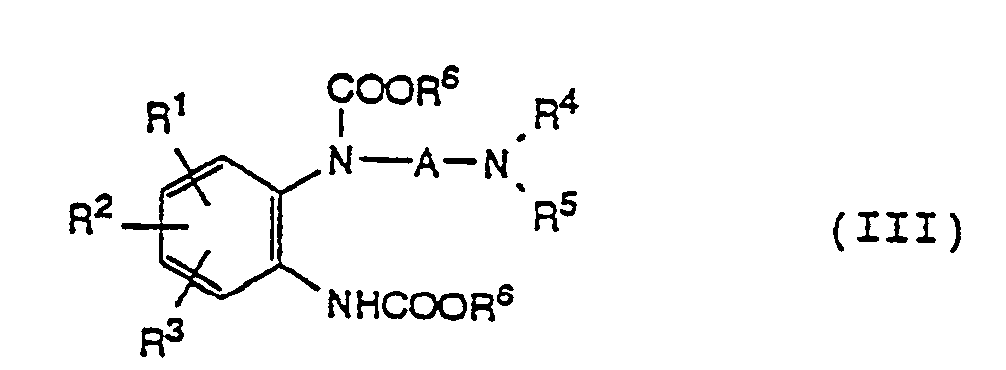
- This intermediate is isolated and then cyclized in the presence of a base such as an alkali metal alkoxide, e.g. sodium ethoxide, in an inert organic solvent such as an alcohol, e.g. methanol, ethanol, isopropyl alcohol, methoxyethanol (methylcellosolve), ethoxyethanol (ethylcellosolve), etc., at room temperature or under warming, preferably at the reflux temperature, to give the compound (I) or the present invention.
- When such a haloformic ester is used in an approximately equimolar amount to the starting compound, the compound (IV) is obtained stably as the intermediate:

- This intermediate (IV) is isolated (and,where necessary, subjected to halogenation etc. of the benzene ring) and again reacted with the carbonylation agent to give compound (III) which, after isolation or without isolation, is heated under reflux in the presence of a base to give the compound (I) of the present invention.
- The process using urea, diphenyl carbonate, N,N'-disuccinimidyl carbonate or N,N'-carbonyldiimidazole as the carbonylalion agent can be performed in the absence of a base in an organic solvent similar to the one mentioned above at room temperature, under warming, or at the reflux temperature, whereby the compound (I) of the present invention is obtained in one step.
- Incidentally, the starting compound (II) can be easily made by reducing the corresponding nitro compound and this corresponding nitro compound can be prepared by reacting the corresponding halide with a substituted ethylenediamine or reacting the corresponding nitroaniline with a substituted aminoethyl halide.
-

- Compound (I) is here synthesized by cyclizing phenylenediamine compound (V) having a primary amino group.
- This reaction is advantageously carried out in the presence of an acid, e.g. hydrochloric acid or sulfuric acid, in an inert organic solvent such as an alcohol, e.g. methanol, ethanol, isopropyl alcohol, methoxyethanol(methylcellsolve), ethoxyethanol(ethylcellosolve), etc., at the reflux temperature.
- Alternatively, as in Process 1, this starting compound (V) is first reacted with a carbonylation agent to give compound (III]) which, after isolation or without isolation, is cyclized into the compound (I) of the present invention.
- The starting compound (V) can be easily made by reacting the corresponding nitro compound with a carbonylation agent and reducing the reaction product.
-

- The halogenation agent useful for this purpose includes, among others, chlorine, bromine, iodine, benzyltrimethylammonium tribromide, phenyltrimethylammonium tribromide, copper (II) halides, e.g. copper (II) chloride etc., dioxane dibromide, pyridinium hydrobromide perbromide, pyrrolidone hydrotribromide and so on.
- This process is advantageously conducted by reacting compound (VI) with a stoichiometric amount, viz. 1 to 3 molar equivalents, or an excess, of the halogenation agent in an inert solvent, e.g. an organic solvent such as dichloromethane, dichloroethane, chloroform, carbon tetrachloride, ether, tetrahydrofuran, dioxane, acetic acid, N,N-dimethylformamide, methanol, ethanol, water, or a mixture thereof, where necessary in the presence of a reagent assisting in halogenation, such as calcium carbonate, zinc chloride or the like, and, in certain instances, with the aid of a catalyst such as an alkali halide or a hydrogen halide, at room temperature or under warming.
-

- In the above formula, the halogen atom X may for example be iodine, bromine or chlorine and the organic sulfonate residue includes alkanesulfonate residues such as methanesulfonyloxy etc. and aromatic sulfonate residues such as benzenesulfonyloxy, toluenesulfonyloxy (particulady p-toluenesulfonyloxy) and so on.
- Compound (I) is here synthesized by reacting compound (VII) with amine of general formula (VIII). This process is advantageously performed by reacting compound (VII) with a stoichiometric amount or an excess of compound (VIII) in an inert solvent, e.g. an organic solvent such as an alcohol [methanol, ethanol, isopropyl alcohol, methoxyethanol (emthylcellosolve), ethoxyethanol (ethylcellosolve), etc., bis(2-methoxyethyl)ether (digrime), benzene, toluene, xylene or the like, preferably in the presence of a base such as trimethylamine, triethylamine, diisopropylethylamine, N,N-dimethylaniline, pyridine, picoline, lutidine, etc. at room temperature, under warming or at the reflux temperature.
-

- In the above reaction formula Y is a halogen atom.
- Compound (I) is here synthesized by reacting 1-(2-propenyl)-substituted benzimidazolinone (IX) with aminoalkyl halide salt (X).
- This process is advantageously performed by reacting compound (IX) with a stoichiometric amount or an excess of compound (X) in an organic solvent such as an alcohol, e.g. methanol, ethanol, isopropyl alcohol, etc., N,N-dimethylformamide, dimethyl sulfoxide, tetrahydrofuran or the like, preferably in the presence of a base such as an alkali metal alkoxide, e.g. sodium methoxide, sodium ethoxide, etc., sodium hydride, potassium hydride, lithium diisopropylamide, etc., at room temperature, under warming or at the reflux temperature. Then, the propenyl group is removed in the presence of hydrochloric acid, sulfuric acid or the like to give the compound (I).
-
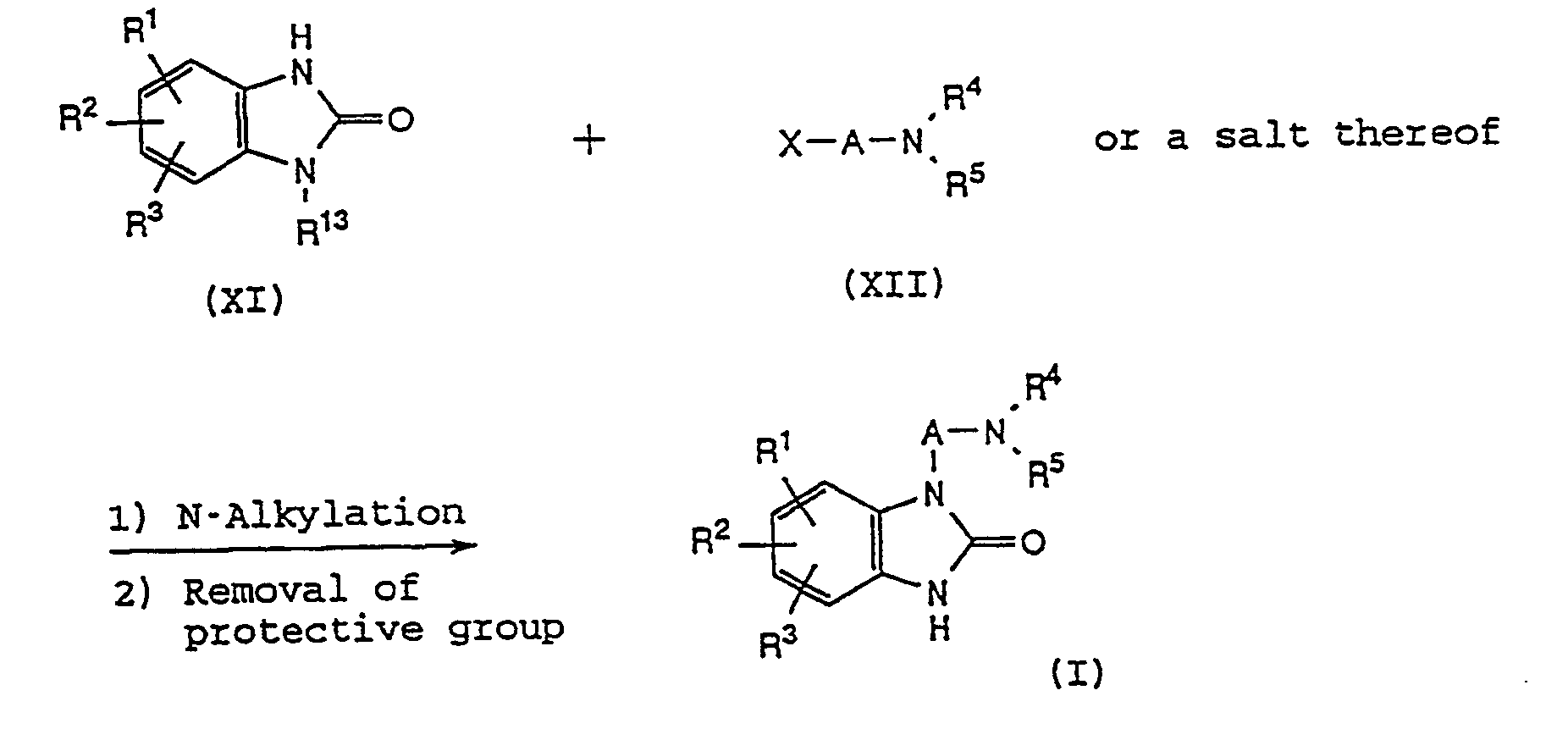
- Compound (I) is here synthesized by reacting protected benzimidazol-2-one derivative (XI) with halide or sulfonate (XII) and removing the protective group.
- This process is advantageously performed by reacting compound (XI) with a stoichiometric amount or an excess of compound (XII) or its salt in an inert solvent such as an organic solvent, e.g. alcohols such as methanol, ethanol, isopropyl alcohol, methoxyethanol (methylcellosolve), ethoxyethanol (ethylcellosolve), etc., bis(2-methoxyethyl)ether (digrime), benzene, toluene, xylene, etc., preferably in the presence of a base such as sodium hydride, potassium hydride, sodium hydroxide, trimethylamine, triethylamine, diisopropylethylamine, N,N-dimethylaniline, pyridine, picoline, lutidine, etc., at room temperature or under warming, preferably at the reflux temperature,and then removing the protective group.
- The method of removal of the protective group depends on the type of protective group. By way of illustration, benzyl type protective groups can be easily eliminated by reduction or oxidation and acyl type and urethane type protective groups can be easily eliminated by hydrolysis under acidic or basic conditions.
-

- In the above reaction formula R14 is a lower alkyl group.
- In this process compound (Ib) having at least one carbamoyl group is synthesized by ammonolysis, namely by treating corresponding lower alkoxycarbonyl-substituted compound (la) with ammonia.
- For this ammonolysis, liquid ammonia is advantageously employed and the reaction can also be carried out in a solvent such as methanol, ethanol or the like. The use of water and glycol which hasten the reaction is advantageous. It is also advantageous, for promoting the reaction, to employ ammonium chloride, sodium methoxide, sodium amide, sodium hydride or butyllithium as a catalyst.
- Though the reaction temperature varies with other conditions, the reaction can generally be conducted with advantage at room temperature or under warming.
-

- In this process compound (Ib) having at least one carbamoyl group is synthesized by hydrolyzing corresponding cyano-substituted compound (Ic).
- This reaction is advantageously conducted in an inert solvent such as methanol, ethanol, isopropyl alcohol, tert-butanol, methoxyethanol (methylcellosolve), ethoxyethanol (ethylcellosolve), water or the like in the presence of a base such as sodium hydroxide or potassium hydroxide at room temperature or under warming; or in a solvent such as tert-butanol or water in the presence of an acid such as hydrochloric acid or sulfuric acid at room temperature or under warming. The reaction can also be conducted advantageously using a base, such as sodium hydroxide, and hydrogen peroxide in a solvent such as alcohols, dichloromethane, chloroform and so on. In this case, the reaction is preferably carried out in the presence of a phase transfer catalyst such as tetrabutylammonium hydrogen sulfate and so on.
-

- Among the formula (le) compounds, compounds having one or more nitro groups can be produced by nitrating the corresponding starting compounds (Id).
- The reaction may be conducted under various conditions, but is preferably conducted by reacting formula (ld) compound with a nitration agent such as a mixed acid of sulfuric acid and fuming nitric acid, a mixed solution of sulfuric acid and nitric acid salt (e.g. potassium nitrate), anhydride of nitric acid and acetic acid, etc., in no solvent or in an organic solvent such as dichloromethane, nitromethane, acetic acid sulfolane, etc., under cooling below 20°C, preferably below 10°C, and then at room temperature after exothermic conditions are over.
-

- In the above reaction formula R14 is as defined before.
- The hydroxymethyl compounds (If) may be produced by using corresponding starting compound (lower alkoxy carbonyl substituted compound (la)) by reducing this starting compound.
- The reduction may be performed in a solvent such as tetrahydrofuran (which does not take part in the reducing reaction) by applying chemical reduction using metal hydride such as lithium aluminum hydride, sodium boron hydride, etc. or sodium metal in liquid ammonia, or by applying catalytic reduction using a catalyst such as rhenium oxide. It is preferred to conduct the reduction in usual manner, and it is preferred that a group susceptible to reduction reaction such as a nitro group is not present - if such group is present, only a lower alkoxycarbonyl group may be reduced selectively, or at the same time, a nitro group may be also reduced.
- The reaction product obtained in any of the above processes is isolated and purified in the free form as such or as a salt The salt can be produced by subjecting the free compound to the usual salt forming reaction.
- The isolation and purification can be carried out by the usual chemical procedures such as extraction, concentration, distillation, crystallization, filtration, recrystallization, chromatography and so on.
- Compositions of this invention have a stimulating effect on the secretion of pulmonary surfactant and are useful in the treatment and prevention of diseases in which pulmonary surfactant is deficient or dysfunctional, for example respiratory diseases such as infant respiratory distress syndrome (IRDS), adult respiratory distress syndrome (ARDS), pulmonary edema, acute or chronic respiratory failure, acute or chronic bronchitis, infections, asthma, etc.
- The stimulating effect of compounds of this invention on the secretion of pulmonary surfactant has been confirmed by the method described below.
- In the experiment, male Hartley guinea pigs weighing 300-350 g were used.
- 50 mg/kg of the test compound was intraperitoneally administered to guinea pigs once. Three hours later, the animals were anesthetized with 100 mg/kg of pentobarbital sodium and sacrificed by bleeding from the abdominal aorta and vena cava. Then, bronchoalveolar lavage with 10 mi/kg of ice-cooled physiological saline was performed twice. The combined bronchoalveolar lavage fluid was centrifuged at 1,000 rpm for 10 minutes at 4°C.
- From the supernatant of bronchoalveolar lavage fluid, the lipid was extracted in accordance with the method of Folch et al. (Journal of Biological Chemistry, 226, 497-502, 1957). The characteristic component of pulmonary surfactant, i.e., disaturated phosphatidylcholine,was extracted by the method of Gilfillan et al. (Journal of Lipid Research, 24,1651-1656,1983). The disaturated phosphatidylcholine was assayed with Nescoat PL Kit-K (Nippon Shoji Co., Ltd.) and the percent increase compared to a control group was determined (M. Takayama, et al.: Clin. Chim. Acta, 79, 93-98, 1977).
- The results are shown in Table 1.

- It is apparent from the above table that the compounds of the present invention potently stimulate pulmonary surfactant secretion and that compound A or B, structurally quite close to the compounds of the invention, do not stimulate secretion of pulmonary surfactant but rather tend to decrease the secretion.
- Pharmaceutical compositions containing one or more of compound (I) and their salts can be manufactured using the carriers, excipients and additives commonly employed in the pharmaceutical field and provided in such dosage forms as tablets, powders, fine granules, granules, capsules, pills, oral liquids (including syrups), injections, drip infusions, inhalants, suppositories, liquids for percutaneous administration, ointments, transdermal therapeutic systems (e.g. buccal preparations), transmucosal therapeutic systems (e.g. nasal liquids) and so on. These preparations are administered orally or parenterally, or via matemal bodies.
- The clinical dosage of compound of the invention depends on the disease, symptom, body weight, age and sex of the patient to be treated, the route of administration and other factors.
- Taking infant respiratory distress syndrome as an example, the preferred intravenous dosage, for instance, is 1 to 500 mg/day for direct administration to neonates and 1 to 5,000 mg, preferably 1 to 2,000 mg, for administration via maternal bodies. In other diseases, the adult daily dose is e.g. 1 to 2,000 mg, preferably 1 to 500 mg,fororal administration, or 1 to 2,000 mg, preferably 1 to 500 mg for parenteral administration, to be administered in a single dose or in 2 to 4 divided doses in either case.
- The following Examples are further illustrative of the invention. It should be noted that production processes for some starting compounds are included in the examples.
- In the examples, "mp" stands for melting point, "Analysis" for elemental analysis, and "NMR" for nuclear magnetic resonance spectrum.
- Unless otherwise noted, the ratios used herein are by volume.
-

- To a solution of 2-fluoronitrobenzene (103.0 g) in 2-propanol (350 ml) was added a solution of N,N-dimethylethylenediamine (128.8 g) in 2-propanol (165 ml) dropwise over a period of 30 minutes. The reaction mixture was heated at 50°C for 4 hours and at 70°C for 3 hours. The reaction mixture was concentrated under reduced pressure and the residue was dissolved in ethyl acetate, washed with water (x 3) and saturated aqueous sodium chloride solution in the order mentioned and dried over anhydrous sodium sulfate. The solution was concentrated under reduced pressure to give 149.2 g of N-(2-nitrophenyl)-N',N'-dimethylethylenediamine. Mass spectrum (m/z): 210 (MW) NMR (CDCI3)
- 8: 2.31 (6H, s), 2.50-2.75 (2H, m), 3.25-3.45 (2H, m), 6.53-6.88 (2H, m), 7.33-7.53 (1H, m), 8.71 (1H, dd, J=1.5 and 8.5 Hz), 8.30 (1 H, br s)

- To a solution of N-(2-nitrophenyl)-N',N'-dimethylethylenediamine (149.2 g) in methanol (1500 ml) were added concentrated hydrochloric acid (60 ml) and 10% palladium-on-carbon (15 g). The reaction mixture was stirred under a hydrogen atmosphere at atmospheric pressure for 5.5 hours. The reaction mixture was then filtered and concentrated under reduced pressure to give 149.2 g of N-(2-aminophenyl)-N',N'-dimethylethylenediamine hydrochloride. Analysis (for C10H18N3Cl)
-


- In 1N aqueous solution of sodium hydroxide (120 ml) was dissolved N-(2-aminophenyl)-N',N'-dimethylethylenediamine hydrochloride (10.0 g) and the free amine was extracted with chloroform (100 ml). The organic layer was dried over anhydrous sodium sulfate and concentrated to half the initial volume. To this solution was added ethyl chloroformate (10.1 g) dropwise, followed by addition of triethylamine (4.5 g). The reaction mixture was stirred at room temperature for 1 hour, was successively washed with 1 N aqueous sodium hydroxide solution and saturated aqueous sodium chloride solution and dried over anhydrous sodium sulfate. The solvent was then distilled off under reduced pressure and the residue was purified by silica gel chromatography (eluent: chloroform:methanol = 50:1) to give 14.6 g of N-(2-ethoxycarbonylaminophenyl)-N-ethoxycarbonyl-N',N'-dimethylethylenediamine. Mass spectrum (m/z): 324 (MH+) NMR (CDCI3)
- 8: 0.90-1.45 (6H, m), 2.00-3.25 (2H, m), 2.27 (6H, s), 3.75-4.70 (6H, m), 6.90-7.45 (3H, m), 7.90-8.05 (1H, m), 10.60 (1 H, br s)
-

- In ethanol (100 ml) was dissolved sodium metal (0.70 g) followed by addition of a solution of N-(2-ethoxycar- bonylaminophenyl)-N-ethoxycarbonyl-N',N'-dimethylethylenediamine (4.88 g) in ethanol (20 ml). The reaction mixture was refluxed for 16 hours and was concentrated under reduced pressure. The residue was diluted with chloroform and the insoluble matter was filtered off. The solvent was then distilled off and the residue was purified by silica gel chromatography (eluent: chloroform:methanol = 10:1) to give 2.69 g of 1,3-dihydro-1-(2-dimethylaminoethyl)-2H-benzimidazol-2-one. mp: 106-107.5°C Mass spectrum (m/z): 205 (M+) NMR (CDCI3)
- 8: 2.32 (6H, s), 2.64 (2H, t, J=7 Hz), 4.00 (2H, t, J=7 Hz), 6.94-7.12 (4H, m), 9.96 (1H, brs)

- To a solution of 1,3-dihydro-1-(2-dimethylaminoethyl)-2H-benzimidazol-2-one (0.63 g) in acetic acid (20 ml) were added zinc chloride (1.33 g) and benzyltrimethylammonium tribromide (2.64 g). The reaction mixture was stirred at 70°C for 24 hours, after which the solvent was distilled off under reduced pressure. To the residue was added a saturated aqueous sodium hydrogen carbonate solution and the product was extracted with ethyl acetate. The organic layer was washed with saturated aqueous sodium chloride solution and dried over anhydrous sodium sulfate. The solvent was distilled off under reduced pressure and the residue was purified by silica gel chromatography (eluent: chloroform:methanol = 15:1) to give 0.31 g of 1,3-dihydro-1-(2-dimethylaminoethyl)-4,5,6-tribromo-2-2H-benzimidazol-2-one (Compound C) and 0.45 g of 5,6-dibromo-1,3-dihydro-1-(2-dimethylaminoethyl)-2H-benzimidazol-2-one (Compound D).
- Mass spectrum (m/z): 440,442,444,446 (MH+) NMR (CDCI3) δ: 2.36 (6H, s), 2.72 (2H, t, J=7 Hz), 3.92 (2H, t, J=7 Hz), 7.16 (1 H, s)
- Mass spectrum (m/z): 362, 364, 366 (MH+)
- NMR (CDCI3)
- δ: 2.29 (6H, s), 2.59 (2H, t, J=7 Hz), 3.89 (2H, t, J=7 Hz), 7.24 (1 H, s), 7.25 (1 H, s), 10.90 (1 H, br s)

- To a solution of 1,3-dihydro-1-(2-dimethylaminoethyl)-4,5,6-tribromo-2H-benzimidazol-2-one (270 mg) in ethanol (5 ml)/ethyl acetate (40 ml) was added 4N hydrogen chloride in dioxane dropwise with stirring. The separated crystals were collected by suction and dried to give 260 mg of 1,3-dihydro-1-(2-dimethylaminoethyl)-4,5,6-tribromo-2H-benzimidazol-2-one hydrochloride. mp: 268-273°C Analysis (for C11H13N3OBr3Cl)
-


-

- In 1 N aqueous sodium hydroxide solution (20 ml) was dissolved N-(2-aminophenyl)-N',N'-dimethylethylenediamine hydrochloride (1.80 g) and the free amine was extracted with chloroform (50 ml). The organic layer was dried over anhydrous sodium sulfate and concentrated to half the initial volume. To this solution was added ethyl chloroformate (0.90 g) dropwise. The reaction mixture was stirred at room temperature for 1 hour, successively washed with 1 N aqueous sodium hydroxide solution and saturated aqueous sodium chloride solution and dried over anhydrous sodium sulfate. The solvent was then distilled off under reduced pressure and the residue was purified by silica gel chromatography (eluent chloroform:methanol = 10:1) to give 0.96 g of N-(2- ethoxycarbonylaminophenyl)-N',N'-dimethylethylenediamine. Mass spectrum (m/z): 252 (MH+) NMR (CDCI3)
- 8: 1.28 (3H, t, J=7 Hz), 2.22 (6H, s), 2.44-2.56 (2H, m), 3.04-3.24 (2H, m), 4.00-4.24 (1 H, m), 4.20 (2H, q, J=7 Hz), 6.64-7.48 (5H, m)
-

- To a solution of N-(2-ethoxycarbonylaminophenyl)-N',N'-dimethylethylenediamine (0.94 g) in methanol (20 ml) and dichloromethane (30 ml) were added calcium carbonate (0.40 g) and benzyltrimethylammonium tribromide (1.46 g). The reaction mixture was stirred at room temperature for 1.5 hours. The insoluble matter was then filtered off and the solvent was distilled off under reduced pressure. The residue was diluted with 1N aqueous sodium hydroxide solution and extracted with ethyl acetate. The organic layer was dried over anhydrous sodium sulfate, the solvent was distilled off, and the residue was dissolved in chloroform (30 ml). To the solution was added ethyl chloroformate (0.53 g) dropwise, and the reaction mixture was stirred at room temperature for 5 hours. The reaction mixture was successively washed with 1 N aqueous sodium hydroxide sol- ution and saturated aqueous sodium chloride solution and dried over anhydrous sodium sulfate. The solvent was distilled off under reduced pressure and the residue was purified by silica gel chromatography (eluent: chloroform:methanol = 50:1) to give 0.95 g of N-(4-bromo-2-ethoxycarbonylaminophenyl)-N-ethoxycarbonyl-N',N'-dimethylethylenediamine. Mass spectrum (m/z): 402, 404 (MH+) NMR (CDCI3)
- δ: 1.01-1.34 (6H, m), 2.27 (6H, s), 2.37-2.57 (2H, m), 2.89-3.11 (1H, m), 3.98-4.65 (6H, m), 6.91 (1 H, d, J=12 Hz), 7.15 (1 H, dd, J=2 and 12 Hz), 8.23 (1H, d, J=2 Hz) (3) The following compound was prepared in generally the same manner as Example 1(4).

- 5-Bromo-1,3-dihydro-1-(2-dimethylaminoethyl)-2H-benzimidazol-2-one
- Starting compound: N-(4-Bromo-2-ethoxycarbonylaminophenyl)-N-ethoxycarbonyl-N',N'-dimethylethylenediamine Mass spectrum (m/z): 284, 286 (MH+) NMR (CDCI3)
- 8: 2.34 (6H, s), 2.65 (2H, t, J=7 Hz), 3.96 (2H, t, J=7 Hz), 6.84 (1 H, d, J=9 Hz), 7.04-7.20 (2H, m), 10.31 (1 H, brs)

- To a solution of 5-bromo-1,3-dihydro-1-(2-dimethylaminoethyl)-2H-benzimidazol-2-one (510 mg) in ethanol (5 ml) and diethyl ether (50 ml) was added 4N hydrogen chloride in dioxane dropwise with stirring.-The separated crystals were collected by suction and dried to give 490 mg of 5-bromo-1,3-dihydro-1-(2-dimethylaminoethyl)-2H-benzimidazol-2-one hydrochloride. mp: 254-261 °C Analysis (for C11H15N3OBrCl)
-

-

- To a solution of N-(2-nitrophenyl-N',N'-dimethylethylenediamine (1.20 g) in chloroform (25 ml) was added ethyl chloroformate (0.64 g) dropwise. The reaction mixture was stirred at room temperature for 5 hours, washed with 1N aqueous sodium hydroxide solution and saturated aqueous sodium chloride solution in turn and dried over anhydrous sodium sulfate. The solvent was then distilled off under reduced pressure and the residue was purified by silica gel chromatography (eluent chloroform:methanol = 10:1) to give 1.10 g of N-(2-nitrophenyl)-N-ethoxycarbonyl-N',N'-dimethylethylened iamine. Mass spectrum (m/z): 282 (MH+) NMR (CDCI3)
- 8:1.08 (3H, t, J=7 Hz), 2.16 (6H, s), 2.52 (2H, t, J=7 Hz), 3.64-4.32 (4H, m), 7.28-7.70 (3H, m), 7.88-8.00 (1 H, m)

- To a solution of N-ethoxycarbonyl-N-(2-nitrophenyl)-N',N'-dimethylethylenediamine (1.08 g) in methanol (25 ml) was added 10% palladium-on-carbon (0.1 g). The mixture was stirred under a hydrogen atmosphere at atmospheric pressure for 30 minutes, and filtered. The solvent was distilled off under reduced pressure to give 0.93 g of N-(2-aminophenyl)-N-ethoxycarbonyl-N',N'-dimethylethylenediamine. Mass spectrum (m/z): 252 (MH+) NMR (CDCI3)
- 8: 1.11-1.31 (3H, m), 2.34 (6H, s), 2.46-2.76 (2H, m), 3.06-3.48 (2H, m), 3.93-4.57 (4H, m), 6.60-7.50 (4H, m) (3) The following compound was prepared in generally the same manner as Example 2(2).

- N-(5-Bromo-2-ethoxycarbonylaminophenyl)-N-ethoxycarbonyl-N',N'-dimethylethylenediamine. Starting compound: N-(2-Aminophenyl)-N-ethoxycarbonyl-N',N'-dimethylethylenediamine Mass spectrum (m/z): 402, 404 (MH+) NMR (CDCI3)
- 8: 1.04-1.10 (3H, m), 1.24-1.32 (3H, m), 2.26 (6H, s), 2.50-2.62 (1H, m), 3.00-3.16 (1H, m), 3.84-4.04 (1H, m), 4.08-4.30 (4H, m), 4.36-4.56 (1H, m), 7.20-7.32 (1H, m), 7.36-7.44 (1H, m), 7.90 (1 H, d, J=10 Hz), 10.70 (1 H, s)
-
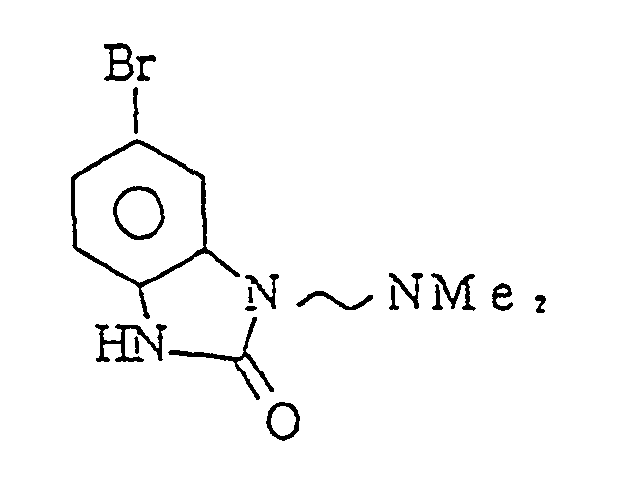
- Starting compound: N-(5-Bromo-2-ethoxycarbonylaminophenyl)-N-ethoxycarbonyl-N',N'-dimethylethylenediamine Mass spectrum (m/z): 284, 286 (MH+) NMR (CDCI3)
- δ: 2.36 (6H, s), 2.66 (2H, t, J=7 Hz), 3.96 (2H, t, J=7 Hz), 6.90 (1 H, d, J=10 Hz), 7.10-7.20 (2H, m), 10.20 (1 H, s)
-


-

- To a solution of N-(2-aminophenyl)-N-ethoxycarbonyl-N',N'-dimethylethylenediamine (1.60 g) in methanol (20 ml) and dichloromethane (30 ml) were added calcium carbonate (1.29 g) and benzyltrimethylammonium tribromide (5.05 g), and the reaction mixture was stirred at room temperature for 24 hours. The insoluble matter was filtered off and the solvent was distilled off under reduced pressure. To the residue were added 5% aqueous sodium hydrogen sulfite and 1N aqueous sodium hydroxide to give an alkaline solution which was extracted with ethyl acetate. The organic layer was washed with saturated aqueous sodium chloride solution and dried over anhydrous sodium sulfate. The solvent was distilled off under reduced pressure and the residue was purified by silica gel chromatography (eluent: chloroform:methanol = 30:1) to give 0.87 g of N-(2-amino-3,5-dibromophenyl)-N-ethoxycarbonyl-N',N'-dimethylethylenediamine. Mass spectrum (m/z): 408, 410, 412 (MH+) NMR (CDCI3)
- 8:1.04-1.40 (3H, m), 2.16 (6H, s), 2.30-2.40 (2H, m), 3.04-3.24 (1 H, m), 4.00-4.40 (3H, m), 5.36 (2H, br s), 7.09 (1 H, d, J=2 Hz), 7.50 (1 H, d, J=2 Hz)

- In ethanol (21 ml) and concentrated hydrochloric acid (7 ml) was dissolved N-(2-amino-3,5-dibromophenyl)-N-ethoxycarbonyl-N',N'-dimethylethylenediamine (0.85 g) and the solution was refluxed for 2 hours. The reaction mixture was concentrated under reduced pressure and the residue was diluted with water. The solution was alkalified with sodium hydroxide and extracted with ethyl acetate. The organic layer was washed with saturated aqueous sodium chloride solution and dried over anhydrous sodium sulfate. The solvent was distilled off under reduced pressure and the residue was purified by silica gel chromatography (eluent: chloroform:methanol = 10:1) to give 0.59 g of 4,6-dibromo-1,3-dihydro-1-(2-dimethylaminoethyl)-2H-benzimi- dazol-2-one. Mass spectrum (m/z): 362, 364, 366 (MH+) NMR (CDCI3)
- δ: 2.38 (6H, s), 2.71 (2H, t, J=7 Hz), 7.05 (1 H, d, J=1.5 Hz), 7.23 (1 H, d, J=1.5 Hz), 10.08 (1 H, br s)
-


-

- A mixed solution of 4-chloro-3-nitrotoluene (1.30 g) and N,N-dimethylethylenediamine (1.34 g) in 1-propanol (20 ml) was refluxed for 24 hours and the solvent was distilled off under reduced pressure. The residue was dissolved in ethyl acetate and the solution was successively washed with water (x 2) and saturated aqueous sodium chloride solution and dried over anhydrous sodium sulfate. The solvent was then distilled off under reduced pressure and the residue was purified by silica gel chromatography (eluent: chloroform:methanol = 30:1) to give 0.19 g of N-(4-methyl-2-nitrophenyl)-N',N'-dimethylethylenediamine. Mass spectrum (m/z): 224 (MH+) NMR (CDCI3)
- 8: 2.26 (3H, s), 2.30 (3H, s), 2.62 (2H, t, J=7 Hz), 3.25-3.44 (2H, m), 6.75 (1 H, d, J=9 Hz), 7.27 (1 H, dd, J=2 and 9 Hz), 7.97 (1H, d, J=2 Hz), 8.17 (1 H, br s)

- A mixture of N-(4-methyl-2-nitrophenyl)-N',N'-dimethylethylenediamine (0.47 g), concentrated hydrochloric acid (0.2 ml) and 10% palladium-on-carbon (0.05 g) in methanol (20 ml) was stirred under a hydrogen atmosphere at atmospheric pressure for 2 hours. The catalyst was filtered off and the filtrate was concentrated under reduced pressure. The residue was dissolved in chloroform (30 ml) followed by dropwise addition of triethylamine (0.66 g) and ethyl chloroformate (0.54 g) in turn. The reaction mixture was stirred at room temperature for 1.5 hours and was successively washed with 1 N aqueous sodium hydroxide solution and saturated aqueous sodium chloride solution and dried over anhydrous sodium sulfate. The solvent was distilled off under reduced pressure and the residue was purified by silica gel chromatography (eluent: chloroform:methanol = 30:1) to give 0.62 g of N-(2-ethoxycarbonylamino-4-methylphenyl)-N-ethoxycarbonyl-N',N'-dimethylethylenediamine. Mass spectrum (m/z): 338 (MH+) NMR (CDCI3)
- 8: 1.00-1.40 (6H, m), 2.26 (6H, s), 2.34 (3H, s), 2.30-2.60 (2H, m), 2.92-3.20 (1 H, m), 3.80-4.60 (5H, m), 6.76-7.00 (2H, m), 7.72-8.00 (1H, m)
-

- Starting compound: N-(2-Ethoxycarbonylamino-4-methyl)-N-ethoxycarbonyl-N',N'-dimethylethylenediamine Mass spectrum (m/z): 220 (MH+) NMR (CDCI3)
- 8: 2.34 (6H, s), 2.36 (3H, s), 2.66 (2H, t,J=7 Hz), 3.99 (2H, t, J=7 Hz), 6.88 (3H s), 9.67 (1H, br s) (4) The following compound was prepared in generally the same manner as Example 2(4).

- 1,3-Dihydro-1-(2-dimethylaminoethyl)-5-methyl-2H-benzimidazol-2-one hydrochloride Starting compound: 1,3-Dihydro-1-(2-dimethylaminoethyl)-5-methyl-2H-benzimidazol-2-one mp: 230-240°C Analysis (for C12H18N3OCl·0.3H2O)

-

- 8: 2.31 (6H, s), 2.65 (2H, t, J=6 Hz), 3.29-3.47 (2H, m), 6.91 (1 H, d, J=11 Hz), 7.61 (1 H, dd, J=2 and 11 Hz), 8.46 (1H, d, J=2 Hz), 8.61 (1H, br s)
-

- 8:1.04-1.40 (3H, m), 2.26 (6H, s), 2.16-2.44 (2H, m), 3.04-3.36 (1H, m), 4.00-4.44 (3H, m), 4.90 (2H, br s), 6.84-7.10 (3H, m)
-
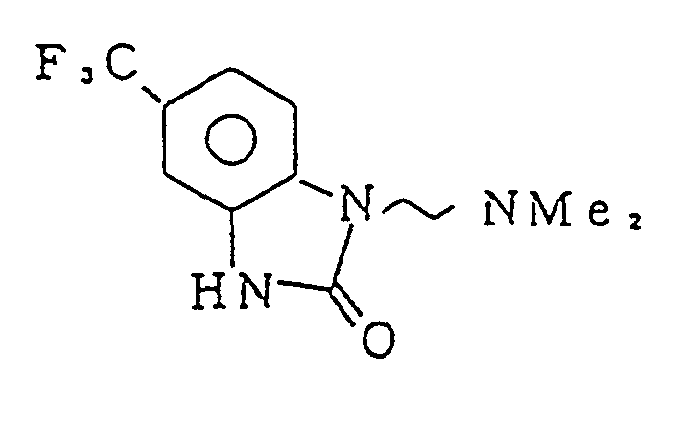
- Starting compound: N-(2-Amino-4-trifluoromethylphenyl)-N-ethoxycarbonyl-N',N'-dimethylethylenediamine Mass spectrum (m/z): 274 (MH+) NMR (CDCl3)
- 8: 2.34 (6H, s), 2.68 (2H, t, J=7 Hz), 4.01 (2H, t, J=7 Hz), 7.00-7.40 (3H, m), 10.76 (1 H, br s)
-
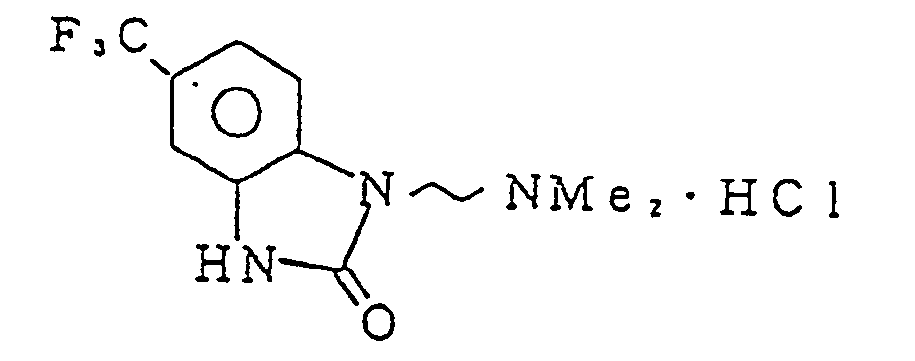

-

- 8: 2.30 (6H, s), 2.62 (2H, t, J=6 Hz), 3.25-3.45 (2H, m), 3.79 (3H, s), 6.81 (IH, d, J=11 Hz), 7.15 (1 H, dd, J=2, 11 Hz), 7.62 (1 H, d, J=2 Hz), 8.21 (1 H, br s)
-


- N-(2-Ethoxycarbonylamino-4-methoxyphenyl)-N-ethoxycarbonyl-N',N'-dimethylethylenediamine Starting compound: N-(4-Methoxy-2-nitrophenyl)-N',N'-dimethylethylenediamine Mass spectrum (m/z): 354 (MH+) NMR (CDCI3)
- δ: 1.08 (3H, t, J=7 Hz), 1.28 (3H, t, J=7 Hz), 2.28 (6H, s), 2.20-2.40 (1 H, m), 2.46-2.60 (1H, m), 2.96-3.10 (1H, m), 3.84 (3H, s), 3.86-4.04 (1 H, m), 4.08-4.28 (3H, m), 4.36-4.52 (1 H, m), 6.58 (1H, dd, J=2 and 10 Hz), 6.96 (1H, d, J=10 Hz), 7.66 (1 H, br s), 10.70 (1 H, br s)
-

- Starting compound: N-(2-Ethoxycarbonylamino-4-methoxyphenyl)-N-ethoxycarbonyl-N',N'-dimethylethylenediamine Mass spectrum (m/z): 236 (MH+) NMR (CDCI3)
- 8: 2.32 (6H, s), 2.64 (2H, t, J=7 Hz), 3.76 (3H, s), 3.96 (2H, t,.J=7 Hz), 6.52-6.96 (3H, m), 10.60 (1 H, br s)
-


- To a solution of 1,3-dihydro-1-(2-dimethylaminoethyl)-5-methoxy-2H-benzimidazol-2-one (0.28 g) in methanol (10 ml) and dichloromethane (15 ml) were added calcium carbonate (0.25 g) and benzyltrimethylammonium tribromide (0.49). The reaction mixture was stirred at room temperature for 16 hours and the insoluble matter was filtered off. The solvent was then distilled off under reduced pressure and the residue was diluted with 1N aqueous sodium hydroxide solution and extracted with ethyl acetate. The organic layer was washed with saturated aqueous sodium chloride solution and dried over anhydrous sodium sulfate. The solvent was then distilled off under reduced pressure and the residue was purified by silica gel chromatography (eluent: chloroform:methanol = 10:1) to give 0.35 g of 6-bromo-1,3-dihydro-1-(2-dimethylaminoethyl)-5-metoxy-2H-benzimidazol-2-one. Mass spectrum (m/z): 314 (MH+) NMR (CDCI3)
- 8: 2.35 (6H, s), 2.67 (2H, t, J=7 Hz), 3.86 (3H, s), 3.95 (2H, t, J=7 Hz), 6.67 (1 H, s), 7.17 (1 H, s), 10.89 (1H, br s)
-


-

- A solution of 3-methoxyaniline (2.21 g) in acetic acid (3 ml) and acetic anhydride (10 ml) was stirred at room temperature for 1 hour. The solution was cooled to 5°C and 60% nitric acid (1 ml) was added dropwise with stirring. The cooling bath was removed, whereupon the solution temperature rose to 60°C. The solution was allowed to cool down to room temperature, poured into ice-water (100 ml) and neutralized with sodium hydroxide. The separated crystals were collected by suction and washed with water. To the crystals was added 4N hydrochloric acid (45 ml) and the mixture was refluxed for 2 hours. The reaction mixture was alkalified with sodium hydroxide and extracted with ethyl acetate. The organic layer was washed with saturated aqueous sodium chloride solution and dried over anhydrous magnesium sulfate. The solvent was distilled off under reduced pressure and the residue was purified by silica gel chromatography (eluent: chloroform) to give 0.67 g of 5-methoxy-2-nitroaniline. Mass spectrum (m/z): 168 (M+) NMR (CDCI3)
- 8: 3.90 (3H, s), 4.32 (2H, br s), 6.12-6.28 (2H, m), 7.94 (1H, d, J=10 Hz)
-

- δ: 2.31 (6H, s), 2.64 (2H, t, J=6Hz), 3.23-3.43 (2H, m), 3.86 (3H, s), 6.13-6.29 (2H, m), 8.10 (1 H, d, J=11 Hz), 8.51 (1 H, br s)
-

- 8: 0.96-1.40 (6H, m), 2.24 (6H, s), 2.10-2.72 (2H, m), 2.88-3.24 (1 H, m), 3.76 (3H, s), 3.80-4.60 (5H, m), 6.60 (1 H, d, J=3 Hz), 6.82 (1 H, dd, J=3 and 10 Hz), 7.80 (1H, d, J=10 Hz), 10.37 (1 H, br s)
-

- Starting compound: N-(2-Ethoxycarbonylamino-5-methoxyphenyl)-N-ethoxycarbonyl-N',N'-dimethylethylenediamine Mass spectrum (m/z): 236 (MH+) NMR (CDCI3)
- δ: 2.34 (6H, s), 2.65 (2H, t, J=7 Hz), 3.82 (3H, s), 3.97 (2H, t, J=7 Hz), 6.54-6.67 (2H, m), 6.95 (1H, d, J=9 Hz), 9.01 (1H, brs)
-


-

- 8: 3.86 (3H, s), 3.91 (3H, s), 6.17 (1H, s), 6.10-6.40 (2H, m), 7.53 (1H, s)

- To a solution of 4,5-dimethoxy-2-nitroaniline (0.81 g) and 2-chloroethyldimethylamine hydrochloride (0.73 g) in N,N-dimethylformamide (20 ml) was added sodium hydride (0.36 g) in small portions with ice-cooling and the reaction mixture was heated at 60°C for 2 hours. The reaction mixture was diluted with 1 N aqueous sodium hydroxide solution and extracted with ethyl acetate. The organic layer was successively washed with water and saturated aqueous sodium chloride solution and dried over anhydrous sodium sulfate. The solvent was then distilled off under reduced pressure and the residue was purified by silica gel chromatography (eluent: chloroform:methanol = 15:1) to give 0.77 g of N-(4,5-dimethoxy-2-nitrophenyl)-N',N'-dimethylethylenediamine. Mass spectrum (m/z): 270 (MH+) NMR (CDCI3)
- 8: 2.32 (6H, s), 2.65 (2H, t, J=6 Hz), 3.28-3.47 (2H, m), 3.86 (3H, s), 3.96 (3H, s), 6.18 (1H, s), 7.61 (1 H, s), 8.69 (1H, br s)
-

- 8:1.00-1.40 (6H, m), 2.24 (6H, s), 2.20-2.70 (2H, m), 2.92-3.10 (1 H, m), 3.80 (3H, s), 3.88 (3H, s), 3.70-4.60 (5H, m), 6.52 (1 H, s), 7.60 (1 H, br s), 10.53 (1 H, br s)
-

- Starting compound: N-(4,5-Dimethoxy-2-ethoxycarbonylaminophenyl)-N-ethoxycarbonyl-N',N'-dimethylethylenediamine Mass spectrum (m/z): 266 (MH+) NMR (CDCI3)
- δ: 2.36 (6H, s), 2.68 (2H, t, J=8 Hz), 3.88 (3H, s), 3.92 (3H, s), 4.00 (2H, t, J=8 Hz), 6.72 (1H, s), 6.80 (1 H, s), 10.50 (1 H, br s)
-


-

- 8: 6.20 (2H, br s), 6.32-6.55 (2H, m), 8.08-8.25 (1 H, m)
-

- 8: 2.31 (6H, s), 2.63 (2H, t, J=6 Hz), 3.20-3.39 (2H, m), 6.24-6.60 (2H, m), 8.02-8.30 (1 H, m), 8.50 (1 H, br s)

- To a solution of N-(5-fluoro-2-nitrophenyl)-N',N'-dimethylethylenediamine (0.55 g) in methanol (20 ml) were added concentrated hydrochloric acid (0.2 ml) and platinum oxide (0.06 g) and the reaction mixture was stirred under a hydrogen atmosphere at atmospheric pressure for 30 minutes. The reaction mixture was then filtered and the solvent was distilled off under reduced pressure. To the residue was added chloroform (25 ml) followed by dropwise addition of triethylamine (0.97 g) and ethyl chloroforrnate (0.60 g) in turn. After being stirred at room temperature for 2 hours, the reaction mixture was successively washed with 1 N aqueous sodium hydroxide solution and saturated aqueous sodium chloride solution and dried over anhydrous sodium sulfate. The solvent was then distilled off under reduced pressure and the residue was purified by silica gel chromatography (eluent: chloroform:methanol = 30:1) to give 0.34 g of N-(2-ethoxycarbonylamino-5-fluorophenyl)-N-ethoxycarbonyl-N',N'-dimethylethylenediamine. Mass spectrum (m/z): 342 (MH+) NMR (CDCI3) .
- δ: 1.01-1.40 (6H, m), 2.27 (6H, s), 2.10-2.57 (2H, m), 2.90-3.30 (1H, m), 3.90-4.60 (5H, m), 6.74-7.12 (2H, m), 7.85-8.05 (1 H, m), 10.59 (1H, br s)
-

- Starting compound: N-(2-Ethoxycarbonylamino-5-fluorophenyl)-N-ethoxycarbonyl-N',N'-dimethylethylenediamine Mass spectrum (m/z): 224 (MH+) NMR (CDCI3)
- δ: 2.36 (6H, s), 2.66 (2H, t, J=7 Hz), 3.98 (2H, t, J=7 Hz), 6.72=6.84 (2H, m), 6.92-6.98 (1H, m), 9.42 (1 H, br s)
-

- mp: 232-240°C Analysis (for C11H15N3OFCl·0.25H2O)
-

-

- 8: 2.30 (6H, s), 2.63 (2H, t, J=6 Hz), 3.22-3.40 (2H, m), 6.59 (1 H, dd, J=2 and 9 Hz), 6.82 (1 H, d, J=2 Hz), 8.11 (1 H, d, J=9 Hz), 8.38 (1 H, br s)

- To a solution of N-(5-chloro-2-nitrophenyl)-N',N'-dimethylethylenediamine (1.02 g) in ethyl acetate (10 ml) was added Raney nickel and the reaction mixture was stirred under a hydrogen atmosphere at atmospheric pressure at 5°C for 1 hour. The reaction mixture was then filtered and the solvent was distilled off under reduced pressure. The residue was dissolved in dichloromethane (15 ml), followed by dropwise addition of triethylamine (1.28 g) and ethyl chloroformate (1.14 g) in turn at 5°C with stirring. The reaction mixture was further stirred at room temperature for 1 hour and diluted with water (10 ml). The organic layer was washed with saturated aqueous sodium chloride solution and dried over anhydrous sodium sulfate. The solvent was distilled off under reduced pressure and the residue was purified by silica gel chromatography (eluent: chloroform:methanol = 50:1) to give 1.05 g of N-(5-chloro-2-ethoxycarbonylaminophenyl)-N-ethoxycarbonyl-N',N'-dimethylethylenediamine. Mass spectrum (m/z): 358 (MH+) NMR (CDCI3)
- 8: 1.00-1.40 (6H, m), 2.26 (6H, s), 2.12-2.70 (2H, m), 2.88-3.24 (1H, m), 3.80-4.60 (5H, m), 7.03 (1H, d, J=2 Hz), 7.22 (1 H, dd, J=2 and 9 Hz), 7.94 (1 H, d, J=9 Hz), 10.71 (1H, brs)
-

- Starting compound: N-(5-Chloro-2-ethoxycarbonylaminoethyl)-N-ethoxycarbonyl-N',N'-dimethylethylenediamine Mass spectrum (m/z): 240 (MH+) NMR (CDCI3)
- 8: 2.34 (6H, s), 2.66 (2H, t, J=7 Hz), 3.96 (2H, t, J=7 Hz), 6.92-7.04 (3H, m), 10.31 (1 H, br s)
-


-

- To a solution of 2-bromonitrobenzene (10.23 g) in 1-propanol (100 ml) was added N,N-dimethylethylenediamine (13.41 g) and the mixture was refluxed for 3 days. The solvent was then distilled off under reduced pressure and the residue was purified by silica gel chromatography (eluent: chloroform:methanol = 50:1) to give 9.72 g of N-(2-nitrophenyl)-N',N'-dimethylethylenediamine. Mass spectrum (m/z): 210 (MH+)
- NMR (CDCI3)
- 8: 2.31 (6H, s), 2.50-2.75 (2H, m), 3.25-3.45 (2H, m), 6.53-6.88 (2H, m), 7.33-7.53 (1H, m), 8.71 (1 H, dd, J=1.5 and 8.5 Hz), 8.30 (1 H, br s)

- To a solution of N-(2-nitrophenyl)-N',N'-dimethylethylenediamine (9.70 g) in methanol (50 ml) were added concentrated hydrochloric acid (8 ml) and 10% palladium-on-carbon (0.97 g) and the mixture was stirred under a hydiogen atmosphere at atmospheric pressure for 3.5 hours. The catalyst was filtered off and the filtrate was distilled off under reduced pressure to give 11.70 g of N-(2-aminophenyl)-N',N'-dimethylethylenediamine dihydrochloride Mass spectrum (m/z): 180 (MH+-2 HCI) NMR (DMSO-d6)
- δ: 2.80 (6H, s), 3.10-3.70 (4H, m), 6.65-7.40 (4H, m), 9.30-11.00 (3H, m)

- In 1 N sodium hydroxide solution (120 ml) was dissolved N-(2-aminophenyl)-N',N'-dimethylethylenediamine dihydrochloride (11.70 g) and the free amine was extracted with 100 ml of chloroform. The organic layer was dried over anhydrous sodium sulfate and concentrated to half the initial volume. To the solution was added ethyl chloroformate (10.13 g) dropwise, followed by addition of triethylamine (4.50 g). The reaction mixture was stirred at room temperature for 1 hour, after which it was successively washed with 1 N aqueous sodium hydroxide solution and saturated sodium chloride solution and dried over anhydrous sodium sulfate. The solvent was then distilled off under reduced pressure and the residue was purified by silica gel chromatography (eluent: chloroform:methanol = 50:1) to give 14.59 g of N-(2-ethoxycarbonylaminophenyl)-N-ethoxycarbonyl-N',N'-dimethylethylenediamine. Mass spectrum (m/z): 324 (MH+) NMR (CDCI3)
- 8: 0.90-1.45 (6H, m), 2.00-3.25 (2H, m), 2.27 (6H, s), 3.75-4.70 (6H, m), 6.90-7.45 (3H, m), 7.90-8.05 (1 H, m), 10.60 (1 H, br s)
-

- In ethanol (100 ml) was dissolved sodium metal (0.70 g) followed by addition of a solution of N-(2-ethoxycar bonylaminophenyl)-N-ethoxycarbonyl-N',N'-dimethylethylenediamine (4.88 g) in ethanol (20 ml). The mixture was refluxed overnight and the solvent was then distilled off under reduced pressure. To the residue was added chloroform and the insoluble matter was filtered off. The solvent was distilled off and the residue was purified by silica gel chromatography (eluent: chloroform:methanol = 10:1) to give 2.69 g of 1,3-dihydro-1-(2-dimethylaminoethyl)-2H-benzimidazol-2-one. Mass spectrum (m/z): 205 (M+) NMR (CDCI3)
- 8: 2.32 (6H, s), 2.64 (2H, t, J=7 Hz), 4.00 (2H, t, J=7 Hz), 6.94-7.12 (4H, m), 9.96 (1 H, br s)

- To a solution of 1,3-dihydro-1-(2-dimethylaminoethyl)-2H-benzimidazol-2-one (1.32 g) in ether (40 ml) was added 4N hydrogen chloride in dioxane dropwise with stirring. The separated crystals were collected by suction and dried to give 930 mg of 1,3-dihydro-1-(2-dimethylaminoethyl)-2H-benzimidazol-2-one hydrochloride mp: 206-215°C Analysis (for C11H16N3OCl)

-

- δ: 1.70-2.14 (4H, m), 2.50-3.00 (6H, m), 4.06 (2H, t, J=7 Hz), 6.85-7.15 (4H, m), 9.97 (1H, br s)

- 1,3-Dihydro-1-[2-(1-pyrrolidinyl)ethyl]-2H-benzimidazol-2-one hydrochloride was prepared in generally the same manner as Example 12(5). mp: 188-191°C Analysis (for C13H18N3OCl·0.7H2O)

-

- 1,3-Dihydro-1-(2-morpholinoethyl)-2H-benzimidazol-2-one was prepared in generally the same manner as Examples 12(3) and 12(4). Mass spectrum (m/z): 248 (MH+) NMR (CDCI3)
- 8: 2.44-2.80 (6H, m), 3.52-3.76 (4H, m), 4.00 (2H, t, J=7 Hz), 6.90-7.12 (4H, m), 10.03 (1 H, br s)

- 1,3-Dihydro-1-(2-morpholinoethyl)-2H-benzimidazol-2-one hydrochloride was prepared in generally the same manner as Example 12(5). mp: 208-220°C(decompn.) Analysis (for C13H18N3O2Cl·0.2H2O)

-

- Starting compounds: 5-Chloro-2-nitroaniline and 2-dimethylaminoisopropyl chloride hydrochloride Mass spectrum (m/z): 257 (M+) NMR (CDCI3)
- 8: 1.10 (3H, d, J=5 Hz), 2.25 (6H, s), 2.80-3.30 (3H, m), 6.68 (1H, dd, J=2 and 12 Hz), 6.78 (1H, d, J=2 Hz), 8.10 (1 H, d, J=12 Hz), 8.56 (1 H, br s)
-

- 8: 0.75-0.95 (3H, m), 1.00-1.40 (6H, m), 2.10-2.40 (6H, m), 2.40-3.35 (2H,; m), 3.75-4.65 (5H, m), 7.00-7.40 (2H, m), 7.92 (1H, d, J=9 Hz), 10.70-11.00 (1 H, m)
-

- 6:1.10 (3H, d, J=7 Hz), 2.36 (6H, s), 3.08-3.21 (1H, m), 3.85 (2H, ABX, J=8, 16 and 16 Hz), 6.88-7.10 (3H, m), 9.80 (1 H, s)
-


-

- 8: 6.21 (1 H, br s), 6.92 (1 H, dd, J=2 and 12 Hz), 7.09 (1H, br s), 7.50-7.80 (1 H, m), 8.24 (1 H, d, J=12 Hz)
-

- δ: 2.32 (6H, s), 2.65 (2H, t, J=6 Hz), 3.27-3.46 (2H, m), 6.78-7.09 (2H, m), 8.22-8.50 (2H, m)

- In ethyl acetate (20 ml) was dissolved N,N-dimethyl-N'-(2-nitro-5-trifluoromethylphenyl)ethylenediamine (0.24 g) followed by addition of a catalytic amount of 10% palladium-on-carbon, and the mixture was stirred under a hydrogen atmosphere at atmospheric pressure and room temperature until the absorption of hydrogen ceased (for about 1 hour). The insoluble matter was filtered off and the solvent was distilled off under reduced pressure. The residue was dissolved in N,N-dimethylformamide (2 ml) followed by addition of N,N'-disuccini- midyl carbonate (DSC) (0.23 g). The reaction mixture was stirred at room temperature overnight, after which it was diluted with 1N hydrochloric acid and washed with ethyl acetate. The aqueous layer was alkalified with sodium hydroxide and the product was extracted with ethyl acetate. The organic layer was washed with saturated aqueous sodium chloride solution and dried over anhydrous sodium sulfate. The solvent was then distilled off under reduced pressure and the residue was purified by column chromatography (eluent: chloroform:methanol = 5:1) to give 0.11 g of 1,3-dihydro-1-(2-dimethylaminoethyl)-6-trifluoromethyl-2H-ben- zimidazol-2-one. Mass spectrum (m/z): 274 (MH+) NMR (CDCI3)
- 8: 2.35 (6H, s), 2.69 (2H, t, J=9 Hz), 4.03 (2H, t, J=9 Hz), 6.97-7.34 (3H, m), 9.58 (1 H, br s)
-

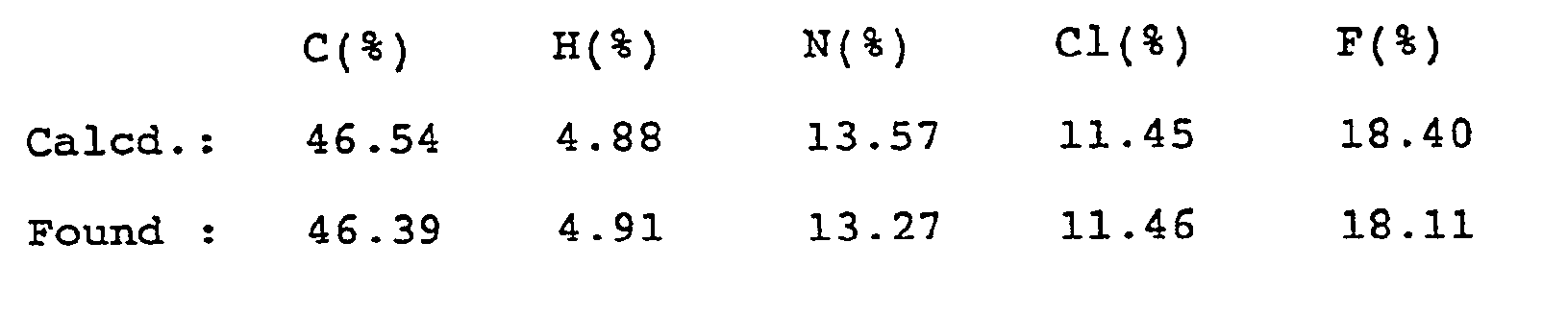
-

- Starting compounds: 2-Nitro-5-methylaniline and 2-chloroethyldimethylamine hydrochloride Mass spectrum (m/z): 224 (MH+) NMR (CDCI3)
- δ: 2.30 (3H, s), 2.34 (3H, s), 2.50-2.69 (2H, m), 3.25-3.44 (2H, m), 6.44 (1 H, dd, J=1.5 and 9 Hz), 6.60 (1 H, d, J=1.5 Hz), 8.06 (1 H, d, J=9 Hz), 8.33 (1 H, br s)
-

- δ: 1.00-1.35 (6H, m), 2.26 (6H, s), 2.29-2.52 (2H, m), 2.90-3.16 (1H, m), 3.80-4.60 (5H, m), 6.88 (1 H, d, J=1 Hz), 7.08 (1 H, dd, J=1 and 8 Hz), 7.82 (1 H, d, J=8 Hz), 10.45 (1H, brs)
-

- δ: 2.34(6H, s), 2.38 (3H, s), 2.64 (2H, t, J=7 Hz), 3.97 (2H, t, J=7 Hz), 6.80-7.00 (3H, m), 9.56 (1 H, br s)
-
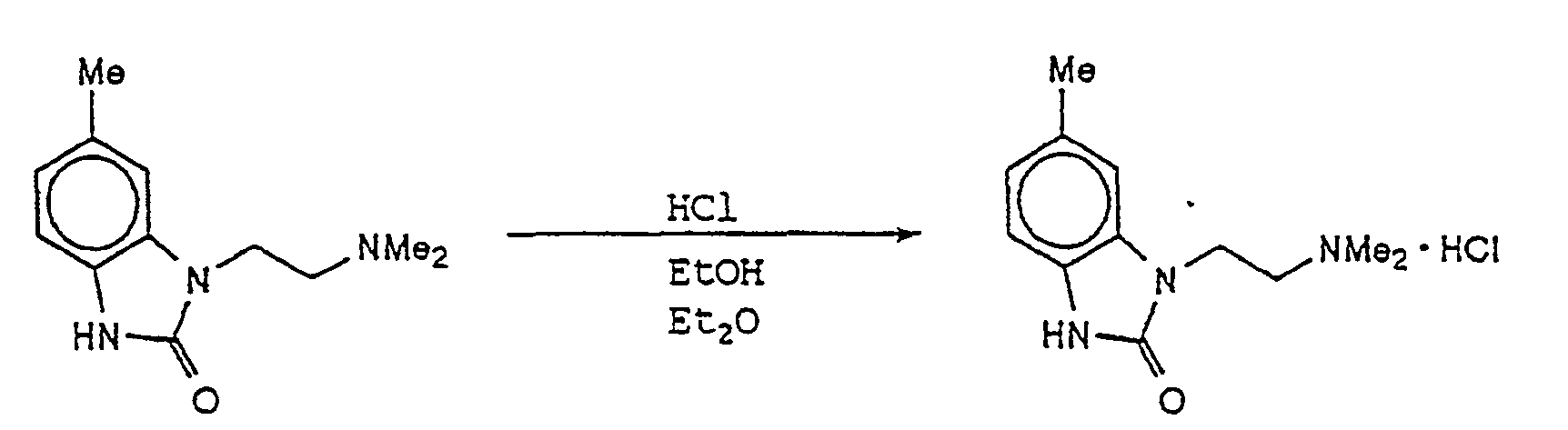

-

- 8: 1.30-1.70 (6H, m), 2.35-2.6 (4H, m), 2.65 (2H, t, J=6 Hz), 3.31 (2H, q, J=6 Hz), 6.57 (1H, dd, J=2, 9 Hz), 6.82 (1 H, d, J=2 Hz), 8.11 (1 H, d, J=9 Hz), 8.6 (1 H, br)
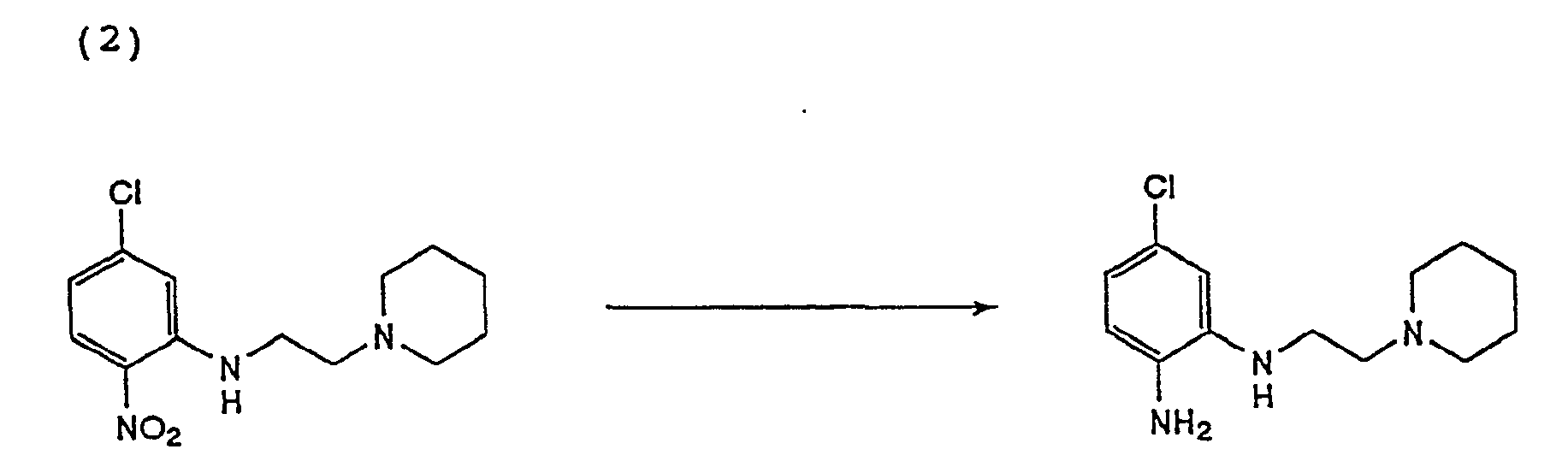
- In ethyl acetate (120 ml) was dissolved 1-[2-(2-amino-5-chlorophenylamino)ethyl]piperidine (2.73 g) followed by addition of Raney nickel (0.5 g), washed in advance with ethyl acetate, and ethanol (0.5 ml). The mixture was stirred under a hydrogen atmosphere at atmospheric pressure until 650 ml of hydrogen had been taken up. The insoluble matter was then filtered off and the solvent was distilled off under reduced pressure to give 2.43 g of 1-[2-(2-amino-5-chlorophenylamino)ethyl]piperidine as a semisolid. Mass spectrum (m/z): 253, 255 (M+) NMR (CDCI3)
- 8: 1.30-1.70 (6H, m), 2.30-2.50 (4H, m), 2.59 (2H, t, J=6 Hz), 3.10 (2H, q, J=6 Hz), 3.34 (2H, br s), 4.14 (1 H, br s), 6.58 (3H, br s)
-

- To a solution of 1-[2-(2-amino-5-chlorophenylamino)ethyl]piperidine (2.41 g) in N,N-dimethylformamide (20 ml) was added N,N'-disuccinimidyl carbonate (2.68 g) over a period of 15 minutes. The mixture was stirred at room temperature overnight and diluted with 5% hydrochloric acid (150 ml). The aqueous solution was washed with ethyl acetate, alkalified with 10% aqueous sodium hydroxide solution and extracted with ethyl acetate. The organic layer was successively washed with water (x 3) and saturated sodium chloride solution and dried over anhydrous sodium sulfate. The solvent was distilled off under reduced pressure to give a crude crystalline product (2.50 g). Recrystallization from ethyl acetate (28 ml) gave 2.12 g of 6-chloro-1,3-dihydro-1-(2-piperidinoethyl)-2H-benzimidazol-2-one as colorless crystals. mp: 156-158.5°C Analysis (for C14H18N3OCl)
-


- To a solution of 6-chloro-1,3-dihydro-1-(2-piperidinoethyl)-2H-benzimidazol-2-one in ethanol (30 ml) was added concentrated hydrochloric acid (330 ul) and the mixture was allowed to stand for 4 hours. The separated crystals were collected by suction and dried at 60°C under reduced pressure to give 1.05 g of 6-chloro-1,3-dihydro-1-(2-piperidinoethyl)-2H-benzimidazol-2-one hydrochloride. mp: 278-282°C Analysis (for C114H19N3OCl2)
-
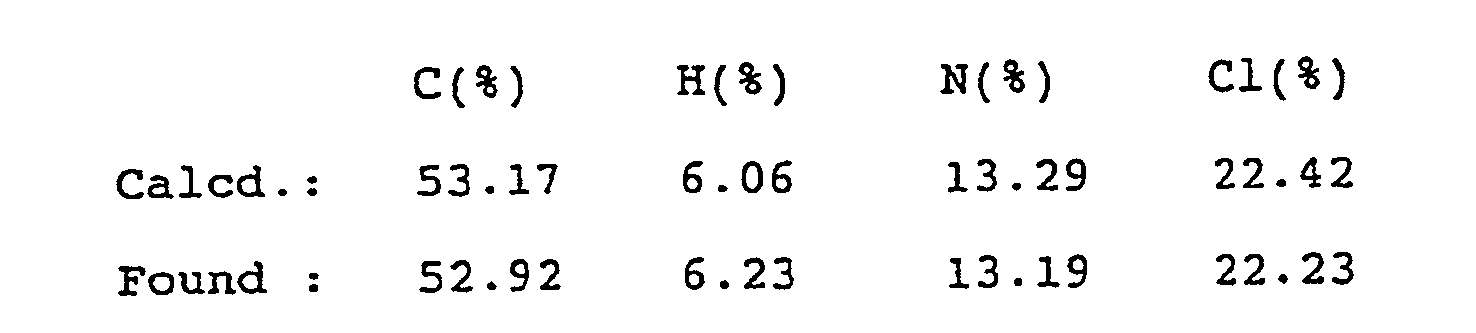
-

- 8: 1.70-1.90 (4H, m), 2.45-2.70 (4H, m), 2.82 (2H, t, J=6 Hz), 3.36 (2H, q, J=6 Hz), 6.58 (1H, dd, J=2 and 9 Hz), 6.83 (1 H, d, J=2 Hz), 8.11 (1 H, d, J=9 Hz), 8.43 (1 H, br s)
-

- δ: 1.60-2.00 (4H, m), 2.40-2.60 (4H, m), 2.60-2.80 (2H, m), 3.05-3.25 (2H, m), 3.35 (2H, br s), 4.05 (1 H, br), 6.60 (3H, br s)
-

-

-
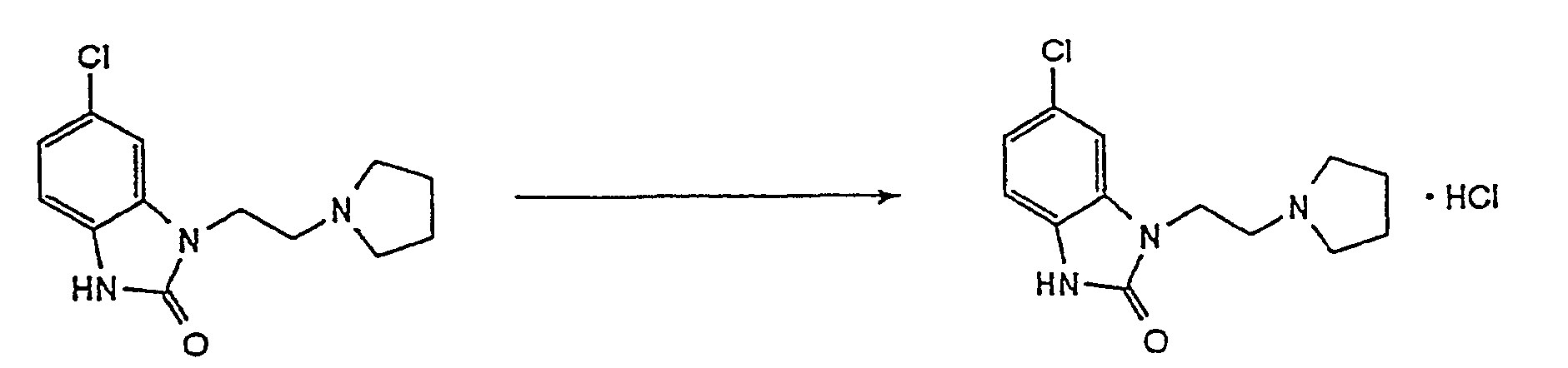
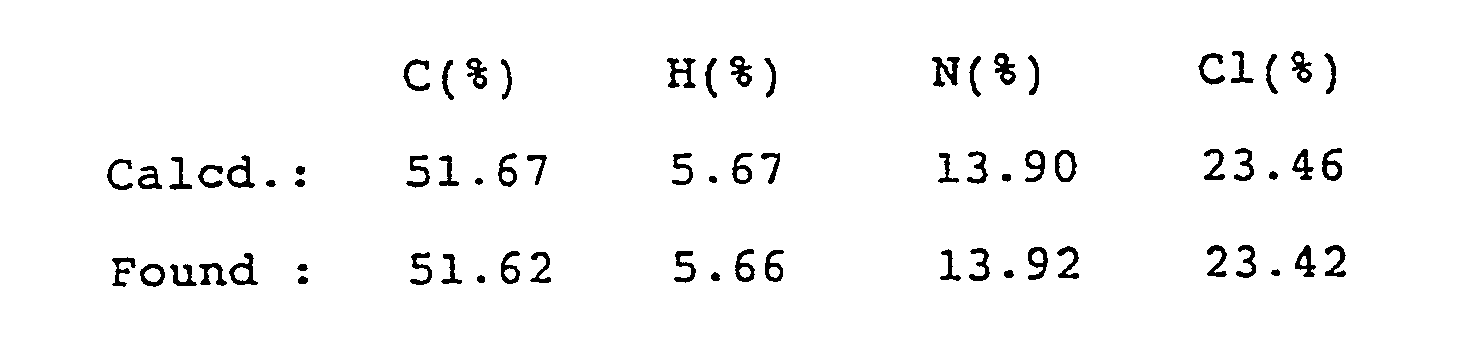
-

- Starting compounds: 4-Chloro-2-fluoronitrobenzene and 1-(2-aminoethyl)morpholine mp: 125.5-126°C Mass spectrum (m/z): 285, 287 (M+)
- NMR (CDCI3)
- δ: 2.45-2.55 (4H, m), 2.75-2.90 (2H, m), 3.24-3.40 (2H, m), 3.70-3.80 (4H, m), 6.59 (1 H, dd, J=2, 9 Hz), 6.81 (1 H, d, J=2 Hz), 8.12 (1 H, d, J=9 Hz), 8.56 (1 H, br s)
-

- Starting compound: 1-[2-(5-Chloro-2-nitrophenylamino)ethyl]morpholine Mass spectrum (m/z): 255, 257 (M+) NMR (CDCI3)
- 8: 2.40-2.55 (4H, m), 2.55-2.70 (2H, m), 3.05-3.20 (2H, m), 3.25 (2H, br s), 3.60-3.80 (4H, m), 4.10 (1 H, br s), 6.59 (3H,br s)
-

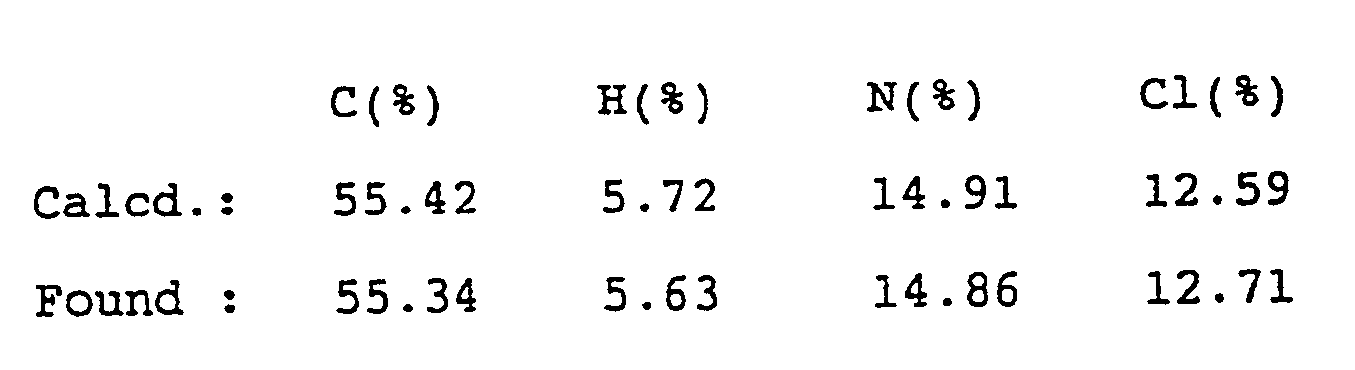
-

- 6-Chloro-1,3-dihydro-1-(2-morpholinoethyl)-2H-benzimidazol-2-one hydrochloride Starting compound: 6-Chloro-1,3-dihydro-1-(2-morpholinoethyl)-2H-benzimidazol-2-one mp: 252-256°C Analysis (for C13H17N3O2Cl2)
-

-

- To 4-aminobenzonitrile (7.26 g) was added acetic anhydride (20 ml) and the mixture was stirred at room temperature for 30 minutes. The reaction mixture was diluted with water and the separated crystals were collected by suction, washed with water and dried under reduced pressure to give 9.40 g of 4-acetamidobenzonitrile. Mass spectrum (m/z): 160 (M+) NMR (CDCI3)
- 8:1.89 (2H, br s), 2.22 (3H, s), 7.40-7.70 (4H, m)

- To a solution of 4-acetamidobenzonitrile (9.40 g) in concentrated sulfuric acid (80 ml) was added potassium nitrate in small portions at a temperature not exceeding 10°C. The reaction mixture was stirred at 5-10°C for 2 hours and poured into ice-water and the separated crystals were collected by suction. To the crystals was added 4N hydrochloric acid (100 ml) and the mixture was refluxed for 2 hours. After cooling to room temperature, the crystals were recovered by filtration, washed with water and dried under reduced pressure to give 7.22 g of 4-amino-3-nitrobenzonitrile. Mass spectrum (m/z): 163 (M+) NMR (DMSO-d6)
- 8: 7.00-7.14 (1 H, m), 7.60-8.10 (3H, m), 8.40-8.60 (1H, m)
-

- 8: 2.31 (6H, s), 2.65 (2H, t, J=6 Hz), 3.28-3.46 (2H, m), 6.87 (1 H, d, J=9 Hz), 7.60 (1 H, dd, J=1, 9 Hz), 8.51 (1 H, d, J=1 Hz), 8.78 (1 H, br s)
-

- 8: 2.37 (6H. s), 2.72 (2H, d, J=7 Hz), 4.04 (2H, t, J=7 Hz), 7.01-7.45 (3H, m), 10.65 (1 H, br s)
-


-

- δ: 2.21 (3H, s), 3.90 (3H, s), 7.41 (1H, br s), 7.58 (2H, d, J=9 Hz), 8.01 (2H, d, J=9 Hz)
-

- 8: 3.82 (3H, s), 7.06 (1H, d, J=9 Hz), 7.80-7.98 (3H, m), 8.55 (1H, d, J=2 Hz)
-

- 8: 2.34 (6H, s), 2.67 (2H, t, J=6 Hz), 3.37-3.73 (2H, m), 3.91 (3H, s), 6.90 (1 H, d, J=9 Hz), 8.06 (1 H, dd, J=2 and 9 Hz), 8.69 (1 H, br s), 8.88 (1 H, d, J=2 Hz)
-

- NMR (CDCI3) 8: 2.37 (6H, s), 2.73 (2H, t, J=7 Hz), 3.90 (3H, s), 4.04 (2H, t, J=7 Hz), 7.00 (1H, d, J=8 Hz), 7.55 (1H, d, J=1 Hz), 7.80 (1 H, dd, J=1 and 8 Hz), 10.10 (1H, brs)
-

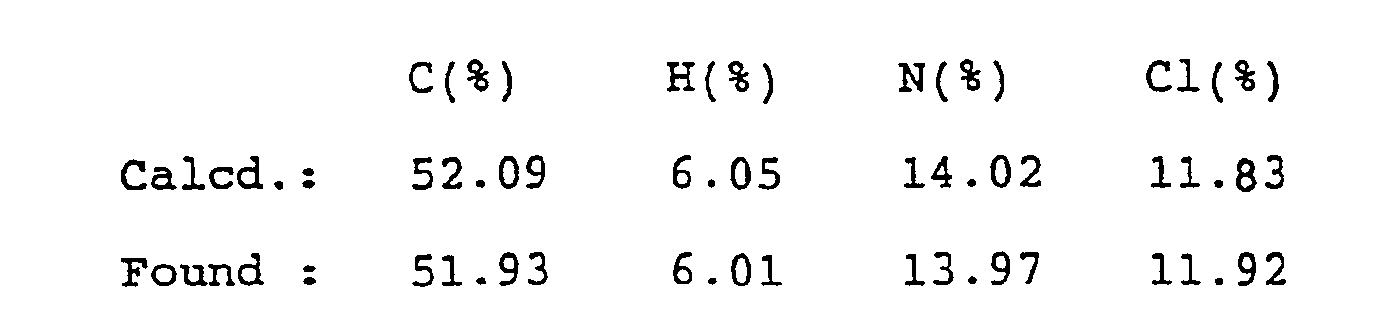
-

- To a solution of 0.37 g of 1,3-dihydro-1-(2-dimethylaminoethyl)-5-methoxycarbonyl-2H-benzimidazol-2- one in 15 ml of tetrahydrofuran was added 0.10 g of lithium aluminum hydride. After being stirred for 1 hour at room temperature, the reaction was quenched by the addition of 3.0 g of sodium sulfate hydrate. The solid was removed by filtration and the solvent was evaporated in vacuo. The residue was chromatographed on silica gel using chloroform-methanol-ammonium hydroxide (40:10:1) to provide 0.20 g of 1,3-dihydro-1-(2-dimethylaminoethyl)-5-hydroxymethyl-2H-benzimidazol-2-one. Mass spectrum (m/z): 235 (M+) NMR (DMSO-d6)
- 8: 2.23 (6H, s), 2.55 (2H, t, J=7 Hz), 3.87 (2H, t, J=7 Hz), 4.51 (2H, d, J=6 Hz), 4.95 (1 H, t, J=6 Hz), 6.90-7.10 (3H, m), 10.65 (1 H, s)
-


-
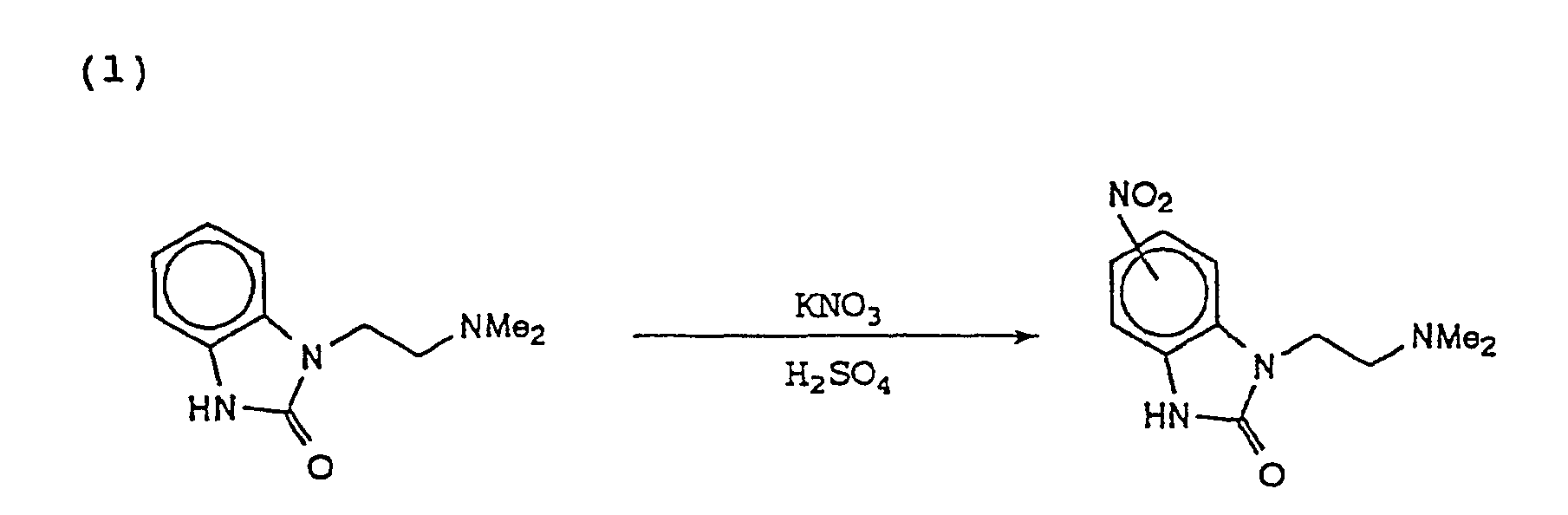
- To a solution of 2.03 g of 1,3-dihydro-1-(2-dimethylaminoethyl)-2H-benzimidazol-2-one in 15 ml of sulfuric acid cooled to 0°C was added in small portions 1.10 g of potassium nitrate. The reaction mixture was stirred at 15°C for 2 hours, poured into ice-water and neutralized with sodium bicarbonate. After being extracted with ethyl acetate, dried over anhydrous sodium sulfate, and concentrated in vacuo, the crude material was chromatographed on silica gel. Elution with chloroform-methanol-ammonium hydroxide (100:10:1) afforded 1.76 g of 1:1 mixture of 1,3-dihydro-1-(2-dimethylaminoethyl)-5-nitro-2H-benzimidazol-2-one and 1,3-dihydro-1-(2-dimethylaminoethyl)-6-nitro-2H-benzimidazol-2-one. Mass spectrum (m/z): 251 (MH+) NMR (DMSO-d6)
- δ: 2.17, 2.18 (6H, s), 2.47-2.61 (2H, m) 3.89-4.06 (2H, m), 7.10-7.41 (1H, m), 7.75-8.07 (2H, m), 11.51 (1H, brs)
-

- Starting compound: A mixture of 1, 3-dihydro-1-(2-dimethylaminoethyl)-5-nitro-2H-benzimidazol- 2-one and 1,3-dihydro-1-(2-dimethylaminoethyl)-6-nitro-2H-benzimidazol-2-one Analysis (for C11H15N4O3Cl·0.7H2O)

- The ratio of the mixture was confirmed as 1:1, since the ratio of NMR (CDCI3) integrations at 8 7.20 (d, J=8.6 Hz) assigned to 4-H of 6-nitrobenzimidazolone and 8 7.53 (d, J=8.8 Hz) assigned to 7-H of 5-nitrobenzimidazolone is exactly 1:1.
-

- δ: 2.33 (6H, s), 2.66 (2H, t, J=6 Hz), 3.28-3.50 (2H, m), 6.61-6.80 (2H, m), 7.24-7.35 (2H, m), 7.94 (1H, s), 8.31 (1H, d, J=9 Hz), 8.55 (1H, br s)
-

- Starting compound: N,N-Dimethyl-N'-[5-(1-imidazolyl-2-nitrophenyl)ethylenediamine Mass spectrum (m/z): 271 (M+) NMR (CDCI3)
- 8: 2.35 (6H, s), 2.69 (2H, t, J=7 Hz), 4.03 (2H, t, J=7 Hz), 7.08-7.26 (5H, m), 7.82 (1 H, m), 10.06 (1H, brs)
-


-

- To a solution of 2.20 g of 4-amino-3-nitrobenzophenone and 1.57 g of 4-methoxybenzyl chloride in 25 ml of N,N-dimethylformamide was added at room temperature 0.40 g of 60% dispersion of sodium hydride in mineral oil, and the mixture was stirred overnight. After addition of saturated ammonium chloride aqueous solution was completed, the reaction mixture diluted with ethyl acetate was washed with brine. Removal of the solvent under reduced pressure gave the crude product, which was chromatographed on silica gel. Elution with hexane- ethyl acetate (3:1) provided 1.95 g of 4-(4-methoxybenzylamino)-3-nitrobenzophenone. Mass spectrum (m/z): 362 (M+) NMR (CDCI3)
- 8: 3.81 (3H, s), 4.55 (2H, d, J=5.5 Hz), 6.91 (2H, d, J=8.7 Hz), 6.95 (1 H, d, J=9.0 Hz), 7.28 (2H, d, J=8.7 Hz), 7.5-7.8 (5H, m), 8.00 (1H, ddd, J=9.0, 1.8 and 0.3 Hz), 8.69 (1H, d, J=2.0 Hz), 8.8 (1H, brs)
-

- 8: 3.3 (2H, br s), 3.78 (3H, s), 4.30 (2H, d, J=3.9 Hz), 4.5 (1 H, br s), 6.58 (1 H. d, J=8.3 Hz), 7.27 (2H, d, J=8.3 Hz), 7.2-7.5 (5H, m), 7.70 (2H, d, J=7.3 Hz)
-

- 8: 3.79 (3H, s), 5.07 (2H, s), 6.86 (2H, d, J=8 Hz), 6.94 (1H, d, J=8 Hz), 7.31 (2H, d, J=8 Hz), 7.4-7.8 (7H, m), 10.3 (1 H, br s)

- To a solution of 1.09 g of 5-benzoyl-1-(4-methoxybenzyl)-2H-benzimidazol-2-one in 10 ml of dimethylsulfoxide was added at room temperature 0.27 g of 60% dispersion of sodium hydride in mineral oil. After being stirred for 30 minutes, the reaction mixture was treated with 0.48 g of chloroethyldimethylamine hydrochloride at room temperature for 2 hours and at 55°C for 3 hours, diluted with water and extracted with ethyl acetate. The ethyl acetate layer was extracted with 10% hydrogen chloride. The aqueous layer was alkalified with 20% sodium hydroxide and extracted with ethyl acetate. The ethyl acetate layer was washed with water and brine in turn and dried over anhydrous sodium sulfate. After removal of the solvent in vacuo, the residue was chromatographed on silica gel using chloroform-methanol (15:1) to afford 1.14 g of 5-benzoyi-1,3-dihydro-3-(2-dimethylaminoethyl)-1-(4-methoxybenzyl)-2H-benzimidazol-2-one. Mass spectrum (m/z): 429 (M+) NMR (CDCI3)
- 8: 2.31 (6H, s), 2.68 (2H, t, J=6.8 Hz), 3.77 (2H, s), 4.05 (2H, t, J=6.8 Hz), 5.04 (2H, s), 6.85 (2H, d, J=8.9 Hz), 6.91 (1H, d, J=8.2 Hz), 7.28 (2H, d, J=8.9 Hz), 7.4-7.8 (7H, m)
-

- To a solution of 1.11 g of 5-benzoyl-1,3-dihydro-3-(2-dimethylaminoethyl)-1-(4-methoxybenzyl)-2H-ben- zimidazol-2-one in 20 ml of acetonitrile and 7 ml of water was added 6.43 g of ceric ammonium nitrate. The reaction mixture was stirred at 60°C for 4 hours, diluted with water and washed with ethyl acetate. After alkali- fying to pH 9 with 10% sodium hydroxide, the basic material was extracted with chloroform and dried over anhydrous sodium sulfate. Removal of the solvent in vacuo afforded the crude material which was chromatographed on silica gel. Elution with chloroform-methanol (10:1) gave 40 mg of 6-benzoyl-1,3-dihydro-1-(2-dimethylaminoethyl)-2H-benzimidazol-2-one. Mass spectrum (m/z): 309 (M+) NMR (CDCI3)
- δ: 2.36 (6H, s), 2.74 (2H, t, J=7 Hz), 4.05 (2H, t, J=7 Hz), 6.98 (1 H, t, J=10 Hz), 7.4-7.6 (5H, m), 7.76 (2H, m), 11.0 (1 H, br s)
-


-

- A mixture of 1.09 g of 5-chloro-2-nitroaniline, 10 g of phenol and 2.0 g of anhydrous potassium carbonate was heated at 150°C for 4 days. The reaction mixture was diluted with 1N sodium hydroxide and extracted with ethyl acetate. The ethyl acetate layer was washed with 1 N sodium hydroxide, water and brine in turn and dried over anhydrous sodium sulfate. After removal of the solvent, the residue was chromatographed on silica gel using chloroform to give 0.70 g of 2-nitro-5-phenoxyaniline. Mass spectrum (m/z): 230 (M+) NMR (CDCI3)
- δ: 5.70-6.40 (4H, m), 7.02-7.51 (5H, m), 8.11 (1H, d, J=10 Hz)
-

- 8: 2.26 (6H, s), 2.57 (2H, t, J=6 Hz), 3.10-3.30 (2H, m), 6.15-6.29 (2H, m), 7.03-7.53 (5H, m), 8.02-8.21 (1 H, m), 8.43 (1 H, br s)
-
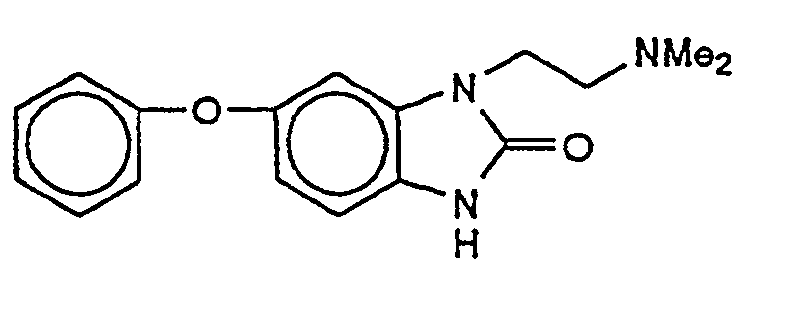
- 8: 2.30 (6H, s), 2.63 (2H, t, J=7 Hz), 3.94 (2H, t, J=7 Hz), 6.70-6.78 (2H, m), 6.92-7.12 (4H, m), 7.24-7.36 (2H, m), 9.46 (1 H, s)
-


-

- A solution of 0.70 g of N,N-dimethyl-N'-(4-cyano-2-nitrophenyl)ethylenediamine in 5 ml of dichloromethane was treated with 3.0 ml of 20% sodium hydroxide, 3.0 ml of 30% hydrogen peroxide and 0.25 g of tetra-n-butylammonium hydrogen sulfate at room temperature for 1 hour. The dichloromethane layer was separated, washed with water and brine in turn and dried over anhydrous sodium sulfate. Removal of the solvent provided 0.30 g of N,N-dimethyl-N'-(4-carbamoyl-2-nitrophenyl)ethylenediamine. Mass spectrum (m/z): 253 (MH+) NMR (CDCI3)
- 8: 2.34 (6H, s), 2.66 (2H, t, J=6 Hz), 3.36-3.45 (2H, m), 5.40-5.80 (2H, m), 6.90 (1 H, d, J=10 Hz), 8.00 (1 H, dd, J=2 and 10 Hz), 8.60 (1 H, d, J=2 Hz), 8.70 (1 H, br s)
-

- 8: 2.20 (6H, s), 2.52 (1 H, t, J=7 Hz), 3.88 (2H, t, J=7 Hz), 7.12 (1 H, d, J=9 Hz), 7.04-7.20 (1H, m), 7.50-7.70 (2H, m), 7.84 (1 H, br s), 11.02 (1 H, br s)
-

- δ: 2.60 (6H, s), 2.80-2.92 (2H, m), 4.12-4.36 (2H, m), 7.16-7.40 (2H, m), 7.52-7.76 (2H, m), 7.92 (1H, br s), 10.40 (1 H, br s), 11.26 (1H, s)
-

- The compound of Example 12(5) (1 g) is uniformly blended with 39 g of lactose and the mixture is comminuted, sieved and filled into No. 3 capsules using a capsule filling machine to give powder inhalant dosage units.
-

- The compound of Example 12(5) (150 g) is uniformly blended with 210 g of sorbitan trioleate. The resulting mixture is distributed in 0.36 gportions into 20 ml aluminum cans. A valve device is inserted into each can. The cans are then sealed and the specified amounts of propellants are forced into each container under pressure using a pressure gas buret to give aerosols.
-

- The compound of Example 12(5) (150 g) is uniformly blended with 10 g of benzalkonium chloride and 4.2 liters of distilled water. The resulting mixture is distributed in 4.36 g portions into 20 ml aluminum cans. Following insertion of a valve device into each can, the cans are sealed and then the prescribed amounts of propellants are filled into the containers under pressure using a pressure gas buret to give aerosols.
-

- The compound of Example 12(5) (100 g) is uniformly blended with 56 g of lactose and 37 g of com starch, followed by addition of 60 g of a 10% hydroxypropylcellulose solution. The resulting mixture is granulated by the wet method. The granules are sieved and dried. Then, 1 g of magnesium stearate is added to and mixed with the dried granules and the mixture is tabletted using a die and punch of 8 mm and 6.4R to give tablets.
-

- The compound of Example 12(5) (50 g), 40 g of crystalline cellulose, 109 g of crystalline lactose and 1 g of magnesium stearate are uniformly mixed up together and the mixture is filled in 200 mg portions into No. 3 capsules using a capsule filling machine.
-

- To 800 ml of water was added 25 g of the compound of Example 12(5) and 33 g of D-mannitol and dissolved in that order, diluted with water to make 1 f, and the solution is aseptically filtered, distributed in 2 ml portions into vials and lyophilized to give injectable dosage units to be dissolved before use.
- While the invention has been described in detail and with reference to specific embodiments thereof, it will be apparent to one skilled in the art that various changes and modifications can be made therein without departing therefrom.
Claims (8)
1. A benzimidazolinone derivative of the general formula (I) or a pharmaceutically acceptable salt thereof:

wherein R1, R2 and R3 are the same or different and selected from hydrogen and halogen atoms and C1-C6 alkyl, halo-C1-C6 alkyl, hydroxy-C1-C6 alkyl, hydroxyl, C1-C6 alloxy, aryloxy,acyl, cyano, carboxy, (C1-C6 alkoxy)carbonyl, carbamoyl, nitro, and nitrogen-containing 5- and 6-membered heterocyclic groups; A is an ethylene group which may have at least one branch; and R4 and R5 are the same or different C1-C6 allyl groups orform together with the adjacent nitrogen atom a pyrrolidinyl, piperidino group or morpholino group provided that when
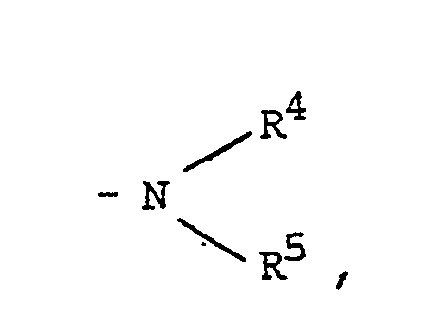
is a piperidino or diethylamino group, at least one of R1, R2 and R3 is other than a hydrogen atom.
2. A compound as claimed in claim 1 wherein R1, R2 and R3 are the same or different and selected from hydrogen and halogen atoms and C1-C6 alloxy groups.
3. A compound as claimed in claim 2 wherein

is a dimethylamino or pirrolidinyl group.
4. A compound according to claim 1 which is 6-Chloro-1,3-dihydro-1-(2-dimethylaminoethyl)-2H-benzimi- dazol-2-one or the hydrochloride thereof; 4,6-dibromo-1,3-dihydro-1-(2-dimethylaminoethyl)-2H-benzimidazol-2-one or the hydrochloride thereof; 6-bromo-1,3-dihydro-1-(2-dimethylaminoethyl)2H-benzimidazol-2-one or the hydrochloride thereof; 1,3-dihydro-1-(2-dimethylaminoethyl)-2H-benzimidazol-2-one or the hydrochloride thereof; or 6-chloro-1,3-dihydro-1-[2-(1-pyrrolidinyl)ethyl]-2H-benzimidazol-2-one or the hydrochloride thereof.
5. A pharmaceutical composition which comprises a pharmacologically effective amount of compound according to any of claims 1 to 4 and pharmaceutically acceptable carrier therefor.
6. The use of compound according to any of claims 1 to 4 for the preparation of a pulmonary surfactant secretion promoting agent.
7. A method of producing benzimidazolinone derivative (I) or salt thereof:

wherein R1, R2 and R3 are the same or different and selected from hydrogen and halogen atoms and C1-C6 alkyl, halo-C1-C6 alkyl, hydroxy-C1-C6 alkyl, hydroxyl, C1-C6 alkoxy, aryloxy, acyl, cyano, carboxy, (C1-C6 alkoxy)carbonyl, carbamoyl, nitro, and nitrogen-containing 5- and 6-membered heterocyclic groups; A is an ethylene group which may have at least one branch; and R4 and R5 are the same or different C1-C6 alkyl groups or form together with the adjacent nitrogen atom a pyrrolidinyl, piperidino group or morpholino group provided that when

is a piperidino or diethylamino group, at least one of R1, R2 and R3 is other than a hydrogen atom, which comprises
(a) reacting phenylenediamine derivative (II)

with carbonylation agent; or
(b) subjecting N-lower alkoxycarbonyl-substituted phenylenediamine derivative (V):

to ring closure; or
(c) reacting halide or sulfonate (VII)

with amine (VIII):

or
(d) reacting 1-2(2-propyl)-sustituted benzimidazolinone (IX):

with aminoalkyl halide salt (X):

or
(e) reacting amino-protected benzimidazol-2-one (XI):

with halide or sulfonate (XII):

or or salt thereof:; or
(f) where at least one of R1, R2 and R3 is a halogen atom, reacting benzimidazolinone derivative (VI):

with halogenating agent; or
(g) where at least one of R1, R2 and R3 is a carbamoyl group, treating alkoxycarbonyl-substituted ben- zimidazol-2-one derivative (Ia):

with ammonia, or hydrolyzing cyano-substituted benzimidazol-2-one derivative (Ic):

or
(h) where at least one of Rl, R2 and R3 is a nitro group, treating corresponding starting compound (Id):

with nitration agent; or
(i) where at least one of R1, R2 and R3 is a hydroxymethyl group, reducing alkoxycarbonyl-substituted benzimidazol-2-one derivative (Ia):

werein R1, R2, R3, R4, R5 and A are as defined above; R6 is a C1-C6 allyl group; X is a halogen atom or an organic sulfonic acid residue; Y is a halogen atom; R13 is an amino-protecting group; one of R7, R8 and R9 is a hydrogen atom and the remaining two are the same or different and selected from hydrogen and halogen atoms and C1-C6 alkyl, halo-C1-C6 alkyl, hydroxyl, C1-C6 alkoxy, aryloxy, acyl, cyano, carboxyl, (C1-C6 alkoxy)carbonyl, nitro and carbamoyl groups and nitrogen-containing 5- and 6-membered heterocyclic groups; and R14 is a C1-C6 alkyl group.
8. A process acoording to claim 7 including converting the product to or from salt form.
Applications Claiming Priority (4)
| Application Number | Priority Date | Filing Date | Title |
|---|---|---|---|
| JP98455/90 | 1990-04-13 | ||
| JP9845590 | 1990-04-13 | ||
| JP285493/90 | 1990-10-23 | ||
| JP28549390 | 1990-10-23 |
Publications (1)
| Publication Number | Publication Date |
|---|---|
| EP0454330A1 true EP0454330A1 (en) | 1991-10-30 |
Family
ID=26439622
Family Applications (1)
| Application Number | Title | Priority Date | Filing Date |
|---|---|---|---|
| EP91303264A Withdrawn EP0454330A1 (en) | 1990-04-13 | 1991-04-12 | Benzimidazolinone derivatives |
Country Status (10)
| Country | Link |
|---|---|
| US (1) | US5162318A (en) |
| EP (1) | EP0454330A1 (en) |
| KR (1) | KR910018360A (en) |
| CN (1) | CN1060837A (en) |
| AU (1) | AU7500891A (en) |
| CA (1) | CA2040235A1 (en) |
| FI (1) | FI911776A7 (en) |
| HU (1) | HUT57735A (en) |
| IE (1) | IE911251A1 (en) |
| TW (1) | TW203049B (en) |
Cited By (25)
| Publication number | Priority date | Publication date | Assignee | Title |
|---|---|---|---|---|
| US5563147A (en) * | 1994-09-12 | 1996-10-08 | Eli Lilly And Company | Serotonerbic tetrahydropyridoindoles |
| US5773448A (en) * | 1995-12-19 | 1998-06-30 | Eli Lilly And Company Limited | Pharmaceutical compounds |
| FR2767827A1 (en) * | 1997-09-03 | 1999-02-26 | Adir | NOVEL INDOLE AND INDAZOLE DERIVATIVES, PROCESS FOR PREPARING THEM AND PHARMACEUTICAL COMPOSITIONS CONTAINING THE SAME |
| WO2000066564A1 (en) * | 1999-05-04 | 2000-11-09 | American Home Products Corporation | Benzimidazolones and analogues and their use as progesterone receptor ligands |
| US6306851B1 (en) | 1999-05-04 | 2001-10-23 | American Home Products Corporation | Cyclocarbamate and cyclic amide derivatives |
| US6319912B1 (en) | 1999-05-04 | 2001-11-20 | American Home Products Corporation | Cyclic regimens using 2,1-benzisothiazoline 2,2-dioxides |
| US6329416B1 (en) | 1999-05-04 | 2001-12-11 | American Home Products Corporation | Combination regimens using 3,3-substituted indoline derivatives |
| US6339098B1 (en) | 1999-05-04 | 2002-01-15 | American Home Products Corporation | 2,1-benzisothiazoline 2,2-dioxides |
| US6355648B1 (en) | 1999-05-04 | 2002-03-12 | American Home Products Corporation | Thio-oxindole derivatives |
| US6358948B1 (en) | 1999-05-04 | 2002-03-19 | American Home Products Corporation | Quinazolinone and benzoxazine derivatives as progesterone receptor modulators |
| US6358947B1 (en) | 1999-05-04 | 2002-03-19 | American Home Products Corporation | Tetracyclic progesterone receptor modulator compounds and methods |
| US6369056B1 (en) | 1999-05-04 | 2002-04-09 | American Home Products Corporation | Cyclic urea and cyclic amide derivatives |
| US6380178B1 (en) | 1999-05-04 | 2002-04-30 | American Home Products Corporation | Cyclic regimens using cyclocarbamate and cyclic amide derivatives |
| US6391907B1 (en) | 1999-05-04 | 2002-05-21 | American Home Products Corporation | Indoline derivatives |
| US6399593B1 (en) | 1999-05-04 | 2002-06-04 | Wyeth | Cyclic regimens using cyclic urea and cyclic amide derivatives |
| US6407101B1 (en) | 1999-05-04 | 2002-06-18 | American Home Products Corporation | Cyanopyrroles |
| US6417214B1 (en) | 1999-05-04 | 2002-07-09 | Wyeth | 3,3-substituted indoline derivatives |
| US6423699B1 (en) | 1999-05-04 | 2002-07-23 | American Home Products Corporation | Combination therapies using benzimidazolones |
| US6436929B1 (en) | 1999-05-04 | 2002-08-20 | Wyeth | Cyclothiocarbamate derivatives as progesterone receptor modulators |
| US6444668B1 (en) | 1999-05-04 | 2002-09-03 | Wyeth | Combination regimens using progesterone receptor modulators |
| US6462032B1 (en) | 1999-05-04 | 2002-10-08 | Wyeth | Cyclic regimens utilizing indoline derivatives |
| US6498154B1 (en) | 1999-05-04 | 2002-12-24 | Wyeth | Cyclic regimens using quinazolinone and benzoxazine derivatives |
| US6509334B1 (en) | 1999-05-04 | 2003-01-21 | American Home Products Corporation | Cyclocarbamate derivatives as progesterone receptor modulators |
| US7115640B2 (en) | 2001-12-21 | 2006-10-03 | X-Ceptor Therapeutics, Inc. | Heterocyclic modulators of nuclear receptors |
| US7582760B2 (en) | 2005-07-13 | 2009-09-01 | Roche Palo Alto Llc | Benzimidazolone and dihydroindolone derivatives and uses thereof |
Families Citing this family (2)
| Publication number | Priority date | Publication date | Assignee | Title |
|---|---|---|---|---|
| US7115644B2 (en) * | 2002-09-13 | 2006-10-03 | Boehringer Ingelheim Pharmaceuticals Inc. | Heterocyclic compounds |
| CR20220565A (en) | 2020-05-06 | 2023-01-13 | Merck Sharp & Dohme Llc | Il4i1 inhibitors and methods of use |
Citations (3)
| Publication number | Priority date | Publication date | Assignee | Title |
|---|---|---|---|---|
| US4215119A (en) * | 1976-03-09 | 1980-07-29 | Boehringer Ingelheim Gmbh | Aminoalkyl-substituted benzimidazolidin-2-ones |
| EP0111993A2 (en) * | 1982-09-27 | 1984-06-27 | Eli Lilly And Company | Improvements in or relating to benzimidazoles |
| EP0385850A2 (en) * | 1989-03-03 | 1990-09-05 | Laboratoires Upsa | Benzimidazole and azabenzimidazole derivatives, process for their preparation, synthesis intermediates, pharmaceutical compositions containing them, useful for the treatment of cardiovascular diseases and duodenal ulcers |
Family Cites Families (4)
| Publication number | Priority date | Publication date | Assignee | Title |
|---|---|---|---|---|
| DE2644833A1 (en) * | 1976-10-05 | 1978-04-20 | Boehringer Sohn Ingelheim | NEW 1-ARYLOXY-2-HYDROXY-3-ALKYLENE AMINOPROPANES AND METHOD FOR THE PRODUCTION THEREOF |
| US4200641A (en) * | 1976-12-21 | 1980-04-29 | Janssen Pharmaceutica, N.V. | 1-[(Heterocyclyl)-alkyl]-4-diarylmethoxy piperidine derivatives |
| US4359468A (en) * | 1981-02-25 | 1982-11-16 | Boehringer Ingelheim Ltd. | Antiallergic N-[4-(indolyl)-piperidino-alkyl]-benzimidazolones |
| JPS62252721A (en) * | 1986-04-24 | 1987-11-04 | Kissei Pharmaceut Co Ltd | Remedy for peptic ulcer |
-
1991
- 1991-04-10 TW TW080102725A patent/TW203049B/zh active
- 1991-04-11 CA CA002040235A patent/CA2040235A1/en not_active Abandoned
- 1991-04-12 KR KR1019910005825A patent/KR910018360A/en not_active Ceased
- 1991-04-12 EP EP91303264A patent/EP0454330A1/en not_active Withdrawn
- 1991-04-12 FI FI911776A patent/FI911776A7/en not_active Application Discontinuation
- 1991-04-12 HU HU911226A patent/HUT57735A/en unknown
- 1991-04-12 IE IE125191A patent/IE911251A1/en unknown
- 1991-04-13 CN CN91102631A patent/CN1060837A/en active Pending
- 1991-04-15 AU AU75008/91A patent/AU7500891A/en not_active Abandoned
- 1991-04-15 US US07/684,866 patent/US5162318A/en not_active Expired - Fee Related
Patent Citations (3)
| Publication number | Priority date | Publication date | Assignee | Title |
|---|---|---|---|---|
| US4215119A (en) * | 1976-03-09 | 1980-07-29 | Boehringer Ingelheim Gmbh | Aminoalkyl-substituted benzimidazolidin-2-ones |
| EP0111993A2 (en) * | 1982-09-27 | 1984-06-27 | Eli Lilly And Company | Improvements in or relating to benzimidazoles |
| EP0385850A2 (en) * | 1989-03-03 | 1990-09-05 | Laboratoires Upsa | Benzimidazole and azabenzimidazole derivatives, process for their preparation, synthesis intermediates, pharmaceutical compositions containing them, useful for the treatment of cardiovascular diseases and duodenal ulcers |
Non-Patent Citations (2)
| Title |
|---|
| JOURNAL OF THE CHEMICAL SOCIETY, January 1960, pages 314-318, Letchworth, GB; J. DAVOLL et al.: "Some N-Substituted 2-oxobenzimidazolines" * |
| PATENT ABSTRACTS OF JAPAN, vol. 12, no. 132 (C-490)[2979], 22nd April 1988; & JP-A-62 252 721 (KISSEI PHARMACEUT CO., LTD) 04-11-1987 * |
Cited By (54)
| Publication number | Priority date | Publication date | Assignee | Title |
|---|---|---|---|---|
| US5563147A (en) * | 1994-09-12 | 1996-10-08 | Eli Lilly And Company | Serotonerbic tetrahydropyridoindoles |
| US5773448A (en) * | 1995-12-19 | 1998-06-30 | Eli Lilly And Company Limited | Pharmaceutical compounds |
| FR2767827A1 (en) * | 1997-09-03 | 1999-02-26 | Adir | NOVEL INDOLE AND INDAZOLE DERIVATIVES, PROCESS FOR PREPARING THEM AND PHARMACEUTICAL COMPOSITIONS CONTAINING THE SAME |
| EP0902027A1 (en) * | 1997-09-03 | 1999-03-17 | Adir Et Compagnie | Indole and indazole derivatives, process for their preparation and the pharmaceutical compositions containing them |
| WO2000066564A1 (en) * | 1999-05-04 | 2000-11-09 | American Home Products Corporation | Benzimidazolones and analogues and their use as progesterone receptor ligands |
| US6306851B1 (en) | 1999-05-04 | 2001-10-23 | American Home Products Corporation | Cyclocarbamate and cyclic amide derivatives |
| US6319912B1 (en) | 1999-05-04 | 2001-11-20 | American Home Products Corporation | Cyclic regimens using 2,1-benzisothiazoline 2,2-dioxides |
| US6329416B1 (en) | 1999-05-04 | 2001-12-11 | American Home Products Corporation | Combination regimens using 3,3-substituted indoline derivatives |
| US6339098B1 (en) | 1999-05-04 | 2002-01-15 | American Home Products Corporation | 2,1-benzisothiazoline 2,2-dioxides |
| US6355648B1 (en) | 1999-05-04 | 2002-03-12 | American Home Products Corporation | Thio-oxindole derivatives |
| US6358948B1 (en) | 1999-05-04 | 2002-03-19 | American Home Products Corporation | Quinazolinone and benzoxazine derivatives as progesterone receptor modulators |
| US6358947B1 (en) | 1999-05-04 | 2002-03-19 | American Home Products Corporation | Tetracyclic progesterone receptor modulator compounds and methods |
| US6369056B1 (en) | 1999-05-04 | 2002-04-09 | American Home Products Corporation | Cyclic urea and cyclic amide derivatives |
| US6380235B1 (en) | 1999-05-04 | 2002-04-30 | American Home Products Corporation | Benzimidazolones and analogues |
| US6380178B1 (en) | 1999-05-04 | 2002-04-30 | American Home Products Corporation | Cyclic regimens using cyclocarbamate and cyclic amide derivatives |
| US6391907B1 (en) | 1999-05-04 | 2002-05-21 | American Home Products Corporation | Indoline derivatives |
| US6399593B1 (en) | 1999-05-04 | 2002-06-04 | Wyeth | Cyclic regimens using cyclic urea and cyclic amide derivatives |
| US6407101B1 (en) | 1999-05-04 | 2002-06-18 | American Home Products Corporation | Cyanopyrroles |
| US6417214B1 (en) | 1999-05-04 | 2002-07-09 | Wyeth | 3,3-substituted indoline derivatives |
| US6423699B1 (en) | 1999-05-04 | 2002-07-23 | American Home Products Corporation | Combination therapies using benzimidazolones |
| US6436929B1 (en) | 1999-05-04 | 2002-08-20 | Wyeth | Cyclothiocarbamate derivatives as progesterone receptor modulators |
| US6441019B2 (en) | 1999-05-04 | 2002-08-27 | Wyeth | Cyclocarbamate and cyclic amide derivatives |
| US6444668B1 (en) | 1999-05-04 | 2002-09-03 | Wyeth | Combination regimens using progesterone receptor modulators |
| US6462032B1 (en) | 1999-05-04 | 2002-10-08 | Wyeth | Cyclic regimens utilizing indoline derivatives |
| US6498154B1 (en) | 1999-05-04 | 2002-12-24 | Wyeth | Cyclic regimens using quinazolinone and benzoxazine derivatives |
| US6503939B2 (en) | 1999-05-04 | 2003-01-07 | Wyeth | Combination regimens using 3,3-substituted indoline derivatives |
| US6509334B1 (en) | 1999-05-04 | 2003-01-21 | American Home Products Corporation | Cyclocarbamate derivatives as progesterone receptor modulators |
| US6521657B2 (en) | 1999-05-04 | 2003-02-18 | Wyeth | Thio-oxindole derivatives |
| US6544970B2 (en) | 1999-05-04 | 2003-04-08 | Wyeth | Cyclic regimens utilizing indoline derivatives |
| US6562857B2 (en) | 1999-05-04 | 2003-05-13 | Wyeth | Cyanopyrroles |
| US6566358B2 (en) | 1999-05-04 | 2003-05-20 | Wyeth | Cyclocarbamate derivatives as progesterone receptor modulators |
| US6583145B1 (en) | 1999-05-04 | 2003-06-24 | Wyeth | Thio-oxindole derivatives |
| US6608068B2 (en) | 1999-05-04 | 2003-08-19 | Wyeth | Indoline derivatives |
| US6693103B2 (en) | 1999-05-04 | 2004-02-17 | Wyeth | 1,2,3,4-tetrahydro-2-thioxo-quinolinyl and 1,2,3,4-tetrahydro-2-oxo-quinolinyl derivatives as progesterone receptor modulators |
| US6713478B2 (en) | 1999-05-04 | 2004-03-30 | Wyeth | Cyclocarbamate derivatives as progesterone receptor modulators |
| US6759408B2 (en) | 1999-05-04 | 2004-07-06 | Wyeth | Combination regimens using progesterone receptor modulators |
| US6794373B2 (en) | 1999-05-04 | 2004-09-21 | Wyeth | Contraceptive methods using benzimidazolones |
| US6835744B2 (en) | 1999-05-04 | 2004-12-28 | Wyeth | 3,3-substituted indoline derivatives |
| US6841568B2 (en) | 1999-05-04 | 2005-01-11 | Wyeth | Thio-oxindole derivatives |
| US6946454B2 (en) | 1999-05-04 | 2005-09-20 | Wyeth | Thio-oxindole derivatives |
| US6982261B2 (en) | 1999-05-04 | 2006-01-03 | Wyeth | Cyanopyrroles |
| US7081457B2 (en) | 1999-05-04 | 2006-07-25 | Wyeth | Cyclothiocarbamate derivatives as progesterone receptor modulators |
| US7084168B2 (en) | 1999-05-04 | 2006-08-01 | Wyeth | Indoline derivatives |
| US7091234B2 (en) | 1999-05-04 | 2006-08-15 | Wyeth | Thio-oxindole derivatives |
| US7253203B2 (en) | 1999-05-04 | 2007-08-07 | Wyeth | Indoline derivatives |
| US7488822B2 (en) | 1999-05-04 | 2009-02-10 | Wyeth | Cyclocarbamate derivatives as progesterone receptor modulators |
| US7569564B2 (en) | 1999-05-04 | 2009-08-04 | Wyeth | Cyclothiocarbamate derivatives as progesterone receptor modulators |
| US7846924B2 (en) | 1999-05-04 | 2010-12-07 | Wyeth Llc | Cyanopyrroles |
| US8329690B2 (en) | 1999-05-04 | 2012-12-11 | Wyeth Llc | Cyclothiocarbamate derivatives as progesterone receptor modulators |
| US8466146B2 (en) | 1999-05-04 | 2013-06-18 | Wyeth Llc | Cyclothiocarbamate derivatives as progesterone receptor modulators |
| US8476262B2 (en) | 1999-05-04 | 2013-07-02 | Wyeth Llc | Cyanopyrroles |
| US8796266B2 (en) | 1999-05-04 | 2014-08-05 | Wyeth Llc | Cyclothiocarbamate derivatives as progesterone receptor modulators |
| US7115640B2 (en) | 2001-12-21 | 2006-10-03 | X-Ceptor Therapeutics, Inc. | Heterocyclic modulators of nuclear receptors |
| US7582760B2 (en) | 2005-07-13 | 2009-09-01 | Roche Palo Alto Llc | Benzimidazolone and dihydroindolone derivatives and uses thereof |
Also Published As
| Publication number | Publication date |
|---|---|
| KR910018360A (en) | 1991-11-30 |
| CN1060837A (en) | 1992-05-06 |
| FI911776A0 (en) | 1991-04-12 |
| CA2040235A1 (en) | 1991-10-14 |
| IE911251A1 (en) | 1991-10-23 |
| HU911226D0 (en) | 1991-10-28 |
| TW203049B (en) | 1993-04-01 |
| AU7500891A (en) | 1991-10-17 |
| HUT57735A (en) | 1991-12-30 |
| FI911776A7 (en) | 1991-10-14 |
| US5162318A (en) | 1992-11-10 |
Similar Documents
| Publication | Publication Date | Title |
|---|---|---|
| US5162318A (en) | Benzimidazolinone derivatives | |
| EP0629622B1 (en) | S-triazine derivative and remedy for estrogen-dependent diseases containing the same as active ingredient | |
| EP0257850B1 (en) | Pyrimidine derivatives | |
| US4855298A (en) | 6-Halo-1,2,3,4-tetrahydroquinazoline-4-spiro-4-imidazolidine-2,2'5'-triones useful for the treatment and prophylaxis of diabetic complications | |
| EP0040401B1 (en) | Triazoloquinoxalin-4-ones and such oxaline-4-thiones | |
| EP0096838B1 (en) | 1-aryloxy-2,3,4,5-tetrahydro-3-benzazepines, a process for preparing the same and their use as medicaments | |
| EP0784054A1 (en) | 1,2,3,4-tetrahydroquinoxalinedione derivative | |
| EP0767170A1 (en) | Novel 4,6-diarylpyrimidine derivatives and salts thereof | |
| US4404384A (en) | O-[3-(4-Substituted-piperazin-1-yl)-2-hydroxypropyl]-hydroxylamines | |
| EP0104522A2 (en) | New pyrazolo(3,4-b)pyridine derivatives and process for producing them | |
| EP0129692A2 (en) | Dibenzodiazepin derivatives, a process for their preparation and their use as medicaments | |
| US5330986A (en) | Indole-7-carboxamide derivatives | |
| HU186975B (en) | Process for preparing new triazolo-quinazolone derivatives | |
| RS50289B (en) | NEW DEGREE SUBSTITUTED AMINO DERIVATIVES OF 3-AMINO-1- PHENYL-1H (1,2,4) TRIAZOLE, A PROCEDURE FOR THEIR PRODUCTION AND THE PHARMACEUTICAL PRODUCTS CONTAINING THEM | |
| EP0376624A1 (en) | 4,5,6,7-Tetrahydrobenzimidazole derivatives and their preparation | |
| HU203345B (en) | Process for producing ergoline derivatives and pharmaceutical compositions comprising same | |
| EP0107930A2 (en) | Fused aromatic oxazepinones and sulphur analogues thereof and their preparation and use in counteracting histamine | |
| US4608375A (en) | Quinazolinone derivatives, processes for the preparation thereof and pharmaceutical composition comprising the same | |
| US4459302A (en) | Acyl-1H-1,2,4-triazole derivatives | |
| JPH051040A (en) | New benzimidazolinone derivative | |
| CS200160B2 (en) | Method of producing novel derivatives of arylamino imidazoline | |
| US4482547A (en) | Substituted-1,3,4-benzotriazepines | |
| EP0412529A1 (en) | Imidazole derivatives, process for the preparation of the same and antiulcer agents containing the same | |
| FI76343C (en) | Process for the preparation of anticholinergic 3- / 2- (mono- and dialkylamino) propyl / -1,2,3,4-tetrahydro-5H- / 1 / benzopyrano / 3,4-c / pyridin-5-one | |
| US4888350A (en) | New acyl-1H-1,2,4-triazole derivatives |
Legal Events
| Date | Code | Title | Description |
|---|---|---|---|
| PUAI | Public reference made under article 153(3) epc to a published international application that has entered the european phase |
Free format text: ORIGINAL CODE: 0009012 |
|
| AK | Designated contracting states |
Kind code of ref document: A1 Designated state(s): AT BE CH DE DK ES FR GB GR IT LI LU NL SE |
|
| 17P | Request for examination filed |
Effective date: 19920318 |
|
| STAA | Information on the status of an ep patent application or granted ep patent |
Free format text: STATUS: THE APPLICATION IS DEEMED TO BE WITHDRAWN |
|
| 18D | Application deemed to be withdrawn |
Effective date: 19931103 |