EP0454483B1 - Bewegungsvektorauffindungsvorrichtung - Google Patents
Bewegungsvektorauffindungsvorrichtung Download PDFInfo
- Publication number
- EP0454483B1 EP0454483B1 EP19910303795 EP91303795A EP0454483B1 EP 0454483 B1 EP0454483 B1 EP 0454483B1 EP 19910303795 EP19910303795 EP 19910303795 EP 91303795 A EP91303795 A EP 91303795A EP 0454483 B1 EP0454483 B1 EP 0454483B1
- Authority
- EP
- European Patent Office
- Prior art keywords
- image
- movement
- output
- accordance
- operation means
- Prior art date
- Legal status (The legal status is an assumption and is not a legal conclusion. Google has not performed a legal analysis and makes no representation as to the accuracy of the status listed.)
- Expired - Lifetime
Links
Images



Classifications
-
- G—PHYSICS
- G06—COMPUTING OR CALCULATING; COUNTING
- G06T—IMAGE DATA PROCESSING OR GENERATION, IN GENERAL
- G06T7/00—Image analysis
- G06T7/20—Analysis of motion
- G06T7/269—Analysis of motion using gradient-based methods
-
- G—PHYSICS
- G06—COMPUTING OR CALCULATING; COUNTING
- G06T—IMAGE DATA PROCESSING OR GENERATION, IN GENERAL
- G06T7/00—Image analysis
- G06T7/20—Analysis of motion
- G06T7/223—Analysis of motion using block-matching
- G06T7/238—Analysis of motion using block-matching using non-full search, e.g. three-step search
Definitions
- the present invention relates to a movement detection device, and more specifically, to a device which detects movement vectors from image signals.
- a method to detect movement vectors by image signal processing is the time-space gradient method which is described in J.O. Limb and J,A, Murply, "Measuring the Speed of Moving Objects from Television Signals", IEEE Trans. Com., Com-23, 4, pp. 474-487 (April 1975) and in others.
- ⁇ and “ ⁇ ” represent the movement amounts in x and y directions, respectively
- d represents the concentration difference among time-sequential images of one given point, namely, the time gradient
- g' x " and “g' y” represent the space gradients in x and y directions, respectively, when the image is expressed as "g”.
- ⁇ B means the computed grand total in a block and "sign( )" is the function which outputs the signal of "g' x " and "g' y ".
- the detection range has no limits, if the spacial concentration distribution of the input images is linear, that is, if the space gradient of the image concentration is constant.
- the spacial concentration distribution of image varies in random cycles, and therefore, the conventional method has the disadvantage of not being easily applicable to large movements.
- a concern of the present invention is to provide a movement vector detection device which solves the aforesaid disadvantage.
- An embodiment of the present invention provides a movement vector detection device which has a wide detection range to images, the space gradient of which is not constant but changes randomly.
- Another embodiment of the present invention provides a movement vector detection device that is capable of more accurately detecting the movement vector of images whose space gradient changes with time and is capable of being applied to large movement images, because, in the space gradient computation, the average space gradient is computed under given weights of the preceding image plane and the current image plane.
- Figure 1 shows the block diagram of an embodiment of the present invention
- Figure 2 shows the cross-section of an image pattern where the frequency is "T”
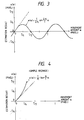
- Figure 3 shows the results of estimation when the movement amounts are estimated by the application of time-space gradient method to the frequency T pattern
- Figure 4 shows the results of estimation by the average gradient method
- Figure 5 shows the results of estimation by the embodiment of Figure 1
- Figure 6 illustrates the effective range of weights
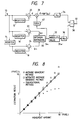
- Figure 7 shows the block diagram of another embodiment of the present invention
- Figure 8 compares the estimation results by a conventional example and the embodiment of Figure 7
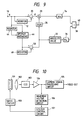
- Figure 9 shows the block diagram of a third embodiment of the present invention
- Figures 10 and 11 show the block diagrams of embodiments where the movement vector detection devices in the present invention are each applied to the image vibration adjustment devices.
- Figure 1 shows the block diagram of an embodiment of the present invention.
- 10 is the input terminal of image signals
- 12 and 14 are the registers which memorize (that is, delay) the input signals for one field period (or one frame period);
- 16 and 18 are the registers which memorize (that is, delay) the input signals only for the scanning time of several pixels that are required for the operation of the space gradient of the image concentration distribution;
- 20, 22 and 24 are subtractors;
- 26 is the sign output circuit which outputs the signal showing the sign (positive, negative or zero) of the input signal (output of subtractor 24);
- 28 is the multiplier);
- 30 is the optimum averaging circuit which averages the two inputs after giving proper weights;
- 32 is the absolute value circuit which outputs the absolute value of the output signal of the optimum averaging circuit 30;
- 34 and 36 are the totalizing circuits which accumulate the data in the designated block for detection of the movement vector;
- 38 is the divider which divides the output of totalizing circuit 34 by the output of totalizing
- the image signal "g" which is input to input terminal 10 is separated into three channels, and firstly, the concentration difference between the time sequential two field (or frame) image planes, that is, the time gradient "d", is computed by register 12 and subtractor 20. Secondly, the space gradient "g d2 " of the current image plane (field or frame) is computed by register 16 and subtractor 22, and thirdly, the space gradient "g d1 " of the preceding image plane (field or frame) is computed by register 18 and subtractor 24 by the use of the image signal of the preceding field (or frame) of register 14.
- Absolute value circuit 32 takes up the absolute value of the output "g da " of optimum averaging circuit 30 and feeds it to totalizing circuit 36. Totalizing circuit 36 computes the total sum of the outputs "
- Sign output circuit 26 outputs "+1" if the space gradient "g d1 " is positive, “0” if g d1 is zero, and “-1” if g d1 is negative, and multiplier 28 multiplies the output of sign output circuit 26 by the time gradient "d" (the output of subtractor 20). Thus, the time gradient in the direction of space gradient is obtained.
- totalizing circuit 34 computes the total sum of the output of multiplier 28 for each block.
- the output of totalizing circuit 34 is sent to the numerator input of divider 38.
- Divider 38 divides the output of totalizing circuit 34 by the output of totalizing circuit 36. The result of division by divider 38 represents the movement amount in the direction of space gradient of each designated block, and the movement amount of each block in horizontal or vertical direction is obtained from output terminal 40.
- Figure 3 is the illustration of the above where the horizontal axis shows the movement amount " ⁇ " of the pixel unit and the vertical axis represents the extimation result of the pixel unit.
- FIG. 7 shows a circuit block diagram of such modified embodiment.
- 42 represents a sign output circuit having the same function as that of the sign output circuit 42 in Figure 1, and is different from Figure 1 in that the output of optimum averaging circuit 30 is used as input.
- Other elements are same as in Figure 1 and they are numbered in the same way.
- the system is structured in such a way that the current image plane is referred to not just for the magnitude of the space gradient but also for its signal.
- Figure 9 shows a block diagram of yet another embodiment.
- 44 represents a register which gives the time lag for 1 field (or frame)
- 46 represents a similar optimum averaging circuit as optimum averaging circuit
- 48 represents a register which gives the time lag for the scanning time of several pixels
- 50 represents a subtractor.
- Optimum averaging circuit 46 averages, under a proper weight, the current image signal from input terminal 10 and the preceding image signal from register 44.
- Register 48 and subtractor 50 computes the space gradient from the output of optimum averaging circuit 46, and the output of subtractor 50 is sent to sign output circuit 26 and absolute value circuit 32.
- the concentration difference "d" has been obtained by register 12 and subtractor 20, as was already explained hereinabove. Therefore, the same processing proceeds thereafter, and the movement amount signal is obtained from output terminal 40.
- the present invention has the advantage of enhancing the detection range of movement vector, without substantial extension of circuits.
- Figures 10 and 11 each show an example where each of the aforesaid movement vector detection circuits is applied to video camera as the vibration correction (anti-vibration) device.
- Figure 10 shows an example which employs, as the anti-vibration unit, a movable top angle prism which optically corrects for the vibration by moving the light axis of the image lens.
- 101 represents a movable top angle prism which moves the direction of light axis of the image lens system, that is, the top angle thereof, and which, by way of example, is a pair of parallel glass sheets having a silicon-based fluid in-between.
- 102 represents an image lens
- 103 represents a CCD or other image sensor which converts the optical image captured by image lens into electronic signals and transmits them as output
- 104 represents a preamplifier
- 105 represents a camera signal processing circuit which outputs the standardized image signals after giving blanking processing, addition of synchronizing signals, gamma correction and other processing to the image signals that are output from the image sensor
- 106 represents the movement vector detection circuit described in the respective embodiments of Figures 1, 7 and 9
- 107 represents the system control circuit which picks up image movement vector data supplied by movement vector detection circuit 106, computes the data on the drive direction of the movable top angle prism so as to offset the movement of the image by vibration, and computes the drive amount required for correction
- 108 represents the drive circuit which drives top angle prism 101 in accordance with the data computed by system control circuit 107.
- movement vectors arising from image vibration is detected by the movement vector detection circuit of each said embodiment, the direction and amount of drive for the movable top angle prism are computed in accordance with these movement vectors, and vibration correction is made by the drive of the movable top angle prism.
- Figure 11 shows an example which employs no optical correction device, but corrects the movement of image by first taking the image temporarily into the memory device and then changing the read-out range from the memory device.
- Image signals which are output from preamplifier 104 are converted to digital signals by A/D converter 109 and are fed into the memory device of digital signal processing circuit 110.
- Memory control circuit 113 controls the rate and timing of A/D conversion for the image take-up into the memory device as well as the timing and address of the write-in into the memory device. This memory control circuit 113 also controls the address and timing of read-out from the memory device.
- the digital image signals that are read out from memory 110 are given various camera signal processings by camera signal processing circuit 111, are converted to analog signals by D/A conversion circuit 112, and then are output as image signals. It is also possible to set up the system in such a way that the digital signals are output as such.
- Movement vector detection circuit 115 detects the movement vector caused by camera vibration, in the same way as in the embodiment of Figure 1; and the movement vector thus detected is fed to system control circuit 114, which in turn computes the direction and magnitude of the image movement, based on the movement vector detected by movement vector detection circuit 115, and then based thereon controls memory control circuit 113 and controls the memory read-out range. That is, the memory takes up in advance the image in a larger image angle than that to be output, and at the time of memory read-out, the movement is corrected by changing the range of its read-out.
- the movement vector detection circuit is not only applicable to vibration correction, but also, as movement detector, to camera panning detection and many other applications.
- the present invention provides a video camera equipped with a high performance vibration correction function which has a very broad range of movement detection and is capable of detecting and making correction for both large and small movements.
Landscapes
- Engineering & Computer Science (AREA)
- Multimedia (AREA)
- Computer Vision & Pattern Recognition (AREA)
- Physics & Mathematics (AREA)
- General Physics & Mathematics (AREA)
- Theoretical Computer Science (AREA)
- Image Analysis (AREA)
- Compression Or Coding Systems Of Tv Signals (AREA)
- Studio Circuits (AREA)
Claims (16)
- Bewegungserfassungseinrichtung, umfassendeine Konzentrationsdifferenz-Betriebseinrichtung (12, 20) zum Erzeugen einer Konzentrationsdifferenz zwischen Bildebenen;eine Flächengradienten-Einrichtung (14, 16, 18, 22, 24, 30; 44, 46, 48, 50) zum Erzeugen von Flächengradienten für jede Bildebene; undeine Bewegungsvektor-Betriebseinrichtung (26, 28 oder 42, 32, 34, 36, 38) zum Erzeugen von Bewegungsvektoren des Bilds auf der Grundlage der Ausgänge der Konzentrationsdifferenz-Betriebseinrichtung und der Flächengradienten-Einrichtung,dadurch gekennzeichnet, daß die Flächengradienten-Einrichtung derart ausgebildet ist, daß sie für jede der Bildebenen gewichtete mittlere Flächengradienten mit gegebenen vorbestimmten Gewichten aus unterschiedlichen Bildebenen erzeugt.
- Einrichtung nach Anspruch 1, bei der die Flächengradienten-Einrichtung umfaßt:eine Einrichtung (16, 22) zum Erzeugen eines ersten Flächengradienten in der Bildebene;eine Einrichtung (14, 18, 24) zum Erzeugen eines zweiten Flächengradienten in einer vorherigen Bildebene; undeine Mittelwertbildungseinrichtung (30) zum Erzeugen eines gewichteten Mittelwerts des ersten und des zweiten Flächengradienten.
- Einrichtung nach Anspruch 1, bei der die Flächengradienten-Einrichtung umfaßt:eine Mittelwertbildungseinrichtung (44, 46) zum Erzeugen - mit gegebenen vorbestimmten Gewichten - einer mittleren Konzentrationsdifferenz aus einer gegenwärtigen Bildebene und einer vorherigen Bildebene; undeiner Einrichtung (48, 50) zum Erzeugen eines Flächengradienten für die gegenwärtige Bildebene aus dem Ausgang der Mittelwertbildungseinrichtung.
- Einrichtung nach einem der vorangehenden Ansprüche, bei der die Konzentrationsdifferenz-Betriebseinrichtung den Zeitgradienten von Bildebenen zwischen Halb- oder Vollbildern erfaßt.
- Einrichtung nach einem der vorangehenden Ansprüche, bei der die Flächengradienten-Einrichtung die Konzentrationsdifferenzen zwischen aufeinanderfolgenden Blöcken von vorbestimmten Anzahlen von Pixeln in der Bildebene erfaßt.
- Einrichtung nach einem der vorangehenden Ansprüche, bei dem das durch die Mittelwertbildungseinrichtung gegebene Gewicht für eine vorhergehende Bildebene größer ist als für eine gegenwärtige Bildebene.
- Einrichtung nach einem der vorangehenden Ansprüche, bei dem die Bewegungsvektor-Betriebseinrichtung den vereinigten Gesamtbewegungsvektor aller Bewegungsvektoren in einem vorbestimmten Block der Bildebene ausgibt.
- Einrichtung nach Anspruch 7, bei dem die Bewegungsvektor-Betriebseinrichtung umfaßt:eine Korrektureinrichtung (26 oder 42, 28) zum Korrigieren des Ausgangs der Konzentrationsdifferenz-Betriebseinrichtung;eine Absolutwert-Betriebseinrichtung (32) zum Berechnen des Absolutwerts des Ausgangs der Mittelwertbildungseinrichtung (30 oder 46);eine erste Totalisierungseinrichtung (36) zum Berechnen der vereinigten Gesamtheit von Ausgängen der Absolutwert-Berechnungseinrichtung für den vorbestimmten Block;eine zweite Totalisierungseinrichtung (34) zum Berechnen der vereinigten Gesamtheit der Ausgänge der Konzentrationsdifferenz-Betriebseinrichtung, wie sie durch die Korrektureinheit korrigiert wurden, für den vorbestimmten Block; undeine Divisionseinrichtung (38) zum Berechnen des Quotienten der Ausgänge der ersten Totalisierungseinrichtung und der zweiten Totalisierungseinrichtung.
- Einrichtung nach Anspruch 8, bei der die Korrektureinrichtung (26, 28) derart ausgebildet ist, daß sie das Vorzeichen des Ausgangs der Flächengradienten-Betriebseinrichtung erfaßt und den Ausgang der Konzentrationsdifferenz-Betriebseinrichtung in Übereinstimmung mit dem Vorzeichen korrigiert.
- Einrichtung nach Anspruch 8, bei der die Korrektureinrichtung (28, 42) derart ausgebildet ist, daß sie das Vorzeichen des Ausgangs der Mittelwertbildungseinrichtung erfaßt und den Ausgang der Konzentrationsdifferenz-Betriebseinrichtung in Übereinstimmung mit dem Vorzeichen korrigiert.
- Bewegungskorrektureinrichtung, umfassend:eine Bewegungserfassungseinrichtung in Übereinstimmung mit einem der vorangehenden Ansprüche; undeiner Korrektureinrichtung (101, 107, 108) zum optischen Korrigieren eines Bildes im Hinblick auf Bewegung auf der Grundlage des Ausgangs der Bewegungsvektor-Betriebseinrichtung.
- Einrichtung nach Anspruch 11, bei der die Korrektureinrichtung eine optische Korrektureinrichtung ist, welche die Bewegung eines Bildes durch Ändern des Kegelwinkekels einer Photographierlichtachse versetzt.
- Einrichtung nach Anspruch 12, bei der die Korrektureinrichtung ein Prisma mit variablem Kegelwinkel umfaßt.
- Bewegungskorrektureinrichtung, umfassend:eine Bewegungserfassungseinrichtung in Übereinstimmung mit einem der Ansprüche 1 bis 10; undeine Korrektureinrichtung (109, 110, 111, 112, 113, 114) zum elektronischen Kompensieren eines Bildes im Hinblick auf Bewegung auf der Grundlage des Ausgangs der Bewegungsvektor-Betriebseinrichtung.
- Einrichtung nach Anspruch 14, bei dem die Korrektureinrichtung eine Speichereinrichtung (110) umfaßt zum Speichern eines Bilds einer vorhergehenden Bildebene, wobei das gespeicherte Bild in Übereinstimmung mit dem Ausgang der Bewegungsvektor-Betriebseinrichtung geändert werden kann.
- Videokamera, umfassend:eine Bildaufnahmeeinrichtung; undeine Bewegungskorrektureinrichtung nach einem der Ansprüche 11 bis 15 zum Korrigieren eines Bildes im Hinblick auf Bewegung in Übereinstimmung mit dem Ausgang der Bewegungsvektor-Betriebseinrichtung.
Applications Claiming Priority (2)
| Application Number | Priority Date | Filing Date | Title |
|---|---|---|---|
| JP113952/90 | 1990-04-27 | ||
| JP11395290A JP2969781B2 (ja) | 1990-04-27 | 1990-04-27 | 動きベクトル検出装置 |
Publications (3)
| Publication Number | Publication Date |
|---|---|
| EP0454483A2 EP0454483A2 (de) | 1991-10-30 |
| EP0454483A3 EP0454483A3 (en) | 1993-08-18 |
| EP0454483B1 true EP0454483B1 (de) | 1997-12-03 |
Family
ID=14625322
Family Applications (1)
| Application Number | Title | Priority Date | Filing Date |
|---|---|---|---|
| EP19910303795 Expired - Lifetime EP0454483B1 (de) | 1990-04-27 | 1991-04-26 | Bewegungsvektorauffindungsvorrichtung |
Country Status (3)
| Country | Link |
|---|---|
| EP (1) | EP0454483B1 (de) |
| JP (1) | JP2969781B2 (de) |
| DE (1) | DE69128298T2 (de) |
Families Citing this family (5)
| Publication number | Priority date | Publication date | Assignee | Title |
|---|---|---|---|---|
| CA2291217C (en) | 1998-12-09 | 2004-09-21 | Kuraray Co., Ltd. | Vinyl alcohol polymer and its composition |
| WO2001061027A1 (fr) * | 2000-02-15 | 2001-08-23 | Kuraray Co., Ltd. | Procede de production de 1,2-epoxy-2,6,6-trimethylcyclohexane methanol optiquement actif |
| US20020168091A1 (en) * | 2001-05-11 | 2002-11-14 | Miroslav Trajkovic | Motion detection via image alignment |
| JP4649108B2 (ja) | 2003-01-16 | 2011-03-09 | パナソニック株式会社 | 画像表示装置および画像表示方法 |
| CN100409279C (zh) * | 2003-01-16 | 2008-08-06 | 松下电器产业株式会社 | 图像显示装置和图像显示方法 |
Family Cites Families (2)
| Publication number | Priority date | Publication date | Assignee | Title |
|---|---|---|---|---|
| FR2648254B2 (fr) * | 1988-09-23 | 1991-08-30 | Thomson Csf | Procede et dispositif d'estimation de mouvement dans une sequence d'images animees |
| JP6046878B2 (ja) | 2011-03-25 | 2016-12-21 | 東芝ライテック株式会社 | ランプ装置および照明器具 |
-
1990
- 1990-04-27 JP JP11395290A patent/JP2969781B2/ja not_active Expired - Fee Related
-
1991
- 1991-04-26 DE DE69128298T patent/DE69128298T2/de not_active Expired - Fee Related
- 1991-04-26 EP EP19910303795 patent/EP0454483B1/de not_active Expired - Lifetime
Also Published As
| Publication number | Publication date |
|---|---|
| JP2969781B2 (ja) | 1999-11-02 |
| DE69128298T2 (de) | 1998-04-09 |
| EP0454483A2 (de) | 1991-10-30 |
| EP0454483A3 (en) | 1993-08-18 |
| DE69128298D1 (de) | 1998-01-15 |
| JPH0410885A (ja) | 1992-01-16 |
Similar Documents
| Publication | Publication Date | Title |
|---|---|---|
| EP0488723B1 (de) | Gerät zur Detektion des Bewegungsvektors | |
| EP0986252B1 (de) | System und Verfahren zur elektronischen Bildstabilisierung | |
| US5510834A (en) | Method for adaptive estimation of unwanted global picture instabilities in picture sequences in digital video signals | |
| EP0589643A1 (de) | Digitale Bildstabilisierung unter Verwendung binärer Kantendaten | |
| KR100232113B1 (ko) | 동벡터검출장치 | |
| US5943090A (en) | Method and arrangement for correcting picture steadiness errors in telecine scanning | |
| US5296925A (en) | Movement vector detection device | |
| EP0454483B1 (de) | Bewegungsvektorauffindungsvorrichtung | |
| US4920429A (en) | Exposure compensation for a line scan camera | |
| US5173770A (en) | Movement vector detection device | |
| EP0488721B1 (de) | Bewegungsdetektion | |
| WO2006052030A1 (ja) | 撮像装置と撮像システムおよび画像の撮影方法 | |
| EP0673575B1 (de) | Videosignale höherer auflösung erzeugt aus quellen niedrigerer auflösung | |
| JP2641599B2 (ja) | 動きベクトル検出装置 | |
| JP3208264B2 (ja) | 手振れ補正装置およびそれを用いたビデオカメラ | |
| JP3157009B2 (ja) | 動きベクトル検出装置及びぶれ補正装置 | |
| JP3001897B2 (ja) | 画像の動きベクトル検出方法および画像の動きベクトル検出装置 | |
| JP2600520B2 (ja) | 画像動き補正装置 | |
| JPH05176218A (ja) | 画像動き補正装置 | |
| GB2256110A (en) | Measuring and correcting frame position errors in film scanning | |
| JP2910284B2 (ja) | 移動ベクトル検出方法及び装置 | |
| JP3126998B2 (ja) | 動きベクトル検出装置 | |
| JPH0410872A (ja) | 動きベクトル検出装置 | |
| JPH04207480A (ja) | 動きベクトル検出装置 | |
| GB2273223A (en) | Correcting image blur due to camera movement |
Legal Events
| Date | Code | Title | Description |
|---|---|---|---|
| PUAI | Public reference made under article 153(3) epc to a published international application that has entered the european phase |
Free format text: ORIGINAL CODE: 0009012 |
|
| AK | Designated contracting states |
Kind code of ref document: A2 Designated state(s): DE FR GB |
|
| PUAL | Search report despatched |
Free format text: ORIGINAL CODE: 0009013 |
|
| AK | Designated contracting states |
Kind code of ref document: A3 Designated state(s): DE FR GB |
|
| 17P | Request for examination filed |
Effective date: 19940107 |
|
| 17Q | First examination report despatched |
Effective date: 19950922 |
|
| GRAG | Despatch of communication of intention to grant |
Free format text: ORIGINAL CODE: EPIDOS AGRA |
|
| GRAH | Despatch of communication of intention to grant a patent |
Free format text: ORIGINAL CODE: EPIDOS IGRA |
|
| GRAH | Despatch of communication of intention to grant a patent |
Free format text: ORIGINAL CODE: EPIDOS IGRA |
|
| GRAA | (expected) grant |
Free format text: ORIGINAL CODE: 0009210 |
|
| AK | Designated contracting states |
Kind code of ref document: B1 Designated state(s): DE FR GB |
|
| REF | Corresponds to: |
Ref document number: 69128298 Country of ref document: DE Date of ref document: 19980115 |
|
| ET | Fr: translation filed | ||
| PLBE | No opposition filed within time limit |
Free format text: ORIGINAL CODE: 0009261 |
|
| STAA | Information on the status of an ep patent application or granted ep patent |
Free format text: STATUS: NO OPPOSITION FILED WITHIN TIME LIMIT |
|
| 26N | No opposition filed | ||
| REG | Reference to a national code |
Ref country code: GB Ref legal event code: IF02 |
|
| PGFP | Annual fee paid to national office [announced via postgrant information from national office to epo] |
Ref country code: GB Payment date: 20040413 Year of fee payment: 14 |
|
| PGFP | Annual fee paid to national office [announced via postgrant information from national office to epo] |
Ref country code: FR Payment date: 20040421 Year of fee payment: 14 Ref country code: DE Payment date: 20040421 Year of fee payment: 14 |
|
| PG25 | Lapsed in a contracting state [announced via postgrant information from national office to epo] |
Ref country code: GB Free format text: LAPSE BECAUSE OF NON-PAYMENT OF DUE FEES Effective date: 20050426 |
|
| PG25 | Lapsed in a contracting state [announced via postgrant information from national office to epo] |
Ref country code: DE Free format text: LAPSE BECAUSE OF NON-PAYMENT OF DUE FEES Effective date: 20051101 |
|
| GBPC | Gb: european patent ceased through non-payment of renewal fee |
Effective date: 20050426 |
|
| PG25 | Lapsed in a contracting state [announced via postgrant information from national office to epo] |
Ref country code: FR Free format text: LAPSE BECAUSE OF NON-PAYMENT OF DUE FEES Effective date: 20051230 |
|
| REG | Reference to a national code |
Ref country code: FR Ref legal event code: ST Effective date: 20051230 |