EP0454487B1 - Circuit de commutation avec mise en forme variable - Google Patents
Circuit de commutation avec mise en forme variable Download PDFInfo
- Publication number
- EP0454487B1 EP0454487B1 EP91303801A EP91303801A EP0454487B1 EP 0454487 B1 EP0454487 B1 EP 0454487B1 EP 91303801 A EP91303801 A EP 91303801A EP 91303801 A EP91303801 A EP 91303801A EP 0454487 B1 EP0454487 B1 EP 0454487B1
- Authority
- EP
- European Patent Office
- Prior art keywords
- gain
- control signal
- amplifier
- signal
- input
- Prior art date
- Legal status (The legal status is an assumption and is not a legal conclusion. Google has not performed a legal analysis and makes no representation as to the accuracy of the status listed.)
- Expired - Lifetime
Links
- 238000007493 shaping process Methods 0.000 title claims description 34
- 230000006870 function Effects 0.000 description 4
- 230000000694 effects Effects 0.000 description 3
- 239000000654 additive Substances 0.000 description 2
- 230000000996 additive effect Effects 0.000 description 2
- 208000019300 CLIPPERS Diseases 0.000 description 1
- 208000021930 chronic lymphocytic inflammation with pontine perivascular enhancement responsive to steroids Diseases 0.000 description 1
- 230000001419 dependent effect Effects 0.000 description 1
- 238000010586 diagram Methods 0.000 description 1
- 238000000034 method Methods 0.000 description 1
- 230000009131 signaling function Effects 0.000 description 1
- 230000007704 transition Effects 0.000 description 1
- 230000000007 visual effect Effects 0.000 description 1
Images

Classifications
-
- H—ELECTRICITY
- H04—ELECTRIC COMMUNICATION TECHNIQUE
- H04N—PICTORIAL COMMUNICATION, e.g. TELEVISION
- H04N5/00—Details of television systems
- H04N5/222—Studio circuitry; Studio devices; Studio equipment
- H04N5/262—Studio circuits, e.g. for mixing, switching-over, change of character of image, other special effects ; Cameras specially adapted for the electronic generation of special effects
- H04N5/272—Means for inserting a foreground image in a background image, i.e. inlay, outlay
- H04N5/275—Generation of keying signals
Definitions
- the present invention relates to video keyers used for video special effects, and more particularly to a keyer with variable shaping for combining a fill video signal with a background video signal by combining the benefits of luminance and linear keying.
- a luminance keyer is described in EP-A-0 360 518.
- the luminance keyer usually has two controls -- a clip and a gain control.
- the gain control determines the amount of gain used in the key processing, typically in a range of 5-150
- the clip control determines a reference level used in the key processing.
- the linear keyer has the same controls as the luminance keyer except that the amount of gain used in the key processing is much lower and includes unity gain, typically in a range of 0.2-20 so that the high and low levels enclose the unity gain function.
- luminance keyers require special processing called "shaping.”
- the shaping of luminance keys is important as a method of reducing visual artifacts caused by discontinuities in a key control output signal between an intermediate ramp and high and low levels when clipped at the output.
- the shaping is undesirable since the input key signal is to be faithfully reproduced, and the input key signal may already be shaped.
- the present invention provides a keyer with variable shaping that combines the benefits of a luminance and a linear keyer.
- a key input signal is amplified by a variable gain amplifier having gain as a function of a gain control signal in the range from 0.5-150.
- the amplified key signal is compared to a clip reference level that is a function of a clip control signal.
- the resulting key signal is clipped to a high and a low level.
- the clipped key signal is shaped to produce a key control signal.
- the variable gain amplifier has two amplifying sections with the first section being a high gain section that has variable gain during the upper part of the gain control signal range, and with the second section being a low gain section that has variable gain during the lower part of the gain control signal range.
- the second section uses a feedback amplifier and changes the amount of feedback.
- the feedback is used to remove the shaping added by the shaping circuit so that as feedback is applied to the second amplifier its gain is reduced and its shaping is reduced. Therefore the overall gain of the variable gain amplifier varies so that the low gain end of the range includes gains required for linear keying with no visible shaping, and the high gain end of the range includes gains required for luminance keying together with the required shaping. Between the low and high gain ends the shaping is gradually added.
- Fig. 1 is a block diagram of a keyer with variable shaping according to the present invention.
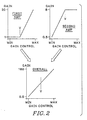
- Fig. 2 is a series of gain versus gain control graphs illustrating the operation of the keyer of Fig. 1.
- a key signal is input to a first amplifier 10, the gain of which is controlled by a gain control signal.
- the output of the first amplifier 10 is input to a comparator 20 together with a clip control signal.
- the output of the comparator 20 is input to a second amplifier 30, the gain of which also is controlled by the gain control signal.
- the output of the second amplifier is a key control signal.
- the first amplifier 10 has an input high gain stage 12 to which the key signal is applied.
- the output of the high gain stage 12 is input to a first multiplier 14 to which a first modified gain control signal is applied.
- the gain control signal is input to a first non-additive mixer (NAM) 16 that has a linear output characteristic for gain control signal values above a threshold gain control value, V, and a fixed output for gain control values at or below V.
- NAM non-additive mixer
- the resultant gain of the first amplifier 10 is a fixed gain for gain control signal values below the threshold V and an increasing gain for gain control values over the threshold.
- the second amplifier 30 has an input adder 31 for combining the output of the comparator 20 with a feedback signal.
- the output of the adder 31 is input to a clipper 33 and then shaped by a shaping circuit 35.
- the output of the shaping circuit 35 is input to a low gain stage 37, the output of which is the key control signal.
- the key control signal is input to a second multiplier 39 to which is applied a second modified gain control signal.
- the second modified gain control signal is obtained from a second non-additive mixer (NAM) 40 to which the gain control signal is input.
- the output characteristic of the second NAM 40 is linear when the input gain control signal is below the threshold V, and a fixed output when the gain control signal is at or above the threshold V.
- the second multiplier 39 varies the feedback applied to the second amplifier 30 from a maximum amount to zero when the gain control signal is below the threshold V, and causes zero feedback to be applied when the gain control is at or above the threshold V.
- the gain of the first amplifier 10 varies from one to maximum, i.e, 20 for the circuit shown in Fig. 1, during the upper part of the gain control signal's range, i.e., above V.
- the gain of the second amplifier 30 varies from low, i.e., 0.5 for the circuit shown in Fig. 1, to its maximum gain during the lower part of the gain control signal's range, i.e., below V.
- the overall gain for the keyer is continuous from 0.5 to 160 for the gain values shown in Figs. 1 and 2.
- the amount of feedback in the second amplifier 30 determines the maximum gain of the variable gain amplifier. With no feedback the overall amplifier gain is maximum. With full feedback the overall amplifier gain is reduced by the amount of available feedback.
- Each of the amplifier gains is varied in such a way so that the gain of the second amplifier 30 goes from minimum gain without shaping to its maximum gain with shaping, and then the gain of the first amplifier 10 varies from its minimum to its maximum.
- the result is that as the gain control signal is varied, the overall gain of the circuit varies so that the low gain end of the range includes gains required for linear keying with no visible shaping, and at gains above the maximum gain of the second amplifier 30 shaping required for luminance keying is fully present. At gains between unity and the maximum gain of the second amplifier 30 shaping is gradually added.
- variable gain amplifier has two stages, the first stage varying in gain over the high gain range and the second stage varying in gain over the low gain range, the second stage including feedback that is maximum for the lowest gain of the second stage and minimum for the highest gain so that shaping is gradually added over the range of one to the maximum gain of the second stage.
Landscapes
- Engineering & Computer Science (AREA)
- Multimedia (AREA)
- Signal Processing (AREA)
- Studio Circuits (AREA)
- Control Of Amplification And Gain Control (AREA)
- Tone Control, Compression And Expansion, Limiting Amplitude (AREA)
Claims (4)
- Incrustateur avec mise en forme variable comprenant :un premier amplificateur (10) ayant un gain relativement grand qui est variable dans une partie supérieure d'une plage d'un signal de commande de gain dans lequel on entre un signal d'incrustation ;un moyen de comparaison (20) pour comparer la sortie du premier amplificateur avec un signal de commande d'écrêtage pour produire un signal d'incrustation de luminance ;un second amplificateur (30) ayant un gain relativement faible qui est variable dans une partie inférieure de la plage du signal de commande de gain et dans lequel on entre le signal d'incrustation de luminance du moyen de comparaison, le second amplificateur fournissant un signal de commande d'incrustation ; etun circuit de contre-réaction (39, 40) faisant partie du second amplificateur qui délivre le signal de commande d'incrustation, en tant que signal de contre-réaction, à l'entrée du second amplificateur pour combinaison avec le signal d'incrustation de luminance, le circuit de contre-réaction fournissant, au second amplificateur, un gain minimal et une mise en forme minimale lorsque le signal de contre-réaction est maximal et fournissant, au second amplificateur, un gain maximal et une mise en forme maximale lorsque le signal de contre-réaction est minimal, le gain global étant ainsi un rapport continu allant d'une valeur inférieure à un à une valeur beaucoup plus grande que un en fonction dudit signal de commande de gain.
- Incrustateur selon la revendication 1, dans lequel le premier amplificateur comprend :un étage à grand gain (12) ayant, comme entrée, le signal d'incrustation ;un premier multiplieur (14) dans lequel on entre la sortie de l'étage à grand gain en même temps qu'un premier signal de commande de gain modifié, la sortie du premier multiplieur étant la sortie du premier amplificateur qui est entrée dans le moyen de comparaison ; etun moyen générateur (16) pour produire le premier signal de commande de gain modifié à partir du signal de commande de gain, de sorte que le gain du premier amplificateur varie sur la partie supérieure de la plage du signal de commande de gain.
- Incrustateur selon la revendication 1, dans lequel le second amplificateur comprend :un moyen d'écrêtage (33) pour écrêter la combinaison du signal d'incrustation de luminance et du signal de contre-réaction entre un niveau haut et un niveau bas ;un moyen de mise en forme (35) pour mettre en forme la sortie du moyen d'écrêtage ;un étage à faible gain (37) dans lequel on entre la sortie du moyen de mise en forme pour fournir le signal de commande d'incrustation ; etun moyen de combinaison (31) pour combiner le signal de contre-réaction avec le signal d'incrustation de luminance du moyen de comparaison pour fournir l'entrée au moyen d'écrêtage.
- Incrustateur selon la revendication 1, dans lequel le circuit de contre-réaction comprend :un second multiplieur (39) dans lequel on entre le signal de commande d'incrustation en même temps qu'un second signal de commande de gain modifié, la sortie du second multiplieur étant le signal de contre-réaction ; etun moyen générateur (40) pour produire le second signal de commande de gain modifié à partir du signal de commande de gain, de sorte que le gain du second amplificateur varie sur la partie inférieure de la plage du signal de commande de gain.
Applications Claiming Priority (2)
| Application Number | Priority Date | Filing Date | Title |
|---|---|---|---|
| US07/515,920 US5051828A (en) | 1990-04-27 | 1990-04-27 | Keyer with variable shaping |
| US515920 | 1995-08-16 |
Publications (3)
| Publication Number | Publication Date |
|---|---|
| EP0454487A2 EP0454487A2 (fr) | 1991-10-30 |
| EP0454487A3 EP0454487A3 (en) | 1992-12-09 |
| EP0454487B1 true EP0454487B1 (fr) | 1997-03-05 |
Family
ID=24053326
Family Applications (1)
| Application Number | Title | Priority Date | Filing Date |
|---|---|---|---|
| EP91303801A Expired - Lifetime EP0454487B1 (fr) | 1990-04-27 | 1991-04-26 | Circuit de commutation avec mise en forme variable |
Country Status (4)
| Country | Link |
|---|---|
| US (1) | US5051828A (fr) |
| EP (1) | EP0454487B1 (fr) |
| JP (1) | JP2727033B2 (fr) |
| DE (1) | DE69124825T2 (fr) |
Families Citing this family (7)
| Publication number | Priority date | Publication date | Assignee | Title |
|---|---|---|---|---|
| US5905539A (en) * | 1990-09-24 | 1999-05-18 | Tektronix, Inc. | Method and apparatus for generating a wipe solid |
| JP2964627B2 (ja) * | 1990-11-21 | 1999-10-18 | ソニー株式会社 | 画像切換装置 |
| JP3503166B2 (ja) * | 1993-07-29 | 2004-03-02 | ソニー株式会社 | 信号変換装置および方法 |
| JPH08181914A (ja) * | 1994-12-21 | 1996-07-12 | Sony Corp | キー信号波形整形装置 |
| GB2299724A (en) * | 1995-04-06 | 1996-10-09 | Dynatech Corp Limited | Suppressing video signals |
| FR2741770B1 (fr) * | 1995-11-23 | 1998-01-02 | Thomson Broadcast Systems | Procede de calcul d'une cle de decoupe d'un sujet evoluant devant un fond colore et dispositif mettant en oeuvre ce procede |
| FR2741769B1 (fr) * | 1995-11-23 | 1997-12-19 | Thomson Broadcast Systems | Procede de traitement du signal constitue par un sujet evoluant devant un fond colore et dispositif mettant en oeuvre ce procede |
Family Cites Families (12)
| Publication number | Priority date | Publication date | Assignee | Title |
|---|---|---|---|---|
| US3678182A (en) * | 1971-03-12 | 1972-07-18 | Philips Broadcast Equip | Chroma key circuit |
| US4141041A (en) * | 1976-09-22 | 1979-02-20 | The Singer Company | Precision gain balance of two video sources for a single display |
| US4206474A (en) * | 1978-08-30 | 1980-06-03 | Rca Corporation | Low-pass filter with remotely controllable rise time |
| JPS5869190A (ja) * | 1981-10-20 | 1983-04-25 | Fujitsu General Ltd | クロマキ−信号発生装置 |
| JPS605677A (ja) * | 1983-06-23 | 1985-01-12 | Nippon Television Kogyo Kk | テレビジヨン信号発生回路 |
| FR2576733B1 (fr) * | 1985-01-28 | 1987-04-24 | Telediffusion Fse | Systeme de surimpression d'images |
| US4970595A (en) * | 1985-04-12 | 1990-11-13 | Ampex Corporation | Apparatus and method for processing video signals with key signals in accordance with previous processing of the video signals |
| US4800432A (en) * | 1986-10-24 | 1989-01-24 | The Grass Valley Group, Inc. | Video Difference key generator |
| US4910592A (en) * | 1988-01-13 | 1990-03-20 | Picker International, Inc. | Radiation imaging automatic gain control |
| US4947255A (en) * | 1988-09-19 | 1990-08-07 | The Grass Valley Group, Inc. | Video luminance self keyer |
| US4920415A (en) * | 1989-03-20 | 1990-04-24 | The Grass Valley Group, Inc. | Self keyer |
| US4967277A (en) * | 1989-10-06 | 1990-10-30 | The Grass Valley Group, Inc. | Non-linear keyer |
-
1990
- 1990-04-27 US US07/515,920 patent/US5051828A/en not_active Expired - Fee Related
-
1991
- 1991-04-23 JP JP3119348A patent/JP2727033B2/ja not_active Expired - Lifetime
- 1991-04-26 EP EP91303801A patent/EP0454487B1/fr not_active Expired - Lifetime
- 1991-04-26 DE DE69124825T patent/DE69124825T2/de not_active Expired - Fee Related
Also Published As
| Publication number | Publication date |
|---|---|
| EP0454487A3 (en) | 1992-12-09 |
| JP2727033B2 (ja) | 1998-03-11 |
| DE69124825D1 (de) | 1997-04-10 |
| US5051828A (en) | 1991-09-24 |
| EP0454487A2 (fr) | 1991-10-30 |
| DE69124825T2 (de) | 1997-10-16 |
| JPH04229785A (ja) | 1992-08-19 |
Similar Documents
| Publication | Publication Date | Title |
|---|---|---|
| US4947255A (en) | Video luminance self keyer | |
| EP0454487B1 (fr) | Circuit de commutation avec mise en forme variable | |
| KR20000069723A (ko) | 개선된 오디오 재생 장치 및 전화기 단말 | |
| KR930001295B1 (ko) | 이득 조절기 | |
| US4860105A (en) | Noise Reducing circuit of a video signal | |
| EP0944166B1 (fr) | Circuit de commande automatique de dynamique | |
| US4441083A (en) | Noise reduction circuit | |
| EP0840501B1 (fr) | Circuit pour l'accentuation d'un signal vidéo | |
| EP0425112B1 (fr) | Circuit de commutation non linéaire | |
| GB2210741A (en) | Analog to digital conversion | |
| JPH04365210A (ja) | 車載音響再生装置 | |
| US4928071A (en) | Limiter circuit | |
| US5748258A (en) | Apparatus and method for processing a video signal | |
| US4903020A (en) | Method and apparatus for digitally processing stored compressed analog signals | |
| EP0851575A2 (fr) | Amplicateurs de radiofréquences | |
| JP2871323B2 (ja) | 映像信号処理装置 | |
| JP2570256B2 (ja) | デイジタルクリツプ補正回路 | |
| JPH07105679B2 (ja) | オーディオ装置 | |
| JP3029361B2 (ja) | 自動利得制御回路 | |
| JP2611238B2 (ja) | 振幅圧縮伸長回路 | |
| KR0144779B1 (ko) | 윤곽보정장치 | |
| JPH09284073A (ja) | 自動利得制御回路 | |
| JPH05292347A (ja) | ガンマ補正回路 | |
| JPH06351036A (ja) | 高彩度画像ディテール補償回路 | |
| JPH11512892A (ja) | ビデオ信号処理装置 |
Legal Events
| Date | Code | Title | Description |
|---|---|---|---|
| PUAI | Public reference made under article 153(3) epc to a published international application that has entered the european phase |
Free format text: ORIGINAL CODE: 0009012 |
|
| AK | Designated contracting states |
Kind code of ref document: A2 Designated state(s): DE FR GB |
|
| PUAL | Search report despatched |
Free format text: ORIGINAL CODE: 0009013 |
|
| AK | Designated contracting states |
Kind code of ref document: A3 Designated state(s): DE FR GB |
|
| 17P | Request for examination filed |
Effective date: 19930602 |
|
| 17Q | First examination report despatched |
Effective date: 19950315 |
|
| GRAG | Despatch of communication of intention to grant |
Free format text: ORIGINAL CODE: EPIDOS AGRA |
|
| GRAH | Despatch of communication of intention to grant a patent |
Free format text: ORIGINAL CODE: EPIDOS IGRA |
|
| GRAH | Despatch of communication of intention to grant a patent |
Free format text: ORIGINAL CODE: EPIDOS IGRA |
|
| GRAA | (expected) grant |
Free format text: ORIGINAL CODE: 0009210 |
|
| AK | Designated contracting states |
Kind code of ref document: B1 Designated state(s): DE FR GB |
|
| PG25 | Lapsed in a contracting state [announced via postgrant information from national office to epo] |
Ref country code: FR Effective date: 19970305 |
|
| REF | Corresponds to: |
Ref document number: 69124825 Country of ref document: DE Date of ref document: 19970410 |
|
| EN | Fr: translation not filed | ||
| PLBE | No opposition filed within time limit |
Free format text: ORIGINAL CODE: 0009261 |
|
| STAA | Information on the status of an ep patent application or granted ep patent |
Free format text: STATUS: NO OPPOSITION FILED WITHIN TIME LIMIT |
|
| 26N | No opposition filed | ||
| PGFP | Annual fee paid to national office [announced via postgrant information from national office to epo] |
Ref country code: GB Payment date: 19990323 Year of fee payment: 9 |
|
| PGFP | Annual fee paid to national office [announced via postgrant information from national office to epo] |
Ref country code: DE Payment date: 19990326 Year of fee payment: 9 |
|
| PG25 | Lapsed in a contracting state [announced via postgrant information from national office to epo] |
Ref country code: GB Free format text: LAPSE BECAUSE OF NON-PAYMENT OF DUE FEES Effective date: 20000426 |
|
| GBPC | Gb: european patent ceased through non-payment of renewal fee |
Effective date: 20000426 |
|
| PG25 | Lapsed in a contracting state [announced via postgrant information from national office to epo] |
Ref country code: DE Free format text: LAPSE BECAUSE OF NON-PAYMENT OF DUE FEES Effective date: 20010201 |