EP0454513A2 - Process and furnace for treating wastes which can be incinerated - Google Patents
Process and furnace for treating wastes which can be incinerated Download PDFInfo
- Publication number
- EP0454513A2 EP0454513A2 EP91400767A EP91400767A EP0454513A2 EP 0454513 A2 EP0454513 A2 EP 0454513A2 EP 91400767 A EP91400767 A EP 91400767A EP 91400767 A EP91400767 A EP 91400767A EP 0454513 A2 EP0454513 A2 EP 0454513A2
- Authority
- EP
- European Patent Office
- Prior art keywords
- waste
- bath
- crucible
- chamber
- container
- Prior art date
- Legal status (The legal status is an assumption and is not a legal conclusion. Google has not performed a legal analysis and makes no representation as to the accuracy of the status listed.)
- Granted
Links
- 239000002699 waste material Substances 0.000 title claims abstract description 64
- 238000000034 method Methods 0.000 title claims description 20
- 238000002485 combustion reaction Methods 0.000 claims abstract description 11
- 238000010438 heat treatment Methods 0.000 claims abstract description 10
- QVGXLLKOCUKJST-UHFFFAOYSA-N atomic oxygen Chemical compound [O] QVGXLLKOCUKJST-UHFFFAOYSA-N 0.000 claims abstract description 5
- 239000001301 oxygen Substances 0.000 claims abstract description 5
- 229910052760 oxygen Inorganic materials 0.000 claims abstract description 5
- VYPSYNLAJGMNEJ-UHFFFAOYSA-N Silicium dioxide Chemical compound O=[Si]=O VYPSYNLAJGMNEJ-UHFFFAOYSA-N 0.000 claims description 22
- 229910052500 inorganic mineral Inorganic materials 0.000 claims description 13
- 239000011707 mineral Substances 0.000 claims description 13
- 239000000203 mixture Substances 0.000 claims description 12
- 239000000377 silicon dioxide Substances 0.000 claims description 11
- 239000007789 gas Substances 0.000 claims description 9
- 239000000126 substance Substances 0.000 claims description 9
- 239000000463 material Substances 0.000 claims description 8
- 239000012159 carrier gas Substances 0.000 claims description 7
- 238000002844 melting Methods 0.000 claims description 6
- 230000008018 melting Effects 0.000 claims description 6
- 238000000227 grinding Methods 0.000 claims description 5
- 230000000694 effects Effects 0.000 claims description 4
- 239000007787 solid Substances 0.000 claims description 4
- 230000004907 flux Effects 0.000 claims description 3
- 239000002245 particle Substances 0.000 claims description 3
- 239000011819 refractory material Substances 0.000 abstract description 3
- 239000011521 glass Substances 0.000 description 8
- 238000009434 installation Methods 0.000 description 7
- 238000000197 pyrolysis Methods 0.000 description 7
- 229910052681 coesite Inorganic materials 0.000 description 6
- 229910052906 cristobalite Inorganic materials 0.000 description 6
- 235000012239 silicon dioxide Nutrition 0.000 description 6
- 229910052682 stishovite Inorganic materials 0.000 description 6
- 229910052905 tridymite Inorganic materials 0.000 description 6
- KKCBUQHMOMHUOY-UHFFFAOYSA-N Na2O Inorganic materials [O-2].[Na+].[Na+] KKCBUQHMOMHUOY-UHFFFAOYSA-N 0.000 description 5
- 238000002309 gasification Methods 0.000 description 5
- CDBYLPFSWZWCQE-UHFFFAOYSA-L Sodium Carbonate Chemical compound [Na+].[Na+].[O-]C([O-])=O CDBYLPFSWZWCQE-UHFFFAOYSA-L 0.000 description 4
- 239000002956 ash Substances 0.000 description 4
- XUIMIQQOPSSXEZ-UHFFFAOYSA-N Silicon Chemical compound [Si] XUIMIQQOPSSXEZ-UHFFFAOYSA-N 0.000 description 3
- HEMHJVSKTPXQMS-UHFFFAOYSA-M Sodium hydroxide Chemical compound [OH-].[Na+] HEMHJVSKTPXQMS-UHFFFAOYSA-M 0.000 description 3
- 238000004806 packaging method and process Methods 0.000 description 3
- 229910052710 silicon Inorganic materials 0.000 description 3
- 239000010703 silicon Substances 0.000 description 3
- 239000004698 Polyethylene Substances 0.000 description 2
- 229910000831 Steel Inorganic materials 0.000 description 2
- QAOWNCQODCNURD-UHFFFAOYSA-N Sulfuric acid Chemical compound OS(O)(=O)=O QAOWNCQODCNURD-UHFFFAOYSA-N 0.000 description 2
- 239000000654 additive Substances 0.000 description 2
- 229910000288 alkali metal carbonate Inorganic materials 0.000 description 2
- 150000008041 alkali metal carbonates Chemical class 0.000 description 2
- 238000005266 casting Methods 0.000 description 2
- 239000000356 contaminant Substances 0.000 description 2
- 239000003517 fume Substances 0.000 description 2
- 230000004927 fusion Effects 0.000 description 2
- 239000012633 leachable Substances 0.000 description 2
- 238000012423 maintenance Methods 0.000 description 2
- 238000004519 manufacturing process Methods 0.000 description 2
- 230000001590 oxidative effect Effects 0.000 description 2
- 239000004033 plastic Substances 0.000 description 2
- 229920003023 plastic Polymers 0.000 description 2
- -1 polyethylene Polymers 0.000 description 2
- 229920000573 polyethylene Polymers 0.000 description 2
- 229910000029 sodium carbonate Inorganic materials 0.000 description 2
- 239000010959 steel Substances 0.000 description 2
- VEXZGXHMUGYJMC-UHFFFAOYSA-M Chloride anion Chemical compound [Cl-] VEXZGXHMUGYJMC-UHFFFAOYSA-M 0.000 description 1
- ZAMOUSCENKQFHK-UHFFFAOYSA-N Chlorine atom Chemical compound [Cl] ZAMOUSCENKQFHK-UHFFFAOYSA-N 0.000 description 1
- 229920000742 Cotton Polymers 0.000 description 1
- 235000002918 Fraxinus excelsior Nutrition 0.000 description 1
- VEXZGXHMUGYJMC-UHFFFAOYSA-N Hydrochloric acid Chemical compound Cl VEXZGXHMUGYJMC-UHFFFAOYSA-N 0.000 description 1
- 239000002253 acid Substances 0.000 description 1
- 230000000996 additive effect Effects 0.000 description 1
- 239000000443 aerosol Substances 0.000 description 1
- 229910000272 alkali metal oxide Inorganic materials 0.000 description 1
- 239000002585 base Substances 0.000 description 1
- 239000011230 binding agent Substances 0.000 description 1
- 229910052810 boron oxide Inorganic materials 0.000 description 1
- 230000015556 catabolic process Effects 0.000 description 1
- 239000000460 chlorine Substances 0.000 description 1
- 229910052801 chlorine Inorganic materials 0.000 description 1
- 239000000567 combustion gas Substances 0.000 description 1
- 230000001143 conditioned effect Effects 0.000 description 1
- 238000006731 degradation reaction Methods 0.000 description 1
- 238000004821 distillation Methods 0.000 description 1
- 239000000839 emulsion Substances 0.000 description 1
- 238000003912 environmental pollution Methods 0.000 description 1
- 239000004744 fabric Substances 0.000 description 1
- 239000011261 inert gas Substances 0.000 description 1
- 238000002347 injection Methods 0.000 description 1
- 239000007924 injection Substances 0.000 description 1
- 239000007788 liquid Substances 0.000 description 1
- 238000011068 loading method Methods 0.000 description 1
- 229910044991 metal oxide Inorganic materials 0.000 description 1
- 150000004706 metal oxides Chemical class 0.000 description 1
- 239000010812 mixed waste Substances 0.000 description 1
- 238000002156 mixing Methods 0.000 description 1
- 230000007935 neutral effect Effects 0.000 description 1
- 238000009206 nuclear medicine Methods 0.000 description 1
- 239000003921 oil Substances 0.000 description 1
- 230000003647 oxidation Effects 0.000 description 1
- 238000007254 oxidation reaction Methods 0.000 description 1
- MOWNZPNSYMGTMD-UHFFFAOYSA-N oxidoboron Chemical class O=[B] MOWNZPNSYMGTMD-UHFFFAOYSA-N 0.000 description 1
- 229940096825 phenylmercury Drugs 0.000 description 1
- DCNLOVYDMCVNRZ-UHFFFAOYSA-N phenylmercury(.) Chemical compound [Hg]C1=CC=CC=C1 DCNLOVYDMCVNRZ-UHFFFAOYSA-N 0.000 description 1
- 238000000746 purification Methods 0.000 description 1
- 230000002285 radioactive effect Effects 0.000 description 1
- 229920005989 resin Polymers 0.000 description 1
- 239000011347 resin Substances 0.000 description 1
- 230000000717 retained effect Effects 0.000 description 1
- 150000003839 salts Chemical class 0.000 description 1
- 239000010802 sludge Substances 0.000 description 1
- 239000011343 solid material Substances 0.000 description 1
- 239000002900 solid radioactive waste Substances 0.000 description 1
- 238000007711 solidification Methods 0.000 description 1
- 230000008023 solidification Effects 0.000 description 1
- 239000000243 solution Substances 0.000 description 1
- 238000009827 uniform distribution Methods 0.000 description 1
Images
Classifications
-
- G—PHYSICS
- G21—NUCLEAR PHYSICS; NUCLEAR ENGINEERING
- G21F—PROTECTION AGAINST X-RADIATION, GAMMA RADIATION, CORPUSCULAR RADIATION OR PARTICLE BOMBARDMENT; TREATING RADIOACTIVELY CONTAMINATED MATERIAL; DECONTAMINATION ARRANGEMENTS THEREFOR
- G21F9/00—Treating radioactively contaminated material; Decontamination arrangements therefor
- G21F9/28—Treating solids
- G21F9/30—Processing
- G21F9/32—Processing by incineration
-
- F—MECHANICAL ENGINEERING; LIGHTING; HEATING; WEAPONS; BLASTING
- F23—COMBUSTION APPARATUS; COMBUSTION PROCESSES
- F23G—CREMATION FURNACES; CONSUMING WASTE PRODUCTS BY COMBUSTION
- F23G5/00—Incineration of waste; Incinerator constructions; Details, accessories or control therefor
- F23G5/02—Incineration of waste; Incinerator constructions; Details, accessories or control therefor with pretreatment
- F23G5/033—Incineration of waste; Incinerator constructions; Details, accessories or control therefor with pretreatment comminuting or crushing
-
- F—MECHANICAL ENGINEERING; LIGHTING; HEATING; WEAPONS; BLASTING
- F23—COMBUSTION APPARATUS; COMBUSTION PROCESSES
- F23G—CREMATION FURNACES; CONSUMING WASTE PRODUCTS BY COMBUSTION
- F23G2204/00—Supplementary heating arrangements
- F23G2204/20—Supplementary heating arrangements using electric energy
- F23G2204/203—Microwave
-
- F—MECHANICAL ENGINEERING; LIGHTING; HEATING; WEAPONS; BLASTING
- F23—COMBUSTION APPARATUS; COMBUSTION PROCESSES
- F23G—CREMATION FURNACES; CONSUMING WASTE PRODUCTS BY COMBUSTION
- F23G2209/00—Specific waste
- F23G2209/18—Radioactive materials
Definitions
- the carrier gas drive pressure to be just greater than the pressure corresponding to the height of the column formed by the molten bath.
- the doser 4 sends 667 g of waste / minute in the duct 7.
- the doser 5 sends 19 g of sodium carbonate / minute into line 7.
Landscapes
- Engineering & Computer Science (AREA)
- General Engineering & Computer Science (AREA)
- Mechanical Engineering (AREA)
- Environmental & Geological Engineering (AREA)
- Physics & Mathematics (AREA)
- High Energy & Nuclear Physics (AREA)
- Processing Of Solid Wastes (AREA)
- Gasification And Melting Of Waste (AREA)
- Incineration Of Waste (AREA)
- Crucibles And Fluidized-Bed Furnaces (AREA)
- Processing And Handling Of Plastics And Other Materials For Molding In General (AREA)
Abstract
Description
La présente invention est relative aux procédés et aux fours de traitement de déchets incinérables, notamment de faible activité nucléaire. Il s'agit notamment de traiter les déchets technologiques se produisant lors des interventions d'entretien et de réparations dans les parties actives d'une installation nucléaire, tels que des gants, des blouses, des surbottes, des plastiques, tels que des flacons de polyéthylène contenant des résidus organiques, mais également des déchets de fonctionnement tels que des résines, des boues organiques, des huiles ou des émulsions. Ces déchets se composent de substances organiques porteuses de radionucléides.The present invention relates to methods and furnaces for the treatment of incinerable waste, in particular of low nuclear activity. This notably involves treating technological waste produced during maintenance and repair operations in the active parts of a nuclear installation, such as gloves, coats, overboots, plastics, such as polyethylene containing organic residues, but also operational waste such as resins, organic sludge, oils or emulsions. This waste consists of organic substances carrying radionuclides.
On connaît déjà un certain nombre de procédés d'incinération de ce type de déchets. Ils présentent tous certains inconvénients tels que la nécessité d'un tri préalable des déchets en fonction de leur pouvoir calorifique inférieur, d'une collecte de cendres pulvérulentes avec, en aval, des conditionnements peu sûrs et la production d'imbrûlés dans les fumées nécessitant des post-combustions coûteuses et peu efficaces.A number of methods of incinerating this type of waste are already known. They all have certain drawbacks such as the need to pre-sort waste according to their lower calorific value, to collect powdery ash with, downstream, unsafe packaging and the production of unburnt in the fumes requiring costly and ineffective afterburners.
Au GB-A-2 157 062, on décrit un procédé de traitement de déchets contenant des radionucléides, qui consiste à charger de la matiére vitreuse dans un four à micro-ondes et à l'y faire fondre sous atmosphère d'air entre 1100 et 1500°C. Puis on met le four sous atmosphère de gaz inerte, tout en modifiant le chauffage micro-onde et on y introduit les déchets à traiter pour les sécher et les distiller. On met ensuite le four sous atmosphère d'air pour brûler les déchets en modifiant le chauffage micro-onde.On modifie encore ensuite le débit d'air et de chauffage pour fondre le résidu dans la matière vitreuse. Au FR-A-2454677, on propose de broyer des déchets radioactifs solides pour mieux les attaquer par l'acide sulfurique.In GB-A-2 157 062, a process for the treatment of waste containing radionuclides is described, which consists in loading vitreous material in a microwave oven and in melting it there under an air atmosphere between 1100 and 1500 ° C. Then the oven is placed under an inert gas atmosphere, while modifying the microwave heating and there introduces the waste to be treated to dry and distill it. The oven is then placed in an air atmosphere to burn the waste by modifying the microwave heating. The air and heating flow is then further modified to melt the residue in the vitreous material. In FR-A-2454677, it is proposed to grind solid radioactive waste in order to better attack it with sulfuric acid.
L'invention vise un procédé permettant de réduire les volumes de déchets à conditionner et de conditionner ces déchets, après gazéification et/ou fusion, sans production de cendres pulvérulentes ni d'imbrûlés, donc dans des conditions de sécurité très satisfaisantes, avec une vitesse élevée, tout en ne nécessitant qu'un investissement réduit et dont le fonctionnement est très simple, sans nécessiter notamment des réglages répétés du chauffage et de l'atmosphère d'un four, ni des températures très élevées.The invention relates to a process making it possible to reduce the volumes of waste to be conditioned and to condition this waste, after gasification and / or fusion, without the production of powdery ash or unburnt matter, therefore under very satisfactory safety conditions, with a speed high, while requiring only a reduced investment and whose operation is very simple, without requiring in particular repeated adjustments of the heating and the atmosphere of an oven, or very high temperatures.
Le procédé suivant l'invention consiste à broyer les déchets à une granulométrie inférieure à 2 mm, à les entraîner par un gaz porteur dans la partie inférieure d'un bain à base de silice fondue, à couler le bain dans lequel se trouvent les matières minérales, dont notamment des radionucléides solides dans le cas de déchets nucléaires, dans un conteneur et à laisser le bain se solidifier dans le conteneur.The process according to the invention consists in grinding the waste to a particle size of less than 2 mm, in entraining it by a carrier gas in the lower part of a bath based on molten silica, in pouring the bath in which the materials are found minerals, including in particular solid radionuclides in the case of nuclear waste, in a container and allowing the bath to solidify in the container.
On effectue, avantageusement, un broyage cryogénique à une température allant de -120 à -80°C. Le broyage préalable facilite non pas une attaque chimique par un acide, mais l'opération ultérieure de pyrolyse des substances organiques des déchets et l'opération physique ultérieure de fusion des matières minérales des déchets dans le bain. Il contribue, de paire avec la hauteur du bain, à la possibilité de traiter les déchets d'un coup, sans avoir à modifier l'atmosphère au dessus au bain pour effectuer des stades successifs distincts de distillation et de combustion. L'entraînement par un gaz porteur y contribue également, en assurant une répartition uniforme des déchets dans le bain.Advantageously, cryogenic grinding is carried out at a temperature ranging from -120 to -80 ° C. The preliminary grinding facilitates not a chemical attack by an acid, but the subsequent operation of pyrolysis of the organic substances of the waste and the subsequent physical operation of melting the mineral matter of the waste in the bath. It contributes, in combination with the height of the bath, to the possibility of treating waste at once, without having to modify the atmosphere above in the bath to carry out separate successive stages of distillation and combustion. Driving by a carrier gas also contributes to this, by ensuring a uniform distribution of the waste in the bath.
Les cendres et matières minérales solides nucléaires restent ainsi dans le bain qui s'enrichit en radionucléides solides et qui, une fois stocké après solidification dans le conteneur, occupe un volume bien moindre que les déchets de départ. La dégradation des chaînes organiques par pyrolyse donne des produits à molécules plus simples, ce qui facilite la gazéification complète en atmosphère de préférence oxydante au-dessus du bain, les gaz de combustion étant ensuite envoyés et épurés en aval. La pyrolyse et la gazéification des produits de pyrolyse sont indépendantes des pouvoirs calorifiques inférieurs des déchets traités, ce qui permet de ne pas pratiquer de tri préalable. Le volume des déchets organiques porteurs est transformé en un volume de gaz qui peut être rejeté après épuration, les matières solides résiduelles étant incorporées au bain en n'augmentant son volume que dans de faibles proportions. La réduction de volume est très importante et il ne se forme pas de cendres pulvérulentes. La gazéification complète des produits de pyrolyse à molécules plus simples supprime la présence d'imbrûlés dans les fumées.The ashes and nuclear solid mineral matter thus remain in the bath which is enriched with solid radionuclides and which, once stored after solidification in the container, occupies a much smaller volume than the initial waste. The degradation of organic chains by pyrolysis gives products with simpler molecules, which facilitates complete gasification in a preferably oxidizing atmosphere above the bath, the combustion gases being then sent and purified downstream. The pyrolysis and gasification of the pyrolysis products are independent of the lower calorific values of the treated waste, which eliminates the need for prior sorting. The volume of organic carrier waste is transformed into a volume of gas which can be rejected after purification, the residual solid materials being incorporated into the bath, increasing its volume only in small proportions. The reduction in volume is very important and there is no powdery ash formed. The complete gasification of the pyrolysis products with simpler molecules eliminates the presence of unburnt matter in the fumes.
Pour diminuer la quantité de gaz à traiter en aval du four, il est avantageux que la pression d'entraînement du gaz porteur soit juste supérieure à la pression correspondant à la hauteur de la colonne formée par le bain fondu.To reduce the quantity of gas to be treated downstream from the oven, it is advantageous for the carrier gas drive pressure to be just greater than the pressure corresponding to the height of the column formed by the molten bath.
En ne coulant de préférence qu'une partie du bain du conteneur, on maintient en permanence un bain en température au fond du creuset, ce qui permet un traitement continu, sans interruption de l'équilibre énergétique.Preferably by flowing only part of the container bath, a temperature bath is permanently maintained at the bottom of the crucible, which allows continuous treatment, without interrupting the energy balance.
Pour être bien sûr que les déchets broyés entraînés dans le bain à base de silice fondue soient bien pyrolysés et que les matières minérales s'incorporent bien au bain par fusion, le bain a une hauteur de 5 à 40 cm au-dessus du niveau d'arrivée des déchets, pour une température du bain de 1000 à 1100°C. Il vaut mieux, de la même façon, que la masse du bain représente de 0,2 à 6 fois le débit massique horaire des déchets. Pour maîtriser la composition du bain, on peut ajouter aux déchets des produits minéraux en une quantité et d'une nature telles que la composition minérale des déchets devienne sensiblement identique à celle du bain. Celui-ci est constitué en général de 40 à 100 % en poids de SiO₂ et de 0 à 60 % en poids d'autres oxydes métalliques, tels que des oxydes de métal alcalin et des oxydes de bore servant de fondants.To be sure that the ground waste entrained in the bath based on molten silica is well pyrolyzed and that the mineral materials are incorporated well in the bath by fusion, the bath has a height of 5 to 40 cm above the level d waste, for a bath temperature of 1000 to 1100 ° C. It is better, in the same way, that the mass of the bath represents from 0.2 to 6 times the hourly mass flow rate of the waste. To control the composition of the bath, mineral products can be added to the waste in an amount and of a nature such that the mineral composition of the waste becomes substantially identical to that of the bath. This generally consists of 40 to 100% by weight of SiO₂ and from 0 to 60% by weight of other metal oxides, such as alkali metal oxides and boron oxides serving as fluxes.
On peut ajouter également aux déchets un fondant permettant de fondre les matières minérales contenues dans les déchets à une température plus basse et de manière que la composition des matières minérales des déchets devienne identique à celle du bain.A flux may also be added to the waste, making it possible to melt the mineral materials contained in the waste at a lower temperature and so that the composition of the mineral materials in the waste becomes identical to that of the bath.
On introduit de préférence un gaz contenant de l'oxygène au-dessus du bain pour effectuer la gazéification des produits de la pyrolyse en atmosphère oxydante au-dessus du bain. Le gaz porteur le plus simple à utiliser est l'air, mais le gaz porteur d'introduction des déchets dans le bain peut être aussi un gaz neutre, sec ou à forte hygrométrie ou réducteur ou donnant dans le bain des conditions d'oxydation hypostoechiométriques. Mais, il n'est pas nécessaire de modifier l'atmosphère au dessus du bain au cours du procédé.Preferably, an oxygen-containing gas is introduced above the bath to effect the gasification of the pyrolysis products in an oxidizing atmosphere above the bath. The simplest carrier gas to use is air, but the carrier gas for introducing waste into the bath can also be a neutral, dry or highly hygrometric or reducing gas or which gives hypostoichiometric oxidation conditions in the bath. . However, it is not necessary to modify the atmosphere above the bath during the process.
L'invention vise également un four de traitement de déchets comprenant un creuset muni d'un dispositif de chauffage, un conduit d'amenée des déchets débouchant dans le bas du creuset, un conduit de soutirage d'un bain débouchant dans le creuset à un niveau supérieur à celui de l'embouchure du conduit d'amenée des déchets, le haut du creuset communiquant avec une chambre de combustion, laquelle communique, par un passage chicané vers le haut, délimité dans une voûte, avec une chambre d'évacuation, un conduit d'amenée d'un gaz contenant de l'oxygène débouchant dans la chambre de combustion.The invention also relates to a waste treatment furnace comprising a crucible provided with a heating device, a waste supply pipe opening out at the bottom of the crucible, a pipe for drawing off a bath opening into the crucible at a level higher than that of the mouth of the waste supply duct, the top of the crucible communicating with a combustion chamber, which communicates, by a baffled passage upwards, delimited in a vault, with an evacuation chamber, an oxygen-containing gas supply duct opening into the combustion chamber.
Ce four permet d'effectuer le traitement, suivant l'invention, des déchets contaminés, le passage chicané permettant au gaz de pyrolyse de séjourner suffisamment longtemps dans la chambre de combustion pour y être brûlé complètement en empêchant ces gaz d'aller directement dans le reste de l'installation en aval.This oven makes it possible to carry out the treatment, according to the invention, of contaminated waste, the baffled passage allowing the pyrolysis gas to remain long enough in the combustion chamber to be burnt completely there by preventing these gases from going directly into the rest of downstream facility.
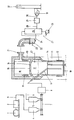
Au dessin annexé, donné uniquement à titre d'exemple, la figure unique illustre un four suivant l'invention dans une installation complète de traitement des déchets, les diverses vannes et équipements auxiliaires de régulation ayant été omis.In the accompanying drawing, given solely by way of example, the single figure illustrates an oven according to the invention in a complete waste treatment installation, the various valves and auxiliary regulation equipment having been omitted.
L'installation comprend une unité de broyage cryogénique, composée d'un concasseur déchiqueteur 1 et d'un granulateur 2, qui fonctionnent à -120°C. Le déchet broyé est envoyé, par un conduit 3, à un premier doseur 4. Un deuxième doseur 5 est alimenté par un conduit 6 provenant d'une source d'additif. Les deux doseurs 4 et 5 débouchent dans un conduit 7 qui est alimenté d'un côté par une source d'air et qui mène à un cyclone mélangeur 8. De celui-ci part une canne 9 qui traverse la paroi latérale d'un four et débouche à proximité du fond 10 de celui-ci. Le four en matériau réfractaire comporte deux parties distinctes. Un creuset 11, en acier réfractaire en partie basse, contenant un bain silicieux fondu et muni de moyens de chauffage 12, et une partie haute, 13, en matériau réfractaire.The installation includes a cryogenic grinding unit, composed of a shredder crusher 1 and a
Une canne 14 de coulée passe à travers le fond 10 et débouche dans le creuset à une hauteur de 400 mm.A
La partie haute 13 comporte une voûte réfractaire 15 munie de passages 16 chicanés qui subdivisent cette partie haute en une chambre de combustion 17 formée au-dessus du bain silicieux et en-dessous de la voûte 15 et en une chambre d'évacuation 18, au-dessus de la voûte 15. La partie haute 13 est munie d'un dispositif de chauffage 19. Dans la chambre 17 débouche une rampe d'air 20. De la chambre 18, un conduit 21 mène à un refroidisseur d'air 22 alimenté en air par un conduit 23 et communiquant par un conduit 24 avec un neutralisateur chimique 25 qui transforme le chlore en chlorure soluble et qui fonctionne en circuit fermé, une pompe 26 faisant circuler, par un conduit 27, une solution de carbonate de métal alcalin ou de soude dans le neutralisateur 25. Un conduit 28 mène de celui-ci à un filtre à très haute efficacité 29. L'efficacité du filtre est de 99,98 %. Ce filtre est destiné à éliminer les aérosols radioactifs. Du filtre 29, un conduit 30 mène à un ventilateur 31 et à une cheminée 32.The
Les exemples suivants illustrent l'invention.The following examples illustrate the invention.
Dans l'installation représentée à la figure, on traite des déchets de maintenance et d'entretien des hôpitaux, des laboratoires et d'usines nucléaires composés de matière plastique, de caoutchouc, de papier, de coton, de tissu. Ces déchets sont contaminés par des radionucléides à vie courte et de faible activité nucléaire.In the installation shown in the figure, we deal with maintenance and upkeep waste from hospitals, laboratories and nuclear plants composed of plastic, rubber, paper, cotton, fabric. This waste is contaminated by short-lived, low-nuclear-activity radionuclides.
Ces déchets broyés dans le concasseur 1 et le granulateur 2, qui fonctionnent à -120°C, ont une granulométrie inférieure à 1 mm dans le conduit 3. Le doseur 4 envoie 667 g de déchets/minute dans le conduit 7. Le doseur 5 envoie 19 g de carbonate de sodium/minute dans le conduit 7.This waste crushed in the crusher 1 and the
Le débit d'air, dans le conduit 7, est de 3 m³ normaux/heure sous pression.The air flow rate in duct 7 is 3 m³ normal / hour under pressure.
Le creuset 11 en acier réfractaire a un diamètre de 500 mm et une hauteur de 1000 mm, ce qui correspond à une capacité de 196 litres. Il contient un bain silicieux fondu composé pour 61 % en poids de SiO₂ et pour 39 % en poids d'un mélange de B₂O₃ et de Na₂O. Le point de fusion est de 900 ± 20°C. La température en fonctionnement est de 1000 ± 50°C. La hauteur du bain, au début du traitement, est de 400 mm (78 litres correspondant sensiblement à 195 kg). Cette masse constitue le culot liquide permanent du creuset qui est à une température de 1000°C.The
L'orifice de la canne d'injection 9 des déchets se trouve à 100 mm au-dessus du fond 10.The orifice of the
Par la rampe 20, on envoie 350 m³ normaux/heure d'air dans la chambre de combustion 17.Via the
Par le conduit 22, on envoie 2300 m³ normaux d'air/heure à 20°C, ce qui permet de ramener la température des gaz sortant par le conduit 21 à une température inférieure à 100°C. La température à la sortie du refroidisseur est d'environ 80°C.Via
Les liants et additifs minéraux des déchets sont retenus dans le bain silicieux. La variation du volume du bain, pour un débit d'introduction de 40 kg/heure de déchets est de 0,7 litre/heure et on effectue une coulée de ce bain par la canne 14 toutes les 96 heures pour une unité traitant 40 kgh⁻¹. Le verre se solidifie dans son fût de réception. Sa composition chimique évolue peu en fonction du temps. L'analyse du verre coulé, après 8 heures de traitement, donne SiO₂ = 61 % + e, tandis que Na₂O + B₂O₃ = 39 % - e.The binders and mineral additives in the waste are retained in the silica bath. The variation in the volume of the bath, for an introduction rate of 40 kg / hour of waste is 0.7 liters / hour and this bath is poured by the
Les effluents sortant par la cheminée 32 comprennent 49.000 m³ normaux de CO₂/heure, 52 m³ d'H₂O/heure et 2600 m³ d'air/heure. La pollution de l'environnement est négligeable, puisque le procédé n'engendre qu'un rejet à 97 % d'air à 20°C. Les contaminants éventuels sont confinés dans le verre de coulée ou piégés sur le filtre spécifique et la teneur en HCl reste inférieure à 100 mg/m³ normal.The effluents exiting through the
Quand on sait que ce type de déchet est actuellement collecté puis compacté et enrobé de béton dans des conteneurs spécifiques et qu'un fût de 200 litres de capacité ne contient que 30 kg de déchets, on voit que le procédé suivant l'invention permet de réduire définitivement les volumes d'un coefficient de 350 environ, tout en permettant d'avoir un conditionnement peu encombrant ayant une bonne résistance mécanique et non lixiviable.When we know that this type of waste is currently collected, then compacted and coated with concrete in specific containers and that a 200-liter drum contains only 30 kg of waste, we see that the process according to the invention makes it possible to permanently reduce the volumes by a coefficient of around 350, while allowing space-saving packaging with good mechanical resistance and non-leachable.
On traite des flacons de polyéthylène et de verre contenant les scintillateurs et traceurs de la médecine nucléaire. L'installation est celle décrite à l'exemple 1.Polyethylene and glass bottles containing the scintillators and tracers of nuclear medicine are treated. The installation is that described in Example 1.
Le doseur 4 fournit 670 g de déchets/minute au conduit 7. Le doseur 5 fournit 25 g de carbonate de sodium/minute au conduit 7. Par la rampe 20, on envoie 5 m³ normaux/heure d'air dans la chambre 17. Par le conduit 23 passent 910 m³/heure, à une température de 20°C. La température, à la sortie du refroidisseur, est de 80°C environ. Dans ce cas, on supprime de l'installation le neutralisateur 25.The
La composition chimique du bain est de 60 % en poids de SiO₂ et de 40 % en poids du mélange de B₂O₃ et de Na₂O. Son point de fusion est de 900 ± 20°C. Sa température en fonctionnement est de 1000 ± 50°C.The chemical composition of the bath is 60% by weight of SiO₂ and 40% by weight of the mixture of B₂O₃ and Na₂O. Its melting point is 900 ± 20 ° C. Its operating temperature is 1000 ± 50 ° C.
La variation du volume du bain essentiellement produite par les flacons de verre pour un débit d'introduction de 40 kg de déchets/heure est de 12,5 litres/heure et on effectue une coulée par la canne 14 toutes les 8 heures (100 litres).The variation in the volume of the bath essentially produced by the glass bottles for an introduction rate of 40 kg of waste / hour is 12.5 liters / hour and a casting is carried out by the
La composition du verre obtenu évolue peu, en fonction du temps, la composition restant sensiblement identique à la composition initiale.The composition of the glass obtained changes little, as a function of time, the composition remaining substantially identical to the initial composition.
Les effluents gazeux sortant par la cheminée sont de 16 m³ normaux de CO₂/heure, 16 m³ d'H₂O/heure et 1000 m³ normaux d'air/heure. Le procédé n'engendre qu'un rejet à 97 % d'air et à 20°C. Les contaminants éventuels sont confinés dans le verre coulé ou piégés sur le filtre.The gaseous effluents leaving the chimney are 16 m³ normal CO de / hour, 16 m³ H₂O / hour and 1000 m³ normal air / hour. The process only generates a discharge at 97% air and at 20 ° C. Any contaminants are confined in the poured glass or trapped on the filter.
Actuellement, ces flacons sont broyés grossièrement pour récupérer les résidus de scintillation, puis compactés et enrobés de béton dans des conteneurs spécifiques. Un fût de 200 litres de ces déchets mélangés ne contient que 30 kg de verre. Le procédé permet de réduire les volumes d'un coefficient de 16 et donne un conditionnement peu encombrant, non lixiviable et de bonne résistance mécanique.Currently, these bottles are coarsely ground to recover scintillation residues, then compacted and coated with concrete in specific containers. A 200 liter drum of this mixed waste contains only 30 kg of glass. The process makes it possible to reduce the volumes by a coefficient of 16 and gives a space-saving, non-leachable packaging with good mechanical strength.
On traite des déchets de l'industrie chimique composés essentiellement de mercure phényle.Waste from the chemical industry is mainly composed of phenyl mercury.
L'installation est essentiellement celle utilisée à la figure 1.The installation is essentially that used in Figure 1.
Le doseur 4 fournit 167 g de déchets/minute au conduit 7. Le doseur 5 envoie 22 g d'un mélange de carbonate de métal alcalin et de silice/minute au conduit 7. On envoie 3 m³/heure d'air sous pression dans le conduit 7.The
Par la rampe 20, on envoie 60 m³ normaux/heure d'air à la chambre 17.Via
Par le conduit 23, on envoie 700 m³ normaux d'air à 20°C/heure. La température, à la sortie du refroidisseur 22, est de 80°C environ.Via
Le neutralisateur chimique transforme HgO en des sels solubles.The chemical neutralizer transforms HgO into soluble salts.
Le bain contient 60 % en poids de SiO₂ et 40 % en poids de Na₂O. Son point de fusion est de 900 ± 20°C. Sa température de fonctionnement est de 1000 ± 50°C.The bath contains 60% by weight of SiO₂ and 40% by weight of Na₂O. Its melting point is 900 ± 20 ° C. Its operating temperature is 1000 ± 50 ° C.
L'analyse du bain coulé, après 8 heures de traitement, donne SiO₂ = 60 % ± e et Na₂O = 40 % ± e.Analysis of the poured bath, after 8 hours of treatment, gives SiO₂ = 60% ± e and Na₂O = 40% ± e.
La variation du volume du bain, pour un débit d'introduction de 10 kg de déchets/heure, est de 3,2 litres/heure.The variation in the volume of the bath, for an introduction rate of 10 kg of waste / hour, is 3.2 liters / hour.
Les effluents gazeux comprennent 11 m³ normaux de CO₂/heure, 4 m³ normaux d'H₂O/heure et 700 m³ d'air/heure. Le procédé n'engendre qu'un rejet à 98, 5 % en poids d'air et à 20°C ( la teneur en Hg est inférieure à 0,3 mg.m³ normal.The gaseous effluents include 11 normal m³ of CO₂ / hour, 4 normal m³ of H₂O / hour and 700 m³ of air / hour. The process only generates a discharge at 98.5% by weight of air and at 20 ° C (the Hg content is less than 0.3 mg.m³ normal.
Claims (10)
Applications Claiming Priority (2)
| Application Number | Priority Date | Filing Date | Title |
|---|---|---|---|
| FR9003728 | 1990-03-23 | ||
| FR9003728A FR2659877B1 (en) | 1990-03-23 | 1990-03-23 | PROCESS AND OVEN FOR TREATING INCINERABLE WASTE. |
Publications (3)
| Publication Number | Publication Date |
|---|---|
| EP0454513A2 true EP0454513A2 (en) | 1991-10-30 |
| EP0454513A3 EP0454513A3 (en) | 1991-12-04 |
| EP0454513B1 EP0454513B1 (en) | 1995-06-28 |
Family
ID=9395037
Family Applications (1)
| Application Number | Title | Priority Date | Filing Date |
|---|---|---|---|
| EP91400767A Expired - Lifetime EP0454513B1 (en) | 1990-03-23 | 1991-03-21 | Process and furnace for treating wastes which can be incinerated |
Country Status (12)
| Country | Link |
|---|---|
| US (1) | US5277846A (en) |
| EP (1) | EP0454513B1 (en) |
| JP (1) | JPH04222682A (en) |
| AT (1) | ATE124563T1 (en) |
| BR (1) | BR9101130A (en) |
| CZ (1) | CZ284662B6 (en) |
| DE (1) | DE69110744T2 (en) |
| ES (1) | ES2075379T3 (en) |
| FR (1) | FR2659877B1 (en) |
| HU (1) | HU210642B (en) |
| MX (1) | MX172258B (en) |
| SK (1) | SK281037B6 (en) |
Cited By (3)
| Publication number | Priority date | Publication date | Assignee | Title |
|---|---|---|---|---|
| WO1998012003A1 (en) * | 1996-09-19 | 1998-03-26 | The Boc Group Plc | Treatment of waste |
| WO2003032328A1 (en) * | 2001-09-28 | 2003-04-17 | Forschungszentrum Jülich GmbH | Method for the detoxification of an object made from ceramic, graphite and/or carbon contaminated with at least one toxic agent in particular a radiotoxic agent |
| FR3080706A1 (en) * | 2018-04-25 | 2019-11-01 | Seche Eco Services | PROCESS FOR TREATING RADIOACTIVE BITUMIN WASTE |
Families Citing this family (8)
| Publication number | Priority date | Publication date | Assignee | Title |
|---|---|---|---|---|
| ES2161242T3 (en) * | 1993-04-06 | 2001-12-01 | Ausmelt Ltd | CAST OF A MATERIAL CONTAINING CARBON. |
| US5424042A (en) * | 1993-09-13 | 1995-06-13 | Mason; J. Bradley | Apparatus and method for processing wastes |
| US5611766A (en) * | 1996-02-06 | 1997-03-18 | Envitco, Inc. | Transportable, modular vitrification system for the treatment of waste material |
| UA57884C2 (en) * | 1999-10-14 | 2003-07-15 | Дейвід БРЕДБЕРІ | Method for treatment of radioactive graphite |
| KR100450003B1 (en) * | 2002-01-08 | 2004-09-30 | 현대모비스 주식회사 | rest throwing apparatus for solid radioactive waste |
| JP5877483B2 (en) * | 2012-02-13 | 2016-03-08 | 清水建設株式会社 | Volume reduction treatment method for combustible waste containing radioactive materials |
| CN104751929B (en) * | 2013-12-26 | 2018-07-06 | 中国辐射防护研究院 | It is integrated low to put combustible solid wastes by utilizing incinerator |
| JP6689012B2 (en) * | 2015-07-27 | 2020-04-28 | 瀬倉株式会社 | Handling method of protective clothing to prevent the generation of radioactively contaminated water due to washing in the radiation controlled area of nuclear facilities |
Family Cites Families (12)
| Publication number | Priority date | Publication date | Assignee | Title |
|---|---|---|---|---|
| DE2631220C2 (en) * | 1976-07-12 | 1986-03-06 | Sorg-GmbH & Co KG, 8770 Lohr | Melting furnace for melting radioactive substances in glass |
| DE2916203A1 (en) * | 1979-04-21 | 1980-11-06 | K E W A Kernbrennstoff Wiedera | METHOD FOR TREATING FLAMMABLE, SOLID, RADIOACTIVE WASTE |
| DE3247349C1 (en) * | 1982-12-22 | 1984-05-24 | Deutsche Gesellschaft für Wiederaufarbeitung von Kernbrennstoffen mbH, 3000 Hannover | Melting furnace for glazing highly radioactive waste |
| CA1200826A (en) * | 1983-06-17 | 1986-02-18 | Majesty (Her) In Right Of Canada As Represented By Atomic Energy Of Canada Limited/L'energie Atomique Du Canada Limitee | Joule melter for the processing of radioactive wastes |
| JPS60203900A (en) * | 1984-03-29 | 1985-10-15 | 日本原子力研究所 | Method of treating waste containing radioactive nuclide |
| US4632690A (en) * | 1985-06-04 | 1986-12-30 | Colwell Jr Robert E | Hazardous waste removal method and apparatus |
| US4735784A (en) * | 1986-07-11 | 1988-04-05 | Morrison-Knudsen Company, Inc. | Method of treating fluoride contaminated wastes |
| DE3815082A1 (en) * | 1988-05-04 | 1989-11-16 | Wiederaufarbeitung Von Kernbre | METHOD AND DEVICE FOR TREATING AND CONVEYING FEED CLEAR SLUDGE TO A GLAZING DEVICE |
| US5067978A (en) * | 1989-08-24 | 1991-11-26 | Fowler Benjamin P | Method for the removal of lead from waste products |
| US5022329A (en) * | 1989-09-12 | 1991-06-11 | The Babcock & Wilcox Company | Cyclone furnace for hazardous waste incineration and ash vitrification |
| US4977837A (en) * | 1990-02-27 | 1990-12-18 | National Recovery Technologies, Inc. | Process and apparatus for reducing heavy metal toxicity in fly ash from solid waste incineration |
| FR2659876B1 (en) * | 1990-03-23 | 1992-08-21 | Tanari Rene | PROCESS AND FURNACE FOR TREATING FUSABLE WASTE. |
-
1990
- 1990-03-23 FR FR9003728A patent/FR2659877B1/en not_active Expired - Lifetime
-
1991
- 1991-03-21 CZ CS91762A patent/CZ284662B6/en unknown
- 1991-03-21 AT AT91400767T patent/ATE124563T1/en not_active IP Right Cessation
- 1991-03-21 ES ES91400767T patent/ES2075379T3/en not_active Expired - Lifetime
- 1991-03-21 EP EP91400767A patent/EP0454513B1/en not_active Expired - Lifetime
- 1991-03-21 DE DE69110744T patent/DE69110744T2/en not_active Expired - Fee Related
- 1991-03-21 SK SK762-91A patent/SK281037B6/en unknown
- 1991-03-22 BR BR919101130A patent/BR9101130A/en unknown
- 1991-03-22 JP JP3081341A patent/JPH04222682A/en active Pending
- 1991-03-22 HU HU91970A patent/HU210642B/en not_active IP Right Cessation
- 1991-03-25 US US07/673,989 patent/US5277846A/en not_active Expired - Lifetime
- 1991-03-25 MX MX025052A patent/MX172258B/en unknown
Cited By (4)
| Publication number | Priority date | Publication date | Assignee | Title |
|---|---|---|---|---|
| WO1998012003A1 (en) * | 1996-09-19 | 1998-03-26 | The Boc Group Plc | Treatment of waste |
| WO2003032328A1 (en) * | 2001-09-28 | 2003-04-17 | Forschungszentrum Jülich GmbH | Method for the detoxification of an object made from ceramic, graphite and/or carbon contaminated with at least one toxic agent in particular a radiotoxic agent |
| FR3080706A1 (en) * | 2018-04-25 | 2019-11-01 | Seche Eco Services | PROCESS FOR TREATING RADIOACTIVE BITUMIN WASTE |
| FR3080707A1 (en) * | 2018-04-25 | 2019-11-01 | Seche Eco Services | PROCESS FOR TREATING RADIOACTIVE BITUMIN WASTE |
Also Published As
| Publication number | Publication date |
|---|---|
| DE69110744T2 (en) | 1995-11-23 |
| HU210642B (en) | 1995-06-28 |
| FR2659877B1 (en) | 1992-11-27 |
| MX172258B (en) | 1993-12-08 |
| EP0454513A3 (en) | 1991-12-04 |
| EP0454513B1 (en) | 1995-06-28 |
| FR2659877A1 (en) | 1991-09-27 |
| CZ284662B6 (en) | 1999-01-13 |
| ES2075379T3 (en) | 1995-10-01 |
| ATE124563T1 (en) | 1995-07-15 |
| SK281037B6 (en) | 2000-11-07 |
| BR9101130A (en) | 1991-11-05 |
| US5277846A (en) | 1994-01-11 |
| CS9100762A2 (en) | 1991-11-12 |
| JPH04222682A (en) | 1992-08-12 |
| HUT56744A (en) | 1991-10-28 |
| DE69110744D1 (en) | 1995-08-03 |
Similar Documents
| Publication | Publication Date | Title |
|---|---|---|
| EP0359209B1 (en) | Method and apparatus for using hazardous waste to form non-hazardous aggregate | |
| EP0452176B1 (en) | Process and furnace for treating fusible wastes | |
| EP0454513B1 (en) | Process and furnace for treating wastes which can be incinerated | |
| FR2473914A1 (en) | METHOD AND APPARATUS FOR RELATIVELY INOFFENSIVE HAZARDOUS COMBUSTIBLE WASTE | |
| JPH04271886A (en) | Method and device for treating solid waste | |
| JP2003506523A (en) | Pyrolysis of waste-gasification method and apparatus | |
| FR2746037A1 (en) | PROCESS FOR THE VITRIFICATION TREATMENT OF ASBESTOSED WASTE, PARTICULARLY FROM THE BUILDING, AND INSTALLATION FOR CARRYING OUT SAID METHOD | |
| US4986197A (en) | Apparatus for using hazardous waste to form non hazardous aggregate | |
| SK299492A3 (en) | Method and device for changing of dangerous wastes for harmless and insoluble products | |
| USRE35219E (en) | Apparatus for using hazardous waste to form non-hazardous aggregate | |
| JPH0730904B2 (en) | Sludge purification treatment method | |
| EP0545804B1 (en) | Method and plant for the vitrification or melting of solid residues from the purification of fumes exhausted by a waste incinerator | |
| KR950013974B1 (en) | Method and apparatus for making hazardous waste into harmless mixture | |
| EP0596774B1 (en) | Process for vitrifying solid residues obtained by burning household and/or industrial refuse, and product obtained by this process | |
| EP0636584B1 (en) | Process and apparatus for vitrifying solid residues from the incineration of domestic and/or industrial waste. | |
| EP0179195B1 (en) | System for feeding a furnace so as to filter gas particles to condens the volatile products and to return them to the furnace | |
| FI118013B (en) | Processing of dust from iron and steel production | |
| EP2679658A1 (en) | Vitrification of inerts and purification of the gas from the pyrogasification of waste | |
| JP2000240928A (en) | Method for spheroidizing sewage sludge incineration ash containing arsenic | |
| JPH11257642A (en) | Method of collecting spherical powder slag | |
| FR2741552A1 (en) | Treatment of toxic waste material e.g. radioactive waste | |
| CZ284954B6 (en) | Process of treating scrap in a blast furnace and apparatus assembly for making the same |
Legal Events
| Date | Code | Title | Description |
|---|---|---|---|
| PUAI | Public reference made under article 153(3) epc to a published international application that has entered the european phase |
Free format text: ORIGINAL CODE: 0009012 |
|
| PUAL | Search report despatched |
Free format text: ORIGINAL CODE: 0009013 |
|
| AK | Designated contracting states |
Kind code of ref document: A2 Designated state(s): AT BE CH DE DK ES FR GB GR IT LI LU NL SE |
|
| AK | Designated contracting states |
Kind code of ref document: A3 Designated state(s): AT BE CH DE DK ES FR GB GR IT LI LU NL SE |
|
| 17P | Request for examination filed |
Effective date: 19920415 |
|
| RAP1 | Party data changed (applicant data changed or rights of an application transferred) |
Owner name: FRAMATOME |
|
| 17Q | First examination report despatched |
Effective date: 19940222 |
|
| GRAA | (expected) grant |
Free format text: ORIGINAL CODE: 0009210 |
|
| AK | Designated contracting states |
Kind code of ref document: B1 Designated state(s): AT BE CH DE DK ES FR GB GR IT LI LU NL SE |
|
| PG25 | Lapsed in a contracting state [announced via postgrant information from national office to epo] |
Ref country code: GR Free format text: LAPSE BECAUSE OF FAILURE TO SUBMIT A TRANSLATION OF THE DESCRIPTION OR TO PAY THE FEE WITHIN THE PRESCRIBED TIME-LIMIT Effective date: 19950628 Ref country code: DK Effective date: 19950628 |
|
| REF | Corresponds to: |
Ref document number: 124563 Country of ref document: AT Date of ref document: 19950715 Kind code of ref document: T |
|
| ITF | It: translation for a ep patent filed | ||
| GBT | Gb: translation of ep patent filed (gb section 77(6)(a)/1977) |
Effective date: 19950704 |
|
| REF | Corresponds to: |
Ref document number: 69110744 Country of ref document: DE Date of ref document: 19950803 |
|
| REG | Reference to a national code |
Ref country code: ES Ref legal event code: FG2A Ref document number: 2075379 Country of ref document: ES Kind code of ref document: T3 |
|
| PLBE | No opposition filed within time limit |
Free format text: ORIGINAL CODE: 0009261 |
|
| STAA | Information on the status of an ep patent application or granted ep patent |
Free format text: STATUS: NO OPPOSITION FILED WITHIN TIME LIMIT |
|
| 26N | No opposition filed | ||
| PGFP | Annual fee paid to national office [announced via postgrant information from national office to epo] |
Ref country code: CH Payment date: 20010305 Year of fee payment: 11 |
|
| PGFP | Annual fee paid to national office [announced via postgrant information from national office to epo] |
Ref country code: SE Payment date: 20010306 Year of fee payment: 11 Ref country code: AT Payment date: 20010306 Year of fee payment: 11 |
|
| PGFP | Annual fee paid to national office [announced via postgrant information from national office to epo] |
Ref country code: NL Payment date: 20010307 Year of fee payment: 11 |
|
| PGFP | Annual fee paid to national office [announced via postgrant information from national office to epo] |
Ref country code: LU Payment date: 20010313 Year of fee payment: 11 |
|
| REG | Reference to a national code |
Ref country code: GB Ref legal event code: IF02 |
|
| PG25 | Lapsed in a contracting state [announced via postgrant information from national office to epo] |
Ref country code: AT Free format text: LAPSE BECAUSE OF NON-PAYMENT OF DUE FEES Effective date: 20020321 Ref country code: LU Free format text: LAPSE BECAUSE OF NON-PAYMENT OF DUE FEES Effective date: 20020321 |
|
| PG25 | Lapsed in a contracting state [announced via postgrant information from national office to epo] |
Ref country code: SE Free format text: LAPSE BECAUSE OF NON-PAYMENT OF DUE FEES Effective date: 20020322 |
|
| PG25 | Lapsed in a contracting state [announced via postgrant information from national office to epo] |
Ref country code: CH Free format text: LAPSE BECAUSE OF NON-PAYMENT OF DUE FEES Effective date: 20020331 Ref country code: LI Free format text: LAPSE BECAUSE OF NON-PAYMENT OF DUE FEES Effective date: 20020331 |
|
| PG25 | Lapsed in a contracting state [announced via postgrant information from national office to epo] |
Ref country code: NL Free format text: LAPSE BECAUSE OF NON-PAYMENT OF DUE FEES Effective date: 20021001 |
|
| EUG | Se: european patent has lapsed |
Ref document number: 91400767.9 |
|
| REG | Reference to a national code |
Ref country code: CH Ref legal event code: PL |
|
| NLV4 | Nl: lapsed or anulled due to non-payment of the annual fee |
Effective date: 20021001 |
|
| REG | Reference to a national code |
Ref country code: GB Ref legal event code: 732E |
|
| REG | Reference to a national code |
Ref country code: FR Ref legal event code: TP |
|
| PGFP | Annual fee paid to national office [announced via postgrant information from national office to epo] |
Ref country code: ES Payment date: 20050317 Year of fee payment: 15 |
|
| PG25 | Lapsed in a contracting state [announced via postgrant information from national office to epo] |
Ref country code: IT Free format text: LAPSE BECAUSE OF NON-PAYMENT OF DUE FEES;WARNING: LAPSES OF ITALIAN PATENTS WITH EFFECTIVE DATE BEFORE 2007 MAY HAVE OCCURRED AT ANY TIME BEFORE 2007. THE CORRECT EFFECTIVE DATE MAY BE DIFFERENT FROM THE ONE RECORDED. Effective date: 20050321 |
|
| REG | Reference to a national code |
Ref country code: GB Ref legal event code: 732E |
|
| PGFP | Annual fee paid to national office [announced via postgrant information from national office to epo] |
Ref country code: FR Payment date: 20060210 Year of fee payment: 16 |
|
| PGFP | Annual fee paid to national office [announced via postgrant information from national office to epo] |
Ref country code: GB Payment date: 20060228 Year of fee payment: 16 |
|
| PGFP | Annual fee paid to national office [announced via postgrant information from national office to epo] |
Ref country code: DE Payment date: 20060307 Year of fee payment: 16 |
|
| PG25 | Lapsed in a contracting state [announced via postgrant information from national office to epo] |
Ref country code: ES Free format text: LAPSE BECAUSE OF NON-PAYMENT OF DUE FEES Effective date: 20060322 |
|
| PGFP | Annual fee paid to national office [announced via postgrant information from national office to epo] |
Ref country code: BE Payment date: 20060403 Year of fee payment: 16 |
|
| REG | Reference to a national code |
Ref country code: ES Ref legal event code: FD2A Effective date: 20060322 |
|
| GBPC | Gb: european patent ceased through non-payment of renewal fee |
Effective date: 20070321 |
|
| BERE | Be: lapsed |
Owner name: *COMPAGNIE GENERALE DES MATIERES NUCLEAIRES Effective date: 20070331 |
|
| PG25 | Lapsed in a contracting state [announced via postgrant information from national office to epo] |
Ref country code: BE Free format text: LAPSE BECAUSE OF NON-PAYMENT OF DUE FEES Effective date: 20070331 |
|
| REG | Reference to a national code |
Ref country code: FR Ref legal event code: ST Effective date: 20071130 |
|
| PG25 | Lapsed in a contracting state [announced via postgrant information from national office to epo] |
Ref country code: DE Free format text: LAPSE BECAUSE OF NON-PAYMENT OF DUE FEES Effective date: 20071002 |
|
| PG25 | Lapsed in a contracting state [announced via postgrant information from national office to epo] |
Ref country code: GB Free format text: LAPSE BECAUSE OF NON-PAYMENT OF DUE FEES Effective date: 20070321 |
|
| PG25 | Lapsed in a contracting state [announced via postgrant information from national office to epo] |
Ref country code: FR Free format text: LAPSE BECAUSE OF NON-PAYMENT OF DUE FEES Effective date: 20070402 |