EP0454520B1 - Verfahren zur Herstellung einer eine aus Polymethylmethacrylat gegossene Platte und eine thermoplastische Grundschicht enthaltenden Verbundfolie und so erhaltenes Produkt - Google Patents
Verfahren zur Herstellung einer eine aus Polymethylmethacrylat gegossene Platte und eine thermoplastische Grundschicht enthaltenden Verbundfolie und so erhaltenes Produkt Download PDFInfo
- Publication number
- EP0454520B1 EP0454520B1 EP91400895A EP91400895A EP0454520B1 EP 0454520 B1 EP0454520 B1 EP 0454520B1 EP 91400895 A EP91400895 A EP 91400895A EP 91400895 A EP91400895 A EP 91400895A EP 0454520 B1 EP0454520 B1 EP 0454520B1
- Authority
- EP
- European Patent Office
- Prior art keywords
- sheet
- thermoplastic material
- polymethyl methacrylate
- slabs
- composite material
- Prior art date
- Legal status (The legal status is an assumption and is not a legal conclusion. Google has not performed a legal analysis and makes no representation as to the accuracy of the status listed.)
- Expired - Lifetime
Links
Images
Classifications
-
- B—PERFORMING OPERATIONS; TRANSPORTING
- B32—LAYERED PRODUCTS
- B32B—LAYERED PRODUCTS, i.e. PRODUCTS BUILT-UP OF STRATA OF FLAT OR NON-FLAT, e.g. CELLULAR OR HONEYCOMB, FORM
- B32B37/00—Methods or apparatus for laminating, e.g. by curing or by ultrasonic bonding
- B32B37/14—Methods or apparatus for laminating, e.g. by curing or by ultrasonic bonding characterised by the properties of the layers
- B32B37/15—Methods or apparatus for laminating, e.g. by curing or by ultrasonic bonding characterised by the properties of the layers with at least one layer being manufactured and immediately laminated before reaching its stable state, e.g. in which a layer is extruded and laminated while in semi-molten state
- B32B37/153—Methods or apparatus for laminating, e.g. by curing or by ultrasonic bonding characterised by the properties of the layers with at least one layer being manufactured and immediately laminated before reaching its stable state, e.g. in which a layer is extruded and laminated while in semi-molten state at least one layer is extruded and immediately laminated while in semi-molten state
-
- B—PERFORMING OPERATIONS; TRANSPORTING
- B29—WORKING OF PLASTICS; WORKING OF SUBSTANCES IN A PLASTIC STATE IN GENERAL
- B29C—SHAPING OR JOINING OF PLASTICS; SHAPING OF MATERIAL IN A PLASTIC STATE, NOT OTHERWISE PROVIDED FOR; AFTER-TREATMENT OF THE SHAPED PRODUCTS, e.g. REPAIRING
- B29C43/00—Compression moulding, i.e. applying external pressure to flow the moulding material; Apparatus therefor
- B29C43/22—Compression moulding, i.e. applying external pressure to flow the moulding material; Apparatus therefor of articles of indefinite length
- B29C43/30—Making multilayered or multicoloured articles
- B29C43/305—Making multilayered articles
-
- B—PERFORMING OPERATIONS; TRANSPORTING
- B29—WORKING OF PLASTICS; WORKING OF SUBSTANCES IN A PLASTIC STATE IN GENERAL
- B29K—INDEXING SCHEME ASSOCIATED WITH SUBCLASSES B29B, B29C OR B29D, RELATING TO MOULDING MATERIALS OR TO MATERIALS FOR MOULDS, REINFORCEMENTS, FILLERS OR PREFORMED PARTS, e.g. INSERTS
- B29K2033/00—Use of polymers of unsaturated acids or derivatives thereof as moulding material
- B29K2033/04—Polymers of esters
- B29K2033/12—Polymers of methacrylic acid esters, e.g. PMMA, i.e. polymethylmethacrylate
-
- B—PERFORMING OPERATIONS; TRANSPORTING
- B29—WORKING OF PLASTICS; WORKING OF SUBSTANCES IN A PLASTIC STATE IN GENERAL
- B29K—INDEXING SCHEME ASSOCIATED WITH SUBCLASSES B29B, B29C OR B29D, RELATING TO MOULDING MATERIALS OR TO MATERIALS FOR MOULDS, REINFORCEMENTS, FILLERS OR PREFORMED PARTS, e.g. INSERTS
- B29K2055/00—Use of specific polymers obtained by polymerisation reactions only involving carbon-to-carbon unsaturated bonds, not provided for in a single one of main groups B29K2023/00 - B29K2049/00, e.g. having a vinyl group, as moulding material
- B29K2055/02—ABS polymers, i.e. acrylonitrile-butadiene-styrene polymers
-
- B—PERFORMING OPERATIONS; TRANSPORTING
- B29—WORKING OF PLASTICS; WORKING OF SUBSTANCES IN A PLASTIC STATE IN GENERAL
- B29L—INDEXING SCHEME ASSOCIATED WITH SUBCLASS B29C, RELATING TO PARTICULAR ARTICLES
- B29L2031/00—Other particular articles
- B29L2031/769—Sanitary equipment
- B29L2031/7692—Baths
Definitions
- Polymethyl methacrylate commonly known in the abbreviation PMMA makes it possible, when using the technique of casting between glass plates followed by polymerization for several hours, plates of a material noble such as the plates sold under the brand names "Plexiglass, Altuglass, etc .". These plates have the appearance of glass, without however having the hardness; but they have a flexibility which allows them to be used for numerous applications in which glass cannot be used conveniently.
- baths made of plastic must have an external plate made of poured PMMA as an outer layer.
- the object of the invention is to solve these difficulties.
- a sheet of a composite material comprising a plate of PMMA (polymethyl methacrylate) prefabricated by casting which will constitute an outer layer of the composite material and a layer support of a thermoplastic material such as ABS (polyacrylonitrile butadiene styrene) or the like, the method being characterized in that, in order to obtain perfect cohesion and junction of the two layers with one another, a machine is supplied with an extruder calendering rollers so as to form a continuous sheet extruded from said thermoplastic material, said PMMA plates are regularly supplied to the inlet of the machine on one side of the sheet of thermoplastic material which are calendered simultaneously with the sheet of thermoplastic material between the calendering rollers of the machine, and cut at the exit of the machine from ca Landrage the composite material sheets obtained consisting of the aforementioned PMMA plates assembled on a support layer of the aforementioned thermoplastic material.
- PMMA polymethyl methacrylate
- the PMMA plates are preferably calendered against the extruded sheet of thermoplastic material as soon as it leaves the extruder, the first calendering action ensuring application of the still fluid thermoplastic material against the non-fluid PMMA plate.
- the thermoplastic material is of the ABS type
- the supply temperature of the ABS sheet at the level of the first calendering train will be close to 240 ° C.
- the polymethylmethacrylate plates for example of a thickness of 3 mm will be brought one by one to room temperature and calendered with the ABS sheet as soon as it leaves the extruder.
- the invention further relates to the sheets of composite material obtained according to the method of the invention, as well as the finished products formed from these sheets.
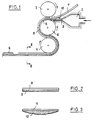
- FIG 1 shows schematically the method of manufacturing the sheets of composite material according to the invention.
- Figure 2 is a sectional view taken in the plane II-II of Figure 1.
- Figure 3 shows like Figure 2 a sectional view of a composite sheet of variable thickness obtainable.
- the sheet of thermoplastic material such as ABS is formed in 2 at the outlet of an extruder 1 in order to feed a calendering machine comprising in the illustrated example three rollers calendering referenced 3, 4 and 5.
- the thermoplastic material leaves the extruder for example around 240 ° C, temperature at which it is fluid.
- the continuous sheet 6 of extruded thermoplastic material is fed over the unit plates as marked 7, 8, 9 cast in polymethyl methacrylate.
- the PMMA sheets have a thickness of a few millimeters, generally between 2.5 and 4 mm which can optionally be reduced to 1 mm in thickness or on the contrary increased to 7 or even 10 mm.
- the PMMA plates are brought to room temperature, and at the entrance to the calendering train, at the junction with the still fluid ABS material, a bead is formed as shown in diagram 10.
- the plates 7 were 3 mm thick, the sheet 6 of ABS was also 3 mm thick, the diameter of the calendering rollers was 300 mm, and the temperatures of the rollers 3, 4 and 5 were respectively 80 ° C, 90 ° C and 90 ° C.
- a composite material of excellent quality resistant to any separation of the two layers was obtained with a running speed of 0.75 m / min, the composite material leaving the third calendering roller at a temperature in the region of 50 to 60 ° C.
- the PMMA plates can be translucent or transparent, and in this case the apparent color of the material will be that of the support layer 6.
- the layer of thermoplastic material 6 can be poured according to the known technique of multilayer extrusion, reserving the raw material for the greatest underlying thickness and the coloring retained for the surface layer.
- the PMMA plates can be painted and decorated in any desired manner, and prior to their use, on their junction face with the thermoplastic material. It has indeed been found that in this case, the paint which probably migrates into the PMMA plate has no action on the quality of the junction between the two layers of composite material, in this case ABS / PMMA.
- the PMMA plate marked 11 was joined to a plate of thermoplastic material 12 whose thickness varied by being thinner on the edges and greater in the center.
- a sheet thus shaped can be obtained simply by providing, for example, a section in accordance with the calendering rollers which will have a diameter slightly larger towards the edges and less important towards the center.
- This can be advantageous, for example if from the composite material we want to shape a bathtub for which it will generally be advantageous to obtain a greater thickness on the bottom, even on the sides of the bathtub and on the other hand less important on the top and in particular the two lateral edges. This will dispense with the establishment of bottom or belt reinforcements.
- the quality of the composite material obtained is excellent, combining the excellence of the surface appearance of the polymethyl methacrylate plate and its hardness, with the rigidity of the thermoplastic material used such as ABS for the undercoat, the material. composite being free from the defects inherent in PMMA, relatively fragile to shocks and which thus acquires an exceptional resistance to such shocks.
- thermoplastic materials in place of ABS, already mentioned, many other thermoplastic materials can be used, and in particular: PE (polyethylene, PS (polystyrene), PP (polypropylene); these materials may or may not be loaded.
- PE polyethylene
- PS polystyrene
- PP polypropylene
- the choice of materials, as well as the choice of the relative thicknesses of the layers will depend on the product which will have to be shaped by thermoforming in a mold from the composite sheet, and in a manner known per se. It will only be noted that, in general, the polymethyl methacrylate sheet may be thinner than it was necessarily with the application of known reinforcement techniques, insofar as the composite material has exceptional resistance being in particular subject to no possible delamination. And in such a material PMMA can, even in a thin layer, provide the qualities of smooth appearance and finish and intrinsic surface hardness that it possesses.
Landscapes
- Engineering & Computer Science (AREA)
- Mechanical Engineering (AREA)
- Laminated Bodies (AREA)
- Extrusion Moulding Of Plastics Or The Like (AREA)
- Casting Or Compression Moulding Of Plastics Or The Like (AREA)
- Moulding By Coating Moulds (AREA)
- Reinforced Plastic Materials (AREA)
- Bathtubs, Showers, And Their Attachments (AREA)
Claims (9)
- Verfahren zur Herstellung einer Folie eines Verbundmaterials mit einer Platte aus Polymethylmethacrylat, die eine äußere Schicht des Verbundmaterials und eine Stützschicht des thermoplastischen Materials bildet, wie z.B. ABS (Polyacrylnitril-Butadien-Styrol) oder ähnlich, dadurch gekennzeichnet, daß im Hinblick auf das Erhalten einer vollständigen Kohäsion und Verbindung der zwei Schichten untereinander:- man durch eine Strangpresse eine Maschine beschickt, die Kalandrierwalzen (3, 4, 5) derart aufweist, daß eine fortlaufende, stranggepreßte Folie (6) aus dem thermoplastischen Material gebildet wird,- man regelmäßig am Eingang der Maschine auf einer Seite der aus thermoplastischem Material gebildeten Folie (6) die Platten (7, 8, 9) aus Polymethylmethacrylat bereitstelit, die gleichzeitig mit der Folie aus thermoplastischem Material zwischen den Kalandrierwalzen (3, 4, 5) der Maschine kalandriert werden,- und man am Ausgang der Kalandriermaschine die erhaltenen Verbundmaterialfolien, die aus den vorher erwähnten Polymethylmethacrylatplatten gebildet sind, abschneidet, welche auf einer vorher erwähnten Stützschicht aus thermoplastischem Material aufgebracht sind.
- Verfahren nach Anspruch 1, dadurch gekennzeichnet, daß die Planen aus Polymethylmethacrylat gegen die aus thermoplastischem Material stranggepreßte Folie (6) von dem Ausgang (2) der Strangpresse aus kalandriert werden, wobei die erste Kalandriertätigkeit ein Aufbringen des noch flüssigen thermoplastischen Materials (10) gegen die Platte (7) aus nicht flüssigem Polymethylmethacrylat sicherstellt.
- Verfahren nach Anspruch 1 oder nach Anspruch 2, dadurch gekennzeichnet, daß am Eingang der Kalandriermaschine das thermoplastische Material (6) seine Liquiditätstemperatur hat, sowie es die Strangpresse (1) verläßt, während die Platten aus Polymethylmethacrylat Umgebungstemperatur haben.
- Verfahren nach einem der vorangegangenen Ansprüche, dadurch gekennzeichnet, daß wenn das thermoplastische Material vom Typ ABS ist, die Zufuhrtemperatur der Folie (6) aus ABS beim ersten Kalandriergang (3, 4) nahe 240°C ist.
- Verfahren nach einem der vorangegangenen Ansprüche, dadurch gekennzeichnet, daß die Dicke der Platten aus Polymethylmethacrylat in der Größenordnung von 1 bis 7 mm liegt und vorzugsweise zwischen 2,5 und 4 mm beträgt.
- Verfahren nach einem der vorangegangenen Ansprüche, dadurch gekennzeichnet, daß die Platten aus Polymethylmethacrylat durchscheinend oder durchsichtig sind und vor ihrer Verwendung auf ihrer Verbindungsseite mit thermoplastischem Material verziert sind.
- Verfahren nach einem der Ansprüche 1 bis 5, dadurch gekennzeichnet, daß die Platten aus Polymethylmethacrylat durchscheinend oder durchsichtig sind und die vorher erwähnte thermoplastische Folie nach der mehrlagigen Strangpreßtechnik mit einer Stützschicht an der Basis und einer gefärbten Oberflächenverbindungsschicht mit der Platte aus Polymethylmethacrylat ausgebildet ist.
- Neues Industrieerzeugnis, das aus einer Folie aus Verbundmaterial gebildet ist, welches nach dem Verfahren gemäß einem der vorangegangenen Ansprüche erhalten wird, dadurch gekennzeichnet, daß es eine obere Platte aus Polymethylmethacrylat aufweist, die durch Gießen in untrennbarer Weise mit einer Stützfolie aus thermoplastischem Material verbunden, erhalten wird.
- Erzeugnis nach Anspruch 8, dadurch gekennzeichnet, daß die Folie aus thermoplastischem Material örtlich verschiedene Dicken nach den Gebrauchsnotwendigkeiten des fertigen Stückes hat, welches durch Wärmeformen in einer Form, ausgehend von der Verbundmaterialfolie gebildet ist.
Applications Claiming Priority (2)
| Application Number | Priority Date | Filing Date | Title |
|---|---|---|---|
| FR9005381A FR2661364B1 (fr) | 1990-04-27 | 1990-04-27 | Procede de fabrication d'une feuille d'un materiau composite comprenant une plaque de polymethacrylate de methyle coulee reunie a une couche support thermoplastique et produits obtenus. |
| FR9005381 | 1990-04-27 |
Publications (2)
| Publication Number | Publication Date |
|---|---|
| EP0454520A1 EP0454520A1 (de) | 1991-10-30 |
| EP0454520B1 true EP0454520B1 (de) | 1994-05-18 |
Family
ID=9396154
Family Applications (1)
| Application Number | Title | Priority Date | Filing Date |
|---|---|---|---|
| EP91400895A Expired - Lifetime EP0454520B1 (de) | 1990-04-27 | 1991-04-02 | Verfahren zur Herstellung einer eine aus Polymethylmethacrylat gegossene Platte und eine thermoplastische Grundschicht enthaltenden Verbundfolie und so erhaltenes Produkt |
Country Status (13)
| Country | Link |
|---|---|
| EP (1) | EP0454520B1 (de) |
| JP (1) | JPH05131559A (de) |
| AT (1) | ATE105766T1 (de) |
| AU (1) | AU639992B2 (de) |
| CA (1) | CA2041138A1 (de) |
| DE (1) | DE69102014T2 (de) |
| DK (1) | DK0454520T3 (de) |
| ES (1) | ES2053292T3 (de) |
| FR (1) | FR2661364B1 (de) |
| LT (1) | LT3566B (de) |
| LV (1) | LV5427A3 (de) |
| RU (1) | RU1814615C (de) |
| UA (1) | UA19870A (de) |
Families Citing this family (12)
| Publication number | Priority date | Publication date | Assignee | Title |
|---|---|---|---|---|
| US5069851A (en) * | 1990-07-09 | 1991-12-03 | Aristech Chemical Corporation | ABS/Acrylic lamination process |
| DE9210508U1 (de) * | 1992-08-06 | 1992-11-26 | Targor GmbH, 55116 Mainz | Verbundplatte |
| DE4436381A1 (de) | 1994-10-12 | 1996-04-18 | Roehm Gmbh | Verbunde aus thermoplastischen Kunststoffschichten für Sanitärartikel |
| KR100316364B1 (ko) * | 1997-11-04 | 2002-07-02 | 사공수영 | 내후성 및 내충격성이 향상된 다층시트 |
| AU1041199A (en) * | 1997-11-06 | 1999-05-31 | Aeci Limited | Method of making an acrylic article |
| NZ505447A (en) * | 1997-12-05 | 2003-07-25 | Rohm Gmbh & Co | Method for producing surface-hardened PMMA films which are highly glossy on both sides, free of gel bodies and can be manipulated in the "film-insert-moulding" method |
| NZ504028A (en) * | 1999-04-27 | 2001-03-30 | Sumitomo Chemical Co | Method for producing multi-layer resin molded article by heat molding a multi-layer thermoplastic resin plate comprising a first surface and a second surface |
| FR2989616B1 (fr) * | 2012-04-20 | 2014-05-09 | New Bath | Procede de fabrication d'une feuille d'un materiau composite |
| CN103879033A (zh) * | 2014-04-16 | 2014-06-25 | 昆山市耐光包装材料有限公司 | 高强度塑料包装盒 |
| CN104354426A (zh) * | 2014-11-19 | 2015-02-18 | 科勒(中国)投资有限公司 | 填料增强型亚克力板 |
| CN107738486A (zh) * | 2017-10-20 | 2018-02-27 | 深圳市捷创新材料有限公司 | 一种多层共挤高分子材料及其制备方法 |
| CN112476866B (zh) * | 2020-10-28 | 2022-09-06 | 龙南新涛亚克力科技有限公司 | 一种亚克力板混炼用的灌料设备 |
Family Cites Families (4)
| Publication number | Priority date | Publication date | Assignee | Title |
|---|---|---|---|---|
| US3798103A (en) * | 1972-02-25 | 1974-03-19 | T Gaunt | Laminating incompatible polystyrene and vinyl chloride or acrylic plastic sheets |
| DE2730899A1 (de) * | 1977-07-08 | 1979-02-01 | Basf Ag | Dekorative verbunde |
| IT1132231B (it) * | 1980-07-24 | 1986-06-25 | Montedison Spa | Prodotto laminare in materiale termoplastico ed articoli con esso ottenuti |
| DE3782058T2 (de) | 1986-07-12 | 1993-04-15 | Fly Fishing Techn Ltd | Verfahren und vorrichtung zur herstellung von angelschnueren. |
-
1990
- 1990-04-27 FR FR9005381A patent/FR2661364B1/fr not_active Expired - Lifetime
-
1991
- 1991-04-02 DK DK91400895.8T patent/DK0454520T3/da active
- 1991-04-02 ES ES91400895T patent/ES2053292T3/es not_active Expired - Lifetime
- 1991-04-02 EP EP91400895A patent/EP0454520B1/de not_active Expired - Lifetime
- 1991-04-02 AT AT91400895T patent/ATE105766T1/de not_active IP Right Cessation
- 1991-04-02 DE DE69102014T patent/DE69102014T2/de not_active Expired - Lifetime
- 1991-04-03 AU AU74054/91A patent/AU639992B2/en not_active Ceased
- 1991-04-24 CA CA002041138A patent/CA2041138A1/fr not_active Abandoned
- 1991-04-25 UA UA4895137A patent/UA19870A/uk unknown
- 1991-04-25 RU SU914895137A patent/RU1814615C/ru active
- 1991-04-30 JP JP3124590A patent/JPH05131559A/ja active Pending
-
1993
- 1993-06-30 LV LV931074A patent/LV5427A3/xx unknown
- 1993-10-28 LT LTIP1434A patent/LT3566B/lt not_active IP Right Cessation
Also Published As
| Publication number | Publication date |
|---|---|
| FR2661364A1 (fr) | 1991-10-31 |
| DE69102014T2 (de) | 1994-09-01 |
| DE69102014D1 (de) | 1994-06-23 |
| JPH05131559A (ja) | 1993-05-28 |
| LTIP1434A (en) | 1995-05-25 |
| DK0454520T3 (da) | 1994-09-19 |
| AU7405491A (en) | 1991-11-07 |
| EP0454520A1 (de) | 1991-10-30 |
| UA19870A (uk) | 1997-12-25 |
| FR2661364B1 (fr) | 1992-07-24 |
| ATE105766T1 (de) | 1994-06-15 |
| LV5427A3 (lv) | 1994-03-10 |
| AU639992B2 (en) | 1993-08-12 |
| LT3566B (en) | 1995-12-27 |
| ES2053292T3 (es) | 1994-07-16 |
| RU1814615C (ru) | 1993-05-07 |
| CA2041138A1 (fr) | 1991-10-28 |
Similar Documents
| Publication | Publication Date | Title |
|---|---|---|
| EP0454520A1 (de) | Verfahren zur Herstellung einer eine aus Polymethylmethacrylat gegossene Platte und eine thermoplastische Grundschicht enthaltenden Verbundfolie und so erhaltenes Produkt | |
| FR2653377A1 (fr) | Procede et dispositif pour former une bande allongee de decoration en materiau plastique et bande de decoration pour automobile, ainsi obtenue par extrusion. | |
| US5723199A (en) | Method of extruding two or more materials | |
| EP2552671B1 (de) | Verfahren zur beschichtung eines kerns einer beliebigen form mittels wärmeformen, automatische maschine zur umsetzung des verfahrens und anhand dieses verfahrens gewonnenes endprodukt | |
| EP0456965B1 (de) | Ski und Verfahren zu seiner Herstellung | |
| US20090148668A1 (en) | plastic composite board with ultrasonic welded structure | |
| EP0589116A1 (de) | Verfahren zum Herstellen eines mehrschichtigen Gegenstandes durch Formen, so hergestellter Gegenstand und Verwendung zur Herstellung von Armaturenbrettern und/oder Verkleidungselementen einer Fahrzeugkarosserie | |
| FR2781165A1 (fr) | Procede de realisation d'un ski ou autre planche de glisse sur neige | |
| FR2701828A1 (fr) | Cuvette de douche avec soubassement support. | |
| EP0782501B1 (de) | Verfahren zum herstellen einer platte beschichtet mit einer verblendungsfläche, insbesondere textil | |
| EP1355797B1 (de) | Verfahren und vorrichtung zur herstellung eines kantenprofils für eine verglasung | |
| EP0558009B1 (de) | Verfahren zur Herstellung eines Skis | |
| FR2629387A3 (fr) | Procede pour la fabrication d'un plateau moulure en stratifie de matiere plastique a deux couches assemblees | |
| FR2790424A1 (fr) | Procede de fabrication de pieces ayant une surface decorative d'aspect metallique | |
| FR2684595A1 (fr) | Plaque en matiere thermoplastique renforcee superficiellement et procedes pour sa realisation. | |
| FR2677915A1 (fr) | Procede de fabrication de recipients en matieres plastiques et recipients obtenus selon ce procede. | |
| FR2522298A1 (fr) | Article decoratif, son procede de fabrication et materiaux pour revetement de sol le comprenant | |
| CH678708A5 (de) | ||
| EP0727301B1 (de) | Verfahren zum Herstellen eines mehrschichtigen Gegenstandes | |
| FR2469268A1 (fr) | Procede de moulage d'elements en matiere plastique sur des materiaux poreux | |
| FR2520643A1 (fr) | Procede de fabrication d'outillages destines a la mise en forme de pieces en matiere metallique ou plastique | |
| FR2687922A1 (fr) | Procede de fabrication d'un plateau pour table de jeu du type table de ping-pong. | |
| FR2801530A1 (fr) | Procede de fabrication de pieces en matiere plastique ayant une surface decorative | |
| CN113442403A (zh) | 一种热熔光纤塑胶板材及其制造方法 | |
| FR3087700A1 (fr) | Procede de fabrication d'une peau |
Legal Events
| Date | Code | Title | Description |
|---|---|---|---|
| PUAI | Public reference made under article 153(3) epc to a published international application that has entered the european phase |
Free format text: ORIGINAL CODE: 0009012 |
|
| AK | Designated contracting states |
Kind code of ref document: A1 Designated state(s): AT BE CH DE DK ES GB GR IT LI LU NL SE |
|
| 17P | Request for examination filed |
Effective date: 19920130 |
|
| 17Q | First examination report despatched |
Effective date: 19930726 |
|
| GRAA | (expected) grant |
Free format text: ORIGINAL CODE: 0009210 |
|
| AK | Designated contracting states |
Kind code of ref document: B1 Designated state(s): AT BE CH DE DK ES GB GR IT LI LU NL SE |
|
| REF | Corresponds to: |
Ref document number: 105766 Country of ref document: AT Date of ref document: 19940615 Kind code of ref document: T |
|
| GBT | Gb: translation of ep patent filed (gb section 77(6)(a)/1977) |
Effective date: 19940519 |
|
| REF | Corresponds to: |
Ref document number: 69102014 Country of ref document: DE Date of ref document: 19940623 |
|
| ITF | It: translation for a ep patent filed | ||
| REG | Reference to a national code |
Ref country code: ES Ref legal event code: FG2A Ref document number: 2053292 Country of ref document: ES Kind code of ref document: T3 |
|
| REG | Reference to a national code |
Ref country code: GR Ref legal event code: FG4A Free format text: 3011856 |
|
| REG | Reference to a national code |
Ref country code: DK Ref legal event code: T3 |
|
| EAL | Se: european patent in force in sweden |
Ref document number: 91400895.8 |
|
| PLBE | No opposition filed within time limit |
Free format text: ORIGINAL CODE: 0009261 |
|
| STAA | Information on the status of an ep patent application or granted ep patent |
Free format text: STATUS: NO OPPOSITION FILED WITHIN TIME LIMIT |
|
| 26N | No opposition filed | ||
| REG | Reference to a national code |
Ref country code: GB Ref legal event code: IF02 |
|
| PGFP | Annual fee paid to national office [announced via postgrant information from national office to epo] |
Ref country code: GR Payment date: 20050330 Year of fee payment: 15 |
|
| PGFP | Annual fee paid to national office [announced via postgrant information from national office to epo] |
Ref country code: SE Payment date: 20050406 Year of fee payment: 15 |
|
| PGFP | Annual fee paid to national office [announced via postgrant information from national office to epo] |
Ref country code: DK Payment date: 20050415 Year of fee payment: 15 |
|
| PG25 | Lapsed in a contracting state [announced via postgrant information from national office to epo] |
Ref country code: SE Free format text: LAPSE BECAUSE OF NON-PAYMENT OF DUE FEES Effective date: 20060403 |
|
| PGFP | Annual fee paid to national office [announced via postgrant information from national office to epo] |
Ref country code: IT Payment date: 20060430 Year of fee payment: 16 |
|
| PG25 | Lapsed in a contracting state [announced via postgrant information from national office to epo] |
Ref country code: DK Free format text: LAPSE BECAUSE OF NON-PAYMENT OF DUE FEES Effective date: 20060501 |
|
| REG | Reference to a national code |
Ref country code: DK Ref legal event code: EBP |
|
| EUG | Se: european patent has lapsed | ||
| PG25 | Lapsed in a contracting state [announced via postgrant information from national office to epo] |
Ref country code: GR Free format text: LAPSE BECAUSE OF NON-PAYMENT OF DUE FEES Effective date: 20061102 |
|
| PG25 | Lapsed in a contracting state [announced via postgrant information from national office to epo] |
Ref country code: IT Free format text: LAPSE BECAUSE OF NON-PAYMENT OF DUE FEES Effective date: 20070402 |
|
| PGFP | Annual fee paid to national office [announced via postgrant information from national office to epo] |
Ref country code: NL Payment date: 20100723 Year of fee payment: 20 Ref country code: ES Payment date: 20100723 Year of fee payment: 20 Ref country code: CH Payment date: 20100723 Year of fee payment: 20 |
|
| PGFP | Annual fee paid to national office [announced via postgrant information from national office to epo] |
Ref country code: LU Payment date: 20100727 Year of fee payment: 20 Ref country code: AT Payment date: 20100727 Year of fee payment: 20 Ref country code: DE Payment date: 20100723 Year of fee payment: 20 |
|
| PGFP | Annual fee paid to national office [announced via postgrant information from national office to epo] |
Ref country code: GB Payment date: 20100727 Year of fee payment: 20 |
|
| PGFP | Annual fee paid to national office [announced via postgrant information from national office to epo] |
Ref country code: BE Payment date: 20100729 Year of fee payment: 20 |
|
| REG | Reference to a national code |
Ref country code: DE Ref legal event code: R071 Ref document number: 69102014 Country of ref document: DE |
|
| REG | Reference to a national code |
Ref country code: NL Ref legal event code: V4 Effective date: 20110402 |
|
| REG | Reference to a national code |
Ref country code: CH Ref legal event code: PL |
|
| REG | Reference to a national code |
Ref country code: GB Ref legal event code: PE20 Expiry date: 20110401 |
|
| BE20 | Be: patent expired |
Owner name: S.A. *TECHNOPLAST Effective date: 20110402 |
|
| REG | Reference to a national code |
Ref country code: ES Ref legal event code: FD2A Effective date: 20110615 |
|
| PG25 | Lapsed in a contracting state [announced via postgrant information from national office to epo] |
Ref country code: GB Free format text: LAPSE BECAUSE OF EXPIRATION OF PROTECTION Effective date: 20110401 Ref country code: ES Free format text: LAPSE BECAUSE OF EXPIRATION OF PROTECTION Effective date: 20110403 |
|
| PG25 | Lapsed in a contracting state [announced via postgrant information from national office to epo] |
Ref country code: NL Free format text: LAPSE BECAUSE OF EXPIRATION OF PROTECTION Effective date: 20110402 |
|
| PG25 | Lapsed in a contracting state [announced via postgrant information from national office to epo] |
Ref country code: DE Free format text: LAPSE BECAUSE OF EXPIRATION OF PROTECTION Effective date: 20110402 |