EP0454536A1 - Wanderfeldröhre mit einer Hülle bestimmt zur Aufnahme einer Verzögerungsleitung durch Kalteindrücken - Google Patents
Wanderfeldröhre mit einer Hülle bestimmt zur Aufnahme einer Verzögerungsleitung durch Kalteindrücken Download PDFInfo
- Publication number
- EP0454536A1 EP0454536A1 EP91400998A EP91400998A EP0454536A1 EP 0454536 A1 EP0454536 A1 EP 0454536A1 EP 91400998 A EP91400998 A EP 91400998A EP 91400998 A EP91400998 A EP 91400998A EP 0454536 A1 EP0454536 A1 EP 0454536A1
- Authority
- EP
- European Patent Office
- Prior art keywords
- sheath
- delay line
- slots
- flanges
- supports
- Prior art date
- Legal status (The legal status is an assumption and is not a legal conclusion. Google has not performed a legal analysis and makes no representation as to the accuracy of the status listed.)
- Withdrawn
Links
- 239000000696 magnetic material Substances 0.000 claims abstract description 26
- 238000000034 method Methods 0.000 claims description 14
- 238000002788 crimping Methods 0.000 claims description 6
- XEEYBQQBJWHFJM-UHFFFAOYSA-N Iron Chemical compound [Fe] XEEYBQQBJWHFJM-UHFFFAOYSA-N 0.000 description 6
- 238000010438 heat treatment Methods 0.000 description 4
- 238000001816 cooling Methods 0.000 description 3
- 238000010894 electron beam technology Methods 0.000 description 3
- 229910052742 iron Inorganic materials 0.000 description 3
- RYGMFSIKBFXOCR-UHFFFAOYSA-N Copper Chemical compound [Cu] RYGMFSIKBFXOCR-UHFFFAOYSA-N 0.000 description 2
- 238000010276 construction Methods 0.000 description 2
- 229910052802 copper Inorganic materials 0.000 description 2
- 239000010949 copper Substances 0.000 description 2
- 230000006866 deterioration Effects 0.000 description 2
- 239000000463 material Substances 0.000 description 2
- 230000003647 oxidation Effects 0.000 description 2
- 238000007254 oxidation reaction Methods 0.000 description 2
- 230000000750 progressive effect Effects 0.000 description 2
- FRWYFWZENXDZMU-UHFFFAOYSA-N 2-iodoquinoline Chemical compound C1=CC=CC2=NC(I)=CC=C21 FRWYFWZENXDZMU-UHFFFAOYSA-N 0.000 description 1
- 229910052582 BN Inorganic materials 0.000 description 1
- PZNSFCLAULLKQX-UHFFFAOYSA-N Boron nitride Chemical compound N#B PZNSFCLAULLKQX-UHFFFAOYSA-N 0.000 description 1
- ZOKXTWBITQBERF-UHFFFAOYSA-N Molybdenum Chemical compound [Mo] ZOKXTWBITQBERF-UHFFFAOYSA-N 0.000 description 1
- LTPBRCUWZOMYOC-UHFFFAOYSA-N beryllium oxide Inorganic materials O=[Be] LTPBRCUWZOMYOC-UHFFFAOYSA-N 0.000 description 1
- 239000003989 dielectric material Substances 0.000 description 1
- 230000000694 effects Effects 0.000 description 1
- 238000000462 isostatic pressing Methods 0.000 description 1
- 238000003754 machining Methods 0.000 description 1
- 238000004519 manufacturing process Methods 0.000 description 1
- 229910052751 metal Inorganic materials 0.000 description 1
- 239000002184 metal Substances 0.000 description 1
- 229910052750 molybdenum Inorganic materials 0.000 description 1
- 239000011733 molybdenum Substances 0.000 description 1
- 238000013021 overheating Methods 0.000 description 1
- WFKWXMTUELFFGS-UHFFFAOYSA-N tungsten Chemical compound [W] WFKWXMTUELFFGS-UHFFFAOYSA-N 0.000 description 1
- 229910052721 tungsten Inorganic materials 0.000 description 1
- 239000010937 tungsten Substances 0.000 description 1
Images

Classifications
-
- H—ELECTRICITY
- H01—ELECTRIC ELEMENTS
- H01J—ELECTRIC DISCHARGE TUBES OR DISCHARGE LAMPS
- H01J23/00—Details of transit-time tubes of the types covered by group H01J25/00
- H01J23/16—Circuit elements, having distributed capacitance and inductance, structurally associated with the tube and interacting with the discharge
- H01J23/24—Slow-wave structures, e.g. delay systems
- H01J23/26—Helical slow-wave structures; Adjustment therefor
-
- H—ELECTRICITY
- H01—ELECTRIC ELEMENTS
- H01J—ELECTRIC DISCHARGE TUBES OR DISCHARGE LAMPS
- H01J23/00—Details of transit-time tubes of the types covered by group H01J25/00
- H01J23/16—Circuit elements, having distributed capacitance and inductance, structurally associated with the tube and interacting with the discharge
- H01J23/165—Manufacturing processes or apparatus therefore
Definitions
- the present invention relates to a traveling wave tube provided with a sheath intended to receive a delay line by cold fitting. It aims to improve the mounting of a delay line in a sheath, when cold, since the fitting is done substantially without friction. It applies to sleeves with integrated polar masses. It also relates to a method for mounting a delay line in a sheath.
- a traveling wave tube is formed by the association of a long and fine electron beam and a delay line intended to guide a microwave wave to be amplified.
- This delay line is often in the form of a helix. It is metallic. It is kept centered by at least three dielectric supports in the form of rods, then is introduced into a metal casing in the form of a sheath.
- the propeller can be made up of several successive sections. It will be possible to deposit on the rods, at the level of two ends of opposite propeller sections, attenuations. This prevents the tube from oscillating and increases its gain.
- the electron beam is produced by a gun placed at the input of the delay line and is collected in a collector placed at the output of the delay line.
- a focusing device surrounds the delay line, so as to make the electron beam converge.
- the scabbard often has the shape of a cylinder of revolution. It is coaxial with the delay line. It is waterproof. It maintains a high vacuum inside the tube.
- the sheath can integrate polar masses and be part of the focusing device.
- the sheath can then be produced in a single piece, made of magnetic material, having substantially the shape of a cylindrical tube carrying flanges.
- the collars act as polar masses. Alternating focusing magnets are inserted between the flanges.
- the sleeve thus produced must seal the vacuum and be rigid enough to support the magnets.
- the sheath is obtained from a cylindrical block of magnetic material. It is cut to give it the shape of a tube and to make the flanges. This realization can be very easily automated.
- the propeller is often made of tungsten or molybdenum, the rods of boron nitride, glucine or beryllium oxide and the sheath of iron.
- the first consists of forcibly fitting the propeller-rod assembly into the sheath.
- the propeller-rod assembly must have an outside diameter 5 to 7 micrometers larger than the inside diameter of the sheath. This method requires very precise control of the dimensions of the parts to obtain a satisfactory tightening.
- the second method which is frequently used consists in heating the sheath so that it expands and then introducing the propeller-rod assembly inside. The tightening is obtained on cooling. When hot, the clearance required to be able to introduce the propeller-rod assembly is of the order of 0.02 to 0.03 millimeters. This method nevertheless has serious drawbacks.
- the implementation is long and delicate.
- the barrel must be heated to around 700 ° C.
- the heating operation takes several hours, as does the cooling.
- the propeller-rod assembly is introduced into the hot sheath, there is a risk of deterioration, by oxidation, of the attenuations which have been deposited on the rods. This method still requires relatively tight part tolerances.
- the present invention aims to remedy these drawbacks and proposes a traveling wave tube, provided with a sheath intended to receive a delay line surrounded by supports, by cold fitting, substantially without friction.
- the sleeve is crimped around the delay line-support assembly by shrinking.
- the set of delay line supports is then clamped in the sleeve.
- a traveling wave tube according to the invention can operate at medium and / or high peak power.
- the tightening provides good thermal contact on the one hand between the delay line and the supports and on the other hand between the supports and the sleeve.
- the present invention provides a traveling wave tube provided with a sheath comprising a single piece of magnetic material, having substantially the shape of a cylindrical tube, carrying successive flanges of height H , characterized in that each flange has at least three radial slots of depth h , and in that the sheath has a thin thickness between two flanges, the slots and the thickness of the sheath contributing to allow crimping of the sheath by shrinking around an assembly comprising at least three supports surrounding a delay line, so that the assembly supports-delay line is tightened in the sheath after the shrinking.
- the depth h of the slots is substantially equal to the height H of the flanges.
- the slots are evenly distributed on each flange. They are placed in the same places on all the flanges.
- the sheath may further include a tube of non-magnetic material mounted inside the part of magnetic material, the part of magnetic material and the tube of non-magnetic material are coaxial.
- the set of delay line supports penetrates into the sheath substantially without friction.
- a support is placed substantially in the middle of a flange portion bounded by two successive slots.
- the invention also relates to a method for mounting a support-delay line assembly in a sheath of a traveling wave tube according to the invention.
- the method can further comprise the application of at least three centripetal forces per portion of sheath between two successive flanges, so as to reduce the internal diameter of the sheath between the flanges.
- centripetal forces on the sheath portions can be done at the same time as the application of the centripetal forces on the flange portions.
- Figure 1 shows, in longitudinal section along the z axis, a sheath with integrated polar masses according to the prior art.
- This sheath comprises a piece 1 in one piece made of magnetic material, soft iron for example.
- This part 1 has the shape of a cylindrical tube 2 of thickness e1 , of axis z, carrying successive flanges 3, preferably regularly spaced.
- the sheath is provided with a substantially cylindrical central orifice 7 centered on the axis z.
- the central orifice 7 is limited by the internal wall of the tube 2.
- the flanges 3 play the role of polar masses. Between the flanges 3, permanent magnet washers 4 are inserted. The faces of the same name of the magnets are opposite and the magnets are alternated.
- the sheath has a thickness e between two successive flanges 3. Here this thickness e is equal to e1 . The thickness e is sufficiently small to avoid losing the magnetic field.
- the part 1 can be produced from a cylindrical block full of magnetic material. It is machined to give it the shape of a tube and to make the flanges. This operation can be automatic.
- FIG. 2 shows a variant of a sheath according to the prior art.
- the piece 1 of magnetic material is mounted on a tube 6 of non-magnetic material, copper, for example.
- the tube 6 and the part 1 are concentric. Indeed, it is sometimes difficult to ensure good vacuum tightness by using only the part 1 made of magnetic material as a sheath.
- the thickness e of the sheath is now equal to the sum of the thicknesses of the cylindrical tube 2 and the tube 6.
- the orifice 7 is now limited by the internal wall of the tube 6.
- the sheath is intended to receive a delay line.
- the delay line heats up strongly.
- the delay line is kept centered by at least three supports in the form of rods, of dielectric material.
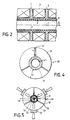
- FIG. 3 represents, in longitudinal section, a sheath with integrated polar masses of a traveling wave tube, according to the invention.
- This sheath is comparable to that shown in FIG. 1. It comprises a piece 30 in one piece made of magnetic material, soft iron for example.
- the part 30 has the shape of a cylindrical tube 31, of thickness e′1 , of axis z, carrying flanges 32 of height H.
- the collars 32 play the role of the polar masses.
- the sheath is provided with a substantially cylindrical central orifice 37 centered on the axis z.
- the central hole 37 is limited by the internal wall of the tube 31 and the inside diameter of the sleeve is equal to the inside diameter of the tube 31.
- permanent magnet washers 34 are inserted between the flanges 32.
- the sleeve has a thickness e ′ between two flanges 32. In the figure, the thickness e ′ is equal to the thickness e′1 of the tube 31.
- Each flange 32 of height H , now comprises at least three radial slots 33, of depth h .
- the slots 33 are distributed regularly on each flange 32 and they are placed in the same places on all the flanges 32. The slots 33 are then aligned on all the successive flanges 32.
- each slot 33 is substantially equal to the height H of the flanges 32. It is preferable that the slots 33 do not bite into the thickness e1 ′ of the tube 31.
- the slots 33 can be produced by machining using a tool such as a bur or circular saw. A single passage of the tool, over the entire length of the sleeve will make the slots 33 aligned on all the flanges 32.
- FIG. 3 only one slot 33 can be seen per flange 32. The others are hidden.
- Figure 4 which is a cross section of Figure 3, there are three radial slots 33 regularly distributed on the flange 32. Two consecutive slots form an angle of 120 °.
- the sheath can also include a tube made of non-magnetic material. This variant is shown in Figures 5, 6a and 6b.
- a method for mounting a set of delay line supports around a sheath is very simple. First of all it suffices to introduce the delay line surrounded by the supports in the sheath. It is expected that the inner diameter of the sheath allows the introduction of the delay line-supports assembly substantially without friction.
- the slits made in the flanges facilitate the deformation of the sheath during the shrinking; they tend to close.
- the method for crimping the sheath may also include the application of at least three centripetal forces, per portion of sheath between two successive flanges. These centripetal forces are distributed so as to allow a reduction in the internal diameter of the sheath between the flanges.
- centripetal forces can be applied at the same time as the forces applied to the flanges.
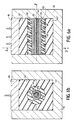
- FIG. 5 represents, in cross section, a tool used to crimp a sheath 52 of a traveling wave tube around a support-delay line assembly, according to the method according to the invention.
- the delay line is a helix 58 and the supports, three in number, of the rods 51.
- the sheath 52 comprises a piece 53 of magnetic material having the shape of a cylindrical tube carrying successive flanges 56. This part 53 is mounted on a tube 54 made of non-magnetic material.
- the flanges 56 each have three radial slots 59 spaced 120 ° apart. Here the number of slots is equal to the number of supports. The two numbers can be different.
- the slots 59 are placed at the same places on all flanges 56.
- each support 51 is disposed under a portion 55 of the flange and substantially in the middle of the portion 55 of the flange.
- each clamping bar 57 is used to apply at least a centripetal force on each portion 55 of the collar.
- the length of each clamping bar 57 is greater than or equal to the length of the sheath.
- the clamping bars 57 are arranged according to the generatrices of the sheath. The bars 57 are in contact with the flanges.
- a centripetal force is applied to each clamping bar 57 so as to reduce the internal diameter of the sleeve 52, at the level of all the flanges 56, until the assembly of supports and delay line is tightened in the sleeve 52,
- the intensity of the applied forces is chosen to obtain a permanent deformation of the sheath and a tightening of the desired delay line-support assembly.
- FIGS. 6a and 6b respectively represent, in longitudinal and transverse section, a variant of a tool suitable for crimping a sheath 62 of a traveling wave tube, according to the invention, around a set of delay line supports.
- the cross section is made along the axis AA ′.
- the delay line is a helix 60 and it is surrounded by three supports 61 in the form of rods.
- the sheath 62 comprises a part 63, in the form of a cylindrical tube carrying successive flanges 68.
- This part 63 is made of magnetic material, it is mounted on a tube 64 made of non-magnetic material.
- the non-magnetic material can be copper.
- the flanges 68 have three slots 69 at 120 ° from one another. Two successive slots 69 define a portion of a collar.
- the supports 61 are arranged substantially in the middle of a flange portion.
- the sheath 62 is deposited, lengthwise, inside a box 65, under a press plate 66.
- the sheath 62 is wedged with blocks 67 of plastic, for example. These blocks 67 of plastic material are machined to the dimensions of the sheath 62.
- the outer surface of the sleeve 62 is in contact with the blocks 67 as well, at the level of the flanges 68 as between two successive flanges 68.
- the plate 66 of the press is lowered vertically from top to bottom.
- the wedging blocks 67 also serve to distribute the pressure of the plate 66 all around and over the entire length of the sheath 62.
- Centripetal forces apply to the sheath 62. They are substantially equal at all points on the outer surface of the sheath 62. They apply both to the flanges 68 and between the flanges 68. The diameter inside the sheath 62 is reduced over the entire length of the sheath 62. The sheath 62 then comes to clamp the supports 61 and consequently the support-delay line assembly.
- the pressure of the press is chosen so that the deformation of the sleeve 62 is permanent and that the tightening is suitable.
- the small thickness e ′ of the sheath 62 between the flanges 68 and the slots 69 of the flanges allow the sheath of the sheath 62 to be constricted.
- the assembly time of the delay line in the sleeve is reduced because the assembly is done cold.
Landscapes
- Engineering & Computer Science (AREA)
- Manufacturing & Machinery (AREA)
- Microwave Tubes (AREA)
Applications Claiming Priority (2)
| Application Number | Priority Date | Filing Date | Title |
|---|---|---|---|
| FR9005393 | 1990-04-27 | ||
| FR9005393A FR2661553A1 (fr) | 1990-04-27 | 1990-04-27 | Tube a ondes progressives muni d'un fourreau destine a recevoir une ligne a retard par emmanchement a froid. |
Publications (1)
| Publication Number | Publication Date |
|---|---|
| EP0454536A1 true EP0454536A1 (de) | 1991-10-30 |
Family
ID=9396163
Family Applications (1)
| Application Number | Title | Priority Date | Filing Date |
|---|---|---|---|
| EP91400998A Withdrawn EP0454536A1 (de) | 1990-04-27 | 1991-04-16 | Wanderfeldröhre mit einer Hülle bestimmt zur Aufnahme einer Verzögerungsleitung durch Kalteindrücken |
Country Status (3)
| Country | Link |
|---|---|
| EP (1) | EP0454536A1 (de) |
| JP (1) | JPH04230933A (de) |
| FR (1) | FR2661553A1 (de) |
Cited By (2)
| Publication number | Priority date | Publication date | Assignee | Title |
|---|---|---|---|---|
| FR2884963A1 (fr) * | 2005-04-22 | 2006-10-27 | Thales Sa | Procede et dispositif de fabrication d'un top |
| US11017976B2 (en) * | 2018-07-09 | 2021-05-25 | General Electric Company | Spiral groove bearing assembly with minimized deflection |
Citations (1)
| Publication number | Priority date | Publication date | Assignee | Title |
|---|---|---|---|---|
| WO1988004102A1 (en) * | 1986-11-28 | 1988-06-02 | Hughes Aircraft Company | Method for securing a slow-wave structure in enveloping structure with crimped spacers |
Family Cites Families (2)
| Publication number | Priority date | Publication date | Assignee | Title |
|---|---|---|---|---|
| JPS5286770A (en) * | 1976-01-13 | 1977-07-19 | Nec Corp | Construction of delay wave circuit structure |
| JPS59214137A (ja) * | 1983-05-20 | 1984-12-04 | Nec Corp | 進行波管 |
-
1990
- 1990-04-27 FR FR9005393A patent/FR2661553A1/fr active Pending
-
1991
- 1991-04-16 EP EP91400998A patent/EP0454536A1/de not_active Withdrawn
- 1991-04-26 JP JP12296691A patent/JPH04230933A/ja not_active Withdrawn
Patent Citations (1)
| Publication number | Priority date | Publication date | Assignee | Title |
|---|---|---|---|---|
| WO1988004102A1 (en) * | 1986-11-28 | 1988-06-02 | Hughes Aircraft Company | Method for securing a slow-wave structure in enveloping structure with crimped spacers |
Non-Patent Citations (2)
| Title |
|---|
| PATENT ABSTRACTS OF JAPAN vol. 1, no. 146 (E-77) 26 novembre 1977, & JP-A-52 86770 (TOSHIMOTO KIKUCHI) 19 juillet 1977, * |
| PATENT ABSTRACTS OF JAPAN vol. 9, no. 81 (E-307)(1804) 10 avril 1985, & JP-A-59 214137 (NIPPON DENKI K.K.) 4 décembre 1984, * |
Cited By (3)
| Publication number | Priority date | Publication date | Assignee | Title |
|---|---|---|---|---|
| FR2884963A1 (fr) * | 2005-04-22 | 2006-10-27 | Thales Sa | Procede et dispositif de fabrication d'un top |
| US11017976B2 (en) * | 2018-07-09 | 2021-05-25 | General Electric Company | Spiral groove bearing assembly with minimized deflection |
| US11037752B2 (en) * | 2018-07-09 | 2021-06-15 | General Electric Company | Spiral groove bearing assembly with minimized deflection |
Also Published As
| Publication number | Publication date |
|---|---|
| JPH04230933A (ja) | 1992-08-19 |
| FR2661553A1 (fr) | 1991-10-31 |
Similar Documents
| Publication | Publication Date | Title |
|---|---|---|
| CH375807A (fr) | Procédé de soudage d'un organe de forme allongée sur une surface courbe et appareil pour sa mise en oeuvre | |
| WO1988006266A1 (fr) | Projectile perforant a noyau dur et guide ductile et son procede de fabrication | |
| EP3089836A1 (de) | Verfahren zur befestigung eines metallrings in einem rahmen sowie durch dieses verfahren erhaltene induktionsspule | |
| EP0154588B1 (de) | Verfahren zum Herstellen einer lösbaren druckdichten Verbindung von Hochdruckleitungen und danach erstellten Verbindungen | |
| EP0454536A1 (de) | Wanderfeldröhre mit einer Hülle bestimmt zur Aufnahme einer Verzögerungsleitung durch Kalteindrücken | |
| FR2596307A1 (fr) | Procede et appareil de soudage par refoulement de pieces, chauffees par induction | |
| EP0037309B1 (de) | Wanderfeldröhre mit aus gekoppelten Hohlräumen bestehender Verzögerungsleitung und mit periodischer permanentmagnetischer Fokussierung und Verstärkereinheit mit einer solchen Röhre | |
| FR2650702A1 (fr) | Tube hyperfrequence muni au moins d'une piece axiale emmanchee a froid dans une enveloppe coaxiale | |
| FR2484875A1 (de) | ||
| EP0004492A2 (de) | Mikrowellenröhre mit einer durch Fluidumströmung gekühlten Verzögerungsleitung | |
| EP0095976B1 (de) | Verfahren zum Schweissen von zwei Teilen | |
| FR3074877B1 (fr) | Canalisation tubulaire longitudinale comportant un organe intercalaire et procedes de montage et de cintrage d'une telle canalisation | |
| FR2524110A1 (fr) | Procede de fabrication d'un tube avec des conduits disposes dans sa paroi | |
| FR2838871A1 (fr) | Procede de fabrication de fenetre hyperfrequence de separation de milieux et fenetre issue du procede | |
| EP0540384A1 (de) | Kühlvorrichtung für eine Mikrowellenröhre | |
| EP0792718B1 (de) | Verfahren zur Herstellung eines Wärmeaustauschers | |
| EP3839396B1 (de) | Gerippte kühlungsvorrichtung mit inseriertem element | |
| FR2518802A1 (fr) | Ligne a retard pour tube a onde progressive | |
| EP3731989A1 (de) | Verfahren zur montage eines ringes in einem rohrförmigen bauteil mittels magnetischer impulse | |
| EP1251544B1 (de) | Mirkowellenverstärker-Elektronenröhre mit miniaturisierter Eingangssteckanordnung und Verfahren zur Herstellung | |
| EP0394095A1 (de) | Wanderfeldröhre mit einer Verzögerungsleitung, die eine bimetallische Spirale enthält | |
| EP0013212A1 (de) | Verfahren zur Herstellung einer Mikrowellenverzögerungsleitung | |
| FR2684750A1 (fr) | Enceinte cylindrique de grand diametre destinee a recevoir des organes devant etre refroidis. | |
| FR2841803A1 (fr) | Procede de fabrication de bagues de serrage pour la fixation de manchons souples | |
| FR2566959A1 (fr) | Dispositif de fixation d'une grille en graphite pyrolytique sur l'embase d'un tube electronique |
Legal Events
| Date | Code | Title | Description |
|---|---|---|---|
| PUAI | Public reference made under article 153(3) epc to a published international application that has entered the european phase |
Free format text: ORIGINAL CODE: 0009012 |
|
| AK | Designated contracting states |
Kind code of ref document: A1 Designated state(s): DE FR GB IT |
|
| 17P | Request for examination filed |
Effective date: 19911123 |
|
| D17P | Request for examination filed (deleted) | ||
| STAA | Information on the status of an ep patent application or granted ep patent |
Free format text: STATUS: THE APPLICATION IS DEEMED TO BE WITHDRAWN |
|
| 18D | Application deemed to be withdrawn |
Effective date: 19931031 |