EP0454716B1 - Spleissmuffe für lichtwellenleiterkabel - Google Patents
Spleissmuffe für lichtwellenleiterkabel Download PDFInfo
- Publication number
- EP0454716B1 EP0454716B1 EP90901845A EP90901845A EP0454716B1 EP 0454716 B1 EP0454716 B1 EP 0454716B1 EP 90901845 A EP90901845 A EP 90901845A EP 90901845 A EP90901845 A EP 90901845A EP 0454716 B1 EP0454716 B1 EP 0454716B1
- Authority
- EP
- European Patent Office
- Prior art keywords
- base
- cable
- cover
- enclosure according
- projections
- Prior art date
- Legal status (The legal status is an assumption and is not a legal conclusion. Google has not performed a legal analysis and makes no representation as to the accuracy of the status listed.)
- Expired - Lifetime
Links
Images



Classifications
-
- G—PHYSICS
- G02—OPTICS
- G02B—OPTICAL ELEMENTS, SYSTEMS OR APPARATUS
- G02B6/00—Light guides; Structural details of arrangements comprising light guides and other optical elements, e.g. couplings
- G02B6/24—Coupling light guides
- G02B6/36—Mechanical coupling means
- G02B6/38—Mechanical coupling means having fibre to fibre mating means
- G02B6/3801—Permanent connections, i.e. wherein fibres are kept aligned by mechanical means
-
- G—PHYSICS
- G02—OPTICS
- G02B—OPTICAL ELEMENTS, SYSTEMS OR APPARATUS
- G02B6/00—Light guides; Structural details of arrangements comprising light guides and other optical elements, e.g. couplings
- G02B6/44—Mechanical structures for providing tensile strength and external protection for fibres, e.g. optical transmission cables
- G02B6/4439—Auxiliary devices
- G02B6/444—Systems or boxes with surplus lengths
- G02B6/4441—Boxes
- G02B6/4446—Cable boxes, e.g. splicing boxes with two or more multi fibre cables
- G02B6/44465—Seals
Definitions
- the present invention relates to the provision of an environmental seal around a splice in one or more optical fibre or other cables.
- Optical fibre cables comprise a bundle of optical fibres surrounded by a protective jacket. Since such cables are manufactured in finite lengths, any installation will in general require separate lengths of cable to be spliced together. A problem arises at the splice, not only in forming fibre splices of low light attenuation, but also in replacing the protective jacket which has to be removed in the region of the splice to expose the fibres. It is with this second problem that the present invention is concerned.
- Splicing an optical fibre is a difficult business, requiring use of a machine for proper alignment of pairs of fibres before a permanent splice is made between each pair.
- the machine will of necessity be some short distance away from the ends of the intact portions of the cables to be joined, ie. some distance from the ends of each cable jacket.
- the jacket of each cable to be joined may be stripped back a distance of, say, 1.5m thereby exposing 1.5m of optical fibres. It can be seen, therefore, that there is a further problem, namely the accomodation of a significant length of optical fibres within the environmental housing which is to replace the removed portions of cable jacket.
- Optical fibres are easily broken by being bent around too sharp a radius, and the housing must therefore provide some way of organizing the fibres along an acceptable path.
- any chosen fibre within the housing be accessible, and therefore the fibres, which may number hundreds, should be organized within the housing in a regular fashion. Also, some means of identifying each fibre is desirable, and such means may have to be by way of its location within the housing since colour coding of the fibre itself is difficult.
- European patent publication 0159857 discloses an enclosure capable of enclosing a butt splice between at least two optical fibres, which comprises: a base having at least two mutually adjacent outlets capable of receiving respective cables; at least one optical fibre organizer attachable to the base and capable of storing a plurality of optical fibres in a path from one of the outlets to another of the outlets, said path having a minimum radius of curvature no smaller than the minimum bend radius of said optical fibre; and a hollow cover, preferably dome-shaped, which can surround the organizer and which can be fixed to the base to close the enclosure.
- DE 2131830 comprises a base capable of receiving a cable and a hollow cover which can be fixed to the base to close the cover.
- a closure ring surrounding the cover and abutting against a lower flange thereof engages screw threads on the base to hold the base and cover together. When assembled a lower edge of the ring is flush with an annular ridge on the base.
- the present invention provides interlocking between base and cover, simple means for securing the parts in a locked configuration, and smooth, generally cylindrical outer surface at the point, preferably entirely convex, especially circular in cross-section, over which a shrinkable sleeve (for example a narrow band) can be shrunk to form an environmental seal.
- a shrinkable sleeve for example a narrow band
- the present invention provides a cable splice enclosure comprising: a base having an outlet capable of receiving a cable; and a hollow cover which can be fixed to the base to close at least partially the enclosure such that adjacent external surfaces of the base and cover lie substantially mutually flush; in which the base and the cover have means which can prevent their separation, said means lying substantially flush with or below said adjacent external surfaces, characterised in that the hollow cover has a generally cylindrical tubular portion having first axially-extending projections at one end, the projections having generally circumferentially-extending first recesses in external surfaces thereof; the base has a generally cylindrical tubular portion having second axially-extending projections, the projections having generally circumferentially extending second recesses in external surfaces thereof; the two tubular portions being capable of being fixed together with the first and second projections mated in interdigitated fashion thereby uniting the two tubular portions to form an extended tubular body with the first and second recesses uniting to form a common continuous circular recess; and a ring that can be positioned in
- An enclosure of this design can be made easy to re-enter because an end (ie the cover), rather than a middle portion, of the assembly can be removed. This is because the cables to be spliced enter the assembly from one end.
- the assembly can be of substantially tubular design of small diameter and length, the design of the internal organizer can be simplified, and a temporary seal (eg over night during a lengthy installation) around the organizer can be made using the cover rather than a wrap-around sheet. Furthermore, the assembly can be easily removed from a man-hole or pole. This is because sufficient free cable will be available due to one of the ingoing cables having been bent in a curve in order to enter the assembly.
- the base preferably comprises a plate having two or more outlets, either as simple apertures or as tubular projections, and the cover preferably is generally cylindrical with one closed end, for example dome-shaped.
- the base plate mates with the open end of the dome to provide the hollow article.
- the base is preferbaly so constructed to allow core blocking of the cables that pass through it. This may be done by providing a reservoir or means for constructing a reservoir into which an encapsulant can be pored or pumped. A portion of each cable stripped of its outer jacket passes through the reservoir such that introduction of an encapsulant, which may cure or otherwise solidify, provides core blocking or further seals the cable outlet, or screens the spliced fibres from any metal work present.
- the oulets are preferably in the form of tubes protruding from the base (or other part) of the hollow article, and means is preferably provided for environmentally sealing the outlets to the cables that pass through them.
- a clamp such as a hose clamp, could be used around the tubular outlets.
- a second possibly is to provide an adhesive, a mastic, or other sealing material between the cables and the outlets.
- the outlets be heat-shrinkable or otherwise recoverable since a tight seal can thus be made between any given outlet and a wide variety of sizes of cables.
- Heat-recoverability may of course be used in conjunction with a sealing material such as a heat-activatable adhesive.
- the two or more outlets may be provided in two basic ways. Firstly they may be independent in the sense that the base (or other part) of the hollow article is moulded or otherwise formed with tubular outlets projecting therefrom at two or more separate positions. In a second technique one (or more) large outlet is provided on the hollow article, which is subsequently divided into the requisite number of smaller outlets; or, what may amount to the same thing, means is provided to obviate the re-entrant gaps that would otherwise provide leak paths between the two or more cables and the large conduit that carries them.
- This may be done either by providing a flexible seal around the two or more cables to change their combined re-entrant cross-sectional shape into a generally circular shape compatible with that of the outlet, or by using a branch-off clip (such as that disclosed in GB 1604981 or 1604985) to deform the outlet to match the cross-sectional shape of the cables. (These techniques are illustrated in the drawings.)
- a seal is preferably made or enhanced by the conduits or conduit being recovered into engagement with the cable or cables. Recovery is preferably brought about by heat. Heat may be supplied by a torch or a hot-air gun although neither of them can supply heat sufficiently locally to recover easily one only of several independant conduits. We prefer therefore to provide self-contained heating means.
- the self-contained heating means preferably comprises an electrical heating means such as a resistive heating wire or a conductive polymer composition.
- the electrical heating means is self-regulating with respect to temperature, and this may be achieved by using as the heater a polymeric composition loaded with a filler such as carbon to give a positive temperature coefficient of resistance.
- the heater may be a discrete heater in thermal contact with the recoverable outlets, or it may be integral with the outlets. Additionally or alternatively, the heater may have the function of activating a heat-activatable sealing material such as a hot-melt adhesive for further environmental sealing or engagement.
- the organizer preferably comprises one or more trays on each of which may be stored a length of one or more optical fibres.
- an organizer may have 5 to 10, preferably about 8 or 10, trays, and each tray may store 5-24, preferably about 10 or 12, optical fibres.
- An optical fibre cable enters the assembly through one outlet, intermediate lengths of the fibres it contains are stored on the trays, and the cable leaves the assembly through another of the outlets. Since the primary function of the assembly is to house a cable splice, each tray will also hold the fibre splices themselves.
- a fibre splice may be made in a small transparent tube into each end of which is inserted one of the two fibres to be spliced.
- the tube contains a curable composition, which is caused to set once the fibres have been correctly aligned therein.
- the trays may be provided with means such as recesses or clips to hold these fibre splice tubes.
- the assembly of the invention may also be used to house an intermediate section of a cable, where the jacket has been removed for testing or access, and where no fibre splices are present.
- the trays are preferably stacked one on top of another and attached in that configuration to a carrier which may be attached to or integral with the base or other part of the enclosure.
- the attachment should be such that any chosen tray may be removed or exposed in order to attend to an optical fibre it carries.
- the trays are rectangular and are attached by means of a short side to a base of the enclosure.
- the trays may be hinged in order that they can be rotated away from the splice closure axis.
- the series of hinges preferably follows a stepped pattern, i.e. lies along a line that is oblique to the planes in which the trays normally lie (this is illustrated in the drawings).
- they may be hinged along an edge, preferably a short edge, so as to be moveable to expose an underlying tray.
- the trays then extend lengthways away from the base and are covered by the cover.
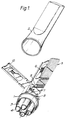
- Figure 1 shows a prior art base plate 1 and a dome-shaped cover 2 which together form an enclosure for use as a butt splice case for optical fibre cables.
- the base 1 is preferably manufactured by moulding from a glass-fibre filled high density polyethylene.
- Outlets 3 are provided in the base through which the cables pass. On a new installation, some only of the outlets 3 may be required, and some may therefore be temporarily blocked as shown at 4. Such blocking may be by any suitable means, but we prefer that the outlets be made with closed ends which are simply cut off as required.
- the dome-shaped cover may be blow-moulded and incorporate a moisture-vapour barrier such as a metal foil.
- the hollow article contains an optical fibre organizer which comprises a series of trays 5.
- Each tray preferably includes means 6 for accomodating splice tubes which house the fibre splices.
- the trays are preferably held in an orderly fashion on a carrier 7 which is fixed to the base 1.
- the trays are shown hinged along their short edges, but other hinging for example pivoting for rotation eg. about one corner in the plane of the trays could be provided. The hinging allows chosen trays to be exposed for installation of the splices or for repair etc. Means is preferbaly also provided for locking the trays in their hinged position.
- the assembly of the invention may be used as follows. Firstly, pass the two cables to be spliced in the direction of the arrows through two of the outlets 3 such that, say 1.5m of each cable protrudes into the splice case. The cable jackets are then removed back to the base 1 to expose 1.5m of fibres. The strength core of each cable is then cut back, leaving enough remaining for it to be fastened into respective fastening holes 8. Each fibre of one cable is then spliced to the correct fibre of the other cable. Groups of say ten or twelve spliced fibres are then stored on each tray. When one tray is filled it is moved by hinging at 9 to expose another tray. Each tray preferably has a rim 10 to ensure a sufficient separation between adjacent trays and/or to prevent fibre slippage from each tray.
- outlets 3 are shown as independant tubular projections, which are preferably produced by moulding integrally with the base.
- the outlets are preferably heat-shrinkable in order that seals can be made to the cables they carry.
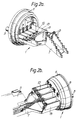
- the base 1 shown in Figure 2a has some additional or alternative features to that shown in Figure 1.
- This base 1 comprises a moulded or otherwise formed part 11 to which is attached a carrier 7 to which trays may be hinged at positions 9. Cables enter the base through outlets 3. Provision is made for connecting (mechanically and/or electrically) a central core of the cable and/or a cable shield or outer strength member (for example a braid or tape wrap): the central strength member can be attached to connections 8 and the outer strength member (or shield) to connections 12. A connection 8 and connection 12 may be provided for each cable.
- the base is so constructed that core blocking of the cables can be provided.
- a certain length of cable jacket is removed so that, when the cable is inserted through an outlet 3, the cable core is exposed over at least part of the distance X shown in the Figure.
- a reservoir may be provided by plates or other means 13 which can be attached, for example by positioning in grooves on the base.
- An encapsulant may then be poured or forced into the reservoir to block the cable or to form a further seal at the cable outlet (ie in addition to the sleeves 3) or to protect the interior of the splice case from any metal work present (metal may cause liberation of hydrogen which can damage optical fibres).
- Figure 2b shows several partially drawn trays 5 attached to a base 1 comprising a moulded part 11 and a carrier 7.
- connectors 8 for cable shielding or for outer strength members are attached to the moulded part. This can provide easy cable installation and easy fibre access.
- the dotted lines between connectors 8 indicate an electrically conductive strip between them that can be severed for example where it is shown pleated to isolate the two connectors at the left from the two at the right.
- the tray partially shown is of a design that allows the tray size to be minimized.
- Such trays can preferbaly hold splices of, say, 7.2mm in width. Bend radii of at least 4.4 cm can easily be accomodated, allowing storage of monomode fibres.
- a single means 13 provides reservoirs for encapsulant for all of the cables simaltaneously.
- Such means may be an integrally moulded part of the base.
- a termination system is provided to aid branching of fibres or groups of fibres from the incoming cable to respective trays.
- the termination system illustrated comprises a series of tubes into which fibres can be fed running from the base to respective trays.
- the tubes may be held in groups (of say four) on a part of the base by a clip as shown.
- Figures 2a and 2b may be used in in-line splice cases.
- Figure 3 shows an underneath view of the bases shown in Figure 2.
- Electrial connections are shown to the sets of contacts 14 and 15. The connections are made such that selective cutting of them can result in any of the following: all cable central conductors and shields connected to the same point (or points); central conductors plus shields of respective cables to different points 3; and all central conductors to one point, and all shields to another point.
- Figure 4 shows a design of carrier 7 made from sheet material.
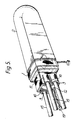
- FIG. 5 An alternative technique from that of Figure 1 of sealing the cables at their points of entry is shown in Figure 5.
- a series of branch-off clips 16 is used in conjunction with a junction box 17 to deform the outlet 3 to conform to the cables 18.
- the junction box is positioned within the outlet 3 and the cables pass between the box and the outlet.
- the branch-off clips cause the outlet to be deformed around the cables into proximity with the box.
- the outlet is again preferably heat-shrinkable.
- Figure 5 shows a further preferred feature which may be used in any of the embodiments; the outlet 3 is shrinkable by self-contained heating means, particularly by an electrical heater which is shown powered via conductors 19. Also shown is a band which joins together base and dome portions of the splice case.
- This band which may also be electrically heat-shrinkable, is provided with self-contained cutting means for re-entry into the splice case.
- a disadvantage of the use of one outlet 3 which is subdivided is that all cables are preferably installed in that outlet before recovery can be used to seal any of them.
- the independant outlets illustrated in Figure 1 allow independant sealing of each cable, and therefore an initial partial installation, followed by addition of further cables at a later date.
- the embodiment of Figure 5 could, however, be modified to allow for this by the use of blank plugs.
- Figures 6 and 7 show alternative ways of using one large outlet to seal several cables.
- a four legged branch-off clip or clips 16 is used, and in Figure 7 a flexible seal 20 (such as that disclosed in GB 2124439) is used around the cables to change their combined re-entrant cross-sectional shape into a circular shape compatible with the circular shape of the outlet 3.
- the outlets 3 are preferably heat-shrinkable, especially by electrical power.
- Discrete electrically shrinkable outlets may be used, shrunk into engagement with the cables and projections on the base.
- the outlets in this case may be pre-shrunk onto such projections, leaving only shrinkage onto the cables to be performed in the field.
- the entire installation of the outlets could be performed in the field.
- Figure 8 shows an enclosure or joining device of the invention, which can be incorporated into the designs of figures 1-7.
- First and second hollow parts 21, 22 are joined together through first and second projections 23, 24 that mate in interdigitated fashion.
- the projections need not extend all around the circumference of the parts.
- the projections have recesses 25 therein, into which is positioned some means 26 for preventing their separation.
- Such means 26 comprises a ring, preferably a split ring, and preferably one that is resiliently deformable so that it can be snapped into the recesses 25.
- the ring may comprise any suitable material, including metal and plastics.
- the external surfaces of the parts 21, 22 that are adjacent are preferably substantially mutually flush, and the ring 26 preferably is flush with them or recessed.
- the projections may prevent relative rotation of the parts 21, 22, and the ring 26 may prevent axial separation.
- Figures 8A and 8B show sections along lines AA and BB respectively of figure 8.
- Part 21 can be seen to have a projection 27 such as a lip or flap that underlies part 22, and this may give the structure more stability where desired.
- Figure 9 shows a temporary seal 28 placed over any gap between parts 21 or 22, and comprising for example an elastomeric, for example rubber, sleeve which may be corrugated.
- a more permanent seal may be provided using a dimensionally-recoverable sleeve 29 as shown in figure 10.
- a sleeve is preferably heat-shrinkable and may be coated on its internal surface with a heat-activatable adhesive.
- the sleeve may be electrically heat-shrinkable, and comprise for example a conductive polymer.
- Figure 11 shows a cable splice enclosure, of butt design, particularly for optical fibre cables, and embodying the invention.
- the base of the enclosure comprises the first part 21, outlets 31 being integral with projection 23.
- the cover which is preferably blind at one end, and especially is dome-shaped, is integral with projections 24.
- Each part 21, 22 may, however, comprise more than one component. Sealing sleeves 29 and 30 are shown in cross-section sealing the parts 21, 22 together and sealing cables 32 to the outlets 31.
- the invention provides a cable splice enclosure and a joining device and a method of sealing. Any of the features of shape, techniques of interconnection, internal components such as organizers disclosed herein may be selected for combination.
Landscapes
- Physics & Mathematics (AREA)
- General Physics & Mathematics (AREA)
- Optics & Photonics (AREA)
- Light Guides In General And Applications Therefor (AREA)
- Mechanical Coupling Of Light Guides (AREA)
- Cable Accessories (AREA)
- Insertion, Bundling And Securing Of Wires For Electric Apparatuses (AREA)
Claims (9)
- Kabelspleißumhüllung, die folgendes aufweist:- eine Basis (21), die einen Auslaß (31) hat, der fähig ist, ein Kabel aufzunehmen; und- eine hohle Abdeckung (22), die an der Basis (21) befestigt werden kann, um die Umhüllung wenigstens teilweise derart zu schließen, daß benachbarte Außenflächen der Basis und der Abdeckung im wesentlichen bündig zueinander liegen;wobei die Basis und die Abdeckung Einrichtungen haben, die ihre Trennung verhindern können, wobei die Einrichtungen im wesentlichen bündig mit oder unterhalb der benachbarten Außenflächen liegen,
dadurch gekennzeichnet,
daß die hohle Abdeckung (22) einen im allgemeinen zylindrischen rohrförmigen Bereich hat, der an einem Ende in Axialrichtung verlaufende erste Vorsprünge (24) hat, wobei die Vorsprünge im allgemeinen in Umfangsrichtung verlaufende erste Ausnehmungen (25) in Außenflächen davon haben;
daß die Basis einen im allgemeinen zylindrischen rohrförmigen Bereich hat, der in Axialrichtung verlaufende zweite Vorsprünge hat, wobei die Vorsprünge im allgemeinen in Umfangsrichtung verlaufende zweite Ausnehmungen (25) in Außenflächen davon haben;
wobei die beiden rohrförmigen Bereiche aneinander befestigt werden können, wobei die ersten und zweiten Vorsprünge fingerartig ineinandergreifend miteinander in Eingriff stehen und dadurch die beiden rohrförmigen Bereiche vereinigen, um einen verlängerten rohrförmigen Körper zu bilden, wobei sich die ersten und zweiten Ausnehmungen vereinigen, um eine gemeinsame durchgehende kreisförmige Ausnehmung zu bilden;
und daß ein Ring (26) in der durchgehenden kreisförmigen Ausnehmung positioniert werden kann, um eine Trennung der beiden rohrförmigen Bereiche in Axialrichtung zu verhindern. - Umhüllung nach Anspruch 1, wobei ein Teil der Basis (21), der den Auslaß (31) hat, mit einem Teil der Basis integral ausgebildet ist, das eine der genannten benachbarten Außenflächen hat.
- Umhüllung nach Anspruch 1 oder 2, wobei ein Teil der Abdeckung (22), der eine der benachbarten Außenflächen hat, mit einem Teil integral ausgebildet ist, das im wesentlichen rohrförmig und an einem Ende blind ist.
- Umhüllung nach einem der vorhergehenden Ansprüche, wobei der Auslaß eine dimensionsmäßig rückstellbare Hülse (30) aufweist.
- Umhüllung nach einem der vorhergehenden Ansprüche, die zusätzlich eine Lichtwellenleiter-Spleißstellenorganisationseinrichtung (5) aufweist.
- Umhüllung nach einem der vorhergehenden Ansprüche, die zusätzlich eine Dichteinrichtung aufweist, um jeglichen Zwischenraum zwischen benachbarten Außenflächen abzudichten.
- Umhüllung nach Anspruch 6, wobei die Einrichtung zum Abdichten eine dimensionsmäßig rückstellbare Hülse (29) aufweist.
- Kabelspleiß, der von einer Umhüllung nach einem der vorhergehenden Ansprüche umschlossen ist.
- Verfahren, um ein Kabelspleißgehäuse mittels einer Umhüllung nach einem der vorhergehenden Ansprüche gegenüber der Umgebung zu schützen, wobei das Verfahren folgendes aufweist:- Positionieren eines Kabels (32) in dem Auslaß (31) der Basis (21); und- Befestigen der Abdeckung (22) auf der Basis.
Priority Applications (1)
| Application Number | Priority Date | Filing Date | Title |
|---|---|---|---|
| AT90901845T ATE103397T1 (de) | 1989-01-17 | 1990-01-17 | Spleissmuffe fuer lichtwellenleiterkabel. |
Applications Claiming Priority (2)
| Application Number | Priority Date | Filing Date | Title |
|---|---|---|---|
| GB898900932A GB8900932D0 (en) | 1989-01-17 | 1989-01-17 | Splice case for optical fibre cable |
| GB8900932 | 1989-01-17 |
Publications (2)
| Publication Number | Publication Date |
|---|---|
| EP0454716A1 EP0454716A1 (de) | 1991-11-06 |
| EP0454716B1 true EP0454716B1 (de) | 1994-03-23 |
Family
ID=10650126
Family Applications (1)
| Application Number | Title | Priority Date | Filing Date |
|---|---|---|---|
| EP90901845A Expired - Lifetime EP0454716B1 (de) | 1989-01-17 | 1990-01-17 | Spleissmuffe für lichtwellenleiterkabel |
Country Status (12)
| Country | Link |
|---|---|
| EP (1) | EP0454716B1 (de) |
| JP (1) | JPH04502971A (de) |
| KR (1) | KR910700476A (de) |
| AR (1) | AR247029A1 (de) |
| AT (1) | ATE103397T1 (de) |
| AU (1) | AU640361B2 (de) |
| BR (1) | BR9007033A (de) |
| CA (1) | CA2045567A1 (de) |
| DE (1) | DE69007612T2 (de) |
| ES (1) | ES2053174T3 (de) |
| GB (1) | GB8900932D0 (de) |
| WO (1) | WO1990008336A1 (de) |
Families Citing this family (7)
| Publication number | Priority date | Publication date | Assignee | Title |
|---|---|---|---|---|
| GB9105435D0 (en) * | 1991-03-14 | 1991-05-01 | Bicc Plc | Optical cable joints |
| US5097530A (en) * | 1991-04-04 | 1992-03-17 | Raychem Corporation | Optical fiber enclosure including novel retaining ring |
| DE4217296A1 (de) * | 1991-09-17 | 1993-12-02 | Siemens Ag | Haubenmuffe für die Aufnahme von Kabelspleißen |
| US5288946A (en) * | 1992-06-18 | 1994-02-22 | Minnesota Mining And Manufacturing Company | Strain relief device and closure |
| GB2277812B (en) * | 1993-05-07 | 1997-01-08 | Siemens Ag | Underground container means for optical cables and connection module |
| US5426715A (en) * | 1993-07-23 | 1995-06-20 | Raychem Corporation | Oval port seal and method used for an optical fiber cable closure |
| IES950097A2 (en) * | 1995-02-07 | 1995-07-12 | Manorbeach Ltd | An optical fibre management system |
Family Cites Families (9)
| Publication number | Priority date | Publication date | Assignee | Title |
|---|---|---|---|---|
| US3557299A (en) * | 1969-02-10 | 1971-01-19 | Minnesota Mining & Mfg | Sealed cable closure |
| DE2131830C3 (de) * | 1971-06-26 | 1975-01-30 | Walter Rose Kg, 5800 Hagen | Topfmuffe für KabelspleiBe |
| GB2104313B (en) * | 1981-06-22 | 1985-06-19 | Raychem Ltd | Cable breakout article |
| DE3125044A1 (de) * | 1981-06-26 | 1983-01-05 | Walter Rose Gmbh & Co Kg, 5800 Hagen | "vorrichtung zum abdichten von kabeln" |
| AU567494B2 (en) * | 1982-05-19 | 1987-11-26 | N.V. Raychem S.A. | Cable joint closure |
| EP0159857B1 (de) * | 1984-04-11 | 1990-07-25 | N.V. Raychem S.A. | Spleissbehälter für Kabel aus optischen Fasern |
| GB8514389D0 (en) * | 1985-06-07 | 1985-07-10 | Telephone Cables Ltd | Joint closure housing |
| GB8602425D0 (en) * | 1986-01-31 | 1986-03-05 | Raychem Sa Nv | Optical fibre splice case |
| DE3706518A1 (de) * | 1987-02-28 | 1988-09-08 | Philips Patentverwaltung | Verfahren und anordnung zum aufwickeln der ueberlaengen miteinander verbundener lichtwellenleiter mittels einer wickelkassette |
-
1989
- 1989-01-17 GB GB898900932A patent/GB8900932D0/en active Pending
-
1990
- 1990-01-15 AR AR90315946A patent/AR247029A1/es active
- 1990-01-17 ES ES90901845T patent/ES2053174T3/es not_active Expired - Lifetime
- 1990-01-17 WO PCT/GB1990/000070 patent/WO1990008336A1/en not_active Ceased
- 1990-01-17 JP JP2501948A patent/JPH04502971A/ja active Pending
- 1990-01-17 EP EP90901845A patent/EP0454716B1/de not_active Expired - Lifetime
- 1990-01-17 BR BR909007033A patent/BR9007033A/pt not_active IP Right Cessation
- 1990-01-17 AT AT90901845T patent/ATE103397T1/de not_active IP Right Cessation
- 1990-01-17 CA CA002045567A patent/CA2045567A1/en not_active Abandoned
- 1990-01-17 AU AU48433/90A patent/AU640361B2/en not_active Ceased
- 1990-01-17 DE DE69007612T patent/DE69007612T2/de not_active Expired - Fee Related
- 1990-01-17 KR KR1019900702044A patent/KR910700476A/ko not_active Abandoned
Also Published As
| Publication number | Publication date |
|---|---|
| ATE103397T1 (de) | 1994-04-15 |
| KR910700476A (ko) | 1991-03-15 |
| DE69007612T2 (de) | 1994-10-20 |
| ES2053174T3 (es) | 1994-07-16 |
| DE69007612D1 (de) | 1994-04-28 |
| CA2045567A1 (en) | 1990-07-18 |
| WO1990008336A1 (en) | 1990-07-26 |
| GB8900932D0 (en) | 1989-03-08 |
| BR9007033A (pt) | 1991-10-22 |
| AR247029A1 (es) | 1994-10-31 |
| AU4843390A (en) | 1990-08-13 |
| EP0454716A1 (de) | 1991-11-06 |
| AU640361B2 (en) | 1993-08-26 |
| JPH04502971A (ja) | 1992-05-28 |
Similar Documents
| Publication | Publication Date | Title |
|---|---|---|
| US5222183A (en) | Splice case for optical fibre cable | |
| EP0159857B1 (de) | Spleissbehälter für Kabel aus optischen Fasern | |
| US5249253A (en) | Electrofit fibre optics butt splice | |
| US5602954A (en) | Electrofit fiber optics butt splice | |
| EP0232147B1 (de) | Muffe für Verbindungen optischer Fibern | |
| EP1929346B1 (de) | Gehäuse und organisierer für telekommunikationsleitungen und spleisstellen | |
| US5997186A (en) | Hybrid cable splice closure and related methods | |
| US5048918A (en) | Optical fiber cable termination | |
| EP1127396B1 (de) | Kabelverschluss | |
| CA2222883A1 (en) | Optical fiber splice case with cross connect feature | |
| EP1929347B1 (de) | Gehäuse für telekommunikationsleitungen und spleissstellen | |
| US4924034A (en) | Re-enterable enclosure around splice | |
| US5255337A (en) | Splice case for optical fibre cable | |
| JPH0332857B2 (de) | ||
| AU640361B2 (en) | Splice case for optical fibre cable | |
| EP0082010B1 (de) | Einlage für einen Verschlusszusammenbau | |
| JPH0680445B2 (ja) | 光フアイバケ−ブル用スプライスケ−ス |
Legal Events
| Date | Code | Title | Description |
|---|---|---|---|
| PUAI | Public reference made under article 153(3) epc to a published international application that has entered the european phase |
Free format text: ORIGINAL CODE: 0009012 |
|
| 17P | Request for examination filed |
Effective date: 19910626 |
|
| AK | Designated contracting states |
Kind code of ref document: A1 Designated state(s): AT BE CH DE DK ES FR GB IT LI NL SE |
|
| 17Q | First examination report despatched |
Effective date: 19920930 |
|
| GRAA | (expected) grant |
Free format text: ORIGINAL CODE: 0009210 |
|
| AK | Designated contracting states |
Kind code of ref document: B1 Designated state(s): AT BE CH DE DK ES FR GB IT LI NL SE |
|
| PG25 | Lapsed in a contracting state [announced via postgrant information from national office to epo] |
Ref country code: DK Effective date: 19940323 |
|
| REF | Corresponds to: |
Ref document number: 103397 Country of ref document: AT Date of ref document: 19940415 Kind code of ref document: T |
|
| REF | Corresponds to: |
Ref document number: 69007612 Country of ref document: DE Date of ref document: 19940428 |
|
| ITF | It: translation for a ep patent filed | ||
| ET | Fr: translation filed | ||
| REG | Reference to a national code |
Ref country code: ES Ref legal event code: FG2A Ref document number: 2053174 Country of ref document: ES Kind code of ref document: T3 |
|
| PLBE | No opposition filed within time limit |
Free format text: ORIGINAL CODE: 0009261 |
|
| STAA | Information on the status of an ep patent application or granted ep patent |
Free format text: STATUS: NO OPPOSITION FILED WITHIN TIME LIMIT |
|
| EAL | Se: european patent in force in sweden |
Ref document number: 90901845.9 |
|
| 26N | No opposition filed | ||
| PGFP | Annual fee paid to national office [announced via postgrant information from national office to epo] |
Ref country code: GB Payment date: 19980108 Year of fee payment: 9 |
|
| PGFP | Annual fee paid to national office [announced via postgrant information from national office to epo] |
Ref country code: FR Payment date: 19980109 Year of fee payment: 9 |
|
| PGFP | Annual fee paid to national office [announced via postgrant information from national office to epo] |
Ref country code: AT Payment date: 19980114 Year of fee payment: 9 |
|
| PGFP | Annual fee paid to national office [announced via postgrant information from national office to epo] |
Ref country code: SE Payment date: 19980116 Year of fee payment: 9 |
|
| PGFP | Annual fee paid to national office [announced via postgrant information from national office to epo] |
Ref country code: CH Payment date: 19980122 Year of fee payment: 9 |
|
| PGFP | Annual fee paid to national office [announced via postgrant information from national office to epo] |
Ref country code: ES Payment date: 19980129 Year of fee payment: 9 |
|
| PG25 | Lapsed in a contracting state [announced via postgrant information from national office to epo] |
Ref country code: GB Free format text: LAPSE BECAUSE OF NON-PAYMENT OF DUE FEES Effective date: 19990117 Ref country code: AT Free format text: LAPSE BECAUSE OF NON-PAYMENT OF DUE FEES Effective date: 19990117 |
|
| PG25 | Lapsed in a contracting state [announced via postgrant information from national office to epo] |
Ref country code: SE Free format text: LAPSE BECAUSE OF NON-PAYMENT OF DUE FEES Effective date: 19990118 Ref country code: ES Free format text: LAPSE BECAUSE OF NON-PAYMENT OF DUE FEES Effective date: 19990118 |
|
| PGFP | Annual fee paid to national office [announced via postgrant information from national office to epo] |
Ref country code: DE Payment date: 19990125 Year of fee payment: 10 |
|
| PG25 | Lapsed in a contracting state [announced via postgrant information from national office to epo] |
Ref country code: LI Free format text: LAPSE BECAUSE OF NON-PAYMENT OF DUE FEES Effective date: 19990131 Ref country code: CH Free format text: LAPSE BECAUSE OF NON-PAYMENT OF DUE FEES Effective date: 19990131 |
|
| PGFP | Annual fee paid to national office [announced via postgrant information from national office to epo] |
Ref country code: NL Payment date: 19990131 Year of fee payment: 10 |
|
| PGFP | Annual fee paid to national office [announced via postgrant information from national office to epo] |
Ref country code: BE Payment date: 19990324 Year of fee payment: 10 |
|
| GBPC | Gb: european patent ceased through non-payment of renewal fee |
Effective date: 19990117 |
|
| REG | Reference to a national code |
Ref country code: CH Ref legal event code: PL |
|
| PG25 | Lapsed in a contracting state [announced via postgrant information from national office to epo] |
Ref country code: FR Free format text: LAPSE BECAUSE OF NON-PAYMENT OF DUE FEES Effective date: 19990930 |
|
| REG | Reference to a national code |
Ref country code: FR Ref legal event code: ST |
|
| PG25 | Lapsed in a contracting state [announced via postgrant information from national office to epo] |
Ref country code: BE Free format text: LAPSE BECAUSE OF NON-PAYMENT OF DUE FEES Effective date: 20000131 |
|
| BERE | Be: lapsed |
Owner name: S.A. RAYCHEM N.V. Effective date: 20000131 |
|
| PG25 | Lapsed in a contracting state [announced via postgrant information from national office to epo] |
Ref country code: NL Free format text: LAPSE BECAUSE OF NON-PAYMENT OF DUE FEES Effective date: 20000801 |
|
| NLV4 | Nl: lapsed or anulled due to non-payment of the annual fee |
Effective date: 20000801 |
|
| PG25 | Lapsed in a contracting state [announced via postgrant information from national office to epo] |
Ref country code: DE Free format text: LAPSE BECAUSE OF NON-PAYMENT OF DUE FEES Effective date: 20001101 |
|
| REG | Reference to a national code |
Ref country code: ES Ref legal event code: FD2A Effective date: 20010503 |
|
| PG25 | Lapsed in a contracting state [announced via postgrant information from national office to epo] |
Ref country code: IT Free format text: LAPSE BECAUSE OF NON-PAYMENT OF DUE FEES;WARNING: LAPSES OF ITALIAN PATENTS WITH EFFECTIVE DATE BEFORE 2007 MAY HAVE OCCURRED AT ANY TIME BEFORE 2007. THE CORRECT EFFECTIVE DATE MAY BE DIFFERENT FROM THE ONE RECORDED. Effective date: 20050117 |