EP0454873A1 - Trocknungsverfahren und vorrichtung dazu - Google Patents
Trocknungsverfahren und vorrichtung dazu Download PDFInfo
- Publication number
- EP0454873A1 EP0454873A1 EP91900347A EP91900347A EP0454873A1 EP 0454873 A1 EP0454873 A1 EP 0454873A1 EP 91900347 A EP91900347 A EP 91900347A EP 91900347 A EP91900347 A EP 91900347A EP 0454873 A1 EP0454873 A1 EP 0454873A1
- Authority
- EP
- European Patent Office
- Prior art keywords
- vessel
- dried
- cooling
- drying
- heated vapor
- Prior art date
- Legal status (The legal status is an assumption and is not a legal conclusion. Google has not performed a legal analysis and makes no representation as to the accuracy of the status listed.)
- Granted
Links
Images


Classifications
-
- F—MECHANICAL ENGINEERING; LIGHTING; HEATING; WEAPONS; BLASTING
- F26—DRYING
- F26B—DRYING SOLID MATERIALS OR OBJECTS BY REMOVING LIQUID THEREFROM
- F26B21/00—Arrangements for supplying or controlling air or other gases for drying solid materials or objects
- F26B21/40—Arrangements for supplying or controlling air or other gases for drying solid materials or objects using gases other than air
-
- F—MECHANICAL ENGINEERING; LIGHTING; HEATING; WEAPONS; BLASTING
- F26—DRYING
- F26B—DRYING SOLID MATERIALS OR OBJECTS BY REMOVING LIQUID THEREFROM
- F26B21/00—Arrangements for supplying or controlling air or other gases for drying solid materials or objects
-
- F—MECHANICAL ENGINEERING; LIGHTING; HEATING; WEAPONS; BLASTING
- F26—DRYING
- F26B—DRYING SOLID MATERIALS OR OBJECTS BY REMOVING LIQUID THEREFROM
- F26B21/00—Arrangements for supplying or controlling air or other gases for drying solid materials or objects
- F26B21/40—Arrangements for supplying or controlling air or other gases for drying solid materials or objects using gases other than air
- F26B21/45—Arrangements for supplying or controlling air or other gases for drying solid materials or objects using gases other than air using steam
-
- F—MECHANICAL ENGINEERING; LIGHTING; HEATING; WEAPONS; BLASTING
- F26—DRYING
- F26B—DRYING SOLID MATERIALS OR OBJECTS BY REMOVING LIQUID THEREFROM
- F26B25/00—Details of general application not covered by group F26B21/00 or F26B23/00
- F26B25/005—Treatment of dryer exhaust gases
- F26B25/006—Separating volatiles, e.g. recovering solvents from dryer exhaust gases
-
- F—MECHANICAL ENGINEERING; LIGHTING; HEATING; WEAPONS; BLASTING
- F26—DRYING
- F26B—DRYING SOLID MATERIALS OR OBJECTS BY REMOVING LIQUID THEREFROM
- F26B3/00—Drying solid materials or objects by processes involving the application of heat
-
- H—ELECTRICITY
- H05—ELECTRIC TECHNIQUES NOT OTHERWISE PROVIDED FOR
- H05K—PRINTED CIRCUITS; CASINGS OR CONSTRUCTIONAL DETAILS OF ELECTRIC APPARATUS; MANUFACTURE OF ASSEMBLAGES OF ELECTRICAL COMPONENTS
- H05K3/00—Apparatus or processes for manufacturing printed circuits
- H05K3/22—Secondary treatment of printed circuits
- H05K3/227—Drying of printed circuits
Definitions
- This invention relates to a drying method for removing free water resided on electronic parts such as printed wiring boards, optical parts such as lenses and prisms, and precision instrument parts such as gears and lead frames having been subjected to advanced cleaning, surface treatments, etc. and to an apparatus therefor.
- This invention provides a method of drying electronic parts such as semiconductors, liquid-crystal display devices and printed wiring boards, optical parts such as lenses and prisms, and precision instrument parts such as gears and lead frames having been subjected to advanced cleaning, surface treatment, etc., which satisfies all of the requirements unachievable by the conventional methods, and which removes the free water residing on the surface of such parts with safety and in a short time to give a high level of finish of drying inexpensively, and an apparatus therefor.
- a gist of this invention is to provide a method of drying an object by heating the object to be dried placed in a vessel with a vapor generated by boiling (hereinafter refered to as heated vapor), followed by cooling of the space within the vessel and an apparatus therefor, characterized in that the air present in the space within the vessel is replaced with the heated vapor, that the cooling operation is carried out, after the introduction of the heated vapor is stopped, with the vessel being sealed from the outer air and that a dry gas is introduced to the vessel after completion of the cooling operation.
- heated vapor a vapor generated by boiling
- the heated vapor to be used here should have a temperature (boiling point) at which the vapor pressure is at least equal to atmospheric pressure (760 mmHg).
- a hydrophilic organic solvent having a boiling point lower than that of water for example, lower alcohols such as methanol, ethanol and IPA (isopropyl alcohol) or acetone can be used taking heat resistance of the object to be dried into consideration.
- a suitable hydrophilic organic solvent can be selected further taking chemical resistance of the object to be dried and cost of solvent into consideration.
- boiling points of various sources of heated vapors are shown below (together with the vapor pressures at 20°C).
- Fig. 1 wherein the axes of ordinates show surface temperature T (°C) of the object to be dried, the moisture content W (mg/l) in the space within the vessel, the amount of free water M (g/m2) resided on the surface of the object to be dried and the amount of condensate Q (g) in the graphs (a), (b), (c) and (d), respectively; whereas the axes of abscissas show elapsed time t.
- the heated vapor used in the following description should be understood to be a 100°C water vapor (steam).
- the drying procedures will be described step by step from (1) to (6).
- the object to be dried is first heated with the steam (where the steam having released thermal energy of course condenses on the surface of the object to be dried to gradually replace the free water resided thereon and finally at the point the object to be dried is heated to the steam temperature, the condensate is replaced with the steam) to fill the space within the vessel with the steam, and after the vessel is sealed from the outer air, the space within the vessel containing the object to be dried is cooled to effect condensation of the moisture present therein (the pressure of the space within the vessel is consequently reduced), finally a dry gas is introduced to the inner space of the vessel utilizing the operation of allowing the inside of the vessel to recover the atmospheric pressure, to effect drying of the object. Accordingly, it is important that the cooling section and the object to be dried are in a heat conductive relationship only through a gas phase and that the condensate formed on the cooling section should be prevented from redepositing on the object to be dried.
- the object to be dried placed in the vessel is dried by sufficiently heating it with a heated vapor, followed by cooling of the space within the vessel.
- This apparatus comprises a vessel for accommodating objects to be dried, having a heated vapor introduction means, a cooling system for cooling the space within the vessel, a section for collecting and discharging the condensate and a dry gas introduction means, and the vessel has a structure where the cooling section of the cooling system can thermally be insulated from the objects to be dried, and the inner space of the vessel can be sealed from the outer air.
- the vessel As the vessel, a cylindrical steel container having an open top (through which objects to be dried can be introduced thereto or taken out therefrom) and a closed bottom (where condensate can be collected and discharged through a pipe connected thereto) which can be closed at the top with a cover is used.
- the reason why the vessel has a cylindrical shape is because it should have a pressure tight structure since the drying process is carried out under reduced pressure even temporarily. It is of course possible to use various types of pressure tight vessel.
- the heated vapor introduction means usually means a piping, communicating to the source of the heated vapor disposed outside the system, having a valve for controlling/shutting-off the flow of the heated vapor.
- a liquid or the source of the heated vapor may preliminarily be poured into the vessel, which may be heated, for example, with an electric heater or a steam heater preliminarily disposed in contact with the vessel to generate vapor within the system.
- the cooling section of the cooling means usually an indirect cooling system where the vessel has a double-sided wall structure at the side wall and/or the bottom or where a cooling pipe is disposed around the inner space of the vessel, through which a cooling medium is passed from the outside of the system
- the heated vapor introducing operation and the cooling operation are performed sequentially.
- a valve for selectively introducing the heating medium or cooling medium to the system is necessary.
- the cooling section is disposed with some horizontal distance from the position where the object to be dried is placed or a partition is disposed therebetween (when the cooling section is disposed substantially at the same level as the level of the object to be dried, or alternatively, the cooling means is disposed below said position, so that the condensate to be formed on the surface of the cooling section may not be in contact with the object to be dried during the cooling operation.
- the object to be dried is placed on a holder made of a material having a low thermal conductivity directly or through a member made of the same material, or it may be suspended from the top of the vessel directly or as carried in a container such as a basket.
- the section for collecting and discharging condensate is a space defined at the bottom of the vessel, which is provided with a condensate discharge pipe, at the lowermost position, having a valve for maintaining vacuum within the vessel, and which has a capacity to allow the total amount of condensate II as shown in Fig. 1-(d) to stay therein or has a depth in which a level gauge can function. While the shape of the above section may not be limited, it is preferably conical in view of the efficiency of collecting condensate. When the heated vapor for heating the object to be dried is generated within the system, consideration must be taken that the section for collecting and discharging condensate is allowed to have a capacity necessary for preventing the heater from heating without any liquid staying at the section.
- a trap formed by liquid-sealing the lower end of the condensate discharge pipe with water is usually used, (the condensate to be formed during the operation of introducing the heated vapor is discharged to the outside of the vessel through the trap).
- the dry gas introduction means usually means a piping (having a flow control valve and/or a shut-off valve) communicating to an external gas source, when the heated vapor is introduced from the outside of the system, the dry gas introduction means may also be used as the heated vapor introduction means, since the heated vapor introduction and dry gas introduction are performed sequentially (in this case a change-over valve for selectively introducing the heated vapor or the gas is necessary).
- drying method of this invention is of batchwise, a plurality of such drying apparatuses are usually provided depending on the line speed of the system of producing the objects to be dried. However, a single or a very small number of drying apparatus having an increased processing ability per unit time can be used.
- Fig. 1 explains the basic drying mechanism of this invention, wherein the numerical values specifically shown therein as examples are of water which was used as the source of heated vapor (the axes of ordinates show surface temperature T (°C) of the object to be dried, the moisture content W (mg/l) in the inner space of the vessel, the amount of free water M (g/m2) resided on the surface of the object to be dried and the amount of condensate Q (g) in the graphs (a), (b), (c) and (d), respectively; whereas the axes of abscissas show elapsed time t (the subscripts 0 means when an object to be dried is introduced into the vessel; 1, when introduction of the heated vapor is started; 2, when introduction of the heated vapor is stopped and cooling of the space within the vessel is started; 3, when cooling of the space within the vessel is stopped and introduction of dry gas is started; and 4, when drying operation is completed).
- Fig. 2 shows, in vertical cross section, an embodiment of the apparatus of this invention
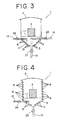
- Figs. 3 and 4 each show, in vertical cross section, another embodiments of the apparatus of this invention, particularly illustrating different ways of introducing the heated vapor (the heated vapor is generated within the system) from that of the apparatus shown in Fig. 2
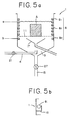
- Fig. 5-(a) is a vertical cross section of an embodiment of the apparatus for an alternative process of this invention
- Fig. 5-(b) is an enlarged view of the pertinent portion thereof.
- Fig. 2 shows, in vertical cross section, an embodiment of the drying apparatus of this invention.
- the drying apparatus consists of a cylindrical vessel 1 in which an object to be dried A can be placed, having a closed bottom 3 (inverted conical shape) and a cover 2 (which can hermetically seal the vessel); a heated vapor introduction pipe 4 having one end thereof opening to the inside of the vessel; a trap 5 connected to the bottom 3 through a condensate discharge pipe 14; a gas introduction pipe 7 having one end thereof opening to the inside of the vessel; and a cooling section 8 (the double-sided wall structure of the vessel is utilized as the cooling section) to which a cooling water introduction pipe 9 and a cooling water discharge pipe 10 are respectively connected; wherein the object to be dried A is placed on a grid-like holder 11 made of a material having a low thermal conductivity so as to achieve thermal insulation thereof from the cooling section.
- the pipes 4, 7, 9, 10 and 14 have flow control valves and/or shut-off valves 21, 23, 24, 25 and 22, respectively; while the vessel has a pressure detector 31 and a temperature detector 32 at the top and a liquid level detector 33 at the bottom, respectively.
- An object to be dried A is first placed on the holder 11 in the vessel (wherein the valves 21, 23, 24 and 25 being closed and the valve 22 being open), and then the vessel is closed with the cover 2 (time: t0 in Fig. 1). Subsequently, the valve 21 is opened to introduce a steam into the vessel (time: t1 --> t2 in Fig. 1).
- the steam is obtained by boiling a demineralized water under the atmospheric temperature (the source of steam is not shown), which is condensed as it heats the object to be dried and the vessel itself and replaces the air within the inner space of the vessel while the condensate flows to the outside of the system through the route: condensate discharge pipe 14 --> trap 5 --> condensate overflow pipe 6.
- the steam filling the vessel after the above operation is condensed on the surface of the cooling section to drop the pressure of the space within the vessel to 0.023 atm (when the preset cooling temperature is 20°C), whereby the condensate collects at the bottom 3 of the vessel.
- the valves 24 and 25 are closed to terminate the cooling operation and the valve 23 is opened to introduce a clean dry gas into the vessel through the dry gas introduction pipe 7 and allow the inner space of the vessel to recover the atmospheric pressure (which can be monitored by the pressure detector 31).
- valve 22 is then opened (to discharge the condensate collected at the bottom of the vessel to the outside of the system), and after the valve 23 is closed, the cover 2 is opened to take out the object to be dried A.
- the drying operation is completed and the apparatus is now ready for the next cycle of drying operation.
- the condensate discharging means in the apparatus of this invention is not limited to such combination, but the trap 5 can be omitted if a relief valve is used in place of the valve 22.
- the above embodiment is the case where water is used as the source of the heated vapor.
- a hydrophilic low-boiling point organic solvent for example, various kinds of lower alcohols can be used taking full countermeasures for their inflammabiliy or explosiveness (in facility and operations); wherein the heating temperature is preferably the boiling point of the alcohol.
- the preset cooling temperature may suitably be selected within the heat drop (temperature difference) between the temperature of the cooling medium to be applicable and the heating temperature.
- Figs. 3 and 4 each show, in vertical cross section, another embodiment of the apparatus of this invention, where the necessary heated vapor is generated within the system (the cooling section 8 shown is a substitute for the same used in Fig. 2, which is a piping disposed spirally along the inner surface at the bottom of the vessel (Fig. 3) or along the inner wall surface (Fig. 4)) thereof.
- the cooling section 8 shown is a substitute for the same used in Fig. 2, which is a piping disposed spirally along the inner surface at the bottom of the vessel (Fig. 3) or along the inner wall surface (Fig. 4)) thereof.
- the above heated vapor introduction pipe 4 is replaced with a liquid introduction pipe 12, and a heater 13 is additionally disposed on the outer surface of the bottom wall of the vessel; where a predetermined amount of liquid is preliminarily introduced to the bottom through the liquid introduction pipe 12, and the liquid thus introduced is heated by the heater 13 to generate a heated vapor in the heated vapor introduction process.
- the condensate to be formed during the heating is discharged to the outside of the system through the condensate discharge pipe 14 (where the valve 22 is a shut-off valve) with the aid of the pressure of the vapor generated.
- the pipe 15 is a drain pipe (the valve 27 is a shut-off valve) for discharging the condensate (the total amount of condensate II shown in Fig. 1-(d)) to be formed during the cooling process.
- the condensate discharge pipe 14 can also be used as a liquid introduction pipe (as occasion demands) by disposing a directional control valve thereto.
- the pipe 14 is allowed to serve as the drain pipe 15 and condensate discharge pipe 14 shown in Fig. 3, and a heater 13 is additionally disposed around the inner surface of the bottom of the vessel (this disposition of heater 13 can also be applied in the apparatus of Fig. 3); where heated vapor can be generated in the same manner as in the apparatus of Fig. 3.
- a relief valve is used as the valve 22, or alternatively the combination of a shut-off valve and a trap 5 as used in the apparatus of Fig. 2 may be used.
- the initial amount of liquid to be introduced to the vessel can be secured according to the value calculated by adding the amount of liquid for preventing heating of the vessel with no liquid staying at the bottom of the vessel to the amount of liquid to be determined from the heat capacity to be heated by the vapor and the latent heat of vaporization.
- Fig. 5-(a) is a vertical cross section of an embodiment of the drying apparatus for an alternative process of this invention.
- Fig. 5-(b) is an enlarged view of the pertinent portion thereof.
- An object to be dried A is placed on a holder 11 thermally insulated from the cooling section like in the apparatuses described above, or the object to be dried may be placed in a basket suspended from the top of the vessel.
- the sections and parts having the same functions as in the above Figures are shown with the same reference numbers.
- the valve 21 is opened and a steam is introduced to the inner space of the vessel.
- an object to be dried A is placed in the vessel (the upper surface of the object to be dried is below the level "a”).
- the steam is condensed as it heats the object to be dried and the vessel itself and the condensates are discharged through the receiver 17 disposed below the object to be dried and through the gutters 8i below the level "a", respectively.
- the object to be dried is taken out from the vessel (where the driving force of drying is the surface temperature of the object to be dried which is considerably higher than the temperature of the inner space of the vessel cooled, so that the moisture in the space near the surface of the object to be dried condenses not on the surface of the object to be dried but on the surface of the cooling section).
- the valve 27 is first opened to discharge the condensate remaining in the vessel through the drain pipe 15, and the valve 27 is closed followed by stopping the introduction of the cooling water to the cooling pipes 8i successively from the lower ones to the upper ones, while the amount of steam introduced to the vessel is gradually increased to allow the vapor phase to recover the level "a".
- a liquid or the source of the heated vapor such as a demineralized water and a low-boiling point hydrophilic organic solvent, may preliminarily be introduced to the bottom of the vessel to heat the introduced liquid with a heater and generate the heated vapor within the vessel likewise; wherein the pipe 4 is used as a liquid introduction pipe; the valve 27 disposed to the drain pipe 15 is closed during the one cycle of drying operation; and the amount of heated vapor to be generated is controlled by conventional procedure, for example, using an electric heater by controlling the electric current.
- this method can achieve a slightly lower level of finish of drying than in any of the above methods since it employs no introduction of dry gas at the final stage of drying operation, this method enjoys shorter drying time and improved operability since this method requires no pressure-tight design of the apparatus because the drying is not carried out under reduced pressure.
- the level of finish of drying in this method is sufficiently high compared with the ones achieved by the conventional methods, and thus this method can fully be utilized as a convenient method for drying objects having simple structures such as plates.
- the method or the apparatus of this invention is very useful in industrial applications since it can be employed for drying electronic parts such as semiconductors, liquid-crystal display devices and printed wiring boards, optical parts such as lenses and prisms, precision instrument parts such as gears and lead frames, having been subjected to advanced cleaning, surface treatments, etc. to achieve a high level of finish of drying with safety and in a short time.
- this invention has the following advantages which have never been achieved by the conventional methods.
Landscapes
- Engineering & Computer Science (AREA)
- Mechanical Engineering (AREA)
- General Engineering & Computer Science (AREA)
- Life Sciences & Earth Sciences (AREA)
- Microbiology (AREA)
- Manufacturing & Machinery (AREA)
- Microelectronics & Electronic Packaging (AREA)
- Drying Of Solid Materials (AREA)
- Cleaning Or Drying Semiconductors (AREA)
Applications Claiming Priority (4)
| Application Number | Priority Date | Filing Date | Title |
|---|---|---|---|
| JP302560/89 | 1989-11-21 | ||
| JP30256089 | 1989-11-21 | ||
| JP324329/89 | 1989-12-14 | ||
| JP32432989 | 1989-12-14 |
Publications (3)
| Publication Number | Publication Date |
|---|---|
| EP0454873A1 true EP0454873A1 (de) | 1991-11-06 |
| EP0454873A4 EP0454873A4 (en) | 1992-05-06 |
| EP0454873B1 EP0454873B1 (de) | 1994-03-30 |
Family
ID=26563169
Family Applications (1)
| Application Number | Title | Priority Date | Filing Date |
|---|---|---|---|
| EP91900347A Expired - Lifetime EP0454873B1 (de) | 1989-11-21 | 1991-06-14 | Trocknungsverfahren und vorrichtung dazu |
Country Status (4)
| Country | Link |
|---|---|
| US (1) | US5222307A (de) |
| EP (1) | EP0454873B1 (de) |
| DE (1) | DE69007779T2 (de) |
| WO (1) | WO1991007239A1 (de) |
Cited By (3)
| Publication number | Priority date | Publication date | Assignee | Title |
|---|---|---|---|---|
| GB2268253A (en) * | 1992-06-29 | 1994-01-05 | Nsk Ltd | Method and apparatus for drying bearing |
| WO2005001888A3 (de) * | 2003-04-11 | 2005-03-17 | Dynamic Microsystems Semicondu | Vorrichtung und verfahren zum reinigen von bei der herstellung von halbleitern verwendeten gegenständen, insbesondere von transport- und reinigungsbehältern für wafer |
| DE10347464A1 (de) * | 2003-10-02 | 2005-05-04 | Dynamic Microsystems Semicondu | Vorrichtung und Verfahren zum Reinigen von bei der Herstellung von Halbleitern verwendeten Gegenständen |
Families Citing this family (26)
| Publication number | Priority date | Publication date | Assignee | Title |
|---|---|---|---|---|
| US5746008A (en) * | 1992-07-29 | 1998-05-05 | Shinko Electric Co., Ltd. | Electronic substrate processing system using portable closed containers |
| US5426865A (en) * | 1992-09-03 | 1995-06-27 | Tokyo Electron Limited | Vacuum creating method and apparatus |
| US5647143A (en) * | 1992-10-30 | 1997-07-15 | Japan Hayes Ltd. | Vacuum-degreasing cleaning method |
| US5806574A (en) * | 1995-12-01 | 1998-09-15 | Shinko Electric Co., Ltd. | Portable closed container |
| JP3354438B2 (ja) * | 1996-06-04 | 2002-12-09 | 株式会社荏原製作所 | 有機物を含有する水媒体の処理方法及び水熱反応装置 |
| US5709065A (en) * | 1996-07-31 | 1998-01-20 | Empak, Inc. | Desiccant substrate package |
| JP3230051B2 (ja) * | 1997-05-16 | 2001-11-19 | 東京エレクトロン株式会社 | 乾燥処理方法及びその装置 |
| JP3837016B2 (ja) * | 2000-09-28 | 2006-10-25 | 大日本スクリーン製造株式会社 | 基板処理方法および基板処理装置 |
| DE10203814C2 (de) * | 2002-01-31 | 2003-11-27 | Siemens Ag | Mobiles Kommunikationsendgerät |
| JP2007115756A (ja) * | 2005-10-18 | 2007-05-10 | Shibaura Mechatronics Corp | スピン処理装置 |
| US7931044B2 (en) * | 2006-03-09 | 2011-04-26 | Curtiss-Wright Flow Control Corporation | Valve body and condensate holding tank flushing systems and methods |
| US20080155852A1 (en) * | 2006-12-29 | 2008-07-03 | Olgado Donald J K | Multiple substrate vapor drying systems and methods |
| US10240867B2 (en) | 2012-02-01 | 2019-03-26 | Revive Electronics, LLC | Methods and apparatuses for drying electronic devices |
| US10876792B2 (en) | 2012-02-01 | 2020-12-29 | Revive Electronics, LLC | Methods and apparatuses for drying electronic devices |
| US12276454B2 (en) | 2020-04-21 | 2025-04-15 | Revive Electronics, LLC | Methods and apparatuses for drying electronic devices |
| US9970708B2 (en) | 2012-02-01 | 2018-05-15 | Revive Electronics, LLC | Methods and apparatuses for drying electronic devices |
| US10690413B2 (en) | 2012-02-01 | 2020-06-23 | Revive Electronics, LLC | Methods and apparatuses for drying electronic devices |
| US11713924B2 (en) | 2012-02-01 | 2023-08-01 | Revive Electronics, LLC | Methods and apparatuses for drying electronic devices |
| US12281847B2 (en) | 2020-04-21 | 2025-04-22 | Revive Electronics, LLC | Methods and apparatuses for drying electronic devices |
| US12215925B2 (en) | 2020-04-21 | 2025-02-04 | Revive Electronics, LLC | Methods and apparatuses for drying electronic devices |
| US8689461B1 (en) | 2012-11-08 | 2014-04-08 | TekDry, LLC | Dryer for portable electronics |
| US10088230B2 (en) | 2012-11-08 | 2018-10-02 | Tekdry International, Inc. | Dryer for portable electronics |
| WO2014153007A1 (en) | 2013-03-14 | 2014-09-25 | Revive Electronics, LLC | Methods and apparatuses for drying electronic devices |
| US12510296B2 (en) | 2020-04-21 | 2025-12-30 | Revive Electronics, LLC | Methods and apparatuses for drying electronic devices |
| US12584689B2 (en) | 2020-04-21 | 2026-03-24 | Revive Electronics, LLC | Methods and apparatuses for drying electronic devices |
| CN115540525B (zh) * | 2022-09-26 | 2024-05-24 | 广州逸芸信息科技有限公司 | 一种空气能热泵烘干机控制器及其控制方法 |
Family Cites Families (14)
| Publication number | Priority date | Publication date | Assignee | Title |
|---|---|---|---|---|
| US787093A (en) * | 1902-08-02 | 1905-04-11 | George Whitman Mcmullen | Process of drying vegetable, mineral, animal, and compound substances. |
| US805367A (en) * | 1904-05-31 | 1905-11-21 | Valentin Lapp | Method of drying and roasting grain. |
| US942150A (en) * | 1909-07-01 | 1909-12-07 | Harry D Tiemann | Process of rapidly drying timber and other moisture-bearing substances. |
| US3262212A (en) * | 1963-03-11 | 1966-07-26 | United Fruit Co | Apparatus and process for freeze drying |
| US3762065A (en) * | 1971-04-12 | 1973-10-02 | Kamas Kvarnmaskiner Ab | Apparatus for drying materials |
| US3943002A (en) * | 1975-02-25 | 1976-03-09 | Esb Incorporated | Device for drying negative plates and plates made therewith |
| JPS58210888A (ja) * | 1982-06-02 | 1983-12-08 | ナニワブラスト工業株式会社 | 電気機器の洗浄乾燥方法 |
| JPS6123324A (ja) * | 1984-07-11 | 1986-01-31 | Hitachi Ltd | 乾燥装置 |
| JPS62149137A (ja) * | 1985-09-24 | 1987-07-03 | Tomuko:Kk | 乾燥装置 |
| JPH0682647B2 (ja) * | 1986-02-21 | 1994-10-19 | 日立東京エレクトロニクス株式会社 | 処理装置 |
| JPS6438182A (en) * | 1987-07-31 | 1989-02-08 | Nippon Kakoki Kogyo Kk | Washer for substance having minute air gap |
| US4841645A (en) * | 1987-12-08 | 1989-06-27 | Micro Contamination Components Industries | Vapor dryer |
| JPH02194883A (ja) * | 1989-01-25 | 1990-08-01 | Purantetsukusu:Kk | 被洗浄物乾燥方法およびその装置 |
| CN105339509A (zh) * | 2013-06-29 | 2016-02-17 | 弗门尼舍有限公司 | 鉴定、分离并使用气味和芳香受体的方法 |
-
1990
- 1990-11-21 DE DE69007779T patent/DE69007779T2/de not_active Expired - Fee Related
- 1990-11-21 WO PCT/JP1990/001521 patent/WO1991007239A1/ja not_active Ceased
- 1990-11-21 US US07/721,493 patent/US5222307A/en not_active Expired - Fee Related
-
1991
- 1991-06-14 EP EP91900347A patent/EP0454873B1/de not_active Expired - Lifetime
Cited By (7)
| Publication number | Priority date | Publication date | Assignee | Title |
|---|---|---|---|---|
| GB2268253A (en) * | 1992-06-29 | 1994-01-05 | Nsk Ltd | Method and apparatus for drying bearing |
| US5337497A (en) * | 1992-06-29 | 1994-08-16 | Nsk Ltd. | Method and apparatus for drying bearing |
| USRE36796E (en) * | 1992-06-29 | 2000-08-01 | Nsk Ltd. | Method and apparatus for drying bearing |
| WO2005001888A3 (de) * | 2003-04-11 | 2005-03-17 | Dynamic Microsystems Semicondu | Vorrichtung und verfahren zum reinigen von bei der herstellung von halbleitern verwendeten gegenständen, insbesondere von transport- und reinigungsbehältern für wafer |
| US8161985B2 (en) | 2003-04-11 | 2012-04-24 | Dynamic Microsystems Semiconductor Equipment Gmbh | Method and apparatus for cleaning articles used in the production of semiconductors |
| DE10347464A1 (de) * | 2003-10-02 | 2005-05-04 | Dynamic Microsystems Semicondu | Vorrichtung und Verfahren zum Reinigen von bei der Herstellung von Halbleitern verwendeten Gegenständen |
| DE10347464B4 (de) * | 2003-10-02 | 2010-05-12 | Dynamic Microsystems Semiconductor Equipment Gmbh | Vorrichtung und Verfahren zum Reinigen und Trocknen von Halbleitererzeugnissen oder von bei der Herstellung von Halbleitererzeugnissen verwendeten Handhabungskörben |
Also Published As
| Publication number | Publication date |
|---|---|
| EP0454873A4 (en) | 1992-05-06 |
| DE69007779T2 (de) | 1994-09-22 |
| US5222307A (en) | 1993-06-29 |
| WO1991007239A1 (en) | 1991-05-30 |
| DE69007779D1 (de) | 1994-05-05 |
| EP0454873B1 (de) | 1994-03-30 |
Similar Documents
| Publication | Publication Date | Title |
|---|---|---|
| EP0454873B1 (de) | Trocknungsverfahren und vorrichtung dazu | |
| US5749159A (en) | Method for precision cleaning and drying surfaces | |
| US4841645A (en) | Vapor dryer | |
| US5752532A (en) | Method for the precision cleaning and drying surfaces | |
| TWI480499B (zh) | 用於半導體基板之運送及大氣壓力下儲存之運輸支架的處理方法,以及用於此方法實施的處理站 | |
| KR102425144B1 (ko) | 침지 냉각 | |
| US5371950A (en) | Isopropyl alcohol vapor dryer system | |
| JPH05505449A (ja) | イソプロピルアルコールのような物質を用いて半導体ウエファーのような物品を乾燥するための蒸気装置及び方法 | |
| JPH06326073A (ja) | 基板の洗浄・乾燥処理方法並びにその処理装置 | |
| WO1993017770A1 (en) | A solvent recovery and reclamation system | |
| JPH05275412A (ja) | 基板の洗浄・乾燥処理方法並びにその処理装置 | |
| US5702535A (en) | Dry cleaning and degreasing system | |
| KR100248568B1 (ko) | 반도체웨이퍼의 증기건조장치 | |
| US5263264A (en) | Method and apparatus for drying wet work | |
| JPS63182818A (ja) | 乾燥装置 | |
| JP2651653B2 (ja) | 真空乾燥装置及び真空乾燥方法 | |
| KR940004787B1 (ko) | 건조방법 및 그 장치 | |
| EP0747140B1 (de) | Verfahren und Vorrichtung zum Spülen und/oder Trocknen von gewaschenen Gegenständen | |
| JPWO1991007239A1 (ja) | 乾燥方法及びそのための装置 | |
| JP2532324B2 (ja) | 基板洗浄方法及び減圧乾燥装置 | |
| RU2008989C1 (ru) | Способ очистки деталей растворителем и устройство для его осуществления | |
| JP2651654B2 (ja) | 真空乾燥装置及び真空乾燥方法 | |
| JPS62149137A (ja) | 乾燥装置 | |
| JP2880549B2 (ja) | ワークの乾燥方法及び装置 | |
| JPH06104223B2 (ja) | 乾燥方法及びそのための装置 |
Legal Events
| Date | Code | Title | Description |
|---|---|---|---|
| PUAI | Public reference made under article 153(3) epc to a published international application that has entered the european phase |
Free format text: ORIGINAL CODE: 0009012 |
|
| 17P | Request for examination filed |
Effective date: 19910814 |
|
| AK | Designated contracting states |
Kind code of ref document: A1 Designated state(s): CH DE FR GB LI NL |
|
| A4 | Supplementary search report drawn up and despatched |
Effective date: 19920319 |
|
| AK | Designated contracting states |
Kind code of ref document: A4 Designated state(s): CH DE FR GB LI NL |
|
| 17Q | First examination report despatched |
Effective date: 19920717 |
|
| GRAA | (expected) grant |
Free format text: ORIGINAL CODE: 0009210 |
|
| AK | Designated contracting states |
Kind code of ref document: B1 Designated state(s): CH DE FR GB LI NL |
|
| REF | Corresponds to: |
Ref document number: 69007779 Country of ref document: DE Date of ref document: 19940505 |
|
| ET | Fr: translation filed | ||
| PLBE | No opposition filed within time limit |
Free format text: ORIGINAL CODE: 0009261 |
|
| STAA | Information on the status of an ep patent application or granted ep patent |
Free format text: STATUS: NO OPPOSITION FILED WITHIN TIME LIMIT |
|
| 26N | No opposition filed | ||
| REG | Reference to a national code |
Ref country code: GB Ref legal event code: 746 Effective date: 19950314 |
|
| PGFP | Annual fee paid to national office [announced via postgrant information from national office to epo] |
Ref country code: FR Payment date: 19951018 Year of fee payment: 6 |
|
| PGFP | Annual fee paid to national office [announced via postgrant information from national office to epo] |
Ref country code: NL Payment date: 19951120 Year of fee payment: 6 |
|
| PGFP | Annual fee paid to national office [announced via postgrant information from national office to epo] |
Ref country code: CH Payment date: 19951122 Year of fee payment: 6 |
|
| PGFP | Annual fee paid to national office [announced via postgrant information from national office to epo] |
Ref country code: GB Payment date: 19961111 Year of fee payment: 7 |
|
| PGFP | Annual fee paid to national office [announced via postgrant information from national office to epo] |
Ref country code: DE Payment date: 19961119 Year of fee payment: 7 |
|
| PG25 | Lapsed in a contracting state [announced via postgrant information from national office to epo] |
Ref country code: LI Effective date: 19961130 Ref country code: CH Effective date: 19961130 |
|
| PG25 | Lapsed in a contracting state [announced via postgrant information from national office to epo] |
Ref country code: NL Effective date: 19970601 |
|
| REG | Reference to a national code |
Ref country code: CH Ref legal event code: PL |
|
| PG25 | Lapsed in a contracting state [announced via postgrant information from national office to epo] |
Ref country code: FR Effective date: 19970731 |
|
| NLV4 | Nl: lapsed or anulled due to non-payment of the annual fee |
Effective date: 19970601 |
|
| REG | Reference to a national code |
Ref country code: FR Ref legal event code: ST |
|
| PG25 | Lapsed in a contracting state [announced via postgrant information from national office to epo] |
Ref country code: GB Free format text: LAPSE BECAUSE OF NON-PAYMENT OF DUE FEES Effective date: 19971121 |
|
| GBPC | Gb: european patent ceased through non-payment of renewal fee |
Effective date: 19971121 |
|
| PG25 | Lapsed in a contracting state [announced via postgrant information from national office to epo] |
Ref country code: DE Free format text: LAPSE BECAUSE OF NON-PAYMENT OF DUE FEES Effective date: 19980801 |