EP0454903B1 - Verbessertes Fahrradschloss - Google Patents
Verbessertes Fahrradschloss Download PDFInfo
- Publication number
- EP0454903B1 EP0454903B1 EP90124945A EP90124945A EP0454903B1 EP 0454903 B1 EP0454903 B1 EP 0454903B1 EP 90124945 A EP90124945 A EP 90124945A EP 90124945 A EP90124945 A EP 90124945A EP 0454903 B1 EP0454903 B1 EP 0454903B1
- Authority
- EP
- European Patent Office
- Prior art keywords
- lock
- cross bar
- locking mechanism
- shackle
- dead bolt
- Prior art date
- Legal status (The legal status is an assumption and is not a legal conclusion. Google has not performed a legal analysis and makes no representation as to the accuracy of the status listed.)
- Expired - Lifetime
Links
- 230000007246 mechanism Effects 0.000 claims description 54
- 239000004033 plastic Substances 0.000 claims description 10
- 230000006835 compression Effects 0.000 claims description 5
- 238000007906 compression Methods 0.000 claims description 5
- 230000004323 axial length Effects 0.000 claims description 2
- 230000000295 complement effect Effects 0.000 claims description 2
- 230000007613 environmental effect Effects 0.000 claims 3
- 230000000694 effects Effects 0.000 claims 1
- 210000002683 foot Anatomy 0.000 description 8
- 238000006073 displacement reaction Methods 0.000 description 7
- 238000010276 construction Methods 0.000 description 5
- 230000006872 improvement Effects 0.000 description 3
- 239000004568 cement Substances 0.000 description 2
- 230000008878 coupling Effects 0.000 description 2
- 238000010168 coupling process Methods 0.000 description 2
- 238000005859 coupling reaction Methods 0.000 description 2
- 239000000428 dust Substances 0.000 description 2
- 230000004048 modification Effects 0.000 description 2
- 238000012986 modification Methods 0.000 description 2
- 239000007787 solid Substances 0.000 description 2
- 238000003466 welding Methods 0.000 description 2
- 229910000760 Hardened steel Inorganic materials 0.000 description 1
- 230000009471 action Effects 0.000 description 1
- 239000000853 adhesive Substances 0.000 description 1
- 238000004026 adhesive bonding Methods 0.000 description 1
- 230000001070 adhesive effect Effects 0.000 description 1
- 210000003423 ankle Anatomy 0.000 description 1
- 230000002301 combined effect Effects 0.000 description 1
- 238000007598 dipping method Methods 0.000 description 1
- 239000011796 hollow space material Substances 0.000 description 1
- 239000000463 material Substances 0.000 description 1
- 239000002184 metal Substances 0.000 description 1
- 238000000034 method Methods 0.000 description 1
- 238000006748 scratching Methods 0.000 description 1
- 230000002393 scratching effect Effects 0.000 description 1
Images



Classifications
-
- B—PERFORMING OPERATIONS; TRANSPORTING
- B62—LAND VEHICLES FOR TRAVELLING OTHERWISE THAN ON RAILS
- B62H—CYCLE STANDS; SUPPORTS OR HOLDERS FOR PARKING OR STORING CYCLES; APPLIANCES PREVENTING OR INDICATING UNAUTHORIZED USE OR THEFT OF CYCLES; LOCKS INTEGRAL WITH CYCLES; DEVICES FOR LEARNING TO RIDE CYCLES
- B62H5/00—Appliances preventing or indicating unauthorised use or theft of cycles; Locks integral with cycles
-
- E—FIXED CONSTRUCTIONS
- E05—LOCKS; KEYS; WINDOW OR DOOR FITTINGS; SAFES
- E05B—LOCKS; ACCESSORIES THEREFOR; HANDCUFFS
- E05B67/00—Padlocks; Details thereof
- E05B67/06—Shackles; Arrangement of the shackle
- E05B67/063—Padlocks with removable shackles
-
- Y—GENERAL TAGGING OF NEW TECHNOLOGICAL DEVELOPMENTS; GENERAL TAGGING OF CROSS-SECTIONAL TECHNOLOGIES SPANNING OVER SEVERAL SECTIONS OF THE IPC; TECHNICAL SUBJECTS COVERED BY FORMER USPC CROSS-REFERENCE ART COLLECTIONS [XRACs] AND DIGESTS
- Y10—TECHNICAL SUBJECTS COVERED BY FORMER USPC
- Y10T—TECHNICAL SUBJECTS COVERED BY FORMER US CLASSIFICATION
- Y10T70/00—Locks
- Y10T70/40—Portable
- Y10T70/413—Padlocks
- Y10T70/437—Key-controlled
- Y10T70/446—Rigid shackle
- Y10T70/452—Sliding
- Y10T70/454—Removable
-
- Y—GENERAL TAGGING OF NEW TECHNOLOGICAL DEVELOPMENTS; GENERAL TAGGING OF CROSS-SECTIONAL TECHNOLOGIES SPANNING OVER SEVERAL SECTIONS OF THE IPC; TECHNICAL SUBJECTS COVERED BY FORMER USPC CROSS-REFERENCE ART COLLECTIONS [XRACs] AND DIGESTS
- Y10—TECHNICAL SUBJECTS COVERED BY FORMER USPC
- Y10T—TECHNICAL SUBJECTS COVERED BY FORMER US CLASSIFICATION
- Y10T70/00—Locks
- Y10T70/40—Portable
- Y10T70/413—Padlocks
- Y10T70/487—Parts, accessories, attachments and adjuncts
- Y10T70/493—Protectors
- Y10T70/496—Sheaths
-
- Y—GENERAL TAGGING OF NEW TECHNOLOGICAL DEVELOPMENTS; GENERAL TAGGING OF CROSS-SECTIONAL TECHNOLOGIES SPANNING OVER SEVERAL SECTIONS OF THE IPC; TECHNICAL SUBJECTS COVERED BY FORMER USPC CROSS-REFERENCE ART COLLECTIONS [XRACs] AND DIGESTS
- Y10—TECHNICAL SUBJECTS COVERED BY FORMER USPC
- Y10T—TECHNICAL SUBJECTS COVERED BY FORMER US CLASSIFICATION
- Y10T70/00—Locks
- Y10T70/50—Special application
- Y10T70/5872—For cycles
Definitions
- the present invention relates generally to a bicycle lock according to the preamble of claims 1, 8 and 11.
- a plastic cover preferably encloses at least the cross bar and is preferably formed of two parts slidably fitted over the cross bar over its respective ends. Centrally, the two parts can be secured to each other, inter alia , by welding or gluing the abutting or superimposed edges thereof. Preferably, means is provided on the lock to keep it free from dirt and dust, and the like.
- Both the cross bar 12 and the shackle 14 preferably are made from a heat treated high grade hardened steel, and both are sufficiently sturdy and thick to present effective resistance to the action of a bolt cutter or a hack saw or a lever.
- the cross bar 12 preferably is of hollow tubular construction while the shackle 14 preferably is made from solid cylindrical rod stock.
- a covering skin 16 and 16a is shown provided on the outer surfaces of both the cross bar 12, and the shackle 14, respectively.
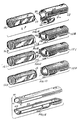
- the cross bar 12 also can be formed of hollow tubular internal construction but with different outer peripheries, such as rectangular, oval, pentagonal, hexagonal andoctogonal, as respectively illustrated in FIGS. 9-13. If desired, the shape of the internal construction of the cross bar 12 can follow its respective outer periphery.
- the two parts of the skin 16 covering the cross bar 12 also can take the shape and construction as illustrated in FIGS. 1B through 1D, as well as illustrated in FIG. 1E.
- the parts 116B and 118B illustrated in FIG. 1B differ from those described above in that their method of joining to one another is effected by the provision of a pair of projections 119B provided with hooked edges and fitting over appropriately shaped cooperative parts 117B, as by being snapped or twisted thereover.
- the parts 116C and 118C illustrated in FIG. 1C are similar to those shown in FIG. 1B and differ therefrom only in further providing an annular depression 111 in one part 118C and a thereinto projecting annular projection 113 provided in part 116C.
- the two halves 101 and 103 are cut along their axial lengths and are provided with cooperating pairs of edges 91 and 93. With the application of either cement or sonic welding to these pairs of superimposed edges 91 and 93, the two halves 101 and 103 can be effectively joined to each other.
- the shackle 14 is generally U-shaped and formed with a pair of legs 18 and 20 of substantially the same length.
- the legs 18 and 20 can be cylindrical or oval, depending on the end use.
- the leg 18 terminates in a bent end or foot 22.
- the foot 22 preferably is sloping outwardly at an obtuse angle from the longitudinal axis of the leg 18, substantially as shown.
- the leg 20, on the other hand, is straight and is provided with a transverse cut 24 facing toward the bent foot 22 of the leg 18.
- FIGS. 1 - 4 A first preferred embodiment of an improved locking device according to the invention is illustrated in FIGS. 1 - 4.
- a locking mechanism 34 is mounted in a side of the tubular cross bar 12 adjacent its end 32. It should be noted that the locking mechanism 34 is entirely disposed in the cross bar 12 in between the pair of legs 18 and 20, i.e., in between the pair of aligned openings 26 and 28.
- This mounting of the lock 34 in the side of the cross bar 10 is utterly unlike that taught by the prior art (note, inter alia , the U.S. Patent No. 4.545,224), where the lock is mounted in the end of the cross bar.
- bolt 42 frictionally engages and rides against such inside surface of the cross bar 12.
- bolt 42 not only strengthens the cross bar 12 adjacent its end 32 but, more importantly, it also serves as a solid dead-bolt, when in place as shown in FIG. 1, in firmly retaining the leg 20 of the U-shaped shackle 14 therein.
- An appropriately shaped end plug 68 preferably is employed, both to seal the end 32 of the cross bar 12 and also to serve as a guide for the entry and withdrawal of the leg 20 via the opening 28 into the interior of the cross bar 12, as shown.
- the end plug 90 is formed of metal or a hard plastic material and is secured in place, as for example by a suitable adhesive, not shown.
- the end of the skin 16 is reduced somewhat in diameter near the end 32 so as to present a neat appearance and further to retain the plug 68 in place.
- the bicycle lock 10 of the invention also features short stub ends at the respective ends 30 and 32 of the cross bar 12, resulting in a compact and sturdy design.
- the stub ends refer to that part of the cross bar 12, observe FIG. 1, which extend outwardly from the respective outer periphery of the pair of openings 26 and 28 to the respective ends 30 and 32 of the cross bar 12.
- the stub near the end 30 is about the size of the diameter of the leg 18, while the stub near the other end 32 is somewhat shorter, i.e., about one-half of the diameter of the leg 20.
- the end of the bent foot 22 is shown as extending somewhat beyond the end 30 of the cross bar 12.
- the skin 16 effectively covers the slight protrusion of the foot 22 beyond the end 30.
- FIGS. 5-6 A second preferred embodiment of an improved locking device according to the invention is illustrated in FIGS. 5-6. Also in this embodiment, a locking mechanism 70 is mounted in a side of the tubular cross bar 12 and within the hole 36 formed therein near its end 32.
- the design of the lock 70 is similar to that of the lock 34 shown in and described with reference to FIGS. 1-4.
- the lock 70 has, however, been strengthened even further against the forceful removal of the shackle 14 from the tubular cross bar 12.
- Locking mechanism 70 essentially comprises a lock cylinder 72 provided with a rib 74 designed to secure the lock cylinder 72 within the tubular cross bar 12, a first dead bolt member 76, that is cresent shaped in cross section and designed for limited positive axial displacement, which member 76 is similar to the deadbolt 42 of FIGS. 1-4, a second elongated guide member 78, complementary to the first dead bolt member 76 and provided with a bore 80 to receive the lock cylinder 72, and a cam 82, which is identical to the cam 46, operatively coupling the lock cylinder 72 to the dead bolt member 76 so as to impart thereto the same limited positive axial displacement between its two operative positions as described above with reference to FIGS. 1-4.
- the cam 82 also is formed with a cutout 84 designed to receive a protruding operative part 86 of a cylindrical member 88.
- Member 88 also incorporates a spring 90 which functions just like the spring 52.
- the elongated guide member 78 is provided with a pair of guide edges 92, 94 to facilitate the limited positive axial displacement of the first dead bolt member 76 relative thereto.
- a bottom flat surface 96 of the first dead bolt member 76 is designed frictionally to slide over a flat bed 98 formed in the second elongated guide member 78 in between its guide edges 92 and 94. It will be appreciated, especially when viewing FIG. 6, that the outer peripheries 100 and 102 respectively, of the first and second members 76 and 78 are both contoured so as to approximate the inner surface of the tubular cross bar 12 and, that the cross section of the combined members 76 and 78 substantially fills up the hollow space inside the tubular cross bar 12.
- a channel 104 which is designed to accommodate therein the rib 74 of the lock cylinder 72, securing thereby the lock cylinder 72 in and to the surrounding second guide member 78. Due to the combined effects of the rib 74 extending into the channel 104 of the member 78, both the lock cylinder 72 and the elongated guide member 78 are secured to one another as well as within the cross bar 12 against displacement therein.
- the first dead bolt member 76 is caused to be displaced axially between its first operative position illustrated in FIG. 6, extending into the transverse cut 24 of the leg 20 of the U-shaped shackle 14, as shown in FIG. 1, and a second operative position, not shown in FIG. 6, in which it is withdrawn from the transverse cut 24.
- FIGS. 7-8 A third preferred embodiment of an improved locking device according to the invention is illustrated in FIGS. 7-8. Also in this embodiment, a locking mechanism 120 is mounted in the side of the cross bar 12 and within the hole 36 formed therein near its end 32. The design of the lock 120 is similar to that of the lock 70 shown in and described with reference to FIGS. 5-6.
- the locking mechanism comprises a lock cylinder 122, a cylindrical member 124 formed with a cresent-shaped protruding part 126, and a cam 128 formed with a cresent-shaped cutout 130 designed to accommodate the operative part 126.
- Member 124 also incorporates a compression spring 132 and a circular depression 134 formed about midway in its periphery, substantially as shown.
- Cam 128 is designed to ride within a transverse cut 136 formed in the underside of dead bolt member 138 and axially displace the same within the channel of a second member 140, substantially as described with reference to the embodiment illustrated in FIGS. 5-6.
- Member 140 also is provided with a bore 142 designed to receive the lock cylinder 122 therein.
- the securing of the various parts of the locking mechanism 120 to each other and within the cross bar 12 is herein effected with the aid of a screw 144 designed to pass through a first bore 146 formed in member 140, and a second bore 148 formed in the lock cylinder 122, with the pointed end 150 of the screw 144 coming to rest in the depression 134 of the cylindrical member 124.
- An end plug 152 is provided to close off the end 32 of the cross bar 12. Plug 152 differs from the end plug 68 in that it does not also serve as a guide for the entry of the leg 20, which function is now assumed by the member 140.
Landscapes
- Engineering & Computer Science (AREA)
- Mechanical Engineering (AREA)
- Lock And Its Accessories (AREA)
- Automatic Cycles, And Cycles In General (AREA)
Claims (17)
- Zweiradschloß, umfassend:(a) einen U-förmigen Bügel (14) und eine Querstange (12), die dazu bestimmt ist, einen Verschluß über das offene Ende des Bügels zu schaffen;(b) der Bügel ist mit einem Paar von Schenkeln (18,20) gebildet, wobei einer (18) der Schenkel an seinem freien Ende mit Mitteln (22) gebildet ist zum Befestigen des Bügels (14) an dem genannten freien Ende an einem Ende der Querstange (12), die genannten Mittel auch als ein Schwenkpunkt dienen, um eine Schwenkbewegung zwischen dem Bügel (14) und der Querstange (12) zu ermöglichen, und wobei das andere Ende (20) der Schenkel an seinem freien Ende mit einem mit einem Schloß in Eingriff tretenden Teil (24) versehen ist;(c) einen Verriegelungs- bzw. Schließmechanismus (34), der in der Seite der Querstange (12) angebracht ist;(d) der Verriegelungs- bzw. Schließmechanismus einen Riegel (42) umfaßt, der dazu gestaltet ist, mit dem mit dem Schloß in Eingriff tretenden Teil (24) des anderen (20) der Schenkel des Bügels (14) in Eingriff zu treten, der Riegel (42) zwei wirksame Stellungen hat: eine Schließstellung, in welcher der Riegel (42) sich in den mit dem Schloß in Eingriff tretenden Teil (24) erstreckt, und eine Nichtschließstellung, in welcher der Riegel (42) von dem mit dem Schloß in Eingriff tretenden Teil (24) zurückgezogen ist;
dadurch gekennzeichnet,
daß der Riegel (42) so gestaltet ist, daß er sich zwischen den beiden genannten wirksamen Stellungen, bewirkt durch den Verriegelungs-bzw. Schließmechanismus (34), bewegt, wenn er von einem abziehbaren Schlüssel (54) manipuliert wird, der Verriegelungs- bzw. Schließmechanismus (34) an der Querstange (12) zwischen dem Paar von Schenkeln (18,20) des Bügels (14) angebracht ist, wobei das Schloß weiterhin umfaßt:(e) eine entfernbare Jocheinrichtung (40), um den Verriegelungs- bzw. Schließmechanismus (34) in der Querstange (12) festzulegen, wobei der Verriegelungs- bzw. Schließmechanismus (34) rechtwinkelig zu der Querstange (12) und mit dieser fluchtend angebracht ist. - Zweiradschloß nach Anspruch 1, wobei die Querstange (12) einen Querschnitt aus einer Gruppe von Querschnitten hat bestehend aus: kreisförmig, rechteckig, oval, fünfeckig, sechseckig und achteckig.
- Zweiradschloß nach Anspruch 1, wobei die Mittel zum Festlegen des Bügels (14) an seinem freien Ende des genannten einen Schenkels (18) einen gebogenen Fuß (22) aufweist, der sich von der Längsachse des genannten einen Schenkels (18) in einem stumpfen Winkel schräg erstreckt.
- Zweiradschloß nach Anspruch 1, wobei der Verriegelungs- bzw. Schließmechanismus (34) ein nockenbetätigtes Riegelschloß ist, und wobei der Schlüssel (54) in den Verriegelungs- bzw. Schließmechanismus nur dann eingesetzt und aus ihm entfernt werden kann, wenn der Riegel sich in seiner genannten Schließstellung befindet.
- Zweiradschloß nach Anspruch 1, wobei das Joch (40) mit einer Führungsfläche für den Riegel versehen ist.
- Zweiradschloß nach Anspruch 5, wobei die Führungsfläche mit einer Fläche in Form eines ebenen Bettes gebildet ist, die durch parallele beabstandete Kanten begrenzt ist.
- Zweiradschloß nach Anspruch 4, weiter umfassend eine Feder (52), die in dem nockenbetätigten Riegelschloß angebracht ist, wobei die Kompression der Feder die arbeitsmäßige Verwendung des abnehmbaren Schlüssels (54) in dem Schloß ermöglicht.
- Zweiradschloß, umfassend:
einen U-förmigen Bügel (14) und eine Querstange (12), die dazu gestaltet ist, einen Verschluß über das offene Ende des Bügels zu schaffen; wobei
der Bügel mit einem Paar von Schenkeln (18,20) gebildet ist, einer (18) der Schenkel an seinem freien Ende mit Mitteln (22) gebildet ist zum Befestigen des Bügels (14) an dem genannten freien Ende an einem Ende der Querstange (12), wobei die Mittel auch als ein Schwenkpunkt dienen, um eine Schwenkbewegung zwischen dem Bügel (14) und der Querstange (12) zu ermöglichen, und wobei der andere (20) der Schenkel an seinem freien Ende mit einem mit einem Schloß in Eingriff tretenden Teil (24) gebildet ist;
einen Verriegelungs- bzw. Schließmechanismus (70,120), der in der Seite der Querstange (12) angebracht ist, wobei
der Verriegelungs- bzw. Schließmechanismus einen Riegel (96,138) umfaßt, der so gestaltet ist, daß er mit dem mit dem Schloß in Eingriff tretenden Teil (24) des genannten anderen (20) der Schenkel des Bügels (14) in Eingriff treten kann, der Riegel (96,138) zwei wirksame Stellungen hat: eine Schließstellung, in welcher der Riegel sich in den mit dem Schloß ein Eingriff tretenden Teil (24) erstreckt, und eine Nichtschließstellung, in welcher der Riegel (96,138) von dem mit dem Schloß in Eingriff tretenden Teil (24) zurückgezogen ist,
dadurch gekennzeichnet, daß der Riegel (96,138) so gestaltet ist, daß er sich zwischen den beiden wirksamen Stellungen, hervorgerufen durch den Verriegelungs- bzw. Schließmechanismus (70,120), hin- und herbewegt, wenn er durch einen abnehmbaren Schlüssel manipuliert wird, wobei der Verriegelungs- bzw. Schließmechanismus (34) an der Querstange zwischen dem Paar von Schenkeln (18,20) des Bügels (14) angebracht ist und das Schloß weiterhin umfaßt:
entfernbare Mittel, um den Verriegelungs- bzw. Schließmechanismus an der Querstange festzulegen; und wobei
die genannten Festlegemittel einen Teil (78,140) aufweisen, der den Verriegelungs- bzw. Schließmechanismus (70,120) umschließt und zu dem Riegel komplementär ist derart, daß der Riegel geführt wird, der an dem genannten Teil gleitet, und der genannte Teil (78,140) mit Zugangsmitteln (80,142) zu dem Verriegelungs- bzw. Schließmechanismus (70,120) versehen ist, und ein Befestigungselement (74,144) den Verriegelungs- bzw. Schließmechanismus (70,120) in dem genannten Teil (78,140) festlegt. - Zweiradschloß nach Anspruch 8, wobei der Verriegelungs- bzw. Schließmechanismus (70,120) mit der Querstange (12) fluchtend angebracht ist und weiterhin ein Nocken vorgesehen ist, der durch den abnehmbaren Schlüssel betätigbar ist und der mit dem Riegel arbeitsmäßig in Eingriff tritt und diesen zwischen den genannten beiden wirksamen Stellungen hin- und herbewegt in einer Richtung rechtwinkelig zu dem rechtwinkelig oder normal angebrachten Verriegelungs- bzw. Schließmechanismus, und ein Endverschlußstück für die Querstange vorgesehen ist, welches nahe dem Verriegelungs- bzw. Schließmechanismus angebracht und dazu gestaltet ist, ein Heraus- bzw. Wegbewegen des genannten Mechanismus aus der bzw. von der Querstange zu verhindern.
- Zweiradschloß nach Anspruch 8, wobei der Verriegelungs- bzw. Schließmechanismus ein nockenbetätigter Riegel ist und das Schloß weiterhin eine in dem Schloß angebrachte Feder umfaßt, deren Kompression wirksame Verwendung des abnehmnbaren Schlüssels innerhalb des Schlosses ermöglicht.
- Zweiradschloß, umfassend:
(a) einen U-förmigen Bügel (14) und eine Querstange (12), die dazu gestaltet ist, einen Verschluß über das offene Ende des Bügels zu schaffen;(b) der Bügel (14) mit einem Paar von Schenkeln (18,20 gebildet ist, von denen einer (18) an seinem freien Ende mit Mitteln zum Befestigen des Bügels (14) an dem genannten freien Ende an einem Ende der Querstange (12) gebildet ist, wobei die genannten Mittel weiterhin als ein Schwenkpunkt dienen, um eine Schwenkbewegung zwischen dem Bügel und der Querstange zu ermöglichen, wobei der andere (20) der Schenkel an seinem freien Ende mit einem mit einem Schloß in Eingriff tretenden Teil (24) versehen ist;(c) einen Verriegelungs- bzw. Schließmechanismus (34), der in der Seite der Querstange (12) angebracht ist;(d) der Verriegelungs- bzw. Schließmechanismus (34) einen Riegel (42) umfaßt, der so gestaltet ist, daß er mit dem mit dem Schloß in Eingriff tretenden Teil (24) des genannten anderen (20) der Schenkel des Bügels (14) in Eingriff treten kann;(e) der Riegel (42) zwei wirksame Stellungen hat; eine Schließstellung, in welcher der Riegel sich in den mit dem Schloß in Eingriff tretenden Teil erstreckt, und eine Nichtschließstellung;
dadurch gekennzeichnet, daß der Riegel so gestaltet ist, daß er sich zwischen den beiden genannten wirksamen Stellungen, hervorgerufen durch den Verriegelungs- bzw. Schließmechanismus (34), hin- und herbewegt, wenn er durch einen abnehmbaren Schlüssel (54) manipuliert wird, der Verriegelungs- bzw. Schließmechanismus (34) mit der Querstange (12) fluchtend und rechtwinkelig zu dieser zwischen dem Paar von Schenkeln (18,20) des Bügels (14) angebracht ist; wobei das Schloß weiter umfaßt:(f) einen durch den abnehmnbaren Schlüssel (54) betätigbaren Nocken (46), der mit dem Riegel (42) arbeitsmäßig in Eingriff tritt und diesen zwischen dessen beiden genannten wirksamen Stellungen hin- und herbewegt, und ein Endverschlußstück (68) für die Querstange (12), welches nahe dem Verriegelungs- bzw. Schließmechanismus (34) angebracht und so gestaltet ist, daß ein Herausbewegen des Verriegelungs- bzw. Schließmechanismus aus der Querstange verhindert ist; und(g) entfernbare Mittel, um den Verriegelungs- bzw. Schließmechanismus in der Querstange festzulegen, wobei diese Festlegemittel ein Joch (40) sind, welches um den Verriegelungs- bzw. Schließmechanismus herum angebracht ist. - Zweiradschloß nach Anspruch 11, wobei der Verriegelungs- bzw. Schließmechanismus ein nockenbetätigter Riegel ist, und das Schloß weiterhin eine Feder (52) umfaßt, die in dem Schloß angebracht ist und deren Kompression die wirksame Benutzung des abnehmbaren Schlüssels in dem Schloß ermöglicht.
- Zweiradschloß nach irgendeinem der Ansprüche 1 bis 11, umfassend eine Kunststoffabdeckung (16) für wenigstens die Querstange (12), wobei die Kunststoffabdeckung aus zwei Teilen gebildet und über die Querstange geschoben ist, und zwar einer von jedem Ende, und Mittel zum Festlegen der beiden Teile der Kunststoffabdeckung aneinander.
- Zweiradschloß nach Anspruch 13, wobei die genannten Mittel aus einem der nachstehend angegebenen Mittel bestehen: ein sich verriegelnder Haken und eine Öse; eine Laubsägenpuzzle-Verriegelung, einen Verdrehungsverschluß; und eine Auführung, bei welcher übereinander liegende Kanten miteinander verschweißt oder verklebt sind.
- Zweiradschloß nach Anspruch 13, wobei einer der beiden Teile der Kunststoffabdeckung weiterhin mit Mitteln versehen ist, um für den Verriegelungs- bzw. Schließmechanismus einen Schutz gegenüber der Umgebung zu bewirken.
- Zweiradschloß nach Anspruch 15, wobei die Mittel zum Schutz gegenüber der Umgebung eine Abdeckung (106) aufweisen, die entlang der teilweisen axialen Länge des genannten einen der beiden Kunststoffteile gleitbar oder verschiebbar ist.
- Zweiradschloß nach Anspruch 15, wobei die einen Schutz gegenüber der Umgebung bewirkenden Mittel einen biegsamen Lappen oder eine solche Klappe aufweisen, die entfernbar gestaltet ist, um ein Loch in dem genannten einen der beiden Kunststoffabdeckteile über dem Verriegelungs- bzw. Schließmechanismus abzudecken.
Applications Claiming Priority (2)
| Application Number | Priority Date | Filing Date | Title |
|---|---|---|---|
| US07/514,175 US5010746A (en) | 1990-04-25 | 1990-04-25 | Bicycle lock |
| US514175 | 1990-04-25 |
Publications (3)
| Publication Number | Publication Date |
|---|---|
| EP0454903A2 EP0454903A2 (de) | 1991-11-06 |
| EP0454903A3 EP0454903A3 (en) | 1992-01-08 |
| EP0454903B1 true EP0454903B1 (de) | 1995-03-29 |
Family
ID=24046100
Family Applications (1)
| Application Number | Title | Priority Date | Filing Date |
|---|---|---|---|
| EP90124945A Expired - Lifetime EP0454903B1 (de) | 1990-04-25 | 1990-12-20 | Verbessertes Fahrradschloss |
Country Status (8)
| Country | Link |
|---|---|
| US (2) | US5010746A (de) |
| EP (1) | EP0454903B1 (de) |
| JP (1) | JPH047479A (de) |
| KR (1) | KR910018262A (de) |
| AR (1) | AR246330A1 (de) |
| AT (1) | ATE120515T1 (de) |
| BR (1) | BR9100104A (de) |
| DE (1) | DE69018254T2 (de) |
Families Citing this family (56)
| Publication number | Priority date | Publication date | Assignee | Title |
|---|---|---|---|---|
| US5010746A (en) * | 1990-04-25 | 1991-04-30 | Kryptonite Corporation | Bicycle lock |
| US5398529A (en) * | 1991-03-07 | 1995-03-21 | Goldman; David S. | Tamper-resistant lock |
| US5138901A (en) * | 1991-09-09 | 1992-08-18 | Dabandjian Ara N | Bicycle lock mounting bracket |
| USD335814S (en) | 1991-09-09 | 1993-05-25 | Ara Dabandjian | Bicycle lock mounting bracket |
| US5133568A (en) * | 1991-09-19 | 1992-07-28 | Balterman Alisa M | U-lock connector for bicycle handlebar |
| US5257517A (en) * | 1991-09-19 | 1993-11-02 | Dale James E | Bicycle lock sleeve |
| US5353663A (en) * | 1992-09-28 | 1994-10-11 | Samuelson Robert N | Combination bicycle lock/handlebar assembly |
| WO1994010414A1 (en) * | 1992-10-30 | 1994-05-11 | Kryptonite Corporation | U-lock with secure wide angle pivot |
| US5406812A (en) * | 1994-05-16 | 1995-04-18 | Jaw; Chin-Woei | Structure of bicycle lock |
| US5564297A (en) * | 1994-09-16 | 1996-10-15 | Bolt Security Products, Inc. | Bicycle lock |
| US5628214A (en) * | 1995-01-06 | 1997-05-13 | Bolt Security Products, Inc. | Bicycle lock |
| US5622066A (en) * | 1995-01-17 | 1997-04-22 | Shallis; Sean T. | Bicycle lock extension link and method |
| US5535609A (en) * | 1995-03-30 | 1996-07-16 | Kuo; Wen-Tai | Lock housing with a key way blocking means |
| US5694796A (en) * | 1995-03-30 | 1997-12-09 | Couillard; Richard Alexander | Hinged lock with detent positions |
| US5706679A (en) * | 1995-06-26 | 1998-01-13 | Kryptonite Corporation | Harness for securing a vehicle |
| US5832753A (en) * | 1996-06-12 | 1998-11-10 | Nielsen; Peter N. | Lock assembly |
| US5975549A (en) * | 1997-01-30 | 1999-11-02 | Ockenden; Lynn Marie | System for simultaneously mounting a plurality of bicycle accessories to a bicycle frame |
| US5787736A (en) * | 1997-07-18 | 1998-08-04 | Ling; Chong-Kuan | Resettable combination coded U-shackle lock |
| US5832762A (en) * | 1997-09-02 | 1998-11-10 | Kryptonite Corporation | U-lock keyway protector |
| US6138975A (en) * | 1998-08-13 | 2000-10-31 | Kryptonite Corporation | Anchored tie-down ring |
| US6341509B1 (en) * | 1999-09-03 | 2002-01-29 | Kryptonite Corporation | Tie lock assemblage with replaceable lock mechanism |
| US6397648B1 (en) | 2001-03-30 | 2002-06-04 | Kryptonite Corporation | U-lock keyway protector |
| USD470096S1 (en) | 2001-06-26 | 2003-02-11 | Johan Maria Alfons Pierret | Luggage support for bicycle |
| US6481250B1 (en) * | 2001-09-14 | 2002-11-19 | Lambert Kuo | Locking head for a cable lock |
| US7273221B2 (en) * | 2001-12-20 | 2007-09-25 | Transbike Systems, Inc. | Attachment system for bicycle accessories |
| USD491041S1 (en) | 2002-08-30 | 2004-06-08 | Robert A. Vito | Cycle lock |
| USD493353S1 (en) | 2002-08-30 | 2004-07-27 | Robert A. Vito | Cycle lock |
| USD493689S1 (en) | 2002-09-05 | 2004-08-03 | Robert A. Vito | Lock closure member |
| US6718802B2 (en) | 2002-09-05 | 2004-04-13 | Robert A. Vito | Tamper resistant lock |
| USD494837S1 (en) | 2002-09-05 | 2004-08-24 | Robert A. Vito | Lock |
| USD494041S1 (en) | 2002-10-11 | 2004-08-10 | Robert A. Vito | Lock assembly component |
| US6701757B1 (en) | 2002-10-11 | 2004-03-09 | Robert A. Vito | Accessory component for a lock |
| US20040172990A1 (en) * | 2003-03-06 | 2004-09-09 | David O' Rouke | Locking device for aluminum staging poles |
| WO2006039477A2 (en) * | 2004-09-29 | 2006-04-13 | Lynn Ockenden | Bicycle quick release accessory adapters and tow mechanisms |
| US20090183535A1 (en) * | 2008-01-22 | 2009-07-23 | Kevin Joseph Darville | Unicycle lock |
| US7481084B1 (en) * | 2008-04-08 | 2009-01-27 | Chun-Hsien Wu | Foldable lock structure |
| US20110315729A1 (en) * | 2010-06-28 | 2011-12-29 | Michael Snyder | Locking Ladder Rack |
| WO2014012564A1 (en) * | 2012-07-20 | 2014-01-23 | Velolock Ltd. | Locking device for a bicycle |
| US20140076010A1 (en) * | 2012-09-14 | 2014-03-20 | Scott Gold | Multi-access lock |
| US9974287B2 (en) * | 2013-08-08 | 2018-05-22 | Nelson Development Group, LLC | Snapping fish stringer |
| EP2865835B1 (de) * | 2013-10-24 | 2018-02-07 | SMIVES GmbH | Digitales Verschlussmittel |
| EP3486411B1 (de) * | 2014-06-12 | 2020-01-29 | Schlage Lock Company LLC | Bügelschloss mit doppelter verriegelung |
| GB2536401A (en) * | 2014-10-28 | 2016-09-21 | Zeal Innovation Ltd | Security locks |
| US10557288B2 (en) * | 2015-04-17 | 2020-02-11 | Schlage Lock Company Llc | Hoop lock with bent foot engagement |
| USD791572S1 (en) * | 2015-09-17 | 2017-07-11 | Bell Sports, Inc. | Bicycle lock |
| US9878752B2 (en) | 2015-10-30 | 2018-01-30 | Altor Locks, Llc | Folding anti-theft device |
| RU169163U1 (ru) * | 2016-03-09 | 2017-03-07 | Вячеслав Борисович Жуков | Противоугонное устройство для транспортных средств |
| US10577833B1 (en) * | 2018-08-10 | 2020-03-03 | Schlage Lock Company Llc | Compact bike lock |
| WO2020056289A1 (en) | 2018-09-14 | 2020-03-19 | Altor Locks, Llc | Grinder resistant lock |
| US12186638B2 (en) * | 2022-08-04 | 2025-01-07 | Wei Hung Lai | Golf bag with retractable hood |
| JP1760629S (ja) | 2022-09-29 | 2024-01-04 | 自転車用錠 | |
| JP1760574S (ja) | 2022-09-29 | 2024-01-04 | 自転車用錠 | |
| USD1064790S1 (en) | 2022-09-29 | 2025-03-04 | Zeal Innovation Ltd. | D-lock |
| USD1044471S1 (en) * | 2023-03-15 | 2024-10-01 | Wenzhou Jinjian Smart Lock Co., Ltd | U type combination lock |
| USD1065973S1 (en) | 2023-03-29 | 2025-03-11 | Zeal Innovation Ltd. | D-Lock |
| USD1011170S1 (en) * | 2023-10-13 | 2024-01-16 | Jianhua Xu | Safety lock |
Family Cites Families (58)
| Publication number | Priority date | Publication date | Assignee | Title |
|---|---|---|---|---|
| DE105187C (de) * | ||||
| US1384590A (en) * | 1921-07-12 | X - x x x x x | ||
| US584575A (en) * | 1897-06-15 | Ments | ||
| DE376842C (de) * | 1923-06-07 | Damm & Ladwig | Vorhaengeschloss | |
| US187362A (en) * | 1877-02-13 | Improvement in shackles | ||
| DE111976C (de) * | ||||
| US491102A (en) * | 1893-02-07 | Permutation-padlock | ||
| US263212A (en) * | 1882-08-22 | Handcuff | ||
| US238548A (en) * | 1881-03-08 | Gardiner f | ||
| US1036992A (en) * | 1912-06-08 | 1912-08-27 | George S Franki | Padlock. |
| US1461725A (en) * | 1918-07-18 | 1923-07-17 | Thomas C Cooper | Lock |
| GB182417A (en) * | 1921-06-27 | 1922-10-26 | Mary Kind | Improvements in portable locking devices |
| US1424543A (en) * | 1922-02-02 | 1922-08-01 | Wiloch Stefan | Padlock |
| US1503210A (en) * | 1922-05-25 | 1924-07-29 | Morrison Donald R | Auto lock and traction device |
| DE388160C (de) * | 1923-01-18 | 1924-01-10 | Heinrich Biemer | Vorhaengeschloss |
| US1542016A (en) * | 1924-03-06 | 1925-06-16 | Stull Jacob Henry | Permutation lock |
| US1690938A (en) * | 1925-10-20 | 1928-11-06 | Yale & Towne Mfg Co | Padlock |
| US1638264A (en) * | 1925-10-31 | 1927-08-09 | Junkunc John | Tire lock |
| DE491840C (de) * | 1926-01-20 | 1930-02-21 | Heinrich Biemer | Vorhaengeschloss |
| US1629859A (en) * | 1926-03-02 | 1927-05-24 | Lot F Burke | Lock holder |
| US1618924A (en) * | 1926-03-11 | 1927-02-22 | Fraim Slaymaker Hardware Co In | Safety device for spare tires |
| US1679665A (en) * | 1927-01-27 | 1928-08-07 | Junkunc John | Spare-tire lock |
| GB471118A (en) * | 1936-02-25 | 1937-08-25 | Hans Herbst | Improvements in permutation locks |
| US2471291A (en) * | 1946-09-07 | 1949-05-24 | Master Lock Co | Padlock |
| DE824896C (de) * | 1949-12-11 | 1951-12-13 | Otto Rinkel Dipl Ing | Schloss fuer Fahrzeuge |
| US3721112A (en) * | 1971-08-18 | 1973-03-20 | J Wellekens | Locks |
| US3739607A (en) * | 1972-03-06 | 1973-06-19 | R Smedley | Lock for skis |
| US3800570A (en) * | 1972-04-06 | 1974-04-02 | S Kaplan | Locking mechanism |
| US3755778A (en) * | 1972-05-04 | 1973-08-28 | J Kennedy | Cycle burglar alarm |
| US3777517A (en) * | 1972-06-07 | 1973-12-11 | Warren M Shwayder | Saw and impact resistant lock shackle |
| US3754418A (en) * | 1972-07-27 | 1973-08-28 | P Miller | Lock apparatus |
| US3855826A (en) * | 1973-05-02 | 1974-12-24 | Hori Lock Kogyo Kk | Padlock |
| US3924426A (en) * | 1973-11-23 | 1975-12-09 | Ernest Zane | Lock for bicycles and the like |
| US3967475A (en) * | 1975-04-04 | 1976-07-06 | Zane Michael S | Combination bicycle lock and mounting bracket |
| US4085600A (en) * | 1976-01-05 | 1978-04-25 | Ahmed El Bindari | Double contact locking mechanism |
| US4064716A (en) * | 1976-04-05 | 1977-12-27 | The Shwayder Company | Saw resistant lock |
| US4155231A (en) * | 1977-04-29 | 1979-05-22 | Kbl Corporation | Bicycle lock and bracket |
| JPS5618547Y2 (de) * | 1978-06-23 | 1981-04-30 | ||
| FR2434745A1 (fr) * | 1978-09-04 | 1980-03-28 | Motobecane Ateliers | Dispositif antivol pour vehicule a deux roues |
| DE2941023A1 (de) * | 1979-10-10 | 1981-04-23 | Hoechst Ag, 6000 Frankfurt | Verfahren zur kontinuierlichen herstellung von di-acetylendiamin |
| US4324119A (en) * | 1980-03-17 | 1982-04-13 | David Mitton | Passive wheel lock for bicycles and the like |
| US4426861A (en) * | 1981-08-13 | 1984-01-24 | Chillis Robert L | Brake lock for motorcycles and the like |
| US4524591A (en) * | 1982-12-30 | 1985-06-25 | Lanka Richard I | Lock device for chain driven vehicles |
| GB2141170A (en) * | 1983-06-03 | 1984-12-12 | Michael Anthony Baldwin | Bicycle lock |
| US4584855A (en) * | 1983-06-29 | 1986-04-29 | Glen Burlingame | Pick-proof locking system |
| US4545224A (en) * | 1983-10-27 | 1985-10-08 | Kbl Corporation | Bicycle lock |
| US4674306A (en) * | 1985-09-16 | 1987-06-23 | Offer Halpern | Vehicle and assembly locking and wrenching apparatus |
| US4730470A (en) * | 1986-09-05 | 1988-03-15 | Kbl Corp. | Security lock |
| US4823567A (en) * | 1987-04-03 | 1989-04-25 | Patton Victor L | Padlock and locking mechanism |
| US4823566A (en) * | 1987-04-03 | 1989-04-25 | Patton Victor L | Padlock and locking mechanism therefor |
| CA1251863A (en) * | 1988-02-29 | 1989-03-28 | Kevin Mccarthy | Fish sorting machine |
| EP0331635A3 (de) * | 1988-02-29 | 1990-02-28 | The Board of Regents of the University of Texas System | Zubereitungen zur Behandlung von Blasenkrebs. |
| US4918949A (en) * | 1988-03-25 | 1990-04-24 | Rhode Gear Usa | Tamper-resistant lock |
| DE3815584C1 (de) * | 1988-05-06 | 1989-08-10 | Aug. Winkhaus Gmbh & Co Kg, 4404 Telgte, De | |
| US4870843A (en) * | 1988-11-04 | 1989-10-03 | Lundberg Herbert J | Security system for cycles and the like |
| US4888967A (en) * | 1988-12-22 | 1989-12-26 | Kuo Li Tsao | Bicycle lock |
| US4987753A (en) * | 1989-12-06 | 1991-01-29 | Kuo Wen T | Padlock |
| US5010746A (en) * | 1990-04-25 | 1991-04-30 | Kryptonite Corporation | Bicycle lock |
-
1990
- 1990-04-25 US US07/514,175 patent/US5010746A/en not_active Expired - Fee Related
- 1990-11-28 JP JP2328780A patent/JPH047479A/ja active Pending
- 1990-11-30 KR KR1019900019561A patent/KR910018262A/ko not_active Ceased
- 1990-12-18 AR AR90318651A patent/AR246330A1/es active
- 1990-12-20 EP EP90124945A patent/EP0454903B1/de not_active Expired - Lifetime
- 1990-12-20 AT AT90124945T patent/ATE120515T1/de not_active IP Right Cessation
- 1990-12-20 DE DE69018254T patent/DE69018254T2/de not_active Expired - Fee Related
-
1991
- 1991-01-11 BR BR919100104A patent/BR9100104A/pt not_active Application Discontinuation
- 1991-02-11 US US07/654,790 patent/US5092142A/en not_active Expired - Lifetime
Also Published As
| Publication number | Publication date |
|---|---|
| DE69018254D1 (de) | 1995-05-04 |
| KR910018262A (ko) | 1991-11-30 |
| EP0454903A3 (en) | 1992-01-08 |
| BR9100104A (pt) | 1992-03-17 |
| JPH047479A (ja) | 1992-01-10 |
| DE69018254T2 (de) | 1995-11-16 |
| EP0454903A2 (de) | 1991-11-06 |
| US5092142A (en) | 1992-03-03 |
| US5010746A (en) | 1991-04-30 |
| ATE120515T1 (de) | 1995-04-15 |
| AR246330A1 (es) | 1994-07-29 |
Similar Documents
| Publication | Publication Date | Title |
|---|---|---|
| US5010746A (en) | Bicycle lock | |
| US4545224A (en) | Bicycle lock | |
| US3924426A (en) | Lock for bicycles and the like | |
| US3800570A (en) | Locking mechanism | |
| US4888967A (en) | Bicycle lock | |
| US4882920A (en) | Steering lock for automobile | |
| EP1081322B1 (de) | Bügelschloss mit auswechselbarem Schliessmechanismus | |
| EP0701933B1 (de) | Lenkradsperrvorrichtung für Kraftfahrzeuge aller Art | |
| US4920772A (en) | Bicycle lock | |
| CA2099793C (en) | Automotive steering wheel anti-theft device | |
| DE102009030031A1 (de) | Bügelschloss | |
| US4689975A (en) | Padlock | |
| WO2004022888A2 (en) | Tamper resistant lock | |
| EP0728659B1 (de) | Fahrradschloss des Ringbügeltyps | |
| US5832753A (en) | Lock assembly | |
| DE10358300B4 (de) | Schwenkbügel-Rahmenschloss, Verwendung eines Schwenkbügel-Rahmenschlosses und Zweirad-Sicherungssystem mit einem Schwenkbügel-Rahmenschloss und einem Sicherungsseil | |
| US5101646A (en) | Tamper-resistant lock | |
| DE3308977C2 (de) | Bügelschloß | |
| DE10031069A1 (de) | Verbindungselement | |
| DE112005000088B4 (de) | Schloss für Zweiräder | |
| US5730012A (en) | Bicycle sprocket lock | |
| US20070234764A1 (en) | Hasps, Shackles and Padlocks | |
| EP0520154A1 (de) | Anordnung eines Kabelschlosses an einem Zweiradrahmen | |
| CN2280133Y (zh) | 凸轮驱动的锁杆 | |
| AU619316B2 (en) | Padlock cover |
Legal Events
| Date | Code | Title | Description |
|---|---|---|---|
| PUAI | Public reference made under article 153(3) epc to a published international application that has entered the european phase |
Free format text: ORIGINAL CODE: 0009012 |
|
| AK | Designated contracting states |
Kind code of ref document: A2 Designated state(s): AT BE CH DE DK ES FR GB GR IT LI NL SE |
|
| PUAL | Search report despatched |
Free format text: ORIGINAL CODE: 0009013 |
|
| AK | Designated contracting states |
Kind code of ref document: A3 Designated state(s): AT BE CH DE DK ES FR GB GR IT LI NL SE |
|
| 17P | Request for examination filed |
Effective date: 19920706 |
|
| 17Q | First examination report despatched |
Effective date: 19930727 |
|
| GRAA | (expected) grant |
Free format text: ORIGINAL CODE: 0009210 |
|
| AK | Designated contracting states |
Kind code of ref document: B1 Designated state(s): AT BE CH DE DK ES FR GB GR IT LI NL SE |
|
| PG25 | Lapsed in a contracting state [announced via postgrant information from national office to epo] |
Ref country code: IT Free format text: LAPSE BECAUSE OF FAILURE TO SUBMIT A TRANSLATION OF THE DESCRIPTION OR TO PAY THE FEE WITHIN THE PRE;WARNING: LAPSES OF ITALIAN PATENTS WITH EFFECTIVE DATE BEFORE 2007 MAY HAVE OCCURRED AT ANY TIME BEFORE 2007. THE CORRECT EFFECTIVE DATE MAY BE DIFFERENT FROM THE ONE RECORDED.SCRIBED TIME-LIMIT Effective date: 19950329 Ref country code: CH Effective date: 19950329 Ref country code: DK Effective date: 19950329 Ref country code: AT Effective date: 19950329 Ref country code: NL Free format text: LAPSE BECAUSE OF NON-PAYMENT OF DUE FEES Effective date: 19950329 Ref country code: FR Effective date: 19950329 Ref country code: GR Free format text: LAPSE BECAUSE OF FAILURE TO SUBMIT A TRANSLATION OF THE DESCRIPTION OR TO PAY THE FEE WITHIN THE PRESCRIBED TIME-LIMIT Effective date: 19950329 Ref country code: LI Effective date: 19950329 Ref country code: BE Effective date: 19950329 Ref country code: ES Free format text: THE PATENT HAS BEEN ANNULLED BY A DECISION OF A NATIONAL AUTHORITY Effective date: 19950329 |
|
| REF | Corresponds to: |
Ref document number: 120515 Country of ref document: AT Date of ref document: 19950415 Kind code of ref document: T |
|
| REF | Corresponds to: |
Ref document number: 69018254 Country of ref document: DE Date of ref document: 19950504 |
|
| PG25 | Lapsed in a contracting state [announced via postgrant information from national office to epo] |
Ref country code: SE Effective date: 19950629 |
|
| REG | Reference to a national code |
Ref country code: CH Ref legal event code: PL |
|
| EN | Fr: translation not filed | ||
| NLV1 | Nl: lapsed or annulled due to failure to fulfill the requirements of art. 29p and 29m of the patents act | ||
| PLBE | No opposition filed within time limit |
Free format text: ORIGINAL CODE: 0009261 |
|
| STAA | Information on the status of an ep patent application or granted ep patent |
Free format text: STATUS: NO OPPOSITION FILED WITHIN TIME LIMIT |
|
| 26N | No opposition filed | ||
| REG | Reference to a national code |
Ref country code: GB Ref legal event code: IF02 |
|
| PGFP | Annual fee paid to national office [announced via postgrant information from national office to epo] |
Ref country code: DE Payment date: 20061031 Year of fee payment: 17 |
|
| PGFP | Annual fee paid to national office [announced via postgrant information from national office to epo] |
Ref country code: GB Payment date: 20061106 Year of fee payment: 17 |
|
| GBPC | Gb: european patent ceased through non-payment of renewal fee |
Effective date: 20071220 |
|
| PG25 | Lapsed in a contracting state [announced via postgrant information from national office to epo] |
Ref country code: DE Free format text: LAPSE BECAUSE OF NON-PAYMENT OF DUE FEES Effective date: 20080701 |
|
| PG25 | Lapsed in a contracting state [announced via postgrant information from national office to epo] |
Ref country code: GB Free format text: LAPSE BECAUSE OF NON-PAYMENT OF DUE FEES Effective date: 20071220 |