EP0454906A1 - Einsatz zur Stabilisierung eines flexibel gebundenen Schriftguts in einem Aktenordner - Google Patents
Einsatz zur Stabilisierung eines flexibel gebundenen Schriftguts in einem Aktenordner Download PDFInfo
- Publication number
- EP0454906A1 EP0454906A1 EP90125811A EP90125811A EP0454906A1 EP 0454906 A1 EP0454906 A1 EP 0454906A1 EP 90125811 A EP90125811 A EP 90125811A EP 90125811 A EP90125811 A EP 90125811A EP 0454906 A1 EP0454906 A1 EP 0454906A1
- Authority
- EP
- European Patent Office
- Prior art keywords
- cover sheet
- sheets
- attached
- velcro
- front cover
- Prior art date
- Legal status (The legal status is an assumption and is not a legal conclusion. Google has not performed a legal analysis and makes no representation as to the accuracy of the status listed.)
- Granted
Links
- 239000011230 binding agent Substances 0.000 title 1
- 239000000463 material Substances 0.000 claims description 2
- 239000002985 plastic film Substances 0.000 claims description 2
- 230000001419 dependent effect Effects 0.000 description 1
Images
Classifications
-
- B—PERFORMING OPERATIONS; TRANSPORTING
- B42—BOOKBINDING; ALBUMS; FILES; SPECIAL PRINTED MATTER
- B42F—SHEETS TEMPORARILY ATTACHED TOGETHER; FILING APPLIANCES; FILE CARDS; INDEXING
- B42F13/00—Filing appliances with means for engaging perforations or slots
- B42F13/40—Filing appliances with means for engaging perforations or slots combined or formed with other articles, e.g. punches, stands
-
- B—PERFORMING OPERATIONS; TRANSPORTING
- B42—BOOKBINDING; ALBUMS; FILES; SPECIAL PRINTED MATTER
- B42F—SHEETS TEMPORARILY ATTACHED TOGETHER; FILING APPLIANCES; FILE CARDS; INDEXING
- B42F11/00—Filing appliances with separate intermediate holding means
Definitions
- the invention relates to an insert for file folders for holding loose documents, in particular telephone books and the like.
- File folders which can be designed, for example, as standing files with a hanger mechanism or as hanging files or pendulum files with staples, make it necessary to provide the document to be recorded with a perforation on the left edge.
- Thicker documents such as brochures, can only be punched with a suitably strong punch designed for this purpose. Instead, it is also possible to attach a tab on the back cover of the brochure, which projects to the left over the spine and has the filing holes.
- the object of the invention is therefore to provide an application of the type mentioned, which makes it possible to accommodate documents to be inserted loosely, in particular telephone books and similar thick but flexible documents in file folders which are standing folders, but also, for example, hanging files or pendulum files can act.
- the documents to be recorded for example a telephone book
- the detachable and adjustable attachment of the retaining straps on the front cover sheet makes it possible to pull the two cover sheets tightly against each other, so that the documents recorded in between, for example a telephone book, maintains their position even when the file folder is standing or hanging.
- each retaining strap is a Velcro strap, which is detachably connected to a Velcro strap counterpart attached to the front of the front cover sheet.
- This Velcro connection offers the possibility of a detachable and continuously adjustable connection in a particularly simple and space-saving manner.
- the attachment of the retaining strap to the rear cover sheet can also be carried out in a particularly simple manner as a Velcro strap connection by attaching a Velcro strap counterpart to the rear of the rear cover sheet, to which the retaining strap is attached.
- a file folder 1 which is only indicated in FIG. 1 as a standing folder with dash-dotted lines, has a known clip mechanism with tack clips 2.
- An insert 3 attached to the tacking brackets 2 for receiving a telephone book 4 has a rear cover sheet 5 and a front cover sheet 6 made of rigid sheet material, for example of thin, rigid plastic sheets.
- the cover sheets 5, 6 are each provided on their left edge 7 with a filing perforation 8 through which the handle 2 grips.
- each tether 11, 12 is designed as a Velcro, which is connected at one end to a Velcro counterpart 13 attached, for example glued, to the rear of the rear cover sheet 5.
- the tether 11 is tautly guided forward about the right edges 9 of the two cover sheets 5, 6 and connected to a Velcro counterpart 14 attached, for example glued, to the front of the front cover sheet 6.
- the Velcro connection between the tether 11 and the Velcro counterpart 14 provides an easily detachable and infinitely length-adjustable connection, so that telephone books 4 of different thicknesses or similar loosely inserted documents can be accommodated.
- FIG. 2 it is indicated by dash-dotted lines how the retaining band 11 connected to the rear cover sheet 5 is placed forward and on the front cover sheet 6.
- the holding straps 11, 12 hold the two cover sheets 5, 6 tight together and prevent the telephone book 4 received between the cover sheets 5, 6 from falling out when the file folder 1 is standing or hanging.
- the two retaining straps 11, 12 are released after opening the file folder 1.
- the telephone book 4 is reinserted between the two cover sheets 5, 6 after use, and the holding straps 11, 12 are fastened to the front of the front cover sheet 6 in the manner described.
- several inserts 3, each consisting of two cover sheets 5, 6, can be accommodated in a file folder 1.
Landscapes
- Sheet Holders (AREA)
- Inks, Pencil-Leads, Or Crayons (AREA)
- Controls And Circuits For Display Device (AREA)
- Purses, Travelling Bags, Baskets, Or Suitcases (AREA)
Abstract
Description
- Die Erfindung betrifft einen Einsatz für Aktenordner zur Aufnahme von lose einzulegendem Schriftgut insbesondere Telefonbüchern u.dgl.
- Aktenordner, die beispielsweise als Stehordner mit einer Bügelmechanik oder als Hängehefter oder Pendelhefter mit Heftzungen ausgeführt sein können, machen es erforderlich, das aufnzunehmende Schriftgut am linken Rand mit einer Abheftlochung zu versehen. Dickere Schriftstücke, beispielsweise Broschüren, können nur mit einem hierfür ausgelegten, entsprechend kräftigen Locher gelocht werden. Statt dessen ist es auch möglich, am hinteren Einbanddeckel der Broschüre eine nach links über den Rücken vorstehende Lasche anzubringen, die die Abheftlochung aufweist.
- Daneben ist es auch bekannt, loses Schriftgut in Taschen aufzunehmen, die mit einer Abheftlochung versehen sind und in den Aktenordnern abgeheftet werden können. Diese Taschen sind aber in erster Linie zur Aufnahme von losen Einzelblättern, Prospekten und verhältnismäßig dünnen gehefteten Schriftstücken vorgesehen und geeignet. Dickere Broschüren und Bücher können in solchen Taschen nicht aufgenommen werden.
- In nahezu allen Büros stellt sich das Problem, Telefonbücher und ähnliche Bücher geordnet unterzubringen, die nur dünne Buchdeckel aufweisen und deshalb nicht mit ausreichender Stabilität stehend nebeneinander in ein Regal eingestellt werden können. Üblicherweise werden deshalb Telefonbücher und ähnliches Schriftgut liegend gestapelt aufbewahrt, wobei aber der Zugriff erschwert ist. Eine hängende Aufbewahrung, bei der am Buchrücken ein mit einer besonderen Aufhängemechanik versehener Versteifungsrücken angebracht werden muß, setzt eine verhältnismäßig aufwendige Aufhängeeinrichtung voraus.
- Aufgabe der Erfindung ist es daher, einen Einsatz der genannten Gattung zu schaffen, der es ermöglicht, lose einzulegendes Schriftgut, insbesondere Telefonbücher und ähnliches dickes, aber flexibles Schriftgut in Aktenordnern unterzubringen, bei denen es sich um Stehordner, aber beispielsweise auch um Hängeordner oder Pendelordner handeln kann.
- Diese Aufgabe wird erfindungsgemäß dadurch gelöst, daß zwei Deckelblätter jeweils an ihrem linken Rand mit einer Abheftlochung zur Aufnahme in Heftbügeln oder Heftzungen des Aktenordners versehen sind und daß die beiden Deckelblätter an ihrem rechten Rand und ihrem unteren Rand durch jeweils ein Halteband miteinander verbunden sind, das jeweils am hinteren Deckelblatt angebracht und auf der Vorderseite des vorderen Deckelblatts lösbar und verstellbar befestigt ist.
- Das aufzunehmende Schriftgut, beispielsweise ein Telefonbuch, kann zwischen die beiden Deckelblätter eingelegt werden, die dann an ihrem rechten Rand und ihrem unteren Rand durch die Haltebänder verbunden werden. Die lösbare und verstellbare Befestigung der Haltebänder am vorderen Deckelblatt ermöglicht es, die beiden Deckelblätter jeweils straff gegeneinanderzuziehen, so daß das dazwischen aufgenommene Schriftgut, bespielsweise ein Telefonbuch, auch bei stehender oder hängender Anordnung des Aktenordners seine Lage beibehält.
- Gemäß einer bevorzugten Ausführungsform des Erfindungsgedankens ist vorgesehen, daß jedes Halteband ein Klettband ist, das mit einem auf der Vorderseite des vorderen Deckelblatts angebrachten Klettband-Gegenstück in lösbarer Verbindung steht. Diese Klettbandverbindung bietet in besonders einfacher und platzsparender Weise die Möglichkeit einer lösbaren und stufenlos verstellbaren Verbindung.
- Wenn das Halteband als Klettband ausgeführt ist, kann die Befestigung des Haltebands am hinteren Deckelblatt in besonders einfacher Weise ebenfalls als Klettbandverbindung ausgeführt werden, indem an der Rückseite des hinteren Deckelblatts ein Klettband-Gegenstück angebracht wird, an dem das Halteband befestigt wird.
- Weitere vorteilhafte Ausgestaltungen des Erfindungsgedankens sind Gegenstand weiter Unteransprüche.
- Nachfolgend wird ein Ausführungsbeispiel der Erfindung näher erläutert, das in der Zeichnung dargestellt ist. Es zeigt:
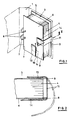
- Fig. 1 in räumlicher Darstellungsweise einen Aktenordner mit einem Einsatz, der ein Telefonbuch aufnimmt, und
- Fig. 2 einen vergrößerten Teilschnitt längs der Linie II-II in Fig. 1.
- Ein Aktenordner 1, der in Fig. 1 nur beispielsweise als Stehordner mit strichpunktierten Linien angedeutet ist, weist eine bekannte Bügelmechanik mit Heftbügeln 2 auf. Ein an den Heftbügeln 2 angebrachter Einsatz 3 zur Aufnahme eines Telefonbuchs 4 weist ein hinteres Deckelblatt 5 und ein vorderes Deckelblatt 6 aus steifem Blattmaterial auf, beispielsweise aus dünnen, biegesteifen Kunststoffblättern.
- Die Deckelblätter 5, 6 sind jeweils an ihrem linken Rand 7 mit einer Abheftlochung 8 versehen, durch die die Heftbügel 2 greifen.
- An ihrem rechten Rand 9 und ihrem unteren Rand 10 sind die beiden Deckelblätter 5, 6 durch jeweils ein Halteband 11 bzw. 12 miteinander verbunden. Jedes Halteband 11, 12 ist als Klettband ausgeführt, das mit seinem einen Ende mit einem an der Rückseite des hinteren Deckelblattes 5 angebrachten, beispielsweise angeklebten Klettband-Gegenstück 13 verbunden ist.
- Das Halteband 11 ist um die rechten Ränder 9 der beiden Deckelblätter 5, 6 straff nach vorn geführt und mit einem an der Vorderseite des vorderen Deckelblattes 6 angebrachten, beispielsweise angeklebten Klettband-Gegenstück 14 verbunden. Die Klettband-Verbindung zwischen dem Halteband 11 und dem Klettband-Gegenstück 14 stellt eine leicht lösbare und stufenlos längenverstellbare Verbindung dar, so daß unterschiedlich dicke Telefonbücher 4 oder ähnliches lose eingelegtes Schriftgut aufgenommen werden kann. In Fig. 2 ist mit strichpunktierten Linien angedeutet, wie das mit dem hinteren Deckelblatt 5 verbundene Halteband 11 nach vorn und auf das vordere Deckelblatt 6 gelegt wird.
- In gleicher Weise ist das untere Halteband 12 auf der Rückseite des hinteren Deckelblatts 5 mit einem Klettband-Gegenstück 13 verbunden und nach vorn auf die Vorderseite des vorderen Deckelblattes 6 gelegt, wo ebenfalls ein Klettband-Gegenstück 14 angebracht ist.
- Die Haltebänder 11, 12 halten die beiden Deckelblätter 5, 6 straff zusammen und verhindern, daß das zwischen den Deckelblättern 5, 6 aufgenommene Telefonbuch 4 bei stehender oder hängender Anordnung des Aktenordners 1 herausfallen kann.
- Zur Entnahme des Telefonbuchs 4 werden nach dem Öffnen des Aktenordners 1 die beiden Haltebänder 11, 12 gelöst. In entsprechender Weise wird das Telefonbuch 4 nach der Benutzung wieder zwischen die beiden Deckelblätter 5, 6 eingelegt, und die Haltebänder 11, 12 werden in der beschriebenen Weise an der Vorderseite des vorderen Deckelblattes 6 befestigt. In dieser Weise können auch mehrere Einsätze 3, die jeweils aus zwei Deckelblättern 5, 6 bestehen, in einem Aktenordner 1 untergebracht werden.
Claims (5)
- Einsatz für Aktenordner zur Aufnahme von lose einzulegendem Schriftgut, insbesondere Telefonbüchern u.dgl., dadurch gekennzeichnet, daß zwei Deckelblätter (5, 6) jeweils an ihrem linken Rand (7) mit einer Abheftlochung (8) zur Aufnahme in Heftbügeln oder Heftzungen des Aktenordners versehen sind, und daß die beiden Deckelblätter (5, 6) an ihrem rechten Rand (9) und ihrem unteren Rand (10) durch jeweils ein Halteband (11, 12) miteinander verbunden sind, das jeweils am hinteren Deckelblatt (5) angebracht und auf der Vorderseite des vorderen Deckelblattes (6) lösbar und verstellbar befestigt ist.
- Einsatz nach Anspruch 1, dadurch gekennzeichnet, daß jedes Halteband (11, 12) ein Klettband ist, das mit einem auf der Vorderseite des vorderen Deckelblattes (6) angebrachten Klettband-Gegenstück (14) in lösbarer Verbindung steht.
- Einsatz nach Anspruch 2, dadurch gekennzeichnet, daß jedes als Klettband ausgeführte Halteband (11, 12) mit einem auf der Rückseite des hinteren Deckelblattes (5) angebrachten Klettband-Gegenstück (13) verbunden ist.
- Einsatz nach Anspruch 1, dadurch gekennzeichnet, daß das hintere und/oder das vordere Deckelblatt (5 bzw. 6) aus steifem Blattermaterial besteht.
- Einsatz nach Anspruch 4, dadurch gekennzeichnet, daß das hintere und/oder das vordere Deckelblatt (5 bzw. 6) jeweils aus einem dünnen, biegesteifen Kunststoffblatt besteht.
Applications Claiming Priority (2)
| Application Number | Priority Date | Filing Date | Title |
|---|---|---|---|
| DE9004912U DE9004912U1 (de) | 1990-04-30 | 1990-04-30 | Einsatz für Aktenordner |
| DE9004912U | 1990-04-30 |
Publications (2)
| Publication Number | Publication Date |
|---|---|
| EP0454906A1 true EP0454906A1 (de) | 1991-11-06 |
| EP0454906B1 EP0454906B1 (de) | 1993-04-28 |
Family
ID=6853381
Family Applications (1)
| Application Number | Title | Priority Date | Filing Date |
|---|---|---|---|
| EP90125811A Expired - Lifetime EP0454906B1 (de) | 1990-04-30 | 1990-12-29 | Einsatz zur Stabilisierung eines flexibel gebundenen Schriftguts in einem Aktenordner |
Country Status (5)
| Country | Link |
|---|---|
| EP (1) | EP0454906B1 (de) |
| AT (1) | ATE88673T1 (de) |
| DE (2) | DE9004912U1 (de) |
| DK (1) | DK0454906T3 (de) |
| ES (1) | ES2042187T3 (de) |
Cited By (3)
| Publication number | Priority date | Publication date | Assignee | Title |
|---|---|---|---|---|
| WO1994004375A1 (en) * | 1992-08-20 | 1994-03-03 | Helle Laursdahl | Cover device for subsequent mounting on books |
| AU649360B2 (en) * | 1991-10-23 | 1994-05-19 | Petrus Jacobus Lubbe | Paper binder |
| US7699553B1 (en) * | 2004-03-31 | 2010-04-20 | Adam Merzon | Binder and multi-function binder hold down page |
Citations (1)
| Publication number | Priority date | Publication date | Assignee | Title |
|---|---|---|---|---|
| FR1470977A (fr) * | 1966-03-10 | 1967-02-24 | Garniture de protection pour classeurs |
-
1990
- 1990-04-30 DE DE9004912U patent/DE9004912U1/de not_active Expired - Lifetime
- 1990-12-29 DK DK90125811.1T patent/DK0454906T3/da active
- 1990-12-29 ES ES199090125811T patent/ES2042187T3/es not_active Expired - Lifetime
- 1990-12-29 EP EP90125811A patent/EP0454906B1/de not_active Expired - Lifetime
- 1990-12-29 AT AT90125811T patent/ATE88673T1/de active
- 1990-12-29 DE DE9090125811T patent/DE59001320D1/de not_active Expired - Fee Related
Patent Citations (1)
| Publication number | Priority date | Publication date | Assignee | Title |
|---|---|---|---|---|
| FR1470977A (fr) * | 1966-03-10 | 1967-02-24 | Garniture de protection pour classeurs |
Cited By (4)
| Publication number | Priority date | Publication date | Assignee | Title |
|---|---|---|---|---|
| AU649360B2 (en) * | 1991-10-23 | 1994-05-19 | Petrus Jacobus Lubbe | Paper binder |
| WO1994004375A1 (en) * | 1992-08-20 | 1994-03-03 | Helle Laursdahl | Cover device for subsequent mounting on books |
| US5540462A (en) * | 1992-08-20 | 1996-07-30 | Laursdahl; Helle | Cover device for subsequent mounting on softbound books |
| US7699553B1 (en) * | 2004-03-31 | 2010-04-20 | Adam Merzon | Binder and multi-function binder hold down page |
Also Published As
| Publication number | Publication date |
|---|---|
| DE9004912U1 (de) | 1990-07-05 |
| DK0454906T3 (da) | 1993-08-23 |
| ES2042187T3 (es) | 1993-12-01 |
| EP0454906B1 (de) | 1993-04-28 |
| ATE88673T1 (de) | 1993-05-15 |
| DE59001320D1 (de) | 1993-06-03 |
Similar Documents
| Publication | Publication Date | Title |
|---|---|---|
| EP0454906B1 (de) | Einsatz zur Stabilisierung eines flexibel gebundenen Schriftguts in einem Aktenordner | |
| WO2001089859A1 (de) | Blatthaltesystem | |
| DE102019213359B4 (de) | Klemmhefter für Papier, insbesondere für Schriftgut | |
| DE8616122U1 (de) | Einhefthilfsmittel | |
| DE9308216U1 (de) | Zusatzausrüstung für Ordner | |
| DE170725C (de) | ||
| EP0641675A2 (de) | Haltevorrichtung für Loseblattsysteme | |
| CH704311A2 (de) | Notizbuchsystem mit austauschbaren Notizpapierstapeln. | |
| DE837842C (de) | Sammelmappe | |
| DE69515856T2 (de) | Dokument mit möglichkeit zum in unabhängigen, wieder zusammenbindbaren teilen auseinandernehmen, transportieren und stapeln | |
| EP0455033A1 (de) | Vorrichtung zum Einheften bzw. Ablegen von Druckschriften | |
| DE642867C (de) | Umschlagdeckel fuer Akten, Hefte, Schnellhefter usw. mit umklappbarer Aktenfahne | |
| DE919103C (de) | Vorrichtung fuer Haengeregistraturen zum Anordnen von Reitern | |
| AT402176B (de) | Ablagehülle | |
| DE4140083A1 (de) | Schnellheftermappe mit integrierten verschiebbaren heftstreifen fuer die ablage in ordnern oder dgl. | |
| DE10018447A1 (de) | Vorrichtung zum Befestigen zumindest einer Markierungseinrichtung an einem Buch oder ähnlichem | |
| EP0481238A1 (de) | Einschlagmappe für Zeitschriften, Broschüren oder lose Blattstapel | |
| DE202007009961U1 (de) | Vorrichtung zum Heften von gelochtem Blattwerk | |
| DE9014608U1 (de) | Vario-Mappe | |
| DE202010008433U1 (de) | Sammelbuch | |
| DE4312914A1 (de) | Schutzumschlag für Bücher, Hefte oder dergleichen | |
| DE202004006625U1 (de) | Aufbewahrungs- und Ablagevorrichtung für Unterlagen | |
| DE7223755U (de) | Aufreihvorrichtung für Loseblattheftung | |
| DE202004011337U1 (de) | Unterschriftenmappe | |
| DE3529851A1 (de) | Buchlesezeichenband |
Legal Events
| Date | Code | Title | Description |
|---|---|---|---|
| PUAI | Public reference made under article 153(3) epc to a published international application that has entered the european phase |
Free format text: ORIGINAL CODE: 0009012 |
|
| 17P | Request for examination filed |
Effective date: 19910906 |
|
| AK | Designated contracting states |
Kind code of ref document: A1 Designated state(s): AT BE CH DE DK ES FR GB GR IT LI LU NL SE |
|
| 17Q | First examination report despatched |
Effective date: 19920505 |
|
| GRAA | (expected) grant |
Free format text: ORIGINAL CODE: 0009210 |
|
| AK | Designated contracting states |
Kind code of ref document: B1 Designated state(s): AT BE CH DE DK ES FR GB GR IT LI LU NL SE |
|
| REF | Corresponds to: |
Ref document number: 88673 Country of ref document: AT Date of ref document: 19930515 Kind code of ref document: T |
|
| REF | Corresponds to: |
Ref document number: 59001320 Country of ref document: DE Date of ref document: 19930603 |
|
| ITF | It: translation for a ep patent filed | ||
| ET | Fr: translation filed | ||
| REG | Reference to a national code |
Ref country code: DK Ref legal event code: T3 |
|
| GBT | Gb: translation of ep patent filed (gb section 77(6)(a)/1977) |
Effective date: 19930726 |
|
| REG | Reference to a national code |
Ref country code: GR Ref legal event code: FG4A Free format text: 3008618 |
|
| REG | Reference to a national code |
Ref country code: ES Ref legal event code: FG2A Ref document number: 2042187 Country of ref document: ES Kind code of ref document: T3 |
|
| EPTA | Lu: last paid annual fee | ||
| PLBE | No opposition filed within time limit |
Free format text: ORIGINAL CODE: 0009261 |
|
| STAA | Information on the status of an ep patent application or granted ep patent |
Free format text: STATUS: NO OPPOSITION FILED WITHIN TIME LIMIT |
|
| 26N | No opposition filed | ||
| PGFP | Annual fee paid to national office [announced via postgrant information from national office to epo] |
Ref country code: LU Payment date: 19941201 Year of fee payment: 5 |
|
| PGFP | Annual fee paid to national office [announced via postgrant information from national office to epo] |
Ref country code: GB Payment date: 19941221 Year of fee payment: 5 |
|
| PGFP | Annual fee paid to national office [announced via postgrant information from national office to epo] |
Ref country code: ES Payment date: 19941223 Year of fee payment: 5 |
|
| PGFP | Annual fee paid to national office [announced via postgrant information from national office to epo] |
Ref country code: SE Payment date: 19941227 Year of fee payment: 5 Ref country code: GR Payment date: 19941227 Year of fee payment: 5 Ref country code: DK Payment date: 19941227 Year of fee payment: 5 Ref country code: CH Payment date: 19941227 Year of fee payment: 5 |
|
| PGFP | Annual fee paid to national office [announced via postgrant information from national office to epo] |
Ref country code: BE Payment date: 19941229 Year of fee payment: 5 |
|
| PGFP | Annual fee paid to national office [announced via postgrant information from national office to epo] |
Ref country code: NL Payment date: 19941231 Year of fee payment: 5 |
|
| EAL | Se: european patent in force in sweden |
Ref document number: 90125811.1 |
|
| PGFP | Annual fee paid to national office [announced via postgrant information from national office to epo] |
Ref country code: FR Payment date: 19951227 Year of fee payment: 6 Ref country code: AT Payment date: 19951227 Year of fee payment: 6 |
|
| PG25 | Lapsed in a contracting state [announced via postgrant information from national office to epo] |
Ref country code: LU Free format text: LAPSE BECAUSE OF NON-PAYMENT OF DUE FEES Effective date: 19951229 Ref country code: GB Effective date: 19951229 Ref country code: DK Effective date: 19951229 |
|
| REG | Reference to a national code |
Ref country code: DK Ref legal event code: EBP |
|
| PG25 | Lapsed in a contracting state [announced via postgrant information from national office to epo] |
Ref country code: SE Effective date: 19951230 |
|
| PG25 | Lapsed in a contracting state [announced via postgrant information from national office to epo] |
Ref country code: LI Effective date: 19951231 Ref country code: CH Effective date: 19951231 Ref country code: BE Effective date: 19951231 |
|
| BERE | Be: lapsed |
Owner name: PROLL ROBERT Effective date: 19951231 |
|
| PG25 | Lapsed in a contracting state [announced via postgrant information from national office to epo] |
Ref country code: GR Free format text: THE PATENT HAS BEEN ANNULLED BY A DECISION OF A NATIONAL AUTHORITY Effective date: 19960630 |
|
| PG25 | Lapsed in a contracting state [announced via postgrant information from national office to epo] |
Ref country code: NL Effective date: 19960701 |
|
| REG | Reference to a national code |
Ref country code: CH Ref legal event code: PL |
|
| GBPC | Gb: european patent ceased through non-payment of renewal fee |
Effective date: 19951229 |
|
| REG | Reference to a national code |
Ref country code: GR Ref legal event code: MM2A Free format text: 3008618 |
|
| NLV4 | Nl: lapsed or anulled due to non-payment of the annual fee |
Effective date: 19960701 |
|
| PG25 | Lapsed in a contracting state [announced via postgrant information from national office to epo] |
Ref country code: AT Effective date: 19961229 |
|
| PG25 | Lapsed in a contracting state [announced via postgrant information from national office to epo] |
Ref country code: ES Free format text: LAPSE BECAUSE OF NON-PAYMENT OF DUE FEES Effective date: 19961230 |
|
| PG25 | Lapsed in a contracting state [announced via postgrant information from national office to epo] |
Ref country code: FR Effective date: 19970829 |
|
| REG | Reference to a national code |
Ref country code: FR Ref legal event code: ST |
|
| PGFP | Annual fee paid to national office [announced via postgrant information from national office to epo] |
Ref country code: DE Payment date: 20001228 Year of fee payment: 11 |
|
| PG25 | Lapsed in a contracting state [announced via postgrant information from national office to epo] |
Ref country code: DE Free format text: LAPSE BECAUSE OF NON-PAYMENT OF DUE FEES Effective date: 20020702 |
|
| REG | Reference to a national code |
Ref country code: ES Ref legal event code: FD2A Effective date: 19970113 |
|
| PG25 | Lapsed in a contracting state [announced via postgrant information from national office to epo] |
Ref country code: IT Free format text: LAPSE BECAUSE OF NON-PAYMENT OF DUE FEES;WARNING: LAPSES OF ITALIAN PATENTS WITH EFFECTIVE DATE BEFORE 2007 MAY HAVE OCCURRED AT ANY TIME BEFORE 2007. THE CORRECT EFFECTIVE DATE MAY BE DIFFERENT FROM THE ONE RECORDED. Effective date: 20051229 |