EP0454927A2 - Kodierungssystem für Videosignale - Google Patents
Kodierungssystem für Videosignale Download PDFInfo
- Publication number
- EP0454927A2 EP0454927A2 EP90313839A EP90313839A EP0454927A2 EP 0454927 A2 EP0454927 A2 EP 0454927A2 EP 90313839 A EP90313839 A EP 90313839A EP 90313839 A EP90313839 A EP 90313839A EP 0454927 A2 EP0454927 A2 EP 0454927A2
- Authority
- EP
- European Patent Office
- Prior art keywords
- low frequency
- coefficients
- prediction
- video image
- signal
- Prior art date
- Legal status (The legal status is an assumption and is not a legal conclusion. Google has not performed a legal analysis and makes no representation as to the accuracy of the status listed.)
- Withdrawn
Links
Images

Classifications
-
- H—ELECTRICITY
- H04—ELECTRIC COMMUNICATION TECHNIQUE
- H04N—PICTORIAL COMMUNICATION, e.g. TELEVISION
- H04N19/00—Methods or arrangements for coding, decoding, compressing or decompressing digital video signals
- H04N19/60—Methods or arrangements for coding, decoding, compressing or decompressing digital video signals using transform coding
-
- H—ELECTRICITY
- H04—ELECTRIC COMMUNICATION TECHNIQUE
- H04N—PICTORIAL COMMUNICATION, e.g. TELEVISION
- H04N19/00—Methods or arrangements for coding, decoding, compressing or decompressing digital video signals
- H04N19/30—Methods or arrangements for coding, decoding, compressing or decompressing digital video signals using hierarchical techniques, e.g. scalability
-
- H—ELECTRICITY
- H04—ELECTRIC COMMUNICATION TECHNIQUE
- H04N—PICTORIAL COMMUNICATION, e.g. TELEVISION
- H04N19/00—Methods or arrangements for coding, decoding, compressing or decompressing digital video signals
- H04N19/60—Methods or arrangements for coding, decoding, compressing or decompressing digital video signals using transform coding
- H04N19/61—Methods or arrangements for coding, decoding, compressing or decompressing digital video signals using transform coding in combination with predictive coding
- H04N19/619—Methods or arrangements for coding, decoding, compressing or decompressing digital video signals using transform coding in combination with predictive coding the transform being operated outside the prediction loop
Definitions
- This invention relates to signal coding systems and, more particularly, to encoding and decoding video signals of moving images suitable for transmission or for storage.
- Prior video signal interframe coding, transmission and reproduction systems initially encode a base frame image.
- This base frame image incorporates both the low and the high spatial frequency components of the image.
- the base frame image is transmitted and thereafter only information representative of the difference between the base frame and each subsequent image is transmitted. Both low and high frequency spatial components are contained within the difference information.
- a high quality version i.e., an accurate or error free representation, of any desired subsequent image can be reconstructed. If difference information is lost during transmission, only a low quality version of the desired image, i.e., an inaccurate or error strewn representation, can be reconstructed.
- Such prior arrangements are inefficient because they lack the ability to rapidly reproduce high quality images in random access applications.
- a video signal is divided into blocks comprising an array of pels. Each block is transformed into the frequency domain. The high and the low frequency coefficients of each block are separately extracted from the resulting transformed matrix. A version of the original image represented by the low frequency coefficients of each block is motion compensated to yield a prediction error signal and motion vectors.
- the prediction error signal, the motion vectors and the high frequency coefficients are encoded using a method suitable to the medium of transmission or storage.
- the prediction error signal and motion vectors are assigned a high priority.
- the high frequency coefficients are assigned a low priority and may be dropped by a network during congestion or not retrieved from storage.
- a receiver decodes and separates the prediction error signal, the motion vectors and the high frequency coefficients.
- the prediction error signal and motion vectors are used to reconstruct a motion compensated version of the low frequency image.
- the high frequency coefficients are inverse transformed and the resulting reconstructed high frequency version of the image is combined with the reconstructed, motion compensated low frequency version of the image to produce a reconstructed version of the original image.
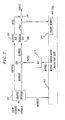
- FIG. 1 shows an encoder that encodes the high frequency coefficients of a DCT of a sequence of image frames in an intraframe format.
- An additional DCT beyond those used in prior motion compensated systems is used as a low-pass loop-filter to generate a low frequency prediction.
- an original video signal VIDIN is first delayed by delay 102 for reasons to be given later.
- the delayed signal 104 is then converted from the pel domain to the Discrete Cosine Transform domain by DCT 106.
- An example DCT 106 groups input pels, i.e. picture elements, into 2- dimensional blocks, e.g., 8x8 pels each.
- DCT 106 produces a set of output frequency coefficients that are grouped into 2-dimensional blocks of the same size as the input blocks.
- the transform coefficients supplied as an output by DCT 106 are then partitioned by separator 108 into two groups, namely, high spatial frequency coefficients and low spatial frequency coefficients.
- the high spatial frequency coefficients, HFREQ are selected based upon a predetermined threshold and are supplied to quantizer 110.
- the remaining low spatial frequency coefficients, LFREQ are supplied to subtracter 112.
- High spatial frequency coefficients HFREQ are quantized by quantizer 110.
- a quantizer reduces the number of levels available for coefficients to assume.
- the quantizing can optionally be made responsive to the quantity of information stored in elastic store 114 so as to prevent elastic store 114 from overflowing.
- the output from quantizer 110, QHFREQ is supplied to elastic store 114.
- Elastic store 114 subsequently supplies QHFREQ to channel coder 116 for encoding appropriate for transmission or storage, depending on the application. If elastic store 114 is not present, QHFREQ is supplied directly to channel coder 116 for encoding.
- Low spatial frequency coefficients LFREQ are coded by interframe prediction techniques that are well known in the art and exploit the correlation normally present between image frames. For example, here we show simple Motion Compensation prediction.
- Low frequency coefficient prediction signal PRED supplied to subtracter 112 is subtracted from the low frequency coefficients LFREQ to yield an initial low frequency prediction error signal LPERR.
- Low frequency prediction error signal LPERR is quantized by quantizer 118 and then supplied as low frequency prediction error signal QLPERR to elastic store 114.
- QLPERR is subsequently encoded and supplied for transmission by channel coder 116.
- Data supplied to channel coder 116 from elastic store 114 is encoded using well known reversible data compression methods.
- a serial bit-stream output that can be transmitted or stored is supplied as an output from channel coder 116.
- quantizers 110 and 118 and elastic store 114 may be eliminated. If quantizer 118 is eliminated, low frequency prediction error signal LPERR is supplied directly to elastic store 114 and adder 120. Additionally, a significance detector (not shown) may be incorporated into quantizer 118. This detector would determine whether the values of the low frequency coefficients in a block of QLPERR were too small to warrant transmission. Insignificant blocks would be replaced by zero (0) before being supplied as an output.
- the quantized prediction error signal QLPERR is added to low frequency coefficient prediction signal PRED by adder 120 to produce "reconstructed" low frequency coefficients RLFREQ. These reconstructed coefficients are inverse transformed by INVERSE DCT 122 to form a low frequency pel domain signal LPEL.
- LPEL is passed into a frame memory 123 of motion compensation prediction unit 124.
- Motion compensation prediction units are well known in the art.
- Original signal VIDIN is also supplied to motion compensation prediction unit 124.
- Delay 102 is required to insure that coefficients LFREQ correspond in time to predicted coefficients PRED due to the processing delay in motion compensation prediction unit 124.
- Motion compensation prediction unit 124 compares each block of the original signal VIDIN with signal LPEL stored in its frame memory 123 and calculates a motion vector for each block. Motion vectors are necessary to reconstruct a shift-matrix for the motion compensated low frequency version of the image. The motion vectors are supplied as output signal MOVECT to elastic store 114 for subsequent transmission by channel coder 116. Channel coder 116 assigns a higher priority to the low frequency quantized prediction error signal and the motion vectors than is assigned to the high frequency coefficients.
- Motion compensation prediction unit 124 also generates MCPEL, which is a block of pels that is shifted by an amount corresponding to each of the aforementioned motion vectors.
- MCPEL represents the prediction to be used in coding the corresponding block of original pels now being supplied as an output by delay 102.
- an original block of pels on signal line 104 passes into DCT 106 at the same time as the corresponding predicted MCPEL block of pels passes into DCT 126.
- the low frequency coefficients supplied as an output from DCT 126 appear as signal PRED, which is the aforementioned prediction for the low frequency coefficients LFREQ.
- DCT 126 does not generate any high frequency coefficients.
- Channel decoder 202 decodes a signal supplied from the channel or from storage and supplies as outputs signals QHFREQ2, QLPERR2 and MOVECT2. Under errorless conditions, a signal with a suffix of 2 is a reconstructed version of the signal having the same base name as shown in Fig. 1.
- High frequency coefficients QHFREQ2 are inverse transformed by INVERSE DCT 204 and the resulting signal, HPEL, is supplied as an output.
- HPEL represents a high frequency pel domain version of the original image.
- Quantized low frequency coefficient prediction error signal QLPERR2 is added to prediction signal PRED2 by adder 206 to generate reconstructed low frequency coefficients RLFREQ2, which are supplied as an output.
- Reconstructed low frequency coefficients RLFREQ2 are inverse transformed by INVERSE DCT 208 to form a signal LPEL2 which represents a low frequency motion compensated pel domain version of the original image.
- Adder 210 sums signals LPEL2 and HPEL and supplies the result as output signal VIDOUT.
- Signal VIDOUT is a full frequency reconstructed version of the original video image signal in the pel domain.
- low frequency pel signal LPEL2 is supplied to a frame memory 211 of motion compensation prediction unit 212.
- Motion compensation prediction unit 212 is also supplied with motion vectors MOVECT2.
- a shifted block of pels, signal MCPEL2, which represents an uncorrected motion compensation predicted version of the low frequency pel domain image is generated by motion compensation prediction unit 212.
- Signal MCPEL2 is supplied to DCT 214 wherein it is transformed into the frequency domain.
- the resulting output of DCT 214 is a set of low frequency prediction coefficients, PRED2, which are supplied to abovementioned adder 206.
- DCT 214 also does not generate any high frequency coefficients.
- motion compensation of the low frequency image is suspended for one frame. Thereafter, at predetermined intervals, motion compensation of the low frequency image may be suspended for additional frame periods. This is useful in applications requiring random access from storage such as compact disks or where the image signal is to be transported over a packet network that cannot guaranty 100% delivery for packets that contain the motion vectors and low frequency error signal. Networks that guaranty 100% delivery would not require suspension of motion compensation.
- the time of suspension is determined by a control mechanism (not shown) and effected by changing the logical condition of signal CTRL supplied to motion compensation prediction unit 124.
- Suspension of motion compensation causes signals MOVECT, MCPEL and PRED to have values of zero (0).
- None is therefore subtracted from the low frequency coefficients at subtracter 112 and LPERR and low frequency coefficients LFREQ are therefore equal.
- This causes the low frequency coefficients LFREQ to be directly encoded rather than prediction error signal LPERR and motion vectors MOVECT thereby resulting in the transmission of a new base frame.
- a corresponding time of suspension of motion compensation is determined by a control mechanism (also not shown) and effected by changing the logical condition of signal CTRL supplied to motion compensation prediction unit 212.
- signal QLPERR2 in the receiver is equal to the low frequency coefficients LFREQ (FIG. 1).
- Suspension of motion compensation causes signals MCPEL2 and PRED2 to have values of zero (0).
- signal RLFREQ2 is equal to signal QLPERR2 and correspondingly LPEL2 represents a low frequency base image.
- the low frequency image and the high frequency image can be computed in parallel, since errors introduced by compressing the low frequency information do not translate into additional errors in the high frequency information. Also, since not all DCT coefficients are necessary to generate either the low frequency image or the high frequency image, the entire DCT need not be computed for each, and an intelligent implementation of the DCT can improve the efficiency of the computation. Additionally, a better prediction of the coefficients in the motion compensation loop is obtained, since fewer coefficients are predicted. Furthermore, by motion compensating only the low frequencies, the overall image quality is not sacrificed in areas with large motion. In this case, motion compensation cannot adequately predict the high frequencies anyway, so little is lost by not motion compensating them. This coding method has all the advantages for packet transmission inherent in any variable bit-rate method. A balance is struck between data compression and robustness to packet loss, by motion compensating low frequencies, yet intraframe coding the high frequencies.
- An embedded code is a digital code that allows bits or symbols to be dropped and inserted without causing mismatch between the memories of the encoder and the decoder.
- the encoding and decoding system described above is such a system.
- another advantage of this system is that if some of the high frequency coefficients transmitted by the encoder are lost they can be zero-filled at the decoder and an image with less error than prior systems will be displayed.
- only the low frequency portions of the intraframe coded base frame and subsequent interframe coded frames until ad including a desired random frame need be read. These are then combined with the high frequency portion of the desired frame and displayed. Therefore, a high quality image can be randomly accessed more rapidly than with prior coded video systems.
Landscapes
- Engineering & Computer Science (AREA)
- Multimedia (AREA)
- Signal Processing (AREA)
- Compression Or Coding Systems Of Tv Signals (AREA)
- Compression, Expansion, Code Conversion, And Decoders (AREA)
- Television Signal Processing For Recording (AREA)
Applications Claiming Priority (2)
| Application Number | Priority Date | Filing Date | Title |
|---|---|---|---|
| US07/517,991 US5001561A (en) | 1990-05-02 | 1990-05-02 | Embedded coding system for video signals |
| US517991 | 1990-05-02 |
Publications (2)
| Publication Number | Publication Date |
|---|---|
| EP0454927A2 true EP0454927A2 (de) | 1991-11-06 |
| EP0454927A3 EP0454927A3 (en) | 1993-01-13 |
Family
ID=24062078
Family Applications (1)
| Application Number | Title | Priority Date | Filing Date |
|---|---|---|---|
| EP19900313839 Withdrawn EP0454927A3 (en) | 1990-05-02 | 1990-12-18 | A coding system for video signals |
Country Status (5)
| Country | Link |
|---|---|
| US (1) | US5001561A (de) |
| EP (1) | EP0454927A3 (de) |
| JP (1) | JPH04229791A (de) |
| CA (1) | CA2034418A1 (de) |
| FI (1) | FI912110A7 (de) |
Cited By (4)
| Publication number | Priority date | Publication date | Assignee | Title |
|---|---|---|---|---|
| WO1994030010A1 (en) * | 1993-06-10 | 1994-12-22 | Snell & Wilcox Limited | Video signal processing |
| EP1081958A1 (de) * | 1999-08-31 | 2001-03-07 | Lucent Technologies Inc. | Verfahren und Vorrichtung für Makroblock DC- und AC-Koefficienten-Prädiktion in Videocodierung |
| US6826232B2 (en) | 1999-12-20 | 2004-11-30 | Koninklijke Philips Electronics N.V. | Fine granular scalable video with embedded DCT coding of the enhancement layer |
| FR2906433A1 (fr) * | 2006-09-22 | 2008-03-28 | Canon Kk | Procedes et dispositifs de codage et de decodage d'images, programme d'ordinateur les mettant en oeuvre et support d'informaton permettant de les mettre en oeuvre |
Families Citing this family (44)
| Publication number | Priority date | Publication date | Assignee | Title |
|---|---|---|---|---|
| US5140417A (en) * | 1989-06-20 | 1992-08-18 | Matsushita Electric Co., Ltd. | Fast packet transmission system of video data |
| US5422675A (en) * | 1990-01-29 | 1995-06-06 | Massachusetts Institute Of Technology | Adaptive modulation/demodulation signal processing |
| US5128757A (en) * | 1990-06-18 | 1992-07-07 | Zenith Electronics Corporation | Video transmission system using adaptive sub-band coding |
| US5218435A (en) * | 1991-02-20 | 1993-06-08 | Massachusetts Institute Of Technology | Digital advanced television systems |
| US5111292A (en) * | 1991-02-27 | 1992-05-05 | General Electric Company | Priority selection apparatus as for a video signal processor |
| US5285276A (en) * | 1991-03-12 | 1994-02-08 | Zenith Electronics Corp. | Bi-rate high definition television signal transmission system |
| JPH04323963A (ja) * | 1991-04-23 | 1992-11-13 | Canon Inc | 画像処理方法及び装置 |
| JPH04358486A (ja) * | 1991-06-04 | 1992-12-11 | Toshiba Corp | 高能率符号化信号処理装置 |
| US6487362B1 (en) | 1991-08-19 | 2002-11-26 | Index Systems, Inc. | Enhancing operations of video tape cassette players |
| US6091884A (en) | 1991-08-19 | 2000-07-18 | Index Systems, Inc. | Enhancing operations of video tape cassette players |
| JP3109185B2 (ja) * | 1991-11-12 | 2000-11-13 | ソニー株式会社 | ディジタルvtr |
| US5227878A (en) * | 1991-11-15 | 1993-07-13 | At&T Bell Laboratories | Adaptive coding and decoding of frames and fields of video |
| US5339108A (en) * | 1992-04-09 | 1994-08-16 | Ampex Corporation | Ordering and formatting coded image data and reconstructing partial images from the data |
| US5270813A (en) * | 1992-07-02 | 1993-12-14 | At&T Bell Laboratories | Spatially scalable video coding facilitating the derivation of variable-resolution images |
| US5253055A (en) * | 1992-07-02 | 1993-10-12 | At&T Bell Laboratories | Efficient frequency scalable video encoding with coefficient selection |
| US5253056A (en) * | 1992-07-02 | 1993-10-12 | At&T Bell Laboratories | Spatial/frequency hybrid video coding facilitating the derivatives of variable-resolution images |
| JPH06197334A (ja) * | 1992-07-03 | 1994-07-15 | Sony Corp | 画像信号符号化方法、画像信号復号化方法、画像信号符号化装置、画像信号復号化装置及び画像信号記録媒体 |
| JPH0698288A (ja) * | 1992-09-10 | 1994-04-08 | Nikon Corp | 静止画記憶装置 |
| JP2902284B2 (ja) * | 1993-11-12 | 1999-06-07 | ケイディディ株式会社 | 動画像の符号化装置 |
| US5566284A (en) * | 1993-12-22 | 1996-10-15 | Matsushita Electric Industrial Co., Ltd. | Apparatus and method for mip-map generation using low-pass filtering based on resolution ratio |
| US5452009A (en) * | 1993-12-29 | 1995-09-19 | Zenith Electronics Corp. | Digital transmission system with data rate optimized for noise in transmission medium |
| JP2956464B2 (ja) * | 1993-12-29 | 1999-10-04 | 日本ビクター株式会社 | 画像情報圧縮伸長装置 |
| US5592226A (en) * | 1994-01-26 | 1997-01-07 | Btg Usa Inc. | Method and apparatus for video data compression using temporally adaptive motion interpolation |
| GB2302488B (en) * | 1994-09-20 | 1997-04-09 | Ricoh Kk | Method for compression |
| JPH08275160A (ja) * | 1995-03-27 | 1996-10-18 | Internatl Business Mach Corp <Ibm> | 離散余弦変換方法 |
| JP3788823B2 (ja) * | 1995-10-27 | 2006-06-21 | 株式会社東芝 | 動画像符号化装置および動画像復号化装置 |
| SE512291C2 (sv) * | 1997-09-23 | 2000-02-28 | Ericsson Telefon Ab L M | Inbäddad DCT-baserad stillbildskodningsalgoritm |
| SE9800088D0 (sv) | 1997-10-10 | 1998-01-16 | Ericsson Telefon Ab L M | Long filter lossless region of interest coding |
| SE9803454L (sv) | 1998-10-09 | 2000-04-10 | Ericsson Telefon Ab L M | Förfarande och system för kodning av ROI |
| US6445701B1 (en) * | 1998-10-09 | 2002-09-03 | Microsoft Corporation | Channel access scheme for use in network communications |
| US6507587B1 (en) | 1998-10-09 | 2003-01-14 | Microsoft Corporation | Method of specifying the amount of bandwidth to reserve for use in network communications |
| US6289297B1 (en) | 1998-10-09 | 2001-09-11 | Microsoft Corporation | Method for reconstructing a video frame received from a video source over a communication channel |
| US6618363B1 (en) | 1998-10-09 | 2003-09-09 | Microsoft Corporation | Method for adapting video packet generation and transmission rates to available resources in a communications network |
| US6438136B1 (en) | 1998-10-09 | 2002-08-20 | Microsoft Corporation | Method for scheduling time slots in a communications network channel to support on-going video transmissions |
| US6754266B2 (en) * | 1998-10-09 | 2004-06-22 | Microsoft Corporation | Method and apparatus for use in transmitting video information over a communication network |
| US6519004B1 (en) | 1998-10-09 | 2003-02-11 | Microsoft Corporation | Method for transmitting video information over a communication channel |
| US6317462B1 (en) | 1998-10-22 | 2001-11-13 | Lucent Technologies Inc. | Method and apparatus for transmitting MPEG video over the internet |
| US6490705B1 (en) | 1998-10-22 | 2002-12-03 | Lucent Technologies Inc. | Method and apparatus for receiving MPEG video over the internet |
| US6639943B1 (en) * | 1999-11-23 | 2003-10-28 | Koninklijke Philips Electronics N.V. | Hybrid temporal-SNR fine granular scalability video coding |
| KR100359821B1 (ko) * | 2000-01-20 | 2002-11-07 | 엘지전자 주식회사 | 움직임 보상 적응형 영상 압축과 복원방법 및 그 장치와디코더 |
| US6647149B2 (en) | 2001-01-03 | 2003-11-11 | Electronics For Imaging, Inc. | Methods and apparatus for securely transmitting and processing digital image data |
| US8165212B2 (en) | 2004-11-19 | 2012-04-24 | Panasonic Corporation | Video encoding method, and video decoding method |
| US7939167B2 (en) * | 2008-12-30 | 2011-05-10 | Cheil Industries Inc. | Resin composition |
| FR2944936A1 (fr) * | 2009-04-23 | 2010-10-29 | Thomson Licensing | Procedes de codage et de decodage d'un bloc de donnees images, dispositifs de codage et de decodage implementant lesdits procedes |
Family Cites Families (7)
| Publication number | Priority date | Publication date | Assignee | Title |
|---|---|---|---|---|
| US4245248A (en) * | 1979-04-04 | 1981-01-13 | Bell Telephone Laboratories, Incorporated | Motion estimation and encoding of video signals in the transform domain |
| FR2575351B1 (fr) * | 1984-12-21 | 1988-05-13 | Thomson Csf | Procede adaptatif de codage et de decodage d'une suite d'images par transformation, et dispositifs pour la mise en oeuvre de ce procede |
| US4805030A (en) * | 1986-01-27 | 1989-02-14 | Fuji Photo Film Co., Ltd. | Method of image signal encoding by orthogonal transformation |
| EP0339589A3 (de) * | 1988-04-28 | 1992-01-02 | Sharp Kabushiki Kaisha | Orthogonales Transformationskodierungssystem für Bilddaten |
| US4941043A (en) * | 1988-06-14 | 1990-07-10 | Siemens Aktiengesellschaft | Method for reducing blocking artifacts in video scene coding with discrete cosine transformation (DCT) at a low data rate |
| JPH0262176A (ja) * | 1988-08-26 | 1990-03-02 | Fujitsu Ltd | 画像符号化伝送装置 |
| US4958226A (en) * | 1989-09-27 | 1990-09-18 | At&T Bell Laboratories | Conditional motion compensated interpolation of digital motion video |
-
1990
- 1990-05-02 US US07/517,991 patent/US5001561A/en not_active Expired - Lifetime
- 1990-12-18 EP EP19900313839 patent/EP0454927A3/en not_active Withdrawn
-
1991
- 1991-01-17 CA CA002034418A patent/CA2034418A1/en not_active Abandoned
- 1991-03-18 JP JP3077226A patent/JPH04229791A/ja active Pending
- 1991-04-30 FI FI912110A patent/FI912110A7/fi unknown
Cited By (8)
| Publication number | Priority date | Publication date | Assignee | Title |
|---|---|---|---|---|
| WO1994030010A1 (en) * | 1993-06-10 | 1994-12-22 | Snell & Wilcox Limited | Video signal processing |
| US5754246A (en) * | 1993-06-10 | 1998-05-19 | Snell & Wilcox Limited | Video signal processing with motion compensation at low bandwidth |
| EP1081958A1 (de) * | 1999-08-31 | 2001-03-07 | Lucent Technologies Inc. | Verfahren und Vorrichtung für Makroblock DC- und AC-Koefficienten-Prädiktion in Videocodierung |
| WO2001017266A1 (en) * | 1999-08-31 | 2001-03-08 | Lucent Technologies Inc. | Method and apparatus for macroblock dc and ac coefficient prediction for video coding |
| US6977961B1 (en) | 1999-08-31 | 2005-12-20 | Lucent Technologies Inc. | Method and apparatus for macroblock DC and AC coefficient prediction for video coding |
| US6826232B2 (en) | 1999-12-20 | 2004-11-30 | Koninklijke Philips Electronics N.V. | Fine granular scalable video with embedded DCT coding of the enhancement layer |
| FR2906433A1 (fr) * | 2006-09-22 | 2008-03-28 | Canon Kk | Procedes et dispositifs de codage et de decodage d'images, programme d'ordinateur les mettant en oeuvre et support d'informaton permettant de les mettre en oeuvre |
| US8711945B2 (en) | 2006-09-22 | 2014-04-29 | Canon Kabushiki Kaisha | Methods and devices for coding and decoding images, computer program implementing them and information carrier enabling their implementation |
Also Published As
| Publication number | Publication date |
|---|---|
| EP0454927A3 (en) | 1993-01-13 |
| JPH04229791A (ja) | 1992-08-19 |
| US5001561A (en) | 1991-03-19 |
| FI912110A7 (fi) | 1991-11-03 |
| FI912110A0 (fi) | 1991-04-30 |
| CA2034418A1 (en) | 1991-11-03 |
Similar Documents
| Publication | Publication Date | Title |
|---|---|---|
| US5001561A (en) | Embedded coding system for video signals | |
| CA2084178C (en) | Statistical multiplexer for a multichannel image compression system | |
| US4821119A (en) | Method and apparatus for low bit-rate interframe video coding | |
| EP0691054B1 (de) | Verfahren und vorrichtung zur effizienten transkodierung | |
| KR100253931B1 (ko) | 디지탈 영상 시퀀스의 디코딩 방법 및 장치 | |
| EP0519962B1 (de) | Digitale bildkodierung mit einer zufallsabtastung der bilder | |
| US7058127B2 (en) | Method and system for video transcoding | |
| US7912122B2 (en) | Picture coding method, picture decoding method, picture coding apparatus, picture decoding apparatus | |
| US6563954B2 (en) | Method for computational graceful degradation in an audiovisual compression system | |
| US6414992B1 (en) | Optimal encoding of motion compensated video | |
| KR19990082456A (ko) | 영상 데이터 압축 장치 및 그 방법 | |
| CN100456836C (zh) | 编码设备和方法 | |
| GB2321154A (en) | Reverse playback of MPEG video | |
| JPH08289294A (ja) | 適応量子化による動画像圧縮システム | |
| US7436889B2 (en) | Methods and systems for reducing requantization-originated generational error in predictive video streams using motion compensation | |
| JPH1013826A (ja) | 画像符号化装置および画像符号化方法、画像復号化装置および画像復号化方法、画像送信装置、画像受信装置、並びに記録媒体 | |
| JPH07107464A (ja) | 画像符号化装置および復号化装置 | |
| KR100207378B1 (ko) | 적응 벡터 양자화를 이용한 영상 부호화 시스템 | |
| KR100203719B1 (ko) | 엠팩-2 영상 비트 스트림에서의 에러 검출방법 | |
| KR100196847B1 (ko) | 영상 신호의 대역별 차분 펄스 부호 변조 회로 | |
| KR100386374B1 (ko) | 트랜스코더 | |
| US20040228402A1 (en) | Error concealment and error resilience | |
| JP2001145108A (ja) | 画像情報変換装置及び方法 | |
| JPH04134988A (ja) | 画像の符号化装置 | |
| JPH09307507A (ja) | 伝送レート変換装置 |
Legal Events
| Date | Code | Title | Description |
|---|---|---|---|
| PUAI | Public reference made under article 153(3) epc to a published international application that has entered the european phase |
Free format text: ORIGINAL CODE: 0009012 |
|
| AK | Designated contracting states |
Kind code of ref document: A2 Designated state(s): DE FR GB IT NL SE |
|
| PUAL | Search report despatched |
Free format text: ORIGINAL CODE: 0009013 |
|
| AK | Designated contracting states |
Kind code of ref document: A3 Designated state(s): DE FR GB IT NL SE |
|
| 17P | Request for examination filed |
Effective date: 19930701 |
|
| 17Q | First examination report despatched |
Effective date: 19930910 |
|
| RAP3 | Party data changed (applicant data changed or rights of an application transferred) |
Owner name: AT&T CORP. |
|
| STAA | Information on the status of an ep patent application or granted ep patent |
Free format text: STATUS: THE APPLICATION IS DEEMED TO BE WITHDRAWN |
|
| 18D | Application deemed to be withdrawn |
Effective date: 19940607 |