EP0455416A2 - Process for producing methylnorbornene dicarboxylic acid anhydride - Google Patents
Process for producing methylnorbornene dicarboxylic acid anhydride Download PDFInfo
- Publication number
- EP0455416A2 EP0455416A2 EP91303720A EP91303720A EP0455416A2 EP 0455416 A2 EP0455416 A2 EP 0455416A2 EP 91303720 A EP91303720 A EP 91303720A EP 91303720 A EP91303720 A EP 91303720A EP 0455416 A2 EP0455416 A2 EP 0455416A2
- Authority
- EP
- European Patent Office
- Prior art keywords
- mcpd
- methylcyclopentadiene
- dicarboxylic acid
- acid anhydride
- methylnorbornene
- Prior art date
- Legal status (The legal status is an assumption and is not a legal conclusion. Google has not performed a legal analysis and makes no representation as to the accuracy of the status listed.)
- Granted
Links
Classifications
-
- C—CHEMISTRY; METALLURGY
- C07—ORGANIC CHEMISTRY
- C07C—ACYCLIC OR CARBOCYCLIC COMPOUNDS
- C07C51/00—Preparation of carboxylic acids or their salts, halides or anhydrides
- C07C51/54—Preparation of carboxylic acid anhydrides
- C07C51/567—Preparation of carboxylic acid anhydrides by reactions not involving carboxylic acid anhydride groups
Definitions
- the present invention relates to a process for producing methylnorbornene dicarboxylic acid anhydride. More particularly, it is concerned with a process for producing methylnorbornene dicarboxylic acid anhydride through Diels-Alder reaction in the presence of a specific catalyst at a specific reaction temperature, from a hydrocarbon fraction (which is a C6 ⁇ 7 fraction of naphtha steam cracking, containing diolefins such as methylcyclopentadiene) and maleic anhydride.
- a hydrocarbon fraction which is a C6 ⁇ 7 fraction of naphtha steam cracking, containing diolefins such as methylcyclopentadiene
- methylnorbornene dicarboxylic acid anhydride has a disadvantage of high production cost, because it is usually produced by converting methylcyclopentadiene dimer (which is expensive) into methylcyclopentadiene (MCPD) by thermal decomposition and adding MCPD to maleic anhydride by Diels-Alder reaction.
- the fraction resulting from steam cracking usually contains MCPD which is a mixture of three structural isomers, namely, 1-methylcyclopentadiene (1-MCPD), 2-methylcyclopentadiene (2-MCPD), and 5-methylcyclopentadiene (5-MCPD), which are shown in the following formulae.
- 1-MCPD and 2-MCPD readily react with maleic anhydride, but 5-MCPD does not react with maleic anhydride because of its steric hindrance if Diels-Alder reaction is carried out at 20-35°C so that heavy substances are formed in only small quantities. Therefore, the yield of methylnorbornene dicarboxylic acid anhydride is very low relative to the amount of MCPD.
- the present invention was completed to address the above-mentioned problems encountered in the prior art technology. Accordingly, it is an object of the present invention to provide a process for producing methylnorbornene dicarboxylic acid anhydride of high purity in a high yield at a low production cost.
- the present invention relates to a process for producing methylnorbornene dicarboxylic acid anhydride by reacting a mixture containing diolefins (such as MCPD) with maleic anhydride, characterized in that the reaction is carried out at 0-50°C in the presence of a protonic acid.
- the mixture is a C6 ⁇ 7 hydrocarbon fraction which is produced when a hydrocarbon mixture such as naphtha undergoes thermal decomposition in the presence of steam.
- methylnorbornene dicarboxylic acid anhydride is produced from a C6 ⁇ 7 hydrocarbon fraction containing diolefins such as MCPD which is obtained by steam cracking of a hydrocarbon mixture such as naphtha.
- This hydrocarbon fraction usually has the following composition.
- the hydrocarbon fraction having the above-mentioned composition undergoes Diels-Alder reaction without purification for the production of methylnorbornene dicarboxylic acid anhydride.
- methylnorbornene dicarboxylic acid anhydride is produced by Diels-Alder reaction of the hydrocarbon fraction containing 1 mol of MCPD components with 0.7-1.0 mol of maleic anhydride which is performed at 0-50°C for 10 minutes to 10 hours in the presence of a protonic acid catalyst.
- methylnorbornene dicarboxylic acid anhydride is produced in the presence of a protonic acid.
- the protonic acid functions as an isomerization catalyst for 5-MCPD.
- it isomerizes 5-MCPD into 1-MCPD and/or 2-MCPD and subjects them to Diels-Alder reaction.
- This isomerization is necessary because the hydrocarbon fraction as a raw material for the process of the present invention contains 5-MCPD, which does not react with maleic anhydride at low temperatures on account of its steric hindrance as mentioned above. Therefore, the process of the present invention is capable of converting all of 5-MCPD in the hydrocarbon fraction into methylnorbornene dicarboxylic acid anhydride even though the reaction temperature is low.
- the protonic acid may be selected from aromatic sulfonic acids (such as benzenesulfonic acid, p-toluene-sulfonic acid, and p-xylene-2-sulfonic acid), mineral acids (such as sulfuric acid, phosphoric acid, and hydrochloric acid), and heteropolyacids (such as phosphomolybdic acid, phosphotungstic acid, silicomolybdic acid, and silicotungstic acid), the most desirable of which are aromatic sulfonic acids having substituent C1 or C2 alkyl groups on the aromatic ring (such as benzenesulfonic acid, p-toluenesulfonic acid, and p-xylene-2-sulfonic acid).
- aromatic sulfonic acids such as benzenesulfonic acid, p-toluene-sulfonic acid, and p-xylene-2-sulfonic acid
- mineral acids such as sulfuric acid, phospho
- the protonic acid should be used in an amount of 0.01-5 wt.%, preferably 0.05-3 wt.%, based on the amount of 5-MCPD.
- the process of the present invention for producing methylnorbornene dicarboxylic acid anhydride may be carried out either continuously or batchwise at a reaction temperature of 0-50°C, preferably 20-40°C. If the reaction temperature is below 0°C, the isomerization of 5-MCPD will be slow. If the reaction temperature is above 50°C, other diolefin components than MCPD will come in the reaction, giving rise to more heavy substances.
- the reaction time for batchwise operation should be 10 minutes to 10 hours, preferably 30 minutes to 3 hours.
- the present invention provides a process for producing methylnorbornene dicarboxylic acid anhydride economically from a C6 ⁇ 7 hydrocarbon fraction containing diolefins which is a steam cracking product, in place of expensive methylcyclopentadiene dimer.
- Diels-Alder reaction was carried out in the same manner as in Example 1 except that p-toluenesulfonic acid was replaced by benzenesulfonic acid (made by Tokyo Kasei). Analysis of the reaction product by gas chromatography indicated that the conversion of MCPD was 100%. On distillation of the reaction product to remove unreacted components and to separate dicarboxylic acid anhydride, there were obtained 216.3 g of light yellowish liquid (distillate) and 9.2 g of residues. The amount of the distillate corresponds to 99.7 mol% based on MCPD. Analysis by gas chromatography indicated that the content of methylnorbornene dicarboxylic acid anhydride in the distillate was 97.1%.
- Diels-Alder reaction was carried out in the same manner as in Example 1 except that p-toluenesulfonic acid was replaced by p-xylene-2-sulfonic acid (made by Tokyo Kasei). Analysis of the reaction product by gas chromatography indicated that the conversion of MCPD was 98.1%. On distillation of the reaction product to remove unreacted components and to separate dicarboxylic acid anhydride, there were obtained 208.5 g of light yellowish liquid (distillate) and 8.5 g of residues. The amount of the distillate corresponds to 96.1 mol% based on MCPD. Analysis by gas chromatography indicated that the content of methylnorbornene dicarboxylic acid anhydride in the distillate was 97.9%.
- Diels-Alder reaction was carried out in the same manner as in Example 1 except that p-toluenesulfonic acid was replaced by 85% aqueous solution of phosphoric acid (made by Koso Kagaku) in an amount equivalent to 0.1% of 5-MCPD and the reaction temperature was changed to 20°C. Analysis of the reaction product by gas chromatography indicated that the conversion of MCPD was 100%. On distillation of the reaction product to remove unreacted components and to separate dicarboxylic acid anhydride, there were obtained 215.0 g of light yellowish liquid (distillate) and 12.7 g of residues. The amount of the distillate corresponds to 99.1 mol based on MCPD. Analysis by gas chromatography indicated that the content of methylnorbornene dicarboxylic acid anhydride in the distillate was 95.3%.
- Diels-Alder reaction was carried out in the same manner as in Example 1 except that p-toluenesulfonic acid was replaced by boron trifluoride-ethyl ether complex (made by Koso Kagaku) in an amount equivalent to 0.1% of 5-MCPD and the reaction temperature was changed to 20°C. Analysis of the reaction product by gas chromatography indicated that the conversion of MCPD was 100%. On distillation of the reaction product to remove unreacted components and to separate dicarboxylic acid anhydride, there were obtained 210.3 g of light yellowish liquid (distillate) and 23.9 g of residues. The amount of the distillate corresponds to 89.8 mol% based on MCPD. Analysis by gas chromatography indicated that the content of methylnorbornene dicarboxylic acid anhydride in the distillate was 82.5%.
- the catalyst based on this comparative example, Bf3-ethyl ether complex is considered the next best catalyst as compared with the protonic acid catalyst of this invention.
- Diels-Alder reaction was carried out in the same manner as in Example 1 except that change was made in the kind and amount of the protonic acid catalyst and the reaction temperature as shown in Table 1.
- the amount of the protonic acid catalyst is expressed in terms of wt.% based on 5-MCPD.
- Diels-Alder reaction was carried out in the same manner as in Example 1 except that the amount of maleic anhydride was changed to 58.9 g, which is equimolar with 5-MCPD contained in 1500 g of the raw material (2) shown below. Analysis of the reaction product by gas chromatography indicated that the conversion of 5-MCPD was 100%. On distillation of the reaction product to remove unreacted components and to separate dicarboxylic acid anhydride, there were obtained 104.5 g of light yellowish liquid (distillate) and 3.2 g of residues. The amount of the distillate corresponds to 97.7 mol% based on 5-MCPD. Analysis by gas chromatography indicated that the content of methylnorbornene dicarboxylic acid anhydride in the distillate was 96.9%.
Landscapes
- Chemical & Material Sciences (AREA)
- Organic Chemistry (AREA)
- Chemical Kinetics & Catalysis (AREA)
- Engineering & Computer Science (AREA)
- Oil, Petroleum & Natural Gas (AREA)
- Furan Compounds (AREA)
- Low-Molecular Organic Synthesis Reactions Using Catalysts (AREA)
- Organic Low-Molecular-Weight Compounds And Preparation Thereof (AREA)
- Epoxy Resins (AREA)
Abstract
Description
- The present invention relates to a process for producing methylnorbornene dicarboxylic acid anhydride. More particularly, it is concerned with a process for producing methylnorbornene dicarboxylic acid anhydride through Diels-Alder reaction in the presence of a specific catalyst at a specific reaction temperature, from a hydrocarbon fraction (which is a C₆₋₇ fraction of naphtha steam cracking, containing diolefins such as methylcyclopentadiene) and maleic anhydride.
- It is known that an alicyclic dicarboxylic acid anhydride is used as a hardener for epoxy resins. In fact, methylnorbornene dicarboxylic acid anhydride, which is liquid at room temperature, is in general use as a hardener for epoxy resins which need heat resistance. Its manufacturing method is described in Japanese Patent Publication No. 28504/1982.
- Unfortunately, the above-mentioned methylnorbornene dicarboxylic acid anhydride has a disadvantage of high production cost, because it is usually produced by converting methylcyclopentadiene dimer (which is expensive) into methylcyclopentadiene (MCPD) by thermal decomposition and adding MCPD to maleic anhydride by Diels-Alder reaction.
- The production cost would be reduced if it is possible to produce methylnorbornene dicarboxylic acid anhydride through Diels-Alder reaction between a hydrocarbon fraction (which is a C₆₋₇ fraction resulting from steam cracking of a hydrocarbon mixture such as naphtha, and containing diolefins such as MCPD) and maleic anhydride. This process, however, has the following problems.
- The fraction resulting from steam cracking usually contains MCPD which is a mixture of three structural isomers, namely, 1-methylcyclopentadiene (1-MCPD), 2-methylcyclopentadiene (2-MCPD), and 5-methylcyclopentadiene (5-MCPD), which are shown in the following formulae.

- 1-MCPD and 2-MCPD readily react with maleic anhydride, but 5-MCPD does not react with maleic anhydride because of its steric hindrance if Diels-Alder reaction is carried out at 20-35°C so that heavy substances are formed in only small quantities. Therefore, the yield of methylnorbornene dicarboxylic acid anhydride is very low relative to the amount of MCPD.
- On the other hand, Diels-Alder reaction at 75-85°C, which is high enough for 5-MCPD to react with maleic anhydride, gives rise to heavy substances, reducing the yield, and also gives rise to methylnorbornene dicarboxylic acid anhydride having a low purity because of the side reactions of diolefins (other than MCPD contained in the fraction) with maleic anhydride.
- The present invention was completed to address the above-mentioned problems encountered in the prior art technology. Accordingly, it is an object of the present invention to provide a process for producing methylnorbornene dicarboxylic acid anhydride of high purity in a high yield at a low production cost.
- In the course of investigation on the process for producing methylnorbornene dicarboxylic acid anhydride at a low production cost, the present inventors noticed that the C₆₋₇ fraction resulting from steam cracking of a hydrocarbon mixture such as naphtha contains MCPD in an amount of 3.0-8.0 wt.%, and found that it is possible to produce methylnorbornene dicarboxylic acid anhydride of high purity in a high yield from the fraction (without purification) and maleic anhydride through Diels-Alder reaction which is performed at a specific temperature in the presence of a specific catalyst. This finding led to the present invention.
- Accordingly, the present invention relates to a process for producing methylnorbornene dicarboxylic acid anhydride by reacting a mixture containing diolefins (such as MCPD) with maleic anhydride, characterized in that the reaction is carried out at 0-50°C in the presence of a protonic acid. The mixture is a C₆₋₇ hydrocarbon fraction which is produced when a hydrocarbon mixture such as naphtha undergoes thermal decomposition in the presence of steam.
- The following is the detailed description of the process for producing methylnorbornene dicarboxylic acid anhydride according to the present invention.
- According to the process of the present invention, methylnorbornene dicarboxylic acid anhydride is produced from a C₆₋₇ hydrocarbon fraction containing diolefins such as MCPD which is obtained by steam cracking of a hydrocarbon mixture such as naphtha. This hydrocarbon fraction usually has the following composition.
- 1-MCPD
- 0.7 - 2.0 wt.%
- 2-MCPD
- 0.8 - 2.0 wt.%
- 5-MCPD
- 1.5 - 4.0 wt.%
- 1,3-cyclohexadiene
- 0.5 - 1.0 wt.%
- 1,3-hexadiene
- 0.2 - 1.0 wt.%
- 2-ethyl-1,3-butadiene
- 0.3 - 1.0 wt.%
- C₆₋₇ olefin or paraffin
- 4.5 - 8.5 wt.%
- Benzene
- 40 - 60 wt.%
- Toluene
- 20 - 40 wt.%
- According to the process of the present invention, the hydrocarbon fraction having the above-mentioned composition undergoes Diels-Alder reaction without purification for the production of methylnorbornene dicarboxylic acid anhydride. In other words, methylnorbornene dicarboxylic acid anhydride is produced by Diels-Alder reaction of the hydrocarbon fraction containing 1 mol of MCPD components with 0.7-1.0 mol of maleic anhydride which is performed at 0-50°C for 10 minutes to 10 hours in the presence of a protonic acid catalyst.
- According to the process of the present invention, methylnorbornene dicarboxylic acid anhydride is produced in the presence of a protonic acid. The protonic acid functions as an isomerization catalyst for 5-MCPD. In other words, it isomerizes 5-MCPD into 1-MCPD and/or 2-MCPD and subjects them to Diels-Alder reaction. This isomerization is necessary because the hydrocarbon fraction as a raw material for the process of the present invention contains 5-MCPD, which does not react with maleic anhydride at low temperatures on account of its steric hindrance as mentioned above. Therefore, the process of the present invention is capable of converting all of 5-MCPD in the hydrocarbon fraction into methylnorbornene dicarboxylic acid anhydride even though the reaction temperature is low.
- The protonic acid may be selected from aromatic sulfonic acids (such as benzenesulfonic acid, p-toluene-sulfonic acid, and p-xylene-2-sulfonic acid), mineral acids (such as sulfuric acid, phosphoric acid, and hydrochloric acid), and heteropolyacids (such as phosphomolybdic acid, phosphotungstic acid, silicomolybdic acid, and silicotungstic acid), the most desirable of which are aromatic sulfonic acids having substituent C₁ or C₂ alkyl groups on the aromatic ring (such as benzenesulfonic acid, p-toluenesulfonic acid, and p-xylene-2-sulfonic acid).
- The protonic acid should be used in an amount of 0.01-5 wt.%, preferably 0.05-3 wt.%, based on the amount of 5-MCPD.
- The process of the present invention for producing methylnorbornene dicarboxylic acid anhydride may be carried out either continuously or batchwise at a reaction temperature of 0-50°C, preferably 20-40°C. If the reaction temperature is below 0°C, the isomerization of 5-MCPD will be slow. If the reaction temperature is above 50°C, other diolefin components than MCPD will come in the reaction, giving rise to more heavy substances. The reaction time for batchwise operation should be 10 minutes to 10 hours, preferably 30 minutes to 3 hours.
- It is desirable to carry out the isomerization reaction and Diels-Alder reaction simultaneously in the presence of a protonic acid catalyst. If the two reactions are performed sequentially (that is, isomerization of 5-MCPD contained in the hydrocarbon fraction is performed first in the presence of a protonic acid catalyst and subsequently Diels-Alder reaction for maleic anhydride is performed), the isomerization of 5-MCPD is slow and 1-MCPD and 2-MCPD (which are originally present or derived by isomerization) undergo dimerization.
- The present invention provides a process for producing methylnorbornene dicarboxylic acid anhydride economically from a C₆₋₇ hydrocarbon fraction containing diolefins which is a steam cracking product, in place of expensive methylcyclopentadiene dimer.
- In addition, the process of the present invention gives rise to methylnorbornene dicarboxylic acid anhydride of high purity in high yields because it resorts to the reaction which is performed at low temperatures in the presence of a protonic acid. The invention will be described in more detail with reference to the following examples, which are not intended to restrict the scope of the invention. In the examples, "%" means "% by weight" unless otherwise indicated.
- In a 3-liter four-mouth flask equipped with a reflux condenser and stirrer were placed 119.4 g of maleic anhydride (which is equimolar with MCPD in 1500 q of the raw material (1) shown below) and p-toluenesultonic acid (made by Tokyo Kasei) in an amount equivalent to 0.5% of 5-MCPD. With the contents kept at 35°C, 1500 g of the raw material (1) shown below was added dropwise over 30 minutes. Then, the contents were kept at the same temperature for I hour to perform Diels-Alder reaction.
- Analysis of the reaction product by gas chromatography indicated that the conversion of MCPD was 100%. On distillation of the reaction product to remove unreacted components and to separate dicarboxylic acid anhydride, there were obtained 214.4 g of light yellowish liquid (distillate) and 9.0 g of residues. The amount of the distillate corresponds to 98.9 mol% based on MCPD. Analysis by gas chromatography indicated that the content of methylnorbornene dicarboxylic acid anhydride in the distillate was 97.8%.
-
- 1-MCPD
- 1.4 %
- 2-MCPD
- 2.0 %
- 5-MCPD
- 3.1 %
- 1,3-cyclohexadiene
- 1.0 %
- 1,3-hexadiene
- 0.2 %
- 2-ethyl-1,3-butadiene
- 0.5 %
- Benzene
- 60.0 %
- Toluene
- 25.0 %
- C₆₋₇ olefin, paraffin
- 6.8 %
- Diels-Alder reaction was carried out in the same manner as in Example 1 except that p-toluenesulfonic acid was replaced by benzenesulfonic acid (made by Tokyo Kasei). Analysis of the reaction product by gas chromatography indicated that the conversion of MCPD was 100%. On distillation of the reaction product to remove unreacted components and to separate dicarboxylic acid anhydride, there were obtained 216.3 g of light yellowish liquid (distillate) and 9.2 g of residues. The amount of the distillate corresponds to 99.7 mol% based on MCPD. Analysis by gas chromatography indicated that the content of methylnorbornene dicarboxylic acid anhydride in the distillate was 97.1%.
- Diels-Alder reaction was carried out in the same manner as in Example 1 except that p-toluenesulfonic acid was replaced by p-xylene-2-sulfonic acid (made by Tokyo Kasei). Analysis of the reaction product by gas chromatography indicated that the conversion of MCPD was 98.1%. On distillation of the reaction product to remove unreacted components and to separate dicarboxylic acid anhydride, there were obtained 208.5 g of light yellowish liquid (distillate) and 8.5 g of residues. The amount of the distillate corresponds to 96.1 mol% based on MCPD. Analysis by gas chromatography indicated that the content of methylnorbornene dicarboxylic acid anhydride in the distillate was 97.9%.
- Diels-Alder reaction was carried out in the same manner as in Example 1 except that p-toluenesulfonic acid was replaced by 85% aqueous solution of phosphoric acid (made by Koso Kagaku) in an amount equivalent to 0.1% of 5-MCPD and the reaction temperature was changed to 20°C. Analysis of the reaction product by gas chromatography indicated that the conversion of MCPD was 100%. On distillation of the reaction product to remove unreacted components and to separate dicarboxylic acid anhydride, there were obtained 215.0 g of light yellowish liquid (distillate) and 12.7 g of residues. The amount of the distillate corresponds to 99.1 mol based on MCPD. Analysis by gas chromatography indicated that the content of methylnorbornene dicarboxylic acid anhydride in the distillate was 95.3%.
- Diels-Alder reaction was carried out in the same manner as in Example 1 except that p-toluenesulfonic acid was replaced by boron trifluoride-ethyl ether complex (made by Koso Kagaku) in an amount equivalent to 0.1% of 5-MCPD and the reaction temperature was changed to 20°C. Analysis of the reaction product by gas chromatography indicated that the conversion of MCPD was 100%. On distillation of the reaction product to remove unreacted components and to separate dicarboxylic acid anhydride, there were obtained 210.3 g of light yellowish liquid (distillate) and 23.9 g of residues. The amount of the distillate corresponds to 89.8 mol% based on MCPD. Analysis by gas chromatography indicated that the content of methylnorbornene dicarboxylic acid anhydride in the distillate was 82.5%.
- The catalyst based on this comparative example, Bf₃-ethyl ether complex, is considered the next best catalyst as compared with the protonic acid catalyst of this invention.
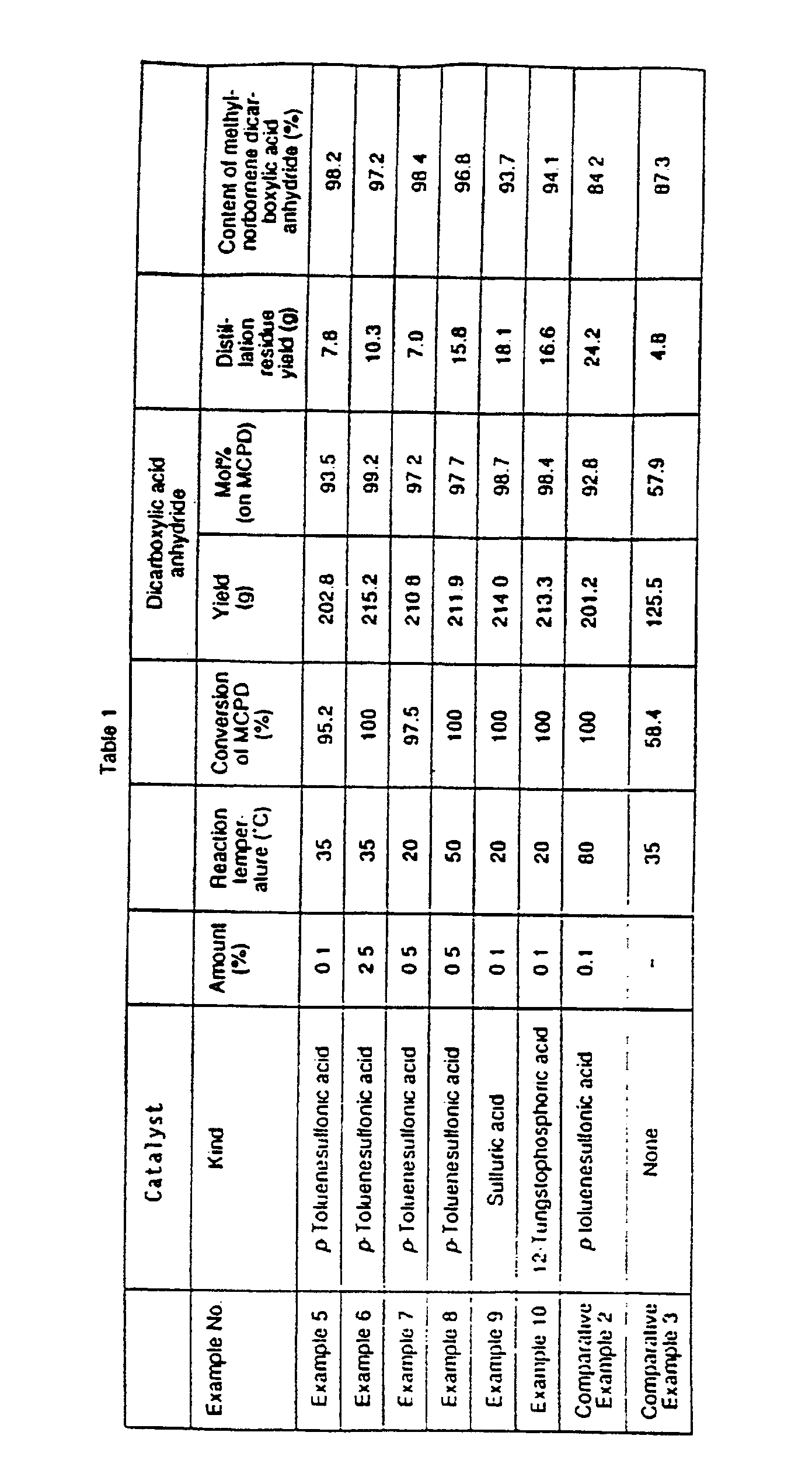
- Diels-Alder reaction was carried out in the same manner as in Example 1 except that change was made in the kind and amount of the protonic acid catalyst and the reaction temperature as shown in Table 1. The amount of the protonic acid catalyst is expressed in terms of wt.% based on 5-MCPD.
- The conversion of MCPD determined by gas chromatography, the amount of dicarboxylic acid anhydride in the distillate and the amount of distillation residues, and the content of methylnorbornene dicarboxylic acid anhydride in the distillate determined by gas chromatography are also shown in Table 1.
- Diels-Alder reaction was carried out in the same manner as in Example 1 except that the amount of maleic anhydride was changed to 58.9 g, which is equimolar with 5-MCPD contained in 1500 g of the raw material (2) shown below. Analysis of the reaction product by gas chromatography indicated that the conversion of 5-MCPD was 100%. On distillation of the reaction product to remove unreacted components and to separate dicarboxylic acid anhydride, there were obtained 104.5 g of light yellowish liquid (distillate) and 3.2 g of residues. The amount of the distillate corresponds to 97.7 mol% based on 5-MCPD. Analysis by gas chromatography indicated that the content of methylnorbornene dicarboxylic acid anhydride in the distillate was 96.9%.
-
- 5-MCPD
- 3.2 %
- 1,3-cyclohexadiene
- 1.1 %
- 1,3-hexadiene
- 0.2 %
- 2-ethyl-1,3-butadiene
- 0.5 %
- Benzene
- 61.0 %
- Toluene
- 26.0 %
- C₆₋₇ olefin, paraffin
- 8.0 %
Claims (5)
- A process for producing methylnorborene dicarboxylic anhydride by reacting a C₆-C₇ fraction which results from steam cracking of a hydrocarbon mixture, said C₆-C₇ fraction containing 5-methylcyclopentadiene, with maleic anhydride at a temperature of 0-50°C in the presence of a protonic acid whereby the 5-methylcyclopentadiene is isomerized to 1-methylcyclopentadiene and 2-methylcyclopentadiene or mixtures thereof.
- The process of claim 1 wherein said protonic acid is an aromatic sulfonic acid having a C₁ or C₂ alkyl substituent on the aromatic ring.
- The process of claim 1 wherein said C₆-C₇ fraction comprises about 0.7-2.0 wt.% 1-methylcyclopentadiene, 0.8-2.0 wt.% 2-methylcyclopentadiene, 1.5-1.0 wt.% 5-methylcyclopentadiene, 0.5-1.0 wt.% 1,3-cyclohexadiene, 0.2-1.0 wt.% 1,3-hexadiene, 0.3-1.0 wt.% 2-ethyl-1,3-butadiene, 4.5-8.5 wt.% C₆-C₇ olefins and paraffin, 45-60 wt.% benzene, and 20-40 wt.% toluene.
- The process of claim 1 wherein there is present about 0.01-5 wt.% of said protonic acid, based on the amount of 5-methylcyclopentadiene.
- The process of claim 1 wherein there is present 0.7-1.0 mol of maleic anhydride per mol of methylcyclopentadiene isomers.
Applications Claiming Priority (2)
| Application Number | Priority Date | Filing Date | Title |
|---|---|---|---|
| JP110586/90 | 1990-04-27 | ||
| JP2110586A JP2919907B2 (en) | 1990-04-27 | 1990-04-27 | Method for producing methyl norbornene dicarboxylic anhydride |
Publications (3)
| Publication Number | Publication Date |
|---|---|
| EP0455416A2 true EP0455416A2 (en) | 1991-11-06 |
| EP0455416A3 EP0455416A3 (en) | 1991-11-21 |
| EP0455416B1 EP0455416B1 (en) | 1995-03-15 |
Family
ID=14539609
Family Applications (1)
| Application Number | Title | Priority Date | Filing Date |
|---|---|---|---|
| EP91303720A Expired - Lifetime EP0455416B1 (en) | 1990-04-27 | 1991-04-25 | Process for producing methylnorbornene dicarboxylic acid anhydride |
Country Status (4)
| Country | Link |
|---|---|
| US (1) | US5149831A (en) |
| EP (1) | EP0455416B1 (en) |
| JP (1) | JP2919907B2 (en) |
| DE (1) | DE69108091T2 (en) |
Families Citing this family (4)
| Publication number | Priority date | Publication date | Assignee | Title |
|---|---|---|---|---|
| JP3012345B2 (en) * | 1991-01-17 | 2000-02-21 | 東燃株式会社 | 5- (2,4-dioxotetrahydro-3-furanylmethyl) norbornane-2,3-dicarboxylic anhydride and method for producing the same |
| JP3103628B2 (en) | 1991-11-05 | 2000-10-30 | 東燃株式会社 | Method for producing methyl norbornene dicarboxylic anhydride |
| CN104370863A (en) * | 2014-11-25 | 2015-02-25 | 南京工业大学 | Preparation method of exo-type nadic anhydride |
| KR102230283B1 (en) | 2017-02-20 | 2021-03-19 | 가부시키가이샤 후지킨 | Fluid controller abnormality detection device, abnormality detection system, abnormality detection method and fluid controller unit |
Family Cites Families (2)
| Publication number | Priority date | Publication date | Assignee | Title |
|---|---|---|---|---|
| US1944731A (en) * | 1927-11-05 | 1934-01-23 | Ig Farbenindustrie Ag | Organic compound having hydrogenated ring systems and process of preparing it |
| JP2775513B2 (en) | 1990-04-27 | 1998-07-16 | 東燃株式会社 | Method for isomerizing methylcyclopentadiene |
-
1990
- 1990-04-27 JP JP2110586A patent/JP2919907B2/en not_active Expired - Fee Related
-
1991
- 1991-03-19 US US07/671,574 patent/US5149831A/en not_active Expired - Lifetime
- 1991-04-25 EP EP91303720A patent/EP0455416B1/en not_active Expired - Lifetime
- 1991-04-25 DE DE69108091T patent/DE69108091T2/en not_active Expired - Fee Related
Non-Patent Citations (9)
| Title |
|---|
| CHEMICAL ABSTRACTS vol. 111, no. 15, 9 October 1989, page 711, abstract no. 133664B, Columbus, Ohio, US; I. MASARU et al.:"Highly heteroatom-dependent pi-facial stereoselectivity in the Diels-Alder reaction of 1,3-cyclopentadienes having a heteroatom substituent at 5-position" & Chem. Lett. 1989 no. 4, pages 663-666 * |
| CHEMICAL ABSTRACTS vol. 78, no. 25, 25 June 1973, page 367, abstract no. 159013p, Columbus, Ohio, US; V.A. MIRONOV et al.:"Cyclic unsaturated compounds. 46. Synthesis and thermal isomerization of 5,5-dimethyl-, 1,5,5-trimethyl- and 1,4,5,5-tetramethylcyclopentadienes."& Izv. Akad. Nauk SSSR, Ser. Khim. 1973,no. 2, pages 363-370 * |
| CHEMICAL ABSTRACTS vol. 78, no. 25, 25 June 1973, page 368, abstract no. 159015r, Columbus, Ohio, US; V.A. MIRONOV et al.:"Cyclic unsaturated compounds. 48. Synthesis and thermal transformations of mono- and di-sec-butylcyclopentadienes."& Izv.Akad. Nauk SSSR, Ser. Khim 1973, no. 2, pages 376-383 * |
| CHEMICAL ABSTRACTS vol. 95, no. 14, 5 October 1981, page 32, abstract no. 116404a, Columbus, Ohio, US; LANCHOW UNIVERSITY:"Studies on the synthesis, chemical structure and properties of MNA, a hardening agent for heat-resistant high-strength epoxy resins" &Lan-chou Ta Hsueh Hsueh Pao, Tzu Jan K'o Hsueh Pan 1981, no. 2, pages 65-73 * |
| CHEMICAL ABSTRACTS, vol. 111, no. 15, 09 October 1989 Columbus, Ohio, USA Ishida Masaru et al.: "Highly heteroatom-dependent pi-facial stereoselectivity in the Diels-Alder reaction of 1,3-cyclopentadienes ....." column 2; ref. no. 133664B * |
| CHEMICAL ABSTRACTS, vol. 68, no. 9, 26 February 1968 Columbus, Ohio, USA V.A.Mironov et al.: "Cyclic unsaturated compounds.XVIII.Mechanism of endo-exo isomerization of the adduct of cyclopentadiene & Izv.Akad .Nauk SSSR,Ser.Khim.1967[8],1697-703 page 3738; column 2; ref. no. 38640A EP 91303720030 * |
| CHEMICAL ABSTRACTS, vol. 78, no. 25, 25 June 1973 Columbus, Ohio, USA Mironov V.A. et al.: "Cyclic unsaturated compounds.46.Synthesis and thermal isomerization of 5,5-dimethyl-,1,5,5-trimethyl-and & Izv.Akad. Nauk SSSR,Ser.Khim.1973,[2],363-70 page 367; column 2; ref. no. 159013P EP 91303720030 * |
| CHEMICAL ABSTRACTS, vol. 78, no. 25, 25 June 1973 Columbus, Ohio, USA Mironov V.A. et al.: "Cyclic unsaturated compounds.48.Synthesis and thermal transformations ofmono- and & Izv.Akad.Nauk SSSR,Ser,Khim.1973,[2],376-83 page 368; column 1; ref. no. 159015R EP 91303720030 * |
| CHEMICAL ABSTRACTS, vol. 95, no. 14, 05 October 1981 Columbus, Ohio, USA Lanchow University: "Studies on the synthesis,chemical structure and properties of MNA,a hardening agent for heat-resistant &Lan-chou Ta Hsueh Hsueh Pao,Tzu Jan K'o Hsueh Pan 1981,[2],65-73. & Chemical EP 91303720030Abstracts vol.71,1969,Registry Number Index,page 1077N * |
Also Published As
| Publication number | Publication date |
|---|---|
| DE69108091D1 (en) | 1995-04-20 |
| DE69108091T2 (en) | 1995-07-20 |
| EP0455416B1 (en) | 1995-03-15 |
| EP0455416A3 (en) | 1991-11-21 |
| JP2919907B2 (en) | 1999-07-19 |
| JPH049376A (en) | 1992-01-14 |
| US5149831A (en) | 1992-09-22 |
Similar Documents
| Publication | Publication Date | Title |
|---|---|---|
| US3526674A (en) | Process for the dehydration of aralkanols | |
| US5382707A (en) | Integrated MTBE process | |
| US2631173A (en) | Production of cyclooctadiene | |
| AU609237B2 (en) | Process for the catalytic hydration of olefins | |
| EP0455416B1 (en) | Process for producing methylnorbornene dicarboxylic acid anhydride | |
| US5034561A (en) | Catalytic alkenylbenzene cyclization | |
| US4229320A (en) | Catalyst for making para-xylene | |
| EP0323270B1 (en) | Process for the catalytic hydration of olefins | |
| US4222800A (en) | Isomerization of endo-endo hexacyclic olefinic dimer of norbornadiene | |
| US4247726A (en) | Para-xylene process and catalyst | |
| JPS6136498B2 (en) | ||
| US4762962A (en) | Process for the isomerization of branched dienes | |
| Mravec et al. | Cyclohexylation of naphthalene over unmodified HY zeolites | |
| US3793393A (en) | Isomerization process with supported nickel oxide catalyst | |
| US3890402A (en) | Oligomerization process | |
| US3387051A (en) | Method of preparation of substituted aryl ethane compounds | |
| Mirzoyev | Interaction of phenol with 3-vinilcyclohexene a catalytic cycloalkenyl chlorination on a centinuosly operating unit | |
| US3151174A (en) | 1, 1-dimethyl tetrahydronaphthindans and process for preparing same | |
| US3996249A (en) | Isomerization process | |
| US2490276A (en) | Preparation of triptane structure compounds | |
| JP3103628B2 (en) | Method for producing methyl norbornene dicarboxylic anhydride | |
| US3956407A (en) | Alkenol production | |
| US3114776A (en) | Reaction of hydrogen sulfide with olefins | |
| US3255272A (en) | Olefin dimerization | |
| US2902523A (en) | Process for producing normally liquid olefinic hydrocarbons |
Legal Events
| Date | Code | Title | Description |
|---|---|---|---|
| PUAI | Public reference made under article 153(3) epc to a published international application that has entered the european phase |
Free format text: ORIGINAL CODE: 0009012 |
|
| PUAL | Search report despatched |
Free format text: ORIGINAL CODE: 0009013 |
|
| 17P | Request for examination filed |
Effective date: 19910515 |
|
| AK | Designated contracting states |
Kind code of ref document: A2 Designated state(s): DE FR GB NL |
|
| AK | Designated contracting states |
Kind code of ref document: A3 Designated state(s): DE FR GB NL |
|
| 17Q | First examination report despatched |
Effective date: 19940427 |
|
| GRAA | (expected) grant |
Free format text: ORIGINAL CODE: 0009210 |
|
| AK | Designated contracting states |
Kind code of ref document: B1 Designated state(s): DE FR GB NL |
|
| REF | Corresponds to: |
Ref document number: 69108091 Country of ref document: DE Date of ref document: 19950420 |
|
| ET | Fr: translation filed | ||
| PLBE | No opposition filed within time limit |
Free format text: ORIGINAL CODE: 0009261 |
|
| STAA | Information on the status of an ep patent application or granted ep patent |
Free format text: STATUS: NO OPPOSITION FILED WITHIN TIME LIMIT |
|
| 26N | No opposition filed | ||
| REG | Reference to a national code |
Ref country code: GB Ref legal event code: IF02 |
|
| PGFP | Annual fee paid to national office [announced via postgrant information from national office to epo] |
Ref country code: GB Payment date: 20070313 Year of fee payment: 17 |
|
| PGFP | Annual fee paid to national office [announced via postgrant information from national office to epo] |
Ref country code: NL Payment date: 20070315 Year of fee payment: 17 |
|
| PGFP | Annual fee paid to national office [announced via postgrant information from national office to epo] |
Ref country code: DE Payment date: 20070430 Year of fee payment: 17 |
|
| PGFP | Annual fee paid to national office [announced via postgrant information from national office to epo] |
Ref country code: FR Payment date: 20070404 Year of fee payment: 17 |
|
| GBPC | Gb: european patent ceased through non-payment of renewal fee |
Effective date: 20080425 |
|
| NLV4 | Nl: lapsed or anulled due to non-payment of the annual fee |
Effective date: 20081101 |
|
| PG25 | Lapsed in a contracting state [announced via postgrant information from national office to epo] |
Ref country code: NL Free format text: LAPSE BECAUSE OF NON-PAYMENT OF DUE FEES Effective date: 20081101 Ref country code: DE Free format text: LAPSE BECAUSE OF NON-PAYMENT OF DUE FEES Effective date: 20081101 |
|
| REG | Reference to a national code |
Ref country code: FR Ref legal event code: ST Effective date: 20081231 |
|
| PG25 | Lapsed in a contracting state [announced via postgrant information from national office to epo] |
Ref country code: FR Free format text: LAPSE BECAUSE OF NON-PAYMENT OF DUE FEES Effective date: 20080430 |
|
| PG25 | Lapsed in a contracting state [announced via postgrant information from national office to epo] |
Ref country code: GB Free format text: LAPSE BECAUSE OF NON-PAYMENT OF DUE FEES Effective date: 20080425 |