EP0455529A1 - Procédé de fabrication d'oxalates doubles de terres rares et d'ammonium et leurs utilisations pour la fabrication d'oxydes de terres rares, oxalates doubles et oxydes obtenus - Google Patents
Procédé de fabrication d'oxalates doubles de terres rares et d'ammonium et leurs utilisations pour la fabrication d'oxydes de terres rares, oxalates doubles et oxydes obtenus Download PDFInfo
- Publication number
- EP0455529A1 EP0455529A1 EP91400979A EP91400979A EP0455529A1 EP 0455529 A1 EP0455529 A1 EP 0455529A1 EP 91400979 A EP91400979 A EP 91400979A EP 91400979 A EP91400979 A EP 91400979A EP 0455529 A1 EP0455529 A1 EP 0455529A1
- Authority
- EP
- European Patent Office
- Prior art keywords
- solution
- ammonium
- oxalate
- rare earth
- nitrate
- Prior art date
- Legal status (The legal status is an assumption and is not a legal conclusion. Google has not performed a legal analysis and makes no representation as to the accuracy of the status listed.)
- Granted
Links
Images
Classifications
-
- C—CHEMISTRY; METALLURGY
- C01—INORGANIC CHEMISTRY
- C01F—COMPOUNDS OF THE METALS BERYLLIUM, MAGNESIUM, ALUMINIUM, CALCIUM, STRONTIUM, BARIUM, RADIUM, THORIUM, OR OF THE RARE-EARTH METALS
- C01F17/00—Compounds of rare earth metals
- C01F17/20—Compounds containing only rare earth metals as the metal element
-
- C—CHEMISTRY; METALLURGY
- C07—ORGANIC CHEMISTRY
- C07C—ACYCLIC OR CARBOCYCLIC COMPOUNDS
- C07C51/00—Preparation of carboxylic acids or their salts, halides or anhydrides
- C07C51/41—Preparation of salts of carboxylic acids
- C07C51/412—Preparation of salts of carboxylic acids by conversion of the acids, their salts, esters or anhydrides with the same carboxylic acid part
-
- C—CHEMISTRY; METALLURGY
- C01—INORGANIC CHEMISTRY
- C01F—COMPOUNDS OF THE METALS BERYLLIUM, MAGNESIUM, ALUMINIUM, CALCIUM, STRONTIUM, BARIUM, RADIUM, THORIUM, OR OF THE RARE-EARTH METALS
- C01F17/00—Compounds of rare earth metals
- C01F17/20—Compounds containing only rare earth metals as the metal element
- C01F17/206—Compounds containing only rare earth metals as the metal element oxide or hydroxide being the only anion
-
- C—CHEMISTRY; METALLURGY
- C01—INORGANIC CHEMISTRY
- C01F—COMPOUNDS OF THE METALS BERYLLIUM, MAGNESIUM, ALUMINIUM, CALCIUM, STRONTIUM, BARIUM, RADIUM, THORIUM, OR OF THE RARE-EARTH METALS
- C01F17/00—Compounds of rare earth metals
- C01F17/20—Compounds containing only rare earth metals as the metal element
- C01F17/206—Compounds containing only rare earth metals as the metal element oxide or hydroxide being the only anion
- C01F17/218—Yttrium oxides or hydroxides
-
- C—CHEMISTRY; METALLURGY
- C01—INORGANIC CHEMISTRY
- C01F—COMPOUNDS OF THE METALS BERYLLIUM, MAGNESIUM, ALUMINIUM, CALCIUM, STRONTIUM, BARIUM, RADIUM, THORIUM, OR OF THE RARE-EARTH METALS
- C01F17/00—Compounds of rare earth metals
- C01F17/20—Compounds containing only rare earth metals as the metal element
- C01F17/206—Compounds containing only rare earth metals as the metal element oxide or hydroxide being the only anion
- C01F17/224—Oxides or hydroxides of lanthanides
- C01F17/229—Lanthanum oxides or hydroxides
-
- C—CHEMISTRY; METALLURGY
- C01—INORGANIC CHEMISTRY
- C01F—COMPOUNDS OF THE METALS BERYLLIUM, MAGNESIUM, ALUMINIUM, CALCIUM, STRONTIUM, BARIUM, RADIUM, THORIUM, OR OF THE RARE-EARTH METALS
- C01F17/00—Compounds of rare earth metals
- C01F17/20—Compounds containing only rare earth metals as the metal element
- C01F17/206—Compounds containing only rare earth metals as the metal element oxide or hydroxide being the only anion
- C01F17/241—Compounds containing only rare earth metals as the metal element oxide or hydroxide being the only anion containing two or more rare earth metals, e.g. NdPrO3 or LaNdPrO3
-
- C—CHEMISTRY; METALLURGY
- C01—INORGANIC CHEMISTRY
- C01P—INDEXING SCHEME RELATING TO STRUCTURAL AND PHYSICAL ASPECTS OF SOLID INORGANIC COMPOUNDS
- C01P2004/00—Particle morphology
-
- C—CHEMISTRY; METALLURGY
- C01—INORGANIC CHEMISTRY
- C01P—INDEXING SCHEME RELATING TO STRUCTURAL AND PHYSICAL ASPECTS OF SOLID INORGANIC COMPOUNDS
- C01P2004/00—Particle morphology
- C01P2004/50—Agglomerated particles
-
- C—CHEMISTRY; METALLURGY
- C01—INORGANIC CHEMISTRY
- C01P—INDEXING SCHEME RELATING TO STRUCTURAL AND PHYSICAL ASPECTS OF SOLID INORGANIC COMPOUNDS
- C01P2004/00—Particle morphology
- C01P2004/60—Particles characterised by their size
- C01P2004/61—Micrometer sized, i.e. from 1-100 micrometer
-
- C—CHEMISTRY; METALLURGY
- C01—INORGANIC CHEMISTRY
- C01P—INDEXING SCHEME RELATING TO STRUCTURAL AND PHYSICAL ASPECTS OF SOLID INORGANIC COMPOUNDS
- C01P2004/00—Particle morphology
- C01P2004/60—Particles characterised by their size
- C01P2004/62—Submicrometer sized, i.e. from 0.1-1 micrometer
-
- C—CHEMISTRY; METALLURGY
- C01—INORGANIC CHEMISTRY
- C01P—INDEXING SCHEME RELATING TO STRUCTURAL AND PHYSICAL ASPECTS OF SOLID INORGANIC COMPOUNDS
- C01P2006/00—Physical properties of inorganic compounds
- C01P2006/21—Attrition-index or crushing strength of granulates
Definitions
- the present invention relates to a process for the production of double rare earth oxalates and ammonium, their use for obtaining rare earth oxide and the products obtained.
- It relates more particularly to a process making it possible to obtain double oxalates having a determined morphology and particle size.
- Rare earth oxides find many applications in the field of ceramics and electronics in particular, but at the present time, there is an increasing demand on the market for products with controlled particle size.
- JP 53 095911-A (Chemical Abstracts 90 , 40940 w) to prepare fine rare earth oxides and more particularly of fine yttrium oxide by calcination of an yttrium and ammonium oxalate which consists in starting from an aqueous solution of a yttrium salt, in precipitating the yttrium in the form of its hydroxide prepared by reaction of the aqueous solution of a yttrium salt and of a basic aqueous solution such as the ammonia then to treat the resulting hydroxide slurry with oxalic acid, and finally to separate the precipitate obtained, to wash it and to calcine it at a temperature of 750 ° C.
- Said process leads, in accordance with the description given in JP 53-095911-A, to obtaining fine yttrium oxide.
- the particle diameter is included between 0.9 and 4.5 ⁇ m, the crystals having the shape of platelets with rounded edges.
- the particle size is still relatively large compared to the dimensions required for certain applications such as luminescence.
- controlling the size of the particles is relatively difficult since the conditions for carrying out the process have a strong influence on it.
- One of the aims of the present invention is in particular to remedy these drawbacks by proposing a process for the production of double ammonium oxalates and of rare earths having a narrow particle size distribution, with average dimensions of the crystals possibly being less than one micron.
- the rare earth compound is advantageously a soluble compound such as a rare earth salt.
- salts suitable for the invention there may be mentioned, by way of example, chlorides, nitrates, sulfates or acetates of scandium, yttrium, lanthanum, cerium, praseodymium, neodymium, samarium, d europium, gadolinium, terbium, dysprosium, Hofnium, erbium, thulium, ytterbium, lutetium or a mixture of these.
- it is possible to use an aqueous solution containing rare earth salts which would come directly or indirectly from the processing of rare earth minerals.
- ceric rare earths means the lightest elements of the rare earths starting with lanthanum and extending to the neodymium in accordance with the atomic number and the “httrique rare earths” denote the heaviest elements of the rare earths according to the atomic number, starting with the samarium and ending with the lutetium and including the yttrium.
- the concentration of rare earth compound is not critical.
- This second solution is an aqueous solution whose pH can be adjusted to a determined value or in a determined zone by adding buffer solution or acids, if necessary.
- this second solution essentially contains one or more rare earth compounds.
- acids As acids, mention may be made of mineral acids such as nitric acid.
- the first solution contains ammonium and oxalate ions provided in the form of one or more salts containing these two species such as, for example, ammonium oxalate or ammonium acid oxalate, or by a mixture of compounds providing each one of the two ammonium or oxalate species.
- ammonium and oxalate ions provided in the form of one or more salts containing these two species such as, for example, ammonium oxalate or ammonium acid oxalate, or by a mixture of compounds providing each one of the two ammonium or oxalate species.
- ammonium salts such as nitrate, ammonium chloride or even ammonia in the form of a gas or in solution for the addition of the ammonium ion.
- oxalate species mention may be made of the various metal oxalates such as sodium oxalate for example, and preferably oxalic acid.
- the first solution is an ammonium oxalate solution.
- the first solution is a solution of ammonium oxalate and oxalic acid.
- This first solution can also comprise a mineral acid (HA) such as nitric acid, for example.
- HA mineral acid
- This acid can be added to an ammonium oxalate solution or released in situ by adding oxalic acid to a solution of ammonium salts, for example ammonium nitrate.
- the quantity of HA acid used is determined to obtain a molar ratio of the anion A- of said acid relative to the total quantity of oxalate less than 5.
- the conditions for implementing the process are not very critical for obtaining a double oxalate.
- controlling the speed of introduction of the second solution, the temperature, the stirring of the mixture makes it possible to modify and control the morphology of the double precipitated oxalate.
- the temperature has an influence on the yield of precipitation because the coefficient of solubility of the double oxalate increases with the rise in temperature.
- the precipitate obtained is separated from the supernatant liquid by any solid / liquid separation process such as, for example, filtration, decantation centrifugation or the like. It can also be subjected to one or more washes, for example to remove the soluble salts.
- the double rare earth and ammonium oxalate can be dried to evaporate unbound water, for example by heat treatment between 50 ° C and 100 ° C or drying under reduced pressure.
- the double rare earth and ammonium oxalate obtained by the process of the invention consists of particles whose shape and dimensions depend on the nature and the pH of the solutions as well as the temperature, stirring and speed conditions. during the mixing of the solutions.
- the product obtained consists of particles in the form of thin platelets (thickness equal to about 0.3 ⁇ m) and of average size between 0, 5 ⁇ m and 3 ⁇ m, preferably between 0.5 ⁇ m and 1 ⁇ m.
- the average particle size varies between 1 ⁇ m and 5 ⁇ m. These particles are substantially cubic in shape.
- the process of the invention makes it possible to produce a double oxalate of rare earths and of ammonium having a homogeneous particle size.
- the particle size distribution of the crystals is very tight.
- the coefficient of dispersion of the crystal sizes is generally less than 0.7, advantageously between 0.2 and 0.6.
- dispersion coefficient is meant the ratio 0 ⁇ 84 - 0 ⁇ 16 20 ⁇ 50 in which 0 ⁇ 84 0 ⁇ 16 0 ⁇ 50 represent the diameters of the particles corresponding to 84%, 16% and 50% of these.
- the morphology and particle size of the rare earth oxides obtained by decomposition of a double oxalate is generally similar to that of said double oxalate used as a precursor. However, depending on the heat treatment conditions of the double oxalate, the particle size of the oxide may be slightly different from that of the oxalate.
- the heat treatment or calcination is generally carried out at a temperature between 600 and 1200 ° C, advantageously between 800 ° C and 1000 ° C.
- the calcination time is conventionally determined by constant weight control. As an indication, the duration of the calcination can vary between 30 minutes and 6 hours approximately.
- a solution of yttrium nitrate at 170 g / l expressed as Y2O3 is added to an ammonium oxalate solution of variable concentration less than 0.9 M.
- the particles have a fairly irregular contour shape.
- This series of examples is carried out with a second solution of yttrium nitrate identical to the first series, but with a first solution containing a mixture of (NH4) 2C2O4 and H2C2O4;
- the results and relationships between the different species used are collated in Table II.
- the Y concentration in the reaction medium is 17 g / l of Y2O3.
- the double oxalate crystals obtained are in the form of a wafer with a thickness of approximately 0.3 ⁇ m and of average dimensions 0.7 and 1 ⁇ m.
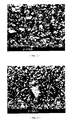
- the morphologies of the oxalate and of the calcined oxide are illustrated respectively in FIGS. 1 and 2.
- a solution of yttrium nitrate containing 150 g / l expressed as Y2O3 and 0.8 mol / l of nitric acid is added in a solution of ammonium oxalate at 25 g / l.
- the quantity of solution engaged is determined to obtain a ratio between the ammonium oxalate and the rare earth salt 10% higher than the stoichiometric ratio.
- an yttrium oxide of D50 equal to 2 ⁇ m is obtained with a particle size dispersion index (F) of 0.5.
- Example IV is reproduced. However, the yttrium nitrate solution does not contain nitric acid, but on the contrary, the ammonium oxalate solution contains 0.2 mol / l of HNO3.
- the yttrium oxide obtained after calcination of the ammonium oxalate and of yttrium has a D50 of 2.3 ⁇ m with a particle size dispersion index equal to 0.45.
- Example 1 is reproduced but using a solution of soluble rare earth salts at 170 g / l in TR2O3, of which 148 g / l (Y2O3) of yttrium nitrate and 22 g / l (La2O3) of lanthanum nitrate.
- the precipitation solution contains 25 g / l of ammonium oxalate.
- the quantities of solutions used are determined to have a NH4 / TR molar ratio equal to 4.
- the precipitate obtained is a double lanthanum and ammonium yttrium oxalate.
- a double ammonium oxalate is prepared by continuously mixing a solution of yttrium nitrate at 170 g / l (expressed as Y2O3) with a solution of ammonium oxalate at 25 g / l.
- the NH4 / Y ratio is 4.75 and the final Y2O3 concentration is 16 g / l.
- the precipitate recovered after separation and washing is a double yttrium and ammonium oxalate having an average particle diameter equal to 1.4 ⁇ m with a particle size dispersion coefficient (F) equal to 0.4.
Landscapes
- Chemical & Material Sciences (AREA)
- Organic Chemistry (AREA)
- Life Sciences & Earth Sciences (AREA)
- Geology (AREA)
- Inorganic Chemistry (AREA)
- Engineering & Computer Science (AREA)
- Oil, Petroleum & Natural Gas (AREA)
- Compounds Of Alkaline-Earth Elements, Aluminum Or Rare-Earth Metals (AREA)
- Organic Low-Molecular-Weight Compounds And Preparation Thereof (AREA)
- Preparation Of Compounds By Using Micro-Organisms (AREA)
- Television Signal Processing For Recording (AREA)
- Medicines Containing Antibodies Or Antigens For Use As Internal Diagnostic Agents (AREA)
Abstract
Description
- La présente invention concerne un procédé de fabrication d'oxalates doubles de terres rares et d'ammonium, leur utilisation pour l'obtention d'oxyde de terres rares et les produits obtenus.
- Elle se rapporte plus particulièrement à un procédé permettant d'obtenir des oxalates doubles présentant une morphologie et granulométrie déterminées.
- Les oxydes de terres rares trouvent de nombreuses applications dans le domaine notamment de la céramique et de l'électronique mais à l'heure actuelle, on constate sur le marché une demande croissante de produits à granulométrie contrôlée.
- Une des voies classiques pour obtenir des oxydes de terres rares et qui est largement décrite dans la littérature, notamment dans le NOUVEAU TRAITE DE CHIMIE MINERALE, Tome VII, (1959), P. 1007 de Paul PASCAL, consiste à calciner entre 500 et 900°C les oxalates de terres rares obtenus par précipitation à l'aide de l'acide oxalique, des sels de terres rares sous forme de solution aqueuse. Cependant, un tel procédé de fabrication ne conduit qu'à des oxydes de terres rares présentant une grosse granulométrie.
- Il est également connu selon JP 53 095911-A (Chemical Abstracts 90, 40940 w) de préparer des oxydes de terres rares fins et plus particulièrement de l'oxyde d'yttrium fin par calcination d'un oxalate d'yttrium et d'ammonium qui consiste à partir d'une solution aqueuse d'un sel d'yttrium, à précipiter l'yttrium sous la forme de son hydroxyde préparé par réaction de la solution aqueuse d'un sel d'yttrium et d'une solution aqueuse basique comme l'ammoniaque puis à traiter la bouillie d'hydroxyde résultante par l'acide oxalique, et enfin à séparer le précipité obtenu, à le laver et à le calciner à une température de 750°C. Ledit procédé conduit conformément à la description donnée dans JP 53-095911-A à l'obtention d'oxyde d'yttrium fin. Le diamètre des particules est compris entre 0,9 et 4,5 µm, les cristaux ayant une forme de plaquettes à bords arrondis.
- Toutefois, la dimension des particules est encore relativement élevée par rapport aux dimensions requises pour certaines applications comme la luminescence. En outre, le contrôle de la dimension des particules est relativement difficile car les conditions de mise en oeuvre du procédé influent fortement sur celle-ci.
- Un des buts de la présente invention est notamment de remédier à ces inconvénients en proposant un procédé de fabrication d'oxalates doubles d'ammonium et de terres rares présentant une distribution granulométrique resserrée, avec des dimensions moyennes des cristaux pouvant être inférieures au micron.
- Par oxalate double de terres rares et d'ammonium, il faut comprendre un composé comprenant une ou plusieurs terres rares permettant après calcination de produire des oxydes simples ou mixtes.
- A cet effet, l'invention propose un procédé de fabrication d'un oxalate double de terres rares et d'ammonium caractérisé en ce qu'il consiste :
- à ajouter dans une première solution contenant des ions oxalate et d'ammonium, une seconde solution contenant un composé de terres rares
- à séparer le précipité obtenu
- et, éventuellement le sécher.
- Selon une caractéristique de l'invention, le composé de terres rares est avantageusement un composé soluble comme un sel de terres rares.
- Parmi les sels convenables pour l'invention, on peut citer à titre d'exemple les chlorures, les nitrates, les sulfates ou acétates de scandium, d'yttrium, de lanthane, de cérium, de praséodyme, de néodyme, de samarium, d'europium, de gadolinium, de terbium, de dysprosium, d'hofnium, d'erbium, de thulium, d'ytterbium, de lutécium ou un mélange de ceux-ci. En particulier, on peut mettre en oeuvre une solution aqueuse contenant des sels de terres rares qui proviendrait directement ou indirectement du traitement des minerais de terres rares.
- Bien que le procédé de l'invention s'applique tout-à-fait bien aux terres rares cériques, il convient plus particulièrement aux terres rares yttriques.
- On entend par "terres rares cériques", les éléments les plus légers des terres rares commençant avec le lanthane et s'étendant jusqu'au néodyme conformément au numéro atomique et l'on désigne par "terres rares yttriques" les éléments les plus lourds des terres rares conformément au numéro atomique, commençant avec le samarium et finissant avec le lutécium et comprenant l'yttrium.
- La concentration en composé de terres rares n'est pas critique.
- Cette seconde solution est une solution aqueuse dont le pH peut être ajusté à une valeur déterminée ou dans une zone déterminée par addition de solution tampon ou d'acides, si cela est nécessaire. Généralement cette seconde solution contient essentiellement un ou plusieurs composés de terres rares.
- Comme acides, on peut citer les acides minéraux tels que l'acide nitrique.
- La première solution contient des ions ammonium et oxalate apportés sous forme d'un ou plusieurs sels contenant ces deux espèces tel que, par exemple, l'oxalate d'ammonium ou l'oxalate acide d'ammonium, ou par un mélange de composés apportant chacun une des deux espèces ammonium ou oxalate. Ainsi, on peut citer à titre d'exemple, les différents sels d'ammonium comme le nitrate, le chlorure d'ammonium ou même l'ammoniac sous forme de gaz ou en solution pour l'addition de l'ion ammonium.
- Quant à l'espèce oxalate, on peut citer les différents oxalates métalliques comme l'oxalate de sodium par exemple, et de manière préférée l'acide oxalique.
- La concentration en ions (C₂O₄)= et NH₄⁺ dans la solution n'est pas critique et peut varier dans de larges limites.
- Selon un mode de réalisation préféré, on déterminera les concentrations en oxalate et ammonium ainsi que la concentration en terre rare dans la seconde solution et les volumes des première et seconde solution pour obtenir en fin d'addition de la seconde solution un rapport molaire entre l'ion oxalate et les terres rares ((C₂O₄)=/TR) supérieur ou égal à 2, avantageusement supérieur à 2,5 et un rapport ammonium à terres rares (NH₄⁺/TR) supérieur ou égal à 2, de préférence supérieur à 2,5.
- Dans un mode de réalisation de l'invention, la première solution est une solution d'oxalate d'ammonium.
- Selon un autre mode de réalisation de l'invention, la première solution est une solution d'oxalate d'ammonium et d'acide oxalique. Avantageusement, le rapport molaire (C₂O₄)=/NH₄⁺ est supérieur à 2 et compris entre 2 et 4.
- Selon un autre mode de réalisation de l'invention, la première solution est une solution d'oxalate d'ammonium et d'ammoniac, le rapport C₂O₄=/NH₄⁺ doit être supérieur à 0, et est alors avantageusement compris entre 0,4 et 2.
- Cette première solution peut également comprendre un acide minéral (HA) tel que l'acide nitrique, par exemple. Cet acide pouvant être ajouté à une solution d'oxalate d'ammonium ou libéré in situ par additiond'acide oxalique à une solution de sels d'ammonium, par exemple de nitrate d'ammonium.
- Quand un acide minéral HA est présent dans la première ou seconde solution, la quantité d'acide HA engagée est déterminée pour obtenir un rapport molaire de l'anion A- dudit acide par rapport à la quantité totale d'oxalate inférieur à 5.
- Les conditions de mise en oeuvre du procédé sont peu critiques pour obtenir un oxalate double. Toutefois, le contrôle de la vitesse d'introduction de la seconde solution, de la température, de l'agitation du mélange permet de modifier et contrôler la morphologie de l'oxalate double précipité.
- Il est également possible de mettre en oeuvre le procédé de l'invention de manière continue par mélange en continu des première et seconde solutions décrites ci-dessous.
- Par ailleurs, la température a une influence sur le rendement de la précipitation car le coefficient de solubilité de l'oxalate double augmente avec l'élévation de la température.
- Le précipité obtenu est séparé du liquide surnageant par tout procédé de séparation solide/liquide comme par exemple, filtration, centrifugation décantation ou analogue. Il peut également être soumis à un ou plusieurs lavages, pour, par exemple, éliminer les sels solubles.
- L'oxalate double de terres rares et d'ammonium peut subir un séchage pour évaporer l'eau non lié par exemple par un traitement thermique entre 50°C et 100°C ou un séchage sous pression réduite.
- L'oxalate double de terres rares et d'ammonium obtenu par le procédé de l'invention est constitué de particules dont la forme et les dimensions dépendent de la nature et du pH des solutions ainsi que des conditions de température, d'agitation et vitesse d'introduction pendant le mélange des solutions.
- Ainsi, dans le cas où la première solution est une solution d'oxalated'ammonium, le produit obtenu est constitué de particules sous forme de plaquettes de faible épaisseur (épaisseur égale à environ 0,3 µm) et de dimension moyenne comprise entre 0,5 µm et 3 µm, avantageusement entre 0,5 µm et 1 µm.
- Dans le cas où la première solution est une solution d'un mélange d'acide oxalique et d'ammoniaque ou d'un autre composé d'ammonium à l'exception de l'oxalate d'ammonium, la dimension moyenne des particules varie entre 1 µm et 5 µm. Ces particules sont de forme sensiblement cubique.
- Le procédé de l'invention permet de produire un oxalate double de terres rares et d'ammonium présentant une granulométrie homogène. Ainsi, la répartition granulométrique des cristaux est très resserrée. Le coefficient de dispersion des tailles des cristaux est généralement inférieur à 0,7, avantageusement compris entre 0,2 et 0,6.
- Par coefficient de dispersion on entend le rapport

- Une des utilisations de ces oxalates doubles de terres rares et d'ammonium est la production d'oxyde de terres rares obtenues par décomposition thermique de ceux-ci.
- La morphologie et granulométrie des oxydes de terres rares obtenus par décomposition d'un oxalate double est généralement semblable à celle dudit oxalate double utilisé comme précurseur. Toutefois, selon les conditions de traitement thermique de l'oxalate double, la granulométrie de l'oxyde peut être légèrement différente de celle de l'oxalate.
- Le traitement thermique ou calcination est généralement réalisée à une température comprise entre 600 et 1200°C, avantageusement entre 800°C et 1000°C.
- La durée de calcination est déterminée de manière classique par le contrôle du poids constant. A titre indicatif, la durée de la calcination peut varier entre 30 minutes et 6 heures environ.
- L'invention sera illustrée par des exemples donnés ci-dessous uniquement à titre indicatif.
- On ajoute une solution de nitrate d'yttrium à 170 g/l exprimé en Y₂O₃ dans une solution d'oxalate d'ammonium de concentration variable inférieure à 0,9 M.
- Les différents essais réalisés sont rassemblés dans le tableau 1 ci-dessous.
- La taille et la répartition granulométrique des produits obtenus sont déterminées à l'aide de l'instrument SEDIGRAPH 5000D qui détermine le taux de sédimentation des particules en suspension et détermine la distribution granulométrique en pourcentages cumulatifs en fonction des diamètres équivalents sphériques. Cette détermination est basée sur la loi de STOKE.

- avec [Y]
- : concentration totale en yttrium dans le milieu réactionnel exprimée en Y₂O₃
- D ₅₀
- : dimension moyenne de l'oxyde de terre rare obtenu par calcination de l'oxalate double (900°C pendant 1 heure).
- Les particules ont une forme de plaquette à contours assez irrégulier.
- Cette série d'exemples est réalisée avec une seconde solution de nitrate d'yttrium identique à la première série, mais avec une première solution contenant un mélange de (NH₄)₂C₂O₄ et H₂C₂O₄;
- Les résultats et rapports entre les différentes espèces mises en oeuvre sont rassemblés dans le tableau II. La concentration en Y dans le milieu réactionnel est de 17 g/l en Y₂O₃.

- Les cristaux d'oxalate double obtenus sont sous forme de plaquette d'épaisseur 0,3 µm environ et de dimensions moyennes 0,7 et 1 µm. Les morphologies de l'oxalate et de l'oxyde calciné sont illustrées respectivement dans les figures 1 et 2.
- Exemples identiques à ceux de la série II, mais avec une première solution qui comprend de l'ammoniaque et de l'acide oxalique.
- Les résultats et rapports entre les différentes espèces sont donnés dans le tableau III (concentration finale en Yttrium : 17 g/l en Y₂O₃)

- On ajoute une solution de nitrate d'yttrium contenant 150 g/l exprimé en Y₂O₃ et 0,8 mole/l d'acide nitrique dans une solution d'oxalate d'ammonium à 25 g/l. La quantité de solution engagée est déterminée pour obtenir un rapport entre l'oxalate d'ammonium et le sel de terre rare supérieur de 10 % au rapport stoechiométrique.
- Après séparation, séchage et calcination de l'oxalate d'ammonium et d'yttrium, on obtient un oxyde d'yttrium de D₅₀ égal à 2 µm avec un indice de dispersion granulométrique (F) de 0,5.
- On reproduit l'exemple IV. Toutefois, la solution de nitrate d'yttrium ne contient pas d'acide nitrique, mais au contraire, la solution d'oxalate d'ammonium contient 0,2 mole/l de HNO₃.
- L'oxyde d'yttrium obtenu après calcination de l'oxalate d'ammonium et d'yttrium présente un D₅₀ de 2,3 µm avec un indice de dispersion granulométrique égal à 0,45.
- L'exemple 1 est reproduit mais en utilisant une solution de sels solubles de terres rares à 170 g/l en TR₂O₃ dont 148 g/l (Y₂O₃) de nitrate d'yttrium et 22 g/l (La₂O₃) de nitrate de lanthane.
- La solution de précipitation contient 25 g/l d'oxalate d'ammonium.
- Les quantités de solutions engagées sont déterminées pour avoir un rapport molaire NH₄/TR égale à 4.
- Le précipité obtenu est un oxalate double d'yttrium de lanthane et d'ammonium.
- Après calcination à 900°C, on obtient un oxyde mixte de lanthane et d'yttrium contenant 12,6 % de La₂O₃ et dont les caractéristiques sont indiquées dans le tableau ci-dessous.

- On prépare un oxalate double d'ammonium par mélange en continu d'une solution de nitrate d'yttrium à 170 g/l (exprimé en Y₂O₃) avec une solution d'oxalate d'ammonium à 25 g/l.
- Ainsi, le rapport NH₄/Y est de 4,75 et la concentration finale en Y₂O₃ est de 16 g/l.
- Le précipité récupéré après séparation et lavage est un oxalate double d'yttrium et d'ammonium présentant un diamètre moyen des particules égal à 1,4 µm avec un coefficient de dispersion granulométrique (F) égal à 0,4.
Claims (18)
- Procédé de fabrication d'un oxalate double de terres rares et d'ammonium caractérisé en ce qu'il consiste :- à ajouter dans une première solution contenant des ions oxalate et d'ammonium, une seconde solution contenant un composé de terres rares- à séparer le précipité obtenu- et, éventuellement le sécher.
- Procédé selon la revendication 1 caractérisé en ce que la première solution est une solution d'oxalate d'ammonium.
- Procédé selon la revendication 1 caractérisé en ce que la première solution est une solution d'acide oxalique et d'un composé d'ammonium.
- Procédé selon la revendication 3, caractérisé en ce que le composé d'ammonium est choisi dans le groupe comprenant l'ammoniaque, l'oxalate d'ammonium, un sel d'ammonium et d'acide minéral ou un mélange de ceux-ci.
- Procédé selon la revendication 4 caractérisé en ce que le sel d'ammonium est un nitrate ou un chlorure d'ammonium.
- Procédé selon les revendications 2 à 5, caractérisé en ce que la première solution contient un acide minéral (HA).
- Procédé selon l'une des revendications précédentes, caractérisé en ce que la seconde solution contient un sel soluble de terres rares choisi dans le groupe des nitrates, chlorures, sulfates ou un mélange de sels de terres rares.
- Procédé selon l'une des revendications 1 à 7, caractérisé en ce que la seconde solution comprend un acide minéral (HA)
- Procédé selon la revendication 7 ou 8 caractérisé en ce que la seconde solution est une solution de nitrate d'yttrium, nitrate d'europium, nitrate de lanthane, nitrate de néodyme, nitrate de dysprosium, cérium, gadolinium, terbium ou un mélange de ceux-ci.
- Procédé selon l'une des revendications précédentes, caractérisé en ce que le rapport molaire C₂O₄=/TR et NH₄⁺/TR à la fin de la précipitation est supérieur à 2, de préférence supérieur à 2,5.
- Procédé selon l'une des revendications précédentes caractérisé en ce que dans la première solution, le rapport molaire (C₂O₄)=/NH₄⁺ est inférieur à 4 et supérieur à 0.
- Procédé selon la revendication 6 ou 8 caractérisé en ce que la quantité d'acide minéral (HA) dans la première solution ou la seconde solution est déterminée pour avoir un rapport entre l'anion A- et les ions oxalates inférieur à 5 dans le milieu réactionnel après mélange.
- Procédé selon l'une des revendications précédentes, caractérisé en ce qu'il consiste à ajouter la seconde solution contenant les sels de terres rares dans la première solution contenant les ions ammonium et oxalate.
- Procédé selon l'une des revendications 1 à 12, caractérisé en ce qu'il consiste à mélanger en continu la première et la seconde solution.
- Procédé de fabrication d'oxyde de terres rares, caractérisé en ce qu'il consiste à calciner l'oxalate double d'ammonium et de terre rare obtenu selon l'une des revendications précédentes, après un séchage éventuel.
- Procédé selon la revendication 15 caractérisé en ce que la température de calcination est comprise entre 600 et 1200°C, de préférence entre 800°C et 1000°C.
- Oxalate double d'ammonium et de terre rare caractérisé en ce qu'il est cristallisé sous forme de plaquette de dimension moyenne comprise entre 0,5 µm et 3 µm avec un coefficient de dispersion granulométrique inférieur à 0,7.
- Oxyde de terres rares caractérisé en ce qu'il est constitué par des particules en forme de plaquette de dimension moyenne comprise entre 0,5 µm et 3 µm avec un coefficient de dispersion granulométrique inférieur à 0,7.
Applications Claiming Priority (2)
| Application Number | Priority Date | Filing Date | Title |
|---|---|---|---|
| FR9005654A FR2661674B1 (fr) | 1990-05-04 | 1990-05-04 | Procede de fabrication d'oxalates doubles de terres rares, et d'ammonium et leurs utilisations pour la fabrication d'oxydes de terres rares, oxalates doubles et oxydes obtenus. |
| FR9005654 | 1990-05-04 |
Publications (2)
| Publication Number | Publication Date |
|---|---|
| EP0455529A1 true EP0455529A1 (fr) | 1991-11-06 |
| EP0455529B1 EP0455529B1 (fr) | 1995-03-22 |
Family
ID=9396346
Family Applications (1)
| Application Number | Title | Priority Date | Filing Date |
|---|---|---|---|
| EP91400979A Expired - Lifetime EP0455529B1 (fr) | 1990-05-04 | 1991-04-12 | Procédé de fabrication d'oxalates doubles de terres rares et d'ammonium et leurs utilisations pour la fabrication d'oxydes de terres rares, oxalates doubles et oxydes obtenus |
Country Status (13)
| Country | Link |
|---|---|
| US (1) | US5518703A (fr) |
| EP (1) | EP0455529B1 (fr) |
| KR (1) | KR0174278B1 (fr) |
| CN (1) | CN1031703C (fr) |
| AT (1) | ATE120176T1 (fr) |
| BR (1) | BR9101788A (fr) |
| CA (1) | CA2041755C (fr) |
| DE (1) | DE69108283T2 (fr) |
| FI (1) | FI912159A7 (fr) |
| FR (1) | FR2661674B1 (fr) |
| IE (1) | IE911499A1 (fr) |
| NO (1) | NO911727L (fr) |
| ZA (1) | ZA912261B (fr) |
Cited By (4)
| Publication number | Priority date | Publication date | Assignee | Title |
|---|---|---|---|---|
| EP0548434A1 (fr) * | 1990-11-22 | 1993-06-30 | Shin-Etsu Chemical Co., Ltd. | Poudre d'oxyde de terres rares et méthode pour sa préparation |
| US5248328A (en) * | 1990-07-18 | 1993-09-28 | General Research Institute For Non-Ferrous Metals | Process for preparing rare earth containing hard alloy |
| EP0683151A1 (fr) * | 1994-05-18 | 1995-11-22 | Shin-Etsu Chemical Co., Ltd. | Méthode pour la préparation de particules polyèdres d'un double oxalate d'ammonium et de terre rare |
| FR2739373A1 (fr) * | 1995-09-29 | 1997-04-04 | Rhone Poulenc Fibres | Procede de preparation de catalyseurs d'ammoxydation |
Families Citing this family (8)
| Publication number | Priority date | Publication date | Assignee | Title |
|---|---|---|---|---|
| CN1043216C (zh) * | 1996-04-11 | 1999-05-05 | 上海跃龙有色金属有限公司 | 大比表面积稀土氧化物及其制备方法 |
| US5951958A (en) * | 1996-07-10 | 1999-09-14 | Shin-Etsu Chemical Co., Ltd. | Method for the preparation of rare earth phosphate of low overstoichiometric phosphorous content |
| AU2015301415B2 (en) | 2014-08-15 | 2019-01-31 | Rare Earth Salts Separation And Refining, Llc | Method for extraction and separation of rare earth elements |
| WO2018022129A1 (fr) | 2016-07-27 | 2018-02-01 | Iowa State University Research Foundation, Inc. | Séparation d'oxalates de métaux des terres rares |
| CN106986760A (zh) * | 2017-02-28 | 2017-07-28 | 上海大学 | 利用磁场制备大尺寸草酸稀土的方法 |
| US11155897B2 (en) | 2017-11-09 | 2021-10-26 | University Of Kentucky Research Foundation | Low-cost selective precipitation circuit for recovery of rare earth elements from acid leachate of coal waste |
| CN108408757B (zh) * | 2018-03-15 | 2020-06-23 | 益阳鸿源稀土有限责任公司 | 一种高纯超细氧化钪粉末的制备方法 |
| CN118343822A (zh) * | 2024-04-30 | 2024-07-16 | 包头稀土研究院 | 片状稀土氧化物的制备方法 |
Citations (4)
| Publication number | Priority date | Publication date | Assignee | Title |
|---|---|---|---|---|
| GB1208565A (en) * | 1966-10-10 | 1970-10-14 | Johnson Matthey Co Ltd | Improvements in and relating to phosphors |
| DE2145820A1 (de) * | 1970-09-15 | 1972-03-16 | Typpi Oy AG, Oulu(Finnland) | Ein Verfahren zur Steigerung des Weissgrades von Zeroxid |
| GB2205090A (en) * | 1987-05-26 | 1988-11-30 | Mitsubishi Metal Corp | Hexagonal-bipyramid crystalline scandium oxide powder |
| US4891163A (en) * | 1986-08-29 | 1990-01-02 | Sumitomo Metal Mining Company Limited | Method of processing nuclear fuel scraps |
Family Cites Families (3)
| Publication number | Priority date | Publication date | Assignee | Title |
|---|---|---|---|---|
| JPS5395911A (en) * | 1977-02-01 | 1978-08-22 | Mitsubishi Chem Ind Ltd | Preparation of fine rare earth oxalate powder |
| JPS5528905A (en) * | 1978-08-18 | 1980-02-29 | Mitsubishi Chem Ind Ltd | Preparation of fine powder of ammonium yttrium oxalate |
| US4375453A (en) * | 1981-12-28 | 1983-03-01 | Allied Corporation | Recovery of gadolinium and gallium oxides |
-
1990
- 1990-05-04 FR FR9005654A patent/FR2661674B1/fr not_active Expired - Lifetime
-
1991
- 1991-03-26 ZA ZA912261A patent/ZA912261B/xx unknown
- 1991-04-12 EP EP91400979A patent/EP0455529B1/fr not_active Expired - Lifetime
- 1991-04-12 DE DE69108283T patent/DE69108283T2/de not_active Expired - Lifetime
- 1991-04-12 AT AT91400979T patent/ATE120176T1/de not_active IP Right Cessation
- 1991-04-29 CN CN91102760A patent/CN1031703C/zh not_active Expired - Lifetime
- 1991-05-02 NO NO91911727A patent/NO911727L/no unknown
- 1991-05-03 FI FI912159A patent/FI912159A7/fi not_active Application Discontinuation
- 1991-05-03 IE IE149991A patent/IE911499A1/en unknown
- 1991-05-03 BR BR919101788A patent/BR9101788A/pt not_active Application Discontinuation
- 1991-05-03 CA CA002041755A patent/CA2041755C/fr not_active Expired - Fee Related
- 1991-05-04 KR KR1019910007258A patent/KR0174278B1/ko not_active Expired - Lifetime
-
1994
- 1994-05-03 US US08/237,415 patent/US5518703A/en not_active Expired - Lifetime
Patent Citations (4)
| Publication number | Priority date | Publication date | Assignee | Title |
|---|---|---|---|---|
| GB1208565A (en) * | 1966-10-10 | 1970-10-14 | Johnson Matthey Co Ltd | Improvements in and relating to phosphors |
| DE2145820A1 (de) * | 1970-09-15 | 1972-03-16 | Typpi Oy AG, Oulu(Finnland) | Ein Verfahren zur Steigerung des Weissgrades von Zeroxid |
| US4891163A (en) * | 1986-08-29 | 1990-01-02 | Sumitomo Metal Mining Company Limited | Method of processing nuclear fuel scraps |
| GB2205090A (en) * | 1987-05-26 | 1988-11-30 | Mitsubishi Metal Corp | Hexagonal-bipyramid crystalline scandium oxide powder |
Non-Patent Citations (1)
| Title |
|---|
| PATENT ABSTRACTS OF JAPAN, vol. 4, no. 61 (C-9)[543], 8 mai 1980; & JP-A-55 28 905 (MITSUBISHI KASEI KOGYO) 29-02-1980 * |
Cited By (9)
| Publication number | Priority date | Publication date | Assignee | Title |
|---|---|---|---|---|
| US5248328A (en) * | 1990-07-18 | 1993-09-28 | General Research Institute For Non-Ferrous Metals | Process for preparing rare earth containing hard alloy |
| EP0548434A1 (fr) * | 1990-11-22 | 1993-06-30 | Shin-Etsu Chemical Co., Ltd. | Poudre d'oxyde de terres rares et méthode pour sa préparation |
| US5332558A (en) * | 1990-11-22 | 1994-07-26 | Shin-Etsu Chemical Co., Ltd. | Rare earth oxide powder and method for the preparation thereof |
| EP0683151A1 (fr) * | 1994-05-18 | 1995-11-22 | Shin-Etsu Chemical Co., Ltd. | Méthode pour la préparation de particules polyèdres d'un double oxalate d'ammonium et de terre rare |
| US5644037A (en) * | 1994-05-18 | 1997-07-01 | Shin-Etsu Chemical Co., Ltd. | Method for the preparation of polyhedral particles of a rare earth ammonium double oxalate |
| FR2739373A1 (fr) * | 1995-09-29 | 1997-04-04 | Rhone Poulenc Fibres | Procede de preparation de catalyseurs d'ammoxydation |
| WO1997012839A1 (fr) * | 1995-09-29 | 1997-04-10 | Rhodia Fiber And Resin Intermediates | Procede de preparation de catalyseurs d'ammoxydation |
| US6083869A (en) * | 1995-09-29 | 2000-07-04 | Rhodia Fiber And Resin Intermediates | Method for preparing ammoxidation catalysts |
| CN1084306C (zh) * | 1995-09-29 | 2002-05-08 | 罗狄亚纤维与树脂中间体公司 | 钒、锑和铁的混合氧化物的制备方法 |
Also Published As
| Publication number | Publication date |
|---|---|
| NO911727L (no) | 1991-11-05 |
| CA2041755A1 (fr) | 1991-11-05 |
| FI912159L (fi) | 1991-11-05 |
| FI912159A0 (fi) | 1991-05-03 |
| DE69108283T2 (de) | 1995-09-28 |
| EP0455529B1 (fr) | 1995-03-22 |
| DE69108283D1 (de) | 1995-04-27 |
| ZA912261B (en) | 1992-01-29 |
| CA2041755C (fr) | 1999-12-14 |
| CN1031703C (zh) | 1996-05-01 |
| KR0174278B1 (ko) | 1999-02-18 |
| ATE120176T1 (de) | 1995-04-15 |
| KR910019910A (ko) | 1991-12-19 |
| FR2661674B1 (fr) | 1994-04-08 |
| FI912159A7 (fi) | 1991-11-05 |
| NO911727D0 (no) | 1991-05-02 |
| IE911499A1 (en) | 1991-11-06 |
| US5518703A (en) | 1996-05-21 |
| CN1056098A (zh) | 1991-11-13 |
| BR9101788A (pt) | 1991-12-17 |
| FR2661674A1 (fr) | 1991-11-08 |
Similar Documents
| Publication | Publication Date | Title |
|---|---|---|
| EP0486351B1 (fr) | Procédé de fabrication d'oxalates doubles de terres rares et d'ammonium et leurs utilisations pour la fabrication d'oxydes de terres rares | |
| EP0581622B2 (fr) | Procédé de préparation de phosphates de terres rares et produits obtenus | |
| RU2311956C2 (ru) | Способ получения смешанных оксидов на цирконий-цериевой основе | |
| EP0455529B1 (fr) | Procédé de fabrication d'oxalates doubles de terres rares et d'ammonium et leurs utilisations pour la fabrication d'oxydes de terres rares, oxalates doubles et oxydes obtenus | |
| EP0031749B1 (fr) | Procédé de fabrication de compositions de polissage | |
| EP0349401B1 (fr) | Trifluorure de terre rare à nouvelles caractéristiques morphologiques et son procédé d'obtention | |
| FR2743555A1 (fr) | Borate de terre rare et son precurseur, leurs procedes de preparation et l'utilisation du borate comme luminophore | |
| EP0581621A1 (fr) | Nouveaux luminophores verts à base de phosphate mixte de lanthane, cerium et terbium, précurseurs de ceux-ci et procédés de synthèse | |
| RU2414427C2 (ru) | Состав для полировки стекла на основе двуокиси церия и процесс для его изготовления | |
| US5545386A (en) | Method for the preparation of globular particles of a rare earth oxide | |
| EP0231715B1 (fr) | Procédé d'obtention, avec une forte productivité de trihydroxyde d'aluminium, de haute pureté et de diamètre médian inférieur à 4 micromètres, réglé à la demande | |
| EP0486350B1 (fr) | Procédé de fabrication d'oxalates doubles de terres rares et d'ammonium et leurs utilisations pour la fabrication d'oxydes de terres rares et oxydes de terres rares obtenus | |
| JPH02258624A (ja) | 新規な形態学的特徴を有する希土類元素酸化物及びその製造方法 | |
| EP0209448B1 (fr) | Procédé de préparation de précurseurs de dérivés oxygénés de terres rares et produits obtenus | |
| JPH01294521A (ja) | 希土類元素化合物の水性コロイド分散体の製造方法及びその生成物 | |
| EP0422970A1 (fr) | Procédé de traitement de minerais contenant des terres rares | |
| JP2655014B2 (ja) | 希土類元素−アンモニウム複合蓚酸塩の製造方法及び得られる複合蓚酸塩 | |
| EP0546871A1 (fr) | Procédé de préparation de fergusonites et produits obtenus | |
| JPS61251514A (ja) | 高純度希土類酸化物の回収方法 |
Legal Events
| Date | Code | Title | Description |
|---|---|---|---|
| PUAI | Public reference made under article 153(3) epc to a published international application that has entered the european phase |
Free format text: ORIGINAL CODE: 0009012 |
|
| AK | Designated contracting states |
Kind code of ref document: A1 Designated state(s): AT BE CH DE DK ES FR GB GR IT LI LU NL SE |
|
| 17P | Request for examination filed |
Effective date: 19911220 |
|
| 17Q | First examination report despatched |
Effective date: 19931027 |
|
| ITF | It: translation for a ep patent filed | ||
| GRAA | (expected) grant |
Free format text: ORIGINAL CODE: 0009210 |
|
| AK | Designated contracting states |
Kind code of ref document: B1 Designated state(s): AT BE CH DE DK ES FR GB GR IT LI LU NL SE |
|
| PG25 | Lapsed in a contracting state [announced via postgrant information from national office to epo] |
Ref country code: GR Free format text: LAPSE BECAUSE OF FAILURE TO SUBMIT A TRANSLATION OF THE DESCRIPTION OR TO PAY THE FEE WITHIN THE PRESCRIBED TIME-LIMIT Effective date: 19950322 Ref country code: SE Effective date: 19950322 Ref country code: ES Free format text: THE PATENT HAS BEEN ANNULLED BY A DECISION OF A NATIONAL AUTHORITY Effective date: 19950322 |
|
| REF | Corresponds to: |
Ref document number: 120176 Country of ref document: AT Date of ref document: 19950415 Kind code of ref document: T |
|
| REF | Corresponds to: |
Ref document number: 69108283 Country of ref document: DE Date of ref document: 19950427 |
|
| PG25 | Lapsed in a contracting state [announced via postgrant information from national office to epo] |
Ref country code: LU Free format text: LAPSE BECAUSE OF NON-PAYMENT OF DUE FEES Effective date: 19950430 Ref country code: LI Effective date: 19950430 Ref country code: CH Effective date: 19950430 Ref country code: BE Effective date: 19950430 |
|
| GBT | Gb: translation of ep patent filed (gb section 77(6)(a)/1977) |
Effective date: 19950510 |
|
| PG25 | Lapsed in a contracting state [announced via postgrant information from national office to epo] |
Ref country code: DK Effective date: 19950622 |
|
| BERE | Be: lapsed |
Owner name: RHONE-POULENC CHIMIE Effective date: 19950430 |
|
| REG | Reference to a national code |
Ref country code: CH Ref legal event code: PL |
|
| PLBE | No opposition filed within time limit |
Free format text: ORIGINAL CODE: 0009261 |
|
| STAA | Information on the status of an ep patent application or granted ep patent |
Free format text: STATUS: NO OPPOSITION FILED WITHIN TIME LIMIT |
|
| 26N | No opposition filed | ||
| REG | Reference to a national code |
Ref country code: GB Ref legal event code: IF02 |
|
| PGFP | Annual fee paid to national office [announced via postgrant information from national office to epo] |
Ref country code: AT Payment date: 20030411 Year of fee payment: 13 |
|
| PG25 | Lapsed in a contracting state [announced via postgrant information from national office to epo] |
Ref country code: AT Free format text: LAPSE BECAUSE OF NON-PAYMENT OF DUE FEES Effective date: 20040412 |
|
| PG25 | Lapsed in a contracting state [announced via postgrant information from national office to epo] |
Ref country code: IT Free format text: LAPSE BECAUSE OF NON-PAYMENT OF DUE FEES;WARNING: LAPSES OF ITALIAN PATENTS WITH EFFECTIVE DATE BEFORE 2007 MAY HAVE OCCURRED AT ANY TIME BEFORE 2007. THE CORRECT EFFECTIVE DATE MAY BE DIFFERENT FROM THE ONE RECORDED. Effective date: 20050412 |
|
| PGFP | Annual fee paid to national office [announced via postgrant information from national office to epo] |
Ref country code: GB Payment date: 20100325 Year of fee payment: 20 |
|
| PGFP | Annual fee paid to national office [announced via postgrant information from national office to epo] |
Ref country code: FR Payment date: 20100521 Year of fee payment: 20 |
|
| PGFP | Annual fee paid to national office [announced via postgrant information from national office to epo] |
Ref country code: DE Payment date: 20100430 Year of fee payment: 20 Ref country code: NL Payment date: 20100402 Year of fee payment: 20 |
|
| REG | Reference to a national code |
Ref country code: DE Ref legal event code: R071 Ref document number: 69108283 Country of ref document: DE |
|
| REG | Reference to a national code |
Ref country code: NL Ref legal event code: V4 Effective date: 20110412 |
|
| REG | Reference to a national code |
Ref country code: GB Ref legal event code: PE20 Expiry date: 20110411 |
|
| PG25 | Lapsed in a contracting state [announced via postgrant information from national office to epo] |
Ref country code: GB Free format text: LAPSE BECAUSE OF EXPIRATION OF PROTECTION Effective date: 20110411 Ref country code: NL Free format text: LAPSE BECAUSE OF EXPIRATION OF PROTECTION Effective date: 20110412 |
|
| PG25 | Lapsed in a contracting state [announced via postgrant information from national office to epo] |
Ref country code: DE Free format text: LAPSE BECAUSE OF EXPIRATION OF PROTECTION Effective date: 20110412 |