EP0455562B1 - Disposiif de détection d'un arc interne à une installation électrique blindée - Google Patents
Disposiif de détection d'un arc interne à une installation électrique blindée Download PDFInfo
- Publication number
- EP0455562B1 EP0455562B1 EP91420045A EP91420045A EP0455562B1 EP 0455562 B1 EP0455562 B1 EP 0455562B1 EP 91420045 A EP91420045 A EP 91420045A EP 91420045 A EP91420045 A EP 91420045A EP 0455562 B1 EP0455562 B1 EP 0455562B1
- Authority
- EP
- European Patent Office
- Prior art keywords
- enclosure
- rod
- arc detector
- light
- wall
- Prior art date
- Legal status (The legal status is an assumption and is not a legal conclusion. Google has not performed a legal analysis and makes no representation as to the accuracy of the status listed.)
- Expired - Lifetime
Links
- 238000001514 detection method Methods 0.000 title description 2
- 238000009434 installation Methods 0.000 title description 2
- 239000000835 fiber Substances 0.000 claims description 8
- 239000012212 insulator Substances 0.000 claims description 5
- 238000010616 electrical installation Methods 0.000 claims description 3
- 230000005540 biological transmission Effects 0.000 claims description 2
- 239000011521 glass Substances 0.000 claims description 2
- 239000011810 insulating material Substances 0.000 claims 1
- 230000003287 optical effect Effects 0.000 description 10
- 239000013307 optical fiber Substances 0.000 description 8
- 239000004020 conductor Substances 0.000 description 7
- 238000012544 monitoring process Methods 0.000 description 2
- 229910018503 SF6 Inorganic materials 0.000 description 1
- 230000008878 coupling Effects 0.000 description 1
- 238000010168 coupling process Methods 0.000 description 1
- 238000005859 coupling reaction Methods 0.000 description 1
- 230000006866 deterioration Effects 0.000 description 1
- 238000010292 electrical insulation Methods 0.000 description 1
- 239000000463 material Substances 0.000 description 1
- 239000002184 metal Substances 0.000 description 1
- 238000005192 partition Methods 0.000 description 1
- 229920003023 plastic Polymers 0.000 description 1
- 230000001681 protective effect Effects 0.000 description 1
- 238000007789 sealing Methods 0.000 description 1
- 230000035945 sensitivity Effects 0.000 description 1
- 230000011664 signaling Effects 0.000 description 1
- SFZCNBIFKDRMGX-UHFFFAOYSA-N sulfur hexafluoride Chemical compound FS(F)(F)(F)(F)F SFZCNBIFKDRMGX-UHFFFAOYSA-N 0.000 description 1
- 229960000909 sulfur hexafluoride Drugs 0.000 description 1
- 229920002994 synthetic fiber Polymers 0.000 description 1
- 230000003313 weakening effect Effects 0.000 description 1
Images

Classifications
-
- G—PHYSICS
- G02—OPTICS
- G02B—OPTICAL ELEMENTS, SYSTEMS OR APPARATUS
- G02B6/00—Light guides; Structural details of arrangements comprising light guides and other optical elements, e.g. couplings
- G02B6/24—Coupling light guides
- G02B6/241—Light guide terminations
-
- G—PHYSICS
- G01—MEASURING; TESTING
- G01R—MEASURING ELECTRIC VARIABLES; MEASURING MAGNETIC VARIABLES
- G01R31/00—Arrangements for testing electric properties; Arrangements for locating electric faults; Arrangements for electrical testing characterised by what is being tested not provided for elsewhere
- G01R31/12—Testing dielectric strength or breakdown voltage ; Testing or monitoring effectiveness or level of insulation, e.g. of a cable or of an apparatus, for example using partial discharge measurements; Electrostatic testing
- G01R31/1227—Testing dielectric strength or breakdown voltage ; Testing or monitoring effectiveness or level of insulation, e.g. of a cable or of an apparatus, for example using partial discharge measurements; Electrostatic testing of components, parts or materials
- G01R31/1254—Testing dielectric strength or breakdown voltage ; Testing or monitoring effectiveness or level of insulation, e.g. of a cable or of an apparatus, for example using partial discharge measurements; Electrostatic testing of components, parts or materials of gas-insulated power appliances or vacuum gaps
-
- H—ELECTRICITY
- H02—GENERATION; CONVERSION OR DISTRIBUTION OF ELECTRIC POWER
- H02B—BOARDS, SUBSTATIONS OR SWITCHING ARRANGEMENTS FOR THE SUPPLY OR DISTRIBUTION OF ELECTRIC POWER
- H02B13/00—Arrangement of switchgear in which switches are enclosed in, or structurally associated with, a casing, e.g. cubicle
- H02B13/02—Arrangement of switchgear in which switches are enclosed in, or structurally associated with, a casing, e.g. cubicle with metal casing
- H02B13/035—Gas-insulated switchgear
- H02B13/065—Means for detecting or reacting to mechanical or electrical defects
-
- G—PHYSICS
- G02—OPTICS
- G02B—OPTICAL ELEMENTS, SYSTEMS OR APPARATUS
- G02B6/00—Light guides; Structural details of arrangements comprising light guides and other optical elements, e.g. couplings
- G02B6/24—Coupling light guides
- G02B6/26—Optical coupling means
- G02B6/32—Optical coupling means having lens focusing means positioned between opposed fibre ends
-
- G—PHYSICS
- G02—OPTICS
- G02B—OPTICAL ELEMENTS, SYSTEMS OR APPARATUS
- G02B6/00—Light guides; Structural details of arrangements comprising light guides and other optical elements, e.g. couplings
- G02B6/24—Coupling light guides
- G02B6/36—Mechanical coupling means
- G02B6/3616—Holders, macro size fixtures for mechanically holding or positioning fibres, e.g. on an optical bench
- G02B6/3624—Fibre head, e.g. fibre probe termination
-
- H—ELECTRICITY
- H02—GENERATION; CONVERSION OR DISTRIBUTION OF ELECTRIC POWER
- H02H—EMERGENCY PROTECTIVE CIRCUIT ARRANGEMENTS
- H02H1/00—Details of emergency protective circuit arrangements
- H02H1/0007—Details of emergency protective circuit arrangements concerning the detecting means
- H02H1/0015—Using arc detectors
- H02H1/0023—Using arc detectors sensing non electrical parameters, e.g. by optical, pneumatic, thermal or sonic sensors
Definitions
- the invention relates to an arc detector for a gas-insulated electrical installation having an elongated sealed enclosure filled with a gas of high dielectric strength, comprising an optical light sensor disposed in said enclosure and an optical fiber for transmitting the light signal supplied by the sensor to a processing device located outside the enclosure.
- Another arc detector known from document CH-A-665,313 uses an optical fiber extending inside the station to collect the light emitted inside the station and transmit it to a processing unit which controls the tripping of the protection circuit breaker.
- the sensitivity of this detector is limited and the presence of the fiber in the station imposes constraints and affects the dielectric strength.
- An arc detection device also known from document DE-A-3 612 090 comprises an optical light sensor which is arranged in the enclosure, which passes through this enclosure in a sealed manner and which is connected to a optical fiber transmission; such a device can only function correctly if all the internal faces of the enclosure are polished so as to reflect the light generated by the arc.
- the present invention aims to allow the realization of a simple arc detector, capable of monitoring large volumes of the station without weakening the dielectric strength, by placing a prism in the elongated enclosure and by orienting this prism relative to the longitudinal axis of the enclosure.
- a single sensor can monitor a long length or even the entire length of the busbar, if care is taken to avoid any opaque internal partition and in particular if the insulators support of the bar have holes for the passage of light.
- the reflection face of the rod is preferably inclined by 45 ° on the axis of the rod so as to reflect a perpendicular radius in the direction of the axis of the rod towards the outside of the enclosure through which the rod passes.
- the rod is advantageously of circular section with a frustoconical reflection surface projecting or recessed. The height of this frustoconical face corresponds substantially to the height of the internal projection of the rod and the optical sensor is preferably secured to an upper wall of the enclosure.
- a busbar of an armored substation includes a tight enclosure with cylindrical wall 10, filled with a gas with high dielectric strength, such as sulfur hexafluoride and containing a conductive bar 11, supported coaxially by support insulators 12 staggered along the bar 11.
- a gas with high dielectric strength such as sulfur hexafluoride
- a conductive bar 11 supported coaxially by support insulators 12 staggered along the bar 11.
- an arc detector 14 which crosses in a sealed manner the wall 10.
- the detector 14 is constituted by a connector 15 having a threaded front part 16, screwed into the wall 10, an intermediate collar 17 with a gripping hexagon and a threaded rear part 18 for connection by screwing an optical conductor 19.
- the connector 15 is traversed by an axial duct 20 receiving in the front part 16, with tight fitting by two O-rings 21 and / or bonding 22, a rod 23 made of glass or transparent insulating synthetic material.
- a rod 23 made of glass or transparent insulating synthetic material.
- the optical conductor 19 is fixed using a sleeve 26 threaded on the 'stripped end 24 and on a section of the sheath 27 of the fiber 25.
- This sleeve 26 has a collar 28 held in abutment against the face of the rear part 18 by a nut 29, screwed onto this rear threaded part 18.
- a seal O-ring 30 is interposed between the collar 28 and the bearing face 18.
- the seal between the connector 15 and the wall 10 is produced by O-rings 31 in the usual manner. Between the terminal face 32 of the optical fiber 25 and the rounded end 33 opposite the rod 23, there remains a frustoconical connection gap 34.
- the metal connector 15 is, in the fixing position of the arc detector 14, slightly set back from the wall 10 so as not to disturb the electrical insulation, while the rod 23 projects from the connector 15 and from the wall 10 entering a reduced height h inside the enclosure. This slight projection of an insulating part 23 does not affect the dielectric strength.
- the rod 23 is of cylindrical section and the end 35 in internal projection has a frustoconical internal cavity in funnel 36 whose depth corresponds substantially to the height of projection h.
- the frustoconical faces 37 are inclined by about 45 ° on the axis of the rod 23 and constitute reflection faces of a light ray 38, in particular of a ray parallel to the wall 10, which is deviated by 90 ° in the direction of the axis of the rod 23 towards the optical fiber 25.
- the rod 23 also picks up the rays oriented differently, in particular in the axis of the rod 23.
- the optical conductor 19 is connected to a processing device 39, which can be common to several sensors 14 and which transforms the light signals transmitted by the optical conductors 19 into a trip or signaling order 40 of a fault.
- a processing device 39 can be common to several sensors 14 and which transforms the light signals transmitted by the optical conductors 19 into a trip or signaling order 40 of a fault.
- the same sensor 14 can monitor several compartments of the busbar or of the enclosure. It is understood that the rays 38, emitted from a point distant from the sensor 14, are substantially parallel to the wall 10 and strike the rod 23 perpendicularly.
- the reflecting faces 37 capture these rays 38 which, in the absence of such faces 37, would pass through simply the rod 23.
- the reflecting faces 37 can be convexly protruding and / or consist of facets or flat faces oriented in the axis of the bar 11.
- the sensor 14 is advantageously fixed to the upper wall 10 in order to '' be oriented downwards and avoid deposits forming a screen for the passage of light.
- the rod 23 is preferably made of transparent plastic, but other materials can be used and the connection between the rod 23 and the optical fiber can be carried out by abutment of the two ends 32,33 opposite.
- the optical conductor 19 of a standard type can be easily installed or removed after unscrewing the nut 29.
- the left part of FIG. 2 shows the sensor 14 before the connection of the optical conductor 19 with a screwed protective cover 42 on the rear part 18 in order to avoid any deterioration during transport. After assembly of the station, it suffices to remove the cover 42 and to fix the optical conductor 19 by fitting the end 24 and tightening the nut 29.
- the sensor 14 hardly penetrates inside the enclosure and it can therefore be fixed at any most suitable point.
- a limited number of sensors 14 and therefore of holes 13 in the wall 10 allows complete monitoring of the installation.
- the section of these orifices 13 can be small and the sealing as well as the fixing of the rod 23, which crosses the wall 10 perpendicularly, can of course be produced differently.
Landscapes
- Physics & Mathematics (AREA)
- General Physics & Mathematics (AREA)
- Engineering & Computer Science (AREA)
- Power Engineering (AREA)
- Optics & Photonics (AREA)
- Gas-Insulated Switchgears (AREA)
- Measuring Instrument Details And Bridges, And Automatic Balancing Devices (AREA)
- Testing Relating To Insulation (AREA)
- Installation Of Bus-Bars (AREA)
- Investigating Or Analysing Materials By Optical Means (AREA)
Description
- L'invention est relative à un détecteur d'arc pour une installation électrique à isolation gazeuse ayant une enceinte étanche allongée remplie d'un gaz à rigidité diélectrique élevée, comprenant un capteur optique de lumière disposé dans ladite enceinte et une fibre optique de transmission du signal lumineux fourni par le capteur à un dispositif de traitement disposé à l'extérieur de l'enceinte.
- Un amorçage interne peut provoquer d'importants dég^ts dans une installation électrique, par exemple dans un poste blindé, lorsque le défaut n'est pas détecté et éliminé rapidement et il est connu de répartir des cellules photoélectriques à l'intérieur du poste pour détecter l'apparition d'un arc en un point quelconque du poste. Ces systèmes sont compliqués et d'une fiabilité incertaine.
- Un autre détecteur d'arc connu d'après le document CH-A-665 313, fait usage d'une fibre optique s'étendant à l'intérieur du poste pour collectionner la lumière émise à l'intérieur du poste et la transmettre à une unité de traitement qui pilote le déclenchement du disjoncteur de protection. La sensibilité de ce détecteur est limitée et la présence de la fibre dans le poste impose des contraintes et affecte la rigidité diélectrique.
- Un dispositif de détection d'arc également connu d'après le document DE-A-3 612 090 comporte un capteur optique de lumière qui est disposé dans l'enceinte, qui traverse cette enceinte d'une manière étanche et qui est relié à une fibre optique de transmission ; un tel dispositif ne peut fonctionner correctement que si toutes les faces internes de l'enceinte sont polies de manière à réfléchir la lumière engendrée par l'arc.
- Par ailleurs, l'utilisation d'un prisme pour dévier les rayons lumineux est également connue depuis fort longtemps.
- La présente invention a pour but de permettre la réalisation d'un détecteur d'arc simple, capable de surveiller des volumes importants du poste sans affaiblir la rigidité diélectrique, en disposant un prisme dans l'enceinte allongée et en orientant ce prisme par rapport à l'axe longitudinal de l'enceinte.
- Le détecteur d'arc selon l'invention est décrit dans la revendication 1.
- Seule une faible partie de la tige pénètre dans l'enceinte, mais cette partie est taillée pour capter des rayons lumineux de toute direction, notamment des rayons parallèles à la paroi de l'enceinte qui frappent perpendiculairement la tige. Dans une enceinte allongée, telle qu'un jeu de barres, un capteur unique peut surveiller une grande longueur ou même toute la longueur du jeu de barres, si l'on prend soin d'éviter toute cloison interne opaque et en particulier si les isolateurs support de la barre présentent des orifices de passage de la lumière.
- La face de réflexion de la tige est de préférence inclinée de 45° sur l'axe de la tige de manière à réfléchir un rayon perpendiculaire dans la direction de l'axe de la tige vers l'extérieur de l'enceinte traversée par la tige. La tige est avantageusement de section circulaire avec une face tronconique de réflexion en saillie ou en creux. La hauteur de cette face tronconique correspond sensiblement à la hauteur de saillie interne de la tige et le capteur optique est de préférence solidaire d'une paroi supérieure de l'enceinte.
- D'autres avantages et caractéristiques ressortiront plus clairement de la description qui va suivre d'un mode particulier de réalisation de l'invention, donné à titre d'exemple non limitatif et représenté aux dessins annexés dans lesquels:
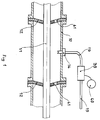
- la figure 1 est une vue schématique en coupe d'un jeu de barres équipé d'un détecteur d'arc selon l'invention,
- la figure 2 est une vue à échelle agrandie du détecteur selon la figure 1, représenté sur la demi-vue de droite accouplé à la fibre optique et sur la demi-vue de gauche avant accouplement de la fibre.
- Sur les figures un jeu de barres d'un poste blindé comporte une enceinte étanche à paroi cylindrique 10, remplie d'un gaz à rigidité diélectrique élevée, tel que l'hexafluorure de soufre et contenant une barre conductrice 11, supportée coaxialement par des isolateurs support 12 échelonnés le long de la barre 11. Dans un orifice fileté 13, ménagé dans la paroi 10 de l'enceinte ou dans un manchon soudé à cette paroi est vissé un détecteur d'arc 14, qui traverse d'une manière étanche la paroi 10. Le détecteur 14 est constitué par un raccord 15 ayant une partie antérieure filetée 16, se vissant dans la paroi 10, un collet intermédiaire 17 à six pans de préhension et une partie postérieure filetée 18 de raccordement par vissage d'un conducteur optique 19. Le raccord 15 est traversé par un conduit axial 20 recevant dans la partie antérieure 16, à emboîtement étanche par deux joints toriques 21 et/ou collage 22, une tige 23 en verre ou en matière synthétique transparente isolante. Dans la partie postérieure 18 du conduit 20 de section amoindrie est emboîtée en alignement de la tige 23, l'extrémité dénudée 24 d'une fibre optique 25. Le conducteur optique 19 est fixé à l'aide d'un manchon 26 enfilé sur l'extrémité denudée 24 et sur un tronçon de la gaine 27 de la fibre 25. Ce manchon 26 présente un collet 28 maintenu en appui de la face de la partie postérieure 18 par un écrou 29, vissé sur cette partie postérieure filetée 18. Un joint torique 30 est interposé entre le collet 28 et la face d'appui 18. L'étanchéité entre le raccord 15 et la paroi 10 est réalisée par des joints toriques 31 de la manière usuelle. Entre la face terminale 32 de la fibre optique 25 et l'extrémité arrondie 33 en regard de la tige 23 subsiste un intervalle 34 de raccordement tronconique. Le raccord 15 en métal est, en position de fixation du détecteur d'arc 14, légèrement en retrait de la paroi 10 afin de ne pas perturber l'isolation électrique,tandis que la tige 23 fait saillie du raccord 15 et de la paroi 10 en pénêtrant sur une hauteur réduite h à l'intérieur de l'enceinte. Cette faible saillie d'une pièce isolante 23 n'affecte pas la tenue diélectrique.
- Dans l'exemple illustré par la figure 2 la tige 23 est de section cylindrique et l'extrémité 35 en saillie interne présente une cavité interne tronconique en entonnoir 36 dont la profondeur correspond sensiblement à la hauteur de saillie h. Les faces tronconiques 37 sont inclinées d'environ 45° sur l'axe de la tige 23 et constituent des faces de réflexion d'un rayon lumineux 38, notamment d'un rayon parallèle à la paroi 10, qui est dévié de 90° dans la direction de l'axe de la tige 23 vers la fibre optique 25. La tige 23 capte également les rayons orientés différemment, en particulier dans l'axe de la tige 23.
- Le conducteur optique 19 est connecté à un dispositif de traitement 39, qui peut être commun à plusieurs capteurs 14 et qui transforme les signaux lumineux transmis par les conducteurs optiques 19 en un ordre de déclenchement ou de signalisation 40 d'un défaut. En prévoyant dans les isolateurs support 12 des orifices 41 de passage des rayons lumineux 38 un même capteur 14 peut surveiller plusieurs compartiments du jeu de barres ou de l'enceinte. On comprend que les rayons 38, émis d'un point éloigné du capteur 14, sont sensiblement parallèles à la paroi 10 et frappent perpendiculairement la tige 23. Les faces de réflexion 37 captent ces rayons 38 qui en l'absence de telles faces 37 traverseraient simplement la tige 23. Les faces de réflexion 37 peuvent être en saillie convexe et/ou être constituées par des facettes ou des faces planes orientées dans l'axe de la barre 11. Le capteur 14 est avantageusement fixé à la paroi supérieure 10 afin d'être orienté vers le bas et d'éviter des dépôts formant un écran au passage de la lumière. La tige 23 est de préférence en matière plastique transparente, mais d'autres matériaux sont utilisables et la liaison entre la tige 23 et la fibre optique peut être réalisée par aboutement des deux extrémités 32,33 en regard. Le conducteur optique 19 d'un type standard peut être facilement mis en place ou démonté après dévissage de l'écrou 29. La partie gauche de la figure 2 montre le capteur 14 avant le raccordement du conducteur optique 19 avec un capot 42 de protection vissé sur la partie postérieure 18 afin d'éviter toute détérioration pendant le transport. Après montage du poste il suffit d'enlever le capot 42 et de fixer le conducteur optique 19 par emboîtement de l'extrémité 24 et serrage de l'écrou 29.
- Le capteur 14 ne pénétre quasiment pas à l'intérieur de l'enceinte et il peut donc être fixé en un point quelconque le plus approprié. Un nombre limité de capteurs 14 et de ce fait d'orifices 13 dans la paroi 10 permet une surveillance complète de l'installation. La section de ces orifices 13 peut être faible et l'étanchéité ainsi que la fixation de la tige 23, qui traverse la paroi 10 perpendiculairement, peuvent bien entendu être réalisées différemment.
Claims (5)
- Détecteur d'arc pour une enceinte étanche allongée d'une installation électrique à isolation gazeuse remplie d'un gaz à rigidité diélectrique élevée, ayant un axe longitudinal et une paroi confinant ladite enceinte comprenant un capteur optique (14) de lumière disposé dans ladite enceinte et constitué par une tige (23) transparente en verre ou en matière synthétique isolante, qui traverse d'une manière étanche la paroi (10) de ladite enceinte, une fibre optique (25) de transmission du signal lumineux fourni par le capteur (14), un dispositif de traitement (39) disposé à l'extérieur de l'enceinte et recevant le signal transmis par la fibre optique (25), ladite tige (23) ayant une extrémité (35) faisant faiblement saillie vers l'intérieur de l'enceinte caractérisé en ce que ladite extrémité comporte une face de réflexion (37) inclinée d'environ 45° sur ledit axe longitudinal et apte à réfléchir dans la direction de ladite tige (23) vers l'extérieur de l'enceinte, un rayon lumineux (38) sensiblement parallèle audit axe longitudinal.
- Détecteur d'arc selon la revendication 1, caractérisé en ce que ladite tige (23) est cylindrique et que ladite extrémité (35) est taillée en tronc de cône (37) coaxial à ladite tige, formant une cavité en entonnoir dans ladite extrémité (35), et ayant un angle au sommet voisin de 90°.
- Détecteur d'arc selon la revendication 2, caractérisé en ce que ladite cavité s'étend sensiblement sur la hauteur h de saillie de la tige (23) dans l'enceinte.
- Détecteur d'arc selon l'une quelconque des revendications précédentes, caractérisé en ce que la tige (23) rectiligne traverse perpendiculairement la paroi (10) de l'enceinte avec interposition d'un joint d'étanchité (21) et que la fibre optique (25) est en regard et dans le prolongement de l'extrémité externe (33) de ladite tige (23) pour transmettre la lumière captée vers le dispositif de traitement (39).
- Détecteur d'arc selon l'une quelconque des revendications précédentes pour un jeu de barres (11) ayant des isolateurs support (12) échelonnés et intercalés entre la barre et la gaine allongée, caractérisé en ce que lesdits isolateurs (12) présentent des orifices (41) de passage de rayons lumineux (38) s'étendant parallèlement audit axe longitudinal.
Applications Claiming Priority (2)
| Application Number | Priority Date | Filing Date | Title |
|---|---|---|---|
| FR9002477 | 1990-02-26 | ||
| FR9002477A FR2658920B1 (fr) | 1990-02-26 | 1990-02-26 | Dispositif de detection d'un arc interne a une installation electrique blindee. |
Publications (2)
| Publication Number | Publication Date |
|---|---|
| EP0455562A1 EP0455562A1 (fr) | 1991-11-06 |
| EP0455562B1 true EP0455562B1 (fr) | 1995-06-28 |
Family
ID=9394211
Family Applications (1)
| Application Number | Title | Priority Date | Filing Date |
|---|---|---|---|
| EP91420045A Expired - Lifetime EP0455562B1 (fr) | 1990-02-26 | 1991-02-11 | Disposiif de détection d'un arc interne à une installation électrique blindée |
Country Status (7)
| Country | Link |
|---|---|
| US (1) | US5170050A (fr) |
| EP (1) | EP0455562B1 (fr) |
| JP (1) | JP3078340B2 (fr) |
| CA (1) | CA2037148A1 (fr) |
| DE (1) | DE69110754T2 (fr) |
| ES (1) | ES2075946T3 (fr) |
| FR (1) | FR2658920B1 (fr) |
Cited By (1)
| Publication number | Priority date | Publication date | Assignee | Title |
|---|---|---|---|---|
| US10928435B2 (en) | 2019-07-15 | 2021-02-23 | The Boeing Company | Electrical fault detector and method of use |
Families Citing this family (14)
| Publication number | Priority date | Publication date | Assignee | Title |
|---|---|---|---|---|
| CH685224B5 (fr) * | 1993-04-19 | 1995-11-15 | Juvenia Montres S A | Montre mysterieuse comportant notamment deux dispositifs d'affichage et moyens de commande destines en particulier a atre utilises avec une telle montre. |
| FR2719125B1 (fr) * | 1994-04-21 | 1996-05-31 | Gec Alsthom T & D Sa | Dispositif de détection d'arc interne pour câble à haute tension à isolation gazeuse. |
| JP2000504199A (ja) * | 1996-01-31 | 2000-04-04 | シーメンス アクチエンゲゼルシヤフト | 閉鎖管形導体 |
| DE19715780B4 (de) * | 1997-04-16 | 2009-10-08 | Areva Sachsenwerk Gmbh | Vorrichtung zur optischen Erfassung von Störlichtbogen in Schaltgeräten und -anlagen |
| US6433976B1 (en) | 1999-09-24 | 2002-08-13 | Square D Company | Instantaneous arc fault light detector with resistance to false tripping |
| US8664961B2 (en) * | 2008-09-19 | 2014-03-04 | Schweitzer Engineering Laboratories Inc | Validation of arc flash detection systems |
| US8593769B2 (en) * | 2008-09-19 | 2013-11-26 | Schweitzer Engineering Laboratories Inc | Secure arc flash detection |
| AU2009293080B8 (en) | 2008-09-19 | 2014-03-13 | Schweitzer Engineering Laboratories, Inc. | Protective device with metering and oscillography |
| WO2010033851A1 (fr) | 2008-09-19 | 2010-03-25 | Schweitzer Engineering Laboratories, Inc. | Capteur de rayonnement électro-optique pour détection d'un flash d'arc électrique |
| BRPI0918899A2 (pt) | 2008-09-19 | 2017-08-01 | Schweitzer Engineering Lab Inc | método para realizar um teste automático de um dispositivo de detecção de arco elétrico, dispositivo de detecção de arco elétrico com teste automático, e, meio de armazenamento legível por computador |
| US8040517B1 (en) * | 2010-04-30 | 2011-10-18 | General Electric Company | Arc flash detection system and method |
| US9438028B2 (en) | 2012-08-31 | 2016-09-06 | Schweitzer Engineering Laboratories, Inc. | Motor relay with integrated arc-flash detection |
| US10804689B2 (en) | 2016-11-18 | 2020-10-13 | Schweitzer Engineering Laboratories, Inc. | Methods and systems for evaluating arc flash exposure hazard |
| US11837862B2 (en) | 2020-10-09 | 2023-12-05 | Schweitzer Engineering Laboratories, Inc. | Arc-flash sensor using optical fiber |
Family Cites Families (8)
| Publication number | Priority date | Publication date | Assignee | Title |
|---|---|---|---|---|
| BE505420A (fr) * | ||||
| US3949226A (en) * | 1972-05-26 | 1976-04-06 | Zenith Radio Corporation | Automatic light intensity controller for CRT lighthouse |
| CH575654A5 (fr) * | 1974-09-11 | 1976-05-14 | Bbc Brown Boveri & Cie | |
| JPS5448172A (en) * | 1977-09-24 | 1979-04-16 | Tokyo Ouka Kougiyou Kk | Plasma reaction processor |
| DE2856188C2 (de) * | 1978-12-27 | 1985-09-05 | Brown, Boveri & Cie Ag, 6800 Mannheim | Einrichtung zur Erfassung von Störlichtbögen in Schaltanlagen |
| US4669817A (en) * | 1983-02-04 | 1987-06-02 | Kei Mori | Apparatus for time-sharing light distribution |
| CH665313A5 (de) * | 1985-01-14 | 1988-04-29 | Sprecher Energie Ag | Gekapselte hochspannungs-anlage. |
| DE3612090A1 (de) * | 1986-04-10 | 1987-10-15 | Siemens Ag | Einrichtung zur optoelektronischen erfassung von stoerlichtboegen |
-
1990
- 1990-02-26 FR FR9002477A patent/FR2658920B1/fr not_active Expired - Fee Related
-
1991
- 1991-02-11 DE DE69110754T patent/DE69110754T2/de not_active Expired - Fee Related
- 1991-02-11 EP EP91420045A patent/EP0455562B1/fr not_active Expired - Lifetime
- 1991-02-11 ES ES91420045T patent/ES2075946T3/es not_active Expired - Lifetime
- 1991-02-25 CA CA002037148A patent/CA2037148A1/fr not_active Abandoned
- 1991-02-25 US US07/660,005 patent/US5170050A/en not_active Expired - Fee Related
- 1991-02-25 JP JP03053427A patent/JP3078340B2/ja not_active Expired - Lifetime
Cited By (1)
| Publication number | Priority date | Publication date | Assignee | Title |
|---|---|---|---|---|
| US10928435B2 (en) | 2019-07-15 | 2021-02-23 | The Boeing Company | Electrical fault detector and method of use |
Also Published As
| Publication number | Publication date |
|---|---|
| FR2658920B1 (fr) | 1992-07-03 |
| JP3078340B2 (ja) | 2000-08-21 |
| US5170050A (en) | 1992-12-08 |
| JPH04216479A (ja) | 1992-08-06 |
| FR2658920A1 (fr) | 1991-08-30 |
| EP0455562A1 (fr) | 1991-11-06 |
| DE69110754T2 (de) | 1996-02-22 |
| DE69110754D1 (de) | 1995-08-03 |
| ES2075946T3 (es) | 1995-10-16 |
| CA2037148A1 (fr) | 1991-08-27 |
Similar Documents
| Publication | Publication Date | Title |
|---|---|---|
| EP0455562B1 (fr) | Disposiif de détection d'un arc interne à une installation électrique blindée | |
| EP3457510B1 (fr) | Liaison électrique comprenant un système de protection électrique | |
| FR2574979A1 (fr) | Isolateur pour ligne a haute tension et appareil permettant des communications par un tel isolateur | |
| FR2560395A1 (fr) | Coupleur optoelectronique pour fibres optiques a prelevement reglable et systeme de transmissions bidirectionnelles d'informations mettant en oeuvre un tel coupleur | |
| EP1191564B1 (fr) | Disjoncteur à isolation au gaz avec un transformateur de courant électronique intégré | |
| FR2640386A1 (fr) | Dispositif pour la detection d'effluves visuels dans une enceinte fermee | |
| EP3147676A1 (fr) | Dispositif de controle d'un conducteur electrique et installation electrique comportant un tel dispositif | |
| EP0813068A1 (fr) | Dispositif pour détecter et localiser des anomalies de la protection électromagnétique d'un système | |
| EP0100694A1 (fr) | Câble isolé pour le transport d'énergie électrique notamment à haute tension, et dispositif de détection de défauts dans un tel câble | |
| EP0836258A1 (fr) | Dispositif de surveillance pour un câble à isolation gazeuse | |
| EP2224252A1 (fr) | Dispositif capacitif de mesure de la tension d'un élément haute tension | |
| EP0065178B1 (fr) | Jonction multiple pour système sous-marin | |
| FR2772979A1 (fr) | Dispositif de raccordement electrique d'un bloc differentiel sur un disjoncteur ou analogue et bloc differentiel equipe d'un tel dispositif | |
| EP2795718B1 (fr) | Dispositif de protection électromagnétique apte à protéger une liaison hyperfréquences entre un connecteur et un élèment hyperfréquences | |
| CH645765A5 (fr) | Procede pour detecter l'interruption de la transmission de signaux lumineux et dispositif pour la mise en oeuvre de ce procede. | |
| EP0788207B1 (fr) | Dispositif de détection d'arc interne pour câble électrique à isolation gazeuse | |
| FR2611333A1 (fr) | Dispositif de transmission d'un signal electrique a travers une paroi d'une cage de faraday | |
| EP1004884B1 (fr) | Procédé et dispositif de détection d'un arc interne dans une liaison électrique sous enveloppe métallique | |
| EP0245563A1 (fr) | Détecteur de niveau optique électronique à capteur double | |
| EP0560145A1 (fr) | Dispositif d'alarme | |
| FR2877124A1 (fr) | Detecteur photoelectrique | |
| CA2147228A1 (fr) | Appareillage electrique a detection de pression integree | |
| JPH0851708A (ja) | ガス絶縁電気機器用アーク光検出装置 | |
| FR2905202A1 (fr) | Bus numerique avec derivations a sensibilite aux contraintes environnementales diminuee. | |
| EP0560650B1 (fr) | Elément de connecteur électrique |
Legal Events
| Date | Code | Title | Description |
|---|---|---|---|
| PUAI | Public reference made under article 153(3) epc to a published international application that has entered the european phase |
Free format text: ORIGINAL CODE: 0009012 |
|
| AK | Designated contracting states |
Kind code of ref document: A1 Designated state(s): BE CH DE ES GB IT LI SE |
|
| 17P | Request for examination filed |
Effective date: 19920415 |
|
| 17Q | First examination report despatched |
Effective date: 19940214 |
|
| RAP1 | Party data changed (applicant data changed or rights of an application transferred) |
Owner name: SCHNEIDER ELECTRIC SA |
|
| GRAA | (expected) grant |
Free format text: ORIGINAL CODE: 0009210 |
|
| AK | Designated contracting states |
Kind code of ref document: B1 Designated state(s): BE CH DE ES GB IT LI SE |
|
| REF | Corresponds to: |
Ref document number: 69110754 Country of ref document: DE Date of ref document: 19950803 |
|
| ITF | It: translation for a ep patent filed | ||
| REG | Reference to a national code |
Ref country code: ES Ref legal event code: FG2A Ref document number: 2075946 Country of ref document: ES Kind code of ref document: T3 |
|
| GBT | Gb: translation of ep patent filed (gb section 77(6)(a)/1977) |
Effective date: 19950918 |
|
| PLBI | Opposition filed |
Free format text: ORIGINAL CODE: 0009260 |
|
| 26 | Opposition filed |
Opponent name: SIEMENS AG Effective date: 19960205 |
|
| PLBF | Reply of patent proprietor to notice(s) of opposition |
Free format text: ORIGINAL CODE: EPIDOS OBSO |
|
| PLAB | Opposition data, opponent's data or that of the opponent's representative modified |
Free format text: ORIGINAL CODE: 0009299OPPO |
|
| PLBF | Reply of patent proprietor to notice(s) of opposition |
Free format text: ORIGINAL CODE: EPIDOS OBSO |
|
| R26 | Opposition filed (corrected) |
Opponent name: SIEMENS AG Effective date: 19960202 |
|
| PLBF | Reply of patent proprietor to notice(s) of opposition |
Free format text: ORIGINAL CODE: EPIDOS OBSO |
|
| RAP2 | Party data changed (patent owner data changed or rights of a patent transferred) |
Owner name: SCHNEIDER ELECTRIC INDUSTRIES SA |
|
| PLBO | Opposition rejected |
Free format text: ORIGINAL CODE: EPIDOS REJO |
|
| PGFP | Annual fee paid to national office [announced via postgrant information from national office to epo] |
Ref country code: ES Payment date: 20000222 Year of fee payment: 10 |
|
| PGFP | Annual fee paid to national office [announced via postgrant information from national office to epo] |
Ref country code: BE Payment date: 20000412 Year of fee payment: 10 |
|
| PLBN | Opposition rejected |
Free format text: ORIGINAL CODE: 0009273 |
|
| STAA | Information on the status of an ep patent application or granted ep patent |
Free format text: STATUS: OPPOSITION REJECTED |
|
| 27O | Opposition rejected |
Effective date: 19990916 |
|
| PGFP | Annual fee paid to national office [announced via postgrant information from national office to epo] |
Ref country code: DE Payment date: 20010201 Year of fee payment: 11 |
|
| PGFP | Annual fee paid to national office [announced via postgrant information from national office to epo] |
Ref country code: SE Payment date: 20010206 Year of fee payment: 11 |
|
| PGFP | Annual fee paid to national office [announced via postgrant information from national office to epo] |
Ref country code: GB Payment date: 20010207 Year of fee payment: 11 |
|
| PG25 | Lapsed in a contracting state [announced via postgrant information from national office to epo] |
Ref country code: ES Free format text: LAPSE BECAUSE OF NON-PAYMENT OF DUE FEES Effective date: 20010212 |
|
| PGFP | Annual fee paid to national office [announced via postgrant information from national office to epo] |
Ref country code: CH Payment date: 20010213 Year of fee payment: 11 |
|
| PG25 | Lapsed in a contracting state [announced via postgrant information from national office to epo] |
Ref country code: BE Free format text: LAPSE BECAUSE OF NON-PAYMENT OF DUE FEES Effective date: 20010228 |
|
| BERE | Be: lapsed |
Owner name: S.A. SCHNEIDER ELECTRIC Effective date: 20010228 |
|
| REG | Reference to a national code |
Ref country code: GB Ref legal event code: IF02 |
|
| PG25 | Lapsed in a contracting state [announced via postgrant information from national office to epo] |
Ref country code: GB Free format text: LAPSE BECAUSE OF NON-PAYMENT OF DUE FEES Effective date: 20020211 |
|
| PG25 | Lapsed in a contracting state [announced via postgrant information from national office to epo] |
Ref country code: SE Free format text: LAPSE BECAUSE OF NON-PAYMENT OF DUE FEES Effective date: 20020212 |
|
| PG25 | Lapsed in a contracting state [announced via postgrant information from national office to epo] |
Ref country code: LI Free format text: LAPSE BECAUSE OF NON-PAYMENT OF DUE FEES Effective date: 20020228 Ref country code: CH Free format text: LAPSE BECAUSE OF NON-PAYMENT OF DUE FEES Effective date: 20020228 |
|
| PG25 | Lapsed in a contracting state [announced via postgrant information from national office to epo] |
Ref country code: DE Free format text: LAPSE BECAUSE OF NON-PAYMENT OF DUE FEES Effective date: 20020903 |
|
| EUG | Se: european patent has lapsed |
Ref document number: 91420045.6 |
|
| GBPC | Gb: european patent ceased through non-payment of renewal fee |
Effective date: 20020211 |
|
| REG | Reference to a national code |
Ref country code: CH Ref legal event code: PL |
|
| REG | Reference to a national code |
Ref country code: ES Ref legal event code: FD2A Effective date: 20021016 |
|
| PG25 | Lapsed in a contracting state [announced via postgrant information from national office to epo] |
Ref country code: IT Free format text: LAPSE BECAUSE OF NON-PAYMENT OF DUE FEES Effective date: 20050211 |