EP0455775B1 - Copieur et procede de copie - Google Patents
Copieur et procede de copie Download PDFInfo
- Publication number
- EP0455775B1 EP0455775B1 EP90917277A EP90917277A EP0455775B1 EP 0455775 B1 EP0455775 B1 EP 0455775B1 EP 90917277 A EP90917277 A EP 90917277A EP 90917277 A EP90917277 A EP 90917277A EP 0455775 B1 EP0455775 B1 EP 0455775B1
- Authority
- EP
- European Patent Office
- Prior art keywords
- electrical signals
- document
- original document
- image
- reflectance
- Prior art date
- Legal status (The legal status is an assumption and is not a legal conclusion. Google has not performed a legal analysis and makes no representation as to the accuracy of the status listed.)
- Expired - Lifetime
Links
- 238000000034 method Methods 0.000 title claims description 20
- 238000012545 processing Methods 0.000 claims description 23
- 238000004519 manufacturing process Methods 0.000 claims description 3
- 238000012544 monitoring process Methods 0.000 claims 5
- 238000012958 reprocessing Methods 0.000 claims 1
- 239000012536 storage buffer Substances 0.000 abstract 1
- 238000002955 isolation Methods 0.000 description 3
- 230000006870 function Effects 0.000 description 2
- 238000003709 image segmentation Methods 0.000 description 2
- 238000003672 processing method Methods 0.000 description 2
- 230000002902 bimodal effect Effects 0.000 description 1
- 238000010586 diagram Methods 0.000 description 1
- 230000000694 effects Effects 0.000 description 1
- 238000012986 modification Methods 0.000 description 1
- 230000004048 modification Effects 0.000 description 1
- 230000003287 optical effect Effects 0.000 description 1
- 238000003825 pressing Methods 0.000 description 1
- 230000000284 resting effect Effects 0.000 description 1
- 239000007787 solid Substances 0.000 description 1
- 238000003860 storage Methods 0.000 description 1
- 238000002834 transmittance Methods 0.000 description 1
Images
Classifications
-
- H—ELECTRICITY
- H04—ELECTRIC COMMUNICATION TECHNIQUE
- H04N—PICTORIAL COMMUNICATION, e.g. TELEVISION
- H04N1/00—Scanning, transmission or reproduction of documents or the like, e.g. facsimile transmission; Details thereof
- H04N1/40—Picture signal circuits
- H04N1/403—Discrimination between the two tones in the picture signal of a two-tone original
Definitions
- This invention relates generally to electronic copiers, and more particularly to such copiers capable of image processing such as for example by object isolation by referencing the background of an image being copied.
- Object isolation of images being electronically copied often employs image segmentation by a thresholding technique wherein the image is partitioned into a finite number of disjoint (non-overlapping) picture elements, called pixels, each of which is represented as a pure binary quantity, i.e., object or background. Thresholding is particularly useful for images containing solid area objects resting upon a contrasting background.
- a threshold rule for image segmentation of positive images one assigns all pixels at or above the threshold reflectance to the background. All pixels with reflectance below threshold fall inside the object.
- the threshold reflectance be determined by an examination of the background level of the entire original document. So called “background referencing” techniques, wherein estimates of the background level are periodically updated so that the threshold reflectance is constantly being updated, are generally not suitable for document copiers because of the high incidents of artifacts produced.
- this is accomplished by pre-scanning the document to gather sufficient data regarding the various reflectances across the image so that a threshold reflectance can be determined.
- the image signal is processed according to the threshold reflectance determined using the data collected during the first scan.
- a copier's life is in part limited by the physical number of times the image is scanned, and the inconvenience of the operators is measured in part by the time duration they must wait to remove the original after pressing the start button.
- a copier which requires only a single scan to determine the threshold reflectance and to effect image processing according to the threshold reflectance would be very preferable to a copier which requires two or more scans for the same functions.
- U.S.-A-4,710,822 relates to an image processing method wherein an image is scanned and electrical signals representing data scanned from the image is stored in digitized form in an image memory.
- the signals representing the image data are grouped into pixels of picture elements sorted by density criteria. Histograms are created using representative densities of picture elements in each group. A determination of a threshold for image processing of the data stored in the memory is made using information generated by the histogram.
- the image from which a histogram is created is based on substantially that of an entire document.
- test print is made using the data read from memory and also using the image data read from memory for making a final print wherein an adjustment is made in the image processing but yet, for making the test print and the final print, only one scan of the document is made.
- EP-A-0 113 016 there is disclosed an image processing method wherein image data is stored in an image buffer.
- the image data is used to generate a histogram of grey scale intensity levels in the image. There are calculated from the histogram, values representing an acceptable range of background grey scale variation. The calculations are compared with a current pixel to correct the current pixels grey scale value.
- this method is suited for use in a copier and no indication that a test print may be made using the data stored in the image buffer and then a final print made using the same data stored in memory even though the image processing is adjusted for making the final print and there is only one scan of an original document.
- the present invention provides an electronic copier and a process for reproducing an original document according to Claims 1 and 5, respectively.
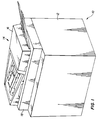
- a copier 10 includes a marking engine 12 and a document scanner 14.
- the document scanner produces a series of electrical signals representative of the image content of originals.
- Scanner 14 consists of an automatic document handler 16 for stream feeding multiple hard copy original pages past an optical system enclosed in an optics housing 18 to be automatically read by a scanning device 20 such as a linear array of solid-state charge-coupled devices (see Figure 2).
- the scanning device scans the originals pages, converting their images to an image data stream of electrical signals.
- scanning device 20 comprises a linear array of CCD's.
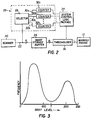
- Image signals pass over a bus 22 unmodified for storage in a full page image buffer 24.
- unmodified it is meant in a form in which the image content of the original can be retrieved.
- Image buffer 24 can retain the un-modified image until a test print has been run and accepted by the operator. In that way, image processing adjustments (as explained below) can be inspected and, if unacceptable, redone from the original image data.
- the image signal passes pixel by pixel along bus 22 into a data monitor unit 26.
- the data monitor unit provides means for determining a characteristic of the original document for purposes of setting image process parameters.
- the parameters provide a threshold reflectance according to the image content of the area of interest, which area is usually a page of the original, but may be a portion of a page or several pages.
- data monitor 26 includes a selector unit 28 which receives the multiple bit data signal and outputs a signal over one of a plurality of paths 30a-30h according to the reflectance value of the signal.
- each pixel of the original image is represented on bus 22 by a eight-bit binary word representing one of 256 reflectance levels (0-255).
- the path 30a-30h selected for a particular pixel will be determined by its reflectance level "R" as follows:
- Each of paths 30a-30h provides an input to one of eight counters 32a-32h, respectively.
- the counters accumulate the number of pixels of the image having a reflectance falling within their respective ranges.
- a system control logic package 34 can form a histogram of the reflectance levels of the pixels of the image. This function summarizes the gray level content of an image, and is, for each gray level, the number of pixels in the image that have that gray level.
- FIG. 3 illustrates the appearance of the histogram of such an image.
- the dark pixels inside the object produce the rightmost peak in the histogram.
- the leftmost peak is due to the large number of light gray pixels in the background.
- the relatively few mid-gray pixels around the edge of the object produce the dip between the two peaks.
- a threshold gray level chosen in the area of the dip will produce a reasonable boundary for the object. Generally the gray level corresponding to the minimum between the two peaks is optimal for defining the boundary. Histograms and thresholding are discussed in Digital Image Processing; Kenneth R. Castleman; Prentice-Hall, Inc.; 1979; page 76. Once a threshold reflectance has been selected, its value is inputted to a thresholder 36.
- the image data can be read from image buffer 24 and sent a pixel at a time to marking engine 12 through thresholder 36.
- the reflectance value of the pixel is compared to the threshold reflectance stored in the thresholder. All pixels at or above the threshold reflectance are assigned to the object. All pixels with gray level below threshold fall outside the object.
- the resultant single bit value of the pixel is sent to the marking engine and the next pixel value is read from image buffer 24.
- the first print of a page by the marking engine may be considered to be a test print.
- the operator upon viewing the test print may decide that the threshold reflectance is too dark or too light in that excessive background may exist or image content may be lost, respectively.
- the operator may, with suitable controls, adjust the threshold reflectance up or down.
- a second test print, or a production print, may now be produced without rescanning the original document since the full image content remains in image buffer 24 until the next original document is scanned into the buffer.
Landscapes
- Engineering & Computer Science (AREA)
- Multimedia (AREA)
- Signal Processing (AREA)
- Facsimile Image Signal Circuits (AREA)
- Control Or Security For Electrophotography (AREA)
Abstract
Claims (8)
- Copieur électronique (10) pour reproduire un document original à partir de signaux électriques représentatifs du contenu d'image du document ; ledit copieur comprenant :
un moyen de formation d'image (12) pour former une copie en se basant sur une série délivrée de signaux électriques traités ;
un moyen de surveillance de données (26) pour déterminer une caractéristique du document original à partir d'une série de signaux électriques représentatifs du contenu de sensiblement tout le document ;
un moyen de traitement d'image (36) pour traiter les signaux électriques représentatifs du contenu d'image du document sur la base de la caractéristique du document original déterminée par ledit moyen de surveillance de données pour améliorer la qualité de la reproduction, et pour appliquer les signaux électriques traités audit moyen de formation d'image ;
un moyen de mémorisation (24) pour mémoriser une série de signaux électriques représentatifs du contenu d'image du document, et pour appliquer les signaux électriques mémorisés audit moyen de traitement d'image ;
un moyen de balayage (20) pour produire, au cours d'un unique balayage du document, une série de signaux électriques représentatifs du contenu d'image du document et pour appliquer les signaux balayés audit moyen de surveillance de données et audit moyen de mémorisation ;
un moyen pour récupérer les séries de signaux de donnée mémorisées dans ledit moyen de mémorisation et pour les appliquer audit moyen de traitement d'image ; et dans lequel :
ledit moyen de traitement d'image (36) est conçu pour 1) traiter les signaux électriques récupérés dans ledit moyen de mémorisation pour la production d'une impression d'essai du document, et 2) retraiter lesdits signaux électriques, récupérés dans ledit moyen de mémorisation, en fonction d'un ajustement pour former une impression finale modifiée du document, le tout avec seulement ledit unique balayage du document original. - Copieur électronique (10) selon la revendication 1, dans lequel ledit moyen de mémorisation (24) est conçu pour mémoriser des signaux électriques représentatifs du contenu d'image non modifié du document.
- Copieur électronique (10) selon la revendication 1, dans lequel :
ledit moyen de surveillance (26) est conçu pour sélectionner une réflectance de seuil parmi tous les niveaux de réflectance de fond du document original ; et
dans lequel ledit moyen de traitement d'image (36) est conçu pour traiter les signaux électriques en fonction de la réflectance de seuil sélectionnée dans ledit unique balayage du document original. - Copieur électronique (10) selon la revendication 1, dans lequel :
ledit moyen de surveillance (26) est conçu pour sélectionner une réflectance de seuil parmi tous les niveaux de réflectance de fond du document original ; et
dans lequel ledit moyen de traitement d'image (36) est conçu pour 1) traiter les signaux électriques en fonction de la réflectance de seuil sélectionnée pour la production d'une impression d'essai, et 2) retraiter les signaux d'image en fonction d'une réflectance de seuil modifiée pour l'impression finale, le tout avec seulement ledit unique balayage du document original. - Procédé de reproduction d'un document original, ledit procédé comprenant :
le balayage d'un document pour produire une série de signaux électriques représentatifs du contenu d'image du document ;
la mémorisation de signaux électriques produits pendant un unique balayage du document ;
la détermination d'une caractéristique du document original à partir des séries de signaux électriques produits au cours dudit unique balayage de sensiblement tout le document ;
la récupération des séries de signaux électriques mémorisées ;
le traitement des signaux électriques récupérés sur la base de la caractéristique déterminée du document original pour améliorer la qualité de la reproduction ;
l'exécution d'une impression d'essai à l'aide des signaux électriques traités ;
à la suite de l'exécution de l'impression d'essai la récupération de nouveau des séries de signaux électriques mémorisées ;
le retraitement des signaux électriques récupérés de nouveau sur la base de la caractéristique déterminée de l'original et d'un ajustement, fourni par un opérateur, effectué à la suite de l'impression d'essai ; et
l'exécution d'une impression finale avec les signaux électriques retraités, le tout avec seulement ledit unique balayage du document original. - Procédé selon la revendication 5, et dans lequel :
ladite étape de détermination comprend la sélection d'une réflectance de seuil parmi tous les niveaux de réflectance de fond de sensiblement tout le document original ; et
dans lequel ladite étape de traitement comprend le traitement des signaux électriques en fonction de la réflectance de seuil sélectionnée, déterminée comme résultat dudit unique balayage du document original. - Procédé selon la revendication 5, et dans lequel :
ladite étape de détermination comprend la sélection d'une réflectance de seuil parmi tous les niveaux de réflectance de fond du document original ; et
dans lequel ladite étape de traitement comprend le traitement des signaux électriques en fonction de la réflectance de seuil sélectionnée, déterminée comme résultat dudit unique balayage du document original, et dans lequel ladite étape de retraitement comprend le retraitement des signaux électriques récupérés en fonction d'une réflectance de seuil modifiée pour l'impression finale, le tout avec seulement ledit unique balayage du document original. - Procédé selon l'une quelconque des revendications 5 à 7, et dans lequel on utilise un histogramme pour déterminer la caractéristique du document original.
Applications Claiming Priority (3)
| Application Number | Priority Date | Filing Date | Title |
|---|---|---|---|
| US07/443,543 US5150223A (en) | 1989-11-30 | 1989-11-30 | Copier with single pass auto exposure |
| US443543 | 1989-11-30 | ||
| PCT/US1990/006785 WO1991008640A1 (fr) | 1989-11-30 | 1990-11-26 | Copieur et procede de copie |
Publications (2)
| Publication Number | Publication Date |
|---|---|
| EP0455775A1 EP0455775A1 (fr) | 1991-11-13 |
| EP0455775B1 true EP0455775B1 (fr) | 1995-09-27 |
Family
ID=23761214
Family Applications (1)
| Application Number | Title | Priority Date | Filing Date |
|---|---|---|---|
| EP90917277A Expired - Lifetime EP0455775B1 (fr) | 1989-11-30 | 1990-11-26 | Copieur et procede de copie |
Country Status (5)
| Country | Link |
|---|---|
| US (1) | US5150223A (fr) |
| EP (1) | EP0455775B1 (fr) |
| JP (1) | JPH04503293A (fr) |
| DE (1) | DE69022719T2 (fr) |
| WO (1) | WO1991008640A1 (fr) |
Families Citing this family (4)
| Publication number | Priority date | Publication date | Assignee | Title |
|---|---|---|---|---|
| JPH04270565A (ja) * | 1991-02-20 | 1992-09-25 | Fuji Xerox Co Ltd | 画像圧縮装置 |
| US5583659A (en) * | 1994-11-10 | 1996-12-10 | Eastman Kodak Company | Multi-windowing technique for thresholding an image using local image properties |
| US5901243A (en) * | 1996-09-30 | 1999-05-04 | Hewlett-Packard Company | Dynamic exposure control in single-scan digital input devices |
| JP3717357B2 (ja) | 2000-01-07 | 2005-11-16 | 理想科学工業株式会社 | 2値化閾値算出方法および装置 |
Family Cites Families (9)
| Publication number | Priority date | Publication date | Assignee | Title |
|---|---|---|---|---|
| JPS587971A (ja) * | 1981-07-07 | 1983-01-17 | Canon Inc | 両面画像形成装置 |
| US4524388A (en) * | 1981-08-11 | 1985-06-18 | Konishiroku Photo Industry Co., Ltd. | Shading correction device |
| US4672186A (en) * | 1981-10-01 | 1987-06-09 | Banctec Inc. | Digital document scanning system |
| JPS5954376A (ja) * | 1982-09-21 | 1984-03-29 | Konishiroku Photo Ind Co Ltd | 画像処理方法 |
| JPS59125176A (ja) * | 1982-12-30 | 1984-07-19 | インタ−ナシヨナル ビジネス マシ−ンズ コ−ポレ−シヨン | ビデオイメ−ジのシエ−ジング効果の補正装置 |
| JPS60124173A (ja) * | 1983-12-09 | 1985-07-03 | Canon Inc | 画像処理装置 |
| JPS63103570A (ja) * | 1986-10-20 | 1988-05-09 | Sharp Corp | カラ−記録方式 |
| US4779106A (en) * | 1986-12-12 | 1988-10-18 | Eastman Kodak Company | Process control for electrostatographic machine |
| US4922350A (en) * | 1988-03-30 | 1990-05-01 | Eastman Kodak Company | Document recognition with forward direction scan for detecting the boundaries of an original document and reverse direction scan for producing recorded image on the original document |
-
1989
- 1989-11-30 US US07/443,543 patent/US5150223A/en not_active Expired - Lifetime
-
1990
- 1990-11-26 JP JP3500594A patent/JPH04503293A/ja active Pending
- 1990-11-26 EP EP90917277A patent/EP0455775B1/fr not_active Expired - Lifetime
- 1990-11-26 DE DE69022719T patent/DE69022719T2/de not_active Expired - Fee Related
- 1990-11-26 WO PCT/US1990/006785 patent/WO1991008640A1/fr not_active Ceased
Also Published As
| Publication number | Publication date |
|---|---|
| JPH04503293A (ja) | 1992-06-11 |
| WO1991008640A1 (fr) | 1991-06-13 |
| DE69022719D1 (de) | 1995-11-02 |
| US5150223A (en) | 1992-09-22 |
| EP0455775A1 (fr) | 1991-11-13 |
| DE69022719T2 (de) | 1996-05-15 |
Similar Documents
| Publication | Publication Date | Title |
|---|---|---|
| US4723173A (en) | Image processing apparatus | |
| US4495522A (en) | Recording apparatus and method of picture image | |
| US4786976A (en) | Image processing apparatus | |
| US5018024A (en) | Image processing apparatus using two-dimensional space frequency to discriminate image type | |
| CA1189374A (fr) | Dispositif et methode de balayage d'images | |
| US6522791B2 (en) | Dynamic user interface with scanned image improvement assist | |
| US4924509A (en) | Image processing apparatus | |
| EP0334937B1 (fr) | Discrimination d'image | |
| US5065257A (en) | Image processing apparatus with means for compensating for dust., etc., on an original | |
| US4850029A (en) | Adaptive threshold circuit for image processing | |
| US5343283A (en) | Scan/print system for performing image processing and an image selection unit for use in the scan/print system | |
| US4862283A (en) | Image discrimination with continuous tone area thinning | |
| EP0455775B1 (fr) | Copieur et procede de copie | |
| EP0725532B1 (fr) | Appareil de traitement d'images avec une fonction pour désigner une région d'une image | |
| JPS58106570A (ja) | 画像判別装置 | |
| US6411735B1 (en) | Method and apparatus for distinguishing between noisy continuous tone document types and other document types to maintain reliable image segmentation | |
| EP0195925B1 (fr) | Procédé pour transformer des niveaux de gris d'images | |
| JP3188804B2 (ja) | 混在画像処理装置 | |
| JPH0550187B2 (fr) | ||
| JPS60125063A (ja) | 画像信号処理装置 | |
| JPH02163883A (ja) | 画像処理方式 | |
| JPS60125060A (ja) | 画像信号処理装置 | |
| JPH029746B2 (fr) | ||
| JPH0969941A (ja) | 画像処理装置及びその方法 | |
| JPS62163455A (ja) | デジタル画像読取装置 |
Legal Events
| Date | Code | Title | Description |
|---|---|---|---|
| PUAI | Public reference made under article 153(3) epc to a published international application that has entered the european phase |
Free format text: ORIGINAL CODE: 0009012 |
|
| AK | Designated contracting states |
Kind code of ref document: A1 Designated state(s): DE FR GB |
|
| 17P | Request for examination filed |
Effective date: 19911114 |
|
| 17Q | First examination report despatched |
Effective date: 19931108 |
|
| GRAA | (expected) grant |
Free format text: ORIGINAL CODE: 0009210 |
|
| AK | Designated contracting states |
Kind code of ref document: B1 Designated state(s): DE FR GB |
|
| REF | Corresponds to: |
Ref document number: 69022719 Country of ref document: DE Date of ref document: 19951102 |
|
| ET | Fr: translation filed | ||
| PLBE | No opposition filed within time limit |
Free format text: ORIGINAL CODE: 0009261 |
|
| STAA | Information on the status of an ep patent application or granted ep patent |
Free format text: STATUS: NO OPPOSITION FILED WITHIN TIME LIMIT |
|
| 26N | No opposition filed | ||
| PGFP | Annual fee paid to national office [announced via postgrant information from national office to epo] |
Ref country code: GB Payment date: 19991004 Year of fee payment: 10 |
|
| PGFP | Annual fee paid to national office [announced via postgrant information from national office to epo] |
Ref country code: FR Payment date: 19991103 Year of fee payment: 10 |
|
| PGFP | Annual fee paid to national office [announced via postgrant information from national office to epo] |
Ref country code: DE Payment date: 19991125 Year of fee payment: 10 |
|
| PG25 | Lapsed in a contracting state [announced via postgrant information from national office to epo] |
Ref country code: GB Free format text: LAPSE BECAUSE OF NON-PAYMENT OF DUE FEES Effective date: 20001126 |
|
| GBPC | Gb: european patent ceased through non-payment of renewal fee |
Effective date: 20001126 |
|
| PG25 | Lapsed in a contracting state [announced via postgrant information from national office to epo] |
Ref country code: FR Free format text: LAPSE BECAUSE OF NON-PAYMENT OF DUE FEES Effective date: 20010731 |
|
| PG25 | Lapsed in a contracting state [announced via postgrant information from national office to epo] |
Ref country code: DE Free format text: LAPSE BECAUSE OF NON-PAYMENT OF DUE FEES Effective date: 20010801 |
|
| REG | Reference to a national code |
Ref country code: FR Ref legal event code: ST |