EP0455865A2 - Circuit pour insérer un signal utile d'une trâme d'un premier signal numérique utilisant la technique de bourrage dans une trâme d'un deuxième signal numérique et utilisation d'un tel circuit - Google Patents
Circuit pour insérer un signal utile d'une trâme d'un premier signal numérique utilisant la technique de bourrage dans une trâme d'un deuxième signal numérique et utilisation d'un tel circuit Download PDFInfo
- Publication number
- EP0455865A2 EP0455865A2 EP90122062A EP90122062A EP0455865A2 EP 0455865 A2 EP0455865 A2 EP 0455865A2 EP 90122062 A EP90122062 A EP 90122062A EP 90122062 A EP90122062 A EP 90122062A EP 0455865 A2 EP0455865 A2 EP 0455865A2
- Authority
- EP
- European Patent Office
- Prior art keywords
- frame
- digital signal
- stuffing
- signal
- elastic memory
- Prior art date
- Legal status (The legal status is an assumption and is not a legal conclusion. Google has not performed a legal analysis and makes no representation as to the accuracy of the status listed.)
- Granted
Links
Images

Classifications
-
- H—ELECTRICITY
- H04—ELECTRIC COMMUNICATION TECHNIQUE
- H04J—MULTIPLEX COMMUNICATION
- H04J3/00—Time-division multiplex systems
- H04J3/02—Details
- H04J3/06—Synchronising arrangements
- H04J3/07—Synchronising arrangements using pulse stuffing for systems with different or fluctuating information rates or bit rates
- H04J3/076—Bit and byte stuffing, e.g. SDH/PDH desynchronisers, bit-leaking
Definitions
- the invention relates to an arrangement for mapping a useful signal from the frame of a first digital signal with a first bit rate using pulse stuffing technology into the frame of a second digital signal with a second bit rate, the bit rates of the first and second digital signals being greater than the bit rate of the useful signal and a use this arrangement.
- the method of pulse stuffing is used.
- the positive plug and the positive-zero-negative plug.
- the tamping process In order to recover the original digital signal, the tamping process must be undone and the clock must be recovered. The clock is usually only incompletely smoothed and is subject to phase modulation, the waiting time jitter.
- the desynchronizer has an elastic memory into which a digital signal A is written and from which a digital signal D is read.
- the write counter with which the data from the digital signal A is written into the elastic memory counts with the aid of the stuffing information in such a way that it is an exact duplicate of the read counter in the synchronizer.
- the read counter which indicates when read from the elastic memory, receives its impulses from a voltage-controlled oscillator.
- a phase comparator compares the phases between the write counter and the read counter.
- the comparison value is filtered and fed to the voltage controlled oscillator.
- the desynchronizer works like a PLL circuit and smoothes the gaps in time with the digital signal, which are caused by the stuff bits.
- the analog PLL circuits require a relatively large amount of space and power.
- the useful signal is first recovered using a phase locked loop.
- the recovered useful signal is subject to a waiting time jitter. This recovered useful signal can then be mapped into the frame of the second digital signal.
- the analog PLL arrangements can be omitted.
- the bit rate of the useful signal is lower than the bit rates of the two digital signals.
- a desynchronizer and then a synchronizer, each with an elastic memory, are not used, but only an elastic memory is necessary. In addition, no analog phase locked loop is necessary.
- the transferred average fill level of the elastic memory of a synchronizer is used in order to minimize the waiting time jitter.
- the information as to whether or not stuffing has been done is transmitted in 1-bit steps from the synchronizer to the desynchronizer using the stuffing information. This can result in a high waiting time jitter. If the output signal of a synchronizer has sufficient free space so that additional information is transmitted, then the average fill level of the elastic memory can be transmitted. If this average fill level is used to control the control loop of the arrangement according to the invention, phase tracking takes place and the waiting time jitter can be reduced. To carry out this method, it is necessary to precisely determine the average fill level of the elastic store.
- the arrangement works according to the following stuffing procedure:
- the level of the elastic memory in the synchronizer is determined at several times within the frame of the Output signal A of the synchronizer is determined and the values are accumulated. The accumulated value is transferred to the arrangement.
- a measure of the fill level of the elastic memory of the arrangement is determined at the same support points in the context of the input signal A of the desynchronizer by accumulation.
- the digital control loop in the arrangement is controlled by comparing the dimensions of the fill levels of the elastic memories in the synchronizer or in the arrangement.
- the following criterion is advantageous for the selection of the support points for determining the fill level of the elastic memories in order to obtain a possibly low waiting time jitter:
- the distance between the support points should be as equidistant as possible in the darning frame of the digital signal A.
- the support points should be distributed over the entire darning frame.
- the determined measure for the average fill level of the elastic memory of a synchronizer is transferred to the arrangement.
- the average fill level of an elastic store ES ' is also determined in the arrangement.
- An integrator I ' provides the measure of the average fill level of the elastic memory ES'.
- the comparison value is fed to a digital filter F and regulates the stuffing ratio that appears at the output of the filter via the filter.
- the digital filter determines the low-pass cut-off frequency and the damping factor of the second-order digital control loop.
- the filtered value, the stuffing ratio, is then fed to a pulse density modulator PDM, in which the stuffing decision is made, which is then fed to a frame generator RG ', which generates the frame of the output signal of the arrangement and controls the read input of the elastic memory ES'.
- the pulse density modulator PDM is constructed as follows: First, the output signal of the filter F, that is to say the stuffing ratio, is fed to a sample and hold element AHG. The stuffing ratio is summed up once per stuffing frame of the output signal S ', that is to say with the clock t SRS' . If the sum is ⁇ 1, the tamping is done and the sum is reduced by 1. If the sum is ⁇ 1, there is no stuffing. The decision as to whether tamping is made is made in the tamping decision maker SE '.
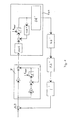
- FIG. 2 shows how a synchronizer and an arrangement interact.
- the synchronizer is supplied with a first digital signal D, which is read in with a clock T D in an elastic memory ES.
- This signal D is mapped into a second digital signal A, which is then transmitted to the arrangement.
- the digital signal D is now to be recovered from the signal A and mapped into the signal S '.
- the bit rates of the signals A and S ' are larger than that of the signal D.
- the recovered signal has a waiting time jitter. This can be done by transferring the average fill level of the memory ES to the arrangement and by evaluating the fill levels using an adder AD, a digital filter F and a Pulse density modulator PDM can be reduced.
- FIG. 1 The most important parts of the synchronizer and arrangement are shown in block diagram form in FIG.
- the arrangement corresponds to the units already shown and described in FIG. 1.
- a frame detector RD ' can also be seen, which detects the frame of the digital signal A and controls the write input of the elastic memory ES'.
- the signals A and S 'each contain the useful signal D, which is written into the elastic memory in a gated manner and read out gently, depending on the predetermined frame.
- the successful reading in of the useful signal is controlled via the write input of the elastic memory and the successful reading out via the read input of the elastic memory.
- the elastic memory inserts the necessary synchronization and frame bits into the gaps in the output signal of the elastic memory generated via the write input.
- a pulse density modulator PDM uses this stuffing ratio to derive the stuffing decision.
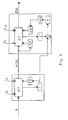
- a "synchronizer" assigned to the arrangement can also be constructed as follows (FIG. 3):
- the "synchronizer” is also an arrangement for repositioning, which is supplied with the first digital signal S (D) which contains the useful signal D.
- the useful signal is written into an elastic memory ES with gaps.
- a frame detector RD detects the frame of the digital signal S (D) and controls the write activation of the elastic memory ES.
- the useful signal D which is inserted into the frame of a digital signal A, is read out from the elastic memory ES.
- the digital signal A has a stuffing frame frequency t SRA . In every darning frame it is possible to plug once.
- a frame generator RG is provided which generates the frame of the digital signal A and controls the read activation of the elastic memory ES. The current fill level of the elastic store ES is determined.
- the current fill levels are accumulated in an integrator I. This happens once for each stuffing frame, that is, with the frequency of the stuffing frame t SRA , which is fed to the integrator. When accumulating, it is not necessary to provide all comparison values as summands.
- the output signal of the integrator I is the average fill level of the elastic memory ES of the nth stuffing frame. This signal is fed to a digital low-pass filter T. The digital low-pass filter is also clocked at the stuffing frame frequency t SRA . Its output signal is the average filtered fill level of the elastic memory of the nth stuffing frame.
- the average filtered memory fill level can be transmitted as additional information in the context of digital signal A to the arrangement according to the invention.
- the mean filtered memory fill level of the nth stuffing frame is fed to a decision maker SE, which makes the stuffing decision depending on the output signal of the low-pass filter T.
- the justification decision is fed to the frame generator RG in the form of a correction value. It is also applied to the digital low pass to correct the low pass output.
- a stuffing decision is made as follows: The stuffing is positive if the mean filtered storage level of the nth stuffing frame is less than a lower threshold for the mean storage level S u .
- the negative is stuffed when the mean filtered storage level of the nth stuffing frame is greater than the upper threshold for the mean storage level S o .
- the mean filtered storage level of the nth tamping frame lies between the upper one Threshold S o and the lower threshold S u , so no plugging is necessary.
- the sawtooth-shaped course of the mean storage level is restored.
- the useful signal D is mapped again into the signal S '(D). The representation of the arrangement corresponds to that from FIG. 2.
Landscapes
- Engineering & Computer Science (AREA)
- Computer Networks & Wireless Communication (AREA)
- Signal Processing (AREA)
- Time-Division Multiplex Systems (AREA)
- Synchronisation In Digital Transmission Systems (AREA)
Applications Claiming Priority (2)
| Application Number | Priority Date | Filing Date | Title |
|---|---|---|---|
| DE4014813 | 1990-05-09 | ||
| DE4014813 | 1990-05-09 |
Publications (3)
| Publication Number | Publication Date |
|---|---|
| EP0455865A2 true EP0455865A2 (fr) | 1991-11-13 |
| EP0455865A3 EP0455865A3 (en) | 1992-09-30 |
| EP0455865B1 EP0455865B1 (fr) | 1995-08-02 |
Family
ID=6405993
Family Applications (1)
| Application Number | Title | Priority Date | Filing Date |
|---|---|---|---|
| EP90122062A Expired - Lifetime EP0455865B1 (fr) | 1990-05-09 | 1990-11-19 | Circuit pour insérer un signal utile d'une trâme d'un premier signal numérique utilisant la technique de bourrage dans une trâme d'un deuxième signal numérique et utilisation d'un tel circuit |
Country Status (2)
| Country | Link |
|---|---|
| EP (1) | EP0455865B1 (fr) |
| DE (1) | DE59009478D1 (fr) |
Family Cites Families (1)
| Publication number | Priority date | Publication date | Assignee | Title |
|---|---|---|---|---|
| EG17964A (en) * | 1985-09-13 | 1991-06-30 | Siemens Ag | A method of transmission for a digital signal |
-
1990
- 1990-11-19 DE DE59009478T patent/DE59009478D1/de not_active Expired - Fee Related
- 1990-11-19 EP EP90122062A patent/EP0455865B1/fr not_active Expired - Lifetime
Also Published As
| Publication number | Publication date |
|---|---|
| EP0455865B1 (fr) | 1995-08-02 |
| EP0455865A3 (en) | 1992-09-30 |
| DE59009478D1 (de) | 1995-09-07 |
Similar Documents
| Publication | Publication Date | Title |
|---|---|---|
| DE69328521T2 (de) | Inkrementaler Phasenglättungsdesynchronisierer und Rechenanordnung | |
| DE69231565T2 (de) | Vorrichtung zur Zeitbasiskorrektur | |
| DE69736532T2 (de) | Synchronisationsgerät | |
| DE69833600T2 (de) | Digitale PLL-Schaltung und Verfahren zur Signalrückgewinnung | |
| DE69217526T2 (de) | Linearer In-line-Desynchronisierer | |
| DE4013317C2 (fr) | ||
| DE3308903A1 (de) | Adaptive schwellenwertvorrichtung | |
| EP0475498B1 (fr) | Circuit d'adaption du débit binaire de deux signaux numériques | |
| EP0503732A2 (fr) | Système de transmission pour la hiérarchie numérique synchrone | |
| DE69132247T2 (de) | Phasenverriegelte Schleifenanordnung | |
| DE69411511T2 (de) | Schaltung zur Taktrückgewinnung mit angepassten Oszillatoren | |
| DE3140683C2 (de) | Zeitdehnungsschaltkreis für Wiedergabesysteme | |
| EP0425041B1 (fr) | Circuit numérique pour le traitement d'un signal d'image analogique avec une horloge asynchrone | |
| DE69620351T2 (de) | Phasenregelschleife im Empfänger zur Zurückgewinnung eines zum Sender synchronen Taktes | |
| EP0455963B1 (fr) | Dispositif et procédé de transformation d'un premier signal utile de la trame d'un premier signal numérique au moyen de technique de justification d'impulsion dans la trame d'un second signal numérique | |
| DE4014814C2 (fr) | ||
| DE19820572A1 (de) | Desynchronisiereinrichtung für ein synchrones digitales Nachrichtenübertragungssystem | |
| EP0455865B1 (fr) | Circuit pour insérer un signal utile d'une trâme d'un premier signal numérique utilisant la technique de bourrage dans une trâme d'un deuxième signal numérique et utilisation d'un tel circuit | |
| DE102006051763A1 (de) | Phasenregelschleife zur Taktgewinnung | |
| EP0461703B1 (fr) | Circuit d'adaption de débit binaire | |
| EP0242446B1 (fr) | Système de mesure du rapport cyclique d'impulsions de fréquence variable | |
| DE4014800C2 (de) | Verfahren zur Ermittlung des mittleren Füllstandes eines elastischen Speichers und Anordnung zur Durchführung des Verfahrens | |
| DE19820658A1 (de) | Digitale Phasenregelschleife für Niedriggeschwindigkeitssignalschaltsystem mit plesiochroner digitaler Hierarchie | |
| DE4218132C2 (de) | Verfahren zur Taktrückgewinnung und Synchronisation | |
| DE10242343A1 (de) | Multinterpolierte Datenwiedergewinnung mit einer relativ niedrigen Abtastrate |
Legal Events
| Date | Code | Title | Description |
|---|---|---|---|
| PUAI | Public reference made under article 153(3) epc to a published international application that has entered the european phase |
Free format text: ORIGINAL CODE: 0009012 |
|
| 17P | Request for examination filed |
Effective date: 19901228 |
|
| AK | Designated contracting states |
Kind code of ref document: A2 Designated state(s): DE FR GB IT SE |
|
| PUAL | Search report despatched |
Free format text: ORIGINAL CODE: 0009013 |
|
| AK | Designated contracting states |
Kind code of ref document: A3 Designated state(s): DE FR GB IT SE |
|
| 17Q | First examination report despatched |
Effective date: 19940520 |
|
| GRAA | (expected) grant |
Free format text: ORIGINAL CODE: 0009210 |
|
| ITF | It: translation for a ep patent filed | ||
| AK | Designated contracting states |
Kind code of ref document: B1 Designated state(s): DE FR GB IT SE |
|
| GBT | Gb: translation of ep patent filed (gb section 77(6)(a)/1977) |
Effective date: 19950807 |
|
| REF | Corresponds to: |
Ref document number: 59009478 Country of ref document: DE Date of ref document: 19950907 |
|
| PG25 | Lapsed in a contracting state [announced via postgrant information from national office to epo] |
Ref country code: SE Effective date: 19951102 |
|
| ET | Fr: translation filed | ||
| PLBE | No opposition filed within time limit |
Free format text: ORIGINAL CODE: 0009261 |
|
| STAA | Information on the status of an ep patent application or granted ep patent |
Free format text: STATUS: NO OPPOSITION FILED WITHIN TIME LIMIT |
|
| 26N | No opposition filed | ||
| PGFP | Annual fee paid to national office [announced via postgrant information from national office to epo] |
Ref country code: SE Payment date: 19961121 Year of fee payment: 7 |
|
| PGFP | Annual fee paid to national office [announced via postgrant information from national office to epo] |
Ref country code: GB Payment date: 19981113 Year of fee payment: 9 |
|
| PGFP | Annual fee paid to national office [announced via postgrant information from national office to epo] |
Ref country code: FR Payment date: 19981119 Year of fee payment: 9 |
|
| PGFP | Annual fee paid to national office [announced via postgrant information from national office to epo] |
Ref country code: DE Payment date: 19990126 Year of fee payment: 9 |
|
| PG25 | Lapsed in a contracting state [announced via postgrant information from national office to epo] |
Ref country code: GB Free format text: LAPSE BECAUSE OF NON-PAYMENT OF DUE FEES Effective date: 19991119 |
|
| GBPC | Gb: european patent ceased through non-payment of renewal fee |
Effective date: 19991119 |
|
| PG25 | Lapsed in a contracting state [announced via postgrant information from national office to epo] |
Ref country code: FR Free format text: LAPSE BECAUSE OF NON-PAYMENT OF DUE FEES Effective date: 20000731 |
|
| PG25 | Lapsed in a contracting state [announced via postgrant information from national office to epo] |
Ref country code: DE Free format text: LAPSE BECAUSE OF NON-PAYMENT OF DUE FEES Effective date: 20000901 |
|
| REG | Reference to a national code |
Ref country code: FR Ref legal event code: ST |
|
| PG25 | Lapsed in a contracting state [announced via postgrant information from national office to epo] |
Ref country code: IT Free format text: LAPSE BECAUSE OF NON-PAYMENT OF DUE FEES;WARNING: LAPSES OF ITALIAN PATENTS WITH EFFECTIVE DATE BEFORE 2007 MAY HAVE OCCURRED AT ANY TIME BEFORE 2007. THE CORRECT EFFECTIVE DATE MAY BE DIFFERENT FROM THE ONE RECORDED. Effective date: 20051119 |