EP0455901A1 - Isolation pour four - Google Patents
Isolation pour four Download PDFInfo
- Publication number
- EP0455901A1 EP0455901A1 EP90305077A EP90305077A EP0455901A1 EP 0455901 A1 EP0455901 A1 EP 0455901A1 EP 90305077 A EP90305077 A EP 90305077A EP 90305077 A EP90305077 A EP 90305077A EP 0455901 A1 EP0455901 A1 EP 0455901A1
- Authority
- EP
- European Patent Office
- Prior art keywords
- shell parts
- heat insulation
- insulation system
- pipe
- pipes
- Prior art date
- Legal status (The legal status is an assumption and is not a legal conclusion. Google has not performed a legal analysis and makes no representation as to the accuracy of the status listed.)
- Withdrawn
Links
- 238000009413 insulation Methods 0.000 title claims abstract description 40
- 230000008878 coupling Effects 0.000 claims abstract description 14
- 238000010168 coupling process Methods 0.000 claims abstract description 14
- 238000005859 coupling reaction Methods 0.000 claims abstract description 14
- 239000000835 fiber Substances 0.000 claims abstract description 12
- 239000000463 material Substances 0.000 claims abstract description 10
- 239000000919 ceramic Substances 0.000 claims abstract description 9
- 239000011257 shell material Substances 0.000 claims description 66
- 239000002184 metal Substances 0.000 claims description 29
- 239000013521 mastic Substances 0.000 claims description 9
- 239000000853 adhesive Substances 0.000 claims description 5
- 230000001070 adhesive effect Effects 0.000 claims description 5
- 239000012530 fluid Substances 0.000 abstract description 4
- 230000007246 mechanism Effects 0.000 description 11
- 229910000831 Steel Inorganic materials 0.000 description 6
- 239000010959 steel Substances 0.000 description 6
- 238000004873 anchoring Methods 0.000 description 4
- 239000011230 binding agent Substances 0.000 description 4
- 238000009434 installation Methods 0.000 description 4
- 239000000498 cooling water Substances 0.000 description 3
- 238000000034 method Methods 0.000 description 3
- 238000009835 boiling Methods 0.000 description 2
- 125000004122 cyclic group Chemical group 0.000 description 2
- 239000012774 insulation material Substances 0.000 description 2
- 230000013011 mating Effects 0.000 description 2
- 230000008439 repair process Effects 0.000 description 2
- 238000005096 rolling process Methods 0.000 description 2
- 230000004075 alteration Effects 0.000 description 1
- 230000015556 catabolic process Effects 0.000 description 1
- 238000006731 degradation reaction Methods 0.000 description 1
- 238000006073 displacement reaction Methods 0.000 description 1
- 230000000694 effects Effects 0.000 description 1
- 238000005538 encapsulation Methods 0.000 description 1
- 238000005265 energy consumption Methods 0.000 description 1
- 238000009422 external insulation Methods 0.000 description 1
- 238000010304 firing Methods 0.000 description 1
- 238000005098 hot rolling Methods 0.000 description 1
- 238000011065 in-situ storage Methods 0.000 description 1
- 239000004816 latex Substances 0.000 description 1
- 229920000126 latex Polymers 0.000 description 1
- 230000014759 maintenance of location Effects 0.000 description 1
- 239000011159 matrix material Substances 0.000 description 1
- 238000004021 metal welding Methods 0.000 description 1
- 230000004048 modification Effects 0.000 description 1
- 238000012986 modification Methods 0.000 description 1
- 230000008569 process Effects 0.000 description 1
- 239000000126 substance Substances 0.000 description 1
- 238000011282 treatment Methods 0.000 description 1
- XLYOFNOQVPJJNP-UHFFFAOYSA-N water Substances O XLYOFNOQVPJJNP-UHFFFAOYSA-N 0.000 description 1
Images


Classifications
-
- F—MECHANICAL ENGINEERING; LIGHTING; HEATING; WEAPONS; BLASTING
- F16—ENGINEERING ELEMENTS AND UNITS; GENERAL MEASURES FOR PRODUCING AND MAINTAINING EFFECTIVE FUNCTIONING OF MACHINES OR INSTALLATIONS; THERMAL INSULATION IN GENERAL
- F16L—PIPES; JOINTS OR FITTINGS FOR PIPES; SUPPORTS FOR PIPES, CABLES OR PROTECTIVE TUBING; MEANS FOR THERMAL INSULATION IN GENERAL
- F16L59/00—Thermal insulation in general
- F16L59/02—Shape or form of insulating materials, with or without coverings integral with the insulating materials
- F16L59/021—Shape or form of insulating materials, with or without coverings integral with the insulating materials comprising a single piece or sleeve, e.g. split sleeves; consisting of two half sleeves; comprising more than two segments
- F16L59/024—Shape or form of insulating materials, with or without coverings integral with the insulating materials comprising a single piece or sleeve, e.g. split sleeves; consisting of two half sleeves; comprising more than two segments consisting of two half sleeves
-
- F—MECHANICAL ENGINEERING; LIGHTING; HEATING; WEAPONS; BLASTING
- F16—ENGINEERING ELEMENTS AND UNITS; GENERAL MEASURES FOR PRODUCING AND MAINTAINING EFFECTIVE FUNCTIONING OF MACHINES OR INSTALLATIONS; THERMAL INSULATION IN GENERAL
- F16L—PIPES; JOINTS OR FITTINGS FOR PIPES; SUPPORTS FOR PIPES, CABLES OR PROTECTIVE TUBING; MEANS FOR THERMAL INSULATION IN GENERAL
- F16L59/00—Thermal insulation in general
- F16L59/14—Arrangements for the insulation of pipes or pipe systems
- F16L59/16—Arrangements specially adapted to local requirements at flanges, junctions, valves or the like
- F16L59/161—Housings for valves, tee pieces, or the like
-
- F—MECHANICAL ENGINEERING; LIGHTING; HEATING; WEAPONS; BLASTING
- F27—FURNACES; KILNS; OVENS; RETORTS
- F27D—DETAILS OR ACCESSORIES OF FURNACES, KILNS, OVENS OR RETORTS, IN SO FAR AS THEY ARE OF KINDS OCCURRING IN MORE THAN ONE KIND OF FURNACE
- F27D3/00—Charging; Discharging; Manipulation of charge
- F27D3/02—Skids or tracks for heavy objects
- F27D3/022—Skids
Definitions
- the present invention is concerned with furnace insulation and in particular with insulation of the skid rail systems used in 'walking beam' and 'pusher' type furnaces.
- 'Walking beam' or 'Pusher' type furnaces are found principally in steel hot rolling mills, although they are to be found in other industries also.
- products steel, or other materials
- the steel billets or other materials are simultaneously heated from a number of points whilst supported on pipes which are located approximately halfway up the vertical height of the furnace and run its whole length.
- skid Pipes' or beams which support the steel are a plurality of pieces of tough, heat-resistant metal which are known as 'Skid Rails'.
- the skid pipes are themselves supported horizontally by vertical pipes of a similar diameter which are known as 'uprights' or 'stand pipes'.
- 'uprights' or 'stand pipes' In order to prevent the skid pipes and stand pipes from softening when the furnace is heated, they are cooled by a continuous internal flow of water. External insulation applied around these pipes prevents the cooling water from boiling and reduces energy consumption.
- Skid pipes which are usually either of circular or triangular section, are traditionally insulated by encapsulating them either in a dense refractory medium or ceramic fibre blanket medium.
- a number of proprietary designs are on the market by which such encapsulation is achieved but all suffer from the same disadvantages as described below.
- a heat insulation system for fluid carrying furnace pipes comprising a plurality of pairs of shell parts adapted to be fitted around a pipe to be insulated, the two shell parts in each pair being connected together mechanically by a coupling means which enables each of the shell parts to be releasable individually from an operational position on the pipe.
- each shell part carries a respective removable metal rod embedded therein, the coupling means being attachable to the two metal rods of the two shell parts to acheive said connection.
- the two shell parts are fabricated from a vacuum formed ceramic fibre material.
- the two shell parts are generally semi-circular in transverse section and of internal diameter dimensioned to fit around the periphery of the pipe, the metal rods being received in respective bores extending within the material of the shell parts, parallel to the longitudinal axis thereof.
- the two shell parts preferably have a generally C-shaped sectional configuration and are adapted to be fitted around the pipe to define a substantially annular sleeve, with the upper facing edges of the two shell parts engaging respective side faces of the skid rails and the lower facing edges of the two shell parts in mutual abutment.
- the respective bores in the two shell parts, which receive the metal rods, are disposed adjacent to, and run substantially the whole length of, said upper facing edges.
- the two shell parts contain recesses intermediate their length, by which the metal rods are exposed from the shell material, the coupling means being attached to the rods in said exposed regions.
- the coupling means comprises a pair of tie means, each of which has a first aperture or hook which receives a respective one of the metal rods and a second aperture which receives a common link bar.
- the link bar is screw-threaded and carries a pair of nuts for selectively retaining the second apertures of the two tie means on the link bar, whereby either of the shell parts can be selectively released from the pipe by removal of the appropriate nut.
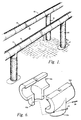
- Fig.1 there is shown part of a walking beam type furnace to which the invention is applied.
- the furnace includes a plurality of pairs of parallel skid pipes 10,12, only one pipe of each pair being shown, carrying skid rails 14.
- the skid pipes 10 comprise hollow metal tubes 16 to the tops of which the skid rails 14 are welded in lines parallel to the respective pipe axes. Adjacent skid rails 14 are separated by a substantially uniform gap, typically of the order of 2.5 - 5.0 cms.
- each pipe 10 is fixed and therefore does not move in operation of the furnace.
- the pipes 12 are arranged to be displaced in a manner such as to advance billets along the furnace.
- the pipes 12 are supported on a cam-type mechanism (not shown) below hearth level which displaces the pipes 12 upwardly, forwardly, downwardly and backwardly in a cyclic manner to achieve forward displacement of the billets along the other, fixed pipes 10.
- the pipes 10,12 are disposed alternately so that each two adjacent fixed pipes 10 has a movable pipe 12 disposed therebetween.
- the upper sides of the skid rails 14 define a discontinuous planar surface on which the billets can slide.
- the horizontal skid pipes 10,12 are supported by respective pluralities of vertical stand pipes or uprights 18,20.
- the stand pipes 18 are fixed rigidly relative to the furnace hearth but the stand pipes 20 are coupled to the cam mechanism (not shown) for achieving the above-described motion of the rails 14, as indicated in Fig.1 by arrows A and B.
- cooling water is passed continuously through the pipes 10,12,18,20 to prevent these pipes from being overheated by the furnace burners.
- the present invention makes use of a system of insulation components made of a very light vacuum cast/formed ceramic fibre which are mounted to the pipes in a manner so that they can be easily mounted/removed without disturbing the insulation system as a whole.
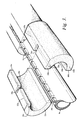
- the insulation system includes a plurality of pairs of mating shells 22a,22b made of the vacuum cast/formed ceramic fibre material.
- Each shell part 22a,22b is of slightly less than semi-circular section so that when butted together around the pipe 10,12, with the skid rails 14 therebetween, they form a substantially continuous sleeve of generally annular configuration, which is cut back somewhat at the top so that the skid rails can project upwardly above the insulation, as best seen in Fig.2.
- each shell part 22a,22b has a pair of front surfaces 24a,24b; 26a,26b separated by an arcuate surface 28a,28b, shaped to fit snugly around the outer periphery of the associated pipe 10,12.
- the lower front surfaces 26a,26b of these shell parts are in direct mutual abutment (see Fig.2).
- the upper front surfaces 24a,24b on the other hand, engage against the respective vertical side surfaces of the skid rails 14 and so are separated by these rails.
- Each shell part 22a,22b is provided with a longitudinally extending through-hole 30a,30b in its upper region adjacent to the respective vertical front surface 24a,24b.
- a respective metal rod 32a,32b Inserted into each through-hole 30a,30b is a respective metal rod 32a,32b, preferably of steel, which is dimensioned so as to occupy substantially the whole length of the associated hole 30.
- the two exposed portions of each pair of rods 32a,32b are arranged to be coupled together mechanically by an anchoring or coupling mechanism 36 shown separately in Fig.4 and shown in situ in Fig.2.
- the coupling mechanism 36 comprises a pair of ties 38a,38b connected respectively to the two metal rods 32a,32b at their exposed regions and interconnected by an adjustable link 40.
- the ties 38a,38b each comprise a length of metal rod/wire having a first loop 42a,42b which is arranged to receive the respective rod 32a,32b and a second loop 44a (not visible in Fig.4) 44b which receives the common adjustable link 40.
- the link 40 comprises a screw-threaded metal rod.
- Respective nuts 46a,46b and washers 48a,48b are disposed outboard of the second loops 44a,44b to enable the two ties to be drawn together and selectively released from the link 40 for the purpose described further hereinafter.
- the recesses 34a,34b are formed on site to enable their position to be selected to suit the position of the chosen gap between two adjacent skid rails 14.
- the fibre-based material of the shells is relatively soft so that the recesses 34 can easily be dug out to expose the rods 32a,32b, using a suitable tool, such as a knife, saw blade, screw-driver or wood-chisel.
- the rods 32a,32b are then inserted longitudinally into the holes 30a,30b, with the respective loops 42a,42b of the ties 38a,38b being disposed over the rods 32 within the respective recesses 34a,34b.
- the link rod 40 is then introduced between the two loops 44a,44b to couple together the two rods 32a,32b (and thereby the two shell parts 22a,22b.
- a high temperature adhesive is applied to the arcuate surfaces 28a,28b of the shells, and possibly also to the surfaces 24a,24b and 26a,26b, and the two shell parts are then offered up to the relevant pipe 10,12.
- the adhesive can be any suitable high-temperature adhesive, such as those sold under the trade names Thermofix or Stellafast.
- the shells are positioned on the pipe so that the link 40 lies between, and spaced from the two selected adjacent skid rails 14 and the nuts are screwed onto the link 40 so as to urge the faces 24a,24b of the shell parts against the adjacent side walls of the skid rails 14. Since the curves of the arcuate faces 28a,28b match the outer periphery of the pipe 10,12, the lower faces 26a,26b automatically lie in mutual abutment.
- a semi-fluid mastic 52 is inserted into the aligned recesses 34a,34b so as to envelope the exposed parts of the metal rods 32a,32b and the whole of the coupling mechanism 36. Mastic is also inserted into all other gaps between the skid rails.
- the upper surface of the mastic can be substantially flush with, or slightly raised above, the surrounding surfaces of the shell parts (see Fig.2).
- the mastic must obviously be capable of withstanding furnace temperatures without degradation and, for this purpose, is preferably ceramic fibre based.
- a plurality of pairs of shell parts 22a,22b are applied in this manner along the length of the pipes 10,12 so as to cover these pipes completely. Any exposed parts remaining can be covered using further mastic or using additional insulation pieces such as shown in Fig.5.
- the insulation piece 48 shown in Fig.5 is formed as a single component of generally C-shaped configuration, the spacing between the ends of which corresponds to the width of the skid rails 14.
- the component 48 is made of essentially the same random fibre matrix as the shell parts 22 but is arranged to be much more flexible by suitable alteration of the chemical binders, used to bind the ceramic fibres. This component 48 can also be made of proprietary blanket.
- the shell parts 22 are intended to be relatively unflexible, and therefore use a binder which is, for example silica- based
- the component uses a binder such as a latex-based binder which provides flexibility.
- the component 48 can thereby be applied over a pipe 10,12 by deforming it in the direction X, Y in Fig.5 to open up the arms.
- the mating shell parts 22 As T-pieces, as shown in Fig.6.
- the two shell parts 22c,22d shown in Fig.6 fit together in an exactly analogous manner to parts 22a,22b except that they have depending part-circular portions 52a,52b which automatically abut one another in a similar manner to the surfaces 26a,26b.
- a pair of pins or nails 54 can be driven, preferably obliquely, through the abutting shell parts on each side of the enclosed vertical pipe 20.
- the shell parts disposed on the stand pipes 20 below the T-pieces can, of course, be fully semi-circular since no skid rails are to be accommodated.
- the T-pieces shown in Fig.6 have depending portions 52a,52b, such portions are not essential and the T-pieces may simply be two semi-circular sectioned pieces with respective part-circular cut-outs to accommodate the adjoining top portions of the vertical stand pipes.
- the mastic can be chipped away to reveal the relevant nut 46, enabling this to be unscrewed to release the relevant tie 38.
- the whole of this shell part can then be pulled or chipped away, together with its metal rod 32.
- the rod can then be inserted into a new shell part, with the tie located on the rod in a suitable recess 34, and this shell part presented to the pipe so that the link 40 engages back into the loop 44 of the tie.
- the nut is replaced and screwed up to anchor the new shell part in place.
- Adhesive is pre-applied to the new shell part, as before.
Landscapes
- Engineering & Computer Science (AREA)
- General Engineering & Computer Science (AREA)
- Mechanical Engineering (AREA)
- Heat Treatments In General, Especially Conveying And Cooling (AREA)
- Thermal Insulation (AREA)
Priority Applications (3)
| Application Number | Priority Date | Filing Date | Title |
|---|---|---|---|
| EP90305077A EP0455901A1 (fr) | 1990-05-11 | 1990-05-11 | Isolation pour four |
| PCT/GB1991/000742 WO1991018251A1 (fr) | 1990-05-11 | 1991-05-10 | Isolation pour four |
| AU78627/91A AU7862791A (en) | 1990-05-11 | 1991-05-10 | Furnace insulation |
Applications Claiming Priority (1)
| Application Number | Priority Date | Filing Date | Title |
|---|---|---|---|
| EP90305077A EP0455901A1 (fr) | 1990-05-11 | 1990-05-11 | Isolation pour four |
Publications (1)
| Publication Number | Publication Date |
|---|---|
| EP0455901A1 true EP0455901A1 (fr) | 1991-11-13 |
Family
ID=8205417
Family Applications (1)
| Application Number | Title | Priority Date | Filing Date |
|---|---|---|---|
| EP90305077A Withdrawn EP0455901A1 (fr) | 1990-05-11 | 1990-05-11 | Isolation pour four |
Country Status (3)
| Country | Link |
|---|---|
| EP (1) | EP0455901A1 (fr) |
| AU (1) | AU7862791A (fr) |
| WO (1) | WO1991018251A1 (fr) |
Citations (7)
| Publication number | Priority date | Publication date | Assignee | Title |
|---|---|---|---|---|
| GB190511380A (en) * | 1905-05-31 | 1905-07-27 | Walter Ingham Sutcliffe | An Improved Construction of Heat Non-conducting Cover for the Flanges of Steam Pipes and the like. |
| DE1243224B (de) * | 1964-12-30 | 1967-06-29 | Voest Ag | Isolierung fuer gekuehlte Rohre bei Stossoefen |
| FR2192694A5 (fr) * | 1972-07-06 | 1974-02-08 | Urquhart Eng Co Ltd | |
| FR2353032A1 (fr) * | 1976-05-26 | 1977-12-23 | Johns Manville | Isolation de tuyaux de glissement pour fours a rechauffer dans des acieries |
| US4312385A (en) * | 1980-01-31 | 1982-01-26 | Matthias Magera | Refractory insulation for cooling pipes in reheating furnaces |
| EP0125753A1 (fr) * | 1983-04-11 | 1984-11-21 | Cameron Iron Works, Inc. | Calorifugeage pour tuyaux |
| FR2619615A1 (fr) * | 1987-08-21 | 1989-02-24 | Didier Werke Ag | Isolation thermique refractaire, pour tubes coulissants, porteurs ou transversaux d'une installation de chauffe |
-
1990
- 1990-05-11 EP EP90305077A patent/EP0455901A1/fr not_active Withdrawn
-
1991
- 1991-05-10 WO PCT/GB1991/000742 patent/WO1991018251A1/fr not_active Ceased
- 1991-05-10 AU AU78627/91A patent/AU7862791A/en not_active Abandoned
Patent Citations (7)
| Publication number | Priority date | Publication date | Assignee | Title |
|---|---|---|---|---|
| GB190511380A (en) * | 1905-05-31 | 1905-07-27 | Walter Ingham Sutcliffe | An Improved Construction of Heat Non-conducting Cover for the Flanges of Steam Pipes and the like. |
| DE1243224B (de) * | 1964-12-30 | 1967-06-29 | Voest Ag | Isolierung fuer gekuehlte Rohre bei Stossoefen |
| FR2192694A5 (fr) * | 1972-07-06 | 1974-02-08 | Urquhart Eng Co Ltd | |
| FR2353032A1 (fr) * | 1976-05-26 | 1977-12-23 | Johns Manville | Isolation de tuyaux de glissement pour fours a rechauffer dans des acieries |
| US4312385A (en) * | 1980-01-31 | 1982-01-26 | Matthias Magera | Refractory insulation for cooling pipes in reheating furnaces |
| EP0125753A1 (fr) * | 1983-04-11 | 1984-11-21 | Cameron Iron Works, Inc. | Calorifugeage pour tuyaux |
| FR2619615A1 (fr) * | 1987-08-21 | 1989-02-24 | Didier Werke Ag | Isolation thermique refractaire, pour tubes coulissants, porteurs ou transversaux d'une installation de chauffe |
Also Published As
| Publication number | Publication date |
|---|---|
| WO1991018251A1 (fr) | 1991-11-28 |
| AU7862791A (en) | 1991-12-10 |
Similar Documents
| Publication | Publication Date | Title |
|---|---|---|
| US20190154338A1 (en) | Stave with external manifold | |
| US3781167A (en) | No-weld refractory covering for water cooled pipes | |
| US4246852A (en) | Industrial furnace with ceramic insulating modules | |
| US5243801A (en) | Refractory tile for heat exchanger protection | |
| GB1596288A (en) | Apparatus and method for thermally insulating an element from a wall | |
| US4569659A (en) | Refractory lining for a furnace | |
| US3804585A (en) | Precast furnace pipe insulation | |
| US20180149429A1 (en) | Stave with external manifold | |
| US3647194A (en) | Protective refractory member | |
| WO1991018251A1 (fr) | Isolation pour four | |
| EP0656508A2 (fr) | Carreau et joint de dilatation pour four | |
| EP0304429A1 (fr) | Four de graphitisation mobile. | |
| US3340832A (en) | Refractory roof and method | |
| US4140483A (en) | Refractory insulation | |
| US1913168A (en) | Suspended refractory structures | |
| US4932187A (en) | Refractory anchor system and method | |
| CS216944B2 (en) | Isolator | |
| US4704155A (en) | Heating vessel lid construction for a glass melting furnace | |
| US4305706A (en) | Unitary protective refractory member | |
| US5154605A (en) | Refractory tile section for reheating furnaces | |
| US3589316A (en) | Panelized suspended roof for reverberatory furnace | |
| RU2357169C1 (ru) | Способ формирования обмуровки теплотехнического агрегата | |
| WO2004109208A2 (fr) | Systemes de support et de refroidissement pour plafonds de chambre de combustion | |
| US4288219A (en) | Refractory insulated member and method of installation thereof in a reheat furnace | |
| US4049371A (en) | Pipe insulation |
Legal Events
| Date | Code | Title | Description |
|---|---|---|---|
| PUAI | Public reference made under article 153(3) epc to a published international application that has entered the european phase |
Free format text: ORIGINAL CODE: 0009012 |
|
| AK | Designated contracting states |
Kind code of ref document: A1 Designated state(s): AT BE CH DE DK ES FR GB GR IT LI LU NL SE |
|
| STAA | Information on the status of an ep patent application or granted ep patent |
Free format text: STATUS: THE APPLICATION IS DEEMED TO BE WITHDRAWN |
|
| 18D | Application deemed to be withdrawn |
Effective date: 19920514 |