EP0455914A2 - Rideau plissé et procédé de fabrication - Google Patents
Rideau plissé et procédé de fabrication Download PDFInfo
- Publication number
- EP0455914A2 EP0455914A2 EP90314237A EP90314237A EP0455914A2 EP 0455914 A2 EP0455914 A2 EP 0455914A2 EP 90314237 A EP90314237 A EP 90314237A EP 90314237 A EP90314237 A EP 90314237A EP 0455914 A2 EP0455914 A2 EP 0455914A2
- Authority
- EP
- European Patent Office
- Prior art keywords
- creases
- shade
- cell
- length
- cells
- Prior art date
- Legal status (The legal status is an assumption and is not a legal conclusion. Google has not performed a legal analysis and makes no representation as to the accuracy of the status listed.)
- Granted
Links
- 238000004519 manufacturing process Methods 0.000 title claims description 16
- 239000000463 material Substances 0.000 claims abstract description 109
- 238000005304 joining Methods 0.000 claims abstract description 9
- 238000000034 method Methods 0.000 claims description 18
- 230000010261 cell growth Effects 0.000 claims description 3
- 230000008602 contraction Effects 0.000 claims description 3
- 210000004027 cell Anatomy 0.000 description 57
- 239000000853 adhesive Substances 0.000 description 11
- 230000001070 adhesive effect Effects 0.000 description 11
- 239000011324 bead Substances 0.000 description 5
- 239000004744 fabric Substances 0.000 description 5
- 238000010276 construction Methods 0.000 description 4
- 229920000742 Cotton Polymers 0.000 description 2
- 229920002472 Starch Polymers 0.000 description 2
- 230000015572 biosynthetic process Effects 0.000 description 2
- 230000001413 cellular effect Effects 0.000 description 2
- 210000003850 cellular structure Anatomy 0.000 description 2
- 238000009413 insulation Methods 0.000 description 2
- 229920000728 polyester Polymers 0.000 description 2
- 235000019698 starch Nutrition 0.000 description 2
- 239000008107 starch Substances 0.000 description 2
- 230000000740 bleeding effect Effects 0.000 description 1
- 238000010438 heat treatment Methods 0.000 description 1
- 238000005192 partition Methods 0.000 description 1
- 229920006267 polyester film Polymers 0.000 description 1
- 238000003825 pressing Methods 0.000 description 1
- 238000004513 sizing Methods 0.000 description 1
- 239000007779 soft material Substances 0.000 description 1
- 230000003068 static effect Effects 0.000 description 1
- 229920002994 synthetic fiber Polymers 0.000 description 1
- 230000007704 transition Effects 0.000 description 1
- XLYOFNOQVPJJNP-UHFFFAOYSA-N water Substances O XLYOFNOQVPJJNP-UHFFFAOYSA-N 0.000 description 1
Images

Classifications
-
- E—FIXED CONSTRUCTIONS
- E06—DOORS, WINDOWS, SHUTTERS, OR ROLLER BLINDS IN GENERAL; LADDERS
- E06B—FIXED OR MOVABLE CLOSURES FOR OPENINGS IN BUILDINGS, VEHICLES, FENCES OR LIKE ENCLOSURES IN GENERAL, e.g. DOORS, WINDOWS, BLINDS, GATES
- E06B9/00—Screening or protective devices for wall or similar openings, with or without operating or securing mechanisms; Closures of similar construction
- E06B9/24—Screens or other constructions affording protection against light, especially against sunshine; Similar screens for privacy or appearance; Slat blinds
- E06B9/26—Lamellar or like blinds, e.g. venetian blinds
- E06B9/262—Lamellar or like blinds, e.g. venetian blinds with flexibly-interconnected horizontal or vertical strips; Concertina blinds, i.e. upwardly folding flexible screens
-
- B—PERFORMING OPERATIONS; TRANSPORTING
- B29—WORKING OF PLASTICS; WORKING OF SUBSTANCES IN A PLASTIC STATE IN GENERAL
- B29C—SHAPING OR JOINING OF PLASTICS; SHAPING OF MATERIAL IN A PLASTIC STATE, NOT OTHERWISE PROVIDED FOR; AFTER-TREATMENT OF THE SHAPED PRODUCTS, e.g. REPAIRING
- B29C53/00—Shaping by bending, folding, twisting, straightening or flattening; Apparatus therefor
- B29C53/36—Bending and joining, e.g. for making hollow articles
-
- B—PERFORMING OPERATIONS; TRANSPORTING
- B31—MAKING ARTICLES OF PAPER, CARDBOARD OR MATERIAL WORKED IN A MANNER ANALOGOUS TO PAPER; WORKING PAPER, CARDBOARD OR MATERIAL WORKED IN A MANNER ANALOGOUS TO PAPER
- B31D—MAKING ARTICLES OF PAPER, CARDBOARD OR MATERIAL WORKED IN A MANNER ANALOGOUS TO PAPER, NOT PROVIDED FOR IN SUBCLASSES B31B OR B31C
- B31D3/00—Making articles of cellular structure, e.g. insulating board
- B31D3/02—Making articles of cellular structure, e.g. insulating board honeycombed structures, i.e. the cells having an essentially hexagonal section
- B31D3/0207—Making articles of cellular structure, e.g. insulating board honeycombed structures, i.e. the cells having an essentially hexagonal section of particular shape or construction
- B31D3/0215—Making articles of cellular structure, e.g. insulating board honeycombed structures, i.e. the cells having an essentially hexagonal section of particular shape or construction for window coverings
-
- E—FIXED CONSTRUCTIONS
- E06—DOORS, WINDOWS, SHUTTERS, OR ROLLER BLINDS IN GENERAL; LADDERS
- E06B—FIXED OR MOVABLE CLOSURES FOR OPENINGS IN BUILDINGS, VEHICLES, FENCES OR LIKE ENCLOSURES IN GENERAL, e.g. DOORS, WINDOWS, BLINDS, GATES
- E06B9/00—Screening or protective devices for wall or similar openings, with or without operating or securing mechanisms; Closures of similar construction
- E06B9/24—Screens or other constructions affording protection against light, especially against sunshine; Similar screens for privacy or appearance; Slat blinds
- E06B9/26—Lamellar or like blinds, e.g. venetian blinds
- E06B9/266—Devices or accessories for making or mounting lamellar blinds or parts thereof
-
- B—PERFORMING OPERATIONS; TRANSPORTING
- B29—WORKING OF PLASTICS; WORKING OF SUBSTANCES IN A PLASTIC STATE IN GENERAL
- B29L—INDEXING SCHEME ASSOCIATED WITH SUBCLASS B29C, RELATING TO PARTICULAR ARTICLES
- B29L2031/00—Other particular articles
- B29L2031/719—Curtains; Blinds; Shades
- B29L2031/7192—Venetian blinds
-
- E—FIXED CONSTRUCTIONS
- E06—DOORS, WINDOWS, SHUTTERS, OR ROLLER BLINDS IN GENERAL; LADDERS
- E06B—FIXED OR MOVABLE CLOSURES FOR OPENINGS IN BUILDINGS, VEHICLES, FENCES OR LIKE ENCLOSURES IN GENERAL, e.g. DOORS, WINDOWS, BLINDS, GATES
- E06B9/00—Screening or protective devices for wall or similar openings, with or without operating or securing mechanisms; Closures of similar construction
- E06B9/24—Screens or other constructions affording protection against light, especially against sunshine; Similar screens for privacy or appearance; Slat blinds
- E06B2009/2423—Combinations of at least two screens
- E06B2009/2435—Two vertical sheets and slats in-between
-
- E—FIXED CONSTRUCTIONS
- E06—DOORS, WINDOWS, SHUTTERS, OR ROLLER BLINDS IN GENERAL; LADDERS
- E06B—FIXED OR MOVABLE CLOSURES FOR OPENINGS IN BUILDINGS, VEHICLES, FENCES OR LIKE ENCLOSURES IN GENERAL, e.g. DOORS, WINDOWS, BLINDS, GATES
- E06B9/00—Screening or protective devices for wall or similar openings, with or without operating or securing mechanisms; Closures of similar construction
- E06B9/24—Screens or other constructions affording protection against light, especially against sunshine; Similar screens for privacy or appearance; Slat blinds
- E06B2009/2423—Combinations of at least two screens
- E06B2009/2441—Screens joined one below the other
-
- E—FIXED CONSTRUCTIONS
- E06—DOORS, WINDOWS, SHUTTERS, OR ROLLER BLINDS IN GENERAL; LADDERS
- E06B—FIXED OR MOVABLE CLOSURES FOR OPENINGS IN BUILDINGS, VEHICLES, FENCES OR LIKE ENCLOSURES IN GENERAL, e.g. DOORS, WINDOWS, BLINDS, GATES
- E06B9/00—Screening or protective devices for wall or similar openings, with or without operating or securing mechanisms; Closures of similar construction
- E06B9/24—Screens or other constructions affording protection against light, especially against sunshine; Similar screens for privacy or appearance; Slat blinds
- E06B9/26—Lamellar or like blinds, e.g. venetian blinds
- E06B9/262—Lamellar or like blinds, e.g. venetian blinds with flexibly-interconnected horizontal or vertical strips; Concertina blinds, i.e. upwardly folding flexible screens
- E06B2009/2627—Cellular screens, e.g. box or honeycomb-like
-
- Y—GENERAL TAGGING OF NEW TECHNOLOGICAL DEVELOPMENTS; GENERAL TAGGING OF CROSS-SECTIONAL TECHNOLOGIES SPANNING OVER SEVERAL SECTIONS OF THE IPC; TECHNICAL SUBJECTS COVERED BY FORMER USPC CROSS-REFERENCE ART COLLECTIONS [XRACs] AND DIGESTS
- Y10—TECHNICAL SUBJECTS COVERED BY FORMER USPC
- Y10T—TECHNICAL SUBJECTS COVERED BY FORMER US CLASSIFICATION
- Y10T156/00—Adhesive bonding and miscellaneous chemical manufacture
- Y10T156/10—Methods of surface bonding and/or assembly therefor
- Y10T156/1002—Methods of surface bonding and/or assembly therefor with permanent bending or reshaping or surface deformation of self sustaining lamina
- Y10T156/1003—Methods of surface bonding and/or assembly therefor with permanent bending or reshaping or surface deformation of self sustaining lamina by separating laminae between spaced secured areas [e.g., honeycomb expanding]
-
- Y—GENERAL TAGGING OF NEW TECHNOLOGICAL DEVELOPMENTS; GENERAL TAGGING OF CROSS-SECTIONAL TECHNOLOGIES SPANNING OVER SEVERAL SECTIONS OF THE IPC; TECHNICAL SUBJECTS COVERED BY FORMER USPC CROSS-REFERENCE ART COLLECTIONS [XRACs] AND DIGESTS
- Y10—TECHNICAL SUBJECTS COVERED BY FORMER USPC
- Y10T—TECHNICAL SUBJECTS COVERED BY FORMER US CLASSIFICATION
- Y10T156/00—Adhesive bonding and miscellaneous chemical manufacture
- Y10T156/10—Methods of surface bonding and/or assembly therefor
- Y10T156/1002—Methods of surface bonding and/or assembly therefor with permanent bending or reshaping or surface deformation of self sustaining lamina
- Y10T156/1007—Running or continuous length work
- Y10T156/1015—Folding
-
- Y—GENERAL TAGGING OF NEW TECHNOLOGICAL DEVELOPMENTS; GENERAL TAGGING OF CROSS-SECTIONAL TECHNOLOGIES SPANNING OVER SEVERAL SECTIONS OF THE IPC; TECHNICAL SUBJECTS COVERED BY FORMER USPC CROSS-REFERENCE ART COLLECTIONS [XRACs] AND DIGESTS
- Y10—TECHNICAL SUBJECTS COVERED BY FORMER USPC
- Y10T—TECHNICAL SUBJECTS COVERED BY FORMER US CLASSIFICATION
- Y10T428/00—Stock material or miscellaneous articles
- Y10T428/24—Structurally defined web or sheet [e.g., overall dimension, etc.]
- Y10T428/24149—Honeycomb-like
-
- Y—GENERAL TAGGING OF NEW TECHNOLOGICAL DEVELOPMENTS; GENERAL TAGGING OF CROSS-SECTIONAL TECHNOLOGIES SPANNING OVER SEVERAL SECTIONS OF THE IPC; TECHNICAL SUBJECTS COVERED BY FORMER USPC CROSS-REFERENCE ART COLLECTIONS [XRACs] AND DIGESTS
- Y10—TECHNICAL SUBJECTS COVERED BY FORMER USPC
- Y10T—TECHNICAL SUBJECTS COVERED BY FORMER US CLASSIFICATION
- Y10T428/00—Stock material or miscellaneous articles
- Y10T428/24—Structurally defined web or sheet [e.g., overall dimension, etc.]
- Y10T428/24744—Longitudinal or transverse tubular cavity or cell
Definitions
- This invention relates to an improved window covering.
- US-A-2201356 discloses a window shade made by joining two folded sheets having interior and exterior folds.
- Figures 4 and 5 show an asymmetrical embodiment where the interior folds of one sheet are joined to the exterior folds of one sheet are joined to the exterior folds of the other sheet.
- US-A-3892898 relates to a honeycomb panel core having interlocking expandable and contractible W-shaped and V-shaped components disposed between partition plates.
- US-A-4347887 shows a "thermal shutter".
- a wide band of material is folded transversely to form a double row column of adjacent cells, which may have rounded visible contours.
- the cells are adhesively bonded to one another and are symmetrical, so that both sides of the shade thus formed have essentially the same appearance.
- US-A-4631217, 4676855 and 4677013 show in Figure 3 a shade of asymmetrical construction.
- a rear wall section of each cell is essentially straight or linear when the shade is in its expanded position. The width of these rear wall sections thus defines the spacing of the adjacent cells, while the front of each cell, containing more material, maintains a non-linear shape.
- US-A-4685986 shows in Figures 1 and 3 shades of nearly symmetrical construction and symmetrical construction, respectively.
- the cellular shade is formed by joining two pleated lengths of material along opposing pleats.
- Figure 6 shows an asymmetrical embodiment of the invention, in which the rear wall is essentially straight when the shade is in its expanded position.
- US-A-4846243 shows a foldable window covering formed of a wide relatively soft material folded transversely, to yield a collapsible shade.
- the front surface of the shade consists of a material doubled back on itself.
- the successive cells are spaced in the expanded position of the shade by a relatively vertical rear wall section of each cell.
- US-A-4861404 shows a method of making a honeycomb product from two sheets of pleated material. Alternating pleats are formed of large and small dimensions, and end parts of the large pleats are then bonded together to form leg portions. These leg portions are then joined to opposing pleats of another sheet.
- an expandable and contractible shade comprising a series of parallelly arranged generally tubular cells, with the longitudinal cell axis transverse to the direction of expansion and contraction of the window shade, said shade comprising at least a number of sequential cells having back faces commonly defined by a first, single piece of flexible material; at least said number of sequential cells having front faces commonly defined by a second, single piece of flexible material having a first set of transverse creases spaced along the length thereof; the first and second pieces of material being fixedly joined to form the cells with the first set of transverse creases of the second material pointing towards the first material; and at least one cell of said sequential cells comprises a front wall portion defining a curved appearing surface projecting outwardly and away from its back face and drooping downwardly at least to the juncture of said at least one cell with a directly adjacent lower cell when said window shade is in the expanded state.
- the invention also provides a method of fabricating a flexible honeycomb shade member having a plurality of superimposed cells parallel to a main surface thereof in the expanded condition of the shade member comprising the steps of:
- the structure of the invention which may be produced by the above method, provides an inexpensive shade with a pleasing appearance.
- the shade shown in Figs. 1 and 2 comprises a series 1 of parallelly arranged cells 2 extending horizontally and fitted with a bottom rail 3 and a head rail 4 (omitted from Fig. 2 for clarity).
- the series is adapted to be fitted into a window opening, for example, with the longitudinal cell axis transverse to the direction of expansion and contraction of the assembly.
- the motion of the shade between the collapsed state of Fig. 1 and the expanded state of Fig. 2 is controlled by lift cords 5 extending from the bottom rail 3 upwardly across the cells 2, and into the head rail 4.
- the cords are directed by generally conventional control pulleys, guides and the like, and are engaged by a conventional locking dog engaging mechanism (not shown).
- the open ended tubular cells 2 are formed by first and second sheets 18, 19 of flexible fabric material, each having a set of transverse creases defining pleats, and the sheets are joined to one another in the area of confronting, inwardly-directed first creases 20, 22 (i.e. the creases which point toward the center of the shade when complete).
- First sheet 18 defines back faces of the cells
- second sheet 19 defines front faces of the cells, the faces being those portions which are visible when the shade is in use.
- the sheet which makes up the back of the shade has a second set of outwardly-directed creases 21 to aid in the manufacture and operation of the shade.
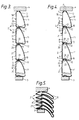
- Each cell 2 has a cross-sectional shape including a drooping front wall 11 extending downwardly from the top portion of each cell at least as far as the juncture between the cell and the directly adjacent lower cell when the shade is in the expanded state and projecting outwardly and away from its back face, so that each cell is wider toward its bottom. Accordingly, when the shade is in its collapsed state as shown in Fig. 1, the drooping loop formed by each cell extends well below the juncture with the adjacent lower cell.
- these shades are disposed between opposed surfaces of the casing of a window.
- the width of the shade is preferably chosen so that the ends of the cells approach the casing closely, such that little air flow takes place through the cells. In this way, the air mass in each cell is essentially static, whereby the cells of air form very effective thermal insulation.
- the pleated sheets of material are joined by beads 6 of adhesive at confronting first creases 20, 22 which partially overlap each other.
- One of these sheets 18 defines a rear wall portion 8 extending downwardly from a top rear portion 7, and a bottom rear portion 9 extending forwardly from the rear wall portion.
- the second sheet of pleated material 19 defines a front wall portion 11 extending downwardly from a top front portion 12, and a bottom front portion 10 extending rearwardly from the front wall.
- the top front portion 12 of one cell is bonded by the bead 6 of adhesive to the bottom rear portion 9 of the adjacent upper cell.
- the formed cells in cross-section effectively define continuous closed loops of material.
- the cell be asymmetrical such that the rear wall portion 8 is of substantially less height (as measured in the vertical direction of the final window covering, transverse to the longitudinal axis of the cell) than the front wall portion 11.
- the rear wall portion would determine the amount of cell expansion which is possible.
- each cell can be arranged to be of predetermined height from the top to the bottom of the shade, for effecting the desired appearance.
- the extent of cell expansion of the assembly is thus controlled by the height of the rear wall portion 8 of each cell; this, together with the amount of material in the front wall portion, determines the curvature of the generally curved surface of the front wall portion 11 of the cell.
- the entire sheet be formed of a relatively soft and flexible fabric material so that in the expanded position shown in Fig. 3, the front wall portion 11 droops downwardly and outwardly away from the rear wall 8, forming a smoothly rounded curve.
- the lowest part of the front wall portion is level or beneath the juncture of the cell with the directly adjacent lower cell. This provides an extremely attractive appearance. It is further preferred that the front wall portion not be creased perceptibly when the shade is in use, principally for aesthetic reasons.
- One sheet may be provided with a first set of pleats, which are joined at intervals along the length of a second, unplated material.
- a minimum of one set of pleats on one sheet is therefore required.
- a temporary crease to assist in manufacture of the shade of the invention can be provided in a number of ways. For example, in order to form a permanent crease in a polyester film material, it is necessary to heat the material to a given temperature while folding it and to press it against a hard surface to form a sharply set crease. However, a temporary crease can be formed during the manufacturing process by pressure with a limited amount of heating. If the shade is then hung and allowed to expand, and the crease is heated above a transition temperature, the polyester material will tend to return to its original shape, so that the temporary crease will effectively disappear.
- a cotton fabric with a water soluble sizing such as starch can be used to form the shade of the invention.
- a cotton fabric with a water soluble sizing such as starch can be used to form the shade of the invention.
- Such a sized cotton fabric can be creased as if it were paper.
- the starch can be dissolved if the shade is subsequently hung out and wetted, removing the creases. Similar techniques may be useful with polyester and synthetic materials.
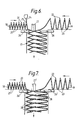
- the basic method of forming the series of cells of the embodiment of Fig. 3 includes an initial step of folding the sheets of material into a pleated form as shown in Fig. 6.
- the basic method is fully disclosed, most particularly at column 4, line 15 through column 6, line 50, in US-A-4685986, the disclosures of which is incorporated herein by reference.
- an object of the preferred embodiment of the invention to provide a shade having cells each with the appearance of a smooth and uncreased curved front wall portion 11, and in which permanent creases are avoided during assembly.
- an expandable-collapsible honeycomb structure is provided from two pleated lengths of material; one of these materials will form one side of the honeycomb structure, while the other will form the other side.
- they can be made of the same or different material.
- the creases in the material can be formed as part of the honeycomb forming process or can be preformed. In any event, the pleated materials are joined together along their creased areas. Permanently creasing the front wall portions in the same manner as in US-A-4685986 is avoided, to provide smooth front wall portions for the sake of appearance.
- Figs. 6 and 7 of the present application partially show the apparatus of the US-A-4685986, as used in accordance with the teachings of the present invention.
- the two sheets of material are attached in the area of confronting, inwardly-directed creases.
- the honeycomb structure 17 is formed by continuously feeding a continuous length of each of the materials 18 and 19 longitudinally of their length and in directions extending toward each other.
- the first material 18 has a first set of transverse creases 20, and a second et of transverse creases 21 spaced along the length of the material in alternating fashion.
- the second piece of material 19 has only a first set of transverse creases 22.
- the first sets of creases on both materials permit the materials to collapse in the accordion fashion shown in Fig. 6 where the creases define the points at which the material folds for the shade to collapse.
- first and second materials are fed in opposite directions, they are fed along a first path in partially collapsed condition. As they near each other, they are progressively brought into and fed along a common second path.
- the successive confronting and inwardly-directed creases 20 and 22 of the two pieces of material are brought into partially overlapping relationship as they are turned from their first path into the common second path and they are then directly attached together in this overlapping relationship.
- adhesive may be applied to one or both of the materials adjacent the creases 20 and 22.
- Fig. 6 shows schematically an adhesive applicator at 24 for applying a bead of adhesive 25 to one side of each of the creases 20. This adhesive may extend the full length of the crease or may be applied intermittently.
- the successive confronting creases 20, 22 are brought into overlapping relationship, they are supported by suitable backup structure 26 while a pressure member 27 moves down onto the overlapped creases to press them into adhering relationship.
- the backup structure 26 can be intermittently moved into and out of supporting relationship and can also be used to move the combined cell structure downwardly along the second common path after each set of creases is secured together. After the materials are joined together, they are collected in their common path. Throughout the process, formation of permanent creases in the front faces of the cells is avoided. Details of this process are found in US-A-4685986.
- the confronting, inwardly-directed creases 20, 22 aid in the folding of the two materials in accordion pleated fashion as the cells are moved to and from collapsed and expanded condition.
- the first material 18 has an additional set of outwardly-directed creases 21, in alternating relation with creases 20, which will also aid in the folding of the two materials and will give the shade a pleated appearance on one side.
- the other material does not have outwardly-directed creases, but rather is allowed to fold up in accordion-like fashion while providing a smoothly-curved drooping surface when the window covering is completed.
- Temporary creases or smooth folds may be formed at 23 to aid in the manufacturing process.
- the distance between creases 22 is greater than the distance between creases 20, in order that material 18 provides a rear wall of the shade which determines the maximum possible expansion of the shade. Material 19 therefore will provide the drooping appearance desired for the shade even in the fully expanded state.
- the connecting of the adjacent cells together is effected while the two materials 18 and 19 are maintained in partially expanded condition.
- any bleeding of adhesive through the materials during he adhesive application or pressing operation will not cause any severe manufacturing problems.
- Fig. 7 showing schematically the method of manufacture used in producing the honeycomb structures of Fig. 4, the two pieces of pleated material are fed along a first path, and as they are turned into a second common path, the creases 20, 22 are brought into laterally spaced relationship with each other. As each pair of associated creases attains this relationship, a piece of strip material 28 is brought into overlaying relationship with the creased areas and joined thereto.
- suitable support means 26' and a cooperating pressure member 27' are used, similar in construction and operation to corresponding means shown in Fig. 6. Details of this method may be found in US-A-4685986.
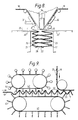
- FIG. 8 An alternative manufacturing process, shown in Fig. 8, both pleats and joins the materials to form a shade similar to that shown in Fig. 7.
- the additional step of pleating materials 18 and 19 is carried out respectively, by first reciprocating forming knife 31 and second reciprocating forming knife 32.
- Second forming knife 32 has a curved surface 33 on one side to avoid creasing material 19 on its surface over what will be the front faces of the cells.
- Support structures 34 provide the surface against which the forming knives press the materials during pleat formation.
- Surface 35 further assists the first forming knife 31 by providing a surface against which outside pleats 20 can be formed on material 18.
- the remainder of the process shown in Fig. 8 is substantially the same as shown in Fig. 7.
- FIG. 9 Another alternative manufacturing process is shown in Fig. 9, which may be used to form the shade of the invention where only one set of pleats is formed on one sheet of material.
- material 18 is fed between first forming conveyor 41 and second forming conveyor 42.
- First forming conveyor 41 has knife portions 43 which, in cooperation with support portions 44 of second forming conveyor 42, create creases 22 in material 19.
- Material 19 is provided uncreased, with beads of adhesive 25 at intervals along its length. Material 19 is joined at creases 22 to material 18 by these beads of adhesive.
- the resulting shade structure will have no outwardly-pointing creases, and will have a smoothly drooping front wall portion.
Landscapes
- Engineering & Computer Science (AREA)
- Structural Engineering (AREA)
- Architecture (AREA)
- Civil Engineering (AREA)
- Mechanical Engineering (AREA)
- Blinds (AREA)
- Liquid Crystal (AREA)
- Curtains And Furnishings For Windows Or Doors (AREA)
- Pyridine Compounds (AREA)
- Acyclic And Carbocyclic Compounds In Medicinal Compositions (AREA)
- Plural Heterocyclic Compounds (AREA)
- Surface Treatment Of Glass Fibres Or Filaments (AREA)
- Window Of Vehicle (AREA)
Applications Claiming Priority (2)
| Application Number | Priority Date | Filing Date | Title |
|---|---|---|---|
| US520932 | 1990-05-09 | ||
| US07/520,932 US5104469A (en) | 1990-05-09 | 1990-05-09 | Method of making a roman shade |
Publications (3)
| Publication Number | Publication Date |
|---|---|
| EP0455914A2 true EP0455914A2 (fr) | 1991-11-13 |
| EP0455914A3 EP0455914A3 (en) | 1992-12-09 |
| EP0455914B1 EP0455914B1 (fr) | 1996-04-24 |
Family
ID=24074632
Family Applications (1)
| Application Number | Title | Priority Date | Filing Date |
|---|---|---|---|
| EP90314237A Expired - Lifetime EP0455914B1 (fr) | 1990-05-09 | 1990-12-24 | Rideau plissé et procédé de fabrication |
Country Status (10)
| Country | Link |
|---|---|
| US (2) | US5104469A (fr) |
| EP (1) | EP0455914B1 (fr) |
| JP (1) | JP3029299B2 (fr) |
| AT (1) | ATE137302T1 (fr) |
| AU (2) | AU640983B2 (fr) |
| CA (1) | CA2035286C (fr) |
| DE (1) | DE69026709T2 (fr) |
| NZ (1) | NZ236878A (fr) |
| PT (1) | PT96628A (fr) |
| ZA (1) | ZA91273B (fr) |
Cited By (1)
| Publication number | Priority date | Publication date | Assignee | Title |
|---|---|---|---|---|
| US8568859B2 (en) | 2010-05-10 | 2013-10-29 | Teh Yor, Co., Ltd. | Double-cell structure for window shade and manufacture method thereof |
Families Citing this family (52)
| Publication number | Priority date | Publication date | Assignee | Title |
|---|---|---|---|---|
| US5339882A (en) * | 1987-03-25 | 1994-08-23 | Verosol Usa Inc. | Venetian-type window covering |
| US5620035A (en) * | 1987-03-25 | 1997-04-15 | Judkins; Ren | Material utilizing flexible strands |
| US5603368A (en) * | 1990-05-09 | 1997-02-18 | Hunter Douglas Inc. | Roll up roman shade |
| US5129440A (en) * | 1990-05-09 | 1992-07-14 | Hunter Douglas Inc. | Roman shade |
| US5104469A (en) * | 1990-05-09 | 1992-04-14 | Hunter Douglas Inc. | Method of making a roman shade |
| US5158632A (en) * | 1990-10-15 | 1992-10-27 | Hunter Douglas Inc. | Method of making an expandable and collapsible window covering |
| US6152205A (en) | 1992-08-25 | 2000-11-28 | Toti; Andrew J. | Window covering system |
| US6068039A (en) * | 1992-09-28 | 2000-05-30 | Judkins; Ren | Material for venetian type blinds |
| WO1994024401A1 (fr) * | 1993-04-16 | 1994-10-27 | Yugenkaisha Watanabe Kasei | Store, procede et appareil utilises pour sa production |
| US5547006A (en) * | 1993-05-04 | 1996-08-20 | Hunter Douglas Inc. | Roll-up cellular shades |
| CA2152139A1 (fr) * | 1994-06-21 | 1995-12-22 | Bryan K. Ruggles | Store muni d'un rideau |
| TW253870B (en) | 1994-07-11 | 1995-08-11 | Newell Operating Co | Cellular panel and method and apparatus for making the same |
| US5834090A (en) * | 1994-12-28 | 1998-11-10 | Teh Yor Industrial Co., Ltd. | Cellular structure |
| CA2190796C (fr) | 1995-11-22 | 2002-07-02 | Wendell B. Colson | Materiau de plafond |
| US5649583A (en) * | 1996-04-29 | 1997-07-22 | Ching Feng Blinds Ind. Co., Ltd. | Waterfall-like window curtain structure |
| US5897730A (en) * | 1996-07-16 | 1999-04-27 | Teh Yor Industrial Co., Ltd. | Method for producing shade material |
| US6662845B1 (en) | 2002-06-19 | 2003-12-16 | Newell Operating Company | Roman shade with separated backing sheet |
| US7614438B2 (en) * | 2003-04-14 | 2009-11-10 | Teh Yor Co., Ltd. | Venetian blind |
| US20090242144A1 (en) * | 2003-04-14 | 2009-10-01 | Fu-Lai Yu | Window covering |
| US6932138B2 (en) * | 2003-05-01 | 2005-08-23 | Teh Yor Co., Ltd. | Roman style shade |
| US7513292B2 (en) * | 2003-12-19 | 2009-04-07 | Hunter Douglas Inc. | Cellular coverings for roll-up shades |
| WO2005062875A2 (fr) * | 2003-12-22 | 2005-07-14 | Hunter Douglas Inc. | Store escamotable pour revetements d'ouvertures architecturales |
| US9702185B2 (en) * | 2003-12-22 | 2017-07-11 | Hunter Douglas, Inc. | Retractable shade for coverings for architectural openings |
| US7383870B2 (en) * | 2004-08-27 | 2008-06-10 | Danelle Larsen | Adjustable blind for oddly-shaped windows |
| US7302985B2 (en) * | 2004-08-27 | 2007-12-04 | Danelle Larsen | Lowerable blind for irregularly-shaped windows |
| USD530129S1 (en) | 2005-04-25 | 2006-10-17 | Hunter Douglas Inc. | Fabric for retractable shade for architectural openings |
| US20070023150A1 (en) * | 2005-07-29 | 2007-02-01 | Fu-Lai Yu | Convertible window covering |
| TWI277511B (en) * | 2005-08-17 | 2007-04-01 | Metal Ind Res & Dev Ct | Honeycomb insulating panel and method of making the same |
| US20080251221A1 (en) * | 2005-09-16 | 2008-10-16 | Jae-Woo Park | Blind Type Curtain |
| KR100794400B1 (ko) * | 2006-01-25 | 2008-01-17 | 박재우 | 블라인드 타입 커튼지 |
| US7571756B2 (en) * | 2006-12-20 | 2009-08-11 | Hunter Douglas Inc. | System for operating top down/bottom up covering for architectural openings |
| US7730925B1 (en) | 2007-05-09 | 2010-06-08 | Pereira Carlos E | Collapsable screen and design method |
| US8261807B2 (en) * | 2008-04-28 | 2012-09-11 | Hunter Douglas Inc. | Dual fabric covering for architectural openings |
| US20100294438A1 (en) * | 2009-05-22 | 2010-11-25 | Lutron Electronics Co., Inc. | Roman shade system |
| US8220518B2 (en) * | 2009-10-20 | 2012-07-17 | Hunter-Douglas, Inc. | Expandable and contractable window covering |
| US9493981B2 (en) | 2009-12-23 | 2016-11-15 | Levolor, Inc. | Safety mechanism for a window covering |
| WO2011119333A1 (fr) | 2010-03-23 | 2011-09-29 | Hunter Douglas Inc. | Système pour faire froncer un tissu dans une direction prédéterminée |
| US8596327B2 (en) * | 2010-06-02 | 2013-12-03 | Hunter Douglas, Inc. | Collapsible shade containing a sheer fabric |
| CN102971478B (zh) | 2010-06-23 | 2016-11-16 | 亨特道格拉斯公司 | 用于建筑开口的塑料双蜂巢遮帘 |
| US8459326B2 (en) | 2011-01-06 | 2013-06-11 | Hunter Douglas, Inc. | Cellular shade assembly and method for constructing same |
| US20120175070A1 (en) | 2011-01-06 | 2012-07-12 | Rupel John D | Cellular Shade Having At Least Two Cellular Columns |
| CA2844513C (fr) | 2011-08-26 | 2019-10-29 | Hunter Douglas Inc. | Store a cellules et double pli comportant des ailettes |
| EP2748399B1 (fr) | 2011-08-26 | 2019-10-09 | Hunter Douglas Inc. | Revêtement avec un panneau cellulaire pour une ouverture architecturale avec un élément absorbant la lumière pour inhiber les bandes lumineuses entre les éléments cellulaires |
| BR112014017101A8 (pt) * | 2012-01-12 | 2017-07-04 | Judkins Ren | material celular para coberturas de janelas e processo de produção do mesmo |
| US9133658B2 (en) | 2013-03-05 | 2015-09-15 | Hunter Douglas Inc. | Sound attenuating covering for an architectural opening |
| USD764212S1 (en) | 2013-03-14 | 2016-08-23 | Hunter Douglas Inc. | Covering for an architectural opening |
| USD734060S1 (en) | 2013-04-01 | 2015-07-14 | Hunter Douglas Inc. | Cellular shade component |
| USD734061S1 (en) | 2013-04-01 | 2015-07-14 | Hunter Douglas Inc. | Portion of a cellular shade component |
| US9657515B2 (en) | 2013-12-31 | 2017-05-23 | Hunter Douglas, Inc. | Cellular shade with divider webs |
| USD764836S1 (en) | 2014-09-08 | 2016-08-30 | Hunter Douglas Inc. | Covering for an architectural opening having multiple columns of double cells |
| TWI859848B (zh) * | 2022-05-13 | 2024-10-21 | 德侑股份有限公司 | 製成簾板之方法 |
| CN119111981A (zh) * | 2024-09-12 | 2024-12-13 | 杭州乔威科技有限公司 | 蜂巢帘及其制作方法 |
Family Cites Families (28)
| Publication number | Priority date | Publication date | Assignee | Title |
|---|---|---|---|---|
| US2049518A (en) * | 1935-10-16 | 1936-08-04 | Schier Max | Venetian blind |
| US2201356A (en) * | 1938-11-21 | 1940-05-21 | Gertrude H Terrell | Window fixture |
| NL6706563A (fr) * | 1967-05-10 | 1968-11-11 | ||
| JPS5025742Y2 (fr) * | 1971-10-15 | 1975-08-01 | ||
| DE7513576U (de) * | 1974-04-29 | 1975-09-18 | Rasmussen, Max Otto Henri, Karlslunde (Dänemark) | Wärmeisolierender Vorhang |
| USRE30254E (en) * | 1974-04-29 | 1980-04-08 | Heikki S. Suominen | Thermal insulating curtain, especially for use in greenhouses |
| USRE31129E (en) * | 1974-06-13 | 1983-01-18 | Heikki S. Suominen | Method and apparatus for producing continuous surface elements |
| US3963549A (en) * | 1974-06-13 | 1976-06-15 | Max Otto Henri Rasmussen | Method and apparatus for producing continuous surface elements |
| US4347887A (en) * | 1980-10-06 | 1982-09-07 | Brown Lawrence P | Thermal shutters |
| US4450027A (en) * | 1982-08-09 | 1984-05-22 | Colson Wendell B | Method and apparatus for fabricating honeycomb insulating material |
| US4631217A (en) * | 1985-10-25 | 1986-12-23 | Hunter Douglas Inc. | Honeycomb structure with Z-folded material and method of making same |
| US4677013A (en) * | 1985-10-25 | 1987-06-30 | Hunter Douglas Inc. | Honeycomb structure having a longitudinally extending back face |
| US4676855A (en) * | 1985-10-25 | 1987-06-30 | Hunter Douglas, Inc. | Method of fabricating honeycomb structures |
| US4673600A (en) * | 1985-11-07 | 1987-06-16 | Hunter Douglas Inc. | Honeycomb structure |
| US4677012A (en) * | 1985-11-07 | 1987-06-30 | Hunter Douglas Inc. | Honeycomb structure with band joined folded material and method of making same |
| EP0230719B1 (fr) * | 1986-01-15 | 1990-01-17 | Hunter Douglas Industries B.V. | Structure en nid d'abeille expansible et un procédé pour sa fabrication |
| US4698276A (en) * | 1986-05-23 | 1987-10-06 | Guilford Mills, Inc. | Differential density fabric |
| US4849039A (en) * | 1987-01-16 | 1989-07-18 | Hunter Douglas,Inc. | Method and apparatus for manufacturing blind material |
| US4795515A (en) * | 1987-03-11 | 1989-01-03 | Jamee Kao | Process and equipment for making hexagon insulating shade |
| US4871006A (en) * | 1988-01-19 | 1989-10-03 | Jamee Kao | Dual fluted shade |
| US4861404A (en) * | 1987-08-28 | 1989-08-29 | Hunter Douglas Inc. | Method of making a honeycomb product |
| US4943454A (en) * | 1987-08-28 | 1990-07-24 | Hunter Douglas, Inc. | Expandable collapsible product and method and apparatus for its manufacture |
| US4846243A (en) * | 1988-08-19 | 1989-07-11 | Graber Industries, Inc. | Foldable window covering |
| US5097884A (en) * | 1989-11-06 | 1992-03-24 | Hunter Douglas Inc. | Roman shade |
| US5104469A (en) * | 1990-05-09 | 1992-04-14 | Hunter Douglas Inc. | Method of making a roman shade |
| US5129440A (en) * | 1990-05-09 | 1992-07-14 | Hunter Douglas Inc. | Roman shade |
| US5119860A (en) * | 1990-10-15 | 1992-06-09 | Water Factory Systems | Flow restrictor for water purification systems |
| US5205334A (en) * | 1991-10-03 | 1993-04-27 | Verosol Usa Inc. | Double layer shade |
-
1990
- 1990-05-09 US US07/520,932 patent/US5104469A/en not_active Expired - Lifetime
- 1990-12-24 DE DE69026709T patent/DE69026709T2/de not_active Expired - Fee Related
- 1990-12-24 AT AT90314237T patent/ATE137302T1/de not_active IP Right Cessation
- 1990-12-24 EP EP90314237A patent/EP0455914B1/fr not_active Expired - Lifetime
-
1991
- 1991-01-14 ZA ZA91273A patent/ZA91273B/xx unknown
- 1991-01-22 JP JP3005565A patent/JP3029299B2/ja not_active Expired - Fee Related
- 1991-01-23 NZ NZ236878A patent/NZ236878A/en unknown
- 1991-01-25 AU AU70038/91A patent/AU640983B2/en not_active Ceased
- 1991-01-30 CA CA002035286A patent/CA2035286C/fr not_active Expired - Lifetime
- 1991-01-31 PT PT96628A patent/PT96628A/pt not_active Application Discontinuation
-
1993
- 1993-11-25 AU AU51950/93A patent/AU669229B2/en not_active Ceased
-
1994
- 1994-10-07 US US08/320,116 patent/US5425408A/en not_active Expired - Lifetime
Cited By (1)
| Publication number | Priority date | Publication date | Assignee | Title |
|---|---|---|---|---|
| US8568859B2 (en) | 2010-05-10 | 2013-10-29 | Teh Yor, Co., Ltd. | Double-cell structure for window shade and manufacture method thereof |
Also Published As
| Publication number | Publication date |
|---|---|
| PT96628A (pt) | 1992-10-30 |
| ZA91273B (en) | 1991-11-27 |
| ATE137302T1 (de) | 1996-05-15 |
| AU7003891A (en) | 1991-11-14 |
| AU640983B2 (en) | 1993-09-09 |
| US5425408A (en) | 1995-06-20 |
| DE69026709T2 (de) | 1996-09-19 |
| CA2035286C (fr) | 1995-05-23 |
| AU669229B2 (en) | 1996-05-30 |
| JPH04228791A (ja) | 1992-08-18 |
| EP0455914B1 (fr) | 1996-04-24 |
| DE69026709D1 (de) | 1996-05-30 |
| US5104469A (en) | 1992-04-14 |
| NZ236878A (en) | 1993-01-27 |
| JP3029299B2 (ja) | 2000-04-04 |
| EP0455914A3 (en) | 1992-12-09 |
| AU5195093A (en) | 1994-02-03 |
Similar Documents
| Publication | Publication Date | Title |
|---|---|---|
| EP0455914B1 (fr) | Rideau plissé et procédé de fabrication | |
| US5746266A (en) | Roll up roman shade | |
| US5129440A (en) | Roman shade | |
| US5097884A (en) | Roman shade | |
| CA1268105A (fr) | Structure alveolaire faite par assemblage de pieces distinctes de materiaux plisses, et sa fabrication | |
| US5090098A (en) | Method of manufacturing a roman shade | |
| US9828800B2 (en) | Collapsible vane structure and related method for a shade for an architectural opening | |
| US5313998A (en) | Expandable and collapsible window covering | |
| EP0654577B1 (fr) | Store de fenêtre | |
| KR100441219B1 (ko) | 건축물덮개용섬유체및이를제작하는방법및장치 | |
| US6673176B2 (en) | Methods of manufacturing window covering with artificial creases | |
| EP2802729B1 (fr) | Matériau cellulaire pour revêtements de fenêtre et son procédé de réalisation | |
| AU645605B2 (en) | Expandable and collapsible window covering | |
| US6513565B1 (en) | Light controlling cellular shade and method of making same |
Legal Events
| Date | Code | Title | Description |
|---|---|---|---|
| PUAI | Public reference made under article 153(3) epc to a published international application that has entered the european phase |
Free format text: ORIGINAL CODE: 0009012 |
|
| 17P | Request for examination filed |
Effective date: 19910107 |
|
| AK | Designated contracting states |
Kind code of ref document: A2 Designated state(s): AT BE CH DE DK ES FR GB GR IT LI LU NL SE |
|
| PUAL | Search report despatched |
Free format text: ORIGINAL CODE: 0009013 |
|
| AK | Designated contracting states |
Kind code of ref document: A3 Designated state(s): AT BE CH DE DK ES FR GB GR IT LI LU NL SE |
|
| 17Q | First examination report despatched |
Effective date: 19941201 |
|
| GRAH | Despatch of communication of intention to grant a patent |
Free format text: ORIGINAL CODE: EPIDOS IGRA |
|
| GRAA | (expected) grant |
Free format text: ORIGINAL CODE: 0009210 |
|
| AK | Designated contracting states |
Kind code of ref document: B1 Designated state(s): AT BE CH DE DK ES FR GB GR IT LI LU NL SE |
|
| PG25 | Lapsed in a contracting state [announced via postgrant information from national office to epo] |
Ref country code: AT Effective date: 19960424 Ref country code: BE Effective date: 19960424 Ref country code: ES Free format text: THE PATENT HAS BEEN ANNULLED BY A DECISION OF A NATIONAL AUTHORITY Effective date: 19960424 Ref country code: CH Effective date: 19960424 Ref country code: DK Effective date: 19960424 Ref country code: LI Effective date: 19960424 Ref country code: GR Free format text: LAPSE BECAUSE OF FAILURE TO SUBMIT A TRANSLATION OF THE DESCRIPTION OR TO PAY THE FEE WITHIN THE PRESCRIBED TIME-LIMIT Effective date: 19960424 Ref country code: NL Free format text: LAPSE BECAUSE OF FAILURE TO SUBMIT A TRANSLATION OF THE DESCRIPTION OR TO PAY THE FEE WITHIN THE PRESCRIBED TIME-LIMIT Effective date: 19960424 Ref country code: IT Free format text: LAPSE BECAUSE OF FAILURE TO SUBMIT A TRANSLATION OF THE DESCRIPTION OR TO PAY THE FEE WITHIN THE PRESCRIBED TIME-LIMIT;WARNING: LAPSES OF ITALIAN PATENTS WITH EFFECTIVE DATE BEFORE 2007 MAY HAVE OCCURRED AT ANY TIME BEFORE 2007. THE CORRECT EFFECTIVE DATE MAY BE DIFFERENT FROM THE ONE RECORDED. Effective date: 19960424 |
|
| REF | Corresponds to: |
Ref document number: 137302 Country of ref document: AT Date of ref document: 19960515 Kind code of ref document: T |
|
| REF | Corresponds to: |
Ref document number: 69026709 Country of ref document: DE Date of ref document: 19960530 |
|
| ET | Fr: translation filed | ||
| PG25 | Lapsed in a contracting state [announced via postgrant information from national office to epo] |
Ref country code: SE Effective date: 19960724 |
|
| NLV1 | Nl: lapsed or annulled due to failure to fulfill the requirements of art. 29p and 29m of the patents act | ||
| REG | Reference to a national code |
Ref country code: CH Ref legal event code: PL |
|
| PGFP | Annual fee paid to national office [announced via postgrant information from national office to epo] |
Ref country code: FR Payment date: 19961211 Year of fee payment: 7 |
|
| PGFP | Annual fee paid to national office [announced via postgrant information from national office to epo] |
Ref country code: GB Payment date: 19961216 Year of fee payment: 7 |
|
| PG25 | Lapsed in a contracting state [announced via postgrant information from national office to epo] |
Ref country code: LU Free format text: LAPSE BECAUSE OF NON-PAYMENT OF DUE FEES Effective date: 19961231 |
|
| PLBE | No opposition filed within time limit |
Free format text: ORIGINAL CODE: 0009261 |
|
| STAA | Information on the status of an ep patent application or granted ep patent |
Free format text: STATUS: NO OPPOSITION FILED WITHIN TIME LIMIT |
|
| 26N | No opposition filed | ||
| PG25 | Lapsed in a contracting state [announced via postgrant information from national office to epo] |
Ref country code: GB Free format text: LAPSE BECAUSE OF NON-PAYMENT OF DUE FEES Effective date: 19971224 |
|
| PG25 | Lapsed in a contracting state [announced via postgrant information from national office to epo] |
Ref country code: FR Free format text: THE PATENT HAS BEEN ANNULLED BY A DECISION OF A NATIONAL AUTHORITY Effective date: 19971231 |
|
| GBPC | Gb: european patent ceased through non-payment of renewal fee |
Effective date: 19971224 |
|
| REG | Reference to a national code |
Ref country code: FR Ref legal event code: ST |
|
| PGFP | Annual fee paid to national office [announced via postgrant information from national office to epo] |
Ref country code: DE Payment date: 20001218 Year of fee payment: 11 |
|
| PG25 | Lapsed in a contracting state [announced via postgrant information from national office to epo] |
Ref country code: DE Free format text: LAPSE BECAUSE OF NON-PAYMENT OF DUE FEES Effective date: 20020702 |